Biosorption of Heavy Metals from Aqueous Solutions Using
Water Hyacinth as a Low Cost Biosorbent
Achanai Buasri1,2* Nattawut Chaiyut1,2 Kessarin Tapang1 Supparoek Jaroensin1 Sutheera Panphrom1 1. Department of Materials Science and Engineering, Faculty of Engineering and Industrial
Technology, Silpakorn University, Nakhon Pathom 73000, Thailand
2. National Center of Excellence for Petroleum, Petrochemicals and Advanced Materials, Chulalongkorn University, Bangkok 10330, Thailand
* E-mail of the corresponding author: [email protected]
Abstract
In this study, biosorption of Cu(II) and Zn(II) ions from aqueous solutions by water hyacinth fiber was investigated as a function of initial solution concentration, initial biomass concentration and temperature. Solutions containing copper and zinc ions were prepared synthetically in single component and the time required for attaining adsorption equilibrium was studied. The optimum sorption conditions were studied for each metal separately. The adsorption equilibrium data were adequately characterized by Langmuir, Freundlich, Temkin and Dubinin-Radushkevich equations. The equilibrium biosorption isotherms showed that water hyacinth possess high affinity and sorption capacity for Cu(II) and Zn(II) ions, with sorption capacities of 99.42 mg Cu2+ and 83.01 mg Zn2+ per 1 g biomass, respectively. All results showed that water hyacinth fiber is an alternative low cost biosorbent for removal of heavy metal ions from aqueous media. Keywords: biosorption, low cost biosorbent, wastewater treatment, heavy metal
1. Introduction
Many industrial processes, such as mining, metal pigment, refining ores, fertilizer industries, tanneries, batteries manufacturing, paper industries and pesticides, result in the release of heavy metals to aquatic ecosystems. Heavy metals are toxic pollutants, which can accumulate in living tissues causing various diseases and disorders. The major toxic metal ions hazardous to humans as well as other forms of life are Cr, Fe, Se, V, Cu, Co, Ni, Cd, Hg, As, Pb, Zn etc. Removal of toxic contaminants from wastewaters is one of the most important environmental issues. Since all heavy metals are non-biodegradable, they must be removed from the polluted streams for the environmental quality standards to be met (Witek-Krowiak et al. 2011). Several methods have been employed to remove heavy metal ions from wastewater, which include chemical precipitation, chemical oxidation/reduction, flotation, reverse osmosis, ion exchange, membrane-related process, ultra filtration, electrochemical technique and biological process (Dursun 2006; Satapathy & Natarajan 2006; Vijayaraghavan et al. 2007; Wang et al. 2006; Deng et al. 2007; Hanif et al. 2007; Preetha & Viruthagiri 2007). Adsorption is the most attractive method due to its simplicity, convenience and high removal efficiency. In common sorption processes, activated carbon and synthetic resins are usually used to gain high removal efficiency. However, due to their high production cost, water decontamination by using these two sorbents is rather expensive (Southichak et al. 2006; Choi & Jang 2008; Francesca et al. 2008; Zheng et al. 2009).
Since 1990’s the adsorption of heavy metal ions by low cost renewable organic materials has gained momentum (Vieira & Volesky, 2000; Rao & Parwate 2002). The utilization of seaweeds, moulds, yeasts, and other dead microbial biomass and agricultural waste materials for removal of heavy metals has been explored (Sudha & Abraham 2003). Agricultural materials particularly those containing cellulose shows potential metal biosorption capacity. The basic components of the agricultural waste materials biomass include hemicellulose, lignin, extractives, lipids, proteins, simple sugars, water hydrocarbons, starch
containing variety of functional groups that facilitates metal complexation which helps for the sequestering of heavy metals (Hashem et al. 2005; Hashem et al. 2007). Agricultural waste materials being economic and ecofriendly due to their unique chemical composition, availability in abundance, renewable, low in cost and more efficient are seem to be viable option for heavy metal remediation (Sud et al. 2008).
Water hyacinth (Eichhornia crassipes) is a noxious weed that has attracted worldwide attention due to its fast spread and congested growth, which lead to serious problems in navigation, irrigation, and power generation. On the other hand, when looked from a resource angle, it appears to be a valuable resource with several unique properties. As a result, research activity concerning control (especially biological control) and utilization (especially wastewater treatment or phytoremediation) of water hyacinth has boomed up in the last few decades (Malik 2007). The objective of this study was to investigate the potential of water hyacinth for absorbing copper (II) and zinc (II) from aqueous solution. Also the influence of various parameters such as initial solution concentration, initial biomass concentration and temperature on biosorption potential of agricultural waste material was studied in detail.
2. Experimental
2.1 Biosorbent Preparation
Reaction of cellulose with phosphoric acid was performed according to the method described in the previous research (Suflet et al. 2006). In a 500 mL, three-necked flask equipped with a nitrogen inlet, a condenser, a thermometer, and a stirrer, 224 g urea was added, heated at 140 oC and flushed with nitrogen. 30 g water hyacinth and 168 mL phosphorous acid were added alternatively portionwise to the molten urea in order to reduce the foaming. The reaction was allowed to proceed at 150 oC for 2 h. The fiber was washed with distilled water and acetone. A sample of fiber was treated with 0.5 M hydrochloric acid for 24 h under slow stirring. The modified cellulose was washed several times with deionized water to remove excess acid from biosorbent. It was dried for 24 h at 60 oC in an oven before starting the experiments.
2.2 Metal Solution Preparation
All chemicals used were analytical grade reagents (Merck, >99 %purity). Stock solutions of metals were prepared in a concentration of 2,000 ppm using nitrate salts dissolved in deionized water with a resistivity value of 17 MΩ. The chemicals used in the batch experiments were nitrate solutions of Cu(NO3)2 and Zn(NO3)2.
2.3 Isotherm Experiments
Batch mode adsorption isotherm was carried out at 30-70 oC. Amount of 1.0-5.0 g modified cellulose were introduced into conical flasks with 100 mL of heavy metal solution. The flasks were placed in a thermostatic shaker and agitated for 150 min at a fixed agitation speed of 700 rpm. Samples were taken periodically for measurement of aqueous phase of heavy metal concentrations. Adsorption isotherms were performed for initial heavy metal concentrations of 250-1,250 ppm. The Cu (II) and Zn (II) concentration of the samples were determined by using a Varian Liberty 220 inductive coupled plasma emission spectrometer (ICP-ES).
The amount of adsorbed Cu2+ and Zn2+ ions (mg metal ions/g biomass) were calculated from the decrease in the concentration of metal ions in the medium by considering the adsorption volume and used amount of the biosorbent: (1)
m
V
C
C
q
i e e)
(
− =where qe is the amount of metal ions adsorbed into unit mass of the biosorbent (mg/g) at equilibrium, Ci and Ce are the initial and final (equilibrium) concentrations of the metal ions in the solution (ppm), V is the volume of metal solution (L) and m is the amount of biosorbent used (g).
2.4 Adsorption Isotherm Models
Batch Adsorption isotherms for copper and zinc ions removal by water hyacinth in terms of Langmuir, Freundlich, Temkin and Dubinin-Radushkevich models were expressed mathematically. The obtained experimental data here are expectedly well fitted with the linearized form of four two-parameter isotherm models.
The Langmuir model assumes a monolayer adsorption of solutes onto a surface comprised of a finite number of identical sites with homogeneous adsorption energy. This model (Langmuir 1916; Langmuir 1918) is expressed as follows:
(2)
where KL and aL are the Langmuir constants related to the adsorption capacity (mg/g) and energy of adsorption (L/mg), respectively. The theoretical maximum monolayer adsorption capacity, qm (mg/g), is given by KL/aL.
The Freundlich isotherm is an empirical expression that takes into account the heterogeneity of the surface and multilayer adsorption to the binding sites located on the surface of the sorbent. The Freundlich model (Freundlich 1906) is expressed as follows:
(3)
where KF and n are indicative isotherm parameters of adsorption capacity (mg/g) and intensity, respectively. Temkin isotherm assumes that decrease in the heat of adsorption is linear and the adsorption is characterized by a uniform distribution of binding energies. Temkin isotherm (Temkin & Pyzhev 1940) is expressed by the following equation:
(4)
where KTe is equilibrium binding constant (L/g), b is related to heat of adsorption (J/mol), R is the gas constant (8.314 x 10⁻³ kJ/K mol) and T is the absolute temperature (K).
Dubinin-Radushkevich isotherm is applied to find out the adsorption mechanism based on the potential theory assuming heterogeneous surface (Dabrowski 2001). Dubinin-Radushkevich isotherm (Dubinin & Radushkevich 1947; Dubinin 1960; Kalavathy & Miranda 2010) is expressed as follows:
(5)
where qm is the maximum adsorption capacity (mg/g), K is a constant related to the mean free energy of adsorption and ε is the Polanyi potential.
3. Results and Discussion
Biosorption of heavy metal ions onto the surface of a biological material is affected by several factors, such as initial solution concentration, initial biomass concentration and temperature.
C
a
C
a
K
q
e L e L L e = +1
C
K
q
n e F e / 1 =)
(
ln
K
C
b
RT
q
e = Te e(
K
ε
)
q
q
e = m−
2exp
3.1 Effect of Initial Solution Concentration
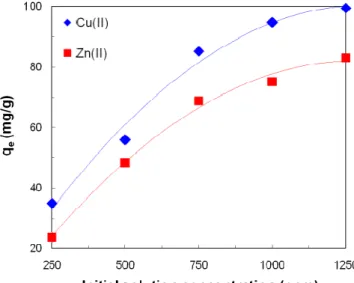
Figure 1 illustrates the adsorption of Cu(II) and Zn(II) ions by water hyacinth as a function of initial metal ion concentration. This increase continues up to 1,000 for Cu2+ and 750 ppm for zn2+ and beyond this value, there is not a significant change at the amount of adsorbed metal ions. This plateau represents saturation of the active sites available on the biosorbent samples for interaction with metal ions. It can be concluded that the amount of metal ions adsorbed into unit mass of the water hyacinth at equilibrium (the adsorption capacity) rapidly increases at the low initial metal ions concentration and then it begins to a slight increase with increasing metal concentration in aqueous solutions in the length between 1,000 and 1,250 ppm for copper, but 750 and 1,250 ppm for zinc. These results indicate that energetically less favorable sites become involved with increasing metal concentrations in the aqueous solution. The metal uptake can be attributed to different mechanisms of ion exchange and adsorption processes as it was concerned in much previous work (Bektas & Kara 2004; Buasri et al. 2007).
3.2 Effect of Initial Biomass Concentration
Experiments conducted with different initial biomass concentrations show that the metal ions uptakes increase with the biosorbent concentration (Figure 2). The number of sites available for biosorption depends upon the amount of the biosorbent. The metal ions uptake was found to increase linearly with the increasing concentration of the biosorbent up to the biomass concentration of 2 and 3 g/100 mL for Cu(II) and Zn(II), respectively. Beyond this dosage, the increase in removal efficiency was lower. Increasing the biosorbent dosage caused a wise in the biomass surface area and in the number of potential binding sites (Witek-Krowiak et al. 2011).
3.3 Effect of Temperature
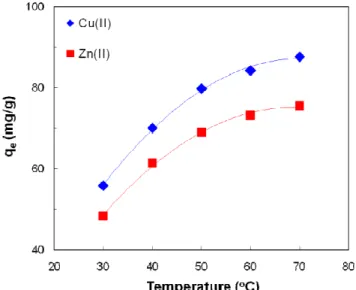
From Figure 3, the amounts of adsorbed copper and zinc ions onto the water hyacinth increase with an increase in the temperature of heavy metal solution. The maximum adsorption capacities was calculated as 87.69 mg Cu2+ and 75.53 mg Zn2+ per 1 g biomass for initial concentration of 500 ppm at 70 oC, showed that this biosorbent was suitable for heavy metals removal from aqueous media. Concerning the effect of temperature on the adsorption process, the metals uptake is favored at higher temperatures, since a higher temperature activates the metal ions for enhancing adsorption at the coordinating sites of the minerals. Also, it is mentioned that cations move faster with increasing temperature. Likely explanation for this is that retarding specific or electrostatic, interactions become weaker and the ions become smaller, because solvation is reduced (Babel & Kurniawan 2003; Inglezakis et al. 2004).
3.4 Effect of Initial Biomass Concentration
In addition to the experimental data, the linearized forms of Langmuir, Freundlich, Temkin and Dubinin-Radushkevich isotherms using Eqs. (2), (3), (4) and (5), are compared. The relationship between the adsorbed and the aqueous concentrations at equilibrium has been described by four two-parameter isotherm models. The isotherm constants and corresponding correlation coefficients for the adsorption of Cu(II) and Zn (II) are presented in Table 1. The correlation coefficients demonstrate that Langmuir, Freundlich and Temkin models adequately fitted the data for Cu adsorption. However, the coefficient of determination (R2) values are higher in the Langmuir model for copper and Freundlich model for zinc adsorption when compared to other models. The Temkin isotherm shows a higher correlation coefficient for both metal (R2 = 0.9886 for Cu2+ and R2 = 0.9870 for Zn2+, which may be due to the linear dependence of heat of adsorption at low or medium coverages. This linearity may be due to repulsion between adsorbate species or to intrinsic surface heterogeneity (Kalavathy & Miranda 2010; Caliskan et al. 2011). The experimental data for both heavy metal ions fit well with the linearized Langmuir, Freundlich, Temkin and
Dubinin-Radushkevich isotherms. R2 values ranged from 0.8397 to 0.9933 and 0.8041 to 0.9948 for adsorption of Cu2+ and Zn2+, respectively. These results indicated that the equilibrium adsorption data of copper and zinc conformed reasonably well to the four two-parameter isotherm models equations.
4. Conclusion
Water hyacinth is an environmentally friendly potential biosorbent for heavy metals. This work examined the efficiency of this sorbent in removal of Cu(II) and Zn(II) ions from aqueous environment. The results indicated that several factors such as initial solution concentration, initial biomass concentration and temperature affect the biosorption process. The physico-chemical characteristics of wastewaters from varying sources can be much more complex compared to the aqueous metal solution used in this study. Because of this, the effects of other components of wastewaters on commercial metal adsorption process should be determined. However, this work can be considered a preliminary study to conclude that water hyacinth is suitable and efficient material for the adsorption of Cu2+ and Zn2+ from aqueous solution. The experimental results were a good fit with the adsorption isotherm models.
Acknowledgements
The authors acknowledge sincerely the Department of Materials Science and Engineering (MSE), Faculty of Engineering and Industrial Technology, Silpakorn University (SU) and National Center of Excellence for Petroleum, Petrochemicals, and Advanced Materials (PPAM), Chulalongkorn University (CU) for supporting and encouraging this investigation.
References
Babel, S. & Kurniawan, T.A. (2003), “Low-cost adsorbents for heavy metals uptake from contaminated water”, Journal of Hazardous Materials 97, 219-243.
Bektas, N. & Kara, S. (2004), “Removal of lead from aqueous solutions by natural clinoptilolite: Equilibrium and kinetics studies”, Separation and Purification Technology 39, 189-200.
Buasri, A., Chaiyut, N., Ponpatcharasakul, N., Artsalee, P. & Potisook, S. (2007), “Factors affecting the removal of copper(II) and zinc(II) from aqueous solutions with clinoptilolite”, Journal of Research in
Engineering and Technology 4, 1-17.
Caliskan, N., Kul, A.R., Alkan, S., Sogut, E.G. & Alacabey, I. (2011), “Adsorption of Zinc(II) on diatomite and manganese-oxide-modified diatomite: A kinetic and equilibrium study”, Journal of Hazardous
Materials 193, 27-36.
Choi, M. & Jang, J. (2008), “Heavy metal ion adsorption onto polypyrrole-impregnated porous carbon”,
Journal of Colloid and Interface Science 325, 287-289.
Dabrowski, A. (2001), “Adsorption-from theory to practice”, Advances in Colloid and Interface Science 93, 135-224.
Deng, L., Zhu, X., Wang, X., Su, Y. & Su, H. (2007), “Biosorption of copper (II) from aqueous solutions by green alga Cladophora fascicularis”, Biodegradation 18, 393-402.
Dubinin, M.M. & Radushkevich, L.V. (1947), “Equation of the characteristic curve of activated charcoal”,
Chemisches Zentralblatt 1, 875-890.
Dubinin, M.M. (1960), “The potential theory of adsorption of gases and vapours for adsorbents with energetically non-uniform surfaces”, Chemical Reviews 60, 235-241.
Dursun, A.Y. (2006), “A comparative study on determination of the equilibrium, kinetic and thermodynamic parameters of biosorption of copper(II) and lead(II) ions onto pretreated Aspergillus niger”,
Francesca, P., Sara, M. & Luigi, T. (2008), “New biosorbent materials for heavy metal removal: Product development guided by active site characterization”, Water Research 42, 2953-2962.
Freundlich, H.M.F. (1906), “Over the adsorption in solution”, Journal of Physical Chemistry 57, 385-470. Hanif, M.A., Nadeem, R., Bhatti, H.N., Ahmad, N.R. & Ansari, T.M. (2007), “Ni(II) biosorption by Cassia
fistula (golden Shower) biomass”, Journal of Hazardous Materials 139, 345-355.
Hashem, A., Abdel-Halim, E.S., El-Tahlawy, K.F. & Hebeish, A. (2005), “Enhancement of the adsorption of Co(II) and Ni(II) ions onto peanut hulls through esterification using citric acid”, Adsorption Science &
Technology 23, 367-380.
Hashem, A., Akasha, R.A., Ghith, A. & Hussein, D.A. (2007), “Adsorbent based on agricultural wastes for heavy metal and dye removal: A review”, Energy Education Science and Technology 19, 69-86.
Inglezakis, V.J., Loizidou, M.D. & Grigoropoulou, H.P. (2004), “Ion exchange studies on natural and modified zeolites and the concept of exchange site accessibility”, Journal of Colloid and Interface Science 275, 570-576.
Kalavathy, M.H. & Miranda, L.R. (2010), “Moringa oleifera-A solid phase extractant for the removal of copper, nickel and zinc from aqueous solutions”, Chemical Engineering Journal 158, 188-199.
Langmuir, I. (1916), “The constitution and fundamental properties of solids and liquids: Part I. Solids”,
Journal of the American Chemical Society 38, 2221-2295.
Langmuir, I. (1918), “The adsorption of gases on plane surfaces of glass, mica and platinum”, Journal of
the American Chemical Society 40, 1361-1403.
Malik, A. (2007), “Environmental challenge vis a vis opportunity: The case of water hyacinth”,
Environment International 33, 122-138.
Preetha, B. & Viruthagiri, T. (2007), “Batch and continuous biosorption of chromium(VI) by Rhizopus arrhizus”, Separation and Purification Technology 57, 126-133.
Rao, M. & Parwate, A.V. (2002), Utilization of low-cost adsorbents for the removal of heavy metals from wastewater - A review”, Journal of Environmental Pollution Control 5, 12-23.
Satapathy, D. & Natarajan, G.S. (2006), “Potassium bromate modification of the granular activated carbon and its effect on nickel adsorption”, Adsorption 12, 147-154.
Southichak, B., Nakano, K., Nomura, M., Chiba, N. & Nishimura, O. (2006), “Phragmites australis: A novel biosorbent for the removal of heavy metals from aqueous solution”, Water Research 40, 2295-2302. Sud, D., Mahajan, G. & Kaur, M.P. (2008), “Agricultural waste materials potential absorbent for sequestering heavy metal ions from aqueous solutions”, Bioresource Technology 99, 6017-6027.
Sudha, B.R. & Abraham, E. (2003), “Studies on Cr (VI) adsorption-desorption using immobilized fungal biomass”, Bioresource Technology 87, 17-26.
Suflet, D.M., Chitanu, G.C. & Pora, V.I. (2006), “Phosphorylation of polysaccharides: New results on synthesis and characterization of phosphorylated cellulose”, Reactive and Functional Polymers 66, 1240-1249.
Temkin, M.I. & Pyzhev, V. (1940), “Kinetics of ammonia synthesis on promoted iron catalysts”, Acta
Physiochem 12, 327-356.
Vieira, R.H. & Volesky, B. (2000), “Biosorption: a solution to pollution?”, International Microbiology 3, 17-24.
Vijayaraghavan, K., Palanivelu, K. & Velan, M. (2007), “Biosorption of copper (II) and cobalt (II) from aqueous solutions by crab shell particles”, Bioresource Technology 97, 1411-1419.
Wang, X., Xia, S., Chen, L., Zhao, J., Chovelon, J. & Nicole, J. (2006), “Biosorption of cadmium(II) and lead(II) ions from aqueous solutions onto dried activated sludge”, Journal of Environmental Sciences 18,
840-844.
Witek-Krowiak, A., Szafran, R.G. & Modelski, S. (2011), “Biosorption of heavy metals from aqueous solutions onto peanut shell as a low-cost biosorbent”, Desalination 265, 126-134.
Zheng, J.C., Feng, H.M., Lam, M.H., Lam, P.K., Ding, Y.W. & Yu, H.Q. (2009), “Removal of Cu(II) in aqueous media by biosorption using water hyacinth roots as a biosorbent material”, Journal of Hazardous
Materials 171, 780-785.
Figure 1. Effect of initial solution concentration on the removal of Cu(II) and Zn(II) by water hyacinth (amount of biosorbent = 2.0 g, temperature = 30 oC and contact time = 150 min)
Figure 2. Effect of initial biomass concentration on the removal of Cu(II) and Zn(II) by water hyacinth (initial solution concentration = 500 ppm, temperature = 30 oC and contact time = 150 min)
Figure 3. Effect of temperature on the removal of Cu(II) and Zn(II) by water hyacinth (initial solution concentration = 500 ppm, amount of biosorbent = 2.0 g and contact time = 150 min)
Table 1. Isotherm constants for the biosorption of Cu(II) and Zn(II) on water hyacinth
Isotherm constants Copper Zinc
Langmuir model KL (mg/g) aL (L/mg) R2 11.5372 0.2168 0.9933 17.6710 0.1432 0.9559 Freundlich model KF (mg/g) n R2 Temkin model KTe (L/g) b R2 Dubinin-Radushkevich model qm (mg/g) K R2 2.9154 2.7198 0.9801 2.8016 1.1200 0.9886 8.5975 0.9429 0.8397 3.7740 2.2530 0.9948 6.3063 0.7220 0.9870 11.4866 0.4602 0.8041