Pricing Sponsored Data Plans in Two-Sided Markets
Sponsoroidun Datan Hinnoittelu Kaksipuolisilla Markkinoilla
Master’s Thesis
Kristian Teromaa
Aalto University School of Business
Master’s Programme in Economics
Table of Contents
Abstract ... 3
Tiivistelmä ... 3
Introduction ... 4
Section I: Related Literature ... 8
Net Neutrality and Two-Sided Networks ... 9
Paid Prioritization ... 10
Investment Incentives ... 10
Zero-Rating ... 11
Net Neutrality and Competition ... 13
Section II: Mobile Data Markets in Europe and United States ... 15
Mobile Data Market in Europe ... 15
Zero-Rating in Europe ... 16
Mobile Data Market in the United States ... 17
Zero-rating in the United States ... 18
Section III: Zero-Rating Without Transfers ... 20
Framework ... 21
The Model ... 23
The Credibility of the Assumptions... 27
Monopolistic Network ... 27
Multi-Period Games and Uncertain Demand for Data ... 27
Maximum Consumption Point Assumption ... 29
The Credibility of Assumptions: Conclusions... 30
Section IV: Zero-Rating with Transfers... 31
Framework ... 31
The Model ... 33
Sponsored Data Plan with Attractive Video Content ... 34
Sponsored Data Plan with Unattractive Video Content ... 35
Effect of the Maximum Consumption Point on the Data Allowance ... 36
Effect of the Revenue Multiplier on the Data Allowance ... 37
Section V: Numerical Solutions ... 39
Effect of the Revenue Multiplier on the Data Allowance ... 39
Effect of the Maximum Consumption Point on the Data Allowance ... 41
Effect of End User Preferences on the Data Allowance ... 42
Profits with Attractive and Unattractive Content ... 43
Section VI: Welfare Effects of Sponsored Data... 46
Why do ISPs Zero-Rate Content for Free? ... 51
Marketing... 51
Customer Retention and Price Competition ... 52
Zero-Rating and Vertical Integration ... 53
Zero-Rating as an Insurance ... 54
Suggestions for Future Research ... 56
Section VIII: Conclusions ... 59
Tie-in to Other Research ... 61
Importance of Zero-Rating ... 61
Appendixes... 64
Appendix I. ... 64
Appendix II. ... 64
Abstract
This thesis shows that a monopoly Internet Service Provider will never offer zero-rated mobile data plans for homogenous consumers if it cannot ask content providers to pay for the traffic increase caused by to zero-rating. Increasing the data allowance will result in similar utility gains for the customers than zero-rating some content, with lower or identical costs for the Internet Service Provider. When a monopoly Internet Service Provider is allowed to collect payments from content providers, prices to both sides of the market are determined by the size of the data allowance. Opposing effects of distorted consumption towards the zero-rated content and increased total consumption of data mean that total welfare effects remain ambiguous and depend on the parameter values.
Tiivistelmä
Tämä pro gradu tutkielma käsittelee mobiilidatasopimuksia, missä
Internet-palveluntarjoaja ei laskee osaa asiakkaidensa datan kulutuksesta heidän kuukausittaiseen mobiilidatan rajoitteeseensa (zero-rating). Näytän että monopoli Internet-palveluntarjoaja ei voi saada enempää voittoa zero-rating -sopimusten myynnistä kuin tavallisten
datarajoitteellisten sopimusten myynnistä, mikäli se ei voi vaatia Internet-sisällöntuottajia maksamaan zero-ratingin aiheuttamasta kasvaneesta datan käytöstä.
Internet-palveluntarjoaja kykenee saavuttamaan saman lisäarvon mitä zero-rating tuottaa kasvattamalla datarajoitteisten sopimusten rajoitetta joko identtisillä tai alhaisemmilla kuluilla. Kun monopoli palveluntarjoaja voi kerätä maksuja
Internet-sisällöntuottajilta, datarajoitteen koko määrittää hinnat markkinoiden molemmilla puolilla. Hyvinvointivaikutukset jäävät monitulkintaisiksi ja riippuvat parametrien arvoista, sillä niihin vaikuttaa kaksi vastakkaista voimaa: hyvinvointia vähentävä zero-ratetun sisällön suuntaan vääristynyt kulutus ja hyvinvointia lisäävä kasvanut kokonaiskulutus.
Introduction
The Internet is perhaps the single most important technological change in our society that has happened in last few decades. It has allowed us to witness an era of unprecedented technological innovation and has completely transformed a myriad of industries.
Importance of the Internet in modern day does not need more emphasis, it permeates our everyday lives thoroughly. Open nature of the Internet allows people from all around the world to connect with each other and lets enterprising individuals find large markets not bound by national borders. This can be argued to be the main driver behind innovation in the age of the Internet.
The openness of the Internet is based on principles of net neutrality. The concept of net neutrality demands that all data on the Internet should be treated equally. Companies which control our access to the Internet should not control how we lawfully use the Internet and that they should not discriminate against content providers’ access to the network. (Gilroy, 2018). Our path to the Internet goes through the Internet service providers (ISP). ISPs allow us, the end users to connect to the Internet and consume content in there hosted by the content providers (CP). Before, the role of the ISPs has been just that, to enable our access to the Internet and nothing more. Technical development has however allowed the ISPs to better discern between different data packets, allowing them to identify what kind of data we use on the Internet and which content providers’ contents we visit. This development could allow them to not only provide access to the Internet but also to influence how we use the Internet, changing their role from a pathway to
gatekeepers of the Internet. This possibility has attracted the attention of many national regulators which have instituted regulation to make sure that Internet service providers adhere to principles of net neutrality.
Net neutrality regulations vary from country to country, but it generally bans certain practices which are considered to be discriminatory and against net neutrality. One such practice is paid prioritization. Paid prioritization allows the ISPs to sell prioritized access to certain content providers, such as Google or Netflix, allowing their customers to connect to these services faster than to other content on the Internet. Conversely, the ISPs could,
without net neutrality regulation, engage in bandwidth throttling, purposefully slowing connection speeds of its customers to certain content on the Internet, or even blocking access to certain websites altogether. Net neutrality regulation is a divisive issue with proponents of net neutrality arguing that it will safeguard competition and innovation on the Internet (Wu, 2003) and opponents argue that government regulation itself threatens innovation on the Internet (Kastrenakes, 2017a).
Net neutrality debate has raged fiercely since 2017, garnering a large amount of media attention with magazines like Politico and New York Times writing extensively about the subject (McGill, 2017 and Kang, 2017b). The debate was sparked after the chairman of Federal Communications Commission Ajit Pai announced that FCC would hold a vote about demolishing current net neutrality regulation. After the announcement swathes of companies, organizations and experts voiced their opinions on net neutrality regulation and the proposed vote. (Lessig & McChesney, 2006 and Mullins & Nagesh, 2015) After his appointment to chairman of FCC in early 2017 (Shields, 2017) Pai started quickly rolling back many Obama era regulations and announced that FCC would stop its investigation into AT&T, T-Mobile, and Verizon (Kang, 2017a). FCC had investigated whether the companies engaged in anticompetitive behaviour by favouring their own subsidiaries on the Internet over non-affiliated content providers. On 14.12.2017 FCC voted 3-2 to end Open Internet order of 2015. Open Internet order had prevented ISPs from selling paid prioritization access to content providers or throttling access to any content (Kastrenakes, 2017b).
The order also classified Internet service providers as common carriers in accordance with Communications Act of 1934 Title II (United States Communications Act, 1934).
Classifying ISPs as common carriers likened them to traditional telecommunications companies setting a considerably stricter regulatory framework for them than before. Even though FCC repealed the Open Internet order, future of net neutrality in the United States is not yet clear. Several lawsuits have been launched, aiming to keep the net neutrality rules intact and some states have passed or considered passing legislation to preserve net neutrality regulation (Reardon 2018). When the new lighter Internet regulations come into effect in the United States, the ISPs have new powerful tools in use. They are allowed to
that they are no longer expressively prohibited to engage in these practices, they are still subject to US antitrust regulation (Kastrenakes, 2017a).
ISPs rarely set data-allowances for their customers with fixed broadband data plans. These plans allow for unlimited consumption of data. Mobile Internet plans often have data-allowances, which allow for a limited amount of data consumption per month. These kinds of plans, data cap plans, can be subject to another discriminatory practice known as zero-rating. An ISP can zero-rate certain content on the Internet. This means that when
customers of the ISP consume content on the Internet, their consumption of the zero-rated content does not count towards their monthly data allowances. When an ISP has zero-rated a content provider such as YouTube, any data used to stream videos from YouTube does not count towards their monthly data limit and customers of the ISP are free to use their data allowance to other content on the Internet. Zero-rating essentially allows the ISPs to choose certain content providers which content the end users can consume without limits, while still having to adhere to their data-allowances when consuming other content on the Internet.
Zero-rating violates principles of the net neutrality as it does not treat all data equally. Zero-rated contracts, however, differ from paid prioritization, since it treats data differently in respect to price while paid prioritization, bandwidth throttling, and other practices treat data unequally based on access or speed of access to content. Even though the practice can be seen as violating principles of net neutrality it is often allowed even in regulatory regimes which otherwise implement strict prohibitions against behaviour which violates principles of net neutrality. European Union, which has its own net neutrality regulation (BEREC, 2016), allows ISPs to zero-rate content and zero-rating practices were allowed in the US even before FCC dismantled the Open Internet order.
While zero-rating does not sound ominous at the first glance, there are some concerns regarding the practice. Zero-rating content makes the content effectively cheaper for consumers to use since there is no opportunity cost in form of data cap. This is liable to increase demand for the zero-rated content, possibly at the expense of other competing CPs. This creates a lucrative business opportunity for the ISPs. They have an ability to increase demand for any content on the Internet and can ask the content providers to pay them in exchange for zero-rating their content. This practice is known as sponsored data
since content providers effectively sponsor the data consumption in their websites and applications to customers of the ISPs.
The focus of this thesis is to provide a framework for pricing zero-rated mobile data plans. I will describe how monopoly ISP sets prices for zero-rated plans when they are not allowed to charge payments from content providers and how the prices are set both for the end users and content providers with sponsored data plans. This thesis will show that a monopoly ISP will never offer zero-rated mobile data plans over data cap plans if it cannot extract payments from the content providers if it cannot obtain other secondary benefits from the zero-rating. Additionally, it will show what forces affect the prices that a monopoly ISP sets to end users and content providers when it can collect payments from both parties. The framework also allows for some discussion about potential welfare effects of sponsored data and finds that changes in welfare mainly depend on how much zero-rating increases total data usage and how much it will distort consumption of the end users compared to unlimited mobile data plans.
Section I of the thesis discusses literature related to net neutrality and zero-rated plans. Section II provides a glance to mobile data markets both in Europe and US and discusses zero-rate practices in these markets. Section III shows that a monopoly ISP never prefers zero-rated plans over data cap plans. Section IV shows how the ISP sets prices and data allowances when it can collect payments from CPs. Section V offers numerical solutions to the framework provided in Section IV. Section VI discusses welfare effects of sponsored data. In Section VII, I discuss limitations of the study, possible reasons why Internet service providers offer zero-rated plans even without transfers between ISPs and CPs, despite Section III suggesting otherwise, and offer suggestions for future research. Section VIII concludes.
Section I: Related Literature
Consumption of Internet content differs vastly from consumption of common, non-Internet goods. The Internet cannot be treated as a common good that is consumed, but more as a network between end and content providers. Nature of the Internet as a network means that end users gain little to none benefit from just the act of being able to access the Internet, they derive utility from consuming Internet content provided by third parties. Just as end users end users, content providers do not benefit just by existing in the realm of the Internet. Content providers gain benefit by being accessed by the end users, as their visits to their websites or applications generate revenue or other benefits for them. Neither party benefits from being on the Internet alone and needs the other side. This networked nature of the Internet and cross-group externalities arising from it means that economists often find that studying the Internet is often best done through lenses of two-sided markets. (For example, see Economides & Tåg 2012, Choi & Kim 2010 and Jullien & Sand-Zantman 2018).
When net neutrality regulation is studied it is often assumed that there are some
prohibitions in place for the behaviour of the networks, i.e. the ISPs. Usually, it is assumed that when net neutrality is in place that the ISP cannot ask payments from the content providers in exchange to access to the network. Additionally, it is often assumed that the ISP cannot prioritize or throttle any content in their network or free some content from data allowance that they have set to their customers.
Even when the residential ISPs are not allowed to charge access fees from content providers, the CPs do not access the Internet for free. Larger CPs generally own large server farms which host their content, while smaller CPs buy hosting services from companies dedicated to this. (Lee & Wu 2009 and Becker et al. 2010) The important distinction is that even when the CP make payments to ISPs, the payments are for being able to exist in the domain of the Internet, a prerequisite of being able to be accessed by end users using various networks. Access charge set by residential ISP differs from these charges as now the network requires payment from the CP, which already exist on the Internet, in exchange for the network allowing its customers to access the CP. Payments made by the CPs to hosting services are often omitted in research, as they happen outside of the networks which are often in the centre of the research.
Net Neutrality and Two-Sided Networks
General notions about two-sided market generally apply when studying effects of net neutrality. In his seminal paper: Competition in Two-Sided Markets, Armstrong (2006) outlined three factors affecting prices in two-sided markets. The relative size of cross-group externalities, the pricing structure of the network and in case of multiple competing networks, whether the two sides of the market aim to join only one or all networks. Armstrong argued that when cross-group externalities are different between the two groups, one group benefiting more from the presence of the other group than vice versa, prices for the group who gains less are determined by the benefit of the other group and not their own benefit, creating a downward pressure for the prices.
The pricing structure of the network has an effect on the pricing when there are multiple competing networks. If the networks charge groups lump-sum access fees to the network, the groups keep the benefit from network externalities for their selves. Networks can alternatively set per transaction fees, having the fees for groups to depend on how well the network performs on the other side of the market. With per transaction charges the network can extract some of the cross-group externalities and is able to set prices higher than with just lump-sum charges.
When there are multiple networks competing for same customers, whether the groups are single-homing or multi-homing affects the prices faced by these groups. Single-homing groups will never join more than one network while multi-homing groups will aim to join all networks. Armstrong argues that Internet is best described by “competitive bottleneck” -model where the end users are single homing, since people do not need to subscribe to multiple data plans in order to access the Internet, while content providers are multi-homing, since content providers want to be able to be accessed from customers of all ISPs. Competitive bottlenecks lead to a situation where the ISPs charge multi-homing group monopoly prices, as the multi-homing group will join all networks either way while competing over the single-homing group and passing some of the profits gained from the multi-homing side to the single-homing side in form of low prices. (Armstrong, 2006 and Rochet & Tirole, 2003).
Paid Prioritization
Effects of net neutrality have been studied by various scholars in the last decade. The focus of the research has often been in paid prioritization, a practice of the ISPs giving priority for data packets of specific CPs in their network. Results from the research have often been ambiguous, with theoretical models suggesting that discarding net neutrality regulation would increase total welfare under some parameter values and decrease total welfare under other, (Economides & Tåg 2012 and Choi & Kim, 2010) while others have found that total welfare either increases or remains unchanged when paid prioritization is allowed (Cheng et al. 2011). While changes in total welfare and consumer surplus often remain ambiguous, paid prioritization clearly sets the ISPs as winners and CPs as losers. ISPs get access to a new revenue stream, and while some CPs benefit from the paid prioritization, ISPs are able to extract part of this surplus, as the CPs are often seen as being the multi-homing side in competitive bottlenecks. Cheng et al. (2011) note that this mirrors views about net
neutrality and paid prioritization presented by ISPs and CPs, with former decidedly against net neutrality regulation and latter generally favouring such regulation.
Effects of paid prioritization are similar to effects of access fees to CPs. For example, Economides and Tåg (2012) find that, in monopoly setting, consumer surplus is higher with access fees since the network can set lower prices for the end users when it charges content providers. While these access fees lead to some content providers leaving the network, reducing consumer surplus, the authors argue that effect of lower prices dominate the effect of lower content provision.
Investment Incentives
One common argument found from the ISP side of the debate is that net neutrality reduces investment incentives for the ISPs. For example, Edward Whitacre, then CEO of SBC Telecommunications (now AT&T) commented in 2005 to Bloomberg that: “How do you think they're going to get to customers? Through a broadband pipe. Cable companies have them. We have them. Now what they would like to do is use my pipes free, but I ain't going to let them do that because we have spent this capital and we have to have a return on it. So there's going to have to be some mechanism for these people who use these pipes to pay
for the portion they're using. Why should they be allowed to use my pipes? (O’Connell, 2005)
Arguments like that of Whitacre have sparked debate among scholars on investment incentives of the ISPs under different regulatory regimes. Cheng et al. (2011) find that investment incentives of the ISPs are stronger with net neutrality than without it and argue that “This goes against the assertion of the broadband service providers that under net neutrality, they have limited incentive to expand.” Choi & Kim (2010) found that
capacity expansion without net neutrality is affected by two opposing effects. By expanding capacity thus reducing congestion in the network, the ISP can increase
payments it collects from the end users but is also discouraged from investing in additional capacity, as it reduces benefits that it can offer with paid prioritization. With less congested network wait times for content are reduced and the CPs are less willing to pay for having first priority of data packet delivery in case of congestion. Krämer & Wiewiorra (2012) have a different take on investment incentives, they argue that paid prioritization will be beneficial in the short run and in the long run increase investment incentives of the ISPs. However, both Choi & Kim (2010) and Krämer & Wiewiorra (2012) find that paid prioritization reduces investment incentives of content providers. With net neutrality, the CPs can keep all returns on their investments but under discriminatory regime the ISPs can extract part of their surplus, lowering their investment incentives.
Zero-Rating
Effects of paid prioritization and pure access charges to the CPs have been studied extensively before, but the issue of zero-rating or sponsored data has been left with relatively little attention, until recently. While general issues with sponsored data have been discussed extensively before, for example by Schewick (2014 and 2016), Lee & Wu (2009) and Yoo (2016), there are only a few formal theoretical models describing the effects of zero-rating. Of the few formal models out there, Somogyi (2017) and Jullien & Sand-Zantman (2018) found similar results, even with relatively different approaches. Somogyi argues that total surplus is increased with sponsored data over net neutrality setting under certain parameter values and reduced under others, finding similar to ones
end users or very unfavoured by the end users and that total surplus increases when the content is preferred but reduced when the unfavoured content is zero-rated. The result is similar to findings of Jullien & Sand-Zantman, who note that in their setting with high-margin and low-high-margin content providers, the network needs to distort consumption of low margin content to induce high-margin CPs to choose sponsored data option. This is a common result in price discrimination settings where the situation of the “low” group needs to be worsened to reduce rent extraction ability of “high” group. The general sense with both articles is that when the share of the content that will not be zero-rated is large enough, the benefits of an increase in total consumption do not eclipse the benefits from distorted consumption. Jullien & Sand-Zantman additionally find that the general principles of two-sided markets apply for sponsored data too. In competitive bottleneck situations, networks that offer zero-rating will set low prices for the end users to
incentivize them to join their networks by transferring their profits from the content provider side.
Outside of theory papers presenting formal mathematical models, the study of sponsored data is often focused on potentially harmful effects of zero-rating, especially on CP side. Barbara van Schewick, professor of Law at Stanford Law School, claims that even though sponsored data practice differs from paid prioritization, the same discriminatory effects apply. (Schewick 2014, Schewick 2016). In her report: T-Mobile’s Binge On violates Key Net Neutrality Principles (2016), Schewick argues that such programs limit competition, free expression, user choice, and innovation, especially harming small-players, non-commercial providers, and start-ups. She notes that Binge On does not offer a meaningful choice between consumption of normal and zero-rated video content. T-Mobile’s lowest qualifying mobile plan allows approximately 9 minutes of video content consumption per day (4.5 hours monthly) and Binge On allows T-Mobile’s customers to consume unlimited amounts of Binge On qualifying content. Cheng et al. (2011) arrive at similar conclusions as Schewick. They argue that without net neutrality commercial actors will gain more ground on the Internet, as they have better ability to pay for preferential treatment, hurting non-profit CPs and the end users which prefer them. Schewick’s argument on harm to innovation is also supported by Vincent Cerf, Chief Evangelist at Google (Cerf, 2006) who stated that innovation in the Internet is not done in the centre of the network but in the “edges”, meaning that openness and non-discriminatory nature of the Internet are the
reasons for innovations and growth of the Internet, echoing End-to-End arguments presented by Saltzer et al. in 1984.
Net Neutrality and Competition
Scholars have been split in their views on whether discriminatory networks harm
innovation or whether they will reduce competition in CP markets. Boliek (2009) finds that especially in mobile networks traditional concerns of net neutrality proponents do not apply since they are aimed more towards fixed cable access networks where competition is scarce. She argues that “Regulators and analysts alike have consistently found present-day mobile communications market to be competitive”, a notion that is also supported by FCC’s Twentieth Mobile Wireless Competition Report (2017). A lighter regulatory approach has been championed by Becker et al. (2010), who argue that instead of more stringent net neutrality regulation, competitive authorities coupled with some light regulation are enough to deal with potential competitive concerns that discriminatory networks might cause. While Boliek (2009) finds that there isn’t much empirical evidence suggesting that discriminatory practices on the Internet have created barriers of entry or reduced innovation, especially Wu (2003) and Lee & Wu (2009) have argued against discriminatory networks. Lee & Wu (2009) see that net neutrality safeguards entry of new CPs to the Internet and that it has been important for innovation on the Internet. Wu (2003) even likens net neutrality to Darwinian competition, where all forms of using the Internet are allowed and only the best survive. Competition between CPs will lead to best content being offered to the end users, against short-term benefits of the networks.
Additional concern presented by Lee & Wu (2009) is fragmentation of the Internet. Without net neutrality, discriminatory practices such as paid prioritization, sponsored data and even blocking access to certain sites might become commonplace. Fragmented
Internet would mean that all end users would no longer have meaningful ways of accessing the same content on the Internet. Content that the end users could be able to access or would be incentivized to access would be determined by their choice of ISP.
Fragmentation of the Internet is not seen in a negative light by everyone. Yoo (2016), argues that consumers can benefit from service differentiation. A discriminatory system can allow the networks to supply varying services to consumers who have different tastes.
Additionally, the CP side can benefit too “By allowing competitors to target subsegments of the overall market that place a higher value on particular services.” (Yoo, 2016)
Net neutrality is a complex issue, evident from the many views that the articles studying it have taken. In the end, discussion boils down to two different paths. First, there are articles studying total welfare effects of net neutrality from some perspective, often using formal mathematical models. The second set of studies focuses on the potential negative effects of discriminatory networks, often recognized as the losers in the first set of studies. These articles go in depth on the potential losses that end users and content providers might face under discriminatory networks and often argue that net neutrality safeguards open internet and innovation on the “edge.” While there is no clear consensus on effects of the net neutrality it is clear that it is a matter of extreme importance and discarding net neutrality could dramatically see how we see and use the Internet.
Section II: Mobile Data Markets in Europe and United States
Mobile Data Market in Europe
Mobile data markets in Europe are heterogeneous compared to the United States. In the US most of the market is controlled by four nationwide companies with regional and local Internet service providers sharing only a fraction of the market. Europe however, consists of various countries which all have their own unique mobile data markets and diverse set of Internet service providers.
Almost every European country has at least three Internet service providers offering services, giving end users a choice between operators (World Heritage Encyclopedia). The number of choices for the end users is not insignificant since ISPs in four Internet service provider markets sell three times more 4G data for 35€ than ISPs operating in markets with only three Internet service providers (Rewheel, 2016).
Figure 1, shows that there is a stark difference in price of data between European countries. This variation is also mirrored in data usage, in 2015 average monthly mobile data usage per person in Finland reached 10 GB while data usage in Germany was at 0.6 GB per month. (Rewheel, 2016)
Zero-Rating in Europe
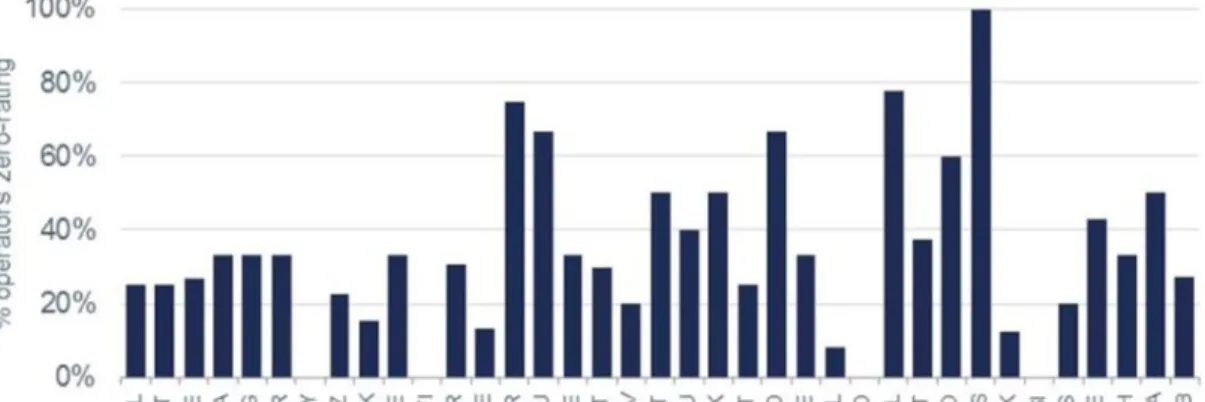
Zero-rating plans have become more common in recent years. A report Zero-rating practices in broadband markets (Aetha, Oswell & Vahida and DotEcon Ltd., 2017) notes that before 2012 zero-rated plans were virtually non-existent in Europe. Figure 2, shows that significant growth has happened since. Most European countries had at least 20% of their ISPs offering zero-rated contracts in 2017.
Figure 2. The Proportion of Operators Zero-Rating by Country
(Aetha, Oswell & Vahida and DotEcon Ltd., 2017)
Content types being zero-rated are as diverse as ISPs zero-rating them. Seen from Figure 3, most prevalent zero-rated categories in Europe are audio streaming, video streaming, text-based communication and social media. These four categories dominate over all other categories and are all zero-rated relatively as often. Of the four categories both social media and text messaging are relatively data light activities, while audio streaming can be categorized as medium data intensity activity and video streaming as heavily data
Figure 3. Prevalence Index Scores for Categories of Zero-Rated Content for Europe
(Aetha, Oswell & Vahida and DotEcon Ltd., 2017)
Mobile Data Market in the United States
The US market is dominated by four nationwide carriers: AT&T, Verizon, T-Mobile, and Sprint. FCC’s Twentieth Mobile Wireless Competition Report (2017) finds that these four Internet Service Providers account for over 411 million connections, over 98% of the nationwide total. With four nationwide operators and a number of smaller operators, coverage and competition situation, measured by the number of operators, seems comparable to Europe. The difference is that US nationwide carriers do not operate universally within the whole United States. The operators may or may not offer coverage within certain areas or regions, leading to less than four options for ISP in some areas. Table 1 shows thatin 2016 only 1 of 716 Cellular Market Areas in the United States had only one mobile wireless provider with over 5% market share operating. With 14.5% of total CMAs having 2 service providers, 21.8% having three service providers and four 63.5% having four or more service providers.
Table 1.
(FCC, 2017)
With only four nationwide ISPs in the US, a comparison between them is easier than in Europe. All four companies offer a range of plans, both limited data allowance plans, and unlimited plans. Limited plans vary from 0.5 GB per month to over 20 GB. Unlimited plans seem to be main products for all four ISPs with heavy promotion in their respective websites. Prices of the unlimited plans range from around 60 to 80 USD per month. Further price comparison between the ISPs is made harder as details of the plans wary. There are differences on how much data their customers are allowed to use with mobile hotspot, whether the ISP starts constricting connection speeds after certain data limits are exceeded, even in unlimited plans, and so on. Pricing practices of the ISPs also hamper more thorough analysis between the mobile carriers. T-Mobile includes taxes and fees in their list prices while other three do not. These taxes and fees are not easily calculated and are varied by region of the customer.
Zero-rating in the United States
All of the four nationwide carriers have included zero-rating in their mobile data plans. The ISPs include zero-rating automatically in all their contracts and do not ask any
additional fee from their customers in exchange for having their data consumption in these sites not counted against their data caps.
T-Mobile offers T-Mobile Binge On service for content providers. Content providers are not required to pay anything to T-Mobile to be accepted, but they need to meet certain technical criteria to qualify. Binge On consist of a large bundle of zero-rated content ranging from multiple different news websites to different music and video streaming services.
Verizon’s FreeBee Data is a more traditional sponsored data program. Content providers are can pay Verizon to be zero-rated. In 2016 Verizon claimed that any brand is able to participate in their FreeBee Data program. At the moment, only content that is zero-rated seems to be Verizon’s video streaming service Go90, which launched in 2015 with intention of attracting millennials (Morgan, 2015).
As Verizon, AT&T also has a sponsored data program where content providers are able to pay AT&T to be zero-rated. AT&T zero-rates its own video streaming services DirectTV and DirectTV Now, while technically allowing for other content providers to sign up for the program.
Sprint does not zero-rate any content at the moment but has made forays into zero-rating before. In 2016, Sprint partnered with Fubo TV to offer a bundled subscription zero-rating for Copa Americano Soccer Tournament. Sprint customers were able to watch the
tournament from Fubo TV for free (normally costing 9.99 USD per month) and have that data not count towards their data caps (Brodkin, 2016).
Section III: Zero-Rating Without Transfers
Mobile data usage takes over half of the total Internet traffic in the world, but data allowances are still relatively small even in many developed countries. (Statista, 2018; Rewheel, 2016). Combined with the fact that the prominence of zero-rated mobile data plans has increased rapidly in both sides of the Atlantic during last few years, means that having formal theoretical models explaining how zero-rated plans affects the consumers and society at large becomes more important every year. Paid prioritization and bandwidth throttling can drastically alter how we use the Internet in the future, but potential issues caused by them have been widely known for years and have been studied extensively. The practice of zero-rating has not garnered as much attention. It is often seen as less harmful practice than paid prioritization or bandwidth throttling, evident from European Union’s BEREC net neutrality guidelines banning these practices but allowing zero-rated data plans in most situations (BEREC, 2016). Effects of zero-rating practices have been discussed by scholars for years but formal models depicting effects of sponsored data have been scarce. In addition to research in sponsored data being rare zero-rated plans where the ISP does not charge payments from the content providers have been left with little or no attention. Section III provides a formal framework which allows us to better understand zero-rating in situations where transfers between the ISP and the zero-rated content providers are not allowed.
This Section shows that an ISP never offers zero-rated plans to end users if they are not allowed to extract payments from CPs in exchange for rating. In this section, zero-rating signifies the situation where no transfers between the ISP and CPs are allowed. Sponsored data is used to specify situation where the ISP can ask payments in exchange for zero-rating. Data cap plans will mean limited data allowance plans where the ISP does not zero-rate any content.
With net neutrality, the ISP is only allowed to collect payments from end users in
exchange for providing them a mobile data plan with either a limited data allowance for a period or an unlimited data plan. Size of data allowance 𝐾0 determines costs of the ISP 𝐶(𝐾0). The cost function is assumed to be increasing in 𝐾0 with 𝐶′(𝐾0) > 0 and 𝐶′′(𝐾
0) < 0. The cost function is assumed to including investments required to network capacity so that the network can always meet all demand for data without congestion. With
net neutrality profit maximization for the network is reduced to setting 𝐾0 and price for end users 𝑃 to profit-maximizing levels based on cost and demand functions.
When the marginal cost of data is identical for all types of mobile data plans, the only factor affecting the profits is the price set by the network and by extension, end users’ willingness to pay for data. This section will show that end user never values a zero-rated plan more than data cap plans or unlimited plans if they lead to same data consumption. Identical costs for same amounts of data and same or lower valuation for zero-rated plans lead the network never offering zero-rated plans over data cap plans or unlimited data plans.
Framework
This thesis uses a modified version of a framework provided by Somogyi (2017). As Somogyi, I assume end users to have Cobb-Douglas utility between two competing content provider types video provider content 𝑣 and other content 𝑜. Video content can be zero-rated while other content can never be zero-zero-rated. Both content provider types are assumed to consist of a large group of small identical content providers which all receive an equal share of the groups’ data demand. End users gain utility from consumption of data from the two content categories and are bounded by data allowance set by the network. If the network does not set consumption constraint for 𝑣 or any of the data, end users will consume up to their maximum consumption point 𝐵. Upon reaching point 𝐵 they will not gain any utility from increased consumption.
There is only one monopoly ISP in the market which sells mobile data plans to end users with price 𝑃 for 𝐾0 amount of data per period. End users are identical and atomistic and divide their data consumption, limited by 𝐾0, between 𝑣 and 𝑜. Video content can be zero-rated while other will never be zero-zero-rated. With data cap plan and budget constraint 𝐾0, end users will consume 𝛼𝐾0 of 𝑣 and (1-𝛼)𝐾0 of 𝑜, the normal Cobb-Douglas
consumption shares. Identical utility functions between end users allow the monopolist network to extract all surplus from the end users by setting the price to match their willingness to pay 𝑃 = 𝑈(𝐾0).
Zero-rating will, contractually, allow end users to consume an infinite amount of the zero-rated content. Consumption of the end users is bound by maximum consumption point 𝐵, where 𝐾0 ≤ 𝐵, for the total amount of data consumed per period. Combined consumption of 𝑣 and 𝑜 cannot exceed this point. Zero-rating has the effect of increasing data
consumption of end users from 𝐾0 to 𝐵. Consumption of 𝑜 is still bound by data allowance 𝐾0 and cannot exceed it but can be lower than it. Consumption of 𝑣 is set by the difference between 𝐵 and data consumption to 𝑜.
Third mobile data plan type that the network can offer is unlimited data plan. Unlimited data plan does not contain data allowance and offers unlimited consumption of data for both content types. Unlimited plan will lead to total data consumption of 𝐵. This plan is a special case of data cap plan where data allowance 𝐾0 is set to 𝐵.
The ISP only offers one of the three plans. 𝐾0 is identical between the data cap plan and the zero-rated plan, set at profit maximizing level for the data cap plan.
As a major difference to the framework presented by Somogyi (2017), I assume that video content providers are noncompeting and completely identical. Essentially, they act as one content provider without any bargaining power. Removing competition between two content providers vying to be zero-rated serves two purposes. First, it reduces the mathematical complexity of the models and secondly it allows the model to determine surpluses and prices better as a function of the data allowance. The framework also omits the assumption that when content is zero-rated the network is congested and total data consumption is less than demand for total data. The network is never congested. Cost of increasing network capacity due to larger data demand is assumed to be included in the cost function of the network. In addition to allowing both end user and 𝑣-type content provider prices to be determined endogenously as a function of the data allowance, these changes are made to allow the analysis focus more on pricing decisions of the network.
In the context of this framework, consumer surplus does not offer any meaningful insights as the network always leaves the end users indifferent between buying the plan or not, leaving net consumer surplus at zero. In this thesis, consumer surplus will mean gross consumer surplus unless other mentioned. Gross consumer surplus describes how much
end users will benefit from the plan before payment to the network. This works as a proxy for net consumer surplus for cases where the network cannot extract all CS. It can be assumed that increases in net consumer surplus can be roughly proxied by increases in gross consumer surplus in the framework of this thesis.
The Model
End user utility: 𝑈 = 𝑣𝛼𝑜1−𝛼 (1)
The budget of data cap plan: 𝑣 + 𝑜 = 𝐾0 (2)
The budget of zero-rated plan: 𝑣 + 𝑜 = 𝐵 𝑎𝑛𝑑 𝑜 ≤ 𝐾0 (3)
The budget of unlimited data plan: 𝑣 + 𝑜 = 𝐵 (4)
End users allocate their data consumption to content categories according to their Cobb-Douglas preferences. Content type’s share of the budget is determined by 𝛼, as the prices for both content types are identical. Consuming 1 GB of 𝑣 content will decrease remaining data per period as much as consuming 1 GB of 𝑜 content. With data cap plans, the end users will consume 𝛼𝐾0 of 𝑣 and (1-𝛼)𝐾0 of 𝑜. An unlimited plan leads to consumption distribution of 𝛼𝐵 of 𝑣 and (1-𝛼)𝐵 of 𝑜. The zero-rated plan introduces additional constraint 𝑜 ≤ 𝐾0 affecting the data distribution between content types. Zero-rate plans have two different consumption distributions, determined by the relative size of end users’ preferences of the video content over the other content, denoted by 𝛼. When 𝛼 is
sufficiently large, the end users prefer 𝑣 content over 𝑜 content enough that consumption of other content is always less than data allowance, meaning 𝑜 < 𝐾0. Somogyi (2017) showed that large 𝛼 then leads to a distribution similar to the unlimited plan, where end users consume 𝛼𝐵 of 𝑣 and (1-𝛼)𝐵 of 𝑜. Relative low levels of 𝛼 mean that other content is preferred enough over video content and that when 𝑣 is zero-rated the end users will consume 𝑜 up to data allowance 𝐾0. Given a choice, they would consume more 𝑜 but are constrained by 𝐾0. Consumption shares are now 𝐵 − 𝐾0 for 𝑣 and 𝐾0 for 𝑜.
Somogyi (2017) presented a threshold value for 𝛼:
𝛼̅ ≡ 1 −
𝐾0This threshold value is dubbed attractiveness of content. Video content is attractive when 𝛼 ≥ 1 −𝐾0
𝐵 and unattractive when 𝛼 < 1 − 𝐾0
𝐵.
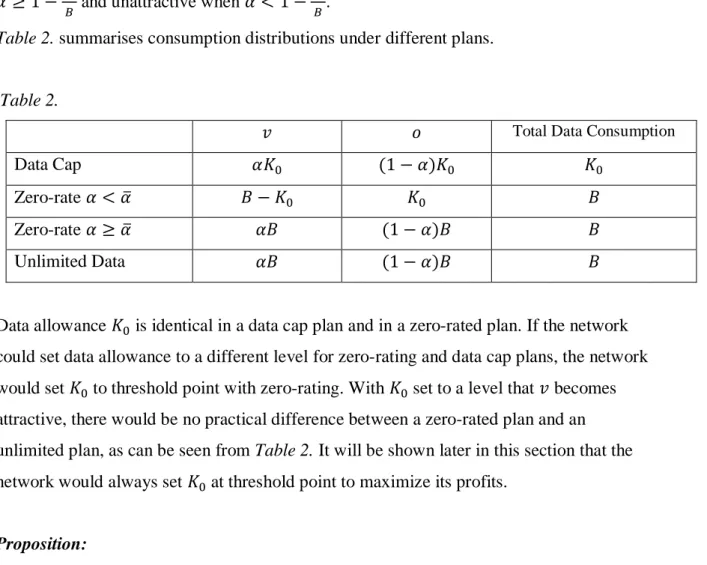
Table 2. summarises consumption distributions under different plans.
Table 2.
𝑣 𝑜 Total Data Consumption
Data Cap 𝛼𝐾0 (1 − 𝛼)𝐾0 𝐾0
Zero-rate 𝛼 < 𝛼̅ 𝐵 − 𝐾0 𝐾0 𝐵
Zero-rate 𝛼 ≥ 𝛼̅ 𝛼𝐵 (1 − 𝛼)𝐵 𝐵
Unlimited Data 𝛼𝐵 (1 − 𝛼)𝐵 𝐵
Data allowance 𝐾0 is identical in a data cap plan and in a zero-rated plan. If the network could set data allowance to a different level for zero-rating and data cap plans, the network would set 𝐾0 to threshold point with zero-rating. With 𝐾0 set to a level that 𝑣 becomes attractive, there would be no practical difference between a zero-rated plan and an unlimited plan, as can be seen from Table 2. It will be shown later in this section that the network would always set 𝐾0 at threshold point to maximize its profits.
Proposition:
A monopolistic ISP will never offer a zero-rated plan to the end users over a data cap plan or an unlimited plan if the ISP’s marginal cost of providing data is identical between options and it cannot extract payments from CPs.
Proof:
The network will offer a zero-rated plan only and only if
𝜋1 > 𝜋0 (6)
Where 𝜋1 is the network’s profits from the zero-rated plan and 𝜋0 is the network’s profits from the data cap plan with a data allowance that maximizes its profits from a range 0 < 𝐾0 ≤ 𝐵.
Table 2. shows that there is no difference between total consumption of data and consumption mix of content types between zero-rating with attractive content and unlimited plan. Both plans lead to similar consumption for end users, thus must lead to identical willingness to pay for a mobile data plan. When both plans have same total consumption, they will lead to cost 𝐶(𝐵) to the network. With no difference in either revenue or cost for the network, the network will never prefer the zero-rated plan over the unlimited plan. If there is a level of 𝐾0 that offers higher profits for the network than unlimited plan the network will never offer the zero-rated plan over the data cap plan. When 𝑣 is unattractive, consumption of 𝑜 is lower with the zero-rated plan than with the unlimited plan. End user’s utility is always lower with the zero-rated plan where 𝛼 is under the threshold point. If 𝐾0 would be increased so that the threshold point is reached end user’s consumption of 𝑜 content would increase, meaning that without a change in data budget they could achieve a higher level of utility with the unlimited plan than with a zero-rated plan.
Equations (7)-(9) show that the amount of data that the end users would like to spend to other content is always higher than what they are allowed under the unattractive content zero-rated plan. When: 𝛼 < 1 −𝐾0 𝐵 (7) 𝛼𝐵 < 𝐵 − 𝐾0 (8) (1 − 𝛼)𝐵 > 𝐾0 (9)
Without the constraint of data allowance in the zero-rated plan the end users would consume more other content, reducing consumption of 𝑣 to achieve their maximum utility under budget 𝐵. Higher utility derived from an unlimited plan means higher willingness to pay for the unlimited plan and higher revenue for the network. The unlimited plan and the zero-rated plan have both total data demand 𝐵 and cost 𝐶(𝐵) of providing the data. With identical costs and higher revenue from unlimited plan, the network will never prefer the zero-rated plan with unattractive content over the unlimited plan. When the network would
preferable to the network than the zero-rated plan, in addition to data cap plan with 𝐾0 = 𝐵.
Graphs 1. and 2. illustrate the differences between unlimited plans and sponsored data plans, where Graph 1. 𝛼 ≥ 𝛼̅and in Graph 2. 𝛼 < 𝛼̅.
Graph 1.
𝒗 is attractive
Switching from data cap plan with data allowance 𝐾0 to either unlimited data or zero-rated plan increases utility from 𝑢0 to 𝑢1. The end users achieve same utility level with the zero-rated plan and the unlimited plan.
𝒗 is unattractive
Switching from the data cap plan with data allowance 𝐾0 to the zero-rated plan increases utility from 𝑢0 to 𝑢1. The unlimited plan with higher consumption of 𝑜 offers higher utility level 𝑢2 than the zero-rated plan.
The Credibility of the Assumptions
The model requires some strong assumptions to keep it simple. While assumptions about monopolistic ISP, an identical mass of end users and certain assumptions about nature of the maximum consumption point do not necessarily reflect reality very accurately, relaxing these assumptions does not change the conclusions.
Monopolistic Network
Mobile data plan markets are highly competitive in both EU and United States. An assumption of monopoly ISP is a large deviation from reality. Increased competition affects prices and data allowances set by the ISPs but does not change the results. As long as the marginal cost of data is identical between plans there is no point for the ISPs to offer zero-rated plans. If one ISP sells zero-rated plans, it must either set lower average price per data than its competitor offering data cap plans or set same the price and lose customers to the competition. Both options lead to reduced profits, making the best response of the ISP to sell data cap plans instead of zero-rated plans. Situations where a company would prefer a less valuable product over more valuable one with identical costs are rare. This
realization should carry over to most competition situations and distributions of end users’ valuations for mobile data plans.
Multi-Period Games and Uncertain Demand for Data
The model can be applied to a multi-period framework without much effort. If the same game is repeated over multiple periods, the results do not change. If the network can alter 𝐾0 and 𝑃 between periods without cost, it can always find a data cap plan which offers equal or higher profits than a zero-rated plan. If costless switching is possible, parameter changes between periods do not matter for the network’s optimal strategy since data cap
optimal choice during the first period, remains the optimal plan on all of the following period. Every period is essentially an individual game with no direct link to previous or following games as the network can optimize profits individually for all of them.
Costless switching between plans is not a very realistic assumption and the costs are often directed at the end users. Some mobile data plans require a minimum amount of time that the plans must be held before changing them. Changing plans might also cause costs for the end users in form of direct costs such as one-time fees required by the new plan or indirect costs such as search costs for the best alternative contract.
Even if it is assumed that end users cannot change data plans between periods and their data demand is uncertain, zero-rated plans are never optimal for the network. Changing demand for data can be modelled by adding demand multiplier 𝜃𝑖, 0 < 𝜃𝑖 < 1, to the utility function. The utility is now derived from function 𝑢 = 𝜃𝑖(𝑣𝛼𝑜1−𝛼), where 𝜃
𝑖 can take different values in different periods. I additionally assume that end users can consume more data than their data allowance 𝐾0 but must either pay overcharge fees for additional data consumption. The network sets overcharge fees endogenously but it can be assumed relatively safely that the network faces larger costs when data consumption exceeds the data allowances. For example, the network can service all its customers with its current capacity when the demand is 𝐾0 but when it is larger than 𝐾0 it needs to buy additional capacity from outside with a higher cost. Higher cost for data for demand over 𝐾0 suggests that when the network sets overcharge fees, per data overcharge fees are larger than per data price for consumption within the data allowance.
The decision in this kind of setting is where to set 𝐾0. In periods where data demanded is less than 𝐾0 end users will end up paying more than they gain in utility from consumption. In periods where demand is high, they must either pay overcharge fees or gain reduced utility from consumption. If changing between plans would be free, the optimal solution would be simply to change data allowance according to demand per period. If we assume that overcharge fees are larger than the cost of unused data, data allowance should be set higher than with earlier model. As overcharge fees increase the optimal level of data allowance nears 𝐵, where the end users will rather pay for the unlimited plan than pay the
overcharge fees. Even in this situation, zero-rating will not be a better option, since better results could still be obtained by unlimited plan or plans with lower data allowance.
Maximum Consumption Point Assumption
A maximum consumption point can be thought to be formed from multiple sources. Essentially, people are not able to consume an infinite amount of data in a finite amount of time. End users can also have other activities as Internet usage. It can be assumed that at the maximum consumption point end user will gain more utility from other activities, essentially capping Internet and data consumption to 𝐵.
While the existence of a maximum consumption point is a realistic assumption, same cannot be said for assuming that there is a common aggregate point 𝐵 for all data
consumption. The assumption of aggregate point 𝐵 leads us to a conclusion that if any kind of Internet content is removed from data allowance, this contents consumption will
increase so much that it reaches the upper bound 𝐵.
Different content types have extremely large differences on how much data they use per time unit. Video streaming, especially HD video streaming, is an extremely data-intensive activity. For example, with 10 GB monthly data allowance one can only watch HD videos for approximately 4 hours (AT&T Data Calculator). It can be fairly easily believed that if video streaming is zero-rated, even if it not very preferred by end users, total consumption can easily increase enough to justify assumption for aggregate maximum consumption point. This, however only applies to extremely data-intensive content. For example, music streaming is considerably less data-intensive than video streaming. Streaming music for 7 days a week and 24 hours in a day would consume only little under 3 GB of data in a month. If it is assumed that there is a common maximum consumption point which is higher than 30% of current 10 GB data allowance, end users could never upper bound for total consumption by just zero-rated music streaming alone. The situation is even worse for data-light activities, one could send just shy of 19000 emails with 3 gigabytes or surf the web for 200 hours. Assuming that zero-rating even moderately data-intensive content could lead to the same amount of data consumption than an unlimited plan, where one also streams HD videos as much as one wants, is extremely unrealistic. Since ISPs do not rate
rated plans, as seen from Figure 3. discussion about nature of maximum consumption points is warranted.
Assuming that there are individual maximum consumption points for all different content types or even content providers does not change the results in this section. In this
framework, it would mean that there are points 𝐵𝑣 and 𝐵𝑜, 𝐵𝑣+ 𝐵𝑜 = 𝐵, for video content and other content respectively. End users cannot consume more video content than 𝐵𝑣 nor consume other content over 𝐵𝑜. Data demand with an unlimited plan is 𝐵 as both contents are freed to be consumed up to their respective upper bounds. With zero-rated plans, total data consumption is 𝐵𝑣+ 𝐾0 as end users consume up to video content’s maximum consumption point but are constrained in consumption of other content by the data allowance.
When 𝑣 is zero-rated and consumption is increased to 𝐵𝑣+ 𝐾0 it is no different from the original model. Cost for providing that amount of data is 𝐶(𝐵𝑣+ 𝐾0), which is identical to the cost in a data cap plan with a data allowance of 𝐵𝑣+ 𝐾0. The data cap plan either does not lead to less utility than the zero-rated plan, or in case of unattractive content leads to a higher utility. When the content is unattractive, end users are not constrained in their consumption mix. With data cap plan consumption of 𝑣 will be less than 𝐵𝑣 and consumption of 𝑜 will be more than 𝐾0, still with the budget of 𝐵𝑣+ 𝐾0. End users can thus gain similar or increased utility from the data cap plan than with the zero-rated plan while causing identical costs for the network. Thus, the network will never favour zero-rated plans over data cap plans.
The Credibility of Assumptions: Conclusions
While some assumptions made in the model have little basis in reality, in case of extremely data light content even requiring one to break several laws of physics to be able to use enough data, relaxing these assumptions did not change the inferences that one can make from the model. In every situation where having a larger choice over consumption mixes does not lead to smaller gross utility than having restrictions over choosing the
consumption mix and costs of producing data for different contract types are identical, the zero-rated contract is never optimal.
Section IV: Zero-Rating with Transfers
Section III discussed a situation where the network was not allowed to extract payments from content providers in exchange for zero-rating their data. This section discusses a situation where transfers between the two parties are allowed. Section IV shows that sponsored data plans increase the amount of data consumed in the network. Effect of sponsored data to social surplus, compared to data cap plans, remains ambiguous and depends on parameter values.
Framework
The monopoly ISP is not allowed to exclude any content provider from the market, i.e. access fee for the CPs is constrained to zero. The network collects price 𝑃 from the end users and is allowed to charge fee 𝐹𝑖, 𝑖 ∈ 𝑎, 𝑢 from 𝑣 content providers in exchange for zero-rating their content. Fee 𝐹𝑎 is charged when a content that is zero-rated is attractive and fee 𝐹𝑢 is charged when the content is unattractive. Other content providers can never be zero-rated. Identical and atomistic end users allow the network to collect all consumer surplus from them in form of price 𝑃. Content providers offer their content to end users free of charge but generate revenue from advertisements and other benefits, which depend on the amount of data that the end users consume in their content. Revenue generated by both CP types is the amount of data demanded from them, multiplied by revenue multiplier 𝑟. Consumption of 𝐾0 amount of content will lead to revenue of 𝑟𝐾0, where 𝑟 > 0.
Revenue generated by the content providers is not assumed to incur any costs for any agent in the network, outside of the costs to the network for providing the data demanded. Profits of the content providers are strictly increasing in the amount of data consumed in their content, before factoring the fee 𝐹𝑖.
The network can set different data allowances for data cap plans and sponsored data plans. Data allowance for data cap plan 𝐾0 is set to a profit-maximizing level
𝑢′(𝐾
𝐾0 is assumed to be exogenous when determining data allowance 𝐾1 for a sponsored data plan.
End users’ utility is based on Cobb-Douglas utility and their data consumption is constrained by data allowance set by the network. When consumption of some or all content is not constrained by 𝐾1, total data consumption increases to the maximum consumption point 𝐵. This happens if the network zero-rates 𝑣-type content or it the network offers an unlimited plan with 𝐾1 = 𝐵. Price 𝑃 is set by the network so that it matches the gross utility that the end users gain from their total data consumption. With data cap plan, end users will consume 𝑎𝐾0 of 𝑣-type content and (1 − 𝛼)𝐾0 of 𝑜-type content. Threshold point 𝛼̅ = 1 −𝐾1
𝐵 determines the amount of data usage for both content types when 𝑣-type content is zero-rated. When video content is attractive consumptions are 𝛼𝐵 and (1 − 𝛼)𝐵 for 𝑣 and 𝑜. When video content is unattractive, i.e. 𝐾1 is set to a level where 𝛼 < 1 −𝐾1
𝐵, consumption is 𝐵 − 𝐾1 and 𝐾1 for 𝑣 and 𝑜.
Video content providers’ benefit from zero-rating is determined by their revenue multiplier 𝑟, data demand faced when zero-rated and data demand when they are not zero-rated. If 𝑣-type content providers refuse to pay for zero-rating data plan offered by the network will be data cap plan, and 𝑣-type content providers face demand 𝛼𝐾0. Increased demand from zero-rating is then 𝛼𝐵 − 𝛼𝐾0 for attractive content and 𝐵 − 𝐾1− 𝛼𝐾0 for unattractive content. This corresponds to a net benefit of 𝑟(𝛼𝐵 − 𝛼𝐾0) and 𝑟(𝐵 − 𝐾1− 𝛼𝐾0) for attractive and unattractive content. Since all content providers are identical and atomistic the network can set fee to a level where 𝑣-type content providers are indifferent between being zero-rated and having data demand associated with data cap plans. The network achieves this by setting fees:
𝐹𝑎 = 𝑟(𝛼𝐵 − 𝛼𝐾0) (11)
and
𝐹𝑢 = 𝑟(𝐵 − 𝐾1− 𝛼𝐾0) (12)
Fee 𝐹𝑎 is exogenous as the network cannot alter it in any way. Revenue multiplier 𝑟, the end user preference for video content 𝛼 and maximum consumption point 𝐵 are all
data allowance 𝐾0, as it is at profit maximizing level if 𝑣-type content providers refuse the zero-rating and can also be assumed to be exogenous. 𝐹𝑢 has same exogenous parameters as 𝐹𝑎, but the network can influence the size of the fee since it can alter 𝐾1.
The Model
The timeline is following:
1. The ISP calculates whether a sponsored data plan can achieve larger profits than a data cap plan.
2. If the sponsored data plan is more profitable, then the network chooses levels for 𝐾1, 𝑃, and 𝐹𝑖.
3. Video content providers choose whether to pay 𝐹𝑖 and be zero-rated or not pay and have data demand associated with the data cap plan.
4. The end users choose whether to pay price 𝑃 for a sponsored data plan with data allowance 𝐾1 and zero-rated video content or not to subscribe to the mobile data plan. If the network did not zero-rate video content the end users will choose between paying the price of data cap plan with data allowance 𝐾0 and not subscribing.
The networks profit is generated from revenue from end users 𝑃 and fees from 𝑣-type content providers 𝐹𝑖 deduced by the cost of providing 𝐵 amount of data to the network 𝐶(𝐵). When the video content is attractive, the network cannot influence its profits outside of deciding between the data cap plan and the sponsored data plan. When the video content is unattractive the network can choose 𝐾1 to maximize its profits.
Profits of the network when the video content is attractive:
(𝛼𝐵)𝛼((1 − 𝛼)𝐵)1−𝛼+ 𝑟(𝛼𝐵 − 𝛼𝐾
0) − 𝐶(𝐵) (13)
𝑠. 𝑡. 𝛼 ≥ 1 −𝐾1
𝐵
When video content is unattractive the network maximizes profits by:
max 𝐾1: (𝐵 − 𝐾1)𝛼𝐾
11−𝛼 + 𝑟(𝐵 − 𝐾1− 𝛼𝐾0) − 𝐶(𝐵) (14) 𝑠. 𝑡. 𝛼 < 1 −𝐾1
Sponsored Data Plan with Attractive Video Content
If the network sets 𝐾1 ≥ (1 − 𝛼)𝐵, 𝑣-type content is attractive, and profits of the network come from equation (13). At this level of 𝐾1, profits of the network are exogenous as 𝐾1 does not affect anything in the function. With 𝐾1 over the threshold point, the end users are not bound by the data allowance, as their consumption of the 𝑜-type content is (1 − 𝛼)𝐵 with total data budget of 𝐵. When 𝐾1 is set to a level where video content becomes attractive the end users are not bound in their consumption by anything else than the maximum consumption point 𝐵. Sponsored data plan with attractive video content
essentially becomes an unlimited data plan, but the network can extract payments from the 𝑣-type content providers.
Sponsored data plan with attractive video content will increase social surplus if 𝐾0 < 𝐵. Gross consumer surplus is increased since data consumption increases from 𝐾0 to 𝐵 and consumption mix between 𝑣-type content and 𝑜-type content does not change between the plans. Video content providers’ gross surplus is increased from 𝑟𝛼𝐾0 to 𝑟𝛼𝐵 but the difference is extracted by the network by fee 𝐹𝑎. Profits of the 𝑜-type content providers are increased, end users’ data consumption in their content is increased from (1 − 𝛼)𝐾0 to (1 − 𝛼)𝐵 and the network cannot extract any payments from them.
If the network would offer sponsored data plan with attractive video content no party would lose any surplus and some parties would gain some surplus. However, section V will show that the network can always get higher profits by setting 𝐾1 under the threshold point, meaning that sponsored data plans with unattractive video content are always more profitable to the network than sponsored data plans with attractive video content. As the network can freely choose the level of 𝐾1, it will never offer sponsored data plans with attractive video content. For this reason, rest of the thesis focuses on the unattractive option.
Sponsored Data Plan with Unattractive Video Content
The network maximizes its profits with equation (14). The problem of the network is that 𝐾1 influences both price 𝑃 = ( 𝐵 − 𝐾1)𝛼𝐾11−𝛼 and fee 𝐹𝑢 = 𝑟(𝐵 − 𝐾1− 𝛼𝐾0). When the network reduces the data allowance 𝐾1 it increases profits from the video content providers, as their share of total data consumption increases. Reducing the data allowance decreases the end users’ utility as they are driven further from their optimal consumption mix, which reduces the price that the network can collect from the end users.
Costs of the network are fixed as the total data consumption is set to 𝐵. The network’s dilemma is to find a level of 𝐾1 which balances between 𝑃 and 𝐹𝑢 and maximizes its profits.
First order condition for the profit function (14) w.r.t. 𝐾1 is:
−𝛼
𝐾1 𝐵− 𝐾1 1−𝛼+ (1 − 𝛼)
𝐾1 𝐵− 𝐾1 −𝛼− 𝑟 = 0
(15)
Equation (15) cannot be explicitly solved for a profit-maximizing level of 𝐾1. Numerical solutions for the profit-maximizing level of 𝐾1 with different parameter values can be easily calculated with any optimization tool. Even though 𝐾1 cannot be derived from equation (15) to explicit function form, equation (15) can be used to gather important information about nature of sponsored data plans. Taking total derivative from equation (15) makes it possible to see how 𝐾1 behaves when different parameters are changed.
Calculating partial derivatives of 𝐾1, 𝐵 and 𝑟 from equation (15) yields:
𝐹
𝐾=
( 𝐾𝐵 1−𝐵)2(
𝐾1 𝐵− 𝐾1 𝑎+
𝐾1 𝐵− 𝐾1 −𝑎−1)
(16)
𝐹
𝐵=
(𝐵− 𝐾 𝐾1 1)2(
𝐾1 𝐵− 𝐾1 𝑎+
𝐾1 𝐵− 𝐾1 −𝑎−1)
(17)𝐹
𝑟= −1
(18)Proposition:
For the ISP to maximize its profits any changes in B must be met with identical relative changes in 𝐾1 and any changes in 𝑟 require 𝐾1 to change in opposite direction.
Proof:
The rate of change between 𝐾1 and 𝐵:
−𝐹𝐵
𝐹𝐾
= −
𝐾1
𝐵 (19)
And the rate of change between 𝐾1 and 𝑟
−𝐹𝑟
𝐹𝐾
> 0
(20)Exact calculations for equations (19) and (20) can be found from Appendixes 1 and 2.
Effect of the Maximum Consumption Point on the Data Allowance
With data cap plans, maximum consumption point does not affect data consumption of the end users or any decisions of the network as long as 𝐾0 < 𝐵. For an unlimited data plan, the network’s revenues and costs are determined by the level of the maximum
consumption point.
Sponsored data plans with unattractive video content level of 𝐵 affects the network’s choice for level of 𝐾1. Equation (19) shows the rate of change between 𝐵 and 𝐾1 and
shows that maximum profits are reached by parallel changes to 𝐾1 for different levels of 𝐵. Larger level of the maximum consumption point will increase the profits of the network, but the network maximizes its profits by matching changes in 𝐵 with similar changes in 𝐾1. For example, assume that the network optimizes its profits and sets 𝐾1 at some initial parameter values. Doing the optimization again with 20% higher value of 𝐵 will lead to a new profit-maximizing value of 𝐾1, which is 20% higher than the initial value of 𝐾1. Not changing 𝐾1 with 20% higher 𝐾1 will increase profits of the network but increasing it by 20% will increase the profits even more.