Value Chain Development
Approaches and activities by seven UN agencies
and opportunities for interagency cooperation
Value Chain Development
Approaches and activities by seven UN agencies
and opportunities for interagency cooperation
Authors: Andreas Stamm / Christian von Drachenfels
(German Development Institute)
Copyright © International Labour Organization 2011 First published 2011
Publications of the International Labour Office enjoy copyright under Protocol 2 of the Universal Copyright Convention. Nevertheless, short excerpts from them may be reproduced without authorization, on condition that the source is indicated. For rights of reproduction or translation, application should be made to ILO Publications (Rights and Permissions), International Labour Office, CH-1211 Geneva 22, Switzerland, or by email: [email protected]. The International Labour Office welcomes such applications.
Libraries, institutions and other users registered with reproduction rights organizations may make copies in accordance with the licenses issued to them for this purpose. Visit www.ifrro.org to find the reproduction rights organization in your country.
Andreas Stamm, Christian von Drachenfels
ILO Value Chain Development: Approaches and activities by seven UN agencies and opportunities for interagency cooperation / Andreas Stamm and Christian von Drachenfels: International Labour Office, Geneva, 2011.
978-92-2-125343-3 (print) 978-92-2-125344-0 (web pdf)
ILO Cataloguing in Publication Data
The designations employed in ILO publications, which are in conformity with United Nations practice, and the presentation of material therein do not imply the expression of any opinion whatsoever on the part of the International Labour Office concerning the legal status of any country, area or territory or of its authorities, or concerning the delimitation of its frontiers.
The responsibility for opinions expressed in signed articles, studies and other contributions rests solely with their authors, and publication does not constitute an endorsement by the International Labour Office of the opinions expressed in them.
Reference to names of firms and commercial products and processes does not imply their endorsement by the International Labour Office, and any failure to mention a particular firm, commercial product or process is not a sign of disapproval.
ILO publications and electronic products can be obtained through major booksellers or ILO local offices in many countries, or direct from ILO Publications, International Labour Office, CH-1211 Geneva 22, Switzerland. Catalogues or lists of new publications are available free of charge from the above address, or by email: [email protected]
Visit our website: www.ilo.org/publns
Photocomposed in Switzerland SCR
Contents
Abbreviations
. . . vForeword
. . . viiIntroduction
. . . 11.
Research to date on value chain development and developing countries
. . . 32.
Brief overview of value chain development approaches
and activities by seven UN agencies
. . . 92.1. International Fund for Agricultural Development . . . 9
2.2. International Labour Organization . . . 11
2.3. United Nations Industrial Development Organization. . . 14
2.4. United Nations Development Programme . . . 16
2.5. International Trade Centre. . . 19
2.6. United Nations Conference on Trade and Development . . . 21
2.7. Food and Agriculture Organization. . . 23
3.
Some critical observations and recommendations
concerning the usage of the Value chain approach
within the UN system
. . . 294. References
. . . 33Annex I: United Nations Capital Development Fund (UNCDF). . . 35
Annex II: UN-ECE . . . 39
Annex III: Stylised value-chain mapping highlighting horizontal and vertical elements . . . . 43
Figure 1: Typology of objectives for value chain interventions . . . 4
Figure 2: Map of generic value chain. . . 6
FAO Food and Agriculture Organization of the United Nations IFAD International Fund for Agricultural Development
ILO International Labour Organization ITC International Trade Centre
LIC Low Income Countries
MDG Millennium Development Goals
MDGF Millennium Development Goals Achievement Fund MIC Middle Income Countries
UNCTAD United Nations Conference on Trade and Development UNDP United Nations Development Programme
UNECE United Nations Economic Commission for Europe UNIDO United Nations Industrial Development Organization
VC Value Chain
VCD Value Chain Development
Abbreviations
Promoting value chain development is increasingly being recognized as a promising approach to ad-dress not only economic development, job creation and inclusive growth, but a wider range of social and environmental development issues.
In recognition of the increasing importance of value chain approaches in development, experts from seven UN agencies met in July 2010 in Geneva to explore how the UN could enhance the effective-ness of its work on value chain development and improve coordination and collaboration across agencies within the spirit of UN Reform and “Delivering as One”. This meeting marked the creation of the so called “United Nations Value Chain Development Group (UN VCD Group)“.
The UN VCD group is working to: i) increase the coherence of the UN’s work in value chain devel-opment and to thereby enhance effectiveness and recognition of the UN system as a credible partner in value chain development; and ii) enhance learning, coordination and collaboration among UN agen-cies in the formulation and implementation of value chain development initiatives at country and regional levels. The group is broadly driven by the recognition that the UN system could be a more effective partner in this important area of work if it further combined the far-reaching competencies and expertise it has. The group as of July 2011 is composed of ten UN agencies actively engaged: FAO, IFAD, ILO, ITC, UNCDF, UNCTAD, UNECE, UNDP, UNIDO and WFP. It is an informal group and consists of individuals who are not officially appointed by the agencies but who are renowned for their expertise and experience in the field of value chain development. Staff from any UN agency with substantial work on value chain development is free to participate. The group is currently co-chaired by ILO and UNDP.
This report is a first output of the work of the group. Based on a review of main publications, in-ternet presentations and internal information it outlines the different approaches and perspectives that seven of the UN agencies apply in their work on value chain development. It also points to some of the challenges the UN system is facing in enhancing its effectiveness and coherence and offers some initial consideration for how the UN system could leverage its strengths further in value chain development.
The first and third parts of the report were written by two consultants of the German Development Institute with inputs from participating UN agencies. The middle section is a compilation of contri-butions by the 7 UN agencies that were part of the survey. The report was edited and compiled by Merten Sievers at the ILO with strong support from Casper Sonesson and Eva Gauss at UNDP.
Henry Jackelen Peter Poschen
Director, Private Sector Division Director, Job Creation Bureau for External Relations and Enterprise Department and Advocacy Employment Sector
UNDP ILO
Strengthening or establishing value chains is an instrument of private sector development that is today widely used by bi- and multilateral donors. Global value chain analysis became popular in the 1990s when e.g. Gereffi and Korneziewicz (1994) showed how global commodity chains developed over time, how the division of labour in the production process is distributed globally and how this affects the distribution of income and profits between developing and developed countries. The ma-jority of business research, however, did initially focus on domestic and international value chains in the context of industrialised countries. In the context of developing countries, researchers and donors were focusing on private sector development, and adopted the value chain concept somewhat later. Altenburg (2007) puts forward two main reasons why value chain development activities have be-come increasingly popular within the donor community since the end of the 1990s. First of all, the link between growth – or more specifically private sector development – and poverty reduction be-came more and more evident. Donors were thus able to legitimize stronger efforts to support private sector development. Secondly, increasing openness to trade and foreign direct investment led to higher competitive pressure on global but also on domestic markets. This global integration, where produc-tion and trade relaproduc-tionships are nowadays much more coordinated, leaves less space for individual firms to design, produce and market on their own. Donors have thus realized that it is important to understand how these integrated production and trade relationships are coordinated and how firms in developing countries can be integrated to benefit from them. Altenburg (2007: 4) argues that “the question is thus not if, but how to integrate in value chains in a way that allows for incorporation of a growing number of the workforce and increasing levels of productivity and incomes.”
The promotion of value chains is a complex challenge within the realm of private sector development and beyond. Actors in a value chain may range from microenterprises to multinational corporations, and it is thus beyond doubt that developing a holistic approach to deal with such diverse actors is challenging. Moreover, these actors – the different links of the value chain – can be embedded in quite different environments. Domestic value chains may e.g. link rural producers with urban mar-keters; in global value chains producers from developing countries might for example be linked to firms in industrialised countries. The specific location of firms implies differing regulatory frameworks and differing access to input factors and information.
While all this makes interventions to develop value chains difficult, the potential of such interven-tions for local economic development and poverty reduction is significant. Take for example the “Micro and small enterprise development for pro-poor growth in Sri Lanka” (short: Enter-Growth) project, which was implemented by ILO from 2005 to 2008. Among other activities value chain development interventions took place in the floriculture sector and the dairy and fish industry. The respective im-pact studies1found positive developments in various areas and in general confirm the usefulness of
Introduction
1The three studies: “Intervention Report: Promoting export anthurium flower production in the North Western Province”, “Intervention Report: Local Value Chain Development of the dairy industry in Kurunegala District” and “Intervention report: Local Value Chain Development of Ornamental Fish in Polonnaruwa” can be accessed here: http://www.value-chains.org/dyn/bds/docs/detail/707/4.
the value chain approach to promote local economic activity by upgrading businesses and linking them to new markets. In addition to that, an analysis by the Springfield Centre (2010: 20,21) ar-gues that e.g. the intervention in the floriculture sector had a more general impact on the market systems and helped to make the market more inclusive by achieving: “the establishment of a na-tional Tropical Floriculture Association which represents small scale growers; a change in attitude by government towards the floriculture sector, recognising it as one of strategic economic importance. (…) a tighter focus by service providers on the real needs of market players.”
The example shows that value chain development does work; the complexity of interventions never-theless requires expertise in various areas. A well-designed division of labour among UN agencies is therefore likely to further increase efficiency of interventions. Agencies have specific strengths, and combining and coordinating these strengths will prove helpful in dealing with the diverse actors and the specific challenges they are facing. In a sense such a division of labour among agencies is sim-ilar to the division of labour in a value chain: Agencies are to a certain extent specialized and they have specific strengths, thus they can offer specific support services in specific contexts to different actors in the value chain. Yet, as in a value chain, this will also require efficient and well-governed coordination of agencies. Some first considerations regarding how seven UN agencies might seize op-portunities for interagency cooperation to further improve the efficiency of value chain development activities are presented in this paper. The paper first briefly sums up some main messages of cur-rent research on value chain development and their relevance for developing countries. A brief overview of value chain development approaches and activities by seven UN agencies then follows. This sec-tion of the paper has been contributed by the specific agencies. Finally, the main authors of this paper conclude by highlighting some of their critical observations and recommendations concerning the usage of the value chain approach within the UN system.
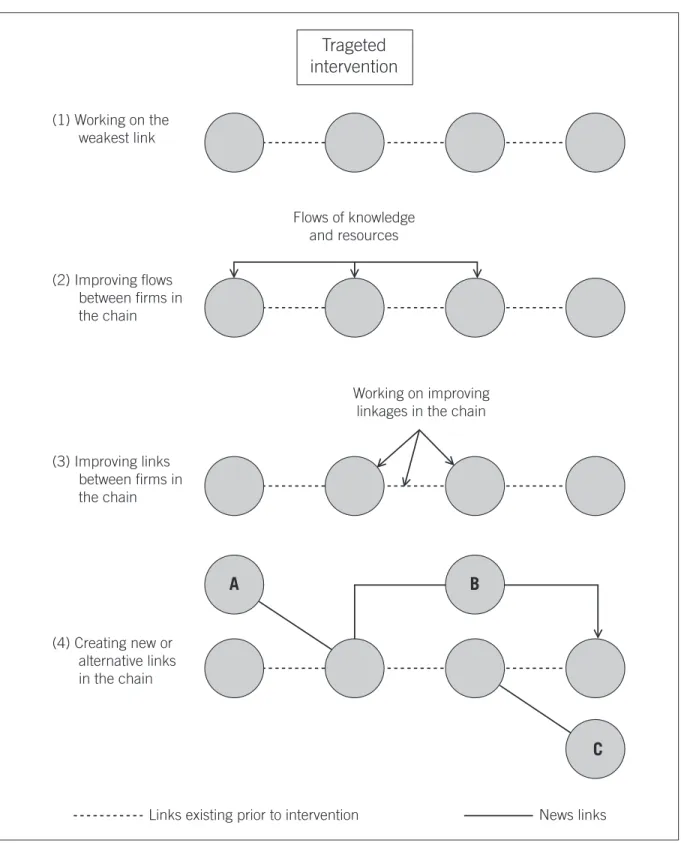
Research on value chains initially focused on those in industrialised countries, before studies were undertaken that also investigated the relevance of value chains for developing countries. Stamm (2004) describes the different approaches that analysed and explained vertical firm linkages before the cur-rent idea and understanding of value chains developed. Indeed the older approaches were very much dominated by research on vertical firm linkages in industrialized countries. The value chain concept gained in importance for developing countries because it became obvious that successful exporters from developing countries were often linked to global value chains. For donors, linking local producers to global value chains therefore quickly became an important activity within their private sector de-velopment portfolios. The recent scientific discourse on the value chain approach is characterized by a rather high degree of “fuzziness”, the interpretations range from a more or less technical descrip-tion of the steps from the incepdescrip-tion of a good to its consumpdescrip-tion and the disposal of its residues, to analysis of the complex interactions among the actors, based on concepts of political economy. Value chain analysis often starts with linear mapping of activities in the chain from the initial input suppliers at the very beginning of the production process to the final consumption of products or serv-ices2. Subsequently, interventions by donors to develop a specific value chain aim at increasing the efficiency of existing links or establishing new ones. Humphrey and Navas-Alemán (2010) identify four different objectives of donor interventions when they are supporting value chain development (see Figure 1):
(1) strengthening the weakest link to address a possible bottleneck in the chain,
(2) improving flows of knowledge and resources to make all firms in the chain more productive, (3) improving specific links between firms, again to improve the efficiency at an identified bottleneck
and
(4) creating new or alternative links in the chain, which e.g. aim at linking local firms in developing countries to global value chains or linking to new, additional lead firms.
1. Research to date on value chain development
and developing countries
2While a linear understanding of value chains can often help to approach a specific value chain, Henderson, J., et al. (2002) point to the fact that a rather linear understanding of a value chain can be misleading as we tend to find value networks of firms. Systemic thinking about firm networks is therefore important when analysing and developing value chains as an intervention on firm A may possibly not only impact on its relationship to firm B but also on other firms that are not within the immediate focus of intervention.
VCD - Approaches and activities by seven UN agencies and opportunities for interagency cooperation - 2011 (1) Working on the weakest link (2) Improving flows between firms in the chain (3) Improving links between firms in the chain (4) Creating new or alternative links in the chain
Trageted
intervention
Flows of knowledge and resources Working on improving linkages in the chainA
B
C
Links existing prior to intervention News links
Figure 1: Typology of objectives for value chain interventions
Working with lead firms is nowadays often regarded as the most promising way to upgrade firms in developing countries. This approach aims at working with the strongest link, rather than the weakest. Lead firms can be regarded as the strongest link, given their bargaining power and their coordinating role in the chain. Stamm (2004) argues that the initial idea of building value chains bottom-up is difficult if not impossible to realise in face of the many established global value chains and their co-ordination by lead firms. Trying to export outside these established chains might be possible if niche markets could be targeted directly. Most often, however, linking local producers to existing value chains in coordination with lead firms will be the only realistic option.
If agencies are working with firms in developing countries that already belong to a specific value chain, it might sometimes also be possible to diversify production and link to other value chains as well. In a recent study on how sectors grow, the McKinsey Global Institute (2010) points to the fact that most often firms innovate gradually and further specialization or the improvement of products is therefore likely to happen within a sector but not in a completely different sector that is new to the economy. Therefore, apart from linking previously unlinked firms to a value chain, it seems also to be an option for value chain development to try to link firms of a specific value chain to other value chains to ensure competitiveness and avoid dependencies.
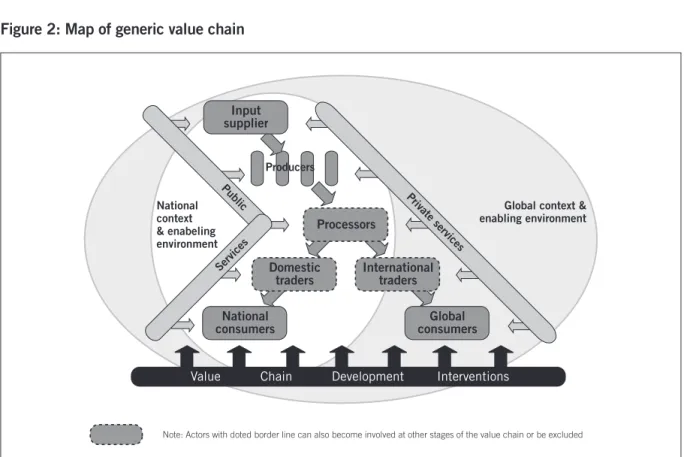
A more systemic view of value chain development needs to take into account not only of the firms that are part of the actual core production chain, but also other actors that are impacting on the chain. Hartwich and Kormawa (2009) distinguished four different groups of actors in a value chain context that refers to both local and international markets (seen Figure 2): the firms that are part of the value chain, public and private service providers whose services are requested by the firms that are part of the value chain, and actors that undertake value chain development interventions. Apart from interactions between actors, the national and global context (e.g. investment climate, trade agreements) determines the context in which value chain actors evolve.
Mapping and analysing the vertical linkages is certainly often important to identify possible weak-nesses in a value chain. It is, however, equally important to think about the horizontal linkages of the firms that are part of the value chain.
Considering the vertical and horizontal linkages reflects systemic network thinking. For example ILO (2010: 46) suggests that: “vertical value-chain interventions focus on strengthening dialogue between large enterprises that dominate the value chain and smaller enterprises in order to identify opportu-nities for increased participation in the value chain by small, local firms. Horizontal value-chain interventions focus on the access that smaller, less powerful businesses have to the business and fi-nancial services they require to participate more effectively in national and global value chains, as well as to the collective actions they can engage in through business associations and cooperatives.” Considering the horizontal linkages and impacts is also especially important with regard to environ-mental and social impacts. Hartwich and Kormawa (2009) argue that environenviron-mental issues have not featured prominently in most value chain analyses. In fact the question of what happens with a product at the end of a value chain has indeed been addressed in more recent studies and support programmes. What might be termed the final vertical link in the chain – when the consumed product turns into waste – has received some attention in the context of how far recycling of waste is pos-sible and maybe even profitable. In addition to that, it is important to think about the recycling of waste that is generated in the production process at the different stages of the value chain. The
thors highlight a couple of issues that might impact on the immediate surroundings of firms at a spe-cific stage in the value chain. Local production might e.g. impact on local biodiversity, water and ecosystems. While these possibly negative impacts are well known it is nevertheless important to con-sider such possible impacts during value chain development. Attention is too often focused on the vertical linkages i.e. the stages of the development of a product in the value chain, and less on hor-izontal linkages and impacts in the value chain.
Bolwig et al. (2010) also describe how initially value chain theory and analysis were focusing too closely on the vertical business-to-business links in the chain. But, especially for development coop-eration, it is important to understand how business activities of firms that are part of a value chain do impact on the horizontal level. Here the authors also point to environmental and social impacts that need to be considered (see their figure in the Annex). Often the focus of pro-poor value chain development activities is on linking firms to global value chains to increase demand for products, thus creating additional jobs locally. While in principle job creation is a desired impact, there still might be negative effects in local communities. For example, if the production process in a firm is optimised through longer shifts or even night shifts this might be good for productivity but at the same time might make it difficult for women to benefit from the new employment opportunities since in many developing countries women are predominantly still taking care of children and housekeeping. Also, the upgrading of the quality of production and products in a local firm may negatively affect the firm’s local suppliers if they are unable to meet requirements for higher product quality. In theory VCD - Approaches and activities by seven UN agencies and opportunities for interagency cooperation - 2011
Global consumers
Value Chain Development Interventions
Global context & enabling environment National
context & enabeling environment
Note: Actors with doted border line can also become involved at other stages of the value chain or be excluded
Pu blic Serv ices Priva te se rvice s Input supplier Processors Domestic
traders Internationaltraders National
consumers
Producers
Figure 2: Map of generic value chain
upgrading of the firms in the value chain will step by step also lead to an upgrading of firms that are connected to the firms in the value chain, due to knowledge transfer etc. However, in the short term it might be difficult if not impossible for firms to continue their business with the firm that is part of the value chain.
To sum up, value chain development approaches have evolved over time and nowadays frequently need to be more complex interventions as working on the vertical linkages is often no longer suffi-cient. Successful promotion of value chains today depends on the integration of public and private service providers and on creating an enabling environment. In addition to that, impacts on the hori-zontal level need attention. Therefore, a division of labour among UN agencies regarding the promotion of value chains is a sensible approach. Combing and coordinating specific strengths will ease dealing with diverse actors and working on different levels.
Considering the increasingly complex analytical approaches to value chain development (e.g. vertical vs. horizontal linkages) and the variety of development-oriented objectives (economic competitive-ness, social outreach, environmental sustainability), the challenge to development cooperation is clearly to find ways of reconciling the required comprehensiveness of the approaches on the one hand, and on the other the need to provide clear guidance for policy making and the shaping of interven-tions on the micro- and meso level. The following chapter describes how seven UN agencies deal with the topic as such and the challenge described.
The following overview of the approaches to value chain development of seven UN agencies briefly describes each agency’s understanding and approach towards VCD as well as their common practices in VCD, and also highlights a few instruments and common practices. All seven agencies are also members of the UN Chief Executive Board’s Cluster on Trade and Productive Capacity3, an intera-gency mechanism dedicated to the coordination of trade and development operations and within the UN system.
The individual chapters have been submitted by representatives of the agencies themselves, following a common reporting structure provided by the authors. Given the time constraints this proved to be the most satisfactory approach compared to compiling individual chapters from the available (pub-lished and grey) literature and a limited number of interviews conducted by the authors. The descriptions of two further agencies, UNCDF and UNECE, that have joined the UN VCD group were not included in the original research and as such do not appear in the main part of the text but in Annex I and in Annex II.
2.1 International Fund for Agricultural Development
The International Fund for Agricultural Development (IFAD), a specialized agency of the United Nations, was established as an international financial institution in 1977 as one of the major outcomes of the 1974 World Food Conference. Currently, 165 countries from all parts of the world are members of IFAD. Over three decades IFAD has been dedicated to eradicating rural poverty in developing coun-tries. IFAD’s overarching goal is to enable poor rural people to improve their food security, raise their incomes and strengthen their resilience.4
2. Brief overview of value chain development
approaches and activities by seven UN
agencies
3http://www.unctad.org/Templates/StartPage.asp?intItemID=4793&lang=1. The UN CEB cluster serves as a coordination forum for trade and productive capacity related outcomes in UN Development Assistance Frameworks as well as joint programmes of member agencies. 4IFAD Strategic Framework 2011-15: http://www.ifad.org/gbdocs/eb/102/e/EB-2011-102-R-2.pdf.
VC approach/instruments and definition
Value chain projects are being increasingly financed in IFAD projects as there is growing realization that unless efforts are made to improve access to markets and farm-gate prices, farmers will not se-cure the full benefits from their efforts. In IFAD’s investment portfolio value chains projects have increased from 3.3% out of all projects approved in 1999 to 45.5% in 20095
While many definitions of value chains exist in the current literature, in IFAD the value chain devel-opment approach is considered as an intervention that finances the necessary activities to address the constraints – or bottlenecks – on the development of a particular agricultural product in a coor-dinated manner, to benefit the smallholder farmers. A pro-poor value chain intervention is one that addresses the full range of activities and constraints of a particular agricultural product (e.g. input supply, market-oriented technology development and its transfer, infrastructure development, credit, capacity building, processing and marketing) in a coordinated manner, and is explicitly designed to include the rural poor in the resulting benefits.
Typical roles
IFAD finances a fairly broad range of activities within the value chain. These include the following: 1. Establishment of and support to farmers’ organizations to improve producers’ bargaining
power, to bulk produce and to lower transaction costs;
2. On-farm storage (e.g. warehouse receipts) for farmers to benefit from seasonal price fluctuations;
3. Contract farming; 4. Out-grower schemes;
5. Market linkages between producers and processors; 6. Infrastructure development;
7. SME development for value-added processing;
8. Support for certification and improving quality standards.
Effective outreach to the poorest and to women is important for IFAD-invested value chain programmes. VCD - Approaches and activities by seven UN agencies and opportunities for interagency cooperation - 2011
Instruments / projects
IFAD is increasingly shifting attention towards governance in favour of the poor, with a clear objec-tive of improving farm-gate prices. With about 1.3 billion people in the world engaged in agriculture, improving farm profitability is the key to retaining the interest of many to remain in rural areas. Improving farm-gate prices will help improve farm profitability and this will directly impact upon rural growth and, with it, on-farm employment. Rural growth will also create a remunerative environment for SMEs and facilitate investments by the private sector in rural areas.
Geographical scope
With a clear focus on the poorer strata of the population, IFAD adopts the value chain approach in Middle Income Countries (MIC) as well as in Low Income Countries (LIC). A recent analysis has shown that the value chain approach is being adopted by all regional divisions within IFAD. Of all value chain projects in IFAD, 25% are in Western and Central Africa, 13% in Eastern and Southern Africa, 27% in Asia and the Pacific, 13% in Latin America and the Caribbean, and 22% in the Middle East and North Africa6
2.2. International Labour Organization
The ILO was founded in 1919, as part of the Treaty of Versailles that ended World War I and to pursue a vision based on the premise that universal, lasting peace can be established only if it is based upon decent treatment of working people. The ILO became the first specialized agency of the UN in 1946. The ILO is the only “tripartite” United Nations agency bringing together representatives of governments, employers and workers to jointly shape policies and programmes.
Four strategic objectives guide the ILO programme and budget: (i) to promote and realize standards and fundamental principles and rights at work; (ii) to create greater opportunities for women and men to secure decent employment and income; (iii) to enhance the coverage and effectiveness of social protection for all; and (iv): to strengthen tripartism and social dialogue.
VC approach and definition
ILO projects linked to Value Chain Development are mainly based in the fields of Job Creation and Enterprise Development. Currently 25 projects in 20 countries have Value Chain Development linked to employment and job quality improvement as their core objective (see: www.ilo.org/valuechains). However several other departments play an important role in linking VCD to ILO’s core competencies,
2. Brief overview of value chain development approaches and activities by seven UN agencies
6Figures were last updated in July 2010, and are extracted from the Pro-poor Rural Value Chain Developmentthematic study, IFAD, 2010.
this includes (i) the International Training centre of the ILO in Turin, offering a variety of courses linked to Value Chain development (see www.itcilo.org/emld) (ii) the Skills department, that uses VCA to analyse skill needs in value chains; (iii) the Better Work programme, a joint ILO IFC programme that works with first-tier suppliers of multinationals on labour standard compliance: (www.betterwork.org) ; (iv) the sectoral activities department, which focuses on social dialogue in specific sectors often along value chains (www.ilo.org/sector); and (v) ILO’s participation in the research network called Capturing the Gains analyses the high road to upgrading global production networks and value chains (www.capturingthegains.org). Publications and projects are related to ILO’s core competency of cre-ating employment, advoccre-ating a move towards decent work conditions and gender equality.
The ILO focuses on the local, national and international value chains that have the best chances of either increasing employment and/or improving working conditions. ILO’s projects currently work with 50+ subsectors evenly distributed between agriculture, services and manufacturing. It uses a market systems analysis that stems from the “making markets work for the poor” approach (see image below). VCD - Approaches and activities by seven UN agencies and opportunities for interagency cooperation - 2011
n o i t c u d o r P g n i c r u o S M a r k e t i n g VA LU E CH AI N G N I T R O P P U S F U N C T I O N S S E L U R & R E G U L A T I O N S s n o i t a l u g e R s d r a d n a t S L a w s l a m r o f n I r u l e s & n o r m s e r u t c u r t s a r f n I n o i t a n i d r o o C R & D I n f o r m a t i o n S k i l l s & c a p a c i t i e s d e t a l e R s e r v i c e s g n i m r o f n I & c o m m u n i c a t i n g g n i t t e S & e n f o r c i n g r u l e s t n e m n r e v o G l a m r o f n I s k r o w t e n t o N - r f - o p r o f i t r o t c e s s s e n i s u B m e m b e r s h i p s n o i t a z i n a g r o e e y o l p m e / r e k r o W p i h s r e b m e m s n o i t a z i n a g r o e t a v i r P s e c t o r T E K R A M P L A Y E R S
The 2010 Strategic Framework of the Sustainable Enterprises programme makes a distinction be-tween verticaland horizontal value-chain interventions7: in the following way:
• Vertical value-chain interventions focus on strengthening dialogue between large enterprises that dominate the value chain and smaller enterprises in order to identify opportunities for increased participation in the value chain by small, local firms.
• Horizontal value-chain interventions focus on the access that smaller, less powerful businesses have to the business and financial services they require in order to participate more effectively in national and global value chains, as well as on the collective actions they can engage through business associations and cooperatives.
Typical roles
Through its projects the ILO acts as a facilitator of Value Chain development processes that bring to-gether the core public and private stakeholders in Value Chains. Increasingly the ILO acts as a back-up and capacity builder of local VCD facilitation bodies in developing countries. The ILO uses the “Making markets work for the Poor” concept.
The ILO has a long history of providing training for enterprise development through its International Training centre in Turin (www.itcilo.org) and as such also acts as a training provider for other inter-national and inter-national organizations in core methodologies related to VCD. This includes courses on designing and executing Value Chain development projects and interventions.8
Instruments and/or projects
Under its strategic objective to create greater opportunities for decent employment, a series of proj-ects have been or are currently being implemented. Enterprise development is a significant but clearly not a dominant activity of ILO. A recent stocktaking disclosed 25 projects related to the VC concept9, located in Latin America and Caribbean, Asia and Africa. Other UN agencies are involved in about half of these projects (i.e. through the MDG fund); ILO has the lead in some of these joint projects. In the headquarters value chain promotion is linked to the “Sustainable Enterprise strategic Framework” with its three pillars: 1) Creating Enabling Environments; 2) Entrepreneurship and Business Development and 3) Sustainable and Responsible Workplaces. One of the three focus areas of pillar 2 within the Sustainable Enterprise programme is called “Value-chain approaches for employment and quality jobs”.
Important tools for VC promotion include: “Value Chain Development for Decent Work: A guide for development practitioners, government and private sector initiatives”,, “Making the strongest links:
2. Brief overview of value chain development approaches and activities by seven UN agencies
7Enterprise Department Strategic Framework 2009: page 46, footnote 25. 8See for example: www.itcilo.org/marketdev.
A practical guide to mainstreaming gender analysis in value chains”, and ITC ILO’s course “Enterprise development through Value Chains and Business services Markets: a Market development Approach to Pro-Poor Growth”10 . The ILO is also developing sector-based workplace practice improvement training packages that underscore ILO’s core role in improving job quality in value chains under the SCORE project: www.ilo.org/score.
2.3. United Nations Industrial Development Organization
The United Nations Industrial Development Organization (UNIDO) was established in 1966 and has been a specialized agency of the United Nations since 1979. Currently it has 173 members. UNIDO’s mandate is to promote and accelerate sustainable industrial development in developing countries and economies in transition, and to work towards improving living conditions in the world’s poorest coun-tries drawing on in-house and global sources of expertise. In recent years, UNIDO has assumed an enhanced role in the global development agenda by focusing its activities on poverty reduction, in-clusive globalization and environmental sustainability.
VC approach and definition
UNIDO has taken part in some of the seminal works on the concept of global value chains and its application to specific industries. Examples are the studies on the global apparel industry (Gereffi and Memedovic 2003) , the agri-food sector (Humphrey and Memedovic 2006) or the global furni-ture industry (Kaplinsky, Memedovic, Morris and Readman 2003) . While those works were analytical in nature, deriving a wealth of policy recommendations on the global level, recent UNIDO work has focused on how to conduct industrial value chain analysis to meet sustainable industrial development goals in the context of less developed countries. Examples include the development of leather value chains in East Africa and the cotton value chain in West Africa. UNIDO’s recent approach uses a more systemic perspective of development in which partnering and collaboration with public and the private sector are imperative.
According to the Medium-term Programme Framework 2010-2013 UNIDO conducts value chain de-velopment within its thematic priority to reduce poverty through productive activities. UNIDO also acknowledges that support to value chain development can work towards different development goals including poverty alleviation, job creation, increased export competitiveness, sustainable development, and economic diversification. UNIDO assumes that the private sector plays the leading role in value chain development both in production and provision of complementary services. Lead firms can play a crucial role in value chains by opening new consumer demands and quality requirements to pri-mary producers and suppliers. Through institutional capacity-building, governments can be empowered to play a more pivotal role in value chain development. National governments and international or-ganizations can also provide support to the intermediary oror-ganizations which are crucial in supplying information and knowledge-based services such as technical training and facilitating coordination among actors in the value chain.
VCD - Approaches and activities by seven UN agencies and opportunities for interagency cooperation - 2011
Typical practices
UNIDO starts by looking at value chains from a processing/transformation point of view. It sees a value chain as “the entire range of activities undertaken to bring a product from the initial input-supply stage, through various phases of processing, to its final market destination, and it includes its disposal after use”. UNIDO finds that many value chain development programmes in Least Developed Countries only focus on primary production tasks and market/trade-related issues while neglecting other tasks with higher value addition. Other aspects often neglected in these programmes are the governance of the chain, sustainable production and energy use, access to finance, and the business environment and policy context.
UNIDO has developed various training courses for value chain and competitiveness analysis, which have been implemented successfully in several Latin American countries, and which resulted in case studies on the pineapple, lime and lemon, and cocoa value chains in Ecuador and the leather value chain in Paraguay. The training aims at transferring the value chain analysis methodology to gov-ernments and private sector agencies so that they can produce similar studies on a cost-effective and sustainable basis while country specificities and value chain contexts are considered. The ap-proach puts emphasis on the use of export unit values to map value-addition throughout the chain. Methodologically, it suggests four levels of analysis: i) analysis of global and regional dynamics to assess demand; ii) analysis of country role models and threats to identify best practice and compe-tition; iii) the assessment of the viability of value-added by-products within the chain (e.g. coffee essence in the coffee value chain) given a country‘s capabilities; and iv) qualitative assessment of demand- and supply-driven aspects influencing a country‘s competitiveness performance in a value chain.
Instruments and/or projects
In the field of trade capacity building, UNIDO has used the value chain approach to help countries respond to market requirement and regulations. Examples here are the sugar industry in those ACP countries complying with EU regulations, and the food sector in Egypt responding to new regula-tions for traceability. In some cases this had substantial positive effects on the inclusion of the poor in the value chain, for example in the cinnamon value chain in Sri Lanka.
In the field of investment and technology promotion, UNIDO has established a Network of Investment and Technology Promotion Offices (ITPOs), which assist companies at different value chain stages to develop investment proposals on value chain upgrading. Subcontracting and Partnership Exchange Centres (SPXs) offer services in the area of supplier–buyer match-making and fostering the creation of linkages with manufacturing companies that are situated further downstream in the value chain. The SPX company benchmarking tool helps companies in the value chain to gauge their competi-tiveness vis-à-vis global best practice and provides the basis for focused and prioritized interventions. In agribusiness development, UNIDO uses the value chain approach to target the interface between agricultural production and agro-industries, which is often where root causes of poor market inte-gration can be found. Working with the food, leather, textile, wood and non-wood forest product industries, as well as agro-machinery and rural engineering, UNIDO reaches out to a comprehen-sive analysis of a range of economic parameters such as productivity, adequacy of technology and
know-how used, post-harvest losses, storage capacities and existing quality and safety control of agricultural products.
With regard to industrial policy, UNIDO recognizes the importance of sectoral prioritization and value capture within the chain. The policy advice group uses value chain analysis to identify bottlenecks and opportunities to pinpoint sector-specific recommendations to policy-makers. It places particular emphasis on the marketability of products as a demand stimulus as well as the impact on sustain-ability (greening the value chain) and poverty (pro-poor value chains).
With regard to sustainable use of resources and energy, UNIDO deals with issues of soaring and volatile energy prices and disruptive and unreliable energy service provision in developing countries. Value chains need reliable and affordable sources of energy if they are to be competitive. They also need to be resource-efficient. The challenge is to find an appropriate balance between energy needs, including its contribution to economic growth and competitiveness, and the growing need to protect the planet from climate change and other negative effects of energy use. The main focus of work on renewable energy is on development of decentralized power supply options for rural areas in off-grid areas, with special emphasis on productive uses and industrial applications. In many cases, this opens up new opportunities for economic activities in value chains.
Geographical scope
UNIDO’s value chain development activities cover all regions of its engagement including Africa, the Arab World, Asia and Pacific, Europe and New Independent States and Latin America and the Caribbean. Most activities, however, are concentrated on the African continent.
Current interagency cooperation in VCD and future potential
UNIDO is engaged in a number of projects where it actively collaborates with UN agencies such as UNDP, IFAD, FAO, ILO, ITC and many others. For example, within the MDG Fund UNIDO is involved in a number of projects with FAO, ILO and UNDP where it takes over the explicit role of productive de-velopment and value addition. In the field of agriculture together with FAO and IFAD it promotes and implements the Africa Agro-industry and Agribusiness Development Initiative (3ADI), an initiative signed by African heads of state and Ministers of Agriculture and of Industry know as the Abuja declaration.
2.4. United Nations Development Programme
Established in 1965, the United Nations Development Programme (UNDP) describes itself as “UN’s global development network” on the ground in 176 countries and territories. Its overall focus areas of work are poverty reduction, democratic governance, environment and energy and crisis prevention and recovery. For UNDP, working with the private sector, including on economic development and value chain development, is a cross-cutting area that contributes to these broader development focus areas. Typically, UNDP also coordinates the various UN agencies in each country or territory. VCD - Approaches and activities by seven UN agencies and opportunities for interagency cooperation - 2011
VC approach and definition
As an important part of its broader Inclusive Market Development approach, UNDP focuses on value chain development and in doing so aims at taking a system-wide perspective, supporting de-sign of VC strategies that address constraints at multiple levels (micro-meso-macro). It supports addressing such constraints through a partnership approach, working with the stakeholders in the VC in a public-private dialogue and partnership process, as well as with specialized UN agencies and other technical partners. UNDP’s “Inclusive Market Development Handbook” outlines a market development / VCD approach that broadly includes the following steps: i) selecting strategic pro-poor value chains / sectors; ii) assessing the sector to identify constraints and designing solu-tions and intervensolu-tions that make the value chains work better, especially for the poor and small producers; iii) support stakeholders and partners to implement and iv) measuring results and exiting.
As mentioned, UNDP links VCD initiatives explicitly to key development issues and has substantive knowledge and expertise to support strategies and capacity development of value chain stakeholders specifically related to the following thematic areas:
• Climate Change and biodiversity protection; • Crisis prevention and recovery;
• Trade related support;
• Pro-poor policies and institutional capacities; • Gender and women empowerment.
Typical roles
Typically, while facilitating value chain development, UNDP acts as either a broker or a partner or both. Building on its early experiences with the Growing Sustainable Business (GSB) initiative and facilitating 40 plus Global Compact Networks, UNDP as a broker facilitates linkages, dialogues and engagement opportunities between base of the pyramid market stakeholders, larger private sector companies further up the value chain, relevant parts of government and other actors with a stake in the value chain. The main objective is to make the value chains not only more competitive but also pro-poor and environmentally sustainable.
UNDP’s VC approach is built around partnerships. First, UNDP has long experience in partnering with the private sector, including around supply and value chain activities. Secondly, partnering with other specialized UN agencies is central to UNDP’s approach. As such it seeks to utilize its UN coordina-tion role in bringing together UN agencies (resident and non-resident), its extensive field presence and its close relationship to Governments to engage strategic policy makers in value chain-specific and evidence-based policy dialogue. Building on this partnership approach, UNDP is moving towards supporting national level sector or value chain “platforms”, which bring together relevant private and public actors in a given sector / value chain to define strategies and implement action plans to
prove sector competitiveness, inclusion and sustainability. In addition to this broader convening role, UNDP normally supports the following types of VCD activities:
• Initial consultation processes for VC selection and VC analysis
• Designing integrated VC programme framework that allows barriers at micro, meso or macro levels to be addressed in an integrated way by various partners
• Coordination and convening of relevant partner, donors, stakeholders and UN agencies
• Capacity development, including building institutional capacities at various levels (public and private)
• Specific technical expertise in areas such as biodiversity protection, climate change, gender aspects, conflict sensitive approaches.
Instruments / projects
One early relevant UNDP initiative has been the Growing Sustainable Business initiative (GSB), which worked with lead firms to facilitate sustainable and inclusive business ventures that are commercially viable and bring concrete development benefits. Many of these were value chain / supply chain re-lated. The initiative has been undertaken in some 18 countries, working with 60+ companies. It is now being transitioned into a broader market and value chain development approach under the rubric “Inclusive Market Development”. UNDP currently has some 20+ value chain projects under imple-mentation or development around the world.
The following are some additional UNDP instruments to support VCD:
• The regional “Africa Facility for Inclusive Markets” (AFIM) provides support to VC-related initia-tives in the region, including select cross-border value chain initiainitia-tives with a focus on facilitating employment and income opportunities for youth and women in Africa;
• The “Green Commodities Facility” manages a global portfolio of national level commodity-focused programmes and platforms that remove barriers and institutionalize systemic approaches and resources for scaling up production of sustainable commodities. Multi-stakeholder approach-es are adopted to improve structural conditions under which producers can meet global standards, certification systems and sustainability initiatives;
• UNDP also hosts the Secretariat and is a partner in the Business Call to Action (BCtA – www.busi-nesscalltoaction.org), which challenges and supports companies to implement inclusive business initiatives, many of which are value chain focused;
• As part of its work on trade under the Enhance Integrated Framework and Aid for Trade, UNDP uses value chain analysis as a tool for preparing sectoral chapters in Diagnostic Trade and Integration Studies (DTIS) and Aid for Trade Needs Assessments.
2.5. International Trade Centre
The International Trade Centre (ITC, based in Geneva) was founded in 1964 as a joint initiative of the World Trade Organization (WTO) and the United Nations Conference on Trade and Development (UNCTAD). ITC’s mission is to foster small business export success in developing and transition coun-tries by providing, with partners, sustainable and inclusive trade development solutions to enterprises, trade support institutions and policymakers. ITC has a lead role in the delivery of Aid for Trade. Its products, services and development activities contribute to holistic solutions to market-led sector value chain development, enabling trade and investment.
The organization’s direct links with markets, market networks and private sector actors around the world allow it to provide beneficiaries with insights to improve value chain performance for economic and social development. ITC’s facilitation of sector development strategy design empowers local stake-holders to efficiently design, syndicate and coordinate multi-agency, multi-year development activities along sector value chains in response to sustainable market objectives.
ITC Value chain approaches
ITC has perfected its value chain approaches over ten years with interventions in more than 70 sec-tors worldwide, providing technical assistance, methodologies and supporting tools to private sector stakeholders, poor communities, government agencies, sector associations, banks and trade support
2. Brief overview of value chain development approaches and activities by seven UN agencies
ITC & Aid-for-Trade: Sustainable development through value chains
International retailers Time, capacity, Value added or lost Market requirements, Revenue chain, Information flow Foreign Suppliers National retailersInternational value chain
Domestic suppliers Domestic producers Processors Export Importers/ Buying agents Wholesalers/ Buying agents Finishing/ packaging Value-adding linkages Trade, Finance, Business
Sector & Agriculture support institutions Policy-makers Enterprises & Communities ITC assistance > Trade intelligence, Policy-maker advice, Network & business linkage building, Market matching, Technical know-how, Strategy & Programming, Competitiveness, Building support services capacity &
capabilities www.intracen.org
Regional & international enabling environment National policies & enabling environment
institutions to support the design, implementation and coordination of national or regional sector and value chain development strategies. The ITC approach orientates stakeholders to market opportuni-ties and buyer requirements, enables value chain stakeholders to design market-led development strategies, organize and coordinate their implementation, and match buyer requirements to supply-side potential to convert commercial value chain opportunities to actual new business and income. Anchored in a platform of strong public-private and inter-agency dialogue, ITC’s value chain stake-holder participatory approaches are particularly effective in encouraging engagement in decision-making at all levels, aligning and integrating sector support services, visualization of interdependencies, pri-oritization of value chain upgrading activities and mobilization of resources for implementation. In the right environment, efficient interactions of this kind lead to better, pragmatic and sustainable so-lutions. ITC’s value chain approaches have proved successful in supporting social-development priorities such as reducing environmental impact footprints, improving uptake of clean technologies, increasing opportunities for higher income for women in trade, and value addition for products from poor com-munities. ITC’s value chain assistance is adapted to suit the needs, circumstances and situation of any particular set of stakeholders and beneficiaries. The focus is on:
1. Trade, Policy and Strategy: Technical assistance partnerships with other agencies, NGO’s and finance providers for export and development success – particularly for WTO accession, Least Developed Countries, small island and land-locked states and vulnerable economies;
2. Market access, orientation and entry costs, customer and buyer requirements and commercial success factors for upgrading the enabling environment and trade support institutions;
3. Advice, direct training, mentoring and counselling of groups of enterprises or communities; 4. Coordination of large scale sector trade development programmes, their implementation and
re-source mobilization.
Sectors of operation include: food and agri-business, manufactured natural products, ethical fashion and cultural industries, services and industrial products.
There are three main ITC Divisions implementing value-chain development interventions:
• Division of Market Development (DMD): assists institutions, associations and enterprises with market analysis, overall long-term market trends, sector value chain, market and value added product development. DMD maintains a number of key market news and statistical services such as ITC’s Trade Maps, Market Access Maps (tariff and non-tariff market entry conditions database), compilation, up-dating and transmission of trade and market information, advice on the estab-lishment of trade information services and networks as well as specific sector competitiveness assistance for agriculture, manufacturing and services exports. The Division’s Sector Competitiveness Section provides overall guidance on sector development activities.
• Division of Business & Institutional Support (DBIS): Offers a suite of solutions along the whole enterprise value chain delivered through vocational training services, certified expert networks, customized business consulting and market exposure. Areas include the design of export-oriented business plans, business-cycle optimization, marketing and e-business solutions at the levels of VCD - Approaches and activities by seven UN agencies and opportunities for interagency cooperation - 2011
the community, quality, standards, packaging, labelling, logistics, financing and trade facilitation solutions, enterprise and small producers, to make them export-ready and strengthen their com-petitiveness in international markets.
• Division of Country Programmes (DCP): Responsible for the programming and overall coordination of ITC regional and country-specific, multi-disciplinary development projects, which are imple-mented through other ITC Divisions and external partners. DCP also coordinates ITC’s Regional Offices, Export Strategy and Business for Trade Policy Sections.
Most of ITC’s sectoral value chain development activities involve the syndication of multiple imple-menting partners: private sector, government agencies, civil society, international agencies and sector associations, selected with beneficiary partners to provide inputs to respond to specific development gaps. For example:
• In the Pacific, fruit and vegetable producers and food processors attracted significant funds from three major international programmes and also received government budgetary allocations to implement a sector strategy designed by stakeholders and facilitated by ITC. Accompanied mar-ket orientation and exchange missions with importing and transit country quarantine facilities, and ITC-led HACCP/ISO value chain quality support to enterprises unblocked import restrictions and opened up new direct sales, almost doubling export levels. SMS-based communications sup-port between value chain actors spread across a very wide geographical area dramatically improved delivery continuity, payments and agriculture extension service effectiveness along value chains – opening up new markets and increasing poor community incomes.
• In value chains of the African commodity sector ITC has been very active in improving quality and supply chain performance, building linkages for direct support to African suppliers from emerging market importing country technical institutions and sector associations for long-term sustainable technical assistance. In collaboration with other agencies’ work in developing standards laborato-ries and training facilities, ITC has succeeded in attracting new buyers and developing trade support organisations to achieve additional new sales contracts valued at several million USD with corresponding increases in employment.
2.6. United Nations Conference on Trade and Development
The United Nations Conference on Trade and Development (UNCTAD) was established in 1964 and has the mission to promote the development-friendly integration of developing countries into the world economy.
UNCTAD’s work is based on three pillars:
1. It undertakes research, policy analysis and data collection for the debates of government representatives and experts;
2. It provides technical assistance tailored to the specific requirements of developing countries, with special attention to the needs of the Least Developed Countries and of economies in transition; 3. It functions as a forum for intergovernmental deliberations, supported by discussions with
ex-perts and exchanges of experience, aimed at consensus building (“intergovernmental machinery”).
VC approach and definition, instruments and/or projects
With regard to its first pillar, VC analysis has figured in several of UNCTAD’s flagship reports of re-cent years, such as the “World Investment Report” (e.g. 2007, Extractive Industries; 2008, Infrastructure; 2009, Agricultural Production) or the “Least Developed Countries Report” (e.g. 2007, LDCs’ participation in GVCs). Some other relevant studies have contributed to a better understanding of the phenomenon of VCs and its role for development (e.g. “Integrating Developing Countries’ SMEs into Global Value Chains”, 2009). UNCTAD’s “Information Economy Report 2010: ICTs, Enterprises and Poverty Alleviation”, applied a value chain perspective to assess the role of different ICTs for en-terprise performance. The role of ICTs, especially broadband connectivity, has also been emphasized as a fundamental factor in explaining the reorganization of the production of many services and goods in global value chains.
In its second pillar, technical assistance, UNCTAD is active e.g. in linking small and medium enter-prises to transnational corporations (Business Linkages Programme) and in developing or strengthening value chains of products and services derived from biodiversity (BioTrade Initiative). UNCTAD’s Business Linkages Programme is a multi-stakeholder initiative to design and implement the necessary meas-ures, incentives and strategies to improve the performance, productivity and efficiency of local TNC suppliers through training, mentoring, information exchange, quality improvements, innovation and technology transfer. UNCTAD’s BioTrade Initiative works with partners in developing countries to pro-mote trade in biodiversity products and services, and focuses on developing and strengthening value chains by, inter alia, enhancing sustainable bio-resources management, promoting product develop-ment and value-addition, facilitating access to markets and developing managerial capacities.
Typical roles
UNCTAD assists host countries that make an official request for the development of national-level programmes for the promotion of BioTrade and TNC-SME linkages. National Business Linkages Programmes work with local development agencies, investment promotion agencies and business service providers, foreign affiliates of TNCs, partner ministries and others by setting-up multi-stake-holder platforms and by providing capacity-building and advisory services. UNCTAD also provides policy advice and assists developing countries’ governments to build an enabling policy environment for TNC-SME linkages, based on the analysis of international experience and best practices. Through the implementation of the BioTrade Programme, UNCTAD is contributing to increase the competitiveness of the value chain, facilitate coordination between the different actors, and bring about environmental, social and economic benefits. The biodiversity-based sectors and chains sup-ported include natural ingredients for the food, cosmetics, pharmaceutical and fashion industries; flowers and foliage; handicrafts; and sustainable tourism. Through national and regional partners VCD - Approaches and activities by seven UN agencies and opportunities for interagency cooperation - 2011
UNCTAD support SMEs, producers’ associations, cooperatives, government entities, academia, etc., in implementing viable and sustainable BioTrade value chains.
Instruments and projects
Within its intergovernmental machinery, UNCTAD hosts several commissions that deal with aspects related to the development of international value chains (Commission on Investment, Enterprise and Development; Commission on Trade and Development).
UNCTAD’s Business Linkages Programmes are flexible in design and content, including backward and forward as well as horizontal linkages. A careful selection of project partners is essential to gaining the confidence and commitment of participating TNCs and SMEs. UNCTAD’s BioTrade Initiative has de-veloped the Guidelines for a Methodology to Support Value Chains for BioTrade Products: from the selection of products to the development of sector strategies, which can be adapted to the conditions and priorities of each country. These guidelines describe each step that is taken in supporting the value chains and an on-line course with UNCTAD’s TrainforTrade will be conducted in the first semester of 2011. Through this methodology, UNCTAD has been guiding beneficiary countries and partners on se-lecting and strengthening BioTrade value chains. Finally, it should be mentioned that UNCTAD is the lead agency within the UN Cluster on Trade and Productive Capacities, dedicated to the coordination of trade and development operations at the national and regional levels within the UN system.
Geographical scope
To date, UNCTAD has implemented eight national Business Linkage Programmes in Argentina, Brazil, Dominican Republic, Mozambique, Peru, Tanzania, Uganda and Zambia. Furthermore, EMPRETEC centres, which run UNCTAD’s flagship entrepreneurship development programme and are currently operational in 32 countries, are increasingly incorporating business linkages into their services port-folio. BioTrade Programmes and activities are being implemented in Bolivia, Brazil, Colombia, Ecuador, Indonesia, Peru, Uganda, in addition to several regional initiatives in the Amazon (Bolivia, Brazil, Colombia, Ecuador, Guyana, Peru, Suriname and Venezuela), and Southern Africa (Botswana, Malawi, Namibia, Mozambique, South Africa, Swaziland, Zambia and Zimbabwe).
2.7. Food and Agriculture Organization
With 131 country offices and a staff of around 3,600, the Food and Agriculture Organization of the United Nations (FAO) leads international efforts to defeat hunger. Serving both developed and devel-oping countries, FAO acts as a neutral forum where its 191 member nations meet as equals to negotiate agreements and debate policy. Through its extensive knowledge and information systems and thousands of field projects and programmes, the organization helps developing countries and countries in transition modernize and improve agriculture, forestry and fisheries practices and ensure good nutrition for all. Since its founding in 1945, FAO has focused special attention on developing rural areas, home to 70 per cent of the world’s poor and hungry people.