Universal Motor
Speed Controller
The TDA1085C is a phase angle triac controller having all the necessary functions for universal motor speed control in washing machines. It operates in closed loop configuration and provides two ramp possibilities.
Features
•
On-Chip Frequency to Voltage Converter•
On-Chip Ramps Generator•
Soft-Start•
Load Current Limitation•
Tachogenerator Circuit Sensing•
Direct Supply from AC Line•
Security Functions Performed by Monitor•
Pb-Free Package is Available*MAXIMUM RATINGS (TA = 25°C, voltages are referenced to Pin 8, ground)
Rating Symbol Value Unit
Power Supply, when externally regulated, VPin9
VCC 15 V
Maximum Voltage per listed pin Pin 3 Pin 4-5-6-7-13-14-16 Pin 10 VPin +5.0 0 to +VCC 0 to +17 V
Maximum Current per listed pin Pin 1 and 2
Pin 3 Pin 9 (VCC)
Pin 10 shunt regulator Pin 12 Pin 13 IPin -3.0 to +3.0 -1.0 to +0 15 35 -1.0 to +1.0 -200 mA
Electrostatic Discharge Sensitivity (ESD) Human Body Model Class 1B,
JESD22 A114-C
Machine Model Class A, JESD22 A115-A Charge Device Model Class IV,
JESD22 C101-C -500 100 2000 V V V
Maximum Power Dissipation PD 1.0 W
Thermal Resistance, Junction-to-Air RqJA 65 °C/W Operating Junction Temperature TJ -10 to +120 °C Storage Temperature Range Tstg -55 to +150 °C Stresses exceeding Maximum Ratings may damage the device. Maximum Ratings are stress ratings only. Functional operation above the Recommended Operating Conditions is not implied. Extended exposure to stresses above the Recommended Operating Conditions may affect device reliability.
MARKING DIAGRAM
Device Package Shipping
ORDERING INFORMATION
TDA1085C PDIP-16 25 Units / Rail
PDIP-16 C SUFFIX CASE 648 PLASTIC PACKAGE 16 1 TDA1085C 16 1 AWLYYWWG
TDA1085C = Device Code A = Assembly Location WL = Wafer Lot YY = Year WW = Work Week G = Pb-Free Package TDA1085CG PDIP-16 (Pb-Free) 25 Units / Rail http://onsemi.com
Figure 1. Representative Block Diagram and Pin Connections Reset Control Amp = -VCC Current Limiter 0.7 V + -Ramp Generator Speed Detector Shunt Regulator Ballast Resistor + VCC Monitoring Voltage Reg
Digital Speed Sense
F/VC Pump Capacitor
Actual Speed
Set Speed
Ramp Current Gen. Control
Motor Current Limit Ramp Gen.
T
iming
Closed Loop Stability Sawtooth Capacitor Sawtooth Set Current
V
oltage Synchronization Current Synchronization T
rigger Pulse Output
Trigger Pulse Gen. 9 10 8 12 11 4 5 6 3 7 16 14 15 2 1 13 ELECTRICAL CHARACTERISTICS (TA = 25°C)
Characteristic Symbol Min Typ Max Unit
VOLTAGE REGULATOR
Internally Regulated Voltage (VPin9)
(IPin7 = 0, IPin9 + IPin10 = 15 mA, IPin13 = 0)
VCC 15 15.3 16 V
VCC Temperature Factor TF - - 100 - ppm/°C
Current Consumption (IPin9)
(V9 = 15 V, V12 = V8 = 0, I1 = I2 = 100mA, all other pins not connected)
ICC - 4.5 6.0 mA
VCC MonitoringEnable Level
VCC MonitoringDisable Level
VCC EN VCC DIS -VCC-0.4 VCC-1.0 -V RAMP GENERATOR
Reference Speed Input Voltage Range VPin5 0.08 - 13.5 V
Reference Input Bias Current - IPin5 0 0.8 1.0 mA
Ramp Selection Input Bias Current - IPin6 0 - 1.0 mA
Distribution Starting Level Range VDS 0 - 2.0 V
Distribution Final Level VPin6 = 0.75 V
VDF/VDS 2.0 2.09 2.2 High Acceleration Charging Current
VPin7 = 0 V VPin7 = 10 V - IPin7 1.0 1.0 -1.2 1.7 1.4 mA
ELECTRICAL CHARACTERISTICS (continued)
Characteristic Symbol Min Typ Max Unit
CURRENT LIMITER
Limiter Current Gain — IPin7/IPin3 (IPin3 = -300 mA)
Cg 130 180 250
Detection Threshold Voltage IPin3 = -10 mA
VPin3 TH 50 65 80 mV
FREQUENCY TO VOLTAGE CONVERTER
Input Signal “Low Voltage” Input Signal “High Voltage” Monitoring Reset Voltage
V12 L V12 H V12 R -100 +100 5.0 -mV mV V Negative Clamping Voltage
IPin12 = -200 mA
- V12 CL - 0.6 - V
Input Bias Current - IPin12 - 25 - mA
Internal Current Source Gain G+ IPin4 IPin 11 , VPin 4+VPin11+0 G.0 9.5 - 11
Gain Linearity versus Voltage on Pin 4 (G8.6 = Gain for VPin4 = 8.6 V) V4 = 0 V V4 = 4.3 V V4 = 12 V G/G8.6 1.04 1.015 0.965 1.05 1.025 0.975 1.06 1.035 0.985
Gain Temperature Effect (VPin4 = 0) TF - 350 - ppm/°C
Output Leakage Current (IPin11 = 0) - IPin4 0 - 100 nA
CONTROL AMPLIFIER
Actual Speed Input Voltage Range VPin4 0 - 13.5 V
Input Offset Voltage VPin5 - VPin4 (IPin16 = 0, VPin16 = 3.0 and 8.0 V)
Voff 0 - 50 mV
Amplifier Transconductance (IPin16/D (V5 - V4)
(IPin16 = + and - 50 mA, VPin16 = 3.0 V)
T 270 340 400 mA/V
Output Current Swing Capability Source Sink IPin16 - 200 50 - 100 100 - 50 200 mA
Output Saturation Voltage V16 sat - - 0.8 V
TRIGGER PULSE GENERATOR
Synchronization Level Currents Voltage Line Sensing Triac Sensing IPin2 IPin1 -±50 ±50 ±100 ±100 mA
Trigger Pulse Duration (CPin14 = 47 nF, RPin15 = 270 kW) Tp - 55 - ms
Trigger Pulse Repetition Period, conditions as a.m. TR - 220 - ms
Output Pulse Current VPin13 = VCC - 4.0 V - IPin13 180 192 - mA
Output Leakage Current VPin13 = - 3.0 V I13 L - - 30 mA
Full Angle Conduction Input Voltage V14 - 11.7 - V
Saw Tooth “High” Level Voltage V14 H 12 - 12.7 V
GENERAL DESCRIPTION
The TDA 1085C triggers a triac accordingly to the speed regulation requirements. Motor speed is digitally sensed by a tachogenerator and then converted into an analog voltage. The speed set is externally fixed and is applied to the internal linear regulation input after having been submitted to programmable acceleration ramps. The overall result
consists in a full motor speed range with two acceleration ramps which allow efficient washing machine control (Distribute function).
Additionally, the TDA 1085C protects the whole system against AC line stop or variations, overcurrent in the motor and tachogenerator failure.
INPUT/OUTPUT FUNCTIONS
(Refer to Figures 1 and 8) Voltage Regulator (Pins 9 and 10)
This is a parallel type regulator able to sink a large amount of current and offering good characteristics. Current flow is provided from AC line by external dropping resistors R1, R2, and rectifier: This half wave current is used to feed a smothering capacitor, the voltage of which is checked by the IC.
When VCC is reached, the excess of current is derived by
another dropping resistor R10 and by Pin 10. These three resistors must be determined in order:
•
To let 1.0 mA flow through Pin 10 when AC line isminimum and VCC consumption is maximum (fast
ramps and pulses present).
•
To let V10 reach 3.0 V when AC line providesmaximum current and VCC consumption is minimum (no ramps and no pulses).
•
All along the main line cycle, the Pin 10 dynamic rangemust not be exceeded unless loss of regulation. An AC line supply failure would cause shut down. The double capacitive filter built with R1 and R2 gives an
efficient VCC smoothing and helps to remove noise from set
speeds.
Speed Sensing (Pins 4, 11, 12)
The IC is compatible with an external analog speed sensing: its output must be applied to Pin 4, and Pin 12 connected to Pin 8.
In most of the applications it is more convenient to use a digital speed sensing with an inexpensive tachogenerator
which doesn′t need any tuning. During every positive cycle at
Pin 12, the capacitor CPin 11 is charged to almost VCC and
during this time, Pin 4 delivers a current which is 10 times the
one charging CPin 11. The current source gain is called G and
is tightly specified, but nevertheless requires an adjustment on RPin 4. The current into this resistor is proportional to CPin 11
and to the motor speed; being filtered by a capacitor, VPin 4
becomes smothered and represents the “true actual motor speed”.
To maintain linearity into the high speed range, it is important
to verify that CPin 11 is fully charged: the internal source on Pin
11 has 100KW impedance. Nevertheless CPin 11 has to be as
high as possible as it has a large influence on FV/C temperature
factor. A 470 KW resistor between Pins 11 and 9 reduces leakage
currents and temperature factor as well, down to neglectable effects.
Pin 12 also has a monitoring function: when its voltage is above 5.0V, the trigger pulses are inhibited and the IC is reset. It also senses the tachogenerator continuity, and in case of any circuit aperture, it inhibits pulse, avoiding the motor to run out of control. In the TDA 1085C, Pin 12 is negatively clamped by an internal diode which removes the necessity of the external one used in the former circuit.
Ramp Generator (Pins 5, 6, 7)
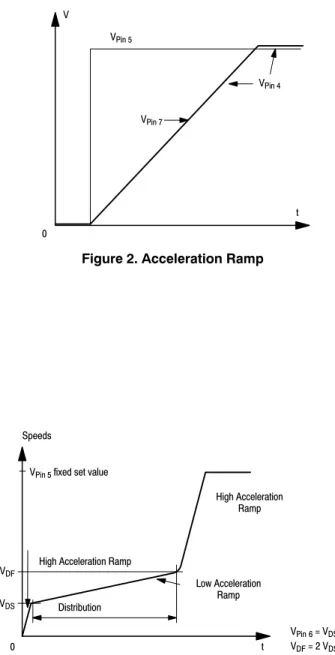
The true Set Speed value taken in consideration by the regulation is the output of the ramp generator (Pin 7). With a given value of speed set input (Pin 5), the ramp generator
charges an external capacitor CPin 7 up to the moment VPin5
(set speed) equals VPin 4 (true speed), see Figure 2. The IC
has an internal charging current source of 1.2mA and delivers it from 0 to 12 V at Pin 7. It is the high acceleration ramp (5.0 s typical) which allows rapid motor speed changes without excessive strains on the mechanics. In addition, the TDA 1085C offers the possibility to break this high acceleration with the introduction of a low acceleration ramp (called Distribution) by reducing the Pin 7 source
current down to 5.0mA under Pin 6 full control, as shown by
following conditions:
•
Presence of high acceleration ramp VPin 5 > VPin 4•
Distribution occurs in the VPin 4 range (true motorspeed) defined by VPin 6x VPin 4x 2.0 VPin 6
For two fixed values of VPin 5 and VPin 6, the motor speed
will have high acceleration, excluding the time for VPin 4 to
go from VPin 6 to two times this value, high acceleration
again, up to the moment the motor has reached the set speed value, at which it will stay, see Figure 3.
Should a reset happen (whatever the cause would be), the above mentioned successive ramps will be fully reprocessed
from 0 to the maximum speed. If VPin 6 = 0, only the high
acceleration ramp occurs.
To get a real zero speed position, Pin 5 has been designed in such a way that its voltage from 0 to 80 mV is interpreted as a true zero. As a consequence, when changing the speed set position, the designer must be sure that any transient zero would not occur: if any, the entire circuit will be reset.
As the voltages applied by Pins 5 and 6 are derived from the internal voltage regulator supply and Pin 4 voltage is also derived from the same source, motor speed (which is determined by the ratios between above mentioned
voltages) is totally independent from VCC variations and
temperature factor. Control Amplifier (Pin 16)
It amplifies the difference between true speed (Pin 4) and set speed (Pin 5), through the ramp generator. Its output available at Pin 16 is a double sense current source with a
maximum capability of ± 100 mA and a specified
transconductance (340 mA/V typical). Pin 16 drives directly
the trigger pulse generator, and must be loaded by an electrical network which compensates the mechanical characteristics of the motor and its load, in order to provide stability in any condition and shortest transient response; see Figure 4.
This network must be adjusted experimentally.
In case of a periodic torque variations, Pin 16 directly provides the phase angle oscillations.
Trigger Pulse Generator (Pins 1, 2, 5, 13, 14, 15) This circuit performs four functions:
•
The conversion of the control amplifier DC outputlevel to a proportional firing angle at every main line half cycle.
•
The calibration of pulse duration.•
The repetition of the pulse if the triac fails to latch on ifthe current has been interrupted by brush bounce.
•
The delay of firing pulse until the current crosses zeroat wide firing angles and inductive loads.
RPin 15 programs the Pin 14 discharging current. Saw tooth signal is then fully determined by R15 and C14 (usually 47 nF). Firing pulse duration and repetition period are in inverse ratio to the saw tooth slope.
Pin 13 is the pulse output and an external limiting resistor is mandatory. Maximum current capability is 200 mA. Current Limiter (Pin 3)
Safe operation of the motor and triac under all conditions is ensured by limiting the peak current. The motor current
develops an alternative voltage in the shunt resistor (0.05 W
in Figure 4). The negative half waves are transferred to Pin 3 which is positively preset at a voltage determined by resistors R3 and R4. As motor current increases, the dynamical voltage range of Pin 3 increases and when Pin 3 becomes slightly negative in respect to Pin8, a current starts to circulate in it. This current, amplified typically 180 times, is then used to discharge Pin 7 capacitor and, as a result, reduces firing angle down to a value where an equilibrium is reached. The choice of resistors R3, R4 and shunt determines the magnitude of the discharge current
signals on CPin7.
Notice that the current limiter acts only on peak triac current.
APPLICATION NOTES
(Refer to Figure 4) Printed Circuit Layout Rules
In the common applications, where TDA 1085C is used, there is on the same board, presence of high voltage, high currents as well as low voltage signals where millivolts count. It is of first magnitude importance to separate them from each other and to respect the following rules:
•
Capacitor decoupling pins, which are the inputs of thesame comparator, must be physically close to the IC, close to each other and grounded in the same point.
•
Ground connection for tachogenerator must be directlyconnected to Pin 8 and should ground only the tacho. In effect, the latter is a first magnitude noise generator due
to its proximity to the motor which induces high dφ/dt
signals.
•
The ground pattern must be in the “star style” in orderto fully eliminate power currents flowing in the ground network devoted to capacitors decoupling sensitive Pins: 4, 5, 7, 11, 12, 14, 16.
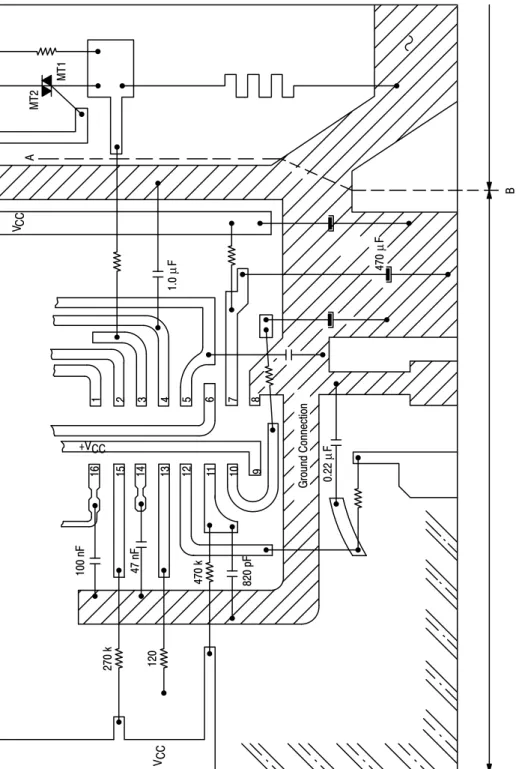
As an example, Figure 5 presents a PC board pattern which concerns the group of sensitive Pins and their associated capacitors into which the a.m. rules have been implemented. Notice the full separation of “Signal World” from “Power”, one by line AB and their communication by a unique strip.
These rules will lead to much satisfactory volume production in the sense that speed adjustment will stay valid in the entire speed range.
Power Supply
As dropping resistor dissipates noticeable power, it is
necessary to reduce the ICC needs down to a minimum.
Triggering pulses, if a certain number of repetitions are kept in reserve to cope with motor brush wearing at the end of its life, are the largest ICC user. Classical worst case configuration has to be considered to select dropping resistor. In addition, the parallel regulator must be always into its dynamic range, i.e., IPin 10 over 1.0 mA and VPin 10 over 3.0 V in any extreme configuration. The double filtering cell is mandatory.
Tachogenerator Circuit
The tacho signal voltage is proportional to the motor speed. Stability considerations, in addition, require an RC filter, the pole of which must be looked at. The combination of both elements yield a constant amplitude signal on Pin 12 in most of the speed range. It is recommended to verify this maximum amplitude to be within 1.0 V peak in order to have the largest signal/noise ratio without resetting the integrated circuit (which occurs if VPin 12 reaches 5.5 V). It must be also verified that the Pin 12 signal is approximately balanced between “high” (over 300 mV) and “low”. An 8-poles tacho is a minimum for low speed stability and a 16-poles is even better. The RC pole of the tacho circuit should be chosen within 30 Hz in order to be as far as possible from the 150 Hz which corresponds to the AC line 3rd harmonic generated by the motor during starting procedure. In addition, a high value
resistor coming from VCC introduces a positive offset at Pin
12, removes noise to be interpreted as a tacho signal. This offset should be designed in order to let Pin 12 reach at least - 200 mV (negative voltage) at the lowest motor speed. We remember the necessity of an individual tacho ground connection.
Frequency to Voltage Converter - F V/C
CPin 11 has a recommended value of 820 pF for 8-poles tachos and maximum motor rpm of 15000, and RPin 11 must be always 470 K.
RPin4 should be chosen to deliver within 12 V at
maximum motor speed in order to maximize signal/noise
ratio. As the FV/C ratio as well as the CPin11 value are
dispersed, RPin4 must be adjustable and should be made of
a fixed resistor in service with a trimmer representing 25% of the total. Adjustment would become easier.
Once adjusted, for instance at maximum motor speed, the FV/C presents a residual non linearity; the conversion factor (mV per RPM) increases by within 7.7% as speed draws to zero. The guaranteed dispersion of the latter being very narrow, a maximum 1% speed error is guaranteed if during Pin 5 network design the small set values are modified, once forever, according this increase.
The following formulas give VPin4: VPin4+G.0@(VCC–Va)@CPin11@R4@f@
(1) 120k RPin11
)
1 In volts. G.0 . (V CC - Va) ] 140 Va = 2.0 VBE 120 k = Rint, on Pin 11 Speed Set (Pin 5)Upon designer choice, a set of external resistors apply a series of various voltages corresponding to the various motor speeds. When switching external resistors, verify that no voltage below 80 mV is ever applied to Pin 5. If so, a full circuit reset will occur.
Ramps Generator (Pin 6)
If only a high acceleration ramp is needed, connect Pin 6 to ground.
When a Distribute ramp should occur, preset a voltage on Pin 6 which corresponds to the motor speed starting ramp point. Distribution (or low ramp) will continue up to the moment the motor speed would have reached twice the starting value.
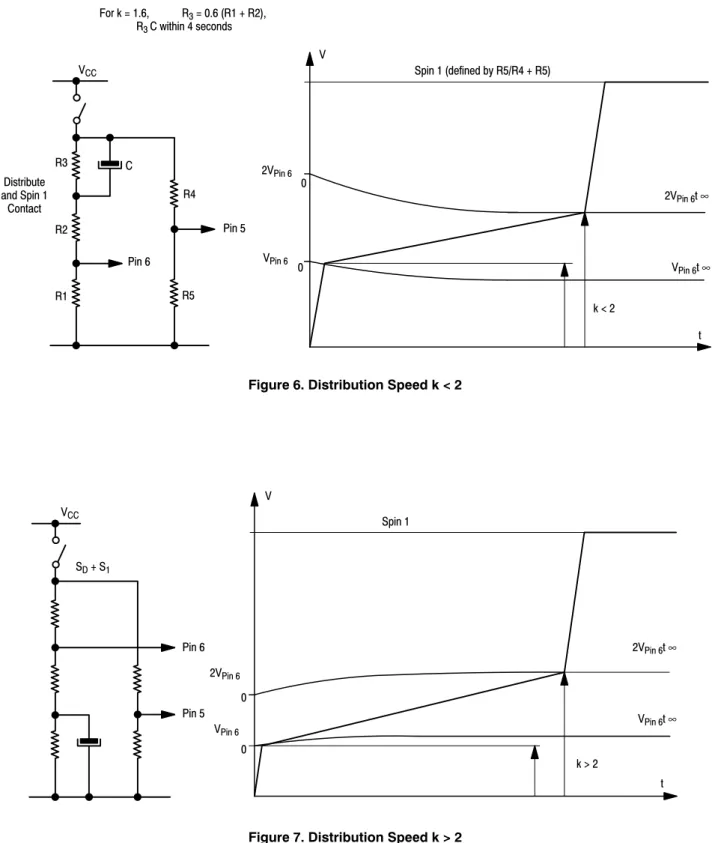
The ratio of two is imposed by the IC. Nevertheless, it could be externally changed downwards (Figure 6) or upwards (Figure 7).
The distribution ramp can be shortened by an external
resistor from VCC charging CPin 7, adding its current to the
internal 5.0 mA generator.
Power Circuits
Triac Triggering pulse amplitude must be determined by Pin13 resistor according to the needs in Quadrant IV. Trigger pulse duration can be disturbed by noise signals generated by the triac itself, which interfere within Pins 14 and 16, precisely those which determine it. While easily visible, this effect is harmless.
The triac must be protected from high AC line dV/dt during
external disturbances by 100 nF x 100 W network.
Shunt resistor must be as non-inductive as possible. It can be made locally by using constantan alloy wire.
When the load is a DC fed universal motor through a rectifier bridge, the triac must be protected from commutating dV/dt by a 1.0 to 2.0mH coil in series with MT2.
Synchronization functions are performed by resistors sensing AC line and triac conduction. 820 k values are normal but could be reduced down to 330 k in order to detect the “zeros” with accuracy and to reduce the residual DC line component below 20 mA.
Current Limitation
The current limiter starts to discharge Pin 7 capacitor (reference speed) as the motor current reaches the designed threshold level. The loop gain is determined by the resistor connecting Pin 3 to the series shunt. Experience has shown that its optimal value for a 10Arms limitation is within
2.0 kW. Pin 3 input has a sensitivity in current which is
limited to reasonable values and should not react to spikes. If not used, Pin 3 must be connected to a maximum positive voltage of 5.0V rather than be left open.
Loop Stability
The Pin 16 network is predominant and must be adjusted experimentally during module development. The values indicated in Figure 4 are typical for washing machine applications but accept large modifications from one model to another. R16 (the sole restriction) should not go below 33 k, otherwise slew rate limitation will cause large transient errors for load steps.
Figure 2. Acceleration Ramp
Figure 3. Programmable Double Acceleration Ramp V VPin 5 VPin7 t 0 VPin6 = VDS 0 VDS VDF
High Acceleration Ramp
Distribution
Low Acceleration Ramp High Acceleration
Ramp VPin5 fixed set value
Speeds
t VPin4
680 R7 1500k R1 1 470k R15 R10 R4 270 6.8k 1N4007 R1 820k R2 820k 120 100 100n Shunt 50 m Ω R3 2.7k C14 47n C16 100n 47 μ R16 68k 150k 50k 220n 22k 1.0 μ 470 μ C7 1.0 μ 68k 47k 1.0 μ Ramp Speed
Speed/Ramp Selector Resistive Network
Tacho Generator
Current limitation: 10
A
adjusted by R4 experimentally
Ramps High acceleration: 3200 rpm per second Distribution ramp: 10 s from 850 to 1300 rpm Speeds: Wash 800 rpm Distribution 1300 Spin 1: 7500 Spin 2: 15,000
Pin 5 V
oltage Set:
609 mV 996 mV 5,912 V 12,000 V Including nonlinearity corrections Including nonlinearity corrections Including nonlinearity corrections Adjustment point Motor Speed Range: 0 to 15,000 rpm Tachogenerator 8 poles delivering 30 V peak to peak at 6000 rpm, in open circuit FV/C Factor: 8 mV per rpm (12 V full speed) C
Pin1 1 = 680 pFV CC = 15.3 V T riacMAX15A-815 A600 V Igt min = 90 mA to cover Quad IV at -10 ° C 11 15 9 10 2 1 13 3 14 16 8 12 4 5 6 7 TDA1085C +V CC C1 1 820 pF 100 μ 100 μ M
Figure 5. PC Board Layout 270k 120 100nF 47nF 470k 820pF 16 15 14 13 12 11 10 9 1 2 3 4 5 6 7 8 1.0 μ F V CC A B MT2 MT1 470 μ F +VCC VCC 0.22 μ F Ground Connection
Pin 6 VCC C R3 R2 R1 R5 R4 Distribute and Spin 1 Contact V 2VPin6t ∞ VPin6t ∞ t k < 2 Spin 1 (defined by R5/R4 + R5) 0 0 VPin6 For k = 1.6, R3 = 0.6 (R1 + R2), R3 C within 4 seconds 2VPin6 Pin 5
Figure 6. Distribution Speed k < 2
SD + S1 VCC Pin 6 k > 2 t 2VPin6t ∞ VPin6t ∞ Spin 1 V VPin6 2VPin6 Pin 5 0 0
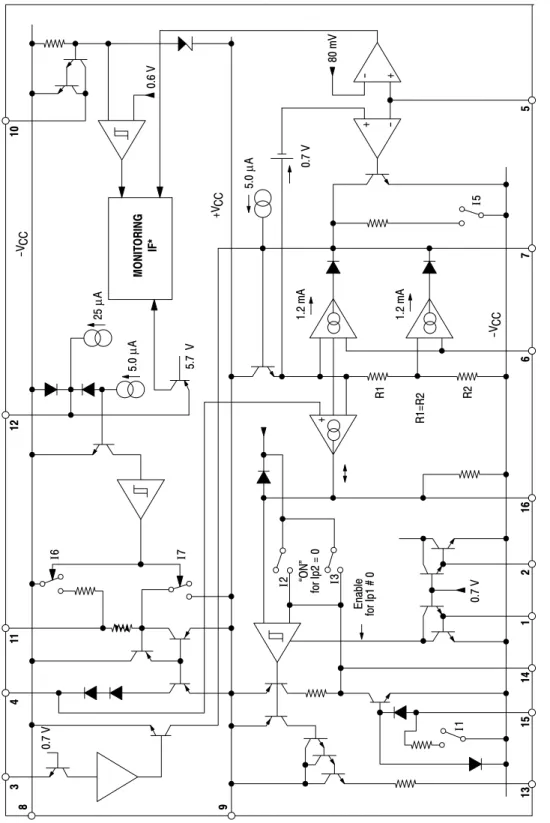
Figure 8. Simplified Schematic 3 4 11 12 10 8 9 13 15 14 1 2 16 6 7 5 0.7V I 6 I7 I 2 I 1 0.7V “ON” for Ip2 = 0 Enable for Ip1 # 0 R1=R2 R1 R2 -VCC 1.2mA 1.2mA 5.7 V 25 μ A 5.0 μ A 0.6V 5.0 μ A +VCC 80mV I 5 + -- + + MONIT ORING IF* *(P12 connected) and (V CC OK) and (VP5>80mV) Then I 1 OFF), ( I 2 OFF), ( I 4 OFF) and ( I 5 OFF) ( I 3 -VCC 0.7 V
PACKAGE DIMENSIONS
NOTES:
1. DIMENSIONING AND TOLERANCING PER ANSI Y14.5M, 1982.
2. CONTROLLING DIMENSION: INCH. 3. DIMENSION L TO CENTER OF LEADS
WHEN FORMED PARALLEL. 4. DIMENSION B DOES NOT INCLUDE
MOLD FLASH.
5. ROUNDED CORNERS OPTIONAL.
-A-B F C S H G D J L M 16 PL SEATING 1 8 9 16 K PLANE -T-M A M 0.25 (0.010) T
DIM MIN MAX MIN MAX
MILLIMETERS INCHES A 0.740 0.770 18.80 19.55 B 0.250 0.270 6.35 6.85 C 0.145 0.175 3.69 4.44 D 0.015 0.021 0.39 0.53 F 0.040 0.70 1.02 1.77 G 0.100 BSC 2.54 BSC H 0.050 BSC 1.27 BSC J 0.008 0.015 0.21 0.38 K 0.110 0.130 2.80 3.30 L 0.295 0.305 7.50 7.74 M 0 10 0 10 S 0.020_ 0.040_ 0.51_ 1.01_ PDIP-16 CASE 648-08 ISSUE T
ON Semiconductor and are registered trademarks of Semiconductor Components Industries, LLC (SCILLC). SCILLC reserves the right to make changes without further notice
to any products herein. SCILLC makes no warranty, representation or guarantee regarding the suitability of its products for any particular purpose, nor does SCILLC assume any liability arising out of the application or use of any product or circuit, and specifically disclaims any and all liability, including without limitation special, consequential or incidental damages. “Typical” parameters which may be provided in SCILLC data sheets and/or specifications can and do vary in different applications and actual performance may vary over time. All operating parameters, including “Typicals” must be validated for each customer application by customer's technical experts. SCILLC does not convey any license under its patent rights nor the rights of others. SCILLC products are not designed, intended, or authorized for use as components in systems intended for surgical implant into the body, or other applications intended to support or sustain life, or for any other application in which the failure of the SCILLC product could create a situation where personal injury or death may occur. Should Buyer purchase or use SCILLC products for any such unintended or unauthorized application, Buyer shall indemnify and hold SCILLC and its officers, employees, subsidiaries, affiliates, and distributors harmless against all claims, costs, damages, and expenses, and reasonable attorney fees arising out of, directly or indirectly, any claim of personal injury or death associated with such unintended or unauthorized use, even if such claim alleges that SCILLC was negligent regarding the design or manufacture of the part. SCILLC is an Equal Opportunity/Affirmative Action Employer. This literature is subject to all applicable copyright laws and is not for resale in any manner.