Unlocking Energy
Babak Falsafi
Rachid Guerraoui
Javier Picorel
Vasileios Trigonakis
∗{
first.last
}
@epfl.ch
EcoCloud, EPFL
Abstract
Locks are a natural place for improving the energy ef-ficiency of software systems. First, concurrent systems are mainstream and when their threads synchronize, they typically do it with locks. Second, locks are well-defined abstractions, hence changing the algorithm implement-ing them can be achieved without modifyimplement-ing the system. Third, some locking strategies consume more power than others, thus the strategy choice can have a real effect. Last but not least, as we show in this paper, improving the energy efficiency of locks goes hand in hand with improving their throughput. It is a win-win situation.
We make our case for this throughput/energy-efficiency correlation through a series of observations obtained from an exhaustive analysis of the energy ef-ficiency of locks on two modern processors and six soft-ware systems: Memcached, MySQL, SQLite, RocksDB, HamsterDB, and Kyoto Kabinet. We propose simple lock-based techniques for improving the energy effi-ciency of these systems by 33% on average, driven by higher throughput, and without modifying the systems.
1 Introduction
For several decades, the main metric to measure the effi-ciency of computing systems has beenthroughput. This state of affairs started changing in the past few years as
energyhas become a very important factor [17]. Reduc-ing the power consumption of systems is considered cru-cial today [26, 30]. Various studies estimate that datacen-ters have contributed over 2% of the total US electricity usage in 2010 [36], and project that the energy footprint of datacenters will double by 2020 [1].
Hardware techniques for reducing energy consump-tion include clock gating [38], power gating [52], as well as voltage and frequency scaling [28, 56]. Soft-ware techniques include approximation [16, 27, 57], con-solidation [18, 21], energy-efficient data structures [23, 32], fast active-to-idle switching [44, 45], power-aware
∗Author names appear in alphabetical order.
0 0.5 1 1.5 2 10 20 Relative to mutex # Threads Power Consumption (lower is better) (a) 10 20 # Threads Energy Efficiency (higher is better) (b) mutex spinlock
Figure 1: Power consumption and energy efficiency of
CopyOnWriteArrayListwith mutex and spinlock. schedulers [48, 55, 59], and energy-oriented compil-ers [63, 64]. Basically, those techniques require changes in hardware, installing new schedulers or runtime sys-tems, or even rebuilding the entire system.
We argue that there is an effective, complementary approach to saving energy: Optimizingsynchronization, specifically its most popular form, namelylocking. The rationale is the following. First, concurrent systems are now mainstream and need to synchronize their activi-ties. In most cases, synchronization is achieved through locking. Hence, designing locking schemes that reduce energy consumption can affect many software systems. Second, the lock abstraction is well defined and one can usually replace the algorithm implementing it without any modification to the rest of the system. Third, the choice of the locking scheme can have a significant effect on energy consumption. Indeed, the main consequence of synchronization is having some threadswaitfor one another–an opportunity for saving energy.
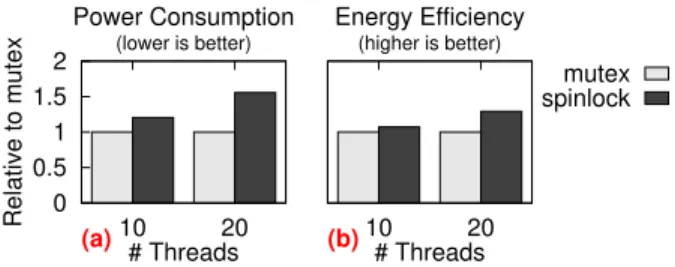
To illustrate this opportunity, consider the av-erage power consumption of two versions of a
java.util.concurrent.CopyOnWriteArrayList[6]
stress test over a long-running execution–Figure 1(a). The two versions differ in how the lock handles con-tention: Mutexes usesleeping, while spinlocks employ
busy waiting. With sleeping, the waiting thread is put to sleep by the OS until the lock is released. With busy waiting, the thread remains active, polling the lock until the lock is finally released. Choosing sleeping as the
waiting strategy brings up to 33% benefits on power. Hence, as we pointed out, the choice of locking strategy can have a significant effect on power consumption.
Accordingly, privileging sleeping with mutex locks seems like the systematic way to go. This choice, how-ever, is not as simple as it looks. What really matters is not only the power consumption, but the amount of en-ergy consumed for performing some work, namely en-ergy efficiency. In the Figure 1 example, although the spinlock version consumes 50% more power than mutex, it delivers 25% higher energy efficiency (Figure 1(b)) for it achieves twice the throughput. Hence, indeed, locking is a natural place to look for saving energy. Yet, choosing the best lock algorithm is not straightforward.
To finalize the argument that optimizing locks is a good approach to improve the energy efficiency of sys-tems, we need locks that not only reduce power, but also do not hurt throughput. Is that even possible?
We show that the answer to this question is positive. We argue for the POLY1 conjecture: Energy efficiency and throughput go hand in hand in the context of lock algorithms.POLYsuggests that we can optimize locks to improve energy efficiency without degrading throughput; the two go hand in hand. Consequently, we can apply prior throughput-oriented research on lock algorithms al-most as is in the design of energy-efficient locks as well. We argue for ourPOLYconjecture through a thorough analysis of the energy efficiency of locks on two mod-ern Intel processors and six software systems (i.e., Mem-cached, MySQL, SQLite, RocksDB, HamsterDB, and Kyoto Kabinet). We conduct our analysis in three layers. We start by analyzing the hardware and software artifacts available for synchronization (e.g., pausing instructions, the Linuxfutexsystem calls). Then, we evaluate opti-mized variants of lock algorithms in terms of throughput and energy efficiency. Finally, we apply our results to the six software systems. We derive from our analysis the following observations that underliePOLY:
Busy waiting inherently hurts power consumption.
With busy waiting, the underlying hardware context re-mains active. On Intel machines, for example, it is not practically feasible to reduce the power consumption of busy waiting. First, there is no power-friendly pause in-struction to be used in busy-wait loops. The conventional way of reducing the cost of these loops, namely the x86
pause instruction, actually increases power consump-tion. Second, themonitor/mwaitinstructions require kernel-level privileges, thus using them in user space incurs high overheads. Third, traditional DVFS tech-niques for decreasing the voltage and frequency of the cores (hence lowering their power consumption) are too coarse-grained and too slow to use. Consequently, the
1POLYstands for “Paretooptimality inlocks for energy efficiency.”
power consumption of busy waiting can simply not be reduced. The only way is to look into sleeping.
Sleeping can indeed save power. Our Xeon server has approximately 55 Watts idle power and a max total power consumption of 206 Watts. Once a hardware context is active, it draws power, regardless of the type of work it executes. We can save this power if threads are put to sleep while waiting behind a busy lock. The OS can then put the core(s) in one of the low-power idle states [5]. Furthermore, when there are more software threads than hardware contexts in a system, sleeping is the only way to go in locks, because busy waiting kills throughput.
However, going to sleep hurts energy efficiency. The
futexsystem call implements sleeping in Linux and is used by pthread mutex locks. In most realistic scenar-ios, thefutex-call overheads offset the energy benefits of sleeping over busy waiting, if any, resulting in worse energy efficiency. Additionally, the spin-then-sleep pol-icy of mutex is not tuned to account for these overheads. The mutex spins for up to a few hundred cycles before employing futex, while waking up a sleeping thread takes at least 7000 cycles. As a result, it is common that a thread makes the costlyfutex call to sleep, only to be immediately woken up, thus wasting both time and energy. We designMUTEXEE, an optimized version of mutex that takes thefutexoverheads into account.
Thus, some threads have to go to sleep for long. An unfair lock can put threads to sleep for long periods of time in the presence of high contention. Doing so results in lower power consumption, as fewer threads (hardware contexts) are active during the execution. In addition, lower fairness brings (i) better throughput, as the con-tention on the lock is decreased, and (ii) higher tail la-tencies, as the latency distribution of acquiring the lock might include some large values.
Overall, on current hardware, every power trade-off is also a throughput and a latency trade-off (motivating the name POLY1): (i) sleeping vs. busy waiting, (ii) busy waiting with vs. without DVFS ormonitor/mwait, and (iii) low vs. high fairness.
Interestingly, in our quest to substantiate POLY, we optimize state-of-the-art locking techniques to increase the energy efficiency of our considered systems. We im-prove the systems by 33% on average, driven by a 31% increase in throughput. These improvements are either due to completely avoiding sleeping using spinlocks, or due to reducing the frequency of sleep/wake-up invoca-tions using our newMUTEXEEscheme.
We conduct our analysis on two modern Intel plat-forms as they provide tools (i.e., RAPL interface [4]) for accurately measuring the energy consumption of the pro-cessor. Still, we believe thatPOLYholds on most modern
multi-cores. On the one hand, without explicit hardware support, busy waiting on any multi-core exhibits simi-lar behavior. On the other hand,futeximplementations are alike regardless of the underlying platform, thus the overheads of sleeping will always be significant. How-ever, should the hardware provide adequate tools for fine-grained energy optimizations in software, POLY might need to be revised. We discuss the topic further in§8.
In summary, the main contributions of this paper are:
• ThePOLYconjecture, stating that we can simply, yet effectively optimize lock-based synchronization to improve the energy efficiency of software systems.
• An extensive analysis of the energy efficiency of locks. The results of this analysis can be used to optimize lock algorithms for energy efficiency.
• Our lock libraries and benchmarks, available at:
https://lpd.epfl.ch/site/lockin.
• MUTEXEE, an improved variant of pthread mutex lock.MUTEXEEdelivers on average 28% higher en-ergy efficiency than mutex on six modern systems. It is worth noting that POLYmight not seem surpris-ing to a portion of the multi-core community. Yet, we believe it is important to clearly statePOLYand quantify through a thorough analysis the reasons why it is valid on current hardware. As we discuss in§8, our results have important software and hardware ramifications.
The rest of the paper is organized as follows. In§2, we recall background notions regarding synchronization and energy efficiency. We describe our target platforms in§3 and explore techniques for reducing the power of synchronization in§4. We analyze in§5 the energy effi-ciency of locks and we use our results to improve various software systems in§6. We discuss related work in§7, and we conclude the paper in§8.
2 Background and Methodology
Lock-based Synchronization. Locks ensure mutual
exclusion; only the holder of the lock can proceed with its execution. The remaining threads wait until the holder releases the lock. This waiting is implemented with ei-thersleeping(blocking), orbusy waiting(spinning) [49]. With sleeping, the thread is put in a per-lock wait queue and the hardware context is released to the OS. When the lock is released, the OS might wake up the thread. With busy waiting, threads remain active, polling the lock in a spin-wait loop.
Sleeping is employed by the pthread mutex lock (MUTEX). MUTEXbuilds on top offutexsystem calls, which allow a thread to wait for a value change on an ad-dress.MUTEXmight first perform busy waiting for a lim-ited amount of time and if the lock cannot be acquired, the thread makes thefutexcall.
The locks which use busy waiting are called spin-locks. There are several spinlock algorithms, such as test-and-set (TAS), test-and-test-and-set (TTAS), ticket-lock (TICKET) [46], MCS (MCS) [46], and CLH (CLH) [22]. Spinlocks mostly differ in their busy-waiting implemen-tation. For example,TASspins with an atomic operation,
continuously trying to acquire the lock (global spinning). In contrast, all other spinlocks spin with a load until the lock becomes free and only then try to acquire the lock with an atomic operation (local spinning).
Energy Efficiency of Software. Energy efficiency rep-resents the amount of work produced for a fixed amount of energy and can be defined as throughput per power
(TPP, #operation/Joule). Higher TPP represents a more energy-efficient execution. We use the terms energy efficiency and TPP interchangeably. Alternatively, en-ergy efficiency can be defined as the enen-ergy spent on a single operation, namely energy per operation(EPO,
Joule/operation). Note that TPP = 1/EPO.
Experimental Methodology. We prefer TPP over
EPO because both throughput and TPP are “higher-is-better” metrics. Recent Intel processors include the RAPL [4] interface for accurately measuring energy con-sumption. RAPL provides counters for measuring the cores’, package, and DRAM energy. We use these en-ergy measurements to calculate average power. Our mi-crobenchmark results are the median of 11 repetitions of 10 seconds. When we vary the number of threads, we first use the cores within a socket, then the cores of the second socket, and finally, the hyper-threads.
3 Target Platforms
We describe our two target platforms and then estimate their maximum power consumption.
Platforms. We use two modern Intel processors:
Name Type #Cores L1 L2 LLC Mem TDP
Xeon server 10 32KB 256KB 25MB 128GB 115W Core-i7 desktop 4 32KB 256KB 8MB 16GB 77W
In the interest of space and clarity of explanation, we fo-cus in the paper on the results of our server. Note that the results on Core-i7 are in accordance with the ones on Xeon. Our server is a two-socket Intel Ivy Bridge (E5-2680 v2), henceforth calledXeon. Xeon runs on frequen-cies scaling from 1.2 to 2.8 GHz due to DVFS and uses the Linux kernel 3.13 and glibc 2.13. Our desktop is an Intel Core i7 (Ivy Bridge–3770K) processor, henceforth calledCore-i7. Core-i7 runs on frequencies scaling from 1.6 to 3.5 GHz due to DVFS and runs the Linux kernel 3.2 and glibc 2.15. Both platforms have two hardware threads per-core (hyper-threads in Intel’s terminology). Intel turbo boost is disabled for all the experiments.
0 40 80 120 160 200 0 5 10 15 20 25 30 35 40 Power (Watts) # Hyper-threads Minimum Frequency 0 40 80 120 160 200 0 5 10 15 20 25 30 35 40 Power (Watts) # Hyper-threads Maximum Frequency 0 40 80 120 160 200 0 5 10 15 20 25 30 35 40 Power (Watts) # Hyper-threads Maximum Frequency
total package cores DRAM
Figure 2: Power-consumption breakdown on Xeon.
3.1 Estimating Max Power Consumption
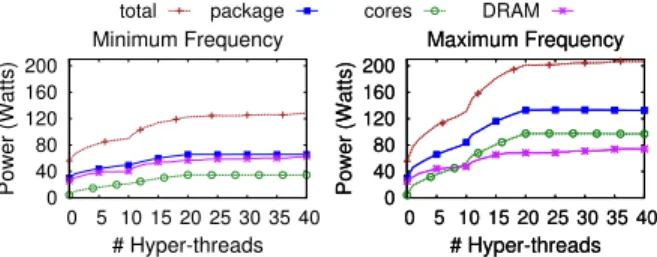
We estimate the maximum power that Xeon can sume, using a memory-intensive benchmark that con-sists of threads sequentially accessing large chunks of memory from their local node. Figure 2 depicts the total power and the power of different components on Xeon, depending on the number of active hyper-threads and the voltage-frequency (VF) setting.Idle Power Consumption. The 0-thread points
repre-sent the idle power consumption, which accounts for the static power in cores and caches, and DRAM background power, and is the power that is consumed when all cores are inactive.2 In both min and max frequency settings the total idle power is 55.5 Watts as the VF setting only affects the active power.
Power of Active Cores. Activating the first core of a socket is more expensive than activating any subsequent due to the activation of the uncore package components. In particular, it costs 6.4 and 13.6 Watts in package power on the min and max VF settings, respectively. The sec-ond core costs 2.3 and 5.6 Watts. We perform more ex-periments (not shown in the graphs) with data sets that fit in L1, L2, and LLC. The results show that the package power is not vastly reduced on any of these workloads, indicating that once a core is active, the core consumes a certain amount of power that cannot be avoided.
Attribution of Power to Cores, Package, and Memory.
Notice the breakdown of total power to package/core3 and DRAM power. DRAM power has a smaller dynamic range than package and core power. On the max VF set-ting, DRAM power ranges from 25 to 74 Watts, while the range of package power is from 30 to 132 Watts, and core power from 4 up to 96 Watts.
Implications. The power consumption of Xeon ranges
from 55 up to 206 Watts. Out of the 206 Watts, 74 Watts are spent on the DRAM memory. Locks are typically transferred within the processor by the cache-coherence protocol, thus limiting the opportunities for reducing power to package power (30-132 Watts). Additionally, once a core is active, the core draws power, regardless
2Still, the OS briefly enables a few cores during the measurements. 3The package power includes the core power.
60 80 100 120 140 1 5 10 15 20 25 30 35 40 Power (Watts) # Threads Power 0 15 30 45 60 1 5 10 15 20 25 30 35 40 CPI # Threads Cycles Per Instruction
134 136 138 140 30 35 40 134 136 138 140 30 35 40
sleeping global spinning local spinning
Figure 3: Power consumption and CPI while waiting. of the type of work performed. Consequently, the op-portunity for reducing power consumption in software is relatively low and mostly has to do with (i) using fewer cores, by, for example, putting threads to sleep, or (ii) re-ducing the frequency of a core.
4 Reducing Power in Synchronization
In this section, we evaluate the costs of busy waiting and sleeping, and examine different ways of reducing them.4.1 Power: The Price of Busy Waiting
We measure the total power consumption of the three main waiting techniques (i.e., sleeping, global spinning, and local spinning–see§2) when all threads are waiting for a lock that is never released. Figure 3 shows the power consumption and the cycles per instruction (CPI). CPI represents the average number of CPU cycles that an instruction takes to execute.Two main points stand out. First, in this extreme scenario, sleeping is very efficient because the waiting threads do not consume any CPU resources. Second, local spinning consumes up to 3% more power than global spinning. This behavior is explained by the CPI graph: Global spinning performs atomic operations on the shared memory address of the lock, resulting in a very high CPI (up to 530 cycles). In local spinning, every thread executes an L1 load each cycle, whereas, in global spinning, storing over coherence occurs once the atomic operation is performed, each 530 cycles on average.
4.2 Reducing the Price of Busy Waiting
We reduce the power consumption of busy waiting in dif-ferent ways: (i) we examine various ways of pausing in spin-wait loops, (ii) we employ DVFS, and (iii) we usemonitor/mwaitto “block” the waiting threads.
Pausing Techniques. Busy waiting with local
spin-ning is power hungry, because threads execute with low CPI. Hence, to reduce power, we must increase the loop’s CPI. We take several approaches to this end (Figure 4).
Any instruction, such as anop, that the out-of-order core can hide, cannot reduce the power of the spin loop. According to Intel’s Software Developer’s Manual [4], “Inserting a pause instruction in a spin-wait loop greatly reduces the processor’s power consumption.” Apause
60 80 100 120 140 1 5 10 15 20 25 30 35 40 Power (Watts) # Threads Power 0 15 30 45 60 1 5 10 15 20 25 30 35 40 CPI # Threads Cycles Per Instruction
132 136 140 144 30 35 40 132 136 140 144 30 35 40
global local local-pause local-mbar
Figure 4: Power consumption and CPI while spinning.
does it not “greatly reduce” power, but it even increases the power consumption by up to 4%.4
In general, the reason behind the very low CPI of lo-cal spinning is the aggressive execution mechanisms of modern processors that allow instructions to execute both speculatively and out of the program order. This results in one out of three of the retired operations being a mem-ory load (the other two are a test and a conditional jump). Without appropriate pausing, the spin loop retires one memory load per cycle.
A way to avoid the speculative execution of the load is to insert a full, or a load, memory barrier. That way, the loads only execute once the previous load retires and the instructions that depend on it, test and jump, are stalled as well. The results (local-mbar) show that the barrier reduces the power consumption of local spinning to the point that becomes less expensive than global spinning (global). Additionally, local-mbar consumes up to 7% less power thanlocal-pause. It is worth noting that local-mbarconsumes less power thanlocal-pauseeven for low thread counts (e.g., 5% on 10 threads). In the rest of the paper, we use a memory barrier for pausing in spin loops.
Dynamic Voltage and Frequency Scaling (DVFS).
An intuitive way of lowering the power consumption of an active core is to reduce the voltage-frequency (VF) point via DVFS (see§3). Figure 5 shows that spinning onVF-minconsumes up to 1.7x less power than on the
VF-maxsetting. Still, DVFS is currently impractical for dynamically reducing power in busy waiting.
First, to trigger the VF change with DVFS, we need to write on a certain per-hardware context file of the
/sys/devicesdirectory (more details about DVFS can be found in [62]). Hence, the VF-switch operation is slow: We measure that it takes 5300 cycles on Xeon. If DVFS is used while busy waiting, this overhead will be on the critical path when the lock is acquired and the thread must switch back to the maximum VF point.
Second, both hyper-threads of a physical core share the same VF setting–the higher of the two. If a hyper-thread lowers its VF setting, the action will have no effect unless the second hyper-thread has the same or lower VF
4We speculate that one of the reasons for this increase in power is that
pausegives a hint to the core to prioritize the other hyper-thread.
60 80 100 120 140 1 5 10 15 20 25 30 35 40 Power (Watts) # Threads VF-max VF-min DVFS-normal monitor/mwait
Figure 5: Power consumption of busy waiting using DVFS andmonitor/mwait.
setting. Consequently, using DVFS with hyper-threading is tricky, and as theDVFS-normalline shows, the power consumption drops only when both hyper-threads lower their VF points.
Monitor/mwait. Themonitor/mwait[4] instructions
allow a hardware context to block and enter an implementation-dependent optimized state while waiting for a store event. In detail, monitor allows a thread to declare a memory range to monitor. The hardware thread then usesmwaitto enter an optimized state until a store is performed within the address range. Essentially,
mwaitimplements sleeping in hardware and can be used in spin-wait loops: The hardware sleeps, yet the thread does not release its context.
These instructions require kernel privileges. We de-velop a virtual device and overload its file operations
functions to allow a user program to declare and wait on an address, similar to [14]. A thread can wake up others with a user-level store. However, threads pay the user-to-kernel switch and system-call overheads for waiting.
Figure 5 includes the power of busy waiting with
monitor/mwait. These instructions can reduce power consumption over conventional spinning up to 1.5x. However, similarly to DVFS, usingmonitor/mwaithas two shortcomings. First, monitor/mwaitcan be only used in kernel space. The overloaded file operation takes roughly 700 cycles. The best case wake-up latency from
mwait, with just one core “sleeping,” is 1600 cycles. In comparison, “waking up” a locally-spinning thread takes two cache-line transfers (i.e., 280 cycles). Second, programming withmonitor/mwaiton Intel processors can be elaborate and limiting. The mwait instruction blocks the hardware context until the thread is awaken. In oversubscribed environments (i.e., more threads than hardware contexts),monitor/mwaitwill likely exacer-bate the “livelock” issues of spinlocks (see§6). Blocked threads might occupy most hardware contexts, thus pre-venting other threads from performing useful work.
Implications. Busy waiting drains a lot of power be-cause cores execute at full speed. Neither of the two plat-forms provides sufficient tools for reducing power con-sumption in a systematic way. Pausing techniques, such aspause, can even increase the power of busy waiting.
Techniques that can significantly reduce power, such as DVFS andmonitor/mwait, are not designed for user-space usage as they require expensive kernel operations. Hence, sleeping is currently the only practical way of re-ducing the power consumption in locks.
4.3 Latency: The Price of Sleeping
In Linux, sleeping is implemented with futex system calls. Afutex-sleep call puts the thread to sleep on a given memory address. Afutex wake-up call awakes the first N threads sleeping on an address (N =1 in locks). Thefutexcalls are protected by kernel locks. In particular, the kernel holds a hash table (array) of locks andfutexoperations calculate the particular lock to use by hashing the address. Given that the array is large (ap-proximately 256∗#coreslocks), the probability of false contention is low. However, operations on the same ad-dress (sameMUTEX) do contend on kernel level.
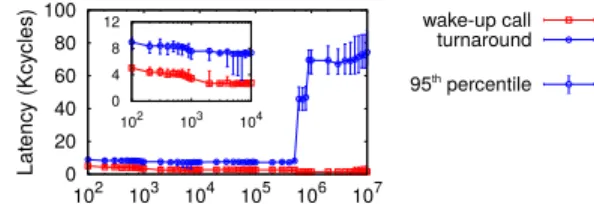
We use a microbenchmark where two threads run in lock-step execution (synchronized at each round with barriers). One makesfutex-sleep calls and the second makes wake-up calls on the samefutex, after waiting for some time. Afutex-sleep call (i.e., enqueuing be-hind the lock and descheduling the thread) takes around 2100 cycles.5This sleep latency is not necessarily on the
critical path: The thread sleeps because the lock is oc-cupied. However, the latency to wake up a thread and the one for the woken-up thread to be ready to execute are on the critical path. Figure 6 contains the wake-up call and the turnaround latencies, depending on the delay between the invocation of the sleep call and the wake-up call. The turnaround latency is the time from the wake-up invocation until the woken-wake-up thread is running.6
The turnaround time is at least 7000 cycles and is higher than the wake-up call latency. Apart from the ap-proximately 2700 cycles of the wake-up call, the woken-up thread requires at least 4000 more cycles before ex-ecuting. Concretely, once the wake-up call finishes, the woken-up thread pays the cost of idle-to-active switching and the cost of scheduling.7
Figure 6 further includes two interesting points. First, for low delays between the two calls, the wake-up call is more expensive as it waits behind a kernel lock for the completion of the sleep call. Second, when the de-lay between the calls is very large (>600K cycles), the turnaround latency explodes, because the hardware con-text sleeps in a deeper idle state [41].
Finally, the results in Figure 6 use just two threads and
5Estimated as the required delay between sleep and wake-up calls for the wake-up calls to almost always find the other thread sleeping.
6The wake-up call latency is directly measured in our microbench-mark, while the turnaround time is estimated as the duration of the sleep call, reduced by the delay between the sleep and wake-up calls.
7When the core is constantly active due to multiprogramming, the turnaround latency only includes the scheduling delays.
0 20 40 60 80 100 102 103 104 105 106 107 La te nc y (K cy cl es )
Delay between futex sleep and wake-up calls (cycles, log10) wake-up call turnaround 0 4 8 12 102 103 104 95th percentile
Figure 6: Latency of differentfutexoperations.
thus represent the best-case latencies, with minimal or no contention at the kernel level. With more threads, a wake-up invocation is likely to contend withfutexsleep calls, all serialized using a single kernel lock.
Implications. futex operations have high latencies
and consume energy, as a non-negligible number of in-structions are executed. Handing over a lock with a
futexwake-up call requires at least 7000 cycles. Even on rather lengthy critical sections (e.g., 10000 cycles), this latency is prohibitive; it almost doubles the execution time of the critical section. In this case, the energy ben-efits of sleeping will not easily compensate the perfor-mance losses. In short critical sections, invokingfutex
calls will have detrimental effects on performance.
4.4 Reducing the Price of Sleeping
Sleeping can save energy on long waiting durations. We estimate when sleeping reduces power consumption with two threads:
Period between wake-up calls (cycles) 1024 2048 4096 8192 Power (Watts) 72.03 69.18 68.75 68.02
The first thread sleeps on a location, while the second pe-riodically wakes up the first thread. We vary the period between the wake-up invocations, which essentially rep-resents the critical-section duration in locks. The results confirm that if a thread is woken up more frequently than thefutex-sleep latency, power consumption is not re-duced. The thread goes to sleep only to be immediately woken up by a concurrent wake-up call. When these “sleep misses” happen, we lose performance without any power reduction. Once the delay becomes larger than the sleep latency (i.e., approximately 2100 cycles on Xeon), we start observing power reductions.
Reducing Fairness. We show two problems with
futex-based sleeping: (i) high turnaround latencies, and (ii) frequent sleeps and wake ups do not reduce power consumption. To fix both problems simultaneously, we recognize the following trade-off: We can let some threads sleep for long periods, while the rest coordinate with busy waiting. If the communication is mostly done via busy waiting, we almost remove thefutexwake-up calls from the critical path. Additionally, we let threads sleep for long periods, a requirement for reducing power consumption in sleeping.
70 80 90 100 110 120 130 140 1 10 20 30 40 Power (Watts) # Threads Power 0 2 4 6 8 10 12 14 1 10 20 30 40 Throughput (Mops/s) # Threads Communication 0 2 4 6 8 10 12 14 1 10 20 30 40 Throughput (Mops/s) # Threads Communication sleep spin ss-1 ss-10 ss-100 ss-1000
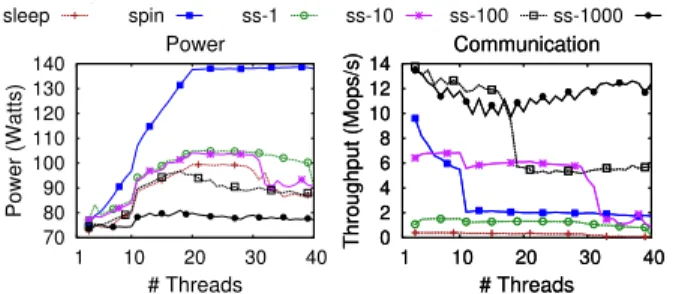
Figure 7: Power and communication throughput of sleeping, spinning, and spin-then-sleep for variousTs.8
This optimization comes at the expense of fairness. The longer a thread sleeps while some others progress, the more unfair the lock becomes. We experiment with the extreme case where only two threads communicate via busy waiting, while the rest sleep. Each active thread has a “quota”T of busy-waiting repetitions, after which it wakes up another thread to take its turn. Figure 7 shows the power and the communication rate (similar to a lock handover) of sleeping, busy waiting, and spin-then-sleep (ss-T) with variousTs on a singlefutex. T is the ratio of busy-waiting overfutexhandovers.
Figure 7 clearly shows that the more unfair an execu-tion (i.e., for largeTs), the better the energy efficiency. First, larger values ofT result in lower power, because the sleep and wake-upfutex calls become infrequent, hence the sleeping threads sleep for a long duration. For example, on 10 threads withT=1000, threads sleep for about 2M cycles. In comparison, with only sleeping, the sleep duration is less than 90000 cycles. Second, spin handovers face minimal contention, as only two threads attempt to “acquire” the cache line. Consequently, be-cause most handovers (99.9%) happen with spinning, the latency is very low, resulting in high throughput.
Implications. Frequent futex calls will hurt the en-ergy efficiency of a lock. A way around this problem is to reduce lock fairness in the face of high contention, by letting only a few threads use the lock as a spinlock, while the remaining threads are asleep.
5 Energy Efficiency of Locks
We evaluate the behavior of various locks in terms of energy efficiency and throughput, heavily relying on the results of§4. We first introduceMUTEXEE, an optimized version ofMUTEX.
5.1
MUTEXEE: An Optimized
MUTEXLock
In §4, we analyze the overhead offutex calls. Addi-tionally, we show how we can trade fairness for energy efficiency. MUTEX does not explicitly take these trade-offs into account, although it is an unfair lock.
8The performance collapse ofspinis due to contention, while ofss-10 andss-100 due to the high idle-to-active switching costs (see Figure 6).
MUTEX MUTEXEE
lock
for up to∼1000 cycles for up to∼8000 cycles
spin withpause spin withmfence
if still busy, sleep withfutex
unlock
release in user space (lock->locked = 0)
wait in user space
wake up a thread withfutex
Table 1: Differences betweenMUTEXandMUTEXEE.
In particular, MUTEX by default attempts to acquire the lock once before employing futex. MUTEX can
be configured (with thePTHREAD MUTEX ADAPTIVE NP
initialization attribute) to perform up to 100 acquire at-tempts before sleeping withfutex.9 Still, threads spin up to a few hundred cycles on the lock before sleep-ing withfutex(the exact duration depends on the con-tention on the cache line of the lock). This behavior can result in very poor performance for critical sections of up to 4000 cycles. In brief, threads are put to sleep, although the queuing time behind the lock is less than thefutex -sleep latency. Additionally, to release a lock, MUTEX
first sets the lock to “free” in user space and then wakes up one sleeping thread (if any). However, a third concur-rent thread can acquire the lock before the newly awaken thread Tawis ready to execute. Tawwill then find the lock occupied and sleep again, thus wasting energy, creating unnecessary contention, and breaking lock fairness.
To fix these two shortcomings, we design an optimized version ofMUTEX, calledMUTEXEE. Table 1 details how
MUTEXEEdiffers from the traditionalMUTEX. The “wait in user space” step of unlock requires further explana-tion. MUTEXEE, after releasing the lock in user space, but before invokingfutex, waits for a short period to detect whether the lock is acquired by another thread in user space. In such case, the unlock operation returns without invokingfutex. The waiting duration must be proportional to the maximum coherence latency of the processor (e.g., 384 cycles on Xeon).
Moreover, MUTEXEEoperates in one of two modes: (i)spin, with∼8000 cycles of spinning in the lock func-tion and∼384 in unlock, and (ii) mutex, with∼256 cycles in lock and∼128 in unlock (used to avoid useless spinning). MUTEXEEkeeps track of statistics regarding how many handovers occur with busy waiting and with
futex. Based on those statistics,MUTEXEEperiodically decides on which mode to operate in: If thefutex -to-busy-waiting handovers ratio is high (>30%),MUTEXEE
uses mutex, otherwise it remains in spin mode.
9For brevity, in our graphs we show the defaultMUTEXconfiguration (i.e., withoutPTHREAD MUTEX ADAPTIVE NP). We choose the default MUTEXversion because: (i) it is the default in our systems (§6), and (ii) we thoroughly compare the two versions and conclude that for most configurationsMUTEXis slightly faster without the adaptive attribute.
Throughput 10 20 30 40 50 60 # Threads 0 4 8 12 16
Critical section (Kcycles)
0 1 2 3 TPP 10 20 30 40 50 60 # Threads 0 4 8 12 16 0 1 2 3 4 5 6
Figure 8: Throughput and TTP ratios ofMUTEXEEover
MUTEXon various configurations with a single lock.
Our design sensitivity analysis for MUTEXEE (not shown in the graphs) highlights three main points. First, spinning for more than 4000 cycles is crucial for through-put: MUTEXEEwith 500 cycles spin behaves similarly toMUTEX. Second, the “wait in user space” function-ality is crucial for power consumption (and improves throughput): If we remove it,MUTEXEEconsumes simi-lar power toMUTEX. Finally, the spin and mutex modes ofMUTEXEEcan save power on lengthy critical sections.
Fine-tuningMUTEXEE. The default configuration
pa-rameters of MUTEXEEshould be suitable for most x86 processors. Still, these parameters are based on the la-tencies of the various events that happen in a futex -based lock, such as the latency of sleeping or waking up. Accordingly, in order to allow developers to fine-tuneMUTEXEEfor a platform, we provide a script which runs the necessary microbenchmarks and reports the con-figuration parameters that can be used for that platform.
Comparing MUTEXEE to MUTEX. Figure 8 depicts
the ratios of throughput and energy efficiency of
MUTEXEE overMUTEX on various configurations on a single lock. MUTEXEEindeed fixes the problematic be-havior ofMUTEXfor critical sections of up to 4000 cy-cles. WhileMUTEX continuously puts threads to sleep and wakes them up shortly after, MUTEXEE lets the threads sleep for larger periods and keeps most lock han-dovers futex free. Of course, the latter behavior of
MUTEXEEresults in lower fairness as shown in Figure 9. Up to 4000 cycles,MUTEXEEachieves much lower 95th percentile latencies thanMUTEX, because most lock
0 1 2 3 4 0 4 8 12 16 Latency (Mcycles)
Critical-section duration (Kcycles) 95th percentile 0 500 1000 1500 2000 0 4 8 12 16 Latency (Mcycles)
Critical-section duration (Kcycles) 99.99th percentile 0 500 1000 1500 2000 0 4 8 12 16 Latency (Mcycles)
Critical-section duration (Kcycles) 99.99th percentile
MUTEX MUTEXEE
Figure 9: 95th and 99.99th percentile latency of a single
MUTEXandMUTEXEEon various configurations.
Throughput 10 20 30 40 50 60 # Threads 8K 128K 2M 32M 512M MUTEXEE Timeout (ns) 1 2 3 4 5+ TPP 10 20 30 40 50 60 # Threads 8K 128K 2M 32M 512M 1 2 3 4 5+
Figure 10: Throughput and TTP ratios of MUTEXEE
without over with timeouts depending on the timeout.
dovers are fast with busy waiting. However, the price of this behavior is a few extremely high latencies as shown in the 99.99th percentile graph. These values are caused by the long-sleeping threads and represent the trade-off between lock fairness and energy efficiency. As the crit-ical section size increases, the behavior of the two locks converges: Both locks are highly unfair.
Reducing MUTEXEE’s Tail Latencies. MUTEXEE
purposefully tries to reduce the number offutex invo-cations by handing the lock over in user space whenever possible. Therefore, it might let some threads sleep while the rest keep the lock busy, resulting in high tail laten-cies. A straightforward way to limit the tail latencies of
MUTEXEE, so that threads are not allowed to remain “in-definitely” asleep, is to use a timeout for thefutexsleep call. Once a thread is woken up due to a timeout, the thread spins until it acquires the lock, without the pos-sibility to sleep again.10 Controlling this timeout essen-tially controls the maximum latency of the lock (given that the sleep duration is significantly larger than the crit-ical sections protected by that lock).
Figure 10 depicts the relative performance of
MUTEXEEwithout over with timeouts for a single lock with 2000 cycles critical sections. For an 8µs timeout,
MUTEXEEdelivers up to 14x lower throughput and 24x lower TPP than without timeouts. In general, for time-outs shorter than 16-32 ms, both throughput and TPP suf-fer, representing the clear trade-off between fairness and performance. For example, with 20 threads, MUTEXEE
with a 4 ms timeout compares to the rest as follows:
Lock Throughput TPP Max Latency
Kacq/s Kacq/Joule Mcycles
MUTEX 317 4.0 2.0
MUTEXEE 855 10.9 206.5
MUTEXEEtimeout 474 6.5 12.0
Depending on the application, the developer can decide whether to use timeouts and choose the timeout duration forMUTEXEE. For brevity, in the rest of the paper, we useMUTEXEEwithout timeouts. As we show in§6, we do not observe significant tail-latency increases due to
MUTEXEEin real systems.
MUTEX TAS TTAS TICKET MCS MUTEXEE Throughput 11.88 16.88 16.98 16.97 12.04 13.32
TPP 174.31 248.14 249.41 249.24 176.72 195.48
Table 2: Single-threaded lock throughput and TPP.
5.2 Evaluating Lock Algorithms
We evaluate various lock algorithms under different con-tention levels in terms of throughput and TPP.
Uncontested Locking. It is common in systems that a
lock is mostly used by a single thread and both the ac-quire and the release operations are almost always un-contested. Table 2 includes the throughput (Macq/s) and the TPP (Kacq/Joule) of various lock algorithms when a thread continuously acquires and releases a single lock. We use short critical sections of 100 cycles.
The trends in throughput and TPP are identical as there is no contention. The locks perform inversely to their complexity. The simple spinlocks (TAS,TTAS, and
TICKET) acquire and release the lock with just a few in-structions. MUTEX performs several sanity checks and also has to handle the case of some threads sleeping when a lock is released.MUTEXEEis also more complex than simple spinlocks due to its periodic adaptation. The queue-based lock,MCS, is even more complex, because threads must find and access per-thread queue nodes.
Contention–Single (Global) Lock. We experiment
with a single lock accessed by a varying number of threads. This experiment captures the behavior of highly-contended coarse-grained locks. We use a fixed critical section of 1000 cycles.
Figure 11 contains the throughput and the TPP results. On 40 threads, MUTEX delivers 73% lower TPP than
TICKET: 63% less throughput and 5.8% more power. The throughput difference is due to (i) the global spin-ning ofMUTEX, and (ii) thefutexcalls, even if they are infrequent. The power difference is mainly because of the pausing technique. MUTEXspins withpause, while
TICKETuses a memory barrier. Withpauseinstead of a barrier,TICKETconsumes 4 Watts more.
Moreover,MUTEXEEmaintains the contention levels and the frequency offutexcalls low, regardless of the number of threads. This results in stable throughput and
0 1 2 3 1 10 20 30 40 50 60 Throughput (Macq/s) # Threads Throughput 0 15 30 45 1 10 20 30 40 50 60 TPP (Kacq/Joule) # Threads Throughput per Power
0 15 30 45 1 10 20 30 40 50 60 TPP (Kacq/Joule) # Threads Throughput per Power
MUTEX TAS TTAS TICKET MCS MUTEXEE
Figure 11: Using a single (global) lock.
0 0.2 0.4 0.6 0.8 1 0 0.2 0.4 0.6 0.8 1 Normalized TPP Normalized Throughput linear MUTEX TAS TTAS TICKET MCS MUTEXEE
Figure 12: Correlation of throughput with energy effi-ciency (TPP) on various contention levels.
TPP because neither contention, nor the number of active hardware contexts increases with the number of threads. This behavior comes at the expense of high tail latency: On 40 threads,MUTEXEEhas an 80x higher 99.9th per-centile latency thanMUTEX.
Regarding spinlocks, TAS is the worst in this work-load. This behavior is due to the stress on the lock, which makes the release ofTASvery expensive. Moreover, for up to 40 threads, the queue-based lock (MCS) delivers the best throughput and TPP. Queue-based locks are de-signed to avoid the burst of requests on a single cache line when the lock is released. On more than 40 threads, fair-ness shows its teeth. As Xeon has 40 hardware threads, there is oversubscription of threads to cores.TICKETand
MCS, the two fair locks, suffer the most: If the thread that is the next to acquire the lock is not scheduled, the lock remains free until that thread is scheduled.
Finally, throughput and TPP are directly correlated: The higher the throughput, the higher the energy effi-ciency. Still,MUTEXEEdelivers higher TPP by achieving both better throughput and lower power than the rest.
Variable Contention. Figure 12 plots the correlation of throughput with TPP on a diverse set of configura-tions. We vary the number of threads from 1 to 16, the size of critical section from 0 to 8000 cycles, and the number of locks from 1 to 512. At every iteration within a configuration, each thread selects one of the locks at random. The results are normalized to the overall maxi-mum throughput and TPP, respectively.
Most data points fall on, or very close to, the linear line. In other words, most executions have almost one-to-one correlation of throughput with TPP. The bottom-left cluster of values represents highly-contended points. On high contention, there is a trend below the linear line, which represents executions where throughput is rela-tively higher compared to energy efficiency. These re-sults are expected, as on very high contention sleeping can save power compared to busy waiting, but still, busy waiting might result in higher throughput.
If we zoom into the per-configuration best throughput and TPP, the correlation of the two is even more pro-found. On 85% of the 2084 configurations, the lock with the best throughput achieves the best energy efficiency
1. 38 1.38 1.26 1. 85 1.71 1.55 1.43 1.17 1.03 0.01 0.16 1.00 1.02 1.12 0.90 0.80 0. 25 1.06 1.17 1.17 1.42 1. 78 1.73 1.52 1.14 1.07 1.03 0.98 1.02 1.10 1.12 1.11 1.25 1.33 1. 44 1.26 0 0.5 1 1.5 2 2.5 WT WT /R D RD CACH E H T D B B-TR EE SET SET/ GET GET M EM SSD WT WT /R D RD 1 6 CO N 32 CO N 6 4 CO N
HamsterDB Kyoto Memcached MySQL RocksDB SQLite Avg
Th rou gh p u t (N or m al ized ) MUTEX TICKET MUTEXEE
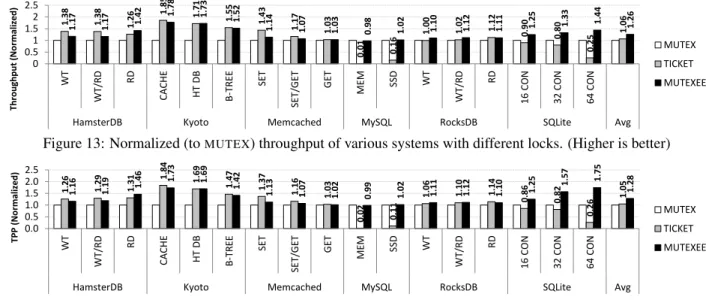
Figure 13: Normalized (toMUTEX) throughput of various systems with different locks. (Higher is better)
1.26 1.2 9 1. 31 1.84 1.69 1.47 1.37 1.16 1.03 0.02 0.11 1. 06 1.1 0 1.1 4 0.86 0.82 0.26 1.05 1.16 1.1 9 1.4 6 1. 73 1. 69 1.42 1.13 1.07 1.02 0.99 1.02 1.11 1.12 1.1 0 1. 25 1.5 7 1.75 1.28 0.0 0.5 1.0 1.5 2.0 2.5 WT WT /R D RD CAC HE H T D B B -TR EE SET SET /GET GET MEM SSD WT WT /R D RD 16 C O N 32 CO N 64 CO N
HamsterDB Kyoto Memcached MySQL RocksDB SQLite Avg
TP P (No rm al ized ) MUTEX TICKET MUTEXEE
Figure 14: Normalized (toMUTEX) energy efficiency (TPP) of various systems with different locks. (Higher is better)
as well. On the remaining 15%, the highest throughput is on average 8% better than the throughput of the high-est TPP lock, while the highhigh-est TPP is 5% better than the TPP of the highest throughput lock.
Finally, MUTEXEE delivers much higher throughput and TPP thanMUTEX; on average, 25% and 32% higher throughput and TPP, respectively. MUTEXis better than
MUTEXEE in just 4% of the configurations (by 9% on average, both in terms of throughput and TPP).
5.3 Implications
The POLY conjecture states that energy efficiency and throughput go hand in hand in locks. Our evaluation of POLY with six state-of-the-art locks on various con-tention levels shows that, with a few exceptions,POLYis indeed valid. The exceptions toPOLYare high contention scenarios, where sleeping is able to reduce power, but still results in slightly lower throughput than busy wait-ing on the contended locks.
For low contention levels, energy efficiency depends only on throughput, as there are no opportunities for sav-ing energy. In these scenarios, even infrequentfutex
calls reduce both throughput and energy efficiency. For high contention, sleeping can reduce power con-sumption. However, the frequentfutexcalls ofMUTEX
hinder the potential energy-efficiency benefits due to throughput degradation. MUTEXEEis able to reduce the frequency of futex calls either by avoiding the ones that are purposeless, or by reducing fairness. MUTEXEE
achieves both higher throughput and lower power than spinlocks orMUTEXfor high contention levels.
6 Energy Efficiency of Lock-based Systems
We modify the locks of various concurrent systems to improve their energy efficiency. We choose the setof systems so that they use the pthread library in di-verse ways, such as using mutexes or reader-writer locks, building on top of mutexes, or relying on conditionals. Note that we do not modify anything else other than the pthread locks and conditionals in these systems.
Table 3 contains the description and the different con-figurations of the six systems that we evaluate. All benchmarks use a dataset size of approximately 10 GB (in memory), except for the MySQL SSD configuration that uses 100 GB. We set the number of threads for each system according to its throughput scalability.
6.1 Results
Figures 13-14 show the throughput and the energy effi-ciency (TPP) of the target systems with different locks.
HamsterDB [3]An embedded key-value store. We run three tests with random reads and writes, varying the read-to-write ratio from 10% (WT), 50% (WT/RD), to 90% (RD). Version: 2.1.7
# Threads: 4
Kyoto [7] An embedded NoSQL store. We stress Kyoto with a mix of operations for three database versions (CACHE, HT DB, B-TREE).
Version: 1.2.76 # Threads: 4
Memcached [8]An in-memory cache. We evaluate Memcached using a Twitter-like workload [40]. We vary the get-to-set ratio from 10% (WT), 50% (WT/RD), to 90% (RD). The server and the clients run on separate sockets. Version: 1.4.22
# Threads: 8
MySQL [9] An RDBMS. We use Facebook’s LinkBench and tuning guidelines [2] for an in-memory (MEM) and an SSD-drive (SSD) configurations.
Version: 5.6.19
RocksDB [10] A persistent embedded store. We use the benchmark suite and guidelines of Facebook for an in-memory configuration [11]. We run 3 tests with random reads and writes, varying the read-to-write ratio from 10% (WT), 50% (WT/RD), to 90% (RD).
Version: 3.3.0 # Threads: 12
SQLite [12] A relational DB engine. We use TPC-C with 100 warehouses varying the number of concurrent connections (i.e., 8, 32, and 64).
Version: 3.8.5
For brevity, we show results withMUTEX,TICKET, and
MUTEXEE. The remaining local-spinning locks are sim-ilar toTICKET(TASis less efficient–see§5).
Throughput and Energy Efficiency. In 16 out of the
17 experiments, avoiding the overheads of MUTEX im-proves energy efficiency from 2% to 184%. On aver-age, changing MUTEX for either TICKET or MUTEXEE
improves throughput by 31% and TPP by 33%. The re-sults include three distinct trends.
First, in some systems/configurations (i.e., Mem-cached and HamsterDB) sleeping can “kill” through-put. For instance, on the SET workload on Memcached,
MUTEXEEallows for a few sleep invocations, resulting in lower throughput thanTICKET.
Second, in some systems/configurations (i.e., MySQL and RocksDB) MUTEX is less of a problem. Both of these systems build more complex synchronization pat-terns on top ofMUTEX. MySQL handles most low-level synchronization with customly-designed locks. Simi-larly, RocksDB employs a write queue where threads en-queue their operations and mostly relies on a conditional variable. Therefore, alteringMUTEXwith another algo-rithm does not make a big difference.
Finally, in MySQL and SQLite sleeping is necessary. Both these systems oversubscribe threads to cores, thus spinlocks, such asTICKET, result in very low through-put. A spinning thread can occupy the context of a thread that could do useful work. Additionally, on the SSD,
TICKETconsumes 40% more power than the other two, as it keeps all cores active. The fairness ofTICKET exac-erbates the problems of busy waiting in the presence of thread oversubscription: TTAS(not shown in the graph) has roughly 6x higher throughput thanTICKET, but it is still much slower thanMUTEXandMUTEXEE.
Overall, in five out of the six systems, the energy-efficiency improvements are mostly driven by the in-creased throughput. SQLite is the only system where the lock plays a significant role in terms of both throughput and power consumption. WithMUTEXEE, SQLite con-sumes 15% and 18% less power than withMUTEXwith 32 and 64 connections, respectively.
Tail Latency. MUTEXEEcan become more unfair than
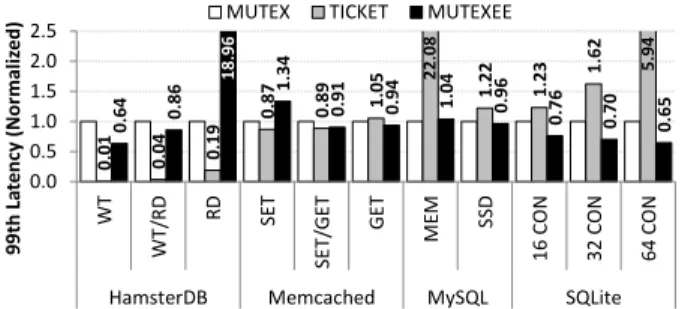
MUTEX(see§5). Figure 15 includes the QoS of four sys-tems in terms of tail latency. For most configurations, the results are intuitive: Better throughput comes with a lower tail latency. However, there are a few configura-tions that are worth analyzing.
First, MUTEXEE’s unfairness appears in the RD con-figuration of HamsterDB, resulting in almost 20x higher tail latency than MUTEX, but also in 46% higher TPP. Second, TICKET has high tail latencies on all oversub-scribed executions as a result of low performance.
Finally,MUTEXEEon SQLite achieves better
through-0.01 0.04 0.1 9 0 .8 7 0.89 1.0 5 1 .2 2 1 .2 3 1.6 2 0 .6 4 0 .8 6 1.3 4 0 .9 1 0 .9 4 1 .0 4 0 .9 6 0 .7 6 0 .7 0 0.65 0.0 0.5 1.0 1.5 2.0 2.5 WT WT/ R D RD SE T SE T/ GET GET MEM SSD 16 CO N 32 CO N 64 CO N
HamsterDB Memcached MySQL SQLite
99 th La te nc y (Nor ma liz e
d) MUTEX TICKET MUTEXEE
1 8 .9 6 2 2 .0 8 5 .9 4
Figure 15: Normalized (toMUTEX) tail latency of vari-ous systems with different locks. (Lower is better)
put and lower power than MUTEX, without increasing tail latencies. TPC-C transactions on SQLite have laten-cies in the scale of tens of ms. Each transaction consists of multiple accesses to shared data protected by various locks. MUTEXEE does indeed increase the tail latency of individual locks, but these latencies are in the scale of hundreds ofµs and do not appear in the transaction laten-cies. However, this low-level unfairness brings huge con-tention reductions. For instance, on 64 CON, the SQLite server withMUTEX puts threads to sleep for 472µs on average, compared to 913µs withMUTEXEE. The result is that withMUTEX, SQLite spends more than 40% of the CPU time on the raw spin lockfunction of the kernel due to contention onfutexcalls. In contrast,MUTEXEE
spends just 4% of the time on kernel locks, and 21% on the user-space lock functions.
Implications. Changing MUTEX in six modern
sys-tems results in 33% higher energy efficiency, driven by a 31% increase in throughput on average. Clearly, the
POLYconjecture (i.e., throughput and energy efficiency
go hand in hand in locks) holds in software systems and implies that we can continue business as usual: To opti-mize a system for energy efficiency, we can still optiopti-mize the system’s locks for throughput.
Additionally, we show thatMUTEXlocks must be
re-designed to take the latency overheads offutex calls into account. MUTEXEE, our optimized implementation of MUTEX, achieves 26% higher throughput and 28% better energy efficiency thanMUTEX. Furthermore, the unfairness of MUTEXEEmight not be a major issue in real systems: MUTEXEE can lead to high tail latencies only under extreme contention scenarios, that must be avoided in well engineered systems.
In conclusion, we see that optimizing lock-based syn-chronization is a good candidate for improving the en-ergy efficiency of real systems. We can modify the locks with minimal effort, without affecting the behavior of other system components, and, more importantly, with-out degrading throughput.
7 Related Work
Lock-based Synchronization. Lock-based
synchro-nization has been thoroughly analyzed in the past. For instance, many studies [13, 15, 34, 42, 46] point out scal-ability problems due to excessive coherence with tradi-tional spinlocks and propose alternatives, such as hier-archical spin- and queue-based locks [34, 43, 54]. Prior work [20, 25] sacrifices short-term fairness for perfor-mance, however, it does not consider sleeping or energy efficiency. Similarly toMUTEXEE, Solaris’ mutex locks offer the option of “adaptive unlock,” where the lock owner does not wake up any threads if the lock can be handed over in user space [60]. David et al. [24] analyze several locks on different platforms and conclude that scalability is mainly a property of the hardware. More-shet et al. [47] share some preliminary results suggesting that transactional memory can be more energy efficient than locks. Wamhoff et al. [62] evaluate the overheads of using DVFS in locks and show how to improve per-formance by boosting the lock owner. Our work extends prior synchronization work with a complete study of the energy efficiency of lock-based synchronization.
Spin-then-sleep Trade-off. The spin-then-sleep strat-egy was first proposed by Ousterhout [49]. Various stud-ies [19, 35, 39] analyze this trade-off and show that just spinning or sleeping is typically suboptimal. Franke et al. [29] recognize the need for fast user-space lock-ing and describe the first implementation of futex in Linux. Johnson et al. [33] advocate for decoupling the lock-contention strategy from thread scheduling. At first glance,MUTEXEEmight look similar to their load-control TP-MCS [31] lock (LC). However, the two have some notable differences. LC relies on a global view of the system for load control, while MUTEXEE performs per-lock load control. LC’s global load control can re-sult in “unlucky” locks having their few waiting threads sleep for at least 100 ms, although there is low lock contention–sleeping threads are not woken up by a lock release, but only because of a decrease in load or 100 ms timeout. Finally, in contrast to MUTEXEE, LC might waste energy, because on low system load, no thread is blocked, even if the waiting times are hundreds ms.
Energy Efficiency in Software Systems. There is a
body of work that points out the importance of energy-efficient software. For instance, Linux has rules to manage frequency and voltage settings [50]. Further work proposes OS facilities for managing and estimat-ing power [48, 55, 58, 59, 65, 66]. Other frameworks approximate loops and functions to reduce energy [16, 57]. Moreover, compiler-based [63, 64] and decoupled access-execute DVFS [37] frameworks trade off perfor-mance for energy. In servers, consolidation [18, 21] col-locates workloads on a subset of servers, and fast
tran-sitioning between active-to-idle power states allows for low idle power [44, 45]. Psaroudakis et al. [53] achieve up to 4x energy-efficiency improvements in database an-alytical workloads, using hardware models for power-aware scheduling. Similarly, Tsirogiannis et al. [61] an-alyze a DB system and conclude that the most energy-efficient point is also the best performing one. OurPOLY
conjecture is a similar result for locks. Nevertheless, while they evaluate various DB configurations, we study the spin vs. sleep trade-off. To the best of our knowledge, this is the first paper to consider the energy trade-offs of synchronization on modern multi-cores.
8 Concluding Remarks
In this paper, we thoroughly analyzed the power/perfor-mance trade-offs in lock-based synchronization in order to improve the energy efficiency of systems. Our re-sults support thePOLYconjecture: Energy efficiency and throughput go hand in hand in lock algorithms.POLYhas important software and hardware ramifications.
For software,POLYconveys the ability to improve the energy efficiency of systems in an simple and systematic way, without hindering throughput. We indeed improved the energy efficiency of six popular software systems by 33% on average, driven by a 31% increase in throughput, These improvements are mainly due to MUTEXEE, our redesigned version of pthread mutex lock, that builds on the results of our analysis.
For hardware, POLY highlights the lack of adequate tools for reducing the power consumption of synchro-nization, without significantly degrading throughput. We performed our analysis on two modern Intel platforms that are representative of a large portion of the processors used nowadays. We argue that our results apply in most multi-core processors, because without explicit hardware support for synchronization, the power behavior of both busy waiting and sleeping will be similar regardless of the underlying hardware.
Our analysis further points out potential hardware tools that could reduce the power of synchronization. In brief, a truly energy-friendlypause, fast per-core DVFS, and user-levelmonitor/mwaitcan make the difference. In fact, industry has already started heading towards these directions. Intel includes on-chip voltage regula-tors on the latest processors, but all the cores share the same frequency. Similarly, the recent Oracle SPARC M7 processor includes a variable-length pause instruc-tion and user-levelmonitor/mwait[51].
Acknowledgments. We wish to thank our shepherd,
Leonid Ryzhyk, and the anonymous reviewers for their fruitful comments. We also want to thank Dave Dice for his useful feedback on an early draft of this paper. This work has been partially supported by the European ERC Grant 339539–AOC.
References
[1] America’s Data Centers Consuming and Wasting Growing Amounts of Energy. http://www.nrdc.org/energy/data-center-efficiency-assessment.asp.
[2] Facebook LinkBench Benchmark.
https://github.com/facebook/linkbench. [3] HamsterDB.http://hamsterdb.com.
[4] Intel 64 and IA-32 Architectures Software Developer Manuals. http:
//www.intel.com/content/www/us/en/processors/ architectures-software-developer-manuals.html. [5] Intel Xeon Processor E5-1600/ E5-2600/E5-4600 Product
Families.http://www.intel.com/content/dam/www/ public/us/en/documents/datasheets/xeon-e5-1600-2600-vol-1-datasheet.pdf.
[6] Java CopyOnWriteArrayList Data Structure.
https://docs.oracle.com/javase/7/docs/api/java/ util/concurrent/CopyOnWriteArrayList.html. [7] Kyoto Cabinet.http://fallabs.com/kyotocabinet. [8] Memcached.http://memcached.org.
[9] MySQL.http://www.mysql.com. [10] RocksDB.http://rocksdb.org.
[11] RocksDB In-memory Workload Performance Benchmarks. https:
//github.com/facebook/rocksdb/wiki/RocksDB-In-Memory-Workload-Performance-Benchmarks. [12] SQLite.http://sqlite.org.
[13] AGARWAL, A.,ANDCHERIAN, M. Adaptive Backoff Synchronization Techniques. ISCA ’89.
[14] ANASTOPOULOS, N.,ANDKOZIRIS, N. Facilitating Efficient Synchronization of Asymmetric Threads on Hyper-threaded Processors. IPDPS ’08.
[15] ANDERSON, T. The Performance of Spin Lock Alternatives for Shared-memory Multiprocessors.IEEE TPDS(1990). [16] BAEK, W.,ANDCHILIMBI, T. Green: A Framework for
Supporting Energy-conscious Programming Using Controlled Approximation. PLDI ’10.
[17] BARROSO, L.,ANDH ¨OLZLE, U. The Case for Energy-proportional Computing.IEEE Computer(2007). [18] BENINI, L., KANDEMIR, M.,ANDRAMANUJAM, J.
Compilers and Operating Systems for Low Power. Kluwer Academic Publishers, 2003.
[19] BOGUSLAVSKY, L., HARZALLAH, K., KREINEN, A., SEVCIK, K.,ANDVAINSHTEIN, A. Optimal Strategies for Spinning and Blocking.J. Parallel Distrib. Comput.(1994).
[20] CALCIU, I., DICE, D., LEV, Y., LUCHANGCO, V., MARATHE, V. J.,ANDSHAVIT, N. NUMA-Aware Reader-Writer Locks. PPoPP ’13.
[21] CHASE, J., ANDERSON, D., THAKAR, P., VAHDAT, A.,AND DOYLE, R. Managing Energy and Server Resources in Hosting Centers. SOSP ’01.
[22] CRAIG, T. Building FIFO and Priority-Queuing Spin Locks From Atomic Swap. Tech. rep., 1993.
[23] DAVID, T., GUERRAOUI, R.,ANDTRIGONAKIS, V. Asynchronized Concurrency: The Secret to Scaling Concurrent Search Data Structures. ASPLOS ’15.
[24] DAVID, T., GUERRAOUI, R.,ANDTRIGONAKIS, V. Everything You Always Wanted to Know About Synchronization but Were Afraid to Ask. SOSP ’13.
[25] DICE, D., MARATHE, V.,ANDSHAVIT, N. Lock Cohorting: A General Technique for Designing NUMA Locks. PPoPP ’12. [26] ESMAEILZADEH, H., BLEM, E., S. AMANT, R.,
SANKARALINGAM, K.,ANDBURGER, D. Dark Silicon and the End of Multicore Scaling. ISCA ’11.
[27] ESMAEILZADEH, H., SAMPSON, A., CEZE, L.,ANDBURGER, B. Architecture Support for Disciplined Approximate
Programming. ASPLOS ’12.
[28] FLEISCHMANN, M. LongRun Power Management. Tech. rep., 2001.
[29] FRANKE, H., RUSSELL, R.,ANDKIRKWOOD, M. Fuss, Futexes and Furwocks: Fast Userlevel Locking in Linux. OLS ’02.
[30] HARDAVELLAS, N., FERDMAN, M., FALSAFI, B.,AND AILAMAKI, A. Toward Dark Silicon in Servers.IEEE Micro
(2011).
[31] HE, B., III, W. N. S.,ANDSCOTT, M. L. Preemption Adaptivity in Time-Published Queue-Based Spin Locks. HiPC ’05.
[32] HUNT, N., SANDHU, P.,ANDCEZE, L. Characterizing the Performance and Energy Efficiency of Lock-Free Data Structures. INTERACT ’11.
[33] JOHNSON, F., STOICA, R., AILAMAKI, A.,ANDMOWRY, T. Decoupling Contention Management from Scheduling. ASPLOS ’10.
[34] K ¨AGI, A., BURGER, D.,ANDGOODMAN, J. R. Efficient Synchronization: Let Them Eat QOLB. ISCA ’97.
[35] KARLIN, A. R., LI, K., MANASSE, M. S.,ANDOWICKI, S. Empirical Studies of Competitive Spinning for a
Shared-memory Multiprocessor. SOSP ’91.
[36] KOOMEY, J. Growth in Data Center Electricity Use 2005 to 2010. Analytics Press Report.
[37] KOUKOS, K., BLACK-SCHAFFER, D., SPILIOPOULOS, V., ANDKAXIRAS, S. Towards More Efficient Execution: A Decoupled Access-execute Approach. ICS ’13.
[38] LI, H., BHUNIA, S., CHEN, Y., ROY, K.,ANDVIJAYKUMAR, T. DCG: Deterministic Clock-Gating for Low-Power Microprocessor Design.IEEE TVLSI(2004).
[39] LIM, B.-H.,ANDAGARWAL, A. Waiting Algorithms for Synchronization in Large-scale Multiprocessors.ACM TOCS
(1993).
[40] LIM, K., MEISNER, D., SAIDI, A., RANGANATHAN, P.,AND WENISCH, T. Thin Servers with Smart Pipes: Designing SoC Accelerators for Memcached. ISCA ’13.
[41] LO, D., CHENG, L., GOVINDARAJU, R., BARROSO, A.,AND KOZYRAKIS, C. Towards Energy Proportionality for Large-Scale Latency-Critical Workloads. ISCA ’14. [42] LOZI, J., DAVID, F., THOMAS, G., LAWALL, J.,AND
MULLER, G. Remote Core Locking: Migrating Critical-Section Execution to Improve the Performance of Multithreaded Applications. ATC ’12.
[43] LUCHANGCO, V., NUSSBAUM, D.,ANDSHAVIT, N. A Hierarchical CLH Queue Lock. ICPP ’06.
[44] MEISNER, D., GOLD, B.,ANDWENISCH, T. PowerNap: Eliminating Server Idle Power. ASPLOS ’09.
[45] MEISNER, D.,ANDWENISCH, T. DreamWeaver: Architectural Support for Deep Sleep. ASPLOS ’12.
[46] MELLOR-CRUMMEY, J.,ANDSCOTT, M. Algorithms for Scalable Synchronization on Shared-memory Multiprocessors.
ACM TOCS(1991).
[47] MORESHET, T., BAHAR, R. I.,ANDHERLIHY, M. Energy Implications of Multiprocessor Synchronization. SPAA ’06. [48] MUTHUKARUPPAN, T., PATHANIA, A.,ANDMITRA, T. Price
Theory Based Power Management for Heterogeneous Multi-Cores. ASPLOS ’14.
[49] OUSTERHOUT, J. Scheduling Techniques for Concurrent Systems. ICDCS ’82.
[50] PALLIPADI, V.,ANDSTARIKOVSKIY, A. The Ondemand Governor. OLS ’06.
[52] POWELL, M., YANG, S., FALSAFI, B., ROY, K.,AND VIJAYKUMAR, T. Gated-Vdd: A Circuit Technique to Reduce Leakage in Deep-Submicron Cache Memories. ISLPED ’00. [53] PSAROUDAKIS, I., KISSINGER, T., POROBIC, D., ILSCHE, T.,
LIAROU, E., T ¨OZUN¨ , P., AILAMAKI, A.,ANDLEHNER, W. Dynamic Fine-Grained Scheduling for Energy-Efficient Main-Memory Queries. DaMoN ’14.
[54] RADOVIC, Z.,ANDHAGERSTEN, E. Hierarchical Backoff Locks for Nonuniform Communication Architectures. HPCA ’03.
[55] RIBIC, H.,ANDLIU, Y. Energy-Efficient Work-Stealing Language Runtimes. ASPLOS ’14.
[56] ROTEM, E., NAVEH, A., MOFFIE, M.,ANDMENDELSON, A. Analysis of Thermal Monitor Features of the Intel Pentium M Processor. TACS Workshop at ISCA ’04.
[57] SAMPSON, A., DIETL, W., FORTUNA, E., GNANAPRAGASAM, D., CEZE, L.,ANDGROSSMAN, D. EnerJ: Approximate Data Types for Safe and General Low-Power Computation. PLDI ’11. [58] SHEN, K., SHRIRAMAN, A., DWARKADAS, S., ZHANG, X.,
ANDCHEN, Z. Power Containers: An OS Facility for Fine-Grained Power and Energy Management on Multicore Servers. ASPLOS ’13.
[59] SINGH, K., BHADAURIA, M.,ANDMCKEE, S. Real Time Power Estimation and Thread Scheduling via Performance
Counters.SIGARCH CAN(2009).
[60] SUNMICROSYSTEMS. Multithreading in the Solaris Operating Environment.http://home.mit.bme.hu/~meszaros/edu/ oprendszerek/segedlet/unix/2_folyamatok_es_ utemezes/solaris_multithread.pdf.
[61] TSIROGIANNIS, D., HARIZOPOULOS, S.,ANDSHAH, M. Analyzing the Energy Efficiency of a Database Server. SIGMOD ’10.
[62] WAMHOFF, J., DIESTELHORST, S., FETZER, C., MARLIER, P., FELBER, P.,ANDDICE, D. The TURBO Diaries: Application-controlled Frequency Scaling Explained. ATC ’14. [63] WU, Q., MARTONOSI, M., CLARK, D., REDDI, V.,
CONNORS, D., WU, Y., LEE, J.,ANDBROOKS, D. A Dynamic Compilation Framework for Controlling Microprocessor Energy and Performance. MICRO ’05. [64] XIE, F., MARTONOSI, M.,ANDMALIK, S. Compile-Time
Dynamic Voltage Scaling Settings: Opportunities and Limits. PLDI ’03.
[65] XU, C., LIN, F., WANG, Y.,ANDZHONG, L. Automated OS-Level Device Runtime Power Management. ASPLOS ’15. [66] ZHAI, Y., ZHANG, X., ERANIAN, S., TANG, L.,ANDMARS,
J. Happy: Hyperthread-Aware Power Profiling Dynamically. ATC ’14.