A Mapping of an Agile Software
Development Method to the Personal
Productivity of the Knowledge Worker
- a Systematic Review of Self-Help Books -
Helga Guðrún Óskarsdóttir
Faculty of Industrial Engineering,
Mechanical Engineering and
Computer Science
University of Iceland
A Mapping of an Agile Software
Development Method to the Personal
Productivity of the Knowledge Worker
- a Systematic Review of Self-Help Books -
Helga Guðrún Óskarsdóttir
60 ECTS thesis submitted in partial fulfillment of a Magister Scientiarum degree in Software Engineering
Advisor(s)
Guðmundur Valur Oddsson Jóhann P. Malmquist
Faculty Representative Bjarni Júlíusson
Faculty of Industrial Engineering, Mechanical Engineering and Computer Science
School of Engineering and Natural Sciences University of Iceland
A Mapping of an Agile Software Development Method to the Personal Productivity of the Knowledge Worker, a Systematic Review of Self-Help Books
Personal Productivity, a Systematic Review
60 ECTS thesis submitted in partial fulfillment of a Magister Scientiarum degree in Software Engineering
Copyright © 2014 Helga Guðrún Óskarsdóttir All rights reserved
Faculty of Industrial Engineering, Mechanical Engineering and Computer Science School of Engineering and Natural Sciences
University of Iceland VRII, Hjarðarhagi 2-6 107, Reykjavik Iceland Telephone: 525 4000 Bibliographic information:
Helga Guðrún Óskarsdóttir, 2014, A Mapping of an Agile Software Development Method to the Personal Productivity of the Knowledge Worker a Systematic Review of Self-Help Books, Master‟s thesis, Faculty of Industrial Engineering, Mechanical Engineering and Computer Science, University of Iceland, pp. 158.
Printing: Háskólaprent
Abstract
This work explores the problem of how to increase knowledge worker productivity by performing a systematic literature review of personal productivity self-help books. The assumption was that personal productivity self-help books are based on the same underlying concepts and that these concepts can give insight into the personal productivity of the knowledge worker. The intent was to identify these concepts, compare them to the state-of-the-art on knowledge worker productivity and the software development method Scrum. The working hypothesis was that Scrum can create the environment and provide the tools needed by the knowledge worker to perform to his highest potential and produce value for the organization. The research design followed the guidelines for systematic reviews in software engineering by Kitchenham (2004). The research scope was based on a definition of personal productivity. Forty personal productivity self-help guides were chosen in a fair and systematic way from Amazon.com using a software program and rigid selection criteria. These books were read and analyzed by one researcher. Twenty-six concepts of personal productivity were identified and defined from the forty personal productivity self-help books. The concepts were compared to the definition of knowledge workers, personal productivity and ten knowledge worker productivity factors and found to be relevant to the personal productivity of the knowledge worker. The concepts were also mapped to the software development method, Scrum.
Útdráttur
Þessi rannsókn greinir fjörtíu vinsælar sjálfshálparbækur til að skoða vandamálið, hvernig á að auka framleiðni þekkingarstarfsmanna. Leiðbeiningar Kitchenham (2004) voru notaðar við hönnun rannsóknarinnar. Gengið var út frá því að sjálfshjálparbækurnar væru allar byggðar á sömu hugtökunum og að þessi hugtök gætu gefið innsýn inn í framleiðni þekkingarstarfsmanna. Tilgátan var að aðferðafræðin Scrum í hugbúnaðargerð byði uppá umhverfi og tól til að auka framleiðni starfsmanna. Sjálfshjálparbækurnar voru valdar á kerfisbundinn hátt og lesnar af höfundi. Tuttugu og sex hugtök voru greind og skilgreind úr fjörtíu vinsælum sjálfshjálparbókum. Hugtökin voru borin saman við fræði þekkingarstarfsmanna og aðferðafræðina Scrum.
Table of Contents
List of Figures ... ix List of Tables ... xi Acknowledgements ... xiii 1 Introduction ... 1 2 Theoretical Background ... 3 2.1 Knowledge Workers ... 3 2.2 Personal Productivity... 52.3 Ten Knowledge Worker Productivity Factors ... 6
2.4 Scrum... 8
3 Research Design ... 11
3.1 Research Scope ... 12
3.2 Search Strategy ... 13
3.2.1 Connection to Amazon.com... 13
3.2.2 The Software Used to Perform the Search ... 14
3.3 Selection Strategy ... 16
3.4 Data Extraction and Data Synthesis Strategy ... 17
3.4.1 Identifying Personal Productivity Concepts ... 18
3.4.2 Comparison with the Theories of Personal Productivity of Knowledge Workers ... 18
3.4.3 Mapping to the Concepts of the Scrum Framework ... 18
4 Software Design... 19
5 Research Execution ... 25
5.1 Search ... 26
5.2 Selection ... 27
5.3 Data Extraction and Synthesis ... 31
6 Results ... 35
6.1 Common Underlying Concepts from the Self-Help Books ... 35
6.2 Relevance to Personal Productivity of Knowledge Workers ... 39
6.2.1 Knowledge Workers and the Concepts ... 39
6.2.2 Personal Productivity and the Concepts ... 41
6.2.3 The Ten Knowledge Worker Productivity Factors and the Concepts ... 42
6.3 Personal Productivity Concepts and Scrum ... 43
8 Discussions and Conclusion ... 67
8.1 Personal Productivity ... 68
8.2 Personal Productivity and Scrum ... 71
8.3 Conclusion ... 72
References ... 75
Appendices ... 79
Appendix A: Results... 81
A.1. Book Summaries ... 81
Appendix B: Data Synthesis ... 91
Appendix C: Data Extraction ... 117
C.1 Data Extraction Form ... 117
C.2 Author Data Extraction Form ... 121
Appendix D: Selection ... 123
D.1 Selection Execution ... 123
D.2 Selected Books... 124
D.3 Excluded Books ... 127
D.3.1 About Organizational Productivity ... 127
D.3.2 About Managing Others & Leadership ... 132
D.3.3 Industry Specific ... 136
D.3.4 Not on Amazon Salesrank (is Zero) ... 139
D.3.5 About Life Fulfillment ... 141
D.3.6 Not Hardcover or Paperback ... 143
D.3.7 About Communications or Manipulation ... 144
D.3.8 Only One Book Per Author ... 145
D.3.9 About Team Productivity ... 146
D.3.10 Tool Specific ... 147
D.3.11 Too Specific Target Group ... 147
D.3.12 Job Hunting ... 148
D.3.13 Religion Specific ... 148
D.3.14 Summery Book ... 148
Appendix E: Search ... 149
E.1 Book Category Exclusion... 149
E.1.2 Included Book Categories ... 150
E.1.3 Excluded Book Categories ... 150
E.2 Book Search Execution ... 153
E.2.1 Search Results ... 153
List of Figures
Figure 1:White-collar work vs. blue-collar work ... 4
Figure 2: Overview of Scrum (Sutherland, 2012) ... 10
Figure 3: Overview of the research design ... 11
Figure 4: Search Strategy ... 13
Figure 5: Search flow ... 14
Figure 6: ReviewSearchHelper database model ... 21
Figure 7: Activities when main method BinSearch.java is run for a keyword. Activity ends when all book categories (browse nodes), that results should be extracted from, are saved in databasetable childbrowsenodestosearch ... 22
Figure 8: Flow when main method ExtractAsin.java is run. Flow ends when all unique ASIN results have been extracted from all the book categories (browse nodes) in childbrowsenodestosearch... 23
Figure 9: Overview of the research execution ... 25
Figure 10: Total results from the unrestricted book search by keyword ... 26
Figure 11: Excluded book categories by reason ... 26
Figure 12: Excluded book results by reason ... 27
Figure 13: Selected books found by keyword ... 28
Figure 14: A hypothesized personal productivity framework with the concepts grouped into levels of personal productivity ... 68
List of Tables
Table 1: Definition of a knowledge worker ... 4
Table 2: Definition of personal productivity ... 6
Table 3: Definitions of the ten knowledge worker productivity factors ... 7
Table 4: Concepts of the Scrum framework ... 8
Table 5: Research questions and objectives ... 12
Table 6: Search parameters ... 15
Table 7: Exclusion criteria checklist for book categories ... 16
Table 8: Selection criteria checklist ... 17
Table 9: Description of the tables in the ReviewSearchHelper database ... 19
Table 10: The forty books to be read for the review ... 28
Table 11: Example of the category, Environment and Technology, the ideas grouped into it and the two concepts, environment and technology, they were categorized into ... 32
Table 12: The definitions and keywords of the concepts identified in the self-help books ... 35
Table 13: A matrix of the underlying concepts and the self-help books they are discussed in, ordered by salesrank (see table 10) ... 38
Table 14: Statements of the knowledge worker definition mapped to the personal productivity concepts ... 39
Table 15: Statements of the personal productivity definition mapped to the personal productivity concepts ... 41
Table 16: The ten knowledge worker productivity factors mapped to the personal productivity concepts ... 43
Table 17: Mapping the keywords of the Scrum concepts with the personal productivity concepts ... 43
Table 18: Overview of the mapping of Scrum concept keywords and personal productivity concept keywords ... 46
Table 19: Six thinking hats(Bono, 2000) ... 86
Table 20: Categories and identified concepts from the first iteration of data synthesis ... 91
Table 21: The 698 ideas and their categories ... 92
Table 22: Complete list of selected books ordered by sales rank (Sales#) from 25.09.13. ... 124
Table 23: Excluded books with exclusion reason 'About organizational productivity'... 127
Table 24: Excluded books with exclusion reason 'About managing others & leadership' ... 132
Table 25: Excluded books with exclusion reason 'Industry specific' ... 136
Table 26: Excluded books with exclusion reason 'Not on amazon salesrank (is zero)„ .... 139
Table 27: Excluded books with exclusion reason 'About life fulfillment' ... 141
Table 28: Excluded books with exclusion reason 'Not hardcover or paperback' ... 143
Table 29: Excluded books with exclusion reason 'About communications or manipulation„... 144
Table 30: Excluded books with exclusion reason 'Only one book per author' ... 145
Table 31: Excluded books with exclusion reason 'About team productivity' ... 146
Table 32: Excluded books with exclusion reason 'Tool Specific' ... 147
Table 33: Excluded books with exclusion reason 'Too specific target group' ... 147
Table 34: Excluded books with exclusion reason 'Job hunting' ... 148
Table 35: Excluded books with exclusion reason 'Religion Specific' ... 148
Table 36: Excluded books with exclusion reason 'Summery Book' ... 148
Table 37: Included book categories and their hierarchy ... 150
Table 38: Complete list of excluded book categories independent of the hierarchy by exclusion reason ... 150
Acknowledgements
I would like to thank my supervisor, Guðmundur Valur Oddsson, for the help, interest, support and motivation throughout this research. I would like to thank him for helping me attend the 21st EurOMA conference. The whole process of writing a paper, presentation and attending the conference was a huge learning experience inspiring me to apply for a doctoral degree. I would also like to thank Jóhann P. Malmquist for pointing out that I can build a future on the knowledge I have attained in the process of this research. I am grateful for my family and boyfriend for their patience of listening to me talk day in and day out about this project and their proofreading. Last but not least I would like to thank Handpoint for their support and patience in allowing me flexible work hours so I could finish this milestone in my life.
1
Introduction
This work explores the problem of how to increase knowledge worker productivity by performing a systematic literature review of personal productivity self-help books. The modern workplace is heavily dependent on knowledge workers, employees of high skill, knowledge and judgment, to produce products and services. These workers need to use creativity and intelligence to solve new problems everyday while manual work is routine and repetitive. The methods used to manage and increase productivity of manual work are not relevant to knowledge workers (Drucker, 1966). Peter F. Drucker identified this challenge in 1959, in his book The Landmarks of Tomorrow.
This is still a challenge in the modern organization. There is little knowledge on how to best manage, measure performance and improve the productivity of knowledge workers. In 2004, Ramírez & Nembhard stated that knowledge workers had increased to about 60-75% of the workforce. Organizations have become dependent on the value produced by knowledge workers. They need to be able to affect the productivity of knowledge workers to run and improve their business. Therefore, it is important to find a solution to the problem: “How to increase knowledge worker productivity?“
The software development industry is a good example of an industry that is struggling with productivity issues because of the non-routine, creative and intellectual nature of the work. Organizations are using agile software development methods, such as Scrum, with hope to increase their performance. The effect that Scrum has on productivity needs to be explored. Case studies performed in organizations using Scrum suggest a positive effect on productivity. A working hypothesis is that Scrum can create the environment and provide the tools needed by the knowledge worker to perform to his highest potential and produce value for the organization.
This work will explore this hypothesis by identifying and defining the concepts which encompass the skills, tools and environment required by the worker to increase his personal productivity. The knowledge worker should be responsible for his own contribution to the organization (Drucker, 1959). Only the worker can manage his own knowledge since each individual interprets the same information into different knowledge (Wilson, 2002). Personal productivity is the value produced from the worker´s effort aligned with the organization‟s objectives which fulfills requirements of stakeholders (Óskarsdóttir & Oddsson, 2014).
Self-help books hold a wealth of information, from personal experience and industry perspective, to results from biological and behavioral research (Óskarsdóttir & Oddsson, 2014). They can help to solve the knowledge worker productivity problem. Consultants write most self-help books. They have experience working as knowledge workers, with knowledge workers and helping organizations improve productivity (Óskarsdóttir & Oddsson, 2014). The assumption is that personal productivity self-help books are based on
the same underlying ideas and that these ideas can give insight into the personal productivity of knowledge workers.
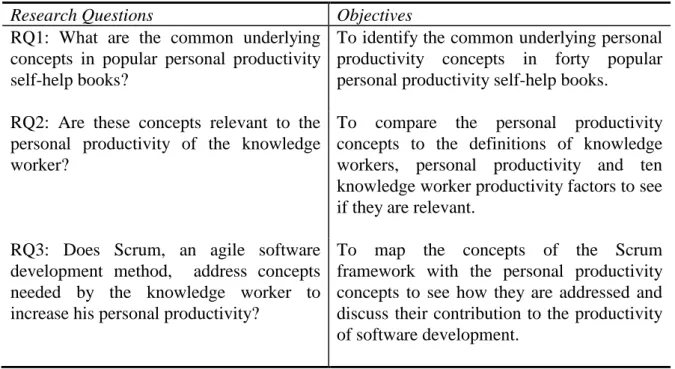
This research will explore these issues by answering three research questions:
What are the common underlying concepts in popular personal productivity self-help books?
Are these concepts relevant to the personal productivity of the knowledge worker?
Does Scrum, an agile software development method, address concepts needed by the knowledge worker to increase his personal productivity?
This research used a systematic review of popular personal productivity self-help books to identify concepts and address these research questions. The research design followed the guidelines for systematic reviews in software engineering by Kitchenham (2004). The research scope was based on a definition of personal productivity. Forty personal productivity self-help guides were chosen in a fair and systematic way from Amazon.com using a software program and rigid selection criteria. These books were read and analyzed by one researcher. Twenty-six concepts of personal productivity were identified and defined from the forty personal productivity self-help books.
With this research I hope to contribute to the field of software engineering by comparing the concepts, identified in the systematic review, to Scrum, an agile software development method. This work hopes to give insight into how Scrum addresses the concepts to affect the productivity of software development. Furthermore, I hope to contribute to the field of operations management by giving insight into the qualities of the individual knowledge worker and how he factors into the productivity of the organization. It is important to define the concepts, which are relevant to personal productivity of knowledge workers, to create a common language to help align future research. A systematic review of self-help books can give a new perspective on knowledge worker productivity and help identify new factors to be researched.
This work hopes to give insight into the problem of managing and increasing knowledge worker productivity and how Scrum does it by answering three research questions. The research questions will be answered by performing a systematic review of personal productivity self-help books. The following chapters will go into each facet of this research in depth: theoretical background, research design, software design, research execution, results, personal productivity concepts, discussions and conclusions. Supporting material is organized into the appendices.
2
Theoretical Background
The theoretical background will explore the concepts of knowledge workers, personal productivity, knowledge worker productivity factors and Scrum. Drucker´s (1991, 1999) theories of knowledge worker productivity and the systematic review of white-collar work by Hopp, Iravani, and Liu (2009) motivated this research. In 1999, Drucker determined six factors of knowledge worker productivity. These six factors are: defining the task, autonomy, continuous innovation, continuous learning and teaching, defining quantity and quality, and the knowledge worker´s willingness to work for the organization (Drucker, 1999).
Hopp et al. (2009) studied managing white-collar work by performing a systematic review of relevant literature. Knowledge work is a subset of white-collar work (Hopp et al., 2009). They identified six critical aspects of individual white-collar work. These six aspects are: creativity, discretion, learning, performance measures, incentives and technology (Hopp et al., 2009). This research combined Drucker‟s (1999) six factors of knowledge worker productivity and Hopp et al. (2009) six critical aspects of white-collar work into a list of ten known knowledge worker productivity factors:
innovation, creativity, autonomy, learning, performance measures, motivation, technology, accountability,
defining results and quality, and defining the task.
The assumption is that these factors affect the productivity of knowledge workers. Using popular personal productivity self-help books, this research aims to explore the knowledge worker productivity problem. Personal productivity help books encourage self-improvement of the reader. The subchapters explore the concepts of knowledge workers, personal productivity and these ten known productivity factors in more depth. The last subchapter will discuss Scrum and describe the framework.
2.1
Knowledge Workers
What is a knowledge worker? There is no single definition of a knowledge worker. Some researchers define them by the nature of their work others by the traits of the worker. Kelloway and Barling (2000) define knowledge work as a discretionary behavior focused on the use of knowledge. Pyöriä (2005) infers that qualities most often credited to knowledge workers in literature are the use of technology, education and the non-routine nature of the work.
Hopp et al. (2009) classify tasks as either white-collar or collar. They define blue-collar tasks as physical and routine tasks and white-blue-collar tasks as intellectual or creative. The characteristics of the tasks can be pictured on two axis, from physical to intellectual and from routine to creative (Hopp et al., 2009). Workers can be classified as knowledge workers, technologists, artists or manual workers by identifying where most of their tasks are on the two axis. Knowledge workers mainly deal with creative and intellectual tasks while technologists perform routine work that needs specialized knowledge (Drucker, 1999). Drucker (1999) states that technologists should be treated as knowledge workers when looking at productivity issues.
This research defines a knowledge worker as someone with high degrees of expertise, education or experience, with the main purpose of creating, sharing or applying knowledge in his job, where the nature of his work is non-routine, creative and intellectual (see table 1)(Óskarsdóttir & Oddsson, 2014). This definition is an amalgam of the definitions of Davenport (2005) and Hopp et al. (2009).
Table 1: Definition of a knowledge worker Knowledge Worker
A worker with high degrees of expertise, education or experience, with the main purpose of creating, sharing or applying knowledge in his job, where the nature of his work is non-routine, creative and intellectual (Óskarsdóttir & Oddsson, 2014).
The definition states that a knowledge worker must have high degrees of expertise, education or experience. An education and experience add to the workers ability to contribute to the organization (Drucker, 1959). An education must prepare the worker for work that does not exist and cannot be clearly defined, the knowledge worker must have learned to learn (Drucker, 1959). Most knowledge work is non-routine, composed of tasks that do not follow a prescribed procedure. The nature of knowledge work is creative and intellectual. Intelligence is defined as a person‟s ability to gain, hold, and apply knowledge quickly and successfully to meet challenges or solve problems (Glynn, 1996). Creativity is defined as the ability to solve problems or develop new ideas (Parkhurst, 1999). Tasks that
Artist (white-collar) Knowledge worker (white-collar) Technologist (white-collar) Manual worker (blue-collar) routine physical intellectual creative
Knowledge includes the mental actions of assimilating, understanding, interpreting, storing and accessing information within the mind of the individual (Wilson, 2002). Each individual interprets the same information into different knowledge (Wilson, 2002). Therefore the knowledge worker needs to take responsibility for his own work, because only he can manage his own knowledge (Drucker, 1959). No one else has the same knowledge structures.
This definition of a knowledge worker will be used in the research design. The next subchapter discusses personal productivity and its relationship with quality, effectiveness and efficiency.
2.2
Personal Productivity
The definition of personal productivity is deduced from different definitions of productivity. Productivity does not have one universal definition. Productivity has been defined as anything that makes the organization work better such as efficiency, effectiveness, turnover, morale, absenteeism and innovation (Pritchard, 1995). This definition is too broad to find solutions to the knowledge worker productivity problem effectively.
The economics definition states that productivity is the ratio of output and input, an efficiency measure (Pritchard, 1995; Tangen, 2005). Efficiency is doing things right and using the input better (Tangen, 2005). The input of knowledge workers is effort and they produce value. This traditional definition of productivity is too narrow for knowledge worker productivity. The nature of knowledge work is non-routine so transforming effort into value differs between tasks. Defining productivity as efficiency only would therefore give a distorted view of the knowledge workers productivity.
Another definition of productivity combines efficiency and effectiveness (Pritchard, 1995). Effectiveness is doing the right things or the ability to reach a desired objective (Tangen, 2005). Effectiveness measures if the value created by the knowledge worker is aligned with the objectives of the organization. There is still a factor missing from the definition that is important to knowledge work, quality. Quality is the degree to which the output fulfills requirements of stakeholders (Wicks & Roethlein, 2009). In traditional manufacturing where products are produced repeatedly, quality can be established once and then monitored. Quality must be defined for each task in knowledge work. Quality therefore has an impact on knowledge worker productivity.
Personal productivity is the productivity of the individual. This research defines personal productivity as the value produced from the worker‟s effort aligned with the organization´s objectives which fulfills requirements of stakeholders (see table 2)(Óskarsdóttir & Oddsson, 2014). This definition includes the factors efficiency, effectiveness and quality of the individual´s transformation of effort into value (Óskarsdóttir & Oddsson, 2014). The works of Pritchard (1995), Tangen (2005), Wicks and Roethlein (2009), Pershing (2006) and Erne (2011) inspired this definition.
Erne (2011) identified five stakeholder groups which requirements can come from. They are: business management, technical management, clients, colleagues and expert
communities (Erne, 2011). These groups can have different weights of importance, it depends on the industry and objectives (Erne, 2011).
Table 2: Definition of personal productivity Personal Productivity
The value produced from the worker‟s effort aligned with the organization‟s objectives which fulfills requirements of stakeholders (Óskarsdóttir & Oddsson, 2014).
It is hard to measure the value produced. Value is subjective and can include intangible variables such as latent value. Latent value is present and can emerge or develop, but is not visible or active right away ("Latent," n.d.). Its importance is often overlooked (Hopp et al., 2009). Latent value can be e.g. value that contributes to the knowledge base of the organization or quality that increases productivity in the long run (Hopp et al., 2009). This definition of personal productivity will be used in the research design. In the following subchapter the ten knowledge worker productivity factors, introduced in the beginning of this chapter, will be defined and discussed.
2.3
Ten Knowledge Worker Productivity
Factors
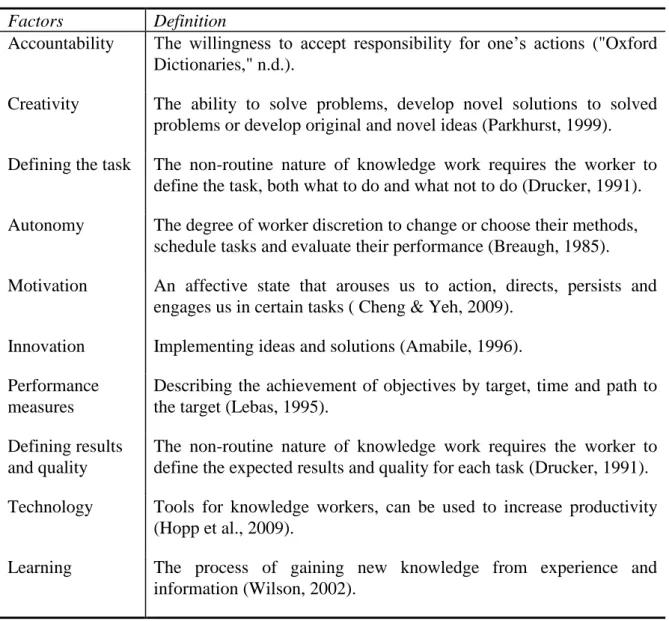
The ten knowledge worker productivity factors identified in the beginning of this chapter are discussed and defined below. The ten knowledge worker productivity factors are: innovation, creativity, autonomy, learning, performance measures, motivation, technology, accountability, defining results and quality, and defining the task. Table 3 defines each productivity factor. The definitions used are the ones relevant to knowledge worker productivity in the opinion of the researcher. In the following paragraphs are descriptions of some relevant studies connected to these factors.
Case studies have been used to study autonomy in knowledge worker industries. Donnelly (2006) examined the autonomy of consultants in their working arrangements. His results showed that the needs of the consultants employers, clients, professionalism and ambitions restricted their autonomy. Lim (2008) examined the job satisfaction of library information technology workers. He confirmed that autonomy is a factor of their job satisfaction. Maruta (2011) states that innovation abilities improve the productivity of knowledge workers. He defines a good innovation worker as someone who can achieve a goal in an efficient way by overcoming obstacles using available knowledge, information and their own insight. Amabile (1996) defines creativity as producing ideas and innovation as implementing them.
Elkjaer (2000) takes a look at organizations and how knowledge workers learn to perform knowledge work. He infers that it is important to be aware of the different theories of
thinks that most organizations will fall back on cognitive learning theory, the base of our school system. Wright (2005) proposes a framework for personal knowledge management. He takes a look at the competences used to solve different problem types and the learning opportunities in each.
Motivation has been studied to identify knowledge worker motivators and explore how to retain workers. Farrington (2006) studied the different motivators for older knowledge workers, over the age of fifty five and younger workers. He states that a strong intrinsic motivator for both age groups is enjoyment and pride in the job they do. Carleton (2011) states that fostering learning and engagement are more important to retaining knowledge workers than pay and incentive schemes. She also mentions that knowledge workers value organizations that ensure work-life balance.
Table 3: Definitions of the ten knowledge worker productivity factors
Factors Definition
Accountability The willingness to accept responsibility for one‟s actions ("Oxford Dictionaries," n.d.).
Creativity The ability to solve problems, develop novel solutions to solved problems or develop original and novel ideas (Parkhurst, 1999). Defining the task The non-routine nature of knowledge work requires the worker to
define the task, both what to do and what not to do (Drucker, 1991).
Autonomy The degree of worker discretion to change or choose their methods,
schedule tasks and evaluate their performance (Breaugh, 1985). Motivation An affective state that arouses us to action, directs, persists and
engages us in certain tasks ( Cheng & Yeh, 2009).
Innovation Implementing ideas and solutions (Amabile, 1996).
Performance measures
Describing the achievement of objectives by target, time and path to the target (Lebas, 1995).
Defining results and quality
The non-routine nature of knowledge work requires the worker to define the expected results and quality for each task (Drucker, 1991). Technology Tools for knowledge workers, can be used to increase productivity
(Hopp et al., 2009).
Learning The process of gaining new knowledge from experience and
information (Wilson, 2002).
Ramírez and Nembhard (2004) infer that no generalized methods exist to measure knowledge work because of its variety and intangibility. Erne (2011) took a look at five different organizations to research how to measure and improve the productivity of
knowledge workers. He identified performance influencers which are: quantity and quality of day-to-day work results, quality of communication with stakeholders, innovation behavior, compliance with standards, and skill development (Erne, 2011). He states that relevant stakeholders carry out performance measures by individual assessments.
Karr-Wisniewski and Lu (2010) examined technology overload, when technological tools begin to decrease productivity instead of improving it. They identified three factors contributing to loss of productivity, which are: information overload, communication overload and system feature overload. No research papers were found specifically about accountability and the productivity of knowledge workers, nor about the affects of defining the task, quality and results on productivity.
The ten knowledge worker productivity factors as defined above will be used in the research design. The next subchapter introduces Scrum, an agile software development method. Scrum uses autonomous teams who are accountable for their own performance. The method also encourages learning, defining the task, quality and results.
2.4
Scrum
Scrum is a popular agile software development method used in organizations with the hope to increase the productivity of software development. Scrum is a framework to organize teams and structure work. The concept Scrum comes from the game of rugby. It describes a play where the players from each team come together and try to control the ball (Takeuchi & Nonaka, 1986). Takeuchi and Nonaka (1986) used the concept to describe an approach to product development, where the members of self-organizing teams work together under subtle control which encourages creativity and spontaneity.
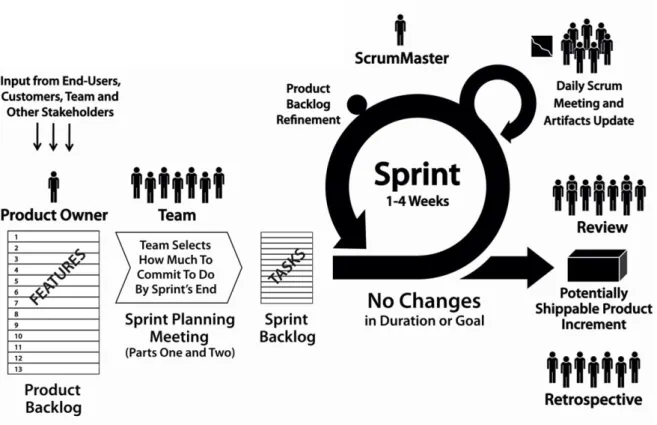
Inspired by Takeuchi and Nonaka, Jeff Sutherland adopted their analogy of Scrum as the name of a framework to organize teams and improve productivity (Sutherland, 2012). Scrum is a framework of best practices in software development. The aim of Scrum is to increase development speed, align individual and organizational objectives, create a performance culture, improve communication with shareholders and encourage learning (Deemer, Benefield, Larman, & Vodde, 2012). Scrum focuses on software development with continuous customer input using rapid iterations called sprints (Deemer et al., 2012). Table 4 describes the concepts of the Scrum framework and figure 2 shows an overview of the Scrum process.
Table 4: Concepts of the Scrum framework
Concepts Description (Deemer et al., 2012)
Product owner The product owner is responsible for the value created. He
communicates the product vision using a refined and prioritized list of features called the product backlog.
Team The team builds the product using the product backlog. It is self-organizing with a high degree of autonomy and accountability.
Concepts Description (Deemer et al., 2012)
ScrumMaster The ScrumMaster protects the team and does whatever is in their power
to help the team and product owner be successful.
Product backlog Prioritized list of product features which should be continually refined.
Sprint Development cycles of work which are timeboxed and never extended.
Sprint planning The team discusses the goals of the sprint and the prioritized items in the product backlog with the product owner in a sprint planning meeting. The team selects items from the top of the product backlog and commits to finishing them during the sprint. The team carries out detailed task planning for each selected item and reviews the definition of done with the product owner.
Sprint backlog The list of committed items for the sprint with a definition of done and detailed tasks.
Product backlog refinement
A meeting used to refine the product backlog. Items are broken down into actionable size, requirements discussed and effort estimated for each item.
Daily scrum A daily meeting where the team discusses what they have done since the last meeting, what they will do before the next meeting and any obstacles to their work.
Sprint burndown
This is a chart which shows an estimate of how much work remains in the sprint. It shows progress towards the sprint goal.
Sprint review A meeting with the relevant stakeholders and product owner where the team can get feedback for the product and the features completed in the sprint.
Sprint retrospective
A meeting where the team can learn from experience and improve the scrum process.
The Scrum process starts with the product vision. Input from customers, the team and other stakeholders is used to create the product backlog (Deemer et al., 2012). The product owner is responsible for prioritizing and refining the product backlog (Deemer et al., 2012). Each sprint starts with a sprint planning meeting where the team selects items into the sprint (Deemer et al., 2012). During the sprint the team works from the sprint backlog which cannot be changed after the sprint has started (Deemer et al., 2012).
The product owner uses 5-10% of the sprint for product backlog refinement which prepares the team and product backlog for the next sprint (Deemer et al., 2012). The team measures progress during the sprint with the sprint burndown and daily scrum meetings (Deemer et al., 2012). At the end of the sprint the team reviews the sprint with stakeholders and
demonstrate the results (Deemer et al., 2012). The aim of a sprint is to create a potentially shippable product increment which can get feedback from the customer (Deemer et al., 2012). The team also has a retrospective meeting to promote continuous improvement of the team and the Scrum process (Deemer et al., 2012).
Figure 2: Overview of Scrum (Sutherland, 2012)
Little research has been performed on the productivity of Scrum. Cardozo, Neto, Barza, Franca, and Silva (2010) did a literature review of papers relevant to the use of Scrum in software development projects. They found 274 primary studies and selected 28 papers for the review. They found that half of the papers discussed productivity. Lee (2012) used a case study to study the success factors of Scrum. He identified four success factors in Scrum and their influencers. The four factors were software development performance, software team characteristics, team competence and software development agility (Lee, 2012). These factors were influenced by e.g. the personal qualities of team members and prior experience, team autonomy, learning curve, team attitude, access to help from external experts and characteristics of tasks (Lee, 2012).
The next chapter describes the design of the research. The research is designed to identify the common underlying concepts in popular personal productivity books. A comparison with the Scrum framework as described above can give insight into how Scrum addresses these concepts to increase productivity.
3
Research Design
The research design consists of defining the scope and creating a protocol review with search, selection, data extraction and data synthesis strategies. The guidelines for performing systematic literature reviews in software engineering by Kitchenham (2004) were used in the research design. First the research questions were identified and the research scope defined from the theoretical background. Then in accordance with the guidelines a protocol review was created, which specified how the review would be carried out in a fair and systematic way. Figure 3 shows an overview of the research design.
Research Scope
a) identify research questions b) define the scope
c) identify limitations of the research
a) 3 research questions
b) scope based on personal productivity
Search Strategy
a) select search source b) design a systematic search c) design how to limit the search
a) Amazon.com, using the Amazon Product Advertising API
b) program written to perform the search,
ReviewSearchHelper
c) exclusion criteria checklist, for Amazon.com book categories
Selection Strategy
a) design a systematic selection process using a selection criteria checklist
b) order by popularity to select 40 most popular books
a) selection criteria checklist created for books relevant to personal productivity b) Amazon.com salesrank used as a popularity indicator
Sco
p
e
Data Extraction Strategy
Create a systematic data extraction process by creating data extraction forms
Book data extraction form and author data extraction form created to be filled out per book
Pro
to
co
l Rev
iew
Data Synthesis Strategy
Explore how the data will be used to answer the research questions: a) RQ1 – personal productivity
concepts
b) RQ2 – comparing concepts with theories
c) RQ3 – mapping concepts to Scrum
3 data synthesis strategies created,
a) Identify personal productivity concepts from data extraction forms
b) Compare personal productivity concepts to the theories of personal productivity of the knowledge worker c) Map concepts of Scrum to personal
productivity concepts
This chapter describes the scope and design of the research using the strategies defined in the protocol review which are; search strategy, selection strategy, data extraction strategy and data synthesis strategy.
3.1
Research Scope
The research scope was based on the working hypothesis that Scrum can create the environment and provide the tools needed by the knowledge worker to perform to his highest potential and produce value for the organization. This research will explore this hypothesis by identifying and defining concepts of personal productivity. The assumption is that personal productivity self-help books are based on the same underlying ideas and that these ideas can give insight into the personal productivity of knowledge workers. To explore these ideas, three research questions were created, they are listed in table 5.
Table 5: Research questions and objectives
Research Questions Objectives
RQ1: What are the common underlying concepts in popular personal productivity self-help books?
To identify the common underlying personal productivity concepts in forty popular personal productivity self-help books.
RQ2: Are these concepts relevant to the personal productivity of the knowledge worker?
To compare the personal productivity concepts to the definitions of knowledge workers, personal productivity and ten knowledge worker productivity factors to see if they are relevant.
RQ3: Does Scrum, an agile software development method, address concepts needed by the knowledge worker to increase his personal productivity?
To map the concepts of the Scrum framework with the personal productivity concepts to see how they are addressed and discuss their contribution to the productivity of software development.
The scope of the research is based on a definition of personal productivity which is described in section 2.2. This means that books about leadership, management, organizational productivity and communications are out of scope. The assumption is that those books discuss how to improve the productivity of others. They do not focus on the productivity of the reader. The scope is, furthermore, limited to books about generalized personal productivity. It excludes books about specific industries or roles.
The search and selection will be as thorough, fair and reproducible as possible. A computer program will be used to perform the book search. The source used to search for primary studies will be the online retailer Amazon.com, using their Amazon Product Advertising API. The Amazon Product Advertising API does not support Kindle only books. A selection bias might occur. The review uses sorting and ranking algorithms from
Amazon.com which are not public. Their reliability is unknown. One researcher will perform the book selection using a selection criteria checklist. Only English books will be selected, creating a language bias. The same researcher will read the books and extract data. The world view of the researcher might affect the results. The search strategy takes in account the scope and the limitations described above.
3.2
Search Strategy
The search strategy was designed to be systematic and enforce the limited scope. Amazon.com was chosen as a search source because of its accessibility, size and popularity. The researcher developed a software program, ReviewSearchHelper, to perform the search and first exclusions. It uses the Amazon Product Advertising API to send search requests and get information about the books. The search will be restricted to specific search parameters, book categories and the limitations of the Amazon Product Advertising API.
This subchapter details the search strategy by introducing the Amazon Product Advertising API, used to connect to Amazon.com and the software program, ReviewSearchHelper, used to perform the search. The software design of the ReviewSearchHelper will be described in detail in chapter 4.
3.2.1 Connection to Amazon.com
The Amazon Product Advertising API was used to connect to Amazon.com to perform the search using the software program, ReviewSearchHelper. The Amazon Product Advertising API is a service that supports search requests and product lookup requests to Amazon.com ("Product Advertising API, Developer Guide API Version 2011-08-01," 2011). Two identifiers are needed to use the Amazon Product Advertising API, an Associate Id and AWS Access Key Id. The Associate Id is used to earn commissions for a specific Amazon locale. The AWS Access Key ID is used to authenticate requests and identify the sender with a secret access key.The researcher applied for these two identifiers for the ReviewSearchHelper. The ReviewSearchHelper could be deemed unsuitable. The license agreement states the application´s aim should be to advertise or market the Amazon
ReviewSearchHelper
a) Search for book categories using specific keywords and parameters b) Exclude unrelevant book categories to restrict search
c) Fetch information about the books in included book categories
Amazon Product Advertising API
A service that supports search requests and product
lookup requests to Amazon.com
Amazon.com
Search source, online retailer
site ("Amazon.com Product Advertising API License Agreement," 2012). The ReviewSearchHelper´s aim is to search for books. The application was accepted and both identifiers provided. Later, the associate program rejected the application. The identifier can still be used, but no money can be earned from commissions.
The Amazon Product Advertising API has limits that affected the scope of the research. Kindle only books are not supported. It also limits the extracted results to the first ten result pages per search. The ReviewSearchHelper narrows the search using book categories until the results pages are fewer than ten. Effectively working around the limitation of the Amazon Product Advertising API. The Amazon book categories are organized in a hierarchical fashion. Each book category has child categories that narrow the search even more. The next subchapter introduces the ReviewSearchHelper.
3.2.2 The Software Used to Perform the Search
The software program, ReviewSearchHelper was designed to perform the search for books on Amazon.com. ReviewSearchHelper is a Java program developed by the researcher. It uses the Amazon Advertising API to search for books on Amazon.com. The ReviewSearchHelper consists of two main classes and their dependencies, BinSearch.java and ExtractAsin.java.
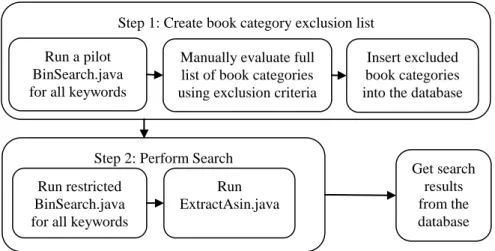
The ReviewSearchHelper carries out the first exclusions. It excludes book categories to BinSearch.java sends a book category search request for each keyword. Specific search parameters are used in all requests to the Amazon Product Advertising API. The keyword in the powerSearch, value in browseNode and itemPage change between requests. Six keywords were chosen for the search. They were derived from the research questions and scope. The keywords are: productivity, personal productivity, effective, effectiveness, efficiency and knowledge worker productivity. BinSearch.java traverses through the hierarchy of book categories until there are fewer than ten result pages or they have no more child categories. It marks those categories. ExtractAsin.java goes through the marked categories and extracts information about the books. The results are saved in a database.
Step 1: Create book category exclusion list
Step 2: Perform Search Run restricted
BinSearch.java for all keywords
Run ExtractAsin.java Get search results from the database Run a pilot BinSearch.java for all keywords
Manually evaluate full list of book categories using exclusion criteria
Insert excluded book categories into the database
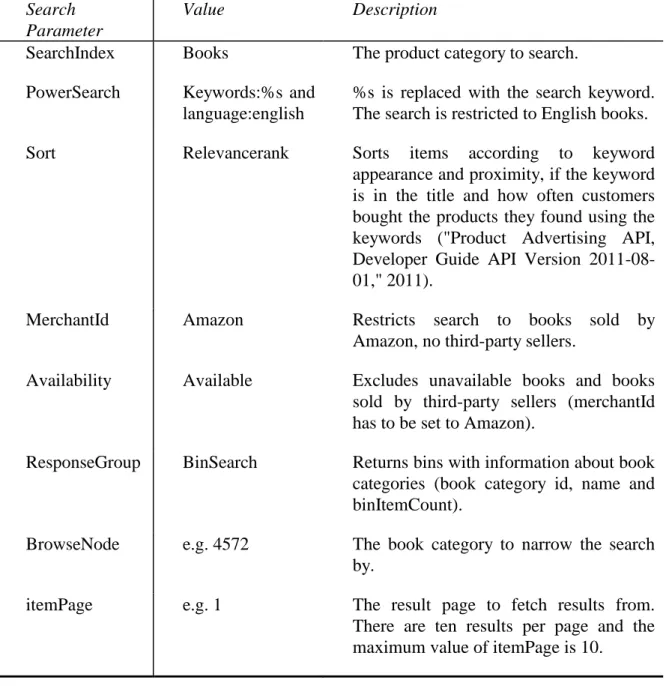
Table 6: Search parameters Search
Parameter
Value Description
SearchIndex Books The product category to search.
PowerSearch Keywords:%s and
language:english
%s is replaced with the search keyword. The search is restricted to English books.
Sort Relevancerank Sorts items according to keyword
appearance and proximity, if the keyword is in the title and how often customers bought the products they found using the keywords ("Product Advertising API, Developer Guide API Version 2011-08-01," 2011).
MerchantId Amazon Restricts search to books sold by
Amazon, no third-party sellers.
Availability Available Excludes unavailable books and books
sold by third-party sellers (merchantId has to be set to Amazon).
ResponseGroup BinSearch Returns bins with information about book
categories (book category id, name and binItemCount).
BrowseNode e.g. 4572 The book category to narrow the search
by.
itemPage e.g. 1 The result page to fetch results from.
There are ten results per page and the maximum value of itemPage is 10.
To narrow the search to relevant books a list of excluded book categories is created and inserted into the database. The BinSearch.java class uses the list to restrict the search to included categories. To create this list a pilot BinSearch.java is run without restrictions to get a full list of book categories. The full list is evaluated manually using the exclusion criteria checklist and excluded categories inserted into the database.
Table 7: Exclusion criteria checklist for book categories Exclude if book category name suggests:
its results are about a specific industry or roles (e.g. psychology, nursing, entrepreneurship, marketing),
its results are dependent on specific tools or software, its results are religion specific or about historical events, its results are about job search or hiring,
its results are about managing or leading people, or its results are organizational specific.
The exclusion criteria checklist was derived from the research questions, scope and a pilot study of book categories found with the keywords on Amazon.com. The ReviewSearchHelper performs the search using two main classes and restricts the search using book categories. The ReviewSearchHelper returns a list of self-help books which need to be manually reviewed to select relevant personal productivity self-help books. How these books are selected is described in the next subchapter selection strategy.
3.3
Selection Strategy
The aim of the selection strategy is to be systematic and return a list of relevant personal productivity self-help books ordered by popularity. The Amazon salesrank will be used as a popularity indicator. Amazon.com calculates the sales rank based on recent and historical sales of all books and is updated hourly (Amazon, 2013). The changes in the sales rank will make the research less reproducible. The search returns a list of books. The book title and description will be reviewed using the selection criteria checklist in table 8. Books that fulfill the criteria will be selected. The forty most popular books from the selected list will be read. The selection criteria checklist was derived from the research questions, scope and a pilot search of books on Amazon.com.
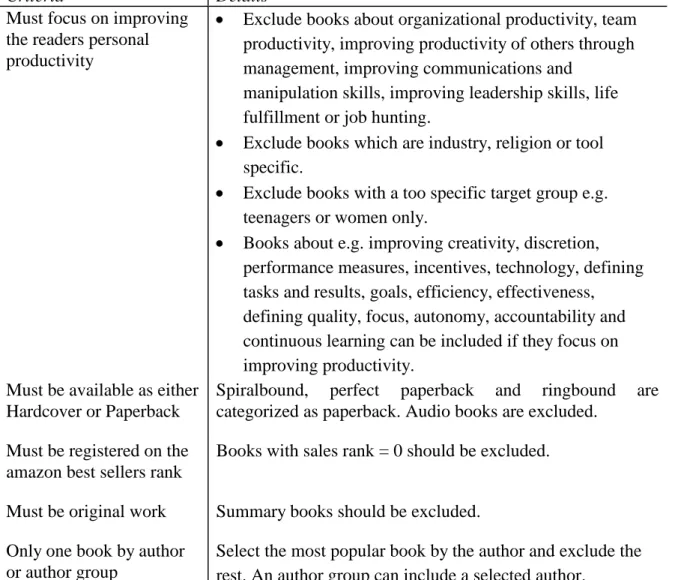
Table 8: Selection criteria checklist
Criteria Details
Must focus on improving the readers personal productivity
Exclude books about organizational productivity, team productivity, improving productivity of others through management, improving communications and
manipulation skills, improving leadership skills, life fulfillment or job hunting.
Exclude books which are industry, religion or tool specific.
Exclude books with a too specific target group e.g. teenagers or women only.
Books about e.g. improving creativity, discretion, performance measures, incentives, technology, defining tasks and results, goals, efficiency, effectiveness, defining quality, focus, autonomy, accountability and continuous learning can be included if they focus on improving productivity.
Must be available as either Hardcover or Paperback
Spiralbound, perfect paperback and ringbound are
categorized as paperback. Audio books are excluded. Must be registered on the
amazon best sellers rank
Books with sales rank = 0 should be excluded.
Must be original work Summary books should be excluded.
Only one book by author or author group
Select the most popular book by the author and exclude the rest. An author group can include a selected author.
3.4
Data Extraction and Data Synthesis Strategy
The Data Extraction Strategy ensures the books in the review are read and analyzed in a systematic way. Two forms were created which will be filled out for each book, a book data extraction form and an author data extraction form. They were created using the theoretical background and the research questions. The data extraction form templates are in Appendix C. The information extracted in this process will be used in the data synthesis strategy to answer the research questions. The data synthesis strategy describes how the objectives will be met and the research questions answered. The data needs to be summarized, compared and analyzed. The subchapters describe the data synthesis strategy for each research question.
3.4.1 Identifying Personal Productivity Concepts
To answer the first research question, common underlying concepts need to be identified from the forty self-help books. The first research question is: what are the common underlying concepts in popular personal productivity self-help books?
The ideas section in the data extraction form will be used to find these concepts. Similar ideas will be combined to create general concepts of personal productivity. This data synthesis will be performed in iterations throughout the process. After the first twenty books have been read, the first set of concepts will be identified. These concepts will be used in the data extraction form for the next twenty books, to see if they confirm the existance of these concepts. The second iteration of this data synthesis will be performed after all the books have been read. The identified concepts will be updated with the information from the second iteration and new concepts identified. The findings will be discussed in chapter 6.1.
3.4.2 Comparison with the Theories of Personal Productivity of Knowledge Workers
The personal productivity concepts identified from the books need to be compared with the definition of personal productivity, knowledge worker and the ten knowledge worker productivity factors, to answer the second research question. The second research question is: are these concepts relevant to the personal productivity of the knowledge worker? The statements from each definition from chapter 2 will be mapped to the personal productivity concepts and their relevance discussed. The findings will be discussed in chapter 6.2.
3.4.3 Mapping to the Concepts of the Scrum Framework
To answer the third research question the personal productivity concepts identified from the books will be mapped to the concepts of the Scrum framework. The third research question is: does Scrum, an agile software development method, address concepts needed by the knowledge worker to increase his personal productivity?
The concepts of the Scrum framework will be analyzed to identify what skills, techniques or methods are needed to create keywords. These keywords for each Scrum concept will then be mapped to the personal productivity concepts. The findings will be discussed in chapter 6.3.
The three research questions will be answered using the three data synthesis strategies described above. The data synthesis strategies use the data extraction forms created in the data extraction synthesis. The forty books which will be read are chosen using the seach and selection strategy. The next chapter goes into detail how the software program, ReviewSearchHelper, was designed to perform the search for books.
4
Software Design
The ReviewSearchHelper was designed to perform a systematic search of books on Amazon.com. The requirement of the program was to return a list of relevant books by sending itemSearch and itemLookup requests to Amazon using the Amazon Product Advertising API and work around its limitations. The program was written in Java 1.7, using Maven 3.0.5 for dependencies, Jersey Client to communicate with the Amazon Product Advertising API, JAXB to parse the XML responses and persistance with hibernate as a provider for the database layer.
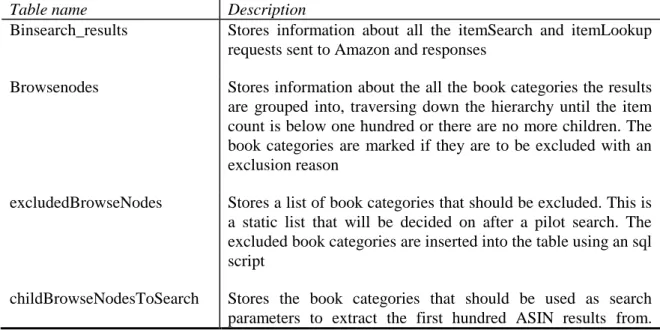
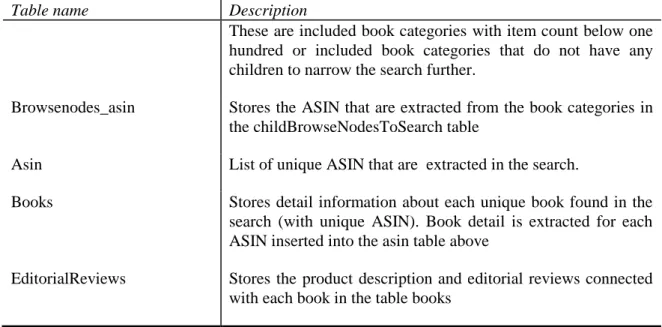
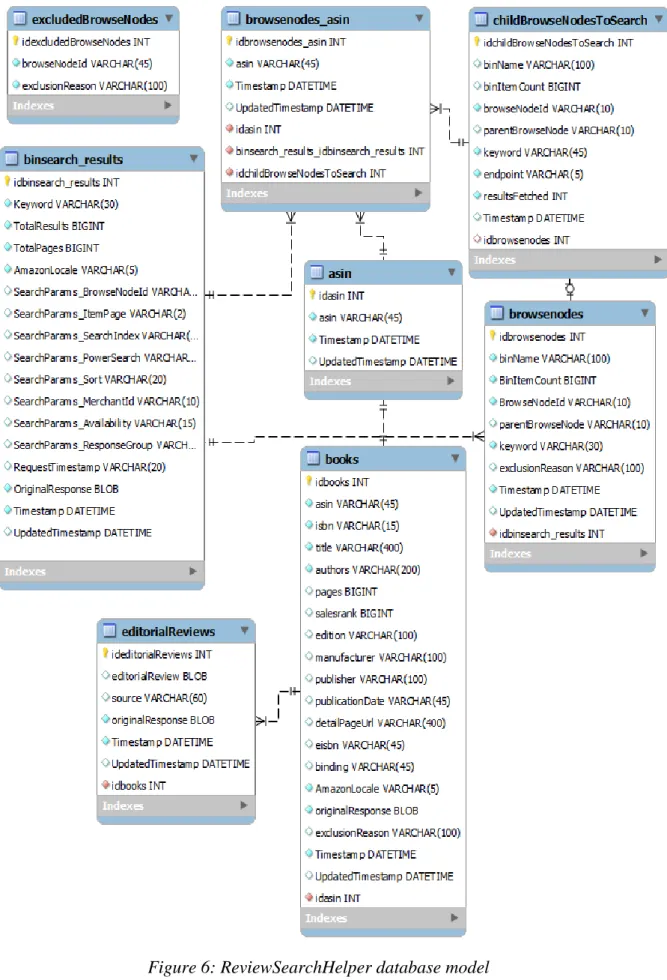
The ReviewSearchHelper performs the search and inserts the results in a MySQL database. The database was designed around the results from the itemSearch and itemLookup requests. The database needed to store and provide information about the selected book categories for the program to search in and information about extracted book results. Book categories are called browse nodes in the Amazon Product Advertising API. The ReviewSearchHelper database has eight tables which are described in table 9. Figure 6 shows the database model of how the tables are connected.
As mentioned in chapter 3, the Amazon Product Advertising API limits the results that can be extracted from Amazon.com to the first ten result pages per search sorted by relevancerank. This complicated the design of the ReviewSearchHelper. The ReviewSearchHelper works around this limitation by using Amazon.com book categories to narrow the search until there are fewer than ten result pages or there are no more child book categories to narrow the search by. There are ten results per page, so the first one hundred book results can be extracted from Amazon.com per book category using the ReviewSearchHelper.
Table 9: Description of the tables in the ReviewSearchHelper database
Table name Description
Binsearch_results Stores information about all the itemSearch and itemLookup requests sent to Amazon and responses
Browsenodes Stores information about the all the book categories the results
are grouped into, traversing down the hierarchy until the item count is below one hundred or there are no more children. The book categories are marked if they are to be excluded with an exclusion reason
excludedBrowseNodes Stores a list of book categories that should be excluded. This is a static list that will be decided on after a pilot search. The excluded book categories are inserted into the table using an sql script
childBrowseNodesToSearch Stores the book categories that should be used as search parameters to extract the first hundred ASIN results from.
Table name Description
These are included book categories with item count below one hundred or included book categories that do not have any children to narrow the search further.
Browsenodes_asin Stores the ASIN that are extracted from the book categories in
the childBrowseNodesToSearch table
Asin List of unique ASIN that are extracted in the search.
Books Stores detail information about each unique book found in the
search (with unique ASIN). Book detail is extracted for each ASIN inserted into the asin table above
EditorialReviews Stores the product description and editorial reviews connected with each book in the table books
The ReviewSearchHelper consists of two main methods, BinSearch.java and ExtractAsin.java and their dependencies. The main method in BinSearch.java takes search keywords as arguments for example, productivity, personal productivity, knowledge worker productivity, efficient, effective or effectiveness. The method will run a book category search for each keyword in the arguments.
BinSearch.java goes through the book categories of the search results. It traverses through the hierarchy until the item count is less than a hundred or there are no more child book categories. BinSearch.java marks those book categories so they can be used to extract results from. The marked book categories are saved in the database table childbrowsenodestosearch. To restrict the search excluded book categories can be inserted into the table excludedbrowsenodes. BinSearch.java skips any book category listed in the excludedbrowsenodes table and does not traverse through its hierarchy.
Figure 7 shows the flow for this method and the database tables the information is stored in. If the BinSearch.java method fails in the middle of a run, for example because of a connection problem to Amazon.com, precautions need to be made before running the
method again. All the rows need to be deleted from database tables
childbrowsenodestosearch and browsenodes for the keyword the search failed in.
The main method in ExtractAsin.java goes through the book categories in childbrowsenodestosearch from the BinSearch.java run and extracts the first one hundred ASIN (Amazon Standard Item Number) results and fetches details about each item. Figure 8 shows the flow for this method and the database tables the information is stored in. ExtractAsin.java marks each book category it has captured the information from. If the ExtractAsin.java method fails in the middle of a run it is safe to run again. It will pick up from where it stopped.
Figure 7: Activities when main method BinSearch.java is run for a keyword. Activity ends when all book categories (browse nodes), that results should be extracted from, are saved
Figure 8: Flow when main method ExtractAsin.java is run. Flow ends when all unique ASIN results have been extracted from all the book categories (browse nodes) in
The software program, ReviewSearchHelper, was designed with the sole purpose of performing the search for personal productivity self-help books on Amazon.com. The complexity of the design arose because of the limitations of the Amazon Product Advertising API. Chapter 5 describes the research execution and the results from the search, selection, data extraction and data synthesis process.
5
Research Execution
The search, selection, data extraction and data synthesis followed the strategies outlined in chapter 3. The search and selection returned 272 relevant books. Data was extracted from the forty most popular books. Figure 9 is an overview of the research execution. The subchapters are organized by strategy and discuss each phase of the research.
Phase 1: Unrestricted book search
The ReviewSearchHelper searched Amazon.com for each keyword ordered by relevance.
41097 total book results
Phase 2: Book category exclusion
a) The ReviewSearchHelper searched for book categories on Amazon.com for each keyword.
b) Complete list of categories manually reviewed using the exclusion criteria checklist in 3.1.4.
a) 1063 distinct bookcategories
b) 24 included, 1039 categories excluded Phase 3: Restricted book search
The ReviewSearchHelper searched Amazon.com for books in the included categories for each keyword ordered by relevance.
1903 total unique book results after category exclusion Sear ch (Sep t. 2 0 1 3 )
Phase 4: Book selection
a) The complete list of unique books was manually reviewed using the selection criteria checklist in table 8 by analyzing the title and book description.
b) Selected books were ordered by ascending amazon sales rank and the 40 most popular books chosen to be read
272 books were selected, 1631 books were excluded Selectio n (Sep t. 2 0 1 3 )
Phase 5: Data extraction, part 1
22 books read and data extraction forms filled out.
698 ideas from 22 data extraction forms
Phase 6: Data synthesis, part 1
a) Ideas from 22 books organized into categories by content b) Categories analyzed for concepts, the concept defined and
the discussions from the books summarized.
c) The 22 books reviewed for the concepts and concepts updated a) 698 ideas in 19 categories b) 27 concepts identified from 698 ideas
Phase 7: Data extraction, part 2
A new version of the book data extraction form created with the identified concepts. 18 books read and data extraction forms filled out.
Resulted in 26 identified concepts, one concept removed and others updated
Phase 8: Data synthesis, part 2
Concepts analyzed and research questions answered.
Data ex tr ac tio n an d s y n th esis (Oct. 2 0 1 3 – Au g u st 2014) Findings reported in chapter 6
5.1
Search
The search strategy described in 3.2 was followed to perform the search. The ReviewSearchHelper searched Amazon.com for each keyword ordered by relevance. Five keywords were used in the search; productivity, effective, effectiveness, efficient, personal productivity and knowledge worker productivity. The search was executed in three phases. First an unrestricted book search (phase 1) was carried out to see if the search needed to be narrowed manually by excluding book categories. This search resulted in 41097 books. Figure 10 shows the total book results for each keyword.
Figure 10: Total results from the unrestricted book search by keyword
The unrestricted book search confirmed the search needed to be narrowed by excluding book categories. The book category exclusion (phase 2) was performed by running only the BinSearch.java in the ReviewSearchHelper to get the complete list of book categories. The list was manually reviewed using the exclusion criteria checklist in table 7. The aim of the book category exclusion was to return a list of excluded book categories to insert into the ReviewSearchHelper database to restrict the search (see Appendix E.1).