Author(s)
Tang, F; Guo, S; Guo, M; Li, M; Wang, CL
Citation
The 2011 IEEE International Conference on Communications
(ICC), Kyoto, Japan, 5-9 June 2011. In IEEE International
Conference on Communications, 2011, p. 1-5
Issued Date
2011
URL
http://hdl.handle.net/10722/152005
Towards Context-Aware Ubiquitous Transaction
Processing: a Model and Algorithm
Feilong Tang
†,‡, Song Guo
‡, Minyi Guo
†, Minglu Li
†and Cho-li Wang
§†Department of Computer Science and Engineering
Shanghai Jiao Tong University, Shanghai 200240, China
‡School of Computer Science, The University of Aizu, Japan §Department of Computer Science, The University of Hong Kong, China
Abstract—Transaction management for mobile and ubiquitous computing aims at providing mobile users with reliable services in a transparent way anytime anywhere. To make such a vision a reality, transaction processing for the mobile and ubiquitous com-puting needs to adapt to the runtime environments dynamically. However, most existing mobile transaction models do not consider the context-based transaction management. In this paper, we propose a context-aware transaction model and context-driven coordination algorithms. They are built on an event-context-action mechanism, enabling the transevent-context-action processing to adapt well to dynamically changing transaction context. The simulation results have also demonstrated that our model and algorithms can significantly improve the successful commit ratio under unstable context conditions.
I. INTRODUCTION
Mobile and ubiquitous computing (MUC) is a new dis-tributed computing paradigm. Through MUC, people can get online access to their preferred services even while moving around, by sharing computing, communication and informa-tion services anytime anywhere. Open MUC environment is prone to failures caused by devices, applications, networks, and basic services of ubiquitous systems. However, most present researches and projects on MUC only focus on com-munication mechanisms (e.g., new comcom-munication protocols tailored for ubiquitous environments) and ubiquitous devices (e.g., with more powerful functions, smaller size and less cost)[2]. This motivates us to investigate the reliability support for advanced ubiquitous applications.
Transaction processing has been widely used to trans-parently guarantee system consistency in various distributed environments. To hide the complexity of service processes from users as much as possible, ubiquitous systems have to dynamically adapt to changing contexts and intelligently handle failures and recovery [6]. Therefore, the advanced transaction management is another key technology[2] to ensure the reliability of MUC in a transparent way. The necessity to set up reliable MUC systems has been discussed in liter-ature, e.g., in [10]. Furthermore, as pointed out in [2,9,10], the traditional mobile transaction proposals are not directly applicable to MUC transactions because MUC allows users to move freely while enjoying preferred services anytime anywhere[10]. Under such circumstances, nodes, data and services that can be directly accessed keep changing with the movement of users.
Transaction management is highly related to computing paradigms. High mobility of MUC environments presents severe challenges to MUC transaction management in the following aspects.
Context-aware transaction model. Transaction context in-cludes information from physical space, information space and human activities. Context awareness is at the center to enable transparent ubiquitous transaction services. Therefore, the MUC transaction model should have the abilities to adapt to dynamical transaction contexts, and thus it can provides general support for various ubiquitous applications.
Context-driven dynamic transaction management. The mo-bility of MUC users makes transaction context, e.g., network connection and bandwidth, continuously changing. In order to improve the successful ratio and efficiency of transactions and to reduce users’ intervention as much as possible, trans-action management should be aware of context changes, and intelligently optimize the distribution and execution modes of ubiquitous transactions.
In this paper, we investigate how to solve the above chal-lenges. Firstly, we propose a context-aware MUC transaction model that handles transactions in an event-context-action manner. Then, we present the context-driven coordination al-gorithms that achieve fast and efficient adaption for transaction processing. Our objective is to provide a context-aware and transparent transaction service for advanced ubiquitous appli-cations. Distinguishing from previous work, our model and algorithms focus on adaptively adjusting transaction execution patterns according to current context, which significantly im-proves successful commit ratio under unstable environments.
The remainder of this paper is organized as follows. Section II gives a review of related work. Section III proposes a context-aware MUC transaction model. In Section IV, we investigate context-driven transaction coordination algorithms. Experiments and evaluation on our model and algorithms are reported in Section V. Finally, Section VI concludes this paper with a discussion on our future work.
II. RELATEDWORK
Existing mobile transaction models mainly focus on the issues like network disconnection, concurrency control, repli-cation, hand-off and restricted resources[4], paying little or no
attention to the context-awareness which has become a crucial part of modern mobile applications.
Intermittent connection is the most serious challenges to mobile transaction processing. To recover from node dis-connections, CLCP [1] uses multiple coordinators to achieve robust and failure-tolerant atomic commit. In [5], a transaction processing framework is proposed to support frequent discon-nections of mobile databases. The main idea is that transaction execution can be done at both the BS (base station) and MHs(mobile hosts). Similarly, HiCoMo(High Commit Mo-bile)[3] keeps base tables for base transactions and aggregate tables for HiCoMo transactions. Concurrency control is an-other important issue for mobile transaction management. Park et al.[7] proposed an optimistic concurrency control method based on a random back-off technique. [8] proposes a multi-version transaction processing approach and a deadlock-free concurrency control mechanism based on a multi-version two-phase locking scheme integrated with a timestamp approach.
Transaction management in ubiquitous environments needs to detect transaction context, such as connectivity and network bandwidth, and then flexibly decides how to coordinate sub-transactions. It has not achieved by existing proposals. This paper is motivated to solve this key issue, especially on the adaptive transaction model and coordination algorithms.
III. CONTEXT-AWARETRANSACTIONMODEL
A. Context of MUC Transactions
The significant difference between MUC and traditional mo-bile computing is that MUC frees users from the complexity of service processes as much as possible by automatically collecting context and adaptively adjusting execution policies. So context awareness is a prerequisite to the MUC transaction processing.
Transaction context includes information from physical space, information space, and human activities related to transaction processing. More specifically, MUC transactions mainly concerns on the following context.
• Wireless network(WN), with attributes connectivity, band-width, delay, losing ratio, cost and stability
• Mobile device(WD), with attributes computing capacity, available memory, available battery, available data, available cache and security
• Location, with attributes longitude and latitude
• User, with attributes profile, purpose and requirements
• Time, with attributes start time and ending time.
B. Context-Aware Transaction Model
A context-aware transaction model for ubiquitous environ-ments can be formulated by the following definition.
Definition 1 (MUCT). An MUC transaction (MUCT) is a 6-tuple MUCT = (T, CT, ECA, D, T S, F S), where:
T={Ti |1in} and CT={CTi |1in} are the set of subtransactions in an MUCT and the set of compensating transactions for the subtransactions, respectively, in which
n is the number of the subtransactions in an MUCT. Each
TABLE I
TRANSACTION STATE DESCRIPTION.
Symbol State Description
I initiation transaction does not start to execute
E executing transaction is executing and has not committed S submitted transaction has successfully committed
F failed transaction has failed to commit and been
rollbacked to the previous state
C compensating compensating transaction is being executed
subtransaction Ti (Ti∈T) can associate at least one compen-sating transaction CTi such that CTi can semantically undo the affects of Ti submitted previously.
ECA=<ECAi|1in>is the list of ECA
(event-context-action) rule descriptors, where ECAi is the rule descriptor of the subtransaction Ti. ECAi has higher priority than ECAi+1.
EachECAi=<Ei, Ci, Ai> is also a list of 3-tuple: event,
context and corresponding action, which describe multiple context-based execution policies for the subtransaction Ti, and are described as follows.
• Ei={Eij}: a set of events that occur during the execution of Ti.
• Ci={Cik}: a set of context associated with a subtransac-tion Ti. We also take Ci as the conditions that must be met for the execution of Ti. Ci covers five dimensions: WN, MD, Location, User, and Time as described in the last subsection. Note that Ci changes dynamically.
• Ai={Ail}: a set of corresponding actions. For example, a user wants to reserve flight tickets from traveling agent A, and the communication link is disconnected at that time. Once such an event is detected, transaction manager may try to connect another traveling agent B to resume the ticket reservation.
Dis a set of dependencies between Tiand Tj (Ti, Tj∈T). We define two kinds of dependencies: successful submission dependency(s) andfailed submission dependency(f). The dependency TisTj means that Tj cannot be executed until Ti successfully commits, while TifTj denotes that Tj can start its execution only if Ti fails to commit.
I
S
F
E C
Fig. 1. State conversion diagram of MUC transactions.
T S={S1, S2, . . . , Sn} is a set of states of all
subtransac-tions in a MUC transaction. Si, the state of subtransaction Ti, is in one of five possible states: I, E, F, S and C (see Table I). Each subtransaction starts with state ‘I’ and ends with state ‘S’ (if it commits successfully) or ‘F’ (if it fails to commit). Fig.1 illustrates the state conversion.
F S is a set of acceptable final states. An MUC transaction may have multiple proper final states that an user is ready to
accept, probably with different priorities.
C. A Case Study
In this section, we describe how to model MUC transactions in a specific scenario. We consider a patient John, driving a car equipped with a mobile device(MD), needs to find a hospital in emergency. MD first queries the nearest hospital to find whether it satisfies medical conditions (T1) for John. If the hospital qualifies, MD sends John’ current physical status to the hospital to prepare corresponding medical services(T2), and then queries the public traffic information service to discover the best path to that hospital based on current road states(T3). If T1fails, MD subscribes the medical service from the Health Service Central Hospital(T4), which can provide versatile medical services while probably being far away.
We model these activities as a MUC transaction such that T={T1, T2, T3, T4}and CT={φ, CT2,φ,φ}, where CT2is the compensating transaction for canceling the reserved medical services. The dependency in T is illustrated in Fig.2.
T1 T2 T3
T4
Start T1 successes End
T 1 fails
OR
Fig. 2. A case of MPC Transactions.
ECA=<<E1,C1,A1>,<E2,C2,A2>,<E3,C3,A3>,<E4,C4,
A4>> describes how to adapt to the context, where
<E1,C1,A1>=<<E1,C11,A11>,<E1,C12,A12>>.
Specifical-ly, <E1,C11,A11> means that MD successfully queries the nearest hospital if the context C11 is qualified, such as connectivity=connected and bandwidth = high (or medium), for the query, where E1 means that John initiates a query to the hospital; A11 is the action that MD queries the hospital successfully. Accordingly, if C11 is unqualified, A12 will be executed, which means MD will contact with the Health Service Central Hospital. <E2,C2,A2>, <E3,C3,A3> and
<E4,C4,A4>are similar.
D={T1sT2, T2sT3, T1fT4, T4sT3}. This depen-dency D specifies that this transaction may be executed in one of two sequencesσ1={T1,T2,T3} andσ2={T1,T4,T3}.
FS={(S, S, S, -), (F, -, S, S)}, where ‘S’ and ‘F’ stand for the successful and failed execution of the corresponding subtransaction respectively, while ‘-’ means that the execution state of the subtransaction does not affect the decision.
IV. CONTEXT-DRIVENCOORDINATIONALGORITHMS FOR
MUC TRANSACTIONS
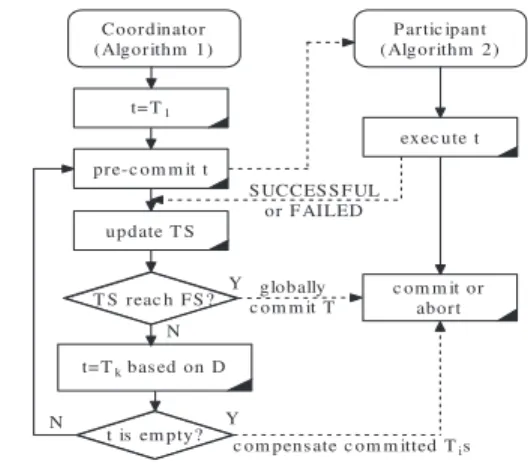
A global MUC transaction T={T1,T2,. . . ,Tn} is initiated by a mobile device (called requestor) while subtransactions are distributed to n mobile devices (called executor). Ac-cordingly, our context-driven coordination approach based on the proposed MUC transaction model consists of two parts:
algorithm1 and algorithm2, which are respectively executed
by a Coordinator in a transaction requestor andnParticipants located in executors. S UCCES S F UL or F AILED Y T S reac h F S ? N pre-c om m it t t is em pty? N
c om pens ate c om m itted Tis
Coordinator (Algorithm 1) P artic ipant (Algorithm 2) t= T1 update T S t= Tkbas ed on D exec ute t c om m it or abort Y globally c om m it T
Fig. 3. Coordination flow for MUC transactions.
Algorithm 1 Coordination algorithm in a requestor
Input: T={T1, T2, . . . , Tn},CT={CT1, CT2, . . . , CTn} ECA rules, dependency set D
Output: T execution result
1: query host Hi for executing Ti in registration center;
2: TS={I,I,. . . ,I};
3: t←T1;
4: while (TSFS)do
5: if (an event t.Ek occurs){
6: check corresponding contextt.Ck;
7: fori=0 to RetryNum do
if (t.Ck is qualified) { sendt toHk;
Sk=‘E’;
wait incoming message;
if (the message is SUCCESSFUL) Sk=‘S’;
else
if (the message is FAILED) Sk=‘F’;} end for} 8: t←−D next subtransaction Tk; 9: if (t=φ) break; 10: end while 11: if (TS⊆FS)
globally commit T by the message CONFIRM;
12: else
compensate subtransactions committed previously by the message CANCEL;
The global MUC transaction T is executed until its state TS achieves one of acceptable final states or no subtransaction exists. The order of executing subtransactions is determined by transaction dependency D. In the case studied in last section, for example, T4 will be immediately executed if T1 fails. The state of each subtransaction is set according to its
execution result. Finally, if one of acceptable final states has achieved, the algorithm confirms all submitted subtransactions. Otherwise, it requires subtransactions submitted previously to execute their corresponding compensating transactions. We illustrate the transaction coordination flow in Fig.3.
Algorithm 2 Coordination algorithm in executors
Input: SubtransactionTk
Output: Execution result of Tk
1: failed:=false;
2: while(Tk does not finish and (not failed)) do
3: execute application operations inTk;
4: if (fail to execute the operations)
5: failed:=true;
6: end while
7: if (failed)
8: send a FAILED message to the requestor;
9: else{
10: send a SUCCESSFUL message to the requestor;
11: wait incoming message;
12: if (receive a CONFIRM message)
13: report execution results to the requestor;
14: else if (receive a CANCEL message){ 15: execute Ti’s compensating transaction;
16: report Ti is cancelled; } }
The algorithm1 coordinates global MUC transactions, where a subtransaction Ti is submitted to an execution node only when (1) it has not been executed(i.e., Si=‘I’), (2) the corre-sponding event occurs, and (3) its context Ci is qualified. By the qualified context, we mean that the current context of a transaction Ti satisfies requirements for executing Ti.
The algorithm2 actually executes individual subtransactions, under the control of the Coordinator by interacting with coordination messages. If a subtransaction is successfully executed, it will be confirmed or compensated upon receiving the message CONFIRM or CANCEL from the Coordinator, respectively. Otherwise, it automatically rollbacks to the pre-vious system state.
V. EXPERIMENTS ANDEVALUATION
We have implemented a simulation system to evaluate the feasibility of the proposed MUC transaction model. We have also investigated how much the successful commit ratio of MUC transactions is improved by using our context-driven coordination algorithms.
A. Experiment Environment
In our system, there are 100 self-organized mobile nodes. Each node acts as a requestor as well as an executor. More specifically, any node can not only issue global MUC trans-action requests but also execute sub-transtrans-actions submitted by other nodes.
The features of node mobility are simulated by changing link states. Let wireless links between nodes disconnect in a probabilityDisconnectProb. In addition, we model the system
load in the number of concurrent MUC transactions (marked asNumMobiTran). The MUC transactions were randomly ini-tiated and concurrently executed in the system. Each of them consists of two subtransactions as T={T1,T2}. Our current experiments concentrate on how to adapt to the dynamic network connectivity and bandwidth.
We evaluate two kinds of transactions:context-aware trans-action (WithCA) and non-context-aware transaction (With-outCA). For WithCA transactions, if the context of a subtrans-action Tiis unqualified, the Coordinator in a requestor resends Tito other nodes for at most RetryNum (RetryNum>1) times. On the other hand, a WithoutCA transaction is dispatched only once so it would fail if at least one link among a requestor and executors is unqualified. In the following experiments, we set RetryNum=3.
B. Results and Evaluation
Because high mobility and frequent network disconnection significantly decrease the transaction commit probability, the
successful ratio (SR) is normally used as the major perfor-mance metrics of mobil transaction models. Therefore, we evaluate MUC transactions throughSRthat is defined as a ratio of transactions submitted successfully to total transactions within a given period.
For each kind of MUC transactions, we conducted compre-hensive simulations in the following various network settings.
100 150 200 250 300 350 400 450 500 10 20 30 40 50 60 70 80 90 100
Number of Concurrent Transactions
Successful Ratio (%)
WithoutCA WithCA
Fig. 4. SR against the number of concurrent transactions.
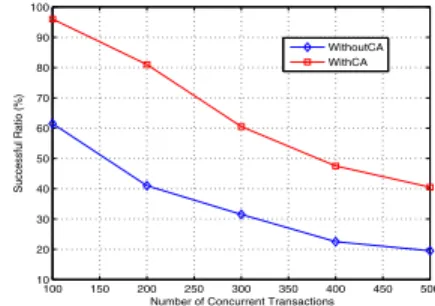
1) The Number of Transactions: In this experiment, we varied the number of concurrent MUC transactions from 100 to 500, where link disconnection probability is fixed at DisconnectProb=0.1. The performance results obtained for the two kinds of transactions WithCA and WithoutCA are shown in Fig.4. The SR degrades for both strategies as the transaction load increases. The reason is that higher load on the physical resources causes heavier data conflicts. From this figure, we can see that in the whole range of the transaction load, WithCA always performs better than WithoutCA. This is because WithCA may redispatch a transaction for at most RetryNun times if previous requests failed while WithoutCA sends a transaction request only once.
2) Disconnected Probability: When a link disconnects or has no enough bandwidth, the nodes connected by the link can no longer initiate transaction requests or report execution
0.1 0.2 0.3 0.4 0.5 0.6 0.7 20 30 40 50 60 70 80 90 100 Disconnection Probability Successful Ratio (%) WithoutCA
WithCA
Fig. 5. SR against link disconnection probability.
results. Therefore, for both WithCA and WithoutCA trans-actions, link states have significant impact on the SR. In this experiment, we measure the transaction SR by varying the DisconnectProb from 0.1 to 0.7 with an increment of 0.1. The performance results are shown in Fig.5, where the number of concurrent MUC transactions in system was fixed as NumMobiTran=50.
As we can see, the performance of the system becomes worse for both execution strategies WithCA and WithoutCA as the value of link disconnection probability increases. The rea-son is that with the increase of failure probability of wireless links, more subtransactions can not be sent to the target nodes. However, the relative performance of WithCA to WithoutCA is not affected by such probability of wireless link failure because WithCA transactions would resend subtransactions to other nodes for more options that WithoutCA transactions do not have. 1 2 3 4 5 6 7 40 50 60 70 80 90 100
Number of Interaction Operations
Successful Ratio (%)
WithoutCA WithCA
Fig. 6. SR against the number of interaction operations in a transaction.
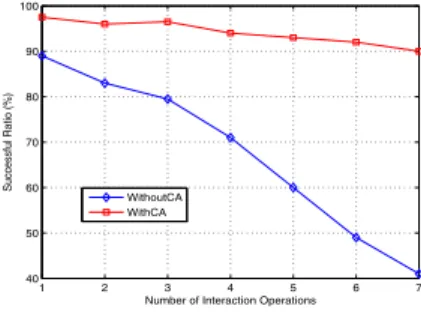
3) The Number of Interaction Operations: Interaction op-erations are issued by a mobile host during its execution. As shown in the previous example, if the query for the nearest hospital is successful, the mobile device sends John’s current emergency status to the hospital and queries public traffic information service to discover the best path to that hospital based on current road states. We can expect that the successful ratio of MUC transactions will become worse as such interac-tions increase duo to communication failures. In this experi-ment, we varied the number of interaction operations in MUC transactions from 1 to 7 with the increment of 1 to evaluate the performance impact of the number of interaction operations. Performance results obtained in terms of the success ratio are
provided in Fig.6, where NumInteration means the number of interaction operations in a MUC transaction.
As the number of interaction operations increases, the performance of WithCA gets a little bit worse because WithCA transactions can be re-executed multiple times. By comparison, a steeper performance degradation is observed in WithoutCA strategy as the number of interaction operations increases. The reason is that WithoutCA transactions are dispatched only once so that the failure probability of these transactions is accumu-lated with the increasing interactions among a mobile device and ubiquitous services through unstable wireless connections.
VI. CONCLUSIONS ANDFUTUREWORK
We have presented a context-aware transaction model and context-driven coordination algorithms. The proposed model and algorithms can adaptively adjust transaction management policies according to the dynamic transaction context. The performance studies show that our proposal can significantly improve the transaction commit ratio of MUC transactions under unstable environments.
We are going to investigate flexible and light-weight mecha-nisms to automatically generate compensating transactions for MUC environments.
ACKNOWLEDGMENT
Feilong Tang thanks The Japan Society for the Promotion of Science (JSPS) for providing the excellent research envi-ronment for his JSPS Postdoctoral Fellow (ID No. P 09059) Program in The University of Aizu, Japan.
This work was supported by the National Natural Science Foundation of China (NSFC) with Grant Nos. 61073148 and 60773089, the National Science Fund for Distinguished Young Scholars with Grant Nos. 61028005 and 60725208, and Hong Kong RGC with Grant No. HKU 717909E.
REFERENCES
[1] S.Obermeier, S.Bottcher, D.Kleine. A cross-layer atomic commit pro-tocol implementation for transaction processing in mobile ad-hoc networks.Distributed and Parallel Databases, 26(2): 319-351, 2009. [2] M.Franklin. Challenges in Ubiquitous Data Management,Informatics,
pp. 24-33, 2001.
[3] M.Lee, S.Helal. HiCoMo: High Commit Mobile Transactions,Kluwer Academic Publishers Distributed and Parallel Databases (DAPD), 11(1): 73-92, 2002.
[4] R. A.Dirckze, L.Gruenwald. A pre-serialization transaction manage-ment technique for mobile multidatabases,Mobile Networks and Ap-plications (MONET), 5(4): 311-321, 2000.
[5] Z.Abdul-Mehdi, A.B.Mamat, H.Ibrahim et al. A model for transaction management in mobile databases.IEEE Potentials, 29(3):32-39, 2010. [6] R.Rouvoy, P.Serrano-Alvarado, P.Merle. Towards Context-Aware
Transaction Services. InLNCS 4025, pp.272-288, 2006.
[7] S.Park, S.Jung. An energy-efficient mobile transaction processing method using random back-off in wireless broadcast environments.
Journal of Systems and Software, 82(12):2012-2022, 2009.
[8] S.K.Madria, M. Baseer, V.Kumar et al. A transaction model and mul-tiversion concurrency control for mobile database systems.Distributed and Parallel Databases, 22(2):165-196, 2007.
[9] N.Roy, S.K.Das. Enhancing Availability of Grid Computational Ser-vices to Ubiquitous Computing Applications IEEE Transactions on Parallel and Distributed Systems, 20(7):953-967, 2009.
[10] F.Perich, A.Joshi, T.Finin et al. On Data Management in Pervasive Computing Environments,IEEE Transactions on Knowledge and Data Engineering, 16(5): 621- 634, MAY 2004.