Caught-in-Translation (CiT): Detecting Cross-level
Inconsistency Attacks in Network Functions Virtualization
Sudershan Lakshmanan Thirunavukkarasu
A Thesis in
The Department of
Concordia Institute for Information Systems Engineering
Presented in Partial Fulfillment of the Requirements for the Degree of
Master of Applied Science (Information Systems Security) at Concordia University
Montréal, Québec, Canada
August 2020
C
ONCORDIA
UNIVERSITY
School of Graduate Studies
This is to certify that the thesis prepared
By: Sudershan Lakshmanan Thirunavukkarasu
Entitled: Caught-in-Translation (CiT): Detecting Cross-level Inconsistency Attacks in Network Functions Virtualization
and submitted in partial fulfillment of the requirements for the degree of
Master of Applied Science (Information Systems Security)
complies with the regulations of this University and meets the accepted standards with re-spect to originality and quality.
Signed by the final examining committee:
Dr. Mohsen Ghafouri Chair Dr. Olga Ormandjieva External Examiner Dr. Chadi Assi Internal Examiner Dr. Lingyu Wang Supervisor Dr. Mengyuan Zhang Co-supervisor Approved by
Chair of Department or Graduate Program Director
August, 2020
Dr. Mourad Debbabi, Dean
Abstract
Caught-in-Translation (CiT)
: Detecting Cross-level Inconsistency Attacks
in Network Functions Virtualization
Sudershan Lakshmanan Thirunavukkarasu
By providing network functions through software running on standard hardware, Net-work Functions Virtualization (NFV) brings many benefits, such as increased agility and flexibility with reduced costs, as well as additional security concerns. Although existing works have examined various security issues of NFV, such as vulnerabilities in VNF soft-ware and DoS, there has been little effort on a security issue that is intrinsic to NFV, i.e., as an NFV environment typically involves multiple abstraction levels, the inconsistency that may arise between different levels can potentially be exploited for security attacks. Existing solutions mostly focus on verification, which is after the fact and cannot prevent irreversible damages. Further adding to the complexity, the different abstraction levels can be managed by multiple service providers, which may render the data required for verifi-cation inaccessible. Moreover, many existing solutions are limited to a single abstraction level and disregard the multi-level nature of NFV.
In this work, we propose the first NFV deployment model to capture the deployment aspects of NFV at different abstraction levels, which is essential for an in-depth study of the inconsistencies between such levels. We then present concrete attack scenarios in which the inconsistencies are exploited to attack the network functions in a stealthy manner. Based on the deployment model, we study the feasibility of detecting the inconsistencies through verification. Furthermore, by drawing an analogy between multi-level NFV events
approach, namely,Caught-in-Translation (CiT), to detect cross-level inconsistency attacks in NFV. Specifically, we first extract event sequences from different abstraction levels of an NFV stack. We then leverage the Long Short-Term Memory (LSTM) to translate the event sequences from one level to another. Finally, we apply both similarity metric and Siamese neural network to compare the translated event sequences with the actual sequences to detect attacks. We integrateCiTinto OpenStack/Tacker, and evaluate its performance using both real and synthetic data. Experimental results show that CiT outperforms traditional anomaly detection and provides an accurate, efficient, and robust solution for detecting inconsistency attacks in NFV.
Acknowledgments
Firstly, I would like to thank my thesis advisor, Dr. Lingyu Wang. His continuous support, guidance and belief in my research abilities helped me the most to finish this thesis work successfully. Whenever I reached out to him with issues related to my work, he always put me on the right path. With his inspiring speeches, he kept me inspired, motivated and driven towards achieving the results. I am extremely fortunate to have had him as my supervisor. I would also like to extend my thanks to my co-supervisor, Dr. Mengyuan Zhang, for the time and effort she has invested to help me with my research. She has always made me think out of the box by asking the right questions. Her invaluable support and guidance helped me throughout my research and for completing my master’s thesis.
I would also like to express my deep gratitude to the members of Audit Cloud Ready (ARC) research group from both Concordia University and Ericsson Research Canada for all the insightful and enthusiastic discussions that has helped me in several occasions. I thank all other faculty members of the CIISE department. I also thank all the examining committee members of my master thesis defence.
Finally, I would like to acknowledge the unconditional support given by my family and friends throughout the years of my master’s study. This accomplishment would not have been possible without them.
Contents
List of Figures x
List of Tables xiv
1 Introduction 1 1.1 Inconsistencies in an NFV Stack . . . 1 1.2 Thesis Statement . . . 3 1.3 Contributions . . . 4 1.4 Thesis Organization . . . 5 2 NFV Deployment Model 6 2.1 Preliminaries . . . 6
2.1.1 The ETSI NFV Reference Architecture . . . 6
2.1.2 NFV Service Models . . . 9
2.1.3 The Cloud Architecture . . . 9
2.2 Motivating Example . . . 10
2.3 The NFV Deployment Model . . . 12
2.3.1 Overview . . . 12
2.3.2 L1: Service Orchestration Level . . . 14
2.3.4 L3: Virtual Infrastructure Level . . . 16
2.3.5 L4: Physical Infrastructure Level . . . 17
3 Inconsistencies in NFV Stack 18 3.1 Overview . . . 18
3.2 Threat Model . . . 20
3.3 Attacks targeting the consistency property . . . 20
3.3.1 Attacks at L2 . . . 20
3.3.2 Attacks at L3 . . . 21
3.4 Attack Scenarios . . . 21
3.4.1 Attack Scenario 1 . . . 22
3.4.2 Attack Scenario 2 . . . 24
3.5 Feasibility of Consistency Verification . . . 25
4 Detecting Cross-level Inconsistency Attacks in NFV 27 4.1 Motivating Example . . . 27
4.2 Key Ideas . . . 29
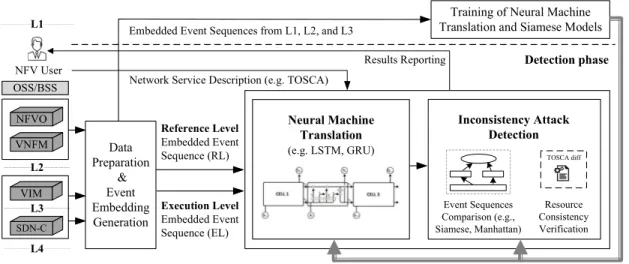
4.3 CiT Overview . . . 30
4.3.1 Training Phase . . . 31
4.3.2 Detection Phase . . . 31
4.4 Data Preparation and Event Embedding Generation . . . 32
4.4.1 Data Preparation . . . 32
4.4.2 Event Embedding Generation . . . 35
4.5 Neural Machine Translation . . . 36
4.5.1 Background on LSTM . . . 36
4.6.1 Background . . . 38
4.6.2 Training . . . 39
4.6.3 Inconsistency Detection . . . 40
4.6.4 Diff-based TOSCA Verifier . . . 42
5 Implementation and Experiments 44 5.1 Implementation of NFV Testbed . . . 44
5.1.1 Onboarding Network Service Descriptors . . . 46
5.1.2 Instantiating the Network Service . . . 46
5.1.3 NFV Testbed Components . . . 47
5.2 Experiments . . . 52
5.2.1 Implementation Details and Experimental Settings . . . 52
5.2.2 Datasets . . . 54
5.2.3 Challenges in Processing the Real-World Data . . . 55
5.2.4 Evaluation on Out-of-Vocabulary (OOV) Events . . . 56
5.2.5 Event Embedding Model . . . 58
5.2.6 Inconsistency Detection Evaluation . . . 59
5.2.7 Robustness Evaluation . . . 67
5.2.8 Hyperparameter Selection . . . 70
5.2.9 Efficiency and Scalability . . . 76
6 Discussion 81 6.1 Additional Use Cases . . . 81
6.2 Feasibility of Training . . . 82
6.3 Employing Attention-based Translation Mechanisms . . . 82
6.4 Adapting to other NFV Platforms . . . 83
7 Related Work 84
7.1 NFV Models . . . 84
7.2 NFV Security . . . 84
7.3 Anomaly Detection on Sequential Data . . . 85
7.4 Translation-based Security Approaches . . . 86
8 Other Contributions 87 8.1 NFVGuard: Verifying the Security of Multilevel Network Functions Virtu-alization (NFV) Stack . . . 87
8.2 NFV Testbed Deployment . . . 88
8.2.1 Implementation Challenges . . . 88
9 Future Work and Conclusion 91 9.1 Future Work . . . 91
9.2 Conclusion . . . 92
List of Figures
1 The ETSI NFV reference architecture [19] . . . 8 2 The NIST cloud model [59] depicting the two-layer view of a multi-tenant
virtualized infrastructure in cloud . . . 10 3 An inconsistency between the NS specification and instance . . . 11 4 The multilevel NFV deployment model . . . 13 5 An implemented attack at L2 causing inconsistency between the path
spec-ificationVNFFG1:NFP1and its instancenfp1-chain . . . 22 6 An illustration of the attack timeline when Alice modifies Bob’s port-chain
nfp1-chainby adding a maliciousmVDUat L2 . . . 23 7 An example showing the feasibility of verifying inconsistencies based on
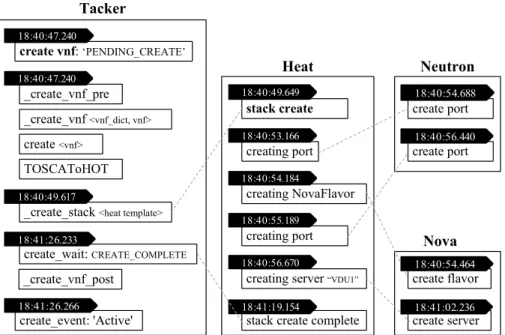
data extracted from different levels . . . 25 8 The motivating example . . . 27 9 CiT System Overview . . . 30 10 An example of causal dependencies between events in Tacker/OpenStack
services . . . 33 11 Example Tacker log entries and the output of data pre-processing (event
sequences and corresponding parameters) . . . 35 12 An example of Seq2Seq translation using the LSTM Encoder-Decoder model
13 An example of training the Siamese Manhattan Network with NFV event
sequences . . . 40
14 An example of event-level and workflow-level inconsistency detection . . . 41
15 A real-world NFV deployment on our testbed implemented using Open-Stack Tacker and ODL. The circled numbers indicate deployment stages: 1) Onboarding the NS Descriptors, 2) Deploying the VNFs, 3) Configuring the VNFs and 4) Instantiating the NS . . . 45
16 VNF catalog in Tacker Horizon showing a list of onboarded VNFDs . . . . 48
17 VNFM module in Tacker Horizon showing a list of deployed VNFs . . . . 48
18 VNFFG catalog in Tacker Horizon showing a list of onboarded VNFFGDs . 49 19 VNFFG manager module in Tacker Horizon showing a list of deployed VNFFGs . . . 49
20 OpenStack VIM . . . 50
21 OpenStack system overview . . . 50
22 OpenStack system defaults . . . 51
23 A list of all the OpenStack services in the NFV testbed . . . 51
24 OpenFlow Rules corresponding to the deployed VNFFGs . . . 52
25 (a) The growth of vocabulary size, and (b) the proportion of unseen event types . . . 57
26 Visualization of NFV events with t-SNE . . . 58
27 The ROC evaluation results ofCiTsbased on D1 . . . 60
28 The ROC evaluation results ofCiTsbased on D2 . . . 61
29 The ROC evaluation results ofCiTsbased on D3 . . . 61
30 The ROC evaluation results ofCiTsbased on D4 . . . 62
33 The ROC evaluation results ofCiTsbased on D7 . . . 63
34 The ROC evaluation results ofCiTsbased on D8 . . . 63
35 The ROC evaluation results ofCiTsbased on D9 . . . 64
36 The ROC evaluation results ofCiTsbased on D10 . . . 64
37 The ROC evaluation results ofCiT based on the datasets D1 . . . 66
38 The ROC evaluation results ofCiT based on the datasets D2 . . . 66
39 The ROC evaluation results ofCiT based on the datasets D7 . . . 66
40 The ROC evaluation results ofCiT based on the datasets D9 . . . 67
41 The ROC evaluation results ofCiT based on D10 tested on D9 . . . 68
42 The impact of number of epochs onCiT- AUC vs. # of epochs . . . 71
43 The impact of number of epochs onCiT- Loss vs. # of epochs . . . 71
44 The impact of number of epochs onCiT- Accuracy vs # of Epoch . . . 72
45 The impact of number of epochs onCiT- Precision vs # of Epoch . . . 72
46 The impact of number of epochs onCiT- Recall vs # of Epoch . . . 72
47 Evaluation of data separation ratio - AUC . . . 73
48 Evaluation of data separation ratio - Loss . . . 73
49 Evaluation of data separation ratio - Training Time . . . 74
50 CiT efficiency study: Training Time. The results are obtained based on LSTM with Em = 256 and U = 250. . . 77
51 CiT efficiency study: Time vs. Training Pairs. The results are obtained based on LSTM with Em = 256 and U = 250. . . 77
52 CiT efficiency study: Hidden Unit Type. The results are obtained based on LSTM with Em = 256 and U = 250. . . 78
53 CiT efficiency study: Event Embedding Dimension; The top sub-figure shows the results from D9 dataset, and the bottom sub-figure shows the results from D10 dataset. . . 78
54 CiT efficiency study: Seq. Embedding Dimension; The top sub-figure shows the results from D9 dataset, and the bottom sub-figure shows the results from D10 dataset. . . 78 55 The evaluation of testing time . . . 80 56 The topology view of VNFs implemented in our NFV tested from
List of Tables
1 Main acronyms used in this thesis . . . 7
2 Dataset statistics (the gray shaded datasets are processed real data) . . . 53
3 Statistics of the original real data (from May 2017 to March 2020) . . . 53
4 Robustness evaluation ofCiT: Sequence label translation for the real-world data. (%) indicates the percentage of correctly translated labels. . . 69
5 Robustness evaluation of CiT. Case study on real-world bugs and denied operations . . . 70
6 The evaluation of data separation based on five metrics . . . 74
7 AUC (%) vs. event embedding dimensions (U = 256) . . . 75
8 AUC (%) vs. event sequences embedding dimensions (Em = 250) . . . 75
Chapter 1
Introduction
Network Functions Virtualization (NFV) has emerged as one of the main technology pillars of 5G networks [35, 112]; for instance, 60% of network service providers will be adopting NFV by 2021 [80] and the NFV market size is projected to grow from $12.9B in 2019 to $36.3B by 2024 [34]. The main benefit of NFV comes from its power in decoupling the network functions, such as firewall or intrusion detection, from dedicated and proprietary hardware appliances. By providing network functions through software-based Virtual Net-work Functions (VNFs) running on top of standard hardware infrastructures, NFV makes it possible for providers to deploy dynamic, agile, scalable, and cost-efficient network ser-vices.
1.1
Inconsistencies in an NFV Stack
Despite such advantages, the increased complexity of an NFV stack means the attack sur-face of NFV environments will be significantly larger than that of traditional networks, leading to novel security vulnerabilities and threats [30]. Existing works [26, 41, 83, 110] have addressed various security threats in NFV (e.g., vulnerabilities in VNFs,
vulnerabili-the lack of interoperability) and proposed corresponding solutions (e.g., hypervisor intro-spection, secure zoning, and image signing).
However, a security issue that is intrinsic to NFV has received little attention, i.e., as NFV environments typically involve several levels of abstraction, the inconsistency be-tween those levels may arise due to the lack of proper synchronization bebe-tween man-agement and orchestration components, which can be exploited by malicious adversaries for security attacks. Although the inconsistency threats have been investigated in other contexts such as cloud and SDN [46], [109], it has only received limited attention in NFV [23, 82, 83, 94] and there lacks an in-depth study about how such inconsistencies may be instantiated and exploited based on concrete deployment of NFV, and how such inconsistencies may be modeled and identified based on existing data in NFV. Addition-ally, such attacks may cause severe security concerns, such as unauthorized modifica-tions of Service Function Chains (SFCs), network eavesdropping, and DDoS, as evidenced by real-world vulnerabilities (e.g., [56–58, 71, 72, 74, 75]) and reported in recent studies (e.g., [23, 24, 41, 83, 90, 94, 110]). Therefore, to ensure the secure deployment of NFV, it is essential to detect such inconsistency attacks (in fact, our solution is able to detect many of the above-mentioned real-world vulnerabilities, as shown later in this work).
To that end, most of the existing works (e.g., [25,27,28,47,48,50,99,102,113,114]) ver-ify the state (e.g., configurations) of the NFV system to detect such inconsistency attacks, which suffers from the following limitations. First, those solutions are mostly retroac-tive in nature as they can only conduct the inconsistency verification after the fact and with a delay (e.g., time to verify). Therefore, those solutions cannot prevent irreversible damages (e.g., information leakage and DoS). Second, most of those approaches (e.g., [25, 28, 50, 102, 114]) heavily rely on the access to lower-level configurational data (e.g., network flow rules, flow classifiers, etc.). However, the practicality of those works could be limited when multiple providers are involved, as accessing the required lower-level data
may become infeasible [98]. Finally, to the best of our knowledge, none of the existing works considers the implication of all abstraction levels in the NFV stack, whereas most only focus on part of the NFV stack (e.g., the physical infrastructure [47], the virtual in-frastructure [48], or Service Function Chaining (SFC) [27, 99, 102, 113, 114]).
1.2
Thesis Statement
In this work, we observe the gap between what is needed for understanding the inconsisten-cies (i.e., detailed information about the NFV deployment) and what is currently available in the ETSI NFV reference architecture [17]. The observation leads us to devise a novel NFV deployment model based on studying existing NFV deployment in open source plat-forms. Our deployment model complements the ETSI NFV architecture with details about all the critical components of an NFV environment, their relationships, and their levels of abstraction. Our deployment model enables us to present concrete attack scenarios in which the inconsistency vulnerabilities are exploited to attack NFV in a stealthy manner. We validate our model and attacks through implementation based on a real NFV testbed, and presenting a feasibility study on the verification solution by gathering information re-quired for identifying the consistency.
As a solution for detecting such inconsistencies in an NFV stack, we propose a novel approach, namely,Caught in Translation (CiT), to translate event sequences between dif-ferent levels of an NFV stack and detect cross-level inconsistency attacks. More specifi-cally, we first study the cross-level mapping of NFV events and generate embeddings for both events and event sequences. Second, we devise an NMT-based technique (tested with Long Short-Term Memory (LSTM) [32], Gated Recurrent Unit (GRU) [14], and simple Recurrent Neural Network (RNN) [3]) to translate event sequences between different
lev-metric [91] to quantify the similarity between a translated event sequence and the actual event sequence in order to detect any inconsistencies. We implementCiT and integrate it into OpenStack/Tacker [98], a popular choice for NFV deployment on cloud management platform. Through extensive experiments with both real and synthetic data, we demon-strate the accuracy and efficiency of our approach. Finally, we discuss several use-cases to demonstrate the practicality ofCiT.
1.3
Contributions
In summary, the main contributions of this work are as follows:
1. To the best of our knowledge, our NFV deployment model is the first effort to capture how NFV is deployed in the real world based on open source platforms, and we believe such a model may see many other applications.
2. The attack scenarios demonstrate both the feasibility and the severity of inconsistency-based security threats, which could draw more attention to this issue and provide insights to its mitigation. Our study about the information required for identifying inconsistencies serves as a foundation for developing security verification solutions to detect such threats.
3. To the best of our knowledge,CiTis the first event-based approach to detect inconsis-tency attacks in an NFV stack. In contrast to most after-the-fact approaches,CiTcan catch malicious events at runtime before such events cause any potentially irrecover-able damages, such as the leakage of sensitive information or denial of service. 4. CiT demonstrates the potential of a translation-based detection approach. First,CiT
is shown to outperform traditional anomaly-based detection in terms of accuracy. Second, the comparison of the three variations of CiT shows that translation can
significantly improve the detection accuracy. Finally, the translation capability may have other applications in NFV, such as providing translated events at a level where the access to actual events is prohibited (e.g., by a different provider).
5. The practicality of CiT is demonstrated through its integration into OpenStack/-Tacker. Its accuracy and efficiency are evaluated through extensive experiments using both real and synthetic NFV datasets, and its robustness is examined through train-ing and testtrain-ing with data collected from different systems, and capturtrain-ing anomalous events triggered by real world bugs and errors. Additionally, we discuss the extension ofCiT to other NFV platforms (e.g., OSM [78], and OPNFV [77]).
1.4
Thesis Organization
The remainder of the thesis is organized as follows. Chapter 2 reviews the ETSI NFV architecture and introduces our NFV deployment model. Chapter 3 presents the attack scenarios and studies the feasibility of consistency verification. Chapter 4 introduces our translation-based inconsistency detection system. Chapter 5 details the implementation and provides the experimental results. Chapter 6 provides more discussions. Chapter 7 reviews the related work and Chapter 8 details contributions to other projects. Chapter 9 elaborates the future work and concludes the thesis.
Chapter 2
NFV Deployment Model
In this chapter, we first review the ETSI NFV architecture and explain what additional information is needed to understand the inconsistencies through a motivating example. We then introduce our multi-level NFV deployment model.
2.1
Preliminaries
2.1.1
The ETSI NFV Reference Architecture
ETSI [19] introduced the NFV reference architecture as represented in Figure 1, to en-able dynamic deployment and management of VNF instances and the relations between them [19]. Figure 1 shows the NFV reference architecture from ETSI (the callouts are not a part of ETSI NFV architecture and will be explained in Chapter 2.2). The architecture in-cludes three main blocks, namely, Virtual Network Functions (VNFs), NFV Infrastructure (NFVI), and NFV Management and Orchestration (MANO). First, VNFs provide a high-level representation of network functions. Second, NFVI represents the cloud infrastruc-ture that provides basic compute, network and storage capabilities. Third, MANO supports dynamically managing and orchestrating the lifecycle of physical and virtual resources,
which is further divided into three managerial components, Virtual Infrastructure Manager (VIM), Virtual Network Function Manager (VNFM), and Network Function Virtualization Orchestrator (NFVO), to complete the entire deployment process. The Operating Support System/Business Support System (OSS/BSS) is considered as an independent module sup-ported by MANO.
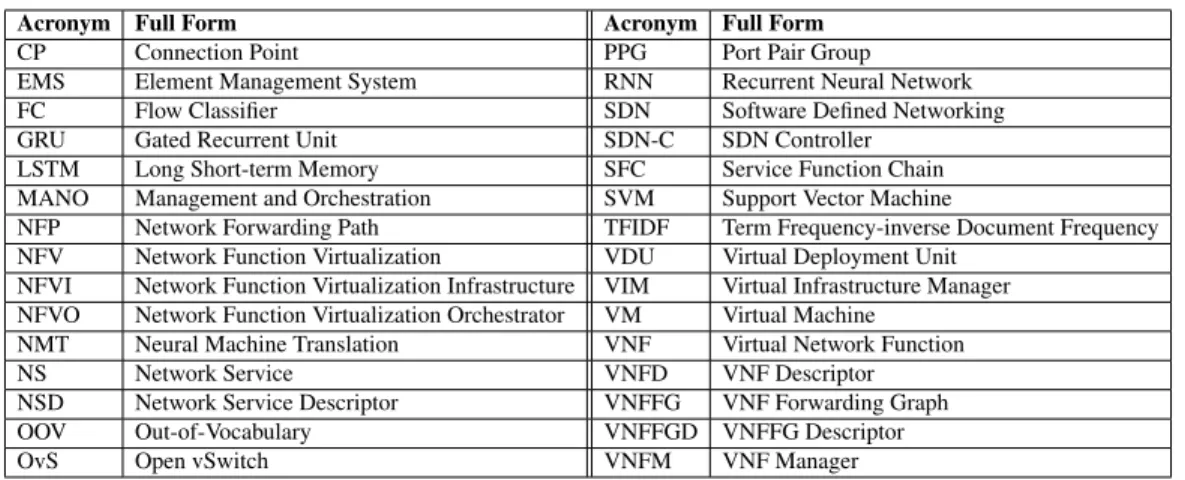
Table 1 lists the main abbreviations we use in this thesis.
Acronym Full Form Acronym Full Form
CP Connection Point PPG Port Pair Group
EMS Element Management System RNN Recurrent Neural Network FC Flow Classifier SDN Software Defined Networking GRU Gated Recurrent Unit SDN-C SDN Controller
LSTM Long Short-term Memory SFC Service Function Chain MANO Management and Orchestration SVM Support Vector Machine
NFP Network Forwarding Path TFIDF Term Frequency-inverse Document Frequency NFV Network Function Virtualization VDU Virtual Deployment Unit
NFVI Network Function Virtualization Infrastructure VIM Virtual Infrastructure Manager NFVO Network Function Virtualization Orchestrator VM Virtual Machine
NMT Neural Machine Translation VNF Virtual Network Function NS Network Service VNFD VNF Descriptor NSD Network Service Descriptor VNFFG VNF Forwarding Graph OOV Out-of-Vocabulary VNFFGD VNFFG Descriptor OvS Open vSwitch VNFM VNF Manager
Table 1: Main acronyms used in this thesis
Virtual Infrastructure Manager
VIM manages physical resources and the virtualized pool of compute, storage and network resources in NFVI. VIM interacts with NFVO and SDN controller to facilitate network service orchestration and traffic steering respectively. VIM’s northbound interface facil-itates orchestration and management module of NFV. The southbound interface interacts with the hypervisor and network controller to implement virtualization and traffic steering respectively.
Virtual Network Function Manager
Figure 1: The ETSI NFV reference architecture [19]
Network Function Virtualization Orchestrator
NFVO handles the complete deployment process of an NS. The two main functionalities of NFVO are: (i) Resource Orchestration, where it orchestrates the resources under the control of multiple VIMs and (ii)Service Orchestration, where it coordinates with multiple VNFMs to create and manage an end-to-end NS. Hence, NFVO is often referred as “the brain of NFV”.
Hence, MANO can be considered as the most critical block inside this architecture in terms of its role in inducing inconsistencies. For example, if the three managerial com-ponents are in accordance with each other for every change inside the NFV environment, inconsistency can certainly be avoided up to a degree. However, that is not the case accord-ing to the current implementation methodologies. Therefore, it is important to understand the role of each managerial component before exploring the inconsistency problem.
2.1.2
NFV Service Models
The following NFV use cases are proposed by ETSI which corresponds to the existing cloud service models (IaaS, PaaS and SaaS) [18].
NFV Infrastructure as a Service (NFVIaaS)
This model enables cloud service providers to lease the infrastructure from another service provider (e.g., a Network Service Provider) to deploy their virtual NSs. Network service provider shall be able to integrate their VNF instances running on the leased infrastructure into an end-to-end network service instance on their own NFV infrastructure.
Virtual Network Platform as a Service (VNPaaS)
In this case, the service provider builds a generic virtual platform which is used by an enterprise to deploy their own network services. This model allows the enterprises to have complete administrative privileges over the network service.
Virtual Network Function as a Service (VNFaaS)
VNFaaS is in accordance with Software as a Service (SaaS) model where a VNF is a network service provider’s application and an enterprise (end-user) becomes the consumer of the network service. The end-user is only able to configure the VNFs without being able to control or manage the underlying platform.
2.1.3
The Cloud Architecture
NIST defines cloud architecture into two distinct layers [59]. The Management Layer comprises of cloud management operations (e.g., create network), which assists tenants to manage their virtual environment. TheInfrastructure Layer includes underlying
imple-key to implement multi-tenancy. SDN can be integrated into the cloud architecture to fur-ther define the east-west traffic flow, which provides the basis to realize service function chaining.
Figure 2: The NIST cloud model [59] depicting the two-layer view of a multi-tenant virtu-alized infrastructure in cloud
2.2
Motivating Example
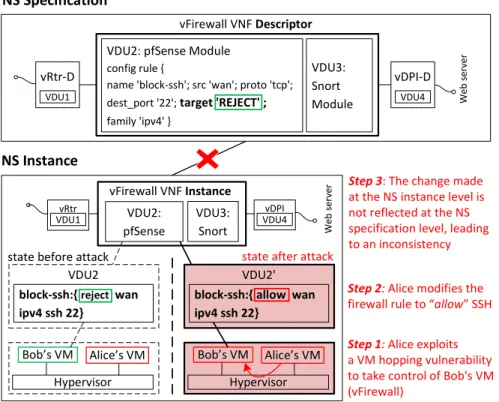
To illustrate what might be missing in the ETSI NFV architecture when it comes to study-ing the inconsistencies, Figure 3 shows a simple example of inconsistency. First, the NS specification (top of the figure) shows that Bob has specified a virtual firewall (vFw) with two Virtual Deployment Units (VDUs), i.e., VDU2 with pfSense for routing and fire-walling (the rule shows that any SSH requests should be rejected), andVDU3withSnort for IDS. Second, the corresponding NS instance depicts the changing state ofVDU2before and after an attack is launched by another user, Alice. By exploiting a VM hopping vul-nerability (e.g., CVE-2015-3456 (Venom), CVE-2015-7835, and CVE-2018-10853), Alice
gains control of VDU2and modifies its pfSenserule to allow SSH requests to the Web server. Importantly, such a change made by Alice on VDU2 will not be reflected at the higher level (in the VNF Descriptor), which leads to a stealthy attack caused by the incon-sistency between the two levels.
Figure 3: An inconsistency between the NS specification and instance
To model this attack using the ETSI architecture, we revisit Figure 1. As the callouts show, the attack involves the following NFV deployment details missing in the ETSI archi-tecture.
- The mappings between VDUs and VNFs, NS instance and VNF, NS instance and NFVI are all absent from the ETSI architecture, e.g., the mapping between the virtual firewall descriptor and the two VDUs is essential to understand the inconsistency in
- The mapping between the management and implementation layers of clouds [59] is also missing in the ETSI model, e.g., the mapping between Bob’s VM and VDU2 allows us to link the attackstep 1andstep 2.
- Other details like the traffic steering related to the dependencies between the man-agerial components and the corresponding virtual resources are also missing.
To complement the ETSI architecture with such missing details, the next chapter de-vises an NFV deployment model.
2.3
The NFV Deployment Model
This chapter proposes a multilevel deployment model for NFV environments. We first provide an overview and then detail each level of the model.
2.3.1
Overview
Our NFV deployment model is based on the NFV deployment of several popular open source platforms including Open Networking Automation Platform (ONAP) [61], Tacker [64], OpenStack [64], and OpenDaylight [62]. We extract the operational dependencies between managerial components (i.e., NFVO, VNFM, VIM, and SDN-C) and functional elements (e.g., VNF, VM, SFC, and virtual switches). We separate the NFV stack into four levels as follows. The first level is based on the common deployment aspects from both ONAP and Tacker, i.e., NFVO and VNFM collaborate together to process descriptors and perform high-level management of VNFs and their connectivity. The second and third levels are based on NIST’s cloud architecture [59], i.e., the management layer for cloud management operations and the implementation layer for underlying implementations.
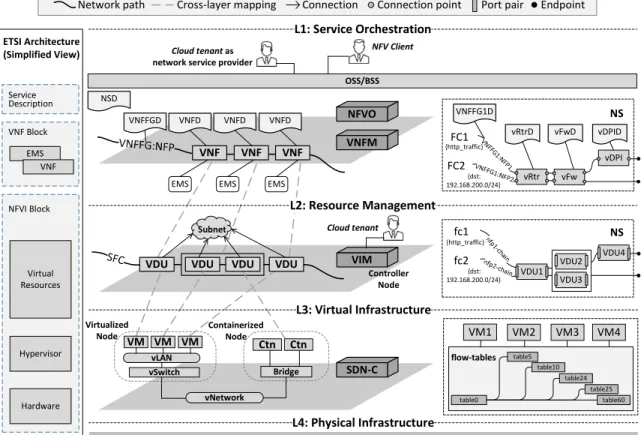
Figure 4 presents our multilevel NFV deployment model (middle) with the mapping to the ETSI NFV reference architecture (left) and our motivating example (right). Specifically,
Figure 4: The multilevel NFV deployment model
1. TheService Orchestration (L1) level is the entry point for NFV users to input their intended design specifications of network services (NS). The managerial components at this level are VNFM and NFVO, which control the onboarding of VNF, and NS based on user specifications.
2. TheResource Management(L2) level instantiates the specifications. The managerial component at this level is VIM, which receives requests from NFVO and deploys the corresponding NS instance accordingly.
3. TheVirtual Infrastructure(L3) level incorporates the virtual compute, storage, and network resource pool. The SDN controller (SDN-C) plays a critical role in manag-ing network traffic steermanag-ing at this level.
4. Finally, thePhysical Infrastructure(L4) level depicts all physical resources to com-plete an end-to-end NFV stack.
2.3.2
L1: Service Orchestration Level
L1 includes the deployment components such as NFVO, VNFM, NSD, VNF, and EMS. Two key NFV managerial components at L1 are NFVO and VNFM, which manage NSs in the form of catalogs such as network service descriptor (NSD). NSD can include other de-scriptors, such as VNF descriptors (VNFD) and VNF forwarding graph descriptors (VNF-FGD). Descriptors provide all necessary network service specifications and implementation information in structured templates for orchestration. For example, the traffic steering is defined in VNFFGD; the incoming network traffic would first pass flow classifiers (FC) before being forwarded to a specific network function path (NFP). An NFP connects VNFs with connection points (CPs) using virtual links.
To deploy an NS instance, an NFV user specifies the descriptors as inputs for NFVO. After NFVO validates the technical accuracy of such inputs, NFVO and VNFM inform VIM to allocate the underlying resources to implement the NS. NFVO manages the VNFFG (network topology), whereas VNFM with Element Management System (EMS) performs high-level management of the individual VNFs based on users’ specifications, e.g., the logical mapping between VDUs and VNFs. However, the implementation details at lower levels are not reflected in VNFM. We place VNFs at the same level of VNFM because of this operational dependency.
Example 1. Tenant Bob wants to deploy an NS with three VNFs to steer traffic to two destinations. The right side of L1 in Figure 4 shows this NS is deployed using four de-scriptors. The NSD for this instance is the composition ofVNFFG1D,vRtrD,vFwD, and vDPID. The lower part of this sub-figure bridges the descriptors with the implementation. For example, vFw at this level includes the interpretation of its corresponding descriptor
vFwD and the instance identifiers ofVDU2 and VDU3 from the lower level. This logical mapping helps to understand the deviation betweenvFwDandVDU2should any inconsis-tencies occur. Logically, NFP1 contains the sequential order of connection points (e.g., CP:vRtr) to chain all three VNFs. FC1 classifies all HTTP traffic to NFP1, while FC2 sends the management traffic throughNFP2.
2.3.3
L2: Resource Management Level
L2 contains virtual resources such as VDUs, subnets, SFC, network ports, etc., depicting how the NFV virtual resources are created and managed inside the cloud environment. VIM is directly responsible for provisioning, interconnecting and decommissioning these virtual resources contained in an NFVI-PoP domain (an NFVI instance). VDUs at L2 follow a many-to-one relationship with the VNFs from L1 and a one-to-one logical mapping with the VMs from the lower level. VNFFGs from L1 are instantiated as service function chains (SFCs; also referred to as port chains). SFC is a sequence of port pair groups, which consist of one or more port pairs.
Once the resource allocation request is received from NFVO, VIM allocates the com-pute, storage and network resources corresponding to the given descriptors. Then, the virtual resources, such as VDUs, subnets, network ports, routers, service chains, are in-stantiated to build an NS. Although VIM can be considered as a part of both L2 and L3, the management operations are executed by cloud tenants from L2 through VIM to directly manage the virtual resources. Hence, VIM is considered as a part of L2 in our model.
Example 2. Once VIM receives the resource creation request from NFVO, it creates the deployment units (e.g.,VDU1) as shown on L2. These VDUs are then configured based on NSD. For example, the mapping ofvFwtoVDU2andVDU3is configured to allow HTTP traffic and block SSH traffic. After the creation and configuration of VNFs, the network
paths are created as defined in VNFFGD. These function paths are implemented as port-chainsnfp1-chainandnfp2-chainwith the respective flow-classifier instancesfc1 andfc2. By definition, nfp1-chainis an ordered list of port-pair-groups (CPs at L1) PPG1, PPG2 and PPG3 corresponding to the virtual instances VDU1, VDU2 andVDU3, respectively.
2.3.4
L3: Virtual Infrastructure Level
L3 includes SDN-C and the virtual networking elements, such as virtual switches, VLANs, VxLANs, virtual routers, flow tables, virtual bridges, and the corresponding interfaces. SDN-C is the management element inside this level (we follow the most widely adopted use case in the SDN usage specification [20] to place SDN controller at this level for provid-ing network connectivity). Flow-tables form the fundamental elements for network traffic steering. These flow-tables are populated with flow-rules, which depict the forwarding be-havior of the SFC. Once the service chains are created, the corresponding traffic flows for each chain are deployed in the virtual switches for traffic steering through VMs. The de-ployment of traffic flow rules is carried out by the SDN-C; this is another reason for us to place SDN-C at this level.
Listing 2.1: Flow-rule that forwards HTTP traffic to vRtr VNF
c o o k i e =0 x 7 9 4 1 8 8 f e 3 6 8 f e 9 0 1 , d u r a t i o n = 1 1 0 8 2 8 1 . 1 7 4 s , t a b l e = 0 , n _ p a c k e t s = 0 , n _ b y t e s = 0 , p r i o r i t y = 3 0 , t c p , i n _ p o r t =" q v o 6 0 9 4 f 4 7 a −3 f " , n w _ s r c = 1 9 2 . 1 6 8 . 1 0 0 . 1 1 , n w _ d s t = 1 9 2 . 1 6 8 . 1 0 0 . 1 0 0 / 3 2 , a c t i o n s = g r o u p : 1
Example 3. Listing 2.1 shows the flow-rule that classifies and forwards the HTTP traffic throughvRtrto the web server. table0acts as an FC for the SFC. Each flow-rule has a matchcriteria followed by theactionthat is to be performed for the matched traffic. In case ofnfp1-chain, simplematchcriteria is to select all HTTP packets originating from the
in_port:qvo6094f47a-3fwith thenw_srcas192.168.100.11and the destination as192.168.100.100/32. Then theactionis to forward the matched packets tovRtr VNF, which is denoted as group:1 referencing the VNF’s port-pair-group. The traffic is then forwarded togroup:2 (vFw) andgroup:3 (vDPI) before it reaches the actual destination.
2.3.5
L4: Physical Infrastructure Level
This level includes all the physical entities (e.g., COTS servers as controller and compute nodes, and physical network functions (PNFs)) that are involved in the NFV stack. The actors involved at this level are typically the physical infrastructure operators or facility managers who also represent the managerial components. The model does not include many details at this level for the sake of clarity.
Chapter 3
Inconsistencies in NFV Stack
In this chapter, we first discuss inconsistencies in NFV and explore potential attacks for exploiting the inconsistencies at different levels. We then provide two concrete attack sce-narios to validate our multi-level NFV deployment model.
3.1
Overview
The inconsistency between the NS specification and instance as discussed in our motivating example (Chapter 2.2) is only a special case. Despite the fact that NFVO is considered as the “brain” of an NFV environment, the other managerial components can operate at each level autonomously, which is referred to as the “split-brain” issue in the literature [21]. For example, VIM and SDN-C can manipulate virtual resources and virtual network freely without going through NFVO. Such autonomous management is intentional in order to effectively manage multiple domains in a single NFV environment (e.g., there can be mul-tiple VIMs managing many NFVI Points of Presence (NFVI-PoP)). However, the lack of synchronization is not intended [82], and it can lead to inconsistencies whenever the states of functional elements managed by two different managerial components differ from each
other. Additionally, in order to facilitate VNFs to mimic the promiscuous mode of tradi-tional networking devices and to route traffic, port security (i.e., packet filtering on a port) is disabled for the VNF instances during NFV deployment by default. The downside of this feature is that, there is no network isolation between tenants who are on the same network. These fundamental design properties of NFV greatly facilitate the attacks that lead to sig-nificant discrepancies in the overall system. Aftermost, the NFV client who is dependent on the underlying levels is unaware of the contemporary functionality of his own network service. These inconsistencies can potentially lead to unexpected behaviors or network errors, security threats [83, 94] including some stealthy attacks as presented later in this chapter.
Therefore, the inconsistency may potentially arise between any managerial components and their functional elements inside an NFV environment. To that end, our multilevel NFV deployment model provides a foundation for analyzing potential inconsistencies, as it sufficiently captures the relationships between different levels of components in an NFV environment. For example, the inconsistencies between the management level and the implementation level of cloud [46] and SDN [109] could be mapped to L2 and L3, while the inconsistencies between user specification and the actual deployment could be captured by comparing L1 to the lower levels.
Next, we investigate potential attacks exploiting the cross-level inconsistencies based on our deployment model shown in Figure 4 and a concrete implementation based on Open-Stack Tacker [64] and OpenDaylight (ODL) [62] (which will be detailed in Chapter 5). We will focus on possible attacks originated at L2 and L3, respectively, which could cause inconsistencies with the user specifications given at L1.
3.2
Threat Model
We assume that the adversary can be a malicious cloud tenant, an admin operator, or an external attacker who controls a virtual machine (e.g., via malware infection) with system privilege. The adversary is assumed to share part of the infrastructure (e.g., compute hosts and physical network) with the victim. We also assume that the cloud infrastructure can have vulnerabilities that the adversaries may identify and exploit. We do not assume the adversaries can compromise the managerial elements, and we donotassume the adversaries can compromise SDN controllers or switches.
3.3
Attacks targeting the consistency property
This chapter explains the possible attack cases which can lead the NFV stack to an incon-sistent state.
3.3.1
Attacks at L2
By targeting the managerial component in this level (VIM) and the other functional ele-ments such as VDU, port-chain, security groups etc., an attacker gains a variety of oppor-tunities to render the NFV system to an inconsistent state.
The potential attacks originated at this level could lead to the modification of VDUs, port-chain, security groups, etc., which could all lead to an inconsistent state of the NFV system. We discuss several possibilities to achieve such attacks in the following.
– Through VIM, a malicious cloud admin, a cloud operator colluding with an external attacker, or a malicious cloud user exploiting a privilege escalation vulnerability will be able to modify the functional elements of another user’s NS. Over time, OpenStack has seen several privilege escalation and sensitive data exposure vulnerabilities, such
as OSSA-2016-005 and OSSA-2017-004 [68]. By exploiting such vulnerabilities, an attacker can perform many unauthorized operations, such as updating a service chain by including a malicious VNF, for the system to reach an inconsistent state.
– As illustrated in our motivating example, an attacker can also take over the control of a VM through exploiting a hypervisor vulnerability and then modifying either its configurations or the traffic flow to lead to an inconsistent state in which the attacker’s actions at L2 are not reflected at L1 causing a stealthy attack.
3.3.2
Attacks at L3
Existing security threats in SDN, such as malware infection, topology poisoning [33], con-trol plane saturation [95], and state manipulation attacks [107], can be employed to manip-ulate the traffic flow in L3. We discuss some possible attacks at this level as follows.
– An attacker can send crafted packets to the SDN controller to externally trigger un-desirable events that lead to inconsistencies. For example, by enabling/disabling the network interfaces on a host, the attacker can trigger host-related events such as HOST_JOIN,HOST_LEAVE, etc.
– An attacker can compromise a virtual switch and program it to modify traffic flows to cause inconsistencies. For example, a critical vulnerability (CVE-2018-1078[63]) in ODL can be exploited to cause uncontrolled communication between VNFs by programming the switch to reconnect to the network upon new flow update events.
3.4
Attack Scenarios
This chapter introduces two real attack scenarios which were implemented in our NFV testbed (introduced in Chapter 5) highlighting the feasibility of an NFV stack to be led to
3.4.1
Attack Scenario 1
Using our testbed, we have implemented a concrete attack that targets the integrity of a service function chain (SFC).
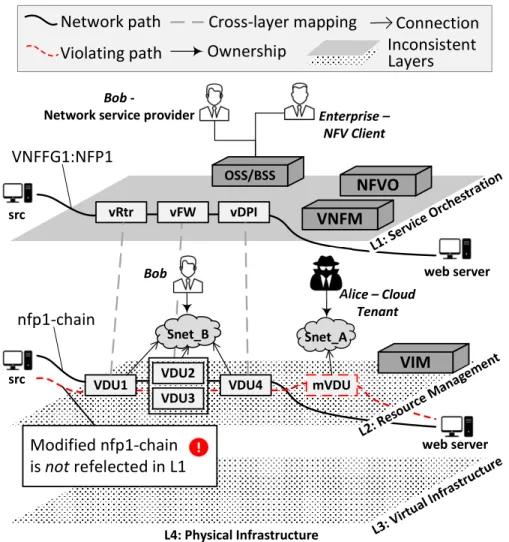
Figure 5: An implemented attack at L2 causing inconsistency between the path specifica-tionVNFFG1:NFP1and its instancenfp1-chain
In Figure 5, Bob is a network service provider serving enterprise NFV clients who happens to share the physical infrastructure with a malicious tenant Alice. The red dashed line shows a compromised service chain instance, nfp1-chain, which is modified by Alice to include a malicious VNF. However, as our test has shown, such a modification at L2 will not be reflected at L1, leading to an inconsistent state of the NFV stack and a
stealthy attack allowing Alice to inspect or modify traffic passing the chain.
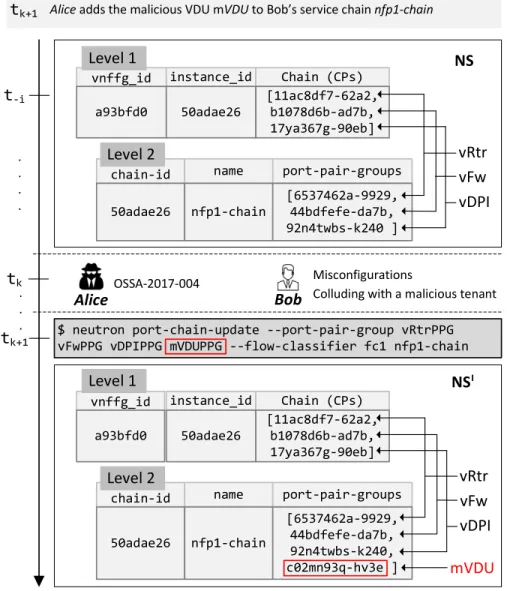
Figure 6: An illustration of the attack timeline when Alice modifies Bob’s port-chain nfp1-chainby adding a maliciousmVDUat L2
More specifically, Figure 6 shows the attack timeline. The port-chain instance (nfp1-chain) ofNFP1consists of three port-pair-groups corresponding to the three VNFs att−itime.
Al-command which would updatenfp1-chainby adding the port-pair-group of a malicious VNFmVDU. Upon the execution of theneutron port-chain-updatecommand, the flow-rules will be updated in the virtual switches forvDPIto forward the traffic further to mVDUas opposed to the path definition in the VNFFGD element of L1. To this end, themVDUVNF is added as a hop in Bob’s port-chain allowing Alice to have unauthorized access to any traffic flowing throughNFP1without being noticed.
3.4.2
Attack Scenario 2
The second concrete attack targets the flow-tables at L3 for causing inconsistencies between L3 and the upper levels. When the network topology gets updated, the SDN controller will install new flow-rules in the virtual switches to reflect the changes. To manipulate the flow-tables at L3, an attacker can trigger a virtual switch reconciliation (a functionality to ensure that switches properly reflect intended controller configurations after restarts) by sending crafted network packets during a network topology update. This would cause the old flow-rules to be installed instead of the new flows. Therefore, the traffic will be steered as specified by the old flow definition contravening the topology update.
Specifically, assuming the end user (NFV Client) updates NS’s topology by changing its VNFFG1definition at L1 to add vDPI toNFP2, which will redirect the management server’s traffic throughvDPIfor further analysis. Upon the update, the corresponding port-chain (nfp2-chain) and flow-rules in the virtual switches must be updated at L2 and L3, respectively. Meanwhile, an attacker triggers a SWITCH_LEAVE event by continuously resetting TCP sessions [107] between compute1_vswitch and the controller. When the switch reconnects, the old flow-rules are re-installed as a consequence of the node-reconciliation vulnerability, leading the traffic ofNFP2to be forwarded to the management server directly without passingvDPI. However, L1 and L2 are not aware of this change in the actual traffic flow, leading the NFV system into an inconsistent state.
In addition to the attacks presented in this chapter, there might be many other ways for exploiting the cross-level inconsistencies in an NFV stack (e.g., attacking the flow-classifier component). To address this issue, we provide a feasibility study on identifying inconsistencies through verification.
3.5
Feasibility of Consistency Verification
Security verification using formal methods [44,94,109] or graph-based approaches [38] has seen applications in clouds and SDN, and it can also provide a viable solution for detecting the aforementioned inconsistencies in NFV. A key challenge is to understand what data needs to be collected from which component of an NFV stack in order to identify the inconsistencies. Based on our multilevel deployment model, we provide some preliminary results on the data collection to show the feasibility of verifying the consistency of NFV.
Figure 7: An example showing the feasibility of verifying inconsistencies based on data extracted from different levels
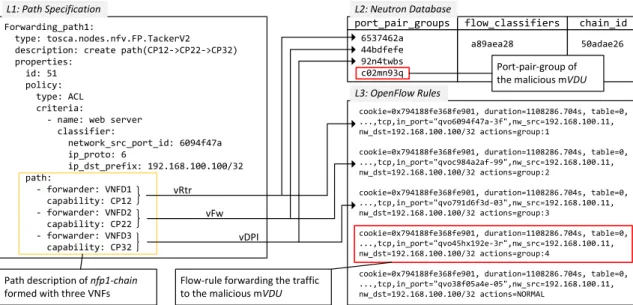
– L1: the descriptors at this level represent users’ requirements, which provide the baseline for verifying consistency. For example, NSD defines the path specification nfp1-chainwith three VNFs (vRtr,vFwandvDPI) and the corresponding net-work path.
– L2: the information related to VNFs and SFCs can be extracted from VIM through several sources, such as Heat, Nova, Neutron databases, and the VDUs (e.g., VNF configurations and logs). The order of VNFs in a chain is preserved as the order of records in Neutron database, while the number of VNFs in a chain is corresponding to the number of records under the same chain_id. In our example, chain_id50adae26 contains four VNFs instead of three as defined in NSD. The inconsistency created by mVDUcould be detected by comparing those data.
– L3: flow-tables from the virtual switches contain the information related to the for-warding behavior of NS. The highlighted flow-rule is the maliciously added flow, which forwards the traffic tomVDU(group 4 in the rule), and also shows the incon-sistency w.r.t. NSD.
More generally, the user-defined NS specification at L1 and the NS deployment related-data at L2 and L3 represent the current system state and will comprise the main inputs to verification mechanisms for detecting inconsistencies.
Chapter 4
Detecting Cross-level Inconsistency
Attacks in NFV
Based on the NFV deployment model introduced in Chapter 2, we present Caught-in-Translation (CiT), an LSTM-based sequence translation system for detecting inconsistency attacks in an NFV stack in this chapter.
4.1
Motivating Example
We present a motivating example to further highlight existing challenges in cross-level inconsistency detection for NFV and motivate towards our solution. The left side of Fig-ure 8 shows the simplified NFV stack of a tenant Bob, which consists of an VNF level with three VNFs (Virtual Router,Virtual Firewall, andVirtual DPI) and a NFVI level with their corresponding Virtual Deployment Units (VDUs). For brevity, other virtual compo-nents, e.g., virtual machines, are omitted from the figure. Knowing that an adversary Eve could potentially inject a malicious VDU (mVDU) into Bob’s network directly at the NFVI level, without causing any noticeable changes to the VNF level 1, Bob is concerned with the following question:“Is my service function chain (SFC) properly deployed at the lower levels?”
The right side of Figure 8 demonstrates the main ideas of our approach to detect incon-sistency attacks. Specifically, a user-level operation Create VNFFG (i.e., creating a VNF forwarding graph) triggers two sequences of events at the VNF-level (in Tacker) and the NFVI level (in Neutron), respectively. Our key idea is to firsttranslatethe lower (Neutron) event sequence to the upper (Tacker) level, and then compare the translated event sequence to the actual Tacker event sequence, such that any inconsistency, such as the one shown in the figure (i.e., the Neutron event updateflowrules does not correspond to any Tacker event), can be detected. However, as shown at the bottom of the figure, a challenge here is that the same Tacker event sequence may correspond to many different Neutron event se-quences, depending on the nature of events and the specification of the VNFs (e.g., a VNF may require multiple VDUs, and a VNF may have the autoscaling capabilities). There-fore, there does not exist a trivial mapping between the event sequences which would allow translation using simple rules. We will tackle this challenge using an NMT-based approach in the remainder of the thesis.
1For instance, by exploiting existing vulnerabilities 2015-3456 [56], 2015-7835 [57], or
4.2
Key Ideas
In contrast to most existing works which mainly verify NFV configurations, our first idea is to take an event-based approach, i.e., examining and comparing events that occur at dif-ferent levels of an NFV stack which correspond to the same user-level operation. The main advantage of relying on events instead of configurations is that we can potentially catch malicious events before they cause any irreversible damages. The events could be inter-cepted and checked (e.g., similar approaches exist for cloud platforms [4, 70]) to prevent malicious events from materializing their negative impact, e.g., injecting a malicious VNF into a Service Function Chain (SFC) to eavesdrop traffic flowing through the chain, or deleting legitimate VNFs from the chain to cause a denial of service. To that end, the main challenge is to detect the fact that certain events could cause inconsistencies between NFV configurations at different levels,beforesuch inconsistencies are materialized. A straight-forward solution could be to apply a standard anomaly-based detection mechanism, which will first train a model of normal events by considering event sequences at all levels of the NFV stack as the training data, and then utilize this model to identify any anomalous events causing inconsistencies. However, as evidenced by our experimental results, such an approach will be outperformed by our solution.
Our second idea is that we can draw an analogy between comparing event sequences at different NFV levels and translating sentences between different natural languages. As a result, we can leverage existing Neural Machine Translation (NMT) techniques designed for the latter to detect inconsistency attacks in NFV. Specifically, inside an NFV stack, a user-level operation, such as creating a VNF, will typically trigger an event sequence at each lower level. The fact that those lower-level event sequences all correspond to the same user operation means that their relationship is similar to the equivalence between sentences written in different natural languages. Thus, by leveraging this similarity to natural
![Figure 1: The ETSI NFV reference architecture [19]](https://thumb-us.123doks.com/thumbv2/123dok_us/10183070.2920791/22.918.234.744.125.545/figure-the-etsi-nfv-reference-architecture.webp)
![Figure 2: The NIST cloud model [59] depicting the two-layer view of a multi-tenant virtu- virtu-alized infrastructure in cloud](https://thumb-us.123doks.com/thumbv2/123dok_us/10183070.2920791/24.918.239.729.247.571/figure-nist-cloud-model-depicting-tenant-alized-infrastructure.webp)