ENERGY EFFICIENT RESOURCE ALLOCATION FOR VIRTUAL NETWORK SERVICES WITH DYNAMIC WORKLOAD IN CLOUD DATA CENTERS
A Dissertation IN
Telecommunications and Computer Networking and
Computer Science
Presented to the Faculty of the University of Missouri–Kansas City in partial fulfillment of
the requirements for the degree DOCTOR OF PHILOSOPHY
by XINJIE GUAN
M. S., University of Missouri-Kansas City, Missouri, USA, 2014 B. S., Southeast University, Jiangsu, China, 2006
Kansas City, Missouri 2015
c ⃝ 2015 XINJIE GUAN ALL RIGHTS RESERVED
ENERGY EFFICIENT RESOURCE ALLOCATION FOR VIRTUAL NETWORK SERVICES WITH DYNAMIC WORKLOAD IN CLOUD DATA CENTERS
Xinjie Guan, Candidate for the Doctor of Philosophy Degree University of Missouri–Kansas City, 2015
ABSTRACT
With the rapid proliferation of cloud computing, more and more network services and applications are deployed on cloud data centers. Their energy consumption and green house gas emissions have significantly increased. Some efforts have been made to control and lower energy consumption of data centers such as, proportional energy consuming hardware, dynamic provisioning, and virtualization machine techniques. However, it is still common that many servers and network resources are often underutilized, and idle servers spend a large portion of their peak power consumption.
Network virtualization and resource sharing have been employed to improve ener-gy efficiency of data centers by aggregating workload to a few physical nodes and switch the idle nodes to sleep mode. Especially, with the advent of live migration, a virtual node can be moved from one physical node to another physical node without service disrup-tion. It is possible to save more energy by shrinking virtual nodes to a small set of physical
nodes and turning the idle nodes to sleep mode when the service workload is low, and ex-panding virtual nodes to a large set of physical nodes to satisfy QoS requirements when the service workload is high. When the service provider explicates the desired virtual network including a specific topology, and a set of virtual nodes with certain resource demands, the infrastructure provider computes how the given virtual network is embed-ded to its operated data centers with minimum energy consumption. When the service provider only gives some description about the network service and the desired QoS re-quirements, the infrastructure provider has more freedom on how to allocate resources for the network service.
For the first problem, we consider the evolving workload of the virtual networks or virtual applications and residual resources in data centers, and build a novel model of energy efficient virtual network embedding (EE-VNE) in order to minimize energy usage in the physical network consists of multiple data centers. In this model, both operation cost for executing network services’ task and migration cost for the live migrations of virtual nodes are counted toward the total energy consumption. In addition, rather than random generated physical network topology, we use practical assumption about physical network topology in our model.
Due to the NP-hardness of the proposed model, we develop a heuristic algorithm for virtual network scheduling and mapping. In doing so, we specifically take the expected energy consumption at different times, virtual network operation and future migration
costs, and a data center architecture into consideration. Our extensive evaluation results show that our algorithm could reduce energy consumption up to 40% and take up to a 57% higher number of virtual network requests over other existing virtual mapping schemes.
However, through comparison with CPLEX based exact algorithm, we identify that there is still a gap between the heuristic solution and the optimal solution. Therefore, after investigation other solutions, we convert the origin EE-VNE problem to an Ant Colony Optimization (ACO) problem by building the construction model and presenting the transition probability formula. Then, ACO based algorithm has been adapted to solve the VNE problem. In addition, we reduce the space complexity of ACO-EE-VNE by developing a novel way to track and update the pheromone.
For the second problem, we design a framework to dynamically allocate resources for a network service by employing container based virtual nodes. In the framework, each network service would have a pallet container and a set of execution containers. The pal-let container requests resource based on certain strategy, creates execution containers with assigned resources and manage the life cycle of the containers; while the execution con-tainers execute the assigned job for the network service. Formulations are presented to optimize resource usage efficiency and save energy consumption for network services with dynamic workload, and a heuristic algorithm is proposed to solve the optimization problem. Our numerical results show that container based resource allocation provides
more flexible and saves more cost than virtual service deployment with fixed virtual ma-chines and demands.
In addition, we study the content distribution problem with joint optimization goal and varied size of contents in cloud storage. Previous research on content distribution mainly focuses on reducing latency experienced by content customers. A few recent s-tudies address the issue of bandwidth usage in CDNs, as the bandwidth consumption is an important issue due to its relevance to the cost of content providers. However, few researches consider both bandwidth consumption and delay performance for the content providers that use cloud storages with limited budgets, which is the focus of this study. We develop an efficient light-weight approximation algorithm toward the joint optimization problem of content placement. We also conduct the analysis of its theoretical complex-ities. The performance bound of the proposed approximation algorithm exhibits a much better worst case than those in previous studies. We further extend the approximate al-gorithm into a distributed version that allows it to promptly react to dynamic changes in users’ interests. The extensive results from both simulations and Planetlab experiments exhibit that the performance is near optimal for most of the practical conditions.
APPROVAL PAGE
The faculty listed below, appointed by the Dean of the School of Graduate Studies, have examined a dissertation titled “Energy Efficient Resource Allocation for Virtual Network Services with Dynamic Workload in Cloud Data Centers,” presented by Xinjie Guan, candidate for the Doctor of Philosophy degree, and hereby certify that in their opinion it is worthy of acceptance.
Supervisory Committee
Baek-Young Choi, Ph.D., Committee Chair
Department of Computer Science & Electrical Engineering Cory Beard, Ph.D.
Department of Computer Science & Electrical Engineering Deepankar Medhi, Ph.D.
Department of Computer Science & Electrical Engineering Ghulam Chaudhry, Ph.D.
Department of Computer Science & Electrical Engineering Sejun Song, Ph.D.
Department of Computer Science & Electrical Engineering Xiaojun Shen, Ph.D.
CONTENTS ABSTRACT . . . iii ILLUSTRATIONS . . . xi TABLES . . . xiv ACKNOWLEDGEMENTS . . . xv Chapter 1 INTRODUCTION . . . 1
1.1 Data Centers Energy Efficiency . . . 2
1.2 Server Power Usage . . . 4
1.3 Network Service Workload Variance . . . 5
1.4 Virtualization Techniques . . . 6
1.5 Network Virtualization . . . 9
1.6 Scope and Contribution of this Dissertation . . . 11
1.7 Organization . . . 13
2 RELATED WORK . . . 15
2.1 Virtual Network Embedding (VNE) . . . 16
2.2 Meta-Heuristic Algorithms in VNE Optimization . . . 19
2.3 Resource Allocation . . . 22
3 ENERGY EFFICIENT VIRTUAL NETWORK EMBEDDING FOR GREEN DATA CENTERS USING DATA CENTER TOPOLOGY AND FUTURE
MI-GRATION . . . 27
3.1 Problem Formulation . . . 31
3.2 Topology and Migration Aware Energy Efficient VNE . . . 39
3.3 A Simple Comparative VNE Example . . . 46
3.4 Evaluations . . . 49
3.5 Summary . . . 57
4 ANT COLONY OPTIMIZATION BASED ENERGY EFFICIENT VIRTUAL NETWORK EMBEDDING . . . 59
4.1 Ant Colony Optimization Based Model and Solution . . . 62
4.2 Evaluations . . . 68
4.3 Summary . . . 74
5 ENERGY AWARE CONTAINER BASED RESOURCE ALLOCATION FOR VIRTUAL SERVICES IN GREEN DATA CENTERS . . . 75
5.1 Adaptive Resource Allocation Framework Using Container-Based Virtu-alization . . . 78
5.2 System Model and Algorithm . . . 83
5.3 Evaluations . . . 90
5.4 Summary . . . 93
6 ACHIEVING OPTIMAL CONTENT DELIVERY USING CLOUD STORAGE 95 6.1 Problem Formulation . . . 97
6.2 Approximation Algorithm . . . 107
6.3 Evaluations . . . 115
6.4 Summary . . . 122
7 CONCLUSIONS AND FUTURE WORK . . . 124
REFERENCE LIST . . . 126
ILLUSTRATIONS
Figure Page
1 PUE data for all large-scale Google data centers [116] . . . 2
2 Power consumption elements considered by Google in their power mea-surement [116] . . . 3
3 Architecture of three types of virtualization techniques . . . 8
4 An example of VNE for green DCs . . . 28
5 A typical hierarchical fat tree data center architecture . . . 29
6 Topology awareness reduces energy consumption (right) . . . 29
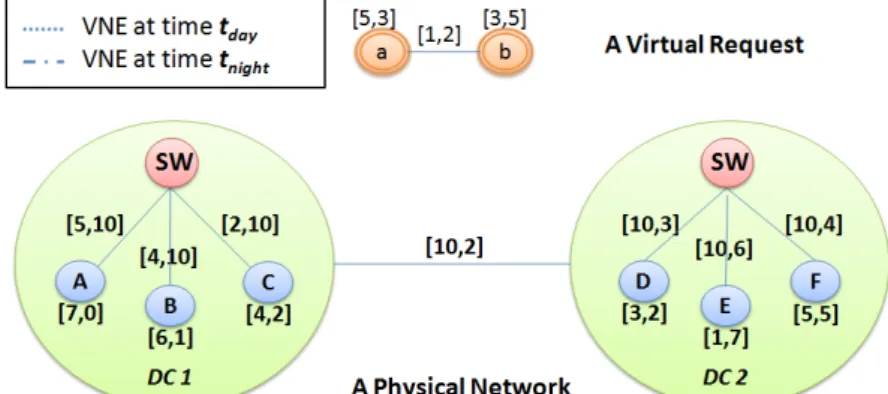
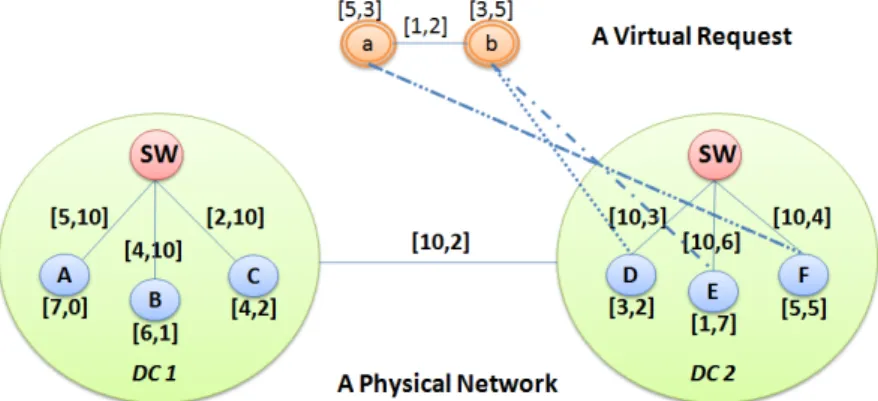
7 Topology Aware VNE (TA-VNE): no feasible embedding available . . . . 47
8 Migration Aware VNE (MA-VNE): total energy cost 86 units . . . 47
9 Topology and Migration-Aware Energy Efficient VNE (TMAE-VNE): to-tal energy cost: 52 units . . . 48
10 Comparison with optimal solution . . . 52
11 Comparison for varied resource usage ratio . . . 53
12 Comparison for varied number of DCs . . . 54
13 Comparison for varied number of DCs under B4 topology . . . 56
15 A tuple (i, i′, u)in the ACO construction graph represents a mapping in the EE-VNE problem that virtual nodeuis assigned to physical nodeiat
timetand physical nodei′ at timet+ 1. . . 64
16 Comparison with optimal solution . . . 69
17 Comparison for varied number of DCs . . . 70
18 Impact of parameters in ACO . . . 73
19 Hypervisor based virtual machines cannot be embedded due to resource limitation . . . 77
20 Container based virtural machines have been successfully allocated with available resources . . . 78
21 Overview of adaptive resource allocation framework . . . 79
22 Components in a physical machine . . . 81
23 Work flow of adaptive resource allocation for activating an application . . 82
24 Comparison for varied number of physical machines . . . 92
25 Comparison for varied number of virtual machines . . . 93
26 Push vs. pull: The origin server pushes some objects to proxy servers. Content user queries objects from the proxy server. A proxy server will pull from the origin server or another cooperative proxy server if it doesn’t have the requested objects. . . 97
27 ri1 = 1.33;ri2 = 1;ri3 = 0.94.Pushing object 1 and2 with the lowest ratiori1andri2(case (a)) is worse than pushing object3(case (b)). . . 108
28 In TLM, either object1, . . . , L−1,(L >1)or objectLcan be pushed to a proxy server. . . 111 29 The upper bound of optimal solution . . . 111 30 Comparison for varied number of objects (simulation with real object sizes)116 31 Comparison for varied standard deviation of object sizes (simulation with
synthetic object sizes) . . . 118 32 Comparison for varied balance parameter α(simulation with real object
sizes) . . . 118 33 Locations for the origin server and proxy servers: the mark in the circle
indicates the location for the origin server; and the remain sites are all proxy servers. Each proxy server is connected to origin server and its cooperative proxy servers. Proxy servers may pull objects from the origin server or a closer proxy server. . . 120 34 Comparison for varied number of objects (Planetlab experiments with real
object sizes) . . . 121 35 Comparison for varied standard deviation of object sizes (Planetlab
ex-periments with synthetic object sizes) . . . 121 36 Comparison for varied balance parameterα (Planetlab experiments with
TABLES
Tables Page
1 Component Peak Power Breakdown for a Typical Server [43] . . . 4
2 Network Virtualization Implementation Techniques Comparison . . . 10
3 Comparison of VNE Studies . . . 20
4 Notations Used . . . 31 5 Algorithms Comparison . . . 49 6 Parameter Setting . . . 51 7 Notations Used . . . 63 8 Parameter Setting . . . 71 9 Parameter Setting . . . 90 10 Notation Used . . . 98
11 Parameter Setting for Simulations . . . 116
ACKNOWLEDGEMENTS
I would like to express my deepest gratitude to my advisor, Dr. Baek-Young Choi, for her guidance, understanding, patience and full support during my Ph.D. study at University of Missouri-Kansas City. Not only gives many helpful advises on my research work, she also provides many invaluable opportunities and suggestions towards my long-term career goals. She is willing to share her experiences and always encourages me to grow as an independent researcher.
I would like to sincerely thank Dr. Sejun Song, for his inspiring guidance, tutoring and financial support. His insights and comments were significant supports for me to un-derstand software defined networks and to clarify and improve the cost efficient resource allocations work presented in this dissertation.
I am grateful to other committee members of my dissertation, Dr. Cory Beard, Dr. Deep Medhi, Dr. Ghulam Chaudhry, and Dr. Xiaojun Shen for their assistances and suggestions. When I am facing questions, they are always open for discussion.
I would like to thank Dr. Hiroshi Saito, Dr. Ryoichi Kawahara for their mentoring during my internship at NTT Service Integration Laboratories. I would also like to thank my mentors Dr. Xin Wang, Dr. Jiafeng Zhu, Dr. Guoqiang Wang, and Dr. Ravi Ravindran for their great help and suggestions during my internships at Futurewei Technologies Inc. I also would like to thank my lab mates, Daehee Kim, Hyungbae Park, Sunae Shin and Kaustubh Dhondge for the friendship and their suggestions for my research.
Wan for his unconditional love, understanding, accompanying and support for my Ph.D. study. Thanks also go to my parents and my son for their encouragement for pursuing my Ph.D. degree.
CHAPTER 1 INTRODUCTION
As the supporting infrastructure of cloud computing services, data centers are rapidly proliferate in recent years. Nowadays, these data centers (DC) are used to deploy large portion of network services and provide large volumes of cost-efficient resources, such as virtual storage (Amazon S3 [5], Dropbox [37]), virtual platform and development tools (Microsoft Azure [100], Google Cloud Platform [91], Amazon EC2 [39]), business applications (Salesforce [97], Workday [121]). It is reported that there were more than 500,000 DCs around the world as of December 2011 [104].
With the fast growth of DCs and services deployed on them, more and more energy has been consumed for DC operating and maintainable. In 2010, between 1.1% and 1.5% of the worldwide total electricity usage was consumed by DCs [70], and their energy costs in the US doubled from 28 billion kWh to 61 billion kWh in six years, according to [1]. In addition, the large energy consumption of DCs not only increases the cost of DC operators, but also impacts our environment through carbon dioxide emission. In 2008, the carbon dioxide emission by global DCs took up to 0.3% of global carbon dioxide emission that was more than some countries, such as Argentina and Netherland [68]. This number is expected to be double in 2020 [117].
Efforts have been made for reducing DC carbon footprint from various aspects in order to save cost and protect environments. Companies, e.g., Google and Facebook
Figure 1: PUE data for all large-scale Google data centers [116]
are greening their DCs through reducing power usage for cooling and other facilities and utilizing renewable energy [51, 83]. Now their DCs have a relatively small Power Utilization Effectiveness (PUE), approximately 1.12 [51,83]. Figure 1 [116] presents that Google improves the PUE of all their large scale data centers. On the other hand, the low PUE means most energy is used for computing that drives us to control computing energy consumption as well.
1.1 Data Centers Energy Efficiency
The power consumed for DCs mainly from three components, the computing pow-er usage, e.g., spow-ervpow-ers, switches, storage, supporting powpow-er usage, e.g., cooling, lighting, office use, and power transfer losses. Figure 2 [116] shows the power consumption ele-ments that are considered in Google PUE measurement.
Figure 2: Power consumption elements considered by Google in their power measurement [116]
by:
PUE= Total DC Power Consumption
IT Equipment Power Consumption (1.1) The global average self-reported DC PUE is approximate 1.7, according to Uptime Insti-tute’s 2014 Data Center Survey [106]. Compared with private DCs, public DCs usually have a low PUE. Four approaches suggested by Google [51] to improve PUE include managing airflow [16, 81], adjusting the thermostat [14, 64], using free cooling [73, 131], and optimizing power distribution [95]. Through these approaches, Google improves their
PUE from 1.23 in 2008 to 1.12 in 2015 [116]. Now, computing energy consumption in DCs overweight energy consumption by all the other DC components. In this disserta-tion, we focus on minimizing the power consumption for computing, especially the CPU power consumption and network link power consumption.
1.2 Server Power Usage
Table 1: Component Peak Power Breakdown for a Typical Server [43] Component Peak Power Count Total
CPU 40 W 2 80 W Memory 9 W 4 36 W Disk 12 W 1 12 W PCI slots 25 W 2 50 W Motherboard 25W 1 25 W Fan 10 W 1 10 W System Total 213 W
Servers power consumption comes from multiple components such as CPU, mem-ory, disk and so on. Fanet al.analyzed the power usages of a server in [43]. As shown in Table 1 [43], server power utilization is dominated by CPU and memory power usage, but power consumed by miscellaneous items, e.g., PCI slots, motherboard becomes signifi-cant when the workload of the server drops. With energy proportional computing [49], voltage or frequency can be adjusted according to a CPU workload, so that machines with less jobs consume less energy. Then, power management techniques can control power assignments to ensure that machines with light loads consume less power, while machines with heavy loads obtain enough power. However, when a server is completely idle without
doing any work, it may still consume up to 50% to 70% of its peak power [13, 127]. This ’baseline power’ cannot be eliminated unless the server is turned off [27]. ’Operation cost’ and ’operation energy consumption’ are used to describe the power consumption for real utilization. The operation cost is approximately linear increased as the workload rises [13, 127]. On the other hand, majority servers in DCs is under utilization. Servers in DCs typically operate at 10% ∼ 50% of their maximum capacity most of time [43]. These large amount of under utilized servers decrease the energy efficiency because of the baseline power consumption.
1.3 Network Service Workload Variance
Traffic and workload of most network services are highly fluctuated related to human activities [8, 50, 69]. The huge differences between the peak workload and the off-peak workload of network services add the difficulties to provision resources for the ser-vice in advance. To guarantee Serser-vice Level Agreement (SLA), the provisioned resources should be enough to support the peak workload of the service. When the resources are statically provisioned based on the peak workload, a portion of resources would be idle when the workload of the service becomes low. As stated in Section 1.2, servers under utilization waste large amounts of energy.
A good news is that some traffic and workload are with patterns and could be predicted in a large time scale, such as day/night and weekday/weekend [89, 92, 98]. For example, both daily pattern and weekly pattern have been identified for PhoneFactor ser-vice in [92] and Youtube in [50]. In these studies, day time and weekdays have more
traffic and heavier workload compared with midnight to early morning and weekends. Driven by the observations, resource could be dynamic provisioned based on the pred-icated demand workload at a planned time, so that the idle resources can be shared by other services or switched to sleep mode.
1.4 Virtualization Techniques
As the main enabling technology for cloud computing, virtualization support-s multi-tenant usupport-sersupport-s to support-share computing, support-storage, and networking resupport-sourcesupport-s. Focusupport-sing on sizeable data centers (DCs), traditional virtualization technologies are mainly for com-puting and storage resources. However, as DCs for cloud comcom-puting rapidly grow in numbers and geographically dispersed DCs are interconnected,networkresource virtual-ization technology becomes one of the most promising technologies for leveraging the full potential of cloud computing. Using virtual servers and sharing the same physical servers significantly cut off the operation cost, power consumption, carbon emission compared with locally hosted dedicated servers [9]. Also, live migration of virtual machines [115] allows for demanded virtual resources to be consolidated in a physical network conserv-ing DC energy consumption.
To enable resource sharing without impacting other virtual servers sitting in the same physical server, various virtualization techniques are developed for different pur-poses. Basically, currently used virtualization techniques could be categorized as: full virtualization, paravirtualization, hardware-assested virtualization and OS-level virtual-ization.
Full virtualization fully simulates the underlaying hardware. In full virtualization, binary translation is used to trap and to virtualize instructions between the virtual hard-ware and the host computer’s hardhard-ware. Binary translation incurs a large overhead, so that the performance of full virtualization may not be good. However, guest OS could be directly embedded without any modification. Examples of full virtualization are VMWare ESXi [40] and Microsoft Virtual Server [99].
Paravirtualization cannot directly embedded a guest OS without any modification. A thin layer named Hypervisor provides API for the communication between the guest OS and hardware. Compared with full virtualization, paravirtualization has a better per-formance with a lower overhead, but is harder to be implemented since the guest OS need to be tailored to run on the Hypervisor. Example of paravirtualization is Xen [85].
Hardware-assested virtualization is a type of full virtualization. In stead of binary translation and paravirtualization, hardware handles privileged and sensitive calls that automatically trapped to Hypervisor. Examples of hardware-assested virtualization are Linux KVM [79], VirtualBox [20].
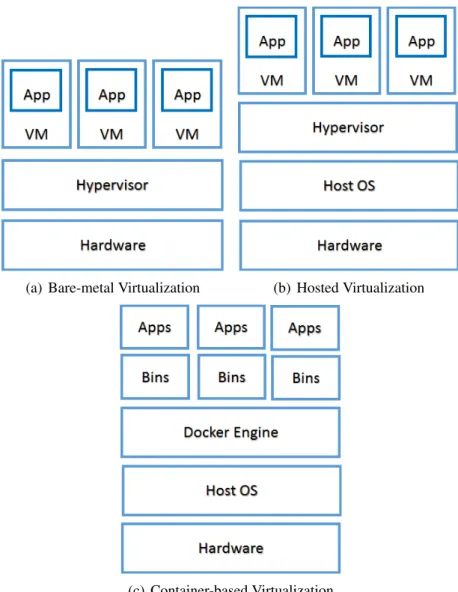
OS-level virtualization or container-based virtualization is an alternative to Hy-pervisor based virtualization techniques. They are based on Linux container [102] and provide superior system efficiency and isolation. Unlike Hypervisor based virtualization, container based virtualization does not need to simulate the entire guest OS, but works as a thread. Therefore, container based VMs are light weighted, and could be fast deployed and migrated between different locations. One of management tool of container based virtualization, named Docker [35] is widely recognized and adopted in many companies
as well. The advent of container based virtualization and the related management tool-s offer a great opportunity to further improve energy efficiency and reduce cotool-st in data centers.
(a) Bare-metal Virtualization (b) Hosted Virtualization
(c) Container-based Virtualization
Figure 3: Architecture of three types of virtualization techniques
As shown in Figures 3, container-based virtualization does not build the guest OS, but only adds necessary bins and libraries to support the applications, while guest OS
is deployed for Hypervisor based OS. In addition, in container-based virtualization, an engine is used to coordinate among multiple containers, while Hypervisor is employed for isolation and resource mapping.
1.5 Network Virtualization
Besides vitualization of servers, network virtualization has been studied and de-veloped for different purposes. For example, virtual networks are utilized to adopt new protocols or techniques for academic usage. In addition, they are employed to support multi-tenant environments for cloud computing and widely spread data centers. By al-lowing resource sharing, virtual networks saves a lot for service providers comparing with traditional dedicated DCs.
Various techniques have been developed to provision virtual resources, create and maintain virtual networks, including Virtual Local Area Networks(VLAN), Virtual Pri-vate Networks(VPN), Overlay Networks, and Programmable Networks.
VLAN partitions ports on switches so that network traffic through tagging pack-ets on hosts. It enables host grouping even if the hosts are not under the same switch. Furthermore, it is flexible to migrate one host from one virtual network to another one by simply changing its VLAN identifier.
VPN assists the construction of logical private networks over public network in-frastructure by establishing virtual end-to-end connections using tunnelling. VPN can be implemented at different network layer (layer 1, layer 2 and layer 3) using various techniques.
Overlay networks are built on top of other networks. In overlay networks, hosts are connected through logical links or tunnels, e.g., GRE tunnels, L2TP tunnels. Overlay networks typically are implemented at the application layer. Examples of overlay net-works applications include most peer to peer protocols, such as Gnutella, Tor, content delivery networks, and real time media flow protocol. Note that VPNs can be categorized as overlay networks.
Programmable networks are networks in which their network devices behavior and flow control are handled independently by software rather than network hardware. Especially software defined networks separate data plane and control plane through mov-ing routmov-ing function from network router to controllers. By usmov-ing SDN infrastructures, network operators have a freedom in choosing the optimal physical servers and physical paths to support virtual nodes and virtual links without interfering other network services or functions.
Existing work, such as [38] that built FlowN, a VNE prototype on NOX OpenFlow controller, and [96] that proposed VNE architecture using BGP configurations and Open-Flow 1.3 switches, gives some guideline in implementing VNE using SDN architecture and infrastructures.
Table 2: Network Virtualization Implementation Techniques Comparison Technique Name Implementation Layer
VLAN Link layer
VPN Physical layer, link layer, network layer Overlay networks Application layer
1.6 Scope and Contribution of this Dissertation
This dissertation focuses improving the efficiency of cloud data centers by devel-oping resource allocation algorithms for two different service requirements. When the service provider explicates the desired virtual network including a specific topology, and a set of virtual nodes with certain resource demands, the infrastructure provider computes how the given virtual network is embedded to its operated data centers with minimum energy consumption. We consider the evolving workload of the virtual networks or virtu-al applications and residuvirtu-al resources in data centers, and build a novel model of energy efficient virtual network embedding (EE-VNE) in order to minimize energy usage in the physical network consists of multiple data centers. In this model, both operation cost for executing network services’ task and migration cost for the live migrations of virtual nodes are counted toward the total energy consumption. Two algorithms are developed towards this optimization problem.
The other is when the service provider only gives some description about the net-work service and the desired QoS requirements, the infrastructure provider has more free-dom on how to allocate resources for the network service. We design a framework to dynamically allocate resources for a network service by employing container based vir-tual nodes. In the framework, each network service would have a pallet container and a set of execution containers. The pallet container requests resource based on certain s-trategy, creates execution containers with assigned resources and manage the life cycle of the containers; while the execution containers execute the assigned job for the network service.
In addition, the joint optimization for content placement problem has been studied to minimize the traffic from content to the final content users without increasing their experienced latency.
The main contributions of this dissertation are summarized as follows:
1) We formulate the problem of virtual network embedding that incorporates energy costs of operation and migration for nodes and links that is non-linear. To solve this problem, we introduce a technique to transform it to a linear programming problem with additional constraints. After proving the NP-hardness of this problem, we de-velop a heuristic algorithm named Topology and Migration-Aware Energy Efficient Virtual Network Embedding (TMAE-VNE) to minimize the energy consumption caused by both operation and future migration. This work is initially published in [56], and later extended to a journal paper [58].
2) To achieve a better solution of EE-VNE problem, we propose a novel ACO based topology migration-aware EE-VNE algorithm (ACO-EE-VNE) to minimize the en-ergy consumption caused by both operation and migration. We develop a novel pheromone update and track scheme in the ACO algorithm, so that the space com-plexity of the ACO algorithm is substantially reduced. This work has been pub-lished in [59]
3) We introduce the framework for container based dynamic resource allocation mech-anism. In this framework, service providers specify their demands from service
level rather than infrastructure level. Physical resources would be dynamically pro-visioned based on current workload of each network service/application. We for-mulate the dynamic resource allocation problem as an optimization problem and convert it as a linear programming problem and develop an efficient and scalable algorithm to solve the dynamic resource allocation problem that could be applied to large scale resource pools.
4) We formulate the joint traffic-latency optimization problem, and prove its NP-completeness. We then develop an efficient light-weight approximation algorithm, named Traffic-Latency-Minimization (TLM) algorithm, to solve the optimization problem with theoretical provable upper bound for its performance. To limit the frequency of updates to the origin server with local changes such as users interest-s interest-shift, we alinterest-so extend our TLM algorithm in a diinterest-stributed manner. We provide the theoretical analysis for time complexity and space complexity of the TLM al-gorithm. This work is initially published in [54], and extended to a journal paper in [55].
1.7 Organization
The remainder of this dissertation is structured as follows. In Chapter 2, we review related work about optimization in virtual network embedding and resource allocation in cloud data centers. Chapter 3 addresses the energy efficient virtual network embedding
problem with evolving demands and physical resources. Chapter 4 presents how an Ant-Colony-Optimization based algorithm is developed and applied to solve the energy effi-cient virtual network embedding problem. Chapter 5 proposes a container based resource allocation framework with a scalable resource allocation algorithm. In Chapter 6, we i-dentify traffic-latency optimization problem in content delivery networks and solve it with practical solutions. Finally, we summarize and conclude the dissertation and introduce the future work in chapter 7.
CHAPTER 2 RELATED WORK
With network virtualization techniques, adopting a new technique or protocol is much easier [32]. Vendors or infrastructure providers (InPs) do not need to purchase new equipment to update or deploy new techniques or protocols. An existing network could be flexibly expanded without involving much configuration work. In addition, network vir-tualization allows a physical network to be shared and divided into several isolated virtual networks (VNs) that consist of virtual machines (VMs) and their specified connectivities. Each VN serves a different group of users with different requirements of computing, stor-age, and network resources. Small institutions could have an economic option by renting VNs from an infrastructure provider rather than building and maintaining their private networks. Therefore, due to its benefits, network virtualization has been highlighted and studied from many aspects, such as resource discovery [53], admission control [94], re-source scheduling [12], security issues [82], and rere-source allocation that is also known as virtual network embedding (VNE) [31, 66, 77, 130, 132].
In this chapter, we first investigate existing work about network virtualization, and resource allocation, then we briefly discuss about content distribution optimization that assigns storage resources to content delivery services and determines content placement in cloud.
2.1 Virtual Network Embedding (VNE)
Network virtualization allows physical nodes and links to be shared by multiple VNs. It improves the physical resource usage efficiency, reduces the cost for service providers, and simplifies the update and deployment of new techniques or protocols [32]. As one of the essential problems in the network virtualization area, VNE has been wide-ly studied to achieve different goals [47]. It maps VNs coming over time to a physical network. In a real application, an InP receives a set of VN requests from the Service Providers (SP). Each VN asks for slices of resources, including computational and net-work resources, to provide value-added services, such as video on demand and voice-over-IP. By properly embedding the VNs, certain optimization goals are expected to be achieved without violating resource limitations.
Various VNE models have been proposed with different optimization goals or constraints. Many schemes aim to increase the VN acceptance ratio that is the number of successfully mapped VN requests to the number of total VN requests [33], or balance the workload on physical nodes or links [132]. [33] modeled the VNE problem with a specified location preference of the virtual nodes as a mixed integer programming prob-lem and presented a deterministic algorithm as well as a random algorithm to solve the problem. [132] designed an algorithm that identifies the physical node or links with max stress and balances the workload of those nodes or links through reconfiguration.
In all of the above mentioned research, VNE has been completed in two stages. In the first stage, all the virtual nodes have been mapped to physical nodes that satisfy the desired demands; while in the second stage, the algorithms compute a proper physical
path for each virtual link in the virtual network. It is possible that a feasible mapping cannot be found for a virtual link, since the link capacities are not considered during the mapping of the virtual nodes. In this case, the above mentioned algorithms have to be backtracked to the first stage and map the virtual node again, which could be time consuming.
To improve the mapping efficiency, one-stage VNE algorithms have been pro-posed where the related virtual links are mapped right after mapping a virtual node [29, 62, 77, 87, 111]. In [62], constraints on delay, routing, and location were taken into consideration in the VNE problem, and the multicommodity flow integer linear program is used to solve the improved model. Trinh, T. et al. [111] tried to increase the profit of the infrastructure provider and save the cost of subscribers by applying a careful overbook-ing concept. The topology of the physical networks and virtual networks are modeled as a directed graph in [77], and the authors present a heuristic VNE algorithm that maps nodes and links at the same stage based on the subgraph isomorphism. [29] is inspired by Google’s PageRank algorithm. It argued that virtual network topologies and virtual nodes’ positions have a significant impact on VNE’s efficiency and acceptance ratio. Vir-tual optical networks mapping to an optical network substrate was studied in [87]. The authors formulated the problem as integer linear programming formulations and designed a greedy randomized algorithm to solve it. [48] proposed a pre-cluster method to parti-tion a virtual network into clusters. In this method, multiple virtual nodes within one VN are mapped to the same physical node if there are enough available resources, so that the traffic inside a VN could be minimized.
In [124], evolving VNs and physical networks are investigated. The authors also suggested migrating embedded virtual nodes or virtual links to accommodate more VN requests. Driven by this observation, [22] tried to minimize the VNE cost when the sub-strate network evolves. They compared the cost differences between re-embedding the virtual nodes or virtual links and migrating them. They solved the proposed problem with a heuristic algorithm. The purpose of [42] is to minimize the reconfiguration cost and bal-ancing the physical link workload. A virtual node or link lying on a congestion physical link would be migrated to another physical node or link. The evolvement or changes of a virtual network are random and unexpected in [22, 42, 124].
In practice, however, many changes of VN workloads are periodic due to day/night time zone effects or weekend effects [109, 120, 128] and can be fairly well predicted [89, 98]. Meanwhile, making the data center energy efficient and protecting the environment attracts much attention. VNE targeting energy efficiency has been recognized and studied in [6,19,46]. Botero, J.F. et al. [19] saved the energy consumption by reducing the number of inactive physical nodes and physical links. Fischer, A. et al. [46] described the way to modify existing VNE algorithms towards energy efficiency without maintaining their other performance by considering energy as a factor when mapping. Energy efficiency is also considered in [6] that partitions and embeds virtual DCs to the substrate network that consists of multiple DCs, so that the inter DC traffic can be reduced and DCs with relative low PUE are used. The migration of virtual nodes and links have not been performed in [6, 19, 46], which would lead to a lower acceptance ratio compared with VNE algorithms that allow migration. In addition, in both [19] and [46], multiple virtual nodes from the
same VN could be consolidated on the same physical node to save energy; however, this may impact the resilience of the virtual networks. On the other hand, in our model, virtual nodes in the same VN are ensured to be mapped to different physical nodes for resilience consideration.
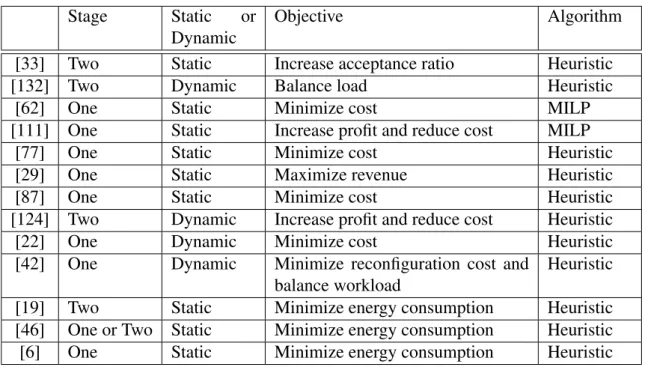
The above mentioned existing work has been summarized and compared in Ta-ble 3. All of the aforementioned work only targets a snapshot optimization where the resource limitations and demand requirements are considered at one time. Differing from these existing VNE solutions, our work is unique in that we holistically aim to optimize the energy efficiency of VNE over the entire life cycle of virtual networks. We achieve this goal by not only considering the embedding for the current moment but also schedul-ing possible migrations for the future at the time we map a virtual network. Thus, we can successfully minimize operation energy costs as well as possible migration costs. In addition, most previous work models the physical network as a graph with an arbitrary topology. This is not precise to describe intra DC networks that are usually organized in a hierarchical topology. We consider the practical topology of physical networks in the real world. In our model, a physical network may consist of multiple DCs, and the network inside each DC is hierarchical.
2.2 Meta-Heuristic Algorithms in VNE Optimization
In the above mentioned work, heuristic algorithms are developed in [6, 46] to-wards different optimization objectives, while [19] utilized CPLEX or GPLK based exact algorithms to solve their proposed optimization problems. CPLEX or GPLK based exact
Table 3: Comparison of VNE Studies
Stage Static or
Dynamic
Objective Algorithm
[33] Two Static Increase acceptance ratio Heuristic
[132] Two Dynamic Balance load Heuristic
[62] One Static Minimize cost MILP
[111] One Static Increase profit and reduce cost MILP
[77] One Static Minimize cost Heuristic
[29] One Static Maximize revenue Heuristic
[87] One Static Minimize cost Heuristic
[124] Two Dynamic Increase profit and reduce cost Heuristic
[22] One Dynamic Minimize cost Heuristic
[42] One Dynamic Minimize reconfiguration cost and balance workload
Heuristic [19] Two Static Minimize energy consumption Heuristic [46] One or Two Static Minimize energy consumption Heuristic [6] One Static Minimize energy consumption Heuristic
algorithms are expected to achieve the optimal solutions for the small scale of the prob-lem. However, the time consumed by these exact algorithms increase significantly as the problem size grows. On the other hand, heuristic algorithms run in polynomial time, but can only search in a very limited solution space, resulting in a relative low quality of the solution compared with the solutions obtained by the exact algorithms.
Heuristic algorithms are developed in [6,46] towards different optimization objec-tives, while Botero [19] utilized a mixed integer programmer solver based exact algorithm to solve their proposed optimization problems. Exact algorithms can achieve the optimal solutions in small scales but are time consuming, especially when the problem size ex-pands; while heuristic algorithms run in polynomial time but cannot approach the optimal
solutions in large scale problems.
Meta-heuristic algorithm offers new methods of solving large scale NP-hard op-timization problems. It is usually inspired by natural biological behavior and includes probabilistic global searching based on evolutions and iterative operations. As a repre-sentative meta-heuristic algorithm, ACO has been utilized in various large scale NP-hard combinatorial optimization problems, e.g., [114]. In [23,41], ACO has been applied to the VNE problem to minimize the cost of VNE. They proved that the ACO based algorithm achieve a better performance than some existing heuristic algorithms. Chang et al.[26] aimed to minimize the energy consumption of migration using ACO based algorithm. However, they only considered the energy consumption in one time snapshot while we minimize the energy consumption in the VN’s entire life cycle. However, [41] focuses on reducing the cost of physical links, while we want to improve the energy efficiency considering both the node energy consumption as well as link energy consumption. In addition, we minimize the energy efficiency of the entire life cycle of virtual network requests rather than in different time snapshots as in [6, 19, 46]. By doing this, the total energy consumption could be further saved; however, the hardness and the scale of the problem is increased as well. In our previous work [56], a heuristic algorithm was pro-posed that reduced the energy consumption and improved the acceptance ratio compared with the existing algorithms. However, as most other heuristic algorithms, it has a low approximation ratio and is inadequate in facing a large solution space.
2.3 Resource Allocation
To save the cost on building and maintaining a private data center, service provider-s move their provider-service and data to cloud infraprovider-structure providerprovider-s. To further provider-save coprovider-st and improve efficiency, dynamic scaling of resource management for web application and big data computing have been studied, such as [78, 118]. Jobs are dispatched to specific servers with web application or hadoop running in that system. Applications are organized in a multi-tier structure and tasks are distributed through a front-end dispatcher [122].
To provider more complicated services/applications, e.g. game hosting, resources are required to be allocated in application level. [122] targeted energy efficient resource allocation at VM level. By embedding and migration the entire VMs, [122] improve energy efficiency for applications that require specific environment setting. In addition, VN level resource allocation has been studied for different objectives, such as increasing acceptance ratio, improving energy efficiency [57, 58]. In these virtual machine or virtual network embedding studies, they all based on VM technologies that isolate VMs at the hardware abstraction layer, e.g., using Hypervisor based virtualization.
As an alternative of hypervisor based virtualization, container based virtualization has been proposed in [102], and attracts many attentions in recent years. As a management tool of container based virtualization, [35] has been recognized and widely used to deploy many network services. [91, 100] also start to support container based virtualization in their cloud services. Due to its light weight size, prompt deployment and shipping [44], with container based VM, it is possible to have an application level adaptive resource allocation mechanism.
However, current hypervisor VM placement models and mechanisms assume 1) physical resources are strictly allocated for each VM, 2) the amount of VM and capacity of VM are static. While, in container based virtualization, 1) resource could be shared based on their priority, e.g. in docker [35], 2) dynamic change the number and capac-ity of containers, 3) the size of containers could be different based on environments of physical machines. Considering the different requirements, a novel framework and theo-retical model are necessary for building an adaptive resource allocation mechanism using container based virtualiztion techniques.
2.4 Optimal Content Distribution
Content distribution algorithms aim to optimize the system performance with lim-ited resources expressed in various metrics. It is worth noting that those content distribu-tion techniques can be based on a P2P structure as well as on a server/client structure. [60] investigated content distribution techniques in both CDNs and P2P networks that are u-tilized to decrease the traffic load in backbone networks or to optimize content users’ experience by shorter end-to-end paths and delays. The motivations of existing content distribution techniques based on CDNs or P2P networks range from improving final user-s’ experience to compressing access cost such as link traffic. Based on the differences on the motivations, most of the content distribution algorithms could be categorized as ’Latency-Minimization’ (LM) and ’Traffic-Minimization’ (TM).
from servers to clients, which is the performance perceived by clients. The average num-ber of autonomous systems (ASes) has been utilized to indicate latency incurred in CDNs in [67]. The authors of [67] also proposed heuristic algorithms to minimize the average number of ASes traveled for requests. [10,11,71] attempted to reduce clients’ access costs for retrieving contents from peers or within the access network. The access cost is related to the distance between content users and replicas [10, 71], or it can be a general concept involving all the costs to complete content transmissions [11]. In addition to the commu-nication and access latency, the computational cost is studied and reduced using clustering algorithms in [28]. The authors in [30] studied the download latency under a competitive P2P environment, where source peers have a limited capacity of parallel connections. They attempted to achieve minimum download time by dynamically changing the source set of peers under a pull-based model. Similar schemes are employed in grid computing including where distributed resources are shared through a high speed network. In [15], data are replicated in nearby caches to final user rather than distant source to reduce data transmission time. In [110], LSAM proxy multicast push web pages to affinity groups for aggregated requests to offload the central server and backbone networks. Moreover, efficient prefetching algorithms are designed in [34,93] to indicate the most probable disk blocks and push those blocks to user nodes in advance in order to speed up data access.
TM algorithms are designed to lower the traffic volume consumed for contents delivery, so to cut down the expenditure for cloud services. In [4], the authors saved the traffic cost through considering the router level and AS level topologies and utilizing mul-ticast streams. Recently, [18] addressed the issue of reducing the traffic volume for large
videos in CDNs. They developed heuristic algorithms for specific topologies by using cache clusters, assuming many system parameters were constant. The study in [61] adopt-ed various forms of local connectivity and storage for multimadopt-edia delivery in a neighbor assisted system to reduce access link traffic. [65] studied the influence of server alloca-tion in ISP-operated CDNs to the transmission bandwidth consumpalloca-tion and suggested the properties of nodes’ topological locations that impact cache placement effectiveness in multiple network topologies. Unified linear programming is utilized to optimal content placement under multiple constraints in [74]. A matrix basedk-means clustering strategy is proposed in [125] to reduce total data movement in scientific cloud workflows. This is where the replication and distribution are constrained by enforcement policies, such as some scientific data are restricted from moving.
Other than the LM and TM algorithms, a few recent works focus on content delivery problems over cloud-based storage. [119] decreased the storage cost by calcu-lating and maintaining a minimal number of replicas under certain availability require-ments. [24, 101] tried to optimize the content providers’ investment by content delivery over multiple cloud storage providers. [21, 76] designed and implemented frameworks to assist replica placement over cloud storage services, in order to make it possible to optimal content delivery over cloud under diversity requirements.
Our work differs from the previous LM and TM algorithms that we collectively consider content providers’ expenditures on traffic volume over cloud storage and content users’ experiences. Our aim is to address the optimization problem of traffic consumption
and latency for large and diverse sizes of contents by a push-pull hybrid content distri-bution strategy, where push means replicating objects on certain servers in advance, and pull means only delivering contents that are requested by the content users.
The push-pull strategy has been implemented for content distribution earlier. [129] analyzed a P2P pull-based streaming protocol to understand the fundamental limitations and design an effective protocol to achieve better throughput. [45] investigated theoretic bounds for pull-based protocol under a mesh network and explained the performance gap. The push-pull strategy is also utilized in data aggregation fields to minimize global communication cost in [25]. However, those push and pull hybrid protocols are designed for P2P networks or sensor networks without considering the storage of nodes. Therefore, they are not suitable for content distribution over cloud storage where the storage space impacts the content providers investment.
We focus on the environments of cloud based content delivery where the content placement can be actively controlled considering traffic volume while the latency can be controlled under storage constraints. We develop an efficient light-weight approximation algorithm with a provable performance bound, and time and space complexity analy-sis. We further design a distributed version of the algorithm in which proxy servers can determine object distribution by exchanging local information without requiring global knowledge.
CHAPTER 3
ENERGY EFFICIENT VIRTUAL NETWORK EMBEDDING FOR GREEN DATA CENTERS USING DATA CENTER TOPOLOGY AND FUTURE MIGRATION
In this Chapter, we study energy efficient virtual network embedding considering practical DC topologies and future migration. Unlike existing work, we focus on improv-ing energy efficiency of virtual network embeddimprov-ing through plannimprov-ing future migration as well as initial embedding.
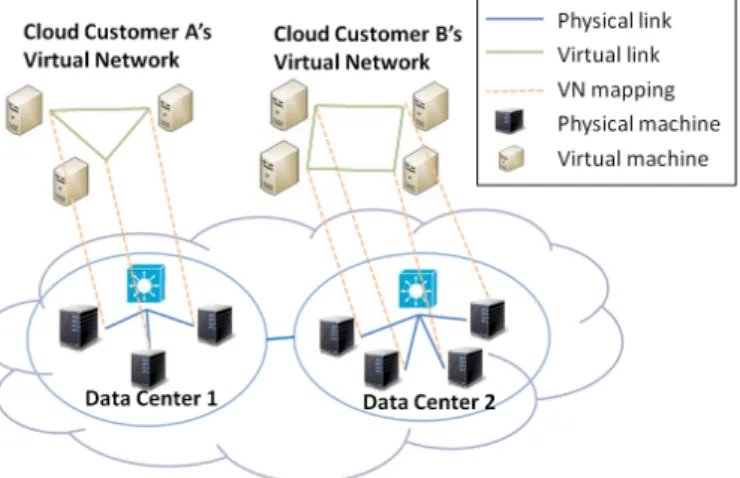
By migrating some virtual nodes or links to other physical nodes or links at a planned time based on predicated VN workloads, idle servers and network elements can be turned off to save energy. Figure 4 depicts an example where two VNs from cloud customers A and B are embedded onto two physical DCs during the day time due to their resource needs. At night, however, the smaller workloads permit the infrastructure provider to combine them onto one DC or rack saving the operating costs of servers and switches. For example, web servers could run on multiple physical servers during the busy hours to ensure the performance but aggregated to a less number of physical servers at night so that some idle physical servers could be turned off to save energy. This motivates us to design a VNE scheme that saves energy and supports energy efficient DCs by aggregating the workload to a less number of servers and turning off idle servers.
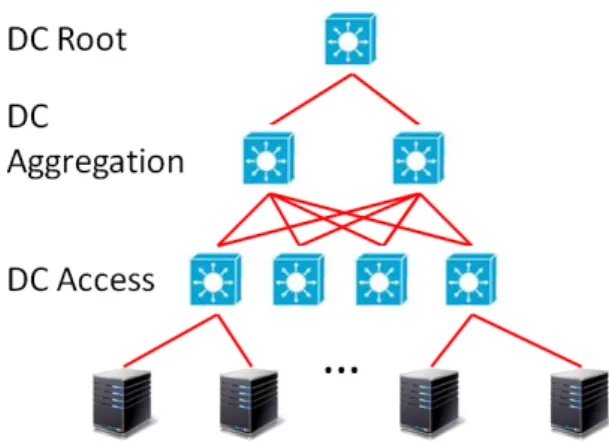
Furthermore, in most existing VNE schemes, the physical networks to embed VN requests are modeled with random graphs. DCs are, however, typically organized in a hierarchical fat tree architecture, as depicted in Figure 5. We consider this hierarchical
(a) A VNE in Green DC during day time
(b) A VNE in Green DC during night time
Figure 4: An example of VNE for green DCs
structure when modeling the VNE problem, so that VN embedding can minimize the en-ergy consumption used by intermediate switches as well as servers, as shown in Figure 6. We build a novel model of virtual network embedding in order to minimize energy usage in data centers for both computing and network resources by taking practical factors into consideration.
Figure 5: A typical hierarchical fat tree data center architecture
Figure 6: Topology awareness reduces energy consumption (right)
• We formulate the problem of virtual network embedding that incorporates energy costs of operation and migration for nodes and links that is non-linear. To solve this problem, we introduce a technique to transform it to a linear programming problem with additional constraints.
named Topology and Migration-Aware Energy Efficient Virtual Network Embed-ding (TMAE-VNE) to minimize the energy consumption caused by both operation and future migration. To the best of our knowledge, this work is the first to opti-mize energy consumption over the VN’s entire life cycle, considering time varying resource demands of virtual network requirements. In addition, we consider a prac-tical intra-DC architecture to further improve energy efficiency.
• We conduct extensive evaluations and comparisons with two state-of-the-art rithms using various inter-DC topologies. The results show that the proposed algo-rithm substantially saves energy consumption and allows high acceptance ratios.
The remainder of this chapter is organized as follows. We formally model the VNE problem with dynamic VN requests, physical nodes with sleep/awake modes, and realistic DC network topologies in Section 3.1. The proposed algorithm is described in Section 3.2. A motivating example is discussed in Section 3.3. The performance evaluations and comparisons of the proposed algorithm with existing algorithms using multiple DC topologies are presented in Section 3.4. The concluding remarks of this chapter are given in Section 3.5.
3.1 Problem Formulation
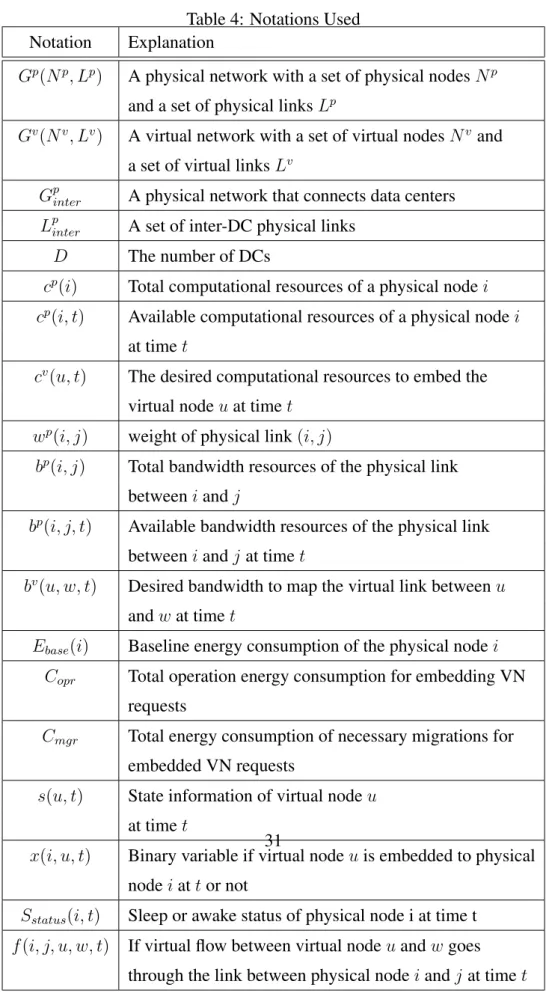
Table 4: Notations Used Notation Explanation
Gp(Np, Lp) A physical network with a set of physical nodesNp and a set of physical linksLp
Gv(Nv, Lv) A virtual network with a set of virtual nodesNv and a set of virtual linksLv
Gpinter A physical network that connects data centers Lpinter A set of inter-DC physical links
D The number of DCs
cp(i) Total computational resources of a physical nodei cp(i, t) Available computational resources of a physical nodei
at timet
cv(u, t) The desired computational resources to embed the
virtual nodeuat timet wp(i, j) weight of physical link(i, j)
bp(i, j) Total bandwidth resources of the physical link
betweeniandj
bp(i, j, t) Available bandwidth resources of the physical link
betweeniandj at timet
bv(u, w, t) Desired bandwidth to map the virtual link betweenu
andwat timet
Ebase(i) Baseline energy consumption of the physical nodei
Copr Total operation energy consumption for embedding VN
requests
Cmgr Total energy consumption of necessary migrations for
embedded VN requests
s(u, t) State information of virtual nodeu at timet
x(i, u, t) Binary variable if virtual nodeuis embedded to physical nodeiattor not
Sstatus(i, t) Sleep or awake status of physical node i at time t
We model the energy efficient VNE problem as an optimization problem aiming to minimize the energy consumed for embedding VN requests. Specifically, the total energy consumption consists of the energy consumed for operation and migration under a group of constraints, including computational and network resource limitations, binary limitations, and flow constraints. We further transform the proposed VNE problem to a linear program problem by introducing two auxiliary variables.
3.1.1 Notations
In this section, we model the VNE problem that minimizes the energy consump-tion with practical DC topologies and migraconsump-tion awareness. Notaconsump-tions used in the Chapter 3 are listed in Table 4.
Assume a physical network Gp(Np, Lp) consists of multiple DCs Gp1(N1p, Lp1), Gp2(N2p, Lp2),· · ·,GpD(NDp,LpD). Here,Dis the number of DCs in a physical network. A DCdincludes a group of physical nodesNdpand physical linksLpd. We have
Gp =Gp1∪Gp2∪· · ·∪GpD∪Gpinter Np =N1p∪N2p∪· · ·∪NDp Lp =Lp1∪Lp2∪· · ·∪LpD∪Lpinter
whereGpinter is the network that connects DCs, andLpinter is the set of all inter DC links. Each physical nodei∈Npis equipped with limited computational resourcescp(i)1, while each physical link between two adjacent physical nodes i and j has limited bandwidth bp(i, j).
An infrastructure provider receives VN requests and assigns proper computational and network resources satisfying the specific demands of each VN request. In detail, a VN request can be modeled as a weighted graphGv(Nv, Lv), whereNv andLv are the
sets of virtual nodes and virtual links, respectively.
Based on the observation that users’ workloads often change predictably with time, such as day and night times [128], we assume VN resource workloads are differ-ent in the time intervals. We denote the minimal desired computational resource at time t for a virtual nodeu ∈ Nv as cv(u, t), and the minimal desired bandwidth resource at
timetfor a virtual link inLv asbv(u, w, t). For the simplicity of our discussion, we only
consider demands of two different times (tandt+ 1for day and night times, respective-ly, for example) for each VN request in the illustrating example and evaluation sections. However, the idea of scheduling and mapping can be naturally extended to handle more time intervals. For a certain virtual nodeuof VN requestv, its requested computational resourcecv(u,·)is specified for the day and night times as shown below.
cv(u,·) = {
cv(u, t), during day time
cv(u, t+ 1), during night time (3.1) The requested bandwidth between virtual nodesu andw, bv(u, w,·) is specified for the
day and night times as:
bv(u, w,·) = {
bv(u, w, t), during day time
bv(u, w, t+ 1), during night time (3.2)
After embedding some VN requests, the available computational resources of a physical node i are the residual computational resources after reserving resources for
already embedded VN requests:
cp(i, t) =cp(i)−∑
∀v↑i
cv(u, t) (3.3)
Here, v ↑ i indicates that virtual node v is embedded on physical node i. Due to the different demands of VN requests for day and night times, the available resources change over time too.
Similarly, the available bandwidth of a physical link between two adjacent physi-cal nodesiandjis defined as:
bp(i, j, t) = bp(i, j)− ∑
∀(u,w)↑(i,j)
bv(u, w, t) (3.4) Here, (u, w) ↑ (i, j) indicates that the virtual link between virtual node uandw passes through the physical link between physical nodesiandj.
Our goal is to embed a group of VN requests with minimal energy consumption that consists of operational energy cost Copr, and migration energy cost Cmgr under
re-source limitations, which is defined as follows; min∑
t
(Copr(t) +Cmgr(t)) (3.5)
In addition, we assume that physical nodes support the sleep and awake mode in the physical network. Especially, there is no energy consumption if a physical node is turned to the sleep mode. For an awake node, a baseline energy is consumed for main-taining basic functions [127], while for each newly embedded virtual node, an additional power is consumed for performing the work on this virtual node.
3.1.2 Operation Energy Consumption
We model the operational energy consumption including energy costs for nodes and links as:
Copr(t) = Energy cost for nodes + Energy cost for link bandwidths
= ∑ i ∑ u ∑ t=0 [αo1Ebase(i)Sstatus(i, t) +αo2cv(u, t)]x(i, u, t) +αo3 ∑ i,j ∑ u,w,u>w ∑ t=0 wp(i, j)bv(u, w, t)f(i, j, u, w, t) (3.6) Here, a binary variablex(i, u, t)is used to indicate whether or not a virtual node uis embedded to physical nodeiat timet.
x(i, u, t) = {
1, if virtual nodeuis assigned to physical nodeiat timet
0, otherwise (3.7)
The operation cost of embedding a virtual node u to physical node i at time t consists of a possible baseline energy consumption Ebase(i) for waking up nodei if its
statusSstatus(i, t−1)at timet−1 is asleep and an operation cost for executing virtual
nodeu’s taskscv(u, t)at timet. Sstatus(i, t) =
{
1, if physical nodeiis asleep at the beginning of timet
0, otherwise (3.8)
On the other hand, link operation cost is determined by traffic volume,bv(u, w, t)
on the virtual link(u, w)at timet, and the weight,wp(i, j)of the physical links(i, j)that
is different for inter or intra DC links. We use network flowf(i, j, u, w, t)to determine whether a physical link (i, j)is used to embed a virtual link u, w. When f(i, j, u, w, t)
is equal to 1, virtual link (u, w) passes through the physical link (i, j). Otherwise, f(i, j, u, w, t)is equal to 0. Coefficientsαo1, αo2, andαo3 are used to balance the weight
among different parts of the operation cost.
3.1.3 Migration Energy Consumption
Even though migrating embedded virtual nodes could save energy, it may intro-duce additional overhead, such as the cost for moving system resources and maintaining additional links when the migration is processed. [115] describes the processes of the vir-tual router’s live migration and its related overhead. We model the migration energy cost at timetas shown below.
Cmgr(t) = Cost due to size of system resource + Cost due to bandwidth usage = αm1 ∑ i1,i2,i1̸=i2 ∑ u ∑ t=1 s(u, t)Elen(i1, i2)x(i1, u, t−1)x(i2, u, t) + αm2 ∑ i1,i2,i1̸=i2 ∑ a,b ∑ u,w,u>w ∑ t=1 bv(u, w, t−1)x(i1, u, t−1)x(i2, u, t) f(a, b, u, w, t−1)wp(a, b)) (3.9) Here, we formulate the migration cost as the summation of duplicating the virtual nodes’ status and maintaining duplicated links before migration is completed. In Equations (3.9), s(u, t)is the coefficient indicating the cost of duplicating execution status for virtual node uat timet. Elen(i1, i2)is the weight of a physical path between physical nodesi1 andi2.
The product ofx(i1, u, t−1)andx(i2, u, t)indicates that the virtual nodeuwas embedded
is the coefficient for maintaining the physical link (a, b) that is used for embedding the virtual link(u, w). Coefficientsαm1,αm2, andαm3 are used to balance the weight among
different parts of the migration cost.
3.1.4 Transformation of the Optimization Objective
Due to the existence of the products of variables, such asx(i1, u, t−1)x(i2, u, t),
the objective function is a non-linear problem that is hard to solve. We transform it to a linear program problem by introducing two auxiliary binary variables: m(i1, i2, u, t−1)
andg(i1, i2, a, b, u, w, t). Here we replacex(i1, u, t−1)x(i2, u, t)withm(i1, i2, u, t−1)
and replacex(i1, u, t−1)x(i2, u, t)f(a, b, u, w, t−1)withg(i1, i2, a, b, u, w, t).
Intuitive-ly, m(i1, i2, u, t−1)indicates if a virtual nodeu has migrated from physical nodei1 to
i2 at timet; whileg(i1, i2, a, b, u, w, t) represents if a physical link(a, b)belongs to the
physical path that embedding virtual link(u, w), and one end of the virtual link has mi-grated from physical node i1 to i2 at time t. Constraints (3.12) and (3.13) are added to
ensure the converted problem is equivalent with the original one. The original objective function is as follows:
min (∑ i ∑ u ∑ t=0 [αo1Ebase(i)Sstatus(i, t) +αo2cv(u, t)]x(i, u, t) +αo3 ∑ i,j ∑ u,w,u>w ∑ t=0 wp(i, j)bv(u, w, t)f(i, j, u, w, t) +αm1 ∑ i1,i2,i1̸=i2 ∑ u ∑ t=1 s(u, t)wp(i1, i2)x(i1, u, t−1)x(i2, u, t) +αm2 ∑ i1,i2,i1̸=i2 ∑ a,b ∑ u,w,u>w ∑ t=1 bv(u, w, t−1)x(i1, u, t−1)x(i2, u, t) f(a, b, u, w, t−1)))wp(i, j) (3.10)
The transformed objective function is as follows: min (∑ i ∑ u ∑ t=0 [αo1Ebase(i)Sstatus(i, t) +αo2cv(u, t)]x(i, u, t) +αo3 ∑ i,j ∑ u,w,u>w ∑ t=0 wp(i, j)bv(u, w, t)f(i, j, u, w, t) +αm1 ∑ i1,i2,i1̸=i2 ∑ u ∑ t=1 s(u, t)wp(i1, i2)m(i1, i2, u, t) +αm2 ∑ i1,i2,i1̸=i2 ∑ a,b ∑ u,w,u>w ∑ t=1 bv(u, w, t−1)g(i1, i2, a, b, u, w, t) wp(i, j))) (3.11)
The following two constraints are introduced to ensure the equivalence of the con-verted problem and the origin problem.
0≤x(i1, u, t−1) +x(i2, u, t)−2m(i1, i2, u, t)≤1 (3.12)
0≤m(i1, i2, u, t) +f(a, b, u, w, t−1)−2g(i1, i2, j, a, b, u, w, t)≤1 (3.13)
3.1.5 Constraints
The optimization goal is subjected to the constraints on computational and net-work resources. ∑ u cv(u, t)x(i, u, t)≤cp(i, t),∀i, t (3.14) ∑ u,w f(i, j, u, w, t)bv(u, w, t)≤bp(i, j, t),∀i, j, t (3.15) Constraint (3.14) ensures that for each physical node i at any time t, the total required computational resources of virtual nodes that mapped toiwould not exceed the available computational resources oni. Constraint (3.15) guarantees that for each physical
![Figure 1: PUE data for all large-scale Google data centers [116]](https://thumb-us.123doks.com/thumbv2/123dok_us/10183602.2920843/18.892.191.732.259.454/figure-pue-data-large-scale-google-data-centers.webp)
![Figure 2: Power consumption elements considered by Google in their power measurement [116]](https://thumb-us.123doks.com/thumbv2/123dok_us/10183602.2920843/19.892.205.716.189.660/figure-power-consumption-elements-considered-google-power-measurement.webp)
![Table 1: Component Peak Power Breakdown for a Typical Server [43]](https://thumb-us.123doks.com/thumbv2/123dok_us/10183602.2920843/20.892.203.717.447.655/table-component-peak-power-breakdown-typical-server.webp)