RECORD AND DETERMINISTIC REPLAY OF PARALLEL PROGRAMS ON MULTIPROCESSORS
BY
NIMA HONARMAND
DISSERTATION
Submitted in partial fulfillment of the requirements for the degree of Doctor of Philosophy in Computer Science
in the Graduate College of the
University of Illinois at Urbana-Champaign, 2014
Urbana, Illinois
Doctoral Committee:
Professor Josep Torrellas, Chair and Director of Research Professor Sarita V. Adve
Professor Vikram S. Adve
Associate Professor Samuel T. King Dr. Gilles A. Pokam, Intel Labs
Abstract
Record and deterministic Replay(RnR) is a primitive with many proposed applications in computer sys-tems, including debugging, security and fault tolerance. RnR is typically a two phase process: in the first phase (record) enough information about an execution is logged which is then used in the second phase (replay) to re-create the execution.
Application-level RnR seeks to record and replay single programs (or sets of programs) in isolation from the rest of the system. In this environment, there are typically two sources of non-determinism that an RnR solution should capture: program inputs(such as the results of the system calls the program makes to the OS or the signals the program receives) and thememory-access interleavingof concurrent threads that result in inter-thread data dependences.
In order to enjoy wide acceptance, RnR solutions should be practical to build and, at the same time, enable a diverse range of use-cases (such as debugging and security analysis). Low recording overhead is a key requirement for many use cases of RnR. While software can often be used to record program inputs with low overhead, it can incur significant overhead to record memory-access interleaving. To reduce this overhead, hardware-assisted RnR techniques have been proposed. The main challenge here is devising hardware mechanisms that are simple enough to be embraced by processor vendors and, at the same time, powerful enough to work for the complex architectures of today. The first part of this thesis is a step in this direction — i.e., building practical and low overhead hardware-assisted RnR systems.
We focus on the hardware-assisted RnR of parallel programs on multiprocessor machines. Firstly, we introduceQuickRec[65], the first physical realization of a hardware-assisted RnR system including new hardware and software. The focus of this project is understanding and evaluating the implementation issues of RnR on a real platform. We demonstrate that RnR can be implemented efficiently on a real multicore Intel Architecture (IA) system. We show that the rate of memory log generation is insignificant, and that the recording hardware has negligible performance overhead, as expected. The evaluations however point
to the software stack as the major source of overhead (incurring an average recording overhead of nearly 13%), an issue that was largely ignored by previous work on hardware-assisted RnR.
We then address the problem of replay speed by introducing Cyrus [31], an RnR scheme that can record programs and replay them in parallel without making any changes to the cache coherence protocol and messages. The proposal uses a novel hybrid hardware/software mechanism for recording memory-access interleaving. The hardware component records a raw and incomplete log that is then processed and transformed into a complete log by an on-the-fly software Backend Pass. As the raw log is being generated, this pass transforms it for high replay parallelism. This can also flexibly trade-off replay parallelism for log size. We evaluate Cyrus through full-system simulation including simulated hardware and using the same real software stack that was used in QuickRec.
QuickRec and Cyrus are limited in terms of the memory consistency models they support: Total Store Order (TSO) and Sequential Consistency (SC), respectively. To enable RnR for other architectures whose memory model is more relaxed, we then propose RelaxReplay [32]. It is a general hardware-assisted MRR scheme that works for any relaxed-consistency model of current processors and does not require any changes to the underlying coherence protocol and messages. RelaxReplay’s core innovation is a new way of capturing memory access reordering. Each memory instruction goes through a post-completion in-order
countingstep that detects any reordering, and efficiently records it. The evaluations show that RelaxReplay induces negligible recording overhead and that the average size of the log produced is only 1–4x as large as in existing solutions — still very small compared to the memory bandwidth of modern machines.
After considering the challenges of building practical RnR systems, the next question to be answered is that of their usability. The last part of this thesis investigates the issue of using the RnR technology in program debugging, the most commonly cited use-case of replay. RnR enables deterministic reproduction of hard-to-repeat software bugs. However, simply providing support for repeatedly stumbling on the same bug does not help diagnose it. For bug diagnosis, developers typically augment the program source with debug code — E.g., by creating and operating on new variables, or printing state. Unfortunately, this renders the RnR log inconsistent and makesReplay Debugging(i.e., debugging while using an RnR log for replay) dicey at best.
To attack this problem, we proposerdb[33], the first scheme for replay debugging that guarantees exact replay in the presence of debug code. rdbrelies on two mechanisms. The first one is compiler support to
split the instrumented application into two executables: one that is identical to the original program binary, and another that encapsulates all the added debug code. The second mechanism is a runtime infrastructure that replays the application and, without affecting it in any way, invokes the appropriate debug code at the appropriate locations. We describe an implementation ofrdbbased on LLVM [3] and Pin [53], and show an example of howrdb’s replay debugging helps diagnose a real bug.
To the memory of my first teacher, my loving mother. To my father, who taught me to be a human before being a scholar. To my precious wife, Razieh, whose tender love I cherish above all else.
Acknowledgements
I am grateful to many people for supporting and contributing to the content of this thesis:
• My advisor, Josep Torrellas, unwaveringly encouraged, supported, and guided me throughout my Ph.D. research. He spent many hours with me, patiently brain storming and providing much needed discussions to help me polish my thoughts. He also contributed many ideas to the projects.
• Sam King worked closely with Josep and me and was a key driving force behind the QuickRec and Cyrus projects. He provided the initial code of Capo3 and continued to advise me afterwards on all the issues related to QuickRec’s OS aspects and hardware/software interface.
• I was lucky to collaborate with Gilles Pokam, Klaus Danne, Cristiano Pereira, Rolf Kassa, Tim Kranich, Shiliang Hu and Justin Gottschlich from the Intel Corporation on the QuickRec project. They designed and implemented the QuickRec hardware for which I built the software and did the hardware/software integration. This collaborative effort laid the foundation for all other projects in this dissertation.
• My friend, Nathan Dautenhahn, had a major role in getting the Capo3 software up and running on the QuickRec hardware, as well as in implementing its replay tool and running the experiments.
Finally, I would like to thank my Ph.D. committee members who provided me with much valuable feedback in improving this dissertation.
Table of Contents
List of Tables . . . x
List of Figures . . . xi
Chapter 1 Introduction . . . 1
1.1 Record and Deterministic Replay . . . 1
1.1.1 Scope of RnR and Definition of Determinism . . . 1
1.1.2 Capturing Sources of Non-determinism . . . 2
1.1.3 RnR in This Thesis . . . 2
1.1.4 Capturing Non-determinism: Hardware-Assisted vs. Software-Only RnR . . . 3
1.2 A Brief Overview of Existing Related Work . . . 4
1.2.1 Software-Only RnR Solutions . . . 4
1.2.2 Hardware-Assisted RnR Solutions . . . 9
1.3 Thesis Contributions and Outline . . . 11
1.3.1 First Physical Prototype of Hardware-Assisted RnR . . . 12
1.3.2 Enabling Fast Replay Through Replay Parallelism . . . 12
1.3.3 Efficient RnR for Relaxed Memory Models . . . 13
1.3.4 Replay Debugging . . . 14
Chapter 2 QuickRec: Prototyping an Intel Architecture Extension for Record and Replay of Multithreaded Programs . . . 15
2.1 Introduction . . . 15
2.2 QuickIA Recording System . . . 17
2.2.1 QuickIA Processor Emulation Platform . . . 17
2.2.2 Recording Interleaving Non-Determinism . . . 18
2.2.3 Programming Interface . . . 24
2.2.4 Other Issues . . . 24
2.3 Capo3 System Software . . . 25
2.3.1 Comparing Capo3 with Capo . . . 25
2.3.2 Capo3 Architecture . . . 26
2.3.3 Virtualizing the QuickRec Hardware . . . 27
2.3.4 Handling Context Switches . . . 28
2.3.5 Recording in Kernel Mode . . . 28
2.3.6 Handling Input/Chunking Interactions . . . 29
2.4 Prototype Characterization . . . 30
2.4.1 Experimental Setup . . . 30
2.4.3 Performance Measurements . . . 36
2.5 Validation Using Replay . . . 38
2.5.1 High-Level Implementation Description . . . 39
2.5.2 Validating the Complete System . . . 41
2.6 Related Work . . . 42
2.7 Lessons Learned . . . 43
2.8 Concluding Remarks . . . 44
Chapter 3 Cyrus: Unintrusive Application-Level Record-Replay for Replay Parallelism . . . . 45
3.1 Introduction . . . 45
3.2 Background and Key Challenges . . . 46
3.2.1 Background on Deterministic RnR . . . 46
3.2.2 Key RnR Challenges . . . 48
3.3 Unintrusive App-Level RnR for Replay Parallelism . . . 50
3.3.1 Main Idea . . . 50
3.3.2 Application-Level RnR . . . 51
3.3.3 Unintrusive Recording Hardware . . . 53
3.3.4 Replay Parallelism . . . 55
3.3.5 Backend Software Pass . . . 59
3.4 Implementation Issues . . . 65
3.4.1 Race Recording Unit (RRU) Design . . . 65
3.4.2 OS Design for RnR . . . 67
3.5 Evaluation Setup . . . 70
3.6 Evaluation . . . 71
3.6.1 Recording & Backend Overhead . . . 71
3.6.2 Comparing Different Backend Pass Algorithms . . . 72
3.6.3 Replay Execution Time . . . 73
3.6.4 Dependence-Tracking Window Analysis . . . 77
3.7 Related Work . . . 78
3.8 Concluding Remarks . . . 79
Chapter 4 RelaxReplay: Record and Replay for Relaxed-Consistency Multiprocessors . . . 81
4.1 Introduction . . . 81
4.2 Background on Chunk-Based Recording . . . 82
4.2.1 Advantages of Chunk-Based Recording . . . 83
4.2.2 Main Limitation: Access Reordering . . . 84
4.3 RelaxReplay Design . . . 85
4.3.1 Concept of Interval . . . 85
4.3.2 Main Idea in RelaxReplay . . . 86
4.3.3 Tracking Instruction Events in RelaxReplay . . . 88
4.3.4 Handling Store-to-Load Forwarding . . . 93
4.3.5 Replaying a RelaxReplay Log . . . 94
4.3.6 Discussion . . . 95
4.4 Detailed Implementation Issues . . . 96
4.4.1 Memory Race Recorder . . . 96
4.4.2 Extension for RelaxReplay Opt . . . 98
4.4.4 Modest Hardware Complexity . . . 100
4.5 Evaluation . . . 100
4.5.1 Experimental Setup . . . 100
4.5.2 Log Characterization . . . 101
4.5.3 Characterization of Recording Performance . . . 107
4.5.4 Characterization of Replay Performance . . . 109
4.5.5 Scalability Analysis . . . 111
4.6 Related Work . . . 112
4.7 Concluding Remarks . . . 114
Chapter 5 Replay Debugging: Leveraging Record and Replay for Program Debugging . . . 115
5.1 Introduction . . . 115
5.2 Background . . . 117
5.2.1 Assumed RnR Environment . . . 117
5.2.2 Debugging Can Break Replay . . . 117
5.3 Using RnR Support for Debugging . . . 119
5.3.1 Inline Debug Code in the Program Code . . . 119
5.3.2 Access Program Code & Data from the Debug Code . . . 121
5.3.3 Output the Results of the Debug Code . . . 121
5.3.4 Keep State in the Debug Code . . . 122
5.4 Basic Design of Replay Debugging withrdb . . . 122
5.4.1 Structure of the Debug Code . . . 123
5.4.2 Generating the Executable for Replay Debugging . . . 123
5.4.3 Executing the Debug Code while Replaying . . . 128
5.5 Advanced Issues . . . 130
5.5.1 Debug-Only Functions and Global Variables . . . 130
5.5.2 Event-Driven Debugging . . . 131
5.5.3 Protecting Against Writes to Main-Program Memory . . . 131
5.5.4 Using gdb with Replay Debugging . . . 132
5.5.5 Replay Debugging with Partial Logs . . . 132
5.5.6 Replay Debugging without Pin . . . 133
5.6 An Example of Replay Debugging . . . 133
5.7 Current Limitations and Potential Solutions . . . 136
5.7.1 Adding/Removing Code in the Main Program . . . 136
5.7.2 Supporting Compiler Optimizations . . . 137
5.7.3 Cross-Region Data Sharing . . . 138
5.8 Related Work . . . 139
5.9 Concluding Remarks . . . 140
Chapter 6 Conclusion . . . 141
List of Tables
2.1 QuickIA platform parameters. . . 18 2.2 Main reasons for terminating chunks. WAB (Write-After-Both) is when a write in one chunk
hits in both the read and the write set of another chunk. . . 23 2.3 Characteristics of the benchmarks. The last column shows the total number of instructions
executed in the 4-threaded run in billions.Waterrefers to Water-nsquare. . . 30 3.1 Parameters of the simulated hardware. . . 70 4.1 Architectural parameters. . . 101
List of Figures
2.1 Photograph of the QuickRec prototype with FPGAs in CPU sockets (a); architecture of the QuickIA processor-emulation platform (b); and architecture overview of the extended Pen-tium core in QuickRec, where circled numbers identify the main CPUtouch pointsrequired
to enable recording (c). . . 17
2.2 Instruction atomicity violation (IAV) example. . . 21
2.3 IAV counter mechanism. . . 22
2.4 Packet formats in QuickRec. . . 23
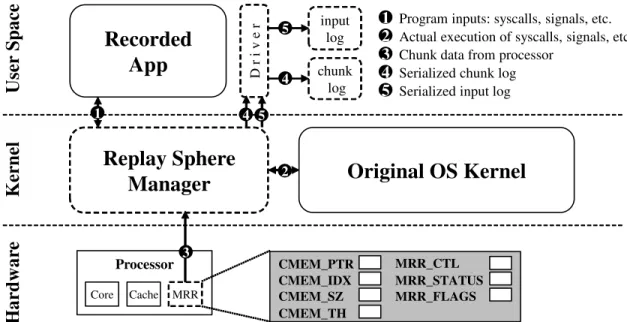
2.5 Overall architecture of Capo3. Dashed boxes indicate QuickRec-specific components. . . 26
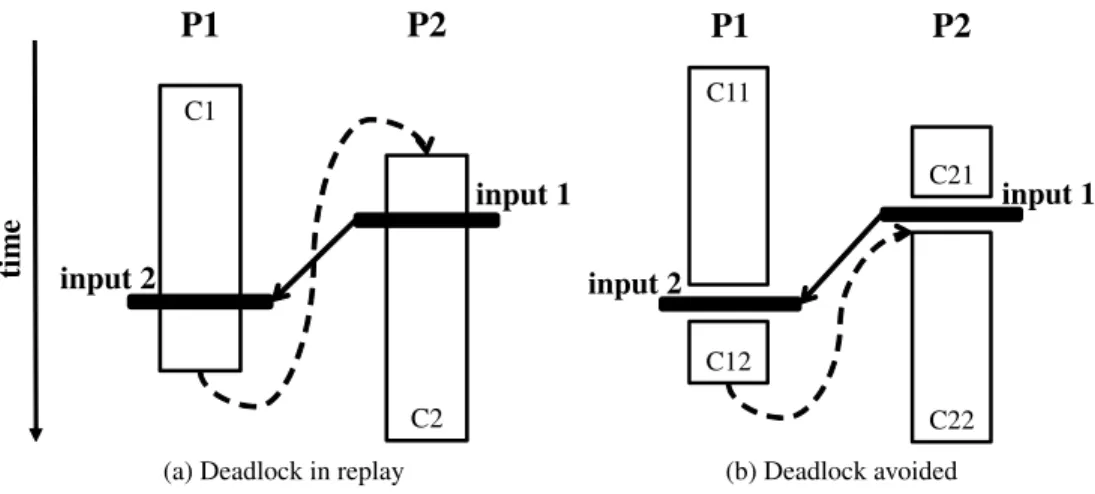
2.6 Examples of dependences between input events (solid lines) and between chunks (dashed lines). . . 29
2.7 Uncompressed log sizes. . . 31
2.8 Memory bandwidth requirements . . . 32
2.9 Average chunk size. . . 33
2.10 Cumulative distribution of chunk size. . . 34
2.11 Chunk termination reasons. . . 35
2.12 RSW and IAV characterization. . . 35
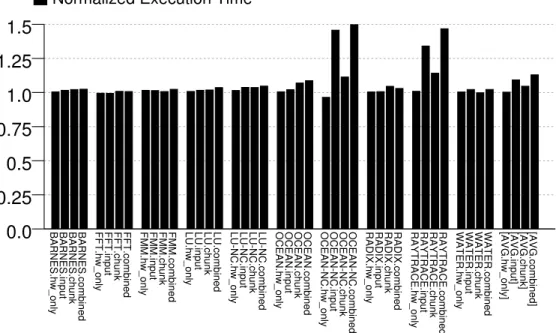
2.13 Execution time with each recording configuration for four-threaded executions. The bars are normalized to the execution time ofnative. . . 37
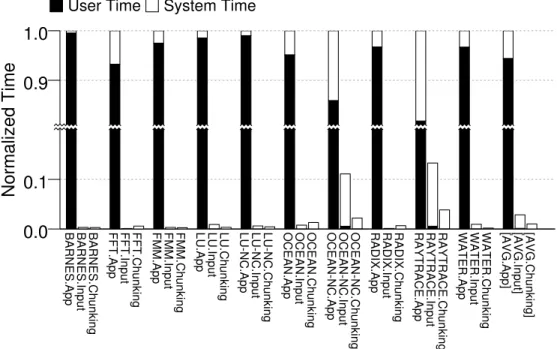
2.14 Total time that the processors spend working on the applications divided into user and sys-tem time. . . 38
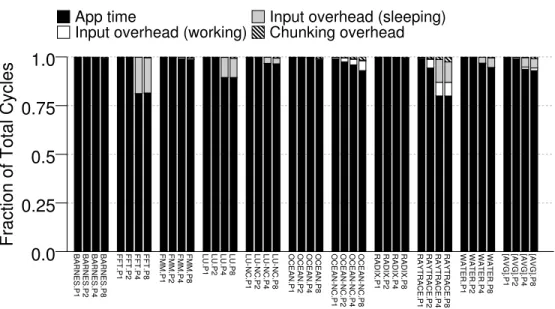
2.15 Breakdown of the total processor cycles for different thread counts. . . 39
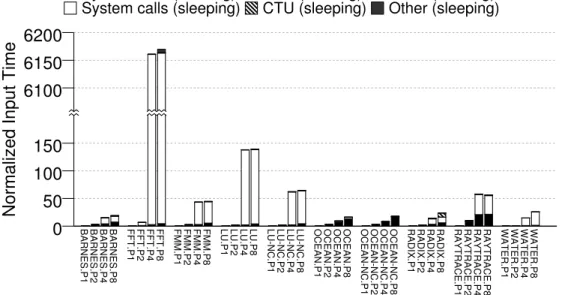
2.16 Breakdown of the normalized overhead of input recording and management. CTU stands for Copy To User. . . 40
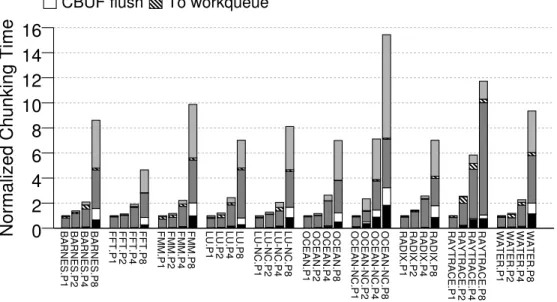
2.17 Breakdown of the normalized chunk-management overhead. . . 41
3.1 Difficulties in capturing inter-thread dependences in application-level RnR. . . 49
3.2 Keeping a snoopy cache coherence protocol unmodified requires recording dependences from the dependence source only. . . 50
3.3 Overview of the Cyrus system. . . 51
3.4 Characterizing the types of interprocessor interactions. . . 52
3.5 High-level view of the Cyrus hardware. . . 54
3.6 Recording dependences in Cyrus. . . 55
3.7 Example of execution and resulting Cyrus logs. The table in (b) depicts the initial chunk data dumped by the processors, while the other tables show the results of the different backends, encoding the corresponding DAGs. In the tables, dashes indicate entries corresponding to dependencies to the processor itself. These are never used. . . 58
3.8 High-level description of the MaxPar algorithm. . . 61
3.9 Flexibility of the backend pass. . . 63
3.10 Race Recording Unit (RRU) design. . . 66
3.11 Overall architecture of our RnR system, where the dashed boxes are the Cyrus extensions. The numbers correspond to the generation of logs during recording. . . 68
3.12 Initial log size for different numbers of processors, shown in terms of the number of bits generated per 1K cycles of total execution time. . . 71
3.13 Overhead of recording with and without the backend pass for 8-processor runs. . . 72
3.14 Normalized Inverse Critical Path Length (NICPL). . . 73
3.15 Log size in bits per 1K instructions. . . 74
3.16 Replay execution time with the MaxPar log for different chunk sizes. . . 74
3.17 Replay execution time with logs from different backends for a 4K chunk size. . . 75
3.18 Replay execution time with a lower processor count than during recording. . . 76
3.19 Breakdown of the replay execution time with the MaxPar log for 4K chunks. . . 77
3.20 Effect of different organizations of the dependence-tracking window on parallelism. I × J×Kstands forI chunk clusters,J chunk size, andKchunks per cluster. . . 77
4.1 Fraction of all the memory-access instructions that are performed out of program order. . . . 85
4.2 Examples of a two-instruction pattern with different timings for their perform (P) and count-ing (C) events. . . 87
4.3 High-level architecture of RelaxReplay. . . 89
4.4 Examples of RelaxReplay operation with perform (P) and counting (C) events. . . 90
4.5 Timing of store-to-load forwarding. . . 93
4.6 RelaxReplay architecture in detail: per-processor Memory Race Recorder (MRR) (a), TRAQ entry (b), and format of the different entry types in an interval’s log record (c). The dashed boxes indicate the components specific to RelaxReplay Opt. . . 94
4.7 RelaxReplay can be paired with any chunk-based MRR scheme. . . 96
4.8 Snoop Table structure in RelaxReplay Opt. . . 99
4.9 Fraction of memory-access instructions found by RelaxReplay to be reordered for 4K (a) and INF (b) intervals. . . 103
4.10 Number ofInorderBlockentries (IBs), normalized to RelaxReplay Base, for 4K (a) and INF (b) intervals. . . 104
4.11 Uncompressed log size in bits per 1K instructions for 4K (a) and INF (b) intervals. . . 106
4.12 TRAQ utilization: average (a) and histograms for four representative applications (b). . . 108
4.13 Replay time with Opt or Base logs, normalized to recording time, for 4K (a) and INF (b) intervals. . . 110
4.14 The effect of processor count on recording. . . 111
5.1 High-level organization of the assumed RnR system. . . 117
5.2 Making debug code work forrdb. . . 120
5.3 Example of a debug region. . . 123
5.4 Compiling an example program for replay debugging: C program containing debug code (a); resulting LLVM IR generated by the Clang front-end (b); extracted debug module (c); resulting main code containing rdb markers (d); function descriptors (e); and argument descriptors (f). . . 124
5.5 Clang/LLVM compilation flow. rdbaugments the two shaded boxes. . . 125
5.7 High-level view of the infrastructure for executing the debug code while replaying (a), and address space of an application running under Pin (b). . . 129 5.8 Example usingrdbfor replay debugging: program with a debug region. . . 134 5.9 Objects accessed in the debug region. . . 135 5.10 Optimization example: program before (a) and after (b) automatic debug code insertion. . . 137
Chapter 1
Introduction
1.1
Record and Deterministic Replay
Many problems in designing and programming reliable computer systems can significantly benefit from the ability to examine a past execution. Being able to deterministically re-create an execution is thus a crucial primitive for these domains. Record and deterministic Replay (RnR) is a primitive that strives to achieve this ability. RnR has broad uses in, at least, program debugging [4, 13, 17, 41, 71, 75, 90, 60], where, for example, a bug can be easily reproduced, intrusion analysis [40, 24, 39, 68], where an intrusion can be traced back to an attacker’s actions, and fault-tolerant, highly-available systems [71, 22], where a backup machine can resume where the primary failed.
RnR is typically a two phase process: in the first phase (record) enough information about an execution is logged which is then use in the second phase (replay) to re-create the execution.
1.1.1 Scope of RnR and Definition of Determinism
RnR may be achieved at different levels of abstraction, from distributed programs (e.g., [7]) to physical ma-chines (e.g. [56]) to virtual mama-chines (e.g., [24, 80]), to OS processes (e.g. [57, 42]) to program components (e.g., [30]). Different solutions have different costs and overheads and, in turn, enable different use-cases. The choice of the level of abstraction, therefore, highly depends on the use-case of RnR that the system designer has in mind and the cost he/she is willing to pay.
Similarly, the definition of “determinism” in the context of replay also depends on the chosen level of abstraction as well as the intended use-case. For example, in some cases, determinism only concerns the observable outputs of a program (e.g. [6, 62]) while, in other cases, it may concern the exact sequence of instructions in the dynamic control flow (e.g., [57, 59]).
1.1.2 Capturing Sources of Non-determinism
In all these cases, however, all sources of non-determinism that can affect the relevant properties of the execution should be captured at record time or inferred at replay time. The resulting logs should be used at replay time to guide the re-execution to ensure deterministic replay. From this point of view, replay solutions can be divided into two broad categories:
• Search-basedRnR techniques record only a subset of all the non-deterministic events that can affect the execution at record time and then use a search phase to infer the missing pieces (e.g., [6, 62, 36]). Example of such missing information include not recorded program inputs or inter-thread data depen-dencies. They typically employ such techniques as symbolic execution or constraint solvers in their search phase. These solutions normally rely on a relaxed definition of “determinism” (such as output determinism), since they can never guarantee stronger forms of determinism due to incompleteness of recorded logs, and are sometimes referred to asrelaxed RnR methods. In the extreme end of the spectrum, they only record the final state of a program (as a core dump) and try to synthesize an execution that can lead to that final state [89].
• Strong RnR techniques that record enough information to be able to do replay without searching. They typically have higher recording overhead than search-based techniques (due to recording larger logs) but provide simpler and faster replay mechanisms.
1.1.3 RnR in This Thesis
Application-levelRnR seeks to record and replay single programs (or sets of programs) in isolation from the rest of the system. This is what users need most of the time and it is general enough to be useful for many of the RnR use-cases mentioned earlier. Also, compared to recording whole machines, it is more portable. Recreating the whole machine state during replay is often very hard and, to work correctly, needs to deal with many non-portable operating system and hardware issues of the platform. Application-level RnR, in contrast, tends to be more portable and add less overhead. In addition, many of the techniques developed for this RnR style, can be easily applied to RnR of virtual machines (using hypervisors) that is another widely useful flavor of RnR.
consider strong RnR techniques and seek functional determinism: each thread in the replayed execution should follow the same sequence of instruction as in the original run and each instruction’s inputs should be the same as those of its original counterpart.
1.1.4 Capturing Non-determinism: Hardware-Assisted vs. Software-Only RnR
In this environment, there are typically two sources of non-determinism that an RnR solution should con-sider: program inputs (such as the results of system calls the program makes to the OS or signals the program receives) and thememory-access interleavingof concurrent threads that result in inter-thread data dependences1. The process of recording the latter is sometimes calledMemory Race Recording(MRR) in
the literature.
Most proposed solutions for application-level RnR use some software support to record and replay program inputs, typically relying on the OS, compiler, libraries and/or run-time systems for this purpose [71, 61, 46, 27, 19, 77, 14, 25, 6, 62, 75, 57, 24, 42, 63]. Typically, this is enough for RnR of single-threaded applications. For multi-threaded applications, however, memory-access interleaving also becomes relevant. There are several proposals for RnR of multithreaded programs. On the one hand, there are those that do not require any special hardware [71, 61, 46, 77, 14, 25, 6, 62], typically relying on the OS or compiler for MRR. Beingsoftware-only solutions, these systems are relatively inexpensive to implement but might incur significant slowdown during recording. Other schemes record with the aid of some special hardware module [10, 58, 59, 85, 86, 34, 56, 57, 66, 67, 81, 18]. These systems add negligible overhead during recording, but can be expensive to implement. We call such schemeshardware-assisted.
Low recording overhead is a key requirement for many use cases of RnR, especially those that involve recording of production runs or cannot tolerate the (often systematic) execution perturbations common in software-only schemes (for example, concurrency debugging). Thus, the lower overhead of hardware-assisted schemes makes them a more likely candidate as a general RnR solution. The obvious challenge here is devising hardware mechanisms that are simple-enough to be embraced by processor vendors and, at the same time, powerful enough to work for the complex architectures of today. This thesis is a step in this direction.
1Inter-Process Communication (IPC) via shared memory is a special form of program input that involves shared memory
accesses. Our RnR mechanism can record such communications by recording the communicating processes together (See the notion of Replay Sphere in Section 2.3.1)
1.2
A Brief Overview of Existing Related Work
RnR has been the subject of a vast body of research. In this section, we review some of the existing work and what flavor of RnR they support and how. Since this thesis mainly focuses on hardware-assisted RnR which is typically used for memory-race recording, we put more emphasis on how MRR is achieved in existing proposals.
In addition to this brief review, we discuss and compare to our work the more closely related pieces of previous work throughout the thesis after introducing each of our contributions. We postpone the discussion of previous work on replay debugging until Section 5.8 as it requires concept that will be introduced in that section.
1.2.1 Software-Only RnR Solutions
Software-only RnR relies on modified runtime libraries, compilers, operating systems and virtual-machine monitors to capture all or some sources of non-determinism. In addition, relaxed RnR approaches also use search-based and formal techniques to recover the missing pieces of information that are not captured at record time.
Strong Software-Only Solutions
Compiler- and Library-Based Approaches. We can divide these approaches into two categories, based on how they capture shared-memory interactions: value-based andorder-based. Value-based techniques record the value returned by shared memory reads. Together with program inputs, this information is enough to enable independent replay of each thread of execution but does not provide much intuition about the interaction between threads as inter-thread data dependences are not explicitly re-created. Order-based techniques record the order in which concurrent threads of execution access shared memory location and enforce the same ordering during replay.
Recap [61] is a solution to enable reverse execution of parallel programs and uses RnR for this purpose. It takes a value-based approach to MRR, where the compiler inserts some code before every read operation that may access shared data. It also uses a special run-time library that handles system calls, signals, and checkpointing. Using this information it can replay each thread of execution independently. Checkpoints are used to provide a consistent snapshot of the execution from where reverse execution can begin.
iDNA [11] is a value-based proposal that uses RnR as a means to reduce the log size needed for record-ing application traces. Instead of recordrecord-ing the trace, it records the memory values read by the executrecord-ing instructions, program code, the register state after a kernel-to-user transition and the register state after cer-tain special instructions whose effects are time or machine specific (e.g. the RTDSC and CPUID instructions on IA-32). It then uses this information to do a per-thread replay of the application, thereby regenerating the trace. It uses heavy-weight binary translation and instruction emulation platform called Nirvana to record and replay its logs.
LeBlanc and Mellor-Crummey [46] propose an order-based approach. They use Reader-Writer locking for shared memory accesses to log an execution. They capture the locking order on shared objects and thus cannot record racy executions that access shared objects without locking.
LEAP [35] is an order-based solution for deterministic replay of multi-threaded Java programs. It uses static analysis to identify all potentially shared memory locations in a program, and then, at record time, instruments the code to record the order in which each variable is accessed by concurrent threads. The authors claim that by recording each variable’s access order independently from other variables, LEAP incurs less record-time synchronization and, hence, less recording overhead compared to solutions that record global interleaving information.
CARE [38] reduces the overhead of order-based techniques such as LEAP by only logging a fraction of all actual precedence orders between reads and their associated writes (i.e., read-write dependences). It assigns to each thread a value prediction cache that keeps buffered variable values. Each time a read action is executed, the buffered value is compared with the one actually read. Only when the values are different, the corresponding read-write dependence is logged. The assumption is that if two consecutive accesses (to the same memory location) of the same thread share the same value, they can be assumed to have executed without interleaving writes from other threads and thus only the first one needs to be recorded.
Chimera [47] uses instrumentation to capture program inputs, thread schedule on each core and synchronization-induced happens-before relationships. This information is enough to replay data-race-free executions. To add support for racy programs, it uses static analysis to identify all accesses that can po-tentially participate in a race. It then places each such access inside a region protected by a “weak lock”. In addition to the original program synchronizations, Chimera records happens-before relationships due to weak-locks to guarantee deterministic replay in presence of data races.
PinPlay [63] is an order-based approach based on the Pin dynamic instrumentation system. It uses Pin for both recording and replay. It records the order of shared memory accesses using a simulation-based implementation of FDR [85] (discussed in Section 1.2.2). The logger simulates a cache-coherency protocol noting the last reader/writer for address ranges used in the program at a tunable granularity. It uses this information to compute read/write, write/write, and write/read dependences for shared-memory address ranges and records a subset of them (others are implied).
Jockey [72] is a library for record and replay of single-threaded programs. It is a library that is loaded in the same address space as the program under RnR, before loading the program itself. Once the program is loaded, Jockey takes over and instruments the program code to intercept system call invocations. In record mode, intercepted system calls are logged in a file; in replay mode, they are replayed back from the file. It also mechanisms to capture signals and memory-mapped I/O to ensure deterministic replay.
R2 [30] is a annotation-based RnR solution for the Windows platform. It records the results of selected functions in a log and during replay returns the results from the log rather than executing the functions. A Programmer have to choose functions that should be recorded. In doing so, they can trade recording overhead and replay fidelity. The programmer should annotate the chosen functions with some keywords so that R2 can handle calls with side effects and multithreading.
Operating-System- and Virtual-Machine-Based Approaches. Some RnR techniques use OS/VM sup-port instead of, or in addition to, compiler and library supsup-port. For example, Russinovich and Cogswell [71] propose to modify the OS scheduler to record thread interleaving in a uniprocessor. This will enable RnR of multi-threaded programs on uniprocessor systems. Similarly, DejaVu [19] records the scheduling decisions of a Java Virtual Machine to enable deterministic replay of multi-threaded Java applications on uniproces-sors.
Paranoid Android (PA) [68] is an RnR-based decoupled security solution for smartphones. It records applications on a phone and ships the log to a cloud-based machine that replays the execution on a virtual replica of the phone. PA records process inputs at the level of system calls. The authors claim that PA can handle multi-threaded applications on uniprocessor systems by enforcing repeatable scheduling decisions using theptrace[2] mechanism; unfortunately, there is not enough information in the paper to corroborate that.
virtual machines. Targeting uniprocessor VMs, they only need to capture inputs to the virtual machine to guarantee RnR. Virtual machine inputs consist of data that is provided to its virtual devices and interrupts that are delivered to the virtual CPU. VMware also provide a similar RnR capability based on the same principle [80].
SMP-ReVirt [25] extend ReVirt to multiprocessor virtual machines by using virtual-memory page-level protections to detect shared-memory communication between virtual CPUs. They implement a concurrent-read, exclusive-write (CREW) protocol between virtual CPUs in a multiprocessor virtual machine. Each read or write operation to shared memory is checked for access before executing. If a virtual CPU attempts a memory operation for which it has insufficient access, the CREW system can capture it and record appro-priate dependences between that virtual CPU and the ones that had previously access the same page. Thus, SMP-ReVirt captures shared-memory dependences at page granularity.
Flashback [75] focuses on application-level RnR for debugging, and captures only the interactions between the application being debugged and the operating system, like system calls and signals. It uses OS support to achieve this and only supports single-threaded programs.
Scribe [42] uses a similar virtual-memory-based mechanism mechanisms to capture the interleaving of shared memory accesses among concurrent threads of execution of a single process. Scribe tries to reduce the number of changes in page-access permissions to reduce the number of dependences that need to be recorded and improve the performance. It does so by letting a thread retain its access to a page for a configurable amount of time and stalling other threads if they try to make a conflicting access the page in that period. Although the paper reports reasonable overheads for system applications with low levels of sharing, it is not clear how it will perform for sharing- and synchronization-intensive programs.
These software-based approaches are either inherently designed for uniprocessor executions or suffer significant slowdown when applied to multiprocessor executions. DoublePlay [77] made efforts to make replay on commodity multiprocessors more efficient. It timeslices multiple threads on one processor and then runs multiple time intervals on separate processors. Hence, it only needs to record the order in which threads in each time interval are timesliced on the corresponding processor. This technique eases logging by only requiring the logger to record the order in which the time slices are executed within a time interval. However, DoublePlay uses an additional execution to create checkpoints off which multiple time intervals can be run in parallel. It also needs to use modified binaries (in particular, a modified libc) for efficient
execution.
Search-Based Software-Only Solutions
ODR [6] and PRES [62] are probabilistic replay techniques for reproducing concurrency bugs. The idea is to record only a subset of non-deterministic events required for deterministic replay (to reduce the record-ing overhead) and use a replayer that searches the space of possible executions to reproduce the same application output or bug, respectively. Respec [50] targets online replay scenarios. It records a subset of non-deterministic events and uses the online replay run to provide external determinism. The idea is to retry the execution from the last checkpoint when a divergence happens. Like DoublePlay [77], it needs to use modified binaries.
CLAP [36] records the branch trace of each thread independently and uses symbolic execution and SMT-based constraint solving [23] to generate a parallel schedule and program inputs for replay. It uses static analysis to identify shared memory accesses. Symbolic execution is used to calculate constraints on program inputs and shared memory values to generate the observed thread paths. Finally, it uses an SMT solver to solve the constraints and infer a consistent ordering of shared memory reads and writes.
Stride [91] tries to improve the speed of off-line searching at the cost of some recording overhead. It combines access-order recording with off-line search to reconstruct inter-thread dependences. Instead of recording exact source and target instructions in each dependence, it records the approximate locations of the instructions. This allows it to relax the requirement of recording the access ordering atomically with performing the accesses themselves and, thus, reduce the recording overhead. It also records the value returned by reads. An off-line search algorithm then infers the exact source and destinations of each dependence using the recorded information. The authors prove that their search algorithm has polynomial time complexity, unlike the exponential worst-case complexity of pure search-based replay schemes.
Zamfir et al. [89] propose “Execution Synthesis”, a debugging technique that skips recording altogether and instead relies on static analysis and symbolic executions to generate a parallel schedule and necessary program inputs that can reproduce the reported bug symptoms. It only “records” a core dump (typically, provided as part of the bug report) and outputs an execution trace that can result in the state captured in the core dump. The generated trace can then be deterministically replayed using their playback infrastructure.
1.2.2 Hardware-Assisted RnR Solutions
Hardware-based solutions usually use hardware to record memory races to reduce the overhead of RnR for multiprocessor executions. Most reuse existing coherence mechanisms for this purpose (BugNet [59] and LReplay [18] are exceptions and will be discussed shortly.)
FDR [85] and RTR [86] are among the very first race recording techniques proposed. They record dependences between pairs of instructions. This can result in large log sizes. Also, the resulting fine-grain ordering constraints can hurt replay efficiency. While FDR only supports SC, RTR supports TSO by recording the value of loads that may violate SC.
To remedy the large log size and fine-grain ordering constraints of earlier designs, most recent MRR techniques are based on the concept ofChunksof instructions (also calledBlocksorEpisodesin the litera-ture). The idea is to divide each thread’s execution into a sequence of dynamic groups of instructions. The execution of each group or chunk is logged as the number of instructions it contains. The MRR hardware also records a partial or total order of all of the application’s chunks. For each inter-thread data dependence, the chunk that contains the source of the dependence is ordered before the chunk that contains the destina-tion. Coherence transactions are used to identify chunk boundaries. During replay, each chunk is executed after all of its predecessors (in the recorded order) and before any of its successors. In this manner, all inter-thread dependences are enforced. The replayer has to count the number of instructions executed in a chunk in order to know when its execution is complete.
Strata [58] uses the concept of stratum to record memory interleaving. A stratum creates a time layer across all the logs for the running threads, which separates all the memory operations executed before and after the stratum. This is done by augmenting the coherence messages with a Log Stratum bit, which can be set by the processor initiating the miss or by a processor that provides the data. If the bit is set, all processors record an entry in their logs at the same time, starting a new epoch. No inter-thread dependence can exist within a single epoch; all such dependences cross strata boundaries. As such, at replay time, dependences can be easily enforced by executing one strata at a time.
DeLorean [56] and Capo [57] use the speculative multithreading hardware of BulkSC [15]. The under-lying hardware enforces SC while allowing aggressive out-of-order execution of instructions. The execution is recorded by logging the order in which processors commit their chunks.
with directory coherence. It uses a Scalar Lamport Clock [43], piggybacked on coherence transactions, to order chunks of different processors. The paper also includes a proposal to integrate RTR’s solution for TSO recording with their chunk-based scheme. Timetraveler [81] builds on Rerun and reduces its log size. While Rerun terminates a chunk upon the first conflicting coherence transaction, Timetraveler allows the chunk to grow beyond that to reduce the chunk count and, thus, the log size.
Intel MRR [66] and CoreRacer [67] are similar solutions, but for snoopy protocols. Instead of pig-gybacking timestamps on coherence messages, every time that a chunk commits, the event is broadcasted with a bus transaction. These global communications are used to synchronize timestamps across different processors. Chunk ordering can be easily established according to the recorded chunk timestamps. While the former is limited to SC, the latter supports TSO by recording the number of stores pending in the pro-cessor’s write buffer when a chunk terminates. This allows CoreRacer to correctly account for reordered and forwarded loads by simulating the write buffer’s content during replay.
Karma [10] is the first chunk-based RnR technique that explicitly targets replay parallelism without re-lying on speculative hardware. It is a whole-system (rather than application-level) RnR scheme for directory protocols. It records bidirectional dependences between source and destination chunks and, hence, makes some modifications to the cache coherence messages. By recording the chunk ordering as partially-ordered directed acyclic graph (DAG), as opposed to scalar timestamps used in earlier solutions, it can accommodate parallel replay.
LReplay [18] is a hardware-assisted MRR solution that does not monitor coherence transactions. In-stead, it includes a non-trivial centralized component that directly tracks the memory operations performed by all cores. It relies on this hardware to detect inter-processor dependences. It supports TSO using RTR’s approach. Due to its specific recording technique, its replay algorithm is complicated and needs to simulate all instructions.
BugNet [59] records user processes by storing the result of load instructions in a hardware-based dic-tionary. It does so by recording the content of each fetched cache line upon first access to it. This is enough to handle both input and memory-interleaving non-determinism and allows each thread to be replayed in-dependently. However, BugNet still needs a solution to record inter-thread dependences, for which it uses FDR [85].
and TSO [48] executions. They use BugNet’s cache-line recording technique and thus can replay each thread independently. They also periodically record some Strata hints to speed-up the off-line search. Using the results of per-thread replays and the hints, inter-thread data dependences can be determined off-line.
Rainbow [70] builds on Strata and uses SC-violation detection hardware to record non-SC executions. When an SC violation is detected, it records some information about delayed and pending instructions that allows it to replay the situation correctly. This scheme needs to augment coherence messages with instruction identifiers. Moreover, to detect SC violations, it requires a central data structure that tracks the coherence transactions of all processors. Due to this centralized data structure, it cannot support distributed-directory coherence protocols. The scheme claims to support general relaxed memory models, although the operation is not described in enough detail.
1.3
Thesis Contributions and Outline
This thesis seeks to assess and improve practicality of hardware-assisted RnR. In particular, we focus on RnR of parallel programs on parallel hardware.
We believe that a practical hardware-assisted RnR solution should possess the following properties in order to improve its chances of being embraced by processor vendors and system software developers:
• It should work with unmodified programs (e.g., no need to recompile programs in-order to make them RnR-able);
• It should have well-defined system architecture with clean separation and minimal interface between hardware and software components;
• Its MRR hardware should be practical to build, i.e., have low design complexity while supporting coherence protocols and memory models of existing processors; and,
• It should accommodate a wide range of use-cases (such as debugging, security and high-availability). In this work, we consider these issues in a series of projects that build on top of each other. The following paragraphs provide a brief overview of each project and highlight its contributions:
1.3.1 First Physical Prototype of Hardware-Assisted RnR
We begin by introducingQuickRec (Chapter 2), the first physical realization of a hardware-assisted RnR system. The focus of this project is on understanding and evaluating the implementation issues of hardware-assisted RnR on a real platform.
On the hardware side, QuickRec presents an FPGA-based prototype of a multicore Intel Architecture (IA) platform that is enhanced with MRR hardware. On the software side, it presents a full software stack, based on a modified Linux kernel, that is capable of recording program inputs and managing the new MRR hardware.
The main contributions of QuickRec are the following:
1. The implementation of the first IA multicore prototype of RnR for multithreaded programs. We demonstrate that hardware-assisted MRR can be implemented efficiently on a real multicore IA sys-tem with modest hardware complexity.
2. A description of several key implementation aspects. Specifically, we show how to efficiently handle the idiosyncrasies of doing MRR on the x86 architecture. We also describe the intricate inter-play between MRR and input recording components as well as the elaborate hardware-software interface required for a working system.
3. An evaluation of the system. We show that the rate of memory log generation is insignificant, given today’s bus and memory bandwidths, and that the recording hardware has negligible performance overhead (as expected). The evaluations however point to the software stack as the major source of overhead (incurring an average recording overhead of nearly 13% in our workloads), an issue that was largely ignored by previous work on hardware-assisted RnR.
1.3.2 Enabling Fast Replay Through Replay Parallelism
Although QuickRec can record parallel programs, the replay is sequential due to its MRR design. This was a compromise to keep the hardware simple — in particular, to avoid changing the cache coherence protocol. This is important since coherence protocols are among the hardest-to-verify components of multi-processor designs and processor vendors are reluctant to embrace solutions involving coherence protocol changes.
Parallel replay, however, can significantly improve replay speed which is a key factor in many use cases of RnR such as online security analysis and fault tolerance.
To address this problem, we proposeCyrus(Chapter 3), an RnR scheme that can record parallel pro-grams and replay them in parallel without making any changes to the cache coherence protocol and mes-sages.
The main contributions of Cyrus are as follows:
1. It is the first hardware-assisted approach for application-level RnR that explicitly targets parllel replay. Moreover, it achieves these goals without requiring any modifications to commodity snoopy cache coherence.
2. It introduces a novel MRR technique based on a hybrid hardware/software design. This hybrid design is the key idea that enables application-level RnR with parallel replay while keeping the hardware extension simple. The hardware component records a raw and incomplete log (due to our recording requirements of only application-level interactions and no cache coherence protocol changes). This log is then processed and transformed into a complete log by an on-the-fly software backend pass. As the raw log is being generated, this pass transforms it for high replay parallelism. This design can also flexibly trade-off replay parallelism for log size.
1.3.3 Efficient RnR for Relaxed Memory Models
QuickRec and Cyrus are limited in terms of the memory consistency models they support: Total Store Order (TSO) and Sequential Consistency (SC), respectively. To enable RnR for other architectures — such as ARM, Power and Tile — whose memory model is more relaxed, we proposeRelaxReplay(Chapter 4). It is a general hardware-assisted MRR scheme that only relies on conventional cache coherence with write atomicity (Section 4.3). Therefore, it works for any current relaxed-consistency multiprocessor.
The main contributions and salient characteristics of RelaxReplay are the following:
1. It is the first complete solution for hardware-assisted MRR that works for any relaxed-consistency multiprocessors with write atomicity.
and hard to map to implementation issues.
3. It can be combined with the specific chunk-ordering algorithm of any existing chunk-based MRR proposal. As a result, that proposal, designed for a certain coherence protocol, can now record relaxed-consistency executions.
4. It produces a compact log representation of a relaxed-consistency execution, which also enables effi-cient deterministic replay with minimal hardware support.
1.3.4 Replay Debugging
After considering the challenges ofbuildingpractical RnR systems, the next question to be answered is that of theirusability. The last part of this dissertation investigates the issue of using the RnR technology for program debugging, arguably its most commonly cited use-case. RnR enables deterministic reproduction of hard-to-repeat software bugs. However, simply providing support for repeatedly stumbling on the same bug does not help diagnose it. For bug diagnosis, developers typically augment the program source with debug code — E.g., by creating and operating on new variables, or printing state. Unfortunately, this renders the RnR log inconsistent and makes Replay Debugging (i.e., debugging while using an RnR log for replay) dicey at best.
To attack this problem, we proposerdb[33], the first scheme for replay debugging that guarantees exact replay in the presence of debug code. rdbrelies on two mechanisms. The first one is compiler support to split the instrumented application into two executables: one that is identical to the original program binary, and another that encapsulates all the added debug code. The second mechanism is a runtime infrastructure that replays the application and, without affecting it in any way, invokes the appropriate debug code at the appropriate locations. We describe an implementation ofrdbbased on LLVM [3] and Pin [53], and show an example of howrdb’s replay debugging helps diagnose a real bug.
Chapter 2
QuickRec: Prototyping an Intel
Architecture Extension for Record and
Replay of Multithreaded Programs
1
2.1
Introduction
To record memory access interleaving with low overhead, researchers have proposed several hardware-assisted RnR designs (e.g., [10, 18, 31, 34, 56, 57, 58, 59, 66, 67, 81, 85, 86]). These proposals have outlined RnR systems that have negligible overhead during recording and can operate with very small log sizes. To evaluate these systems, the authors typically implement their techniques in software-based simulators. In addition, they typically run their simulations without an operating system that manages and virtualizes their special hardware. The exceptions are LReplay [18], which extends and simulates the RTL (Register Transfer Level) model of a chip multiprocessor and does not discuss system software issues, and Capo [57] and Cyrus [31], which use an RnR-aware operating system on top of simulated hardware.
Although this evaluation approach helps assess the efficacy of the proposed algorithms, it ignores prac-tical aspects of the design, such as its integration with realistic cache coherence hardware, coping with relaxed memory models, and virtualizing the recording hardware. In addition, promoting RnR solutions into mainstream processors requires a co-design with the system software that controls the hardware, and omitting software effects from the evaluation presents only part of the overall performance picture.
To evaluate the practical implementability of hardware-assisted RnR, we have builtQuickRec, the first multicore IA-based prototype of RnR for multithreaded programs. QuickRec is based onQuickIA[82], an Intel emulation platform for rapid prototyping of new IA extensions. QuickRec is composed of a Xeon server platform with FPGA-emulated second-generation Pentium cores, andCapo3, a full software stack for managing the recording hardware from within a modified Linux kernel.
This work focuses on identifying and characterizing RnR-related implementation issues. Specifically,
1This is joint work with Gilles Pokam, Klaus Danne, Cristiano Pereira, Rolf Kassa, Tim Kranich, Shiliang Hu and Justin
Gottschlich from the Intel Corporation and Nathan Dautenhahn and Samuel T. King from the UIUC. Hardware development was done by the Intel researchers. The software stack development and integration was done by the UIUC researchers.
we describe how QuickRec records the memory access interleaving of threads, and how to integrate this support into a commodity IA multicore. We discuss subtle issues related to capturing the ordering of in-structions with multiple memory accesses, and the interaction with the memory consistency model. We also discuss how Capo3 records the inputs to processes, manages the replay logs, and virtualizes the hard-ware components. We provide data characterizing QuickRec’s recording performance and log parameters. Overall, our evaluation demonstrates that RnR can be practical for real IA multicore systems.
This effort has led to some lessons learned, as well as to some pointers for future research directions. In particular, we find that the main challenge of RnR systems is to take into account the idiosyncrasies of the specific architecture used, such as single instructions producing multiple memory transactions. Further, we find that the software stack has a dominant role in the overall system performance, as it manages the logs. Based on these experiences, we suggest focusing future research on recording input events efficiently, and on replay techniques that are tolerant of the micro-architectural details of the system.
The main contributions of this work are the following:
•The implementation of the first IA multicore prototype of RnR for multithreaded programs. The prototype includes an FPGA design of a Pentium multicore and a Linux-based full software stack.
• A description of several key implementation aspects. Specifically, we show how to efficiently handle x86 instructions that produce multiple memory transactions, and describe the elaborate hardware-software interface required for a working system.
•An evaluation of the system. We show that the rate of memory log generation is insignificant, given today’s bus and memory bandwidths. In addition, the recording hardware has negligible performance overhead. However, the software stack incurs an average recording overhead of nearly 13%, which must be reduced to enable always-on use of RnR.
This chapter is organized as follows: Section 2.2 introduces the QuickRec recording hardware; Sec-tion 2.3 describes the Capo3 system software; SecSec-tion 2.4 characterizes our prototype; SecSec-tion 2.5 dis-cusses using replay for validation; Section 2.6 outlines related work; Section 2.7 describes lessons learned; and Section 2.8 concludes the chapter.
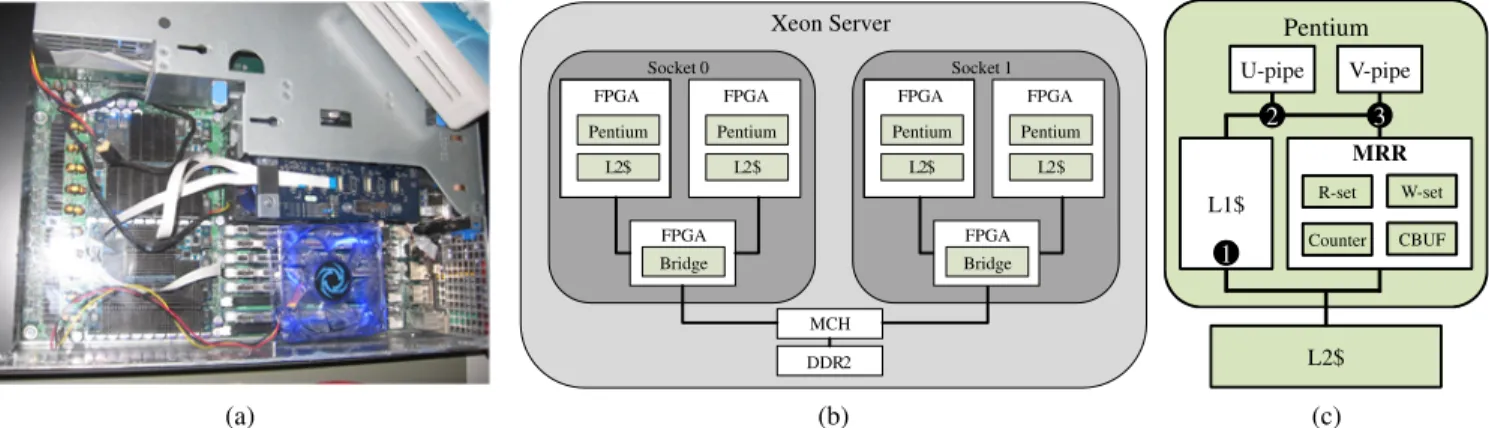
(a) Xeon Server Socket 0 FPGA L2$ Pentium FPGA L2$ Pentium FPGA Bridge MCH DDR2 Socket 1 FPGA L2$ Pentium FPGA L2$ Pentium FPGA Bridge (b) Pentium U-pipe V-pipe MRR R-set W-set Counter CBUF L1$ L2$ 2 3 1 (c)
Figure 2.1: Photograph of the QuickRec prototype with FPGAs in CPU sockets (a); architecture of the QuickIA processor-emulation platform (b); and architecture overview of the extended Pentium core in QuickRec, where circled numbers identify the main CPUtouch pointsrequired to enable recording (c).
2.2
QuickIA Recording System
The QuickRec recording system prototyped in this work is built on a FPGA processor-emulation platform called QuickIA. This section introduces QuickIA and then describes the changes we added to support RnR. Figure 2.1a shows a picture of the QuickRec recording system testbed.
2.2.1 QuickIA Processor Emulation Platform
The QuickIA processor emulation platform [82] is a dual-socket Xeon server board in which Xeon CPUs are substituted with FPGA modules from XtreamData [84]. Each such FPGA module is composed of two Compute FPGAs and one Bridge FPGA, as shown in Figure 2.1b. Each Compute FPGA implements a second-generation Pentium core with private L1 and L2 caches. The Bridge FPGA implements the inter-connect between the two Compute FPGAs and the Intel Front Side Bus (FSB), which inter-connects the two CPU sockets to the Memory Controller Hub (MCH) on the platform. This allows both CPU sockets to be fully cache coherent, with full access to memory and I/O. The QuickIA system implements a MESI coherence protocol with L2 as the point of coherence.
The Pentium cores used in the QuickIA emulation platform are fully synthesizable. Each core features a dual-pipeline in-order CPU with floating-point support. In addition, each core is extended with a set of additional features to reflect the state of the art of modern processors. These changes include L1 cache line size increase to 64 bytes, Memory Type Range Registers, physical address extension, and FSB xAPICs.
Cores 4 Pentium cores Clock 60MHz
L1 data 32KB, private, WB, 8-way assoc, cache 64B line size, 1-cycle latency L2 512KB, private, WB, 16-way assoc, cache 64B line size, 4-cycle latency Coherence MESI
Memory 8GB DDR2, 24MB/s bandwidth (measured by STREAM [55]), 90-cycle round-trip latency Table 2.1: QuickIA platform parameters.
The four emulated Pentium cores run at 60MHz. While this clock frequency is low, the memory band-width is also low (24MB/s), which means that the ratio between CPU speed and memory bandband-width is similar to that of today’s systems. The QuickIA system includes 8GB of DDR2 memory and basic peripher-als (network, graphics card and HDD), and can boot a vanilla SUSE Linux distribution. The basic platform parameters are shown in Table 2.1.
2.2.2 Recording Interleaving Non-Determinism
To record the non-determinism of memory access interleaving, the RTL of the synthesizable Pentium core is augmented to capture the order of memory accesses. This support includes mechanisms to break down a thread’s execution intochunks(i.e., groups of consecutive dynamic instructions), and then order the chunks across cores. A significant effort was invested in integrating this support into the Pentium core without adding unnecessary complexity. Some of the main challenges we faced include dealing with the IA memory model, and coping with x86 instructions with multiple memory accesses. The extended Pentium core is then synthesized and downloaded into FPGAs to boot up the QuickRec emulation platform. A high-level overview of the extended Pentium core is shown in Figure 2.1c. In the figure, theMemory Race Recorder (MRR)box implements the functionality for recording memory access interleaving, while the circled num-bers indicate the CPUtouch pointsrequired to enable it.
Capturing and Ordering Chunks
The QuickRec recording system implements a mechanism similar to the Intel MRR [66] to divide a thread’s execution into chunks. It adds Bloom filters next to the L1 cache to capture the read and write sets of
the memory accesses in a chunk (R-set and W-set in Figure 2.1c). The line addresses of the locations accessed by loads and stores are inserted into their respective set at retirement and at global observation time, respectively. A thread’s chunk is terminated when the hardware observes a memory conflict (i.e., a data dependence) with a remote thread. Conflicts are detected by checking the addresses of incoming snoops against addresses in the read and write sets. When a conflict is detected, a counter (Counterin Figure 2.1c) with the current chunk size is logged into an internal chunk buffer (CBUFin Figure 2.1c), along with a timestamp that provides a total order of chunks across cores. The chunk-size counter counts the number of retired instructions in the chunk. After a chunk is terminated, the read and write sets are cleared, and the chunk-size counter is reset.
In addition to terminating a chunk on a memory conflict, QuickRec can be configured to terminate a chunk when certain system events occur as well, such as an exception or a TLB invalidation. A chunk also terminates when the 20-bit chunk-size counter overflows. Additionally, the addresses of lines evicted from L2 are looked up in the read and write sets and, in case of a hit, the chunk also ends. This is done because the read and write sets would not observe future coherence activity on these evicted lines. Further information on chunk termination is provided in Section 2.2.3.
Figure 2.1c shows the main CPU touch points required to enable the chunking mechanism described above. The first CPU touch point is hooked-up to the external L1 snoop port to allow snoops to be forwarded to the MRR for address lookups. The second and third CPU touch points are hooked-up to the U and V integer execution pipelines of the Pentium core. They provide diverse functionalities, such as forwarding load and store line addresses to the MRR for insertion into the read and write sets, and forwarding the instruction retirement signal to the MRR to advance the chunk-size counter.
One of the complexities we encountered when integrating the chunking mechanism into the Pentium core was keeping updates to the read and write sets within one cycle, so that they can be performed in parallel with a cache access. The problem is that only the lower bits of the addresses are available at the beginning of a cache cycle, as the upper bits (tag bits) are provided usually late in the cycle, after a DTLB access. To preserve a single cycle for the read and write set update, addresses (tag plus set bits) are buffered into a latch stage before they are fed to the Bloom filter logic. To compensate for the delayed update of the read and write sets, these buffers are also looked-up on external snoops, at the cost of additional comparators for each address buffer.
Integration into the IA Memory Model
The IA memory model, very similar to the Total Store Model (TSO), allows a load to retire before a prior store to a different address has committed, hence effectively ordering the load before the prior store in memory. In this situation, using the retired instruction count is not sufficient to guarantee that loads and stores are ordered correctly during replay. This is because, during replay, instructions are executed in program order. Hence, regardless of when the store committed to memory during the recorded execution, the store is evaluated before the load during replay. To address this problem, QuickRec implements a solution similar to the one proposed in CoreRacer [67] to handle TSO. The idea is to track the number of pending stores in the store buffer awaiting commit and, at chunk termination, append the current number to the logged entry. This number is called the Reordered Store Window (RSW) count. The MRR is hooked-up to the memory execution unit to enable this functionality.
Instruction Atomicity Violation
In the x86 ISA, an instruction may perform multiple memory accesses before completing execution. For instance, a split cache line access, which is an access that crosses a cache line boundary, requires more than one load or store operation to complete. In addition, some complex instructions require several memory operations. For example, the increment instruction (INC) performs a load and a store operation. At the micro-architecture level, these instructions are usually broken down into multiple micro-operations orµops. An Instruction Atomicity Violation (IAV) occurs if an event causes the QuickRec recording system to log a chunk in CBUF in the middle of such an instruction execution. An example of such an event is a memory conflict. Because software is usually oblivious of split cache line accesses andµop execution, IAVs make it difficult for software to deterministically reproduce a program execution.
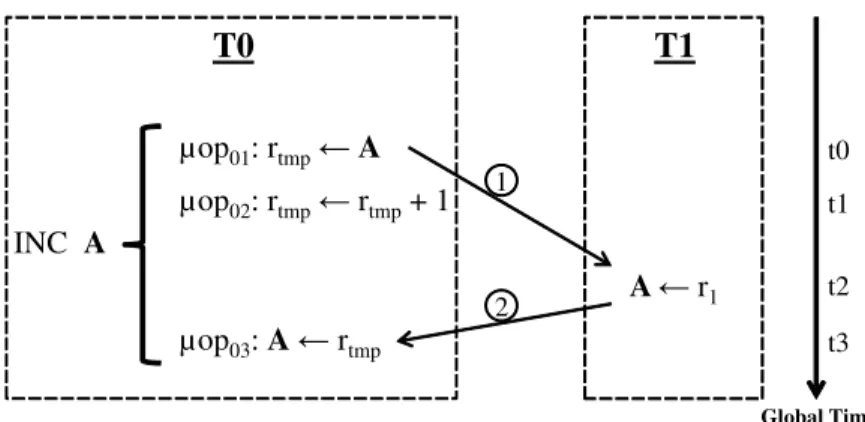
Figure 2.2 shows an example. Thread T0 executes instruction INC A, which increments the value in memory location A. The instruction breaks down into the threeµops shown in the figure: a read from A into user-invisible register rtmp, the increment of rtmp, and the store of rtmpinto A. At the same time, thread T1
writes A. Suppose that the operations interleave as shown in the time line.
When the store in T1 executes at time t2, a conflict with T0 is detected, sinceµop01has read from the
same address at t0. Therefore, QuickRec terminates the chunk in T0 and logs an entry in T0’s CBUF. This chunk is ordered before the store in T1. However, since the INC instruction has not yet retired, INC is not
INC A µop01: rtmp←A µop02: rtmp← rtmp+ 1 µop03: A← rtmp T0 T1 A ← r 1 1 2 t0 t1 t2 t3 Global Time
Figure 2.2: Instruction atomicity violation (IAV) example.
counted as belonging to the logged chunk. Then, when the INC instruction executesµop03and retires at
t3, a conflict with T1 is detected. This causes QuickRec to terminate the chunk in T1 and log an entry in T1’s CBUF that contains the store. The logged chunk is ordered before the currently-executing chunk in T0, which is assumed to include the INC instruction. Consequently, in this naive design, the replay would be incorrect. Indeed, while during recording,µop01occurred before the store in T1, which in turn occurred
beforeµop03, during replay, the store in T1 will be executed before the whole INC instruction.
This problem occurs because the INC instruction suffers an IAV. Although the instruction has performed some memory transactions during the earlier chunk in T0, since the instruction has not retired when the chunk in T0 is logged, the instruction is counted as belonging to the later chunk in T0.
The QuickRec recording system solves this problem by monitoring the retirement of the multiple mem-ory accesses during the execution of the instruction. Specifically, it uses a dedicated IAV counter to count the number of retired memory transactions for a multi-line or multi-operation instruction (Figure 2.3). The IAV counter is incremented at every retired memory transaction, and is reset when the instruction retires. At chunk termination, if the IAV counter is not zero, the current instruction has not retired, and an IAV has been detected. In this case, QuickRec saves the value of the IAV counter in the log entry of the terminated chunk. Since, during replay, we know exactly the number (and sequence order) of the memory transac-tions that need to occur in a given instruction, by reading the IAV counter and examining the RSW count (Section 2.2.2), we know how many memory operations of the subsequent instruction need to be performed before completing the current chunk. In our actual implementation, the IAV counter is incremented by 1 for each access in a split cache line reference, and by 2 for any other access. With this design, an odd counter
value indicates that the chunk terminated between the accesses of a split cache line reference.
Chunk entry
IAV
Counter
µop Ld/St retirement µop Ld/St split Instr. retirement Event recording signal IAVFigure 2.3: IAV counter mechanism.
Consider again the example of Figure 2.2. When T1 executes the store at time t2 and a conflict is detected in T0, the INC instruction has not yet retired. The IAV counter in T0 is 2, since the only retired access is that of µop01. Therefore, an IAV is detected. The QuickRec recording system terminates the
chunk in T0 and, as it logs the chunk, appends to it the value of the IAV counter. This log entry conveys to the replayer the information that an IAV has occurred in the chunk and that only the first memoryµop had retired at the time of chunk termination.
Instruction atomicity violation was first introduced in [64] and then described in [67]. The main differ-ence with [67] is that we log the number of retired memory transactions instead of the number of transferred bytes. The advantage of logging memory transactions over transferred bytes is the reduction in the log size.
Log Management
CBUF is organized into four entries, where each is as large as a cache line. When a chunk terminates, a 128-bit chunk packet is stored in CBUF. When a CBUF entry is full, it is flushed by hardware to a dedicated memory region called CMEM. To minimize the performance impact, this is done lazily, during idle cycles, by bypassing the caches and writing directly to memory. Occasionally, however, the chunking mechanism must stall the execution pipeline to allow CBUF to drain to CMEM to avoid overflow.
packet. Both are very conservatively sized as 128-bit long. Once a TSA is logged for a thread, subsequent chunk packets for that thread only need to log the timestamp difference (TSD) with respect to the last TSA. The TSA is then logged again when the value in TSD overflows. Note that this also causes a chunk termination. Figure 2.4 shows the format of these two packets. The chunk packet contains the TSD, chunk size (CS), and RSW and IAV counts. It also contains aReasonfield, which indicates why the chunk was terminated — e.g., due to a RAW, WAR or WAW conflict, an exception, or a chunk-size overflow. Table 2.2 lists the main reasons for terminating chunks.
Format Reason TSD CS RSW IAV Reserved
0 2 3 6 7 38 39 58 59 63 64 79 80 127
3 bits 4 bits 32 bits 20 bits 5 bits 16 bits 48 bits
Format Reserved TSA Reserved
0 2 3 6 7 70 71 127
3 bits 4 bits 64 bits 57 bits
Chunk Packet
Timestamp Packet
Figure 2.4: Packet formats in QuickRec.
Type Reason
RAW RAW conflict between chunks WAR WAR conflict between chunks WAW WAW conflict between chunks
WAB Both WAR and WAW conflicts between chunks EXCEPT Exception, interrupt, far call, or far return EVICT Line eviction from L2 that hits the R-set or W-set CS OVERFLOW Chunk size overflow
TLBINV TLB invalidation
XTC Explicit chunk termination instruction
Table 2.2: Main reasons for terminating chunks. WAB (Write-After-Both) is when a write in one chunk hits in both the read and the write set of another chunk.