occasional
The Occasional Papers are pub-lished quarterly by NISPAcee and dis-trib ut ed together with the NISPAcee News let ter. The series launches ac a dem ic publications that discuss results of policy research in differ-ent fi elds of pub lic ad min is tra tion. It provides a forum for the analysis and dis cus sion of contemporary problems and pos si ble so lu tions, models and meth ods of public ad-ministration and public pol i cy with as sess ments of em pir i cal evidence from re gion al experience in pub lic sec tor reform.
The main goal is to enhance the quality and quantity of intellectual ex change among re search ers, edu-cators, schol ars and prac ti tio ners dealing with major is sues of pub lic administration and public policy in the Central and East Eu ro pe an
re-Volume VI
No 2 • Spring 2005
Content
Stanislav Klazar, Juraj Nemec,
Jiri Pribil, Marketa Sumpikova
E-governance and its Application
in Area the of Programming
Pub-lic Expenditures: The Case for the
Czech Republic 1and Slovakia /p.3
Anastasia Golubeva ,
Irina Merkuryeva, Nikita Shulakov
Development of E-government
in St. Petersburg: Evaluation of
Web Sites Performance
Copyright © 2005 by NISPAcee
Editor
Bohdan Krawchenko, School of Development, University of Central Asia, Bishkek, Kyrghyzstan
Deputy Editor
Juraj Sklenar, NISPAcee Secretariat, Bratislava, Slovakia
Editorial Board Members
Ingrid Shikova, Information Centre of the European Union, Bulgaria Ivan Maly, Masaryk University, Czech Republic
Michal Illner, Academy of Sciences, Czech Republic Wolfgang Drechsler, University of Tartu, Estonia
Mzia Mikeladze, Georgian Technical University, Georgia
Gyorgy Jenei, Budapest University of Economic Sciences, Hungary
Golam Mostafa, Kazakhstan Institute of Management, Economics and Strategic Planning, Kazakhstan
Salih Murzaev, Academy of Management, Kyrghyzstan
Vladislav Domarkas, Kaunas Technological University, Lithuania Pawel Swianiewicz, University of Warsaw, Poland
Agnieszka Pawlowska, Maria Curie-Sklodowska University, Poland Gabriela Cecilia Stanciulescu, Academy of Economic Studies, Romania Sergei Pushkarev, Ural State University, Russia
Milan Bucek, University of Economics, Slovak Republic Stanka Setnikar-Cankar, University of Ljubljana, Slovenia Dragoljub Kavran, Government of Serbia, Yugoslavia
English Language Editor
Todd G. Williams, Acme Anvil Language Services, Hungary
Submissions
Papers should be written on relevant public administration and public policy issues based on empirical research carried out in Central and East European countries. The papers should not exceed forty pages in length. If a paper is written in a language other than English, a three-page English summary should be submitted with a bibliography and a description of the length of the entire document. Each author may propose two reviewers for their submission, but the final selection of reviewers is at the discretion of the editor. Those authors whose papers are selected for publication will receive a modest honorarium.
Editorial correspondence, including manuscripts for submission, should be addressed to Mr. Juraj Sklenar, deputy editor, NISPAcee Secretariat, Hanulova 5/B, P.O.Box 163, 840 02 Bratislava 42, Slo-vak Republic, phone/fax: +421-2-6428 5557, e-mail: [email protected]. Manuscripts should be sent in electronic form.
Subscriptions
Subscriptions and limited additional copies are available without charge. Requests to be placed on the mailing list or for additional copies should be addressed to the deputy editor. Change of address notifications should be sent to the publisher at least four weeks in advance, including both the old and new addresses.
NISPAcee Occasional Papers are published with the support of the Local Government and Public Service Reform Initiative (affiliated with the Open Society Institute), Nador ut. 11, 1525 Budapest, Hungary.
V
olume VI • No 2 • Spring 2005
NISPAcee
occasional
papers
E-governance and its Application
in Area the of Programming Public
Expenditures: The Case for the Czech
Republic
*and Slovakia
Stanislav Klazar
1, Juraj Nemec, Prof., PhD.
2,
Jiri Pribil
3and Marketa Sumpikova, PhD.
4countries. Because public money/taxpayer’s money is used, the principle should be that any expenditure program and any expendi-ture item is realized in an environment where openness, transparency and publicity prin-ciples dominate. Ex-ante, during the process, and ex-post information about the processes and outcomes shall be available to anybody interested.
In the first part of our paper we investigate the potential of e-government/governance concerning the improvement of processes of preparing, awarding, realizing and evaluating public expenditure programs. The main areas are ex-ante audit of intended public expen-ditures, selection and/or similar decision making processes, and processes of ex-post, performance based audits of finished expendi-ture activities.
The second part of the paper focuses on evaluating the current level of use of e-government/governance tools in two CEE countries, the Czech Republic and Slovakia, with the main focus on the Czech Republic.
2. E-government/governance
Over the last few years, it has become evident that information – inevitably linked with Information Technology (IT) – has be-come of critical importance for the success of any organization, including the public sector system. New technologies (personal computers, the internet, mobile phones) are fundamentally changing our everyday lives. With the growing complexity of IT solutions and information systems which all functions of modern organizations vitally depend on, with growing investments in this field which are becoming a heavy burden even for very1. Introduction
The main features of modern “European Administration” are defined by the important document “European governance: a White Paper” (European Commission, 2001), as openness, participation, accountability, ef-fectiveness and coherence. The contents of the “White Paper” represent current trends of changing from government to governance, or further to “public leadership” (Bouckaert, 2002), representing the next step in public ad-ministration systems reforms where all stake-holders benefit from mutual co-operation.
Modern governments must use a large range of tools and instruments to achieve the necessary quality level of governance, and shall utilize all suitable new technologies in the delivery of any type of governmental services. E-government/governance repre-sents one such important emerging tool, with increasing importance during last ten years, when the use of the internet took on its world-wide character.
E-government/governance is ready to support better achievement than any of the main modern governance characteristics. In our paper we want to focus just one dimen-sion of this relationship – the impact of e-government/governance on the efficiency and effectiveness of public expenditure.
Public expenditure programs spend between 30 and 60% of GDP in developed
* This paper is based on original research for the Grant
Agency of the Czech Republic, project No 402/03/1221.
1 University of Economics Prague, the Czech Republic 2 Faculty of Finance, Matej Bel University Banska Bystrica,
Slovakia
3 University of Economics Prague, the Czech Republic 4 Faculty of Management, University of Economics Prague, the
E-governance and its Application
rich organizations, and with a tremendouslyrapid development of technology offering new solutions to business problems, these issues are entering the everyday agenda of top managers.
As an outcome of such processes on the level of the public sector, a popular new expression – e-government/governance
– was coined. E-government simply means modern government that performs all its functions and provides all its services through intensive use of electronic means for information processing, computers, net-works, the internet, etc. Electronic means are only not used for internal information processing and communication within governmental agencies but also for commu-nication with other agencies, citizens and businesses (Vintar, 2002).
E-government/governance means that government is taking advantage of the new technology development to provide people with better government services. The basic aims of e-government/governance are to im-prove the ability of all people to participate in democracy and to enhance the efficiency and effectiveness of all kinds of government services.
E-government/governance can be directly linked to the main dimensions of “good governance” (Leitner, 2003), espe-cially:
• Coherency of policy making: it supports better quality co-ordination of policy making both on the horizontal and verti-cal levels;
• Participatory democracy: it supports more active participation of all players in policy making processes;
• Consistency, efficiency and effectiveness of policy implementation: it supports co-operation and networking in policy im-plementation phase, makes them faster, simpler and more cost-effective; and • Transparency and openness of political
processes: it provides general access to information at very low cost.
As indicated by some research, e-government/governance may play a crucial role also in connection with limiting corrup-tive behavior in the society and the
govern-ment. Choi (2004) tested the following (as well as other) hypotheses:
1. The greater the degree of e-government, the lower the level of corruption in the country.
2. The more developed a country’s ITC infrastructure is, the lower the level of corruption will be.
3. The greater the transparency through e-government is, the lower the level of corruption in the country will be. 4. The higher the accountability through
e-government is, the lower the level of corruption in the country will be. 5. The greater the empowerment through
e-government is, the lower the level of corruption in the country will be.
The most important correlation has been found for the first hypothesis; data shows that the level of e-government has a greater impact on corruption than any other variable (variables like the level of eco-nomic development of the country, the size of government and the scope of government regulation). Hypotheses 2 – 5 were also statistically significant. Such findings serve to confirm that e-government/governance is one of the key tools in building new modern governance systems.
According to the Green Paper (1998), we can distinguish governmental e-services by the three main functions they serve:
1. Information services to retrieve sorted and classified information on demand (e.g., WWW);
2. Communication services to interact with individuals (private or corporate) or groups of people (e.g., e-mail or discus-sion forums); and
3. Transaction services to acquire products or services online or to submit data (e.g., government forms, voting).
Taking into the account the main di-mensions mentioned, we suppose that e-government/governance will be able to improve the quality of governance by for example:
1. Making it easier for people to have a say in government (e.g., to register a mo-tor car or a new company from his/her
V
olume VI • No 2 • Spring 2005
NISPAcee
occasional
papers
home every day of the week is more flex-ible, accessible and faster);
2. Providing integrated services (because of the fact that different governmental organizations will communicate more ef-fectively with each other). (E.g., after an accident, it may be necessary to contact several different governmental organiza-tions – a hospital, the fire department and the police. Due to the modern ways of sharing information and integrating their services, only one call will by nec-essary);
3. Better information services relative to government law, regulations, and poli-cies. (E.g., to fill in a tax form online will be more convenient due to implementa-tion of cross over check points, quota-tions of possible inputs and validation of formal requirements).
However, it is necessary to stress that e-government/governance, similar to any other public governance tool, is not just one-dimensional; it does not just have a positive character. Certain important fears are connected with introducing it that mod-ern govmod-ernment should cope with:
1. Citizens can be very quickly divided into 2 groups, one with the ability to use e-government, the second group without. There seems to be only two remedies for this threat – community access to the internet and improving the ability of citi-zens to use new IT technologies . Commu-nity access to the internet (in libraries, offices, etc.) for people who are not able access the internet from their homes, and focus on public information programs and educational programs in using the new technologies should be the priority for the e-government policy 5;
2. There is a fear of the “Big brother is watching you” phenomena; this means that the government can know too much about the people and use the informa-tion in not appropriate way. To face this
problem it will be necessary to review and strengthen all legislative measures designed to protect privacy (for some skeptical remarks see, e.g., Kumar A., 2002); and
3. Sometimes is it noticed that government will have to rise to the challenge of e-government methods being far too im-personal. The authors of this paper strike back because there will still remain many situations for which dealing with the hu-man officer will be not expendable.
The current scale of use of e-government/governance
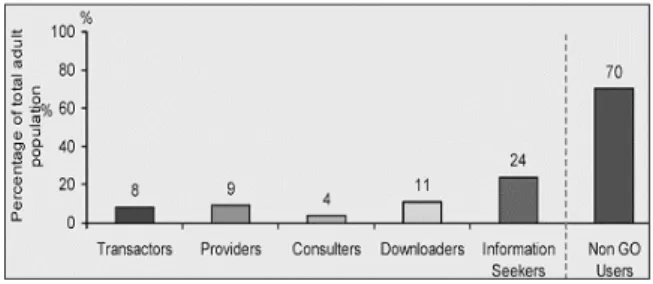
In this section, we utilize the results of a representative international study com-pleted by Taylor Nelson Sofres Interactive in November 2003. The basic method of collecting information was the question-naire which was used in 32 countries from around the world. The regional insight revealed an interesting finding: it is now evident that the top users of e-Government are Scandinavian countries (see Chart 1). A possible explanation for this is the signifi-cant increase of broadband in this region and it also seems that the internet has ma-tured to the level where many people use it as their primary source of information; the growth of e-Government is self-evident then.
Regions of the Americas and of Western Europe have for a long time been above the average (except Great Britain and the pos-sible reason here is that there is much to do to convince the citizens of the benefit of e-Government and online access – Brits still prefer other delivery channels such as the telephone or face to face communication).
The Czech Republic is a leader in using e-Government among the transition coun-tries. Internet penetration in companies has reached over 90 % and we suppose it could be the reason for such high e-Government usage (there is no doubt that people use the internet in companies for personal use also). Poland with 6 % penetration is far un-der the global average, but does not leave the line of other transition countries.
5 The National Computer Literacy Program launched in
February 2003 is aimed at giving the public at large (i.e., people who may not have had any previous experience with computers) the possibility of learning the basics of computer literacy, including the use of the internet. This project met with extraordinary acclaim. In the first two months more than 10,000 candidates enrolled for courses and more than 210 regional training centers were set up (mostly in schools).
E-governance and its Application
Figure 1
Percentage of population who used
e-government in 2002/2003
Source: Government online, an international perspective 2003, global summary. TNS Study. November 2003.
The authors identified 5 basic groups of e-Government users within the last dec-ade – Transactors, Providers, Consulters, Downloaders and Information Seekers. This approach allows one to create and measure development trends (Table 1) for individual groups as defined bellow:
• Non users – have not used the internet to get or provide information or transact with Government;
• Transactors – used the internet to pay for government products or services through the use of a credit card or bank account (e.g., rates, driving license, recycle bins, traffic fines);
• Providers – used the internet to provide personal/household information to the government;
• Downloaders – used the internet to print government forms that were then sent by post or fax (e.g., tax form to claim govern-ment rebates);
• Information seekers – have used the inter-net to get information from a government website; and
• Consulters – used the internet to express a point of view or to participate in commu-nity consultations with the government.
Table 1
Change in the users of e-government
between the years 2002 and 2003 (in
percentage points)
Table 1 describes changes in involvement of different kinds of e-government users. The number of users from all groups (except Con-sulters) is on the increase. This indicates two trends:
• On one hand, e-government is going to be-come an integral part of e-business without exceptional; and
• On the other hand, rates of increasing participation of citizens in democratic proc-esses do not grow significantly, limiting this aspect of e-government/governance poten-tial (see also Chart 2).
Figure 2
The users of e-government in 2003
Source: Government online, an international perspective 2003, global summary. TNS Study. November 2003
A bit different results arise from a similar study for North America (the US and Canada). There is stable penetration of Downloaders and a rapid decrease in Providers. We have no explanation for this development. We did not uncover any relationships between the perception of e-government online safety and the penetration of Providers (this group should be the most sensitive).
Increase (+) Decrease (-)
Transactors +2 Providers +2
Consulters No signifi cant change
Downloaders +2
Information Seekers +2
V
olume VI • No 2 • Spring 2005
NISPAcee
occasional
papers
Some other general trends results from Table 3. The demographic pattern (55 percent penetration for users below 20 years of age) indicates an increasing trend for the future.
Table 3
E-government penetration and
demographic pattern
Source: Government online, an international perspective 2003, global summary. TNS Study. November 2003.
3. The potential of E-government/
governance in the area of
public expenditure
As already indicated above, e-government/ governance has an important link to the level of efficiency and effectiveness of public expenditures. Web based applications (the ones we focus on) can be used in all phases of processes of allocation and use of public ex-penditures. We may find at least the following areas where e-government/governance may play a significant role:
• Allocation of public funds (including ex-ante audit and programming of public expenditures);
• Realization processes of public expendi-tures (mainly public procurement); and • Auditing and control of public expenditures
(mainly interim audit of awarded programs, and ex-post, performance-based audits of realized programs).
Though this phase may still be underes-timated, e-government/governance may play already play a very important role in public policy making processes that are the main base of any public expenditure decision. In this phase, information and communication functions of e-government/governance are the key factors to allocating limited public resources effectively.
According to standard economic theory (Haveman and Margolis, 1970) and also ac-cording to the “good practice” policies of many international organizations (EU financial control rules), ex-ante audits of any public expenditure decision shall be a compulsory part of governmental activities, focusing on the 3E dimensions – economy, efficiency and effectiveness (in some cases dimensions like outcomes, impacts, internal rate of return and many others are included, too).
In the past, such processes were normally an internal issue of respective responsible organization. Today, the internet provides many possibilities to improve processes of ex-ante auditing by involving all (or at least most) of the stakeholders whose views should be taken into account.
The change from incremental subjective budgeting to program budgeting (Wright and Nemec, 2003) represents another important
Table 2
E-government changes from 2001 to 2003 (North America)
Source: Government Online: A National Perspective Report. Leger Marketing. August 2003
2001 2002 2003 Number of respondents 1507 1501 1500 Transactors 10% 12% 13% Providers 16% 17% 14% Consulters N/A 7% 8% Downloaders 19% 24% 24% Information Seekers 36% 37% 40% Non GO Users 54% 52% 49% 2000 2001 2002 Internet User 22 26 28 Non-Internet User 78 74 72 Demographic
parameter adult population (2002)Penetration in % of
<20 55 20 – 29 44 30 – 39 34 40 – 59 24 60 + 05 Male 32 Female 25
E-governance and its Application
dimension and perspective for e-government/governance. Programs are not only prepared on the basis of communication with all stake-holders, but they should be publicly and transparently announced to all interested parties. A web based application can be tailored to fit the needs of any kind of public expenditure program and its budget, provided that there will be a central point (for example, a government portal) to reduce the cost of searching the net for any stakeholder.
The role of e-government in public pro-curement processes is already fully recog-nized in all developed, but also many de-veloping, countries. Publishing new tenders on net is efficient as the number of internet users increases and the unit costs of publi-cation decrease. Publishing tenders and all other procurement documentation via the internet increases transparency and improves the chance to obtain “best value” for public money. Today, the internet is used to support all phases of procurement processes; in some cases, it even represents the core base for realization of certain procurement processes (for example in Romania, e-procurement is the standard and the only tool to procure certain items in defined branches of government).
The role and impact of e-government in the ex-post phase of realizing public expendi-ture programs shall also not be underesti-mated. Publishing reports and findings via the internet (centrally or in a decentralized way) is not only a tool for transparency and open-ness, but it supports the level of accountabil-ity, and serves as a learning tool as well.
4. The level of use of
E-government/governance in
the Czech Republic
In this section, we only analyze the Czech Re-public (taking into account space constraints), and it is the most highly developed country from this point of view.
The Czech government realizes the impor-tance of e-Government. We can cite the gov-ernment document (E-Govgov-ernment and Other Projects, online www.mfcr.cz): “The E-Govern-ment project in the Czech Republic is aimed at providing citizens and economic entities with the opportunity for swift and straightforward
electronic communication with the state au-thorities, thereby increasing the transparency of public authority, while reducing the cost of public administration. Within the framework of developing an information society, the project will also involve legislative support of electronic public administration and e-com-merce. The government has approved a White Paper on E-Commerce as the basic document for the promotion of electronic trade.”
In this section, furthermore, we would like to specifically mention “community portals” which will play a major role in public par-ticipation in government. The emphasis is on making the right information available at the right time. The common tools to enable communication between a citizen and the government are what are called “community portals.”
The most often visited community portal in the Czech Republic is the web page of Min-istry of Finance (www.mfcr.cz) with 11000 hits per day. The second is the official webpage of the Ministry of Interior of the Czech Republic (www.mvcr.cz) with 4500 hits. The third is the website of the Czech Statistical Office and the Public Administration Portal of the Czech Republic. In following text we introduce two portals including their structure, impact and limits.
The Public Administration Portal
Let us start with the Public Administration Portal administered by the Ministry of Infor-matics. The vision of the Ministry of Informat-ics is as follows “…the ‘Public Administration Portal’ project, which was launched in August 2003, is aimed at creating a single portal that would offer remote access to information about the services of various public admin-istration institutions to both citizens and legal entities. The information section of this portal will contain information about official procedures that apply to various situations in people‘s lives. The portal also offers free information about the Land Registry, as well as the full text versions of Czech and EC legal regulations.” (Vision of Public Administration Portal, online http:// portal.gov.cz)
The transaction section of the portal enables users to sort out certain matters (in particular tax returns and matters lying within the competence of the Ministry of Labor and
V
olume VI • No 2 • Spring 2005
NISPAcee
occasional
papers
Social Affairs) directly via remote access and relying on electronic signatures.
It should be “the electronic gateway for the public to administration and government services in the Czech Republic.” (Quote comes from the “Welcome” page of the Public Administration portal (http://portal.gov.cz/ wps/en/en.html). The aim of this portal is to provide help for citizens in finding information and communicating with public administrative authorities. The services currently offered by the Portal are based on 3 mutually intercon-nected databases:
• Legislation (enables searches for up-to-date versions of the laws of the Czech Republic, including EU directives and regulations); • Contact list for public administrative
au-thorities (is present, but not too accessible because of a bad navigation tool bar); and • Do it online – transactional services.
Unfortunately, the pages seem to be a bit confusing. The scope of interest is too wide and the structure of the web page is too deep. Authors of the web did not follow the recom-mendation of the guru of web design usability (www.useit.com) “to be flat and clear” (un-derstood to mean building low level websites with clear links) and it is the main reason the portal is “only” third. Today it is not the gate-way for e-government for ordinary user access directly to specialized parts of e-government (especially the Ministry of Finance). This is a pity because the Ministry of Finance portal is not able to offer such a wide range of services as to serve as a real “gateway.” The “gateway” should deliver links to the different areas of e-government and provide comprehensive guide-lines to the e-government services. Authors of this paper suppose there is still much to do.
Ministry of Finance Portal
As mentioned above, the most frequently visited website from “community portals” has for some time now been the website of the Ministry of Finance of the Czech Republic. It looks plain and more tabular than the Public Administration portal. When using a Front Page based application for measurement of download speed, we determined that this site is twice as fast as the other websites.
Online services on this site are wide-rang-ing, but we concentrate on the ones concern-ing public finance – taxes. The website of MF CR provides users with online assistance and delivery of tax returns. All kinds of taxes are ready for online processing such as personal income tax, corporate income tax, VAT, excise duties, inheritance and gift tax, and real estate transfer taxes. An authorized web based ap-plication is able to validate basic form criteria and does not allow the user to process an incomplete tax return (or other tax form). An appropriate reference guide follows every step of the process and the user is given some feed-back each time. It is possible to send a request for help to the public authority (appropriate tax administrator). All tax rates and allowances are updated so it is not necessary for the tax-payer to study all amendments in the law.
There are some studies (Vitkova. 2002 and 2003, Sandorf, 2001) that calculate the administrative costs of taxation with respect to economies from online reporting. We follow the results of recent research in the Czech Re-public (Vitkova, 2002) and calculate the extent of economies. The time saving aspect for the tax administrator is calculated to be about 70 % (transcription, validation and comparison of inputs with other public authorities such as the Czech social security administration) and for the taxpayer about 30 % (sample size of 154 taxpayers). The savings mentioned above
Table 4
Storage costs of tax and accounting reports (in mil. Czech crowns)
Source: Vitkova, 2002
Whole tax
system income taxPersonal income taxCorporate VAT Road tax Transfer tax
Storage costs 28097 6612 6220 12148 1955 1162
Other costs 148376 5884 103531 34050 3608 1303
Savings for taxpayer
E-governance and its Application
are increased by new amendments of theAc-counting Law – allowance to store all account-ing and law records in an electronic form.
We assume a very low additional cost of buying hardware and software due to present saturation (PCs and appropriate software are already commonly used). The largest e-gov-ernment economies are calculated for per-sonal income tax, VAT and transfer and road taxes. On the other hand, corporate income tax is not cost sensitive in e-government on-line processing.
There is a drawback of online processing: the problem of authorization of electronic documents. Electronic signatures might have been the best tool to overcome this obstacle but it failed. Only very few taxpayers have the certification to use their own electronic signa-ture in the Czech Republic. The main reasons are assumed to be price (30 EURO per year), incompatible laws and the suspicious tenden-cies of taxpayers. That is why most online taxpayers prefer using online applications for tax returns and then print the form and send it through the mail). The full potential of e-gov-ernment is not yet utilized. A substitute solu-tion for the absence of electronic signatures is using special web based applications (e.g., www.podatelny.cz), but the number of appli-cation forms is still limited.
5. E-government/governance
and public expenditures
management in the Czech
Republic and Slovakia
In part four, we indicated the most important areas where e-government/governance may help to improve processes of preparation, implementation and evaluation of public ex-penditure programs. It is necessary to stress that in both selected countries, represent-ing a part of the most developed CEE region (Slovakia and the Czech Republic joined the EU in 2004), e-government/governance is not comprehensively developed as of yet (some barriers have been already indicated above). Because of this fact, there is no chance to expect that it is already being used in an incomprehensive, intentional and systematic way to cover all mentioned phases of public expenditures management.
However, some first interesting attempts already exist which show the way ahead. In this part we provide two examples from two different areas – the use of the internet in processes of drawing resources from EU funds in the Czech Republic and the main aspects of electronic support to public procurement processes in Slovakia.
E-government and EU funds: The Czech Republic
The Czech Republic introduced the pilot project titled “Tenders for Funds from Struc-tural EU funds.” The web based application consists of two basic parts:
• Identification of applicant; and
• Description of the proposed project, includ-ing a simple evaluation of the project. 3
Identification of Applicant (Identifikace žadatele), Chart 3, is intuitive. It should be supported with database of for the demo-graphic and economic situation in relevant regions (derived from the address); some structural projects are eligible only to ap-plicants from “relatively poor” regions. By correctly completing the Address field auto-matically eliminates inadmissible structural sources (funds, operation programs, etc.).
The second part of this web based ap-plication is the Specification of Project (Speci-fikace projektu) – Chart 4. One very important part of project submission is to choose the right (appropriate) source (structural fund). The rolling menu is helpful for Applicant at this stage. There are names of individual financial sources and a brief description.
The choice of particular financial source will affect the number of projects and the level of “Own source/Requested sources” (Vlastní/ Požadované zdroje). It is common that there is a different ratio for co-financed projects from different structural funds. The web application automatically reports insufficient own sources and the applicant is forced to adjust the esti-mates (see next picture).
3 There is one issue connected to this. The question is, if all
the evaluation criterions shall be publicly known (before and within the process of application) to all applicants or not. The common practice in CR is that the criteria are not public and the decision of the administrator about whether the bid was accepted or not does not need to be justified. The process transparency decreases and the opportunity for inefficiency increases.
V
olume VI • No 2 • Spring 2005
NISPAcee
occasional
papers
Figure 3
Pilot project – Tenders for Funds from Structural EU funds
Figure 4
Specification of the project, evaluation criterions
project description
E-governance and its Application
The “Own source/Requested sources”point is not the only criterion for evaluation of project. The other can be the present value of project costs. This value is calculated by web a based application and is dependent on chosen interest rate.
The web based application provides use-ful information for the applicant through the indication of a numerical order of his applica-tion amount and other applicaapplica-tions for the same financial source. The applicant receives prompt feedback whether his application is competitive or not.
This is only a pilot project; it is one of the possible ways how to make the application for funds from the Structural Funds of the EU more accessible to applicants. The number of evaluation points and characteristics of the project can be wider and may be mutually connected (to meet formal and subject crite-ria). The number of incomplete or unsatisfac-tory applications can be reduced to minimum and indirect administrative costs will, thus, be significantly reduced.
On the other hand, direct administrative costs (costs on the side of the administrator) will be reduced as well. The output of web based applications will be directly saved to database and actualization can be prompt. The preparation and evaluation time for the project will be reduced and the efficiency of the process will increase.
It is clear that without e-certification (sig-nature), however, it will be necessary to have a physical copy of a contract, but information processing will still be much more efficient using online communication.
Prompt publication of the results of evalu-ated projects seems to increase the transpar-ency of the process and can provide useful feedback for subsequent applicants. The conditions for this are more than convenient. The government supports the participation of the Czech Republic in the IDA program (Inter-change of Data between Administrations) as of January 1, 2003. This program focuses on the use of information and communication tech-nologies for the support of swift and effective electronic exchange of information between the public administrations of individual EU Member States and EU authorities. Czech par-ticipation in this program can be perceived as
one of the prerequisites for the connection of the Czech Republic to the information infra-structure of the EU.
Electronic media and public
procurement in Slovakia
Compared to some other countries (US, Roma-nia), there is no e-public procurement system in Slovakia as of yet. There are many reasons for this such as the non-existence of functional mechanisms to implement laws on electronic signatures or the fact that there are EU delays in preparation of new public procurement directives which are also expected to include sections on e-procurement.
However, the necessity and potential of the use of the internet in public procurement processes is already recognized in Slovakia, as expressed, for example, by the two follow-ing important documents:
• Government decree 389/2000 from Novem-ber, 2000, on publishing of tender inten-tions, tenders, tender documentation and tender results using telecommunication media; and
• Transparency International “good practice” guidelines, showing all phases when in-formation about the procurement process should be displayed to participants and to general public.
The Decree is the first official governmen-tal document concerning the use of the inter-net in public procurement. It does not include any obligations, but at least provides condi-tions concerning publishing of most important procurement documents via the internet, and leaves free space for extra activities as decid-ed on by respective bidders.
Transparency International Slovakia is really active in the public procurement area, as this is an area which is very corruption sensitive. TIS published several documents/ guidelines (see literature) in 2001 – 2003 viding good-practice advice for public pro-curement processes. Respective documents provide a list of internet supported informa-tion that should be published to increase the transparency and effectiveness of public pro-curement in Slovakia (Table 5) at every and all levels of the public procurement system.
V
olume VI • No 2 • Spring 2005
NISPAcee
occasional
papers
Table 5
Transparency International Slovakia guidelines on publishing public
procurement information
of public procurement processes might be expected in Slovakia relatively soon.
5. Conclusions
E-government/governance importance stead-ily increases in all developed countries, as do many factors supporting quick development of this inevitable tool/mechanism of good governance. CEE countries started taking their first steps in the area of e-government/ governance during last few years following the
Public procurement phase Information to be published Executive body
Before the concrete process starts Internal anti-corruption system All procurement organizations Internal Code of Ethics in Public
Procurement All procurement organizations
Procurement program Procurement entities
Ex-ante audits for major items Procurement entities
Integrity Pact Procurement entities
Guidelines, forms, manuals Public Procurement Offi ce List of qualifi ed procurement offi cers Public Procurement Offi ce Issuing the list of qualifi ed bidders Public Procurement Offi ce Preparation of tender
document, publishing of notices, pre-qualifi cation
Information about the intent to sign
an Integrity Pact Procurement entities
Preliminary notice Procurement entities
Tender notice Procurement entities
Results of qualifi cation Procurement entities
Call for offers Procurement entities
Tender documentation Tender documentation Procurement entities
All communication (clarifi cations) with
bidders Procurement entities
List of non-selected/non-qualifi ed
candidates, including clarifi cation Procurement entities Minutes from opening of tenders Procurement entities
Results of tender Procurement entities
Minutes from tender evaluation
(secret parts excluded) Procurement entities
Contract (if not impossible) Procurement entities Minutes about any change in contract Procurement entities Ex-post audit (internal) Procurement entities Ex-post audit (external) Auditing bodies Publishing of good and bad practice
examples Public Procurement Offi ce
National yearly procurement report Public Procurement Offi ce Yearly procurement reports Procurement entities
Complaints and remedies Complaints Procurement entities
Decisions of Public Procurement Offi ce
on complaints Public Procurement Offi ce
Cases, court decisions Public Procurement Offi ce
Not surprisingly, the list included in Table 5 represents, at this moment, only a quality of standard that is not much followed by pro-curement bodies. Recent TIS research proved that, for example, state administration district offices in most cases in 2003 did not provide the above-mentioned information via their web pages; these bodies did not even create some important documents such as procure-ment plans/programs at all. However, the existence of such a list at least indicates that major changes in favor of electronic support
E-governance and its Application
massive increase of internet use in the latenineties.
However, current achievements (as clearly shown from examples of two selected countries, Slovakia and the Czech Republic) are still limited, and this is true even concern-ing the general use of the internet to fulfill three basic e-government/governance func-tions – information services, communication services and transaction services.
Taking into account this fact, it comes as no surprise that the really great potential of e-government/governance in the areas of ef-fectiveness and efficiency for public expendi-tures is minimally used in CEE conditions and only a few non-related cases of good practices could be found.
References
1. Choi, J. W., (2004), E-government and Cor-ruption: An Empirical Analysis from a Glo-bal Perspective. IRSPM – VIII, Budapest, 2. Gecelovský, Vladimír, (2004), Štátna služba
na Slovensku. Košice, Dominanta 3. Government Online: A National
Perspec-tive Report. Leger marketing. On line www.legermarketing.com
4. Government online, an international per-spective 2003, global summary. TNS Study, November 2003
5. The Green Paper. EU publication 1998. 6. Hamerníková, B. – Kubátová, (1999), K.:
Veřejné finance. Eurolex
7. Haveman, R.H.-Margolis, J., (1970), Public Expenditures and Policy Analysis. Chicago 8. Klazar, S., (2003), Efficiency of tax revenue forecasts in the Czech Republic. PhD the-sis, University of Economics. Prague, 9. Kubatova, K – Vitek, L., (1997), Danova
teorie a politika. Praha, Grada
10. Kumar A., (2002), E-Government and Ef-ficiency, Accountability and Transparency. Secretary to the Government of Kerala. India. November
11. Leitner, Ch. (Ed.), (2003), eGovernment in Europe: The State of Affairs. European Institute of Public Administration, Maas-tricht, Holandsko
12. Medveď, J., (2001), Formy prejavu tienovej ekonomiky. FF UMB Banska Bystrica
13. New Zealand Government Online website (online http://www.govt.nz)
14. Ochrana, F., (2001), Veřejný sector a efektivní rozhodování. Management press. Praha
15. Orviska, M. and col., (1997), Ekonómia a financovanie verejného sektora. FF UMB Banska Bystrica
16. Sandorf, C., (2001), Tax compliance costs – Measurement and policy. Bath Fiscal Publication.
17. Ursiny, D., (2002), Vlach, J.: Protikorupčné a informačné minimum vo verejnom ob-starávaní. CPHR-TIS,
18. Vintar, M., (2002), Applying Information Management Methods and Techniques in CEE Countries. In: Wright, G. – Nemec, J. (eds.): Public Management in CEE Transi-tion: Concepts and Cases. NISPAcee 19. Vitkova, J., (2002), Administrative and
compliance costs of Czech Tax system. PhD thesis, University of Economics. Prague
20. Vitkova, J., (2003), Administrative costs of taxation. Acta Facultatis Aerarii Publici – Univerzita Mateja Bela
21. Vlach J. – Nemec J., (2001), Verejné obstarávanie v USDA a v Európskej únii, CPRH-TIS,
22. Vlach J. – Flassik I. – Nemec J. – Gašparovič P. – Moško M., (2001), Inovačné témy verejného obstarávania, CPHR-TIS
23. Vlach J. –. Nemec J., (2001), Verejné obstarávanie vo väzbe na korupciu a transparentnosť, CPHR-TIS
24. Vlach, J. – Nemec, J., (2003), Eticky kodex a Integrity Pacts vo verejnom obstarávaní. CPHR-TIS
25. de Wulf, L.: Incidence of budgetary out-lays. Public finance/finances publiques, Vol. XXXVI, no. 1 /1981,
V
olume VI • No 2 • Spring 2005
NISPAcee
occasional
papers
Development of E-government in St.
Petersburg: Evaluation of Web Site
Performance and Usability
*Anastasia Golubeva
1, Irina Merkuryeva
2, Nikita Shulakov
3Abstract
This paper analyzes functional performance, effectiveness and usability of St. Petersburg government sites. Investigation of the level of web penetration, functional advancement and user-friendliness of selected sites under external approach reveals visible variation in accessibility and usability, implying the need for development of interactive elements. Internal evaluation is suggested for a strategic approach to web sites improvement aimed at the integration of agency network presence.
1. Introduction
Digital technologies serve as a basic source of transformation in economies and societies around the world; development of modern in-formation communications technologies (ICT) augments the competitiveness of national economies and contributes to global integra-tion processes. During the last few years the rapid spread of ICT lead to a visible increase in private sector efficiency. The wide expan-sion of the internet has provided ample oppor-tunity for the growth of the electronic commu-nity. The public sector cannot stand aside of these processes. Requirements for 21st century
governments are stated in terms of “good gov-ernance” demanding democratic, responsive, efficient, participative, inclusive and transpar-ent policy-making. Internet-based technolo-gies not only modify the habitual functions of public agencies, but also introduce irreversible changes to the fundamental relations between
government agencies and the public. Virtu-ally all administrative reform programs are integrated with e-government concepts. People turn to on-line services seeking information that would be too costly or time-consuming to obtain in a traditional manner. Programs and projects related to the e-government phenom-ena are developing worldwide, and Russia is no exception in this process.
Among the first signs of e-government development in Russia is a rapid growth of the number of on-line government agency repre-sentatives. These establishments include web portals for federal and regional governments, sites of executive authorities and numerous informational and educational initiatives. Unfortunately, since the ongoing projects of government internet endorsement are often at the very beginning stages, most efforts are spent on project design, and much less is done for strategy elaboration, goal setting and monitoring of these project results.
Our research is focused on the short-comings associated with this design-based approach, which can be summarized as an overall deficiency of strategic planning in web site development and low attraction of evalu-ation and monitoring procedures. Although Russian authorities have little or in some cases no experience with information technol-ogies, we already know from non-government structures that evaluation of web site perform-ance is supposed to be done along with web design at the very beginning of the project and to be maintained continuously thereafter. Development of web sites is not self-sufficient; it is supposed to be a user-oriented approach where visitor satisfaction is a key determinant for project evaluation. For this reason, the purpose of our research is to develop a tool for efficiency and usability measurement of government web sites.
* This paper was presented at the NISPAcee Annual Conference in Vilnius, Lithuania, May 2004.
1 Assistant professor, Public Administration Department,
School of Management, St. Petersburg State University, St. Petersburg, Russia
2 Associate professor, Public Administration Department,
School of Management, St. Petersburg State University, St. Petersburg, Russia
Development of E-government
The remainder of this paper contains sev-eral sections. Section 2 provides background on the general trends in Russian e-government development. Section 3 describes the results of federal and local initiatives implemented in the city of St. Petersburg and analyzes the major de-ficiencies of the current policies and solutions. Two approaches to the assessment of govern-ment web site performance and usability — in-ternal and exin-ternal evaluation — are suggested in Sections 4 and 5; implementation of external evaluation procedures is demonstrated for a sample of functional executive committees’ web sites. Section 6 concludes with recommenda-tions for further development and promotion of the city government agency web sites.2. National Environment:
Development and
Implementation of Federal
e-Government Programs
The need for a systematic approach to the de-velopment of e-government structures was first formally recognized by Russian policy-makers in 2002, when the federal program “e-Russia, 2002 – 2010” was adopted. Promotion of e-gov-ernment principles was one of the top priorities identified by the program along with estab-lishment of the proper regulatory and legal environment for ICT, for the dissemination of internet infrastructure and for e-education. The major goals of the program were to increase economic efficiency in the public and private sectors, to expand the usage of information technologies in the government departments, and put most of the regular government func-tions online. According to the original schedule, by 2010 up to 65% of all internal and at least 40% of inter-departmental communications at vari-ous federal, regional and local agencies were to be conducted electronically (Skidén, 2003).The program stimulated amazing changes at various government levels. The fist stage of “e-Russia” implementation was marked by large-scale investment into computer equip-ment, establishment of intranet and G2G communications systems, first launches of e-procurements and development of internet portals for federal and regional authorities.
Annual ICT expenditures in most govern-ment departgovern-ments grow steadily, although
these growth rates still remain behind the overall ICT market. The major funding source for ICT introduction is the federal budget (76%), supplemented by external loans (4%), non-budget funds and technical aid (20%). The “e-Russia” program contributes only about 15% of overall ICT investments; in relative terms, this amount represents about 0.2% of the GDP or 1% of federal budget expenditures (Shalmanov, Chachava et al., 2004).
When attempting to evaluate the penetra-tion of ICT in the country governance, one should remember that in 2001 only 20% of Russian ministries and federal departments were represented on-line. By 2004 the situation changed significantly — rapid growth of the number of department web sites is considered as one of the main achievements of “e-Rus-sia.” Some of the web sites developed within the last few years are worthy of mention here, including automatic management systems in-troduced by the Ministry of Railway Transport, the State Customs Committee and the Ministry of Taxation. The government bodies reckoned as the leaders in ICT investments and efficien-cy are shown in Table 1. It can be readily seen from the table that the most efficient invest-ment programs are run by the departinvest-ments that perform financial or property manage-ment functions; as it follows from further analysis, the same pattern is observed on the regional level in the case of St. Petersburg.
Table 1
Federal Agencies ICT Investments and
Efficiency, 2001 – 2003
* Points were assigned based on expert opinion, internal agency data and other information sources. The num-bers shown were determined as total ITC expenditures multiplied by an expert efficiency ratio; points range from 0 to 100.
Source: CNews Analytics
Rank Department Points*
1 Ministry of Taxation 76
2 State Committee on Customs 76
3 Ministry of Railway Transport 72
4 Ministry of Finance/Treasury 60
5 Ministry of Education 54
6 Ministry of Property 48
7 Ministry of Communications/Ministry of Economic
V
olume VI • No 2 • Spring 2005
NISPAcee
occasional
papers
The growing interest in implementing new electronic technologies into the governance of the country was further supported by Russian administrative reforms that mandated federal agencies to provide immediate public access to information on their activities, includ-ing legislation. Meetinclud-ing these requirements inevitably leads to bringing the government web sites to the standards of transparency and openness. However, some obstacles arise in the course of this process. Although, during 2003, 14 ministries and departments increased the amount of information provide by 1.5 – 2 times, no visible changes occurred in the information content and structure of 15 major department web sites. As a result, by the end of 2003, only 6 ministries and departments met openness requirements 4.
The federal e-Russia program was sup-ported by the corresponding regional-level legislative initiatives. An experimental net-work of regional internet portals was run in 7 regions: Kaliningrad, Novgorod, Perm, Tula, Cheliabinsk, Khanty-Mansiysk and St. Pe-tersburg. Yet, the regional initiatives develop slower due to additional obstacles such as lack of funding, an inconsistent legislative base and the absence of technological stand-ards and information supply rules.
Vacancy and opposition to electronic solutions observed in some federal agen-cies along with an insufficient recourse base at the regional level warn against excessive optimism in the ICT area. Even the most advanced economies often claim e-govern-ments as inefficient due to high costs. These programs require enormous initial invest-ments that might never be paid back. Bringing public-government relations on-line might not be demanded, especially in countries with low internet penetration and a digital divide between different areas or population groups.
Still, in the case of Russia, there are fierce arguments in favor of further e-government development. In a vast country, internet tech-nology can facilitate overcoming distances, time and communications barriers, including provision of direct access and connection to
central government agencies. Russia has a huge potential for ICT sector expansion. Inter-net users already represent 10% of the adult population in urban areas, which is a critical penetration point — this barrier is used as an indicator of mass consumption for any tech-nology and drastic market growth expected afterwards. This is far below the standards of the countries of Western Europe and North-ern America, but the market is expanding at considerable rates. In 2003, the number of internet users increased by 25% while internet traffic grew by over 180%; similar trends are taking place in the registration of new do-mains (Shalmanov, Popova, et al., 2004).
Based on these arguments, we believe that the key requirement for successful and efficient e-government development is en-suring and stimulating broad public involve-ment. For this reason, this paper focuses on the e-government components classified as government-to-consumer (G2C) and govern-ment-to-business (G2B) relations. These are the components working beyond the scope of internal government operations and which re-quire public demand for internet technologies as a way to obtain certain goods or services from government agencies.
We consider user friendliness of govern-ment web sites as a key feature making citi-zens choose the electronic communication mode with government agencies. This prop-erty stimulates demand and justifies invest-ments into ICT. We restrict further considera-tions to the case of St. Petersburg to illustrate the opportunities of regional e-governments and to investigate the efficiency of the recent undertakings.
3. Regional e-Government
Developments: the Case of St.
Petersburg
In this section, we describe the developments that federal initiatives get at the regional level taking St. Petersburg as an example. We out-line the legislative infrastructure and historical trends of e-government achievements in the city, give a sketch of different agencies on-line presence and evaluate functional perform-ance of regional executive committee web representatives.
4 The Ministry of Taxation, the Ministry of Education, the
Ministry of Defense, the Ministry of Nature, the Federal Commission for Securities and the State Nuclear Supervision Agency
Development of E-government
3.1 Legislative and Historical
Background
There are strong prerequisites for e-govern-ment develope-govern-ment in St. Petersburg, the sec-ond largest city in Russia, following Moscow in the level of information technology devel-opment. In 2003, the number of people dealing with the internet exceeded 750 thousand, and there were over 100 internet providers operat-ing in the city 5.
The national ICT development strategy was supported enthusiastically by regional governments. The principal legislative initia-tives aimed at the development of e-govern-ment in the city included the regional target program “Electronic St. Petersburg” and the strategy of transition to the information soci-ety. It is remarkable that St. Petersburg is one of the leading regions in local co-funding of ICT programs.
The structure of the St. Petersburg govern-ment comprises three traditional branches: legislative, executive and judicial. The City As-sembly represents the legislative branch. The City Government headed by the Governor and Administration, which consists of 25 func-tional committees, 13 industrial departments and 19 territorial branches, realizes executive functions. The judicial branch incorporates the Statutory Court and magistrates. The lo-cal governance system is repre-sented with 111 municipalities. The above-mentioned legis-lative initiatives created a basis for creation of the web sites for St. Petersburg government agencies. Howev-er, prior to 2002, there was no central informa-tion resource, or an official web representative of executive
au-thorities. Dispersed individual establishments did not follow any uniform strategy in informa-tion sharing; records for over 60% of govern-ment agencies were not listed on the web at all; the existing representatives in many cases did not carry official status.
In January, 2002, the official portal of the St. Petersburg government was launched (www.gov.spb.ru); this establishment united all city government agencies and established new requirements to internet projects devel-opers on the volume of submitted informa-tion, use of modern technologies, and quan-tity of services offered on-line.
As a result of both centrally coordinated program and numerous private initiatives, by 2004 all branches and local governance were, to a varied degree, represented on-line. The official city government portal provided basic uniform information on all executive authorities; in addition, there were sepa-rate web sites for the Legislative Assembly and the Governor (www.assembly.spb.ru, www.gubernator.spb.ru). Individual executive authorities are represented on-line to a differ-ent extdiffer-ent with a general positive trend in the number of establishments. Figure 1 illustrates the ratio of different type agencies present on-line at the moment of the study. The high-est web presence (60%) is observed among executive functional committees; territorial
5 New Economy Foundation, URL: http://www.neweco.ru/
main.html? r=124&id=1047544970
Figure 1
On-Line Presence of St. Petersburg Regional and Local
Government Agencies, 2004 (Ratio of the total number of
agencies in the category)
V
olume VI • No 2 • Spring 2005
NISPAcee
occasional
papers
branches and municipal governments share second place (37%) and the level of industrial department expansion remains as low as 15%. Obviously, these statistics on web presence are closely linked to agency resources and the range of powers and functions.
Taking into consideration the fact that the highest penetration rate is observed among functional executive committees, we limit further considerations to this type of agency, keeping in mind that all evaluation techniques described below can easily be transferred to other government structures. Apart from high web presence, the nature of executive com-mittee functions provides the broadest op-portunities for development of on-line interac-tions with the public, making them especially interesting for thorough investigation. We proceed further with description and assess-ment of the functional opportunities provided on executive committee web sites.
3.2 Functional Advancement of
Executive Committee Web Sites
At the start of our evaluation, we attempted to describe the level of e-government functional development in executive committees. The purpose of this research was to locate se-lected agencies in the functional development stages. The theory commonly identifies a few stages of e-government evolution such as initial presence, informative stage, transaction development and complete integration (Dro-zhzhinov, Serikov et al., 2002). For the purpose of this paper we used the following 5-step scale to describe functional advancements of executive committee web sites:
1. Initial establishment. This stage corre-sponds to the original placement of an agency on-line; first-stage representatives of this type contain the most essential agency-specific information. At the very basic level it could assume a single home page crea-tion; further developments might include provision of contact information and links to the physical government structure, visiting rules and hours, agency descrip-tions (information on the performed func-tions, history, and organization structure). Further opportunities are presentation of strategic vision, including agency mission
and goal setting, information on the leaders and key persons;
2. Directory elaboration. This is the second logical development stage for an agency that has already established an initial rep-resentative when web sites are used as a “directory” providing contact information, links to the physical government divisions, descriptions of agency functions and pro-vided services. By gradual and consistent extension of the information provided at the initial establishment stage, web sites climb to the next development level. A complete agency directory would include full-scale information on agency subdivi-sions, functions performed and contacts, relevant links to other federal and local government agencies, affiliated structures, mass media and cooperating organizations from the public and private sector. It often contains useful city information in the area of agency competence or even a complete phone directory;
3. Information source. Further extension of information provided forces the govern-ment agencies to offer unique data not available or problematic to obtain from other sources, such as statistical databases, legislation, official or other relevant publi-cations. Apart from reader-oriented mate-rials, an informative e-government gives access to downloadable forms, applications or instructions for using agency-specific services. This stage presumes development of the network representatives oriented to a transition towards continuous informa-tion updates on the web sites. To achieve this goal, agencies normally start to issue regular news and press releases; they also utilize web sites as billboards announc-ing calls for ongoannounc-ing competitions, grants, target programs and tenders, publishing job offers and social programs reviews. Announcements are further supplemented by the results, schedules and reports on agency activity. In addition, sections for comments on hot political issues from agency officials and experts along with the answers to frequently asked questions can be published at this stage;
4. Interactions development. At this stage further development is hampered without
Development of E-government
availability of external feedback and active involvement of site users. Some solutions aimed at development of site interactivity include e-mail service, subscriptions to agency news, bulletins and site updates, organization of direct enquiries to policy-makers and appointment scheduling, elabo-ration of discussion forums, on-line confer-ences, addition of live effects, availability of on-line services using electronic forms; and 5. On-line transactions. The ultimatedevelop-ment stage assumes complete integration of electronic services where all agency functions can be performed through on-line systems or even incorporation of additional on-line features that are not available in the traditional mode. This includes the pos-sibility for on-line purchases and payments via electronic system, forms and reports submission and proceeding, registration for services, participation in tenders and e-procurements.
Development stages listed above generally take place in the listed order; however, it is not exceptional that the later stages can occur to the detri-ment of the earlier ones. We used the suggested scale to evaluate all 14 web sites of functional executive commit-tees. Each site was ranked by an ex-pert on a 10 – point scale — this was the
maximum score any agency could get on each of the 5 development stages. A development stage earned the highest rank of 10 if virtually all originally listed features were present on the web site at the moment of investigation. A minimal 0 score was assigned if there were no signs of relevant functions at all. Since no agency could be expected to maintain all possible features, we conclude that the devel-opment stage is “complete” if it reached the 5 point benchmark. In this section, we did not attempt to evaluate the quality of provided
services or information; the fact of certain options being present on the web site was enough to earn points. We further proceed to the detailed qualitative analysis of web site options offered.
The suggested evaluation technique al-lowed us to place agencies according to their global network penetration degree. Given a short history of city e-government undertak-ings, we would expect the agencies to be approaching the third development stage serving as an information source with a slow expansion to interactivity. Formal evaluation confirms this hypothesis; Figure 2 summarizes the result of executive committee functional evaluations.
An overall agency rating shows that the current usage of e-government potential stays at the level of about 25%. Keeping in mind a high variation between web establishments of different committees, the general picture
clearly shows that there is a sufficient field for improvement even in the most developed area of initial establishment (rank 4.05), fol-lowed closely by directory elaboration (3.65) and information sources (2.72). Interactions development are at the very beginning stage with a rank of 1.70, and on-line transaction op-portunities are not exploited at all. Hence, the picture suggests that there is no stage, even initial establishment, that can be considered as one conquered by all agencies.