1
Mastery Strategies
OVERVIEW
Mastery strategieshelp students remembermathematical content and proce-duresandpracticetheircomputational skills.They are especially engaging to Mastery math students.
Mastery math students . . .
• Want tolearn practical information and set procedures.
• Like math problems thatare like problems they have solved before and
that use algorithms to produce a single solution.
• Approach problem solvingin a step-by-step manner.
• Experience difficulty whenmathematics becomes too abstract or when
faced with nonroutine problems.
• Want a math teacher whomodels new skills, allows time for practice,
and builds in feedback and coaching sessions.
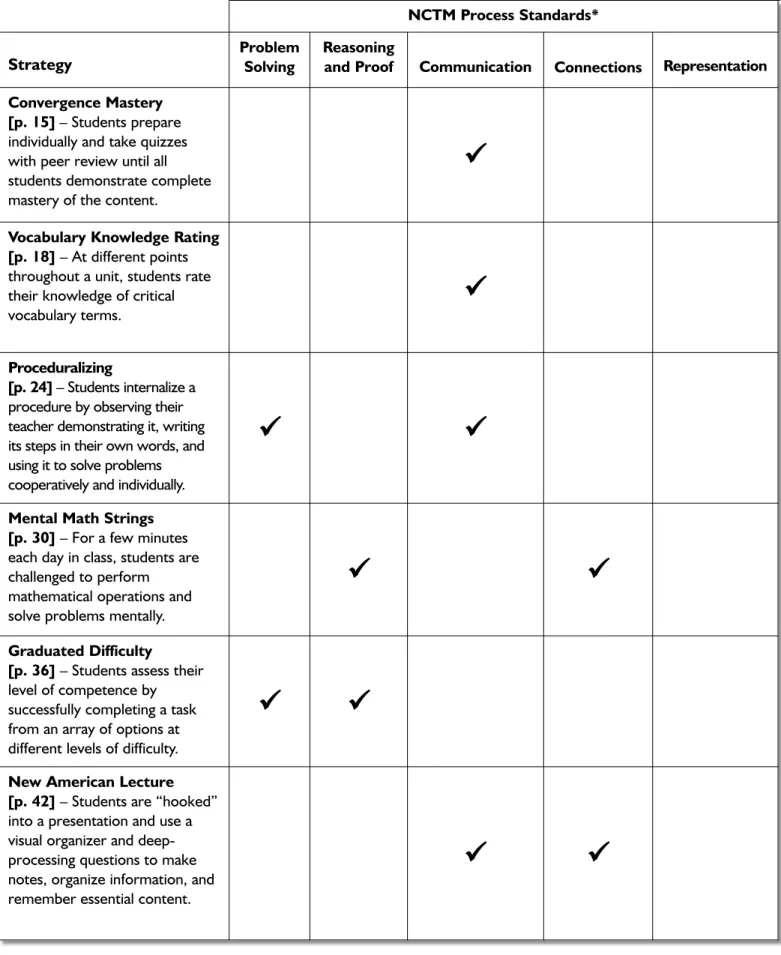
The six Mastery strategies in this chapter can help you meet these NCTM Process Standards (see Figure 1.0).
FIGURE 1.0 Correlation of Mastery Strategies to NCTM Process Standards
*For more information on the National Council of Teachers of Mathematics (NCTM) Process Standards, please consult theirPrinciples and Standards for School Mathematics(2000), or visit their website at www.nctm.org.
Strategy
Problem Solving
Reasoning
and Proof Communication Connections Representation
Convergence Mastery [p. 15]– Students prepare individually and take quizzes with peer review until all students demonstrate complete mastery of the content.
Vocabulary Knowledge Rating [p. 18] – At different points throughout a unit, students rate their knowledge of critical vocabulary terms.
Proceduralizing
[p. 24] – Students internalize a procedure by observing their teacher demonstrating it, writing its steps in their own words, and using it to solve problems cooperatively and individually.
Mental Math Strings [p. 30] – For a few minutes each day in class, students are challenged to perform mathematical operations and solve problems mentally.
Graduated Difficulty
[p. 36] – Students assess their level of competence by successfully completing a task from an array of options at different levels of difficulty.
New American Lecture [p. 42] – Students are “hooked” into a presentation and use a visual organizer and deep-processing questions to make notes, organize information, and remember essential content.
Strategy Overview
In every math classroom, after every quiz or test, a wonderful instructional opportunity presents itself: the opportunity to help students learn from their mistakes. But the truth is, in most math classrooms, tests are returned with red marks on them, and the next unit begins. This means that the great majority of math students are missing the chance to root out errors, clarify confusions, and grow as learners.
The Convergence Mastery strategy is a simple but powerful way to provide students with multiple opportunities to learn from their mistakes and achieve mastery of important math procedures and skills. At the heart of the strategy is a series of short quizzes focused on a single core skill (e.g., factoring polynomials). Before taking the first quiz, students practice the skill and review in pairs or small groups. Students take the first quiz individually, return to their groups, and grade one another’s quizzes as the teacher provides the correct answers. Only two grades are possible:
1. Students with one or more incorrect answers receive an Incomplete 2. Students who answer every question correctly receive an A
Students who receive an A are not required to take additional quizzes. Instead, they help group members who received an incomplete to review, make corrections, and prepare for the next quiz. The strategy continues until all students have received an A.
How to Use the Strategy
1. Select a math procedure or skill you want all students to master. 2. Develop three to five short quizzes that contain problems
represen-tative of the skill.
3. Explain the quiz process and grading procedures to students. Be sure they understand how the process is designed to help them. 4. Provide a few minutes for students to review the skill in small groups. 5. Administer a quiz to all students. Quizzes are timed (usually 5
min-utes per quiz).
6. Share the correct answers, and have students grade other group members’ quizzes.
7. Excuse any students who received an A from further quizzes. Have these students help their group members correct errors and prepare for the next quiz. If necessary, provide coaching sessions to struggling students. 8. Continue the process (Steps 5–7) until virtually all students have
received an A.
The Strategy in Action: Examples
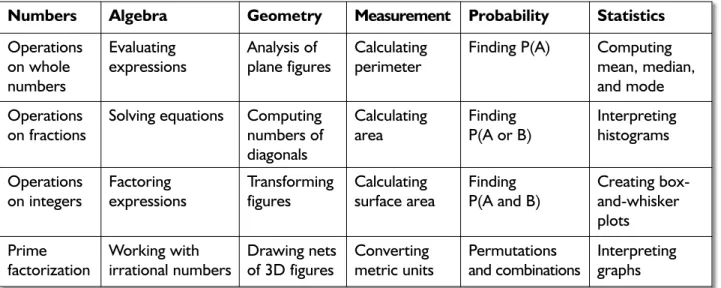
Figure 1.1 shows sample topics ideal for the Convergence Mastery strategy.
Numbers Algebra Geometry Measurement Probability Statistics
Operations on whole numbers Evaluating expressions Analysis of plane figures Calculating perimeter
Finding P(A) Computing mean, median, and mode Operations
on fractions
Solving equations Computing numbers of diagonals Calculating area Finding P(A or B) Interpreting histograms Operations on integers Factoring expressions Transforming figures Calculating surface area Finding P(A and B) Creating box-and-whisker plots Prime factorization Working with irrational numbers Drawing nets of 3D figures Converting metric units Permutations and combinations Interpreting graphs
FIGURE 1.1 Ideal Convergence Mastery Topics
Quiz 1
Solve each equation and show your work. 1. 2(4x+5) = 26
2. .5(6x −8) = 15
3. −3(3x+2) = −24
Quiz 2
Solve each equation and show your work. 1. 2(6x+4) = 32
2. .5(8x−3) = 7
3. −4(x+5) = −60
Quiz 3
Solve each equation and show your work. 1. 5(2x+5) =35
2. .5(4x− 8) =10
3. −2(3x+7) = −4
Quiz 4
Solve each equation and show your work. 1. 4(2x+3) =36
2. .5(3x− 1) =11
3. −3(2x+ 1) = −27
Quiz 5
Solve each equation and show your work. 1. 6(x+2) = 48
2. .5(10x − 8) = 11
3. −2(4x+ 8) =−10
FIGURE 1.2 Sample Convergence Mastery Quizzes—Solving Equations
Figure 1.2 shows a sample set of quizzes for solving equations.
Why the Strategy Works
Sometimes, teaching strategies come from real-life experiences. The initial seed for the Convergence Mastery strategy was planted at Boy Scouts camp where one of the authors of this book (Ed Thomas) spent his summers as a young boy. At summer camp, scouts had opportunities to earn awards and merit badges for meeting various challenges. One challenge was to make fire without matches. On certain nights, scouts were given a rock, a piece of steel, and 30 minutes to produce a fire. Scouts who succeeded were given a “Singed Eyebrows” certificate. Scouts who failed were invited to try again the next time the Singed Eyebrows station was open. Whenever a scout produced fire, whether it was on the first try or the fourth, he received his Singed Eyebrows certificate. This open-door policy on success motivated scouts to keep trying, learn from their mistakes, and achieve mastery in the skill of making fire.
Convergence Mastery takes the wisdom of Boy Scouts camp and puts it to work in the mathematics classroom. The strategy provides students with repeated and controlled practice opportunities, which help build students’ debugging skills and maximize skill acquisition. Convergence Mastery also provides teachers with an easy way to differentiate instruction according to students’ readiness levels. Students who need more practice opportunities and more coaching receive both. At the same time, students who have already mastered the skill do not sit around idly; instead, they become part of the teaching and learning process. What’s more, by having students help other students who have yet to receive an A on a quiz, Convergence Mastery capitalizes on the power of peer-coaching partnerships, which have been shown to increase students’ academic intensity (Fuchs, Fuchs, Mathes, & Simmons, 1997) and lead to academic gains and more positive attitudes toward subject matter (King-Sears & Bradley, 1995).
Planning Considerations
The idea behind Convergence Mastery is that all students converge towards mas-tery of the highlighted skill or procedure by achieving a perfect score on a short quiz. In terms of preparing for Convergence Mastery in the classroom, most of the planning time goes to the development of the quizzes. Here are a few guidelines to keep in mind when developing Convergence Mastery quizzes: Select a focus skill that students are familiar with and have partially mastered. For example, if students have experience with solving linear equations but have been making mistakes in the process, then solving lin-ear equations would be an ideal candidate for Convergence Mastery. Make the quizzes brief.Remember, during a single class period, students will be taking up to five quizzes while also spending 5 minutes of study time between each quiz. Make sure that each quiz can be completed by students in 5 minutes. Keep the focus skill and the level of difficulty constant across all the quizzes.Only the problems should vary from quiz to quiz.
Consider projecting the quizzes.To save paper and time, you might consider writing the quizzes on a transparency or designing them in a program like Microsoft PowerPoint and then projecting them through a multimedia device.
Variations and Extensions
Depending on the difficulty of the focus skill and students’ level of profi-ciency, you may choose to play a more active teaching and coaching role between quizzes. If you choose to run the between-quiz coaching sessions yourself, you may want to vary the role of students who earn the A grade and exit the quiz-taking activity. For example, you might allow them to begin their homework, or ask them to design and solve problems at a higher level of difficulty than those on the quizzes. These students can also be invited to participate in subsequent quizzes and earn extra credit points, which increases the sense of reward for having mastered the skill early.
Strategy Overview
Successful students know how to assess and evaluate their own learning. They tend to have a clear understanding of what they know and which concepts and ideas they still need to learn. Vocabulary Knowledge Rating (VKR) gives teachers of mathematics a strategic approach to vocabulary instruction—an approach that helps students evaluate the state of their learning and build a deep understanding of critical content. VKR provides teachers with a wealth of formative assessment data by providing answers to two questions: One, which concepts are giving the entire class difficulty? And two, which individual students are struggling most with the content of the unit?
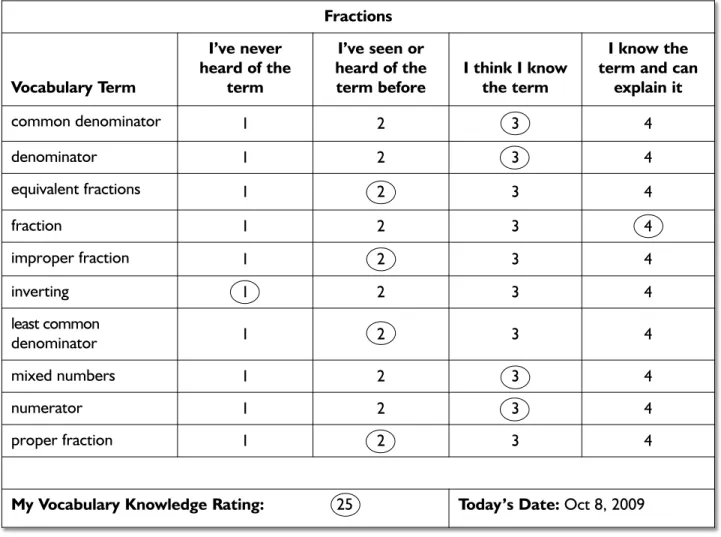
In VKR, students numerically rate their understanding of key terms using an organizer like the one shown in Figure 1.3.
Fractions Vocabulary Term I’ve never heard of the term I’ve seen or heard of the term before I think I know the term I know the term and can
explain it common denominator 1 2 3 4 denominator 1 2 3 4 equivalent fractions 1 2 3 4 fraction 1 2 3 4 improper fraction 1 2 3 4 inverting 1 2 3 4 least common denominator 1 2 3 4 mixed numbers 1 2 3 4 numerator 1 2 3 4 proper fraction 1 2 3 4
My Vocabulary Knowledge Rating: 25 Today’s Date:Oct 8, 2009
FIGURE 1.3 Student’s VKR for a Unit on Fractions
Because self-assessment is always an ongoing process, VKR is most effective when it is used regularly. Typically, students complete a VKR organizer at least three times over the course of a mathematics unit:
• Before the unit begins to assess their initial understanding and help
them activate any relevant background knowledge.
• During the unit to assess what they currently know and
under-stand and to determine which words and concepts require more study.
• After the unit is completed, but prior to the test or culminating
assessment, to focus study efforts and to reflect on the learning process.
How to Use the Strategy
1. Prioritize your vocabulary by selecting the 10 to 12 most important words from your unit that students should focus on. Limit your selections to only the most critical words that every student will need to know and understand.
2. Distribute a VKR organizer to each student (see Organizer A on page 23 for a blank reproducible). Review the ranking system with students:
1 = I have never heard of this term.
2 = I have seen or heard of this term, but I am not sure what it means. 3 = I think I know what this term means.
4 = I know this term, and can explain what it means.
3. Have students rate their current knowledge of each vocabulary word by selecting the appropriate number on the four-point scale. To complete the organizer, students record the sum of their points in the Knowledge Rating box and date their work.
4. Have students revisit their initial VKR organizers throughout the unit to reassess their knowledge and monitor how their understanding of key content has expanded and still needs to grow.
5. Help students prepare for an end-of-unit test or culminating assessment by giving them time to review and reflect on their previously completed VKR organizers and to discuss their learning with classmates.
Implementation Note: Formative assessment data from students’ VKR organizers can also be used to provide parents and educational support service specialists with valuable information to help focus conversations with each student about his or her learning.
The Strategy in Action: Examples
Here are some sample middle school mathematics units with correspond-ing vocabulary terms:
Measurement:area, altitude, base, circumference, diameter, grid, length, unit of measurement, perimeter, radius, volume
Geometry:circle, hexagon, octagon, parallelogram, pentagon, polygon, quadrilateral, rectangle, rhombus, square, trapezoid, triangle
Statistics:box and whisker plot, data, mean, measures of central tendency, median, mode, range, quartile, rank, stem and leaf plot, tally, variance
Why the Strategy Works
In their research into vocabulary instruction, Jenkins, Stein, and Wysocki (1984) show that students need to be exposed to new words at least six times to master and retain their meanings. VKR provides teachers with a manage-able way to keep students closely connected to the key terms and concepts in a unit, giving them the exposure they need to learn new words deeply.
Another important aspect of vocabulary instruction is focusing on only the most important concepts and terms. In fact, Marzano (2004) shows that when vocabulary instruction is focused on critical academic terms (as opposed to high-frequency word lists), student achievement can increase by as much as 33 percentile points on content-area tests. This is why VKR con-centrates both the teacher’s and students’ attention on only 10 to 12 terms.
A final benefit of VKR is that it builds the habits and skills of self-reg-ulated learning, which has been identified as a hallmark of intelligent behavior (Costa & Kallick, 2000).
Planning Considerations
While VKR is not a difficult strategy to implement, there are a few impor-tant guidelines to consider:
Select only the most critical words. Resist the temptation to list every word that students might encounter during the unit, and include only the 10 to 12 critical words that will be most helpful to students. In some cases, you may choose to include words that are not quite central to the unit but will help scaffold student learning. For example, in selecting words for a unit on fractions, a teacher chose to include the term number linebecause she wanted students to compare and order fractions using a number line. Determine when and how you will help students assess their learning. Identify the segments of your unit in which you will present and discuss a number of the words and concepts from your list. In between these seg-ments, give students ample opportunity to self-assess their knowledge
and reflect on their progress. Make sure that all students know that these are valuable periods of class time that should be used for meaningful reflection and discussion.
Decide when it will be appropriate to analyze students’ progress.Ask yourself, At what points would it be helpful for me to know whether students have learned the key words and concepts? After a weekend? Before a school break? At the completion of smaller sections within the unit?
Variations and Extensions
Create Your Own VKR
After you and your students have used a traditional VKR organizer, consider inviting your class to revise or improve upon the form by creat-ing a new set of descriptive column headcreat-ings. For example, after a group discussion, a class of sixth graders developed a three-point VKR scale with the following headings:
1 = I really don’t know this word. 2 = I have seen or heard this word.
3 = I really know this word because I can give an example.
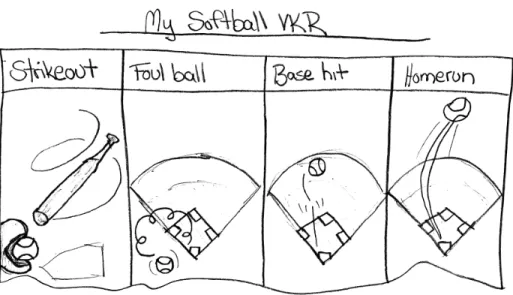
You can also extend the strategy by inviting students to develop their own creative, personally meaningful VKR organizers. For example, Figure 1.4 shows how an eighth grader incorporated her love of softball into her VKR organizer.
Definition Doctor (adapted from Thomas, 2008) is a great way to review VKR words and to formatively assess students’ vocabulary knowl-edge using an engaging whole-class game format. It works especially well in conjunction with VKR because VKR automatically aligns the activity with a set number of critical terms that have already been the focus of instruction. You can use Definition Doctor at various points within the VKR cycle by following these simple steps:
1. Have all students take out their VKR organizers.
2. Begin by playing the role of the Definition Doctor yourself. Select a student (Student A) to choose one word for you—the Definition Doctor—to define and explain why the word is important to the lesson or unit.
3. After you define and explain the word, Student A assumes the role of the Definition Doctor and a new student (Student B) chooses a word for the good doctor to define and explain. (If the Definition Doctor is having trouble, you may choose to allow him or her to get a “second opinion” by allowing for a “consult” with you or another student.)
4. Student B now becomes the Definition Doctor and a new student selects a word.
5. Continue this process until all the words from the list have been defined and explained.
6. Keep track of any words that seemed to give students difficulty and review them with the class.
Topic: Vocabulary Term I’ve never heard of the term I’ve seen or heard of this term before I think I know this term I know the term and can
explain it 1 2 3 4 1 2 3 4 1 2 3 4 1 2 3 4 1 2 3 4 1 2 3 4 1 2 3 4 1 2 3 4 1 2 3 4 1 2 3 4 1 2 3 4 1 2 3 4
My Vocabulary Knowledge Rating: Today’s Date:
Organizer A: Vocabulary Knowledge Rating Organizer
Copyright 2010 by Thoughtful Education Press. All rights reserved. Reprinted from Styles and Strategies for Teaching Middle School Mathematics, by
Edward J. Thomas and John R. Brunsting. Thousand Oaks, CA: Corwin, www.corwin.com. Reproduction authorized only for the local school site or nonprofit organization that has purchased this book.
Strategy Overview
Mathematics is brimming with procedures: long division, finding the great-est common factor, completing the square, differentiating the product of two functions, just to name a few. Often, the difference between successfully and unsuccessfully internalizing mathematical procedures proves the difference between high and low achievers in mathematics. In classrooms throughout the country, teachers of mathematics spend significant classroom time demonstrating procedures while students watch, copy their teacher’s work, and strive to keep pace before trying a few practice problems on their own.
But jump ahead a few weeks and many students won’t be able to recall the steps well enough to apply the procedure (or skill) and successfully solve a problem. In order for students to master, internalize, and retain the steps of important mathematical procedures, students need to do more than watch, copy, and keep pace with their teacher’s work; students need to make mathematical procedures their own.
The Proceduralizing strategy helps students make even the most chal-lenging mathematical procedures their own through observation, mathe-matical analysis, collaboration, and independent practice. Students observe a teacher solving different sample problems using the procedure; analyze the procedure by identifying its general steps and writing the steps in their own words; collaborate with a partner to solve two problems, once by coaching and once by calculating; and independently practice and refine their knowledge by applying the procedure to solve a set of problems.
How to Use the Strategy
1. Select a mathematical procedure that is important for your students to learn. The procedure should be accessible to students and be rel-evant to current (or future) classroom applications.
2. Model the procedure with students using sample problems. The sample problems should not be overly complex; rather, they should clearly illustrate the general steps in the procedure.
3. Review the sample problems with students, and focus on the essen-tial steps in the procedure. Don’t overwhelm students with additional information like prerequisite procedures or secondary processes. 4. Work with students to identify a set of generalized steps for the
pro-cedure. Have students write these steps in their own words. Encourage students to ask questions about the procedure and steps to help them internalize the information.
5. Organize students into pairs. Have students review the procedure together to make sure that they’ve internalized all of the steps.
6. Provide each pair of students with two problems. One student works on solving the first problem (without seeing the steps) while the other stu-dent coaches using the steps. For the second problem, stustu-dents switch roles. While students are working collaboratively, circulate around the room to monitor students’ progress and answer any questions.
7. Encourage students to share their experiences with the entire class, including both successes and difficulties they had solving the prob-lems collaboratively.
8. Assign additional problems for students to solve independently using the same procedure. This work can be completed in class or for homework.
The Strategy in Action
Jackie Parra teaches sixth-grade mathematics and has identified graphing equations of the form y = mx+bas an important procedure for all of her
students to know well. To help her students master this essential graphing procedure, Jackie uses the Proceduralizing strategy.
Jackie starts by graphing a few linear equations using the slope-intercept form, y= mx+b,and summarizes the procedure into five general
steps that her students can easily understand: 1. Write the equation in the form y= mx+b.
2. Use graphing paper to plot the number bon the y-axis. (This point is the y-intercept of the graph.)
3. Write the slope mas a fractionk– h.
4. From the y-intercept, move h units horizontally and k units verti-cally on the plane. Plot a point at this location.
5. Draw a line (using a straight edge) through the two points plotted in Steps 2 and 4. The line, and all of its points, represent the infinite set of ordered pair solutions (x,y) for the linear equationy= mx+b.
To better illustrate the steps in the procedure, Jackie models one more equation for students. While she graphs this equation step by step, her students carefully record the steps in their own words. Jackie reminds her students to write the steps in general terms so they can use them to graph other equations (and coach their partners).
1. Beginning with the equation 2x – y = –1,Jackie rewrites the equation in y = mx+bform: y = 2x +1.
2. Second, Jackie plots the y-intercept (b) on a transparency that she projects onto the board:(0,1).
3. Third, she reminds students to be careful and make sure that they write the slope (m) as a fraction (k–
h): m = 2 = 4
–
units up (k) and two units to the right (h). She plots a second point here: (2,5).
5. For the fifth step in the procedure, Jackie uses a straightedge to draw a line between the two points: line passing through (0,1) and (2,5).
She explains to her students that for every equation of the form y = mx +b there is an infinite number of ordered pairs of numbers that can
be substituted for xand yto form a true equation. The set of all of the ordered pairs of numbers that make the equation true is the solution of the equa-tion. When graphed, these points representing the solution of the equation will form a straight line.
After she finishes graphing the equation y = 2x +1, Jackie organizes her students into pairs. Students share their steps with their partners and review the procedure before starting the activity together.
Jackie provides each pair of students with two equations to graph. One student puts away her steps and graphs the first equation while her part-ner coaches her. Students switch roles for the second equation. The stu-dent-coach from the first equation now graphs the second equation while his partner coaches him.
After all of the students have had the opportunity to graph an equation and coach their partner doing the same, Jackie brings her class back together. She asks questions and encourages her students to share their thoughts on the Proceduralizing strategy so far. Jackie wraps up her lesson by assigning students some more equations to graph for homework so they can practice using the procedure on their own.
Why the Strategy Works
Proceduralizing draws its instructional power from two distinct lines of research: direct instruction and peer coaching. Let’s begin with direct instruction. Direct instruction is a broad name for those teaching frame-works that involve the teacher modeling a skill or procedure for students. After the teacher has modeled the skill, students practice it in phases, with
less help and guidance from the teacher during each phase. The ultimate goal of a direct-instruction lesson is student independence.
Research has consistently shown that direct instruction has a dramatic impact on students’ mathematical achievement, improving students’ abil-ity to master and retain procedures, solve problems with greater confi-dence, and remain focused and engaged in mathematical learning (Kroesbergen & Johannes, 2003; Flores & Kaylor, 2007).
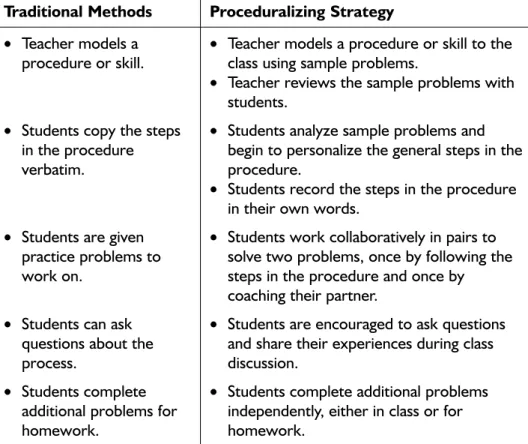
However, we have all probably used direct instruction in our mathemat-ics classrooms and been less than thrilled by the results. The reason for this is simple: Not all forms of direct instruction are created equal. Proceduralizing maximizes the benefits of direct instruction by adding several additions and twists to the traditional direct-instruction model. Figure 1.5 outlines these additions and twists and compares Proceduralizing to more traditional direct-instruction methods.
Traditional Methods Proceduralizing Strategy
• Teacher models a
procedure or skill.
• Students copy the steps
in the procedure verbatim.
• Students are given
practice problems to work on.
• Students can ask
questions about the process.
• Students complete
additional problems for homework.
• Teacher models a procedure or skill to the
class using sample problems.
• Teacher reviews the sample problems with
students.
• Students analyze sample problems and
begin to personalize the general steps in the procedure.
• Students record the steps in the procedure
in their own words.
• Students work collaboratively in pairs to
solve two problems, once by following the steps in the procedure and once by coaching their partner.
• Students are encouraged to ask questions
and share their experiences during class discussion.
• Students complete additional problems
independently, either in class or for homework.
FIGURE 1.5 Traditional Direct Instruction Versus Proceduralizing
Of all the revisions to traditional direct instruction, the most important is the integration of a simple peer-coaching model into the larger direct-instruction framework. By allowing students to work and learn together in a structured way, you and your students reap the sig-nificant benefits associated with learning partnerships, including more on-task behavior, increased engagement, and the development of more positive attitudes towards mathematics (King-Sears & Bradley, 1995).
Planning Considerations
Mathematics contains a great number of procedures. Some procedures are more complex with numerous steps while others are more basic and con-tain only a few steps. Some procedures are essential to mathematics while others aren’t as important and are “nice to know.”
While the Proceduralizing strategy works best with critical procedures involving multiple steps, it can be used with most levels of mathematical content. When planning a Proceduralizing lesson for your classroom, you should follow these guidelines:
• Select a procedure that maintains a high degree of consistency for a
variety of problems for which the procedure applies. For example, the procedure for finding the least common multiple (LCM) or greatest common factor (GCF) of a pair of numbers remains consis-tent for every pair of numbers.
• Review prerequisite skills with students, but don’t present too much
information. Most mathematical procedures rely on concepts and skills that students have learned previously. However, it is impor-tant that some time be taken to identify and review relevant con-cepts and skills so they do not become barriers for students. It is also important not to present so much information that the key steps in the procedure are lost.
• Work through the procedure and generalize the steps before
model-ing the procedure with students. Students are expected to generalize and record the steps of the procedure in their own words, so it is important that you have a clear set of general steps. By working through the procedure and developing a list of steps in the planning stage, you will be prepared to review the procedure, answer students’ questions, and provide help and feedback as needed.
• Make sure your examples are clear, concise, and easy to understand.
Modeling the procedure is essential to the Proceduralizing strategy. You need to consider how information will be presented to and received by students. Any written information needs to be visible and readable for all students. Manipulatives and hands-on proce-dures need to be easily seen and connect well to your mathematics content. Your modeling of the procedure should be clear, efficient, and, of course, mathematically accurate.
• Allow ample time for students to write their steps in their own
words, share their steps, and review the procedure with a partner. Cognitively speaking, the most important part of the Proceduralizing activity is the period of time in which students write the steps in their own words and refine their steps with a partner.
• Prepare appropriate problems for the cooperative learning
activ-ity. Be sure that the problems you select are aligned with the pro-cedure that your students are learning. Serving up problems that don’t fit the procedure will deflate the entire learning experience.
Similarly, problems that are only somewhat related to the proce-dure can be confusing at first and should be introduced later on in the unit.
• Select an appropriate independent practice activity to close the lesson.
Think about how you want your students to practice the procedure on their own. Assign activities for class work or homework that are meaningful and will help students further internalize the steps in the procedure.
Variations and Extensions
While the Proceduralizing strategy works best with core mathematical procedures involving multiple steps, the following moves can help you use the Proceduralizing strategy with any mathematical content.
Fill in the Blank
For younger students or students who are struggling with a procedure, you can provide students with your typed list of general steps for the pro-cedure with a few key words missing. As students watch and study your demonstration of the procedure, they fill in the blanks of each step and capture the key elements of the procedure.
Math Vocabulary: Fun and Games
Sometimes a new mathematical procedure includes a significant number of new vocabulary words. Make sure you preview these words and define them with your students prior to starting your Proceduralizing lesson. Vocabulary games are great ways to introduce students to new and potentially intimidating terms.
Three’s Company
The Proceduralizing strategy can easily work with cooperative groups of three students. After students review their steps in the procedure, they are given three problems. While one student works to solve the first prob-lem, the other two students observe and coach using their steps. Students switch roles, so each student solves one problem and coaches twice.
Apply Technology
To verify that the procedure really does work, have students use a computer or calculator to check for themselves. For the graphs of y = mx + bequations featured earlier, students could use a graphing
calculator to check that their solutions and graphs are indeed correct. Also, consider using software programs to introduce your students to a procedure. A slide show is a great way to show visual represen-tations of the procedure and reveal the steps in the procedure one at a time.
Strategy Overview
Most math educators would agree that in order to learn math, students must do math. This principle, put forth by the National Council of Teachers of Mathematics (NCTM) in 1989, has served as a cornerstone for reforming mathematics instruction ever since. Today, many math educa-tors use the term engagement when they talk about students doing math in the classroom.
Mental Math Strings is a daily activity that engages students directly by challenging them to call up essential facts and perform a wide variety of mathematical operations—to do math—in their heads. No calculators, no paper, no pencils. The strategy requires only a few minutes each day and can be done at the start of class, end of class, or as a break during class. We like to think of Mental Math Strings as a kind of a daily multi-ple vitamin for math students: They provide a rich mix of nourishing mathematical concepts and activities that help keep students’ minds in peak condition.
A typical Mental Math String includes key vocabulary terms, impor-tant measurement equivalencies, and connections to imporimpor-tant mathemat-ical concepts. For example, a Mental Math String might contain this sequence of activities:
• Start with the number of inches in two feet. • Add the first odd whole number to your answer. • Divide by the number of vertices in a pentagon. • Cube your result.
• Add the digits of your answer together.
• Multiply by the number of diagonals in a square.
So, how did you do with this Mental Math String? Did you come up with an answer of 16?
While a simple Mental Math String is beneficial to students, the daily string routine can be greatly enhanced using an instructional model called PEACE.
The progressive stages of the PEACE model ask students to
Preview the material;
Engage in the mental operations required by the string;
Assess their final answers;
Correct mistakes and errors in thinking; and
Engage in a second Mental Math String.
How to Use the Strategy
To implement Mental Math Strings in your classroom, follow the stages in the PEACE model:
Preview Stage:Preview the content, procedures, and skills embedded in the Mental Math String with your students.
Engagement Stage 1:Present the steps of the Mental Math String one at a time to students so they can compute each step in their heads. Assessment Stage:Provide the final answer, so students can determine whether they performed all of the steps correctly.
Correction Stage: Demonstrate (verbally, in written form, or using a student volunteer) how each step is correctly performed, allowing students to identify and correct mistakes one line at a time.
Engagement Stage 2: Present a second Mental Math String that involves the same concepts, vocabulary, and procedures but uses dif-ferent numbers. Collect work from all students to note and communi-cate rates of improvement between the first and second string.
The Strategy in Action
Joanne Ehrhardt uses Mental Math Strings to engage students in mathe-matical learning and continuously build their background knowledge of key vocabulary terms, measurement units, and mathematical procedures. In the preview stage, Joanne previews the information that the students will encounter in the steps of the Mental Math String. Prior to today’s Mental Math Strings challenge, Joanne asks students to activate and shore up gaps in their prior knowledge with these questions:
1. How many inches are in one foot? 2. How many inches are in one yard? 3. What is the first odd whole number? 4. What is the first even whole number?
5. How many sides are on a pentagon? On an octagon? On a hexagon? 6. How many vertices are on a pentagon? On an octagon? On a hexagon? 7. How do you square a number?
8. How do you cube a number?
9. What is the sum of the digits of the number 64? What is the product? 10. How many diagonals can be drawn on a square? On a parallelogram?
On a rhombus?
The preview stage of the PEACE model provides students with oppor-tunities to learn and review important mathematical facts and operations
will not explicitly appear in the string. Previewing in this way also increases students’ chances of succeeding in the Mental Math Strings activ-ity and builds students’ knowledge base of critical facts and procedures.
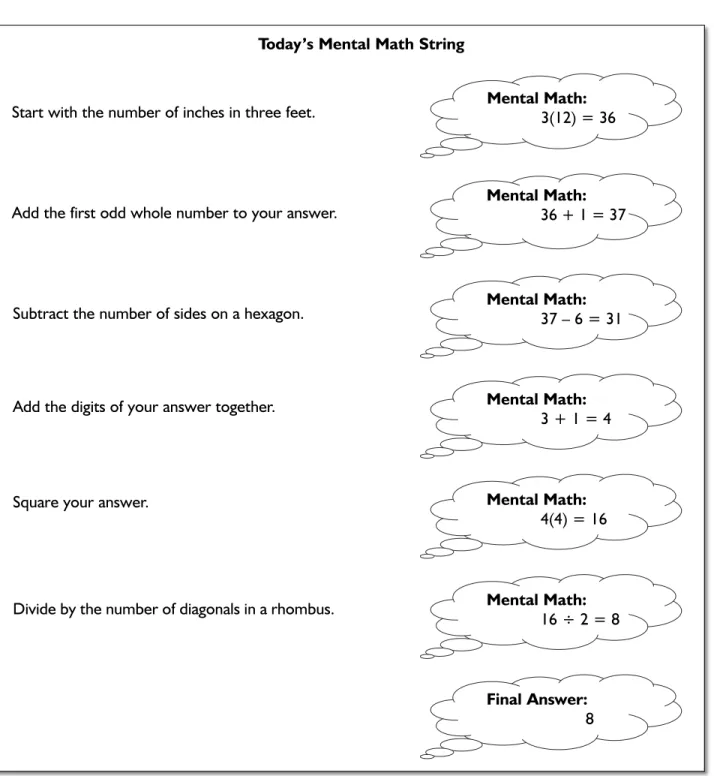
After the preview stage, Joanne and her students enter the first engage-ment stage. Joanne reads each line of the Mental Math String and pauses for a few seconds after each line, giving students time to recall or deter-mine the key number associated with that line of the string and then apply that number as an operation of the previous answer. For example, here is today’s Mental Math String (Figure 1.6):
FIGURE 1.6 Today’s Mental Math String
Mental Math: 3(12) = 36 Mental Math: 36 + 1 = 37 Mental Math: 37 – 6 = 31 Mental Math: 3 + 1 = 4 Mental Math: 4(4) = 16 Mental Math: 16 ÷ 2 = 8 Final Answer: 8 Today’s Mental Math String
Start with the number of inches in three feet.
Add the first odd whole number to your answer.
Subtract the number of sides on a hexagon.
Add the digits of your answer together.
Square your answer.
In the assessment stage that follows, Joanne invites students to turn to one another and share their final answers, and then she encourages students who feel confident about their answers to share them with the class. To alleviate any confusion or differences of opinion, Joanne quickly identifies the correct answer.
Students who did not solve the Mental Math String correctly now get an opportunity to identify what they did wrong during the correction stage of the PEACE model. To accomplish this, Joanne asks for a volunteer who solved the string correctly to stand before the class and verbally recount the steps in the string so all students can identify their mistakes one line at a time. Sometimes, the volunteer student will record the line-by-line answers on the board to make it easier for students to identify their mistakes. Joanne is always pleased by how eager students are for this opportunity to receive immediate feedback on their work. She is also very happy that the number of student moans and groans over their own mistakes and miscalculations has dropped significantly since the beginning of the year. Since using Mental Math Strings, Joanne’s students are more careful, more confident, and more knowledgeable than they were at the start of the year.
During the final phase of the PEACE model, the second engagement stage, Joanne encourages students to show that they have learned from their mistakes and helps all of her students experience success. Joanne pre-sents a second Mental Math String, which includes the same vocabulary terms and concepts as the first but contains different numbers and requires different mental calculations.
Students complete the string, check their answers, and the day’s lesson begins. Before moving on to the day’s lesson, however, Joanne is sure to remind students that Mental Math Strings are daily exercises and that they will work on another string tomorrow to help keep their mathematical minds sharp.
Why the Strategy Works
Some of the most striking findings in recent educational research come from studies into the power of formative assessment. For example, Robert Marzano (2006), citing a 1991 study conducted by Bangert-Drowns, Kulik, and Kulik, shows that regular formative assessment can lead to gains of 25 percentile points or more in student achievement.
So, what makes for effective formative assessment? According to Marzano, the most important criterion is “sound feedback,” or feedback that
• Is frequent;
• Gives students a clear idea of how well they are learning and how
they can get better; and
• Provides encouragement to the student. (Marzano, 2006, p. 11)
Mental Math Strings put the power of formative assessment and sound feedback to work in the classroom. It happens daily. It provides both the teacher and the student with good information about students’ understanding
able to perform automatically to achieve success in mathematics—all without putting undue burden on the teacher. And Mental Math Strings encourages students by giving everyone in the class the opportunity to achieve success by systematically rooting out errors in their own thinking and then putting their revised understanding to work with a second Mental Math String.
Planning Considerations
In designing Mental Math Strings, keep the following tips in mind: 1. Include terms and procedures that are central to what you’re teach-ing. Mental Math Strings typically require general mathematical knowledge as well as more unit-specific terms and procedures. For example, the Algebra String below focuses on the terms greatest common factor and coefficient. It also requires students to apply the procedure for finding a GCF in their heads.
• Start with the greatest common factor (GCF) of 24 and 30. • Square your result.
• Add the coefficient of 4x5.
• Subtract the number of degrees in a right angle. • Square your result.
2. Keep it short and sweet.Mental Math Strings are meant to be used daily and completed quickly. Five to eight steps in a string are all you need.
3. Make two. Remember, you’ll need a string for both engagement stages in the PEACE model.
4. Decide how to preview the string. Once you’ve identified the vocabulary, concepts, skills, and procedures students will need to know to succeed, think about what you will do to preview the activity. Will you provide questions to students as Joanne Ehrhardt did in the model lesson? Will you review and reteach the component parts? Can you involve “student-teachers” in the preview stage?
Variations and Extensions
PEACE Model
The PEACE model can be applied to any engagement activity in any mathematics classroom. Whether students are learning computation pro-cedures with rational numbers, computing perimeters, areas, surface areas, and volumes in geometry, or solving equations in algebra, the pro-gressive stages associated with the PEACE model will increase success rates and student learning.
The PEACE model can also be applied to homework. Students will experience more success with homework if the associated mathematical terms and procedures are previewed before students begin their home-work. This might be done towards the end of class on the same day that the homework is assigned. It is equally important that the students’ work is assessed the day the homework is due. Following the assessment, students should be led through the process of identifying and correcting their mistakes. Similar problems should be part of the next homework assignment so students can demonstrate that they have learned from their mistakes and can enjoy higher levels of success.
While the PEACE model described in this section includes two engage-ment stages, additional engageengage-ment stages can be added as needed. It is vital to the success of the strategy that the assessment and correction stages are implemented after each student engagement stage.
A final and highly engaging variation on Mental Math Strings involves student-generated strings. Challenge students to use the content they’re currently learning to create Mental Math Strings for their fellow students. Students can then work in pairs or small groups to complete each other’s strings, review key processes and concepts, and work through the PEACE model (or use a simplified version of the PEACE model).
Strategy Overview
In the mathematics classroom, students function at different levels of profi-ciency and comprehension. Some students may not be ready for the most challenging problems, while others become bored with problems and con-cepts that they have already mastered. This means that when math teachers rely on one-size-fits-all teaching and problem-solving approaches, students at both the higher and lower levels of proficiency will likely become frus-trated and may disengage from the learning at hand.
The Graduated Difficulty strategy provides an effective remedy to this common classroom challenge. For a Graduated Difficulty lesson, the teacher creates three levels of problems, all representing the same math concept or skill, but at distinct levels of challenge. The first level requires students to demonstrate basic knowledge, understanding, and proficiency associated with the concept or skill. The second level includes an extension or challenge that requires students to apply their knowledge, understand-ing, and proficiency beyond the basic level. The third level calls for the application of higher levels of math reasoning within or even beyond the context of the math concept or skill.
Before beginning a Graduated Difficulty lesson, it is important to explain to students the value of self-assessment and to remind them that they are responsible for their choices as they
• Analyze the three tasks;
• Select the task that best fits their level of understanding; • Complete the task and assess their performance; and • Set goals for achievement at higher levels.
How to Use the Strategy
1. Select a math concept or skill you want your students to master. 2. Develop three problems or problem sets that represent three levels
of difficulty.
3. Explain the process and the value of accomplishment associated with the varying levels of difficulty. Make sure students understand that three levels of difficulty are provided so they can analyze their own skill and comprehension levels, make choices, succeed, advance to higher levels, and get the most out their learning experience.
4. As students analyze the different problems, encourage students who are capable to select the more challenging levels, and assure all students that it’s okay to begin with the easier problems and to switch levels during the activity.
5. Provide an answer key (or rubric) so students can check their work. Students who successfully complete the level three problems can
serve as coaches for other students, or they can design even more challenging problems of their own and then solve them.
6. After all the students complete their work, invite students to present their solutions to the class.
7. At the conclusion of the Graduated Difficulty activity, help students establish personal goals for improvement. Provide additional tasks or problems so students can build their knowledge, understanding, and proficiency. The additional practice can come in the form of in-class work or homework.
The Strategy in Action: Examples
Three Levels of Problem Sets Involving Integers
Three Levels of Word Problems Involving Percents and Discounts
Level 1: High Tech Super Store has a 25% off sale on all computers and printers. Travis bought a computer and laser printer that regularly cost $799 and $249, respectively. Disregarding tax, find the total discounted cost of the new computer and printer. Level 2: The Johnsons are starting a new family business and need to
purchase two computers and two printers. Electronics and More is having a major sale. All computers are being discounted by 25% and all printers are being discounted by 30%. Find the total discounted cost of two computers and two printers that regularly cost $899 and $299, respectively.
Level 3: Jennifer needs a new laptop computer, color ink-jet printer, and black-and-white laser printer. She also needs a new desk and chair. Computer Depot is having a sale on all its merchandise. Computers and accessories are being discounted 25%. Furniture is being discounted 40%. Find the total cost of Jennifer’s purchase based on the prediscount prices shown below. Include a 6% sales tax on all items. Laptop Computer . . . $1199
Color Ink-Jet Printer . . . $149 B&W Laser Printer . . . $399
I. Simplify. II. Simplify. III. Simplify.
1. 12 −15 1. −10 +14 −20 1. −12 − (−20)
2. −21 +11 2. 24 −6 −16 2. 14 + 24 −30
3. 32 + 14 −22 3. 12 − 30 + 15 3. −12 −0 +14
4. −14 −18 4. 17 − 21 −4 4. −24 − (−20) −11
Chair . . . $139
Three Levels of Geometric Problem Solving
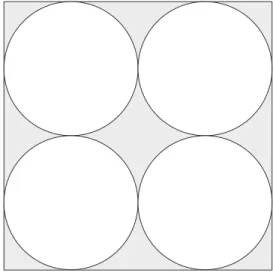
Problem: The drawing below (Figure 1.7) consists of four circles inscribed in a square. Each circle is tangent to two other circles. The area of the square is 64 square units. Choose one of the levels below. Level 1: Find the total area of all four circles.
Level 2: Find the area of the shaded region.
Level 3: Find the area of the hypocycloid bounded by the four circles.
FIGURE 1.7 Hypocycloid
Why the Strategy Works
Graduated Difficulty comes from the work of Muska Mosston (1972). What Mosston discovered is that when teachers invite students into the process of analyzing and selecting the work that is most appropriate for them, the classroom dynamic changes for the better. Some of the benefits include
• Increased opportunities for all learners to succeed; • Higher levels of student engagement and focus;
• Boosts in student confidence with more students attempting
higher-level tasks;
• The development of task-analysis and self-assessment skills as
students work to find the best match for themselves; and
• The establishment of a collaborative culture in which teachers work
with students as they reflect on and discuss their work, their deci-sions, and their goals.
What makes the strategy especially appealing to students is the choice. Choice is one of the strongest, most empowering of human motivators, and classrooms that encourage decision making tend to build trust between teachers and students and build students’ intrinsic motivation to learn and succeed (Erwin, 2004).
The strategy is also an ideal way to develop students’ goal-setting skills. As Robert Marzano’s (2007) research in The Art and Science of Teaching shows, encouraging students to set meaningful learning goals and helping them to evaluate and track their progress leads consistently to increased achievement levels in the classroom.
Planning Considerations
The idea behind Graduated Difficulty is that students’ levels of achievement can be improved by providingoptions at different levels of dif-ficulty and challenge. Clearly, to prepare for a Graduated Difficulty lesson, you’ll need to take some time to develop the three levels of problems or tasks your students will complete.
One thing to avoid when creating levels is the temptation to base diffi-culty on the quantity of problems you ask students to solve. Simply asking students to solve more problems doesn’t lead to the kind of task analysis and self-assessment that Graduated Difficulty naturally promotes among students. In other words, basing difficulty on the number of items will not encourage students to ask questions, such as What skills and knowledge are needed to complete each level? and, How do my current skills and knowledge match up to the requirements of each task?
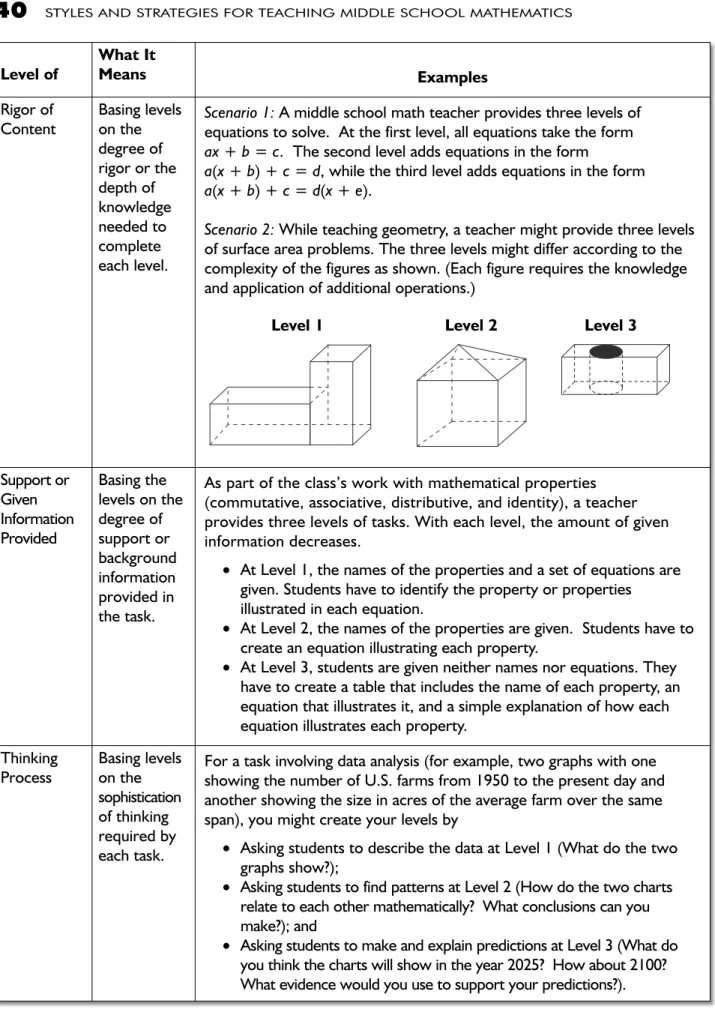
Figure 1.8 on page 40 shows three ways to design levels that will pro-mote task analysis and self-assessment on the part of students.
In addition to considering how you can challenge students with three different levels of difficulty, when designing a Graduated Difficulty lesson it is important to think about the following questions.
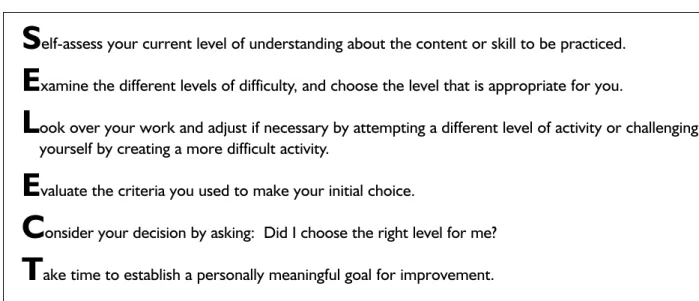
How will you introduce and explain the lesson?Students need to under-stand and be comfortable with their roles in a Graduated Difficulty lesson. Make sure students know how to analyze and select a task and reinforce the idea that it is okay for students to select whichever task is the best for them. Sara Avery, a middle school mathematics teacher, designed a poster (Figure 1.9) to help students through her Graduated Difficulty lessons.
How will students check their work?Students should be able to self-assess their work to determine if they have arrived at a correct answer and have made a good choice. To help students determine if they have com-pleted their chosen task correctly and well, provide them with an answer key that shows how the answer was calculated. For more open-ended activities, you might choose to give students a rubric with clear guidelines and benchmarks.
How will students reflect on their learning? The ultimate goal of Graduated Difficulty is to help all students move to higher levels of think-ing and learnthink-ing. It is important for students to take stock of where they are
Level of Means Examples Rigor of Content Basing levels on the degree of rigor or the depth of knowledge needed to complete each level.
Scenario 1:A middle school math teacher provides three levels of equations to solve. At the first level, all equations take the form
ax+ b= c. The second level adds equations in the form
a(x+ b) + c= d, while the third level adds equations in the form
a(x+ b) + c= d(x+ e).
Scenario 2:While teaching geometry, a teacher might provide three levels of surface area problems. The three levels might differ according to the complexity of the figures as shown. (Each figure requires the knowledge and application of additional operations.)
Level 1 Level 2 Level 3
Support or Given Information Provided Basing the levels on the degree of support or background information provided in the task.
As part of the class’s work with mathematical properties (commutative, associative, distributive, and identity), a teacher provides three levels of tasks. With each level, the amount of given information decreases.
• At Level 1, the names of the properties and a set of equations are
given. Students have to identify the property or properties illustrated in each equation.
• At Level 2, the names of the properties are given. Students have to
create an equation illustrating each property.
• At Level 3, students are given neither names nor equations. They
have to create a table that includes the name of each property, an equation that illustrates it, and a simple explanation of how each equation illustrates each property.
Thinking Process Basing levels on the sophistication of thinking required by each task.
For a task involving data analysis (for example, two graphs with one showing the number of U.S. farms from 1950 to the present day and another showing the size in acres of the average farm over the same span), you might create your levels by
• Asking students to describe the data at Level 1 (What do the two
graphs show?);
• Asking students to find patterns at Level 2 (How do the two charts
relate to each other mathematically? What conclusions can you make?); and
• Asking students to make and explain predictions at Level 3 (What do
you think the charts will show in the year 2025? How about 2100? What evidence would you use to support your predictions?).
FIGURE 1.8 How to Create Different Kinds of Graduated Tasks
at the end of the lesson so they can chart their own goals for improvement. To help students develop personal learning goals, encourage them to share their work and decision-making process with others through classroom dis-cussion and teacher conferences. Think about how you will help students convey their thoughts and experiences with questions like these:
• What went well for you in this lesson? • What caused you trouble?
• What criteria would you use to examine your choice and work? • Do you think you made the right choice?
• What do you need to do to move to a higher level?
Variations and Extensions
The Graduated Difficulty strategy can be implemented with the following variations and extensions.
• Depending on the complexity of the problems students will be
solv-ing, you may choose to implement the Paired Learner model (see pages 150–158) and allow students to work in pairs. This will encour-age teamwork, communication, and collaboration among students.
• The teacher can select students or pairs of students and provide
them with transparencies so they can easily share their work with the class during the presentation of solutions.
• Students who have higher levels of understanding and proficiency
can be encouraged and rewarded for completing all three levels of problems successfully.
S
elf-assess your current level of understanding about the content or skill to be practiced.E
xamine the different levels of difficulty, and choose the level that is appropriate for you.L
ook over your work and adjust if necessary by attempting a different level of activity or challenging yourself by creating a more difficult activity.E
valuate the criteria you used to make your initial choice.C
onsider your decision by asking: Did I choose the right level for me?T
ake time to establish a personally meaningful goal for improvement.Strategy Overview
Mathematics is filled with content and procedures that students need to remember if they are going to succeed. For teachers, this raises a critical ques-tion: How can we make the information we present in the classroom more engaging and more memorable? New American Lecture provides a mathe-matics teacher with a strategic way of delivering content and providing direct instruction in a mathematical procedure. In a typical New American Lecture, the teacher provides students with four kinds—or Ps—of support:
• The teacher prepares students for the lecture with an engaging hook. • The teacher presents brief chunks of content, which students record
on a visual organizer.
• The teacher pausesafter each chunk and poses a review question. • The teacher provides time for students to process content and/or
practice skills during and after the lecture.
How to Use the Strategy
Developing and implementing a New American Lecture requires 4 Ps: 1. Prepare a hook. Prepare a way to “hook” student interest and
involve them in the content. Open discussion with a topic-related question, but with a question that may appear to be off the wall. Encourage students to think and share responses in small groups; then, open up a class discussion.
2. Present the content in chunks using a visual organizer. Chunks are subsets of the material that will either overlap or subsequently be connected to other chunks of the content.
3. Pause every 5 minutes. Pause periodically throughout instruction to ask students to think about the content in multiple ways, from dif-ferent perspectives.
4. Process and/or practice the material. Assess the nature of content: a. If declarative content, provide focused time for students to
process the material; or
b. If procedural content, provide appropriate practice materials and class time.
The Strategy in Action
Alan Gorman teaches algebra. Today, Alan is using New American Lecture to teach his students about three common transformations: translations, reflections, and dilations.
Phase One: Prepare Students for Learning
Alan begins the lesson by asking students if they’ve seen any of the Transformers movies. “What do you know about Transformers? Why are they called Transformers?” Alan asks. After students offer their ideas, Alan explains that Transformers help illustrate a critical concept in mathemat-ics: transformation.
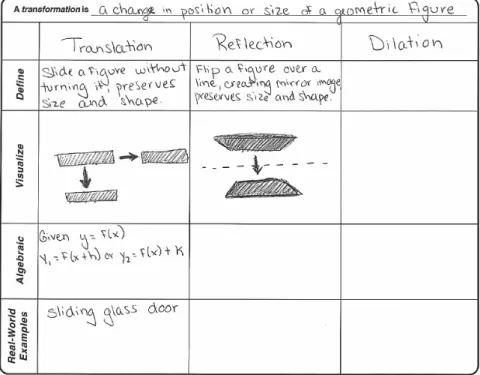
Alan provides students with a simple definition of transformation and then helps students brainstorm some real-world examples, including
• Changing an assigned seat in the classroom; • Changing lanes while driving;
• Changing the size of a photograph or computer graphic; and • Changing direction while dancing.
With each new example, Alan asks students to think about two ques-tions: One, What does each type of change look like? and two, What does each change feel like? Then, to focus students’ attention on the specific content of the lecture, Alan asks students to describe, in words, the actual or apparent change in their physical position or size if they:
• Took one step backward (translation);
• Looked in a full-length mirror (reflection); and • Viewed a 3 ×5 picture of themselves (dilation).
After the discussion, Alan connects students’ ideas to the lesson by saying,
It turns out that our three scenarios that we’ve been discussing—taking a step
backward, looking in a mirror, and viewing a photograph—are examples of the
three most common types of transformations, which are called translation,
reflection, and dilation. Of course, in mathematics, we can describe these kinds of
changes in position and size with perfect precision and in more than one way. By
the end of today’s lesson, you will be able to describe translation, reflection, and
dilation in four different ways: verbally in your own words, visually by sketching
each transformation, algebraically by representing each transformation as an
equation, and by identifying your own real-world example of each.
Phase Two: Present the Content
Alan distributes a visual organizer designed around the three trans-formations. For each transformation, students have to make notes that define the transformation, then show it visually, represent it algebraically, and cite at least one real-world example. A student’s partially completed organizer looks like Figure 1.10 on page 44.
Phase Three: Pause Every 5 Minutes
Each type of transformation represents one chunk of the lecture, and each takes roughly five minutes to present. After each 5-minute segment, Alan stops lecturing, gives his students an extra minute or 2 to complete
their notes, and then poses a question to help students think more deeply about transformations and how to apply them. To engage all his learners and to help students develop greater perspective and understanding of the content, Alan rotates the styles of the questions he poses.
After the first chunk on translations, Alan asks a Mastery question designed to help students practice and review what they learned: In terms of an arbitrary function f(x), can you algebraically define g(x), a horizontal trans-lation of eight units?
After the second chunk on reflections, Alan poses an Understanding question focused on comparative analysis: Compare and contrast translations and reflections. What is similar and different about them algebraically, graphi-cally, and numerically?
After the third chunk on dilation, Alan poses an Interpersonal ques-tion focused on real-world applicaques-tions of the three transformaques-tions: Many careers, especially those involving design, use transformations as part of the planning and creative process. Think of a career activity that might use these three types of transformations (e.g., architect, artist, graphic designer, etc.). Describe or illustrate how all three types of transformations might be part of the career activity.
Finally, after all of the transformation types have been presented, Alan poses a Self-Expressive question focused on visualizing and applying the three transformations: Choose one of our unit’s vocabulary words and print the letters of that word in block form on graph paper. On the same or on separate graphs, translate, dilate, and reflect the vocabulary word. Be sure to label each transformation and describe its changes from your original.