© 2013 The MITRE Corporation. All rights reserved. Public Release Pending
M r P e t e C h r i s t e n s e n
T e s t a n d E v a l u a t i o n P o r t f o l i o M a n a g e r T h e M I T R E C o r p o r a t i o n 1 5 N o v e m b e r 2 0 1 3W i t h g u i d a n c e a n d s u p p o r t f r o m
D r D a v e B e l l , M s S u s a n M a y, M s J e a n P e t t y D A S D D T & E : D r S t e v e n J . H u t c h i s o n , M r T o m S i m m s , M r T e r r y M u r p h y O S D D O T & E : M r D a v e A l a n d … . A n d m a n y o t h e r sProposed Cybersecurity T&E
Process
What, Why and How?
What do we want to accomplish?
–
Provide an overview of
Proposed OSD Cybersecurity T&E Process–
Gather your ideas and feedback
Why is this important?
–
Threats in Cyberspace are exploiting vulnerabilities at alarming rates
–
DOD policies and procedures are changing to help DOD mitigate risks
–
Government, FFRDC, SETA and Industry partners must collaborate to
deliver operationally effective systems
How will we do it?
1.
Present proposed Cybersecurity T&E Process2.
Gather your feedback as we go and–
Have fun as we do it!
Bottom Line Up Front
Cyberspace is an ambiguous term
–
Liberally applied prefix to anything!
Cyber Space links Social, Information and Physical
Networks
–
Massive Attack Surface exposes “Information” to
Threats!
“Cyber” Threats exploit vulnerabilities
–
Threats exercise a “Kill Chain”
DOD SE and T&E Communities must collaborate
–
Or Mission Critical Information will remain vulnerable
Systems Acquisition and Test focus must shift
–
Assure the “Mission”
Cyber T&E must assess ability to execute Missions
–
Understand Threats, Evaluate Attack Surface and
Kill Chain to close vulnerabilities
US DOD T&E Community is working the issue
–
DT&E and DOT&E collaborated on methodology
–
Working Policy, Infrastructure and Workforce
Cybersecurity and DOD
DoD missions increasingly depend upon complex, interconnected IT environments. These environments are inherently vulnerable, providing
opportunities for adversaries to negatively impact DoD missions. A comprehensive T&E program is required to address cybersecurity, starting early in the acquisition lifecycle, to provide early discovery and
allow correction of developmental and operational issues in order to support the warfighter.
DOD Information
Network
Graphics Source: WIKIPEDIA Commons
Approved US Govt. Cybersecurity Definition
Cybersecurity
— The prevention of damage to, protection of,
and restoration of computers, electronic communications
systems, electronic communications services, wire
communication, and electronic communication. This includes
information contained therein, to ensure its availability, integrity,
authentication, confidentiality, and nonrepudiation.
–
Defined in National Security Presidential Directive-54/Homeland
Security Presidential Directive-23
© 2013 The MITRE Corporation. All rights reserved. Public Release Pending
Working Definition: Attack Surface
Information Domain Information Network
Cyberspace
“Exposes” Information and Data via Interconnected Social, Physical and
Information Networks
Attack Surface: A system’s exposure to reachable and exploitable cyber vulnerabilities within the system boundaries
Source: SANS Attack Surface Problem: http://www.sans.edu/research/security-laboratory/article/did-attack-surface Aug 2011: Comprehensive Experimental Analyses of
Automotive Attack Surfaces
Source: : University of California, San Diego, University of Washington Image Source: Josh O’Sullivan : MITRE Corp.
Working Definition: Cybersecurity Kill Chain and
Cyber Attack Lifecycle
Source: Mandiant APT 1 Attack Cycle MITRE: Cyber Attack Lifecycle
Cybersecurity Kill Chain: A sequence of actions performed by an adversary to execute cyber attacks with specific objectives, such as data theft.
Cyber Attack Lifecycle: A framework to understand and anticipate the moves of cyber adversaries at each stage of an attack.
Working Definition: Cybersecurity T&E
Cybersecurity T&E:
–
Examination of security measures to reduce
the attack surface and mitigate kill chain
effects in order to evaluate system resilience
in response to threat representative cyber
attacks. “
© 2013 The MITRE Corporation. All rights reserved. Public Release Pending
Cybersecurity T&E is not executed in a vacuum!– In collaboration with Users, PM, Systems Engineers, Security Controls
Assessors
– Beginning prior to MS A and in conjunction with existing Systems
Engineering and Systems Security Engineering Processes
– In an incremental and iterative manner prior to
Identify and verify baseline security requirements
Mitigate exposed vulnerabilities and
Assess a system’s resilience to execute Critical Operational Missions in response to threat representative cyber attacks including the ability to restore normal operations.
Challenges with DOD Cybersecurity, Capabilities
Development, Systems Acquisition and Test
Word Cloud: Google Search for “Cyber Security” 6,970,000 results (0.31 seconds)
Word Cloud: Google Search for “DOD 5000” 8,620,000 results (0.27 seconds) © 2013 The MITRE Corporation. All rights reserved. Public Release Pending
Integrated Cybersecurity T&E Includes
SE/SSE and CIO Disciplines and Artifacts
Early Security Testing (test data) RMF Security Assessment Report/POA&M (attack surface analysis) DT Red Team “Kill Chain” Testing
Materiel Solution Analysis (MSA) DT Blue Team Testing RMF Security Plan SE Cybersecurity Requirements Validation RMF Security Assessment Plan & TEMP
T&E Step 5 Operational Cyber Vulnerability Evaluation
Cybersecurity T&E: Planned and Executed in
Collaboration: Acquisition, CIO, SE and T&E Aligned
Cybersecurity Engineering and Test must be integrated and iterative throughout the acquisition lifecycle– Includes all communities
Systems Engineering, IT, Security Control Assessor, etc.
–
Integrated Product Teams must align artifacts activities, within
acquisition milestones and events.
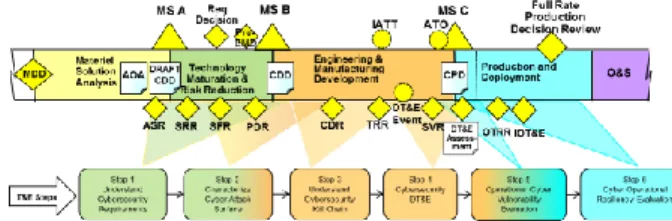
Cybersecurity T&E Process
Step 1
Understand Cybersecurity Requirements
Step 2
Characterize the Cyber Attack Surface
Step 3
Understand the Cybersecurity Kill Chain
Step 4
Cybersecurity DT&E
Beginning at Pre-MS A or Pre-EMD, with update at Milestone C: Understand Cybersecurity requirements and develop an approach for cybersecurity T&E. Requirements may be specified or implied.
Beginning at Pre-EMD: Characterize the attack surface; in the integrated environment, determine possible threat vectors.
Post CDR: Analyze and evaluate potential vulnerabilities to determine measures to improve resilience.
Prior to MS C: Cybersecurity DT&E event in a realistic mission environment, with use of cyber range, CNDSP, representative users and Cybersecurity threat representation.
Realistic developmental Cybersecurity DT&E event
Note: Steps may be iterative to resolve exposed vulnerabilities
In conjunction with MS C, operational test and evaluation event to assess residual vulnerabilities and risk. Director OT&E must approve entry to Step 6, based on resolution of vulnerabilities.
Operational Test Step 5 Operational Cyber Vulnerability Evaluation Step 6 Cyber Operational Resiliency Evaluation
Post-MS C operational test and evaluation event to assess operational capabilities to fight through Cyber Attacks
Realistic Cyber Threat Test
Example Cybersecurity T&E Example Mapped
to the Acquisition Lifecycle
Process fits but is not limited to the DoDI 5000.02 milestones
–
Steps are mapped to both milestones and design review steps
–
Programs have latitude on timing of Step activities
Process shifts “discovery” earlier within the acquisition life cycle
and builds in “fix-it” intervals
The findings in any one step may require revisiting a prior step
Experimental Analyses of Automotive Attack
Surfaces
■
Modern automobiles are
pervasively computerized
Engine, Transmission, Body, Airbag, Antilock Brakes, HVAC, Keyless Entry Control, etc.■
Attack Surface extensive
Telematics: Blue Tooth, Cellular, Wi-Fi, Keyless Entry
Attack Surface is easily exploited–
OBD Diagnostics
–
CD players
–
Bluetooth
Cellular radio/ Wi-Fi–
Allow long distance vehicle
control, location tracking,
in-cabin audio exfiltration
Source: : University of California, San Diego: Stephen Checkoway, Damon McCoy, Brian Kantor, Danny Anderson, Hovav Shacham, and Stefan Savage
University of Washington: Karl Koscher, Alexei Czeskis, Franziska Roesner, and Tadayoshi Kohno
Step 1 - Understand Cybersecurity
Requirements
– Identify cybersecurity requirements for Cybersecurity T&E
- Review all available program resources
- Capabilities Document, Architectures, RFP, System Specification, Program Protection Plan,
- Identify critical operational missions and associated information systems
- Identify critical mission dependencies on hardware/software components that may be susceptible to cybersecurity intrusions
- Identify critical data exchanges and interfaces (include non-programmatic systems if applicable)
- Identify additional implied (derived) and essential requirements
– Identify cyber threat environment to be emulated in test
– Identify MAC/CL or RMF security categorization
– Identify cybersecurity test organization(s), including
- DIACAP/RMF security controls assessor
- Blue Team
- Red Team
– Identify Cybersecurity T&E resources
- Cyber range resources(e.g., National Cyber Range (NCR), DoD IA Range, Joint Information Operations Range (JIOR)) (See Backups for more detail)
- M&S or tools for cybersecurity
– Integrate cybersecurity into T&E events and/or
– Plan for dedicated cybersecurity test events as appropriate and if possible
Plan may need to be revised and updated as understanding of Attack Surfaces and Vulnerabilities is refined
Cyber Security Requirements
Specified requirements
– Requirements clearly identified in program documentatio
– ICDs/CDDs, CONOPs,
– Product Specifications and PPP
– DoD regulations, such a DoDI 8500.02 (DIACAP).
DIACAP IA Controls (IACs) are identified as requirements based on a system’s MAC/CL designation
Implied requirements
– Implied requirements are translated into technical requirements that enable the capabilities defined in CONOPS and other operational documentation
– AKA as Derived Requirements
– Requirements driven by operational capabilities
– Requirements driven by acquisition approach and/or technology choices
Use of COTS/GOTS and free open source software (FOSS).
– Implied tasks include additional tasks the developer must accomplish to operate securely
Includes the Cyber Threat environment
– Objective of Step 2
Characterize the cyber attack surface to identify the additional implied cybersecurity requirements.
Essential requirements
– Essential tasks are those that must be achieved to provide sufficient resilience to support mission accomplishment in the presence of cyber attack
– Objective of Step 3
Analysis of potential kill chain activities to identify essential cybersecurity requirements necessary to improve resilience of the operational system to cyber attack.
Cybersecurity Testing Resources
Penetration
Testing (Red)
• “Graduation exercise”
• Exploit one or more known or suspected weaknesses
• Focus attention on specific problemor attack vector
• Both internal and external threats
• Develop an understanding of the
inherent weaknesses of a technology
• Model actions of a defined
internal or external hostile entity
• Conducted covertly with minimal staff knowledge
• May harm systems and
components and require clean up
Vulnerability
Assessment (Blue)
Comprehensive
Identifies any/all known
vulnerabilitiespresent in systems Reveals systemic weaknesses in
security program
Focuses on adequacy & implementation of technical security controls and attributes Full knowledge and cooperation of
systems administrators
Multiple methods used: hands-on testing, interviewing key personal, or examination of relevant artifacts No harm to systems
Feedback to developers and system administrators for system
remediation and mitigation
• Assesses compliance to IA controls
• Executes the Security Assessment Plan (SAP)
• Linked to the Certification and Accreditation of the system
• Based on Security Technical
Implementation Guides (STIGs) or
similar documentation
• Can be determined by multiple methods: hands-on testing, interviewing key personal, or examination of relevant artifacts
• Includes a review of operational and management security
controls
• Conducted with full knowledge and assistance of systems administrators, owner and developer
• No harm to systems
Security Controls
Assessors (SCAs)
Example Step 1: Understanding Cybersecurity
Requirements/Develop T&E Approach
Urban Assault Vehicle Example Requirements Resources 1. System Threat Assessments
2. Capabilities Documents 3. Information Support Plan 4. Program Protection Plan
5. Mission Assurance Category: III 6. Confidentiality Level: Classified 7. Contract Specs
DODAF Architecture Products Cybersecurity T&E Approach
1. Early T&E involvement 2. Requirements Analysis 3. Design Reviews
4. Contactor SIL Testing
5. Blue Team DT&E Cyber Range 6. Red Team DT&E Event
7. Red Team OT&E in Field
Step 2 - Characterize the Cyber
Attack Surface
Characterize the attack surface to identify additional implied
cybersecurity requirements and possible threat vectors
In the integrated environment, determine possible threat
vectors
- Utilize cybersecurity SMEs to assist in analyzing the attack surface to determine
likely avenues of cyber attack
- Examine PPP, System Design, system architecture products (e.g., SV-1. SV-6
viewpoints) to identify interfacing systems, services, and data exchanges that may expose the system to potential threat exploits
- Examine system CONOPS to understand roles and responsibilities of a system
operators, administrators, and the computer Network Defense Service Provider (CNDSP)
- Identify host environment provisions for system protection, monitoring, access
control, system updates, etc.
- Evaluate early DIACAP/RMF and other security test artifacts
Example Step 2: Characterize the Attack
Surface
Urban Assault Vehicle Attack Surface Vehicle Attack Surface
1. Vehicle to Vehicle Comms 2. Telematics 3. Keyless Entry 4. OBD II 5. Radio 6. Anti Theft T&E Assess
1. Evaluate Contractor/SIL Security Artifacts 2. Baseline Cybersecurity posture
3. Approach to close/mitigate vulnerabilities 4. Likelihood of attack?
5. What happens if/when exploited ? © 2013 The MITRE Corporation. All rights reserved. Public Release Pending
Step 3 – Understand the Cybersecurity
Kill Chain
Analyze and evaluate potential vulnerabilities to determine
measures to improve resilience (cyber range or lab)
-
Develop initial concept for cyber security testing activities at the component and subsystem level• Identify test opportunities to conduct cybersecurity testing in a system of
systems context (such as JITC interoperability testing)
• Identify and integrate DIACAP/RMF security controls assessment activities into
unit testing. Functional testing, etc.
• Evaluate early DIACAP/RMF artifacts
-
Perform a vulnerability assessment using a Blue Team, to determine likely avenues of cyber attack and the most likely threat exploits• Include or emulate the CNDSP
• Enumerate discovered vulnerabilities and supply to contractor for remediation
-
Analyze the kill chain to determine how the system would respond in the contested cyber domainPrototype Cybersecurity Kill Chain Test
Overview
Blue Team/Red Team Portrays APT •Recon •Weaponize •Deliver •Exploit •Control •Execute •Maintain APT Objectives •Exfiltrate data
•Violate data availability •Corrupt data integrity
APT attempts multiple attacks while adjusting for success or failure Defenders attempt to analyze attacks and determine courses of action Defender Objectives
• Protect Against Intrusions
• Detect Intrusions
• React to Intrusions
• Mitigate Intrusions
• Determine Responses
• Restore After intrusion
SUT and CNDSP Portray Test Items
• Detect • Deny • Disrupt • Degrade • Deceive • Destroy • Recover Data Collection •Attacker actions •Defender detections •Defender actions •Mission activity
Source: Institute for Defense Analysis (IDA), February 2013 © 2013 The MITRE Corporation. All rights reserved. Public Release Pending
Example Step 3: Kill Chain Analysis
Vehicle SV-6 Systems Data Exchange Requirements
Urban Assault Vehicle Attack Surface Vehicle Attack Surface
1. Deny Vehicle/Vehicle Comms
2. Intercept Telematics
3. Clone Keyless Entry
4. Corrupt OBD II
5. Monitor Radio
6. Disable Anti Theft
T&E Activities
1. Verify/Exercise Critical Mission Threads 2. Exploit Kill Chain
3. Use Blue Team to Assess Vulnerabilities
Step 4 - Cybersecurity T&E
Evaluate system-of-systems cybersecurity in a mission
context, using realistic threat exploitation techniques
Conduct
Red Team
assessment to identify remaining
vulnerabilities
- Red Team emulates the threat adversary TTPs
- Red Team attempts to exploit the attack surface and execute cyber kill chain
activities
- Include or emulate the CNDSP - Include typical users if available
Identify exploitable threat vectors and vulnerabilities
Analyze results to determine impact to mission
Collaborate with PM and SE
to recommend corrective
actions to improve resilience
- May include non-materiel solutions such as TTP and recommendations to the
CNDSP
“Cyber resiliency” is the ability of a nation, organization, or mission or business process
(and supporting systems) to anticipate, withstand, recover from, and evolve to improve capabilities in the face of, adverse conditions, stresses, or attacks on the supporting cyber resources it needs to function.
Threat-Based Testing
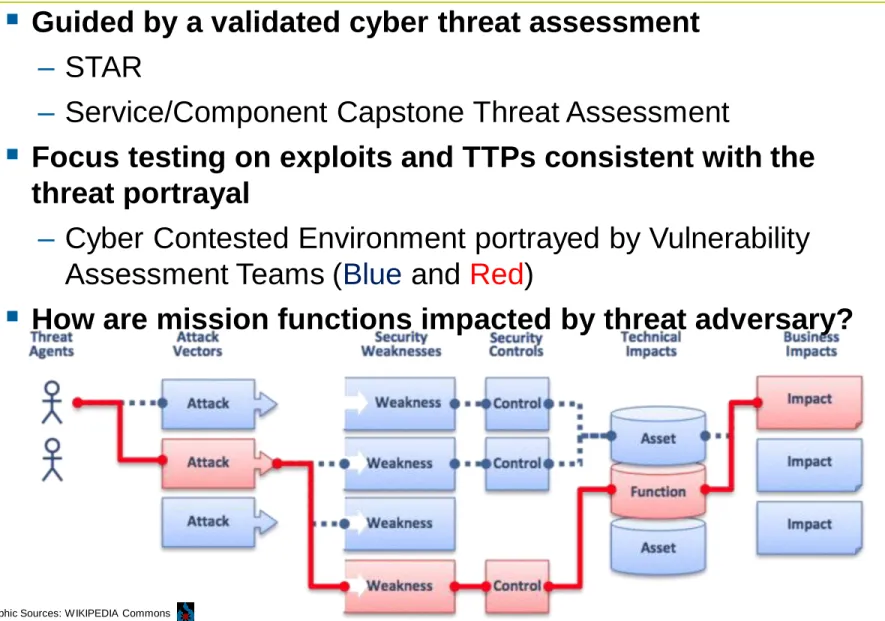
Guided by a validated cyber threat assessment
–
STAR
–
Service/Component Capstone Threat Assessment
Focus testing on exploits and TTPs consistent with the
threat portrayal
–
Cyber Contested Environment portrayed by Vulnerability
Assessment Teams (
Blue
and
Red
)
How are mission functions impacted by threat adversary?
Graphic Sources: W IKIPEDIA Commons
Example Step 4: Full Up DT&E Red Team
Event
Urban Assault Vehicle Autobahn Mission
Exercise Critical Missions
1. Tx/RX Vehicle/Vehicle Comms 2. Cellular Phone Calls
3. Use Keyless Entry
4. Upload/Download OBD II Data 5. Tune Radio
6. Anti Theft
T&E Activities
1. Establish Representative Cyber Environment with Threats and Users
2. Conduct Red Team Assessment
3. Understand Mission Impacts 4. Evaluate Test Data
5. Produce DT&E Assessment
Step 5 – Operational Cyber Vulnerability Evaluation
Step 5 - An operational cyber vulnerability assessment to determine readiness for operational evaluation
– Purpose
OTA or a Blue Team will conduct an overt, cooperative, and comprehensive
vulnerability assessment in an operational environment
Evaluate Configuration management, patch management, network access
controls, and system cybersecurity tools
Leverage production-representative DT&E data to the maximum extent possible
– Provide vulnerability evaluation results and recommendations to materiel developers, as appropriate for remediation
– Vulnerability results should not be provided to Red Teams performing Step 6
– Correcting all vulnerabilities found during this step will be the entrance criteria for Step 6
– (Note) Vulnerabilities identified in Step 5 may require re-testing
– Preparation for IOT&E
– This step may also make use of available developmental test events and data as appropriate.
|28|
Example Step 5: Operational Cyber
Vulnerability Evaluation
Exercise Critical Missions 1. Tx/RX Vehicle/Vehicle Comms 2. Cellular Phone Calls
3. Use Keyless Entry
4. Upload/Download OBD II Data 5. Tune Radio
6. Anti Theft
T&E Activities
1. Establish Representative Cyber Environment with Threats and Users
2. Conduct Blue Team Assessment
3. Evaluate Test Data
4. Determine readiness for OT&E © 2013 The MITRE Corporation. All rights reserved. Public Release Pending
Step 6 - Cyber Operational Resiliency Evaluation
Step 6 - A full-up operational test of the system-of-systems in a representative operational and threat environment
– Purpose
Conduct an independent and comprehensive evaluation of protect, detect, react,
restore capabilities, to include exploitation potential, and mission impact.
Some system information and network information may be provided to the Red
Team to facilitate the cybersecurity evaluation
– Red Team should not have access to the detailed Step 5 vulnerability evaluation
– Discover:
How well do the system’s cybersecurity capabilities protect key/critical information
and data?
Does the system’s ability to detect penetration and penetration attempts support the
rapid identification of hostile cyber activity?
Does the system support rapid reaction and mitigation of penetration/exploitation?
Does the system support reconfiguration and restoration of critical services, data,
and functions?
Systems with High/Medium risk to “CIA” for system information;– COOP and contingency plans must be evaluated © 2013 The MITRE Corporation. All rights reserved. Public Release Pending
Example Step 6: Penetration Testing with
Representative Threat
Urban Assault Vehicle Autobahn Mission
Exercise Critical Missions 1. Tx/RX Vehicle/Vehicle Comms 2. Cellular Phone Calls
3. Use Keyless Entry
4. Upload/Download OBD II Data 5. Tune Radio
6. Anti Theft
T&E Activities
1. Establish Representative Cyber Environment with Threats and Users
2. Conduct Red Team Assessment
3. Understand Mission Impacts 4. Evaluate Test Data
5. Produce OT&E Assessment
Cybersecurity T&E Key Take Aways!
Cybersecurity T&E Process activities begin pre-Milestone A and continue throughout the Acquisition Lifecycle
– Collaborative process helps translate cybersecurity requirements, host environment, threats, etc. into testing activities
Cybersecurity T&E process requires the development and testing of mission-driven cybersecurity requirements
– Requires systems engineering, systems security engineering and T&E expertise.
Test and Evaluation Master Plan (TEMP) must detail
– How testing will provide the information needed to assess cybersecurity and
– Inform Systems engineering, Risk Management and Acquisition Decisions.
Test activities must integrate
– RMF security controls assessments and
– Tests of commonly exploited and emerging vulnerabilities early
Cybersecurity DT&E is expected to identify issues related to resilience of military capabilities before MS C
– Early developmental T&E provides data and feedback to the PM and SE Teams
– Informs requirements, facilitates change to minimize impact on cost, schedule, and performance
Cybersecurity OT&E is expected to ensure that the system under test can
– Withstand realistic threat representative cyber-attacks and
– Return to normal operations in the event of a cyber-attack.
Cybersecurity T&E Process represents a “shift left”
– Because it requires early T&E involvement. © 2013 The MITRE Corporation. All rights reserved. Public Release Pending
Closing
Next time someone says Cyber …..– Stop and ask them what they really mean
Attack Surface in Cyberspace is massive– How big is your attack surface? Is your information protected?
Cyber Threats exploit vulnerabilities– Cyber Kill Chain must be understood and disrupted!
Current US DOD processes are being changed– Systems Engineering, Systems Security Engineering, Developmental and Operational Test Communities are collaborating
Cyber Security must protect Mission Critical Information– Information is the “What” Mission Assurance is the Why!
T&E seeks to ID Attack Surface and Disrupt Kill Chain!– Close High Risk Vulnerabilities Early
US DOD T&E Community: Actively working the problem– Methodology and Policy in work to shift discovery to left
– Cyber T&E Infrastructure and Workforce will enable and execute
Cyber Goths
© 2013 The MITRE Corporation. All rights reserved. Public Release Pending
“ T h e i n t e r n e t i s o n e g i g a n t i c w e l l
-s t o c k e d f r i d g e r e a d y f o r r a i d i n g ; f o r
s o m e s t r a n g e r e a s o n , p e o p l e g o u p
t h e r e a n d j u s t g i v e s t u f f a w a y
. ”
— M e g a ' Z i n e s , M a c w o r l d ( 1 9 9 5 )
Questions, Comments,
Recommendations?
Pete ChristensenT&E Portfolio Manager OSD Portfolio