The XML and Semantic Web Worlds:
Technologies, Interoperability and Integration.
A Survey of the State of the Art
*Nikos Bikakis1 • Chrisa Tsinaraki2 • Nektarios Gioldasis2 • Ioannis Stavrakantonakis2 • Stavros Christodoulakis2
1 National Technical University of Athens, Greece & Institute for the Management of Information Systems, "Athena" Research Center, Greece.
e-mail: [email protected]
2 Lab. of Distributed Multimedia Information Systems & Applications, Technical University of Crete, Greece.
e-mail: {chrisa, nektarios, gstavrak, stavros}@ced.tuc.gr
Abstract
In the context of the emergent Web of Data, a large number of organizations, institutes and companies (e.g., DBpedia,Geonames, PubMed ACM, IEEE, NASA,
BBC) adopt the Linked Data practices and publish their data utilizing Semantic Web (SW) technologies. On the other hand, the dominant standard for information exchange in the Web today is XML. Many international standards (e.g., Dublin Core, MPEG-7, METS, TEI, IEEE LOM) have been expressed in XML Schema resulting to a large number of XML datasets. The SW and XML worlds and their developed infrastructures are based on different data models, semantics and query languages. Thus, it is crucial to provide interoperability and integration mechanisms to bridge the gap between the SW and XML worlds.
In this chapter, we give an overview and a comparison of the technologies and the standards adopted by the XML and SW worlds. In addition, we outline the latest efforts from the W3C groups, including the latest working drafts and recommendations (e.g., OWL 2, SPARQL 1.1, XML Schema 1.1). Moreover, we present a survey of the research approaches which aim to provide interoperability and integration between the XML and SW worlds. Finally, we present the
S
PARQL2
XQueryand XS2OWL Frameworks, which bridge the gap and create an interoperable environment between the two worlds. These Frameworks provide mechanisms for: (a) Query translation (SPARQL to XQuery translation); (b) Mapping specification and generation (Ontology to XML Schema mapping); and (c) Schema transformation (XML Schema to OWL transformation).Keywords: XML vs. RDF, XML Schema vs. RDFS, XML Schema vs. OWL, RDFS vs. OWL, XQuery vs. SPARQL, XPath vs. SPARQL, OWL 2, SPARQL 1.1, XML Schema 1.1.
*
1.
Introduction
In the context of the emerging Web of Data, a large number of organizations, institutes and companies (e.g., DBpedia, Geonames, PubMed, DBLP, ACM, IEEE, IBM, NASA, BBC, NSF, etc.) adopt the Linked Data practices; they use the Semantic Web (SW) technologies, publish their data and offer SPARQL endpoints (i.e., SPARQL-based search services) over it. On the other hand, the dominant standard for information exchange in the Web today is XML. In addition, many international standards (e.g., MPEG-7, MPEG-21, VRA Core, METS, TEI, IEEE LOM,etc.) have been expressed in XML Schema, resulting to a large number of XML datasets.
In the Web of Data, the applications and services have to coexist and interoperate with the existing applications that access legacy systems like, for instance, the very large XML-based audiovisual digital libraries of the digital video broadcasters (e.g., BBC TV-Anytime Service, etc.), the XML-based digital libraries of the cultural heritage institutions, etc.
Since the SW (OWL/RDF/SPARQL) and XML (XML Schema/XML/XQuery) worlds have different data models, different semantics and use different query languages to access them, it is crucial to develop tools and methodologies that will allow bridging the gap between them. In addition, it is unrealistic to expect that all the legacy data (e.g., Relational, XML, etc.) will be converted to SW data. Thus, it is crucial to provide interoperability and integration mechanisms that will allow the SW users to access external heterogeneous data sources from their own working environment. It is also important to offer SPARQL endpoints over legacy data in the Linked Data context.
In this chapter, we deal with the mechanisms that allow the exploitation of the legacy data, in the Web of Data. In particular, in the first part of the chapter (Section 2), we try to present and compare the XML and SW worlds. In particular, we outline and compare the technologies and the standards adopted in the two worlds. In addition, we present the latest efforts from the W3C groups, including the latest working drafts and recommendations (e.g., XML Schema 1.1, OWL 2, SPARQL 1.1, XQuery and XPath Full Text 1.0, XQuery Update Facility 1.0, etc.). In the second part (Sections 3 and 4), we present a survey of the existing approaches that deal with the interoperability and integration issues between the XML and SW worlds.
Finally, in the third part (Sections 5–8), we outline the
S
PARQL2
XQueryandXS2OWL Frameworks that have been developed in order to provide an interoperable environment between the SW and the XML worlds.
2.
XML World vs. Semantic Web World —
A Comparison
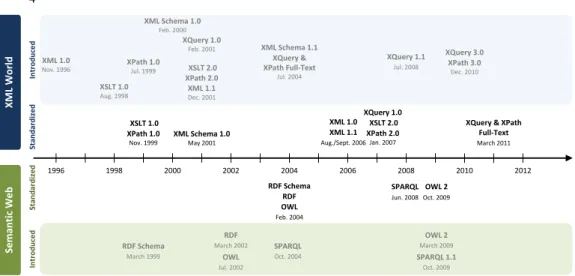
In this section we outline the XML and SW worlds, we present the adopted technologies and we compare their basic characteristics. Throughout this comparison, we distinguish three levels: (a) The data level; (b) The schema level; and (c) The query level. Table 1 provides an overview of the current W3C standards adopted in each level in the XML and SW worlds. In addition Fig. 1 outlines the history of the XML and SW technologies proposed by W3C.Table 1. Overview of the W3C Standards currently adopted in the XML and SW
Worlds
Level XML World Semantic Web
Data XML RDF
Schema XML Schema RDF Schema – OWL
Query XQuery – XPath SPARQL
At the data level, the Extensible Markup Language (XML) [1] is the data representation language in the XML world, while the Resource Description Framework (RDF) [2] is used to represent the SW data.
At the schema level, the XML Schema [3] is used to describe the structure of the XML data. Currently, the XML Schema 1.0 is a W3C recommendation and the XML Schema 1.1 [4][5] is under development and has reached the W3C working draft level of standardization. Regarding the SW, the RDF Schema (RDFS) [6] and the Web Ontology Language (OWL) [7] are exploited to describe the structure and the semantics of the RDF data. Recently, a new version of OWL, OWL 2.0 [8] has become a W3C recommendation.
Finally, at the query level, the XML Path Language (XPath) [9] and the XML Query Language (XQuery) [10] are employed for querying XML data. In the SW world, the SPARQL Protocol and RDF Query Language (SPARQL) [12] is the standard query language for RDF data. Currently, the W3C SPARQL working group [14] is working on the extension of the SPARQL query language in several aspects, resulting in SPARQL 1.1. SPARQL 1.1 includes several components like the SPARQL 1.1 Query, Update, Protocol, Service Description, Property Paths, Entailment Regimes, Uniform HTTP Protocol for Managing RDF Graphs, and Federation Extensions.
In the rest of this section, we outline the models adopted in the XML and SW worlds at the data level (Section 2.1) and we present and compare their schema (Section 2.2) and query (Section 2.3) level languages.
Fig. 1. Timeline of theW3Ctechnologies related to the XML and SW Worlds 1
2.1.
Data Level
In this section we present in brief the models adopted at the data level in the XML and SW worlds. Section 2.1.1 describes the XML model that is adopted in the XML world, while Section 2.1.2 outlines the RDF model that is used in the SW world.
2.1.1. XML
The Extensible Markup Language (XML) [1] is a general-purpose markup language, designed to describe structured documents. XML is based on tags like HTML, however, XML it does not have a fixed set of tags, but allows users to define their own tags. In addition, unlike HTML, the XML tags have no specific semantics. An XML documentconsists of plain text and markup, in the form of tags and may be represented as an ordered labeled tree. An XML document may contain the following types of nodes: document nodes, elements, attributes, text
nodes, comments, processinginstructions, and namespaces.
2.1.2. RDF
The Resource Description Framework (RDF) [2] is a general purpose language for representing information about resources on the Web. To some extent, RDF is a lightweight ontology language. RDF has a very simple and flexible data model, based on the central concept of the RDF statement. RDF statements are triples
1
Available at: http://www.dblab.ntua.gr/~bikakis/XMLSemanticWebW3CTimeline.pdf (also as svg and png). 1998 2000 2002 2004 2006 2008 2010 2012 1996 RDF Schema RDF OWL Feb. 2004 OWL 2 Oct. 2009 SPARQL Jun. 2008 XML 1.0 XML 1.1 Aug./Sept. 2006 XQuery 1.0 XSLT 2.0 XPath 2.0 Jan. 2007 XSLT 1.0 XPath 1.0 Nov. 1999
XQuery & XPath Full-Text March 2011 XML Schema 1.0 May 2001 XML 1.0 Nov. 1996 XSLT 2.0 XPath 2.0 XML 1.1 Dec. 2001 XQuery 3.0 XPath 3.0 Dec. 2010 XPath 1.0 Jul. 1999 XSLT 1.0 Aug. 1998 XQuery 1.0 Feb. 2001 XQuery 1.1 Jul. 2008 XML Schema 1.1 XQuery & XPath Full-Text Jul. 2004 XML Schema 1.0 Feb. 2000 St an d ar d iz e d X M L W o rl d Se m an ti c W e b In tr o d u ce d In tr o d u ce d St an d ar d iz e d RDF Schema March 1999 SPARQL Oct. 2004 RDF March 2002 OWL Jul. 2002 OWL 2 March 2009 SPARQL 1.1 Oct. 2009
(subject, predicate, object) consisting of the resource (the subject) being described, a property (the predicate), and a property value (the object). In particular, the subject can either be an IRI or a Blanknode. Every predicatemust be an IRI and the object can be an IRI, Blanknode or RDF Literal. A collection of RDF statements (or else
RDF triples) can be intuitively understood as a directed labeled graph, where the resources are nodes and the statements are arcs (from the subject node to the object node) connecting the nodes. Finally a set of RDF triples is called RDF
Dataset or RDFGraph.
2.2.
Schema Level
In this section we present the schema languages adopted in the XML and SW worlds. Section 2.2.1 outlines the XML Schema language, used in the XML world. The SW languages are then presented; in particular, RDF Schema is presented in Section 2.2.2 and OWL language is presented in Section 2.2.3. Finally, a comparison between the schema languages adopted by the XML SW worlds is presented in Section 2.2.4.
2.2.1. XML Schema
The XML Schema [3] is a schema definition language that has been developed by
the W3C and has been expressed in XML syntax. XML Schema is intended to describe the structure and constrain the content of documents written in XML by providing rich structuring capabilities. XML Schema can specify the exact element hierarchy and specify various types of constraints placed on the XML data define options (e.g., limits on the number of occurrences of an element, ranges of the values of elements or attributes, etc.).
In particular, an XML document is composed of elements, with the root element delimiting the beginning and the end of the document. Each XML Schema element belongs to an XML Schema type, specified in the type attribute. The elements are distinguished into complex and simpleelements, depending on the kind (simple or complex) of the types they belong to. The XML Schema simple types are usually defined as restrictions of the basic datatypes provided by XML Schema (i.e., xs:string, xs:integer, etc.). Moreover, the XML Schema complextypes represent classes of XML constructs that have common features, represented by their elements and attributes.
Regarding the document structure, XML Schema, support rich structuring capabilities. The XML Schema elements may either have a predefined order as is specified in the XML Schema element sequence or be unordered as is specified in the XML Schema elements choice and all. The XML Schema sequence, choice and
all elements may be nested. The minimum and maximum number of occurrences of the elements, choices and sequences are specified, respectively, in the
minOccurs and maxOccurs attributes (absent minOccurs and/or maxOccurs correspond to values of 1). Reusable complex structures, combining sequence,
element definitions is supported by the substitutionGroupattribute, which states that the current element is a specialization of another element.
The XML Schema attributes describe element features with values of simple type and may form attribute groups comprised of attributes that should be used simultaneously.
Default and fixed values may be specified for both attributes and simple type elements, in the defaultand fixed attributes respectively. Inheritance is supported for both simple and complex types, and the base types are referenced in the base attribute of the type definitions. All the XML Schema constructs may have textual annotations, specified in their annotation element.
The top-level XML Schema constructs (attributes, elements, simple and complex
types, attribute and model groups) have unique names (specified in their name attribute). The nested elements and attributes have unique names in the context of the complex types in which they are defined, while the nested (complex and simple) types are unnamed. All the XML Schema constructs may have unique identifiers (specified in their id attribute). The top-level constructs may be referenced by other constructs using the ref attribute.
XML Schema 1.1. Currently, a new version of XML Schema, XML Schema 1.1 [4][5] is under development and has reached the W3C working draft level of standardization. XML Schema 1.1 is backwards compatible with XML Schema 1.0 and introduces several new features and mechanisms. The most important among them are discussed in the following paragraphs.
The new assert element is used to make assertions about element and attribute values, specify relationships and enforce constraints on elements and/or attributes above and beyond the constraints specified in their declarations.
The alternative element allows an element to have as type a member of a set of types.
The override element replaces, in XML Schema 1.1, the deprecated XML Schema 1.0 redefine element.
The all element has been enhanced in XML Schema 1.1 to allow elements with multiple occurrences. The substitutionGroup element has also been modified in XML Schema 1.1 and allows an element to be substituted by multiple elements. Finally, the any and anyAttribute elements have been enriched with additional attributes that allow to indicate the extension elements or attributes not allowed in an element.
Regarding the datatypes, XML Schema 1.1 introduces several new features: (a) The new error datatype is used to trigger an error; (b) The anyAtomicType is introduced, which represents the union of the value spaces of all the primitive types; (c) The XML Schema 1.1 dateTimeStamp datatype is introduced, which is identical to the dateTime, except from that it requires the time zone to be specified; and (d) The XML Schema 1.1 yearMonthDuration and dayTimeDuration datatypes are introduced, which are constrained versions of the duration datatype, and several others.
Finally, several facets are introduced, like, for instance, the assertion facet, which is used to constrain a simpleType; the explicitTimezone facet which is used with date datatypes to specify whether the time zone is required; and the minScale and maxScale facets which are used with the XML Schema 1.1 precisionDecimal datatype, in order to constrain the size of the exponent.
2.2.2. RDF Schema
The RDF Schema (RDFS) [3] is an extension of RDF designed to describe, using a set of reserved words called the RDFS vocabulary, resources and/or relationships between resources. It provides constructs for the description of types of objects (classes), type hierarchies (subclasses), properties that represent object features (properties) and property hierarchies (subproperty).
In particular, a Class in RDFS corresponds to the generic concept of a type or category, somewhat like the notion of a class in object-oriented languages, and is defined using the construct rdfs:Class. The resources that belong to a class are called its instances. An instance of a class is a resource having an rdf:type property whose value is the specific class. Moreover, a resource may be an instance of more than one classes. Classes can be organized in a hierarchical fashion using the construct rdfs:subClassOf. A property in RDFS is used to characterize a class or a set of classes and is defined using the construct rdf:Property. The rdfs:domain construct is used to indicate that a particular property applies to a designated class, and the rdfs:range construct is used to indicate the values of a particular property. In a similar way with the class hierarchies, RDFS provides the rdfs:subPropertyOf construct for the definition of property hierarchies.
2.2.3. OWL
The Web Ontology Language (OWL) [7][8] is the standard language for defining and instantiating Web ontologies. OWL and RDFS have several similarities. OWL is defined as a vocabulary like RDF, however OWL has richer semantics.
An OWL Class is defined using the construct owl:Class and represents a set of individuals with common properties. All the OWL classes are considered to be subclasses of the class owl:Thing and superclasses of the class owl:Nothing. Moreover, OWL provides additional constructors for class definition, including the basic set operations, union, intersection and complement that are implemented, respectively, by the constructs owl:unionOf, owl:intersectionOf, and owl:complementOf and several other constructors like, for example, owl:oneOf, owl:equivalentClass, etc. Regarding the individuals, OWL allows to specify two individuals to be identical or different through the owl:sameAs and owl:differentFrom constructs. Unlike RDF Schema, OWL distinguishes a property whose range is a datatype value from a property whose range is a set of resources. Thus, the OWL Datatypeproperties are relations between class individuals and XML schema datatypes and are defined using the construct owl:DatatypeProperty; The OWL Object properties are relations between class individuals and are defined using the owl:ObjectProperty construct.
Finally, two properties may be stated to be equivalent, using the construct
owl:equivalentProperty.
OWL 2. The OWL 2 Web Ontology Language (OWL 2) [8] is a W3C recommendationsince the October of 2009. OWL 2 has a very similar overall structure with OWL 1 and is backwards compatible with it, while it introduces a plethora of new features.
Some of these new features are commonly referred as syntactic sugar, since these features do not change the expressiveness or the semantics of OWL 1; they have been introduced in order to make some common statements easier to be constructed like, for instance, the owl:AllDisjointClasses and owl:disjointUnionOf that are used to specify the disjoint classes more easily than using the owl:disjointWith
and owl:unionOf OWL 1 statements.
In addition, a large number of the new OWL 2 features enhance the language
expressiveness by adding restrictions and new characteristics over the OWL
properties. Among them there are the qualified property cardinality restrictions
that are specified using the new constructs owl:minQualifiedCardinality,
owl:maxQualifiedCardinality and owl:qualifiedCardinality. Moreover, reflexive,
irreflexive, and asymmetric properties are supported using, respectively, the
owl:ReflexiveProperty, owl:IrreflexiveProperty and owl:AsymmetricProperty constructs. In
addition, a set of classes can be specified to be mutually disjoint using the
owl:propertyDisjointWith and owl:AllDisjointProperties constructs. Furthermore, the new
property owl:hasSelf has been introduced to allow relating a class to itself. OWL 2 also allows stating that an individual should not hold certain values for certain
properties using the new owl:NegativeObjectPropertyAssertion and
owl:NegativeDataPropertyAssertion statements. Finally, a very useful, new feature
allows a property to be defined in terms of a chain of object properties, using the construct owl:propertyChainAxiom.
The newly introduced owl:hasKey construct can be used to define that the instances of a class is identified by a set of datatype or object properties, thus providing an identity constraint mechanism.
OWL 1 is highly dependent on XML Schema regarding both the built-in and the user-defined datatypes. Using OWL 2, the users can integrate in their ontologies the datatype definitions, using the XML Schema datatypes and
constraints. Moreover, OWL 2 has introduced two new built-in types: owl:real and
owl:rational. Finally, OWL 2 allows new datatypes to be defined as the complement
of existing datatypes, using the owl:datatypeComplementOf statement.
OWL 2 provides top and bottom object and datatype properties analogous to
the owl:Thing and owl:Nothing classes for representing the universal and the empty
class. In particular, OWL 2 provides the owl:topObjectProperty and
owl:bottomObjectProperty properties, corresponding to the universal and the empty
object property respectively, as well as the owl:topDataProperty and
owl:bottomDataProperty properties, corresponding to the universal and the empty
2.2.4. Schema Level Comparison
In this section we provide a brief comparison between the schema definition languages adopted by the XML the SW worlds. Our comparison is based on a set of generic characteristics over the schema languages presented in the previous sections.
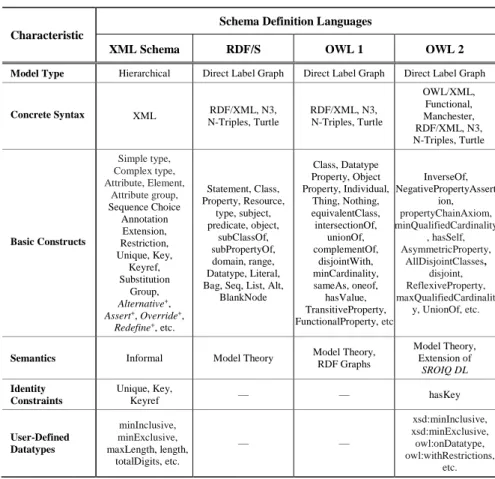
Table 2 presents an overview of this comparison. For each language we present: (a) Its ModelType; (b) Its ConcreteSyntax, that is, how language elements are represented; (c) The BasicConstructs of its model; (d) The language Semantics; (e) The Identity Constraint mechanism supported by the schema definition languages; and (f) An overview of the User-DefinedDatatypes mechanism (if such a mechanism is supported).
Table 2. Comparison of the Schema Definition Languages in terms of a set of generic Characteristics
Characteristic
Schema Definition Languages
XML Schema RDF/S OWL 1 OWL 2
Model Type Hierarchical Direct Label Graph Direct Label Graph Direct Label Graph
Concrete Syntax XML RDF/XML, N3, N-Triples, Turtle RDF/XML, N3, N-Triples, Turtle OWL/XML, Functional, Manchester, RDF/XML, N3, N-Triples, Turtle Basic Constructs Simple type, Complex type, Attribute, Element, Attribute group, Sequence Choice Annotation Extension, Restriction, Unique, Key, Keyref, Substitution Group, Alternative+, Assert+, Override+, Redefine+, etc. Statement, Class, Property, Resource, type, subject, predicate, object, subClassOf, subPropertyOf, domain, range, Datatype, Literal, Bag, Seq, List, Alt,
BlankNode Class, Datatype Property, Object Property, Individual, Thing, Nothing, equivalentClass, intersectionOf, unionOf, complementOf, disjointWith, minCardinality, sameAs, oneof, hasValue, TransitiveProperty, FunctionalProperty, etc. InverseOf, NegativePropertyAssert ion, propertyChainAxiom, minQualifiedCardinality , hasSelf, AsymmetricProperty, AllDisjointClasses, disjoint, ReflexiveProperty, maxQualifiedCardinalit y, UnionOf, etc.
Semantics Informal Model Theory Model Theory,
RDF Graphs Model Theory, Extension of SROIQDL Identity Constraints Unique, Key, Keyref — — hasKey User-Defined Datatypes minInclusive, minExclusive, maxLength, length, totalDigits, etc. — — xsd:minInclusive, xsd:minExclusive, owl:onDatatype, owl:withRestrictions, etc. Note. The+indicates XML Schema 1.1 constructs.
It can be observed from Table 2 that the XML Schema provides a flexible mechanism to support identity constraints as well as rich capabilities for defining user datatypes. In contrast, none of the RDF Schema and OWL 1 languages supports identity constraints or user-defined datatypes. These limitations have
been overcome by OWL 2, which introduces an identity constraint mechanism using the hasKey construct and supports user defined datatypes.
2.3.
Query Level
In this section we present the query languages used in the XML and SW worlds. Section 2.3.1 outlines the XPath, XQuery 1.0 and XQuery 1.1 languages, used in the XML world. The SPARQL query language that is adopted in the SW world is presented in Section 2.3.2. Finally, a comparison between the query languages adopted by the XML and SW worlds is presented in Section 2.3.2.
2.3.1. XPath and XQuery
Path expressions play a significant role in XML query evaluation, since the path expressions are used to traverse the tree representations of the XML documents and select a node or a set of nodes. The XML Path Language (XPath) [9] is a W3C recommendation that specifies a path language capable of describing path expressions on the tree data model of XML. The XPath language is essentially a subset of the XQuery language, which is the W3C standard for querying XML data; thus, in the rest of this chapter we will only refer to XQuery language.
The XML Query Language (XQuery) [10] is based on a tree-structured model of the XML document content. XQuery exploits XPath expressions to address specific parts of the XML documents. The basic structure of the most XQuery queries is the FLWOR expression. FLWOR stands for the For, Let,Where, OrderBy and Return XQuery clauses. FLWORs, unlike path expressions, allow the users to manipulate, transform, and sort the query results.
The For and Let clauses generate a list of tuples preserving document order, with each tuple consisting of one or more bound variables. In particular, the For clause sets up an iteration over the tuples in the tuple list. The Let clause is used to set the value of a variable. However, unlike the For clause, it does not set up an iteration. The optional Where clause serves as a filter for the tuples generated by the For and Let clauses. The optional OrderBy clause is used to order the results; if no Orderby clause exists, the order of the tuple list is determined by the For and Let clauses and by the document order. Finally, every XQuery expression has a Return clause that always comes last. The Return clause specifies the XML nodes that are included in the results and probably how they are formatted. In addition, XQuery supports conditional expressions based on the keywords if-elseif-else.
A key feature of XQuery is the large number of built-in functions and operators provided (over 100) [11], covering a broad range of functionality That includes functions for manipulating strings, dates, combine sequences of elements, etc. Moreover, XQuery supports user-defined functions, defined either in the query itself, or in an external library. Both built-in and user-defined functions can be called from almost any place in a query.
2.3.2. SPARQL
The SPARQL Protocol and RDF Query Language (SPARQL) [15] is a W3C recommendation and it is today the standard query language for RDF data. The evaluation of SPARQL queries is based on graph pattern matching. A Graph Pattern (GP) is defined recursively and contains Triple patterns and SPARQL operators. The operators of the SPARQL algebra which can be applied on graph patterns are: AND (i.e., conjunction), UNION (i.e., disjunction), OPTIONAL (i.e., optional patterns, like left outer join) and FILTER (i.e., restriction). The Triple patterns are just like RDF triples except that each of the subject, predicate and object parts may be a variable. A sequence of conjunctive triple patterns is called Basic Graph Pattern (BGP). The SPARQL Where clause consists of a Graph Pattern (GP).
SPARQL allows four query forms: Select, Ask, Construct and Describe. The
Select query form returns a solution sequence, i.e., a sequence of variables and their bindings. The Ask query form returns a Boolean value (yes or no), indicating whether a query pattern matches or not. The Construct query form returns an RDF graph structured according to the graph template of the query. Finally, the
Describe query form returns an RDF graph which provides a “description” of the matching resources. Thus, based on the query forms, the SPARQL query results may be RDF Graphs, SPARQL solution sequences and Boolean values.
SPARQL provides various solution sequence modifiers that can be applied on the initial solution sequence in order to create another, user desired, sequence. The supported SPARQL solutions sequence modifiers are: Distinct, Reduced, Limit,
Offset and OrderBy. While the Distinct modifier ensures that duplicate solutions are eliminated from the solution set, the Reduced modifier simply allows them to be reduced. The Limit modifier puts an upper bound on the number of solutions returned. Moreover, the Offset modifier returns the solutions starting after the specified number of solutions. Finally, the OrderBy modifier, establishes the order of a solution sequence.
SPARQL 1.1. The SPARQL 1.1 is the result of the W3C SPARQL working group [14] on the extension of the SPARQL query language in several aspects. SPARQL 1.1 includes the components SPARQL 1.1 Query, Update, Protocol, Service Description, Property Paths, Entailment Regimes, Uniform HTTP Protocol for Managing RDF Graphs, and Federation Extensions.
The SPARQL 1.1 tries to eliminate the main limitations of the current SPARQL version like aggregate functions, nested queries, update operations, paths, and several other issues.
The aggregate functions that are supported from almost all the query languages will also be included in the SPARQL 1.1 Query [16]. In particular, SPARQL 1.1 will support the following aggregate functions: COUNT, SUM, MIN/MAX, AVG,
GROUP_CONCAT, andSAMPLE.
In addition, nested queries, which are very important in cases where the result from one query is used as an input to another query, will be supported by
SPARQL 1.1. Moreover, in order to implement negation, SPARQL 1.1 has
adopted the new operators NOT EXISTS and MINUS.
In the current SPARQL version, a SELECT query may project only variables.
SPARQL 1.1 allows the SELECT queries to project any SPARQL expression:
Using the keyword AS in the SELECT clause, the result of a SPARQL expression is
bound to the new variable specified by AS and this new variable is going to be projected.
In several cases, in order to find a node, it is necessary to express queries that
use fixed-length paths to traverse the RDF graph. The SPARQL 1.1 Property
Paths [18] extends the current basic graph patterns in order to support the expression of path patterns.
SPARQL 1.0 can be used only as a retrieval query language, since it does not
support data management operators. The SPARQL Update 1.1 [17] includes
several features for graph management. The INSERT and INSERTDATA operations
are exploited to insert new triples in RDF graphs. In addition, the DELETE and
DELETEDATA operations are used to delete triples from an RDF graph. The LOAD
and CLEAR operations perform a group of update operations as a single action. In
particular, the LOAD operation copies all the triples of a graph into the target graph, while the CLEAR operation deletes all the statements from the specified graph. Finally, in order to create a new RDF graph in an RDF graphs repository or to delete an RDF graph from an RDF graphs repository the CREATE and DROP operations are introduced.
2.3.3. Query Level Comparison
In this section we present a comparison between the query languages adopted in the XML and SW worlds. Our comparison has been based on a set of generic characteristics (Table 3) and on a set of language features (Table 4).
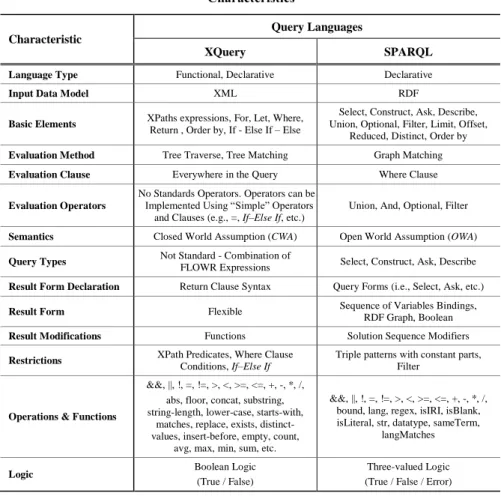
In Table 3 we give an overview of our comparison over a set of generic characteristics. For each query language, we present: (a) Its LanguageType; (b) Its
InputDataModel, that is, the data format accessed by the language; (c) The Basic
Elements of the language; (d) The method exploited by the query language to evaluate the queries (Evaluation Method); (e) The Evaluation Clause, that is, the clauses of the query language that are used to describe the evaluation settings; (f) The algebra operators defined at each language (Evaluation Operators); The language Semantics; (g) The QueryTypes supported by the language; (h) The Result
FormDeclaration, that is, how and where the user can specify the form of the results inside a query; (i) The available result forms for each language (ResultsForm); (k) The Results Modification, that is, how the return results can be modified; (l) The mechanisms provided for defining evaluation Restrictions; (m) The built-in
Operations&Functions provided by each query language; and (n) The Logic adopted by the language operations and functions.
It can be observed from Table 3 that a large number of differences can be identified. These differences are mainly due to: (a) The different data models types (i.e., tree – graph); (b) The functional style of the XQuery language; (c) The different assumptions made (i.e., the Closed World Assumption in the XML world
vs. the Open World Assumption in the SW world); (d) The logic adopted (XQuery adopts Boolean logic while SPARQL adopts three-valued logic), and several others.
Table 3. Comparison of the Query Languages in terms of a set of generic Characteristics
Characteristic
Query Languages
XQuery SPARQL
Language Type Functional, Declarative Declarative
Input Data Model XML RDF
Basic Elements XPaths expressions, For, Let, Where, Return , Order by, If - Else If – Else
Select, Construct, Ask, Describe, Union, Optional, Filter, Limit, Offset,
Reduced, Distinct, Order by
Evaluation Method Tree Traverse, Tree Matching Graph Matching
Evaluation Clause Everywhere in the Query Where Clause
Evaluation Operators
No Standards Operators. Operators can be Implemented Using “Simple” Operators and Clauses (e.g., =, If–Else If, etc.)
Union, And, Optional, Filter
Semantics Closed World Assumption (CWA) Open World Assumption (OWA)
Query Types Not Standard - Combination of
FLOWR Expressions Select, Construct, Ask, Describe
Result Form Declaration Return Clause Syntax Query Forms (i.e., Select, Ask, etc.)
Result Form Flexible Sequence of Variables Bindings,
RDF Graph, Boolean
Result Modifications Functions Solution Sequence Modifiers
Restrictions XPath Predicates, Where Clause Conditions, If–Else If
Triple patterns with constant parts, Filter
Operations & Functions
&&, ||, !, =, !=, >, <, >=, <=, +, -, *, /, abs, floor, concat, substring, string-length, lower-case, starts-with,
matches, replace, exists, distinct-values, insert-before, empty, count,
avg, max, min, sum, etc.
&&, ||, !, =, !=, >, <, >=, <=, +, -, *, /, bound, lang, regex, isIRI, isBlank, isLiteral, str, datatype, sameTerm,
langMatches
Logic Boolean Logic
(True / False)
Three-valued Logic (True / False / Error)
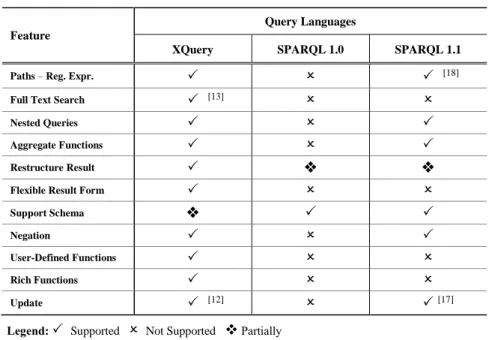
Table 4 presents a comparison between the XQuery, the SPARQL 1.0 and the SPARQL 1.1 query languages over several features. For each feature we indicate if the languages fully support it (), partially support it () or do not support it (). Table 4 is based on the W3C specifications and working drafts and does not consider possible languages extension proposed from other parties.
It can be observed fromTable 4 that the XQuery language supports almost all the features, except from the SupportSchema feature, which is partially supported by the XQuery language. Since the XQuery language can partially exploit schema information, it supports only path expressions, while can not support type-based queries. Note that the Full Text Search and Update features have been recently introduced as W3C recommendations (see [13] and [12] respectively).
We can observe from Table 4, the SPARQL 1.1 (which is currently a W3C working draft) covers almost all the features which are not supported by the
current SPARQL version (SPARQL 1.0). However, the FullTextSearch feature is not supported by SPARQL 1.1; several SPARQL implementations (e.g., Jena, Sesame, etc.), though, support full text search. In addition, neither the User-Defined
Functions nor the RichFunctions features are supported by the SPARQL 1.1 which particularly supports about 20 build-in functions. Finally, the SPARQL 1.1 does not support the Flexible Result Form and partially supports the Restructure Result features; SPARQL can restructure the results of CONSTRUCT queries, however these results can be only RDF graphs.
Table 4. Comparison of the XQuery and SPARQL Query Languages
Feature
Query Languages
XQuery SPARQL 1.0 SPARQL 1.1
Paths – Reg. Expr. [18]
Full Text Search [13]
Nested Queries
Aggregate Functions
Restructure Result
Flexible Result Form
Support Schema
Negation
User-Defined Functions
Rich Functions
Update [12] [17]
Legend: Supported NotSupported Partially
3.
Motivating Example — Use Cases
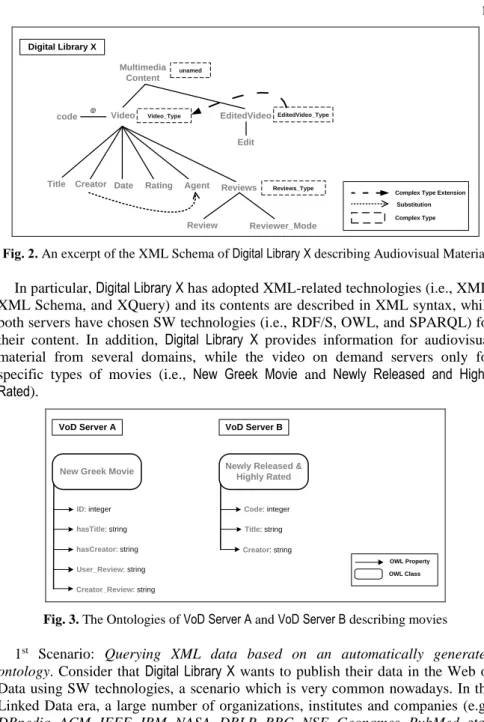
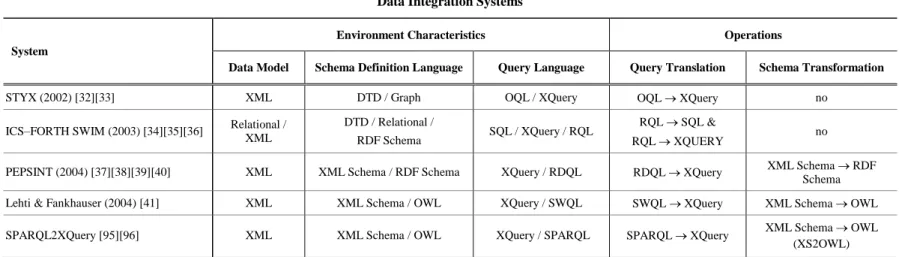
In this section, we outline two “real-word” scenarios in order to illustrate the need for bridging the XML and the SW world. In our examples, three hypothetically autonomous partners are involved: DigitalLibraryX(Fig. 2) which is an audiovisual digital library that belongs to an institution or an organization, as well as two video on demand servers (Fig. 3), VoDServer A and VoD Server B. Each partner provides different content and has adopted different technologies to represent and manage their data.
Multimedia Content Video unamed Video_Type Rating Date Creator code
Title Reviews Reviews_Type
Review Reviewer_Mode
Complex Type Substitution
@
Agent
Complex Type Extension
Digital Library X
EditedVideo EditedVideo_Type
Edit
Fig. 2. An excerpt of the XML Schema of DigitalLibraryX describing Audiovisual Material
In particular, DigitalLibraryX has adopted XML-related technologies (i.e., XML, XML Schema, and XQuery) and its contents are described in XML syntax,while both servers have chosen SW technologies (i.e., RDF/S, OWL, and SPARQL) for their content. In addition, Digital Library X provides information for audiovisual material from several domains, while the video on demand servers only for specific types of movies (i.e., New Greek Movie and Newly Released and Highly
Rated).
OWL Class OWL Property
VoD Server A
User_Review: string
New Greek Movie
hasCreator: string hasTitle: string ID: integer
Creator_Review: string
Newly Released & Highly Rated
Creator: string Title: string
VoD Server B
Code: integer
Fig. 3. The Ontologies of VoDServerA and VoDServerB describingmovies
1st Scenario: Querying XML data based on an automatically generated ontology.Consider that DigitalLibraryX wants to publish their data in the Web of Data using SW technologies, a scenario which is very common nowadays. In the Linked Data era, a large number of organizations, institutes and companies (e.g., DBpedia, ACM, IEEE, IBM, NASA, DBLP, BBC, NSF, Geonames, PubMed, etc.) publish their data utilizing SW standards and technologies. In particular, they offer SPARQL endpoints (i.e., SPARQL-based search services)over their data. In this case, a schema transformation and a query translation mechanism are required. Using the schema transformation mechanism, the XML Schema of DigitalLibraryX will be transformed to an ontology. Then, the query translation mechanism will be used to translate the SPARQL queries posed over the generated ontology to XQuery queries over the XML data.
As a special case of this scenario, consider the case, in which DigitalLibraryX wants to publish their data in the Web of Data, however, unlike the 1st scenario,
DigitalLibraryX wants to use existing, well accepted vocabularies (e.g., Friend of a Friend (FOAF)2, Dublin Core (DC)3, etc.).
2nd Scenario:Querying XML data based on existing ontologies. Consider Web of Data users and/or applications, who express their queries or have implemented their APIs over the ontologies of VoD Server A and/or VoD Server B using the SPARQL query language. These users and applications should be able to have access to Digital Library X, without being required to adjust their working environment (e.g., query language, schema, API, etc.).
In these cases, a mapping model and a query translation mechanism are required. In such a case, an expert specifies the mappings between the ontologies of VoDServerA and VoDServerB and the XML Schema of DigitalLibraryX. These mappings are, then, exploited by the query translation mechanism in order to translate the SPARQL queries posed over the ontology of VoDServer A and VoD
ServerB to XQuery queries to be evaluated over the XML data of DigitalLibraryX. To sum up, in the Linked Data era, publishing legacy data and offering SPARQL endpoints has become a major research challenge. Although, several systems (e.g., D2R Server [80], OpenLink Virtuoso [82], TopBraid Composer4, etc.) offer SPARQL endpoints5 over relational data, to best of our knowledge there is no system supporting XML data (except from the
S
PARQL2
XQueryFramework presented here).4.
Bridging the Semantic Web and XML worlds —
A Survey
In order to overcome the heterogeneity among the information systems, a large number of data integration [23] and data exchange systems [24] have been proposed in the literature. The data integration systems provide mechanisms for querying heterogeneous sources in a uniform way based on a global schema. The data exchange systems (also known as data transformation/translation systems) restructure the data from the sources according to a global schema. In recent research works, semantics are exploited to bridge the heterogeneity gap among the information systems and provide semantic integration and interoperability [59][60].
In the context of XML, the first research efforts have attempted to provide interoperability and integration between the relational and XML worlds (e.g., [61][62][63][64][65][66][67]). In addition, several approaches focus on data integration and exchange over heterogeneous XML sources (e.g., [68][69][70][71] [72][73][74][75][76]).
2http://www.foaf-project.org/
3http://dublincore.org/schemas/rdfs/
4 http://www.topquadrant.com/products/TB_Composer.html
Regarding the XML and SW worlds, numerous approaches for transforming XML Schema to ontologies and/or XML data to RDF and vice versa have been proposed in the literature. Moreover, some other recent approaches combine SW and XML technologies in order to transform XML data to RDF and vice versa.
In the rest of this section we present the existing approaches that deal with the interoperability and integration issues between the XML and SW worlds (Section 4.1). The recent approaches are described and compared in Section 4.2. Finally, a discussion about the drawbacks and the limitations of the current approaches is presented in Section 4.3.
4.1.
Existing Approaches
—
An Overview
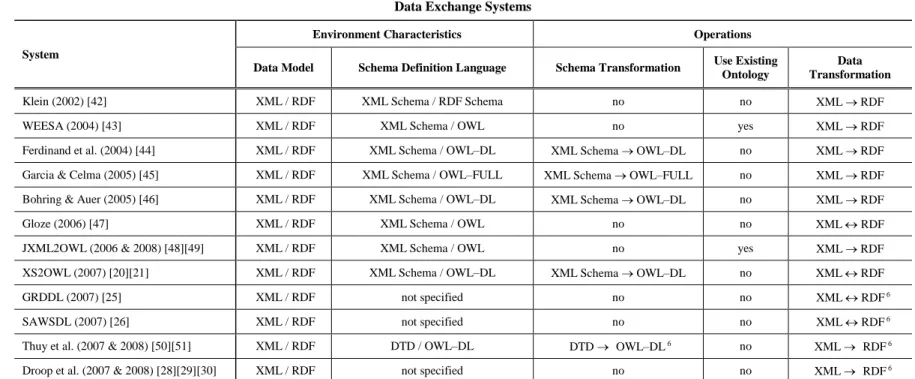
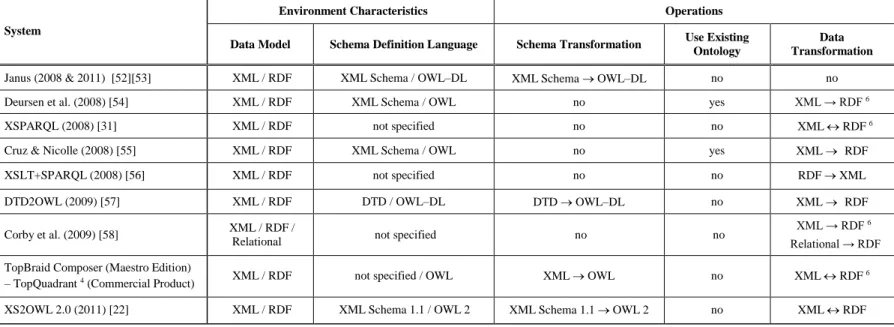
In this section, we present the literature related to interoperability and integration issues between the SW and XML worlds. Table 5 and present the proposed systems in terms of the environment characteristics and the supported operations. These systems have been distinguished into data integration systems (Table 5) and data exchange systems (Table 6) and are presented in a chronological order.
Table 5 provides an overview of the data integration systems in terms of the
EnvironmentCharacteristics and the supported Operations. In particular, the system described in each row is specified in the first column (System), the environment characteristics are shown in columns 2–4 and the supported operations are shown in columns 5–6. The environment characteristics include the Data Models of the underlying data sources (2nd column), the involved SchemaDefinitionLanguages (3rd column) and the supported Query Languages (4th column). The operations include the Query Translation operation (5th column) and the Schema Transformation operation (6th column). If a schema transformation operation is supported the value is the operation description; if the method does not support schema transformation, the value is "no".
Table 6 provides an overview of the data exchange systems and is structured in a similar way with Table 5. The system described in each row is specified in the first column (System), the Environment Characteristics are shown in columns 2–3 and the supported Operations used are shown in columns 4–5. The environment characteristics include the DataModels of the underlying data sources (2nd column) and the involved SchemaDefinitionLanguages (3rd column). The operations include the SchemaTransformation operation (4th column), the indication for the Useof an
ExistingOntology (4th column) and the DataTransformation mechanism (5th column). If a schema transformation operation is supported, the value of the third column is the operation description; if the method does not support schema transformation, the value is "no". If the value of the fourth column is "yes", the method supports mappings between XML Schemas and existing ontologies and, as a consequence the XML data are transformed according to the mapped ontologies. Finally, if a data transformation mechanism is provided, the fifth column has its description as value and the value "no" if the system does not provide a data transformation mechanism.
It can be observed from Table 5 that the data integrationsystems are older, thus they do not support the currently standard technologies (i.e., XML Schema, OWL, RDF, SPARQL, etc.). Notice also, that, although the data exchange systems shown in Table 6 are more recent, they do not support an integration scenario neither they provide query translation mechanism. Instead, they focus on data and schema transformation, exploring how the RDF data can be transformed in XML syntax and/or how the XML Schemas can be expressed as ontologies and vice versa. In the next section, we describe the latest efforts; most of them focus on combining the XML and the SW technologies in order to transform the underlying data.
Table 5.Overview of the Data Integration Systems in the SW and XML Worlds
Data Integration Systems
System
Environment Characteristics Operations
Data Model Schema Definition Language Query Language Query Translation Schema Transformation
STYX (2002) [32][33] XML DTD / Graph OQL / XQuery OQL XQuery no
ICS–FORTH SWIM (2003) [34][35][36] Relational / XML
DTD / Relational /
RDF Schema SQL / XQuery / RQL
RQL SQL &
RQL XQUERY no
PEPSINT (2004) [37][38][39][40] XML XML Schema / RDF Schema XQuery / RDQL RDQL XQuery XML Schema RDF Schema Lehti & Fankhauser (2004) [41] XML XML Schema / OWL XQuery / SWQL SWQL XQuery XML Schema OWL SPARQL2XQuery [95][96] XML XML Schema / OWL XQuery / SPARQL SPARQL XQuery XML Schema OWL
Table 6.Overview of the Data Exchange Systems in the SW and XML Worlds
Data Exchange Systems
System
Environment Characteristics Operations Data Model Schema Definition Language Schema Transformation Use Existing
Ontology
Data Transformation
Klein (2002) [42] XML / RDF XML Schema / RDF Schema no no XML RDF
WEESA (2004) [43] XML / RDF XML Schema / OWL no yes XML RDF
Ferdinand et al. (2004) [44] XML / RDF XML Schema / OWL–DL XML Schema OWL–DL no XML RDF Garcia & Celma (2005) [45] XML / RDF XML Schema / OWL–FULL XML Schema OWL–FULL no XML RDF Bohring & Auer (2005) [46] XML / RDF XML Schema / OWL–DL XML Schema OWL–DL no XML RDF
Gloze (2006) [47] XML / RDF XML Schema / OWL no no XML RDF
JXML2OWL (2006 & 2008) [48][49] XML / RDF XML Schema / OWL no yes XML RDF
XS2OWL (2007) [20][21] XML / RDF XML Schema / OWL–DL XML Schema OWL–DL no XML RDF
GRDDL (2007) [25] XML / RDF not specified no no XML RDF 6
SAWSDL (2007) [26] XML / RDF not specified no no XML RDF 6
Thuy et al. (2007 & 2008) [50][51] XML / RDF DTD / OWL–DL DTD OWL–DL 6 no XML RDF 6
Droop et al. (2007 & 2008) [28][29][30] XML / RDF not specified no no XML RDF 6
Table 6. (cont'd)Overview of the Data Exchange Systems in the SW and XML Worlds
Data Exchange Systems
System
Environment Characteristics Operations
Data Model Schema Definition Language Schema Transformation Use Existing Ontology Transformation Data Janus (2008 & 2011) [52][53] XML / RDF XML Schema / OWL–DL XML Schema OWL–DL no no
Deursen et al. (2008) [54] XML / RDF XML Schema / OWL no yes XML → RDF 6
XSPARQL (2008) [31] XML / RDF not specified no no XML RDF 6
Cruz & Nicolle (2008) [55] XML / RDF XML Schema / OWL no yes XML RDF
XSLT+SPARQL (2008) [56] XML / RDF not specified no no RDF XML
DTD2OWL (2009) [57] XML / RDF DTD / OWL–DL DTD OWL–DL no XML RDF
Corby et al. (2009) [58] XML / RDF /
Relational not specified no no
XML → RDF 6
Relational → RDF TopBraid Composer (Maestro Edition)
– TopQuadrant 4 (Commercial Product) XML / RDF not specified / OWL XML OWL no XML RDF 6
4.2.
Recent Approaches
In this section, we present the latest approaches related to the support of interoperability and integration between the XML and SW worlds. The former approaches utilize the current W3C standards technologies (e.g., XML Schema, RDFS, OWL, XQuery, SPARQL, etc.). With the DTD2OWL [57] system be an exception, since it is focus on transforming DTD schemas (instead of XML Schemas) to OWL ontologies. The most of the latest efforts focus on combining the XML and the SW technologies in order to provide an interoperable environment. In particular, they merge SPARQL, XQuery, XPath and XSLT features to transform XML data to RDF and vice versa.
The Semantic Annotations for WSDL (SAWSDL) W3C Working Group [25] uses XSLT to convert XML data into RDF and a combination of SPARQL and XSLT for the inverse transformation. Additionally, the Gleaning Resource Descriptions from Dialects of Languages (GRDDL) W3C Working Group [26] uses XSLT to extract RDF data from XML.
XSPARQL [31] combines SPARQL and XQuery in order to achieve the transformation from XML to RDF and back. In the XML to RDF scenario, XSPARQL uses a combination of XQuery expressions and SPARQL Construct queries. The XQuery expressions are used to access XML data and the SPARQL
Construct queries are used to convert the accessed XML data into RDF. In the RDF to XML scenario, XSPARQL uses a combination of SPARQL and XQuery clauses: The SPARQL clauses are used to access RDF data, and the XQuery clauses are used to format the results in XML syntax.
In XSLT+SPARQL [56] the XSLT language is extended in order to embed SPARQL SELECT and ASK queries. The SPARQL queries are evaluated over RDF data and the results are transformed to XML using XSLT expressions.
In other approaches, SPARQL queries are embedded into XQuery and XSLT queries [27]. In [28][29][30], XPath expressions are embedded in SPARQL queries. The former approaches try to process XML and RDF data in parallel and benefit from the combination of the SPARQL, XQuery, XPath and XSLT language characteristics. Also, a method that transforms XML data to RDF and translates XPath queries into SPARQL has been proposed in [28][29][30].
4.3.
Drawbacks & Limitations
—
A Discussion
In this section we present a discussion over the existing approaches related to the support of interoperability and integration between the XML and SW worlds and highlight their main drawbacks and limitations.
As already mentioned, the existing data integration systems (Table 5) are quite old and do not support the current standard technologies (e.g., XML Schema, OWL, RDF, SPARQL, etc.). On the other hand, the data exchange systems(Table
6) are more recent. However, they neither support integration scenarios nor they provide query translation mechanisms. Instead, they focus on data transformation. Finally, none of the existing systems can offer SPARQL endpoints (i.e., SPARQL-based search services) over XML data (except from the
S
PARQL2
XQueryFramework presented later in this chapter).The main drawback of the latest approaches ([25][26][27][28][29][30][31][56]) is that there is no way to express XML retrieval queries using the SPARQL query language.
In particular, the users of these systems are forced to: (a) be familiar with both the XML and SW models and languages; (b) be aware of both ontologies and XML Schemas in order to express their queries; and (c) be aware of the syntax and the semantics of each of the above approaches in order to express their queries. In addition, each of these approaches has adopted its own syntax and semantics by modifying and/or the merging the standard technologies. These modifications may also result in compatibility problems. A consequence of the assumptions made by these approaches is that they have been evaluated over only a few kilobytes of data.
The major limitation of the existing data exchange systems, which provide schema transformation mechanisms, is that they do not support the XML Schema identity constraints (i.e., key, keyref, unique). In addition, none of them supports the XML Schema user-defined simple datatypes. Finally, none of the existing approaches considers the new constructs introduced by XML Schema 1.1. These limitations have been overcome by the XS2OWL Framework [20][22], which is presented later in this chapter (Section 6).
The XS2OWL Framework belongs to the data exchange systems category. It provides a transformation model for the automatic and accurate expression of the XML Schema semantics in OWL syntax. In addition, it allows the transformation of XML data in RDF format and vice versa. The current version of the XS2OWL
Transformation Model [22] exploits the OWL 2 semantics, in order to achieve a more accurate representation of some XML Schema constructs. For instance, the XML Schema identity constraints (i.e., key, keyref, unique) can now be accurately represented in OWL 2 syntax (which was not feasible with OWL 1.0), thus overcoming the most important limitation of the previous version of XS2OWL
Transformation Model. In addition, this version supports the new XML constructs introduced by XML Schema 1.1 [4]. To the best of our knowledge, this is the first work that fully captures the XML Schema semantics and support the XML Schema 1.1 constructs.
Regarding the data integration systems and in particular the query translation operation, a major limitation in the existing literature is that there do not exist approaches addressing the SPARQL to XQuery translation.
The SPARQL to SQL translation has been extensively studied and several systems and approaches have been proposed in the literature both for integrating relational data with the SW (e.g., [77][78][79][80][81][82][83]) and for accessing RDF data stored in relational databases (e.g., [84][85][86][87]). However, despite the significant research efforts on the SPARQL to SQL translation, to the best of our knowledge there is no work addressing the SPARQL to XQuery translation.
Given the very high importance of XML and the related standards in the web, this is a major limitation in the existing research.
In the Linked Data era, publishing legacy data and offering SPARQL endpoints has become a major research challenge. Although, several systems (e.g., D2R Server [80], OpenLink Virtuoso [82]
,
TopBraid Composer4) offer SPARQL endpoints over relational data, to best of our knowledge there is no system supporting XML data.The
S
PARQL2
XQueryFramework [95][96] presented in this chapter (Section 5), provides a formal model for the expression of mappings from OWL to XML Schema and a generic method for SPARQL to XQuery translation. TheS
PARQL2
XQuery Framework supports both manual and automatic mapping specification. In addition, it has been integrated with the XS2OWL Framework, thus facilitating the automatic mapping generation and maintenance. Moreover, theS
PARQL2
XQueryFramework has been evaluated over large datasets.Compared to the latest approaches ([25][26][27][28][29][30][31][56]), in the
S
PARQL2
XQueryFramework working scenarios the users (a) work only on SW technologies; (b) are not expected to know the underlying XML Schema or even the existence of XML data; and (c) they express their queries only in standard (i.e., without modifications) SPARQL syntax.5.
The
S
PARQL
2
X
Query
Framework —
An Overview
In this section, we present an overview of the
S
PARQL2
XQuery Framework [95] [96] that has been developed to provide an interoperable environment between theSW (OWL/RDF/SPARQL) and XML (XML Schema/XML/XQuery) worlds.
In particular, the
S
PARQL2
XQuery Framework offers an interoperable environment where SPARQL queries are automatically translated to XQuery queries, in order to access XML data across the Web. TheS
PARQL2
XQuery Framework provides a mapping model for the expression of OWL to XML Schema mappings and a method for SPARQL to XQuery translation. To this end, our Framework supports both manual and automatic mapping specification between ontologies and XML Schemas. In order to support the automatic mapping specification scenario, theS
PARQL2
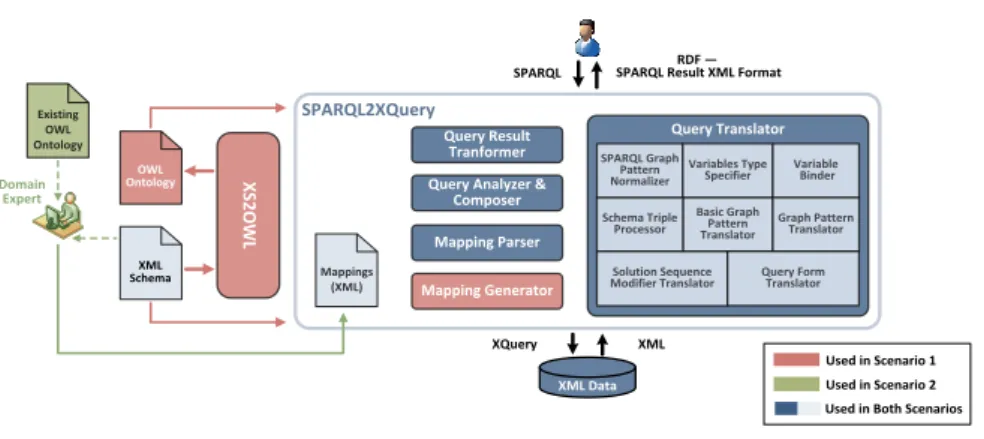
XQuery has been integrated with our XS2OWLFramework which generates OWL ontologies that fully capture the XML Schema semantics. The system architecture is presented in Fig. 4.
The
S
PARQL2
XQuery Framework provides an essential component for the Linked Data environment that allows setting SPARQL endpoints over existing XML data, as well as a fundamental part of ontology-based integration frameworks involving XML sources.SPARQL2XQuery SPARQL Mappings (XML) Mapping Parser Mapping Generator
Query Analyzer & Composer Query Translator XML Data Existing OWL Ontology X S2 O W L OWL Ontology XML Schema RDF ―
SPARQL Result XML Format
XQuery XML Domain Expert Solution Sequence Modifier Translator SPARQL Graph Pattern Normalizer Variables Type Specifier Variable Binder Basic Graph Pattern Translator Graph Pattern Translator Schema Triple Processor Query Form Translator Used in Scenario 2 Used in Scenario 1
Used in Both Scenarios
Query Result Tranformer
Fig. 4.System Architecture. In the first scenario, the XS2OWLFramework is used to generate an OWL ontology from the XML Schema. The mappings are automatically specified and stored. In the second scenario, a domain expert specifies the mappings between an existing ontology and the XML Schema. In both scenarios, SPARQL queries are processed and translated into XQuery queries for accessing the XML data. The results
are transformed in the preferred format and returned to the user.
As shown in Fig. 4, our working scenarios involve existing XML data that follow one or more XML Schemas. Moreover, the
S
PARQL2
XQueryFramework supports two different scenarios:1st Scenario: Querying XML data based on automatically generated OWL
ontologies. In that case, the following steps take place:
(a)Using the XS2OWL Framework, the XML Schema is expressed as an OWL ontology.
(b)The Mappings Generator component, taking as input the XML Schema and the generated ontology; automatically generates, maintains and stores the mappings between them in XML format.
(c)The SPARQL queries posed over the generated ontology are translated by the Query Translator component to XQuery expressions.
(d)The query results are transformed by the Query Result Transformer component into the desired format (SPARQL Query Result XML Format [19] or RDF).
In this case, the
S
PARQL2
XQueryFramework can be utilized as a fundamental component of hybrid ontology–based integration [59] frameworks (e.g., [93]), where the schemas of the XML data sources are represented as OWL ontologies and these ontologies are further mapped to a global ontology.2nd Scenario: Querying XML data based on existing OWL ontologies. In this
case the following steps take place:
(a)Existing OWL ontologies are manually mapped by a domain expert to the XML Schema.
(b)The SPARQL queries posed over the existing ontology are translated to XQuery expressions.
In both scenarios, the systems and the users that pose SPARQL queries over the ontology are not expected to know the underlying XML Schemas or even the existence of XML data. They express their queries only in standard SPARQL, in terms of the ontology that they are aware of, and they are able to retrieve XML data.
Our Framework provides the following operations:
1. Schema Transformation. Every XML Schema can be automatically transformed into OWL ontology, using the XS2OWL Framework.
2. Mappings Generation. The mappings between the OWL representations of the XML Schemas and the XML Schemas and their OWL representations can be either automatically detected or manually specified and stored as XML documents.
3. Query Translation. Every SPARQL query that is posed over the OWL representation of the XML Schemas (first scenario) or over the existing ontology (second scenario), is translated into an XQuery query that can be answered from the XML data.
4. Query Result Transformation. The query results are transformed in the preferred format.
5. XML – RDF Transformation. Transformation of XML data in RDF syntax and vice versa.
Finally, the
S
PARQL2
XQuery Framework is going to be integrated in an ontology-based mediator framework [91][92][93][94] that we are developing now and is going to provide semantic interoperability and integration support between distributed heterogeneous sources using the standard SW and XML technologies.6.
The
X
S
2O
WLFramework —
An Overview
In this section we describe the schema transformation process exploited in the first scenario supported by the
S
PARQL2
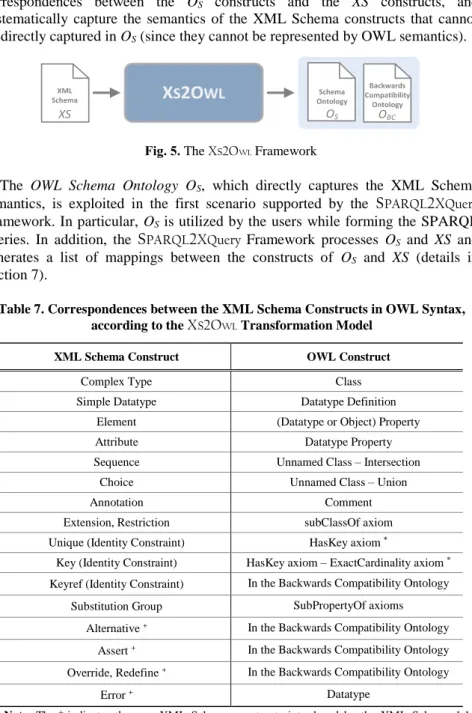
XQuery Framework in order to express the XML Schema semantics in OWL syntax. This is accomplished by the XS2OWLFramework [20][22], which implements the XS2OWLTransformation Model . The
XS2OWL Transformation Model allows the accurate representation of the XML Schema constructs in OWL syntax without any loss of the XML Schema semantics.
Here we present, an extended and updated version of the XS2OWL
Transformation Model, XS2OWL 2.0 [22] exploits the OWL 2 semantics, in order to achieve a more accurate representation of some XML Schema constructs. For instance, the XML Schema identity constraints (i.e., key, keyref, unique) can now be accurately represented in OWL 2 syntax (which was not feasible with OWL 1.0), thus overcoming the most important limitation of the previous version of
XS2OWL Transformation Model. Additionally, this version supports the new XML constructs introduced by XML Schema 1.1. To the best of our knowledge, this is the first work that fully captures the XML Schema semantics and support the XML Schema 1.1 constructs.