Durham E-Theses
Theodicy and the Problem of Evil in Islam: The
Risale-i Nur as Case Study
YESILHARK, TUBANUR
How to cite:
YESILHARK, TUBANUR (2013) Theodicy and the Problem of Evil in Islam: The Risale-i Nur as Case Study, Durham theses, Durham University. Available at Durham E-Theses Online:
http://etheses.dur.ac.uk/9416/
Use policy
The full-text may be used and/or reproduced, and given to third parties in any format or medium, without prior permission or charge, for personal research or study, educational, or not-for-prot purposes provided that:
• a full bibliographic reference is made to the original source • alinkis made to the metadata record in Durham E-Theses • the full-text is not changed in any way
The full-text must not be sold in any format or medium without the formal permission of the copyright holders. Please consult thefull Durham E-Theses policyfor further details.
Academic Support Oce, Durham University, University Oce, Old Elvet, Durham DH1 3HP e-mail: [email protected] Tel: +44 0191 334 6107
http://etheses.dur.ac.uk
Theodicy and the Problem of
Evil in Islām:
The Risale-i Nur as Case Study
Thesis Submitted for the Degree of Doctor of Philosophy
By
Tubanur Yesilhark Ozkan
A copyright of this thesis rests with the author. No quotation from it should be published without her prior written consent
and information derived from it should be acknowledged.
University of Durham, Durham September, 2013
Acknowledgements
The existing Master Thesis originated at Durham University, the School of Governmental and Institutional Affairs. The supervision took place by Dr. Colin Turner and Dr. Hasan Hörküç.
Here, I would like to express my thanks to Dr. Turner for his patient guidance and useful critiques of this research work. I would also like to thank Dr. Hörküç for his enthusiastic encouragement and his advice and assistance in keeping my progress on schedule.
My grateful thanks are also extended to Dr. Faris Kaya, Mr. Hakan Gülerce and other members and staff of the Istanbul Foundation for Science and Culture, who have always provided me with literature and have made it possible for me to deepen my research through conferences and
presentations.
I would like to give special mention to Mr. Bekir Sevinç, Dr. Ömer Seyfettin Sevinç and Mr. Kenan Demirtaş for their helpful insights and inputs in the developmental process of this thesis and to Mrs. Hatice Arıcı and Ms. Esra Coşkun for their help.
My special heartfelt thanks and appreciation goes to Muhammed Yeşilhark. Without his support, my academic career would not have been possible. I am deeply indebted to my parents Kenan and Nurten Yeşilhark for their sophisticated insights, compassion and care and to Talha Yeşilhark for his tireless encouragement and motivation.
Finally I would like to express my heartfelt gratitude to my husband Gökmen Özkan for his support and love and to our little sunshine Zülal Özkan for being such an easy baby and toddler all the way.
iii
Abstract
The thesis at hand presents a critical analysis of the writings of the contemporary, 20th century Muslim scholar, theologian and exegete Said Nursi (1876-1960) of Turkey. Special reference is given in this thesis to his views and writings on theodicy and the problem of evil from the perspective of Islām.
This thesis is an attempt to discover the Qur‟anic narrative of evil (sharr) as deviating from the human perception of evil in this world; to analyze Nursi‟s magnum opus on the definition of sharr and its correspondence to the Qur‟anic definition thereof; and to challenge Nursi‟s works with the thoughts and views of his predecessors and contemporaries in order to try to filter new insights and offer possible solutions to theodicy and the problem of evil through Nursi‟s Risale-i Nur Collection.
The methodology that has been used in this study follows Izutsu‟s example as seen in Ethico-Religious Concepts of the Qur‟an and God and Man in the Koran: namely to conduct an inductive investigation of the term sharr in the Qur‟ān and Nursi‟s Risale-i Nur Collection.
There are several issues that can be considered to be the main findings of this study: 1) human perception of evil in this world to a great extent at odds with the Qur‟anic definition of sharr, 2) new theological concept called „negative worship‟, establishing a relation between sharr and worship, 3) relationship between theodicy and the Divine Names of God, 4) link between the human „I‟ (ana) and, if misused, its encouragement for all kinds of
ashrār (pl. sharr), 5) original interpretation to the Qur‟anic verse [2:30], 6) sharr, ana and free choice (juz‟ī ikhtiyār) consist of the same nature and finally 7) suffering of on-human beings part of the field of theodicy.
iv
Table of Contents
1 INTRODUCTION 1
1.1 BACKGROUND AND CONTEXT TO THIS STUDY 1
1.2 AIMS OF THIS STUDY 4
1.3 MOTIVATION 5
1.4 CONTRIBUTION OF THE STUDY TO THE FIELD 5
1.5 METHODOLOGY 6
1.6 OUTLINE OF STUDY 21
2 SHARR IN QUR’ĀN, TAFSῑR AND ḤADῑTH 24
2.1 INTRODUCTION 24
2.2 SEMANTIC ANALYSIS OF THE TERM ‘SHARR’ IN QUR’ĀN AND ḤADῑTH 27
2.3 THE SEMANTIC FIELD OF SHARR 29
2.3.1 PARSIMONY 29
2.3.2 GOING ASTRAY 30
2.3.3 REJECTING GOD 30
2.3.4 IDOLATRY 31
2.3.5 VIOLATION OF (A COVENANT OR TREATY) 32
2.3.6 TURNING AWAY, AVERSION 33
2.3.7 SLANDER 35
v
2.4 VERSES BEYOND THE SEMANTIC FIELD OF SHARR 40
2.4.1 SHARR AS A TEST 40
2.4.2 SHARR IN HELL (JAHANNAM) 41
2.4.3 SATAN OR EVIL INCLINATIONS 43
2.5 OPINIONS OF EXEGETES WITH REGARD TO THE VERSES ON SHARR 47
2.5.1 CHAPTER 3,VERSE 180 48
2.5.2 CHAPTER 5,VERSE 60 49
2.5.3 CHAPTER 8,VERSES 22 AND 55 51
2.5.4 CHAPTER 10,VERSE 11 53
2.5.5 CHAPTER 17,VERSES 11 AND 83 54
2.5.6 CHAPTER 21,VERSE 35 56
2.5.7 CHAPTER 72,VERSE 10 56
2.5.8 CHAPTER 113,VERSES 1 TO 5 57
2.5.9 CHAPTER 114,VERSE 4 65
2.6 SEMANTIC ANALYSIS OF THE TERM SHARR IN ḤADῑTH 66
2.7 CONCLUSION 72
3 MUSLIM THEOLOGIANS AND PHILOSOPHERS ON THEODICY 74
3.1 INTRODUCTION 74
3.2 MAIN THOUGHTS IN MUSLIM THEOLOGY 78
3.2.1 JABRIYYA 79
vi
3.2.3 QADARIYYA 79
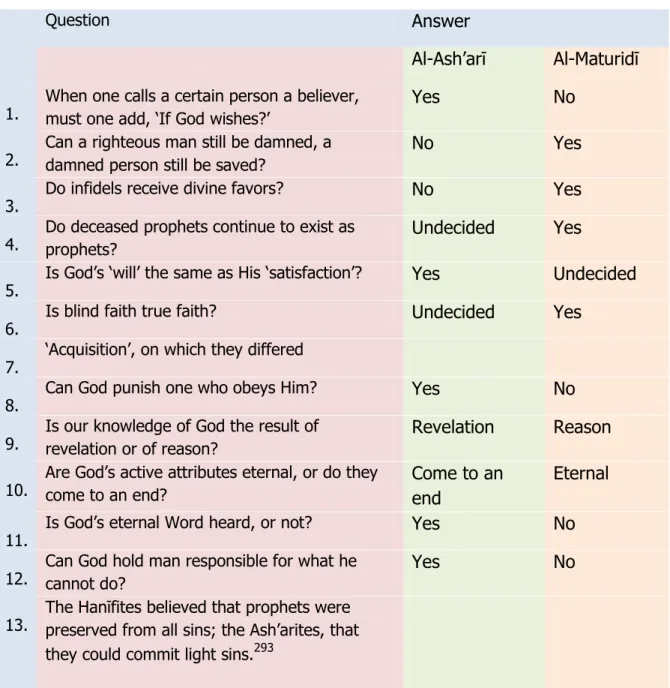
3.2.4 MATURIDĪ AND ASH’ARĪ 80
3.2.5 AL-MATURIDῑ ON EVIL 84 3.3 THE THEORY OF VALUE 91 3.4 IBN SῑNĀ (AVICENNA) 93 3.5 IBN RUSHD (AVERROES) 100 3.6 AL-GHAZĀLῑ 105 3.7 CONCLUSION 113
4 SHORT BIOGRAPHY ON SAID NURSI 115
4.1 SAID NURSI’S LIFE 115
4.2 SAID NURSI’S METHOD 119
4.3 ACHRONOLOGICAL OVERVIEW OF NURSI’S WORKS ON SHARR 121 4.4 NURSI’S APPROACH TO SHARR IN HIS LIFETIME – SOME EXAMPLES 124
5 PROLOGUE TO SHARR IN THE RISALE-I NUR 128
5.1 INTRODUCTION 128
5.2 TAWHῑD 129
5.2.1 DIVINE NAMES THEOLOGY 134
5.2.2 TANZῑH AND TASHBIH 138
5.3 THE CONCEPT OF FAITH (ῑMĀN) AND ‘CONNECTION’(INTISĀB) 142 5.3.1 THE REMOVAL OF THE VEIL OF COMMONPLACE 144
5.4 THE CONCEPT OF BEING (WUJŪD) AND NON-BEING (‘ADAM) 146
vii
5.4.2 NON-BEING (‘ADAM) 156
5.5 LIFE (ḤAYĀT) AND ITS PURPOSE 160
5.5.1 THE TWO FACES OF LIFE: MULK AND MALAKŪT 163
5.6 LIFE AFTER DEATH 164
5.6.1 THE WISE AND JUST 167
5.6.2 THE GLORIOUS AND ETERNAL 167
5.6.3 THE PRESERVER AND GUARDIAN 169
5.7 CONCLUSION 170
6 THE NATURE OF EVIL ACCORDING TO THE RISALE-I NUR 172
6.1 INTRODUCTION 172
6.2 THE NOTION OF BITHEISM 174
6.3 THE ALL-POWERFUL (QADῑR) 177
6.3.1 MYSTERY OF TRANSPARENCY (SHAFĀFIYAH) 180
6.3.2 MYSTERY OF RECIPROCITY (MUQĀBALA) 181
6.3.3 MYSTERY OF BALANCE (MAWĀZANAH) 181
6.3.4 MYSTERY OF ORDER (AL-NIẒĀM) 181
6.3.5 MYSTERY OF DISENGAGEDNESS (TAJARRUD) 182
6.3.6 MYSTERY OF OBEDIENCE (ṬĀ’AH) 182
6.4 PRINCIPLES OF THE RISALE REGARDING KHAYR AND SHARR 183 6.5 THE DEFINITION AND NATURE OF SHARR:ILLUSION OR REALITY? 189
viii
6.5.2 THE BEST OF ALL POSSIBLE WORLDS 192
6.5.3 THE NATURE OF A WORLD OF DUALITY 194
6.5.4 THE PRINCIPLE OF PLENITUDE 196
6.6 THE NECESSITY OF SHARR(WHY DOES GOD CREATE SHARR?) 202 6.6.1 SHARR AS A TEST AND THE CREATION OF PARADISE AND HELL 204
6.6.2 WHY SATAN HAS BEEN CREATED 205
6.6.3 CALAMITIES AND INFLICTS 213
6.6.4 NATURAL DISASTERS 216
6.7 SHARR AND WORSHIP 218
6.8 FINAL COMPARISONS BETWEEN PREVIOUS THEODICIES AND THE THEODICY OF
NURSI 221
6.9 CONCLUSION 224
7 THE MORAL ASPECT OF SHARR AND EXISTENTIAL THEODICY 231
7.1 INTRODUCTION 231
7.2 FACULTIES OF HUMANKIND AND THE ABILITY TO DO SHARR 234
7.2.1 INSTINCT (SHAHWA) 235
7.2.2 INTELLECT (‘AQL) 236
7.2.3 AGGRESSION (GHAḌAB) 237
7.3 ADAM’S CREATION AND THE FALL 239
7.3.1 ADAM WAS TAUGHT THE NAMES 247
7.4 THE NOTION OF THE ‘DIVINE TRUST’(AMĀNAH) 249
ix
7.5 THE ‘ANA’ AS ONE ASPECT OF THE ‘DIVINE TRUST’(AMĀNAH) 261 7.5.1 THE ‘SELF-REFERENTIAL’ AND THE ‘OTHER-INDICATIVE’ 265
7.5.2 THE ‘ANA’ PERTAINING TO KHAYR 266
7.5.3 THE ‘ANA’ PERTAINING TO SHARR 268
7.5.4 HOW PHILOSOPHY MAY LEAD TO SHARR 269
7.6 FREE WILL (JUZ’ῑ IKHTIYĀR) AND DIVINE DETERMINING (QADAR) 274 7.6.1 COMPATIBILITY OF DIVINE DETERMINING AND FREE WILL 277
7.6.2 NATURE OF FREE WILL 282
7.6.3 ALL GOODNESS PERTAINS TO GOD, ALL SHARR PERTAINS TO MAN 293
7.7 EXISTENTIAL THEODICY IN NURSI 295 7.7.1 SUFFERING AND DEATH OF INNOCENT CHILDREN 296
7.7.2 OLD AGE 298
7.7.3 THE SUFFERING OF NON-HUMAN BEINGS 301
7.8 CONCLUSION 303
x
Table of Figures
FIGURE 1:DIFFERENCE BETWEEN ASH’ARῑ AND MATURIDῑ ... 83
FIGURE 2:EXISTENCE OF MINOR SHARR ... 206
FIGURE 3:THE FACULTIES OF HUMANKIND ... 235
FIGURE 4:THE TWO FACES OF ‘ANA’ ... 266
FIGURE 5:FREE CHOICE,ACQUISITION AND SHARR ... 285
FIGURE 6:EXPLANATION OF THE RELATION BETWEEN THEORETICAL MATTER AND EXTERNAL EXISTENCE ... 291
xi
Transliteration
Said Nursi‟s writings were originally written in Ottoman (Arabic letters) and later in his lifetime translated into Turkish (Latin alphabet). However, the current Turkish version of the Risale-i Nur is in fact a combination of Ottoman and Farsi words. After the 1980‟s, the works started to be translated into English and thereafter, gradually into many other major languages.
Any Arabic or Farsi words have been written in italics. Words such as „Qur‟ān‟ or „Islām‟ which have been integrated into common English usage have been used in that agreed form without special marking.
The Arabic-to-English list of transliteration employed in this thesis follows Neil Robinson‟s Discovering the Qur‟an: A Contemporary Approach to a Veiled Text.1 ء ‟ س s ل l ب b ش sh م m ت t ص ṣ ن n ث th ض ḍ ه h ج j ط ṭ و w ح ḥ ظ ẓ ي y
خ kh ع „ ة ah; at (construct state)
د d غ gh لا (article) al- and ‟l
ذ dh ف f ر r ق q ز z ك k Long vowels: ā, ū, ī
1 Neal Robinson. Discovering the Qur‟an: A Contemporary Approach to a Veiled Text
1
1
Introduction
1.1 Background and Context to this Study
The problem of evil is not a contemporary one. It has been a dilemma throughout history. During the time of the Greeks, it was first discussed by Epicurus (341-270 B.C.), and later quoted by Lactantius (A.D. 260-340) as follows:
God either wishes to take away evils but is unable; or He is able, and is unwilling; or He is neither willing nor able, or He is both willing and able. If He is willing and is unable, He is feeble, which is not in accordance with the character of God; if He is able and unwilling, He is envious, which is equally at variance with God; if He is neither willing nor able, He is both envious and feeble, and therefore not God; if He is both willing and able, which is alone suitable to God, from what source then are evils? Or why does He not remove them?2
This question and dilemma of God being omnipotent and at the same time infinitely good, is not old, forgotten and solved. It is still fresh in the minds of people, and arises anew ever since a natural evil occurs or a moral evil is committed.
Two poles of thought have been developed regarding theodicy: monism and dualism. Monism3 suggests that the universe forms an ultimate, harmonious unity; evil is only apparent and would be recognized as good if it can be seen in its full cosmic context.4 In other words, there might be partial evil; however from a universal context it is good. The main ideas introduced are
2On the Anger of God, chap. 13, trans. By William Fletcher in The Writings of the Ante-Nicene Fathers (Grand Rapids, Michigan: Wm. B. Eerdman), Vol. vii, 1951.
3 The founder of Monism in western thought is the Dutch philosopher Spinoza (1632-1677)
who espoused the pantheistic system. For further information see Spinoza‟s Ethics, trans. by R. H. M. Elves (London: George Bell & Sons, 1891).
2 first of all that everything that comes from God is perfect. Hence, since God is the infinite perfect One, every creation makes its own contribution to that infinite perfection. Furthermore, good and evil are not objective realities. Both are formed by comparing one to the other. And evil is therefore just an illusion of our finite perspective and can be seen as a “lesser good.”5 Every creation necessarily is determined by divine perfect nature and they act in a certain manner. They are therefore not free, since the only free is the perfect Determiner.
When talking about moral evil, namely the sin of a person, this is, according to the thought of Monism, due to lack of complete truth, a privation of virtue. The answer to the following question, how lacks can occur within an
infinitely perfect reality, is given through the „principle of plenitude.‟6 Hence, in order to show the huge range of diversity in God‟s creation and the infinite creativity of God, a sinner must exist just like a saint. The weakness of Monism, as stated by Hick, is that even if one accepts the idea that evil is just illusory, it is still very real for it can be felt, it hurts and it is experienced painfully by human beings. Therefore, evil should not be thought of as similar to a dream, a hallucination or a mirage. Hick states further that the pain suffered by human beings does not all of a sudden become bearable, if one knows that evil is an absolute universal necessity. For a reconciliation to take place, one must be able to show that either evil is to be justly deserved or that it is a means to a good end.7
5Ibid., 20.
6 Arthur Lovejoy, The Great Chain of Being. (Harvard University Press, 1936). The „principle
of plenitude‟ means that a universe which contains as many different beings as possible, lower and higher, is more perfect than a universe which would contain only the highest and most perfect beings.
3 Dualism8, on the other hand, rejects this harmony in the world and suggests that good and evil are completely opposed to one another. Their duality can be overcome only by one destroying the other. The basic idea of this pole is the acceptance of two entities, namely good and evil, or mind and matter. This excludes the belief in a perfectly good and infinitely powerful Creator. The argumentation is that every design in this world is a means to an end. If the Designer has tied everything to certain means, this would mean that His power is limited and He therefore is dependent on means, for he could also come to the end by a single word.9 Internal dualism suggests that God is good and evil, and that those two constantly oppose each other. In other words, God is infinitely good but at the same time He is the source of surd evil. E. S. Brightman calls the solution for evil „theistic finitism.‟ It
understands God as „an eternal, conscious spirit, whose will is unfailingly good.‟ But at the same time „there is something in the universe not created by God and not a result of voluntary divine self-limitation, which God finds as either obstacle or instrument to his will.‟ This „obstacle‟ lies within God‟s own nature.10 Moral evil occurs through the malfunctioning of system which is designed for the preservation and enhancement of life.
This very gerenalized background forms just a partial basis for what is to come in this study: besides taking into consiederation most of the theories
8 The thought of dualism was developed before Christianity and traces back to the ancient
Zoroastrian religion (618-541 B.C.) The notion of dualism has been applied to theodicy by a more „contemporary‟ western scholar, namely Plato (428/427-348/347 B.C.) and was later carried on by J. S. Mill (1806-73) and E. S. Brightman (1884-1953). For further information see Cf. Francis M. Cornford, Plato‟s Cosmology: The Timaeus of Plato translated with a running commentary, 1937 (New York: The Liberal Arts Library, 1957); J. S. Mill, Three Essays on Religion (London: Longmans, Green, Reader & Dyer, 1875); E. S. Brightman, A Philosophy of Religion (New York: Prentice-Hall, Inc., 1940).
9Evil and the God of Love, 28, see also J. S. Mill, Three Essays on Religion (London:
Longmans, Green, Reader & Dyer, 1875), 176-7.
10Evil and the God of Love, 31, see also E. S. Brightman, A Philosophy of Religion (New
4 that have been developed in the field of theodicy, this study broadens the field by offering a semantic analysis of the term sharr in the Qur‟ān and by looking into Said Nursi‟s views on theodicy by means of his contemporary work the Risale-i Nur Collection.
1.2 Aims of this Study
This study aims to examine new and unique ideas to the debates surrounding theodicy and the problem of evil, the evil nature of man,
predestination and its compatibility with free will, „Divine Trust‟, the human „I‟ (ana) and its nature and function, the perfect paradisal state of Adam and his wife, the reasons for the creation of Satan, and the concept of „natural‟ and „moral evil‟. This will be made comparable to those studies already undertaken on theodicy and the problem of evil, and so will greatly enhance the possibility for a lively and fruitful discourse.
Previous work has been concentrated mainly on the general human
perception of evil in this world, dividing it into two main categories, namely „natural‟ and „moral‟ evil. Following this division, possible answers, solutions and theories have been developed. It seems however unlikely that much further work can be undertaken with this type of divisions. This study aims to highlight the potential to develop research into the definition of sharr from the perspective of Divine Scripture and to look further into the ethico-moral aspect of evil and its connection with ana as one major aspect of the „Divine Trust‟ given to humankind, as well as its link with divine determining and free will. It is strongly believed that Said Nursi‟s works can contribute in this respect in a major way.
5
1.3 Motivation
The starting point of this endeavor was to write a comparative work on Divine Justice. However, after reading texts such as Ruth Scoralick‟s Das Drama der Barmherzigkeit Gottes: Studien zur biblischen Gottesrede und ihrer Wirkungsgeschichte in Judentum und Christentum (Stuttgart: Verlag Katholisches Bibelwerk GmbH, 1999), Rolf Baumann‟s “Gottes Gerechtigkeit” – Verheiβung und Herausforderung für die Welt (Freiburg: Herder
Taschenbuch Verlag, 1989) and Lempp and Thaidigsmann‟s Gottes
Gerechtigkeit in der Dialektik der Aufklärung (München: Kaiser Verlag, 1990), a much bigger, unsolved problem seemed to be the discussion about putting God on trial – in other words, the question around why God did not interfere to prevent injustices. This directly led to the problem of evil, arguably the biggest challenge of traditional theism which comprises arguments against God‟s existence. Starting a comparative work would have been far beyond the scope of this thesis, hence the study has been confined to Muslim thought. Comparative work may thus be conducted in form of articles after the completion of this work.
1.4 Contribution of the Study to the Field
This study contributes to the field of theodicy and the problem of evil in many different ways: it explores the concept in view of Said Nursi‟s Risale-i Nur Collection, thus adding another contemporary viewpoint to the discourse. It identifies the Qur‟anic understanding of sharr as being at odds with the human perception of evil and provides a definition for the nature of sharr in the view of Nursi. It shows that the notion of „natural evil‟ is not conform to the Qur‟anic definitions. Furthermore, Nursi establishes a relation between sharr and worhip, creating a new theological concept that he calls „negative worship‟, comprising illnesses and calamities. These, according to Nursi,
6 make man realize his impotence and weakness, leading him to take refuge in God. Nursi also provides a link between theodicy and the Divine Names of God, claiming that God‟s Beauteous (jamālī) and Glorious (jalālī) Names together in unity form a „Divine Mosaic‟, pointing to their Creator. Another novelty is Nursi‟s link between ana and, if misused, its encouragement for all kinds of ashrār. Nursi is thus arguably the first scholar to suggest ana to be one meaning of the Qur‟anic Divine Trust. Another contribution to the field is Nursi‟s original interpretation of the Qur‟anic verse [2:30] stating that the angels‟ questioning and doubts were not related to human beings‟ creation (khāliqun) but rather in regards to them being placed on earth (jā‟ilun). For anything God creates is pure good (khayr al-mahdh). Yet another
contribution is Nursi‟s claim that sharr, ana and free choice (juz‟ī ikhtiyār) all consist of the same nature. All of them have no external existence serving as a unit of measurement; and in order for them to exist, there is no need for all causes to gather. Thus, all of the above, namely sharr, ana and free will can easily be attributed to man, making him responsible for his actions. And finally, Nursi adds the suffering of non-human beings into the field of
theodicy asking how their short life, annihilation and their being killed without exception can be reconciled with God‟s compassion and kindness.
1.5 Methodology
In order to build a profound basis for the concept of sharr, it is important to have an idea of the semantic structure of the term sharr in the Qur‟ān and to make a semantic analysis of key concepts and terms. To define the methodology that will be used for this study, Izutsu‟s Ethico-Religious Concepts in the Qur‟an11 and God and Man in the Koran12 will be consulted
11Toshihiko Izutsu. Ethico Religious Concepts in the Qur‟ān (Montreal&Kingston:
7 as main reference. The author of this study is aware of the fact that the methodology of Izutsu concentrates merely on the semantic analysis of key concepts and terms in the Qur‟ān – nevertheless, this very same
methodology will also be used to define the term sharr in the Risale-i Nur Collection (henceforward referred to as Risale) which is our main reference point in the second part of this study, especially covering chapters six and seven. How this methodology has been ultimately applied to the Risale will be explained at the end of this section.
The aim will be to do an inductive investigation of ethical terms in the Qur‟ān that will be “as little prejudiced as possible by any theoretical position or moral philosophy.” 13 The best way of doing this, according to Izutsu, is to place oneself in the position of a child who is trying to learn its mother tongue; in other words, to try to find all defining attributes for a single term and reach the basic meaning of that term before it goes through the filter of that language community.14 For according to Izutsu, the analytical study of key terms in a language which he calls „semantics‟ is a whole
Weltanschauung – not only of the people who use that language as a tool to speak and think, but more importantly for those who use it to conceptualize and interpret the world that surrounds them.15
12 Toshihiko Izutsu. God and Man in the Koran (New Hampshire: Ayer Company Publishers,
Inc., 1987).
13Ethico Religious Concepts in the Qur‟ān, 13. 14 Ibid., 14.
15God and Man in the Koran, 11. Izutsu thereby makes use of the writings of Johann Leo
Weisgerber, who was influenced by Wilhelm von Humboldt‟s view of language as a mirror of its speakers‟ vision of the world (Weltansicht) and pointed out the importance of language as an intellectual process of world-shaping (Weltanschauung). For further reading, see Johann Leo Weisgerber, Vom Weltbild der deutschen Sprache (Düsseldorf: Schwann Verlag, 1950) and also his Grundformen sprachlicher Weltgestaltung (Köln und Opladen:
Westdeutscher Verlag, 1963); furthermore Wilhelm von Humboldt, Über die Verschiedenheit des menschlichen Sprachbaues und ihren Einfluss auf die geistige Entwicklung des
8 Izutsu suggests three main ethical concepts to be found in the Qur‟an. The first he calls „Divine Ethics,‟16 which can be established by studying the names and divine attributes of God and which aims to describe God‟s ethical nature. The second is called „Human Ethics‟17 and deals with absolute trust in God (islām and īmān) on the one hand, and with pious fear of God
(taqwā) on the other. Those two form an ethico-religious concept, which is a response to God‟s ethical actions and describes the different facets of the fundamental attitude of man towards God, his Creator. In other words, according to Izutsu, it is a reflection of „Divine Ethics.‟ Izutsu calls the third concept also „Human Ethics,‟ with the difference that this concept refers to the principles and rules of conduct regulating ethical relations among individuals of the same religious community. This is covered mainly by
Islamic jurisprudence.18 For the establishment of his semantic analysis of the ethico-religious concepts in the Qur‟an, Izutsu concentrates mainly on the second concept, the human response to the ethical actions of God.
One aspect, according to Izutsu, is to distinguish between „descriptive‟ words on the one hand which he explains as the primary level of ethical discourse, and „evaluative‟ words on the other, which are defined by Izutsu as words of the secondary level moral discourse.19 To give an example for this, Izutsu writes:
Thus, in the essentially nonreligious context of Jāhilīyah, „humility‟ and „self-surrender‟ were considered something disgraceful, a manifestation of weak and ignoble character, whilst „haughtiness‟ and „refusal to obey‟ were, in the eyes of pre-Islamic Arabs, marks of noble nature. With the advent of Islam, the balance was completely overturned. Now, in the purely monotheistic context of Islam, „humility‟ in the presence of God and total „self-surrender‟ to
16Ethico Religious Concepts in the Qur‟ān, p. 17. 17 Ibid., 17.
18 Ibid., 18. 19 Ibid., 19-22.
9 Him became the highest virtues, and „haughtiness‟ and „refusal to obey‟ the marks of irreligiousness. In other words, the term denoting these personal properties completely changed their value. Whilst the descriptive layer of their meaning remained the same, their evaluative force changed from negative to positive or from positive to negative.20
This is a clear example of how to distinguish the purely descriptive meaning of a term from its evaluative meaning, keeping in mind that the evaluative layer might change completely whereas the descriptive layer remains the same. According to Izutsu, words such as „good‟ and „bad‟ belong to the secondary level moral discourse for they do not describe precisely what is meant by them. Whereas in actual life, man‟s moral evaluations are mainly made on the primary level of discourse by using words such as „pious‟, „hypocrite‟, „stingy‟, „humble‟, „generous‟, etc. instead of using a rather general classification like „good‟ or „bad.‟21 In relation to this study, the term sharr, if merely translated as „bad‟ or „evil‟ is rather a secondary level,
evaluative term. Therefore it will be important to study other related words in the Qur‟ān, which will serve as primary level terms that define and
describe what is meant by sharr.
In order to establish such a healthy body of definitions, Izutsu draws the reader‟s attention to different methods of analysis of a single ethical term in the Qur‟ān and its application. According to Izutsu, one of the simplest, however not very reliable methods, is to give the equivalent meaning of that term in one‟s own language. This method, he states, has proven itself to be frequently misleading rather than enlightening.22 He gives the example of the word ẓālim, which is mostly translated as „evil-doer‟ or the word kāfir that is usually equated with „disbeliever‟ or „unbeliever‟. These translations, although they might be helpful as a first step in language learning, are
20 Ibid., 22. 21 Ibid., 19-20. 22 Ibid., 24.
10 according to Izutsu by no means satisfying. In order to grasp the semantic category of these words, one needs to “inquire what sort of man, what type of character, what kind of acts are actually designated by this name in Old Arabic – in this specific case, in the Qur‟ān.”23
Izutsu believes that the Qur‟ān itself defines many words of its own in different places within the Qur‟ān; this is known as „exegesis of the Qur‟an by the Qur‟an‟ (tafsīr Qur‟ān bi‟l Qur‟ān). Hence, gathering those verses where the same word is used in one place and comparing them with one another might help to find out the original definition of that Arabic word.24 Izutsu further points out a danger in defining the semantic category of a word in the Qur‟ān: namely the tendency of a word being strongly
influenced by the neighboring words belonging to the same meaning field – in many cases by its antonym.25 To give the example of the word kāfir again, it can have the meaning of „ingrate‟ when used as the antonym of shākir „one who is thankful‟ or the meaning of „unbeliever‟ when used as the
contrary of mu‟min. However, the former important semantic element, which is the original meaning of the word kāfir, can be completely lost, if the word is being interpreted solely in terms of „belief.‟26
According to Izutsu, there is a strong interconnection between a particular word and the culture it is used in. The stronger that connection, the more difficult it is to transpose that word into a different language. This kind of words can be found within the henotheistic nomadic Arabia; words, that are typical of the life and manners of that particular culture and hence which are
23 Ibid., 25. 24 Ibid. 25 Ibid., 26 26 Ibid.
11 untranslatable.27 The reason is that the semantic category of this kind of words has a long cultural history behind it.28
Another important method Izutsu introduces is called „contextual
interpretation‟29 and the practical rules for such an interpretation he quotes from Professor J. Marouzeau as to “bring together, compare and put in relation all the terms that resemble, oppose and correspond with each other.”30
For the method of semantic analysis, Izutsu introduces seven cases in which any passage assumes a strategic importance: 1) contextual definition, 2) value of synonyms, 3) elucidation by contrast, 4) clarification by its negative form, 5) semantic field, 6) parallelism and 7) secular aspects of the term.31 Firstly, a passage is semantically relevant and the strategy is called
„contextual definition‟ when the exact meaning of a term is defined by means of verbal description.32
Secondly, synonyms can be of value especially if one word is substituted for another word within the same passage or in precisely the same kind of verbal context.33
As for the third method of analysis, the semantic structure of a term is elucidated by contrast. If there are two words that are very close to each other in meaning, for instance khayr and ḥasanah, one may look at their
27 Ibid., 27.
28 For further information and examples of the words hamāsah, murūwah and jahl, see Ethico Religious Concepts in the Qur‟ān, 27 ff.
29 Ibid., 36. 30 Ibid.
31 Ibid., 37-41.
32 Ibid., 37, see the word birr in the Qur‟ān, 2:172,177 as example. 33 Ibid., see the Qur‟ān, 7:92-93;94-95 as example.
12 oppositions used in the Qur‟ān. If one becomes sure about the meaning of one of the terms, says Izutsu, the other three terms will be easier to define.34
The fourth method of analysis is to define the semantic structure of a vague word (X) in terms of its negative (not-X). Although this might be very
difficult to do in other areas, since not-X could be anything else but X, Izutsu states that in the area of moral evaluation, defining a word X through its negative can be very useful.35
The challenge of the fifth method of analysis is to disentangle the different semantic groupings of different words. It will be better to quote Izutsu at this point as follows:
[…] in the Qur‟ān the verb iftara („to invent‟, „to forge‟) most frequently takes as its grammatical „object‟ the noun kadhib (a ‟lie‟), thus forming a well-nigh inseparable group. To join this group comes the word ẓālim. In fact the expression „Who does more wrong, or who is more unjust (aẓlam) than he who forges (iftara) against God a lie (kadhib)?‟ is one of the set phrases of our Scripture. This makes it clear that the three words iftara-kadhib-ẓālim
form in the Qur‟ān a peculiar group or combination, a semantic field in the sense just explained.36
The sixth method Izutsu calls the “rhetorical device of parallelism”. Although this method is more common in the Biblical Hebrew and in Classical Chinese, he states, parallelism in poetic style can be found to some extend also in the Qur‟ān.37 Izutsu gives a few small examples of which one is in Sūrah 29:47 and 49:
And none denies Our signs save the kāfir.
34 Ibid., 38-39.
35 Ibid., 39, see the word istakbara in the Qur‟ān [32:15] as example. 36 Ibid., 40.
13
And none denies Our signs save the ẓālim.
In this example one is able to see, states Izutsu that these two words are semantic equals in terms of refusing to believe in divine signs.38
The last and seventh method is the non-religious aspect of a term
mentioned in the Qur‟ān. As an example Izutsu gives Pharaoh‟s dialogue with Moses, where Pharaoh says: “And thou didst a deed of thine which thou didst, and thou art an ungrateful (kāfirīn)!” [26:19] The term is used in a non-religious context in this verse, for it is Pharaoh who speaks to Moses and who uses the term kāfir to accuse Moses of being ungrateful. According to Izutsu, this method is of particular importance since it provides the
semanticist with very valuable information regarding the structure of the word concerned.39
Izutsu rightly states that morality in Islām developed exclusively within its eschatological framework.40 Hence, the Qur‟anic outlook on good and bad is accordingly deeply connected with ākhirah; man‟s ultimate destiny. One can see in his chapter „Good and Bad‟, that there are a lot of terms which fall under this semantic field.41 Words like ṣāliḥ, birr, fasād, ma„ruf and munkar, ḥ-s-n and s-w‟ are just a few. Relevant to this study is Izutsu‟s brief section on khayr and sharr.42 These two are mainly used as antonyms in the Qur‟ān. Khayr, according to Izutsu, has a very comprehensive meaning, which
comprises everything that could be considered as valuable, beneficial, useful
38 Ibid., 41. 39 Ibid. 40 Ibid., 203. 41 Ibid. 42 Ibid., 217.
14 and desirable. And semantically it covers the worldly and religious spheres alike.43
Izutsu makes the distinction between „worldly‟ and „religious‟ in the sense that he divides the verses in the Qur‟ān about khayr according to their context. In this respect, the „worldly‟ meaning of the word khayr is to be found in verses like [38:32] and [2:180; 215; 272; 274]. In these verses, khayr behaves as synonym of māl (wealth).44 On the other hand, the „religious‟ sphere of the term khayr, according to Izutsu, is to be found in verses where God‟s bounty is explained [3:26; 73-74] or where God‟s special favor is addressed [2:105; 269 and 16:30], where it is explained that God knows every khayr in people‟s hearts [8:70], where God talks about the positive effects of faith [6:158], about pious work [2:110, 5:48, 21:90] and makes the description of an excellent believer [38:47], etc.45
Although it might be helpful to make this kind of a distinction for certain terms so it helps the reader to understand what God considers to be good from a worldly perspective (in this case, it would be māl being something good); nonetheless every action of a Muslim should ultimately be related on one or another aspect with the divine or religious sphere. An example for this can be seen in one of the verses quoted by Izutsu as „worldly‟ aspect:
Whatever of good (khayr) ye give benefits your own souls, and ye shall only do so seeking the „face‟ of Allah. Whatever good (khayr) ye give, shall be rendered back to you. And ye shall not be dealt with unjustly. [2:272] Those who spend of their goods (amwāl, pl. of māl) by night and by day, in secret and in public, have their reward with their Lord: [2:274]
43 Ibid.
44 Ibid., 217-8. 45 Ibid., 219-20.
15 This verse, rather than talking about khayr merely as a „worldly‟ affair,
suggests khayr (be it an action or māl) to be done or treated merely for the sake of God and to please only Him. From this perspective, the term ceases to be only a „worldly‟ affair and becomes maybe both in one: „worldly‟ and „religious‟, inseparable from each other.
This raises the question whether such a distinction between „worldly‟ and „religious‟ terms or actions, as made by Izutsu, is appropriate. One might ask, whether the term „worldly‟ really exists. When Solomon says that he has loved the love of good things (khayr) better than the remembrance of his Lord,46 does this imply that „good things‟ is a „worldly‟ term? If Solomon was admiring his horses by remembering and praising his Lord‟s bounties
(tafakkur), this term would hardly be classified as „worldly‟. It is also worth mentioning that the Qur‟an translation used by Izutsu does not seem to be correct. According to other translations,47 Solomon says: “Verily, I have come to love the love of all that is good (ḥubb al-khayri) in order to bear my Sustainer in mind (‟an dhikri Rabbī).”48 This is profoundly different from saying that Solomon loved things more than the remembrance of his Lord and is closer to the idea of tafakkur mentioned before. Likewise, wealth being used interchangeably with khayr49 does not exclude it from being a „religious‟ affair, for being thankful for that wealth and spending it for the sake of God would be sufficient to count as „religious‟.
To give another simple example: many people would agree to think that a rope is a „worldly‟ thing. However, a rope is neither a „worldly‟, nor a
„religious‟ thing. It simply is a thing that serves humans. However, the action
46 Ibid., 217, ref to Qur‟an, 38:32
47 Qur‟ān translations by Asad, M., Davudoğlu, A.; Eliaçık, I.
48 Ahmed Davudoğlu. Kur‟an-ı Kerim ve Izahlı Meali (Istanbul: Çelik Yayın-Dağıtım, 1981),
[38:32]
16 that is performed with that rope, for instance saving a person‟s life or
strangling someone, might be sacred or profane, respectively. Furthermore, while for many people, going to the mosque is a „religious‟ act, going there so that others think of that person as pious would turn that action into a „worldly‟ matter. In this regard making such distinctions as „worldly‟ or „religious‟ can be very misleading in two ways: the term itself does not change, khayr is good in any case, no matter in which context it is used. To differ between worldly and religious implies that the worldly is something bad, something that should not be desired, something that should not be loved compared to the religious. However, this is deceptive for the world should be loved as God‟s creation, as the reflections of God‟s most beautiful attributes and names, as God‟s beauty and bounty.
The impact such a distinction might have on Izutsu‟s methodology is manifold. By making a distinction between worldly goods and religious goods; and by dividing the word good (khayr) in the field of religious matters into two, namely the good the source of which lies in God, and the good produced by man, Izutsu opens the doors to several critiques.
First of all this kind of distinction implies that only religious khayr is a bounty from God, whereas the worldly khayr is not. However the whole chapter 55, sūrah al-Raḥmān in the Qur‟an talks about God‟s favors on earth and by counting each of them asks over and over, which of these favors man would deny.
Secondly, to state that there is one sort of khayr the source of which lies in God and another produced by man50 entails that man is the creator of his own actions and that man is able to create his own khayr. However, this
17 goes against the verse “whatever good (ḥasana) happens to thee is from God and whatever evil (sayyiah) befalls thee is from thyself.”51
Sharr, on the other hand, functions as the opposite of khayr in all respects.52 Quite interesting is Izutsu‟s comment on the following verses in the Qur‟ān:
Fighting is prescribed upon you, and ye dislike it. But it is possible that ye dislike a thing which is good (khayr) for you, and that ye love a thing which is bad (sharr) for you. But Allah knoweth, and ye know not.53 and
[…] On the contrary live with them on a footing of kindness and equity. If ye take a dislike to them, it may be that ye dislike a thing, and Allah brings about through it a great deal of good (khayr).54
Although these verses are mainly explained simply in the sense that the goodness or badness of a thing depends on the ultimate end to which it leads and has nothing to do with man liking or disliking it, Izutsu adds another aspect to it which comes close to what will be discussed later in this study: Izutsu writes that taken from the reverse side, this verse would imply that “the problem of whether a thing is khayr or sharr tends to be made dependent [by the Qur‟an] on man‟s natural subjective reaction to it, that is, whether he likes it or hates it.”55 This might lead to the assumption that what man calls sharr is in fact his own subjective view and has nothing to do with God‟s view on the same matter. This will be discussed in more detail after chapter three.
51 The Qur‟an, 4:79.
52Ethico Religious Concepts in the Qur‟ān, 220. 53 Qur‟ān, 2:216.
54Qur‟ān, 4:19. 55 Ibid.
18 There is one more aspect that needs attention in Izutsu‟s work, and that is his analysis of the term sayyi‟ah. This term might have, according to Izutsu, two different meanings: it may mean an unfavorable and disagreeable turn of affairs in human life, all unpleasant circumstances and misfortune that befall a man; or it may mean the „evil‟ work a man does against God‟s will, often called disobedience (ma„ṣiyah).56 This is of particular importance since it is related to the difficult theological discussions between the Ash‟ariyya and the Mu‟tazila and Qadariyya57. At this point, Izutsu quotes the Maturidī theologian al-Bayyāḍī as follows:
The Mu‟tazilī al-Jubbā‟ī asserts: it is an established fact that the word sayyi‟ah
is sometimes used in the sense of „calamity‟ (balīyah) and „trial‟ (miḥnah), and sometimes in the sense of „sin‟ (dhanb) and „disobedience‟ (ma„ṣiyah). It is also certain that God attributes sayyi‟ah to Himself in the verse “Say: everything comes from God”, and that in the following verse He attributes it to man: “And every sayyi‟ah that befalls thee comes from thyself.” Obviously something must be done here to establish harmony between the two statements so that they may not contradict each other. In reality, there is no contradiction because when sayyi‟ah is attributed to God it is to be understood as „adversity‟ and „misfortune‟, while the same word means „disobedience‟ when it is attributed to man.58
There is no need to say, states Izutsu, that al-Bayyāḍī, as a Maturidī theologian, will deny any kind of distinction and therefore states that
everything comes from God, be it īman or kufr.59 This study will nevertheless concentrate on the term sharr, since sayyi‟ah after all is closer in meaning to disobedience and is used as such.
As has been previously noted, the same methodology introduced by Izutsu above will also be applied to the Risale-i Nur Collection, comprising mainly
56 Ibid., 226-227.
57 For more information regarding the ahl al-sunnah, Mu‟tazila and Qadariyya, and their
theological discussions see chapter two.
58 Kamāl al-Dīn Aḥmad al-Bayyāḍī. Ishārāt al-Marām min „Ibārāt al Imām (Cairo, 1949), 310. 59Ethico-Religious Concepts in the Qur‟ān, 227.
19 the second part of this thesis, namely chapters five, six and seven. In this respect, an inductive investigation in form of a semantic analysis of the term sharr in the Risale will be conducted. Having located all the passages and pages that deal with the notion of sharr, their relation to each other will be analysed. This will hopefully help to define Nursi‟s understanding of sharr and how far his views on sharr are in line with the Qur‟anic definition thereof. One of the challenges in reading Nursi‟s works is the fact that he does not employ only one sort of methodology therein. Nursi‟s methodology is manigfold: it is reason-based; that is, a logical argumentation of the
existence and unity of God, of eschatology, prophethood, etc. At this point it might be important to note that Nursi frequently employs the term „proof‟ when he uses this type of methodology. This might be quite puzzling, given the fact that his proofs are not really „proofs‟ at all in the philosophically and scientifically accepted sense of the term. Nursi in fact uses faith (īmān) as a tool which leads one to read and interpret creation accordingly. Thus, the Nursian „proofs‟ should not be seen as irrefutable proofs that will turn everyone who reads it immerdiately into a believer – it should rather be accepted as a rhetorical emphasis to his rational argumentation for what he believes to be the truth.
Furthermore, Nursi‟s methodology is revelation-based, in other words, directly related to the Qur‟ān. Thirdly, it is authority-based, that is, in accordance with transmission (hadīth); fourthly, experimental-sensory
(ḥissī); fifthly, experiential-self-developed (tajrubī/haqq al-yaqīn); and sixthly heart-centred (hadsī wa kashfī). Since the last three types of evaluation are rather personal, it becomes not an easy task to understand him.
Since, as stated previously, Nursi makes use of faith as a tool for his
20 rather faith-related aspects to form a prologue and, so to say, a basis for Nursi‟s analysis of sharr. For it is clear that Nursi presupposes belief in a higher being in order to be able to understand and maybe accept his treatise on sharr. The outlines for each chapter will be elaborated in more detail in the next section.
After heaving read all passages and pages related to sharr in the Risale, the next step will be to analyse all topics that are in direct or indirect relation with the term. The two most important ones are being (wujūd) and non-being („adam), followed by the reason for the creation of Satan, the notion of Divine Trust, the ana, free will and divine determining as well as the faculties of humanking and Adam‟s creation and the Fall. The methodology that will be employed in analyzing Nursi‟s works in regards to sharr will be, besides the guidance of Izutsu‟s methodology mentioned above, mainly based on twelve principles that have been derived from the Risale itself, and which have been explained in detail in chapter 6. These principles are shortly to be mentioned here: 1) Any existence (wujūd) requires an existing cause; 2) There is no absolute non-existence („adam al-muṭlaq) in the universe; 3) existence is pure good (wujūd khayr al-mahdh) whereas non-existence is pure sharr („adam sharr al-mahdh); 4) sharr is non-existential in nature and arises from non-existence („adam); 5) there is no absolute sharr (sharr al-muṭlaq) in the universe; 6) abondaning a minor sharr can lead to greater sharr; 7) sharr has some sort of external reality or minor existence; 8) ashrār are the manifestation of Divine Glory; 9) all good things are the manifestation of Divine Beauty; 10) the creation of sharr is not sharr, rather the desire for sharr is sharr; 11) free will (juz‟ī irada) has no actual
existence; and 12) destruction is easy.
With the methodology based on these principles, chapters 6 and 7 have been developed.
21
1.6 Outline of Study
There is a very extensive range of material on theodicy and the problem of evil in the context of Islam. The problem, however, seems to be that in many cases, the human conception of evil in this world is taken for granted. It is thus the aim of this study to first of all try to find out whether human being‟s perception of evil is equal to the definition and understanding of sharr (evil) in the Qur‟ān. Furthermore, as a second step, to explore the concept of sharr in the writings of Said Nursi; for as of yet, there is no intensified academic writing on this topic in regards to Nursi‟s views. In the course of this study, Colin Turner‟s The Qur‟an Revealed: A Critical Analysis of Said Nursi‟s Epistles of Light (Berlin: Gerlach Press, 2013) has been published; a solid work, which covers and critically analyses approximately eighteen main topics of the Risale. Although this work touches on some issues that have been covered in this study, it does not offer an extensive analysis of the problem of sharr from Nursi‟s perspective.
The link between the first and second section of this work is thus to firstly introduce Nursi‟s novel ideas and thoughts into the discourse of theodicy and the problem of evil through illustrating that Nursi‟s understanding of sharr is in line with the definition of sharr in the Qurān; secondly to bring Nursi into the discourse of theodicy and to challenge his works with the ideas of his predecessors and contemporaries. In this regard, the first section of this study covers chapters two and three; chapter four is a bridging chapter and the second section of this study covers chapters five, six and seven. The second chapter will consist of a semantic analysis of the term sharr in Qur‟an and Hadīth, including the study of different exegetes from different
22 centuries. The main objective in this chapter will be to find out whether evil as perceived by human beings is the same as the definition of sharr in the Qur‟ān. In other words, does man‟s definition of evil correspond with the Qur‟ān‟s definition of sharr?
The third chapter covers the theological and philosophical approach to the problem of evil, by looking into the mainstream thoughts in Islamic history such as the Ash‟arī, Maturidī, Jabriyya, Qadariyya and Mu‟tazila as well as by studying philosophers and theologians like Ibn Sīnā (Avicenna), Ibn Rushd (Averroes) and al- Ghazālī. The aim here is to provide an overview of the main types of solutions offered to the problem of evil in the past and to show in which ways they have been objected, criticized and limited. This chapter will furthermore serve as a guideline to see in what ways Nursi‟s views on evil has been an asset to the hitherto widely discussed topic. The next is a bridging chapter that will consist of a brief biography of Said Nursi as well as excerpts from his life which will illustrate his own way of dealing with apparent ashrār (pl. sharr), calamities, inflicts and injustices committed against him. This might shed light on Nursi‟s „Existential Theodicy‟, in other words, his way of comforting and overcoming difficulties in practice rather than theory.
The fifth chapter will be a prologue to the problem of sharr in the Risale-i Nur. Due to the sensitivity and complexity of the topic at hand and its close relation to so many other areas of theology; and for the sake of easing the reader‟s way as he embarks towards the journey of understanding sharr according to the Risale-i Nur, some aspects of theology such as the Oneness of God, faith, being and non-being, and life and its purpose – again from the Risale‟s perspective – will be discussed.
23 The sixth chapter, then, will concentrate on the nature of evil according to the Risale. The objective in this chapter will be to deal with problems such as the existence or non-existence of sharr, the reconciliation of sharr with God‟s Omnipotence, the reasons for the creation of Satan, the reasons for the existence of dualities in this world, and the relationship between sharr and worship. Furthermore, in this chapter, Nursi‟s works will be challenged with views such as „bitheism‟, „theistic finitism‟, „anthropodicy‟ as well as the well known solutions offered to the problem of evil such as privatio boni, the best of all possible worlds, world of dualities, and the principle of plenitude. Finally, the seventh chapter, which will form the heart of this study, will discuss the moral aspect of sharr from Nursi‟s perspective. Thus, the objective will be to analyze the cause and creator of an „evil will‟; how sin entered into the perfect paradisal state of Adam and his wife; divine determining and its compatibility with free will; God‟s intention to punish some and save others; and God‟s wish to create a human being who would freely sin. In this regard, the chapter will cover mainly Adam‟s fall, the notion of „divine Trust‟, free will and divine determining as well as existential theodicy.
24
2
Sharr in Qur’ān, Tafsῑr and Ḥadῑth
2.1 Introduction
This chapter will explore the meaning of sharr in the Qur‟ān, Tafsīr and Ḥadīth. The methodology that will be used in approaching the Qur‟anic text will be that of Toshihiko Iztusu, which has already been explained in the introduction. The application of this sort of semantic analysis hopefully will help the reader to distinguish between sharr, as purposed and willed by God and evil, as understood by man. Once the difference becomes clear, it will be easier to apply this distinction to the rest of this study.
Three different Qur‟an translations are used in order to see and be aware of possible differences in translation: The Meaning of the Holy Qur‟ān
by ‟Abdullah Yūsuf ‟Alī; An Interpretation of the Qur‟an by Majid Fakhry (both English translations); Kur‟an-ı Hakim‟in Açıklamalı Meali by Prof. Dr. Suat Yıldırım (Turkish translation) and Der Koran by Adel Theodor Khoury, with the assistance of Muhammad Salim Abdullah (German translation). As for the interpretation of the Qur‟ān – although to be found only in very few instances in the Hadīth collections – the first and foremost is that of the Messenger of God, Muhammed. The Qur‟ān itself makes this clear: “… we have sent down unto thee the Message; that you may explain clearly to men what is sent for them, and that they may give thought”60, “It is He who has sent amongst the unlettered a messenger from among themselves, to
rehearse to them His signs, to sanctify (purify) them, and to instruct them in scripture and wisdom…”61 Hence one can say that the Messenger is the foremost interpreter of the Qur‟ān. However it is not always easy to know
60 Qur‟ān, 16:44. 61 Ibid., 62:2.
25 which ḥadīth is sahīh (sound)62 and which is not. For this study, those ḥadīth have been considered, that are in accordance with the teaching of the
Qur‟ān.63 One source is the Ḥadīth Encyclopedia Kütüb-i Sitte (Turkish Translation and Commentary) by Prof. Dr. Ibrahim Canan. This source has been chosen because of several reasons:
1) It includes the six major ḥadīth collections Sahih Bukhārī (by Imam Bukhārī, d. 870); Sahih Muslim (by Muslim bin al Ḥajjāj, d. 875); Sunan al Sughra (by al Nasā‟ī, d. 915); Sunan abū Dāwud (by Abu Dāwud, d. 888); Jami al Tirmidhī (by al Tirmidhī, d. 892) and Muwaṭṭā‟ (by Mālik bin Anas, d. 795).
2) In addition to the above, it also includes as a seventh book the Sunan ibn Mājah (by ibn Mājah, d. 887). Although some scholars have accepted the Sunan ibn Mājah instead of the Muwaṭṭā‟ as the sixth book of the al-Kutub al-Sittah, Canan has chosen to include the Sunan ibn Mājah as seventh book into his collection.
3) The commentary of Ibrahim Canan excludes any ḥadīth repetitions. A second source for ḥadīth is the Ḥadīth Institute for Knowledge and
Education and Methodology, <http://www.hikem.net/index.html> which has proven itself to be a very useful site for ḥadīth search, providing its Arabic original as well as the necessary sources for each of the narrations.
62 John Burton. An Introduction to the Hadith (Edinburgh: Edinburgh University Press Ltd.,
1994), 110-111.
63 Murtaḍa Mutahhari. Understanding the Uniqueness of the Qur‟ān in Al-Tawhīd, trans.
Mahliqa Qara‟i, vol. 1, no. 1-3 (1987). According to the Shi‟a, any Ḥadīth narrated from the Prophet Muhammed or the twelve infallible Imams should be checked against the Qur‟ān‟s teachings. If they do not comply with the Qur‟ān, they should be regarded as false or not trustworthy. For further information, see also Ṭabāṭabā‟ī, ‟Allāmah Sayyid M. Ḥ. Shi‟ite Islam, trans. Seyyed Hossein Nasr (Albany: State University of New York Press, 1975), 102ff. It should be noted that this method is also to be found in the Sunnī tradition and is not unique to the Shi‟ite.
26 Although the aim of this chapter is to understand the Qur‟ān with the help of the Qur‟ān itself, the term sharr has also been investigated by considering the interpretations of different mufassirūn. The number of exegetes from whom one can choose is enormous. Because of the scope of this study, it is necessary to find some principle of selection. In order to provide a
diachronic overview, two classical and two medieval exegetes have been chosen. Furthermore four contemporary exegetes have been selected due to their different approaches. The principle of the selection has been to choose those mufassirūn whose works are most widely read, who are from different school of thoughts and who are highly esteemed by Muslims throughout the ages. Additionally, one contemporary exegete, who considers himself to be a ḥanīf64 (Ihsan Eliaçık) has been added as well due to his sometimes
interesting approach to certain topics of the Qur‟ān. The authors and works to be considered are as follows:
Abū Ja‟far Muhammad ibn Jarīr al-Tabarī (d. 310/923), Jāmi‟ al-bayān ‟an ta‟wīl al Qur‟ān; Fakhr al-Dīn al-Rāzī (d. 606/1209), Mafātīḥ al-ghayb; Abū „Abdullah al Qurṭubī (d. 670/1273), Tafsīr al-Qurṭubī; Isma‟il ibn „Umar abū‟l-Fidā„ Ibn Kathīr (d. 774/1373), Tafsīr al-Qur‟ān al-„aẓīm; Muhammed Hamdi Yazır (d. 1343/1942), Hak Dini Kur‟an Dili; Syed Abū „l- ‟Alā Mawdūdī (d. 1380/1979), Tafhīm al-Qur‟ān; Muhammad Ḥusayn Tabātabā‟ī (d.
1382/1981), Tafsīr al-Mīzān; Ihsan Eliaçık, Yaşayan Kur‟an. This study however is not restricted only to these exegetes. Other scholars will be brought into the discourse where necessary.
It is well known that since the time of Muhammed, there have been different approaches to the interpretation of the Qur‟ān. This started already in the
64 The term ḥanīf refers to those who retained some or all of the tenets of the monotheist
27 first two centuries after hijrah, when the Islamic Empire was expanding and the Muslims came into contact with Greek philosophers as well as involved themselves in religious discussions with scholars of different religions and sects (‟ilm al-kalām).65 Thus, before the second century had come to an end, there were disputes over the names and attributes of God and about his actions, about heaven and hell, about free will and predestination, about reward and punishment and about al-barzakh (the intermediary period between death and resurrection).66 To justify their claims, every group referred to the Qur‟ān. Hence, one can either explain a verse by freeing oneself from any preconceived idea and by going where the Qur‟ān leads; or one can interpret the Qur‟ān so it fits one‟s preconceived beliefs by tailoring the verses accordingly.67 Obviously and hopefully, the former will be the aim and focus when looking at the term sharr in the Qur‟ān within the study at hand.
2.2 Semantic Analysis of the term ‘
sharr
’ in Qur’ān and ḤadῑthBy examining the behavior of the key term sharr in the Qur‟ān, it will be important to let the Qur‟anic term explain itself for it has been understood in the introduction of this study on the methodology of Izutsu, that to
understand the meaning of a word it is not sufficient to simply consult dictionaries. They can merely be a mediator and help.
The Arabic root-word for sharr is sh-r-r, occurring thirty one times in the Qur‟ān and comprising thirty verses. In one of these verses, it has the
meaning „sparks of fire‟ (bishararin) and therefore falls outside of the area of
65Mahmood Namazi, Thematic Approach to Qur‟ān Exegesis in Message of Thaqalayn, A
Quarterly Journal of Islamic Studies, 10/4 (2010), 43.
66Ibid., 44. 67Ibid., 45.
28 interest68. Eleven of the twenty nine verses are Medinan verses whereas eighteen are Meccan69. None of these seem to describe any kind of disaster or natural calamities that were defined later by many philosophers and theologians as „natural evil‟.70 Rather, any kind of misbehavior by man
against the will of God is named sharr. Hence, if the term sharr is considered to be a secondary level moral term, in other words, forms the evaluative rather that descriptive layer of a term71, it is important to build the related semantic field of it. However, before proceeding, it will be helpful to
remember the definitions of descriptive and evaluative terms as explained by Izutsu. This part has been explained in more detail in the Introduction of this study.
The descriptive72 form of a term in the Qur‟ān is mainly used in its primary level, in other words, where it describes the true characteristics of the moral code of a community.73 For example, instead of using the word „good‟ to describe a person (which would be a term of the secondary level of moral discourse for it does not give a precise description), to say „that pious person‟, or „that person is humble‟.74 On the other hand, the evaluative75 form of a term in the Qur‟ān is mainly used in its secondary level. Here, it is used merely as classificatory, in order to classify the primary level terms, such as „humility‟ or ‟generosity‟, into a “recognized category of moral values.”76
68 ‟Abd al-Bāqī, M. F. Al-Mu‟jam al-mufahras li-alfāẓ al-Qur‟ān al-Karīm , 378. 69 Uncertainties have been ignored.
70 See chapter II.
71 See introduction or Izutsu. Ethico-Religious Concepts in the Qur‟ān, 19-22. 72Ethico-Religious Concepts in the Qur‟ān, 21.
73 Ibid., 20. 74 Ibid. 75 Ibid., 21. 76 Ibid., 20.
29
2.3
The Semantic Field ofsharr
In this case, that recognized secondary level moral term would be sharr. The following deeds fall into the semantic field77 of the term sharr and form its descriptive layer:
2.3.1 Parsimony
The state of extreme stinginess, withholding things in a covetous manner. The Arabic root-word used for it in the Qur‟ān is b-kh-l. This word occurs 7 times in the Qur‟ān78, one time in combination with the term sharr. In each of these verses God warns man not to withhold from what He has given man out of His grace and God further warns that no property and good in the world can protect man from punishment. Hence, whoever shows stinginess harms himself and not God, for God is the possessor of all things. Parsimony is therefore identified as sharr for piling up possessions instead of spending them for the sake of God is sharr, although one might think that it is good:
And let not those who are niggardly in spending (yabkhalūna) what God has given them of His bounty suppose that it is good for them. No, it is sharr; they will carry what they stinted around their necks on the Day of Resurrection. And to Allah belongs the inheritance of the heavens and the earth. Allah is aware of what you do.79
It is worth mentioning at this point that God touches on man‟s foolishness when it comes to distinguish between khayr and sharr. This verse points out that if man thinks unwisely that greedily withholding God‟s gifts is good for him – he should know that it is not. What he considers to be khayr, in fact is
77 The notion of „semantic field‟ has been explained in the Introduction of this study. 78 ‟Abd al-Bāqī, M. F. Al-Mu‟jam al-mufahras li-alfāẓ al-Qur‟ān al-Karīm , 115. Also see
Qur‟ān, 3:180; 4:37; 9:76; 47:37-8; 57:24; 92:8.