TOPICAL REVIEWS IN AGRICULTURAL BIODIVERSITY
F. Engelmann, M.E. Dulloo, C. Astorga, S. Dussert and F. Anthony (editors)
Conserving coffee
F. Engelmann, M.E. Dulloo, C. Astorga, S. Dussert and F. Anthony (editors)
Complementary strategies for
ex situ
conservation of coffee (
Coffea arabica
L.) genetic resources. A case study in
CATIE, Costa Rica
ii Conserving coffee genetic resources
Bioversity International is an independent international scientific organization that seeks to improve the well-being of present and future generations of people by enhancing conservation and the deployment of agricultural biodiversity on farms and in forests. It is one of 15 centres supported by the Consultative Group on International Agricultural Research (CGIAR), an association of public and private members who support efforts to mobilize cutting-edge science to reduce hunger and poverty, improve human nutrition and health, and protect the environment. Bioversity has its headquarters in Maccarese, near Rome, Italy, with offices in more than 20 other countries worldwide. The Institute operates through four programmes: Diversity for Livelihoods, Understanding and Managing Biodiversity, Global Partnerships, and Commodities for Livelihoods.
The international status of Bioversity is conferred under an Establishment Agreement which, by January 2007, had been signed by the Governments of Algeria, Australia, Belgium, Benin, Bolivia, Brazil, Burkina Faso, Cameroon, Chile, China, Congo, Costa Rica, Côte d’Ivoire, Cyprus, Czech Republic, Denmark, Ecuador, Egypt, Greece, Guinea, Hungary, India, Indonesia, Iran, Israel, Italy, Jordan, Kenya, Malaysia, Mali, Mauritania, Morocco, Norway, Pakistan, Panama, Peru, Poland, Portugal, Romania, Russia, Senegal, Slovakia, Sudan, Switzerland, Syria, Tunisia, Turkey, Uganda and Ukraine.
Financial support for Bioversity’s research is provided by more than 150 donors, including governments, private foundations and international organizations. For details of donors and research activities please see Bioversity’s Annual Reports, which are available in printed form on request from [email protected] or from Bioversity’s Web site (www. bioversityinternational.org).
The geographical designations employed and the presentation of material in this publication do not imply the expression of any opinion whatsoever on the part of Bioversity, the Institut de recherche pour le développement (IRD), the Centro Agronómico Tropical de Investigación y Enseñanza (CATIE) or the CGIAR concerning the legal status of any country, territory, city or area or its authorities, or concerning the delimitation of its frontiers or boundaries. Similarly, the views expressed are those of the authors and do not necessarily reflect the views of these organizations.
Mention of a proprietary name does not constitute endorsement of the product and is given only for information.
Citation: Engelmann F, Dulloo ME, Astorga C, Dussert S and Anthony F, editors. 2007. Complementary strategies for ex situ conservation of coffee (Coffea arabica L.) genetic ressources. A case study in CATIE, Costa Rica. Topical reviews in Agricultural Biodiverstity. Bioversity International, Rome, Italy. x+63pp.
Cover photo: Fruiting branch of Coffea canephora at Divo (Ivory Coast). ISBN 978-92-9043-752-9
Bioversity International Via dei Tre Denari, 472/a 00057 Maccarese, Rome, Italy ©Bioversity International, 2007
Foreword
vAcknowledgements
viiPartners in this publication
ixI. Introduction 1
Florent Engelmann and Ehsan Dulloo
II. Coffee genetic resources 12
François Anthony, Stéphane Dussert and Ehsan Dulloo III. Conservation of coffee genetic resources
in the CATIE field genebank 23
François Anthony, Carlos Astorga, Joaquín Avendaño and Ehsan Dulloo
IV. Characterization and assessment ofCoffea arabicaL.
genetic resources conserved in the CATIE field genebank 35
François Anthony, Benoît Bertrand, Carlos Astorga and Philippe Lashermes
V. Construction of coffee core collections 45
François Anthony and Stéphane Dussert
VI. Cryopreservation of coffee genetic resources 49
Stéphane Dussert, Nelly Vasquez, Karol Salazar, François Anthony and Florent Engelmann
VII. Conclusions and prospects 59
Florent Engelmann, Ehsan Dulloo, Stéphane Dussert and François Anthony
It is now well recognized that an appropriate conservation strategy for a particular plant genepool requires a holistic approach, combining in a complementary manner the different ex situ and in situ conservation techniques available. Selection of the appropriate methods should be based on a range of criteria, including the biological nature of the spe-cies in question and the practicality and feasibility of the particular method chosen, as well as the cost-effectiveness and security afforded by its application. Considerations of complementarity with respect to the efficiency and cost-effectiveness of the various conservation meth-ods chosen are also important. Complementarity is a flexible concept, which evolves with the availability of techniques aiming at conserving, propagating and characterizing the genetic resources in question. Re-search on the development of complementary conservation strategies gained momentum at the beginning of the 1990s, and is coordinated by Bioversity International (Bioversity)1.
This research area is of particular relevance for species with seeds displaying non-orthodox storage behaviour, whose traditional ex situ storage method is the field genebank. In some ways, this method offers a satisfactory approach to conservation. The genetic resources under conservation can be readily accessed and observed, thus permitting detailed evaluation. However, there are certain drawbacks that limit its efficiency and threaten its security. The genetic resources are exposed to pests, diseases and other natural hazards, such as drought, weather dam-age, human error and vandalism. Field genebanks are costly to maintain and, as a consequence, are prone to economic decisions that may limit the level of replication of accessions, the quality of maintenance, and even their very survival in times of economic stringency. Even under the best circumstances, field genebanks require considerable inputs in the form of land, labour, management and materials, and, in addition, their capacity to ensure the maintenance of much diversity is limited.
For many years, non-orthodox seed research has been recognized by Bioversity as an area of critical importance for the conservation of plant genetic resources, and numerous projects on this topic have been or are being implemented in collaboration with research institutions and genebanks worldwide. Many of these projects have focused on the development of cryopreservation, i.e. the storage of biological material at ultra-low temperature, usually that of liquid nitrogen (-196°C), as cryopreservation is the only method currently available to ensure the safe and cost-effective conservation of germplasm of non-orthodox-seed species.
vi Conserving coffee genetic resources
Recognizing the tremendous potential interest of the results achieved at IRD with cryopreser-vation of coffee seeds, Bioversity decided to support a research programme aiming at transferring and testing on a large scale in a genebank located in a developing country the freezing protocol developed in France. This was performed in 1998–2000 in the framework of two successive projects with IRD and CATIE, Costa Rica. CATIE was an ideal partner as it fulfilled the set of criteria required for participation in such a project. Indeed, CATIE holds one of the largest field collections of coffee worldwide, mainly of Coffea arabica. CATIE’s fully equipped biotechnol-ogy laboratory includes all the facilities required for cryopreservation and molecular biolbiotechnol-ogy research, as well as highly skilled scientific and technical staff. Moreover, Bioversity and CATIE have a long and successful collaboration history in various areas, including cryopreservation of tropical plant germplasm. At the time of the initiation of this programme, IRD staff were also working in CATIE on a collaborative research project on the characterization and rationaliza-tion of the CATIE coffee germplasm collecrationaliza-tion using molecular tools. We were thus in an ideal situation to study how new technologies (molecular biology and cryopreservation) could be efficiently employed to complement more classical ones to characterize and rationalize an ex situ germplasm collection, and to improve its conservation status.
To our knowledge, the work described in this publication represents the first example of the application of these techniques in a genebank located in a developing country, in the frame-work of the development of an ex situ complementary conservation strategy for C. arabica, i.e. a crop of commercial importance at the global level. We hope that this publication will help in stimulating research on complementary conservation strategies for other problem crops, as well as on the biotechnological tools required to implement them.
Laura Snook
Florent Engelmann
Bioversity International Bioversity International
Director, Understanding and Managing Honorary Research Fellow, In vitro Diversity Programme Conservation and Cryopreservation
The editors gratefully acknowledge all staff from CATIE, IRD and Bio-versity who have been involved in this project. It is thanks to their strong commitment, dedication and enthusiasm throughout its implementation that this project has come to such a highly successful conclusion. They also would like to acknowledge the contributions of IRD and Bioversity, which have made this publication possible, and that of the two indepen-dent reviewers (Jan Engels and Charles Agwanda) who contributed to significantly improving the manuscript.
Institut de recherche pour le développement
(IRD)
Originally founded in 1944, IRD (the former ORSTOM) is a public science and technology research institute, reporting to the French ministries in charge of research and development cooperation. Working throughout the tropics, IRD conducts its research in close cooperation with its nu-merous partner countries with a view to assisting the economic, social and cultural development of developing countries. IRD fulfils three main missions: research, training, and consultancy; it also collaborates in the dissemination of scientific and technical information in develop-ing countries.
IRD has research and service units, joint research units with universi-ties and other research bodies, and it collaborates with observatories and technology-specific support networks. The scientific activities of the Institute are interdisciplinary and cover six priority topics, namely environmental hazards; global warming; desertification; water resources; management of marine and continental ecosystems; nutrition, health, emerging diseases, education, migration and poverty reduction policies. Working in Africa, Asia, Indian Ocean nations, Latin America and the Pacific area, IRD operates in 35 countries and in five French overseas territories. IRD participates in major world research programmes con-ducted in the South through its network of representatives and numerous researchers in the tropical area.
Centro Agronómico Tropical de Investigación y
Enseñanza (CATIE)
The Tropical Agricultural Research and Higher Education Center, CATIE, is a regional centre dedicated to research and graduate education in agriculture, and to the management, conservation and sustainable use of natural resources.
Its Regular Members include the Inter-American Institute for Coop-eration on Agriculture (IICA); Belize; Bolivia; Colombia; Costa Rica; the Dominican Republic; El Salvador; Guatemala; Honduras; Mexico; Nicaragua; Panama; Paraguay; and Venezuela. CATIE’s core budget is strengthened by generous annual contributions from these members.
CATIE’s thematic lines of emphasis include agro-ecology, agroforestry systems, organic agriculture, integrated pest management (IPM) and biological control, genetic resources conservation, and plant breeding. Emphasis is also given to natural resource management, including for-estry, biodiversity and protected areas, and to socio-economic issues.
x Conserving coffee genetic resources
CATIE’s strategies include networking at the regional and international level for generation, adaptation and validation of new technologies, dissemination of information, and execution of development projects in the field.
The centre works with strategic research, development and education partners from approxi-mately 100 institutions to conduct its activities throughout Latin America.
Bioversity International
Bioversity International is an independent international scientific organization that seeks to improve the well-being of present and future generations of people by enhancing conservation and the deployment of agricultural biodiversity on farms and in forests. It is one of 15 centres supported by the Consultative Group on International Agricultural Research (CGIAR), an as-sociation of public and private members who support efforts to mobilize cutting-edge science to reduce hunger and poverty, improve human nutrition and health, and protect the environ-ment. Bioversity has its headquarters in Maccarese, near Rome, Italy, with offices in more than 20 other countries worldwide. The Institute operates through four programmes: Diversity for Livelihoods; Understanding and Managing Biodiversity; Global Partnerships; and Commodi-ties for Livelihoods.
Florent Engelmann1 and Ehsan Dulloo2
1In vitro and cryopreservation, Institut de recherche pour le développement (IRD), UMR DIA-PC, 911 avenue Agropolis, BP 64501, F-34394 Montpellier cedex 5, France; and Honorary Research Fellow, In vitro and cryopreservation, Bioversity International, Via dei Tre Denari 472/a, 00057 Maccarese, Rome, Italy
2Senior scientist, Bioversity International, Via dei Tre Denari 472/a, 00057 Maccarese, Rome, Italy
Coffee is one of the most important beverages in the world and is consumed by more than a third of the world’s population. It is also a very important commodity crop for many developing countries, once contributing over US$ 10–11 billion annually (Bolvenkel et al. 1993) and provid-ing a source of income for thousands of small-scale farmers, as well as beprovid-ing a significant source of employment. However, during the crisis years that began in 2000 and continued to the end of 2004, earnings slumped to just over US$ 5.5 billion annually, while the value of retail sales in industrialized countries continued to remain healthy and to increase steadily, increasing to exceed US$ 70 billion (Osorio 2005).
The commercial coffee comes from two main species, Coffea arabica L. and C. canephora Pierre ex Froehner, and many varieties of coffee have been developed in response to wide-spread prevalence of pests and diseases, such as Coffee berry borer, Coffee berry disease, Coffee leaf rust, and, more recently, Fusarium wilt and others, all of which undermine coffee production and quality. It is recognized that the cultivated varieties, in particular C. arabica, have a very narrow genetic base (Anthony et al. 2002) and their improvement depends on the availability of adequate amounts of genetic diversity. The genus Coffea is endemic to the Old World tropics of Africa, particularly Madagascar, and over 100 wild species are found in the Afrotropical-Madagascar region, including the Comoros and the Mascarene Islands (Chevalier 1947; Bridson and Verdcourt 1988; Stoffelen 1998). This region, together with farm-ers’ fields growing old and traditional coffee varieties, represents the ultimate source of coffee genetic diversity, on which the future of coffee improvement depends. However, deforestation and encroachment by agricultural activities, population pressures and economic hardships threaten all these reservoirs of genetic diversity, and with these threats comes the danger of significant erosion of the Coffea genepool. Chapter 2 of this publication provides a detailed account of the coffee genetic resources and the threats they are facing. The conservation of coffee genetic resources has not received much attention recently, but efforts to collect and conserve coffee genetic resources were initiated in the 1960s and 1970s by ORSTOM (now IRD), FAO and IBPGR (now Bioversity), and several options for their conservations have been developed.
Conservation options
Two basic conservation strategies, each comprising various techniques, are employed to con-serve genetic diversity, namely in situ and ex situ conservation (Engelmann and Engels 2002). Article 2 of the Convention on Biological Diversity provides the following definitions for these categories (UNCED 1992):
• Ex situ conservation means the conservation of components of biological diversity outside their natural habitat.
2 Conserving coffee genetic resources
xIn situ conservation means the conservation of ecosystems and natural habitats and the maintenance and recovery of viable populations of species and, in the case of domesticated or cultivated species, in the surroundings where they have developed their distinctive prop-erties.
There is an obvious fundamental difference between these two strategies: ex situ conservation involves the sampling, transfer and storage of target taxa from the collecting area, whereas in situ conservation involves the designation, management and monitoring of target taxa where they are encountered (Maxted et al. 1997). Another difference lies with the more dynamic na-ture of in situ conservation compared with the more static ex situ conservation. These two basic conservation strategies are further subdivided into specific techniques, including seed storage, in vitro storage, DNA storage, pollen storage, field genebank and botanic garden conservation for ex situ, and protected area, on-farm and home garden conservation for in situ, each technique presenting its own advantages and limitations (Engels and Wood 1999). Ex situ conservation techniques are in particular appropriate for the conservation of crops and their wild relatives, whilein situconservation is especially appropriate for wild species and for landrace material on-farm.
In situ
conservation
In situ conservation offers the possibility of conserving a greater diversity of species and genepools at the same time. It is a dynamic conservation process, as plants continue to evolve with changes in their environment, most importantly pests and diseases (Maxted et al. 1997; Hodgkin and Ramanatha Rao 2002). It is suitable for crop evolution and genetic studies, and represents a viable alternative for conservation of non-orthodox-seed species. However, in situ conservation leaves the plant material vulnerable to natural and human-induced disasters, and the plant material is not readily accessible for use. The appropriate management regimes are poorly understood and high levels of supervision and monitoring are required to implement in situ conservation. Finally, the amount of genetic diversity that can be conserved in any one reserve is not easily measurable.
On-farm conservation
On-farm conservation is also a dynamic process in which plants continue to evolve (Jarvis et al. 2000; Watson and Eyzaguirre 2002). It ensures the conservation of valuable genetic diversity in traditional landraces, weedy crops and ancestral forms. The material is easily accessible for use by farmers and local communities. However, it is vulnerable to changes in management prac-tices and the appropriate management regimes are poorly understood. On-farm conservation requires the maintenance of traditional cultivation systems. The amount of genetic diversity that can be conserved on farm remains to be evaluated.
Conservation in field genebanks
Conservation in field genebanks is suitable for species with non-orthodox storage behaviour. In some ways, this method offers a satisfactory approach to conservation (Engelmann and Engels 2002). The genetic resources under conservation can be readily accessed and observed, thus per-mitting detailed evaluation. However, there are certain drawbacks that limit its efficiency and threaten its security (Engelmann 1997a; Withers and Engels 1990). The plants are exposed to pests, diseases and other natural hazards such as drought, weather damage, human error and vandal-ism. In addition, they are not in a condition that is readily conducive to germplasm exchange because of the great risks of disease transfer through the exchange of vegetative material. Field genebanks are costly to maintain and, as a consequence, are prone to economic decisions that may limit the level of replication of accessions, the quality of maintenance and even their very
survival in times of economic stringency (Dulloo et al. 2001). Even under the best circumstances, field genebanks require considerable inputs in the form of land (often needing multiple sites to allow for rotation), labour, management and materials, and, in addition, their capacity to ensure the maintenance of much diversity is limited (Engelmann and Engels 2002).
In vitro
conservation
In vitro conservation methods represent a relatively easy alternative for medium- to long-term conservation of a large number of non-orthodox, sterile or clonal species (Withers and Engelmann 1998). Cryopreservation (in liquid nitrogen at -196°C) provides long-term safety of the stored material, with limited maintenance and monitoring once the material is in storage. Germplasm exchange is facilitated by in vitro methods as they permit the production of virus-free material through meristem culture and their rapid multiplication (Engelmann 1997b). However, there are risks of somaclonal variation in some species when maintained under in vitro slow growth. In vitro storage is relatively high-tech and maintenance costs of the material are high. Individual slow growth and cryopreservation protocols need to be developed or adapted for most species. Difficulties are encountered in storing non-orthodox-seed species, and only a limited number of accessions can be conserved, especially when using slow growth storage.
Pollen storage
Pollen conservation is another viable alternative for conserving species with non-orthodox seeds. Pollen storage is a relatively easy and low-cost procedure (Towill and Walters 2000). Using pol-len facilitates germplasm exchange, as a relatively small quantity of material is required for a single sample. Most importantly, pollen is generally less likely to be infected by pathogens than other propagules. The disadvantages of pollen conservation are that only paternal material is conserved, i.e. less than half of the total genetic make-up of an organism; individual regenera-tion protocols need to be developed to produce haploid plants; and further research is needed to produce diploid plants.
DNA storage
DNA storage in DNA libraries is yet another alternative for conserving species with non-or-thodox seeds (Adams and Adams 1992). It is also a relatively easy and low-cost procedure. It is particularly useful for conserving specific genes responsible for heritable characteristics of particular value (e.g. disease resistance). DNA is easily accessible and is especially convenient for exchange among plant breeders. However, procedures for regenerating entire plants from conserved DNA are not available at present, and numerous problems exist with gene isolation, cloning and transfer.
Seed storage
Seeds are regarded as the most convenient material for ex situ conservation, and they make secure medium- to long-term conservation feasible (FAO 1996). Seed storage is both efficient and reproducible, allowing the conservation of a wide range of genetic diversity. Seeds are also a convenient form for germplasm use and exchange. Moreover, they require only limited main-tenance and monitoring once the material is placed in storage. However, seed storage does not allow for the conservation of useful genotypes. There are risks of losing genetic diversity with each regeneration cycle and it is a static conservation process, as it ‘freezes’ the evolutionary development of useful characteristics, especially related to resistance to pests and diseases. Most importantly, the usability of seed for long-term storage depends on its storage behaviour.
A large number of plant species have seeds that are termed ‘orthodox’, meaning that the seeds are desiccation tolerant and can be dehydrated down to low water contents, and that they are also
4 Conserving coffee genetic resources
cold tolerant and can be stored at low temperature for extended periods (Roberts 1973). There are three main categories of plant species for which seed conservation presents a problem. Firstly, some crops, such as banana and plantain, do not produce seeds and are thus propagated vegeta-tively. Secondly, some species, such as potato or sugar-cane, include both sterile genotypes and genotypes producing orthodox seeds. However, these seeds are generally highly heterozygous and are thus of limited interest for the conservation of particular genotypes. These species are normally maintained as clones. Thirdly, numerous fruit and forest tree species, especially of tropi-cal origin, produce retropi-calcitrant seeds, i.e. seeds that cannot be dried to sufficiently low moisture level to allow their storage at low temperature (Roberts 1973; Chin and Roberts 1980). There is also a large number of species, termed intermediate (Ellis et al. 1990), for which the seeds can be dried to some extent, but their long-term conservation remains problematic.
Cryopreservation
The traditional ex situ conservation method for these difficult-to-store categories of plant spe-cies is in the form of field collections, which present both advantages and major drawbacks, as described previously. Cryopreservation, i.e. the storage of biological material at ultra-low temperature, usually that of liquid nitrogen (-196°C), is the only technique currently available to ensure the safe and cost-efficient long-term conservation of the genetic resources of the problem species mentioned above. At this temperature, all cellular division and metabolic processes are stopped. The plant material can thus be stored without alteration or modification for a theoreti-cally unlimited period of time. Moreover, cultures are stored in a small volume, protected from contamination, and require very limited maintenance (Engelmann 2000).
Cryopreservation of vegetatively propagated species is becoming a reality and is used rou-tinely for long-term conservation of an increasing number of germplasm collections (Engel-mann 2004). As concerns non-orthodox-seed species, a number of review papers have been published in the last decade that present extensive lists of plant species whose embryos or embryonic axes have been successfully cryopreserved (Kartha and Engelmann 1994; Bajaj 1995; Pence 1995; Engelmann et al. 1995; Engelmann 1997a, b; Engelmann and Takagi 2000; Towill and Bajaj 2002). This might lead to the conclusion that freezing of embryos is a routine proce-dure applicable to numerous species, whatever their storage characteristics. However, careful examination of the species mentioned in these papers reveals that only a limited number of truly recalcitrant seed species are in fact included. This is because research in this area is recent and addressed by very few teams worldwide and because recalcitrance is a dynamic concept that evolves with research on the biology of species and improvement in storage procedures. Some species previously classified as recalcitrant have thus been moved to the intermediate or even sub-orthodox categories, and can now be stored using classical or new storage techniques (Engelmann 2000).
In comparison with the results obtained with vegetatively propagated species, cryopreserved storage of non-orthodox seeds is still at a very preliminary research stage. There are a number of reasons behind this situation, including the huge number of (mainly wild) species falling within this storage category, a lack or insufficient knowledge of their biology, the inexistence or non-operationality of in vitro culture protocols for most of these species, and the large het-erogeneity in the physical, biochemical and physiological characteristics of their seeds (most importantly concerning their moisture content) within and between seed lots (Engelmann 2000). Fortunately, there are various options to consider for improving storage of non-orthodox seeds, including employing very precisely controlled desiccation and cooling conditions, using other cryopreservation techniques that have so far seldom been employed, and selecting seeds or embryos at the right developmental stage, which is a parameter of critical importance for the success of any cryopreservation experiment (Engelmann 1999).
Development of complementary conservation strategies
It is now well recognized that an appropriate conservation strategy for a particular plant genepool requires a holistic approach, combining in a complementary manner the different ex situ and in situ conservation techniques available (Engelmann and Engels 2002). In situ andex situ methods, including a range of techniques for the latter (storage of germplasm as seeds, plants in the field, pollen, in vitro cultures under slow growth, cryopreserved explants, DNA sequences), are options available for the different genepool elements (cultivated species, including landraces and modern varieties; wild relatives; weedy types; etc.). Selection of the appropriate method should be based on a range of criteria, including the biological nature of the species in question; the practicality and feasibility of the particular method chosen (which depends on the availability of the necessary infrastructure); as well as the cost-effectiveness and security afforded by its application (Maxted et al. 1997). Considerations of complementarity with respect to the efficiency and cost-effectiveness of the various conservation methods chosen are also important. In many instances, the development of appropriate complementary conser-vation strategies requires further research to define the criteria, refine the method and test its application for a range of genepools and situations (Dulloo et al. 1998, 2005; Nissilä et al. 1999; Ramanatha Rao et al. 1999). An important area in this is the linkage between in situ and ex situ components of the strategy, especially with respect to the dynamic nature of the former and the static, but potentially more secure, approach of the latter (Engelmann and Engels 2002; Reed et al. 2004). Cryopreservation needs to be integrated as a key component in the development of complementary conservation strategies for non-orthodox-seed species since, as mentioned previously, it is the only technique currently available to ensure the safe and cost-efficient long-term conservation for species producing non-orthodox seeds.
Another key component in the development of conservation strategies is the construction of core collections, which can be used either for conservation projects or evaluation purposes. A core collection is a subset of a larger germplasm collection and contains the maximum possible genetic diversity of the species with the minimum of repetitiveness (Frankel 1984). Despite the simple formulation of the core collection concept, construction of core collections appears often to be difficult because of lack of evaluation data for the whole collection. In many cases, a pragmatic approach can be encouraged, with the objective of structuring the germplasm ac-cessions using passport data (see Chapter 5).
Research on the development of complementary conservation strategies and of the relevant storage methods required for their implementation can be effectively carried out through col-laborative studies, involving fundamental and applied research organizations within countries, as well as through close cooperation with international institutions concerned with conserva-tion research. Part of the work presented in this publicaconserva-tion originates from the occurrence of such a situation with coffee.
Conservation of coffee germplasm
The conservation of coffee germplasm is closely associated with C. arabica domestication and has predominantly involved conservation in field genebanks because of the non-orthodox nature of coffee seeds. It first began on farms in the centre of origin, Ethiopia. Subsequently, worldwide exten-sion of coffee cultivation contributed to the establishment of field genebanks in producer countries. The size of the collections increased greatly during the second half of the last century, when coffee germplasm collections were made during explorations across Africa (see Chapter 2). Considering the lifespan of coffee trees (about 30 years) and the inherent problems associated with maintenance of field genebanks (as described above), there is now an urgent need for rejuvenating the ageing coffee trees (Dulloo et al. 2001) and for the development of complementary methods of conservation.
6 Conserving coffee genetic resources
Numerous in vitro techniques have thus been developed for medium-term storage of coffee germplasm (Dussert et al. 1997c). The establishment of an in vitro coffee core collection was initiated in 1991 at IRD Montpellier (France) but, a few years later, the limits of this technique was recognized with the occurrence of some genotypic selection and intraspecific genetic drift (Dussert et al. 1997a).
Research on the conservation of coffee seeds has also been promoted by Bioversity and IRD. Though C. arabica seeds can withstand desiccation down to 0.08-0.10 g H2O.g-1dw water content
(fresh weight basis) (Becwar et al. 1983; Ellis et al. 1990), they cannot be considered orthodox because they remain cold-sensitive (van der Vossen 1977; Couturon 1980; Ellis et al. 1990) and desiccation does not increase their longevity (van der Vossen 1977; Ellis et al. 1990). Fully hy-drated seeds stored at 19°C under 100% relative humidity remained viable for 36 months for C. arabica and 15 months for C. canephora and C. stenophylla (Couturon 1980). Because of their intermediate storage behaviour, coffee seeds cannot be used for long-term conservation and coffee genetic resources are conventionally conserved as trees in field genebanks.
This highlights the importance of developing cryopreservation protocols for long-term conser-vation of coffee germplasm (Dussert et al. 2002). Research for cryopreserconser-vation techniques was performed with different explants, including seeds (Normah and Vendagasalam 1992), zygotic embryos (Abdelnour-Esquivel et al. 1992; Normah and Vendagasalam 1992), apices (Mari et al. 1995) and somatic embryos (Bertrand-Desbrunais et al. 1988; Tessereau et al. 1994).
However, seeds were considered the most interesting material for long-term conservation of coffee genetic resources using cryopreservation. Indeed, they are the only explant type for which a cryopreservation protocol could be developed that would not include any in vitro step, thereby allowing its implementation under low-tech conditions. In addition, seeds represent the base propagation unit for an autogamous species such as C. arabica and can be efficiently used for gene pool conservation in the case of allogamous species. Research was thus actively pursued at IRD Montpellier, leading after several years to the establishment of a simple, robust and efficient cryopreservation protocol based on the determination of very precise conditions for desiccation and freezing of seeds, which was applicable to a range of coffee species (Dussert et al. 1997b, 1998, 1999, 2000, 2002).
Past research has also shown that pollen can also be effectively stored under vacuum at -18°C and remain viable for more than two years and fertile for at least six months. (Walyaro and van der Vossen 1977). Regrettably, to our knowledge, there been no further research on coffee pollen conservation, and this represents a major gap in coffee conservation research.
Research on the in situ conservation of coffee genetic resources has lagged behind the efforts made in developing ex situ conservation techniques. In situ conservation of coffee germplasm has often resulted passively from the establishment and management of protected areas in biodiversity hotspots (Dulloo et al. 1998). The natural habitats of coffee are principally forest ecosystems, and it is widely known that the biological diversity in these habitats is under threat from high rates of deforestation, land clearing and introduced invasive species. Efforts to con-serve natural populations of coffee germplasm are very limited, and known examples come from work done in Ethiopia (Gole 2002) and in Mauritius (Dulloo 1998). There is still much to be done within the areas of coffee diversity hotspots in Madagascar and on mainland Africa, particularly in Tanzania, while major areas within the central Africa region, such as Gabon and the Central African Republic, still remain unexplored.
Aims of this publication
For many years, non-orthodox-seed research has been recognized by Bioversity and its pred-ecessors as an area of critical importance for the conservation of plant genetic resources, and
numerous projects on this topic have been or are being implemented in collaboration with research institutions and genebanks worldwide (Engelmann and Engels 2002; Engelmann 2003). Recognizing the tremendous potential implications of the results achieved at IRD for long-term storage of coffee germplasm, and also for other non-orthodox-seed species, Bioversity decided to support a research programme aiming at transferring and testing on a large scale in a genebank located in a developing country the freezing protocol developed in France. This was implemented in 1998–2000 in the framework of two successive projects with IRD and CATIE, Costa Rica. CATIE was an ideal partner as it fulfilled the set of criteria required for participating in such a project. Indeed, CATIE holds one of the largest field collections of coffee worldwide, mainly of C. arabica, with 1852 accessions of this species (9760 trees), including wild plants and varieties from the diversity centre (Ethiopia), varieties from the dispersion centre (Yemen), va-rieties derived from two genetic populations spread worldwide in the 18th century (known as Typica and Bourbon), introgressed lines derived from interspecific hybrids, mutants and other selected genotypes (see Chapter 3). CATIE’s fully equipped biotechnology laboratory includes all the facilities required for cryopreservation and molecular biology research, as well as highly skilled scientific and technical staff. Moreover, Bioversity and CATIE have a long and successful collaboration history in various areas, including cryopreservation of tropical plant germplasm (Abdelnour-Esquivel 2000; Engelmann 2003). At the time of the initiation of this programme, CATIE was also implementing collaborative research projects on coffee with IRD and another French research institute, CIRAD (Centre de coopération internationale en recherche agronomique pour le développement). Staff from these two institutes were working on a permanent basis in CATIE. These collaborative projects included research on the characterization and rationalization of the CATIE coffee germplasm collection (see Chapters 3 to 5); on the utilization of the material from the coffee collection for improvement purposes (Anthony et al. 1999; Bertrand et al. 1999, 2005); and on the use of biotechnology for large-scale propagation of improved material (Etienne et al. 1999, 2002; Etienne and Bertrand 2001).
The aim of this publication is to illustrate how new technologies (molecular biology and cryo-preservation) can be efficiently employed to complement more classical ones for characterizing and rationalizing an ex situ germplasm collection, and to improve its conservation status. To our knowledge, the work described in this publication represents the first example of the application of these techniques in a genebank located in a developing country, in the framework of the devel-opment of an ex situ complementary conservation strategy for C. arabica, i.e. a crop of commercial importance at the global level. The approach that was applied to coffee genetic resources might be used with other perennial plants whose seeds also display non-orthodox storage behaviour.
References
Abdelnour-Esquivel, A. 2000. Current status of cryopreservation research and future perspectives for its application in Costa Rica. pp. 325–329, in: F. Engelmann and H. Takagi (editors). Cryopreservation of Tropical Plant Germplasm - Current Research Progress and Applications. JIRCAS, Tsukuba, Japan, & IPGRI, Rome. Italy.
Abdelnour-Esquivel, A., Villalobos, V. & Engelmann, F. 1992. Cryopreservation of zygotic embryos of Coffea spp. CryoLetters 13:297–302.
Adams, R.P. & Adams, J.E. 1992. Conservation of Plant Genes: DNA Banking and In vitro Biotechnology. Academic Press, San Diego, USA.
Anthony, F., Astorga, C. & Berthaud, J. 1999. Los recursos genéticos: las bases de una solución genética a los problemas de la caficultura latinoamericana. pp. 369–406 in: B. Bertrand and B. Rapidel (editors). Desafíos de la Caficultura Centroamericana. IICA/PROMECAFE-CIRAD-IRD-CCCR France, San José.
8 Conserving coffee genetic resources
Anthony, F., Combes, M.-C., Astorga, C., Bertrand, B., Graziosi, G. & Lashermes, P. 2002. The origin of cultivated Coffea arabica L. varieties revealed by AFLP and SSR markers. Theoretical and Applied Genetics 104:894–900.
Bajaj, Y.P.S. (editor). 1995. Biotechnology in Agriculture and Forestry, Vol. 32. Cryopreservation of Plant Germplasm I. Springer, Berlin, Germany.
Becwar, M.R., Stanwood, P.C. & Lehonhardt, K.W. 1983. Dehydration effects on freezing characteristics and survival in liquid nitrogen of desiccation-tolerant and desiccation-sensitive seeds. Journal of the American Society for Horticultural Science 108:613–618.
Bertrand B., Aguilar, G., Santacreo, R. & Anzueto, F. 1999. El mejoramiento genético en América Central. pp. 407–456, in: B. Bertrand and B. Rapidel (editors). Desafíos de la Caficultura Centroamericana. IICA/PROMECAFE-CIRAD-IRD-CCCR France, San José.
Bertrand, B., Etienne, H., Cilas, C., Charrier, A. & Baradat, P. 2005. Coffea arabica hybrid performance for yields, fertility and bean weight. Euphytica 141:255–262.
Bertrand-Desbrunais, A., Fabre, J., Engelmann, F., Dereuddre, J. & Charrier, A. 1988. Reprise de l’embryogenèse adventive à partir d’embryons somatiques de caféier (Coffea arabica L.) après leur congélation dans l’azote liquide. Comptes Rendus de l’Académie des Sciences de Paris 307:795–801.
Bolvenkel, E., Buckley, T. & Eijgendaal, C. 1993. Report on a mission for the International Trade Centre. Dissemination Activities for Coffee – an exporters guide (Project Nos INT/50/33 – INT/24/64 – INT/84/01).
Bridson, D. & Verdcourt, B. 1988. Coffea. pp. 703–727, in: R.M. Polhill (editor). Flora of Tropical East Africa. Rubiaceae, Part 2. A.A. Balkema, Rotterdam, The Netherlands.
Chevalier, A. 1947. Les vrais et les faux caféiers. Nomenclature et systématique. pp. 115–263, in: Les caféiers du globe. Encyclopédie biologique nº 28. P. Lechevalier, Paris, France.
Chin, H.F. & Roberts, E.F. (editors). 1980. Recalcitrant Crop Seeds. Tropical Press Sdn. Bhd., Kuala Lumpur, Malaysia.
Couturon, E. 1980. Le maintien de la viabilité des graines de caféiers par le contrôle de leur teneur en eau et de la température de stockage. Café-Cacao-Thé 1:27–32.
Dulloo, M.E. 1998. Diversity and conservation of wild Coffea germplasm in the Mascarene Islands. PhD Thesis, University of Birmingham, UK. 225 p.
Dulloo, M.E., Guarino, L., Engelmann, F., Maxted, N., Attere, F. & Ford-Lloyd, B.V. 1998. Complementary conservation strategies for the genus Coffea: A case study of Mascarene Coffea species. Genetic Resources and Crop Evolution 45:565–579.
Dulloo, M.E., Charrier, A., Dussert, S., Anthony, F., Tesfaye, S., Rakotomalala, J.J. & Agwanda, C. 2001. Conservation of coffee genetic resources: constraints and opportunities. Ref. B208 in: Proceedings (CD-ROM) of the 19th International Scientific Colloquium on Coffee, Trieste, Italy, 14–18 May 2001. ASIC, Montpellier, France.
Dulloo, M.E., Ramanatha Rao, V., Engelmann, F. & Engels, J. 2005. Complementary conservation of coconuts. pp. 75–90, in: P. Batugal, V.R. Rao and J. Oliver (editors). Coconut Genetic Resources. IPGRI-APO, Serdang, Malaysia.
Dussert, S., Chabrillange, N., Anthony, F., Engelmann, F., Recalt, C. & Hamon, S. 1997a. Variability in storage response within a coffee (Coffea spp.) core collection under slow-growth conditions. Plant Cell Reports 16:344–348.
Dussert, S., Chabrillange, N., Engelmann, F., Anthony, F. & Hamon, S. 1997b. Cryopreservation of coffee (Coffea arabica L.) seeds: importance of the precooling temperature. CryoLetters 18:269–276.
Dussert, S., Engelmann, F., Chabrillange, N., Anthony, F., Noirot, M. & Hamon, S. 1997c. In vitro conservation of coffee (Coffea spp.) germplasm. pp. 287–305, in: M.K. Razdan and E.C. Cocking (editors). Conservation of Plant Genetic Resources In Vitro Vol. 1. M/S Science, USA.
Dussert, S., Chabrillange, N., Engelmann, F., Anthony, F. & Hamon, S. 1998. Cryopreservation of seeds of four coffee species (Coffea arabica, C. costatifructa, C. racemosa and C. sessiliflora): importance of seed water content and of freezing rate. Seed Science Research 8:9–15.
Dussert, S., Chabrillange, N., Engelmann, F. & Hamon, S. 1999. Quantitative estimation of seed desiccation sensitivity using a quantal response model: application to nine species of the genus Coffea. Seed Science Research 9:135–144.
Dussert, S., Chabrillange, N., Vasquez, N., Engelmann, F., Anthony, F., Guyot, A. & Hamon, S. 2000. Beneficial effect of post-thawing osmoconditioning on the recovery of cryopreserved coffee (Coffea arabica L.) seeds. CryoLetters 21:47–52.
Dussert, S., Chabrillange, N., Engelmann, F., Anthony, F., Vasquez, N. & Hamon, S. 2002. Cryopreservation of Coffea (coffee). pp. 220–233, in: L.E. Towill and Y.P.S. Bajaj (editors). Biotechnology in Agriculture and Forestry, Vol. 50. Cryopreservation of Plant Germplasm II. Springer-Verlag, Berlin, Germany.
Ellis, R.E., Hong, T. & Roberts, E.H. 1990. An intermediate category of seed storage behaviour? I. Coffee. Journal of Experimental Botany 41:1167–1174.
Engelmann, F. 1997a. Importance of desiccation for the cryopreservation of recalcitrant seed and vegetatively propagated species. Plant Genetic Resources Newsletter No. 112:9–18.
Engelmann, F. 1997b. In vitro conservation methods. pp. 119–162, in: B.V. Ford-Lloyd, J.H. Newburry and J.A. Callow (editors). Biotechnology and Plant Genetic Resources: Conservation and Use. CABI, Wallingford, UK.
Engelmann, F. 1999. Alternative methods for the storage of recalcitrant seeds – an update. pp. 159–170, in: M. Marzalina, K.C. Khoo, F.Y. Tsan and B. Krishnapillay (editors). Recalcitrant Seeds. Proceedings of the IUFRO Seed Symposium 1998, Kuala Lumpur, Malaysia, 12–15 October 1998.
Engelmann, F. 2000. Importance of cryopreservation for the conservation of plant genetic resources. pp. 8–20, in: F. Engelmann and H. Takagi (editors). Cryopreservation of Tropical Plant Germplasm - Current Research Progress and Applications. JIRCAS, Tsukuba, Japan, & IPGRI, Rome. Italy.
Engelmann, F. 2003. IPGRI’s strategy for in vitro and cryopreservation research – Discussion paper. IPGRI Internal Document. IPGRI, Rome, Italy.
Engelmann, F. 2004. Plant cryopreservation: progress and prospects. In Vitro Cellular and Developmental Biology - Plant 40:427-433.
Engelmann, F. & Engels, J.M.M. 2002. Technologies and strategies for ex situ conservation. pp. 89–104, in: J.H.H. Engels, V.R. Rao, A.H.D. Brown and M.T. Jackson (editors). Managing Plant Genetic Diversity. CABI, Wallingford, UK, & IPGRI, Rome, Italy.
Engelmann, F. & Takagi, H. (editors). 2000. Cryopreservation of Tropical Plant Germplasm - Current Research Progress and Applications. JIRCAS, Tsukuba, Japan, & IPGRI, Rome. Italy.
Engelmann, F., Dumet, D., Chabrillange, N., Abdelnour-Esquivel, A., Assy-Bah, B., Dereuddre, J. & Duval, Y. 1995. Factors affecting the cryopreservation of coffee, coconut and oil palm embryos. Plant Genetic Resources Newsletter No. 103:27–31.
Engels, J.M.M. & Wood, D. 1999. Conservation of agrobiodiversity. pp. 355–386, in: D. Wood and J.M. Lenné (editors). Agrobiodiversity: Characterisation, Utilisation and Management. CAB International, Wallingford, Oxon, UK.
Etienne, H. & Bertrand, B. 2001. Trueness-to-type and agronomic characteristics of Coffea arabica trees micropropagated by the embryogenic cell suspension technique. Tree Physiology 21:1031–1038.
Etienne, H., Etienne-Barry, D., Váquez, N. & Berthouly, M. 1999. Aportes de la biotecnología al mejoramiento genético del café: el ejemplo de la multiplicación por embriogénesis somática de
10 Conserving coffee genetic resources
híbridos F1 en America Central. pp. 457–496, in: B. Bertrand and B. Rapidel (editors). Desafíos de la Caficultura Centroamericana. IICA/PROMECAFE-CIRAD-IRD-CCCR France, San José. Etienne, H., Anthony, F., Dussert, S., Fernandez, D., Lashermes, P. & Bertrand, B. 2002.
Biotechnological applications for the improvement of coffee (Coffea arabica L.). In Vitro Cellular and Development Biology - Plant 38:129–138.
FAO [Food and Agriculture Organization of the United Nations]. 1996. Report on the State of the World’s Plant Genetic Resources for Food and Agriculture. FAO, Rome, Italy.
Frankel, O.H. 1984. Genetic perspectives of germplasm conservation. pp. 161–170, in: W.K. Arker, K. Llimensee, W.J. Peacock and P. Starlinger (editors). Genetic Manipulation: Impact on Man and Society. Cambridge University Press, Cambridge, UK.
Gole, T.W. 2002. Ecological studies on a keystone forest ecosystem for Coffea arabica gene conservation. Unpublished PhD Dissertation.
Hodgkin, T. & Ramanatha Rao, V. 2002. People, plants and DNA: perspectives on the scientific and technical aspects of conserving and using plant genetic resources. pp. 469–480, in: J.H.H. Engels, V.R. Rao, A.H.D. Brown and M.T. Jackson (editors). Managing Plant Genetic Diversity. CABI, Wallingford, UK, & IPGRI, Rome, Italy.
Jarvis, D., Sthapit, B. & Sears, L. (editors). 2000. Conserving Agricultural Biodiversity In Situ: A Scientific Basis for Sustainable Agriculture. Proceedings of a workshop. Pokhara, Nepal, 5–12 July 1999. IPGRI, Rome. Italy.
Kartha, K.K. & Engelmann, F. 1994. Cryopreservation and germplasm storage. pp. 195–230, in: I.K. Vasil and T.A. Thorpe (editors). Plant Cell and Tissue Culture. Kluwer, Dordrecht, The Netherlands.
Mari, S., Engelmann, F., Chabrillange, N., Huet, C. & Michaux-Ferrière, N. 1995. Histo-cytological study of apices of coffee (Coffea racemosa and C. sessiliflora) in vitro plantlets during their cryopreservation using the encapsulation-dehydration technique. CryoLetters 16:289–298. Maxted, N., Ford-Lloyd, B.V. & Hawkes, J.G. 1997. Complementary conservation strategies.
pp. 15–39, in: N. Maxted, B.V. Ford-Lloyd and J.G. Hawkes (editors). Plant Genetic Resources Conservation: the In situ Approach. Chapman and Hall, London, UK.
Nissilä, E.A.J., Ramanatha Rao, V., Engelmann, F. & Riley, K.W. 1999. Ex situ strategies for complementary conservation of Asian sweet potatoes. Plant Genetic Resources Newsletter No. 117:1-11.
Normah, M.N. & Vengadasalam, M. 1992. Effects of moisture content on cryopreservation of Coffea and Vigna seeds and embryos. CryoLetters 13:199–208.
Osorio, N. 2005. The world coffee market: lessons from the crisis and future scenarios. International Coffee Organization, London, UK. See: www.ico.org/news/Brazile.pdf
Pence, V.C. 1995. Cryopreservation of recalcitrant seeds. pp. 29–52, in: Y.P.S. Bajaj (editor). Biotechnology in Agriculture and Forestry, Vol. 32. Cryopreservation of Plant Germplasm. Springer Verlag, Berlin, Germany.
Ramanatha Rao, V., Batugal, P., Engelmann, F. & Riley, K. 1999. Coconut genetic resources conservation - Focus on in vitro and in situ conservation. pp. 11–32, in: K.U.K. Nampoothiri, V.A. Parthasarathy, A.R.S. Menon and H.H. Khan (editors). Plantation crops of Kerala, challenges and options: a compendium of background papers on the Focal Theme of the Eleventh Kerala Science Congress. The State Committee on Science, Technology and Environment, Kerala, India. Reed, B.M., Engelmann, F., Dulloo, M.E. & Engels, J.M.M. (editors). 2004. Guidelines for the
management of field and in vitro germplasm collections. IPGRI/FAO/SGRP, Rome, Italy. Roberts, H.F. 1973. Predicting the viability of seeds. Seed Science and Technology 1:499–514. Stoffelen, P. 1998. Coffea and Psilanthus (Rubiaceae) in tropical Africa: a systematic and palynological
study, including a revision of the West and Central African species. Doctoral thesis, Katholieke Universiteit Leuven, Leuven, Belgium.
Tessereau, H., Florin, B., Meschine, C., Thierry, C. & Pétiard, V. 1994. Cryopreservation of somatic embryos: a tool for germplasm storage and commercial delivery of selected plants. Annals of Botany 74:547–555.
Towill, L.E. & Bajaj, Y.P.S. (editors). 2002. Biotechnology in Agriculture and Forestry, Vol. 50. Cryopreservation of Plant Germplasm II. Springer, Berlin, Germany.
Towill, L.E. & Walters, C. 2000. Cryopreservation of pollen. pp. 115–128, in: F. Engelmann and H. Takagi (editors). Cryopreservation of Tropical Plant Germplasm - Current Research Progress and Applications. JIRCAS, Tsukuba, Japan, & IPGRI, Rome. Italy.
UNCED [United Nations Conference on Environment and Development]. 1992. Convention on Biological Diversity. UNCED, Geneva, Switzerland.
van der Vossen, H.A.M. 1977. Methods of preserving the viability of coffee seed in storage. Kenya Coffee 45:31–35.
Walyaro, D.J. & van der Vossen, H.A.M. 1977. Pollen longevity and artificial cross-pollination in Coffea arabica L. Euphytica 26: 225–231.
Watson, J.W. & Eyzaguirre, P.B. (editors). 2002. Home Gardens and In Situ Conservation of Plant Genetic Resources in Farming Systems. Proceedings of the Second International Home Gardens Workshop, Witzenhausen, Germany, 17–19 July 2001. IPGRI, Rome, Italy.
Withers, L.A. & Engelmann, F. 1998. In vitro conservation of plant genetic resources. pp. 57–88, in: A. Altman (editor). Biotechnology in Agriculture. Marcel Dekker Inc., New York, USA. Withers, L.A. & Engels, J.M.M. 1990. The test tube genebank - a safe alternative to field conservation.
II. Coffee genetic resources
François Anthony,1 Stéphane Dussert2 and Ehsan Dulloo3
1 Plant Genetics & Genomics, Institut de recherche pour le développement (IRD), UMR RPB, 911 avenue
Agropolis, BP 64501, F-34394 Montpellier cedex 5, France
2 Seed Conservation Biology & Technology, Institut de recherche pour le développement (IRD), UMR DIA-PC,
911 avenue Agropolis, BP 64501, F-34394 Montpellier cedex 5, France
3 Senior scientist, Bioversity International, Via dei Tre Denari 472/a, 00057 Maccarese, Rome, Italy
Introduction
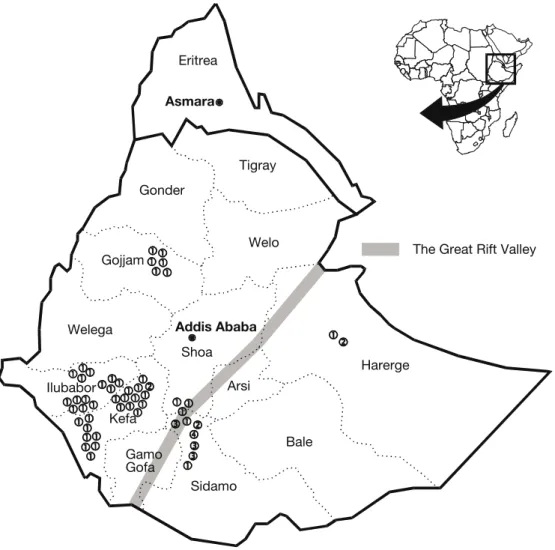
Coffee has become one of the most popular beverages in the world, but its consumption remained low until the 17th century. Wild plants of Coffea arabica L. were discovered in about AD 850 in Ethiopia (Smith 1985), but the centre of genetic diversity also includes the Boma Plateau of Sudan (Thomas 1942) and Mount Marsabit of Kenya (Bridson 1982; Anthony et al. 1987). Coffee spread to Arabia (now Yemen) probably in the 14th century (Chevalier 1929a), then to Mecca, whence it was taken home by pilgrims to other parts of the Islamic world. Spread of coffee consumption to Europe is dated to 1615, when Venetian merchants brought coffee beans from Mocha to Europe (Smith 1985). This started a lucrative trade for the Arabians for 100 years, during which time they were the sole providers of coffee. Several expeditions were then sent by the Dutch, the French and the British to obtain coffee seeds or plants from Arabia, which led to the worldwide dissemination of two genetic populations—Typica and Bourbon—in the 18th century (see Chapter 4).
The interest in other coffee species came later, during the course of Africa’s exploration at the end of the 19th century and the beginning of the 20th century. Only four coffee species were known in 1834 (Chevalier 1929b), but they were 36 in 1901 (de Wildeman 1901), about 50 in 1929 (Chevalier 1929b) and up to a hundred species nowadays (Chevalier 1947; Bridson and Verdcourt 1988; Stof-felen 1998). Several new species have been described recently (StofStof-felen et al. 1996, 1997a, b, 1999, [2006], 2007; Davis 2001; Davis and Rakotonasolo 2000; 2001a, b, 2003; Cheek et al. 2002; Davis and Mvungi 2004; Sonké and Stoffelen 2004), indicating that the inventory of wild coffee is not yet complete. Based on flowering and flower characters, taxonomists have classified the coffee species into two genera, Coffea L. and Psilanthus Hook. f. (Leroy 1980; Bridson 1987), but this distinction is not supported by molecular data analysis (Lashermes et al. 1997; Cros et al. 1998). All Coffea species are native to the inter-tropical forests of Africa, Madagascar and the Mascarene islands, while the Psilanthus species originate from Africa, India, Malaysia, Papua New Guinea and Australia (Bridson 1987; Bridson and Verdcourt 1988). Three groups of species have been identified in the genus Coffea on the basis of biogeographical data: in the Madagascar region, in East Africa, and in Central and West Africa (Chevalier 1947; Bridson and Verdcourt 1988; Stoffelen 1998).
Coffee trees differ greatly in morphology, size and ecological adaptation. Particular atten-tion has been paid to the genus Coffea, which includes the two cultivated species of economic importance,C. arabica (Arabica coffee) and C. canephora (Robusta coffee). Of the two, Arabica coffee accounts for 70% of the market, compared with 30% for Robusta. All Coffea species are diploid (2n=2x=22) and generally self-incompatible, except for C. arabica, which is tetraploid (2n=4x=44) and self-compatible. Nevertheless, the coffee species share a common genome, making possible interspecific hybridizations and hybrid production either within Coffea species (Charrier 1978; Louarn 1992; Le Pierrès 1995), or between Coffea and Psilanthus species (Couturon et al. 1998). This shows the potential value of genetic resources as sources for transfer of new characters from diploid species into the genome of C. arabica cultivars.
This chapter discusses the major collecting expeditions of coffee genetic resources made and the genebanks where the collected materials were introduced. The importance of the resources being conserved in these genebanks is then discussed, particularly in regard to some of the traits of agro-nomic interest to show their importance to coffee breeding programmes and geagro-nomic projects.
Coffee genetic resources collecting
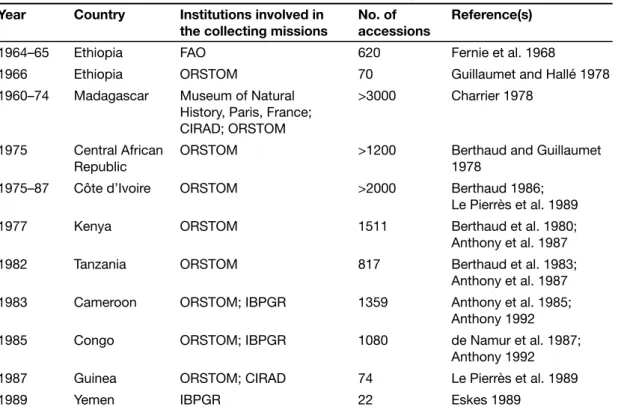
Interest in coffee genetic resources increased during the second half of the 20th century, as breeders became aware that deforestation was causing the erosion of coffee habitats, thereby threatening coffee genetic resources. It was estimated that the closed high forest in Ethiopia had declined to only 18% by 1997, which represents a loss of 60% in less than 30 years (Gole et al. 2002). Consider-ing the socio-economic importance of C. arabica cultivation, two large surveys were organized in Ethiopia: by FAO in 1964–65 (Fernie et al. 1968) and by ORSTOM (now IRD) in 1966 (Guillaumet and Hallé 1978). Collecting of other species started at the same period in the Madagascar region through a joint initiative of the Paris Museum of Natural History, CIRAD and ORSTOM. In Af-rica, survey missions were conducted in seven countries between 1975 and 1987 by ORSTOM (Table 2.1). Lastly, a mission was organized by IPGRI in Yemen (Eskes 1989), an area considered to be the first centre of dispersion for C. arabica outside Ethiopia (Meyer 1965).
Table 2.1. Main collections of coffee genetic resources (years of collection, countries surveyed, institutions involved, number of accessions collected, and references).
Year Country Institutions involved in
the collecting missions
No. of accessions
Reference(s)
1964–65 Ethiopia FAO 620 Fernie et al. 1968
1966 Ethiopia ORSTOM 70 Guillaumet and Hallé 1978
1960–74 Madagascar Museum of Natural History, Paris, France; CIRAD; ORSTOM
>3000 Charrier 1978
1975 Central African Republic
ORSTOM >1200 Berthaud and Guillaumet
1978
1975–87 Côte d’Ivoire ORSTOM >2000 Berthaud 1986;
Le Pierrès et al. 1989
1977 Kenya ORSTOM 1511 Berthaud et al. 1980;
Anthony et al. 1987
1982 Tanzania ORSTOM 817 Berthaud et al. 1983;
Anthony et al. 1987
1983 Cameroon ORSTOM; IBPGR 1359 Anthony et al. 1985;
Anthony 1992
1985 Congo ORSTOM; IBPGR 1080 de Namur et al. 1987;
Anthony 1992
1987 Guinea ORSTOM; CIRAD 74 Le Pierrès et al. 1989
1989 Yemen IBPGR 22 Eskes 1989
Notes: ORSTOM (Office de la recherche scientifique et technique outre-mer) is now Institut de recherche pour le développement (IRD), France.
CIRAD is Centre de coopération internationale en recherche agronomique pour le développement, France. IBPGR (International Board for Plant Genetic Resources) became the International Plant Genetic Resources Institute (IPGRI), which in turn became Bioversity International.
14 Conserving coffee genetic resources
The collected material generally comprised seed in the case of the autogamous species C. arabica, and stem cuttings, seedlings and seeds for the other species. An accession can thus correspond to one genotype when stem cuttings were collected or to several genotypes in the case of seed collecting. At least 11 700 accessions, representing 70 Coffea species, were collected and introduced into field genebanks (Table 2.2). Of these species, about 50 taxa were native to the Madagascar region; 8 taxa to eastern Africa, including C. arabica; 7 taxa to central Africa; and 4 taxa to West Africa (Figure 2.1). New species from Cameroon and Congo were recently described (Stoffelen et al. [2006], 2007) and others remain to be identified (Anthony 1992).
Table 2.2.Major coffee genebanks in the world and distribution of the C. arabica accessions collected in Ethiopia by FAO (Fernie et al. 1968) and ORSTOM (Guillaumet and Hallé 1978) surveys.
Area Country Institute FAO
collection
ORSTOM collection
Latin America Costa Rica Centro Agronómico Tropical de Investigación y Enseñanza (CATIE)
original Colombia Centro Nacional de Investigaciones
de Café (CENICAFE)
duplicate‡ duplicate† Brazil Instituto Agronômico de Campinas (IAC) original duplicate† Africa Côte d’Ivoire Centre National de Recherche
Agronomique (CNRA)
duplicate§ original Cameroon Institut de Recherche Agronomique
et de Développement (IRAD)
original Ethiopia Jimma Agricultural Research Centre (JARC) original
Kenya Coffee Research Foundation (CRF) duplicate¶ original Tanzania Tanzanian Agricultural Research
Organization (TARO)
original duplicate†† Madagascar Centre National de Recherche Appliquée
au Développement (FOFIFA)
original Asia India Central Coffee Research Institute (CCRI) original
Indonesia Indonesian Coffee and Cocoa Research Institute (ICCRI)
Notes:† germplasm introduced from Cameroon. ‡ germplasm introduced from Costa Rica. § germplasm introduced from Kenya. ¶ germplasm introduced from Tanzania. †† germplasm introduced from Côte d’Ivoire.
Existing coffee genebanks
The report The State of the World’s Plant Genetic Resources for Food and Agriculture (FAO 1998) reported 21 087 coffee accessions conserved worldwide. As with other crops of economic im-portance, exchanges of genetic material have led to an increase in the number of duplicates in many genebanks. Accessions of the cultivated species C. arabica and C. canephora correspond either to wild plants collected in forest habitats or to cultivated plants selected in plantations and breeding centres. The accessions of the cultivated species C. arabica have been widely spread, while the other species have had a more restricted distribution.
Accessions of
C. arabica
Most coffee genebanks were set up during the first half of the 20th century, the earliest being the Indonesian Coffee and Cocoa Research Institute (ICCRI) in 1900, the Agronomic Institute of
GUINEA CÔTE D'IVOIRE CAMEROON CONGO CENTRAL AFRICA ETHIOPIA KENYA TANZANIA MADAGASCAR REGION C. anthonyi C. canephora C. congensis C. liberica C. mayombensis Coffea sp. Psilanthusspp. > 50 taxa C. costatifructa C. mufindiensis C. pocsii C. pseudozanguebariae C. canephora C. congensis C. liberica C. arabica C. canephora C. humilis C. liberica C. stenophylla Psilanthusspp. C. canephora C. humilis C. liberica Psilanthusspp. C. anthonyi C. brevipes C. canephora C. charrieriana C. congensis C. liberica C. mayombensis Coffeasp. Psilanthusspp. C. arabica C. eugenioides C. fadenii C. pseudozanguebariae C. sessiliflora
Figure 2.1.Coffee species collected on the African mainland and the Madagascar region, and introduced into field genebanks.
Campinas (IAC) in Brazil in 1924 and the Central Coffee Research Institute (CCRI) in India in 1925 (van der Vossen 2001). Coffee farmers supplied genebanks with materials which displayed good agronomic performance or presented specific traits. Many mutants were thus isolated, as well as numerous varieties selected from the base populations of Typica and Bourbon that were disseminated from Yemen during the 18th century (see Chapter 4). Such selected accessions represent 72% of the genetic resources conserved in the CATIE genebank (see Chapter 3). The accessions collected by FAO and ORSTOM in Ethiopia in the 1960s were introduced in five and four genebanks, respectively (Table 2). Further introductions occurred from these genebanks in Colombia, Côte d’Ivoire and Kenya for the FAO accessions and in Costa Rica, Colombia and Kenya for the ORSTOM accessions. This has contributed to the preservation of corresponding genetic resources, although genetic diversity in duplicated germplasm was often lower than in the original one.
Accessions of other species
Large genebanks of C. canephora accessions were set up in several coffee producing countries, including Côte d’Ivoire, Cameroon, Madagascar and India (Charrier and Berthaud 1985). As forC. arabica genetic resources, introductions of C. canephora originated from plantations and
16 Conserving coffee genetic resources
breeding centres in the first instance, until the collecting of wild plants began in the 1980s. However, only part of the known diversity has been conserved in each genebank, as recently shown in a study using molecular markers (Prakash et al. 2005). Of the five genetic groups identified in this species (Dussert et al. 2003), only one group was well represented in India, two groups were little represented and two other groups were lacking.
Most of the other wild coffee species (i.e. not cultivated) have been introduced into only two genebanks, namely in Madagascar for the Mascarocoffea species and in Côte d’Ivoire for the mainland African species. These unique collections are threatened in the long term because they are nowhere safely duplicated. In the Malagasy genebank, 25% of the accessions and 50% of the genotypes were estimated to have been lost over a period of 20 years (Dulloo et al. 2001). In Côte d’Ivoire, the climate is not optimal for coffee culture and the risk of damage by fire is high (Dulloo et al. 2001). There is therefore an urgent need for duplication of the wild coffee genetic resources conserved in these genebanks. A few genotypes of some species, principally C. eugenioides S. Moore, C. liberica Hiern, C. racemosa Lour. and C. stenophylla G. Don, are, how-ever, present in several other genebanks.
Insight into coffee genetic diversity
The genus Coffea is characterized by a large number of species whose differentiation has oc-curred relatively recently, about 5 to 25 million years ago (Anthony and Lashermes 2005). It is thought that the diversity of coffee species and the genetic diversity within them have been the result of a rapid speciation and adaptive radiation process (Cros 1994; Lashermes et al. 1997). Diversity can be analysed at the genetic and morphological levels, the latter often being used as a proxy of the former. Only few studies have been undertaken to examine the level of genetic diversity in wild coffee plants. A good insight into coffee genetic diversity—using phenotypic characteristics such as data on plant morphology, adaptation, biochemical compounds and resistance to pests and diseases as proxies—is given below.
Morphology
There can be wide diversity among morphological traits in coffee plants. Coffee plants can be shrubs or trees, whose height varies from 1 m in C. humilis Chev. up to 20 m in C. liberica var. dew-evrei (Chevalier 1947). Leaf size varies considerably, from 2 cm (e.g. C. eugenioides) to 48 cm (e.g. C. magnistipula Stoff. & Robbr.) in length, and from 0.8 cm (C. eugenioides) to 30 cm (e.g. C. liberica var. dewevrei) in width (Chevalier 1947; Bridson and Verdcourt 1988; Stoffelen 1998). Mature fruits are generally red (e.g. C. arabica, C. canephora), but also yellow (e.g. C. liberica), orange (e.g. C. congensis Froehner), violet (e.g. C. racemosa) or black (e.g. C. salvatrix Swynnerton & Phillipson). Further, white fruits were observed in a Psilanthus taxon collected in Congo (Anthony 1992). Bean size is another variable character, which makes necessary the definition of an adequate desiccation time prior to cryopreservation (Dussert et al. 1998). Extreme values of 1000-bean weight were 29 g (e.g. C. pseudozanguebariae Bridson) and 198 g (e.g. C. liberica var. liberica) (Clifford et al. 1989).
Adaptation
Altitude is an important factor structuring forest habitats in Africa (White 1983). The coffee species are distributed from sea level (e.g. C. liberica var. liberica) to 2100 m (e.g. C. eugenioides). Among the cultivated species, C. canephora grows in lowland forests, up to 1400 m (Bridson and Verdcourt 1988) while C. arabica is found in submontane forests between 1000 and 2000 m (Meyer 1965; Gole et al. 2002). These ecological differences of habitat could explain the vari-ations observed in cold sensitivity among in vitro microcuttings of different species stored at various temperatures (Engelmann et al. 1993).