Aims and learning outcomes
Pharmacokinetics is a fundamental scientific discipline that underpins applied therapeutics. Patients need to be prescribed appropriate medicines for a clinical condition. The medicine is chosen on the basis of an evidence-based approach to clinical practice and assured to be compatible with any other medicines or alternative therapies the patient may be taking.
The design of a dosage regimen is dependent on a basic under-standing of the drug use process (DUP). When faced with a patient who shows specific clinical signs and symptoms, pharmacists must always ask a fundamental question: ‘Is this patient suffering from a drug-related problem?’ Once this issue is evaluated and a clinical diagnosis is avail-able, the pharmacist can apply the DUP to ensure that the patient is prescribed an appropriate medication regimen, that the patient under-stands the therapy prescribed, and that an agreed concordance plan is achieved.
Pharmacists using the DUP consider: ● Need for a drug
● Choice of a drug ● Goals of therapy ● Design of regimen
– Route
– Dose and frequency
– Duration
● Monitoring and review ● Counselling
Once a particular medicine is chosen, the principles of clinical pharmaco-kinetics are required to ensure the appropriate formulation of drug is chosen for an appropriate route of administration. On the basis of the patient’s drug handling parameters, which require an understanding of
1
Basic pharmacokinetics
Soraya Dhillon and Kiren Gill
absorption, distribution, metabolism and excretion, the dosage regimen for the medicine in a particular patient can be developed. The pharmacist will then need to ensure that the appropriate regimen is prescribed to achieve optimal efficacy and minimal toxicity. Pharmacists then ensure that the appropriate monitoring is undertaken and that the patient receives the appropriate information to ensure compliance. Clinical pharmaco-kinetics is thus a fundamental knowledge base that pharmacists require to ensure effective practice of pharmaceutical care.
The aim of this chapter is to provide the practising clinical pharma-cist with the appropriate knowledge and skills of applied clinical phar-macokinetics, which can be applied in everyday practice.
The objectives for this chapter are to enable the reader to:
● State the rationale for using therapeutic drug monitoring (TDM) to optimise drug therapy.
● Identify drugs that should be routinely monitored. ● Define first-order and zero-order kinetics.
● Apply one-compartment pharmacokinetics to single and multiple dosing following the intravenous and oral administration of drugs. ● Apply the basic principles of interpretation of serum drug
concen-trations in practice.
● Apply one-compartment pharmacokinetics to describe steady-state serum drug concentrations following oral slow-release dosing. ● Use the method of iteration to derive individualised
pharmaco-kinetic parameters from serum drug concentration data.
● Apply nonlinear pharmacokinetics to describe steady-state plasma concentrations following parenteral and/or oral phenytoin therapy.
Introduction
Pharmacokinetics provides a mathematical basis to assess the time course of drugs and their effects in the body. It enables the following processes to be quantified:
Absorption Distribution Metabolism Excretion
These pharmacokinetic processes, often referred to as ADME, determine the drug concentration in the body when medicines are prescribed. A fundamental understanding of these parameters is required to design an
appropriate drug regimen for a patient. The effectiveness of a dosage regimen is determined by the concentration of the drug in the body.
Ideally, the concentration of drug should be measured at the site of action of the drug; that is, at the receptor. However, owing to inaccess-ibility, drug concentrations are normally measured in whole blood from which serum or plasma is generated. Other body fluids such as saliva, urine and cerebrospinal fluid (CSF) are sometimes used. It is assumed that drug concentrations in these fluids are in equilibrium with the drug concentration at the receptor.
It should be noted that the measured drug concentrations in plasma or serum are often referred to as drug levels, which is the term that will be used throughout the text. It refers to total drug concentration, i.e. a combination of bound and free drug that are in equilibrium with each other.
In routine clinical practice, serum drug level monitoring and opti-misation of a dosage regimen require the application of clinical pharma-cokinetics. A number of drugs show a narrow therapeutic range and for these drugs therapeutic drug level monitoring is required (Chapter 2). Table 1.1 identifies drugs that should be routinely monitored.
A variety of techniques is available for representing the pharmaco-kinetics of a drug. The most usual is to view the body as consisting of compartments between which drug moves and from which elimination occurs. The transfer of drug between these compartments is represented by rate constants, which are considered below.
Rates of reaction
To consider the processes of ADME the ratesof these processes have to be considered; they can be characterised by two basic underlying concepts. Rates of reaction 3
Table 1.1 Drugs that should be routinely monitored
Therapeutic group Drugs
Aminoglycosides Gentamicin, tobramycin, amikacin Cardioactive Digoxin, lidocaine
Respiratory Theophylline
Anticonvulsant Phenytoin, carbamazepine, phenobarbital
The rate of a reaction or process is defined as the velocity at which it proceeds and can be described as either zero-orderor first-order.
Zero-order reaction
Consider the rate of elimination of drug A from the body. If the amount of the drug, A, is decreasing at a constant rate, then the rate of elimin-ation of A can be described as:
where k*the zero-order rate constant.
The reaction proceeds at a constant rate and is independent of the concentration of A present in the body. An example is the elimination of alcohol. Drugs that show this type of elimination will show accumula-tion of plasma levels of the drug and hence nonlinear pharmacokinetics.
First-order reaction
If the amount of drug A is decreasing at a rate that is proportional to A, the amount of drug A remaining in the body, then the rate of elimination of drug A can be described as:
where kthe first-order rate constant.
The reaction proceeds at a rate that is dependent on the concentration of A present in the body. It is assumed that the processes of ADME fol-low first-order reactions and most drugs are eliminated in this manner.
Most drugs used in clinical practice at therapeutic dosages will show first-order rate processes; that is, the rate of elimination of most drugs will be first-order. However, there are notable exceptions, for example phenytoin and high-dose salicylates. In essence, for drugs that show a first-order elimination process one can show that, as the amount of drug administered increases, the body is able to eliminate the drug accordingly and accumulation will not occur. If you double the dose you will double the plasma concentration. However, if you continue to increase the amount of drug administered then all drugs will change from showing a first-order process to a zero-order process, for example in an overdose situation. d d A t kA d d * A t k
Pharmacokinetic models
Pharmacokinetic models are hypothetical structures that are used to describe the fate of a drug in a biological system following its administration.
One-compartment model
Following drug administration, the body is depicted as a kinetically homo-geneous unit (see Figure 1.1). This assumes that the drug achieves instant-aneous distribution throughout the body and that the drug equilibrates instantaneously between tissues. Thus the drug concentration–time profile shows a monophasic response (i.e. it is monoexponential; Figure 1.2a).
It is important to note that this does not imply that the drug concentration in plasma (Cp) is equal to the drug concentration in the tissues. However, changes in the plasma concentration quantitatively reflect changes in the tissues. The relationship described in Figure 1.2a can be plotted on a log Cp vs time graph (Figure 1.2b) and will then show a linear relation; this represents a one-compartment model.
Two-compartment model
The two-compartment model resolves the body into a central compart-ment and a peripheral compartcompart-ment (see Figure 1.3). Although these com-partments have no physiological or anatomical meaning, it is assumed that the central compartment comprises tissues that are highly perfused such as heart, lungs, kidneys, liver and brain. The peripheral compart-ment comprises less well-perfused tissues such as muscle, fat and skin.
A two-compartment model assumes that, following drug adminis-tration into the central compartment, the drug distributes between that compartment and the peripheral compartment. However, the drug does not achieve instantaneous distribution, i.e. equilibration, between the two compartments.
The drug concentration–time profile shows a curve (Figure 1.4a), but the log drug concentration–time plot shows a biphasic response Pharmacokinetic models 5
Single component
ka k
Figure 1.1 One-compartment model. kaabsorption rate constant (h1), k elimination rate constant (h1).
Cp Time (a) log Cp Time (b)
Figure 1.2 (a) Plasma concentration (Cp) versus time profile of a drug showing a one-compartment model. (b) Time profile of a one-compartment model showing log Cpversus time.
Drug in
k12 k21
k Central
Peripheral
Figure 1.3 Two-compartment model. k12, k21and k are first-order rate constants: k12rate of transfer from central to peripheral compartment; k21rate of transfer from peripheral to central compartment; krate of elimination from central compartment.
(Figure 1.4b) and can be used to distinguish whether a drug shows a one- or two-compartment model.
Figure 1.4b shows a profile in which initially there is a rapid decline in the drug concentration owing to elimination from the central compart-ment and distribution to the peripheral compartcompart-ment. Hence during this rapid initial phase the drug concentration will decline rapidly from the central compartment, rise to a maximum in the peripheral compartment, and then decline.
After a time interval (t), a distribution equilibrium is achieved between the central and peripheral compartments, and elimination of the drug is assumed to occur from the central compartment. As with the one-compartment model, all the rate processes are described by first-order reactions. Pharmacokinetic models 7 Cp Time (a) log Cp Time (b)
Figure 1.4 (a) Plasma concentration versus time profile of a drug showing a two-compartment model. (b) Time profile of a two-two-compartment model showing log Cp versus time.
Multicompartment model
In this model the drug distributes into more than one compartment and the concentration–time profile shows more than one exponential (Figure 1.5a). Each exponential on the concentration–time profile describes a compart-ment. For example, gentamicin can be described by a three-compartment model following a single IV dose (see Figure 1.5b).
Pharmacokinetic parameters
This section describes various applications using the one-compartment open model system.
Cp Time (a) log Cp Time (b)
Figure 1.5 (a) Plasma concentration versus time profile of a drug showing multicompartment model. (b) Time profile of a multicompartment model showing log Cpversus time.
Elimination rate constant
Consider a single IV bolus injection of drug X (see Figure 1.2). As time proceeds, the amount of drug in the body is eliminated. Thus the rate of elimination can be described (assuming first-order elimination) as:
Hence
XX0exp(kt)
where Xamount of drug X, X0dose and kfirst-order elimination rate constant.
Volume of distribution
The volume of distribution (Vd) has no direct physiological meaning; it is not a ‘real’ volume and is usually referred to as the apparent volume of distribution. It is defined as that volume of plasma in which the total amount of drug in the body would be required to be dissolved in order to reflect the drug concentration attained in plasma.
The body is not a homogeneous unit, even though a one-compartment model can be used to describe the plasma concentration–time profile of a number of drugs. It is important to realise that the concentration of the drug (Cp) in plasma is not necessarily the same in the liver, kidneys or other tissues.
Thus Cpin plasma does not equal Cpor amount of drug (X) in the kidney or Cpor amount of drug (X) in the liver or Cpor amount of drug (X) in tissues. However, changes in the drug concentration in plasma (Cp) are proportional to changes in the amount of drug (X) in the tissues. Since
Cp(plasma)Cp(tissues) i.e. Cp(plasma)X(tissues) Then
Cp(plasma)VdX(tissues)
where Vdis the constant of proportionality and is referred to as the vol-ume of distribution, which thus relates the total amount of drug in the body at any time to the corresponding plasma concentration. Thus
V X C d p d d X t kX Pharmacokinetic parameters 9
and Vdcan be used to convert drug amount Xto concentration. Since XX0exp(kt)
then
Thus
CptCp0exp(kt)
This formula describes a monoexponential decay (see Figure 1.2), where Cptplasma concentration at any time t.
The curve can be converted to a linear form (Figure 1.6) using natural logarithms (ln):
ln Cptln Cp0kt
where the slope k, the elimination rate constant; and the y interceptln Cp0. Since
then at zero concentration (Cp0), the amount administered is the dose, D, so that
If the drug has a large Vdthat does not equate to a real volume, e.g. total plasma volume, this suggests that the drug is highly distributed in tis-sues. On the other hand, if the Vdis similar to the total plasma volume this will suggest that the total amount of drug is poorly distributed and is mainly in the plasma.
Half-life
The time required to reduce the plasma concentration to one half its initial value is defined as the half-life(t1/2).
Consider ln Cptln Cp0kt C D V p0 d V X C d p X V kt V d d X 0exp( )
Let Cp0decay to Cp0/2 and solve for tt1/2: ln(Cp0/2)ln Cp0kt1/2
Hence
kt1/2ln Cp0ln(Cp0/2) and
This parameter is very useful for estimating how long it will take for levels to be reduced by half the original concentration. It can be used to estimate for how long a drug should be stopped if a patient has toxic drug levels, assuming the drug shows linear one-compartment pharmacokinetics.
Clearance
Drug clearance (CL) is defined as the volume of plasma in the vascular compartment cleared of drug per unit time by the processes of metab-olism and excretion. Clearance for a drug is constant if the drug is eliminated by first-order kinetics. Drug can be cleared by renal excretion or by metabolism or both. With respect to the kidney and liver, etc., clearances are additive, that is:
CLtotalCLrenal CLnonrenal
t k t k 1 2 1 2 2 0 693 / / (ln ) . Pharmacokinetic parameters 11 ln Cp Time *Concentration at time 0 *
Mathematically, clearance is the product of the first-order elimination rate constant (k) and the apparent volume of distribution (Vd). Thus
CLtotalkVd
Hence the clearance is the elimination rate constant – i.e. the fractional rate of drug loss – from the volume of distribution.
Clearance is related to half-life by
If a drug has a CL of 2 L/h, this tells you that 2 litres of the Vdis cleared of drug per hour. If the Cpis 10 mg/L, then 20 mg of drug is cleared per hour.
Pharmacokinetic applications
This section describes how pharmacokinetics can be used in clinical practice.
Single IV administration
Decay from a toxic level
For example, patient D has a potentially toxic digoxin level of 4.5g/L. Given that the half-life of digoxin in this patient is 60 h, and assuming that renal function is stable and absorption is complete, for how long should the drug be stopped to allow the level to fall to 1.5g/L? (a) Calculate elimination rate constant (k):
(b) Time for decay (t) from Cp1to Cp2
t C C k t ln ln ln . ln . . . p p h 1 2 4 5 1 5 0 0116 94 7 k 0 693 60 0 0116 1 . . h t1 2/ 0 693. Vd CL
Hence
t4 days
Multiple doses
Some drugs may be used clinically on a single-dose basis, although most drugs are administered continually over a period of time. When a drug is administered at a regular dosing interval (orally or IV), the drug accumu-lates in the body and the serum concentration will rise until steady-state conditions have been reached, assuming the drug is administered again before all of the previous dose has been eliminated (see Figure 1.7).
Steady state
Steady state occurs when the amount of drug administered (in a given time period) is equal to the amount of drug eliminated in that same period. At steady state the plasma concentrations of the drug (Css
p) at any time during any dosing interval, as well as the peak and trough, are similar. The time to reach steady-state concentrations is dependent on the half-life of the drug under consideration.
Effect of dose
The higher the dose, the higher the steady-state levels, but the time to achieve steady-state levels is independent of dose (see Figure 1.8). Note that the fluctuations in Cp maxand Cp minare greatest with higher doses.
Pharmacokinetic applications 13
Time Cp
Effect of dosing interval
Consider a drug having a half-life of 3 h. When the dosing interval, , is less than the half-life, t1/2, greater accumulation occurs, i.e. higher steady-state levels are higher and there is less fluctuation in Cp maxand
Cp min(see Figure 1.9, curve A). When t1/2, then a lower accumulation
occurs with greater fluctuation in Cp maxand Cp min(see Figure 1.9, curve C). If the dosing interval is much greater than the half-life of the drug, then Cp min approaches zero. Under these conditions no accumulation will occur and the plasma concentration–time profile will be the result of administration of a series of single doses.
Time to reach steady state
For a drug with one-compartment characteristics, the time to reach steady state is independent of the dose, the number of doses administered, and the dosing interval, but it is directly proportional to the half-life.
Prior to steady state
As an example, estimate the plasma concentration 12 h after therapy commences with drug A given 500 mg three times a day.
Time A = 0.75 g B = 0.5 g C = 0.35 g 12 10 8 6 4 2 0 Cp
Figure 1.8 Time profiles of multiple IV doses – reaching steady state using different doses.
Consider each dose as independent and calculate the contribution of each dose to the plasma level at 12 h post dose (see Figure 1.10).
From the first dose: Cp1Cp0exp(k12) From the second dose:
Cp2Cp0exp(k4) Pharmacokinetic applications 15 Time A: 0.5g 2-hourly 2 B: 0.5g 3-hourly 3 C: 0.35g 6-hourly 6 12 10 8 6 4 2 0 Cp
Figure 1.9 Time profiles of multiple IV doses – reaching steady state using different dosing intervals. Time (h) 8 12 12 16 24 36 Cp Cp
Thus, total Cptat 12 h is
CptCp0exp(k12) Cp0exp(k4) Remember that Cp0D/Vd.
This method uses the principle of superposition. The following equation can be used to simplify the process of calculating the value of Cpat any time tafter the nth dose:
where nnumber of doses, dosing interval and ttime after the nth dose.
At steady state
To describe the plasma concentration (Cp) at any time (t) within a dosing interval () at steady state (see Figure 1.11):
Remember that Cp0D/Vd. Alternatively, for some drugs it is important to consider the salt factor (S). Hence, if applicable, Cp0SD/Vdand:
C S D kt V k t p d [exp ] [1 exp )] ( ) ( C D kt V k t p d [exp ] [1 exp )] ( ) ( C D kn kt V k t p d exp [1 exp ] [ ( ) [exp( )] ( ) Time Cp Cp max Cp min
Figure 1.11 Time profile at steady state and the maximum and minimum plasma concentration within a dosage interval.
To describe the maximum plasma concentration at steady state (i.e. t0 and exp(kt)1):
To describe the minimum plasma concentration at steady state (i.e. t ):
To describe the average steady-state concentration, Cssp (this nota-tion will be used throughout the book):
Since
then
Steady state from first principles
At steady state the rate of drug administration is equal to the rate of drug elimination. Mathematically the rate of drug administration can be stated in terms of the dose (D) and dosing interval (). It is always important to include the salt factor (S) and the bioavailability (F). The rate of drug elim-ination will be the clearance of the plasma concentration at steady state:
Rate of drug eliminationCLCss p At steady state: S F D C CL pss
Rate of drug administration S F D
C D t V pss 1/2 d 1.44 t1/2 0 693 Vd CL . Cpss D C S D pss CL or CL C D k V k p min d [exp )] [1 exp )] ( ( C D V k p max d [1 exp )] 1 ( Pharmacokinetic applications 17
Rearranging the equation:
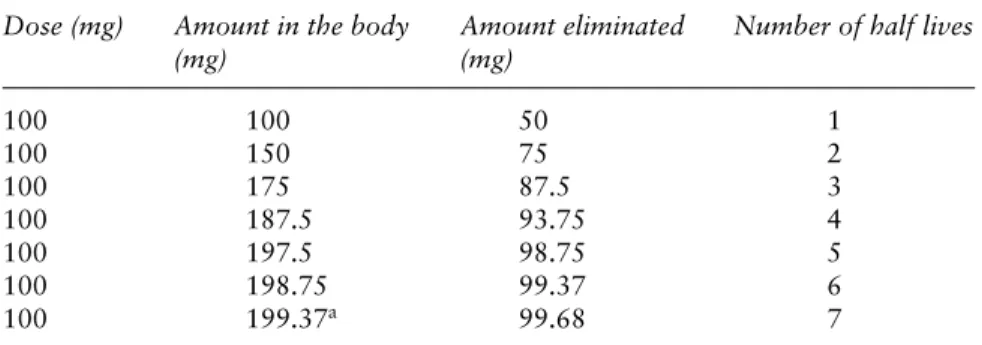
In practice, steady state is assumed to be reached in 4–5 half-lives. If we assume that a patient is receiving a 100-mg dose and half the total amount is eliminated at each half-life, Table 1.2 shows the time to reach a steady-state concentration in the body.
Intravenous infusion
Some drugs are administered as an intravenous infusion rather than as an intravenous bolus. To describe the time course of the drug in plasma during the infusion prior to steady state (see Figure 1.12), one can use:
where
or
if a salt of the drug is given.
R S D R D Cpt R[1 exp kt] CL ( ) Cpss S F D CL
Table 1.2 In practice, steady state is assumed to be reached in 5 half-lives. If we assume a patient is receiving 100-mg doses and half the total amount is eliminated at each half life, the table shows the time to reach steady-state concentration in the body
Dose (mg) Amount in the body Amount eliminated Number of half lives
(mg) (mg) 100 100 50 1 100 150 75 2 100 175 87.5 3 100 187.5 93.75 4 100 197.5 98.75 5 100 198.75 99.37 6 100 199.37a 99.68 7
Following a continuous infusion, the plasma concentrations will increase with time until the rate of elimination (rate out) equals the rate of infusion (rate in) and will then remain constant. The plateau concen-tration, i.e. Cssp, is the steady-state concentration. Steady state will be achieved in 4–5 times the t1/2. If one considers the previous equation, which describes the plasma concentration during the infusion prior to steady state, then at steady state,
exp(kt)0
As rate inrate out at steady state,
where RD/ infusion rate (dose/h).
When a constant infusion is stopped, the drug concentrations in the plasma decline in an exponential manner, as illustrated in Figure 1.13.
To estimate the plasma concentration, Cp at tone must describe the decay of Css
p at time tto Cpat time t. Thus, from the above:
To describe the decay of Cpfrom tto t, one uses the single-dose IV bolus equation CptCp0[exp(kt)] Cpss D CL Cpss D CL R CLCpss Pharmacokinetic applications 19 Cp Cp Time ss
Since Cp0is Cssp, then from the above,
Loading dose
The time required to obtain steady-state plasma levels by IV infusion will be long if a drug has a long half-life. It is, therefore, useful in such cases to administer an intravenous loading dose to attain the desired drug concentration immediately and then attempt to maintain this con-centration by a continuous infusion.
To estimate the loading dose (LD), where Cssp is the final desired concentration, use
If the patient has already received the drug, then the loading dose should be adjusted accordingly:
or
if the salt of the drug (salt factor S) is used.
LD d p ss p initial V C C S ( ) LD d pss pinitial V (C C ) LDVd Cpss Cp Dexp[ k t( t CL )] Cp X Cp Time Cpss
Now consider the plasma concentration–time profile following a loading dose and maintenance infusion (see Figure 1.14). The equation to describe the time course of the plasma concentrations of drug follow-ing simultaneous administration of an IV loadfollow-ing dose (LD) and initi-ation of infusion (D) is the sum of the two equiniti-ations describing these two processes individually:
The final plasma concentration achieved is not the ‘true’ steady-state concentration, since that will still require about 4 half-lives to be reached, but depending on the accuracy of the loading dose it will be fairly close. However, this regimen allows the concentration somewhere near steady state to be achieved more rapidly. If the salt is used:
Single oral dose
The plasma concentration–time profile of a large number of drugs can be described by a one-compartment model with first-order absorption and elimination.
Consider the concentration versus time profile following a single oral dose (Figure 1.15). Assuming first-order absorption and first-order
C S kt V S D kt p d LD exp exp CL ( ) [1 ( )] C kt V D kt p d LD exp exp CL ( ) [1 ( )] Pharmacokinetic applications 21 Cp Time Resultant level Maintenance infusion
Loading dose decay
Final steady-state level
elimination, the rate of change of amount of drug (X) in the body is described by:
where kaabsorption rate constant; kelimination rate constant; Xamount of drug in the body; and Xaamount of drug at the absorption site (X0if all is available). Following integration:
To convert X to Cp one uses the apparent volume of distribution (Vd). Furthermore, following oral administration, the bioavailability (F) and salt factor (S) (see below) must be considered.
Fractional bioavailability, F
F is the fraction of an oral dose that reaches the systemic circulation, which following oral administration may be less than 100%. Thus, if F0.5 then 50% of the drug is absorbed. Parenteral dosage forms (IM and IV) assume a bioavailability of 100%, and so F1; it is therefore not considered and is omitted from calculations.
X X k kt k t k k 0 a exp exp a a [ ( ) ( )] d d a a X t k X kX Cp Time Figure 1.15 Single oral dose profile.
If the loading dose is to be administered orally, then the bioavail-ability term (F) needs to be introduced. Thus:
Salt factor, S
Sis the fraction of the administered dose, which may be in the form of an ester or salt, that is the active drug. Aminophylline is the ethylene-diamine salt of theophylline, and Sis 0.79. Thus 1 g aminophylline is equivalent to 790 mg theophylline.
Accordingly, Sneeds to be incorporated along with Finto the oral loading dose equation and the equation that describes the plasma con-centration Cpat any time tfollowing a single oral dose. Thus,
and
N.B. The S factor may need to be considered during IV infusion administration.
Multiple oral dosing
Prior to steady state
Consider a patient on medication prescribed three times a day. The pro-file shown in Figure 1.16 shows the administration of three doses. If we consider a time 28 h into therapy, all three doses would have been administered.
To calculate Cpat 28 h post dose, use the single oral dose equation and consider the contributions of each dose:
Contribution from dose 1; t128 h:
C SFD V k kt k t k k p1 d a a a exp exp [ ( 1) ( 1)] C SFD V k kt k t k k t p d a a a exp exp [ ( ) ( )] LD d p V C S F LDVdCp F Pharmacokinetic applications 23
Contribution from dose 2, t218 h:
Contribution from dose 3; t38 h:
Thus,
Cp28hCp1 Cp2 Cp3
The above method uses the principle of superposition to calculate the Cp at any time tafter the nth dose. The following equation can simplify the process.
where nnumber of doses, dosage interval and ttime after the nth dose. C SFDk V k k nk kt t p a d a exp ( ) [1 ( )](exp( )) 1 eexp exp a at ( ) [ ( )](exp( k nk k ⎧ ⎨ ⎪⎪ ⎩⎪⎪ 1 ))) ( ) 1expka ⎫ ⎬ ⎪⎪ ⎭⎪⎪ C SFD V k kt k t k k p3 d a a a exp exp [ ( 3) ( 3)] C SFD V k kt k t k k p2 d a a a exp exp [ ( 2) ( 2)] Time (h) 28 h 3 2 1 Cp
At steady state
At steady state the plasma concentration–time profile can be described by
The plasma concentration at steady state fluctuates between a maximum
(Cp max) and a minimum (Cp min) concentration, within a dose interval
(see Figure 1.17).
To estimate Cp max, one first needs to estimate time to peak (tpk):
Note that tpkis independent of the dose administered. Thus,
The minimum plasma concentration at steady state occurs just before the next dose, i.e., when t . So
When using these formulae, individual values should be calculated, since they are often used more than once.
C SFDk V k k k k p a d a min ( ) exp( ) exp( ) exp( 1 k k a a ) exp( ) 1 ⎧ ⎨ ⎪⎪ ⎩⎪⎪ ⎫ ⎬ ⎪⎪ ⎭⎪⎪ C SFDk V k k kt k p a d a pk max ( ) exp( ) exp( ) ex 1 p p( ) exp( ) k t k a pk a 1 ⎧ ⎨ ⎪⎪ ⎩⎪⎪ ⎫ ⎬ ⎪⎪ ⎭⎪⎪ t k k k k k k pk a a a e 1 1 1 ln [ exp( )] [ ( )] C SFDk V k k kt k k t p a d a ( ) exp( ) exp( ) exp( 1 aa a t k ) exp( ) 1 ⎧ ⎨ ⎪⎪ ⎩⎪⎪ ⎫ ⎬ ⎪⎪ ⎭⎪⎪ Pharmacokinetic applications 25 Time Cp Cp max Cp min
C A S E S T U D Y 1 . 1 Multiple IV bolus
Patient D receives Drug Code XR2, 100 mg every 8 h. At steady state, two plasma concentrations are measured:
Sample 1 is taken at 1 h post dose: Conc9.6 mg/L Sample 2 is taken pre dose: Conc2.9 mg/L See Figure 1.18
Since the samples were taken at steady state, the pre-dose sample represents the trough concentration. Cp max, Cptand Cp minwill be the same within each dosing interval. → Cp Cp1h Cp predose Time (h) 8 16
Figure 1.18 Two plasma concentrations measured at steady state, Cp 1hand Cp predose.
When the half-life of a drug is long, the fluctuations between the peak and trough are small, and the equation derived above under Intravenous infu-sion (p. 18) can be used to describe the average steady-state concentration:
Clinical case studies
C D T pss CL
Clinical case studies 27
C A S E S T U D Y 1 . 1(continued)
Calculate the elimination rate constant (k)
Now Cp1is 9.6 mg/L and Cp2is 2.9 mg/L, and sample times are 1 h and 8 h (extrapolated). Thus
t2t17 h So
and the half-life (t1/2) is
Calculate the volume of distribution (Vd)
The volume can be calculated from either the 1 h post- or pre-dose samples. From the 1 h post-dose sample
The following equation describes the plasma concentration 1 h post dose at steady state: Thus → V D kt C k V d p1 d exp e exp( ) [ ( )] . 1 100 0 1710 1 0 1710 8 9 6 1 100 0 8428 9 6 0 7454 1 . ( ) . . . . e 1 1 8. L C D kt V k p d exp 1 1 exp( ) [ ( )] t1 2 0 171 0.693 4.1h . k k ln 9.6 In 2.9 1.197 0.171h 1 7 7 k C C t t ln p1 ln p2 2 1
C A S E S T U D Y 1 . 1(continued)
From the pre-dose sample
The following equation describes Cp,minat steady state:
Calculate clearance
Individualised pharmacokinetic parameters The patient’s individual parameters are as follows: Elimination rate constant (k) 0.171 h1 Volume of distribution (Vd) 11.8 L
Clearance (CL) 2.02 L/h
Half-life (t1/2) 4.1 h Time to steady state (tss) 18.5 h
CL L/h d k V 0 171 11 8 2 02 . . . C D k V k V D k p d d exp exp min ( ) [ ( )] exp( 1 )) [ ( )] . ( min . C k V p d exp e 1 100 2 91 0 1710 8 ee L 0 1710 8 100 0 2546 2 9 0 7454 11 8 . ) . . . . C A S E S T U D Y 1 . 2 Oral dose
Patient H, aged 40 years and weighing 60 kg, receives an oral dose of Drug Code XR4, 500 mg every 12 h. The patient is at steady state. A plasma level is measured at 10 h post dose and is reported to be 18.2 mg/L.
Clinical case studies 29
C A S E S T U D Y 1 . 2(continued)
Assume one-compartment kinetics, all doses were given and F1. Estimate patient H’s individualised pharmacokinetic data.
Data given: Vd0.4 L/kg CL0.05 L/h/kg
ka0.4 h1 S1
Use population data to obtain starting parameters Vd0.46024 L
CL0.05603.0 L/h k0.125 h1
t1/25.5 h
Estimate Cptat sampling time (i.e. Cp predicted), t 10 h
Now
SFDka115000.4 and
Vd(kak)24(0.40.125) and the exponential part is
Thus → Cpt 200 6 6 0 2865 0 7768 0 0183 0 9918 . . . . . − ⎛ ⎝ ⎜⎜⎜⎜ ⎞⎠⎟⎟⎟⎟⎟ 10.6 mg/L ( ) ( ) ( ) ( e e e e 0.125 10 0.125 12 0.4 10 1 1 0.4 12 ) C SFDk V k k kt k t p a d a exp [ ( )] exp( ) ( ) exp( 1 k t k a a exp ) ( ) 1
C A S E S T U D Y 1 . 2(continued)
Compare Cp predictedwith Cp measured
Assess whether the patient is ‘clearing’ the drug faster or slower than the initial population data estimate. Assume the volume of distribution is fixed. From the data, the predicted concentration, 10.6 mg/L, when compared with the measured value of 8.2 mg/L, does suggest that the patient’s clearance is faster than population data.
Alter k accordingly by the process of iteration Let k0.10 h1. Thus
CL2.4 L/h
Predict Cpt at 10 h post dose using the above information; ka remains the same:
Vd(kak)24(0.40.10) and the exponential part is
Thus
Cp10 h14.1 mg/L
Still Cp predictedis less than Cp measured. Let k0.08 h1. Thus
CL1.92 L/h
Predict Cptat 10 h post dose: Vd(kak)24(0.40.08) and the exponential part is
Thus
Cp10 h18.4 mg/L
Now Cp predictedis very close to Cp measured.
→ e 1 e e 1 e 0.08 10 0.4 12 0.08 10 0.4 12 − e 1 e e e 0.10 10 0.4 10 0.10 12 0.4 12 −
Assessment of individualised data
In practice the glossary of equations described (p. 37) can be used to simulate plasma concentration vs time profiles for a dosage regimen using different routes of administration. The important issue is to utilise mean pharmacokinetics parameters derived from research that match the clinical and demographic data of the patient. Basic data can be obtained from original research papers or from the pharmaceutical indus-try for the specific drug. Where possible the equations that describe the average steady state concentration (Css
p) can be used to estimate the levels in the patient. Pharmacokinetic interpretation and estimation of a patient’s actual pharmacokinetic data, e.g. CL, relies on plasma concentrations measured at a specific time following drug administration where this depicts the average plasma concentration.
The basic questions to be asked when determining which set of equations to use follows the algorithm described in Figure 1.22.
To determine whether the data are acceptable, see monographs on individual drugs because, for TDM, the individual parameters must be Clinical case studies 31
C A S E S T U D Y 1 . 2(continued) Summary k (h1) CL (L/h) C p predicted(mg/L) 0.125 3.0 10.6 0.10 2.4 14.1 0.08 1.92 18.4
Hence using k0.08 h1the predicted concentration is 18.4 mg/L, which is similar to the observed concentration of 18.2 mg/L.
The patient’s observed pharmacokinetic parameters CL1.92 L/h
Vd24 L k0.08 h1
t8.6 h
interpreted in light of the patient’s dosage details, clinical status, and so on (see individual drug monographs in the following chapters).
Nonlinear pharmacokinetics: Basic parameters
Drugs such as phenytoin will show nonlinear drug handing. The process of metabolism are nonlinear and the rate of metabolism shows zero order. In practice, Michaelis–Menten pharmacokinetics are applied, and the equations are summarised below.
If a patient receives different doses of phenytoin, e.g. 200 mg/day, 250 mg/day, 300 mg/day or 400 mg/day, the steady-state plasma concen-tration varies exponentially with time; that is, a small change in the total daily dose of phenytoin shows a disproportionate increase in the steady-state concentration (Css
p) (Figure 1.19).
Figure 1.20 describes the profile of the rate of metabolism of pheny-toin given at different dosages. As the dose of phenypheny-toin increases, the rate of elimination increases until it reaches a plateau where the rate of elimination is constant despite increases in the total daily dose of the drug. The profile can be described as follows.
Rate of elimination:
Hence the model that appears to fit the pattern for the metabolic elim-ination of phenytoin is not linear and is the one proposed by Michaelis and
d d m pss m pss X t V C K C Daily dose Cpss Figure 1.19 Css
Menten. The velocity (V) or rate at which an enzyme can metabolise a substrate (Cp) can be described by the following equation:
where Vis the rate of metabolism, Vm(sometimes referred to as Vmax) is the maximum rate of metabolism and Kmis the substrate concentration (Cp) at which Vwill be half Vm, i.e. when half the total enzyme is com-plexed with the substrate. (See Figure 1.21.)
V V C
K C
m p
m p
Nonlinear pharmacokinetics: Basic parameters 33
Daily dose
Rate of elimination
Figure 1.20 Profile of elimination following phenytoin administration.
Substrate concentration (Cp) Vm
Vm/2
Km
Figure 1.21 Relationship between rate of metabolism (V) versus substrate concen-tration (Cp) for a drug showing nonlinear pharmacokinetics.
At steady state we know that the rate of administration is equal to the rate of elimination; hence, in the clinical situation, the daily dose (R, or D) is substituted for velocity (V), and the steady-state phenytoin con-centration (Css
p) is substituted for substrate concentration (S). Further equations can be described for steady-state concentrations.
At steady state the rate of administration is equal to the rate of elimination. The rate of administration can be expressed as SFD/where D/can equal R. Hence
Vm is the maximum metabolic capacity, i.e. the total amount of drug that can be eliminated at saturation. Kmis the Michaelis constant, which by definition is the concentration at which the metabolism is operating at half the maximum capacity.
All drugs will show nonlinear handling if they are administered in high enough doses. However, only a small number of drugs show non-linear handling at the doses used clinically.
Whether a drug will show linear or nonlinear drug handling in therapeutic doses depends on the drug’s Michaelis constant Km. For example, consider a drug that has a Kmthat is much greater then Cssp, i.e. the plasma levels seen with normal therapeutic doses of the drug. The rate of elimination can be described as
Since Kmis much more than Cssp, the equation simplifies to
Since Vmand Kmare constants, this now represents a first-order process. In another simulation a drug has a Km that is much less thanCssp, i.e. the plasma levels seen with normal therapeutic doses of the drug.
d d m pss m pss X t V C K C d d m pss m X t V C K d d m pss m pss X t V C K C RSF V C K C m pss m pss
Since Kmis much less than Cpss, the equation simplifies to
Since Vmis a constant, this now represents a zero-order process.
Hence, the relationship between the Michaelis constant (Km) of the drug and the plasma levels of the drug normally achieved with thera-peutic dosages will determine whether the drug will show linear first-order or zero-first-order saturation pharmacokinetics.
Practical clinical use of nonlinear equations
The above equation can be used
● To calculate predicted Cpssfrom a given dosage regimen, to estimate the patient’s Vmusing population Kmvalues.
● To describe the relationship between the total daily dose R(mg/day) and the steady-state serum concentration.
or
N.B. The last three equations are linear relationships.
Clearance (CL) is the parameter that relates the rate of elimination to the plasma concentration. Since CLR/Css
p, CL m m pss V K C C D C K D pss pss m ( max ) C V C K R F S pss m pss m ( ) R F S V K R C ( m m) pss C K R F S V R F S pss m m ( ) ( ) R F S V C K C m pss m pss d d m X t V
And since apparent t1/2(0.693Vd)/CL,
From the above equations, it can be noted that the clearance and half-life will alter depending on the steady-state concentration. Thus Vmand Km should be used to describe the kinetics of phenytoin and not clear-ance and half-life.
Toxic drug levels
For the decay of a toxic plasma concentration (Cp) to a desired plasma concentration (Cp):
where t decaytime (days) to allow Cpto fall to Cp.
Phenytoin serum levels in the presence of altered plasma protein binding
To calculate a ‘corrected’ Css
pfor a patient with a low serum albumin:
where Cp adjustedplasma concentration that would be expected if the patient had a normal serum albumin; C*p steady-state serum level observed; P serum albumin concentration observed; P‘normal’ serum albumin concentration (40 g/L); phenytoin free fraction (0.1).
To calculate a ‘corrected’ Css
pfor a patient with both uraemia and hypoalbuminaemia:
where 0.44 is an empirical adjustment factor and 0.2.
Chapter 10 on antiepileptics describes the clinical use of the above equations. C C P P p adjusted p * (1 )( .0 44 ) C C P P p adjusted p * (1 )( ) C K C C C C V V t p decay m p p p p m d ( )) ( ln / ( ) t V K C V 1 2 0 693 . d( m pss) m
Glossary of pharmacokinetic equations and their application in clinical practice
(1)
(2)
CLkVd (3)
Single IV bolus injection
CptCp0exp(kt) (4)
Single oral dose
Equation to describe plasma concentration at any time (t) after a single oral dose:
(5)
Multiple IV bolus injections
Equations to describe the concentration at any time within a dosing interval:
(6a)
(6b)
(6c)
IV infusion prior to steady state
(7) Cpt D S kt CL exp [1 ( )] C C k k p minss p0 exp exp ( ) ( ) 1 ⎡ ⎣ ⎢ ⎢ ⎤ ⎦ ⎥ ⎥ C C k p maxss p0 exp 1 1 ( ) ⎡ ⎣ ⎢ ⎢ ⎤ ⎦ ⎥ ⎥ C C kt k t pss p0 exp exp ( ) ( ) 1 ⎡ ⎣ ⎢ ⎢ ⎤ ⎦ ⎥ ⎥ C C k k k kt k t t p p0 a a a exp exp [ ( ) ( )] t k 1 2 0 693 / . C S F D V p0 d
IV infusion at steady state
(8)
Multiple oral dosing at steady state
Equation to describe the concentration at any time (t) within a dosing interval, at steady state:
(9)
The maximum concentration is given by:
(10)
The time at which the maximum concentration occurs is given by:
(11)
The minimum concentration is given by:
(12)
Loading doses
(13)
(14)
The average steady state concentration (Css
p) can be described by: (15) Cpss S F D CL LD d p desired p observed V C C S F ( ) LD d p V C S F C C k k k k k k p minss p0 a a exp exp exp ( ) ( ) ( 1 aa a exp ) ( ) 1 k ⎡ ⎣ ⎢ ⎢⎢ ⎤ ⎦ ⎥ ⎥⎥ t k k k k k k maxss a a a exp exp 1 1 1 ln [ ( )] [ ( )] ⎧ ⎨⎨ ⎪⎪ ⎩⎪⎪ ⎫ ⎬ ⎪⎪ ⎭⎪⎪ C C k k k kt k p maxss p0 a a max ss exp exp e ( ) ( ) 1 x xp exp a max ss a ( ) ( ) k t k 1 ⎡ ⎣ ⎢ ⎢⎢ ⎤ ⎦ ⎥ ⎥⎥ C C k k k kt k k t pss p a a a exp exp exp 0 1 1 ( ) ( ) ( ) exp(ka) ⎡ ⎣ ⎢ ⎢⎢ ⎤ ⎦ ⎥ ⎥⎥ Cpss D S CL
Toxic level decay for drugs that show first-order elimination
(16) Where Cp1toxic plasma level and Cp2desired plasma level.
Nonlinear pharmacokinetic equations
Time for decay lnCp lnCp k
1 2
Glossary of pharmacokinetic equations 39
Daily dose Cpss
Figure 1.19 Css
pprofile following different doses of phenytoin.
Daily dose
Rate of elimination
Figure 1.20 Profile of elimination following phenytoin administration.
Pharmacokinetic model
The model that appears to fit the pattern for the metabolic elimination of phenytoin is not linear and is the one proposed by Michaelis and
Menten. The velocity (V) or rate at which an enzyme can metabolise a substrate (Cp) can be described by the following equation:
(17) where V is the rate of metabolism and Vm (sometimes referred to as Vmax) is the maximum rate of metabolism and Km is the substrate con-centration at which Vwill be half Vm, i.e. when half the total enzyme is complexed with the substrate.
V V C K C m p m p Substrate concentration (Cp) Vm Vm/2 Km
Figure 1.21 Relationship between rate of metabolism (V) versus substrate concen-tration (Cp) for a drug showing nonlinear pharmacokinetics.
When equation (18) is used in the clinical situation, the daily dose (R, or D) is substituted for velocity (V), and the steady-state phenytoin concentration (Css
p) is substituted for substrate concentration. Expressions can then be derived for steady state concentrations.
(18) (19) (20) (21) C V C K R F S pss m pss m ( ) R F S V K R C ( m m) pss C K R F S V R F S pss m m ( ) ( ) R F S V C K C m pss m pss
Glossary of pharmacokinetic equations 41 or
(22)
Toxic drug levels
For the decay of a toxic plasma concentration (Cp) to a desired plasma concentration (Cp):
(23)
where t decaytime (days) to allow Cpto fall to Cp.
Phenytoin serum levels in the presence of altered plasma protein binding
To calculate a ‘corrected’ Csspor a patient with a low serum albumin:
(24)
where Cp adjustedplasma concentration that would be expected if the patient had a normal serum albumin; Cp*steady-state serum level observed; P serum albumin concentration observed; P‘normal’ serum albumin concentration (40 g/L); phenytoin free fraction (0.1).
To calculate a ‘corrected’ Css
p for a patient with both uraemia and hypoalbuminaemia:
(25)
where 0.44 is an empirical adjustment factor and 0.2. N.B. The last three equations are linear relationships.
Clearance (CL) is the parameter that relates the rate of elimination to the plasma concentration.
Since (26) CL p ss R C C C P P p adjusted p / * (1 )( .0 44 ) C C P P p adjusted p * / (1 )( ) C K C C C C V V t p decay m p p p p m/ d ( ln( / )) ( ) C D C K D pss max pss m ( )
Does the drug show linear or nonlinear pharmacokinetics?
Linear, use Eqs 1 to 16 (a) Intravenous dosing
Nonlinear, use Eqs 17 to 24 Is it intravenous therapy? IV dosing IV bolus? Is it Is it Prior to ss?
Single IV dose? Multiple IV dose? IV infusion?
At ss?
INTRAVENOUS EQUATIONS, see
Eqs 4, 6, 7, 8
Figure 1.22 Getting the correct equation: the equation numbers link to the glossary of equations. (a) Intravenous dosing. (b) Oral dosing. (c) Loading doses and toxic level decay.
(27)
And since
(28)
(29)
From the above equations, it can be noted that the clearance and half-life will alter depending on the steady-state concentration. Thus Vmand Km should be used to describe the kinetics of phenytoin and not clearance and half-life.
Selection of equations in clinical practice
In considering which equation to apply, use the algorithms shown in Figures 1.22a–c. The relevant questions are answered and the correct equation is selected from the summary of equations above.
t V K C V 1 2 0 693 / d m pss m . ( ) Apparent CL / d t1 2 0 693. V CL m m pss V K C
References/Further reading
Clark, B (1986). In Clark B, Smith D A, eds. An Introduction to Pharmacokinetics, 2nd ed. Oxford: Blackwell Scientific.
Evans W E, Schentag J J, Jusko W J, Harrison H, eds (1992). In Evans W E, Schentag J J, eds. Applied Pharmacokinetics: Principles of Therapeutic Drug Monitor-ing, 3rd edn. Vancouver: Applied Therapeutics.
Gibaldi M, Prescott L, eds (1983). Handbook of Clinical Pharmacokinetics. New York: ADIS Health Science Press.
Shargel L, Wu-Pong S, Yu A B C (2005). Applied Biopharmaceutics and Pharmaco-kinetics. New York: Appleton & Lange Reviews/McGraw-Hill.
Taylor W J, Diers-Caviness M H (2003). A Textbook of the Clinical Application of Therapeutic Drug Monitoring. Irving, TX: Abbott Laboratories Ltd, Diagnostic Division.
References/Further reading 43
Does the drug show linear or nonlinear pharmacokinetics?
Linear, use Eqs 1 to 16 Nonlinear, use Eqs 17 to 24 Is it oral* therapy? Oral* dosing Is it Prior to ss? (b) Oral dosing
(c) Loading doses and toxic level decay Single oral dose?
*Equations can be used for rectal and intramuscular dosing if salt factor,
bioavailability and absorption rate constant are know Multiple
doses?
At ss?
Is it a toxic level of drug? Linear or nonlinear?
ORAL EQUATIONS, see Eqs 5, 9, 10, 11, 12
Is a loading dose required? Is it intravenous or oral?
Use Eqs 13 to 14
Linear, use Eq.16 Nonlinear, use Eq.23
White J R, Garrison M W (1994). Basic Clinical Pharmacokinetics Handbook. Vancouver: Applied Therapeutics.
Winter M E (2003). Basic Clinical Pharmacokinetics, 4th edn. Philadelphia: Lippincott Williams and Wilkins.