AIZAD AYASYI B AB GHAFAR
A thesis submitted in partial fulfillment of the requirements for the award of the degree of
Bachelor of Mechanical Engineering
Faculty of Mechanical Engineering Universiti Malaysia Pahang
UNVERST MALAYSA PAHANG
NO. FerOelar,
037921
No. Pnogi- Tarzkh
ABSTRACT
Proton Saga is one of the most successful sedan cars in Malaysia. The aerodynamics of this car can be defined as bad because the box shape gives a great value of drag coefficient. The improvement of the aerodynamics of Proton Saga car can reduce the fuel consumption because the power needed to withstand the drag force created is decreased. Economical effective wool tufts method is use to analyze the airflow of Proton Saga car with vortex generator. The increase of pressure distribution on the rear window surface of the car makes the flow separation to delay. The aerodynamics improves with the changes of most turbulence flow into laminar flow. The prediction that can be made that the drag force created decrease proportionally with the drag coefficient. This paper presents the analysis of the effect of vortex generator usage on delaying flow separation of Proton Saga car experimentally.
ABSTRAK
Kereta Proton Saga adalah salah satu kenderaan yang banyak digunakan di Malaysia. Keadaan aerodinamik kereta mi adalah tidak begitu baik kerana bentuknya yang berupa seakan kotak menyebabkan nilai pemalar heret untuk kereta mi adalah tinggi. Penambahbaikan aerodinamik dapat mengurangkan kadar penggunaan minyak kerana kuasa yang dijana oleh enjin yang diperlukan untuk menentang daya heret yang terhasil dapat dikurangkan. Kaedah analisis yang murah dan berkesan menggunakan benang kait untuk mengkaji aliran udara keatas permukaan kereta Proton Saga dengan penambahan allat penjana pusaran angin. Peningkatan tekanan diatas permukaan cermin belakang kereta mi menyebabkan perubahan aliran udara ditangguh. Aerodinamik kereta im diperbaiki dengan perubahan aliran udara jems pusaran kepada aliran udara jenis sekata. Anggapan yang dapat dibuat adalah daya heret berkurangan secara langsung dengan pemalar heret. Kertas kajian mi ditulis untuk mengkaji kesan penggunaan alat penjana pusaran angin terhadap penangguhan aliran udara secara ujikaji.
TABLE OF CONTENT
CHAPTER TITLE PAGE
ACKNOWLEDGEMENTS iv
ABSTRACT v
ABSTRAK vi
LIST OF CONTENT vii
LIST OF FIGURE x
LIST OF SYMBOLS xii
LIST OF ABBREVIATION xiii
LIST OF APPENDICES xiv
1 INTRODUCTION
1.0 Introduction 1
1.1 Problem Statement 3
1.2 Objectives of the Project 3
1.3 Scope of the Project 4
1.4 Flowchart 5 1.5 Thesis Disposition 6 2 LITERATURE REVIEW 2.0 Introduction 7 2.1 Aerodynamics 2. 1.1 Definition 9
2.1.2 Classes of Aerodynamics Problems 9
2.1.3 Automotive Aerodynamics 10
2.2.1 Introduction 11
2.2.2 Boundary Layer Development 11
2.2.3 Laminar & Turbulent Flows 12
2.2.4 Flows around car's body 13
2.2.5 Flows around Sedan 14
2.2.6 Pressure Distribution 15
2.3 Vortex Generator (VG(s))
2.3.1 Introduction 15
2.3.2 Mechanism of VG(s) 16
2.4 Previous Research of VG(s) 18
2.4.1 Research on Aerodynamic Drag Reduction by VG(s)
2.4.1.lIntroduction 18
2.4.1.2 Experiment Method 18
2.4.1.3 Designing the Evo VG(s) 19
2.4.1.4 Test Results 21
2.4.1.5 Conclusion 24
2.4.2 Blowing the Vortex Part 4
2.4.2.1 Introduction 25
2.4.2.2 Experiment Method 25
2.4.2.3 Test Result 27
2.4.2.4 Conclusion 28
2.5 Airflow Measurement Techniques 29
2.6 Design the VG(s) 2.6.1 Various Designs of VG(s) 30 2.6.2 Factors to be considered 31 2.7 Consequences of using VG(s) 32 2.7 Conclusion 33 3 RESEARCH METHODOLOGY 3.0 Introduction 34
lx
3. 1.1 Wool Tufts Preparations 36
3.1.2 Driving and Photographing 37
3.1.3 Method Procedure 37 3.2 Fabricating the VG(s) 3.2.1 Material Selection 38 3.2.2 Design of the VG(s) 38 3.3 Experiment Parameters 39 3.4 Conclusion 40
4 RESULT AND DISCUSSION
4.0 Introduction 41
4.1 Airflow Analysis on Proton Saga Body without VG(s) 41
4.2 Design and Fabricating the VG(s) 44
4.3 Airflow analysis on Proton Saga body with VG(s) 44
4.3.1 Airflow Analysis of 90° VG(s) 45
4.3.2 Airflow Analysis of 15°VG(s) 46
4.3.3 Airflow Analysis on the Designs of the VG(s) 47
4.4 Conclusion 48 5 CONCLUSION 5.1 Overall Conclusion 50 5.2 Recommendations 51 REFERENCES 52 APPENDIX 53
LIST OF FIGURE
NO. TITLE PAGE
1.1 Common shapes with its drag coefficients 2
1.2 Flow around a sedan 2
1.3 Flowchart 5
2.1 Overview diagram for Literature Review 8
2.2 Flow through a plate 11
2.3 Velocity boundary layer development on a flat plate 12
2.4 Patterns of air flows through a Porsche body 13
2.5 Patterns of airflow around rear body observe using tuft-wool 14
2.6 Pressure distribution on sedan car 15
2,7 VG(s) installed on a car 16
2.8 Schematics of velocity profile around rear end 16
2.9 Schematics of flow around VG(s) 17
2.10 Velocity profile on roof 19
2.11 Location of VG(s) 20
2.12 Bump shape VG(s) 20
2.13 Delta wing shape VG(s) 21
2.14 Test result for Bump shape 21
2.15 Test result for Delta wing shape 22
2.16 Velocity distribution by CFD without VG(s) 23
2.17 Velocity distribution by CFD with VG(s) 23
2.18 Pressure distribution by CFD 24
2.19 Wool tufts on Toyota Prius rear window 26
2.20 Airtabs VG(s) 26
2.21 4 VG(s) installed to the car 27
xl
2.23 Single vortex generator designs 31
3.1 Overview diagram for research methodology. 35
3.2 Grid line for wool tufts line up 36
3.3 3D models for 90° angle VG(s) 39
3.4 3D models for 150 edge VG(s) 39
4.1 Wool tufts patents at early acceleration 42
4.2 Wool tufts patterns at 30 km/h 42
4.3 Wool tufts patterns at 50 km/h 43
4.4 The separation point 43
4.5 90°VG(s) 45
4.6 150VG(s) 45
4.7 Comparison of wool tufts patterns with and without VG(s) 46 4.8 Comparison of wool tufts patterns with and without VG(s) 47 4.9 Comparison of wool tufts patterns for both VG(s) designs 48
LIST OF SYMBOLS Cd = Coefficient of Drag T = Shear Stress U = Velocity of Air FD = Drag Force P = Density of Air g = Gravity Acceleration h = Height X = Sweep Angle = Incidence Angle A = Projected Area p = Pressure Re = Reynolds Number V = Velocity of Car
LIST OF ABBREVIATIONS
VG(s) Vortex Generator/s
CFD Computational Fluid Dynamics
mm Millimeter
m Meter
3D Three Dimensional
kg Kilogram
LIST OF APPENDICES
APPENDIX TITLE PAGE
Al 90°VG(s) Design 53
A2 15°VG(s) Design 54
Bl Final Year Project 1 Gantt Chart 55
CHAPTER 1
INTRODUCTION
4.0 Introduction
The presence of road vehicles is increases each day. This situation forced the manufactures to improve their vehicle's design. Some of the improving features on the vehicles are aerodynamic design, ergonomic design and the power of the engine. Feature such an aerodynamic design need to be improve after concerning to the attractive looks, fuel consumption and passengers safety regarding to the vehicle's stability. It is an important feature of aerodynamic design to give safety condition for the passenger.
The body of a car is design via studies of air flows through the surface. Drag coefficient of a car is refers to the dimensionless coefficient of drag force of a certain shape [1]. The reduction of drag is essential to improve driving performance, fuel consumption and aerodynamics design that can gain attractive.
The body car is design in such ways to allow air flows through the body. The sedan car like Proton Saga car body's bluffness, when expressed by the drag coefficient is generally between 0.2 and 0.5, while the more bluff cubic objects is greater than 1 and least bluff bullets is less than 0.1. Figure 1.1 below shows the variety shapes and its general drag coefficient:
-
_____ C0 039 Harnispw
- Co =0.007
_____ MoH
Figure 11 Common shapes with its drag coefficients
Two elements that have major influence on the drag coefficient of a bluff object are the roundness of its front corners and the degree of taper at its rear end.
Figure 1.2 Flow around a sedan. [6]
Figure 1.2 above shows the flows around a sedan car. The presence of a trunk at the rear cause the flow to separates at the roof end and then spreads downwards.
In aeronautical field, it is important to measure the best drag and lift force of an airplane in order to lower the stall speed of the plane and improve the stability. To achieve that, vortex generators (VG(s)) increases the mean streamwise momentum of the boundary layer by drawing in high momentum fluid from the freestream [2].
J
If the same principles applied into the sedan car, theoretically the drag coefficient can be reduce by the help of VG(s), thus improving the airflow around the car's body.
4.1 Problem Statement
When a sedan car such as Proton Saga car moving, the airflow separation above the car's body occur. Because there are different pressure distributions from the roof of the car down to the window and boot lid, the airflow around these parts is slightly different. Laminar flow occurs at low pressure region on top of the roof while the pressure distribution increase as the air flows along the rear window and the boot lid. The increments of pressure distribution contribute the existence of
turbulent flow at A region as shown in Figure 1.2.
The present of turbulent flow will affected the aerodynamic of the car. The separation point from laminar flow to turbulent flow occurs at the rear end of the Proton Saga car roof. The purpose of VG(s) installed are to give additional air and to control the flow separation at the roof end of Proton Saga car by delaying the flow separation, thus allowing the laminar air flows along the rear window. As this happen, the aerodynamic of Proton Saga car will be improved.
1.2 Objective of the Project
i. To study the air flow of Proton Saga car.
ii. To design and fabricate the suitable size of VG(s) that can improve the aerodynamic of Proton Saga car, thus reduce the drag coefficient.
wool tufts method.
ii. Fabricate suitable VG(s) using aluminum sheets. iii. Literature study.
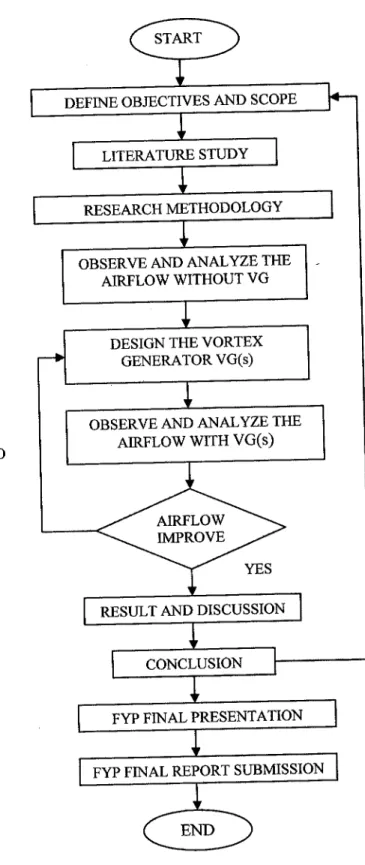
1.4 Flowchart
START
I
DEFINE OBJECTIVES AND SCOPE I LITERATURE STUDYI RESEARCH METHODOLOGY
OBSERVE AND ANALYZE THE AIRFLOW WITHOUT VG
DESIGN THE VORTEX GENERATOR VG(s)
OBSERVE AND ANALYZE THE NO
I I
AIRFLOW WITH VG(s)AIRFLOW
IMPROVE>
YES RESULT AND DISCUSSION]T
CONCLUSION]E:
FYP FINAL PRESENTATION
4,
FYP FINAL REPORT SUBMISSION
the project, the scope and limitation and the problem statement on why this project is necessary to be done discussed in this chapter. Chapter 1 also is an overview about the project in more general view.
Chapter 2 is the Literature Review; discuss about the literature that referring to the project. The content in this chapter is narrowed from the general description about aerodynamics to the consequences of VG(s) usage on a car. Also include in this chapter are the previous studies on VG(s) usage to improve the aerodynamics of the car with different procedure.
The methodology of the study will be discuss in Chapter 3; Research Methodology. The procedure for analysis, design and fabrication process will be discussed in detail and systematic way. The material selection and procedure to be done for goal achieve will be discuss later on.
Result and Discussion is the title for Chapter 4. All the result data, graphs, photographic and calculation will be show and discuss in this chapter. the whole conclusion whether the objective is achieve or not will be stated in Chapter 5 after concerning all the result and analysis.
CHAPTER 2
LITERATURE REVIEW
5.0 Introduction
The purpose of this chapter is to explain about the principles of aerodynamics especially on road vehicle which can be understood through fluids dynamics studies. Chapter Two also discussed about the previous researches on VG(s). In addition, in order to design the VG(s), the way of the flow through the vehicle must be observed. This flow can be observed via aero test and using simulation which is will be explained details in this chapter. From the previous research, the VG(s) was design to suite a sedan car. A part from that, we can apply the mechanism of VG(s) to Malaysian sedan car. This mechanism will be discussed details in Chapter Two. Figure 2.1 shows the overview diagram for Chapter Two.
Flow separation
Laminar and Turbulence flow
Pressure Distribution on the car surface
Drag Coefficient
Airflow Measurement Techniques
Vortex Generator
Previous Studies of VG(s)
Consequences of VG(s)
2.1 Aerodynamics
2.1.1 Definition
Aerodynamics is a branch of fluids mechanics which study about the forces generated on a body in a flow 3]. The aerodynamics usually involves calculation in the properties of the flow such as pressure, velocity, temperature, density as a
function of space and time. In order to calculate or approximate the forces and moments acting on the bodies in the flow, we must understand the pattern of the flows.
2.1.4 Classes of Aerodynamics Problems
Aerodynamic problem can occurred in many classes. The studies of flow around solid objects of various shapes called the External Aerodynamics such as evaluating the lift and drag on an airplane and the shock waves that form in front of the nose of a rocket. The Internal Aerodynamic then studies about the flow through passages in solid objects such as study of the airflow through a jet engine or through
an air conditioning pipe.
The second classification of aerodynamic is the ratio of the characteristic flow speed to the speed of sound. A problem is called subsonic if all the speeds in the problem are less than the speed of sound, transonic if speeds both below and above the speed of sound are present, supersonic when the characteristic flow speed is greater than the speed of sound, and hypersonic when the flow speed is much greater than the speed of sound.
The third classification is concerned about the influence of viscosity. Some problem involve only negligible viscous effects mean that the viscous can be
2.1.5 Automotive Aerodynamics
Automotive aerodynamics is the study of the aerodynamics of road vehicles [4]. This study involves reducing drag, reducing wind noise and preventing undesired lift forces at high speed. It is also important to produce required downwards aerodynamics force to improve traction and cornering abilities in some class of racing car.
To have a small surface, the aerodynamic automotive will integrate the wheel and lights. To be streamlined, it does not have shape edge crossing the wind stream and feature a sort tail called fastback. The aerodynamic design will have a flat and smooth to produce desirable downwards forces. The air rams into the engine bay for used of cooling, combustion, passengers, reaccelerated by a nozzle and then ejected under the floor.
Automotive aerodynamic is much different from the aircraft aerodynamic such as road vehicle shapes is bluff, vehicle operates very close to the ground, operating speed lower, the ground vehicle has fewer degrees of freedom and its motion is less affected by aerodynamic forces.
Total Aerodynamic drag = Cd multiplied by the frontal area. The width and height of curvy cars lead to gross overestimations of frontal area [4].
I
2.2 Flows Separation Through a Road Vehicle
2.2.1 Introduction
In determining and observing the aerodynamic of road vehicles it is important to know the airflow through the vehicle's body. Basically, airflow around car's body
can be divided into two simple type which are laminar and turbulent flows. Both layers can be describing in the boundary layer development on car's surface
2.2.2 Boundary Layer Development
In physics and fluid mechanics, the boundary layer is that layer of fluid in the immediate vicinity of a bounding surface [5]. For flow over any surface, there will always exist a velocity boundary layer and hence surface friction [6]. On a body of a car, this surface friction could create drag force that could effect the aerodynamic of the car. To introduce the concept of boundary layer, consider a flow through a plate
in Figure 2.2. U. _ Free stream U00 Velocity Y ! T boundary I
bf
Ia erpp.x
Y, v• A —x, u Turbulent region Buffer layer Laminar sublayer
surface and the free stream whose thickness increases in the flow direction. The surface shear stress, 'rs provides the surface drag force, FD. The surface friction is strongly depending on the flows condition weather laminar or turbulent flows. On car's surface, the boundary layer becomes thicker towards the rear of the car. The thicker the boundary layer, the more easily airflow will separate from the body, leading to turbulent flow [6].
2.2.5 Laminar & Turbulent Flows
Figure 2.3 shows the laminar and turbulent flows of velocity boundary layer development on a flat plate.
Streamline
xc
wl-4-1
-
Laminar - i• TurbulentTransition
Figure 2.3 Velocity boundary layer development on a flat plate [1]
The laminar flow section preceding the turbulent flow section. Laminar flow occurs where viscous forces are dominant and characterized by smooth, constant
13 fluid motion. Turbulent flow dominated by inertial forces, producing random eddies, vortices and other flow fluctuations [6].
2.2.6 Flows Around Car's Body
Figure 2.4 shows the patterns of air flows through a Porsche body on a common road. Note that the blue arrows represent laminar flow while the red arrows represent turbulent flow.
Figure 2.4 Patterns of air flows through a Porsche body [7]
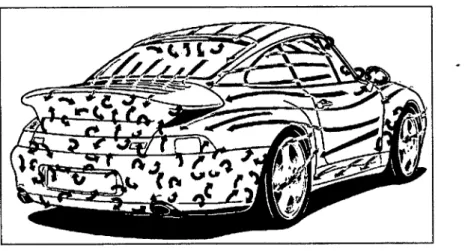
The patterns of airflow can be observed by sticking tuft-wool around the car body and drove the car. Figure 2.5 shows how the tuft-wool sticked to the car body to observe the airflow patterns.
![Figure 1.2 Flow around a sedan. [6]](https://thumb-us.123doks.com/thumbv2/123dok_us/1884592.2775031/13.891.171.708.549.724/figure-flow-around-a-sedan.webp)

![Figure 2.2 Flow through a plate [1]](https://thumb-us.123doks.com/thumbv2/123dok_us/1884592.2775031/22.891.211.741.736.968/figure-flow-through-a-plate.webp)