This is an
Accepted Manuscript
, which has been through the
Royal Society of Chemistry peer review process and has been
accepted for publication.
Accepted Manuscripts
are published online shortly after
acceptance, before technical editing, formatting and proof reading.
Using this free service, authors can make their results available
to the community, in citable form, before we publish the edited
article. We will replace this
Accepted Manuscript
with the edited
and formatted
Advance Article
as soon as it is available.
You can find more information about
Accepted Manuscripts
in the
Information for Authors
.
Please note that technical editing may introduce minor changes
to the text and/or graphics, which may alter content. The journal’s
standard
Terms & Conditions
and the
Ethical guidelines
still
apply. In no event shall the Royal Society of Chemistry be held
responsible for any errors or omissions in this
Accepted Manuscript
or any consequences arising from the use of any information it
contains.
Accepted Manuscript
ChemComm
www.rsc.org/chemcomm
View Article OnlineView Journal
This article can be cited before page numbers have been issued, to do this please use: A. Santoru, C. Pistidda, M. H. Sørby, M. R. Chierotti, S. Garroni, E. Pinatel, F. Karimi, H. Cao, N. Bergemann, T. T. Le, J. Puszkiel, R. Gobetto, M. Baricco, B. C. Hauback, T. Klassen and M. Dornheim, Chem. Commun., 2016, DOI: 10.1039/C6CC05777B.
Table of Contents
The addition of KH to KNH
2provides the first metal amide – hydride solid solution by either
mechanochemical or thermal input.
ChemComm
Accepted
Manuscript
Published on 31 August 2016. Downloaded by Access provided by HZG Library on 01/09/2016 11:29:32.
Journal Name
COMMUNICATION
This journal is © The Royal Society of Chemistry 20xx J. Name., 2013, 00, 1-3 | 1
Please do not adjust margins
Please do not adjust margins
a.Nanotechnology Department, Helmholtz-Zentrum Geesthacht Max-Planck Straße1, 21502, Geesthacht, Germany
b.
Department of Chemistry and NIS centre, University of Torino, V. Giuria 7, 10125, Torino, Italy
c.Physics Department, Institute for Energy Technology (IFE), P.O. Box 40, NO-2027
Kjeller, Norway
d.Department of Chemistry and Pharmacy, University of Sassari, V. Vienna 2,
07100, Sassari, Italy
e.
Department of Physicochemistry of Materials,Consejo Nacional de
Investigaciones Científicas y Técnicas (CONICET) y Centro Atómico Bariloche, Av. Bustillo km 9500, San Carlos de Bariloche, CP 8400, Argentina
Electronic Supplementary Information (ESI) available: powder X-ray and neutron diffractograms, Rietveld refinements, thermal decomposition, experimental details. See DOI: 10.1039/x0xx00000x
Received 00th January 20xx, Accepted 00th January 20xx DOI: 10.1039/x0xx00000x www.rsc.org/
KNH
2- KH: a metal amide - hydride solid solution
Antonio Santoru*[a, b], Claudio Pistidda[a], Magnus H. Sørby[c], Michele R. Chierotti[b], Sebastiano
Garroni[d], Eugenio Pinatel[b], Fahim Karimi[a], Hujun Cao[a], Nils Bergemann[a], Thi T. Le[a], Julián
Puszkiel[a, e], Roberto Gobetto[b], Marcello Baricco[b], Bjørn C. Hauback[c], Thomas Klassen[a] and
Martin Dornheim[a]
We report for the first time the formation of a metal amide-hydride solid solution. The dissolution of KH into KNH2 leads to an
anionic substitution, which decreases the interaction among NH2
-ions. The rotational properties of the high temperature polymorphs of KNH2 are thereby retained down to room
temperature.
The amides of alkaline and alkaline-earth metals were discovered and independently investigated by J. L. Gay-Lussac and H. Davy in the early 19th century1, 2. Further studies on their properties were performed towards the end of the same century, most systematically from A. W. Titherley3. The determination of their crystal structures was possible only after the 1930s with the studies of Juza et al.,4-10 later continued by Jacobs et al.11, 12
At that time this class of compounds was mostly used for organic synthesis. However, more recently, metal amides – metal hydrides mixtures have been proven to be suitable for reversible hydrogen storage.13 Furthermore, metal amides – metal borohydrides systems are regarded as potential solid state ionic conductors.14
The structural and thermal properties of light-weight amides prepared by reaction of metal hydrides with ammonia have been systematically examined by in situ diffraction experiments.15 While the reaction mechanism and products reported in previous studies were confirmed for the amides of lithium and sodium,16-18 the formation of new K-N-H based intermediates was suggested for potassium amide. The same
intermediates were proven to play a role in the desorption reactions of the K-Mg-N-H system.19 These intermediates are isolated here in the KNH2-KH system and, to the best of our
knowledge, identified as the first metal amide-hydride solid solution.
The crystal structures of pristine potassium amide and potassium hydride have already been investigated by X-ray and neutron diffraction.7, 8, 12, 20-22 Potassium hydride is known to crystallize in a cubic rock-salt type structure with space group (s.g.) Fm3̅m and no polymorph changes are expected in the temperature range from room temperature (RT) to 390 °C.21 For potassium amide, the stable polymorph at RT is monoclinic with s.g. P21/m.7 Upon heating this phase
transforms into a tetragonal structure with in P4/nmm at 54 °C.12 The latter phase is stable only in a narrow temperature range; and already above 75 °C the stability of a cubic phase (Fm3̅m) prevails.12, 20, 22 An increase of symmetry is therefore reached with the two phase transitions at higher temperature. The explanation of the symmetry changes resides in the increasingly high orientational disorder of the amide anions, as proven by powder neutron diffraction (PND), quasielastic incoherent neutron scattering and orientation-dependent deuterium spin lattice relaxation.20, 23, 24 If the maximum temperature upon heating is kept below the decomposition temperature of KNH2 (ca. 340 °C), the two phase transitions
and the associated rotational dynamics should be reversible on cooling.
This is in agreement with the present in situ synchrotron radiation powder X-ray diffraction experiment (SR-PXD) on KNH2 (ESI). When a 0.5 KNH2 + 0.5 KH mixture was
investigated, the expected phase transformations of KNH2 took
place, but the interaction of KNH2 and KH in the temperature
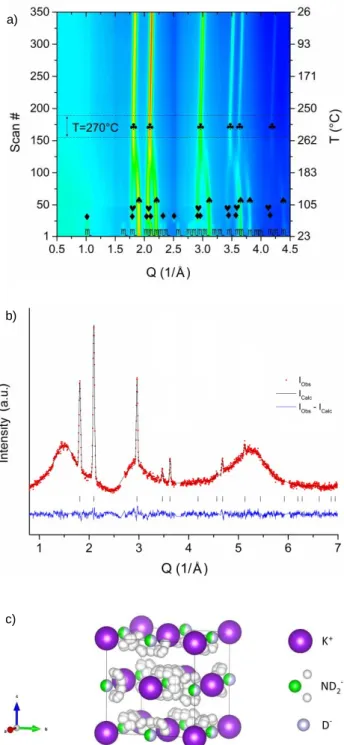
range between 100 °C and 270 °C led to the formation of a new cubic structure (Figure 1 a).†
PND at 270 °C of a potassium deuteramide - potassium deuteride mixture confirmed the presence of a single cubic phase at this temperature (Figure 1 b).‡
Page 2 of 5
ChemComm
ChemComm
Accepted
Manuscript
Published on 31 August 2016. Downloaded by Access provided by HZG Library on 01/09/2016 11:29:32.
View Article Online DOI: 10.1039/C6CC05777B
COMMUNICATION Journal Name
The structure was solved assuming an ionic crystal with unaltered positions for the potassium cations and partially occupied sites at the original positions of amide and hydride anions. Indeed the formation of a solid solution is highly favorable due to the structural similarities between the two
cubic polymorphs of KNH2 and KH (same space group, same
cation, same charge for the anions, similar lattice constants). The local symmetry of the deuteramide groups is compatible with the s.g. Fm3̅m only assuming rotational dynamics and orientational disorder. In this case the restrictions imposed from both the s.g. and rigid amide groups resulted in partially occupied sites (multiplicity = 192) for the deuterium atoms of each amide group (Figure 1 c).
The final Rietveld refinement25, 26 of the PND pattern (Figure 1 b) confirmed the structural model, i.e. the formation of a potassium amide-hydride solid solution. To the best of our knowledge, no similar cases have been reported so far for other alkaline metal amides-metal hydrides mixtures.
The similarity of chemical environment between the starting materials and the x KNH2 + (1- x) KH samples at different
compositions (x = 0.1, 0.5, 0.9) after annealing was verified by
1
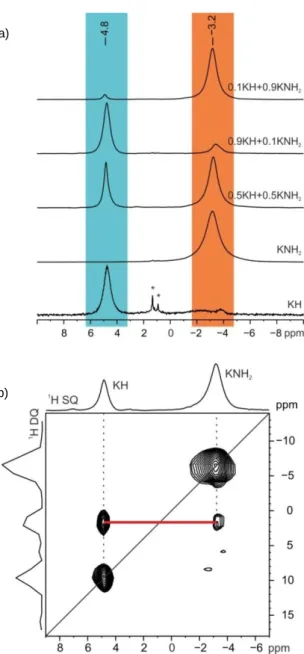
H magic angle spinning solid-state NMR (MAS SSNMR), see Figure 2.§
No significant shifts are observed while the integral values perfectly reflect the composition of the solid solution. Furthermore, the same T1 1H value (46 s) for both signals
supports the formation of a solid solution since it indicates that spin diffusion is active. This is only possible if they belong to the same phase or in the case of homogeneous samples on a nanometer scale.27 Direct evidence of the solid solution formation is provided by the 1H double-quantum (DQ) MAS SSNMR experiment (Figure 2 b). Indeed, the observed DQ correlation between the KNH2 (-3.2 ppm) and KH (4.8 ppm)
signals implies that they are in close spatial proximity each other (less than 5 Å). This is only possible if they are intimately related as in a solid solution.28, 29 Similar correlation, although much weaker, is observed for the sample before annealing (Supporting Information), which can be explained with the formation of a small fraction of solid solution due to the fast rotation and slightly increased temperature during the NMR experiment.
The effect of the starting composition of the mixtures on the final structure was studied by means of in situ SR-PXD. A linear relationship was found between the unit cell parameter of the cubic phase at T = 270 °C and the molar fraction of amide anions (Figure 3 and Table 1) as expected from Vegard’s law.30 This indicates volumes of mixing close to zero and, therefore, an almost ideal behavior for the solid solution (∆Hmix ≈ 0).
It is noteworthy that, for the compositions x = 0.1, 0.3, 0.5, 0.7, the structure did not change during the cooling process down to RT, except for the thermal contraction of the unit cell volume (more details in Table 1 and in Supporting Information).
It appears that the addition of potassium hydride can stabilize the cubic geometry, which retains the rotation of the amide anions even at RT. A similar behavior was previously reported for the sodium borohydride - sodium chloride systems, at different temperature (T = - 81 °C).31Ex situ PXD of annealed samples (x = 0.3, 0.5, 0.7, 0.9) collected with a Bragg Brentano diffractometer proves the coexistence of at least two different cubic structures. The composition x = 0.1, however, presented unchanged cubic phase (see Supporting Information). At the Figure 1. a) In situ SR-PXD experiment on the 0.5 KNH2 + 0.5 KH sample. = KNH2
(P21/m), = KNH2 (P4/nmm), ♥ = KNH2 (Fm3̅m), ♠ = KH (Fm3̅m), ♣ = new phase
(Fm3̅m). b) PND pattern of the nominal 0.5 KND2 + 0.5 KD mixture annealed up to
270 °C and kept in isothermal condition during the data collection. Rwp(%) = 2.8 (corrected for background). The wavy background was originated from the quartz sample holder (see Supporting Information). c) Structural model of the cubic phase (s.g. Fm3̅m) of composition K(ND2)0.46D0.54 obtained after the Rietveld refinement,
taking into account the anionic substitution at the position (0.5 0.5 0.5) and the orientational disorder of amide anions.
b) a) c)
ChemComm
Accepted
Manuscript
Published on 31 August 2016. Downloaded by Access provided by HZG Library on 01/09/2016 11:29:32.
View Article Online DOI: 10.1039/C6CC05777B
Journal Name COMMUNICATION
This journal is © The Royal Society of Chemistry 20xx J. Name., 2013, 00, 1-3 | 3
Please do not adjust margins
Please do not adjust margins
composition x = 0.9, coexistence of the cubic and monoclinicphases was found. These results suggest the presence of a two phase field at RT. Nevertheless, even in the cases where phase segregation occurred, both cubic structures were proven to be unchanged even after several months, hence a complete transformation back to the pure monoclinic phase of KNH2 and
cubic phase of KH did not occur.
Noteworthy, the same structures are formed simply by mechanochemical treatments of the starting reactants. In some cases (x = 0.1, 0.3 and 0.9) manual grinding is enough to promote the formation of detectable amounts of K(NH2)xH(1-x)
solid solution. These species are therefore easily formed and are expected to be possibly identified as reaction products or
intermediates in future studies of amide-based systems containing potassium.
Table 1. Structural details of the K(NH2)xH(1-x) phase at different compositions
x[a] x [b] a / Å [c] α / K-1[d] a / Å [e] 0 0 5.74934(14) 3.19(2)E-05 5.70390(14) 0.1 0.070(5) 5,81372(13) 5.30(1)E-05 5.73769(13) 0.3 0.240(8) 5,8989(2) 5.88(2)E-05 5.8134(2) 0.5 0.490(14) 6.0003 (2) 6.32(1)E-05 5.9060(2) 0.7 0.72(3) 6,07768(12) 6.83(1)E-05 5.98320(12) 0.9 0.91(3) 6,14553(14) 6.83(2)E-05 6.04230(14) 1 1 6,17667(8) 7.38(1)E-05 6.06473 (8)
[a] Nominal composition and [b] Refined composition (molar fraction) of KNH2 [c]
Refined cell parameters at 270 °C [d] Calculated linear thermal expansion coefficients [e] Calculated cell parameters at 20 °C. Estimated standard deviations are given in parentheses.
To the best of our knowledge, amide/hydride solid solutions were not reported so far. In this sense, the chemistry of the K-based amide/hydride system is interestingly peculiar and differs substantially from the one of the other alkaline metal amides/hydrides.
The research leading to these results has received funding from the European Marie Curie Actions under ECOSTORE grant agreement no. 607040. The help of the beamline scientists Francisco Martinez Casado, Dorthe Haase, Olivier Balmes, (MAX-lab – Lund, Sweden), Martin Etter and Jozef Bednarcik (DESY – Hamburg, Germany) is thankfully acknowledged. A.S. thanks the research groups of Turin University, Sassari University and IFE for the fruitful discussion and Dr. Klaus Taube, coordinator of the ECOSTORE project, for providing the essential networking opportunities.
Notes and references
†The in situ SR-PXD experiments were performed at the diffraction beamline I711, MAX Lab (Lund, Sweden) and at the diffraction beamline P02, DESY (Hamburg, Figure 2. a) 1H (400.23 MHz) MAS SSNMR spectra of starting reagents and x KNH
2 +
(1 - x) KH samples at different composition (x = 0.1, 0.5, 0.9) after annealing recorded with a spinning speed of 32 kHz. Asterisks denote impurities. b) 2D 1H (400.23 MHz) DQ MAS SSNMR spectrum of the KNH2 + KH (x = 0.5) after annealing
recorded with a spinning speed of 32 kHz. The red line highlights the DQ correlation between the KH and KNH2 signal.
a)
b)
Figure 3. Unit cell parameters (dots) obtained by in situ SR-PXD experiments in isothermal conditions (T = 270 °C) as a function of the potassium amide content and corresponding linear fit (continuous line). The values for T = 20 °C (triangles) were calculated using the thermal expansion coefficient of each phase and then fitted (dotted line). The error bars for molar fractions and cell parameters were calculated considering the errors of the Rietveld process.
Page 4 of 5
ChemComm
ChemComm
Accepted
Manuscript
Published on 31 August 2016. Downloaded by Access provided by HZG Library on 01/09/2016 11:29:32.
View Article Online DOI: 10.1039/C6CC05777B
COMMUNICATION Journal Name Germany) (monochromatic beams of ≈ 0.99 Å and ≈ 0.2 Å were employed
respectively). The in situ cells and the procedure used are described elsewhere.19, 32 ‡ PND was performed at the PUS instrument at the JEEP II reactor at IFE, Norway.33
Neutrons with = 1.5539 Å were provided by a focussing Ge(511) monochromator at 90° take-off angle. Data was collected in the range 2 = 10-130° (2 = 0.05°) by
2 detector banks each with 7 vertically stacked position sensitive detectors. The sample was contained in an argon-filled quartz tube with 6 mm diameter placed inside an in-house built furnace. The structure solution was carried out using the software “FOX”34. The Rietveld refinement was performed by means of the
software GSAS35 and the EXPGUI graphic interface36.
§ Solid-state NMR experiments were run on a Bruker AVANCE II 400 instrument operating at 400.23 MHz for 1H and equipped with a 2.5 mm probe. The 1H MAS spectra were acquired at the spinning speed of 32 kHz with the DEPTH sequence (π/2 − π – π) for the suppression of the probe background signal (1H 90° = 2.5 µs;
scans = 16; relaxation delay = 53 s). 2D 1H DQ MAS experiments were performed at
32 kHz with the back-to-back (BABA) recoupling pulse sequence with excitation times of one rotor period (1H 90°= 2.5 µs; 32 scans; t1 increments = 46; relaxation
delay = 53 s). 1H scale was calibrated with adamantane (1H signal at 1.87 ppm) as external standards.
1. J. L. Gay and L. J. Thenard, Journal, 1809, 32, 23-39.
2. H. Davy, Philosophical Transactions of the Royal Society of London, 1808, 98, 333-370.
3. A. W. Titherley, Journal of the Chemical Society, Transactions, 1894,
65, 504-522.
4. R. Juza, Angewandte Chemie, 1964, 76, 290-300.
5. R. Juza, Zeitschrift für anorganische und allgemeine Chemie, 1937,
231, 121-135.
6. R. Juza, K. Fasold and C. Haeberle, Zeitschrift für anorganische und allgemeine Chemie, 1937, 234, 75-85.
7. R. Juza, H. Jacobs and W. Klose, Zeitschrift für anorganische und allgemeine Chemie, 1965, 338, 171-178.
8. R. Juza and H. Liedtke, Zeitschrift für anorganische und allgemeine Chemie, 1957, 290, 205-208.
9. R. Juza and K. Opp, Zeitschrift für anorganische und allgemeine Chemie, 1951, 266, 313-324.
10. R. Juza, H. H. Weber and K. Opp, Zeitschrift für anorganische und allgemeine Chemie, 1956, 284, 73-82.
11. H. Jacobs, Zeitschrift für anorganische und allgemeine Chemie, 1971,
382, 97-109.
12. H. Jacobs and E. Von Osten, Zeitschrift für Naturforschung, 1976, 31, 385-386.
13. P. Chen, Z. Xiong, J. Luo, J. Lin and K. L. Tan, Nature, 2002, 420, 302-304.
14. M. Matsuo, A. Remhof, P. Martelli, R. Caputo, M. Ernst, Y. Miura, T. Sato, H. Oguchi, H. Maekawa, H. Takamura, A. Borgschulte, A. Züttel and S.-i. Orimo, Journal of the American Chemical Society, 2009, 131, 16389-16391.
15. C. Pistidda, A. Santoru, S. Garroni, N. Bergemann, A. Rzeszutek, C. Horstmann, D. Thomas, T. Klassen and M. Dornheim, The Journal of Physical Chemistry C, 2015, 119, 934-943.
16. W. I. F. David, M. O. Jones, D. H. Gregory, C. M. Jewell, S. R. Johnson, A. Walton and P. P. Edwards, Journal of the American Chemical Society, 2007, 129, 1594-1601.
17. J. W. Makepeace, M. O. Jones, S. K. Callear, P. P. Edwards and W. I. F. David, Physical Chemistry Chemical Physics, 2014, 16, 4061-4070. 18. H. Yamamoto, H. Miyaoka, S. Hino, H. Nakanishi, T. Ichikawa and
Y. Kojima, International Journal of Hydrogen Energy, 2009, 34, 9760-9764.
19. A. Santoru, S. Garroni, C. Pistidda, C. Milanese, A. Girella, A. Marini, E. Masolo, A. Valentoni, N. Bergemann, T. T. Le, H. Cao, D. Haase, O. Balmes, K. Taube, G. Mulas, S. Enzo, T. Klassen and M. Dornheim, Physical Chemistry Chemical Physics, 2016, 18, 3910-3920.
20. M. Müller, J. Senker, B. Asmussen, W. Press, H. Jacobs, W. Kockelmann, H. M. Mayer and R. M. Ibberson, The Journal of chemical physics, 1997, 107, 2363-2373.
21. V. G. Kuznetsov and M. M. Shkrabkina, J Struct Chem, 3, 532-537. 22. M. Müller, B. Asmussen, W. Press, J. Senker, H. Jacobs, H. Büttner,
W. Kockelmann and R. M. Ibberson, Physica B: Condensed Matter, 1997, 234–236, 45-47.
23. M. Müller, B. Asmussen, W. Press, J. Senker, H. Jacobs, H. Büttner and H. Schober, The Journal of chemical physics, 1998, 109, 3559-3567.
24. J. Senker, Solid State Nuclear Magnetic Resonance, 2004, 26, 22-35. 25. H. M. Rietveld, Journal, 1967, 22, 151-152.
26. H. M. Rietveld, Journal, 1969, 2, 65-71.
27. K. Gaglioti, M. R. Chierotti, F. Grifasi, R. Gobetto, U. J. Griesser, D. Hasa and D. Voinovich, CrystEngComm, 2014, 16, 8252-8262. 28. D. Braga, L. Chelazzi, F. Grepioni, E. Dichiarante, M. R. Chierotti
and R. Gobetto, Crystal Growth & Design, 2013, 13, 2564-2572. 29. M. R. Chierotti and R. Gobetto, CrystEngComm, 2013, 15, 8599-8612. 30. L. Vegard, Zeitschrift für Physik, 5, 17-26.
31. J. E. Olsen, P. Karen, M. H. Sørby and B. C. Hauback, Journal of Alloys and Compounds, 2014, 587, 374-379.
32. U. Bösenberg, C. Pistidda, M. Tolkiehn, N. Busch, I. Saldan, K. Suarez-Alcantara, A. Arendarska, T. Klassen and M. Dornheim,
International Journal of Hydrogen Energy, 2014, 39, 9899-9903. 33. B. C. Hauback, H. FjellvåG, O. Steinsvoll, K. Johansson, O. T. Buset
and J. Jørgensen, Journal of Neutron Research, 8, 215-232. 34. V. Favre-Nicolin and R. Cerny, Journal of Applied Crystallography,
2002, 35, 734-743.
35. A. C. L. a. R. B. V. Dreele, Los Alamos National Laboratory Report LAUR 86-748, 2000.
36. B. Toby, Journal of Applied Crystallography, 2001, 34, 210-213.
ChemComm
Accepted
Manuscript
Published on 31 August 2016. Downloaded by Access provided by HZG Library on 01/09/2016 11:29:32.
View Article Online DOI: 10.1039/C6CC05777B