Open Research Online
The Open University’s repository of research publications
and other research outputs
Stemming the flow: improving retention for distance
learning students
Conference or Workshop Item
How to cite:
Slade, Sharon and Prinsloo, Paul (2015). Stemming the flow: improving retention for distance learning students. In: EDEN 2015 Annual Conference Proceedings, European Distance and E-Learning Network.
For guidance on citations see FAQs.
c
2015 European Distance and E-Learning Network and the Authors Version: Version of Record
Link(s) to article on publisher’s website:
http://www.eden-online.org/system/files/Book%20of%20Abstracts EDEN%202015%20Annual%20Conference Barcelona.pdf
Copyright and Moral Rights for the articles on this site are retained by the individual authors and/or other copyright owners. For more information on Open Research Online’s data policy on reuse of materials please consult the policies page.
STEMMING THE FLOW: IMPROVING RETENTION FOR DISTANCE LEARNING STUDENTS
Sharon Slade, Open University, United Kingdom, Paul Prinsloo, University of South Africa, South Africa
__________________________________________________________________________________
ABSTRACT
Though concern about student attrition and failure is not a new phenomenon, higher education institutions (HEIs) have struggled to significantly reduce the revolving door syndrome. Open distance learning higher education is particularly susceptible to high student attrition. Despite a great deal of research into the student journey and factors impacting on likely success, we are not necessarily closer to understanding and being able to mitigate against student attrition. Learning analytics as emerging discipline and practice promises to help penetrate the fog…
This case study describes work undertaken at the Open University in the UK to investigate how a learning analytics approach allows the University to provide timely and appropriate student support in a cost-effective manner. It includes a summary of the establishment of curriculum-based student support teams and a framework which defines more standardised student support informed by both student data and an enhanced knowledge of the curriculum. The primary aim of student support teams is to proactively support students through their study journey and to optimise their chances of reaching their declared study goals.
Higher education institutions (HEIs) are making increasing use of learning analytics to support delivery of timely and relevant student support. The Open University in the UK, like other HEIs, knows a great deal about its students before they start to study and is able to track student behaviours once study has begun. Until recently, the university has not taken full advantage of the additional insight offered by such information. This paper describes the framework of support interventions established for all student support teams and describes the learning analytics approach used to support that framework.
Keywords
Learning Analytics, Student Support, Retention, Distance Learning, Curriculum Support.
1. BACKGROUND
It is difficult to understate the scope and impact of the changes facing higher education. Terms such as “disruption” and “innovation” (Christensen, 2008), “disaggregation” (Wiley & Hilton III, 2009), the “unbundling and unmooring” (Watters, 2012), “revolution” (Altbach, Reisberg & Rumbley, 2009), and “crisis” (Carr, 2012) have become endemic to discourses on the current and future states of higher education. Distance, open and e-learning are particularly vulnerable to concerns around quality and student retention (Gaskell & Mills, 2015) despite and amidst claims that higher student attrition in distance education is ‘normal’ and that we should not pathologise this phenomenon (Woodley, 2004). Considering higher education as moral practice, we cannot shy away from the cost of student attrition, to students and institutions alike (Prinsloo & Slade, 2014).
Within this climate, there are claims that student data has become ‘the new black’ (Booth, 2011) and that collecting, analysing and using student data will be a game changer (Diaz & Brown, 2012). Baker and Siemens (2014) point to the potential of learning analytics made possible due to the increasing quantities of data, standardised formats of educational data, increased computational power and the increased availability of a range of analytical tools.
The Open University in the UK (UKOU) supports almost 200,000 distance learning students each year across a range of over 600 undergraduate, postgraduate and professional modules making up a range of qualifications. Teaching is delivered through module materials and on-module academic support from a tutor and/or faculty staff (see Simpson, 2013; Tait, 2012).
Students receive module materials in electronic and/or hard copy and are typically supported, at a distance, through each module by their tutor, working in groups of around 20 students. Tutors facilitate students’ learning and understanding through a variety of approaches: for example, at occasional, optional local tutorials, through assignment marking, interaction and discussion via online tutor group forums, as well as through personal email and phone contact where needed.
1.1 Drivers For Change
In addition to the impacts of general changes affecting higher education, open distance learning (ODL) institutions are particularly affected by changes in funding regimes in the context of their student profiles, admission requirements, costs, and need for effective student support (e.g., Subotzky & Prinsloo, 2011). At the scale at which UKOU operates, student recruitment is a resource intensive activity. Over time, the size and complexity of the support model led to a number of localised approaches and growing inconsistencies in service and support delivery. Understandably, for reasons of both cost and student benefit, a priority has been to maximise the retention and progression of its students.
Following a significant review and pilot period (Open University, 2011), the University established a new model of curriculum-led support which would provide integrated learning and teaching in order to:
• enhance the student experience;
• be flexible and adaptable in responding to changes in student needs and the University’s environment;
• be cost-effective for students and the University; and
• improve module completion and progression onto further study.
This paper discusses the framework of consistent support established across all SSTs and the use of learning analytics to inform and facilitate that support. The framework recognises many of the issues mentioned in the review of Beetham et al (2009), for example, that there needs to be recognition of the diversity of learners and the need to support learners in developing study practices which are based on technology, particularly at key ‘transition points’ of study.
1.2 A Targeted Approach To Student Support
Since early 2014, students have been supported by a primary student support team (SST) based in one of 12 regional or national centres in the UK (Open University, 2014a). Students are automatically allocated to an SST at registration based on their primary curriculum area. Qualifications and modules are uniquely associated with an SST, with almost all on-study (non-academic) support provided by the relevant SST. Each SST has interventions closely aligned to its curriculum and to the profile of its students. The SST aims to pre-empt and guide student behaviour and to rapidly respond to situations where students are not engaging as expected. Each qualification within an SST’s curriculum area (and each module within each qualification) has a number of defined milestones which have been agreed to be key or at least facilitative to the students’ eventual completion and success.
Student support teams combine milestone tracking with additional information generated by module tutors and students to trigger interventions aimed at encouraging the student and to keep them on track. As students study, pause between modules, or consider which module to study next, support and advice is consistently provided by the same team accessed via a single set of contact details.
The team’s challenge has been to provide student support which is personalised to students’ different needs – but at scale. The approach to student support described below can be summarised as ‘inform all, target advice, guide the individual’. Interventions begin one-to-many, are then narrowed down to selected cohorts of students and end with individual guidance for a few.In this respect, learning analytics seems to provide a very effective approach to optimise the collection and analysis of student data in order to personalise support at scale.
3. A MODEL OF INTEGRATED LEARNING AND LEARNER SUPPORT (MILLS)
An enhanced model of support was developed which integrates both learning and learner support into a single framework. This is known within the UKOU as the Model for Integrated Learning and Learner Support (MILLS) and defines both the principles and practices for each SST’s student support interventions and provides a consistent framework within which all SSTs operate.
Students are classified as students in three senses: as students of the University, as students aiming for a qualification and/or as students studying a module. MILLS is designed to incorporate support interventions which are explicitly associated with each of these aspects of studentship. Support interventions are designed to take cognisance of the relevant stage of the student journey with the recognition that more focus may be required at particular stages than others.
3.1 An overview of the Model and links to tracking data
The MILLS framework comprises a set of prescribed 8 module (M) and 4 qualification (Q) focused Universal Interventions which all SSTs apply as appropriate to students within their curriculum area across the student journey. These Universal Interventions cover both the learner and their learning whilst studying a qualification and/or a module. Whilst the interventions are applied to each module or qualification, the selection of appropriate students in receipt of an intervention is conditional on their personal data or study behaviour (or a combination of both). The interventions can be generic and unmodified or tailored to include qualification or module-specific content. For example, a generic ‘getting started’ e-message sent to all students one week after module start may be tailored depending on where the student is located, their stage on their qualification journey, whether they are an undergraduate or a postgraduate student and which qualification or module they are studying.
Universal Interventions are driven by tracking student data within an SST and can be delivered via telephone, e-message, or email, although the scale of the intervention exercise has necessarily resulted in email as a default mode.
In addition, reactive learner support interventions are driven by direct student and/or tutor contact and are therefore personalised for the individual student. They can be elicited in response to an intervention from the SST (for example, students responding to an e-message regarding their preparedness for an end-of-module assessment) or they may be spontaneously generated by students at any point in their student journey, for example, a student contact around changing study intentions or to appeal against an assignment score.
As well as Universal Interventions, an SST is able to apply Elective learning and learner support interventions to meet the needs of specific curriculum areas, subject to resource availability.
Both Universal and Elective Interventions may be targeted to particular subsets of students. For example, although each SST would be expected to provide a universal welcome to all students, they may wish to define and select some students according to very specific criteria. Thus, SSTs with modules or qualifications with a significant work-based component may define all students not in current employment as potentially at greater risk of non completion, whereas those on a maths qualification may choose to define all those who have not attempted a maths diagnostic and who have a low Previous Educational Qualification (PEQ) as at potential risk.
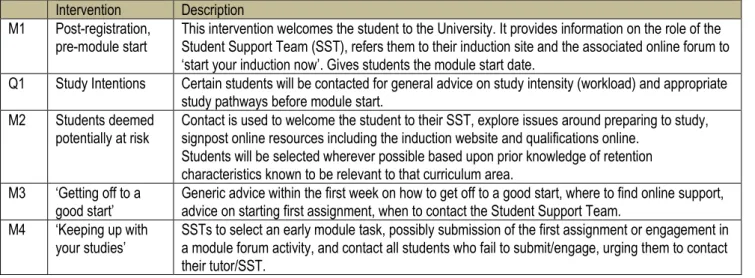
In developing MILLS for a specific SST, teams were thus given a clear framework of those interventions, described below in Table 1, which relate to the whole student journey, coupled with sufficient flexibility to allow the framework to be tailored as appropriate to their learning strategy and student profile.
Table 1 A summary of the key module (M) and qualification (Q) interventions
Intervention Description
M1 Post-registration,
pre-module start
This intervention welcomes the student to the University. It provides information on the role of the Student Support Team (SST), refers them to their induction site and the associated online forum to ‘start your induction now’. Gives students the module start date.
Q1 Study Intentions Certain students will be contacted for general advice on study intensity (workload) and appropriate study pathways before module start.
M2 Students deemed
potentially at risk
Contact is used to welcome the student to their SST, explore issues around preparing to study, signpost online resources including the induction website and qualifications online.
Students will be selected wherever possible based upon prior knowledge of retention characteristics known to be relevant to that curriculum area.
M3 ‘Getting off to a
good start’
Generic advice within the first week on how to get off to a good start, where to find online support, advice on starting first assignment, when to contact the Student Support Team.
M4 ‘Keeping up with
your studies’
SSTs to select an early module task, possibly submission of the first assignment or engagement in a module forum activity, and contact all students who fail to submit/engage, urging them to contact their tutor/SST.
Intervention Description
M5 ‘Reviewing your
progress’
Contact to encourage reflection on study progress as a mid-module progress check. Students signposted to relevant web resources and encouraged to contact the SST for advice as needed. Q2 ‘Your next module’ Contact to encourage reflection on choice of next module within their qualification (where
applicable) or to consider their choice of qualification and how this might link in with career aspirations, as well as to encourage completion of personal development plans. Signposts for additional advice and guidance if required, and how to register, etc.
M6 ‘Meeting the
challenge’
Contact to encourage reflection on study progress in the final third of the module, to think about study choices and who to contact if there are concerns about progress.
M7 End-of-module
assessment
Advice and support for preparing for an exam or final written assessment, including signposts to resources for revision, academic writing, past exam papers and managing stress – plus advice on practical arrangements, including rules on resit/resubmission and postponement.
Q3 Next steps Contact to encourage students to reflect on their progression within their qualification and to plan ahead in terms of study intensity, career and study goals.
M8 Resit/resubmission
advice
Preparation support to all students eligible for resit/resubmission.
Q4 Qualification
completion
Contact to congratulate student, explain the benefits of becoming an alumnus (including the extended careers service), signpost to details of graduation and further study possibilities.
4. LEARNING ANALYTICS TO SUPPORT RETENTION
Learning analytics is already a key part of the approach within the UKOU to proactively support students in achieving their declared study goals. The term intervention is being used in a broad sense to reflect the complexity and diversity of learning and teaching. In the UKOU context, this could for example imply a range of potentially combined interventions, such as re-versioning learning materials; posting a message to a whole cohort via an online noticeboard; targeting a specific category of students with relevant support; and changing a module or qualification’s assessment strategy as a result of an improved understanding of student engagement or known problems.
At the simplest level, the University uses student data to target anddeliver the MILLS interventions to whole or partial groups of students. This approach focuses on students already registered on a module or qualification and is largely based on tracking student progression against pre-defined milestones (learner focus). In addition, analytics is helping to review curriculum design (learning focus) and there are a number of ongoing projects which are using or piloting other approaches with the aim of systematically improving student retention and progression.
4.1 Data Visualisation
As learning analytics becomes more embedded within business as usual, it will be crucial that staff are both equipped to access data in a simple and meaningful way, and have the requisite skills and understanding to interpret raw and combined data as well as any derived information. An approach is underway to put in place data visualisation software which will allow relevant staff to view and drill down into information. This will provide access to a suite of visual data reports and tools that provide an ‘in-flight’ view of the progress and status of the student body, as well as providing visual data reports and tools that enable SSTs and module and qualification teams to evaluate their interventions.
4.2 Predictive Modelling
Work has been underway for some time on a set of predictive models which have the potential to identify a range of possible future outcomes at individual student or module level. This approach allows for the establishment of interventions designed to prevent or minimise events that are shown to impact on attrition rates. One approach, developed initially for income forecasting, performs a statistical analysis on historical data. When applied to current students, the model provides predictions of the likelihood of each student reaching a series of future milestones. This model uses demographic and previous study history data and has potential use for SSTs wanting to employ a more rigorous approach to identifying students at potential future risk of non completion, say. A second approach combines a historical analysis of previous study behaviours (typically online engagement) and assignment submission rates to the behaviours of current students on a
module and predicts the likelihood of passive withdrawal. This approach has been piloted on a number of level 1 modules and seems to provide a reliable indication of students at risk of non submission of future work and thus of non completion. The University is aware of the need to avoid wholesale reliance on productive models, recognising that students are individuals rather than a reflection of their data (Prinsloo & Slade, 2015). There is also recognition of the need to avoid unnecessary or permanent labelling of individuals. Whilst the adoption of such models provides a capability to assess the risk of non completion at scale, it is understood that interventions based on predictions alone require some aspect of human interpretation. Having said that, it is hoped that such models will enable the deployment of a useful predictive indicator of student persistence that can be used to trigger timely and relevant interventions. In response to concerns regarding the use of data to determine student support, the UKOU introduced a policy which specifically addresses the ethical use of learning analytics (Open University, 2014b). It is considered to be the first HEI to introduce such a policy.
4.3 Small Data Student Tools
The Student Tools pilot is exploring whether making analytical tools available to students will support them in making informed study choices. This pilot is investigating the value of using data captured during the pre-study phase of the student journey in creating insight into student retention and is currently developing prototype tools which enable students to self-serve analytics outputs to impact their motivation and inform their study choices.
4.4 Intervention and evaluation
Any system which sets out to improve student retention and progression rates should be coupled with an appropriately rigorous evaluation process. An evaluation workstream has been established which provides an academically sound approach to identifying, making and evaluating the success of evidence-based interventions at the curriculum, module and individual student level. This will allow SSTs, as well as module and qualification teams, to evaluate the effectiveness of interventions for review and improvement purposes. As well as supporting students already registered with the University, the increased understanding of the factors impacting student success will also be shared with the marketing and registration teams to inform interventions made during the enquirer journey.
5. THE IMPACT OF LEARNING ANALYTICS ON STUDENT RETENTION
Longer term retention in distance learning institutions can be problematic to track and control (Subotzky & Prinsloo, 2011; Woodley, 2004), and a learning analytics approach would be useful in better understanding student patterns of drift between modules. However, as other studies have found (Clow, 2013), it is very difficult to directly attribute any changes in retention and completion data to a set of interventions triggered by learning analytics. The UKOU piloted the Student Support Team approach between 2009 and 2012 in seven different curriculum areas. Each pilot team developed a set of interventions based on their understanding of the needs of students within their subject areas and used student demographic and study data. The outcome was not necessarily improved retention and completion across the piece, but an increased understanding of the types of interventions that might prove effective as well as an improved appreciation of the resource requirements and constraints for planning and implementing specific interventions. This pilot work led directly to the establishment of the current Student Support Teams and influenced the core framework of universal interventions known as MILLS.
Further work is clearly needed on several fronts. The University will continue to work toward an improved understand of how to reliably evaluate the effectiveness and impact of learning and learner interventions. It is crucial that we are able to assess where best to invest intervention resource - any intervention, even if automated, will trigger further response and engagement from the student. At a time when resources are finite and increasingly stretched, decisions must be made about where resource will be placed and which activities must stop. Analytics provides enormous potential in support of more impactful retention strategies, but must be well understood before it can be universally embraced and implemented. Alongside this, there is a need to ensure that all those who are required engage in interpretation of student data have the skills and understanding needed. Further staff development is key to this and should not be underplayed. Finally, the voice of the student is key - the UKOU is committed to its mission as an Open University, consulting its students on the uses of their data as the role of learning analytics is further explored.
References
1. BAKER,S.J.D.&SIEMENS,G.(2014). Educational data mining and learning analytics.In Cambridge Handbook of the Learning Sciences. Retrieved from http://www.columbia.edu/~rsb2162/BakerSiemensHandbook2013.pdf
2. BEETHAM,H.,MCGILL,L.&LITTLEJOHN,A.(2009) Thriving in the 21st Century: Learning literacies for the Digital Age (LLiDA project), JISC, DOI= http://www.academy.gcal.ac.uk/llida/LLiDAReportJune2009.pdf
3. BOOTH,M.(2012, July 18). Learning analytics: the new black.In EDUCAUSEreview, online. Retrieved from http://www.educause.edu/ero/article/learning-analytics-new-black
4. CARR,N.(2012). The crisis in higher education.In Technology Review. Retrieved from http://www.technologyreview.com/featuredstory/429376/the-crisis-in-higher-education/
5. CHRISTENSEN,C.(2008). Disruptive innovation and catalytic change in higher education. Forum for the Future of Higher Education. In EDUCAUSE. Retrieved from https://net.educause.edu/ir/library/pdf/ff0810s.pdf
6. CLOW,D.(2013b, November 13). Looking harder at Course Signals.[Web log post]. Retrieved from http://dougclow.org/2013/11/13/looking-harder-at-course-signals/
7. DIAZ,V.&BROWN,M.(2012). Learning analytics. A report on the ELI focus session.Retrieved from http://net.educause.edu/ir/library/PDF/ELI3027.pdf
8. GASKELL,A.&MILLS,R.(2015).The quality and reputation of open, distance and e-learning: what are the challenges? In Open Learning: The Journal of Open, Distance and e-Learning. DOI: 10.1080/02680513.2014.993603. Retrieved from http://www.tandfonline.com/doi/pdf/10.1080/02680513.2014.993603
9. GRAU,J.&MINGUILLÓN,J.(2011) Redefining dropping out in online higher education: a case study from the UOC, In Proceedings of LAK11: 1st International Conference on Learning Analytics and Knowledge, ACM
10. OPENUNIVERSITY(2011). Minutes of the meeting of Senate Retrieved from http://www.open.ac.uk/foi/main/sites/www.open.ac.uk.foi.main/files/pics/d132327.pdf
11. OPENUNIVERSITY(2014a). SSTs are here! In Snowball, online. ed 57 January 2014 Retrieved from http://intranet.open.ac.uk/snowball/57-january-2014/sst.php
12. OPENUNIVERSITY(2014b). Ethical use of Student Data for Learning Analytics Policy Retrieved from http://www.open.ac.uk/students/charter/essential-documents/ethical-use-student-data-learning-analytics-policy
13. PRINSLOO,P.&SLADE,S.(2014). Educational triage in higher online education: walking a moral tightrope. In International Review of Research in Open Distance Learning, 14(4), 306-331. http://www.irrodl.org/index.php/irrodl/article/view/1881 14. PRINSLOO,P.&SLADE,S.(2015). Student privacy self-management: implications for learning analytics. Paper delivered at
LAK15, 16-20 March, Poughkeepsie, New York.
15. SUBOTZKY,G.&PRINSLOO,P.(2011). Turning the tide: a socio-critical model and framework for improving student success in open distance learning at the University of South Africa,In Distance Education, 32(2): 177-193.
DOI:10.1080/01587919.2011.584846
16. SIMPSON,O.(2013). Supporting students in online, open & distance learning (3rd edition). London, UK: Routledge. 17. TAIT,A.(2000). Planning student support for open and distance learning. InOpen Learning: The Journal of Open, Distance
and e-Learning,15(3),287-299.
18. WILEY,D.&HILTONIII,J.(2009). Openness, dynamic specialization, and the disaggregated future of higher education. International Review of Research In Open and Distance Learning, 10(5), 1—16. Retrieved from
http://www.irrodl.org/index.php/irrodl/article/view/768/1414
19. WOODLEY,A.(2004). Conceptualising student dropout in part-time distance education: pathologising the normal? InOpen Learning: The Journal of Open, Distance and e-Learning, 19(1): 48-63.