175
The Effect of Electronic Auditing in Reducing the Burden of
Electronic Environment Complexity of Accounting Information
System on the Auditor
Abdullah Mohammad Al-Zoubi 1* Fares Saoud Al-Qadi 2
1. Faculty of Finance and Business Administrative, Accounting Department, Alalbayt University 2. Faculty of Business Administrative, Accounting Department, Jarash University
Abstract
This study aims to show the effect of Electronic Auditing in reducing the burden of Electronic Environment Complexity of Accounting Information System on the Auditor. So as to achieve the study objectives, a questionnaire has been prepared consisting of 17 paragraphs related to the capacity of Electronic Auditing System in reducing the complexity of Electronic Environment that external auditors face when they are asked to audit accounts of a company that uses Electronic Accounting Information System. The complexity of Electronic Environment has been determined through an interview made with a number of programmers of Accounting Information System and number of Auditors who use Electronic System in auditing, 100 questionnaires were distributed on external auditors working in Auditing offices in Amman that were chosen randomly. Out of the total questionnaires 92 have been collected valid to be analyzed with 92% response. The study reached to a conclusion that there is an effect to the Electronic Auditing System in reducing the burden of Electronic Environment Complexity of Accounting Information System on the Auditor regarding to the increasing Trust Factor and the dealing with multi–generation of Electronic Accounting Information System, and in following up mistakes and sorting them out directly…etc. The two researchers recommend that auditors increase their interest in Electronic Auditing Field, because of its impact in reducing the burden of Electronic Environment Complexity of Accounting Information System on the Auditor, and confirming the accuracy and authenticity of data from Accounting Information Systems.
Keywords: Electronic Auditing, Accounting Information System, Complexity of Electronic Environment. 1. Introduction
Technological Development has no limits and is not limited to a specific science, it has extended till it reached the Accounting Information Systems, that have been changed from the traditional systems –use of books and traditional records– into the Electronic Systems that employ computer and software in processing financial data and issuing financial reports,. This development does not stop at this point but continued to affect the development of computer itself, from generation to generation, the software, from language to language, and accessed to cover the greatest possible variety of accounting systems such as Cost Accounting Systems, Financial Accounting Systems and other several systems, as the performance of the processes within these systems has become invisible and the issuing of financial lists has become electronic, more quicker and with less efforts. However, this development has put more stress on the auditor, who has to face these changes when doing his work that is auditing the financial processes and financial lists that have been prepared accurately and according to common principles of accounting and as planned. But how the auditor would do this work that burdened him with existing invisible processes and complex environment, and the several processes performed quickly and processed data electronically, so the auditor moved towards developing his system into electronic system so as to keep up with the development of the Electronic Accounting Information Systems, but the question is " Is this Electronic System able to face the burden that burdened the auditor and reduce it to the extent that enable the auditor to reach the sate of comfort when doing data auditing as well as attain the state of trust and tranquility in the produced data from Electronic Accounting System?".
Therefore, this study has come to demonstrate the effect of Electronic Auditing in reducing the burden of Electronic Environment Complexity of Accounting Information System on the Auditor.
2. Problem of the Study
Increasing interests and developments have recently occurred to the Accounting Information System. This system has been changed from the traditional into the electronic system, as well as from programming language to higher programming language. This change lead to the increase in the swiftness of performing the financial processes and the complicating of electronic environment of Accounting Information System available in front of the auditor; the reason of this complication is that the processing of the financial data is taking place within a quick , an invisible and complicated electronic environment. This has been illustrated by a number of Accounting Information System Programmers and auditors during an initial interview with them, This has increase the burden on auditors who are asked to face this complex environment, the great volume of data and
176
the processes swiftly performed by Electronic Information System; thus, this requires the search for a new technique of auditing that adapts the development occurred to the Electronic Accounting Information System, that is the change which occurred to the method of auditing- from traditional into electronic System, but the question remains: will this development lead to reduce the burden of Complex Electronic Environment imposed on Auditors?; so that, the objective of this study is "to demonstrate the effect of electronic auditing in reducing the burden of the complexity of electronic environment of Accounting Information System on the Auditor".
3. Importance of the Study
Importance of the study comes from the extent of Auditors needs to facing the increasing technological developments on Accounting Information Systems, these have constituted a burden on the auditors caused change in the method of data process and in issuing reports on traditional way to electronic way; On the other hand, to suit –the quickness of performing auditing processes– with the quickness of performing financial processes in Electronic Accounting Information Systems.
4. Variables of the Study
Variables of the study are divided into two main variables:
1. Independent Variable: is Electronic Auditing, whereas Electronic Auditing has been authorized as an
Independent Variable because the nature of the study require studying the effect of the elements of Electronic Auditing System jointly (devices, software, persons…etc.) in reducing the burden of complicating electronic environment not studying nature of devices or software or persons separately.
2. Dependent Variable: dependent variable represent in reducing the complicating of Electronic
Environment of Accounting Information System.
5. Objectives of the Study
Mainly, the study aims to show the effect of Electronic Auditing in reducing the burden of complicating electronic environment of Accounting Information System on the Auditor.
6. Hypothesis of the Study
The study is based on one main hypothesis:
There is no effect of the electronic auditing system in reducing the burden of complicating electronic environment of Accounting Information System on the Auditor.
7. Procedural Definitions
– Electronic Auditing: is a process of applying any type of systems by using Information Technology to
help the auditor in planning, controlling and documenting auditing works ( Al-Saadi, 2010).
– Complicating electronic environment of Accounting Information System: it is the problems or
difficulties that face external auditors when they are asked to audit a company's accounts that works within electronic environment (i.e. the company uses Electronic Accounting Information System in preparing its accounts and financial reports such as processing invisible processes, multi-generation of Accounting Information System and multi-forms of data…etc.
8. Population and Sample of the Study
Population of the study consists of external auditors working in Auditing Offices in Amman Governorate in the Hashemite Kingdom of Jordan, where several auditing offices were chosen randomly, 100 questionnaires were distributed on external auditors working in these offices, 92 questionnaires have been returned valid to be analyzed with response percent 92%.
9. Sources of Collecting Data
Sources of Gathering Data are divided into two main sources:
1. Secondary Sources: represent scientific references, books, journals, published articles and studies on
specialized scientific websites, these sources are to enrich theoretical aspect of the study and to place it in its framework.
2. Initial Sources: a questionnaire has been approved as a tool of the study to collect the initial data. The
questionnaire consists of two main Sections:
a. First Section: Features of the study sample.
b. Second Section: consists of 17 paragraphs related to the capacity of the electronic auditing in
reducing complicity of electronic environment that the external auditors face when they are asked to audit a company's accounts that uses Electronic Accounting Information System.
Likert scale has been approved to determine the responses values of study sample, it is as follows:
Table No. (1) Likert Scale and Responses Values
Likert Scale Strongly Agree Agree Neutral Disagree Strongly Disagree Average
Responses Values 5 4 3 2 1 3
177
10. Previous Studies
1. Braun & Davis (2003) Study, titled:
Computer–Assisted Audit Tools and Techniques: Analysis and Perspective
This study aims to highlight the most popular Computer–Assisted Audit Tools and Techniques that the auditor can use to increase efficiency and efficacy of auditing process, and to achieve the objective of the study, the data of the study were obtained from 90 expert auditors in GAS (General Audits Software) and work in official Auditing Offices in several states of USA. They have been chosen through an initial interview in order to find out experts in the abovementioned software. The study concluded that the auditor should use GAS (General Auditors Software) in auditing processes and parallel imitation, for their impact on the efficacy of auditing process, and its easiness and its swiftness in testing data; therefore, the auditor can give an opinion, not only at the end of the year, but also can give his opinion at the quarter or half of the year. The researchers recommend to increase auditors training on using computers in auditing process for their effect in increasing the validity of the results.
2. Bible et al., (2005) Study, titled:
The Effect of Electronic Audit Environments on performance
This study aims to show the effect of Electronic Auditing Environment on auditor performance; in order to achieve the objective of the study a sample of 48 experts auditors working in one of the four greatest auditing companies in the world has been taken; the researchers as well relied on the researches that reached to results that the electronic work environments are the most knowledge demanding than those paper traditional environments; this matter will negatively affect the auditor's performance. The study concluded that the auditors in electronic work environments are less capable to specify mistakes than those auditors working in traditional paper environments. The auditors working in electronic work environments require experiences, efforts and knowledge in electronic methods suit with work environment.
3. Jaber (2009) Study, titled:
The Effect of Computerizing Accounting Information Systems in Perpetuating Auditing Path from Perspectives of Auditors and Employees in Information Technology Filed.
This study aims to know the role of Accounting Information Systems in Perpetuating Auditing Path from the Perspectives of Auditors and Employees in Information Technology Filed, and to identify the nature and components of auditing path in the light of Electronic Accounting Systems. The study relied on the questionnaire tool in collecting field data, and they have been distributed onto the whole population of the study that consists of (4) audit companies and (13) companies working in Information Technology Field– which have excellent classification–; this study reached that there is no statistically significant differences between computerizing Accounting Information Systems and Perpetuating auditing path which preserves and perpetuates the element of documentation, follows up and records events and accounting processes; as the researcher recommends that the designer and analyzer of the systems should know the importance of perpetuating auditing path, and that leads to saving all supervision and control requirements.
4. Al-Azab (2005) Study, titled:
Building Model of Measuring the Effect of Information Technology on External Auditing Process of the Commercial and Investment Jordanian Banks
This study aims to develop Model of Measuring the Effect of Information Technology on External Auditing Process of Commercial and Investment Jordanian Banks, The Study Model depended on General Level of Information Technology at Banks and General Level of Information Technology at Auditing Offices (General Level of Information Technology considered as Independent Variable, whereas Dependent Variable is the phases of External Auditing Process : Planning, Evaluating External Control Systems, Checking and Getting Evidence Proves, Completing Auditing Process and Issuing Reports), the study based on the data were collected through the questionnaire that has been distributed onto (87) auditors working in Auditing offices and companies that charged with auditing the Jordanian Commercial and Investment Banks, Statistic analysis has been executed on (83) suitable and complete questionnaires; this study reached that there is an effect of general technology on external auditing process of Jordanian Commercial and Investment Banks directly, and the researcher recommends –in the light of this accelerating development of Information Technology– that the companies and institutions should try to stay in this path and put plans and strategies to remain renewal continuous process on the light of recent developments in Information Technology in order to enable to preserve its existence and continuity.
5. Al–Jabari (2004) Study, titled:
178
This study aims to set a model or steps for performing effective auditing process in the light of accounting system depending on the computer, and how to use the computer in supporting auditing process, this study relied on performing interviews with all auditors in Fast Link Company– amounting to (10) auditors–; whereas this study reaches that putting a model for performing auditing process within Electronic Accounting System distributes the company into sessions then the activities are determined in each session, after that the most important risks are determined in these activities; finally these risks are audited. This study reaches that proving model's effectiveness in respect of taken time and reducing looses because it starts with the most important risks. The researcher recommends to start auditing with the most important risks due to its importance because falling in these risks lead to cause great loose for the company.
6. Khaddash and Syam (2003) Study, titled:
"The Extent of Auditors Accepting to Use Information Technology", Field Study on Auditing Offices in Jordan.
This study aims to measure the extent of Jordan Auditors' perception of the importance of using Information Technology in Auditing Process, in addition to determining the extent suing it and the obstacles that limit this use; to achieve the objectives of the study, a questionnaire has been developed and distributed onto a sample of auditors working at 10 big auditing offices in Jordan, their number is (125) auditors, 46 questionnaires are approved from 60 distributed questionnaires. This study concluded that the auditors perceive the importance of using Information Technology in Auditing as it has more effect in providing accuracy, strengthening efficacy and reducing the cost, but their actual use has not reach the required limit due to some obstacles, such as: the use of Traditional Accounting Systems by some companies, some auditors lack experience and skill, and the absence of obligating legislations that organize the use of Information Technology in Accounting and Auditing. The researchers recommend the necessity of strengthening the Auditors' perception and to increase their contents in the importance of using Information Technology in Auditing Process because of the abovementioned characteristics (Accuracy, Efficacy, Reducing Cost).
7. Bierstaker et al., (2001) study, titled:
The Impact of Information Technology on the Audit Process: An Assessment of the State of the Art and Implications for the Future.
This study aims to show the effect of Information Technology on Auditing Process, data were collected by making interviews with auditors in greater five accounting companies in the world. These companies possess great sources that might help in the programming process; moreover, someone, who worked in the greatest International Accounting Companies, prepared a training course, then he integrated the data of this course with the data of the interviews made with the auditors in order to evaluate the effect of technology on auditing process. The study reached to a conclusion that the transition from paper system into the advanced auditing software, lead to the completion of applying most auditing process procedures; and that technology has a great effect on every phase of the auditing process, and it helps to audit all the client's data, This on its turn lead to achieving huge benefits in the efficacy and effectiveness of Auditing.
11. Information Technology and Electronic Auditing
Definitions related to Information Technology are varied, It is defined as those systems and devices that depend on modern technology in transmitting data and present them to the beneficiary bodied with less effort, more rapid time and easier ways (Syam, 2001, p11), it is also defined as all developed techniques that are used in transmitting data–with their different forms– into information– with all their different types– that are used by beneficiaries in all aspects of life (Al-Salimi, 1997, p9).
As regard to Auditing, it is defined as an organized and objective process designed to get evidences related to the special confirmations of the administration, as regard to the financial data, and to subjectively evaluate these evidence in order to verify the extent of their correspondence with the specific standards, then transmitting the results to concerned Sectionies (Boynton, et. al., 2006).
In a presentation to Electronic Auditing, it was defined as applying any type of systems by using information technology to help the auditor in planning, controlling and documenting auditing works (Al-Sa'adi, 2010), It is also called "E–Auditing" which is Computer–Assisted Auditing for Electronic Records Users to perform Section or whole of auditing works. This indicates that companies using computers to record their activities and store their data electronically become apt to audit their accounts electronically (Florida DeSectionment of Revenue, 2012).
The researcher points out that the above-mentioned reveals the link between Information Technology and Electronic Auditing. It is the using of developed techniques as software and computers in auditing process so
179
that E–Auditing becomes the using of computer to check accounting books (making sure of processes safety such as accounts processes, recording, classification and carryover) and financial lists (outcomes safety) in order to give an opinion about the extent of validity of financial lists and their committing with generally accepted accounting standards, in the institutions that use computer in recording their activities and preserving their data.
12. The Reasons of Using Computers in Auditing
The most important reasons for using computers in auditing are:
1. Continual development in Accounting Information System, as the computer has become the only means, in the present time, to audit these systems.
2. Saving auditor's time in performing his position.
3. Changing the way of processing data from traditional way to electronic way. 4. The auditor can use the computer in performing some auditing processes:
a. Checking authenticity of accounting processes.
b. Identifying between branch balances and general balance.
c. Analyzing balances that increase or decrease specific numbers to check them more. d. Analyzing some balances like : movable, slow and instant.
e. Using the computer in preparing financial reports and lists.( Al–Qabani, 2006, p69).
13. Computer – Assisted Audit Techniques 13.1Auditing Around the Computer
This method tests the credibility of data on the computer through calculating the expected results of the financial transactions entered in to the system (Cerullo & Cerullo, 2003), This means the auditing of the inputs and the outputs of the financial processes. The computer is ignored where the auditor tests some processes from the beginning to the end by getting the original documents of these processes and reviewing them traditionally from the beginning to the end; then compares the results with outputs he reached to by the computer (Haidarah, 2007, P 40).
13.2Auditing Through the Computer
This technique focus on testing the steps of automatism process, the logic software, routine procedures and programmed control; it is supposed that if perfect processing software and efficiency control procedures and logical programming of financial processes set up, then the results will be correct and accurate, and the occurring of mistakes is unlikely; then the control elements in Complex Information Technology Systems will be tested. This has been confirmed in Statement on Auditing Standard 94 (SAS 94) that provides instructions to the auditors in respect of perfect evaluation of the internal control activities in Information Technology Systems (Cerullo & Cerullo, 2003).
13.3Auditing with the Computer
This is called Method or Technique of Computer– Assisted Audit Technique (CAATs), this method uses the computer to improve the capability and efficiency of the auditors, as on a wide scale software called General Audit Software (GAS) is in use. This software employs to perform the complex algorithms in the computer (Cerullo & Cerullo, 2003). This technique may be used in executing some auditing processes to check the validity of accounting processes and comparing between branch balances and the general balance, and the using the computer in preparing financial lists and reports on short terms and other processes (Shihata, 2000); as well as, the balanced imitation is considered– that represents in using the software by the auditor in preparing processing client's data and then comparing extracted results from his software with the extracted results from client's software "one of GAS" (2010, On line Available///F\/Courses/2010-11/CGA/AUI/06course/m07intro.htm).
14. Accounting Information System
Accounting Information System is considered one of Administrative organization components; as this system is specialized in collecting, classifying, processing, analyzing and accessing data suitable to the external Sectionies such as probable investors and internal Sectionies such as the administration of the Institution to take decisions, and it is also considered as one of the main components of Managerial Information System (MIS) ( Al-Rida, 2008, P 4).
Turner & Weickgenannt defined Accounting Information System as forming processes and procedures that get the accounting data from institution processes, and registering them in suitable books, and processing their details through classifying them, analyzing, emerging and reporting them for internal and external users (Turner & Weickgenannt, 2009, P4).
180
Accounting Information System can be traditional system or computer system –uses computer devices–, regardless of its type, it can be defined as a system collects, enters, processes, stores data to transfer them into useful data and reporting them, to provide their users with what they need to plan, control, analyze and take decisions ( Salehi et. al., 2010, P 187).
If we specially look at Accounting Information System as electronic system uses computers, its definition becomes one of the Electronic Information System in institutions that aims to collect, process, store and access accounting information using computers to do several important jobs:
1. Collecting accounting data.
2. Entering accounting data and storing them in accounting information system. 3. Processing accounting data in order to use them to achieve institution objectives. 4. Storing accounting information.
5. Showing quantity data on report form periodically and made to order. (Al–Qudah, 2011, P 368).
15. Results of the Study:
Before starting to analyze data, Kolmogorov Smirnov Test of Normal Distribution and Cronbachs Alpha equation been done to measure the Internal Consistency Degree of the questionnaire paragraphs, as Cronbach Alpha reached the 92.9%, while Kolmogorov Smirnov Test of Normal Distribution appeared more than 5% , that means the data of the study are distributed normally.
The results of the study will be shown through four Sections, as follows:
15.1 First Section: Characteristics of Study's Sample: 15.1.1 Gender:
Table No. (2)
Repetitions and percents of Study's Sample according to Gender: Gender Repetition Percent Accumulated Percent
Male 82 89.1% 89.1%
Female 10 10.9% 100.00%
Total 92 100.00%
Table No. (2) shows that the number of males included in the study's sample is 82 auditors and 8 females with percent 89.1% to 10.9% consecutively, the researchers perceive that the abovementioned numbers represent the real actuality of auditors, and the reasons of this:
a. Females don’t desire the nature of work that requires field visits and extends to long time. b. Males are the most capable to perform auditing works that requires great efforts.
15.1.2 Experience
Table No. (3)
Repetitions and percents of Study's Sample according to Experience: Years of Experience Repetition Percent Accumulated Percent
Less than one year 12 13.00% 13.00%
From one to three years 26 28.30% 41.30%
More than three years 54 58.70% 100.00%
Total 92 100%
Table No. (3) shows that the majority of study's sample are experts, number of auditors who have more than three years of experience is 45 auditors (58.70%) and 26 auditors from one to three years of experience (28.30%) and 12 auditors less than one year of experience (13%), this reinforces the
181
importance of the initial data that have been collected and the strength of its indication because it is arising from the experts in external auditing field.
15.1.3 Used Auditing System
Table No. (4)
Repetitions and percents of Study's Sample according to Used Auditing System: Auditing System Repetition Percent Accumulated Percent
Traditional 18 19.60% 19.60%
Electronic 36 39.10% 58.70%
Traditional & Electronic 38 41.30% 100.00%
Total 92 100%
Table No. (4) Shows that the majority of study's sample is able to understand the questions and answers of the questionnaire as required, this is because the majority of them use electronic system in auditing as follows:
38 auditors with (41.30%) use traditional and electronic systems to perform auditing works, and 36 auditors with (39.10%) use electronic system, and 18 auditors use traditional system, this indicates that increasing number of auditors who use electronic in comparison with traditional system – auditors ability to transfer from system to another, i.e. from traditional to electronic–.
15.1.4 Auditor obtaining courses in Electronic Auditing Table No. (5)
Repetitions and percents of Study's Sample according to Auditor obtaining courses in Electronic Auditing Electronic Auditing Courses Repetition Percent Accumulated Percent
Yes 54 58.70% 57.70%
No 38 41.30% 100.00%
Total 92 100.00%
Table No. (5) shows that 54 auditors of study's sample (58.70%) have got courses in electronic auditing, and 38 auditors (41.30%) have not got courses. This confirms the previous indication mentioned in table No. (4), that the majority of the study's sample is able to understand the questionnaire questions and answers, as required.
15.2 Section Two: Study Field: Reducing the burden of the complication of the electronic environment of Accounting Information System on Auditing
182
Table No. (6)
Descriptive Statistical Results related to reducing the burden of complicating the electronic environment of Accounting Information System on Auditing
No. Paragraph Arithmetic
Mean
Standard Deviation 1. Using Electronic Auditing System leads to increasing the credibility factor in the
information extracted from Electronic Accounting Information System. 4.260 0.797
2. Electronic Auditing System is capable to deal with multi–generations in Electronic
Accounting Information Systems. 4.000 0.784
3.
Designing the Electronic Auditing Systems in a way suitable to the accounting session, that can follow up mistakes, and extracting them gradually in Electronic
Accounting Information System.
4.020 0.877
4. Electronic Auditing System can deal with several forms of data entry in Electronic
Accounting Information Systems. 4.070 0.676
5. Electronic Auditing System can deal with several data entries in Electronic
Accounting Information Systems. 4.020 0.851
6. Electronic Auditing System can compare its results with the results of Electronic
Accounting Information Systems. 4.040 0.837
7. Electronic Auditing System diagnoses the mistakes of complicated arithmetic in
Electronic Accounting Information Systems. 3.960 0.783
8. Electronic Auditing System diagnoses the mistakes of accounting entries in
Electronic Accounting Information Systems. 3.960 0.888
9. Electronic Auditing System can audit all transactions produced by Electronic
Accounting Information Systems accurately. 3.930 0.708
10. Electronic Auditing System limits the problem of tracing invisible transactions in
the Electronic Accounting Information Systems. 3.780 0.724
11. Electronic Auditing System controls software's mistakes in the Electronic
Accounting Information Systems. 3.800 0.715
12. Electronic Auditing System controls the mistakes of modifying, developing and
maintaining the Electronic Accounting Information Systems. 4.090 0.690
13. Electronic Auditing System finds out the mistakes of self–implementation processes
in the Electronic Accounting Information Systems. 4.000 0.695
14. Electronic Auditing System is considered as controlling procedure to control the
processes of the Electronic Accounting Information System. 4.110 0.971
15. Electronic Auditing System is able to check procedures progress separately in each
stage through the Electronic Accounting Information System. 3.890 0.733
16. Using Electronic Auditing System to audit the data of the Electronic Accounting
Information System, makes the auditor feels psycho–satisfaction and tranquility. 3.870 0.801
17. Electronic Auditing System facilitates auditing a large volume of data produced by
the Electronic Accounting Information Systems. 4.040 0.837
General arithmetic Average 3,990 0.532
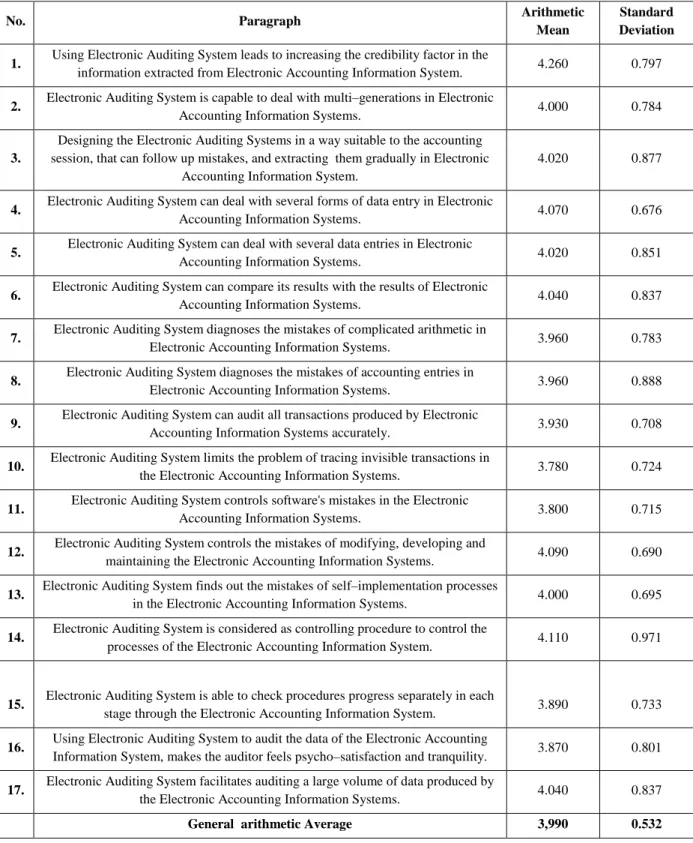
Table No. (6) points out the majority of problems and Complications that faces the external auditors when asked to audit the accounts of a company using Electronic Accounting System to process invisible operations, multiplicity of the generations of the accounting systems, multiplicity of data forms, mistakes of the programs and other complications demonstrated in the previous Table. These complications have become a heavy burden on the account auditor. By the general arithmetic average of the questionnaire paragraphs which is 3,990 and the
183
arithmetic averages that have appeared in the previous Table related to each paragraph separately, it is revealed that it is higher than 3 that is the average of the responses reliable to compare the responses of the sample of the study, whether accepting or refusing to respond, according to Likert Scale, for the responses of the samples of the study manifested in the previous Table No. (1) ; it has an indication to the sample’s approval that the above mentioned items illustrate Electronic Auditing System can reduce the burden of Electronic Environment Complexity of Accounting Information System during the increasing of trust factor with extracted information from Electronic Accounting Information System, and the ability to deal with mutilgenerations in Electronic Systems, as well as following up errors and extracting them gradually because Electronic Auditing System checks transactions progress separately in each stage and has an ability for electronic comparison between its results and the results of Electronic Accounting Information Systems, and Electronic Auditing System distinguishes with the ability to deal with multi–entries and the form of data entry to the Electronic Accounting Information System, and diagnosis the complex accounting errors in addition to the errors of accounting entries, and limits the problem of tracing invisible transactions; on the other hand – programming aspect– Electronic Auditing System can control the errors of the program and modify, improve, maintain and explore the transactions’ errors that self–executed within electronic systems because it is considered as an external control procedure to control the processes of Electronic Accounting Information System, all of this has a psychic effect on the auditor that is feel with tranquility and satisfaction during doing auditing process.
15.3 Section Three: Differences in Study Field that are due to the Features of the Sample
An independent– Sample T–Test and ANOVA Test have been performed to illustrate the difference between Study Sample’s responses, and the results show that there are no differences between sample’s responses in virtue of gender but show differences in sample’s responses in virtue of:
15.3.1 Getting Courses in Electronic Auditing: Table No. (8) shows that there are statistically significant
differences; these differences are in favor of who got the courses in electronic auditing, that shown in Table No. (7) who got the courses in auditing their arithmetic mean is higher than who don’t get the courses.
Table No. (7)
The Differences between the Responses of Study Sample in respect of getting the auditor the courses
No. Fields Getting courses Sample Vol. arithmetic
mean
Standard Deviation
1. Reducing the Burden of Electronic Environment Complexity Yes No 54 38 4.140 3.770 0.432 0.589 Table No. (8)
The Differences between the Responses of Study Sample in respect of getting the auditor the courses
No. Fields Contrasts T DF SIG
1. Reducing the Burden of Electronic Environment
Complexity Equal Unequal 3.478 3.292 90.000 63.907 0.001 0.002
15.3.2 Used Auditing System: Table No. (8) Shows that there are statistically significant differences, these
differences are in favor of who use Electronic Auditing System rather than who use Traditional Auditing System; whereas Table No. (9) and Form No. (1) show the arithmetic mean to whom use the Electronic Auditing System is more than the arithmetic mean to whom use the Traditional Auditing System.
184
Table No. (9)
The Results of Descriptive Statistics of Used Auditing System
No. Fields Experiences Sample
Vol.
arithmetic mean
Standard Deviation
1. Reducing the Burden of Electronic Environment Complexity Traditional Electronic Traditional & Electronic 18 36 38 3.360 4.120 4.160 0.599 0.357 0.411 Table No. (10)
The Differences between the Sample Study responses in respect of Used Auditing System
No. Fields Total of
Squares DF SIG
1. Reducing the Burden of Electronic
Environment Complexity Among Groups Within Groups 8.965 16.788 2.000 89.000 0.000 Figure No. (1)
Arithmetic Means of Used Auditing Systems
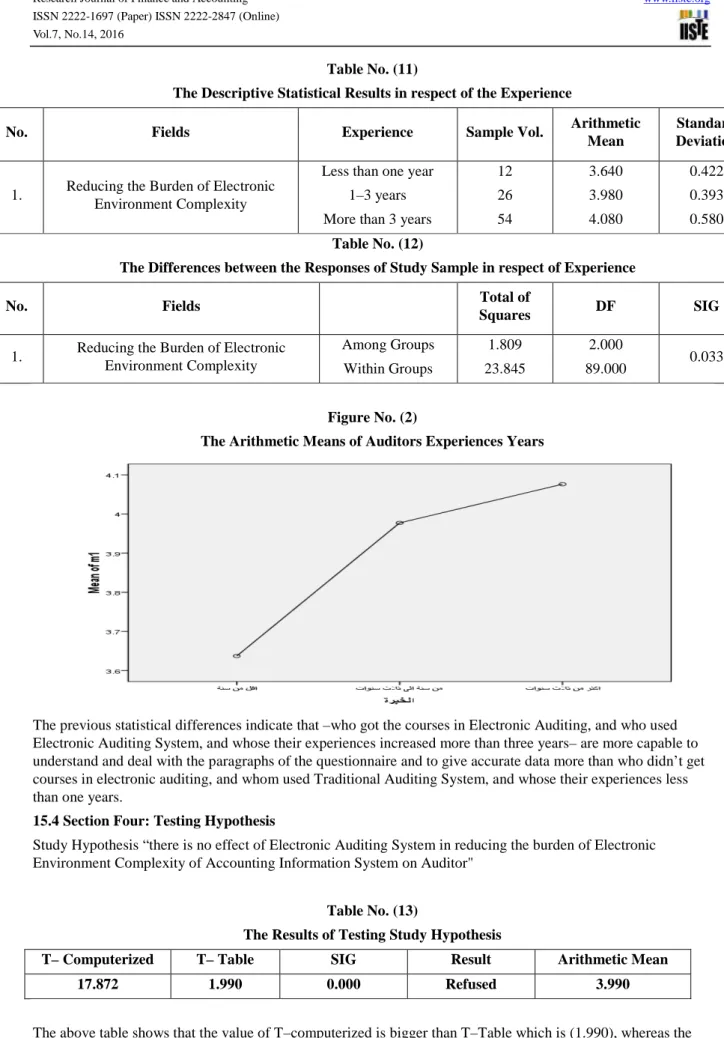
15.3.3 Number of Experiences Years: Table No. (12) shows that there are statistically significant differences ,
these differences are in favor of whom their experiences increase more than three years; and that is clarified in Table No. (11) and Form No. (2) the Arithmetic Mean to whom their experiences increase more than three years are more than the Arithmetic Mean to whom their experiences between one and three years, whereas the Arithmetic Mean to Whom their experiences are between one and three years is more than whom their experiences are less than one year.
185
Table No. (11)
The Descriptive Statistical Results in respect of the Experience
No. Fields Experience Sample Vol. Arithmetic Mean
Standard Deviation
1. Reducing the Burden of Electronic Environment Complexity
Less than one year 1–3 years More than 3 years
12 26 54 3.640 3.980 4.080 0.422 0.393 0.580 Table No. (12)
The Differences between the Responses of Study Sample in respect of Experience
No. Fields Total of
Squares DF SIG
1. Reducing the Burden of Electronic Environment Complexity Among Groups Within Groups 1.809 23.845 2.000 89.000 0.033 Figure No. (2)
The Arithmetic Means of Auditors Experiences Years
The previous statistical differences indicate that –who got the courses in Electronic Auditing, and who used Electronic Auditing System, and whose their experiences increased more than three years– are more capable to understand and deal with the paragraphs of the questionnaire and to give accurate data more than who didn’t get courses in electronic auditing, and whom used Traditional Auditing System, and whose their experiences less than one years.
15.4 Section Four: Testing Hypothesis
Study Hypothesis “there is no effect of Electronic Auditing System in reducing the burden of Electronic Environment Complexity of Accounting Information System on Auditor"
Table No. (13)
The Results of Testing Study Hypothesis
T– Computerized T– Table SIG Result Arithmetic Mean 17.872 1.990 0.000 Refused 3.990
The above table shows that the value of T–computerized is bigger than T–Table which is (1.990), whereas the significance Level is less than 5%, according to decision makers the null hypothesis is refused, and accepting the alternative hypothesis when increasing T–computerized more than T–table and Significance level is less than
186
5%; according to the previous, the null hypothesis will be refused and accepting the alternative hypothesis that attributes "there is no effect of Electronic Auditing System in reducing the burden of Electronic Environment Complexity of Accounting Information System on Auditor".
16. Results
1. The Electronic Auditing System is able to reduce the burden of Electronic Environment Complexity of Accounting Information System on the Auditor with respect to:
a. Increasing the factor of reliance with information extracted from Electronic Accounting Information Systems.
b. Dealing with mutilgenerations in Electronic Accounting Information Systems.
c. Following up errors and extracting them gradually in Electronic Accounting Information Systems. d. Dealing with the multiplicity of data entries and forms entered in Electronic Accounting Information
Systems.
e. Electronic comparison between the results of Electronic Auditing System and the Results of Electronic Accounting Information Systems.
f. Diagnosis complicated accounting errors in Electronic Accounting Information System. g. Diagnosis accounting entries in Electronic Accounting Information System.
h. Limiting tracking invisible transactions in Electronic Accounting Information System. i. Controlling program's errors Electronic Accounting Information System.
j. Controlling, modifying, developing and maintaining Electronic Accounting Information Systems. k. Finding out processes' self–implement errors in Electronic Accounting Information Systems.
l. Checking transactions progress separately in each stage through the Electronic Accounting Information System.
m. Auditing the greatest mass of data produced from Electronic Accounting Information Systems.
n. Auditing data of Electronic Accounting Information System makes the auditor feels with tranquility and satisfaction.
o. External controlling procedure to control processes of Electronic Accounting Information System. 2. Refusing the null hypothesis and accepting the alternative hypothesis which it is “there is an effect of
Electronic Auditing System in reducing the burden of Electronic Environment Complexity of Accounting Information System on Auditor".
3. There are statistically significant differences between the responses of study sample which are attributed to get the courses in Electronic Auditing and to use the Electronic Auditing System in performing auditing works and the number of experiences years for the auditors, these differences showed that who get courses in electronic auditing, use electronic system in auditing and their experiences are more three years are more capable to understand questionnaire's questions and to deal with it and to present accurate data more than who don’t get courses in electronic auditing, and who use traditional auditing system, and whose experience is less than one year.
4. The auditors' capability to transfer from auditing system into another one (i.e. from traditional to electronic) this shown in Table No. (3) Whereas the majority of auditors use electronic auditing system.
17. Recommendations
1. Increasing auditors concern in electronic auditing field due to the effect in reducing the burden of Electronic Environment of Accounting Information System on the auditor, and confirming the accuracy and the reliability of data extracted from Accounting Information Systems.
2. Holding courses for auditors in electronic auditing field in order to increase their efficiency and educating them about its importance in the light of technologies developments of Accounting Information Systems.
3. Executing a study about obstacles that auditors face in applying Electronic Auditing System.
References
Arabic References
– Haidarah, Saleh Omar Mubarak (2007), The Effect of using Information Technology System on External Auditing Process , Field Study on Auditing Offices in Kingdom of Saudi Arabia, unpublished Master Thesis, Amman Arab University, Jordan– Amman.
187
– Khaddash, Husam Eldeen, and Walid Syam (2003), The Extent of Auditors Acceptance for Using Information Technology, Study Field on Auditing Offices in Jordan, Studies Journal, University of Jordan, Jordan, Vol. No. 30, issue 2, P P 297–298.
– Al-Rida, Oqba (2008), Association of Certified Public Accountants in Syria, prepared within Scientific Activities of Association of Certified Public Accountants in Syria, Syria– Damascus.
– Al-Salimi, Alaa Abdelrazzaq, (1179), Information Technology, issue 1, Kahloun, Amman.
– Al-Sa’adi, Ibrahim Khalil (2010), The Effect of Using Information Technology on Auditing profession in Industrial Companies Sector in Jordan (Field Study), General Directorate Institute Journal, Vol. 50, issue 1, P 63.
– Syam, Walid Zakria, (2001), The Responsibility of Internal Auditor when auditing Information Technology Information, paper presented to the Third Professional Conference of Jordanian Association of Certified Public Accountants titled (Auditor and Legal and Professional Responsibility).
– Al-Azab, Hani Abdelhafez (2005), Building a Model for Scaling The Effect of Information Technology on External Auditing Process on Jordan Commercial and Investment Banks, unpublished Doctorate Thesis, Amman Arab University for Higher Studies, Faculty of Financial Studies and Higher Administration, Amman, Jordan.
– Al-Qabani, Thana’a Ali (2006), Plastic Money and the Effect of Eelectronic Transactions on Internal Auditing in Commercial Banks, University publisher, Egypt, Alexandria.
English References
- Bible, L. & Graham, L. & Rosman, A., (2005) The Effect of Electronic Audit Environments on Performance, Journal of Accounting, Auditing & Finance, Vol. 20 N 1, p27-42.
- Bierstaker, J., Burnaby, P .And Thibodeau, J. (2001), The impact of information technology on the audit process: an assessment of the state of the art and implications for the future, University of Massachusetts, USA, Managerial Auditing Journal,PP:159-164.
- Boynton, W. C. & Johnson R. N. & Kill, W. G, (2006), Modern Auditing, John Wiley and Sons Inc.
- Braun R. L. & Davis H. E., (2003), Computer-Assisted Audit Tools and Techniques: Analysis and Perspective, Managerial Audit Journal, Vol. 18, No. 9, PP 725-731.
- Cerullo M. V. and Cerullo M. J, (2003), Impact of SAS No. 94 on Computer Audit Techniques, Information Systems Control Journal, Volume 1. On Line Available: www.isaca.org.
- Computer Auditing, (2010), Generalized audit software (GAS) On Line Available:///F|/Courses/2010-11/CGA/AU1/06course/m07intro.htm
- Florida DeSectionment of Revenue, (2012), Auditing in an Electronic Environment (e-auditing), On Line Available: http://dor.myflorida.com/dor/forms/2012/gt800050.pdf
- Al-Jabari, T .(2004), The Impact of Information Technology on the Internal Audit Process in Jordan, Master Degree, Amman Arab University for Graduate Studies, Faculty of Managerial and Financial Graduate Studies, Amman, Jordan.
- Al-Qudah, G. M. A. , (2011), The Impact of Accounting Information Systems on Effectiveness of Internal Control in Jordanian Commercial Banks "Field Study", INTERDISCIPLINARY JOURNAL OF CONTEMPORARY RESEARCH IN BUSINESS, VOL 2, NO 9, PP:365-377.
- Salehi ,M., Rostami, V. And Mogadam, A, (2010), Usefulness of Accounting Information System in Emerging Economy:Empirical Evidence of Iran, International Journal of Economics and Finance, Vol. 2, No. 2, On line available:www.ccsenet.org/ijef
- Turner, L. And Weickgenannt, A., (2009), Accounting Information System Controls And Processes, Northern Kentucky University, United State of America.On line Available:www.wiley.com/college/turner.
Arab websites
Shihata, Hussin, (2000), Audit and control Fundamentals in a computer and the Internet, Alazhar University, Egypt. On line Available: http://shaheer.ahlamontada.com/t873-topic