Middlesex University Research Repository
An open access repository of
Middlesex University research
http://eprints.mdx.ac.uk
Gallear, David Nicholas (1999) Developing a theory of total quality
management - using the delphi technique. PhD thesis, Middlesex
University.
Available from Middlesex University’s Research Repository at
http://eprints.mdx.ac.uk/13585/
Copyright:
Middlesex University Research Repository makes the University’s research available electronically. Copyright and moral rights to this thesis/research project are retained by the author and/or other copyright owners. The work is supplied on the understanding that any use for
commercial gain is strictly forbidden. A copy may be downloaded for personal,
non-commercial, research or study without prior permission and without charge. Any use of the thesis/research project for private study or research must be properly acknowledged with reference to the work’s full bibliographic details.
This thesis/research project may not be reproduced in any format or medium, or extensive quotations taken from it, or its content changed in any way, without first obtaining permission in writing from the copyright holder(s).
If you believe that any material held in the repository infringes copyright law, please contact the Repository Team at Middlesex University via the following email address:
"
Middlesex
University
London
Middlesex University Research Repository:
an open access repository of
Middlesex University research
http://eprints.mdx.ac.uk
Gallear, David Nicholas, 1999.
Developing a theory of total quality management
-
using the delphi
technique.
Available from Middlesex University's Research Repository.
Copyright:
Middlesex University Research Repository makes the University's research available electronically. Copyright and moral rights to this thesis/research project are retained by the author and/or other copyright owners. The work is supplied on the understanding that any use for commercial gain is strictly forbidden. A copy may be downloaded for personal, non-commercial, research or study without prior permission and without charge. Any use of the thesis/research project for private study or
research must be properly acknowledged with reference to the work's full bibliographic details. This thesis/research project may not be reproduced in any format or medium, or extensive quotations taken from it, or its content changed in any way, without first obtaining permission in writing from the copyright holder(s).
If you believe that any material held in the repository infringes copyright law, please contact the Repository Team at Middlesex University via the following email address:
DEVELOPING A THEORY OF TOTAL
QUALITY MANAGEMENT - USING THE
DELPHI TECHNIQUE
A thesis submitted in part fulfilment of the requirements
for the degree of Doctor of Philosophy
DAVID NICHOLAS GALLEAR
Middlesex University Business School
EXECUTIVE SUMMARY
DEVELOPING A THEORY OF TOTAL QUALITY MANAGEMENT - USING THE DELPHI TECHNIQUE
Submitted by David Nicholas Gallear for the Degree of Doctor of Philosophy
Quality has become an important determinant of competitiveness, to the point that it is now widely considered to be the foundation upon which other factors that contribute to competitive advantage, such as cost, speed of delivery, reliability of delivery and flexibility, must be built. Total Quality Management (TQM) has emerged as a prominent tool for organisations in pursuit of lasting improvements in quality, business performance and, for introducing change. A large and increasing number of organisations are starting to adopt TQM in recognition of its strategic importance. The importance of quality is also recognised by governments and industrialists throughout the developed world. The increasing number of awards expounding the value of TQM is a manifestation of the importance placed on the concept. All the signs indicate that the adoption of TQM is unlikely to diminish.
Despite the interest, and the attention of many researchers and writers, TQM remains an imprecise subject. Examination of the large volume ofTQM related publications revealed that the literature is dominated by prescription and anecdote and highlights a lack of empirical work. A number of broad areas can be identified where it would appear that the literature has remained irreconcilable or under-developed. Moreover, it appears that the domination of TQM's development by practitioners has resulted in the absence of a theoretical grounding for TQM. These findings pointed to the need for substantive research to extend the current knowledge and understanding of TQM and to support its future development.
The aim of this study was to address these broad areas and to fill an important gap in the existing knowledge and understanding ofTQM. More specifically, the aim was to develop an inductive theory o/TQM based on the expert opinion o/practitioners in the leading organisations. For the purpose of this study "theory" is defined as comprising three components: concepts, relationships
and underlying logic.
The study achieves this aim through the explication of the views of a sample of best practice TQM organisations representing a wide range of industry sectors. The design of the research was motivated by the distinctive shortfalls in the domain and strategy of previous TQM research. After evaluating the methodological options available, the Delphi method was identified as the most
relevant and practical research technique. A modified Delphi survey comprising four planned rounds of postal questionnaires was used to collect the study's primary data. Conversion of this primary data into the proposed theory involved a profound process of interpretation and refinement which centred around explaining the logic underlying the salient TQM variables that were identified. Exploratory factor analysis was used to aid the interpretive processes. The salient variables were heuristically organised into a set ofTQM concepts and the interrelationship digraph technique was used to facilitate the extraction of the salient relationships between the concepts from the core body of underlying logic.
The study identifies nine key concepts of the TQM approach and puts forward seven key propositions that explain the important relationships between them. The three core concepts are Customer Focus, Internal Collaboration and DynamiclEnergetic Leadership. The study corroborates the belief evident in the more recent TQM literature that TQM is a management philosophy. The idea that TQM is a "management fad" is refuted. The study provides strong evidence that TQM is universally applicable to 'for profit' organisations. It is also shown that the impact of TQM goes beyond management practice. TQM is undeniably concerned with the attitude, the values and the behaviour of all of the members of an organisation.
The primary data in this study came from a sample that comprised 'for profit' organisations only. The proposed theory has therefore been derived in this context. This represents the main boundary to which generalisation can be taken. An objective of the study was to test the proposed concepts in order to refine the proposed theory. This objective was only partially met due to unexpected diversity in some of the qualitative primary data.
This study has expanded understanding by contributing an inductively developed theory ofTQM to the present knowledge. This interpretation of TQM, which identifies the logic underlying the relevance of the important TQM variables, transcends a description of TQM which is specified purely in terms of the relevant variables. The study also contributes an understanding ofTQM that explicitly distinguishes its purpose from its mechanics. The core practical contribution of the study is that it can act as a conduit to improve practitioner understanding. Practitioners seeking to improve the performance of their organisation to a position of sustainable competitive advantage through the introduction of a TQM approach can have an understanding of TQM that is based on proven practice. The study also contributes a set ofTQM concepts and an interrelationship digraph that can act as a base-line from which existing TQM approaches may be critically examined. Furthermore, the study contributes a theory of TQM to the development of a sound theoretical framework that can systematically and appropriately guide future research.
ACKNOWLEDGEMENTS
As with any major undertaking the completion of this study has only been made possible through the help, support and guidance I have received from a large number of people.
I would like to thank the individuals from all the organisations that participated in this research. Without their willingness to invest time in sharing information with me, this study could not have been undertaken.
lowe a huge debt of thanks to Professor Abby Ghobadian for the key role he has played in keeping me on course to complete this work. I value and appreciate the wise counsel and considered feedback that he has shared with me. This helped me enormously to keep focused on the task in hand.
During the course of this project I have also received much support and encouragement from my colleagues at the Management Development Unit (MDU) and the Centre for Interdisciplinary Strategic Management Research (CISMR) - Jonathan, Howard, Hong, Tibor, Starn, Debbie and Eileen, and more recently Nick and Paul. I would like to express my thanks to them all.
Finally, I would like to recognise the huge, unwavering support that I have received from my family and close friends. Throughout what has undoubtedly been a lengthy process they have kept faith in me and provided me the inspiration to keep going. In particular I need to thank my parents Derek and Gill and, Joanna. It is their belief in me and their unselfishness and understanding that has underpinned and sustained my application to this work.
TABLE OF CONTENTS
Executive Summary Acknowledgements Contents List of Tables List of Figures Glossary of Abbreviations CHAPTER 1: INTRODUCTION1.1
1.2
1.3
1.41.5
1.6
1.7
Critique of the TQM Literature Importance of the Study
Aim and Objectives of the Study The Study's Contribution to Knowledge Outline of Research Methodology Scope and Limitations of the Study Structure of the Report
CHAPTER 2: LITERATURE REVIEW 2.1 2.1.1
2.2
2.2.1 2.2.1.1 2.2.1.22.3
2.3.1 2.3.2 2.3.3 2.42.4.1
2.4.2
2.4.3
2.4.4
2.5 2.5.1 2.5~2 2.5.3 2.5.4 2.5.52.6
2.6.1
2.6.1.1 2.6.1.2 2.6.1.3 2.6.2 2.6.2.12.6.3
IntroductionFramework of literature review
Origins and Historical Development of TQM
Review of contribution of quality "gurus"
Who are the "gurus" of quality and why are their contributions treated so significantly?
Summary examination of the teachings of the quality gurus
Importance of "Quality"
Perceived importance of "quality"
Perceived importance of "quality" in practice Demonstrated importance of "quality"
Importance of "TQM"
Perceived importance of "TQM"
Perceived importance of "TQM" in practice Demonstrated importance of "TQM"
Summary of findings - importance of "TQM"
Broad Suggestions/Definitions of TQM
The 'philosophy' perspective
The 'management system' perspective The 'strategy' perspective
The other definitions/suggestions Summary of findings
What is Involved (TQM Components/Elements)
Review of the non-prescriptive contributions
Empirical or structured interview derivation Questionnaire survey derivation
Literature survey derivation
Summary of non-prescriptive contribution findings
Review of case study evidence
Review of the prescriptive contributions
111 iv xi X 111 xiv 5 6 9 10 12 16 17 17 21 25 26 27 33 34 36 38 41 41 42
47
55 56 56 58 59 59 61 63 63 63 6874
77 80 822.6.4 2.6.5 2.7 2.7.1 2.7.1.1 2.7.l.2 2.7.1.3 2.7.l.4 2.7.2 2.7.3 2.7.4
2.8
2.B.1 2.8.1.1Summary of examination of the prescriptive contributions Examination of quality award frameworks
Process of TQM Implementation
Review of the non-prescriptive contributions
Empirical or structured interview examinations Questionnaire survey examinations
Conclusions about implementation process drawn by other non-prescriptive contributions
Case study examinations
Summary of examination of the non-prescriptive contribution findings Review of the prescriptive contributions
Summary of examination of the prescriptively based contributions
Reasons for Failure ofTQM / TQM Implementation Process
Review of the non-prescriptive contributions
Empirical or structured interview study evidence 2.8.1.2 Questionnaire survey derived evidence
2.8.1.3 Case study evidence
2.B.2 Summary of examination of the non-prescriptive contribution evidence 2.B.3 Review of the prescriptive contributions
2. B. 4 Summary of an examination of the prescriptive contributions
2.9 Contributions That Have Attempted to Understand Why Failure in TQM Occurs and How it Might Be Overcome
2.9.1 The systems perspective 2.9.2 Contingency perspectives
2.10 Other Important Issues in the TQM Domain
2.10.1 Practical guidance for designing the appropriate TQM approach
2.10.1.1 Summary of findings
2.10.2 Issues relating to the effect of TQM on facets of organisational behaviour
2.10.2.1 Organisation structure 2.10.2.2 Management style 2. I 0.2.3 Organisational culture
2.10.2.4 Strategic level processes and considerations 2. 10.2.5 Top leadership role
2.10.3 Issues relating to the effect or impact of various interventions on TQM
2.10.3.1 Use and role of external consultants
2.10.3.2 Relevance ofBS EN IS09000 to TQM approach
2.10.4 External range of applicab ility of TQM
2.10.4.1 SME applicability
2.10.4.2 Service industry applicability
CHAPTER 3: METHODOLOGY - RESEARCH DESIGN
3.1 Introduction 3.1.1 Structure of chapter
3.2 A Theory ofTQM 3.2.1 Constituents of theory
3.2.2 How a theory differs from other forms of output
3.2.3 The value of a theoretical contribution
3.2.4 Structure of theory adopted for this investigation
3.2.5 Some views on the theory building process
3.2.6 Evaluation of a theoretical contribution
3.3 Mode(s) of Research 82 91 94 95 95 98 98 99 104 105 106 112 113 113 116 119 120 122 123 130 132 133 136 137 141 142 142 145 148 153 155 160 160 162 165 166 169 175 179 179 180 181 182 183 183 185 186
3.3.1 3.3.2
3.4
3.4.1 3.4.2 3.4.3 3.4.4 3.4.5 3.4.6 3.5Theory building - induction Enhancing the theory - deduction
Research Strategy, Research Domain and Research Method/Technique
Research strategy and domain Research method/technique Delphi technique
Purpose and attributes of the Delphi technique The Delphi process
Concerns about Delphi and corresponding recommendations
Summary of the Research Design
CHAPTER 4: METHODOLOGY - THE RESEARCH PROCESS
4.1
Introduction and Structure of the Chapter4.2
The Sample4.2.1 Unit of analysis and specification of participant
4.2.2 Target sample size
4.2.3 Criteria for selection of organisations and the panel assembly process
4.2.4 Resultant participant group and its demographics
4.2.5 Characteristics of the participant group
4.3
The Information Gathering Plan4.3.1 Modification of the conventional Delphi format
4.3.2 Structure of the information gathering plan - A four round Delphi survey
4.3.3 Analysis and development stages in the research process
4.3.4 Time schedule of the research process
4.3.5 Pre-testing the questionnaires
4.3.6 Use and construction of feedback reports
4.4
Statistical Analysis 4.4.1 Use of significance testing4.4.2 Use of exploratory factor analysis
4.4.3 Use of cross-tabulation
4.4.4 Cut-off points applied to the interpretation of mean scores
CHAPTER 5: STIMULUS FOR THE INTRODUCTION OF TQM
5.1
5.2 5.2.1 5.2.2 5.2.3 5.2.4 5.2.5 5.2.6 5.3 5.3.1 5.3.25.4
5.4.1 5.4.2 5.4.3 5.4.4 IntroductionReasons for Introducing TQM
Defensive strategic response Change strategic response Reactive strategic response Cooperative strategic response Strategic response summary
Differences in reasons according to size and class of organisation
Sources Resulting in Identification of TQM
Identification channels Summary
Organisational Changes Resulting From the Introduction ofTQM
Pre-TQM organisation structures
Profile of changes in organisation structure
Differences in the profile of changes in organisation structure according to size or class of organisation
Pre- TQM and present day management styles
186 187 188 188 191 193 194 196 197 202 204 204 204 207 209 212 214 216 216 217 222 223 225 228 230 230 231 232 233 234 235 237 238 238 239 239 240 240 241 243 244 246 246 247 248
5.4.4.1 Findings for dimension (a) passive / directive / participative and dimension (b) proactive / reactive
5.4.4.2 Findings for pre-TQM dimension (c) specific management style
5.4.4.3 Findings for post-TQM introduction dimension (c) devolved / centralised
5.4.5 Profile of changes in management style
5.4.5.1 Summary of management style change profile
5.4.6 Differences in the profile of changes in management style according to size or class of organisation
5.4.7 TQM quality practices
5.4.8 Pre- TQM quality practices
5.4.8.1 Nature ofpre-TQM quality practices
5.4.8.2 Responsibility for quality prior to the introduction of TQM
5.4.8.3 Variations in attitude towards quality practices according to location within organisation
5.4.9 Present (TQM) quality practices
5.4.9.1 Nature of quality practices following the introduction ofTQM 5.4.9.2 Responsibility for quality after the introduction ofTQM
5.4.10 Summary and profile of changes in quality practices
5.4.11 Differences in the profile of changes in quality practices according to size or class of organisation
5.5 Chapter Summary
CHAPTER 6: ORGANISATIONAL ROLE AND SPAN OF APPLICATION OFTQM 6.1 6.2 6.3 6.3.1 6.3.2 6.3.3 6.4 6.5 6.5.1 6.5.2 6.5.3 6.5.4 . Introduction Method of Investigation
Findings - Organisational Role and Span of Application of TQM
Purposes of TQM
Methodological foundations General characteristics
Influence of Size and Class of Organisation on Organisational Role ofTQM
Factor Analysis Applied to Organisational Role ofTQM
Stage 1 and stage 2 factor analysis findings - purposes of TQM
Stage 1 and stage 2 factor analysis findings - methodological foundations ofTQM
Stage 1 and stage 2 factor analysis findings - general characteristics of TQM Summary and further observations of factor analysis of the organisational role ofTQM
CHAPTER 7: STRATEGIC ROLE OF TQM
7.1 7.2 7.3 7.3.1 7.3.2 7.3.3 . 7.4 7.4.1 Introduction Method of Investigation Conceptual Focus
Conceptual relationships (statements) between strategy and TQM Product, process and service quality as a generic business strategy TQM as a generic strategy underpinning/supporting other efforts of the organisation Operational Focus Further observations 249 250 251 251 256 257 258 259 260 260 260 263 263 269 271 273 275 277 278 280 280 286 295 298 299 300 303 308 311 313 314 314 315 323 324 325 337
7.5 Influence of Size and Class of Organisation on Strategic Role ofTQM 338 7.6 Factor Analysis Applied to Strategic Role ofTQM 339
7.6.1 Stage 1 and stage 2 factor analysis findings - conceptual strategic role of TQM 339 7.6.2 Stage 1 and stage 2factor analysis findings - operational strategic role ofTQM 342
CHAPTER 8: MAIN ELEMENTS AND SUB-ELEMENTS OF TQM
8.1 Introduction
8.1.1 Method of investigation
8.2 The Main Elements ofTQM
8.2.1 Sub-elements of TQM concerned with management process
8.2.2 Sub-elements of TQM concerned with market focus
8.2.3 Sub-elements of TQM concerned with process focus
8.2.4 Sub-elements of TQM concerned with people focus
8.2.5 Sub-elements of TQM concerned with communication and measurement
8.3 Influence of Size and Class of Organisation on Sub-Elements ofTQM 8.4 Factor Analysis Applied to the Sub-Elements ofTQM
8.4.1 Stage 1 and stage 2 factor analysis findings: sub-elements concerned with management process
8.4.2 Stage 1 and stage 2 factor analysis findings: sub-elements concerned with market focus
8.4.3 Stage 1 and stage 2 factor analysis findings: sub-elements concerned with process focus
8.4.4 Stage 1 and stage 2 factor analysis findings: sub-elements concerned with people focus
8.4.5 Stage 1 and stage 2 factor analysis findings: sub-elements concerned with communication and measurement
CHAPTER 9: CONDITIONS FOR TOTAL QUALITY
9.1 9.1.1 9.1.2 9.1.3 9.1.4 9.2 9.3 9.4 Introduction A definition of "culture" The importance of culture
The need for an appropriate method of investigation Method of investigation
Findings - 'Necessary Conditions' Underpinning A TQM Culture Influence of Size and Class of Organisation on Necessary Conditions Factor Analysis Applied to the Necessary Conditions
CHAPTER 10: A PRELIMINARY PROPOSED THEORY OF TQM
10.1 10.2 10.3 10.3.1 10.3.2 10.3.3 10.4 10.5 10.6 Introduction
Inputs to the Preliminary Conceptual Map
Description of Concept Structure and Concept Formation Procedure
Development of concept structure Concept formation procedure Importance index
Prevalent Concepts - Preliminary Conceptual Map of TQM Development of the Conceptual Relationships
Prevalent Relationships Between the Nine TQM Concepts
346 346 348 348 354 358 362 367 376 379 380 383 386 387 391 397 397 398 399 399 401 416 417 421 422 428 428 430 432 433 438 441
CHAPTER 11: PARTIAL TESTING OF PROPOSED THEORY OF TQM
11.1 Introduction
11.2 Scope of the Testing
11.3 Testing Approach and Procedure 11.4 Findings
11.4.1 Customer Focus 11.4.2 Internal Collaboration
11.4.3 Dynamic/Energetic Leadership
11.4.4 Findings for the four other partially tested concepts 11.4.4.1 Participative Management
11.4.4.2 Process Architecture and Management 11.4.4.3 People Realisation
11.4.4.4 Strategic Framework
11.5 Summary of Partial Theory Testing Findings
CHAPTER 12: CONCLUSIONS AND RECOMMENDATIONS
12.1 12.2 12.3 12.3.1 12.3.2 12.3.3 12.3.4 12.4 12.5 12.5.1 12.5.2 12.5.3 12.6
The Aim and Objectives and Extent That They Were Met Summary of Key Findings
Conclusions
Critical evaluation of research methodology and use of modified Delphi technique
Range of applicability ofTQM The nature of the TQM approach
Position ofTQM in relation to schools of management thought
Extending the Present Knowledge Recommendations
Future use of modified Delphi technique The introduction and use of TQM Practical use of research findings
Directions for Future Research
REFERENCES
APPENDICES
TQM "usage" surveys
Deming's fourteen points for management and seven deadly sins. Participant invitation letter
Listing of participants' organisations
Business dimensions for individual participants
Business characteristics profile for three classes of organisation Delphi questionnaires 1 to 4
Qualifier covering letter Feedback reports 1 to 3 446 447 449 451 452 455 460 464 464 466 468 471 472 474 475 477 478 479 481 484 487 487 488 488 490 491 493 Appendix 2.1.1 Appendix 2.2.1.2 Appendix 4.2.3 Appendix 4.2.4 Appendix 4.2.5a Appendix 4.2.5b Appendix 4.3.2 Appendix 4.3.5 Appendix 4.3.6 Appendix 5.4.5 Appendix 5.4.9.1 Appendix 7.1 Appendix 7.3.1 Appendix 7.4
Sample section of pre-TQM management style analysis worksheet Sample section of present day (TQM) quality practice analysis worksheet Reference of key terms
Map (I) of apparent principal causal relationships Map (II) of apparent principal causal relationships
Appendix 10.5a Appendix 10.5b Appendix 11.3 Appendix 11.4 Appendix 11.4.3a Appendix 11.4.3b Appendix 11.4.4.1
Inter-relationship record matrix Inter-relationship summary matrix
Summary matrix of second and third round Delphi questionnaire evidence for the seven proposed TQM concepts tested
Profiles of the fourth round Delphi questionnaire evidence for the seven proposed TQM concepts tested
Summary of elements of the roles of quality steering groups
Breakdown of examples of top management participation in on-going total quality initiatives
Extent of use of management problem solving tools and techniques in the benchmark sample
LIST OF TABLES
Table 2.6.3 Summary of an examination of pertinent prescriptive literature contributions
describing the components/elements of TQM 83
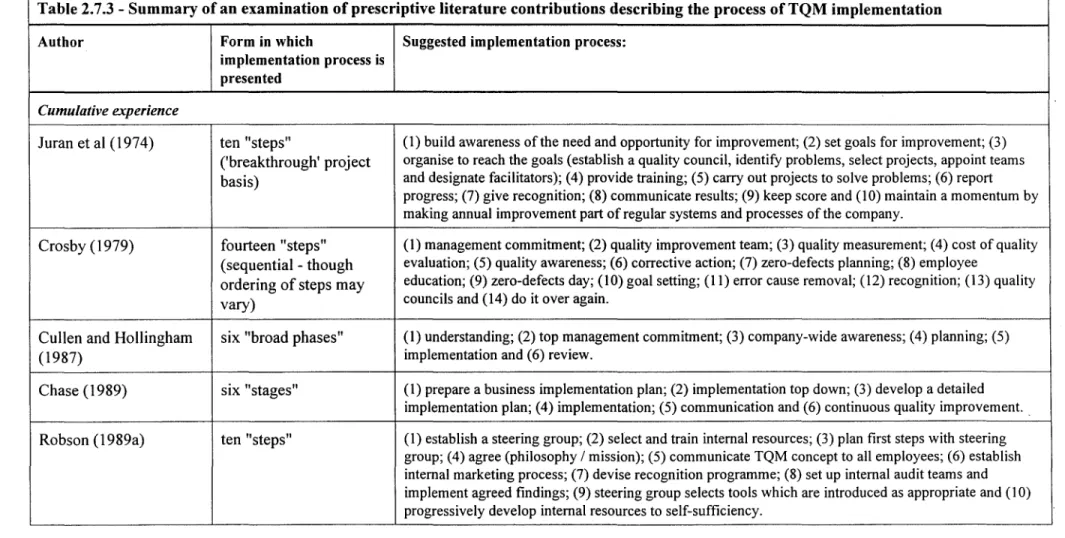
Table 2.7.3 Summary of an examination of prescriptive literature contributions describing
the process of TQM implementation 107
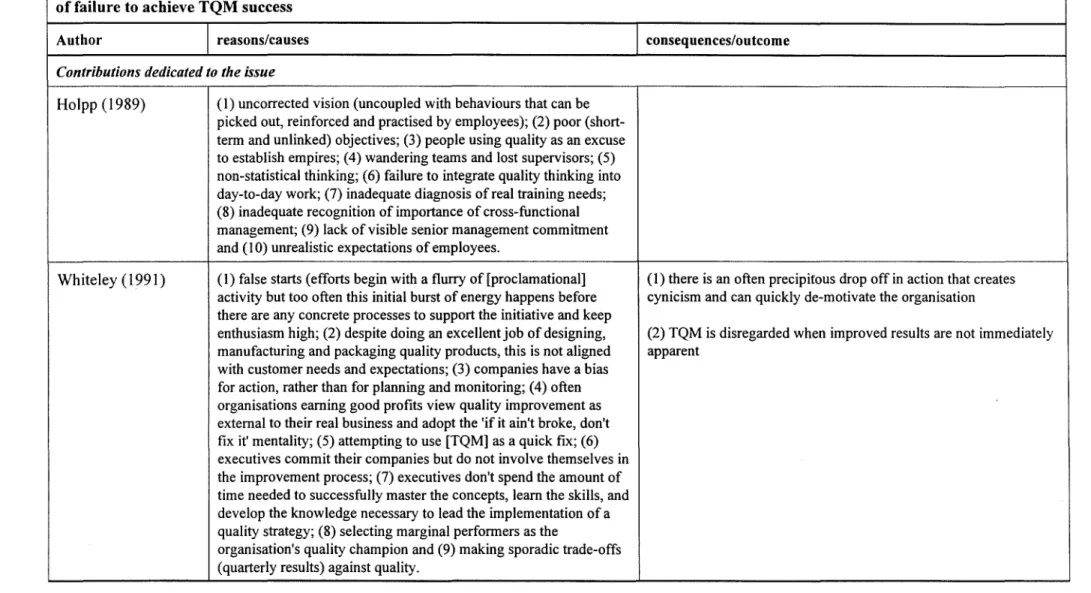
Table 2.8.3 Summary of an examination of prescriptive literature suggestions concerning the causes/reasons for, and consequences/outcomes of failure to achieve TQM
success 124
Table 3.4.2 Comparative assessment of potential research techniques 192 Table 4.2.3 Breakdown of individuals indicating an interest in participating in the study 211
Table 4.3.3 Illustration of the study's main analyses 222
Table 5.4.1 Original (pre-TQM) organisation structures 246
Table 5.4.4.1 Characteristics of management style before and after introduction ofTQM 249
Table 5.4.4.2 (Specific) pre-TQM management style 250
Table 5.4.9.1a FORMAL present day quality practices 265
Table 5.4.9.1b INFORMAL present day quality practices 266
Table 5.4.9.1c PREVENTA TIVE present day quality practices 266
Table 5.4.9.1d DETECTIVE present day quality practices 267
Table 5.4.11 Differences in present day quality practices according to organisation size
and class 274
Table 6.5.1a Factor loadings on (stage 1) twelve variable set of purposes ofTQM 300 Table 6.5.1 b Factor loadings on (stage 2) nine variable set of 'agreed' purposes ofTQM 302
Table 6.5.1c Summary of new explanatory variables -Purposes ofTQM 303
Table 6.5.2a Factor loadings on (stage 1) eighteen variable set of methodological
foundations of TQM 305
Table 6.5.2b Factor loadings on (stage 2) twelve variable set of 'agreed' methodological
foundations ofTQM 306
Table 6.5.2c Summary of new explanatory variables -Methodologicalfoundations ofTQM 308
Table 6.5.3a Factor loadings on (stage 1) thirteen variable set of general characteristics
ofTQM 308
Table 6.5.3b Factor loadings on (stage 2) twelve variable set of 'agreed' general
characteristics of TQM 310
Table 6.5.3c Summary of new explanatory variables -General characteristics ofTQM 311 Table 7.3.2 Illustration of how organisations operationalise product, process and service
quality as a generic business strategy 323
Table 7.3.3 Reasons why participants regard TQM as a generic strategy underpinning
or supporting other efforts of the organisation 324
Table 7.6.1a Factor loadings on (stage 1) eight variable set of strategic conceptual
roles ofTQM 340
Table 7.6.1b Factor loadings on (stage 2) seven variable set of 'agreed' strategic conceptual
roles ofTQM 340
Table 7.6.lc Strategic conceptual role ofTQM (fixed 3 factor solution) 341 Table 7.6.1d Strategic conceptual role ofTQM (fixed 4 factor solution) 341 Table 7.6.le Summary of new explanatory variables - Strategic conceptual role ofTQM 342 Table 7.6.2a Factor loadings on (stage 1) eleven variable set of strategic operational
roles ofTQM 342
Table 7.6.2b Strategic operational role ofTQM (fixed 2 factor solution) 344 Table 7.6.2c Strategic operational role ofTQM (fixed 3 factor solution) 344 Table 7.6.2d Strategic operational role ofTQM (fixed 4 factor solution) 344 Table 7.6.2e Summary of new explanatory variables - Strategic operational role ofTQM 345 Table 8.3a Important TQM sub-elements: differences between views of large
organisations and SMEs 376
Table 8.3b Important TQM sub-elements: differences between views of manufacturing,
service and MIS organisations 377
Table 8.4.1a Factor loadings on (stage 1) fifteen variable set of management process
TQM sub-elements 380
Table 8.4.1c Table 8.4.2a Table 8.4.2b Table 8.4.2c Table 8.4.2d Table 8.4.2e Table 8.4.3a Table 8.4.3b Table 8.4.4a Table 8.4.4b Table 8.4.4c Table 8.4.5a Table 8.4.5b Table 8.4.5c Table 9.4.1 Table 9.4.2 Table 9.4.3 Table 10.2a Table 1O.2b Table lO.2c process TQM sub-elements 382
Summary of new explanatory variables associated with management process 383
Factor loadings on (stage 1) ten variable set of market focus TQM
sub-elements 383
Factor loadings on (stage 2) nine variable set of 'important' market focus
TQM sub-elements 384
Main element: market focus (fixed 3 factor solution) 385
Main element: market focus (fixed 4 factor solution) 385
Summary of new explanatory variables associated with market focus 386 Factor loadings on 'important' process focus sub-elements ofTQM 386 Summary of new explanatory variables associated with process focus 387 Factor loadings on (stage 1) seventeen variable set of people focus TQM
sub-elements 388
Factor loadings on (stage 2) thirteen variable set of 'important' people focus
TQM sub-elements 390
Summary of new explanatory variables associated withpeoplefocus 391
Factor loadings on (stage 1) twenty seven variable set of communication
and measurement TQM sub-elements 392
Factor loadings on (stage 2) twenty two variable set of 'important'
communication and measurement TQM sub-elements 395
Summary of new explanatory variables associated with communication
and measurement 396
Factor loadings on (stage 1) fifteen variable set of necessary conditions for
the attainment of an organisation-wide quality ethos 418
Factor loadings on (stage 2) fourteen variable set of 'important' necessary
conditions for the attainment of an organisation-wide quality ethos 419 Summary of new explanatory variables - Necessary conditions for the
attainment of an organisation-wide quality ethos 420
Summary of new explanatory variables (NEVs) 423
Summary of remaining important variables (RIVs) 425
LIST OF FIGURES Figure 2.1.1£1 Figure 2.1.1b Figure 2.2 Figure 2.6.5 Figure 3.1 Figure 304.5 Figure 3.5 Figure 4.2Aa Figure 4.2Ab Figure 4.2Ac Figure 4.2.5 Figure 4.3.2 Figure 4.304 Figure 5.2 Figure 5.3.l Figure 504.2 Figure 504.5 Figure SA. lOa Figure SA. lOb Figure 6.3.l Figure 6.3.2 Figure 6.3.3 Figure 7.3.1 Figure 704 Figure 8.2.1 Figure 8.2.2 Figure 8.2.3 Figure 8.204 Figure 8.2.5 Figure 9.2 Figure 10.3.1 Figure 10.3.2 Figure 10.5 Figure 10.6 Figure 11.3 Figure 11.4.1 Figure 1104.2 Figure 1104.3
Illustration of the categorisation of the TQM literature 18 Illustration of the structure of the literature review 19
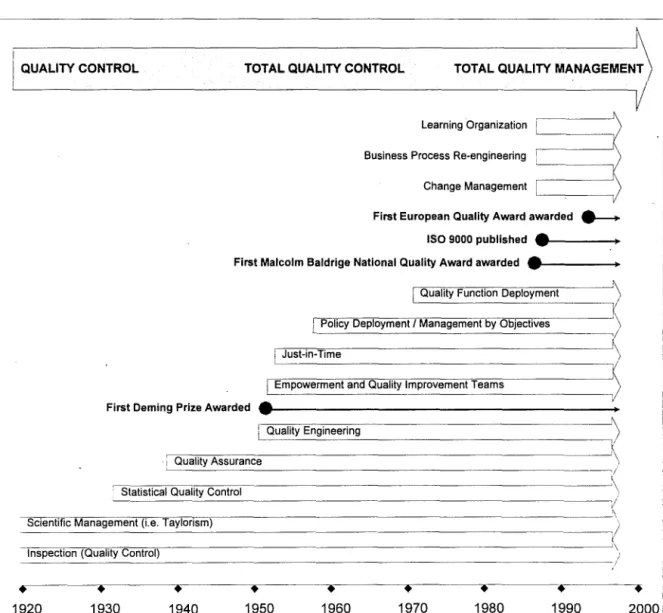
The evolution of TQM 22
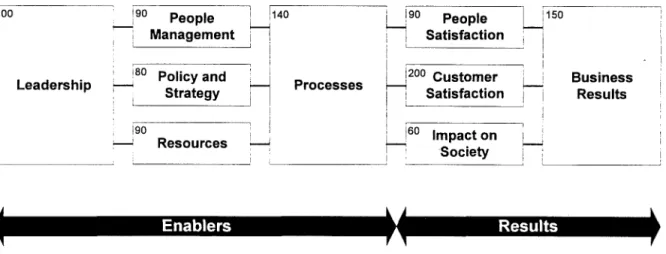
The European Quality Award (EQA) framework 93
A framework for Research Methodology 178
Illustration of the Delphi process 197
Summary of the investigation's research design 203
Participants geographical location 212
Distribution of organisation size; Participating organisations business
orientation 213
Organisation 'class' distribution for large organisations; Organisation 'class'
distribution for small-to-medium sized enterprises (SMEs) 214
General Information section of Delphi round 1 questionnaire 215
The modified Delphi format developed for the investigation 220
Resultant primary research time schedule 224
Primary reasons for introducing TQM (grouped according to nature of
strategic response) 236
Sources resulting in identification of TQM (grouped according to the
identification channel type) 241
Profile of prevalent organisation structure changes 248
Profile of change in management style resulting from the introduction of TQM 251 Comparison of the nature of pre-TQM with present (TQM) quality practices 271 Profile of prevalent changes with regards to quality practices resulting from
the introduction ofTQM 272
Mean scores for proposed organisational roles of TQM: purposes of TQM 281 Mean scores for proposed organisational roles of TQM: methodological
foundations 287
Mean scores for proposed organisational roles ofTQM: general characteristics 295 Mean scores for proposed conceptual relationship statements 315 Mean scores for proposed strategic issues addressed by TQM 326 Mean scores for TQM sub-elements concerned with management process 349
Mean scores for TQM sub-elements concerned with marketJocus 354
Mean scores for TQM sub-elements concerned with process Jocus 358 Mean scores for TQM sub-elements concerned withpeopleJocus 363
Mean scores for TQM sub-elements concerned with communication and
measurement 368
Mean scores for proposed necessary conditions that must exist for a quality
ethos to permeate an organisation in its entirety 402
Structure of concepts underlying the TQM approach 429
Illustration of iterative procedure for developing preliminary conceptual map 431 Illustration of procedure for identifying the relationships of the TQM theory 439 Interrelationship digraph of the concepts and of the relationships of the
proposed theory of Total Quality Management 442
Illustration of the procedure used in designing the fourth round Delphi
questionnaire 449
Summary profile of Delphi fourth round evidence in support of the proposed
TQM concept Customer Focus 453
Summary profile of Delphi fourth round evidence in support of the proposed
concept Internal Collaboration 457
Summary profile of Delphi fourth round evidence in support of the proposed
GLOSSARY OF ABBREVIATIONS AQA ASQC BIM BQA CBI CEO CI DTI EFQM EOQ EQA GAO GMFP HRM IDS IQS JIT JUSE MBNQA MCDM M/S OEM PDCA PIMS QA QC QCOC QIM QM ROI SEM SME SPC SQC TQC TQM UK US
Australian Quality Award
American Society of Quality Control British Institute of Management British Quality Association Confederation of British Industry Chief Executive Officer
Continuous improvement
Department of Trade and Industry
European Foundation for Quality Management European Organisation for Quality
European Quality A ward General Accounting Office (US) Global Manufacturing Futures Project Human resource management
Incomes Data Services Ltd International Quality Study Just-in-time
Union of Japanese Scientists and Engineers Malcolm Baldrige National Quality Award Multiple-criteria decision-making
Manufacturing/service
Original equipment manufacturer Plan-do-check-act
Profit Impact of Market Strategy Quality assurance
Quality control
Quality critical organisational characteristic Quality improvement meetings
Quality management Return on investment
Structural equation modelling Small to medium-sized enterprise Statistical quality control
Statistical quality control Total Quality Control Total Quality Management United Kingdom
'CHAPTER 1: INTRODUCTION
1.1 Critique of the TQM Literature
Much has been written about how "quality" should be managed in an organisation. The perceived importance of total quality management (TQM) as a means of improving performance has also captured the attention of many researchers and writers. The large increase since the early 1980s in the volume of TQM related publications and the range of publications where TQM related contributions appear bears witness to this statement.
To substantiate the points made in the previous paragraph the relevant databases were examined using the search term 'TQM {or} total quality management'. The ABI Inform CD-ROM Database, which provides citations of articles in a large and diverse number of journals dealing with management-related issues, revealed the following statistics. Between January 1986 and December 1991 a total of 407 articles were referenced. Between January 1992 and December 1995 the number of articles referenced was 2281 - a significant increase in volume. Finally, between January 1996 and January 1998 the database identified 423 articles with 'TQM {or} total quality management' appearing in the citation. The Global Bookbank Premium Service provides a database of all texts published in the English language. A recent search (June 1997) of this database identified 324 texts with 'Total Quality Management' or 'TQM' in the title.
The author's observations correspond with Lascelles and Dale's (1988) observation of quality improvement discussion, that a striking feature of the literature on quality and TQM is the variety of texts and journals in which they are discussed. These range from those dedicated to the subject, to those concerned with marketing, economics, general management, personnel and human resource management, industrial engineering and strategic management. This list is not exhaustive. Journals aligned exclusively to the subject ofTQM began to appear in the late 1980s, for example The TQM Magazine (since 1988), Total Quality Management (since 1990) and Total Quality Review (since 1996). Though the title may suggest its focus is on productivity, the journal National Productivity Review features articles primarily relating to quality issues, and more recently to TQM. The Journalfor Quality and Participation (inaugurated in 1978) and Benchmarkingfor Quality Management and Technology (inaugurated in 1994) are other such examples. In addition to these dedicated journals, special issues of other management journals focusing entirely on TQM
have also begun to appear. For example, Journal of Organisational Change Management Vol. 6, No.4 (1993) positioning articles on either side of the "TQM relevance" debate and Academy of Management Review Vol. 19, No.3 (1994) seeking to contribute to the goal of TQM theory development.
A cursory examination of the composition of the TQM literature, that is to say the types or nature of the contributions to the TQM debate, indicates that the literature offerings are extremely fragmented. Furthermore, a large number of articles are written by practitioners in practitioner journals. Examination of a variety of key sources cataloguing TQM literature contributions I leads the author to the conclusion that the literature is dominated by prescription and anecdote, and unquestionably highlights a lack of empirical work beyond some specific technical issues.
When the ABI Inform CD-ROM Database search results referred to above (using the search term 'TQM {or} total quality management') were limited to those articles which also indicated 'empirical' in their long citation, the following statistics were revealed. Of the January 1986 to December 1991 articles none indicated an empirical grounding. For the period January 1992 to December 1995 twenty four articles were identified. For the period January 1996 to January 1998 only twelve such articles were identified. When the Global Bookbank Premium Service search referred to above was narrowed to include only those books identified as presenting comprehensive case history evidence as a major component of their format, only six texts were identified. When narrowed to include only those texts identified as being based around an empirical research study of multiple organisations, only four texts were identified. Though the findings of these more specific database searches cannot be regarded as conclusive of the composition of the TQM literature, they nevertheless provide a good indication of its composition.
Similar conclusions about the composition of the TQM related literature have been reached by a number of other authors [Yearout (1992); Dean and Bowen (1994); Sitkin et al (1994); Ahi(e et al (1995); Hackman and Wageman (1995); Wilkinson and Willmott (1996) and Morrow (1997)
F.
I (computer accessed CD-ROM citation databases; literature databases accessed through the world-wide-web; social science citation indexes and the reference lists ofTQM review articles).
2Two different styles of brackets are used when referencing in the text throughout this thesis. The convention that has been adopted is as follows. Square brackets are used to enclose a reference or references in the text when the author is identifying: (a) a piece or pieces of work, or (b) an author or a number of authors. For example, "A number of surveys have been cited to this effect [Summers (1993); Holder and Walker (1993); Pike and Hewins (1992) and Ackoff(1993)].". A reference enclosed in round brackets in the text signifies that the author is acknowledging that the view, observation or idea being presented was originally put forward by another author. For example, "Therefore, verdicts on TQM's effect on Western
Dean and Bowen (1994) concluded that total quality was a ubiquitous organisational phenomenon that had been given little research attention, concluding that given its mission to improve organisational performance, TQM was almost completely prescriptive in nature. Sitkin et al (1994) concluded that although there were a number of identifiable perspectives represented in the literature on the management of quality in organisations, nearly all of the past work had been descriptive or prescriptive in nature, with very little emphasis on theory development or testing. Ahire et al (1995) suggested that there was a lack of a sound theoretical framework classifying past efforts and guiding future TQM research. In an attempt to fill this void Ahire et al (1995) undertook to review, classify and analyse the TQM research for the period 1970 to 1993. Their review covered forty four refereed managementjoumals and identified 226 TQM-related articles. They reported that the major emphasis in published TQM research had been on conceptual, practitioner-oriented, "do-every thing-right" types of articles (107 articles), followed by case studies (56 articles). Conceptual articles referred to prescriptive models ofTQM, prescriptive methods for implementing TQM and opinions about various aspects ofTQM. They reported that empirical research, which they classified as articles based on a field study of a large number of organisations, had been the topic of significantly fewer articles (29 articles). Furthermore, that these were some of the more recent articles. These findings led them to conclude that: (a) the broad database necessary for empirical testing of TQM theories was only beginning to be generated and, as such, (b) the TQM field had yet to develop a theoretical and empirical base3
• Based on their examination
of the TQM literature from the empirical, conceptual and practical viewpoints, Hackman and Wageman (1995) proposed three evident worrisome trends: (a) that large amounts of rhetoric was winning over substance; (b) that an astonishing number of other interventions, some related to TQM and some not, were increasingly being presented under the TQM banner and (c) that too much of the TQM literature consisted of anecdotal case reports that they suggested may be of more use politically in promoting TQM than in building knowledge about TQM processes. This led Hackman and Wageman (1995) to conclude that internal problems would be less likely to cause TQM to drop from popular usage, than lack of research indicating which practices have actual results, the dilution of the philosophy as it has become popular and the presentation of unrelated interventions as TQM.
business may be premature (Summers, 1993).".
3The author would suggest from his own examination of the fu11226 article reference list provided by Ahire et al (1995), that these authors had been generous with the number of articles that they positioned as TQM related, but more pertinently had been even more generous with the number of articles that they had classified as empirical.
,A cursory examination of the content of the TQM literature, that is to say of what is discussed by the TQM literature contributions, indicates that there is a wide-ranging lack of consensus. The literature contains many case studies of successful companies' efforts and descriptions of quality concepts and quality improvement programmes, and appears to have addressed every conceivable aspect ofTQM. Nevertheless, five broad areas can easily be identified where it would appear that the literature has remained irreconcilable or under-developed. Firstly, the elements of a TQM approach are somewhat unclear. Furthermore there appears to be little agreement as to the relative importance or appropriate emphasis among the various elements, or how different elements interact. Secondly, there appears to be little agreement, in fact it may be argued much disagreement, concerning the details of TQM implementation. Thirdly, identification of the management style necessary for TQM appears to have been given little attention. Fourthly, there appears to have been little attempt to systematically discern the channels that facilitate organisational culture change as part of the TQM approach. Finally, there appears to be a lack of consensus about the scope of applicability of TQM. That is to say to which types of organisation and when, the introduction ofTQM is applicable. It would appear that it has widely been assumed that TQM is universally applicable.
The TQM literature appears to have concerned itself perhaps for too long with promoting the adoption of TQM, while generating little sound evidence which might serve to constructively and successfully direct practitioners' efforts. It appears that the literature has largely failed to demonstrate its capacity to address the issues of how companies might be more successful in their endeavours to achieve high product and service quality and to gain competitive advantage through the TQM approach. What is clearly noticeable is the absence of substantiating data on many aspects ofTQM, that has been systematically collected from organisations successfully practising TQM. This lack of data appears to be a major limitation and restraint. Although the prescriptive, non-empirical approaches described in the literature may be regarded as a good introduction to the subject ofTQM, they do not provide the careful analyses neceSsary to evaluate the relative merits of various TQM strategies and tactics.
A number of authors have commented upon or offered reasons why the composition of the literature is in the format discussed previously [Griffin (1988); Wilkinson et al (1992); Grant et al (1994); Reeves and Bednar (1994); Smith et al (1994); Butz Jr (1995); Ahire et al (1995) and Morrow (1997)]. These authors' suggestions, which appear to be well founded, boil down to the fact that TQM applications have preceded the theoretical framework. That is to say TQM has
emerged from practical needs of organisations embracing the philosophy. The origins and historical development ofTQM is examined in section 2.2. Griffin (1988) argued that the case had been the same for quality circles. Grant et al (1994) argued that TQM's origins and dissemination pattern are quite different from those of almost every other management innovation of the past half-century, citing management-by-objectives, time-based management and strategic management of core competencies as examples, and that it has by-passed the leading business schools and management consulting companies. As a result, they suggested it has not received the careful academic scrutiny that has served to give credence and authority to other innovations in organisation and management. Both Wilkinson et al (1992) and Morrow (1997) suggested that the majority of contributions had been made by people with a technological, operations or production background and perspective, and only recently had research attention focused on the management or 'people' side of TQM and the need to demonstrate the effectiveness of TQM scientifically. Reeves and Bednar's (1994) investigation of definitions of quality offered a slightly different perspective, leading them to conclude that the complexity and multiple perspectives historically associated with the concept of quality have made theoretical and research advances difficult.
1.2 Importance of the Study
Findings presented in the above critique indicate that TQM is a prevalent management concept. Furthermore, the positive contribution that TQM can make to industrial and commercial organisations' competitive advantage is generally recognised. Perceived and demonstrated importance of TQM is examined in section 2.4. The arguments presented above would clearly indicate however that, despite the interest, TQM remains an imprecise subject. That is to say TQM is far from clearly understood. It would appear that the domination of TQM's development by practitioners has resulted in the absence of a theoretical foundation for TQM. Indeed, it may be argued that theoretical and research advances have been hampered by TQM's pattern of evolution. Nevertheless, what is undisputable is that academic research has not provided the corrective function for TQM that it could have and should have provided4
•
The arguments presented clearly indicate that there is a need for substantive research to extend the current knowledge and understanding of TQM and to support its future development. There is a need for the wide-ranging views and opinions to be reconciled into a common level of TQM understanding. Specifically, there appears to be an urgent need to incorporate first-hand TQM
experience into the existing body of knowledge. Furthermore, this first-hand experience needs to be a consensus of expert opinion from a large and wide-ranging sample of practitioners rather than anecdotal evidence from single organisations.
The timing of the study is of particular importance. A large and increasing number of organisations are starting to adopt TQM in recognition of the strategic importance of, and as part oftheir commitment to, the management of quality [Wheatley (1992); Heller (1994) and Wilkinson et al (1994)]. It is apparent however that many organisations are misunderstanding and mis-applying TQM (section 2.4.3). Furthermore, 'there appears to be a large contingent of organisations who believe they already have a TQM approach in place. Again it would appear that in many cases there has been a fundamental misunderstanding of what TQM involves. It may be argued that the very popularity of TQM has impede~ top management's deep understanding of its ideology and consequences (Grant et aI, 1994). Nevertheless, such evidence would appear to support Ackoffs (1993) proposition that there may be a lot of knowledge and intuition, but there is little wisdom in the practice ofTQM5
• That is to say, little theory is consciously involved in the practice ofTQM.
The author's observations correspond with those of Sitkin et al (1994), that some writers have recently argued that the potential contribution ofTQM may be lost if its theoretical underpinnings are not critically assessed. Specifically, there is a dual need to accurately and comprehensively define TQM's theoretical foundation. Firstly, to stop organisations wrongly perceiving what TQM is and hence mis-applying it. Secondly, in order that organisations may avoid wrongly perceiving that they already have TQM and re-examine their existing approaches.
1.3 Aim and Objectives of the Study
The overall aim of the study was to fill an important gap in the existing knowledge and understanding of TQM. This was:
to develop an inductive theory of Total Quality Management (TQM) based on the expert opinion of leaders in the field.
A full description of what would constitute a theoretical contribution in the context of this study is given in chapter 3. Briefly, theory comprises concepts, relationships and rationale. Therefore,
5 Ackoff (1993) made the point that doing things right requires knowledge, but doing the right thing
to achieve the overall aim, the following constituted the key objectives of the research:
Key objective 1
To identify the prevalent concepts underpinning TQM and their inter-relationships.
Key objective 2
To identify the rationale underlying these concepts and inter-relationships.
Meeting these key objectives would in tum require identification of the relevant TQM variables and their relationships, and the rationale for the inclusion of these variables and inter-relationships. To this end the following sequence of supporting objectives was pursued:
Supporting objective 1
To establish the changes to important aspects of organisational behaviour (structure, management style and quality practices) that are brought about by the introduction ofTQM.
Supporting objective 2
To establish the organisational role (functions) and the span of application of the TQM approach.
Supporting objective 3
To establish the strategic role of TQM.
Supporting objective 4
To establish the elements of TQM, and the channels that facilitate the development of important orientations in organisational culture that must prevail for a TQM approach to be successful.
Furthermore, it is important when making a theoretical contribution to identify the main boundaries to which generalisation can be taken. In this respect it would be necessary to fill another important gap in the existing knowledge and understanding by examining the question of the universal applicability of TQM. To this end, the following supporting objectives were pursued:
Supporting objective 5
To establish why organisations subscribe to a TQM philosophy.
Supporting objective 6
To establish what influence size and class of organisation would have on the important TQM variables.
To enhance the study, augmenting its overall aim, there were two further objectives. The first enhancement would be to establish in non-prescriptive terms, how a TQM approach might most successfully be introduced in an organisation. Therefore, further objective 1 was:
To derive a non-prescriptive model ofTQM implementation process.
The second enhancement would be to refine the proposed theory. Therefore, further objective
2 was:
To collect the relevant factual data and information in order to test the validity of the concepts of the resultant theory.
In order to achieve the aim and objectives, the study interrogates a sample of practitioners employed in different sizes and types of industrial and commercial organisations around the world that are peer renowned for their success in using a TQM approach. Secondary research is used as a background to the investigation, but more importantly, findings from this are used to ground the proposed theory in extant knowledge.
1.4 The Study's Contribution to Knowledge
The introduction and use of TQM by organisations has been and continues to be justified largely on anecdotal evidence or prescription rather than hard empirical data. This study seeks to use the available evidence to systematically clarify what TQM is, and what are its key components, through the articulation of a consensus view from a sample of multiple best practice organisations. That is to say, the study's primary data is based on the views of demonstrated TQM expertise. In this way practitioners, seeking to improve the performance of their organisation to a position of sustainable competitive advantage through the introduction of TQM approach, can have an understanding of TQM that is based on proven practice. They can therefore also justify the introduction and use of TQM on meaningful non-prescriptive grounds.
Furthermore, this understanding of TQM is developed and presented as a theory. Theory development differs from other forms of research outcome in that in addition to presenting the "what" of the subject under question, it also seeks to explain the "why". Identification of the relevant variables and concepts of the subject and their inter-relationships being augmented by explication of the logic underlying the variables' and concepts' relevance6
• It is reasonable to
profess that an interpretation ofTQM which identifies the logic underlying the relevance ofTQM variables, transcends a description of TQM which is specified purely in terms of the relevant variables and can resolve many of the assumptions about TQM that are taken for granted. It may be argued that this study therefore not only provides the opportunity for a high level of agreement about TQM, but also provides for a deep and common level of understanding.
As a part of the study, the organisational roles ofTQM and its span of application are explicitly delineated, in addition to the important elements and activities. The latter appears to have been the exclusive focus of much of the previous TQM research. Moreover, the variables describing the role and span of application ofTQM are subsequently incorporated as integral components of the . proposed theory. In this way the objectives and desired outcomes of TQM are included in the proposed theory, but at the same time are made explicit from the elements and activities. They are included in their own right. To the author's knowledge this approach has not been adopted before.
It would appear that in previous research, objectives and elements of TQM have been treated as one and the same thing. Put another way, previously the "means" have not been explicitly
6The definition of 'theory' used in this study is presented in section 3.2.4. Briefly, it is defined in terms of the three components it comprises: concepts, inter-relationships and underlying logic.
distinguished from the "ends".
Examination of the TQM literature indicates that the gaps in understanding ofTQM are numerous and often considerable. Indeed, many specific facets ofTQM deserve empirical consideration that would constitute major research projects in their own right. However, it is reasonable to suggest that before future research can be directed relevantly and appropriately, there is an overriding need to authoritatively and intellectually map the main variables of TQM and their main connections. Research about the various specific facets can then be incorporated into a sound theoretical framework. In this way, TQM research is significantly more likely to be cumulative and value-adding. By embedding TQM in a systematic theory of organisation and management, this study aims to initiate the development of such a platform, from which TQM understanding may become convergent, and that would enable poor design ofTQM applications to be avoided. It provides a baseline for managers who wish to critically examine their existing approaches or the pre-packaged TQM programmes being marketed.
In summary, for researchers and practitioners the present study contributes:
• an understanding ofTQM based on the proven practice of leading exponents;
• an understanding ofTQM that can resolve many assumptions taken for granted about TQM; • a deep and common level of understanding of TQM;
• an understanding ofTQM that explicitly distinguishes its purposes from its mechanics and • a base-line from which existing TQM approaches may be critically examined.
Furthermore, it contributes a theory ofTQM to the development ofa sound theoretical framework that can systematically and appropriately guide future TQM research.
1.5 Outline of Research Methodology
In this section a precis of the study's research methodology is presented. The research methodology is described in detail in chapters 3 and 4. Chapter 3 describes the design of the research. Chapter 4 describes the applied research process.
The research methodology was designed to bridge distinctive shortfalls in TQM knowledge by providing the necessary data/information to achieve the overall aim and the objectives described
in section 1.3. Furthermore, the design of the research was motivated by the distinctive shortfalls in the domain and strategy of previous TQM research described in section 1.1. To this end the research design identified:
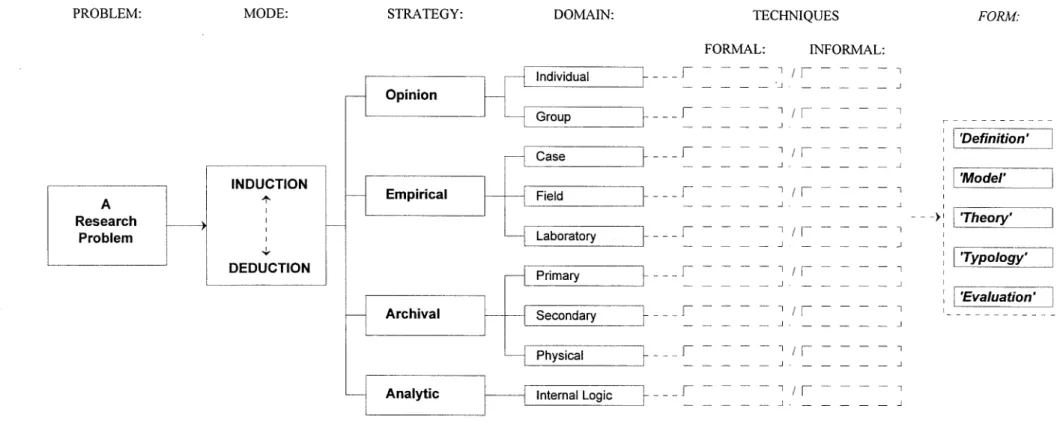
an opinion research strategy in the group domain using the formal Delphi technique, to develop an inductive theory of TQM which is subsequently deductively tested.
Based on this research design, the research process comprised of four broad phases:
developing the research questions (section 1.1 / chapter 2); identifying and assembling the participants;
collecting data and information using the Delphi technique and
deriving a TQM theory and evaluating the validity of the theory's concepts.
It was decided that the primary data would be drawn from an international sample of expert TQM practitioners from 'for profit' organisations recognised as leaders in the field. Supported by examination of methodological shortcomings of previous TQM research investigations, it was concluded that a great deal more could be learnt from organisations that had achieved a high level of TQM success than from organisations that had either failed or made little progress. Furthermore, that there would be a greater likelihood of reaching a greater degree of consensus about TQM if the sample was large and wide-ranging. A modified Delphi survey comprising four planned rounds of postal questionnaires was used to collect the study's primary data. First and second round questionnaires focused on collection of the primary data for the derivation of a theory ofTQM, and third and fourth round questionnaires focused on collection of the primary data for testing the proposed theory's conceptual map7. Fifty respondents was the target sample size for the start of the study (the first round questionnaire) and twenty five respondents was the target sample size for the final questionnaire. A committee of six other known and experienced TQM practitioners was assembled and used to screen and verify the research instruments at each of the four questionnaire stages.
For the most part, the study used pre-coded instrument design for collection of the primary data to be used in the derivation of the proposed theory. Various pre-defined sets of variables were
7The term "conceptual map" refers to the resultant set of identified TQM concepts. The term "conceptual map" is used in preference to the more technically accurate term "concept map", in the remainder of this thesis, for purely linguistic/aesthetic terms.
submitted to the participants for examination, thereby generating the primary data in the form of comparatively rated TQM variables. Conversion of this primary data into the proposed theory involved a profound process of interpretation which centred around explaining the logic underlying these primary data findings. Three other sources of knowledge were combined in order to do this. These were: secondary source data; other primary data in the form of additional documentation supplied by the participants and the previous experience and internal logic of the author. Broader literature on organisation and management theory and behaviour were integrated with the TQM literature to provide the secondary source data.
Examining and refining the primary data collected for derivation of the theory made extensive use of the social science technique of factor analysis. Factor analysis was an ideal method since it involves systematically grouping variables on the basis of the variance in responses according to established mathematical criteria (Black, 1994). Two other versatile statistical techniques were also used extensively. Cross-tabulation was applied to augment identification of salient relationships between the TQM related study variables. The non-parametric
x
2 test of significancewas used to examine the influence of size and class of organisation on the study variables.
Outcomes of the interpretive processes were two-fold. Firstly, a more concise set of salient TQM related variables was identified. Secondly, a core body of logic underlying the TQM approaches of the expert practitioners was derived. The salient variables were heuristically organised into a set of TQM concepts and the inter-relationship digraph technique was used to facilitate the extraction of the salient relationships between the concepts from the core body of underlying logic. Thus, the proposed theory, comprising its three components: concepts, relationships and underlying logic, was articulated.
The qualitative primary data collected through the third and fourth round Delphi questionnaires was then used in an attempt to test the validity of the concepts and hence refine the proposed . theory.
1.6 Scope and Limitations of the Study
The primary data collected in this study came from a sample that comprised 'for profit' organisations only. The resultant proposed theory of TQM has therefore been derived in this context. This should be borne in mind and treated as a boundary to which generalisation can be
taken in any ensuing interpretation or use of the proposed theory.
An objective of the study was the testing of the conceptual map of the proposed theory in order to refine the proposed theory8. As it transpired this theory testing component of the study proved to be significantly more limited than had been envisaged. It had been planned that evaluation of the conceptual map would follow a route that commenced by correlating the concepts against the TQM elements that the best practice sample had implemented during their TQM implementation processes, and against the actual quality practices that exist in the best practice organisations as a result of the introduction ofTQM. These 'present day' quality practices were investigated in the second round Delphi questionnaire. Investigation of the TQM implementation processes was the main concern ofthe third round Delphi questionnaire. The anticipated outcome of this examination would have been the identification of a number of gaps in the correlative analysis. These gaps would then form the basis of investigations to be conducted through the fourth round Delphi questionnaire. In practice the route described proved not to be possible. The main reason for this was that the primary data collected for this purpose, that is to say the implementation plans of the best practice organisations, were found to be far too diverse to permit a meaningful correlative analysis to be undertaken. Whilst it was anticipated that no two implementation plans would be the same, the high level of variation in the plans across the sample was unexpected. Furthermore, the 'present day' quality practices were found to be too highly organisation-specific at the actual activity level investigated to permit a meaningful correlative analysis. The result of these unexpected findings was that the Delphi fourth round questionnaire then became the primary mechanism for testing the conceptual map, rather than a closing mechanism. This meant that only partial testing of the conceptual map was possible. This in turn blocked the presentation of a "refined" theory.
A further consequence of the unexpected finding described above was that the process of designing, and hence the final design, of the fourth round Delphi questionnaire was to a certain extent compromised. In a "cumulative" study of this nature there is an inevitable trade-off between analysing the results of each questionnaire round as comprehensively as possible and ensuring that the momentum of the overall study is not lost. For its primary data the study was drawing on a shifting pool of resources. There was no guarantee that the participants starting the study would remain in their posts for the duration of the study - over time people change jobs, change companies or retire, all of which can compromise their ability to continue to participate. There was