272
A Final Solution of Informality
Problem on Self-employed and Employed in Kosovo
Nakije Kida
1Abstract: A higher level of implementation of tax legislation, efficiency in the Tax Administration of Kosovo (TAK), cooperation between TAK and municipal levels, stimulated and encouraged the reduction of informality of the self-employed and workers in Kosovo businesses. This paper examines two types of employment in Kosovo (employed and self-employed) in 9 Regions (Ferizaj, Gjakova, Gjilan, Mitrovica, Peja, Prishtina 1, Pristina 2, Prishtina 3 and Prizren) and the Department of Large Taxpayers (DLT). To study the dynamics of employment growth, evidence was obtained from the employment figures from the TAK central level, the 2013-2016 period on monthly and yearly basis. The employment performance results have a two-sided positive impact, first they examine the efficiency of TAK in reducing the informality of self-employed and workers in Kosovo, and secondly they examine business co-operation towards reducing informality. The assessment of results is based on descriptive employment statistics for large regions separately.
Keywords:Tax Administration of Kosovo; Informality; Self-employed; Workers; Effeciency
JEL Classification: H21; H26; J54; J83
1. Introduction
This paper reflects the policy and tax system in TAK, presenting in detail the strategy and factual results, especially from 2013 onwards. In the context of the study objective, there are also presented the effects of the strategy implementation that have led the TAK for years as well as the TAK efficiency on stimulating the declaration of Personal Income Tax by self-employed persons and especially the declaration of the wage tax by employers (the wage tax).
A summary of the literature on the addressed problem, but not comprehensive, is focused on creating a strategy of generating new jobs. Self-employment and employment of new workers of different professions does not require more capital but more professionalism, a good opportunity for urban and rural places to create new jobs, and should therefore be supported by governments. Inter-institutional cooperation in Kosovo has created joint activities with the sole purpose to increase self-employment and state employment through the fight against informality in the economy. TAK cooperation with Kosovo Customs aims to get as much information as possible for businesses and individuals who violate, forbidding them at the borders while exporting, importing, etc. Kosovo Police is also in cooperation with these two institutions, fighting evasion, delinquent operations and money laundering.
Kosovo institutions have generally been offered professional assistance by international institutions, while TAK has been specially trained by the Deutsche Gesellschaft für Internationale Zusammenarbeit (GIZ), the International Monetary Fund (IMF), etc. The motto register, declare and pay the tax, is worth to anybody engaged in business activity that generates income. All these should be treated in accordance to the tax laws in Kosovo, to make a good business name and to gain a positive competition in the economy. On one side the employee benefits (decent salary and establishment of the pension base), while, on the other side, employers and the self-employed benefit
1 Prof. ass. Dr, Albanian, Republic of Kosovo, Corresponding author: [email protected],
273
grants and donations by TIM public institutions and international organizations, gaining lower-interest loans and a good name.
All this can be achieved in advance through cooperation with the Business Registration Agency in Kosovo (BRAK/ARBKO), which within the Ministry of Trade and Industry (MTI) has 29 “one – sto – shop” offices throughout Kosovo. Increase of transparency has increased the efficiency in registering new businesses,1 has improved the business environment, spending only 1.96 hours for a registered business (for LLC - Limited Liability Companyonly 2.32 days). Demand by businesses to acquire LLC status is more frequent than that of individual businesses. However, good news is that the participation of women as self-employed has increased from 25% (2016) to 28% (2017). But, women’s participation as a partner or stakeholder is low, only 15%. (https://arbk.rks-gov.net/). For these and others, there are the findings of the study presented through the descriptive analysis of a structured questionnaire.
2. A Review of Literature
The self-employment strategy through business generation is a necessity to increase employment in Kosovo, though the benefits to self-employed are low. While, historically the genesis of the strategy as a support to self-employment, as a means of reducing the state unemployment, has shown its first effects in the developed countries, such as Belgium, Denmark, Finland, France, Italy, Germany, Portugal, Spain, etc.
A self-employment demonstration was mandated by the Section 9152 of Omnibus Budget Reconciliation Act (OBRA) from 1987, the act which authorized up to three states to participate in an experimental self-employment demonstration lasting from 1 to 3 years (Benus, Johnson, Shen & Shen, 1994).
This strategy, in the form of programs approved by these countries, demonstrated how an aid program for self-employment growth functions as a generator of employment for the mid-term period. Chomerurs Createures, an enormous program, operated in France, where initial capital was offered to entrepreneurs who were ready to start a business. Such successful projects resulted even during the years 1990-1999 in the US, where 752 applicants who had declared to be ready to start a business through free engagement of entrepreneurs’ training were trained and funded with initial capital, providing support services and financial assistance for minimal initial capital by the state for three years. How the implementation of such programs was dealt with and how some self-employed professions had positive effect on the increase of employment was emphasized by Benus et.al. (1990) and Benus, Johnson et.al (1993). A good discussion about this issue was also provided by Kitching and Smallbone, 2008, Rapelli, 2012, Burke, 2012, Bögenhold et al. 2014.A wide self-employment network has been established by independent translators, temporary managers, contractors (Barley and Kunda 2006), which, to Burke and Cowling,2 enhances the firm's ability to be flexible, innovative
and entrepreneurial to manage the risk of the business from insecure environment. Other professions are as much creative as self-employment as well as other aforementioned professions, and some of them are3: media makers (Storey et al., 2005), journalists (Baines, 1999), self-employed at television and radio (Dex et al., 2000), at films (Rowlands & Handy, 2012), publishers (Stanworth & Stanworth, 1995), photography and make-up artists (Moeran, 2009), public relations (Tech et al., 2002), design (Henninger & Gottschall, 2007), art (Menger, 1999) and Music (Armstrong, 2013), etc. On the other hand there are professions that have not been massively involved as self-employed so far, as medical professionals like nurses, midwives and healthcare visitors (Drennan et al., 2007). How to deal with this strategy for self-employment in Kosovo, where mostly small and medium businesses operate and there is a young population enough educated to start a business?
1 Only in 2017 there were 9,335 trading companies registered with a foreign owner, partner or shareholder. 2 CORSE, 2015, The Handbook of Research on Freelancing and Self-Eployment, p. 13.
274
The inability of the state to organize self-employment through financial incentives does not mean that entrepreneurs in Kosovo do not enjoy benefits of different nature, there are other incentives such as training from the Ministry of Social Welfare and International Organization (IOM, USAID, etc.), through the projects as vocational training for many young people in Kosovo, and there are occasions when employees were paid up to 80% of the wage (for 1-2 years) by these organizations.
The World Bank has been supporting the Agriculture sector in Kosovo since 2012, aiming to improve productivity and access to markets, especially that of horticulture and livestock sector (the sector which has generated self-employment through initial capital, funding new agricultural technology, improving the product quality etc.), for applicants to start business as farmers as well as to expand the existing businesses of farmers. Other projects were also donated by the International Development Association (IDA), Denmark (11 million euros), to 700 beneficiaries in Kosovo for investments in the construction of greenhouses, granaries and cowsheds, construction of dairy collection facilities, growing of orchards and machinery farming.1
Such programs also encourage women to self-employment through creating a business. Kosovo, unlike other countries, has no benefits in other mentioned professions as in developed countries even though there are solid conditions for such a thing. Kosovo youth are distinguished for their skills in every profession, achieving extraordinary success out of Kosovo. Emigration of young Kosovars with attractive professions has become a routine, so the idea of state funding of these young people with initial capital, and the possibility of funding with soft loans from abroad through various projects, would affect reduction of the state unemployment just by these self-employed.
There are projects in Kosovo to continue for four more years by the World Bank (WB), through IDA for $ 22 more million, in rehabilitation of the irrigation scheme of horticulture, Radoniqi and Dukagjini that will create effects on expanding the self-employment even for young farmers. However, it will be very effective to reduce unemployment in Kosovo if projects are financed by urban areas (there is an excellent human resource capacity that can be practiced by different professions as translators, contractors, accountants, journalists, media makers, television, radio, taxi, film, photographers, publishers, lecturers, artists, make-up artists, hairdressers, public relations, design and graphics, music, midwives, therapists, masseurs, children and elderly caretakers, etc. In developed countries, small businesses have a special treatment because they double-reduce the employment burden (employing themselves and others).2 For example, in Britain, it is noted that 5.4 million small enterprises in the private sector include only their owner. Public policies are those that have a great role in providing potential self-employment opportunities in this country, so public policies must work in Kosovo either. State tax authorities all over the world treat every business equally when it comes to paying taxes. Fiscal policies are those that categorize businesses which will benefit state incentives, and the most privileged category should be small businesses and other businesses involved in manufacturing and exporting. Fiscal incentives in Kosovo are especially for the category of manufacturing and exporting businesses but there are no financial incentives for small and medium-sized businesses as self-employed. The authority which controls businesses in Kosovo is the Tax Administration of Kosovo (TAK), which is widely discussed below.
2. A Tax Administration of Kosovo, I’ts Background, Strategy and Efficiency
Establishment of the Central Fiscal Authority (CFA) and its transformation into TAK was a short three-year period.3 “Pursuant to authorizations given by the Resolution 1244 (1999) of the United Nations Security Council of 10 June 1999. Taking into account the Regulation no. 1999/1 of the United Nations Interim Administration Mission in Kosovo (UNMIK), amended, on 25 July 1999 on
1 The World Bank in Kosovo, Countrz Snapshot, 2017.p. 4.
2The Handbook of Research on Freelancing and Self-Employment, Chapter 2, p. 16.
3 Kida, N. (2014). Applicatin and effect VAT tax in Republic of Kosovo: Applicatin of VAT over 150 countries worldwide and Kosovo, p. 252. Editor: Lap Lambert Academic Publishing 25 February 2014. www.amazon.it/Applicatin-effect-VAT-Republic-Kosovo/dp/3659216682.
275
authorizations of the Interim Administration in Kosovo and the Regulation no.1999/16 by UNMIK, amended, on 6 November 1999 on the Establishment of the Central Fiscal Authority and other issues related to it, begins the first genuine phase of the tax system under UNMIK’s full powers” Kida N. (2014, p. 38).
The strategic goal of the central fiscal authorities was developing a tax system that would make Kosovo self-sustaining through its fiscal resources as early as possible. A special challenge to a sacred and necessary mission that TAK had to organize and administer were also the human resources, the post-war emergency period (1999) showed its true appearance, the need for a comprehensive coordination of Kosovo with friends from the International Community to establish a modern Tax Administration. The Kosovo Tax Administration was organized (17 January 2000) under the direction and administration of UNMIK. The first TAK director was an international expert employed by a USAID contractor. In order to institutionalize administration and tax procedures (12 April 2000), was announced the Regulation No. 2000/20 on Tax Administration and Procedures. From October 2001 to February 2003 there were co-directors, one from USAID and one from Kosovo, who shared the role of the director. The Tax Administration Authority (on 18 February 2003) was transferred from UNMIK to the Ministry of Economy and Finance, and the Kosovo Director assumed the duties of the TAK Director. Since then, TAK has functioned as an autonomous organization entirely managed by Kosovo residents with advice and assistance from international donor organizations in the first place, USAID, EU Pillar IV, CAFAO-UNMIK and EU (Kida, 2014, p. 40).
Since its establishment TAK has received skilled workers from the field of economics, law, who would handle the management and tax audit work. In its very beginning, when a small number of types of taxes were applied, a symbolic staff was admitted, at the beginning of 2000, 35 employees were hired, the time when the first management structures were formed, is also known as the first and second generations of employees in this important institution of the post-war Kosovo. It is known that now (2017) TAK staff reaches over 784, with a constant demand to increase. Out of 652 employees in 2011, 298 were tax inspectors, working in the control department and that of the taxpayer service, 63 were tax collectors and 291 were employees working in the administration from the director to the housekeeper. It is clear that TAK needs additional human resources especially for tax-control inspectors because it does not meet the needs for a wider involvement in business visits. Most importantly, there are few inspectors, though professional, about 70% of them aged 50-55 (within 15 years they get retired), and within this period the number of inspectors must be tripled for two reasons:
Firstly, employing new employees within 10 to 15 years would increase the effectiveness of wider involvement of businesses in educational activities and controls (recruitment of inspectors has been very slow from 2011 to 2017 there is an increase of only 16.8%);
Secondly, increasing employees during this time would increase the quality of work to new inspectors as a result of cooperation and exchange of experiences between young and old inspectors, as experience is the mother of learning.
The motto of TAK “voluntary disclosure” of taxpayers has been accomplished (businesses mostly make voluntary disclosure1), compared to the times a tax inspector can visit a business2. A higher qualification structure of employees of 85.3% (while 1.5% with higher education and only 12.9% with secondary education) is a guarantee that work is done professionally. While the gender structure in
1 From the TAK 2016 annual report results that in 2014 were performed 1056 inspections in Kosovo businesses by tax inspectors, in 2015 were performed 1282 inspections, whereas in 2016 were performed 1499 inspections (an increase of 18% (2014-2015) and 14% (2015-2016). While the annual plan of inspections in 2016 was 2222, only 67.5% of planning was carried out (by 284 tax inspectors)
2 According to an analysis made in a study in 2011 (Kida N, 2014, p. 40), is noted that the relationship between inspectors and businesses is that one inspector controls 30 businesses. Compared the very low growth rate (about 16.8%) of employees at TAK from 2011 (652) in 2017 (784).
276
general is to be admired, 46% female and 54% male, while in leading positions it is in the disadvantage of women.1
Figure. 1. A system of tax compliance management in Kosovo (www.atk-ks.org), by the author
Despite that, TAK remains committed to complement and overcome its obligations to laws, government, local and international institutions, and to be a catalyst for the development of the country and society.2 A comparison of the efficiency on collecting revenues by TAK in 2002 and 2010, according to taxes in Fig. 2, appears to be an increase in VAT participation in total revenues from 36.2% in 2002 to 51% in 2010, the Presumptive tax (PT) from 42.4% in 2002 to 0.2% in 2010 (replaced by PT with IS -Tax on Small Business). PD (Tax on Big Business) did not exist in 2002, from 2005 onwards this type of tax is declared (2010 was 11.6% of total revenue). Profit tax was applied until 2004 and it was replaced by the Tax on Corporate (CD) where participation in 2010 was 16.4%. While the Wage Tax (WR) in 2002 was not widely applied in 2002, while in 2003 it was massively involved, and in 2010 participation in total income was only 5.3%, while in 2016 it reached 20.8%.
Figure 2. The two figures represent the revenues according to the types of taxes in Kosovo2002 and 2010 (N.kida, 2014, p. 196).
While in the structure of revenues in 2016, according to the types of taxes, the largest share had VAT with 46.7%, then Corporate tax with 21.0%, withholding tax with 20.8%, individual business tax with 8.6% and interest tax, dividends, property rights, rent, lottery winnings and gambling 2.9%.
1 This implies that in the operational work of the tax audit work a lot of women while in leadership positions (from the te am leading level to the director) the female male ratio is discriminatory for women.
2 Annual Report of the Tax Administration of Kosovo, reporting period: January-December, 2016. p.7. Mission
• We are here to collect taxes and contributions to support the economic development and wellbeing of citizens.
Vision
• Be trustworthy and respected as well as be well-versed with leading administrations in Europe.
Our values
• Professionalism • Integrity and Honesty, • Efficiency and
Effectiveness, • The excellence of
services, • Transparency
277
Figure 3. Revenues by types of taxes for 2015 and 2016 Source: TAK, Annual Report, 2015 and Annual Report 2016, p. 15
Note: TVSH - Value added tax, TB - Withholding tax, PD - Individual business tax, WR - Tax on interest, dividend, property rights, rent, lottery and gambling, CD – Corporate tax
In 2017, the largest share belongs to the Value Added Tax (VAT) with 46.7%, then to the Personal Income Tax (PIT) by 29.4% and the Corporate Tax by 23.9% (Source: TAK, Annual Report, 2016, p .17). Total revenues in 2014 amounted to 303.7 million euros, the share of income from wage tax by employees throughout Kosovo was 22.3% (67.857.126 euros), in 2015 were realized 332 million euros and the share of wage tax was 21.62 % (71,848,878 euros), in 2016 total revenues were 386 million euros and the wage tax participation was 20.7% (80,327,270), which shows that there is an increase in the tax declaration even though total revenue participation is decreasing as a result of total revenue growth.1
Figure 4. Revenues from Taxes and Pension Contributions in Kosovo in 2016 (TAK, Annual Report 2016, p. 17)
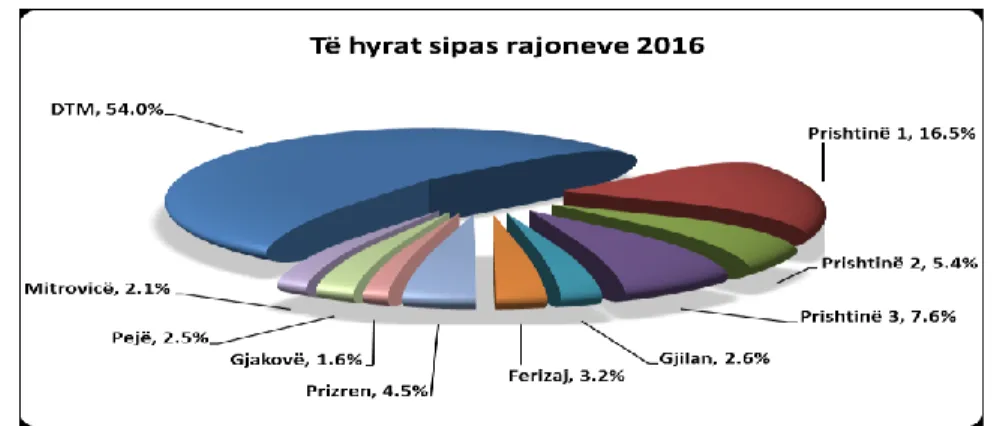
While in 2017, revenues planned to be realized are 420 million euros, while 392 million euros or 93% of planned revenues have been realized so far. While according to the projection, revenues planned to be collected by TAK in 2018 will be 446 million euros, that is a real challenge for TAK when we consider that businesses also work with cash while controls by TAK are not frequent (a small number of Tax Inspectors). Revenues by region have this distribution, the Department of Large Taxpayers (DLT) has collected 54% of total revenues and the rest is collected from regions Prishtina 1 (16.5%) and other regions Prishtina 2 (5.4%) Prishtina 3 (7.6%), Gjilan (2.6%), Ferizaj (3.2%), Prizren (4.5%), Gjakova (1.6%), Peja (2.5%), Mitrovica 2.1%).
278
For the period 2014, 60,142 visits were conducted; in 2015 a total of 55,099, while in 2016 a total of 42,606 visits1 were conducted, as well as 7,043 mandatory fines and 723 fines were issued for non-originating goods as a result of the established irregularities.
Figure 5. Total revenues collected by regions in 2016
During this period as a result of conducted visits, 1.8 million euros were issued as mandatory fines, the value of non-originating goods was 2.9 million euros, as a consequence the penalty for this commodity was in the amount of 438,596 euros, the stock shortage was in the amount of 41.9 million euros, additional turnover in the amount of 201.9 million euros, where as a result there was additional tax in the amount of 17.03 million euros, while the reduction of lending and loss was in the amount of 15.8 million euros.2
The number of active businesses registered by the end of 2016 is 87,979, of which 63,753 are individual businesses, while 24,226 are legal businesses, and 42,654 are fiscal numbers for persons.3 The use of Electronic Disclosure Information (EDI) has been used by 65,194 taxpayers (December 2016), while this system has been used by 63,208 taxpayers. In 2016,4 through EDI, 1,712,258 statements (including corrections) were filed, where according to the types of taxes, the structure of declarations is: VAT, 16.9%, Withholding Tax and For Pension Contributions (WM & CM) on average 31.8% each, Income Tax, Dividend, Property Rights, Rent, Winning Lottery and Gambling (WR) 9.4%, Single Businesses 7.4% and other taxes together for 2.9%.
While the electronic statements (number of declarations) according to taxes are:5 Value Added Tax (VAT, are 263,694), Wage tax (WM are 495,865), Employee's pension contribution (CM are 497,552), Personal Income Taxes from Small Businesses (IS are 115, 036), Small Taxes (QS are 20,631), Personal Income Taxes for Large Businesses (PD are 11,040), Tax on Large Corporate (CD are 7,458), Wage Taxes (WR are 145, 631), Rental Tax (IR are 4,716) and Partnership taxes (DO are 619). It is seen that the electronic declaration that dominates in the system is from withholding tax (WM or wage tax) and worker's pension contribution (WM).
The World Bank (Doing Business 2017), in its annual report business on environment of doing business ranked Kosovo at position 60 out of the 190 world economies (countries) evaluated by this report. Meanwhile, the “tax payment” indicator has positioned TAK in position 43 or 34 positions higher than in the previous year, where it was in position 77 (Source: Annual Report 2016, pp.45.) Kosovo in “Starting a Business” is also ranked from position 27 (2016) to position 13 (2017) or 14 positions above, “Dealing with construction Permits” from position 125 (2016) to 129 (2017) or 4
1 The envisaged visit plan for the period 2016 is 45,510, realization is lower by 6,4% (42,606), therefore the number of visits is worsening each year, a reason to increase the number of tax inspectors in Kosovo.
2 The TAK, Annual Report 2016, the results of the fulfilling visits. Source: VKME by SIGTAS [modernizing the data network by continuously transforming the physical files into the electronic ones. It is a priority created not only for TAK staff (assessment of performance) but also for the most accurate and rapid assessment of taxpayer status by TAK in the last 5 years].
3 TAK annual report 2016 (source of Information Technology (SharePoint). 4 TAK annual report 2016 (source of Information Technology (SharePoint). 5 TAK annual report 2016 (source of Information Technology (SharePoint).
279
positions below; “Getting electricity” from position 111 (2016) in position 114 (2017) or 3 positions below, “Registering Property” in these two years has the same position (33). While in “Getting Credit” there is a fall for one position (from position 19 to position 20).
“Protecting Monority Investors” has been downgraded for a position (from 62 in 2016 to 63 in 2017). “Trading across Border” has an increase for 8 positions (from 59 in 2016 to 51 in 2017). Even “Enforcing Contract” Kosovo does not improve but falls for 1 position (from 43 to 44). Finally, “Resolving Insolvency” has an improvement for 1 position (164 as it was, now it is in position 165).1
This significant change has come as a result of many reforms undertaken in TAK, and in particular the finalization of the electronic system for declaration and payment of online taxes. TAK welcomes this assessment from the World Bank by listing TAK at 43 out of 190 countries (taxation systems) and will continue with reformation, aiming to improve the business environment, in particular that the payment of taxes be at a minimal cost.
4. Study Metodology
The methodology used in this study is combined, based on in-depth literature, primary data through instruments (structured questionnaire) carried out in a sample of 900 businesses throughout Kosovo (total 900 surveys2). The questionnaire is carried out in all types of businesses, filled in by owners and
employeess.
The questionnaire was constructed based on 10 questions processed with SPSS. Secondary data were used for employees and self-employed for the period 2013-2016, from the source of the TAK Planning Department, through its available Information Technology. To determine the number of questionnaires to be completed, Taro Yamane's diary was used, methods (Taro Yamane, 1967) has a confidence level of 95% while the magnitude of the error is considered to be 5%. Formula, Yamane: n=N/(1+N · e²); Where, n = sample size or respondents; N = population size; e = level of accuracy (95% confidence level or 5% error level). Given that around 80169 businesses (2017) are active in Kosovo. Formula, Yamane: n= 80169/ [(1) + (80169·0.05²)]; n = 80169 / [(1+ 200.42)] ; Sample size is n= 398.01. 900 questionnaires have been completed for this study, which is twice as much as the formula recommends.
5. Result of Study
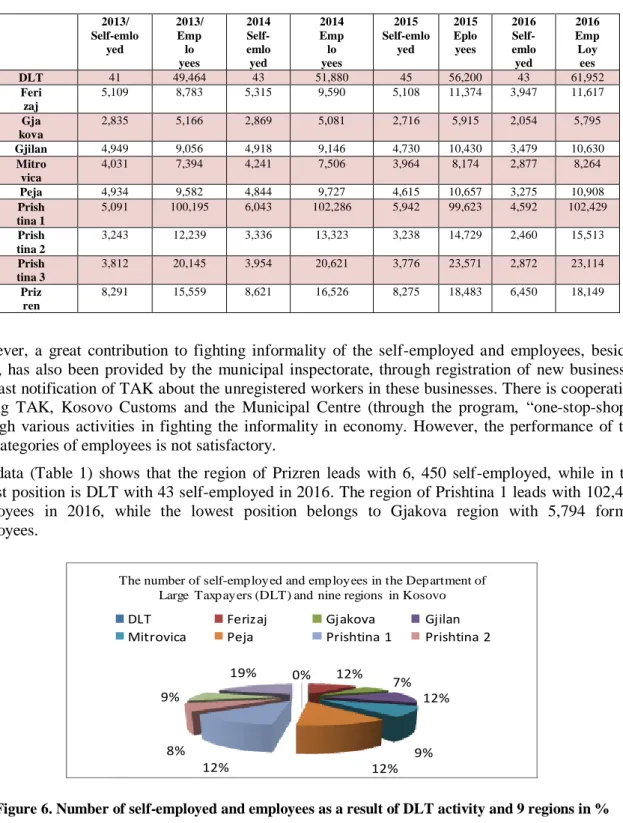
The results of the secondary data (statistics in TAK, table 1) show an unsatisfactory performance of revenue collection from wage tax and business disclosure. Statistics show that in 2011 there were 41142 self-employed, in 2012 there were 41754 self-employed (an increase of only 1%), in 2013 increase of 1% or 42450 self-employed. While, the second largest categories in Kosovo that declare and pay wage tax are 219,163 employees in 2011 and 228,425 in 2012 or 4% more than the previous year. As well the increase for 2013 is 4%. The linear growing trend of the two categories of employees continues in the years 2014 to 2017 (an increase of no more than 4-6%).
280
Table 1. Number of self-employed and employees as a result of DLT activity and 9 regions (by the author)
However, a great contribution to fighting informality of the self-employed and employees, besides TAK, has also been provided by the municipal inspectorate, through registration of new businesses and fast notification of TAK about the unregistered workers in these businesses. There is cooperation among TAK, Kosovo Customs and the Municipal Centre (through the program, “one-stop-shop”) through various activities in fighting the informality in economy. However, the performance of the two categories of employees is not satisfactory.
The data (Table 1) shows that the region of Prizren leads with 6, 450 self-employed, while in the lowest position is DLT with 43 self-employed in 2016. The region of Prishtina 1 leads with 102,429 employees in 2016, while the lowest position belongs to Gjakova region with 5,794 formal employees.
Figure 6. Number of self-employed and employees as a result of DLT activity and 9 regions in % Source: By the author
The total of employees and self-employed in 2013 are 287,729, in 2014 are 289,870, in 2015 are 301, 565 and up to September 2016 are 277, 306 employees and self-employed. The growth as percentage of both categories is decreasing year-on-year (0.07%, 4% and in decrease of -8%). Expressed in percentage, in nine regions and in the Department of Large Taxpayers (DLT), the efficiency report to declare as self-employed and employee is different from region to region, this shows the efficiency of tax inspectors of various TAK regions.
2013/ Self-emlo yed 2013/ Emp lo yees 2014 Self-emlo yed 2014 Emp lo yees 2015 Self-emlo yed 2015 Eplo yees 2016 Self-emlo yed 2016 Emp Loy ees DLT 41 49,464 43 51,880 45 56,200 43 61,952 Feri zaj 5,109 8,783 5,315 9,590 5,108 11,374 3,947 11,617 Gja kova 2,835 5,166 2,869 5,081 2,716 5,915 2,054 5,795 Gjilan 4,949 9,056 4,918 9,146 4,730 10,430 3,479 10,630 Mitro vica 4,031 7,394 4,241 7,506 3,964 8,174 2,877 8,264 Peja 4,934 9,582 4,844 9,727 4,615 10,657 3,275 10,908 Prish tina 1 5,091 100,195 6,043 102,286 5,942 99,623 4,592 102,429 Prish tina 2 3,243 12,239 3,336 13,323 3,238 14,729 2,460 15,513 Prish tina 3 3,812 20,145 3,954 20,621 3,776 23,571 2,872 23,114 Priz ren 8,291 15,559 8,621 16,526 8,275 18,483 6,450 18,149 0% 12% 7% 12% 9% 12% 12% 8% 9% 19%
The number of self-employed and employees in the Department of Large Taxpayers (DLT) and nine regions in Kosovo
DLT Ferizaj Gjakova Gjilan
281
Four most efficient regions presented, with total participation are, Prishtina 1 with 12%, Prishtina 2 with 12%, Peja 12%, and Prizren 12%. Expressed in percentage, in nine regions and in the Department of Large Taxpayers (DLT), the efficiency report to declare as self-employed and employee is different from region to region, this shows the efficiency of tax inspectors of various TAK regions. The results of primary data (structured questionnaires) are presented in two parts. 4.1. The First Part of the Questionaire
Type of business activity1: Activity, Trade 520 businesses or 55.5% in total. Activity, Manufacturing 120 businesses or 13.4% in total. Activity, Services 235 businesses or 26.1% in total. Activity, Other, 45 businesses or 5.0% in total did not respond.
The first question: How many workers are not registered?
Businesses with 5 employees, responded that 3 out of 5 employees found in the
workplace were undeclared. So, there are 2 employees without job contract or 40%
informality in wage tax in 490 businesses;
Businesses with 12 employees, responded that 6 out of 12 employees found in the
workplace were undeclared. So, there are 6 employees without job contract or 50%
informality in wage tax in 170 businesses;
Businesses with 20 employees, responded that 4 out of 20 employees found in the
workplace were undeclared. So, there are 4 employees without job contract or 20%
informality in wage tax in 100 businesses;
140 out of 900 surveyed businesses or 22.2% in total did not respond.
It turns out that large businesses are more real in declaring the wage tax (informality is 20%), while in small and medium businesses, informality reaches 40-50% of employees without a job contract. The second question: How many workers are declared from €0 to €80?
Businesses with 5 employees responded that 1 employee was declared with €80 or 20%
of employees (510 businesses responded);
Businesses with 12 employees responded that 2 employees were declared with €80 or
17% of employees (200 businesses responded);
Businesses with 20 employees responded that 4 employees were declared with €80 or
20% of employees (75 businesses responded);
115 out of 900 surveyed businesses or 12.17% in total did not respond.
The third question: How old are the employees and how much do they earn?
Businesses with 5 employees, 450 of them responded that the average age of employees
is 42 and a wage of €230;
Businesses with 12 employees, 270 businesses responded that the average age of
employees is 29 and a wage of €280;
Businesses with 20 employees, 100 businesses responded that the average age of
employees is 32 and a wage of €340;
50 businesses did not respond or 5.5% in total out of 900 surveyed businesses.
1 Surveyed are mostly small and medium enterprises. Classification of businesses in Kosovo according to the criterion of employees <9 employees are small enterprises, while middle enterprises from 10-49 employees. The business classification is done, with 5 employees, 12 employees and 20 employees (with the aim of facilitating the survey).
282
Question four: How long are the workers held by the employer at a job?
Category of businesses with 5 employees, 520 of them have responded (or 58% of
respondents responded) that employees are held up to 2 years;
Category of businesses with 12 employees, 230 of them have responded (or 58% of
respondents responded) that employees are held up to 5 years;
category of businesses with 20 employees, 98 of them have responded (58% of
respondents responded) that employees are held up to 10 years;
52 businesses did not respond or 5.8% in total out of 900 surveyed businesses.
4.2. The Second Part of the Questionnaire
The first question: What would be the powerful measures to fight evasion in tax on wages and pension contributions?
200 businesses (or 22.2%), as important measures consider, awareness of taxpayers,
organization of workshops, etc.;
520 businesses (or 57.7%), as unimportant measures consider taking direct and indirect
data and registering them with penalties;
While 120 businesses (17.8%) consider both measures not important;
20 businesses (2.2%) did not respond to this question.
Employers oppose the stringent measures the state would take for the proper implementation of law on regular job contracts. They prefer more frequent information measures.
The second question: Do the joint additional information and control activities of municipal inspectors, police and TAK help to direct employee registration unless there are differences?
As important measures, 600 businesses (66.6%) consider joint information and control
activities of municipal inspectors, police and TAK in direct registration of employees;
As less important measures, 200 businesses (22.2%) consider joint information and
control activities of municipal inspectors, police and TAK in direct registration of employees;
While, 75 businesses or (8.3%) consider the both measures not important at all;
25 businesses (2.77%) did not respond to this question.
Employers prefer cooperation among TAK, municipal inspectors and the police if applied to all businesses alike.
The third question: Are employers obstacle to reducing informality in the wage tax? What do employees think?
According to employees who work in 480 businesses (53.3%), employers can dismiss
them if they seek a regular job contract;
According to employees who work in 370 businesses (41.1%), employers do not dismiss
them even though they have requested a regular job contract;
While at all important is considered a job contract by employees in 100 businesses
(11.1%);
283
According to the responses received from employees, 53.3% of them do not hesitate to indicate that their job is jeopardized if they ask for a job contract. While 41.1% did not have any obstacles by the employer in asking for a job contract. 11% of employees who work in 100 businesses are indifferent in obtaining the job contract. 5.5% of the surveyed respondents refuse to respond.
Question Four: Are tax inspectors (human resources) insufficient to cover the high number of registered businesses with information and control visits?
According to employers and employees, the increase of informative and controlling
visits by TAK is considered important because 500 businesses (55.5%) state that within a
year they did not have any visits from TAK;
While 315 businesses (35%) state that the visits from the tax inspectors are sufficient
and that the employment of new inspectors is not necessary;
While 15 businesses or 1.7% of total respondents from businesses and employees
consider employment of young inspectors not important at all;
70 businesses (7.8%) did not respond to this question.
As understood by businesses (35%), increasing the number of tax inspectors is unnecessary. However, it is very important that more than half of businesses (55.5%) require more visits from TAK.
The fifth question: Would stimulation in wages fight corruption among the tax and communal inspectors?
250 businesses (27.7%) consider the wage increase as an important measure in fighting
corruption among inspectors;
180 businesses (20%) consider it a little important;
While 400 businesses (44.4%) consider it not important at all;
70 businesses (7.8%) did not respond to this question.
According to businesses (44.4%), increase of wages to inspectors would not be a measure to reduce corruption, to them the legal penalties are those that reduce and fight corruption. About 27.7% of businesses responded that they think the wage increase reduces corruption of tax officials. As a result of this, self-employed try not to issue employment contracts and not transfer the salaries through the bank.
Apparently the challenge of tax evasion and pension contributions for employees and other business obligations is done in order to super-fulfill their objectives, contrary to tax laws in Kosovo. The Government of Kosovo has oriented action plans to address these problems, and as initials, firstly are the fiscal programs for receiving subsidies and specialized online services, and secondly the radicalization of punitive measures for employers who disregard tax rules. In addition, the Government of Kosovo must advance and guide general, economic and legal policies so that the entrepreneurs invest with social and environmental responsibility, creating no additional costs for their businesses, except tax obligations they have. Since employers lack funding to expand their businesses, they declare it difficult to employ workers.
However, they, as entrepreneurs should be encouraged not to perform multiple roles in their businesses, such as management, marketing and accounting, but to engage additional productive workers, what is the interest of the company as well.
284
5. Conclusions and Recommendations
Constant modernization of TAK, professionalism of human resources, and co-operation in the central and local level, failed to ensure that taxpayers (self-employed and employees) are equal before the law. This proves that lawlessness has given way to high tax evasion, especially to that of the wage tax. In addition, the lack of tax inspectors in the wider involvement of taxpayers in education and control, gave way to the lack of real declaration of employees and registration of businesses.
In order to achieve a higher involvement of employees with business contracts and businesses with a business certificate, TAK needs its strongest point, the human resources stimulate through wage increases.
Peru has proven this with wage increase to tax inspectors (as high as that of a deputy), seeking from them to meet the highest standards at work, and which produced spectacular results in revenue collection, three times more than before the reforms.
On this basis, TAK on one hand can increase the standards at work, and on the other hand, within 10 years recruit twice the existing inspectors with higher education criteria and age (young, dynamic and enthusiastic). This would enable TAK to compete on “tax payment” in the region in the coming years. - TAK together with its partners, Customs, Kosovo Police and the directorates of market inspectors at the local level should have the initiative and build a positive cooperation;
- The Ministry of Finance and TAK should focus on human capital, the development of qualitative and quantitative performance;
- Encouraging creation of a higher authority of tax inspectors as well as taxpayers, ensuring strict rule-of-law compliance.
APPENDIX A. The First Part of the Questionnaire
Businesses classified by number of employees
The first question:
How many workers are not registered?
The second question:
How many workers are declared from €0 to €80?
The third question: How old are the employees and how much do they earn?
Question four: How long are the workers held by the employer at a job?
Type of business activity
N1 E 2 % N3 P 4 % N M5 P6 N % V 7 Ll8 N9 %
(Businesses with 5 employees) Only 2 employees with work contracts (or 20% of the real salary statement - WM and CM
pensioners) 490 2 40 % 510 1 20% 480 24 230 520 58 2 Trad e 500 55.5
(Businesses with 12 employees). There are only 4 workers with work contracts (or 33% of the real wage bill - WM and CM workers' retirements) 170 6 50 % 200 2 17% 270 29 280 230 25. 5 5 Prod ucti on 120 13.4
(Businesses with 20 employees) There are 12 workforce workers (or 60% of real wage tax declarations - WM and CM pensioners). 100 4 20 % 75 4 20% 100 32 340 98 10. 9 1 0 Serv ices 235 26.1
They did not answer 140 22.2% 115 12.77% 50 5.5% 52 5.8% Te
tjera
45 5.0
Total: 900 100.0 900 100.0 900 100.0 900 100.0 900 100.0
1 Number of businesses. 2 Fiscal evasion in WM & CM.
3 The number of Businesses that answered in the questionnaires. 4 Unannounced worker.
5 Average age of employees. 6 The average salary.
7 Average number of days of employment in a job. 8 Type of business activity.
285
APPENDIX A. The Second Part of the Questionnaire Question 1. What
would be the powerful measures to combat evasion in tax on wages and pension contributions? a) through taxpayer awareness, organization of seminars, etc. b) Through, receiving direct and indirect data and recording them with punishments?
Question 2. Do the joint information and control activities of the municipal inspectors, the police and the TAK help to directly register employees if no differences are made? Question 3. Are employers obstructive in lowering informality in payroll salaries, what do employees think? Question 4. Are the tax inspectors (human resources) unable to cover the number of registered businesses with information and control visits?
Question 5. Stimulate pay, would it fight corruption among tax and communal inspectors?
N % N % N % N % N %
Most important (a) 200 22.2 600 66.6 480 53.3 500 55.5 250 27.7
Less important (b) 520 57.7 200 22.2 370 41.1 315 35 180 20.0
Not important at all (a and b)
160 17.77 75 8.3 100 11.1 15 1.7 400 44.4
They did not answer 20 2.22 25 2.77 50 5.5 70 7.8 70 7.8
Total 900 100.0 900 100.0 900 100.0 900 100. 0 900 100.0 Mean 6.67 4.32 6.24 7.59 3.74 Std. Deviation 4.354 4.354 4.449 3.993 4.153 Variance 18.954 18.953 19.790 15.943 17.245
6. References
ATK, Raporti Vjetor i Administrates Tatimore të Kosovës, periudha raportuese:Janar-dhjetor,2016.fq.7. http://www.atk-ks.org/wp- content/uploads/2017/04/Raport-Vjetor- .
Burke, A.E., The Entrepreneurship Role of Freelancers - Theory with Evidence from the Construction Industry. International Review of Entrepreneurship, 9(3), pp 131-158.
Burke, A. & Fraser, S. (2012). Self-employment: the role of intellectual property right laws. Small Business Economics, 39(4), pp. 819-833. https://link.springer.com/article/10.1007.
Chukwuemeka, Nnadi (2014). The Role of Creativity and Innovation in Business Growth and Sustainability. An Ideal
Model. Nnadi, Int J Econ and Manage Sci, vol. 3:1, http://dx.doi.org/10.4172/2162-
6359.1000171.https://www.omicsonline.org/.
CORSE (2012). The Handbook of Research on Freelancing and Self- Eployment. Pp. 13-16. European Commission (EC) (2012). Supporting entrepreneurs and the self- employed. Luxembourg.
Benus, Jacob M.; Johnson, Terry R.; Shen, Theodore & Shen, Theodore (1994). Final Impact Analysis ofthe Washington and MassachussetsSelf- Employment Demonstrations. P. 3.
Kitching, J. & Smallbone, D. (2008). Defining and Estimating the Size of the UK Freelance Workforce. London: PCG. Kida, N. (2014). Applicatin and effect VAT tax in Republic of Kosovo: Applicatin of VAT over 150 countries worldwide and Kosovo, p. 252. Lap Lambert Academic Publishing (2014). ww.amazon.it/Applicatin-effect-VAT-Republic-Kosovo. Kida, N. (2013). The history of Tax Administration of Kosovo and i’ts efficiency. Oeconomica, Business Administration and Business Economics, Vol. 9, no. 3, pp. 5-21.
Kida, N. (2013). Tatimi i Vleres se Shtuar ecuria dhe karakteristikat e tij. Universiteti Publik i Tiranës – Fakulteti i
Ekonomisë. Revista Shqiptare Socio Ekonomike Journal Publications, ISSN: 2222-5846, viti- XIX,Nr.1(74).
http://www.acer.org.al/2013/125-revista-viti- 2013.
(2016). Minisria e Financave -Thesari/Administrata Tatimore e Kosoves - Teknologjia Informative. www.atk-ks.org. (2017). The World Bank in Kosovo, Country Snapshot. P. 4. http://pubdocs.worldbank.org/en/.
Leighton, Patricia & Duncan, Brown (0). The rise of Europes Independent Profesionals (IPROS). http://www.efip.org/sites/default/files/future_working_full_.
Source Online
http://biznesetehapura.com/sq. https://arbk.rks-gov.net/.
286 http://ask.rks-gov.net/media/3839/buletini-janar-tm4-2017.pdf). https://arbk.rks-gov.net/. http://www.atk-ks.org/publikime/buletini-2/. https://arbk.rks-gov.net/. https://arbk.rks-gov.net/Page.aspx?id=1,9,23. http://www.atk-ks.org/multimedia/broshura-informative/. http://www.atk-ks.org/multimedia/manualeprezantime/. http://www.atk-ks.org/wp- ]content/uploads/2012/04/Udhezuesi-per-punedhenes_Shqip.pdf. http://www.atk-ks.org/multimedia/video-3/. http://www.atk-ks.org/video-2/. http://www.atk-ks.org/wp-content/uploads/2016/07/TAX_REP_WEB.pdf. http://www.atk-ks.org/wp-content/uploads/2016/04/Raporti-i-punes-Janar-Dhjetor-2015- . http://www.atk-ks.org/wp-content/uploads/2010/09/Raporti-i-punes-per-vitin-2014.pdf. http://www.atk-ks.org/wp-content/uploads/2010/09/Raporti-i-punes-per-vitin-2013.pdf. http://www.atk-ks.org/wp-content/uploads/2013/02/Raporti-Janar-Dhjetor-2012-07-02-2013-. http://www.atk-ks.org/wp-content/uploads/2012/04/Raporti-i-punes-2011.pdf. http://www.atk-ks.org/wp-content/uploads/2010/09/Raporti-Vjetor-2010_web.pdf. http://www.atk-ks.org/wp-content/uploads/2017/03/Plani-vjetor-i-pun%C3%ABs-2017- . http://www.atk-ks.org/wp-content/uploads/2017/03/Plani-i-detajuar-i-trajtimit-t%C3%AB- . http://www.atk-ks.org/wp-content/uploads/2016/04/Plani-vjetor-i-punes-2016-VF.pdf http://www.atk-ks.org/publikime/dokumente/. http://www.itg-rks.com/sq/Aleanca-Kosovare-e-Biznesit-. http://www.itg-rks.com/sq/Bankat-dhe-institucionet-tjera-financiare. http://www.helvetas-ks.org/eye/wp-conent/uploads/2014/04/BiznesetFillestaredheSherbimetperMbeshtetjeneBizneseveFillestareneKosov.