FINANCIAL SYSTEM DEVELOPMENT AND ECONOMIC GROWTH IN SELECTED AFRICAN COUNTRIES: EVIDENCE FROM A PANEL COINTEGRATION ANALYSIS
RANDALL STARKEY Student No: 605S2244
A thesis submitted in partial fulfilment of the requirements for the degree of
MASTER OF COMMERCE (FINANCIAL MARKETS)
DEPARTMENT OF ECONOMICS & ECONOMIC HISTORY RHODES UNIVERSITY, GRAHAMSTO\X'N
Supervisor: PROFESSOR MESHACH AZIAKPONO
DECLARATION
Except for references specifically indicated in the tex
t, and
such help as
has been
acknowledged, this thesis is wholly my own wo
rk and has not been submitted
to
any
other Tertiary Institution for degree purpo
ses.
ABSTRACT
Financial systems (i.e. banking systems and stock markets) can influence economic growth by performing the five key financial functions, namely: mobilising savings, allocating capital, easing of exchange, monitoring and exerting corporate governance, as well as ameliorating risk. The level of development of the financial system is a key determinant of how effectively and efficiently these functions are performed. This study examines the short-run and long-run relationships between financial system development and economic growth for a panel of seven African countries (namely: Egypt, Ivory Coast, Kenya, Morocco, Nigeria, South Africa and Tunisia) covering the period 1988 to 2008. While numerous empirical studies have researched this topic, none of the previous African empirical literature have investigated thjs by using three groups of financial development measures (i.e. overall financial development, banking system development and stock market development measures) as well as employing panel cointegration analyses.
The investigation of the long-run finance-growth relationship is conducted using two metllOds; the Pedroni panel cointegration approach and the Kao panel cointegration technique. The Pedroni panel cointegracion approach is morc often applied in empirical research as it has less restrictive deterministic trend assumptions, while the Kao panel cointegration technique is employed in this study for comparison purposes. Furthermore, the short-run linkages bet\veen financial development and economic growth are analysed using the Holtz-Eakin d of (1989) panel Granger causality test.
The results of the Pedroni cointegration tests show that there arc long-lun relationships between overall financial development (measured by LOFD and OFD2) and economic growth, banking system development (measured by LPSC) and economic growth, as well as stock marker development (measured by LMCP and LVLT) and economic growth. In contrast, the Kao test fails to find any cointegration between finance and growth. However, on the balance, findings largely support a conclusion of cointegration between financial development and economic growth since the Pedroni approach is more appropriate for examining cointegration in heterogeneous panels. Estimates of these long-run cointegrating relationships show that all five financial development measures have the expected positive linkages with growth. However, only four of the five financial development measures were found to have significant long-run linkages with growth, as the relationship between LOFD and growth was not found to be significant in the long-run.
The panel Granger causalit), results show that economic growth Granger causes banking system development in the short-run (i.e. there is demand-following finance), irrespective of the measure of banking development used. While there is bi-directional, reciprocal causality between economic growth and both of the measures of overall financial development and one measure of srock market development (i.e. LVLT).
Thus, pulicy makers should focus on formulating policy which promotes faster paced economic growth so as to stimulate financial development, while at the same time encourage policy that promotes the balanced expansion of the banking systems and srock markets in ordet to augment economic growth.
ACKNOWLEDGEMENTS
First and foremost, praise to the Lord Jesus Christ for giving mc the strength, knowledge and wisdom to write this thesis. I would also like to acknowledge the financial assistance towards this Masters rcsearch provided by the Allan Gray Prestigious Masters' and Doctoral Postgraduate Scholarship. However, the opinions exprcssed and conclusions arrived at are those of the author and are not necessarily to be attributed to the donor or Rhodes University.
My profound gratitude goes to my supervisor, Professor l'vleshach Aziakpono, for his invaluable advice, guidance and professional supervision. I am forever indebted to you for your commitment, encouragement, belief in my abilities, and sacrifices of time and resources made which have allowed me to realise this dream.
A number of other people have contributed significantly to the production of this thesis. I would like to express my deepest gratitude to my parents, Ashley and Inel Starkey, for their patience, moral support, advice and encouragement without which this thesis could not have been written. I am also hugely indebted to my girlfriend, Kim Harris, who not only assisted with editing this research but also provided essential support and encouragement from the onset of my Masters studies. Last but not least, I am grateful to my sister, Simone, for her support and encouragement in times when I might have doubted my abilities. You all have been a pillar of strength throughout my University studies.
I dedicatc this thesis to my parents, Ashley and Inel Starkey. May the Lord bestow upon you many blessings and grant you everything your hearts' desire.
FINANCIAL SYSTEM DEVELOPMENT AND ECONOMIC GROWTH IN
SELECTED AFRICAN COUNTRIES: EVIDENCE FROM A PANEL
COINTEGRATION ANALYSIS
TABLE OF CONTENTS
Abstract ... , ... , ... ,',., .. " ... iii Acknowledgements"".,,,,,,,,,,,,,,,,,,,,,,,,,,,,,,,,,,,,,,,"'"'''''''''''''''''''''''''',,',,'''''''''''''''''''''''''''''''''""""""''''''''',.,''',v Table of Contents"",,,,,,,,,,,,,,,,,,,,,,,,,,,,,,,,,,,,,,,,,,,,,,,,,,,,,,''''''''''''''''''''''''''''''''''''''''''','''''"',,',''''''''''',,.,,''',',,,,,,,vi Lis t of Figutes"", "",,,,.,,.,,,,,.,,, "'"'' "',"'",''',,'' ""'" """""""",,,,,,,.,,,,, '" ", ", '" """,'" "'" '" '" """" "'" ",,,'," ""'" ,ix us t of Tables" " ""'"'''' ""'" """""'''''' """""""" """""'" """'''' '" "'''''''''' "'"'''''''''''''''' """"'" """",,,,,,,,,,,,,,,,,.ixCHAPTER 1:
INTRODUCTION
1.1 Background, Context and Rationale for Research" ... " ... " ... " ... "." ... , 1 1.2 Objectives of the Research .... , .. " ... ,,, ... ,, ... ,, ... ,,',., ... ,,, .. ,,.,, .. , .. ,,., .. ,,.,,"" ",., .. ,,, ... ,,,,6 1.3 Methodology .... " ... " ... ,,, ... ,,, ... ,.,,, ... ".,., .. ,."." .. , .. "., .. "., .. " .. ",',."',.,","',, ... , ... ,." .. ,6 1.4 Structure of the Study .... , ... , ... """ ... " .. ,,, .... ,,,,,, ... ,, ... " .... " .. "."",."." .... " ... " .. ,.,, ... ,.7
CHAPTER 2:
THEORETICAL ISSUES AND SURVEY OF EMPIRICAL LITERATURE
2.1 Introduction" ... " ... " ... " ... "." ... " ... " ... 8 2.2 Conceptual Definitions ... " ... , ... ,." ... ""." .. " .. " .... "." .. ,'" ... ,'"."" ... "., .... , ... , ... " .. 8 2.2.1 Defin;tion and Composition of the Financial System"" .. " ... " ... 8 2.2.2 functions of the financial Systcm ... " ... ",,, .... ,, ... ,, .... ,, ... ,,,, .. ,, ... " 11 2.2.3 Financial System Archi tectu re ... "." .. , .. , ... " .. ,.,." .. ,'" ... "".".,., ... , ... ,." .. "."., .. "."., .. ,"", .. ,""", .. ,,""'" 12 2.3 Theoretical Issues in the Finance-Growth Nexus .. " ... " .. "" .. " .... "" ... , .. " .... , .... , 13 2,3,1 Linkages between Finance and Economic Activiry ... " ... " .... " ... " ... ,,, ... ,, 14 2.3,2 The Impacts of the Financial System on Economic Growth: Endogenous Growth ... 15
2.3.3 Competing Causal Views Regarding the Finance-Growth Nexus ... 20
2.4 Empirical Research ... 22
2.4.1 Bank-based Empirical Literature ... .23
2.4.2 Market-based Empirical Literature ... 27
2.4.3 Hybrid (Bank-Market) based Empirical Literature ... 32
2.5 Conclusions ... 35
CHAPTER 3:
OVERVIEW AND COMPARISON OF FINANCIAL SYSTEMS
3.1 Introduction ... 373.2 Background of Mrican Financial Systems ... 37
3.3 Banking Systems ... 40
3.3.1 Banking Systems: Size ... 41
3.3.2 Banking Systems: Liquidiry ... 44
3.4 Stock Markets ... 46
3.4.1 Srock Markets: Size ... 47
3.4.2 Stock Markets: Liquidity ... 49
3.5 Links between Financial System and Economic Pcrformance ... 52
3.5.1 Banking System Development and Economic Growth ... 52
3.5.2 Stock Market Development and Economic Growth ... 54
3.6 Conclusions ... 56
CHAPTER 4:
METHODOLOGY AND ANALYTICAL FRAMEWORK
4.1 Introduction ... 574.2 Model Specification ... 57
4.3 Description of the Data ... 59
4.3.1 Descriptions of the Variables ... 59
4.3.2 Data Sources ... 63
4.4.1 Principal Component Analysis ... 64
4.4.2 Testing for Stationarity/Unit Roots ... 66
4.4.3 Testing for Cointegration ... 72
4.4.4 Testing the Direction of Causality ... 80
4.5 Conclusions ... 83
CHAPTERS
:
EMPIRICAL RESULTS
5.1 Introduction ... 855.2 Overall Financial Development Measures ... 85
5.3 Long-run Finance-Growth Relationship ... 86
5.3.1 Tests for Stationarity ... 86
5.3.2 Tests for Cointegration ... 89
5.4 Direction of Causality ... 94
5.5 Conclusions ... 98
CHAPTER 6:
CONCLUSIONS, RECOMMENDATIONS AND LIMITATIONS
6.1 Summary of Findings and Conclusions ... 1006.2 Policy Implications and Recommendations ... 1 02 6.3 Limitations of the Study and Areas for Further Research ... ! 05
References ... 1 07 Appendix ... 129
LIST OF FIGURES
In Text Figures
Figure 3.1: Regional Gross Domestic Savings and Gross Capital Formation in 2008 ... 39
Figure 3.2: Interest Rate Spreads in 2007 ... 39
Figure 3.3: Liquid Liabilities Ratios ... 42
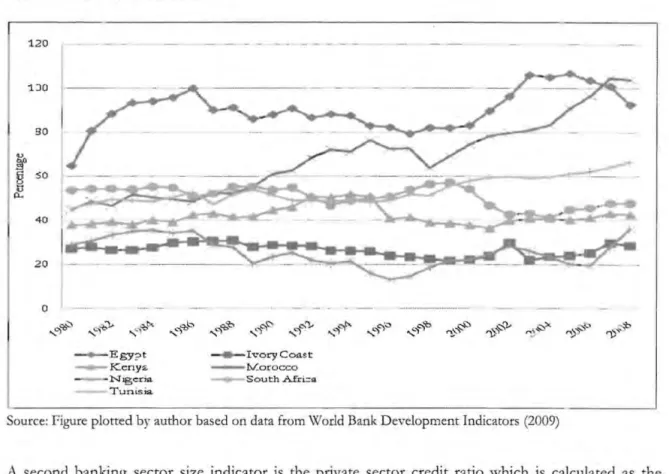
Figure 3.4: Domestic Credit provided to the Private Sector as a Percentage of GDP ... 43
Figure 3.5: Bank liquid resetves to Bank assets Ratios ... 45
Figure 3.6: Ratio of Market Capitalisation to GDP ... 48
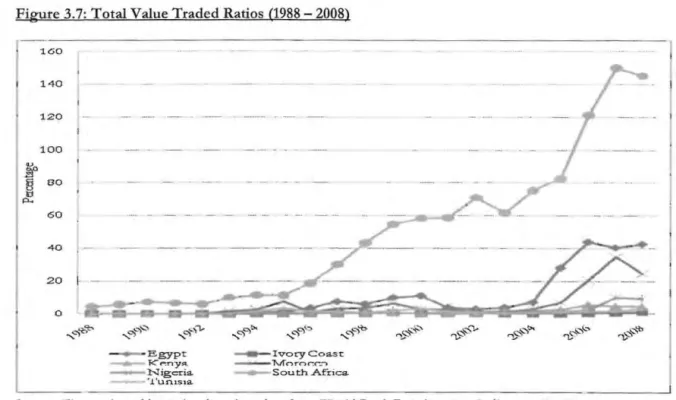
Figure 3.7: Total Value Traded Ratios (1988 - 2008) ... 51
Figure 3.8: Turnover Ratio (1996 - 2008) ... 51
Appendix Figures
Figure A.I: Movement of Banking Development Measures and Economic Growrh ... 143Figure 1\.2: Movement of Stock Market Development Measures and Economic Growth ... 144 Figure A.3: Movement of Overall Financial Development Measures ... 145
LIST OF TABLES
In Text Tables
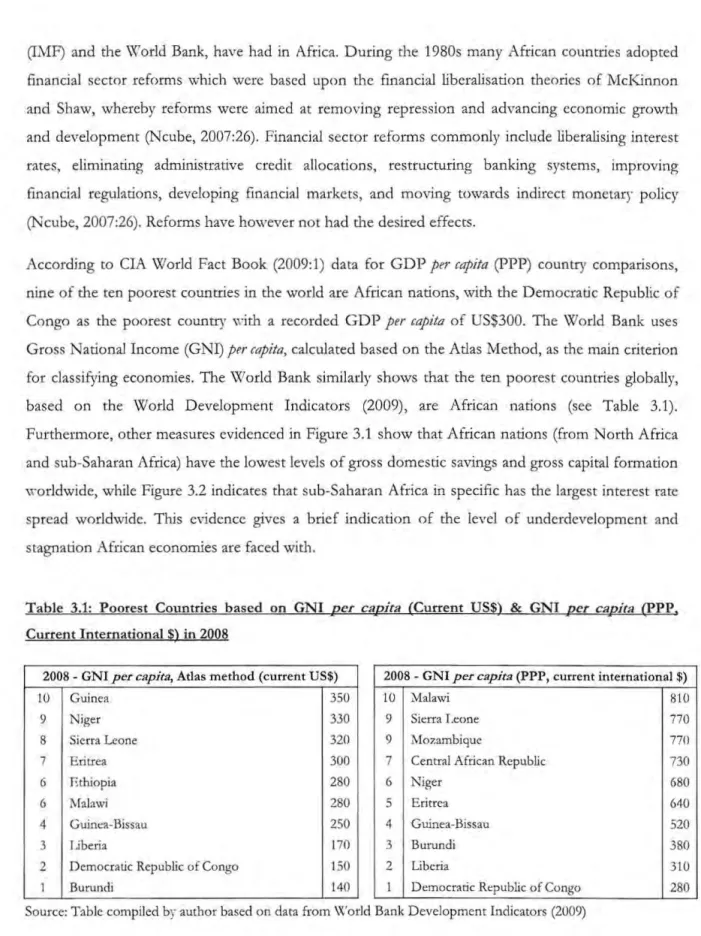
Table 3.1: Africa's poorest countries in terms of GNI per copito ........ 39Table 3.2: Global Rankings of African Banking Systems ... 41
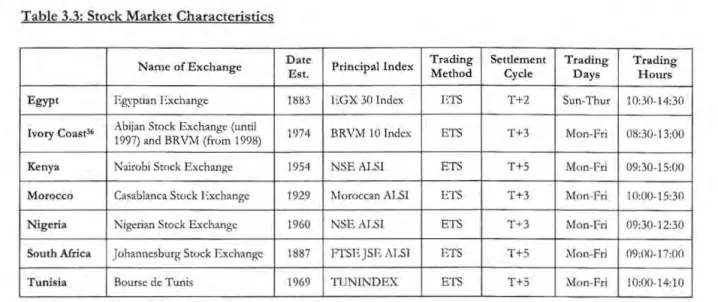
Table 3.3: Stock Market Characteristics ... 47
Table 3.4: Total Number of Listed Companies for selected periods ... 49 Table 4.1: Description of the BD and SD measures used in the study ... 60
Table 5.1: Unit Root Test Results JIntercept Alone, and Intercept and Trendj ... 88
Table 5.2: Specifications of Models Estimated ... 89
Table 5.3: Panel Cointegration Test Results [Models 1 - 12] ... 92
Table 5.4: Panel OLS Estimates of Models 1,2,4,5, and 6 ... 93
Appendix Tables
Table A.l: Summary Table of Finance-Growth Empirical Literature Reviewed ... 129
Table A.2: Complete List of Total Number of Listed Companies for entire period ... 138
Table A.3: Pair ,,·ise Correlation results between Financial Development Measures and Growth .... 139
Table A.4: Overall Financial Development Index derived using the Findex formula ... 140
Table A.S: Log of Overall Financial Development Index derived using the Findex fnrmula ... 141
Table 1\.6: Principal Component Analysis (PCA) Results ... 142
Table A.7: Overall Financial Development Index derived by employing PCA ... 142
Appendix Notes
Note A.I: Panel Fully Modified OLS (FMOLS) ... 146CHAPTER 1:
INTRODUCTION
1.1 BACKGROUND, CONTEXT AND RATIONALE FOR RESEARCH
It has long been recognised and accepted that financial systems, i.e. tlnancial intermediaries and tlnancial markets, play an important role in a country's economic growth (Claus et ai, 2004:1)'.
Financial systems perform the key functions of mobilising savings, aUocating capital, providing an efficient payment system, and monitoring and exerting corporate governance (Aziakpono, 2008:22). A major determinant of the ability of a financial system to effectively and efficiently perform these
key functions is the c;xtent to which a country's financial system is developed. Both theoretical and empirical literature (such as Hermes and Lensink, 1996; Levine and Zervos, 1998; Goodhart, 2005; Chakraborty and Ray, 2006) suggest that financial system development is crucial for resolving agency and information asymmetry problems as well as reducing transaction costs.
African financial systems however remain largely underdeveloped due to a number of factors, which include the adoption of financially repressive policies post independence, poor macroeconomic management and political corruption, together giving rise to bank insolvencies, low savings rates and
inefficient resource allocation (Yartey, 2004:14). The underdevelopment has meant that African economies struggle to accelerate economic growth and reduce poverty. Researchers commonly refer to African economies as suffering from the Ugrowth tragedy" evidenced by average real income, investment, and savings for sub-Saharan African countries systematically declining in each decade from the 1970s to 2000 (Ndikumana, 2001 :9). Several researchers (such as Odedokun, 1996; Gelbard and Leite, 1999; Allen and Ndikumana, 2000) have reported positive effects of financial system development on economic growth in Africa. Consequently, there exists a strong case for the promotion of financial development in Africa.
From a theoretical viewpoint, in the course of executing the key functions alluded to above; financial
systems positively influence factor accumulation, innovation, and playa crucial role in understanding variations in growth since economic growth is often discontinuous (Allen and aura, 2004:3). The I Financial markets refer to im;titution~ organised for the creation and trading of financial assets, such as a stock exchange. Financial intermediaries refer to the institutions carrying out the market function of matching providers of funds with users of funds, such as
literature also distinguishes between the effects of these key functions on economic performance when performed by financial intermediaries (i.e. banks) and when performed by the financial markets (i.e. stock markets) (Aziakpono, 2008:22). This matter has gained considerable attention and is commonly termed the "bank-based versus market-based" debate. Contributors to this debate explore the separate effects of the banking system and stock markets on the promotion of economic
growth and investigate issues such as: "Do financial systems perform different functions or are they
doing the same thing in different ways?" "Can one say that either a bank-based system or a market-based system is 'better' than the other?" (Allen and Oura, 2004:11). There exists no uniform definition of what constitutcs a bank-based system or a market-based system (Levine, 2002:9). However, a bank-based system principally refers to a financial system dominated by the banking sector performing the key growth enhancing functions, while a market-based system is characterised by the stock market predominantly stimulating economic growth (Beck and Levine, 2002:148). The theoretical arguments in favour of the bank-based view emphasises the significance of financial intermediaries in the processes of (i) improving the information flow, (ii) identifying high-quality projects, (iii) mobilising and allocating capital, (iv) monitoring corporate managers, and (v) providing risk management (Chakraborty and Ray, 2006:332). Conversely, the market-based view highlights the role of stock markets in (i) channelling savings towards firms to satisfy capital needs, (ii) enhancing corporate governance by casing takeovers, (iii) amplifying information availability for all participants in the market, and (iv) diversifying and managing risk (Levine, 2002:3; Law, 2004:10). Supporters of each view further underline the deficiencies associated with the opposing view. Stiglitz (1985:136) argues that advanced stock markets reduce an individual investor's incentive to obtain information as stock markets publicly divulge information rapidly, while mude (1993:31) stresses that liquid markets create a myopic investor climate where cost of 'exit' of unhappy stockholders is low, hence there are less incentives for implementing rigorous corporate control. In opposition to the bank-based view, Rajan (1992:1367) asserts that financial intermediaries hinder innovation and
efficient corporate governance as they acquire inside information about firms which is used to extract information rcnts and protect larger firms from competition. Furthermore, government
owned banks are utilised as political tools which are more inclined to channel credit to labour intensive industries whilst neglecting strategic projects (La Porta </ ai, 2002:265).
A large body of empirical research exists within this field investigating the relationship between financial development and economic growth (or finance-growth relationship), using either banking
system development measures or stock marker development measures, albeit with focus on developed countries. Studies analysing the effects of financial development utilising banking system development indicators alone include Odedokun (1998), Allen and Ndikumana (2000), Ferreira da Silva (2002). OveraU, findings indicate that banks have a positive influence on economic growth. Furthermore, developing nations are said to be largely bank-based economies as these countries have a dualistic structure - a large labour intensive low productivity sector and a smaller modern
manufacturing sector - so the transition from a traditional economy to a modern economy is funded more by banks within these countries as opposed to the scarcely established stock markets. Hence, during the early stages of economic development the level of financial development, based upon bank development measures, is a good indicator of future economic growth (Ferreira da Silva, 2002).
Studies examining financial development based solely on stock market development indicators include Filer ,/ al (1999), Choong ,/ til (2005), Vazakidis and Adamopoulos (2009), among others. These studies commonly find that stock market development promotes economic growth within the
respective countries, and developed countries were morc likely to be classified as market-based financial systems. It was also uncovered that developed economies benefited more from stock market development than developing economies. This finding was confirmed by Singh (1997), Azarmi ,/ al. (2005), and Chakraborry (2008) who examined the impacts of stock markets on economic development in India (a developing economy) and found that stock market development was unlikely to promote quicker industrialisation and long-term economic growth.
There are however fewer studies which empirically assess the relationship between financial development and economic growth by simultaneously employing banking system development and stock market development measures. The usc of financial development measures representing a single aspect of the financial system, when both stock markets and banking systems are fairly developed, hinders the discovery of the overall effect of the financial system on economic growth and may lead to incorrect conclusions concerning the effects of financial development (Aziakpono, 2008:283; Beck and Levine, 2004:424). One such study using both bank and stock market development indicators was performed by Arestis ,/ tIl (2001) examining Germany, Japan, France, the UK and the US. Arestis ,/ al (200 I :37) found that overall both banks and stock markets were able to promote economic growth, but the banking system was relatively more important. The researchers also found that the US and the UK could be classified as market-based financial systems while France, Germany and Japan were classified as bank-based financial systems. Conflicting results
are found by Corbett and] enkinson (1996) who suggest that growth enhancing activities in Germany, the UK, and the VS are predominantly financed by banks, with little stock market finance. While Beck and Levine (2002) find no support for a bank-based or market-based financial system in these countries, suggesting that distinguishing between the two is not important for growth.
Hence, of the smaller body of research which incorporates both banking system and stock market development measures, contrasting results appear with litrIe consensus existing regarding the role played by each towards economic growth.
Most of the empirical research assessing the finance-growth relationship, using both bank and stock market development measures, employ either time series or cross country analysis. Both of these techniques however suffer from drawbacks which could explain contrasting findings across studies (Law, 2004:16). Cross-sectional data suffers from endogeneity problems and does not have the advantage of time series variations which could increase estimation efficiency (Law, 2004:16). While Asian (2008:4) declares "it is not probable to discuss integration and cointegration properties of cross-sectional data". Time series dara is often constrained by small observations hence may yield unreliable results and misguided conclusions (Christopoulos and Tsionas, 2004:57). However, panel data analyses which are sparsely conducted, exploit both cross-sectional and time-series properties, and represent an attempt to utilise the data in the most efficient manner and to control for the drawbacks of the previous two methodologies. Panel data approaches importantly control for country specific fixed effects, hence explicitly accounting for the fact that some potentially important factors of growth are unobservable andlor unmeasurable, in this way avoiding potential biases from omitted variables (Allen and Ndikumana, 2000:146). Panel data studies also correct for simultaneity and are able to estimate long-run cointegrating relationships (Apergis et aI., 2007:181). In terms of studies employing panel data techniques to examine the effect of financial de,-e!opment on economic growth, there is a very limited number of such studies focusing on African economies. These include Ndikumana (2000), Kelly and Mavrotas (2003), and Padachi e/ al. (2007). Ndikumana (2000) examines thirty sub-Saharan African countries from 1970 to 1995 for the effects of financial development on domestic investment, while controlling for country specific fixed effects and non -financial factors of investment. Ndikumana (2000:393) found a positive relationship between
domestic investment and five banking system development indicators2, with signals th.(lt financial development can stimulate economic growth through capital accumulation. Kelly and Mavrotas (2003) analysed the impact of financial development on private savings for a dynamic heterogeneous panel of seventeen African countries for the petiod from 1960 to 1997. Using three banking sector development indicators', Kelly and IVIavrotas (2003:9) found inconclusive evidence of the impact of financial development on private savings since results were highly dependent on thc financial development measure used. This indicates the importance of utilising different measures of financial development rather than a single indicator. Padachi et al. (2007) investigated the dynamic link between finance and growth in forty-four African countries over the period 1979 to 2002. Employing twO banking system development measutes' Padachi el al. (2007) results indicate that financial development has a positive and significant effect on the level of economic growth, however the contribution of financial development to growth is not as strong as other explanatory variables
(such as investment ratio, measure of openness, and a proxy for quality of human capital).
Of the African panel data studies undertaken, many of these studies favour the usage of multiple banking sector development measures as seen above, while there are scanty available panel data srudies of the finance-growth relationship in Africa emploring both bank and srock market development measures. Hence, there is a need to fill this gap. As alluded to earlier, using a single indicator may hinder the discovety of the overall effects of financial development on economic performance, which in the context of this field of research is of critical importance to African governments. The largely underdeveloped nature of African countries means that African
governments are under pressure to improve and strengthen the drivers of economic gro\\-th so as to
stimulate development within their countries_ In order for governments to formulate optimum
growth enhancing economic policy, expert knowledge of the relative importance of the banking
sector and the stock market in the financial system is vital. Therefore, the form of financial structure that is most conducive for economic growth must be determined in order to aid the formulation of sound economic policy for a country (Arestis el al., 2005:1). Policy intervention should be tailored towards the promotion of the specific financial structure that more significantlr contributes to
. rive dc\-c\opmcnt indicators: (i) the ratio of liquid liabilitics as to GDP, (ii) total crcdit to the pri,-ate sector as a ratio of GDP, (iii) wtal domcstic credit pro,-idcd by thc banking sector as a ratio of GOP, (i'-) claims on go,'crnmt;:nt and other public entities as a ratio of GDP, C'-) a compo:-ite index of tinancial de,-elopment.
~ Three de\'elopmcnt measures: (i) the rdati,·c importance of deposit moner banks rclati,·c to central banks, (ii) bank liquid liabilities
a~ a ratio of GDP, (iii) prh-atc credit by depn:-it money banks and other financial imtitutions as a ratio of GDP.
4 Two mcasures: (i) liquid liabilities:'ls a ratio of GOP, (Ii) crcdit by financial intermediaries to the privatc sector as a ratio of GOP. 5
growth rather than promoting a second-best alternative system. Policies promoting the alternative
system mal' be misplaced and fail to raise economic growth (Chakraborty and Ray, 2006:346). Against this backdrop, this study will investigate the impact of financial system development on economic performance in African countries by employing the more 'efficient' approach of panel data analysis and will utilise both banlcing system and stock market development measures.
1.2 OBJECTIVES OF THE RESEARCH
The broad objective of this study is to determine what the impact is of financial system development on economic growth within the seven selected African countries based on the relative contributions of the ban Icing systems, stock markets and overall financial systems. To achieve this, the following specific sub-objectives will be pursued:
• To analyse the structure, state of affairs and development of the financial systems in each of the seven countries;
• To determine the overall effect of the financial system on economic growth using aggregate measures of financial system development;
• To analyse the relationships between ban Icing system development and economic growth, and between stock market development and economic growth in the seven countries;
• To determine the direction of causality which prevails berween the various measures of fmancial development and economic growth; and
• Based on the findings of the study proffer policy advice that could assist in stimulating the development of the financial system.
1.3 METHODOLOGY
This section briefly describes the systematic structure that will be followed in order to achieve the objectives and sub-objectives of this study, while a full discussion of the econometric methodologies employed in this study will be expanded on in Chapter 4. Firstly, a detailed literature review of both theoretical and empirical literature will be performed in order to provide an in-depth understanding of the finance-growth relationship. Secondl)" a brief overview of the study countries' banlcing
systems and stock markets, in terms of size and liquidity, wiU serve to achieve the first sub-objective. For the empirical analysis, the study will use annual panel data for Egypt, the h'ory Coast, Kenya, Morocco, Nigeria, South Africa and Tunisia from 1988 to 2008. The chosen srudy period is considered due to data availability constraints, since it is the only period wherein aU seven countries had stock market data available for.
Thirdly, formal econometric tests begin by employing the method of principal component analysis (PCA) and by applying the Finelex formula, in order to create two aggregate measures of financial de,·elopment, representaci"e of both banking system and stock market development. The new aggregate financial development indexes will be used as measures of overall financial development and will be employed in the empirical analysis to achie,'e the second sub-objective. In order to address the third sub-objective two panel cointegration techniques, proposed by Pedroni (1999, 2004) and Kao (1999), shall be useel after employing panel based unit root tests (which include the 1m, Peseran and Shin (2003) test, the Maddal. and Wu (1999) Fisher-ADF based test and the Choi (2001) Fisher-ADF based approach). Furthermore, the Holtz-Eakin e/ ,iI. (1989) panel Granger causality test shall be applied in order to determine the causal relation among the variables and thus contend with the fourth sub-objective.
I n order to meet our broad objective, the panel cointegration results will be analysed to determine whether there are any long-run effects from overall financial system development, banking system development and stock market development on economic growth in the seven African countries.
1.4 STRUCTURE OF THE STUDY
This study is organised into six chapters as follows. Chapter 2 provides a conceptual understanding and a review of the existing theoretical and empirical literature concerning the relationship between financial development and economic growth. Chapter 3 provides a brief background, overview and comparison of the financial systems of the seven countries used in the analysis. Chapter 4 provides the econometric methodology used in this study, specifically the PCA, panel unit root tests, panel cointegration analysis and panel Granger causality tests. Chapter 5 reports and discusses the findings of the study. While the summary of findings, implications for policy action and conclusions are presented in Chapter 6.
CHAPTER 2:
THEORETICAL ISSUES AND SURVEY OF EMPIRICAL
LITERATURE
2.1 INTRODUCTION
This chapter reviews the conceptual, theoretical and empirical literature concerning the relationship between financial system development and economic performance. Therefore, this chapter is broadly organised into four main sections. Section 2.2 discusses concepts which arc central to
understanding the 'financial system'. Section 2.3 reviews the key theoretical issues in the finan ce-growth relationship, i.e. the pioneering theoretical literature, the effects of finance on growth by
means of endogenous growth theory, and the possible causal directions in the relationship. Section
2.4 examines the body of existing empirical studies which investigate linkages between financial
development and economic growth using three principal categorics of financial development
indicators (i.e. banking development, stock market development, and bank-market development indicators). Finally, Section 2.5 concludes the chapter.
2.2 CONCEPTUAL DEFINITIONS
It is imperative that from the outset a profound understanding be obtained of the financial system and key issues pertaining to it, such as: what is referred to by a 'financial system', understanding the
composition of a financial system, appreciating the important functions performed by the financial
system, and the different classifications of financial systems due to their design variations.
2.2.1 DEFINITION AND COMPOSITION OF THE FINANCIAL SYSTEM
The term 'financial system' is habitually utilised in a myriad of financial literature texts, yet this expressIOn is scarcely ever accompanied by a specific definition, giving the impression that this
expressIOn and concept is unanimously understood and without great difficulty. According to Goodspeed (2008:4), the financial system is comprised of "the financial markets, financial
intermediaries and other financial institutions which execute the financial decisions of households, businesses and governments". Howells and Bain (2005:4) define the financial system as "a set of markets for financial instruments, and the individuals and institutions that trade in those markets, together with the regulators and supervisors of the system." Combining these two definitions, the financial system hence describes the arrangements (i.e. financial markets, fmancial intern1ediaries and control systems) which allow for the exchange of financial instruments (i.e. financial contracts), so
that funds may flo\\' between participants (i.e. lenders and borrowers). from the foregoing definitions, the financial system is composed of four common elements.
Participants - the participants in the financial system are the ultimate lenders and ultimate
borrowers. Ultimate lenders are surplus economic units, hence are non-financial entities whose savings exceed their real consumption, whilst ultimate borrowers are deficit economic units whose incomes are insufficient for financing their current spending plans (Howells and Bain, 2005:7).
Consequently, the financial surpluses of lenders are transferred to deficit units either by way of
direct financing or indirect financing so to put surpluses into productive usage (Black ,/ 01.,
2000:238). Direct financing is a financial transaction which occurs between a lender and a borrower to bring about the direct transfer of the lender's surplus funds to the borrower using the financial markets, and in exchange the lender receives a financial instrument (such as a bond or share) (Black et 01.,2000:238). Direct financing occurs only when a lender's requirements regarding risk, return and liquidity are identical to a borrower's needs in tern1S of cost and term to maturity, such as financing by means of a new share issue or long-term bond issue. Indirect financing is a financial transaction in which the lender and borrower have no direct contact; instead financing occurs through third party financial intermediaries (such as banks) that are "'illing to bear the risk of the !lnancial transactions (Black et aI., 2000:238). Hence, surplus economic units place their savings in financial intermediaries in exchange for financial instruments (such as savings deposits, insurance policies etc.) while the financial intermediaries loan the lenders' funds to de!lcit economic units.
Financial Instruments - financial instruments are "evidences of claims against other economic units or of ownership in them" (Goldsmith, 1969: 4) and are issued by ultimate borrowers or financial
intermediaries. These issuers are confronted with very diverse combinations of transactional, enforcement and informational frictions which motivates the creation of a variety of financial
instruments with differing characteristics such as the duration, marketability, security, contract
essential and attractive characteristic of financial instruments, hence the ease with which holders of financial claims can recover their investments either from the issuer or in a secondary market is of
great importance. Financial instruments issued by ultimate borrowers, such as companies (issuing shares, promissory notes etc.) and governments (issuing treasury bills, government bonds etc.), for the purpose of direct fmancing are referred to as primary securities. \Vhile instruments issued by finandal intermediaries (such as savings accounts, negotiable certificates of deposit etc.) in the
process of providing indirect financing are called indirect securities (Goodspeed, 2008:7).
Financial Intermediaries - financial intermediades are institutions which intermediate between lenders and borrowers, as the financial middlemen, and thus facilitate the flow of funds from savers to borrowers (Goodspeed, 2008:6). These institutions arise to provide indirect finance, thus
ameliorate the conflicts which exist between lenders and borrowers regarding theif requirements in terms of risk, return, and term to maturity relating to the extension and acquisition of financing (Levine, 1997:691). Financial intermediaries are broadly categorised into depository intermediaries and non-depository intermediaries. (i) Depository intermediaries, commonly referred to as banks, expedite the flow of funds from lenders to borrowers by accepting deposits from individuals and
institutions, and making loans with the deposited funds (Fourie el ai, 1996:10). These intermediaries
include central banks, commercial banks, land and agricultural banks, credit unions, mutual savings banks, and savings and loan associations. (ii) Non-depository intermediaries are financial intermediaries that do not accept deposits instead receive contracnlal contributions from lenders and invest the funds. Therefore, altering the composition and nature of lenders portfolios and this way allows borrowers to access funds more readily (Goodspeed, 2008:6). Non-depositolY financial
intermediaries include insurance companies, pension and provident funds, unit trUSts, hedge funds,
exchange traded funds, finance companies, and investment trust/companies.
Financial Markets - financial markets are the conventions which exist allowing for direct financing,
the direct transfer of excess funds of surplus units to finance deficit units requiring funds (Fourie ,/ 01., 1996:15). These conventions sen'e to bring together buyers (lenders) and sellers (borrowers) of financial instruments and to determine the price of these instruments (Goodspeed, 2008:7). Financial markets include the equity market, bond market, money market and the derivatives market. The foreign exchange market is however not truly a financial market as there is no flow of surplus funds to deficit units, rather this market senTes as a conduit for locals undertaking transactions in a foreign country or to foreigners undertaking transactions in the domestic economy (Faure, 2008:8).
2.2.2 FUNCTIONS OF THE FI 'ANCIAL SYSTEM
The need for a financial system stems fIOm the fact that thete ate costs associated with acquiting
information, making transactions and enforcing contracts. Existence of these frictions, in turn, creates incentives for the establishment of distinct financial instruments, financial intermediaries and
financial matkets (Levine, 1997:690). Hence, financial systems arise in otder to minimise the problems of information asymmetry, enforcement of contracts and transactions costs.
A cross reading of the literature (which includes Merton and Bodie, 1995; Levine, 1997; IVlontiel,
2003; Levine, 2004; Aziakpono, 2008; Demirgul'-Kunt and Levine, 2008; Goodspeed, 2008) reveals
that the financial system more closely perfotms five key functions. The five key functions include, (i) Savings mobilisation and the channelling of savings to investments: financial systems perform the
key task of collecting and pooling capital received from savers, and allocating these funds to
qualified participants and prospectively profitable projects as financial intermediaries and markets have the ability to overcome high transaction costs and information asymmetries which are barriers to financial transactions.(ii) Providing information and allocating capital: by collecting, processing ilnd evaluating information about firms, management and market conditions, financial systems are
able to provide, otherwise high cost and inaccessible, information about prospective profitable
investments that savings can be allocated towards. (iii) Monitoring and exerting corporate governance: financial intermediaries and markets perform a delegated monitoring role as they are able to economise on the benefits of aggregate monitoring COStS, in this way reducing incentive problems, credit rationing, and capital mismanagement. (iv) Ameliorating risk: financial systems
provide mechanisms to manage uncertainty and risk, such as trading, risk sharing and risk
diversification. (v) Easing of exchange: financial systems arc importantly responsible for the clearing
and settling of payments, ensuring these processes occur swiftly and at the lowest possible costs, so to ease the exchange of goods and services.
Therefore, interactions between the four elements of the financial system serve to perform the five essential functions which arc aimed at mitigating market frictions. From a functional perspectivc~,
how well financial systems perform these crucial functions determines how well they will reduce market frictions and consequently the degree of influence the financial system will have on savings
rates, technological innovation, investments, and economic growth rates. In light of the importance , :o.fenon and Bodie's (1995) functional perspectj"e of the financial system suggests that the key :IspeC( of the financial system is its
of the financial system functions, these functions will be examined in greater detail in Sec cion 2.3.2b where the impact of cach funccion on economic growth will be closely evaluated.
2.2.3 FINANCIAL SYSTEM ARCHITECTURE
Early proponents of the finance-growth nexus, such as Gurley and Shaw (1955) and Goldsmith (1969) amongst others, acknowledged the existence of diverse financial systems across countries. Financial system architectures differ with respect to the types and relative size of financial instruments, fmandaI markets and financial intermediaries in existence. Similarly, many economists have perceived a relationship between financial structural differences and variations in real activity. As a result, there has been a plethora of research in the area of financial system design in an attempt to uncover the combinations of regulatory and disclosure requirements, and, institutional and market details which may be responsible for specific levels of economic activity. According to Thakor (1996:918), "different financial system designs will manifest themselves in different divisions of activities between financial institutions and markets". In light of this and since stock markets and banks are viewed as subscitute sources of corporate finance (Arestis et al,2001 :19), economists commonly differentiate between two types of financial systems, namely, bank-based financial systems and market-based financial systems. The bank-based and market-based financial systems will be briefly discussed below from an institutional perspective (i.e. the institutions that make up each financial sysrem).
oj Balik-based jillallcia/ systems
According to Vitols (2001:1), a bank-based system refers to a financial system in which "the bulk of ftoancial assets and liabilities consist of bank deposits and direct loans". Sjogren (1994:317) suggests that a bank-based financial system is characterised by financial intermediaries performing the principal credit supplier role to firms, providing indirect finance and exhibiting extensive co -operation with firms. However, as noted by Levine (2002:9), there is no uniform definition of what constitutes either a bank-based or market-based financial system. Since this section is primarily concerned with the institutional design of a financial system, from here on, the expression 'bank -based financial system' refers to a financial system in which a dominant role is assigned to depository
financial intermediaries. in particular commercial banks, land and agriculrural banks, credit unions,
post banks, and mutual savings banks. In a bank-based financial system these depository intermediaries predominantly perform the key functions of the financial system ,,-hich promote
growth, while a lesser role is due to the functions of financial markets in the economy.
b) Market-hased }illallcial I)'stems
Sjogren (1994:317) defines a market-based system as a financial system with a relatively lower debt! equity ratio, where the role of internal financing is important, and financial markets are more active in corporate reorganisation and mergers than banks. Vitols (2001 :1) acknowledges that the dominant forms of financial assets in market-based systems are tradable securities. While Trehan (2008:1) suggests that in market-based financial systems the majority of financial power is held by
stock markets and economic performance is dependent on the performance of stock markets. Hereafter the expression 'market-based financial system' will be used to describe a financial system wherein the srock market is the chief growth enhancing financing mechanism. Despite some literature acknowledging bond markets along with stock markers as crucial financial mechanisms in fostering growth within market-based financial systems, the wide spread underdevelopment and often absence of bond markets in Less-Developed-Countries (LDCs) motivates the inclusion of only
stock markets in a classification of market-based financial systems, for the purpose of this study.
2.3 THEORETICAL ISSUES IN THE FINANCE-GROWTH NEXUS
For over a century, a range of theoretical propositions regarding the role played by finance in the process of economic development have amassed. As early researchers attempted to validate these claims, further competing viewpoints regarding the importance of financial systems for growth and
the possible casual relationships emerged. Hence, this section aims to review ljtcrature on the early
finance-growth linkages, the importance of financial system functions for economic growth, and the possible causal linkages, with the purpose of uncovering the key theoretical issues underlying the relationship between finance and growth.
2.3.1 LINKAGES BETWEEN FIN,~NCE AND ECONOMIC ACTI\1TY
The early work of Bagehot (1873), Schumpeter (1911), Fisher (1933) and others provides an outlook wherein finance is an important factor for variations in economic activity. Bagehot (1873) acknowledged that rhe mobilisation of capital b)' the financial system was pivotal to the industrial
revolution in England, while Schumpeter (1911) argued that the development of financial institutions direcrly influenced technological improvement and productivity growth.
Other earl)' literature acknowledging linkages between the financial system and real activity can be
naccd back to a strand of literature termed 'Financial Crises literature> which closely analyses various booms, busts and general financial activity around specific time periods. 1\ constituent of this area of literature is the 'debt-deflation theory of Great Depressions' which was advanced by Fisher (1933) while analysing the Great Depression of 1929. Fisher (1933:341) identified two chief financial disturbances which underlie the severity of the downturn, namely, debt disturbances and price-level disturbances. Prior to the Great Depression the stability of the economy was compromised due to debt disturbances which commonly arose when borrowers endeavoured to earn unusually large
prospective profits from new investment opportunities in new inventions. This resulted in a great volume of over-indebtedness (Fisher, 1933:348). The severity of over-indebtedness lead to distress selling as debtors and/or creditors were forced into initiating liquidation, resulting in price-level disturbances, hence deflation. Fisher (1933:341) states that these two major factors (i.e. deflation and over-indebtedness) that were behind the downturn gave other factors (such as over-investment, over-confidence and over-speculation) some of their importance. Hence, Fisher (1933) argued that a poorly functioning financial system was responsib1e for the severity of the economic do\\·nturn. The period that followed Fisher's (1933) work saw the explicit role of the financial system In
influencing real activity down-pla),ed by an array of economists such Keynes in his theory of output determination, Hicks (1937), Modigliani (1944), and Friedman and Schwartz (1963). These
economists rather shifted emphasis to money as the financial variable most relevant to aggregate economic beha\"iour, than understating the role of all other aspects of the financial system (Gertler,
1988:562). The seminal work of Gurley and Shaw (1955) however provided some of the most influential theoretical insights into the finance-growth relationship and was an attempt to divert
attention back towards the overall linkages between financial structure and growth. Gurley and Shaw (1955:515) emphasised that financial aspects were important for economic development and not a
"goods" (wealth, labour, output, income) aspect alone. Central to Gurley and Shaw's (1955) work was a prominent role played by financial intermediaries in economic development, specifically the credit provision role of financial intermediaries, moving attention away from the money supply role. The theory postulates that the money stock is an adequate proxy for finance only when the financial
system is in its infancy stages of development (Gurley and Shaw, 1955:520). Howeyer, as financial
systems expand there is significant growth in the number of non-bank financial intermediaries which offer varieties of differentiated tlnancial products that are close substitutes for money (Gurley and Shaw, 1955:520). The availability of diverse financial products enhances the promotion of the
institutionalisation of savings and investment, which crucially expands credit availability and S0, allows borrowers to accumulate debt without having to reduce spending. Hence, Gurley and Shaw
(1955) argue that financial intermediaries (bank and non-bank), through their debt issuing role, influence real activity and thus financial aspects are important for economic development. Consequendy, considering the money supply alone will not provide a reliable measure of intermediary debt issue and therefore imptecise conclusions about the relationship between financial
and real activities (Gurley and Shaw, 1955:522).
2.3.2 THE IMPACTS Of THE fINANCIAL SYSTEM ON ECONOMIC GRo\VrH:
ENDOGENOUS GROWTH THEORY
Much of the initial work on the linkages bet\,'een finance and economic activity, although ground-breaking, was criticised for a lack of analytical foundations (pagano, 1993:613). Conseguendy,
endogenous growth models emerged as an analytical framework for investigating the much proclaimed relationship between financial development and growth. Endogenous growth models demonstrate that in the absence of exogenous technological progress there can be self-sustaining
growth, and economic growth rates are associated with preferences, technology, income distribution and institutional arrangements (pagano, 1993:613). Hence, these models indicate that finance not only has level effects (i.e. improves the level of capital stock and the level of productivity) but also
growth effects (i.e. influences the growth rates of capital stock and productivity). Furthermore, there exists differing specifications of endogenous growth models distinct as to the financial mechanism included in the model accounting for the role of finance. Accordingly a variety of endogenous b'l'owth models have been used to provide theoretical analysis of the finance-growth relationship
1992; Saint-Paul, 1992; Pagano, 1993; Becsi and Wang, 1997; Greenwood and Smith, 1997).
However, a simple 'AK' endogenous gro\\·th model will be specified below in order to illustrate the
role of financial development in the economic growth process.
n) Endogenolls Crowl/) Model
The AK endogenous growth model used by Pagano (1993) to discuss the effects of financial
development on growth will be utilised below, where output is a linear function of capital, such that:
Y, =AK, ... (2.1),
where Y, is total output in an economy, K, is capital stock, and A is a constant (referring to the level of technology in the economy, or factor productivity).
This simple AK endogenous growth model provides a setting wherein only capital (KJ is used in production and it exhibits constant returns to scale. Capital depreciates at a constant rate of
0
and there is no population growth so that:K .. ,=I,+(l-0)K, ... (2.2), where II is gross investment and 8 is the rate of depreciation.
It is also assumed that a proportion of savings, the size of 1-¢, is lost during the process of
financial intermediation. This savings leakage indicates inefficiency in the financial systems, thus only the fraction
¢
of total savings can be used to finance investments. Therefore, in a closed economythe investment-saving relationship can be described as:
I,=¢S, . . ... ... . ... (2.3),
where SI indicates gross saving and r/> is the proportion of savings available for investment.
If s denotes the gross savings rate, so that:
Then the steady-state growth rate, g, is expressed as: K'+I- K, g= K,
g=AI/B-o
I, +(I-o)K, - K, = ¢S'_o K, Kj ... (2.5), So, Equation (2.5) reveals three ways in which financial development can influence growth: (i) it may improve [A] the marginal productivity of capital; (ii) it can increase [¢] the proportion of savings channelled to investments; and (iii) it can enhance [s] the private savings rate.b) Role
oj
tbe Financial SystenlAs alluded to in Section 2.2.2, the financial system performs five key functions. Next, it wiU be illustrated how the performance of these financial functions may influence economic growth by means of altering the elements of the steady-state growth rate (in Equation (2.5) above).
(i) Mobilisation of savings and channelling towards investments. There are significant transaction and information costs involved in the process of collecting and pooling savings of diverse individuals (Levine, 2004:22). The financial system is able to minimise these frictions as financial intermediaries have scale economies in the associated cOSts and use numerous contracts with capital abundant units. Hence, efficient financial systems are more effective at exploiting economies of scale and thus mobilising savings of individuals, in this way have a large impact on the savings rate ([s] in Equation (2.5)) and therefore economic growth (Levine, 2004:22). The savings mobilised by financial intermediaries are then channelled to investors, thus enabling them to obtain savings at significantly lower costs than would be possible if individual investors wete to mobilise savings directly from individual savers. Hence, an efficient fmancial system can increase the quantity of savings channelled to investment ([ ¢] in Equation (2.5)) and thus improve economic growth. The cost of intermediation, a proportion of savings (1-¢), is absorbed by the financial system primarily as reward for financial services supplied and also as the spread between borrowing and lending rates (pagano, 1993:615). However, this sayings leakage may also reflect X-inefficiency of the financial intermediaries and their market power common in Jess competitive markets where monopolistic premiums arc charged (pagano, 1993:615; Aziakpono, 2008:25). As financial development advances
- greater competition, more financial services and financial institutions are more experienced - the cost of intermediation will decline. Smaller intermediation costs (1-¢) mean a larger proportion of mobilised savings are funnelled towards investors [¢], consequently accelerating economic growth.
(ii) Information provision and efficient allocation of capital. Investors are often unable to acquire the desired information concerning potential investments due to high information costs (i.e. costs of coUecting, processing, and producing information) associated with evaluating firms, managers, and market conditions. Without reliable information individuals are reluctant to undertake investments, thus high information costs keep capital from flowing to its highest value lise (Levine, 2004:7). However, financial intermediaries perform a specialist role in researching investment possibilities, producing quality information and selling this information on to investors at lower costs than otherwise obtainable (Levine, 2004:7). Hence, through the provision of high quality information, financial intermediaries thereby direct savings efficiently towards flOancing more sound investments. As a result financial intermediaries augment the marginal product of capital (fA] in Equation (2.5)) which in turn affects growth positively (pagano, 1993:615).
(iii) Monitoring firms and exerting corporate governance. A firm's savings and allocation decisions are often dependent on the extent to which its shareholders and creditors can effectively enforce corporate governance. Poor governance often results in highly concentrated ownership which distorts corporate decisions and national policies, thus restricting innovation and hindering economic growth (Morek et aI., 2005:661). The high costs associated with enforcing effective 'direct' corporate governance often discourage potential investors and creditors. Hence, financial arrangements are established to alleviate market frictions and improve the corporate governance process. More specifically, financial markets ensure sound corporate governance by monitoring firm value and performance, reflected in the stock price variations and facilitating takeovers of undervalued firms (Ncube, 2007:20). With financial intermediaries, predominantly banks, performing the task of delegared monitoring of capital and the usage of such. Thus financial arrangements \vhich evaluate, screen, and monitor corporations, improves the efficiency with which firms allocate resources and ensures higher productivity of capital (raises [Al in Equation (2.5)). Hence, the effectiveness of corporate governance directly impacts firm performance with potentially large implications for growth rates.
(iv) Ameliorating risk. Savers generally have lower risk preferences but seek high-return investments which tend to have higher risk. The financial system, which promotes the efficient allocation of
capital to projects with the highest rates of return, also encourages the selection of projects with
high returns as well as high risk since financial arrangements exist for pooling, trading and
diversifying risk (Levine, 2004:16). However, there is ambiguity as to the net effect of risk alleviation for the steady-state growth rate (Levine, 2004:6). Financial arrangements like liquid stock markets allow investors to readily purchase and sell stocks while firms have permanent access to capital, in
this way increase investment into illiquid, high return projects and lowers risk (Levine, 1997:692).
Thus, the financial system enables people to diversify away this risk which induces a portfolio
modification toward investments with higher expected rerurns which can alter resource allocation, enhance rhe productivity of capital ([AJ in Equation (2.5)) and improve rhe growth rate (Levine, 2004:15). In contrast, there is an ambiguous response of sa,;ngs to risk sharing. According to
Pagano (1993:617), consumers - with utility functions with constant relative risk aversion - tend to save less when financial markets (such as an insurance market) are introduced as the need for precautionary savings is reduced. Hence, the financial system which promotes more efficient risk sharing can effectively reduce the savings rate ([sJ in Equation (2.5)) and to a degree offset the
growth-enhancing effects of improved productivity of capital.
(v) Easing exchange. The financial system, by means of various financial arrangements of the payment system', plays an important role in rhe facilitation of the exchange of goods and services.
An efficient payment system reduces the transaction and information frictions which are inherent in a barter exchange economy, where goods and services are evaluated for fair exchange, saving participants both time and energy (Berthelemy and Varoudakis, 1996a:8; Ncube, 2007:19). As a
result of the time and energy savings, the payment system promotes specialisation - division of labour - amongst economic units so that they have opportunities to concentrate on production
processes. Greater concentrated attention of economic unitS encourages innovation and thus the labour force is more likely to invent better equipment and production processes which promote productivity improvements (Smith, 1776:3). Levine (2004:24), in reviewing Greenwood and Smith
(1997:164), states that "More specialisation requires more transactions. Since each transaction is costly, financial arrangements that lower transaction costs will facilitate greater specialisation. In this
6 Pa),ment system refers to the in!'truments (e.g. currency etc.), the institutional and organisational strucrures, the operational
procedures, and the communication netvmrks that facilitate exchange of assets :\nd sen'ices between economic units (Aziakpono, 200S,22).
way, markets that promote exchange encourage productivity gains." Accordingly, the financial system by promoting exchange encourages specialisation, productivity gains ([A] in Equation (2.5))
and thus the progression of economic growth.
2.3.3 COMPETING CAUSAL VIEWS REGARDING THE fiNANCE-GROWTH NEXUS
The theoretical insights provided so far show that a relationship exists between financial system development and economic growth. As previously noted the early work of Bagehot (1873) and Schumpeter (1911) are amongst a collection of authors who view finance as a leading factor in stimulating output growth and enhancing economic development. In contrast, Joan Robinson (1952)
suggested that it was economic development that produced demands for financial arrangements and the financial system responded automaticall)' to these demands. Hence, according to Robinson
(1952:86), "By and large, it seems to be the case that where enterprise leads finance follows". Patrick
(1966) provides a detailed explanation of the causal relationship between financial development and economic growth. Patrick (1966:175) refers to them as 'demand-following phenomena' and 'suppl y-leading phenomena'.
Patrick's (1966) 'demand-following' view emphasised the demand side of the economy from which he believed the need for financial factors emerged, reinforcing the earlier views of Robinson (1952).
According to Patrick (1966:174), demand for financial services emanating from savers and investors
in an economy was the leading factor in the formation of financial institutions, financial assets and
liabilities. Moreover, this demand for financial services was dependent on the rate of growth of
output, commercialisation and monetisation of traditional sectors of the economy. Hence, as
declared by Patrick (1966:174), "the evolutionary development of the financial system is a continuing consequence of the pervasive, sweeping process of economic development". In light of
the above, the activities of the financial system are somewhat of an automatic response process,
widening and developing as a consequence of real economic development, playing a passive role in the growth process. Evidently in this context, causality flows from economic growth to financial development. On the other hand, the 'supply-leading' view acknowledges finance as a leading factor
in the growth process, as similarly suggested by Schumpeter (1911). In this view, financial
institutions and their financial services arc established, not in response to demand, but rather in
advance of demand for them, to serve two functions (patrick, 1966:175). Firstly, financial 20