Title: The role of vocabulary learning strategies in lexical
progression in an ESL context
Name: Nuzhat Jafari
This is a digitised version of a dissertation submitted to the University of
Bedfordshire.
It is available to view only.
This item is subject to copyright.
The role of vocabulary learning strategies in
lexical progression in an ESL context
Nuzhat Jafari
Doctor of Philosophy
2017
The role of vocabulary learning strategies in
lexical progression in an ESL context
By Nuzhat Jafari
A thesis submitted to the University of Bedfordshire in partial fulfilment of the requirements for the degree of Doctor of Philosophy
DECLARATION
I, Nuzhat Jafari, declare that this thesis and the work presented in it are my own and has been generated by me as the result of my own original research.
The role of vocabulary learning strategies in lexical progression in an ESL context
I confirm that:
1. This work was done wholly or mainly while in candidature for a research degree at this University;
2. Where any part of this thesis has previously been submitted for a degree or any other qualification at this University or any other institution, this has been clearly stated;
3. Where I have cited the published work of others, this is always clearly attributed;
4. Where I have quoted from the work of others, the source is always given. With the exception of such quotations, this thesis is entirely my own work;
5. I have acknowledged all main sources of help;
6. Where the thesis is based on work done by myself jointly with others, I have made clear exactly what was done by others and what I have contributed myself;
7. Either none of this work has been published before submission, or parts of this work have been published as indicated on [insert page number or heading]:
Name of the candidate & Signature Nuzhat Jafari
Date 17/05/17
Director of Study Dr Fumiyo Nakatsuhara
Reader in Language Assessment
Centre for Research in English Language Learning and Assessment (CRELLA) University of Bedfordshire, UK
Second Supervisor Dr John Field
Reader in Cognition in Language Learning
Centre for Research in English Language Learning and Assessment (CRELLA) University of Bedfordshire, UK
i
Abstract
This study explores vocabulary learning strategies (VLSs) behind the lexical progression in adult learners assessed by productive vocabulary tests. Previous research has provided some insights into this issue (Ahmad, 1989; Gu and Johnson, 1996; Wu, 2005). Such research, however, tended to focus on individual or a small number of strategies, and very few studies looked at a group of VLSs as a whole (e.g. Schmitt, 1997) particularly in the Pakistani tertiary ESL context. This large-scale, longitudinal study was therefore designed to fill this gap, by examining the impact of some curricular and extra-curricular VLSs on vocabulary gain assessed by two types of a productive vocabulary test.
The two types of test (i.e. general and course-related vocabulary tests) were administered twice to 578 Pakistani tertiary students who were learning English as a second language with a one-year gap in between to assess the learners’
vocabulary progress. They also responded to the VLS questionnaire to report on the VLS they adopted, and 120 of them also took part in four weeks’ structured
vocabulary learning diary reports (N=120 x 4 weeks) as well as interviews to elaborate on their VLSs use.
Wilcoxon Signed Ranks tests identified the learners’ significant vocabulary gain
between the pre- and post-tests. A series of multiple regression analyses showed extra-curricular, self-initiatives and selective-attention strategies significantly predicted general vocabulary progress, whereas the curricular, dictionary for comprehension, association and imagery and selective-attention strategies
ii turned out to be best positive predictors of course-related vocabulary progress. Structured weekly diary reports and interview data indicated complex nature of VLSs use, such as the use of certain VLSs in particular contexts and two or more strategies in combination. Students who progressed in both general and course-related vocabulary seemed to use a variety of strategies in combination, and their balanced and integrated approach appeared to be the most efficient in general and course-related vocabulary progression.
iii
Table of Contents
ABSTRACT ... I
CHAPTER 1 INTRODUCTION ... 1
1.1CONTEXT OF THE STUDY ... 1
1.1.1 Pakistani profile ... 2
1.2BACKGROUND OF THE STUDY ... 5
1.3AIMS OF THE STUDY ... 8
1.4ORGANISATION OF THE DISSERTATION ... 13
CHAPTER 2: LITERATURE REVIEW ... 16
2.1INTRODUCTION ... 16
2.2VOCABULARY ... 16
2.2.1 The nature of vocabulary ... 17
2.2.2 Knowing a word ... 19
2.2.3 Learning process of vocabulary ... 20
2.2.4 Aspects of word knowledge ... 22
2.3VOCABULARY LEARNING IN THE SECOND LANGUAGE ... 24
2.3.1 Challenges in vocabulary learning ... 25
2.4CURRICULAR AND EXTRA-CURRICULAR VOCABULARY LEARNING STRATEGIES (VLSS) ... 28
2.4.1 Language learning strategies (LLS) ... 29
2.4.2 Vocabulary learning strategies (VLSs) ... 30
2.4.3 Taxonomies of vocabulary learning strategies ... 30
2.4.4 Meta-cognitive strategies: selective-attention and self-initiative ... 33
2.4.5 Curricular vocabulary learning strategies ... 35
2.4.6 Extra-curricular vocabulary learning strategies ... 55
2.5RESEARCH INTO ESL/EFL VOCABULARY LEARNING STRATEGIES ... 63
2.5.1 Adopted VLSs and their impact on vocabulary learning ... 64
2.5.2 The adopted patterns of VLSs their impact on vocabulary knowledge 70 2.6VOCABULARY LEARNING IN PAKISTANI ESL CONTEXT ... 77
2.7SUMMARY AND GAPS IN THE LITERATURE ... 79
2.8RESEARCH QUESTIONS ... 81
2.9MEASURING LEARNERS’ VOCABULARY KNOWLEDGE... 82
CHAPTER 3: RESEARCH PROCEDURE AND METHODOLOGY ... 89
3.1INTRODUCTION ... 89
3.2RESEARCH DESIGN AND METHODOLOGY ... 90
3.2.1 Longitudinal research design ... 90
3.2.2 Mixed-methods research design ... 92
3.3DATA COLLECTION METHODOLOGY ... 100
iv
3.3.2 Research instruments ... 109
3.4DATA COLLECTION PROCEDURE ... 123
3.4.1 The pilot study ... 123
3.4.2 The main study ... 134
3.5THE ETHICAL CONSIDERATIONS ... 163
CHAPTER 4: RESULTS OF VLS QUESTIONNAIRE AND VOCABULARY TESTS ... 165
4.1INTRODUCTION ... 165
4.2VOCABULARY LEARNING STRATEGIES (VLSS) QUESTIONNAIRE ... 167
4.2.1 Factor Analysis of vocabulary learning strategies (VLSs) questionnaire ... 167
4.2.2 The internal reliability and the descriptive statistics of the VLS questionnaire ... 171
4.3THE PRODUCTIVE VOCABULARY LEVELS TEST ... 182
4.3.1 The internal reliability of the Pre-PVLT and Post-PVLT ... 183
4.3.2 Descriptive statistics of the Pre- and Post-PVLT test ... 185
4.3.3 Progress in general vocabulary (PVLT test) ... 186
4.4THE PRODUCTIVE COURSE-RELATED VOCABULARY TEST (PCVT) ... 188
4.4.1 The Inter-rater reliability (IRR) Pre- and Post-PCVT test ... 189
4.4.2 Descriptive statistics of the Pre- and Post-PCVT test ... 191
4.4.3 Progress in course-related vocabulary (PCVT test) ... 192
4.5IMPACT OF VOCABULARY LEARNING STRATEGIES ON VOCABULARY GAIN... 194
4.5.1 Examination of the impact of macro curricular and extra-curricular VLSs on general vocabulary gain (PVLT) ... 196
4.5.2 Examination of the impact of macro curricular and extra-curricular VLSs on course-related vocabulary gain (PCVT) ... 197
4.5.3 Examination of the impact of sixteen micro-curricular VLSs [DV: PVLT (general vocabulary gain) ... 199
4.5.4 Examination of the impact of sixteen micro-curricular VLSs [DV: PCVT (course-related vocabulary gain) ... 200
4.5.5 Examination of the impact of eleven micro-extra-curricular VLSs [DV: PVLT (general vocabulary gain) ... 202
4.5.6 Examination of the impact of eleven micro-extra-curricular VLSs [DV: PCVT (course-related vocabulary gain) ... 204
4.6COMPARISONS OF THE USE OF TWO MACRO VLSS ACROSS DIFFERENT VOCABULARY PROGRESS GROUPS ... 206
4.7SUMMARY OF THE FINDINGS AND DISCUSSION ... 208
4.7.1 The findings of Research Question 1 ... 209
4.7.2 The findings of Research Question 2 ... 211
CHAPTER 5: RESULTS OF DIARY REPORTS, INTERVIEWS AND DISCUSSION ... 212
5.1INTRODUCTION ... 212
v
5.2.1 Categories of VLSs used in diary reports for vocabulary learning ... 214
5.3INTERVIEW DATA ANALYSIS ... 235
5.3.1 Inter-coder reliability between two coders ... 235
5.3.2 Coding scheme for interview data ... 236
5.4SUMMARY OF RESULTS AND DISCUSSION ... 263
5.4.1 Summary and discussion of the results for Research Question 1 ... 263
5.4.2 Summary of results for Research Question 2 ... 289
CHAPTER 6: CONCLUSION ... 301
6.1INTRODUCTION ... 301
6.2SUMMARY OF THE STUDY ... 303
6.3ORIGINALITY OF THE STUDY ... 309
6.4CONCLUSION... 311
6.5THE IMPLICATIONS OF THE FINDINGS AND THE CONTRIBUTION OF THE STUDY ... 318
6.5.1 The theoretical implications... 319
6.5.2 Methodological implications ... 321
6.5.3 Pedagogical implications ... 324
6.6LIMITATIONS AND SUGGESTIONS FOR FUTURE RESEARCH ... 328
BIBLIOGRAPHY ... 330
APPENDICES ... 359
APPENDIX 3.1PRODUCTIVE VOCABULARY LEVELS TEST (PVLT) ... 359
APPENDIX 3.2PRODUCTIVE COURSE VOCABULARY TEST (PCVT) ... 363
APPENDIX 3.3VLS QUESTIONNAIRE ... 364
APPENDIX 3.4INTERVIEW (TRANSCRIBED) ... 371
APPENDIX 3.5STRUCTURED WEEKLY DIARY REPORTS FOR VOCABULARY LEARNING ... 372
vi
List of Tables
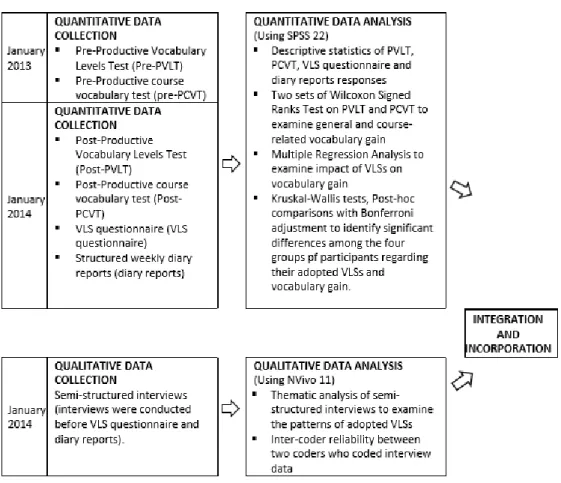
Table 3.1 Framework for research design ... 98
Table 3.2 The number of participants in different data sources ... 108
Table 3.3 The four groups of participants selected for interview and diary reports ... 108
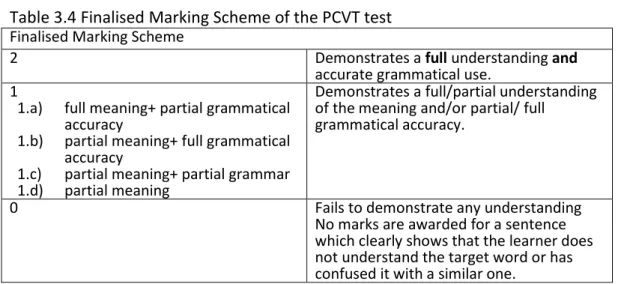
Table 3.4 Finalised Marking Scheme of the PCVT test ... 112
Table 3.5 The rationale of the interview items ... 119
Table 3.6 Details of the deleted items ... 127
Table 3.7 VLS questionnaire reliability analysis (pilot study) ... 128
Table 3.8 Reliability analysis of the PVLT test (pilot study) ... 128
Table 3.9 Reliability analysis of the PCVT test (pilot study) ... 129
Table 3.10 T-test analysis, the PVLT test (pilot study) ... 130
Table 3.11 T-test analysis, the PCVT test (pilot study) ... 130
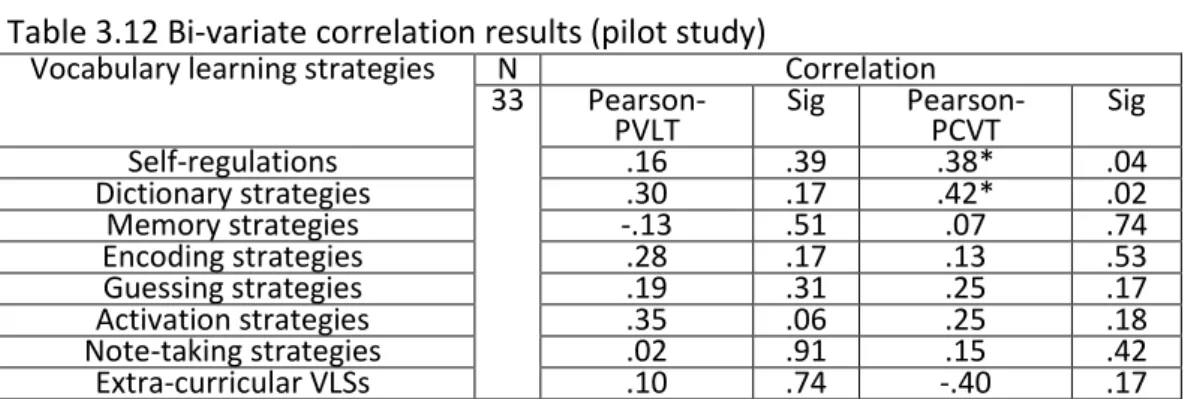
Table 3.12 Bi-variate correlation results (pilot study) ... 131
Table 3.13 Data collection phase and procedure (main study) ... 135
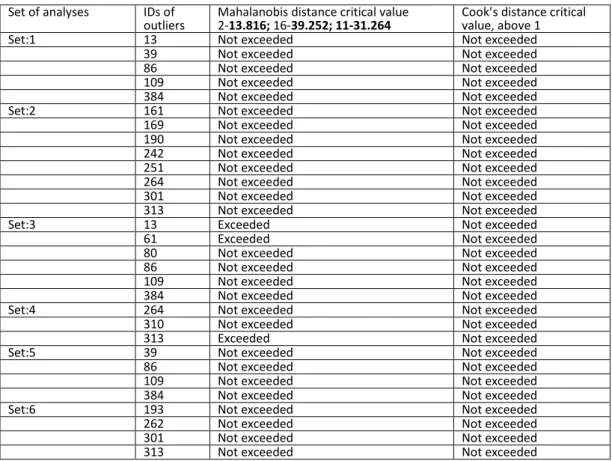
Table 3.14 Outliers and critical values ... 158
Table 4.1 Eigenvalues and Scree plot ... 169
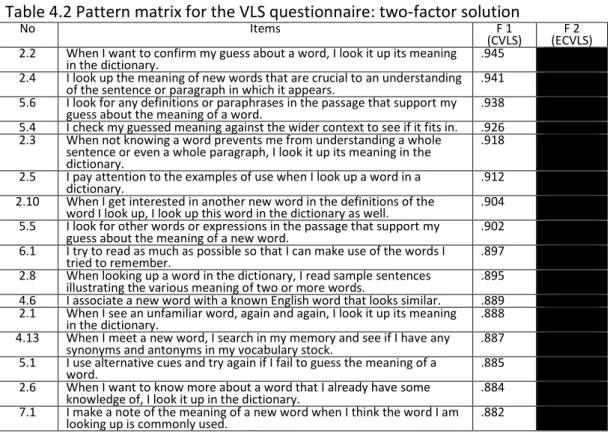
Table 4.2 Pattern matrix for the VLS questionnaire: two-factor solution ... 169
Table 4.3 Item analysis of two macro-VLSs ... 172
Table 4.4 Descriptive statistics of the curricular VLSs (factor-1) and extra-curricular VLSs (factor-2) ... 174
Table 4.5 Reliability analysis of the main study VLS questionnaire ... 175
Table 4.6 Patterns of adopted curricular VLSs ... 179
Table 4.7 Internal consistency of extra-curricular VLS questionnaire ... 180
Table 4.8 Descriptive statistics of extra-curricular VLS questionnaire ... 181
Table 4.9 Reliability analysis of the PVLT test ... 183
Table 4.10 Item-total statistics of the Pre- and Post-PVLT test ... 184
Table 4.11 Descriptive statistics of 72-items of each Pre- and Post-PVLT test ... 185
Table 4.12 Descriptive statistics of the Pre- and Post-PVLT test scores ... 187
Table 4.13 Mean and sum of ranks between the Pre- and Post-PVLT test ... 187
Table 4.14 Inter-rater reliability test with 30-item Pre- and Post-PCVT between the four raters ... 189
Table 4.15 Spearman rho between the four raters of Pre- and post-PCVT test (N=578 for all cells)... 189
Table 4.16 Descriptive statistics of Pre- and Post-PCVT test in relation of IRR ... 189
Table 4.17 Absolute agreement between the four raters of each Pre- and Post-PCVT test ... 190
Table 4.18 Descriptive statistics of 30-items Pre- and Post-PCVT test ... 191
Table 4.19 Descriptive statistics of the Pre- and Post-PCVT test scores ... 193
Table 4.20 Mean and sum of ranks between Pre- and Post-PCVT test ... 193
Table 4.21 Independent and dependent variables used in six sets of multiple regression analysis ... 195
vii
Table 4.22 Multiple regression models summaries overall impact (IV: two macro VLSs)
... 196
Table 4.23 Multiple Regression coefficients (curricular and extra-curricular VLSs) [DV: PVLT (progress in general vocabulary)] ... 197
Table 4.24 Multiple regression models summarise overall impact ... 198
Table 4.25 Multiple Regression coefficients (curricular and extra-curricular VLSs) [DV: PCVT (progress in course-related vocabulary)] ... 198
Table 4.26 Multiple regression models summaries overall impacts (IV: 16 curricular VLSs) ... 199
Table 4.27 Multiple Regression coefficients (micro-curricular VLSs) [DV: PVLT (progress in general vocabulary)] ... 200
Table 4.28 Multiple Regression models summaries overall impact ... 201
Table 4.29 Multiple Regression coefficients (micro-curricular VLSs) [DV: PCVT (progress in course-related vocabulary)] ... 201
Table 4.30 Multiple regression models summaries overall impact ... 203
Table 4.31 Multiple Regression coefficients (micro-extra-curricular VLS) [DV: PVLT (general vocabulary gain] ... 203
Table 4.32 Multiple regression models summaries overall impact ... 204
Table 4.33 Multiple Regression coefficients (micro-extra-curricular VLS) [DV: PCVT (course-related vocabulary gain] ... 205
Table 4.34 Use of VLSs across four vocabulary progress groups ... 206
Table 5.1 Categories of VLSs used in diary reports for vocabulary learning... 215
Table 5.2 Selective-attention and self-initiatives about focused vocabulary across four progress groups ... 217
Table 5.3 Guessing strategies and first interaction with new words across four progress groups ... 219
Table 5.4 Strategies to learn the meaning of unknown new words across four progress groups ... 222
Table 5.5 Aim(s) of consulting a dictionary across four progress groups ... 223
Table 5.6 Adopted note-taking strategies across four progress groups ... 225
Table 5.7 Aim(s) to use vocabulary note-taking strategies across four progress groups227 Table 5.8 Methods of vocabulary note-taking strategies across four progress groups . 228 Table 5.9 Adopted memory strategies across four progress groups ... 229
Table 5.10 Adopted activation strategies across four progress groups ... 231
Table 5.11 Adopted extra-curricular VLSs across four progress groups ... 233
Table 5.12 Inter-coder reliability between two coders ... 236
viii
List of figures
Figure 2.1 An information processing system (Weinstein, Goetz, and Alexander, 1988,
P.15) ... 20
Figure 3.1 Framework for research design ... 98
Figure 3.2 Specimen of VLS questionnaire used in the study ... 116
Figure 3.3 Normal Probability Plots of six sets of multiple regression analysis ... 156
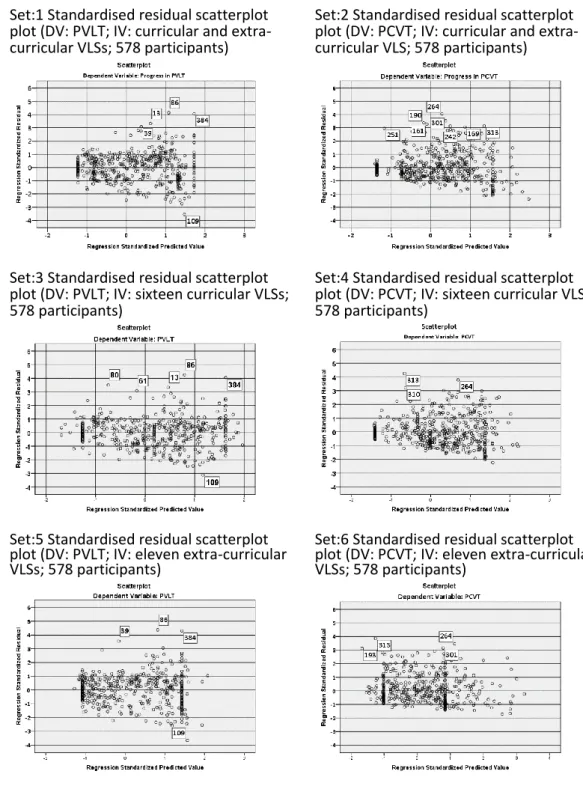
Figure 3.4Standardised residual scatterplots, six sets of multiple regression analysis .. 157
Figure 4.1 Histogram of 72-items Pre- and Post-PVLT test ... 186
ix
Acknowledgements
I acknowledge the guidance and support of my supervisors and I owe my deepest gratitude to Dr Fumiyo Nakatsuhara, Dr John Field and Dr Chihiro Inoue for their considerate advice, encouragement and constant support. I would like to thank them for their patience and believing in my potential during the entire PhD journey. I would also like to express thanks to Professor Stephen Bax for taking me on in the first place, helping me through the early stages, for reading my thesis and giving me suggestions at the final stage of my PhD. I would like to extend my appreciation to the examiners, Professor James Milton and Dr Andrew Davidson for their insightful comments and advice on improving this thesis.
I am grateful to the Research Graduate School (RGS) and Centre for Research in English Language Learning and Assessment (CRELLA) for providing extra research and statistical analysis training and opportunities to present and discuss my work at Postgraduate Research Forums. I am grateful to CRELLA for funding me to present my work at national and international seminars to get an expert feedback. I would like to extend my thanks to all staff members of CRELLA, who provided valuable insights on my work. In particular, I would like to thank Professor Lynda Taylor, Professor Anthony Green, Dr Chihiro Inoue and Dr Sathena Chan for their suggestions on my quantitative analysis and their participation in a series of expert focus group discussions to inform the marking
x discussions about qualitative analysis and for reviewing the Chapter 5 of the thesis.
I am also grateful to Professor Paul Meara, Professor Norbert Schmitt and Associate Professor Peter Gu for listening to my presentations and giving me feedback to improve my work. I am grateful to Associate Professor Peter Gu for sending me his published material and for giving me suggestions on my work throughout my PhD by answering questions I emailed to him, and I would like to thank him for his illuminating answers about various aspects of his work. He took time out of his busy schedules to answer questions from somebody who was not his student, and some exchanges went to a considerable length.
I am also grateful to the teachers in the SKANS School of Accountancy and Professional Academy of Commerce (PAC) for sanctioning their consent to conduct the research during their classes, and to many students who participated in the study. Without their participation, the research could not have been successfully completed.
Above all, I am thankful to my family and friends, as always. Last but not least, thank you - my sons, for letting mummy spend so much time in front of the computer. Thanks for inspiring me to continue with this work.
To all of the above, thank you. This dissertation could not have been attempted or completed without you.
1
Chapter 1 Introduction
1.1 Context of the Study
Pakistan is a federal parliamentary republic in South Asia. It is the sixth-most populous country with a population exceeding approximately 197 million people. The use of English as a second language (L2) in Pakistan dates before the creation of the country which was first introduced by the British rule in the 16th century (Mehboob, 2009). English is the official language of Pakistan (Rahman, 2008) which is studied as a compulsory subject from early years of education.
Based on the researcher’s experience as an English teacher in the Pakistani
education context, it has been observed that Pakistani tertiary students found it tough to learn and remember English vocabulary. It seems that more teacher-centred approaches to teaching English are used in Pakistan. On the other hand, due to the cultural and religious impacts, Pakistani tertiary students tend to be more dependent on their teachers especially in state universities. Students require language learning strategies and vocabulary learning strategies training to fulfil their L2 learning needs.
Since the decline of Martial Law situations in Pakistan, the Ministry of Education Pakistan is putting much effort to upgrade education systems in Pakistan. However, research work in Pakistan is still in the inadequate situation due to the lack of funding and research training (Memon, 2007). There is a call for empirical studies on English learning and vocabulary learning as this sort of the research
2 work is expected to facilitate students, educators and policyholders in Pakistani ESL context.
1.1.1 Pakistani profile 1.1.1.1 Demography
Pakistan is the sixth largest country in the world with almost 176 million people (Government of Pakistan, 2011). The country has a large Muslim majority and there are approximately 174 million Muslims who live in Pakistan (Miller, 2009), constituting 96% of the population which turned Pakistan into the second largest Muslim population in the world. Urdu is the National Language of Pakistan whereas English is taught as a second language. It is estimated that approximately there are 72 local languages currently in Pakistan (Lewis, 2009). Pakistan had been a British colony like most parts of South Asia which began with the trade establishment of the East India Company in the early 17th century and continued for two centuries. The British colonial rule was over in 1947. However, the British left the strong influence of trade, language, culture, religion and education in South Asia which is strengthening even today. Pakistan had recurrent involvement of military regimes for 33 of its 64 years of existence until 2008. The country is now democratic. However, its democratic system is still in a challenging situation due to terrorism threats to Pakistan. Pakistan scores particularly poorly for its security tackle (Fund for peace, 2011) and is classified as a country with low human development by United Nations (UNDP, 2011).
3
1.1.1.2 National language
Urdu has often been associated with the language of Muslims during British rule for many centuries (Rahman, 1999). The two-language policy was adopted by the British colonial administration in Indo-Pak subcontinent until 1880 1) English education was restricted to a small elite cadre of local rulers and administrators 2) the education to the Muslims was provided through the medium of Urdu. Due to the implementation of this policy, English became the language of power and prestige whereas the other local languages including Urdu were significantly neglected. However, Urdu became the National language of Pakistan after the independence from the British Raj and now is widely understood and used as an official language in the country.
1.1.1.3 English as L2 in Pakistan
Coleman (2010, 2011), Seargeant and Erling (2011) and Wedell (2011) identified the roles that English plays in the developing countries like Pakistan. For example, Coleman (2010) conducted a large-scale study on English as a second language learning in Pakistan which provides a profile of Pakistani demography, national language and a role of English as L2. The study was conducted to design new policies to facilitate English learning by British Council Pakistan.
In Pakistan, the role of English is quite significant as it is the language of the government, the military and higher education. It is the language of power and the language of an elite class that has conquered the country since its independence on 1947. Coleman (2010) categorised Pakistani schools into four
4 groups. The elite private schools are accredited with British Education system
and their mode of learning and communication is totally English. However, schools run by the armed forces, non-elite English medium schools, and state schools follow Pakistani education system. They also use English as the medium of instruction due to the Government new policy. In 2010 the Government of Pakistan decreed that English should be used as the medium of instruction for the teaching of science and mathematics in schools which increased the need for
Teachers’ education and training to fulfil the new policy.
Due to the current policies and role of English, English literacy is taken as a compulsory part of education from Kindergarten till bachelor degree. Students need to pass English literacy as a compulsory module and mode of communication for rest of the other modules is also English. Due to the globalisation and current situations, the English language is necessary to achieve good grades, good jobs and foreign relations in Pakistan.
1.1.1.4 Applied Linguistics in Pakistan
Capstick (2011) surveyed the current research and research needs in Pakistan and identified that there is a lack of applied linguistics research in Pakistan due to the non-availability of funds and lack of education and training in conducting these types of research work. Rahman (2010) identified that Pakistan does not have Applied Linguistics departments similar to the well-recognised universities in other parts of the world, though Linguistics courses do exist within English Literature departments across the country. Due to this, most of the Applied
5 Linguistics research carried out by local researchers in Pakistan can be questionable and does not fulfil the International criteria (Capstick, 2011). Obtaining a Master’s degree in English Literature is one of the criteria which are necessary to work as an English teacher in Pakistan. Due to this situation, English literacy is often taught by teachers with a very brief knowledge of applied linguistics in Pakistan and the emphasis that is given to rote learning and
literature. English Applied Linguistics is a relatively new subject in Pakistan’s
universities but it is being taught at the undergraduate and postgraduate level in some universities in Pakistan as the government recognises the significance of applied linguistics and is putting more emphasis on it now by sanctioning extra funding to the Higher Education Commission (HEC). The HEC has been offering an extensive programme of training and funding for English faculty at public sector universities to update their skills in communicative language teaching as well as additional courses such as Research Methods training. The universities are also introducing the short courses in English in which a TESOL Certificate/Diploma is a component.
1.2 Background of the Study
In learning a language, the development of a successful command of vocabulary is a constant need throughout all levels of proficiency. Read (2000) emphasises that words are the fundamental building pieces of language from which larger structures, for example, sentences, paragraphs and entire texts are shaped. Read (2000) further elaborates that for native speakers, although the rapid language
6 development happens at the young age of their childhood, vocabulary information keeps on growing normally in grown-up life because of new encounters, innovations, ideas, social patterns and more chances for learning. For L2 learners, vocabulary acquisition is commonly a more challenging and lengthy process (Gu and Johnson, 1996). L2 learners encounter lexical gaps, i.e., sometimes they encounter words which are not comprehensible to them or ideas which cannot be expressed by these learners as appropriately as they could in their first language (L1). L2 learners often struggle and complain due to the difficulties of vocabulary learning which is compulsory to learn the language (Gu, 1994). Learners get challenged with vocabulary learning at the early stages of foreign language learning, and this difficulty never ends. Learners initiate the use of vocabulary learning strategies (VLSs) to handle these challenges caused in learning vocabulary (Gu, 2012b). Given such continuous challenges that L2 learners face with vocabulary learning and the potential usefulness of VLSs for their learning, it is valuable and theoretically thought-provoking to research the adopted VLSs of learners to learning vocabulary and to determine the value of applied strategies (Gu, 2012b).
Schmitt (2000) notes that teaching methodology is shifted from teacher-centred approaches to more communicative learner-centred learning where learners can make their choices about their learning styles and methods. These learners-centred communicative methods introduced the independent learning of vocabulary to the L2 learners, i.e., to train ESL learners for the real-life communicative situations outside the English classroom. The practicality of the
7 theory of self-directed learning of language and vocabulary gave rise to the research into the area of second language learning strategies (e.g., Naiman et al,
1978; O’Malley et al, 1985; Rubin, 1987, Skehan, 1989; Oxford, 1990) and
vocabulary learning strategies (e.g., Ahmad, 1989; Gu and Johnson, 1996; Schmitt, 1997; Tsai and Chang, 2009; Van-Zeeland and Schmitt, 2013). Most of these studies on VLSs have been either descriptive or experimental in nature. These studies in the field of VLSs emphasised the significance of VLSs or explored the patterns of adopted VLSs of successful and unsuccessful learners. Schmitt (1997) highlights that the research work which has been done on vocabulary learning strategies has focused individual or small numbers of vocabulary learning strategies, with very few studies focused the group of vocabulary learning strategies as a whole. The existing state of the area is epitomised by the lack of an inclusive list or taxonomy of vocabulary learning strategies. To the
researcher’s knowledge, there is not any study which has combined quantitative and qualitative methods with a longitudinal research design focusing curricular and extra-curricular VLSs in the Pakistani and also in overall English as a second language (ESL) context. As far as Pakistani ESL context is concerned, this might be due to the lack of funding and lack of research training in Pakistan as a result of the long regime martial law which ended in 2013. Gu (2012b) speculates in relation to overall ESL context that this research gap is due to the difficulty in manipulating an effective vocabulary size measure that very few studies have investigated the impact of VLSs on the progress of vocabulary.
8 Schmitt (2007) proposes that vocabulary learning difficulties can be controlled by applying specific vocabulary teaching and learning in a principled way. For example, these difficulties may be minimised by using curricular and extra-curricular VLSs to learn vocabulary during English lesson and independent self-study outside the class. Vocabulary learning involves VLSs and other behaviours which learners adopt consciously or unconsciously (Nation, 2001). It is recommended that “one of the ways teachers can aid this process is by helping
learners become aware of and practised in using a variety of VLSs. Research
shows that many learners do use strategies for learning vocabulary” (Schmitt,
2007, p. 755). Previous studies identified the profiles of learners indicating that not all the students use VLSs to learn their vocabulary (Gu and Johnson, 1996; Gu, 2003a). Students who use VLSs seem to be more successful in learning vocabulary as compared to the least users of these strategies. Research (Ahmed, 1989; Sanaoui, 1995) indicates that successful learners tended to utilise a variety of strategies, structure their vocabulary learning, audit and practise target words, and stay mindful of the semantic connections amongst new and already learnt words. The successful learners tended to be aware of their learning aims, learning challenges and finding a way to direct it, whereas unsuccessful learners may not have this mindfulness or, control and lack the ability to use self-initiatives and selective-attention.
1.3 Aims of the study
This empirical study is designed to explore the VLSs employed by university students in a Pakistani ESL context and to examine the impact of adopted VLSs
9 on their course-related and general vocabulary gain. After decades of research on VLSs in ESL/EFL context noted earlier in this chapter, research has to date been conducted on various aspects of VLSs which are mostly related to curricular vocabulary learning (e.g., meta-cognitive, dictionary strategies, guessing strategies, note-keeping strategies, social strategies, activation strategies and memory strategies). However, with the passage of time, technology, media and social media have been involved in teaching and learning the English language and vocabulary which may need to be researched with the collaboration of VLSs. To address this need, some empirical research on some individual extra-curricular VLSs has been conducted in foreign and second language learning (Maley, 1987; Strevens, 1987; Milton and Meara, 1995; Grab and Stoller 1997; Schmitt, 1997; Schmitt, 2000; Harris and Snow, 2004; Alsaif and Milton, 2012). However, there is not any empirical research conducted on curricular and extra-curricular VLSs in overall ESL and Pakistani ESL context. This study is therefore designed to explore VLSs and their effects on vocabulary gain in a Pakistani tertiary context to partially fill such a gap in the literature. The findings of this study are expected to offer a better understanding of vocabulary learning strategies used by successful learners. As such, it is hoped that this study will contribute theoretical, methodological and pedagogical implications to
enhancing second language learners’ vocabulary learning and assessment of vocabulary.
10 RQ1: What are the curricular and extra-curricular VLSs adopted by Pakistani tertiary students to learn English vocabulary?
RQ2: What is the impact of the curricular and extra-curricular VLSs on vocabulary gain in this context?
The previous research in the related field reported an extensive list of VLSs (i.e., meta-cognitive strategies, guessing strategies, dictionary strategies, note-taking strategies, memory strategies, encoding strategies, activation strategies, learning vocabulary through the exposures of English media, English press and publications and having interaction with native speakers) to learn course-related and general vocabulary (Ahmed, 1989; Milton and Meara, 1995; Schmitt, 1997; Fan, 2003; Alsaif and Milton, 2012; Zhang and Lu, 2015). It has also reported that ESL learners use a variety of curricular and extra-curricular VLSs to learn course-related and general vocabulary. Some of the strategies listed above are briefly explained below (see more details in Chapter 2, Section 2.3).
“Meta-cognition consists of two features, understanding or appraisal of one’s
own thinking, and management of one’s own thinking and learning endeavours” (Chamot and O’Malley, 1994, p.272). Schmitt (2000) categorises self-initiatives and selective-attention as meta-cognitive strategies which incorporate a mindful overview of the learning process and taking initiatives about planning, monitoring and evaluating the best ways to learn vocabulary. It involves L2
learners’ self-initiatives and selective-attention to expand access to the input of vocabulary, determining the most appropriate means to learn vocabulary and
11 assessing themselves to measure improvement (Gu and Johnson, 1996). It also
includes learners’ initiatives towards the selection of words to learn and to skip.
Schmitt (1997) defines guessing strategies as “if learners do not know a word,
they must discover its meaning by guessing from their structural knowledge of the language, guessing from an L1 cognate, guessing from context, using
reference materials, or asking someone else” (p.210). Learners use guessing
strategies, e.g., using immediate and wider contexts and linguistic clues to guess the meaning of unknown words (Gu and Johnson, 1996). Dictionary strategies are defined as discovery strategies (Schmitt, 1997) to discover the meaning of a new word. Learners use a variety of strategies to discover meaning and definition of the new word from monolingual and bilingual dictionaries. Learners also used note-taking strategies which can be defined as the practice of writing down and recording key points of information about focused vocabulary items for learning purposes. Learners prepare notes on their note-books, in the margin of their text-books and word-processed note-keeping. Learners may record the target words, along with their meanings, synonyms, antonyms, definitions, grammatical usage and write them down in example sentences. Memory strategies “involve
relating the word to be retained with some previously learned knowledge, using
some form of imagery, or grouping” (Schmitt, 1997, p. 211). Learners use
memory strategies, e.g., rehearsal and repetition of word lists, oral and visual repetition, association and elaboration and using imagery (Gu and Johnson, 1996). Memory strategies encoding may involve a variety of micro-strategies, e.g., visual encoding, auditory encoding, word-structure, semantic encoding and
12 contextual encoding to memorise vocabulary (Gu, 2005). To remember and stimulate learnt vocabulary, learners use deliberate activation strategies, e.g., using learnt words in oral and written communication, and academic speaking and communicative tasks (Gu and Johnson, 1996). Learners also use curricular VLSs to learn vocabulary and improve their English. The extra-curricular VLSs may include reading English newspaper and magazines (Grabe and Stoller, 1997; Schmitt, 1997), reading English literature, watching English TV programmes, watching and listening to English news on TV, watching English movies with sub-titles, listening to English music (Maley, 1987; Milton, 2008), listening to matches commentary (Strevens,1987) and learning vocabulary through social interaction where mode of communication is English (Milton and Meara, 1995).
The previous research implicates that learners use a variety of VLSs to learn their vocabulary (Gu and Johnson, 1996, Schmitt, 1997; Gu, 2003a; 2005; 2010). Similarly, Abraham and Vann (1987), Medani (1988), and Gu (1994; 2003b; 2005; 2010) explore language and VLSs adopted by the learners and report the significant difference of adopted VLSs between the successful and unsuccessful learners. The related studies also found the verified significant differences of adopted VLSs’ patterns between successful and unsuccessful learners (Ahmad, 1989; Moir and Nation, 2002). These studies also reported a positive correlation between VLSs and vocabulary gain (Gu and Johnson, 1996; Kojic-Sabo and Lightbown, 1999; Fan, 2003). Researchers agree on the same point that it is not the VLSs which are good or bad but it’s the appropriate use of these strategies
13 which makes these strategies effective or ineffective. Research (Gu and Johnson, 1996, Schmitt, 1997; Gu, 2003; Gu, 2005; Gu, 2010) also highlights the significance of meta-cognitive strategies and their role in the effective way of using vocabulary learning strategies in overall successful learning of vocabulary.
1.4 Organisation of the dissertation
This subsection provides an overview of the thesis. This dissertation is composed of six chapters. Chapter 1 is the Introduction, in which the background of the
study and aims of the study is provided. This introductory chapter 1 has also provided the structure of the thesis with the overview of each chapter.
Chapter 2: Literature Review starts with a review of vocabulary learning in the
ESL research, highlighting the significance of vocabulary in learning an L2. The chapter then reviews the challenges involved in vocabulary learning as discussed in the literature. The chapter provides an overview of the definition of vocabulary, aspects of vocabulary knowledge, and constructs related to measuring the vocabulary knowledge. After that, the chapter provides an overview of the taxonomies and classifications of VLSs, the definitions of VLSs and the benefits of using VLSs on vocabulary gain. For each VLSs, relevant studies in the literature concerning the impact of VLSs are also reviewed. The chapter then describes the adopted patterns of VLSs and their implications on vocabulary learning found in the previous studies. The chapter identifies some research gaps in the literature and proceeds with the two Research Questions. The Chapter ends with the reviews on the measuring of vocabulary knowledge.
14
Chapter 3: Research Procedure and Methodology portrays in detail the research
methods of the present study. The chapter firstly describes the research design and approaches used in this study. The chapter then describes the quantitative and qualitative research methods employed to explore VLSs and their impact on vocabulary gain, detailing the phases of the study, participants, development of the research instruments, data collection procedures and methods of data analysis.
Chapter 4: Results of VLS Questionnaire and Vocabulary Tests presents the
quantitative findings of each Research Question. The chapter first presents the results of the exploratory factor analysis (EFA) of the VLS questionnaire to categorise the VLSs. The chapter then presents and discusses the findings of VLS questionnaire regarding Research Questions 1. It then presents the results of the Productive Vocabulary Levels Test (PVLT) and the productive course-vocabulary test (PCVT). The chapter finally presents the multiple regression analysis to address Research Question 2.
Chapter 5: Results of Diary Reports, Interviews and Discussion aims to offer richer
insight into the findings provided in Chapter 4. The quantitative findings of the structured diary reports and the thematic findings of the semi-structured interview responses are discussed with the quantitative findings of the VLS questionnaire and vocabulary tests to elaborate the Research Questions. This chapter begins with the results of the structured diary reports of vocabulary learning explaining the adopted patterns of VLSs by the successful (high-achieving) and least successful (low-(high-achieving) learners. The chapter,
15 subsequently, presents the qualitative findings of the interviews and further compares the qualitative findings with quantitative findings of VLS questionnaire and structured diary reports to elaborate the adopted patterns of VLSs of the successful (high-achieving) and least successful (low-achieving) learners. Salient findings from different data sources about the two Research Questions of this study are summarised, synthesised and discussed.
Chapter 6: Conclusions presents the summary of the study and conclusion
summarising and discussing the findings. Then following some descriptions of the limitation of this study, this chapter concludes with the contributions and implications of this study.
16
Chapter 2: Literature Review
2.1 Introduction
Having introduced the main aims of the present thesis in Chapter 1, Chapter 2 provides a review of the literature on vocabulary learning strategies (VLSs), with a particular focus on VLSs and their impact on vocabulary learning in English as a Second Language (ESL) contexts.
This chapter is organised into nine sections. Following this introduction (Section, 2.1), Section 2.2 reviews the nature of vocabulary, how vocabulary is learnt, and aspects of word knowledge. Section 2.3 presents the relevant literature to review the significance of vocabulary learning in the ESL context.
Section 2.4 reviews each curricular and extra-curricular VLSs followed by Section 2.5 which evaluates the research into VLSs focusing the adopted VLSs by learners and the impact of VLSs on vocabulary gain in the ESL contexts. Section 2.6 then introduces vocabulary learning and VLSs in the Pakistani tertiary context where the present study was conducted.
After some literature gaps are presented in Section 2.7, the chapter proceeds towards the research questions of the study (Section 2.8). This chapter ends with the reviews of measuring vocabulary knowledge in ESL context.
2.2 Vocabulary
This study explores the role of vocabulary learning strategies (VLSs) and their impact on lexical gain. Before reviewing VLSs and their impact on the progression of vocabulary knowledge; it is worth exploring briefly what is vocabulary and
17 what it means to know a word. This section reviews the nature of vocabulary and key concepts about knowing a word.
2.2.1 The nature of vocabulary
It is vital to establish criteria to define a word due to its effect on learning burden
that is some efforts are required to learn it (Nation, 1990). It is also necessary to know what is meant by a word to estimate word knowledge (Milton, 2009). Thornbury (2002) suggests that the choice concerning what considers a word may appear to be somewhat academic. There are essential implications regarding teaching and learning vocabulary. The words can bunch together to shape units that act as though they were single words.
The several boundaries are set in term of what a word is. Carter (1998) notes the (often perceived) definition of the word, “A word is any sequence of letters bounded on either side by a space or punctuation mark” (p.4). This definition of a
word may be used to classify words in written texts. However, it does not fit in
spoken texts. For example, if ‘bring, long, obviously, good’ are separate words
then what about the phrases such as ‘once in a blue moon’and ‘looking for’. Such kinds of phrases can function as a meaningful unit with a fixed or semi-fixed form. Due to these issues, Carter (1998) rejects the above orthographic
definition of a word and elaborates that this definition “is not sensitive to distinctions of meaning or grammatical function and it is not complete” (p.5).
According to Richards and Renandya (2007), the concept of a word has been broadened to lexical phrases and routines. Thornbury suggested (2002) that
18
“words can group together to form units that behave as if they were single words” (p.12).
There are few terms which are often used by experts to define a word, i.e.,
tokens, types, lemmas and word families (Nation, 2001; Thornbury, 2002; Milton,
2009). Counting every word form in a text is defined as tokens. If the same word form appears more than once, then each existence of it is counted. For example, the sentence ‘It is not easy to say it correctly’ includes eight tokens. Types are
counted the same way as in tokens. However, if the same words occur, they are
counted only for once. For the same example sentence above, there are seven different types as it appeared twice. Types should be referred if the aim is to
measure the vocabulary knowledge of learners, especially in writing. “This has
important implications for testing. In testing, it simplifies the process of choosing
the words to include in a test” (Milton, 2009, p.9).
Lemmas require a headword and some of its inflected and reduced forms. For
example, ‘write’, ‘wrote’, ‘written’, ‘writing’ are forms of the same word and ‘write’ is the lemma. A lemma consists of a headword which can be useful in the corpus as it reduces the number of units. However, it is challenging to choose what should be comprised of a word family and what should not (Nation 2001). This study follows the lemmatised definition of the word as it focuses the productive knowledge of vocabulary. Lemmatised forms of words are used to assess the productive knowledge of vocabulary (Nation 2001). The word families
19 Two types of vocabulary tests 1) The Productive Vocabulary Levels Test (Nation and Laufer, 1995;1999) and 2) productive course vocabulary test (Read, 2000; Nation, 2001) are used in this study (see Section 3.3.2.1), and both of these tests followed the lemmatised definition.
2.2.2 Knowing a word
Lexical entry is defined as information about a word that is stored in the mental lexicon and accessed when producing or recognising a word. It includes information that links the words with others in a network (Field, 2004; Aitchison, 2008). Meara (1997) stresses that knowing a word is much more than knowing its form. ESL learners have to develop a whole set of associations between words like those of an L1 user. L2 learners need to acquire oral and written forms of the word, homonyms/homophones with the same form, word class, inflections, syntactic properties (e.g. the pattern that follows a verb: PUT + object + position), range of senses (e.g., right), senses contrasted with those of other words (pie vs cake), collocations (heavy + smoker), co-occurrence (drive + car take + bath), sense relations, e.g., synonyms / antonyms / inclusion within a lexical set (e.g. flowers, tools).
There are different terminologies used to classify word knowledge and types of vocabulary learning which are reviewed in the next section. For instance: lexical breadth, lexical depth and fluency, incidental and explicit learning of vocabulary, explicit and implicit vocabulary learning, and receptive and productive word knowledge.
20
2.2.3 Learning process of vocabulary
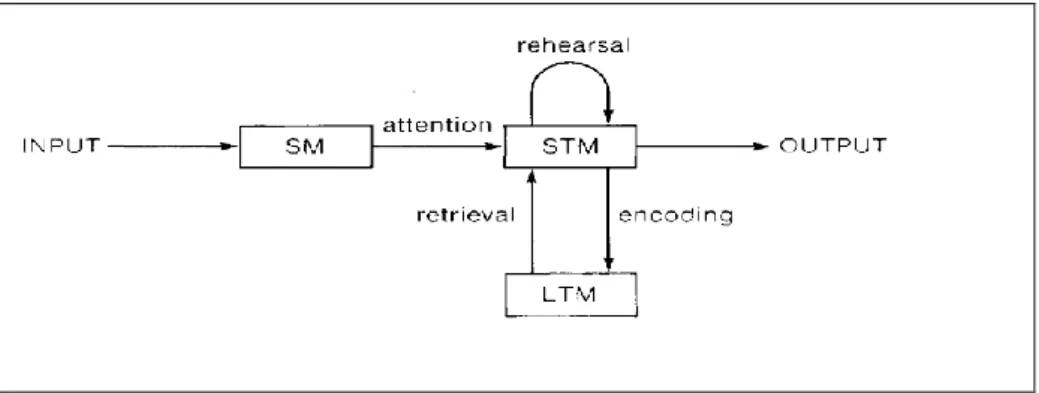
Weinstein, Goetz, and Alexander (1988) demonstrate ‘a simple information processing model of the learner’ of the learning process as shown in Figure 2.1 below.
Figure 2.1 An information processing system (Weinstein, Goetz, and Alexander, 1988, P.15)
Three memory stores which are represented by boxes in this figure consist this model of the learning process. It includes sensory memory (SM), short-term
memory (STM), and long-term memory (LTM). The four control procedures are
represented by arrows which include attention, rehearsal, encoding, and
retrieval.
Learning process starts with the attention when information from different resources (e.g., textbooks, newspapers, magazines, listening to music) enters the system through sensory memory. Learners need to pay attention to this information because it can fade quickly in the sensory store. The learner may transfer this information from sensory store to short-term memory by putting attention to this information. Weinstein, Goetz, and Alexander (1988) note that
“learning strategies aimed at the process of attention can influence selective
21 15). Learners cannot make the decision without finding out what the word means and how it functions. After having the first meeting with the new word, learners try to guess the meaning by using linguistic and sentence structure clues. After this, they consult teacher or dictionary to confirm the meaning, usage and then decide whether to keep this word in their notebook or not for further learning.
To continue the learning process, the learner should rehearse and memorise the information to process this from sensory memory into short-term memory
otherwise it can fade away rapidly. “Learning strategies aimed at the process of
rehearsal can influence how much rehearsal takes place, and thus, how long information can be held in short-term memory” (ibid, p.15). Then Information can be transferred from short-term memory to long-term memory store by applying encoding strategies. Though information stored in long-term memory is more likely to be permanent, the retrieval of the information can be hindered. Weinstein, Goetz, and Alexander (1988) note that “learning strategies aimed at
the process of encoding can influence how fast information is encoded and how
much is encoded” (ibid, p.15). The process of transferring knowledge from long-term memory to short-long-term memory is referred to retrieval. Learners retrieve this knowledge whenever they need.
This learning process may be linked with vocabulary learning strategies (VLSs). Learners may start the learning process by getting information from the outer word while using guessing in context, dictionary use and note-taking. This information is being stored in learners’ sensory memory. They may transfer this
22 initial knowledge (receptive) from sensory store to short-term memory by using memory rehearsal strategies. This knowledge may be transferred into long-term memory (productive) by using encoding strategies. Other than real-life situations, activation strategies may facilitate vocabulary learning by providing deliberate practice of retrieval.
2.2.4 Aspects of word knowledge
Milton (2013) emphasises that “there is no definitive list of what comprises word
knowledge and even native speakers will not know every facet of every word in
their lexicon” (p.59). There are many facets to know about each vocabulary item
which involves many degrees of knowledge because vocabulary items are not isolated units of language and fit into many intertwining systems and levels
(Nation, 1990; Elgort and Nation,2010). Milton (2013) notes that “potentially,
there is a lot involved in knowing a word” (p.58). Usually, word knowledge is divided into receptive or passive knowledge (i.e., the lexical items that are known when heard or read) and productive or active knowledge (i.e., the words that can be called to mind and used in speech or writing) (Milton, 2009). Milton (2013)
note that “perhaps the most important conclusion that emerges from the
research is the importance of vocabulary knowledge in being able to understand
and communicate in a foreign language” (p.71).
There are some other terms of learning vocabulary which are often used in ESL context, such as, incidental, explicit and implicit vocabulary learning. Milton and Donzelli (2013) point out that there is a confusion in the terminology of
23 incidental, explicit and implicit vocabulary learning. In language learning, the concept of implicit learning is unsatisfactorily distinguished from the concept of implicit learning in psychology (Rieder, 2003). There is a crucial distinction made between explicit and implicit learning in psychology. For example, implicit learning involves the absence of conscious operations in the learning procedure. The learner is not purposely testing a hypothesis or searching for a structure in the exposed language. In language learning, incidental learning may refer to learning in the sense that psychologists typically use it (Harris and Snow 2004). Incidental vocabulary learning may be defined as the learning of new words as a
by-product of a meaning-focused communicative activity, such as reading or
listening, and interaction which occurs through “multiple exposures to a word in different contexts” (Huckin and Coady 1999, p. 185). Milton and Donzelli (2013)
note that the learner may make a cognizant note of new vocabulary, test out new vocabulary in a communicative task which may make the attention on vocabulary learning genuinely explicit. However, any learning would at present be called coincidental because the concentration of the action was thought to be communication instead of vocabulary learning. This kind of learning may be called informal to differentiate it from fairly incidental learning where the learner
does not tend to put a thoughtful, conscious consideration to the vocabulary learning (Milton, 2008).
Knowing the form and meaning of the word is considered as the receptive knowledge of the word, and knowing its grammar function and usage is linked with productive knowledge of vocabulary (Nation, 2001; Thornbury, 2002). The
24 receptive knowledge of the word is obtained through language input from listening, reading and then comprehending it. In contrast, the productive knowledge of the word is linked with the production of language forms by talking and writing to pass on messages to others. The productive knowledge of the vocabulary also involves the attempt to express the meaning through speaking and writing and retrieving the appropriate spoken and written word form. Generally, knowing a word means having the knowledge of the form and
meaning at receptive level (Nation, 2001). However, from the point of view of
productive knowledge and use, knowing the word involves three aspects. 1) being able to produce the word to express the meaning 2) being able to produce the word in context to express the meaning, and 3) knowing the grammatical functions (Nation, 2001; Thornbury, 2002). The aim of the study is to explore the adopted VLSs and their impact on the gains of productive knowledge of vocabulary. Therefore, those mentioned above three key aspects of productive knowledge of vocabulary are used in this study.
2.3 Vocabulary learning in the second language
Schmitt (2008) proposes that “one thing that students, teachers, materials
writers, and researchers can all agree upon is that learning vocabulary is an
essential part of mastering a second language” (p. 329). Milton (2009) emphasises that “words are the building blocks of language and without them,
there is no language” (p.3). Nation (2001) suggests that vocabulary learning is as
important as other language skills to learn the language. Vocabulary learning is one of the necessary sub-goals of a range of important goals to learn the
25 language. Therefore, it is recommended (Nation, 2001, p.4) that “teachers and learners should give careful consideration to how vocabulary is learned”.
Moir and Nation (2002) note that the choices of vocabulary learning relate to the
learners’ language learning goals, e.g., learning English for academic purposes,
for social uses, and for specific aims such as reading newspapers or watching TV. L2 learners learn vocabulary from different sources. Learners receive vocabulary input and gain vocabulary knowledge during their English lessons in their classroom. Learners may be involved in the artificial communicative tasks (i.e., role play, dialogue, scenario-based learning). However, it seems that the language classroom can be a poor place for language interaction between learners in a natural way (Milton, 2006; Laufer, 2010; Milton et al., 2012). The classroom input is not the only source of vocabulary learning as L2 learners learn English from many varied sources (Milton, 2009). For example, learners may learn vocabulary from social interaction, English media and press outside the classroom. Milton (2006; 2009) suggests that vocabulary can be learnt by getting involved in the online social interaction, media and extensive reading of newspaper outside the classroom.
2.3.1 Challenges in vocabulary learning
Schmitt (2007) notes that English vocabulary learning can be challenging for ESL learners as the English language possibly comprises the highest number of words in any major language. For example, knowledge of the most frequent
26 which is essential (Schonell et al.,1956; Adolphs and Schmitt, 2003) to participate in the basic everyday oral communication. On the other hand, “the vocabulary in
the 2,000-3,000-frequency band provides additional material for spoken discourse, but additionally, knowledge of around 3,000 families is the threshold that should allow learners to begin to read authentic texts. Most research indicates that knowledge of the most frequent 5,000-word families should
provide enough vocabulary to enable learners to read authentic texts” (Schmitt,
2007, p.746).
Another challenge which is faced by EFL learners to learn vocabulary is the long journey towards achieving different aspects of vocabulary knowledge (e.g., knowledge of form, meaning, grammatical function, collocation, and constraints on use). Schmitt (2007) specifies that the first step to learning vocabulary perhaps is to know the meaning of a word. However, ESL learners require much more in-depth knowledge of vocabulary to be able to use it in any required situation.
Nation (2001) emphasised that L2 learners need to know an enormous number of vocabulary including high-frequency, academic, technical and low-frequency words. Frequency-based studies show that some vocabulary items are much more useful than others (Hwang and Nation, 1995). The high-frequency words cover a large proportion of the words in oral and written texts and occur in all kinds of uses of the language. It is often suggested that these high-frequency words are so important in learning an L2 that considerable time should be spent to learn these words. It is recommended that learners should focus these
high-27 frequency words by putting attention in the form of direct as well as incidental learning by applying VLSs (Nation, 2001).
The other challenge in learning vocabulary is the way it is learnt incrementally; it prompts to the suggestion that words must be met and used variously to be genuinely learnt (Schmitt, 2007; Nation, 2015). Researchers such as McKeown et al. (1985), Nation (1990) and Nagy (1997) propose that some exposures are necessary to learn vocabulary. Even vocabulary learnt through a rich program of vocabulary instruction needs seven or more encounters for long-term learning (McKeown et al., 1985). Nation (1990) recommends that activation of old vocabulary may be as important as it is to learn new ones otherwise it will fade away from memory.
Schmitt (2007) proposes that vocabulary learning challenges can be minimised by ensuring appropriate vocabulary teaching and learning. For example, these challenges may be addressed by explicit and implicit learning of vocabulary. Vocabulary learning may be facilitated through independent vocabulary learning,
i.e., vocabulary learning strategies. It is recommended that “one of the ways teachers can aid this process is by helping learners become aware of and practised in using a variety of vocabulary learning strategies. Research shows
that many learners do use strategies for learning vocabulary” (Schmitt, 2007, p.
755). Schmitt (2007) further suggests that different vocabulary learning techniques should frequently be utilised simultaneously instead of being used individually. An appropriate application of VLSs implies active management (i.e.,
28 how often to give attention to the target vocabulary) of strategies which is recommended as an outstanding approach to successful learning of vocabulary (Gu and Johnson, 1996). Research (Ahmed, 1989; Sanaoui, 1995) indicates that successful learners take initiatives towards utilising a variety of strategies, structure their vocabulary learning, audit and practise target words, and stay mindful of the semantic connections amongst new and already learnt L2 words. That is, the successful learners may aware of their learning and find a way to direct it, whereas unsuccessful learners generally do not have this mindfulness and control in taking appropriate initiatives and selection to learn vocabulary. This section reviewed the nature of vocabulary, aspects of vocabulary knowledge, the significance of vocabulary learning to master the language and challenges involved in L2 vocabulary learning. The next section will mainly review curricular and extra-curricular VLSs.
2.4 Curricular and extra-curricular Vocabulary learning strategies
(VLSs)
This section is organised into six sub-sections. It reviews (a) the language learning strategies, (b) vocabulary learning strategies, (c) taxonomies of VLSs, (d) meta-cognitive strategies, (e) curricular VLSs and (f) extra-curricular VLSs regarding vocabulary learning in English as a second (ESL) and foreign language learning (EFL) contexts.
29
2.4.1 Language learning strategies (LLS)
VLSs are a part of LLS which learners adapt to learn the language (Nation, 2001). Gu (2012a) notes that definition of LLS is argued because LLS are considered as unclear definable concept due to their close resemblance to each other. It might be the main cause that there is a lack of interest in researching language learning strategies even today (ibid). This ‘conceptual fuzziness’ should not be considered an issue to overthrow decades of research on Language learning strategies (Gao, 2007; Rose, 2012). The experts and researchers need to react beyond these issues as such sort of studies may guide to teaching and pedagogical implications (Gu, 2012a).
In the 1970’s, ESL researchers had a considerable interest in discovering useful language learning strategies (Schmitt, 1997). Some of these studies were experimental and most of the work was done on identifying strategies used by good learners (Rubin, 1975; Naiman et al., 1978; Wong-Fillmore, 1979; O’Malley
et al., 1985) whereas, some studies were of descriptive nature to explore and describe categories of learning strategies (O’Malley and Chamot, 1990; Oxford,
1990). Though these studies were directly dedicated to language learning strategies, these studies indirectly impacted on taxonomies of strategies related to vocabulary learning (Schmitt, 1997).
30
2.4.2 Vocabulary learning strategies (VLSs)
Vocabulary learning can be facilitated by VLSs, so it is significant for teachers and language learners to understand the definition and usefulness of VLSs to learn vocabulary (Nation, 2001). The next section will review the definition of VLSs.
2.4.2.1 Definition of vocabulary learning strategies
Vocabulary learning involves VLSs and other behaviours which learners adapt to learn their vocabulary (Nation, 2001). It may be difficult to arrive at a definition of what a vocabulary learning strategy is. VLSs can increase the efficiency of
vocabulary learning and vocabulary use. Gu (2012b) defines VLSs as “conscious efforts” by learners to make their learning experience more “effective and “efficient” to learn vocabulary and to increase vocabulary size. This point is
further outlined as “VLS are indispensable in describing and explaining the vocabulary development of a foreign language” (Ibid, p.4).
In other words, VLSs can be defined as an approach to facilitate vocabulary learning (Schmitt, 2000). Learning strategies can be used for various vocabulary learning purposes so any action or deliberate planning to learn vocabulary can be a VLS (Schmitt, 1997). According to Rubin (1987) and Schmitt (1997), VLSs are linked with the process by which the information is obtained, stored, retrieved,
and used as reviewed in Section 2.2.3.
2.4.3 Taxonomies of vocabulary learning strategies
The research on vocabulary learning strategies, VLSs taxonomies and categorisations (Gu and Johnson, 1996; Schmitt, 1997; Nation, 2001; Zhang and