This is the author’s version of a work that was submitted/accepted for
pub-lication in the following source:
Humphrey, John
(2014) Kumarina and bidders voting in transfer schemes.
Company and Securities Law Journal,
32(7), pp. 473-485.
This file was downloaded from:
http://eprints.qut.edu.au/78253/
c
Copyright 2014 Lawbook Co.
Notice
:
Changes introduced as a result of publishing processes such as
copy-editing and formatting may not be reflected in this document. For a
definitive version of this work, please refer to the published source:
Kumarina and bidders voting in transfer schemes
JS Humphrey*
Transfer schemes are an alternative means of acquiring control of a company to making a takeover bid under the provisions in Ch 6 of the Corporations Act 2001 (Cth). The recent decision Re Kumarina Resources Ltd [2013] FCA 549 overturned long-standing practice in relation to a certain type of transfer scheme. If followed, the decision would allow a “bidder” to vote at scheme meetings where the scheme consideration for the acquisition of the target shares are shares in another company, and the scheme results in a merger. But the bidder is not allowed to vote where the scheme consideration is cash. The article points out the difficulties arising from this decision and argues that it should not be followed. In providing a “no objection” statement, the Australian Securities and Investments Commission (ASIC) has created uncertainty as to the approach it will take towards the bidders being allowed to vote at scheme meetings where the scheme consideration for the acquisition of target shares are shares in another company. The article also points out that in providing the no objection statement in Kumarina, ASIC appears to have ignored breaches of s 606(1) of the Corporations Act. There is a pressing need for ASIC to clarify its position and, in particular, whether or not it will provide a no objection statement in respect of future transfer schemes where a bidder (or its parent company) votes at the scheme meeting.
I
NTRODUCTIONTransfer schemes have been used in Australia for at least 30 years as a means of effecting change of control transactions. A transfer scheme involves all (or substantially all)1 of the shares in the target company being transferred to the “bidder” who pays the target shareholders the consideration provided for under the terms of the scheme. The consideration can be cash, securities issued by another entity, or a mixture of both. Much has been written comparing transfer schemes with takeover bids under Ch 6 of the Corporations Act 2001 (Cth). The author agrees with the view expressed by other commentators that a transfer scheme “remains a contentious transaction structure”.2
The main reason that transfer schemes are contentious is that the threshold that must be satisfied before a scheme will be approved (resulting in the compulsory acquisition of the shares of those who vote against the scheme) is set at a lower level than the compulsory acquisition threshold required under a takeover. In the case of a company with only ordinary voting shares on issue, the bidder under a takeover bid must end up controlling at least 90%3 of the issued ordinary shares as a result of the bid in order to utilise the compulsory acquisition procedure under s 661A of the Corporations Act. In the case of a transfer scheme, the bidder will compulsorily acquire the shares of those who do not support the scheme if: the scheme resolution passes a headcount test;4 is supported by shareholders holding at least 75% in aggregate of the shares voted at the scheme meeting (“the 75% test”); and is approved by the court. Very few schemes fail to pass the headcount test. If only 60% of the shares on issue are voted at a scheme meeting5 it means that the 75% test will be satisfied in a transfer scheme if the holders of 45% of the total shares on issue vote in favour of the scheme. As can be seen in the example given, this is a considerably lower threshold than that required under a takeover bid. The difficult policy issue is the achievement of an appropriate balance in transfer schemes between the (adequacy of a) threshold which permits the compulsory acquisition of property on the one hand and the ability of a minority to thwart a transaction considered beneficial by a majority of shareholders on the other.
*John Humphrey is a Professor and Executive Dean of the Faculty of Law, Queensland University of Technology, a director of a number of companies listed on the Australian Securities Exchange and was a member of the Australian Takeovers Panel. Prior to taking up the role of Executive Dean he was a partner at King & Wood Mallesons.
1 Sometimes a scheme will not include shares held by the bidder.
2 Damian T and Rich A, Schemes, Takeovers and Himalayan Peaks: The Use of Schemes of Arrangement to Effect Change of Control Transactions (3rd ed, Herbert Smith Freehills, 2013) p 1.
3 Corporations Act 2001 (Cth), s 661A(1)(b)(ii) requires a bidder to acquire 75% of the shares it offered to acquire under the takeover bid as a pre-requisite to compulsory acquisition. If the bidder started with a 70% stake prior to a “mop up bid” it would have to acquire a further 22.5%, meaning it would have to control 92.5% to reach the compulsory acquisition threshold. 4 A “headcount test” is where the scheme must be approved by a majority of those shareholders present and voting at the scheme meeting.
5 See Companies and Markets Advisory Committee, Members’ Schemes of Arrangement, Discussion Paper (June 2008) at [4.2.3]: “Data on schemes entered into over the last 10 years indicate that, on average, some 62% of shares have been voted on a scheme (under the voted shares test), but only some 22% of shareholders have voted (under the headcount test). On some occasions significantly less than 10% of shareholders have voted.”
JS Humphrey*
In assessing whether the 90% compulsory acquisition threshold has been satisfied under a takeover bid, the shares controlled by the bidder and its associates are taken into account. In a transfer scheme, the position in relation to shares controlled by the bidder and its associates is not governed by the relevant statutory provisions.6 One can see in using the example given above (with 60% of the ordinary shares voted at the scheme meeting) that if a bidder started with a 20% stake in the target and could vote that stake in favour of the transfer scheme resolution then satisfaction of the 75% test would require that only an additional 25% of the shares in the company be voted in favour of the scheme. The question of whether a bidder can vote at a scheme meeting is therefore a matter of considerable practical importance.
In the absence of statutory prescription the matter has been governed by practice. Until recently the practice has been described in the following terms:
In a scheme of arrangement where the acquirer (or its associate) holds shares in the target, the traditional approach has been to quarantine the votes of the acquirer (or its associate) either by obtaining their agreement not to vote on the scheme, excluding those shares from operation of the scheme or even convening a separate class meeting. This approach reflects an expectation that the court, in assessing whether to approve the scheme, will elect to disregard the votes of the acquirer and its associates due to their interest in successful completion of the scheme transaction.7
The recent decision of Gilmour J in Re Kumarina Resources Ltd8 will do nothing to alleviate the contentiousness of transfer schemes. In a departure from normal practice, his Honour permitted the holding company of the bidder to vote at the scheme meeting. In his reasons his Honour appears to have drawn a distinction between transfer schemes where the scheme consideration provided is cash and transfer schemes where the consideration provided is securities in another body. The Australian Securities and Investments Commission (ASIC) provided a letter dated 22 May 2013 under s 411(17) of the Corporations Act saying it had no objection to the scheme (“ASIC letter”) prior to the court hearing where approval of the scheme was considered. When regard is had to ASIC Regulatory Guide 60, which sets out the basis on which ASIC will provide “no objection” statements, it would appear that ASIC must have given consideration to the matter and decided that voting by the parent of a bidder in the relevant circumstances was not objectionable.9
The decision, if followed, would fundamentally alter the desirability of the acquisition of a pre-bid stake where a prospective acquirer is contemplating embarking on a change in control transaction using a scheme. Indeed it has been suggested that the decision has the potential to encourage the development of a two-stage process where a stake is acquired under a takeover bid which is followed by a “squeeze out” scheme.10
In this article, it is argued that his Honour should have recognised that Utilico Investments Ltd had a conflict of interest by being effectively both vendor and purchaser and, as a consequence, the court should have disregarded the votes cast by it at the scheme meeting. It is also argued that because of breaches of s 606(1) of the Corporations Act the votes attaching to the Kumarina Resources Ltd shares acquired by the Kumarina Chairman 10 days prior to the scheme meeting should have been disregarded. If that had been done, the 75% test would not have been satisfied. Finally, it is suggested that there is a need for ASIC to clarify its position going forward on whether or not it will raise objections if “bidders” vote at transfer scheme meetings.
R
ELEVANT FACTSKumarina proposed to enter into a scheme of arrangement with its members under s 411(4)(b) of the
Corporations Act. The scheme proposed the merger of Kumarina with Zeta Resources Ltd by way of
the acquisition by Zeta of all the ordinary shares in Kumarina. Under the scheme, Kumarina’s shareholders would receive one Zeta share for every four Kumarina shares held, plus one Zeta option for every four Kumarina options held. The intended result of the scheme was that Kumarina would become a wholly owned subsidiary of Zeta and would be delisted. This type of transfer scheme is fairly common.
6 Corporations Act 2001 (Cth), Pt 5.1
7 Cook P, D’Andreti A and Tse E, M+A Perspectives – August 2013 (Gilbert+Tobin, 8 August 2013). 8
Re Kumarina Resources Ltd [2013] FCA 549.
9 ASIC, Schemes of Arrangement, Regulatory Guide 60 (September 2011) at [60.104]. It should be noted that because the no objection statement was provided prior to the court hearing where approval of the scheme was sought, ASIC may have arrived at its view for reasons different to those of Gilmour J.
10
See Dyer B, “Kumarina Resources – Have Bidders’ Dreams Come True?”, Takeover Legal Update (Ashurst Australia, June 2013).
The Scheme Booklet was dated 8 April 201311 and was registered by ASIC following the first court hearing. At the date of the Scheme Booklet, Utilico owned 10.1% of Kumarina’s issued capital, while Zeta was a wholly owned subsidiary of Utilico.
At the date of the Scheme Booklet, ICM Ltd owned 9.8% of Kumarina’s issued capital and it was envisaged that ICM would be actively involved in the management of Zeta for at least five years following implementation of the scheme, pursuant to the terms of an investment management agreement entered into with Utilico. In the Scheme Booklet, Utilico and ICM conceded that they were “associates” in respect of the Kumarina scheme.
Peter Sullivan was the Chairman and a non-executive director of Kumarina and he was paid directors fees of $48,000 per annum by Kumarina. If the scheme was implemented, Sullivan was to become the non-executive Chairman and a director of Zeta, for which he would be paid directors fees of $50,000 per annum. At the date of the Scheme Booklet, Sullivan owned 5.9% of Kumarina’s issued capital. On 6 May 2013 he acquired a further 9,056,265 shares in Kumarina (“the 6 May acquisition”) and as a result of that purchase he owned 18.6% of Kumarina’s issued capital at the time of the scheme meeting on 16 May 2013. Justice Gilmour accepted that Sullivan was an associate of Zeta by virtue of ss 12(2)(c) and 15(1)(c) of the Corporations Act. His Honour does not seem to have considered whether Sullivan was also an associate of Utilico. Utilico, ICM, and Sullivan all voted their shares in favour of the scheme at the transfer scheme meeting. As noted above, following the scheme meeting ASIC provided the ASIC letter confirming that it had no objection to the scheme and advising that it did not intend to appear at the second court hearing.
At the second court hearing, a number of parties (“the objectors”) objected to the approval of the scheme on the basis that each of Utilico, ICM, and Sullivan should be treated as being in a separate class to those Kumarina members not associated with Zeta and, alternatively, even if they were not a separate class, their votes should not be counted when considering whether the scheme was approved by the requisite statutory majority. If either of the objector’s contentions had been accepted, the 75% test would not have been satisfied and the scheme would not have been approved.
The objectors contended that the practice of shareholders related to or associated with the offeror voting separately to other shareholders remained common and referred Gilmour J to a number of examples12 to support their contention.
D
ECISIONHis Honour decided to approve the scheme and made orders accordingly. He rejected the objectors’ arguments that because of their respective relationships with Zeta, the votes of Utilico, ICM, and Sullivan should be disregarded. In the case of Utilico, his Honour distinguished Re Hellenic & General Trust Ltd,13 a case upon which the objectors relied, on the basis that it dealt with a cash buy-out and not a merger, and found that Utilico should not be treated as a separate class. His Honour found that because Utilico was not in a separate class it followed that its associate ICM should not be treated as being in a separate class.
His Honour then found that the fact that Sullivan was to be appointed as Chairman and a non-executive director of Zeta and that he was to receive $2,000 more in directors fees at Zeta than he received as Chairman and non-executive director of Kumarina, did not mean that he should be in a separate class.
Having dealt with the “class” arguments and rejected them, his Honour does not seem to have directly dealt in his reasons with the alternate submission that the votes of Utilico, ICM, and Sullivan should not be counted even if the holders did not form a separate class. By approving the scheme his Honour rejected that submission.
In deciding to exercise his discretion and approve the scheme, his Honour considered whether the scheme was “fair and reasonable from the viewpoint of an intelligent and honest person”14 and placed reliance on the fact that the independent expert expressed the opinion that the scheme was fair and reasonable and that a large majority of Kumarina shareholders had voted in favour of the scheme. His Honour also appeared to be critical of the fact that the objectors had initially indicated they would support the scheme and had not raised objections to Sullivan voting at the scheme meeting.15 This decision raises some important issues, which are considered below.
11
Kumarina Resources Ltd, Scheme Booklet (8 April 2013).
12 These examples included: Re Archaean Gold NL (1997) 23 ACSR 143; Aston Resources Ltd [2012] FCA 229; Re oOh!Media Group Ltd [2012] FCA 26; Re Talison Lithium Ltd [2013] FCA 194.
13 Re Hellenic & General Trust Ltd [1976] 1 WLR 123. 14 Re Kumarina Resources Ltd [2013] FCA 549 at [53]. 15 Re Kumarina Resources Ltd [2013] FCA 549 at [55]-[57].
JS Humphrey*
V
OTING BY BIDDERS IN TRANSFER SCHEMESThe objectors in Kumarina contended that the practice of disregarding votes cast by shareholders related to or associated with the bidder when considering whether the scheme was approved by the requisite statutory majority, still remained common practice. Some commentators have put it more strongly than just a matter of practice:
Any shares in the target that the bidder, or a related body corporate of the bidder, holds (or which a third party holds for the benefit of the bidder or a related body corporate of the bidder) will not be able to be used by the bidder in satisfying the member agreement requirements for a scheme of arrangement.16
The authority cited in support of this proposition is the decision of Templeman J in Re Hellenic. In that case a company applied for court approval of a scheme relating to its ordinary shares. The shares were held as to 53.01% by Merchandise and Investment Trust Ltd (MIT) (a wholly owned subsidiary of Hambros Ltd) and as to 13.95% by the National Bank of Greece (NBG). Under the scheme the ordinary shares of the company were to be cancelled and new shares were to be issued to Hambros with the result that the company would become a wholly owned subsidiary of Hambros. The former shareholders were to be compensated in cash for the loss of their shares. However, if the scheme went through, NBG would become liable to a very substantial capital gains tax in Greece. At the shareholders meeting convened by the court, MIT voted in favour of the scheme and NBG voted against.
The resolution in favour of the scheme was carried by the necessary 75% majority of the share class present and voting, but without the votes of MIT the resolution would not have been carried against the votes of NBG. NBG objected to the approval of the scheme and Templeman J declined to approve it. He held that MIT (as a wholly owned subsidiary) should be treated as having a community of interest with Hambros (as offeror) and as such had an interest that was different from that of the remaining shareholders. It followed that MIT formed a separate class and the scheme meeting had not been properly constituted:
So far as the MIT shares are concerned it does not matter very much to Hambros whether they are acquired or not. If the shares are acquired a sum of money moves from parent to wholly owned subsidiary and shares move from the subsidiary of the parent. The overall financial position of the parent and the subsidiary remains the same. The shares and the money could remain or be moved to suit Hambros before or after the arrangement. From the point of MIT, provided MIT is solvent, the directors of MIT do not have to question whether the price is exactly right. Before and after the arrangement the directors of the parent company and the subsidiary could have been made the same persons with the same outlook and the same judgement. Counsel for the company submitted that since the parent and subsidiary were separate corporations with separate directors, and since MIT were ordinary shareholders in the company, it followed that MIT had the same interests as the other shareholders. The directors of MIT were under a duty to consider whether the arrangement was beneficial to the whole class of ordinary shareholders, and they were capable of forming an independent and unbiased judgement, irrespective of the interests of the parent company. This seems to me to be unreal. Hambros are purchasers making an offer. When the vendors meet to discuss and vote whether or not to accept the offer, it is incongruous that the loudest voice in theory and the most significant vote in practice should come from the wholly owned subsidiary of the purchaser. No one can be both a vendor and a purchaser and, in my judgement for the purpose of the class meetings in the present case, MIT were in the camp of the purchaser.17
It was open to Gilmour J to decide that Re Hellenic had been wrongly decided or should no longer be followed but he chose not to do that. Instead, he considered the decision in Re Hellenic and effectively distinguished it on the basis that, in this case, the scheme did not result in Kumarina becoming a wholly owned subsidiary of Utilico (as would happen under a transfer scheme with a cash consideration) but rather a partially owned subsidiary.18 His Honour stated that:
[Re Hellenic] falls into a different category. In that case under the proposed scheme all shares in the target company were to be cancelled and new shares issued to the bidder which was to pay the shareholders of the target 48 pence per share cancelled. The bidder’s wholly owned subsidiary owned 53.01% of the shares in the target and it voted in favour of the scheme in a single class meeting. Templeman J considered that the subsidiary should have voted in a separate class and refused approval of the scheme. That is not this case. Here the scheme is not a buy-out and transfer of Kumarina shares from the other shareholders to Utilico through Zeta. The
16 Damian and Rich, n 2, p 317.
17 Re Hellenic & General Trust Ltd [1975] 1 WLR 123 at 126 (emphasis added).
scheme will effect a merger with Zeta in which all existing shareholders will participate equally and will continue as shareholders of Zeta. Separately Utilico will obtain additional shares in Zeta and will obtain control of Zeta through that transaction. However, the rights and commercial effect of the Scheme are the same for all of Kumarina’s shareholders.19
It is acknowledged that the scheme in Re Hellenic was a cancellation scheme (where existing shares are cancelled rather than transferred) and not a transfer scheme as in Re Kumarina. However, beyond certain differences in the tax treatment that may be applicable to shareholders in the scheme company, it is difficult to see much difference in the Australian context between the outcome of a cancellation scheme and a transfer scheme where the scheme consideration is securities. In both cases shareholders in the scheme company lose title to their shares and in return receive the other securities. It is respectfully submitted that by distinguishing Re Hellenic on the basis that Kumarina shareholders were not being bought out for cash and were continuing as shareholders of Zeta, his Honour has created considerable uncertainty. The logical result of this approach would be that the ability of bidders to vote at transfer scheme meetings should differ depending on the consideration being offered under the relevant scheme. It is difficult to see why this should be so.
The observation by his Honour that all existing Kumarina shareholders will participate equally and will continue as shareholders of Zeta is factually incorrect. Under the terms of the scheme, ineligible foreign shareholders in Kumarina (that is, shareholders resident in specified jurisdictions outside Australia) did not receive shares in Zeta and instead received an entitlement to a cash sum derived from the proceeds from the sale of shares that they would have been issued had they been eligible to participate. This effectively puts them in the same position as the shareholders in Re Hellenic (that is, under the scheme the ineligible foreign shareholders received cash and retained no ongoing indirect interest in the assets of Kumarina). His Honour seems to have placed some importance on the fact that all Kumarina shareholders would continue as shareholders of Zeta if the scheme were implemented. That the grounds relied upon by his Honour for distinguishing Re Hellenic were factually incorrect casts some doubt on the correctness of the decision.
Even if his Honour’s understanding of the effect of the scheme had been correct, it is not immediately apparent why this would provide a basis for distinguishing Re Hellenic. It is true that, under the terms of the scheme, shareholders in Kumarina would have retained an indirect interest in the assets of Kumarina as a result of acquiring shares in Zeta. However, they also acquired an interest in other assets owned by Zeta and the proportionate indirect interest in the Kumarina assets are not the same because Zeta already had shares on issue at the time the scheme consideration was issued and more were to be issued to third parties separately to the scheme. Indeed, the Scheme Booklet drew Kumarina shareholders’ attention to the fact that their indirect interest in Kumarina assets would be considerably diminished in the event the scheme was implemented.20
It is, with respect, difficult to see a rationale for why a bidder or its parent company should be able to vote on a scheme resolution where an indirect interest in the scheme company’s assets is maintained following implementation of a scheme (that is, where the consideration is securities) and effectively be disqualified from voting when the consideration is cash. The issue that his Honour did not address was why it is that a bidder (or its parent company) can be both a vendor and a purchaser where the scheme consideration is securities.
In fairness to his Honour it should be pointed out that the decision in Re Hellenic has been much criticised. Some authors have argued that there was no need in that case for the subsidiary of the bidder to form a separate class, but rather the relevant votes should simply have been disregarded by the court at the approval hearing:
In the authors’ view, Templeman J arrived at the correct result in this case, but for the wrong reasons. If, as seems to be the position from the facts set out in the judgment, MIT was to be treated in exactly the same way under the scheme as every other shareholder in the target, then it was appropriate to include it in the same class as all the other shareholders. However, the court ought to have completely disregarded the votes of MIT on the grounds that it had an extraneous commercial interest (which resulted from the fact that it was a wholly owned subsidiary of the Bidder) which rendered its view “a self-centred view rather than a class-promoting view” to use the words of Street J in [Re Jax Marine Pty Ltd (1967) 85 WN (Pt 1) (NSW) 130].21
The practical difference between the two courses is that under one the bidder (and/or its related corporations) is excluded from the scheme meeting at which most shareholders vote (and votes in its
19 Re Kumarina Resources Ltd [2013] FCA 549 at [44] (emphasis added). 20 Kumarina Resources Ltd, n 11, p 17.
JS Humphrey*
own meeting), and under the other a bidder (and/or its related corporations) can still attend the scheme meeting, speak, and vote, but in the knowledge that those votes will be disregarded for the purposes of the court’s approval. While an unnecessary proliferation of classes in schemes would significantly diminish their utility and so should be avoided, the author wonders whether the preservation of the right of a bidder (or its related corporations)22 to speak at the scheme meeting by not constituting them as a separate class in transfer schemes is worth the uncertainty that arises, as evidenced by the decision in Kumarina. However, pursuit of that issue, interesting as it is, is a matter beyond the scope of this article.
The point to note is that whether one goes down the separate class route, as was done in Re Hellenic, or one assumes the correctness of the proposition set out above and goes down the one class route in which the votes of the bidder are disregarded, the result is effectively the same – in both cases the votes cast by Utilico at the Kumarina scheme meeting should have been disregarded in determining whether the 75% test had been satisfied. The basis of either of the above approaches is simply that a bidder (or its parent) cannot be both a vendor and a purchaser, and should therefore not have its votes counted for the purposes of assessing whether the prescribed statutory majorities have been obtained.
There are some other issues that arise if his Honour’s approach is followed. What would be the limits to the application of the new approach? It is not uncommon to find that the consideration for a transfer scheme is a mixture of cash and securities in another company. Would the new approach apply to schemes where the consideration was predominantly securities? Would the new approach apply to a scheme where the proposed mix of consideration is 90% cash and 10% securities by value? Implementation of either scheme would, to use his Honour’s words, “effect a merger ... in which all existing shareholders will participate equally and will continue as shareholders”. One could argue that neither of the above examples was a merger as contemplated by his Honour’s formulation because the scheme consideration included an element of cash. But the rationale for so doing is not immediately apparent if the new requirements propounded by his Honour are properly understood as being continuation as a shareholder and equal treatment of all shareholders. On this basis it would only be cash transfer schemes where bidders’ votes were excluded.
Proponents of schemes and their advisors are generally looking for as much transactional certainty as they can get. If the test for whether a bidder can vote is based on whether or not a merger is effected by the scheme, then in both of the above examples, a bidder should not (absent other circumstances which bear on the matter) be precluded from voting, notwithstanding the different commercial nature of the transactions. One can envisage schemes with a mixture of consideration heavily weighted towards cash where a bidder with a significant pre-bid stake votes and effectively approves the scheme and by so doing moves to a shareholding in excess of 90% of the merged company, after which the compulsory acquisition procedure in Ch 6A.1 of the Corporations Act could be utilised to mop up the balance.
In the author’s opinion, it is hard to see a good justification for the court to take a different view on whether or not a bidder can vote at a scheme meeting on the basis of the consideration being offered under a scheme. The fundamental issue is whether a bidder can be both vendor and purchaser, or whether that inherent conflict should operate to preclude the votes cast by a bidder (and/or its related corporations) being counted for the purposes of approval of the scheme. That fundamental conflict exists irrespective of the nature of the scheme consideration and, in the author’s respectful view, courts should think carefully before disregarding this conflict in determining voting rights at scheme meetings where the scheme results in a change of control of a company.
As pointed out above, his Honour did not conclude that Re Hellenic had been wrongly decided. Instead, he distinguished it on the basis that it did not apply to mergers where all shareholders in the scheme company continued on as shareholders in the bidding company. In the author’s respectful opinion, this creates an artificial division which is undesirable and unsupported by authority or principle. The author considers it highly preferable that a uniform approach be taken to the determination of voting rights and that the approach should be that (consistent with the principle enunciated in Re Hellenic and past practice) votes cast by the bidder (and those in the bidder’s camp) should be disregarded.
There will be some who will be more than a little surprised that this has indeed become an issue. After all, in December 2009, the Corporations and Markets Advisory Committee (CAMAC) delivered a report on Members’ Schemes of Arrangement in which it expressed the following view:
22 There is generally no bidder as such in a creditor’s scheme. While uniformity in regards to creditors schemes and members schemes may be desirable where sensibly possible, in the author’s view some degree of caution is necessary in applying decisions on creditor schemes to member schemes which effect a change in control of a company.
Intending Controller
The discussion paper raised the question whether the position of an intending controller in a change of control scheme needs any clarification to ensure that any votes cast in favour of the scheme by that person and any associates of that person are disregarded.
The Committee agrees with the view in submissions that the class composition test already precludes an intending controller and its controlled entities from voting with other shareholders as part of one class. There does not appear to be a need for legislative clarification.23
One might quibble on the basis of the earlier discussion that it is not the class composition test as such that precludes intending controllers (that is, bidders or their parent companies) from voting with the other shareholders as part of one class. However, it is obvious that CAMAC thought it was already abundantly clear that an intending controller could not vote with other shareholders and accordingly no legislative clarification of the matter was necessary.
Voting by Utilico
It follows that, in the author’s view, votes cast by Utilico at the scheme meeting should have been disregarded for the purposes of determining whether the scheme had been approved by the requisite statutory majorities.
R
EGISTRATION OFS
CHEMEB
OOKLET BYASIC
As noted above, the Scheme Booklet was registered by ASIC after the first court hearing. The following appears in the Scheme Booklet:24
As at the date of this Scheme Booklet, Zeta does not have a Relevant Interest in any Kumarina Shares. Accordingly, as at the date of this Scheme Booklet, Zeta had no voting power in Kumarina. However, as at the date of this Scheme Booklet, Zeta’s parent company, Utilico, and Utilico’s investment manager, ICM, both held shares in Zeta. As at the date of this Scheme
Booklet, the number of Kumarina Shares held by Utilico and ICM were as follows:
Name Number of Kumarina
Shares
Percentage of Kumarina Shares
Utilico Investments Limited 7,199,366 10.13% ICM Limited 7,000,000 9.84%
In the author’s view, there is a good argument that this quote is misleading for the following reasons. In general terms, a person will have a “Relevant Interest” in shares if they are the holder of the shares or they control the exercise of the voting rights attached to those shares or the right to dispose of the shares.25
Under the Corporations Act, the “voting power” of a person is calculated in accordance with the following formula:
Person’s and associates’ votes x 100 Total votes in designated body
where:
person’s and associates’ votes is the total number of voting shares attached to all the voting shares in the designated body that the person or an associate has a relevant interest in.26
In order to determine Zeta’s “voting power” in Kumarina under the Corporations Act, it is necessary to aggregate the votes attached to Kumarina shares in which Zeta had a “relevant interest” and the Kumarina shares in which associates of Zeta had a relevant interest. Zeta did not have a relevant interest in any Kumarina shares but it is necessary to consider relevant interests held by associates of Zeta to determine Zeta’s “voting power”.
23
CAMAC, Members’ Schemes of Arrangement (December 2009) at [5.4.1]. 24 Kumarina Resouces Ltd, n 11, p 97 (emphasis added).
25 Corporations Act 2001 (Cth), s 608(1). 26 Corporations Act 2001 (Cth), s 610(1).
JS Humphrey*
Zeta was a wholly owned subsidiary of Utilico and, pursuant to s 12(2)(a)(ii) of the Corporations Act,27 Utilico was an associate of Zeta in respect of Kumarina. At the relevant time Utilico had a relevant interest in 10.1% of Kumarina’s issued voting shares.
Sullivan was going to be appointed a director of Zeta if the scheme was implemented. He declined to make a recommendation to Kumarina shareholders on this basis. He was acting in concert with Zeta and was therefore an associate of Zeta by virtue of ss 12(2)(c)28 and 15(1)(c).29 This seems an unremarkable conclusion and indeed it was accepted by Gilmour J subsequently in his judgment.30 At the date of the Scheme Booklet, Sullivan had a relevant interest in 5.9% of Kumarina’s issued voting shares.
It follows that Zeta had “voting power” in Kumarina under the Corporations Act of at least 16%. No attempt has been made to deal with the ICM shareholding in this analysis as the relationship with Zeta is more complex and it is unnecessary for the efficacy of the points made below.
In the Scheme Booklet, the term “relevant interest” is defined to have the same meaning as in the
Corporations Act whereas “voting power” is not similarly defined. There is, therefore, an argument that “voting power”, when used in the paragraph of the Scheme Booklet set out above, means something narrower (namely only votes attached to shares in which Zeta has a relevant interest) than the definition given to that term in s 610(1). The concept of “voting power” is a statutory construct (arguably bearing little resemblance to the meaning the term might have in common parlance) and is based on an aggregation of certain relevant interests – another artificial statutory construct. As used in the paragraph set out above, the fact that Zeta has no voting power is said to flow from the fact that it does not have a relevant interest in Kumarina shares. It seems anomalous to interpret the paragraph so that what is said to flow from the application of a statutory construct (that is, relevant interest) is the common parlance meaning of “voting power” rather than the technical meaning under the corresponding statutory construct. In the author’s view, it would be both confusing and inappropriate to give “voting power” the narrower construction.
If that is accepted, then it follows that the paragraph set out above is misleading in a material respect, notwithstanding that full details of Utilico’s and Sullivan’s shareholding in Kumarina were set out in the Scheme Booklet. Apart from anything else, the issues in relation to s 606(1) (which are dealt with below) would have been more clearly in focus for ASIC, Kumarina shareholders, and the court, had disclosure of Zeta’s “voting power” (as defined in s 610(1)) had been properly made.
There is accordingly, in the author’s view, an issue as to whether ASIC should have registered the
Scheme Booklet without the appropriate disclosure being made.
B
REACHES OF SECTION606(1)
OF THEC
ORPORATIONSA
CTSection 606(1) is arguably the lynchpin of the takeovers regime contained in Ch 6 of the
Corporations Act and provides as follows:
(1) A person must not acquire a relevant interest in issued voting shares in a company if: (a) the company is:
(i) a listed company; or
(ii) an unlisted company with more than 50 members; and
(b) the person acquiring the interest does so through a transaction in relation to securities entered into by or on behalf of the person; and
(c) because of the transaction, that person’s or someone else's voting power in the company increases:
(i) from 20% or below to more than 20%; or
(ii) from a starting point that is above 20% and below 90%.
27
Corporations Act 2001 (Cth), s 12(2)(a)(ii) provides: “For the purposes of the application of the associate reference in relation to the designated body, a person (the second person) is an associate of the primary person if, and only if, one or more of the following paragraphs applies ... the primary person is a body corporate and the second person is ... a body corporate that controls the primary person.”
28 Corporations Act 2001 (Cth), s 12(2)(c) provides, in essence, that B is an associate of A if B is a person with whom A is acting or proposing to act in concert in relation to the company’s affairs.
29 Corporations Act 2001 (Cth), s 15(1)(c) provides, in essence, that B is an associate of A if B is a person with whom A is or proposes to become, associated, whether formally or informally, in any other way.
The application of s 606(1) can be a very technical matter; however, in the present case it appears to be reasonably straightforward. Kumarina is a company to which the section applies and on 6 May 2013, Sullivan acquired a relevant interest in 9,056,265 Kumarina shares through a transaction. For the reasons set out above, Zeta had “voting power” (as defined in s 610(1)) in Kumarina of 16% at the date of the Scheme Booklet.
The additional shares in Kumarina acquired by Sullivan on 6 May 2013 represented approximately 12.7% of Kumarina’s issued voting shares. Through the application of s 610(1), the effect of this acquisition was to increase the voting power of Zeta in Kumarina from 16% to 28.7%, seemingly in breach of s 606(1). In the author’s view, there are also good arguments that the 6 May acquisition also had the effect of increasing Utilico’s voting power in Kumarina in breach of s 606(1).
If Sullivan was an associate of Zeta, as Gilmour J accepted,31 it is difficult to see how he was not also an associate of Utilico pursuant to ss 12(2)(c) and 15(1) of the Corporations Act. Utilico wholly owned Zeta at the time the scheme negotiations were going on. In a practical sense, it is extremely unlikely that Zeta could have entered into the “Scheme Implementation Agreement” without the consent of Utilico. Implementation of the scheme involved Zeta ceasing to be a wholly owned subsidiary of Utilico and the introduction of minority interests with consequent tax and legal impacts on Utilico. Further, Utilico was a participant in an interlocking web of transactions and the proposed scheme was conditional upon an acquisition of assets by Zeta from Utilico. Upon completion of the transactions Zeta remained a subsidiary of Utilico. As a matter of fact, Sullivan could not have realistically been expected to be appointed and remain as Chairman of Zeta post the merger without the support of Utilico. In these circumstances, it is difficult to see how Utilico and Sullivan were not acting in concert (along with Zeta) to give effect to the scheme and were therefore associated in relation to Kumarina.
At the date of the Scheme Booklet Utilico owned 10.1% of Kumarina. ICM and Utilico considered themselves associates for the purposes of the scheme and Gilmour J seems to have accepted this.32 At that date ICM owned 9.84% of Kumarina and Sullivan owned 5.87%. If Utilico and Sullivan were associated as discussed above, the application of s 610(1) meant that Utilico had voting power in Kumarina of 25.84% at the date of the Scheme Booklet. Assuming this voting power had arisen without a breach of s 606(1) there would seem to be a breach of s 606(1)(c)(ii) arising as a result of the 6 May acquisition given that the effect of the acquisition was to increase the voting power of Utilico from 25.8% to 38.5%.
There is, in the author’s view, a very strong argument that any votes attaching to the shares acquired in breach of s 606(1) should not have been counted at the scheme meeting.33 To do otherwise would be to countenance the acquisition of shares prior to scheme meetings in breach of s 606(1) for the purpose of achieving the required statutory majorities.
It does not appear that these points were argued before his Honour and so of course he did not have to deal with them. It is not clear whether this was a deliberate decision by the objectors and their legal advisers, or an oversight. The breaches are relevant, as discussed below, to the issue of whether or not ASIC should have issued the ASIC letter.
Voting by Sullivan
It follows that the votes attaching to the 9,056,265 shares acquired by Sullivan on 6 May 2013 should have been disregarded for the purposes of determining whether the scheme had been approved by the requisite statutory majorities.
V
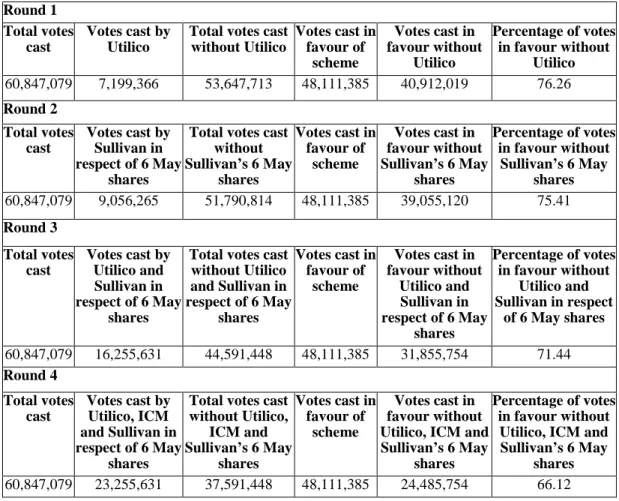
OTING ANALYSISThis article has argued that, for the reasons set out above, the votes cast by Utilico and a majority of the votes cast by Sullivan should not have been counted for the purposes of determining whether the 75% test had been met. The impact of this is set out in the voting table below.
31 Re Kumarina Resources Ltd [2013] FCA 549 at [31]. 32 Re Kumarina Resources Ltd [2013] FCA 549 at [29]. 33
This would be all of the 9,056,265 shares given the terms of s606(1)(c)(ii) of the Corporations Act 2001 (Cth) and the impact of the acquisition on Utilico’s voting power.
JS Humphrey*
TABLE 1: Voting table
Round 1 Total votes
cast
Votes cast by Utilico
Total votes cast without Utilico Votes cast in favour of scheme Votes cast in favour without Utilico Percentage of votes in favour without Utilico 60,847,079 7,199,366 53,647,713 48,111,385 40,912,019 76.26 Round 2 Total votes cast Votes cast by Sullivan in respect of 6 May shares
Total votes cast without Sullivan’s 6 May shares Votes cast in favour of scheme Votes cast in favour without Sullivan’s 6 May shares Percentage of votes in favour without Sullivan’s 6 May shares 60,847,079 9,056,265 51,790,814 48,111,385 39,055,120 75.41 Round 3 Total votes cast Votes cast by Utilico and Sullivan in respect of 6 May shares
Total votes cast without Utilico and Sullivan in respect of 6 May shares Votes cast in favour of scheme Votes cast in favour without Utilico and Sullivan in respect of 6 May shares Percentage of votes in favour without Utilico and Sullivan in respect of 6 May shares 60,847,079 16,255,631 44,591,448 48,111,385 31,855,754 71.44 Round 4 Total votes cast Votes cast by Utilico, ICM and Sullivan in respect of 6 May shares
Total votes cast without Utilico, ICM and Sullivan’s 6 May shares Votes cast in favour of scheme Votes cast in favour without Utilico, ICM and Sullivan’s 6 May
shares
Percentage of votes in favour without Utilico, ICM and Sullivan’s 6 May
shares
60,847,079 23,255,631 37,591,448 48,111,385 24,485,754 66.12
It will be immediately apparent from Table 1 that, had the votes cast by either Utilico or Sullivan (in respect of the 6 May shares) not been counted, the scheme vote would have satisfied the 75% requirement of s 411(4)(a)(ii)(B). However, if the votes cast by both Utilico and Sullivan in respect of the 6 May shares had not been counted on the basis of on the arguments set out above, then the scheme vote would not have satisfied the 75% requirement.
The author has not dealt with the position of ICM in this analysis because nothing turns on it for the purposes of the arguments put forward in this article. However, for the sake of completeness, a row has been included in the table which also shows what the vote would have been had votes cast by ICM been excluded. On the basis of the facts in the case (including that Utilico and ICM considered themselves associates) it would not, in the author’s view, have been unreasonable to treat ICM as being in the camp of the bidder and disregarding its votes.
ASIC
LETTERThe court must not approve a scheme under s 411 of the Corporations Act unless it is satisfied that the scheme has not been proposed for the purpose of enabling any person to avoid the operation of any of the provisions of Ch 6 or it receives a no objection statement from ASIC.34 The ASIC Regulatory Guide 60 expresses its view on interested parties voting in the following terms:
The Corporations Act does not prohibit proponents or their associates (interested parties) who hold target shares or target securities from voting in relation to an acquisition. However, if the vote is to demonstrate approval by the remaining shareholders:
(a) interested parties should fully disclose their interests; and
(b) interested parties should either not vote in favour of the resolution to approve the scheme, or should vote in a separate class.
When interested parties vote in the same class as other members or creditors because they have a divergent commercial interest that falls short of requiring they meet as a separate class, voting should be by ballot. This ballot should be retained by the company, or an
audited record of the voting should be retained. This will assist the court in determining whether or not to approve the scheme.35
Clearly in ASIC’s view not all interested parties will necessarily have a sufficiently divergent commercial interest to preclude them from voting. Perhaps not surprisingly, these paragraphs are carefully worded and they assimilate the position of a bidder (and its related corporations) on the one hand with that of other scheme proponents such as the directors of the target company on the other. The result is ambiguity as to ASIC’s position on bidders (and/or their related corporations) voting at scheme meetings. If an attempt is made to try and unpack this, it is, in the author’s view, hard to see a more fundamentally divergent commercial interest than that of a bidder (and its parent company), and presumably the Regulatory Guide was framed with these parties in mind.
ASIC Regulatory Guide 60 goes on to set out the basis on which it will provide the no objection statement under s 411(17):
We will state in writing that we have no objection to a scheme of arrangement if an applicant satisfies us that:
(a) all material information relating to the proposed scheme has been disclosed to us; (b) the standard of disclosure to all members fulfils the requirements under reg 5.1.01 and Sch 8 of the [Corporations Regulations 2001 (Cth)];
(c) the standard of disclosure to, and treatment of, all members is equivalent to the standard that would be required by the disclosure requirements and the principles in s 602 relating to the target securities in a takeover bid; and
(d) there are no other reasons to oppose the scheme (eg public policy grounds) and the other matters referred to in this guide ... have been complied with.36
The provision of a no objection statement is not a matter that is undertaken lightly and involves a consideration by ASIC of the entire scheme process. Though the no objection process seems aimed principally at providing comfort in relation to the non-avoidance of the Ch 6 provisions, ASIC indicates in the above quote that it will give consideration to a broader range of matters before providing the no objection statement. It is not clear in the present case what consideration, if any, ASIC gave to the seeming breach(es) of s 606(1) of the Corporations Act referred to above in considering whether or not to provide the no objection statement, and perhaps it does not matter. One could argue that the ASIC statement was provided before the decision where his Honour accepted that Zeta and Sullivan were associated; however, the association and the issues that flowed from it should have been reasonably obvious to the protagonists without judicial recognition of the association.
Leaving aside the operation of s 606(1), the provision of the no objection statement in Kumarina
raises a serious issue in the quote above. The issue is whether ASIC, by so doing, was endorsing the proposition that the holding company of a bidder (and by implication a bidder) under a transfer scheme may vote on the scheme in the same meeting as other ordinary shareholders (in the absence of other circumstances which mean that the holding company should be in a separate class) for the purposes of applying Regulatory Guide 60.
There is a view amongst some practitioners that ASIC did not appreciate the circumstances of the case and that it will adopt a different practice going forward. The author has had informal discussions with a number of senior officers of ASIC from which it seems the provision of a no objection statement by ASIC in the circumstances which existed in Kumarina was an oversight on its part as regarding the issue of the bidder voting. The takeover point does not appear to have been appreciated. What was clear from these discussions is that ASIC regards the court as the final decision-maker and it does not readily accept primary responsibility for what might be viewed as the Kumarina anomaly. This is a little concerning and it would be very helpful if ASIC clarified its position.
C
ONCLUSIONIt is respectfully submitted that Gilmour J was wrong not to give effect to the conflict principle enunciated in Re Hellenic and that the basis on which his Honour has distinguished that decision seems to be incorrect as a matter of fact and supported by neither authority nor principle. The author has pointed out a number of difficulties that will arise if the decision is followed and submitted that in light of these difficulties the decision should not be followed.
35 ASIC Regulatory Guide 60, n 9 at [60.94]-[60.95]. 36 ASIC Regulatory Guide 60, n 9 at [60.104].
JS Humphrey*
The popularity of schemes as a means of effecting control transactions is growing and it is desirable that the uncertainty caused by the decision in Kumarina be resolved as soon as possible. Allowing bidders to vote with other shareholders in transfer schemes is likely to effectively result in a diminution in the “compulsory acquisition” threshold under a members scheme and promote the desirability of the acquisition of pre-bid stakes. It is submitted that courts should approach the issue on the basis that there is an inherent conflict in being both a vendor and a purchaser, and, accordingly, bidders (and their related corporations) should be unable to vote their shares to approve a scheme at a scheme meeting with the other shareholders. Whether this is done by way of excluding the relevant shares from the operation of the scheme, putting bidders (and their related corporations) in a separate class, or just discounting votes cast, is a less important (though still very interesting) issue on which no doubt much is still to be written.
This article has argued that ASIC overlooked breaches of s 606(1) of the Corporations Act and that it should not have provided a no objection statement prior to the court approval hearing. It is arguable, having regard to the terms of ASIC Regulatory Guide 60, that in providing a no objection statement ASIC has endorsed the practice of bidders being able to vote at transfer scheme meetings along with the other shareholders. To resolve the uncertainty, ASIC should, as a matter of urgency, clarify what its approach will be going forward. If ASIC fails to take action, then, in the author’s view, there is a good basis for further consideration on whether the legislative clarification that CAMAC previously thought unnecessary should be put in place.37
To finish where the article started, even if ASIC provides the clarification sought in this article, transfer schemes seem likely to remain contentious transaction structures for some time to come.