SPAIN
4.1 Introduction
Spain has suffered a lot from the current crisis and is the first large economy that may find itself in need of fiscal rescue. If this happens it may prove quite dam-aging to the euro. Yet, since the mid-1990s, Spain was a champion of growth and fiscal stability; its unem-ployment had fallen rapidly to the levels that prevailed in the rest of the European
Union. This chapter discusses the reasons why such a virtuous ini-tial situation deteriorated so sharply since the start of the cri-sis. Was this just bad luck or were the booming years just a mirage?
4.2 The Golden Decade, 1995–2007
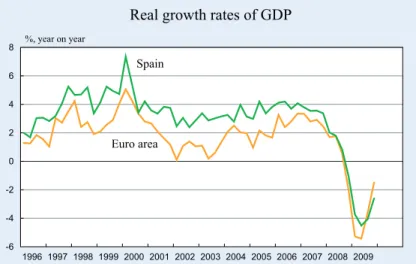
The 12 years before the financial crisis could be labelled the “Golden Decade” for the Span-ish economy, with growth exceed-ing the European average (see Figure 4.1; see also Chapter 2, Figure 2.1).
Spain had traditionally been a leader in unemployment, its economy had been plagued by restrictions to competition and its growth experience had been chaotic at best. The Golden Decade was a period of strong growth during which unemploy-ment declined from the patholog-ical level of 20 percent to levels much more aligned with the European average. This is illus-trated in Figure 4.2, where we see a 14 year fall starting at the end of the 1990 recession and abrupt-ly ending with the current crisis.
One out of three jobs created in the EU-15 in the peri-od 2000–2007 was in Spain.
At the end of the 1990s Spain joined the European Monetary Union, which gave it a fiscal windfall in the form of a very rapid convergence of interest rates to the European levels. Like other peripheral coun-tries, Spain benefited from the fact that it no longer had to pay a premium for the inflation and depreci-ation risk in the form of higher interest rates (see also Chapter 2, Figure 2.1). Moreover it benefited
-6 -4 -2 0 2 4 6 8 1996 1997 1998 1999 2000 2001 2002 2003 2004 2005 2006 2007 2008 2009 %, year on year
Source: Eurostat: Quarterly national accounts (namq), GDP and main components (namq_gdp), volumes (namq_gdp_k), option "I2000 Index, 2000=100", data extracted on 13 December 2010.
Real growth rates of GDP
Euro area Spain 6 10 14 18 22 1990 1992 1994 1996 1998 2000 2002 2004 2006 2008 2010
Unemployment rate in Spain
%
Source: OECD: StatExtracts, Labour, Labour Force Statistics, Labour Statistics (MEI), Harmonized Unemployment Rates and Levels (HURS), data extracted on 11 January 2011.
Figure 4.2 Figure 4.1
from the euro insofar as a long-term capital market was estab-lished on which it was possible to get mortgage loans with a long duration (say 20 years).
Spain has caught up with the European Union, since joining the Community in 1986. How-ever, the catching-up process was not smooth. There were crises between 1992 and 1994 which were dealt with by competitive devaluations. Income per capita (in PPP terms) went from about 80 percent of the EU-15 level in the mid-1990s to more than 90 percent by 2007. The joining
of the euro in 1999 implied low interest rates, which were negative in real terms in the period 2002–2005. This contributed to a huge boom in construction and real estate accompanied by the expansion of financial intermediation.
Spain has typically had a more pronounced economic cycle than the European Union on average. Historical reasons were a sectoral composition with a larger (albeit declining) weight on agriculture, low and medi-um technology industries and tourism, and a more procyclical economic policy until 1994, when a phase of orthodox macro-management was implemented. The latest long boom was driven mainly by construc-tion, with Spain managing to do better than the EU-15 even in periods of economic deceleration. This is set to reverse in the present recession.
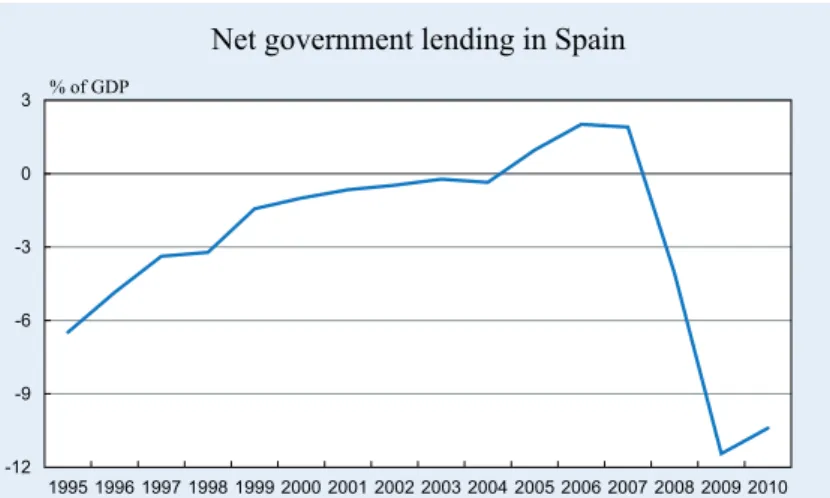
Growth, coupled with the rea-sonable fiscal policy that pre-vailed during the period, implied that there was no major problem with the public budget. As illus-trated in Figure 4.3, Spain entered the Golden Decade with large budget deficits (6 percent in 1995) that were inherited from the sharp recession of the early 1990s and further reinforced by its high unemployment rate; but throughout the Golden Decade it managed to reduce those deficits and eventually run a moderate budget surplus in the mid-2000s, thanks to the strength of the economy and the downward
trend in unemployment. As the recent crisis set in, though, the surplus quickly degenerated into an severe deficit, as has happened in other EU countries where the recession has been particularly severe.
Figure 4.4 depicts the evolution of inflation and long-term interest rates over the relevant period. In the early 1990s Spain had to pay a large risk premium for its inflation risk: although inflation was just 6 percent, long-term nominal rates amounted to 14 percent. Thereafter, inflation fell in the context of the conver-gence criteria of the transition period to the euro and so did nominal interest rates, as markets anticipated that Spain would join the European Monetary Union and that its bonds would be nearly as good as German ones. Nominal rates remained low during the Golden Decade, but inflation picked up somewhat.
-12 -9 -6 -3 0 3 1995 1996 1997 1998 1999 2000 2001 2002 2003 2004 2005 2006 2007 2008 2009 2010
Net government lending in Spain
% of GDP
Source: IMF: General government net lending/borrowing, percent of GDP, World Economic Outlook Database, April 2010, www.imf.org/external/pubs/ft/weo/2010/01/weodata/weorept.aspx?sy=1995&ey =2011&scsm=1&ssd=1&sort=country&ds=.&br=1&pr1.x=53&pr1.y=18&c=184&s=GGXCNL_NGDP&gr p=0&a=, data extracted on 11 January 2011.
-2 0 2 4 6 8 10 12 14 16 1991 1993 1995 1997 1999 2001 2003 2005 2007 2009 Inflation %
Source: OECD: StatExtracts, Labour, Finance, Financial Indicators (MEI), Financial Indicators, Long-term interest rates, data extracted on 11 January 2011; OECD: StatExtracts, Prices and purchasing power parities, Prices and price indices, Consumer prices (MEI), Consumer price indices (MEI), data extracted on 11 January 2011; own calculations.
10-year real and nominal interest rates and inflation in Spain
Real interest rate Nominal interest rate Figure 4.3 Figure 4.4
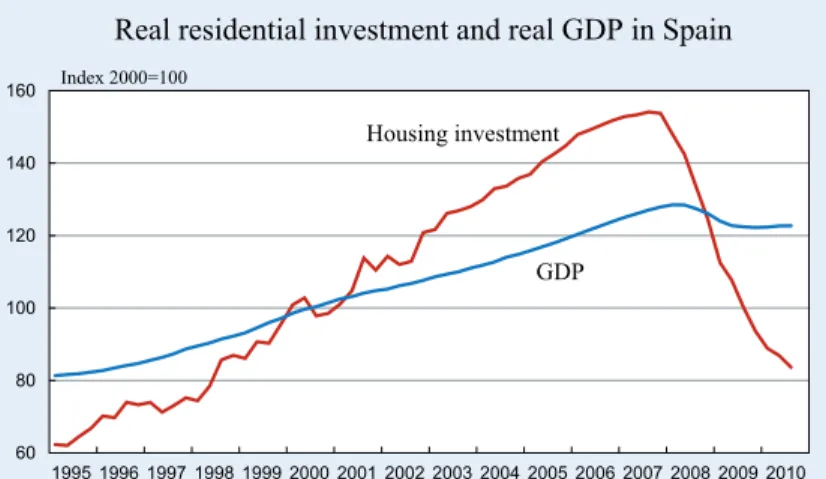
Where did the strong growth come from? As is well known, an important driving force for the economy was the construction sector. Residential investment was boosted by very strong increases in house prices. As illustrated in Figure 4.5 it rose faster than GDP throughout the Golden Decade, only to experience a brutal fall during the crisis.
As shown in Figure 4.6, house prices trebled during the Golden Decade – and in that respect only a fraction of this rise has been reverted during the crisis. As is well known, this pattern has emerged in other countries as well, but Spain is one of the countries where it has been most salient. (While many analysts interpret this as evidence of an asset bubble, there is in fact a debate about this, to which we return below.) Regardless of whether high asset prices emerge due to their fundamen-tal values or due to rational or irrational speculation, they gen-erally boost investment in those assets; conversely, one expects such investment to collapse should there be a sharp fall in prices, regardless of its cause. It is true, though, that falling prices are more likely to happen if the rise is due to a bubble rather than the fundamentals, since one typically expects that bubbles cannot last forever. Because of the key role of con-struction, high growth was associated with a strong de-mand for goods and services. As a result, the Spanish economy started accumulating current account deficits mainly via rapidly growing imports. The creation of a common capital market that eliminated the interest spreads in the euro area induced a strong capital flow to 60 80 100 120 140 160 1995 1996 1997 1998 1999 2000 2001 2002 2003 2004 2005 2006 2007 2008 2009 2010 Housing investment GDP Index 2000=100
Source: Instituto Nacional de Estadistica (INE), ES CHAIN-TYPE QTY INDEX OF GDP (CONSTANT) VOLA, ESGDP..VE, data extracted on 15 January 2011; Instituto Nacional de Estadistica (INE), ES CHAIN-TYPE QTY INDEX OF GFCF - CONSTRUCION & HOUSING VOLA, ESGFCCHVE, data extracted on 15 January 2011.
Real residential investment and real GDP in Spain
Figure 4.5 30 50 70 90 110 130 1995 1996 1997 1998 1999 2000 2001 2002 2003 2004 2005 2006 2007 2008 2009 2010 Index 2005=100
Source: ECB: Spain, quarterly residential property prices, new and existing dwellings, residential property in good & poor condition, whole country, neither seasonally nor working day adjusted, government agency (other than NSI/NCB), Series Key RPP.Q.ES.N.TD.00.0.00, Unit 2007=100, http://sdw.ecb.europa.eu/
quickview.do?SERIES_KEY=129.RPP.Q.ES.N.TD.00.0.00, data extracted on 11 January 2011.
Nominal house prices in Spain
Figure 4.6 -12 -10 -8 -6 -4 -2 0 2 1990 1992 1994 1996 1998 2000 2002 2004 2006 2008 2010 % of GDP
Source: IMF: Current account balance, percent of GDP, World Economic Outlook Database, October 2010, www.imf.org/external/pubs/ft/weo/2010/02/weodata/weorept.aspx?sy=1990&ey=2010&scsm=1&ssd=1& sort=country&ds=.&br=1&pr1.x=76&pr1.y=7&c=184%2C111&s=BCA_NGDPD&grp=0&a=, data extracted on 18 January 2011.
Evolution of the current accounts
United States Spain Figure 4.7
Spain which impacted the Spanish economy by facilitating a credit-driven boom in the construction industry and the resulting current account de-ficit. In the last years of the Golden Decade the current account deficit and capital im-ports in relation to GDP be-came extensive, even exceeding those of the United States. This is illustrated in Figure 4.7.1
The boom was also accompa-nied by a persistence of high inflation, which remained con-sistently higher than the average of the euro area throughout the period (see Chapter 2, Figu-re 2.6). One possible Figu-reason for this is that GDP remained high-er than its potential for sevhigh-eral consecutive years, which gener-ated upward pressure on prices and led to an accumulating inflation differential between Spain and its main trading part-ners. As a result, Spain suffered an aggregate loss of competi-tiveness, which possibly added to the worsening of the trade balance. This is illustrated in Figure 4.8, which shows that unit labour costs in Spain grew faster than the average of the euro area and in particular faster than in stagnating Ger-many. Reversing this loss of competitiveness through price and wage moderation is likely to prove a painful process in light of the fact that, as dis-cussed below, real wages in Spain are quite rigid. This may be compounded by the fact that inflation may be very low in the average of the euro area as long
90 100 110 120 130 140 1999 2000 2001 2002 2003 2004 2005 2006 2007 2008 2009 2010
Index 1999QI=100, seasonally adjusted
Source: Eurostat: Nominal unit labour cost, seasonally adjusted and adjusted data by working days, namq_aux_ulc-Unit labour cost - quarterly data, data extracted on 13 December 2010.
Unit labour costs growth
Germany Euro area* Spain * changing composition 0 1 2 3 4 5 1995 1996 1997 1998 1999 2000 2001 2002 2003 2004 2005 2006 2007 2008 2009 % of GDP
Source: Eurostat: General government, gross capital formation, percentage of GDP, gov_a_main-Government revenue, expenditure and main aggregates, data extracted on 2 December 2010.
Public investment
Germany United Kingdom France Spain EU-27 Italy 0 1 2 3 4 5 6 7 Germ any UK Austria EU -15 Nethe rlan ds Denm ark Italy Fran ce Finla nd Spai n %Source: Eurostat: Gross fixed capital formation by private sector, Millions of euro (from 1.1.1999)/Millions of ECU (up to 31.12.1998), nama_gdp_c-GDP and main components - current prices, data extracted on 9 December 2010, own calculations.
Average growth of investment in equipment between 1995 and
2009
Figure 4.8
Figure 4.9
Figure 4.10
1 The situation was similar in Greece, Portugal and Ireland, but the exact oppo-site in Germany, which suffered from strong capital exports leading to export surpluses via a difficult period of real depreciation and economic slump. An overview of this development is given in Chapter 2.
as the recession prevails, so that negative inflation would in principle be needed in Spain to restore its competitiveness.
It must be noted that the expansion period went together with a substantial increase in investment in equipment as well as public investment (see Figures 4.9 and 4.10). The amount of public invest-ment in Spain is remarkable. For example, Spain, in 2010, ranked second only to China in the kilome-tres planned for the extremely expensive high speed trains. Public infrastructure has improved dramati-cally but this raises doubts about whether the social cost-benefit analysis’ result is positive in many important projects. Nevertheless, these develop-ments contributed positively to productivity and thus mitigated the negative effects of the boom years on competitiveness.
Another important aspect of the Golden Decade has been the surge in immigration. While Spanish fertility rates have been extremely low since the mid-1970s, the country began to attract a large number of immi-grants during the Golden Decade, primarily because of many new jobs in construction. As a result, the population rose very rapidly from 40 to 45 million in less than 10 years (see Figure 4.11).
The immigration wave was driven by both push and pull factors; in particular, the strong economy drove up the demand for labour and because of the role of construction and services a large share of that extra demand for labour was for the unskilled. This is illustrated in Table 4.1. In relative terms, immigrants are twice more represented in unskilled
occupations than native-born workers, and even more when considering only services to households and construction.
At the same time, and somewhat paradoxically, the country was heavily investing in higher education, and the share of the workforce with university degrees was rising rapidly. This, in spite of the fact that, due to the construction boom, the structure of the Spanish econ-omy was being modified in favour of unskilled-inten-sive sectors.
Immigration policies were relatively liberal because of the low fertility rates of the natives and because migrants helped to tame wage inflation, which bene-fited employers and kept CPI inflation under control. It also fuelled the demand for residential investment, but this may have been unfortunate in light of the fact that there was widespread agreement that such large flows would have to subside eventually, implying that the economy would have to reallocate resources towards other sectors.
4.3 The crisis
If one looks at aggregate GDP data, the experience of Spain during the crisis has been similar to that of the rest of Europe; in 2009 Spanish GDP contracted by 3.6 percent. On the other hand, the employment situation has deteriorated considerably more than in the rest of Europe, where it has risen from around 7.5 percent in 2008 to 10 percent (see Chapter 1, Figure 1.10). In Spain, the unemployment rate has, during the same period, risen very rapidly from
11.4 percent to 20 percent, that is, it is back to its pre-Golden Decade pathological level. This evidence suggests that there has been virtually no labour hoard-ing in Spain durhoard-ing the recent recession: In normal times firms tend to retain their workers dur-ing downturns, because it is costly to rehire and retrain them during the following recovery. As a result, the burden of a recession typically does not fall entirely upon employment. Hours worked and work loads tend to decrease as well. The relationship between employ-ment and output over the cycle 35 40 45 50 1975 1980 1985 1990 1995 2000 2005 2010 Million persons
Source: OECD: StatExtracts, Labour, Labour Force Statistics, Annual labour force statistics, ALFS Summary tables, Population, data extracted on 11 January 2011.
Development of total population in Spain
is usually referred to as Okun’s law (see Box 4.1). Okun’s law captures the extent of labour hoarding during a typical cycle. In Spain, the fall in employ-ment is under-predicted by Okun’s law; instead it is quite well predicted by a standard production func-tion that relates output to the amount of labour and capital input and implicitly assumes that these two factors are entirely employed, or at least that their utilization rate does not vary.
There are presumably two reasons why we do not observe labour hoarding in Spain. First of all, a lot of jobs have been destroyed permanently, as the economy undergoes restructuring away from the construction sector. Firms do not expect these jobs to come back and therefore have no incentives to retain their workers. Second, the two-tier structure of the Spanish labour market where workers who hold temporary contracts are used as a margin of adjustment makes employment more reactive to the cycle (see Box 4.2). While this margin of flexi-bility allows for rapid job growth during booms, as
during the late 1980s and the Golden Decade, it also means that unemployment may go up extremely rapidly as firms stop renewing short-term contracts. This was observed during the reces-sion of the early 1990s and it is even more salient now.
A by-product of the severity of the crisis is the sharp deterioration in public finances that we have documented in Figure 4.3. It is somewhat of a puz-zle that budget deficits in Spain are comparable to those in Greece, since the initial situation was much sounder in Spain. It appears that even con-trolling for the role of GDP growth, the govern-ment fiscal balance in Spain is very sensitive to the unemployment rate. Thus, according to our esti-mates, a 1 percentage point increase in the unem-ployment rate triggers a deterioration in the gov-ernment net fiscal balance of 0.8 percent of GDP. Since unemployment has risen by 10 points since 2010, its contribution alone explains 8 points of deficit.
Table 4.1
The occupational composition of native-born and foreign-born in Spain (in %)
Foreign-born Native-born Legislators, senior officials and managers 6.8 8.1
Professionals 9.4 12.4
Technicians and associate professionals 8.3 11.0
Clerks 6.7 9.9
Service workers and shop and market sales workers 16.8 14.7 Skilled agricultural and fishery workers 2.4 3.7
Craft and related trade workers 15.3 17.2
Plant and machine operators and assemblers 7.6 11.0
Elementary occupations 26.3 11.2
Sales and services elementary occupations
n.a. n.a. Street vendors and related workers 1.3 0.7 Shoe cleaning and other street services
elementary occupations
0.1 0.0 Domestic and related helpers, cleaners
and launderers
11.9 4.1 Building caretakers, window and related
cleaners
0.4 0.5 Garbage collectors and related labourers 0.3 0.4
Agricultural, fishery and related labourers
6.0 1.8 Labourers in mining, construction,
manufacturing and transport
n.a. n.a. Mining and construction labourers 4.8 2.0 Manufacturing labourers 0.6 0.6 Transport labourers and freight handlers 0.8 0.8 Elementary occupations, n.e.c. n.a. n.a.
Armed forces 0.4 0.7
All occupations 100.0 100.0
Source: OECD: StatExtracts, Demography and Population, Migration Statistics, Database on Immigrants in OECD Countries (DIOC), Immigrants by detailed occupation, data extracted on 11 January 2011.
As a result of these developments, during the crisis the country has suffered from a sharp rise in the spread between its yield on government bonds and German bond yields, as illustrated in Figure 4.12. In that respect it has been lumped with other problematic countries in Europe, such as Greece or Portugal, despite the fact that Spain’s fiscal woes are far more recent. The rescue package for Greece implemented in spring 2010 eased the spreads only temporarily and since September 2010 they have been higher than ever before under the euro, though small relative to pre-euro times. This suggests that the markets do not
entirely discount a scenario where the deficit remains high for a while and the debt-to-GDP ratio continues to grow to problematic levels such that insolvency can-not be ruled out. This may happen either through a deflationary spiral or a continuation of the recession.
4.4 Was the Golden Decade unsustainable?
At face value, the Golden Decade had a number of features that were unsustainable, at least in the sense that they could not go on forever.
Box 4.1
Spain and Okun’s law
Okun’s law, often referred to as “Okun’s rule of thumb”, is used by economists to assess the response of unemployment to output over the business cycle. In its simplest form, it is a mechanical relationship between the change in the unemployment rate and the change in GDP growth:
(
g v)
, cu=
where u is the change in the unemployment rate, g the growth rate of GDP, v the trend growth rate of productivity, and c is called the Okun coefficient. Typical estimates ofc range from 0.3 to 0.5. Typical estimates ofv range around 2.5 percent, although as we point out in Figure 4.14 total factor productivity growth in Spain has been essentially zero since 2000. Withc = 0.5 and v = 1% a contraction of GDP of 4 percent, which is about the cumulated GDP contraction in 2009 and 2010 according to IMF estimates, is associated with a rise in the unemployment rate by 0.5*5 = 2.5 points. Instead, however, unemployment rose from 11.4 (in 2008) to 20.1 per-cent (in 2010), i.e. an increase of 8.7 points. Thus net job destructions were far higher than predicted by this “law”.
Instead, production functions give us a more structural relationship between inputs and outputs. A typical production function used in models is the Cobb-Douglas one:
( )
1,
=K AL Y
where one can show that the exponents are equal to the share of the corresponding factor in national income, implying that is about 0.3. Furthermore,A is interpreted as the technological level. The long-term growth rate of GDP per capita would be equal to that ofA absent any short-run fluctuations.
Assuming a secular growth rate(A/A) of 1 percent, the above formula implies that if GDP falls by 4 percent (again cumulated 2009 and 2010 figures), then employment should change by
L L = A A + 1 1 Y Y =1 4 0.7=6.7.
Relative to Okun’s law, the production function approach predicts a relationship between employment and growth instead of unemployment and growth. Furthermore, the response of employment to growth has a coefficient
1
1 which is about 1.4 and thus much larger than the corresponding one in Okun’s law.
With an initial unemployment rate of 11.3 percent in 2008 and no change in participation, the change in the unemployment rate, calling L the total labour force, is:
(
1 0.113)
5.94. 7 . 6 = = = = L L L L L L uThis is closer to (but still smaller than) the observed increase of 8.7 points, suggesting there is no labour hoarding in Spain in the current recession.
• The positive inflation differential vis-à-vis the rest of the euro area remained high. Thus competitive-ness had been deteriorating over the years. • House prices grew faster than the economy,
sug-gesting there was an asset bubble, as in the United States.
• High house prices boosted both residential invest-ment and consumption through their effect on
household wealth. To the extent that house prices were too large, these two variables were also too high, and the collapse in the housing bubble should lead to a rapid drop in these two components of GDP.
• Very large trade deficits were due to both the per-sistent lack of competitiveness and the high level of domestic demand. As a result the net foreign Box 4.2
The two-tier structure of the Spanish labour market
In the aftermath of Franco’s death, Spain quickly adopted a system of wage setting institutions similar to those prevailing in the rest of continental Europe. Collective bargaining played a key role in the formation of wages, and the prevalence of sectoral negotiations along with the scope for additional wage increases being agreed upon at the firm level led to a labour market plagued by structural wage inflation and a high equilibrium level of unemployment. At the same time, the generous employment protection provisions that characterized the paternalistic industrial relations of the Franco era were retained. These developments resulted in a very rapid rise in unemployment, which rose from under 5 percent in 1976 to 21 percent in 1985, making Spain the most pathological example of euro sclerosis. In 1984, in a desperate move to exit this situation, the Gonzalez government inaugurated what could be labelled the Southern European path to flexibility. It tackled employment protection legislation (which was decried by employers as a major barrier to job creation) by making it more flexible for new hires, while preserving the conditions of existing contracts. More specifically, the use of temporary labour contracts was liberalized, while employment protection legislation for permanent contracts was left unchanged.1
In the second half of the 1980s, this policy appeared to be a success: employment growth picked up, and unemployment fell to 16 percent. In effect, temporary contracts allowed employers to bear the risk of hiring a worker while retaining the option of dismissing him should he prove unproductive or should the firm’s economic outlook become unfavourable. Since this logic specifically applies to the new workers being hired, its effect is as large, everything else equal, as if the reform had applied to the whole workforce.2 Indeed, during this period, as much as 95 percent of new hires were under fixed-term contracts, and the share of existing employees under temporary contracts quickly rose to more than 30 percent of total employment. Thereafter, the Spanish labour market reached a sort of equilibrium: while temporary contracts were much criticized, their conditions of use and their share in employment and hires were basically unchanged.3
Economists have criticized this model of the labour market on different grounds. First, it is not appealing to treat identical people differently, although the evidence suggests that many temporary workers end up with permanent jobs,4 more so certainly than the unemployed. Second, it is frequently argued that there is excess turnover, which reduces the employers’ incentives to invest in their workers’ human capital. Part of the problem is that the legal limits on the use of temporary workers tend to make it impossible to renew a contract on temporary terms, and instead leave the employer with the choice between dismissal and conversion of the contract into a permanent one. Third, the use of temporary contracts may further reduce the exposure of permanent employees to job loss, which leads them to ask for higher wages.5 This may eventually lead to a higher equilibrium rate of un-employment. Here the issue is that collective bargaining sets the wages for both permanent and temporary workers, while the workers who do negotiate typically are under permanent contracts. The effect would disappear if temporary workers had a different wage from permanent ones.
Despite these shortcomings, the system remains and there seems to be little scope for a reform that would unify the terms of labour contracts throughout the economy. This may be because such a two-tier structure is a stable outcome of the political game played by the various interested parties.6 For example, consider a single employment contract that would be more flexible than existing permanent ones but less than existing temporary ones. Such a contract would be objected to by both the incumbent “insider” employees who have permanent contracts, and by employers, who rely on temporary contracts at the margin to adjust their workforce.7
1 A precise account of the use of temporary contracts in Spanish labour market reform can be found in Bentolila et al. (2008). 2 See Bentolila and Saint-Paul (1992).
3 See Toharia (1999).
4 See Güell and Petrongolo (2007). 5
See Bentolila and Dolado (1993).
6 See Saint-Paul (1993, 2000).
7 Since temporary workers are dismissed first, the employers would lose more from the greater restrictions on their adjustment
margin than they would gain from having more flexible terms for workers that are inframarginal and unlikely to be part of an adjustment.
asset position of the country quickly deteriorat-ed and adjustment had to take place sooner or later. Because of Spain’s membership in the European Union and the euro area, these deficits could be financed by capital inflows at low inter-est rates.
There are two narratives that we may consider to interpret these facts.2One considers that the Golden
Decade resulted from overly soft budget constraints due to the rapid interest convergence and the associ-ated capital imports, which overheassoci-ated the economy. The economy was plagued by mispricing and a mis-allocation of resources, and this was bound to end brutally as the housing bubble burst. The other con-siders that these developments were transitory, that they were an optimal response of the economy to its fundamentals and that the economy would gradually re-balance itself as it converges to its long-run growth path.3Let us develop these two conflicting
interpre-tations.
Both interpretations have in common that Spain enjoyed low interest rates from its participation in the euro area. The low interest rates increased the demand for credit for construction purposes and triggered a housing boom. The housing boom boosted the whole economy via a rise in employment and subsequent consumption of construction workers as well as capi-tal gains that made owners of real estate property richer, providing them with the equity they needed to borrow and invest more in the real economy.
The difference in these interpreta-tions is whether or not this pro-cess turned unhealthy. According to the first interpretation, it was mistakenly believed that the observable price and wage in-creases would continue indefinite-ly. Consumers and real investors had an incentive to over-borrow, and banks were generously and imprudently providing excessive credit with funds they borrowed abroad. The country enjoyed a period of overly soft budget con-straints, which overheated the economy and caused a bubble that ultimately burst. Interest rates were too low in relation to Spain’s macroeconomic situation: despite the expan-sion of capacity via real investment, output remained consistently above potential and as a result inflation was higher than in the core of Europe. Compe-titiveness was deteriorating and trade deficits kept accumulating boundlessly as the capital inflow seemed to be available forever. The forces for self-correction were weak, because for a given interest rate, the greater the inflation rate, the smaller the real interest rate and the larger the incentives to invest. As the construction sector is more sensitive to interest rates and credit con-ditions than other types of investment, the high level of activity was especially driven by construction. Low interest rates are also likely to lead to inflated asset val-ues, even in the absence of a bubble. And while the economic conditions that may lead to the emergence of an asset bubble are not well understood, there are reasons to believe that they are more likely to arise, the lower the interest rate. Hence it is plausible that the housing bubble was caused by the inadequate mone-tary conditions and the excessive capital inflow that necessarily came with the euro. The monetary condi-tions were appropriate for the euro area as a whole but not for Spain. They could not continue forever; as for-eign debt accumulated, consumers had eventually to reduce their expenditures. As competitiveness keeps on deteriorating because of inflation inertia, while the capital flow stalls due to convergence in rates of return and investors becoming aware of a default risk, the economy eventually experiences a slowdown. This process could be gradual but would be much more drastic if it was triggered by the bursting of the bubble. Such a brutal adjustment scenario is indeed consistent with the observed behaviour of the Spanish economy since the onset of the financial crisis.
0.0 0.5 1.0 1.5 2.0 2.5 3.0 3.5 Jan
2008 Apr Jul Okt 2009Jan Apr Jul Okt 2010Jan Apr Jul Okt 2011Jan Apr
Spread between Spanish and German
10-year government bond yields
%
Source: Reuters Ecowin, Government Benchmarks, Bid, 10 year, yield, close, 24 January; own calculations. 7 May
16 June
21 Jan 2011
Figure 4.12
2See Sinn (2010) for a theoretical view of the two interpretations. 3See Sinn and Koll (2001).
Under the second scenario, the imbalances would just be a natural feature of Spain’s convergence path to the GDP levels of the richer EU countries. Given that before the euro Spain’s capital market was separated from the core of Europe by exchange rate risks, there was an abundance of profitable and unexploited investment possibilities in Spain, offering higher rates of return than the projects available in the core when Spain entered the euro area. Thus the capital flow from the European core to Spain was welfare enhanc-ing for Europe as a whole, because it resulted in more GDP in Spain than was lost against the trend in the core. As the capital investment in Spain boosted labour demand and wages, the prices of non-traded goods like construction services, where productivity gains were small, rose rapidly. Given that traded goods had the same price in Spain and elsewhere, this meant that inflation was larger in Spain (the so-called Balassa-Samuelson effect). The price increases of non-traded capital goods such as real estate resulting from this effect were part of the true, own rate of return to capital in Spain that investors correctly foresaw and included in their investment decisions.4Furthermore,
it was optimal for consumers to anticipate their future income increases by increasing consumption immedi-ately and financing such an increase by borrowing abroad with the aid of their banking system. This explains the large trade deficits of the Golden Decade. Finally, house prices were high not because of a bub-ble but because of fundamental factors, such as the low interest rates, the strong growth prospects of the economy and the large expected increases in the demand for housing due to the rapid population growth. The construction boom was in turn just the normal reaction of the economy to these forces.5
The brutality of the crisis and the unusual magnitude of the net capital import as measured by the current account deficit sug-gest that the first scenario is more plausible. But the forces des-cribed in the second scenario may also have played a role in the initial phase of the Golden
De-cade. After all, given Spain’s initial situation, there was ample room for catching-up in terms of human and physical capital, technology and infrastructure. Given stable market institutions and openness to trade and international capital movements, it was to be expected that Spain would grow faster than the EU average. The issue has more to do with growth being excessive rather than there being growth as such.
To illustrate the complex interplay between sustain-able and unsustainsustain-able forces in shaping the aggregate economy, it is instructive to discuss further Spain’s competitiveness problem during the boom years. This is what we do in the next section, before returning to the main policy issues facing the country in the cur-rent crisis.
4.5 Competitiveness and productivity6
The Achilles’ heel of Spanish growth has been pro-ductivity. Spain has had a consistently positive infla-tion differential with the euro area, up to the recent recession. As we have seen above, Spain lost competi-tiveness with respect to the EU-15 as measured by the evolution of unit labour costs. Using that measure, Spain’s competitiveness with respect to Germany has deteriorated by 30 percent since 1999, a loss of com-petitiveness similar to that of Italy.
Since the 1990s European labour productivity growth has been lower than the growth of productivity in the United States, and Spain became a laggard in the European Union. In Spain labour productivity growth was near zero between 1998 and 2000, with
-6 -4 -2 0 2 4 1993 1995 1997 1999 2001 2003 2005 2007 2009
%, annual growth rates
Source: AMECO: European Commission, Database “Gross domestic product at 2000 market prices per person employed (RVGDE)”, http://ec.europa.eu/economy_finance/ameco/user/serie/SelectSerie.cfm, data extracted on 11 December 2010, own calculations.
Labour productivities
Germany United States
Spain Figure 4.13
4According to Dorfman, Samuelson and Solow (1958), the allocation of capital to different countries is efficient if the price change of capital goods plus the marginal value product of capital is the same across all countries.
5 An illustration of these views can be found in Garriga (2010).
6In this section, we draw in part from the results reported in Ghemawat and Vives (2009).
positive rates afterwards but only picking up after the destruction of employment during the crisis (see Figure 4.13).
As illustrated in Figure 4.14, total factor productivity (TFP) – a measure of the technological efficiency of the economy – displays basically negative or zero growth rates from 2001, while increases in TFP have been consistently larger in the euro area (although neg-ative between 2001 and 2003 and after the crisis).
Behind the poor productivity performance of the Spanish economy lie several factors, the central ones being the importance of construction and tourism and an insufficient accumulation of human and tech-nological capital. In other words, the Golden Decade was labour intensive and relied on immigration and on economic sectors with little potential for techno-logical improvements, above all construction. While welfare increased because many unemployed workers found jobs, there was little potential for future welfare gains as Spain attained full employment because of its low productivity growth and its inadequate allocation of economic activity. There may also be other factors behind the poor productivity performance in addition to the structure of economic activity. The level of edu-cation in Spain in relation to the EU-27 is low, with a low proportion of high school and vocational training in the economically active population. Spain typically does poorly in the PISA study on secondary educa-tion. Somewhat surprisingly, Spain shows a higher proportion of university students but it has a poor performance in terms of the high rate of students quitting – between 30 and 50 percent depending on the field – and with a large number of years required
on average to obtain a degree. The university system has improved in its research capabilities but it is high-ly bureaucratic, universities lack autonomy and have severe problems of governance and financing. In regard to technological capital, R&D spending as part of GDP has shown an increasing tendency, but at 1.35 percent is still well below the EU-15 average at close to 2 percent (2008), not to mention the distance to countries such as the United States, Japan or the Scandinavian countries. Furthermore, R&D policy has tended more to dispersion than to consolidation of critical mass in key areas.
In light of these competitiveness problems and of the country’s deteriorating external position during the Golden Decade, it is natural to expect that export per-formance has been disappointing. In fact, the picture is more complex. Spanish exports to the world have retained their share since the introduction of the euro while, for example, those of France or the United States have fallen (see Figure 4.15). For services, Spain’s share in the world market has grown over the past decade, just like Germany’s – while again France’s, in contrast, fell behind (see Figure 4.16).
What explains this satisfactory performance in a con-text of aggregate loss of competitiveness? The answer is that there are “pockets” of competitiveness in the export sector, i.e. industries that, for various reasons, have managed to keep productivity growth in line with labour costs, thereby maintaining their positions in international markets.
Spain has managed, partially out of the privatization process of state-owned firms in the late 1980s and 1990s, to consolidate outward looking utilities in the energy, transportation and telecommuni-cation sectors, as well as in con-struction and banking. The financial sector displays two international banks that have come out strengthened from the crisis and at least one strong large savings bank with an ambitious international expansion plan. The competitiveness of Spanish banks, with expansion in Latin America, the European Union, the United States and now also in Asia, derives from the early liber-alization process in Spain, which increased competition and fos--6 -4 -2 0 2 4 1993 1995 1997 1999 2001 2003 2005 2007 2009
%, annual growth rates
Source: AMECO: European Commission, Database “Total Factor Productivity: total economy (ZVGDF)”, ec.europa.eu/economy_finance/ameco/user/serie/SelectSerie.cfm, data extracted on 11 December 2010, own calculations.
Total factor productivities
Germany United States
Euro area-12
Spain Figure 4.14
tered efficiency in the sector. These large firms in regulated sectors are an asset for the Spanish economy. Overall, Spain has built up a solid reputation in architecture, construction and engineering services as well as financial services and tourism (see Figure 4.17).
Furthermore, a segment of small and medium-sized exporting companies, especially from Cata-lonia and the Basque country, have proven their international competitiveness in the produc-tion of industrial goods and advanced services. Catalonia and the Basque country are regions with a more diversified economic structure with less dependence on the construction sector. For example, Catalonia’s export share in world markets has been steady at 0.46 percent from 1995 until 2008 despite the pressures of globalization. Catalonian firms have made efforts to become more competitive in terms of reducing costs, investing in human capital, product differen-tiation and the adoption of new technologies.
Thus we observe that there is a dynamic export sector which, due to its good productivity perfor-mance, has coped well with the trend toward real exchange rate appreciation during the Golden Decade. But this does not imply that competitiveness is adequate: To restore the external balance and create jobs at the same time, the Spanish economy needs to export more, i.e. to become more competitive. This must be achieved by a combination of real depreciation and productivi-ty growth in the export sector. The latter will only prevail if structural reforms are undertak-en (see Sections 7 and 8); the greater the improvement in pro-60 70 80 90 100 110 120 2000 2001 2002 2003 2004 2005 2006 2007 2008 2009 2010 Index 2000=100
Source: IMF, database accessed through EcoWin Pro, data extracted on 16 December 2010.
Share in world merchandise exports
Germany United States France Spain 0 2 4 6 8 10 Total Tran spor tation Trav el Com mun icatio ns Cons truction Insura nce Fina ncial Cump uter a nd informati on Roya lties an d lice nse fe es Othe r busi ness serv ices Pers onal, cu ltura l and re crea tiona l Gove rnme nt 2000 2007 %
Source: OECD: StatExtracts, International trade and balance of payments, Trade in Services, Trade in services by service category, data extracted on 11 January 2011.
Spanish share of service exports in the OECD
by service 60 70 80 90 100 110 120 130 140 2000 2001 2002 2003 2004 2005 2006 2007 2008 2009 Index 2000=100Source: WTO: Trade in commercial services, Other commercial services (Commercial services - Travel & Transport), Exports, US dollar at current prices (Millions), stat.wto.org/StatisticalProgram/WSDBViewData.a spx?Language=E, data extracted on 11 January 2010, own calculations.
Share in world exports of services
excluding transportation and travel
Germany United States France Spain Figure 4.15 Figure 4.16 Figure 4.17
ductivity obtained thanks to the structural reform, the smaller the real depreciation that is needed to rebal-ance the economy, and the less painful the adjustment is for workers and consumers.
4.6 Current adjustment issues
In some ways, the adjustment that was necessary in order to offset the imbalances of the Golden Decade is taking place during the current crisis: house prices are falling sharply, although only a fraction of the required adjustment has been achieved; the trade bal-ance is recovering; construction and private consump-tion have fallen sharply.
Some of these developments are cyclical. For example the improvement in the trade balance is chiefly driven by the sharp fall in consumers’ disposable income, which is itself a by-product of the recession. According to the Bank of Spain (2009, chapter 5), the structurally adjusted improvement in the trade bal-ance is much smaller than the actual one. Nevertheless, there is an improvement in the trade balance even adjusting for the cycle, and the resulting improvement in the net asset position of the country (relative to the path that would have been followed in the absence of the crisis) will last beyond the recession and help finance future deficits. Other aspects, like the evolution of asset prices or the reallocation of activi-ty away from consumption, are likely to have longer lasting effects.
This is the structural adjustment that is needed, but in order for it to proceed smoothly the economy must be capable of absorbing it without experienc-ing a protracted recession. Ideally, the resources that are released from the construction sector should be relocated to the external sector; in order to support such a reallocation, the real exchange rate should depreciate in order for export demand to offset the fall in domestic consumption and residential invest-ment. That is, the competitiveness losses that Spain accumulated during the Golden Decade must be undone.7
Given the country’s member-ship in the European Monetary Union, this means that prices
and wages have to fall or at least increase at a lower rate than in the rest of the euro area (and the lower the overall inflation in the euro area is, the more this means that deflation has to actually take place in Spain). Spain will have to undergo a painful process of real depreciation which mirrors the pro-cess Germany encountered under the euro before the crisis.
It is indeed true that presently inflation rates in Spain are lower than in the rest of the euro area. Therefore, during the crisis, part of the competitiveness deficit that was accumulated during the Golden Decade is being reversed. Presumably, to the extent that there is inflationary inertia, these gains will not be purely cyclical and will persist beyond the recession. More worrying though is the lack of wage moderation, which makes us concerned that the adjustment is going to be even more painful than necessary and that the prospect of a “lost decade” during which growth remains sluggish and unemployment stays above 20 percent should not be discarded. In other words, the (slight) improvement in competitiveness is not being financed by slow wage growth but by produc-tivity gains that are achieved at the expense of employment, as the least productive jobs are destroyed and as a rise in the capital/labour ratio makes each job more productive.
Table 4.2 strikingly illustrates this point: Despite the sharp rise in unemployment, wage inflation remains substantial. In fact these numbers suggest that Spain suffered from a large wage shock in 2008, right at the onset of the recession. This can only be partly explained by the lagged reaction to the surge in infla-tion in 2007. If one looks at real wage growth by sub-tracting inflation in the preceding year from nominal wage growth, one also gets an acceleration of real wages instead of the moderation that would have been expected in response to the sharp rise in unemploy-ment (see Table 4.3).
The lack of reaction of wages to labour market con-ditions has long been noted in the literature on
Table 4.2
The lack of response of wage increases to unemployment
Year 2004 2005 2006 2007 2008 2009
Unemployment
rate 11.0 9.2 8.5 8.3 11.3 18.0
% increase in
nominal wages 3.0 3.7 4.0 4.5 6.1 3.7
Source: Bank of Spain (2009), Annual Report, Table 1.1, p. 17. 7International investors nowadays hesitate
to bring their funds to Spain, and if so they require substantial interest surcharges to compensate for the perceived default risk.
Spanish unemployment8 and essentially comes from
the rigidity of the labour market. Since most of the adjustment falls on holders of temporary contracts and perhaps on immigrants (including a number of illegal ones), permanent workers are relatively shel-tered and continue to demand substantial wage increases despite the poor prevailing economic con-ditions.
As pointed out by Garicano (2010), this stands in contrast to the experience of other countries, where wages are typically more reactive to labour market conditions. For example, real wage growth in the United Kingdom became negative in the first quarter of 2008, thus showing a quick
reaction to the crisis. And as a result of such moderation (and of the fall of the pound sterling), GDP and employment started recovering in the second quarter of 2009.
It is therefore essential, if Spain aims at exiting the crisis on a sus-tainable growth path, that it implements structural reforms of its labour market so as to in-crease the sensitivity of wages to unemployment. Otherwise, its economic performance will re-main inherently unstable even if growth resumes, since any shock that would need to be absorbed by the labour market, such as a productivity slowdown or a structural shock that would re-quire intersectoral reallocation of
labour, may trigger a protracted recession.
While the crisis has partly cor-rected some of the imbalances of the Golden Decade, it has gener-ated new imbalances, mostly in the area of public finances. These issues have led to a rather quick implementation of reforms that are aimed at restoring the coun-try’s fiscal balance. The reason why the government has acted swiftly is that it want-ed to prevent a “Greek scenario” under which spreads on government bonds would skyrocket, mak-ing the financmak-ing of the debt problematic and increas-ing the likelihood of contagion to the entire euro area. In the extreme case, the government could even find itself incapable of refinancing its debt and would technically be bankrupt. The austerity programme, which is described in Box 4.3, is quite ambitious, and even involves exceptional measures such as a reduc-tion in the wages of civil servants by 5 percent in 2010. According to the Bank of Spain (2010), “the objectives are very ambitious and, in many cases, do not have a precedent, since in the past Table 4.3
The lack of response of real wage increases to unemploymenta)
Year 2004 2005 2006 2007 2008 2009 Unemployment rate 11.0 9.2 8.5 8.3 11.3 18.0 % increase in real wages 0.4 0.5 0.3 1.8 1.9 2.3 a)
Real wage growth is computed as nominal wage growth minus the preceding year’s CPI inflation.
Source: Bank of Spain (2009), Annual Report, Table 1.1, p. 17; own calculations.
Box 4.3
The fiscal austerity package
The aim of fiscal consolidation is to bring back the deficit to 3 percent of GDP in 2013 with an intermediate objective of 6 percent in 2011 from the projected close to 10 percent deficit of 2010. The fiscal measures approved in late 2009 for the fiscal year 2010 seek to reduce expenditures and increase taxes. On the expenditure side, the following are notable: • a reduction of the rate of hiring in the public sector to 10 percent of the
attrition level,
• no hiring of temporary workers in the public sector. On the tax side, the following was decided:
• elimination of the deduction of 400 euros from the income tax, • increase in the VAT rate,
• increase in the taxation of personal capital income.
In May 2010, in the middle of the Greek crisis, further austerity measures were decided:
• a temporary reduction of public wages by 5 percent as of July 2010, • a freezing of public wages in 2011,
• a reduction of public investment by 6 billion euros over the 2010–2011 period,
• a freezing of pension levels in 2011,
• the elimination of a child benefit (paid at birth) in 2011.
In addition there is a phasing out of fiscal incentives (deduction of mortgage payments) for home ownership from 2011 on.
8 See Blanchard et al. (1995). Recently Bentolila and Folgueroso (2010) have pointed out that wages are generally unre-active to both labour market conditions and productivity.
one only tried to freeze the growth rate of spending. Their fulfillment will require a rigorous implementa-tion and control which should allow the timely iden-tification of possible deviations”. A potential cloud on the horizon of fiscal consolidation is the opti-mistic growth outlook assumed by the Spanish gov-ernment for 2011, which at 1.3 percent is above the consensus forecast (the IMF predicts a GDP growth of just 0.7 percent).
The emergency implementation of such a fiscal aus-terity package illustrates the evils of a “stop-and-go” macroeconomic policy. During 2008 and 2009 there was considerable consensus in political and academic circles for implementing large Keynesian stimulus packages while not paying attention to the long-term consequences of such measures. Essentially governments assumed that they could gradually reduce the deficits once the macroeco-nomic outlook began to improve and revert to a bal-anced growth path with a stable debt-to-GDP ratio, albeit at a higher level than before the crisis. Under such an ideal scenario the governments would have smoothed the crisis optimally, and a permanently higher (but manageable) debt level would have been the (worthwhile) price to pay for it. This is some-what in line with the scenarios we envisaged for fis-cal adjustment in last year’s EEAG report (see EEAG 2010, p. 89), although we pointed out that to stabilize debt at 100 percent, substantial fiscal restraint should be exerted and growth should pro-ceed at a reasonable pace.
The problem is that governments discounted an alternative, less rosy scenario, i.e. that the magnitude of the deficits would lead to people being worried about future fiscal problems, with the twin conse-quences that the recovery is less than satisfactory due to the economic agents’ reluctance to invest and spend, and that asset markets quickly react by imposing a large risk premium on the bond yields of the most exposed governments. It is the emergence of this scenario that has compelled the Spanish govern-ment to implegovern-ment its emergency austerity package. Its timing could not have been worse: both an adverse supply shock (due to the tax hikes) and an adverse demand shock (due to the reduction in pub-lic spending) are hitting the economy at a time when it is still in recession and unemployment is very high. In retrospect, it would have been better to have been more cautious in 2008–2009 and to have kept an eye on the long-term sustainability of public finances rather than joining the bandwagon of unbridled
spending. This is more or less the strategy Germany adopted (in 2009 the German public deficit ran at 3.9 percent of GDP, versus an average of 6 percent for the EU-27), and it may have played a role in the strong recovery of the German economy in 2010. On the other hand, the compulsory contractionary poli-cies implemented by the Spanish government in 2010 will probably harm its recovery and – given the poor performance of the labour market in absorbing shocks – pave the way for another lost decade. The contractionary policies most likely could have been softened had the Spanish government embarked on a programme of reforms early in the crisis. This would have yielded credibility to Spanish economic policy and implied less financing constraints in internation-al capitinternation-al markets.
Finally, another issue is that the adjustment in house prices is still incomplete. Some analysts believe they should fall further by some 20 to 30 percent. If this happens, another dip into recession may follow, with further financial problems for banks that may spread to the public sector if these liabilities are bailed out, as was the case in Ireland in 2010.
4.7 The key issue of labour market reform
The most important issue facing Spanish labour mar-kets today is the inability of wages to fall in response to increases in unemployment even when such an increase is massive. Labour market developments in the current crisis suggest that little has changed since the early 1980s, when Spain suffered from very high unemployment and there was no mechanism for it to return to normal levels. The introduction of flexible labour contracts in the 1980s allowed for an increase in employment while being compatible with the polit-ical balance of power. But it did nothing to increase the cyclical sensitivity of wages because it did not increase the exposure of incumbent employees to competition from outsiders in the wage-setting process. The key challenge facing policymakers is how to reform the labour market institutions to increase this competition.
To address this challenge, it is necessary to under-stand the source of the problem. It is widely believed that an important aspect is the inappropriate level at which wage bargaining takes place (that is, the sec-toral level), and the low coordination between sectors. An intermediate level of wage-setting along with low coordination delivers high and persistent
unemploy-ment at the aggregate level.9 One could envisage
national wage negotiations that once prevailed in Sweden. However in the end the Swedish approach did not deliver the wage dispersion between sectors needed for an efficient intersectoral allocation of labour and was therefore abandoned. Therefore, the best course seems to be decentralizing wages at the firm level, but this runs into the problem that it is dif-ficult to impede higher level negotiations or to dis-mantle the current system.
An interesting proposal was made in 2009 by 100 prominent economists (see Abadie et al. 2009). This proposal allows for agreements at the firm level to supersede any sectoral agreement, for example, if the lower level agreement implied lower wage growth than the sectoral one. Thus, sectoral agreements would only define a default option in the case that bargaining does not take place at the firm level.
Another prominent proposal consists in replacing the dual system of employment protection with a unique labour contract under which employment protection would grow progressively with an employee’s tenure. It is not obvious to us how this would significantly differ from the current system. It would still be the case, under such a proposal, that workers with low tenure would display a large turnover and would be dismissed before high tenure workers. It is true, though, that temporary workers would not face a deadline at which the employer must either get rid of them or give them full employment protection; but they could still be dismissed preventively in order to avoid the future increases in firing costs. By the same token, if it is the case that the dual employment pro-tection system makes wages more rigid by reducing the exposure to unemployment of the workers who are most influential in wage negotiations, replacing the system with a unique labour contract and pro-gressive employment protection will not change that feature much.
It is impossible to increase wage flexibility without increasing the exposure of insiders to outside compe-tition: this is what a decentralization of wage bargain-ing to the firm level or a reduction in employment protection for permanent contracts would achieve. This means that there is no politically cheap way to implement such a change. The mid-1980s deregula-tion of temporary contracts boosted employment at the margin at low political costs, and for this reason it
was not able to increase wage flexibility. Nevertheless, such deregulation proceeded in spite of the unions’ opposition, who feared its long-term consequences. The reason is that unemployment was very high at that time, which made it easier to extract concessions from the unions. Given the current level of unemploy-ment, there may be an opportunity for a far-reaching reform of the labour market.
Indeed, in July 2010 a labour reform package was approved which goes in the direction of attacking the duality of the labour market but in a timid way, reducing firing costs for firms in poor economic con-ditions10and widening the conditions under which
the contrato de fomento de empleo (contract of employment promotion; a permanent contract with less generous employment protection provisions) may be used.11It also introduces steps towards the
“Austrian model” by creating a lifelong individual capitalization fund for workers (the worker will be able to make use of the fund in cases of dismissal, transfer, retirement or for training purposes, to be implemented in 2012). The reform of collective bar-gaining procedures towards decentralization has started but has basically been left pending for future reform in March 2011.
The reform as it stands is a half-way reform, which depends on judicial review that may compromise its efficiency. It will have to prove its effectiveness when the economy starts growing again. There is some risk that it might be undone if economic conditions improve. Collective bargaining is an unresolved issue that is pending as well as the features of the unem-ployment subsidy. Efficiency would require having a higher subsidy for a shorter period of time to incen-tivize job search.12
4.8 Other key reforms
Reform of the labour market is key but by itself it will not make the economy grow. Without a series of reforms to improve productivity, Spain will face a
pro-9See Calmfors and Driffill (1988).
10The reduction is to 20 days per year worked instead of 45 days per year in case of a wrongful dismissal. Nevertheless the new measures are plagued by legal uncertainty since they rely on the discretion of judges in determining the circumstances where they apply. Uncertainty in the implementation of employment protection legis-lation is viewed by many economists as very harmful to job creation and replacing it by a transparent system of unconditional severance payments has often been advocated.
11This contract specifies a severance pay of 33 days per year worked in the case of wrongful dismissal, instead of the usual 45 days. 12 In the extreme, one could abolish unemployment benefits or reduce them to subsistence levels and have workers rely on their cap-italization fund to finance their consumption during unemployment spells.