Keegan, B
and
Taylor, J
(2019)Are you local? The challenges of local search
engine optimisation strategies. Journal of Digital and Social Media
Market-ing, 7 (3). pp. 270-280. ISSN 2050-0076
Downloaded from:
http://e-space.mmu.ac.uk/625541/
Publisher:
Henry Stewart Publications
Please cite the published version
Are you local? The challenges
of local search engine optimisation
strategies
Received (in revised form): 11th July, 2019
Brendan Keegan
Senior Lecturer in Digital Marketing, Manchester Metropolitan University
Brendan Keegan is a Senior Lecturer in Digital Marketing at Manchester Metropolitan University. His teaching and research agenda concentrates on digital marketing strategy, in particular the evolution of social media marketing practices. The core of his research focuses on the influence of digital technology on business practices such as campaign strategy and management as well as the impact of agency– client relationships.
Room 6.32, School of Business and Law, Manchester Metropolitan University, Oxford Road, Manchester M15 6BH, UK
Tel: +44 (0)161 247 3835; E-mail: [email protected]
James Taylor
Digital Marketing Consultant and Director, Dispense Digital
James Taylor is a Digital Marketing Consultant and Director of Dispense Digital, a remote digital marketing agency. After achieving a first degree in advertising and brand management, he worked in an agency capacity at PushON before branching into consultancy work and his own agency practice.
Dispense Digital, 76 Manchester Rd, Denton, Manchester M34 3PS, UK E-mail: [email protected]; [email protected]
Abstract Local search engine optimisation (SEO) can be a powerful strategy for small to medium-sized enterprises. Limited studies provide information on these strategies. This paper discusses the approaches used by specialist SEO agencies, and the associated challenges they face. Semi-structured interviews with key informants reveal a range of practical approaches. Challenges identified include the influence of recent search engine algorithm updates resulting in fluctuating ranking factors, as well as the importance of mobile when enacting a local SEO strategy. A better understanding of the nuances of local SEO strategies is provided in order to assist and inform scholars and industry practitioners. KEYWORDS: search engine marketing, SEO, digital marketing, campaign strategy, algorithm updates
INTRODUCTION
Since the earliest manifestations of search engine optimisation (SEO), the consistent challenge has been to remain relevant within search engine results pages (SERPs). For small to medium-sized businesses, maintaining a high-ranking position within SERPs is imperative to enhance revenue and reputation. In contrast to larger firms with large budgets, search agencies
frequently optimise small businesses’ digital presences for localised results, commonly referred to in the industry as ‘local SEO’. A litany of industry and academic research offers advice on the subject of SEO
techniques and their effects;1 however, very
few studies provide information on local SEO. To address this lacuna, the present article sheds light on the phenomenon by offering insights into its application as well
as identifying the barriers faced by industry experts.
BACKGROUND
When exploring the potential implications that SEO can have for online presences, it is important to understand the process behind SERPs. Briefly, when a user employs a search engine for information retrieval, it responds to the query inputted by the searcher, and in turn displays results relevant to that query in the SERP.2 While acknowledging the
relevance of Bing and other search engines, Google is the market leader and therefore a key area for SEO specialists. For this reason, this study focuses primarily on Google’s search engine platform.
The Google ‘PageRank’ algorithm provides the basis for which all websites that are indexed are ranked. By ‘crawling’ websites and analysing ranking factors within each website that the algorithm specifies, results are displayed in order of relevance.3 The ranking
factors analysed by the PageRank algorithm, however, are subject to constant change. It is through monitoring the developments in ranking factors that SEO practitioners are able to develop appropriate techniques to optimise the performance of their websites.4 These techniques are particularly
relevant for small business owners, who must apply SEO in order to stay relevant in a competitive online environment. As the complexity of the PageRank algorithm develops, SEO professionals must be aware of the implications an algorithm update may have on their clients’ SERP performance.5
Moreover, the importance of changes to the PageRank algorithm highlights the necessity of investigating post-update best practice and providing a basis for the formulation of strategic contingency plans.
LOCAL SEO
According to Mena,6 ‘65 per cent of all
Google searches contain a local reference’. It is thus clear that the implications of an
algorithm update relating to local SEO can affect the manner in which consumers can discover a business online. Sutton7
explored the effects of a local SEO campaign conducted by a regional medical office which saw impressive growth in revenue (333 per cent year on year). Sutton’s study confirms both the priority of geo-targeted keywords and the importance of optimising websites based on the desired search results. It also highlights the importance of local SEO strategy in improving the online visibility of a small- to medium-sized business.
Another aspect of local SEO that supports the discovery of businesses is the integration of standard search results pages with Google’s various application programming interfaces (APIs), most notably Google Maps.8 The
Google Maps API allows websites to display maps, location data, directions and location-targeted data to their visitors. Since the Google ‘Local/Maps’ update of 2005, draggable maps and integrated location data have become a feature of Google’s search results pages.9 Since the integration of maps
with local search, Google has developed the accuracy of geolocation in searches, and has been able to display accurate, location-based results on long-tail (less popular) search terms.
The increased accuracy of local search results means that businesses must prepare for a wider array of potential searches. Previously, results would have only been displayed on specific searches; now vague and ambiguous searches with a local keyword display competing results. Additionally, since the introduction of HTML5, websites and web users can interact with the Geolocation API. Location services, particularly in relation to mobile search, are now much more accurate in pinpointing a user’s location and displaying search results informed by both search query and user location.
In another study, search statistics demonstrated very reliable and common search patterns for local searches.10
Consequently, three patterns of high-volume, local search keywords were derived. The most popular patterns were the keyword
with city name, or city name followed by keyword, while the least popular pattern was a keyword followed by city name and abbreviation of state/city. Considering this hierarchy of local search patterns, the findings underline the importance of SEO keyword research that considers localised approaches to SEO.11
Of course, SEO strategy is not without its challenges. Periodic updates mean reordering of priorities, such as link structure and content ranking. The constant change faced by both web developers and search engine marketers highlights the importance of an SEO strategy with the capacity to adjust to a volatile environment.12
The expansion of search engine capabilities has led to a growth of paid advertisements and additional paid search platforms, such as pay-per-click (PPC) and Google AdSense. According to Xing and Lin,13 while PPC offers an advantage to
SEO firms in terms of short-term profits, the associated advertising costs render such profits unsustainable for large clients. By contrast, the consistent pricing associated with organic search services makes them a reliable alternative to paid strategies.
A drop in organic link quality may lead a business or an SEO specialist to suggest a brief PPC campaign in favour of a time-consuming, organic SEO campaign. However, it is widely accepted that search engine users prefer to click organic links over paid/sponsored links, suggesting a considered approach to sponsored results is required. SEO TECHNOLOGY AND UPDATES Platforms such as WordPress and Google’s own Blogger offer content management systems (CMS) that allow users to generate desktop and mobile-friendly websites.14
The most popular CMS is WordPress, which offers both free and paid-for tools that assist webmasters in achieving their online goals. The growing popularity of CMS systems has resulted in an increase in demand for SEO
tools, and technology to assist webmasters in carrying out their SEO strategies.15 A major
advantage of modern CMS plugins for SEO is the ease with which SEO processes can be computer-generated. For example, ‘XML sitemaps’ aim to provide search engines with the ability to rapidly crawl and index websites. Modern CMS systems generate XML sitemaps automatically, again assisting novice webmasters in their SEO efforts. While no auto-generated sitemap is perfect,16
SEO plugins can certainly be useful,17
although even automated SEO systems still require a basic knowledge of SEO.
PageRank updates affect SERPs across all platforms. In 2015, Google introduced mobile-friendliness as a ranking factor,18 making it essential to have a
mobile-optimised website and mobile SEO strategy in addition to desktop strategy. The integration of cross-platform devices also means that webmasters can optimise Google’s extensive API library to benefit the users of all devices. According to Svennerberg,19 43
per cent of all APIs use Google Maps. While not only highlighting Google’s significance in the API arena, this statistic also highlights the popularity of localised data for both webmasters and users.
While there are several major PageRank updates each year, those that are primarily focused on local SEO occur (on average) every two years. Following the Universal search update of 2007 and the introduction of Google Places in 2010, major local SEO updates now focus heavily on the integration of local search data within the search engine results pages.20 The Venice update of 2012
set the standard for the way in which local search operates. By factoring users’ IP address in a query, the Venice update allows Google to return ‘highly relevant and personalised results to the user’.21 The history of the
major local updates signifies the importance of personalised user results. Since the Venice update, webmasters must take into account the often ambiguous approaches users take to query Google.
Google offers a number of discrete approaches for local SEO strategy (such as listing a business through Google MyBusiness). While this approach may appear to be an efficient method of gaining a listing within the SERPs, the implications of operating a singular approach to SEO can be damaging. In a survey of 5,000 individuals who had conducted a local business search within the last 12 months, Comscore22 found
that 25 per cent of searchers overlooked Google Maps in search results, and chose to focus on the information within the website provided through their search. In another noteworthy update, the Penguin update of 2012 confirmed the ranking priority given to quality content, resulting in 3 per cent of global websites implementing manipulative content techniques being negatively affected by the update.23 Weiche24 found that the
Pigeon update restricted the integration of map results depending on the search query. Although there are many other factors, such as user location and IP address, the findings of the research suggest that local businesses cannot rely solely on a Google MyBusiness profile, as localised maps are no longer displayed with every ‘localised’ search query. Subhani25 substantiates these findings, stating
that the Penguin update ‘impacted 3.1 per cent of the total search queries in Google’. Gabe26 analysed 13 websites on their ranking
positions, post-Penguin update, and found that the websites that experienced the largest drop in rankings had ‘questionable’ link quality, including potential spam, and inbound links from ‘untrustworthy’ sources. The implications of the Penguin update meant that websites using dubious strategies were severely penalised. With the Pigeon update, Google claimed to have created ‘closer ties between the local algorithm and core algorithms’.27 The claim of ‘creating
closer ties’ highlights to webmasters that they must be aware of both local and core algorithm updates in the future, suggesting an ongoing implementation of Google’s features within SERPs.
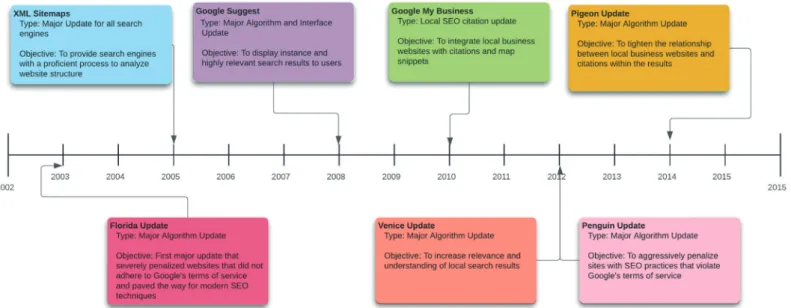
The timeline in Figure 1 maps the increasing complexity of the PageRank algorithm at each update between 2000 and 2015. By implementing features such as user location and social media, the PageRank algorithm must factor in the variety of search methods that are available to users, and anticipate their queries to display relevant results. Since 2017, it is worth noting that subsequent updates have been rolled out,
such as the Fred, Macabee and Florida updates.28 These updates came after the data
collection period of this study, however, so are not included in the figure.
In summary, it is clear that many studies have been conducted in the area of search engine marketing; however, few address the specific implications relating to local business owners’ use of local SEO. In this regard, the present research addresses two key areas that require more investigation: the evolution of local SEO, and the impact of search engine updates on local SEO.
METHOD
This study seeks to investigate local SEO among industry experts who provide business owners SEO services. Participants were asked to recount the influence of local SEO updates on their client websites. As such, semi-structured interviews were conducted in order to collect expert opinions within the SEO industry. Due to SEO being a highly specified area in the digital marketing sector, a purposive sampling procedure was used to identify 20 industry professionals who were in a position to provide insights. Sharma29
recommends purposive sampling when researching a specific subject, as it provides the best available knowledge concerning the sample subject. After the target group was established, individuals that fit the sample criteria were selected, approached and scheduled for interview. In doing so, the current practice of search engine marketers in relation to Google’s major algorithm updates was investigated. Data collection also gathered opinions on local SEO. Specifically, participants were encouraged to explain how client SERP performance was affected by algorithm updates.
Thematic analysis of interview transcripts used coding to simplify the data, establishing meaning, identifying patterns and developing concepts.30 Within the transcripts of the
research, coding is utilised to identify key
words and recurring phrases to identify trends within the data. The thematic analysis process allows for a deeper analysis of the interview data, with a particular emphasis on comparing and contrasting data between interviewees. Additionally, data analysis established the foundations for a conceptual framework of local SEO, as presented in the findings.
FINDINGS
Thematic analysis of findings revealed the following themes as the most pertinent to performing local SEO: webmaster guidelines, mobile SEO, algorithm updates and ranking factors.
Webmaster guidelines
This theme centres on the substantial importance that all participants place on researching, and adhering to, Google’s Webmaster Guidelines. When asked specifically about contingency plans in relation to algorithm updates, participants directly referred to the quality of the overall website, in terms of how the website and the websites’ content adhered to Google’s Guidelines:
‘We do not stray too close to the fine line between Google’s guidelines and unsavoury SEO. The more you work towards the factors that Google are looking for (great user experience, engaging content, quality natural links), the major updates shouldn’t have a massive impact.’ (Participant 6) ‘We make sure that everything we do follows Google’s guidelines.’ (Participant 4)
Additionally, all participants indicated that, rather than having a set contingency plan when reacting to an algorithm update, their approach involved consistently adhering to Google’s Webmaster Guidelines in the assumption that complying with such advice will result in a reduction of penalties once an update is released:
‘There is no set way of planning for it, you just have to do the right thing initially. But hey, that’s SEO!’ (Participant 3)
‘You hope that what you’re doing is enough that your sites aren’t going to be massively impacted.’ (Participant 5)
‘Try and adhere to the webmaster guidelines as much as you can.’ (Participant 1)
Participants were, however, divided in what they perceived to be the cause of penalties. While it is generally believed that failure to observe Google’s Webmaster Guidelines will result in penalties, some participants also believed that websites could be further penalised for both historical SEO techniques as well as attempting to manipulate search engines using ‘black hat’ SEO techniques:
‘For example, with Penguin, everyone went down the guest posting route because there was an agreement that the webmaster let the user post a link. Within a month, guest posts were seen as unnatural links and people were getting penalised for something they thought was within the boundaries of the guidelines.’ (Participant 1)
‘It could be something like duplicate content, or maybe they’ve just been a bit daft with several location pages with duplicate content. People try to take the shortcut, but only if you put the effort in will you be rewarded. We also check backlink profiles too.’ (Participant 2) ‘It tends to be a case of something in the distant past, such as link stuffing, which you may have been able to get away with in the past but now means you’ve been hit for it.’ (Participant 7)
It is clear that Google’s Webmaster
Guidelines form the contingent approach to dealing with algorithm updates. Participants made an overwhelmingly strong case against specific, rigid and preset contingency plans. It is clear that an ongoing approach to website analysis that is in accordance with Google’s Guidelines is the favoured approach.
Mobile SEO
Mobile SEO featured heavily in participants’ accounts, as well as the effects of specific major local algorithm updates. In addition, all participants stated that the future of local SEO will centre on mobile platforms and utilising mobile technology to integrate local SEO with mobile search:
‘I suspect that, given the current trends, 80–90 per cent of searches in the next decade will be conducted on mobile or tablet devices.’ (Participant 7)
‘Mobile usage and location will also grow in popularity.’ (Participant 1)
Another popular opinion was that paid search would be an important component in the future of local SEO, with Google leveraging the tracking capabilities of modern technology in order to attribute offline business visits and transactions to a paid click:
‘Google is also testing call tracking, to attribute calls and in-store visit as a PPC click.’ (Participant 6)
‘More and more, Google knows where you are, especially due to the popularity of mobile search and GPS tracking on mobile devices. Google knows where I am twenty-four seven. So, Google knowing where you are going to be in the future, is a massive thing.’ (Participant 4)
Many participants also indicated the shift towards Google gaining a greater understanding of the context behind a search term. Again, this was in reference to mobile search, and mobile users searching for specific local terms ‘on the go’:
‘I think it’s going to be based around Google gaining a better understanding around the context of what people are searching for.’ (Participant 1)
‘In a local search point of view, I would expect to see a much more structured way
of Google understanding the context of a mobile search query.’ (Participant 7)
The key theme of mobile SEO highlights the shift in technology and context that Google will work towards in the future. By assessing the data, a trend starts to emerge where the complexity of a search term (in terms of context-based search terms) increases as mobile usage grows in popularity. Algorithm updates
It was also evident that participants considered algorithm updates to be a large part of their role as SEO professionals. Participants recognised how sporadic, frequent algorithm updates destabilised local SEO strategies:
‘For our agency in particular, Penguin was a game changer.’ (Participant 3)
‘It’s taken a while to really get to grips with the level of change that will need to happen to fully recover from the update.’ (Participant 14)
‘Probably Panda. Well … Panda and Penguin are quite close in that respect.’ (Participant 5)
‘The Florida update of 2004 wiped out two-thirds of our traffic, as that was solely how we earned our money. It was a bit of a shock at the time, but that is search. It was pretty much overnight.’ (Participant 8)
Additionally, when asked specifically about the impact of local SEO updates, participants noted that local SEO recovery tends to be much harder than with major updates, due to the unsavoury SEO history that is attributed to many small business websites:
‘It is a bit more difficult with local SEO, it may not be possible to come back if you’re using a spam technique to rank locally.’ (Participant 1)
‘It’s a long, tedious process, but you’re making sure that the information for each locality is correct. You then have to look at
the link equity of each store, and check to see if local media mentions the brand, or specifically, the store.’ (Participant 8)
The influence of algorithm updates illustrates how search engine marketers operate in a highly unstable environment. Furthermore, the participants’ responses clearly indicate the difficulty they face with responding to updates as well as educating their clients on how to rectify unsavoury SEO.
Ranking factors
This final theme was evident throughout all responses from participants, particularly with questions related to the effects of algorithm updates. While one would expect participants to comment on specific ranking factors (particularly in relation to algorithm updates), the frequency in which the same ranking factors were mentioned shows that search engine marketers place more significance on certain ranking factors than they do on others:
‘The more you work towards the factors that Google are looking for (great user experience, engaging content, quality natural links), the major updates shouldn’t have a massive impact.’ (Participant 17) ‘The Penguin update flipped SEO on its head and moved everyone towards producing proper websites and content.’ (Participant 3) ‘Post-Penguin, it’s made us marketers. We can’t just throw mud at the wall, we actually need to add value to campaigns and produce content that people actually want to read.’ (Participant 11)
When asked about how specific local SEO algorithm updates affected their local SEO clients, many participants recognised that Google values readable content and penalises duplicate content. Additionally, responses within the data convey a trend of context-led search, suggesting future local updates will be based on gaining a greater understanding around the context on which
a search is being performed. Most notably, the ‘Schema’ markup tool for local business websites provides Google the context of a search, and positively influences other local ranking factors such as Google Maps, business citations and location-based content:
‘Google knows our location, and if I did a local search, I would expect to see results from around my location. We use Schema to the code, so that Google knows where our clients are based. Without Schema, Google doesn’t necessarily understand the context of the text in the web page.’ (Participant 12)
‘Local SEO is now a lot more targeted towards rich snippets, and getting your business listed with citations. So, we’ve seen a shift from using things like location-based landing pages, toward local case studies, rich snippet mark-ups and local content.’ (Participant 4)
The majority of participants were aware of the minimal impact that the Pigeon update had on their local SEO clients. When asked specifically about the update, participants referred directly to local ranking factors that they felt had been confirmed as quality ranking factors. Additionally, participants cited other local SEO updates that they felt had been more severe than Pigeon, and tended to associate Pigeon with a shift in citation quality rather than an update that aggressively sought to penalise business websites:
‘We didn’t really see any overall effect from Pigeon.’ (Participant 14)
‘I guess Pigeon was born from the Hummingbird update and was bringing Hummingbird to local SEO. It was about getting businesses to be seen as an object and to enable the algorithms to understand what the business was.’ (Participant 18)
The consistent reference to mobile-led SEO again displays what the participants consider to be the future of local SEO. Through the key themes identified from the data,
it is evident that local SEO is reliant on high-quality content and shows the barriers of context and SEO malpractice that search engine marketers face when attempting to implement local SEO. The key themes also vindicate the assumption that search engine marketers face regular challenges in attempting to deal with the volatile SEO landscape, which can explain the reason why no participants claimed to have a set contingency plan for dealing with potential updates as they cannot plan for an update they have no information about.
DISCUSSION
The results highlight the challenges faced by search engine marketers when reacting to major algorithm updates and implementing local SEO strategies. The data indicates a general consensus among search engine marketers that ranking factors affect ranking results both positively and negatively. Additionally, the data highlights the overwhelming shift towards mobile search, particularly in reference to local SEO and location-tracking services.
Algorithm updates form a key part of any search engine marketers’ role, both in understanding the implications of an algorithm update, and having the ability to react successfully to an update if penalties do occur. As evidenced by Figure 1, the algorithm update that had the largest negative impact was Penguin, particularly in comparison with the updates that occurred in the early 2000s. However, while Penguin was the most commonly stated update, the majority of participants suggested that major algorithm updates were significantly more ‘severe’ in the early 2000s, when SEO began to gain popularity. This suggests that the participants misjudged the severity with which they could be penalised as updates rolled out more frequently, resulting in a false sense of security and, for many of them, a severe penalty when they were eventually penalised for current and/or historical SEO.
Therefore, the findings of this study support the research concerning the volatility of the SEO environment.31–33
Previous literature has suggested that the Penguin update was by far the most severe major algorithm update of modern SEO34 and the findings substantiate this
claim, with the majority of participants citing Penguin as the algorithm update with the most severe impact on ranking results. While the literature suggests that the Pigeon update had an effect on the ranking factor integration and on-page visibility,35, 36 when
the participants were asked specifically about the effect of the Pigeon update on local SEO, they all claimed that Pigeon had little to no effect on their clients’ ranking. Alternatively, some participants indicated that Pigeon was a positive update, as it educated the participants about the ranking factors on which they needed to focus. Furthermore, this update justified the participants’ assumptions regarding successful local SEO techniques.
Within this study, Google’s Webmaster Guidelines are a key theme. Previous research suggesting that search engine marketers rely on contingency plans to assist in reacting to algorithm updates would appear to be flawed — indeed, not one of the participants in this study reported having such a plan.
Rather, 100 per cent of respondents indicated that their preferred approach to minimising the impact of algorithm updates was simply to adhere to Google’s Webmaster Guidelines. As well as establishing a knowledge gap in the previous research in this field, these original findings also highlight the temperamentality of the SEO environment.
Regarding the future of local SEO, the overall consensus was that the shift toward mobile SEO will continue. With one participant claiming that 80 per cent of all searches are done on a mobile device, and a 100 per cent response rate related to mobile development, participants’ responses extend the previous knowledge in this area.37–39
Moreover, the data outlines the opinion that future local SEO will be mobile-led, with a focus on GPS tracking and the ability to attribute offline purchases, such as a PPC metric. Participants expressed cynicism regarding the practices of Google, noting the decrease in map results as a ranking factor update attributed to the Penguin update, as well as the use of GPS tracking as a new way to push paid search on webmasters.
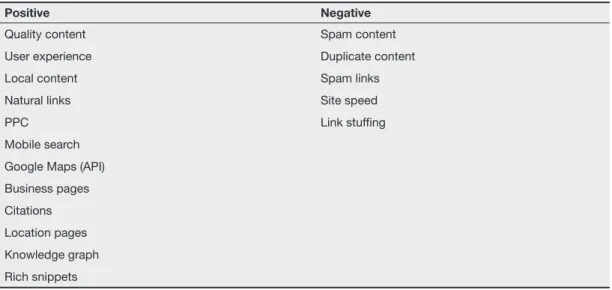
Interestingly, participants made at least twice as many comments on positive ranking factors than they did on negative ranking factors. Table 1 rounds up the positive Table 1: Ranking factors in local SEO
Positive Negative
Quality content Spam content User experience Duplicate content
Local content Spam links
Natural links Site speed
PPC Link stuffing
Mobile search Google Maps (API) Business pages Citations Location pages Knowledge graph Rich snippets
and negative ranking factors mentioned in the interview transcripts. While Gabe40
generalises ranking factors as either positive (white hat) or negative (black hat), the findings from this study also recognise commonalities between the factors (eg content). In terms of local SEO, participants referred to quality content, business pages and citations as positive factors, as they provide search engines the context behind a search. This finding also underlines the participants’ view that local SEO should be context-led, with future updates potentially rewarding websites that utilise ranking factors that assist in the search engines’ understanding of the context of a search query.
Throughout the research, it is clear that the future of local SEO will be based around context-led searches, conducted on a mobile platform. While Comscore41 highlights
that the majority of search engine users prefer organic links to paid search, SEO professionals suggest a shift from local search to paid results. This may suggest that local SEO campaigns relying solely on organic search campaigns may have to adjust their strategies to shift towards paid search. Lastly, participants highlighted the influence that unsavoury (black hat) SEO practices have had on their performance, such as severe penalties for poor-quality links.
CONCLUSION
This study aims to understand local SEO and the challenges that search engine marketers face when performing it. While the literature surrounding digital marketing and SEO is sufficient, research in the specific area of local SEO is sparse. This study contributes to the literature on local SEO in four areas. First, it identifies the primary barrier to the success of search engine marketers as Google’s major algorithm updates. The Penguin and Panda updates in particular penalised local SEO malpractice directly, primarily affecting websites that employed unsavoury SEO techniques such as duplicate content,
link-stuffing (linking to high-ranking but non-relevant sites) and spam links. SEO professionals also face the challenge of fixing historically unsavoury SEO techniques on their websites; if such malpractice is not located and fixed, Google will penalise the website severely.
Secondly, the study highlights how none of the participants claimed to use, or to have ever used, a contingency plan to respond to algorithm updates; rather, all participants referred to Google’s Webmaster Guidelines as a way of consistently staying within the parameters of ‘white hat’ SEO. The overall consensus was one of playing it safe by adhering to the rules. The search engine marketers and webmasters understood the penalties that could occur if they strayed from the Webmaster Guidelines, and therefore chose not to take the risk.
Thirdly, none of the participants found the Pigeon update to have had any effect on their websites. Contrary to the literature, participants even suggested that Pigeon was a positive update, in that it confirmed that they were sticking to the Webmaster Guidelines and using the correct ranking techniques to deliver successful SEO campaigns.
Lastly, the participants highlighted the significant rise in the popularity of performing search on mobile devices. This research adds to the popular research within the literature concerning the rise in mobile usage, with participants going on to forecast the growth of GPS tracking and offline PPC as future considerations for local SEO. References
1. Wilcox, G. B., Sussman, K. and Chung, A. (2018) ‘Social media’s return on investment in an integrated market-ing campaign: media mix modellmarket-ing’, Journal of Digital
and Social Media Marketing, Vol. 6, No. 2, pp. 181–190.
2. Langville, A.M. and Meyer, C.D (2011) ‘Google’s PageRank and Beyond: The Science of Search Engine Rankings’, Princeton University Press, Princeton, NJ. 3. Google Algorithms (2018) ‘Inside Search’, available at:
https://www.google.co.uk/insidesearch/howsearch-works/index.html (accessed 5th February, 2019). 4. Perner, P. (2015) ‘Machine Learning and Data Mining
in Pattern Recognition’, Springer-Verlag, Heidleberg and Berlin.
5. Sponder, M. and Khan, G. F. (2017) ‘Digital Analytics for Marketing’, Routledge. New York, New York, US. 6. Mena, J. (2012) ‘Machine-to-Machine Marketing
(M3) via Anonymous Advertising Apps Anywhere Anytime (A5)’, CRC Press Taylor and Francis Group, Boca Raton, FL.
7. Sutton, A.T. (2012) ‘Local SEO: How geotargeting keywords brought 333% more revenue’, available at: http://www.marketingsherpa.com/article/case-study/ how-geotargeting-keywords-brought-333 (accessed 5th February, 2019).
8. Jacobson, D., Woods, D. and Brail, G. (2011) ‘APIs: A Strategy Guide’, O’Reilly Media Inc. Sebastopol, CA. 9. GooglePress (2005) ‘Google Merges Local and Maps
Products’, available at: http://googlepress.blogspot. co.uk/2005/10/google-merges-local-and-maps-products_06.html (accessed 5th February, 2019). 10. David, M. (2015) ‘WordPress 3 Search Engine
Opti-mization: Optimize Your Website for Popularity with Search Engines’, Packt Publishing, Birmingham. 11. Ibid.
12. Ntoulas, A., Cho, J. and Olston, C. (2004) ‘What’s New on the Web? The Evolution of the Web from a Search Engine Perspective’, ACM, New York, NY. 13. Xing, B. and Lin, Z. (2006) ‘The impact of search
en-gine optimisation on online advertising market’, paper presented at the Conference on Electronic Commerce, Fredericton, New Brunswick, 13th–16th August. 14. Roupp, H. (2015) ‘Teaching World History in the
Twenty-first Century: A Resource Book’, Routledge Taylor and Francis Group.
15. Onishi, A. (2013) ‘Pro WordPress Theme Develop-ment’, Apress. New York, NY.
16. Jerkovic, J. (2010) ‘SEO Warrior: Essential techniques for increasing web visibility’, O’Reilly Media Inc. Sebastopol, CA.
17. Qiu, Y. (2014) ‘CMS website search engine optimi-zation’, Bachelor thesis, Lahti University of Applied Sciences.
18. Enge. E., Spencer. S. and Stricchiola. J. (2015) ‘The Art of SEO: Mastering Search Engine Optimisation’, O’Reilly Media Inc. Sebastopol, CA.
19. Svennerberg, G. (2013) ‘Beginning Google Maps API 3’, Apress. New York, NY.
20. Varndell, D. (2014) ‘SEO 2014: Includes how to recover from Penguin, Panda or Manual Penalties’, Lulu Press.
21. Ibid.
22. Comscore (2015) ‘Trends shaping Local Search in 2015’, available at: http://www.comscore.com/ Insights/Events-and-Webinars/Webinar/2015/ Trends-Shaping-Local-Search-in-2015 (accessed 5th February, 2019).
23. Ibid, ref. 20 above.
24. Weiche, A. (2014) ‘Designing Business Location Pages: Part One — Single Location Business, avail-able at: http://localu.org/blog/author/aweiche/ page/2/ (accessed 5th February, 2019).
25. Subhani, A. B. (2014) ‘Intro to WWW Marketing’, Abbott Press. Bloomington, IN.
26. Gabe, G. (2013) ‘Penguin 2.0 initial findings — a deeper update, but not broader’, available at: http:// www.hmtweb.com/marketing-blog/penguin-2-ini-tial-findings/ (accessed 5th February, 2019). 27. WAGMob (2014) ‘Learn SEO’, available at: http://
ebookshelf.net/learn-seo_ebook-download1555529 (accessed 5th February, 2019).
28. Search Engine Journal (2019) ‘Google Algorithm updates & changes: a complete history’, available at: https://www.searchenginejournal.com/goo-gle-algorithm-history/ (accessed 5th February, 2019).
29. Sharma, R. K. (1997) ‘Sociological Methods and Techniques’, Atlantic Publishers, New Dehli. 30. Saunders M., Lewis P. and Thornhill A. (2015) ‘Research
Methods for Business Students’, Pearson Education. London.
31. Ibid, ref. 12 above.
32. Erdemir, A. S. (2015) ‘Digital PR in Turkey: how Turkish brands integrate content marketing, social media and SEO in PR campaigns’, Journal of Business
and Behavioral Sciences, Vol. 27, No. 2, pp. 38–54
33. Ibid, ref. 1 above. 34. Ibid, ref. 25 above. 35. Ibid, ref. 20 above. 36. Ibid, ref. 24 above.
37. Zicherman, K. (2012) ‘10 reasons why your clients need a mobile website’, Booktango, Bloomington, IN.
38. Ibid, ref. 22 above. 39. Ibid, ref. 32 above. 40. Ibid, ref. 26 above. 41. Ibid, ref. 22 above.