Seton Hall University Dissertations and Theses
(ETDs) Seton Hall University Dissertations and Theses
Spring 2-27-2020
The Influence of Professional Development Methods on Student
The Influence of Professional Development Methods on Student
Mathematics Performance in New Jersey Public Elementary
Mathematics Performance in New Jersey Public Elementary
Schools
Schools
Xanthy Karamanos
Seton Hall University, [email protected]
Follow this and additional works at: https://scholarship.shu.edu/dissertations
Part of the Educational Leadership Commons, Elementary Education and Teaching Commons, and the
Science and Mathematics Education Commons
Recommended Citation Recommended Citation
Karamanos, Xanthy, "The Influence of Professional Development Methods on Student Mathematics Performance in New Jersey Public Elementary Schools" (2020). Seton Hall University Dissertations and Theses (ETDs). 2732.
The Influence of Professional Development Methods on
Student Mathematics Performance in New Jersey Public Elementary Schools
by
Xanthy Karamanos
Submitted in partial fulfillment of the requirements for the degree Doctor of Education
Department of Education Leadership, Management and Policy Seton Hall University
Abstract
This quantitative study was developed to determine the influence of professional development methods on student academic performance in elementary mathematics. The study also reviews the relationship between content that was delivered in professional development programs and student performance. Additionally, the research analyzes the difference in student math
performance when professional development decisions are made by administrators versus a mixed group of stakeholders. An online survey was conducted to collect data from district- and school-level administrators in New Jersey public school districts that serve elementary students from grades three to six. The study includes representation from 11.4% of public school districts across the state. The results of the survey were examined with public data from New Jersey Department of Education district performance reports. Regression models were used for each of the three research questions and identified the control variables as the percentage of students with disabilities, the percentage of English learners, and the percentage of economically
disadvantaged students. The results indicate that the content that was delivered and the decision maker were more significant factors for the influence of professional development on student academic performance compared to the provided methods.
Keywords: professional development, student academic performance, mathematics, elementary
Dedication
This work is dedicated to the memory of Dr. Gerard Babo, an extraordinary, patient, and caring teacher who taught me to never doubt myself and helped me believe that the sky is the limit. May his memory be eternal.
Acknowledgements
I would like to acknowledge all of the people who have supported me throughout the dissertation process and my graduate work at Seton Hall.
First, I would like to sincerely thank my mentor, Dr. Reid, for his constant support. I am grateful for his guidance and would not have made it this far without his patience and kindness. I would also like to thank my committee member, Dr. Blissett for (patiently) answering the
millions of statistics questions I had throughout my coursework. Thank you to Dr. Bertolini for joining my committee and for the valuable input he has provided. Thank you all for taking the time to work with me on my committee and always having confidence in me.
I would like to express my gratitude to all of my professors at Seton Hall that have taught me many valuable leadership lessons throughout my studies, including current and past
professors: Dr. Gutmore, Dr. Corino, Dr. Kuchar, and Dr. Walker. Thank you!
Finally, words cannot express how grateful I am to my family and friends for their constant encouragement: To my parents, Christos and Stalo, thank you for your unconditional love, support, and patience. To my Yiayias, thank you for always showering me with love and home cooked meals. To my brothers, family, and friends, thank you for holding me accountable, reminding me to have fun, and constantly asking, “how much longer?” To my favorite principal, Steven Preville, thank you for being the greatest coach a novice leader could’ve asked for. To all of my BFE family (especially Mollie, Maria, Lindsay, Chelsea, Elisa, Steph) thank you for being the best cheerleaders. To Aimee and Dr. Jeff, thank you for always keeping me focused. To Rob, thank you for believing in me and refilling my water bottle whenever my nose was stuck in a book. I am eternally grateful for all of you.
Table of Contents ABSTRACT………... ii DEDICATION………... iii ACKNOWLEDGEMENTS………... iv TABLE OF CONTENTS……… v LIST OF TABLES………. ix LIST OF FIGURES……….... x CHAPTER I: INTRODUCTION……… 1
Context of the Problem………... 1
Problem Statement……….. 3
Purpose of the Study………... 4
Significance of the Study……… 4
Theoretical Framework………... 5
Research Design……….. 7
Research Questions………. 8
Limitations and Delimitations………. 9
Definition of Terms………... 10
Organization of the Study………. 12
CHAPTER II: REVIEW OF LITERATURE………... 13
History of Professional Development in School Districts……… 13
Purpose of Professional Development……….. 16
Linking to Student Academic Performance……….. 17
Methods of Professional Development………. 23
In-Service Training.……….. 23
Out-of-district Workshop.………... 24
Online Learning……… 24
Job-embedded Professional Development……… 25
Professional Learning Community (PLC) ………... 26
Site-based Coaching………. 26
Stakeholders and Decision Making……….. 27
Professional Development in Mathematics……….. 29
Factors to Designing Effective Professional Development……….. 30
Gaps in the Literature………... 32
CHAPTER III: METHODOLOGY……….. 34
Introduction………... 34
Research Design……… 36
Population………. 36
Sampling………... 37
Survey Questions and Main Themes……… 38
Control Variables……….. 41
Validity and Reliability………. 42
Data Collection………. 43
Data Analysis……… 44
Limitations and Delimitations………... 46
Introduction………... 50
Overview of Data……….. 51
Research Question #1………... 54
Research Question #2………... 57
Research Question #3………... 62
CHAPTER V: CONCLUSIONS AND RECOMMENDATIONS………... 69
Introduction………... 69
Summary of Findings……… 71
In-Service Trainings……….. 72
Out-of-district Workshops……… 73
Online Learning……… 73
Job-Embedded Professional Development………... 74
Professional Learning Communities………... 74
Site-Based Coaching………. 75
Content Delivered………. 76
Professional Development Decision Makers……….... 77
Implications for Practice and Policy………. 78
Implications for Practice………... 79
Implications for Policy……….. 80
Recommendations for Future Research……… 82
Conclusion……… 85
REFERENCES………... 86
Appendix A. Data Collection Tool………... 93 Appendix B. Direction of the New Jersey Assessment System and Spring 2019
List of Tables
Table 1. Descriptive Statistics for State Mathematics Performance Trends………... 48
Table 2. Descriptive Statistics for Control Variables in Sample and all Statewide Elementary School Districts..………..….…...…….… 53
Table 3. Administrative Positions of Respondents in Sample……….. 54
Table 4. Means for Methods of Professional Development Provided……….………. 56
Table 5. Regression Model for Methods of Professional Development Provided.…………... 57
Table 6. Means for Content Delivered in Professional Development..………...……….… 60
Table 7. Regression Model for Content Delivered in Professional Development………..…….. 61
Table 8. Means for the Planner of Professional Development: Administrators or Mixed Stakeholders……….. 66
List of Figures
Figure 1. Framework for Studying the Effects of Professional Development on Teachers and Students (Desimone, 2009)………... 18 Figure 2. Model of Relationship between Professional Development and Improvements in
Chapter I Introduction Context of the Problem
K-12 public education is an ongoing topic of conversation. From President Lyndon B. Johnson’s Elementary and Secondary Education Act (ESEA) in 1965 and President George W. Bush’s No Child Left Behind Act (NCLB) of 2001 to President Barack Obama’s Every Student Succeeds Act (ESSA) in 2015, politicians and governing bodies have constantly changed the landscape of education in a variety of ways. Federal, state, and local governments continue to influence public school funding, standards, and teaching quality. Throughout years of change, providing students with a high-quality education has remained a priority.
One way in which these governments have attempted to ensure a high-quality education for students is by focusing on teacher quality. Research has consistently evidenced that teacher quality is the most important school-based factor for improving student outcomes in terms of, for example, achievement, attendance, and graduation (Darling-Hammond, 2000; Garet, Porter, Desimone, Birman, & Yoon, 2000; Guskey, 2009; Mizell, 2010). In 2004, NCLB stated that, by 2006, all teachers must be considered “highly qualified” to obtain teaching positions in public schools. The state of New Jersey defines a highly qualified teacher as an individual with at least a bachelor’s degree, a valid state certification, and demonstrated expertise in their core academic subject area (NJDOE, 2014).
Although hiring individuals who are deemed “highly qualified” to teach students is a vital step, it is critical for teachers to continue their professional growth throughout their careers, as research has indicated that “professional development is viewed as an integral part of one’s career cycle” (Guskey, 1994; Zambak, Alston, Marshall, & Tyminski, 2017). Over the decades,
states, school districts, and researchers have dedicated a significant amount of time and resources to studying the effects of professional development. They have found that high-quality,
sustained, and intensive professional development has an active role in student learning and achievement (Darling-Hammond, Wei, Andree, Richardson, & Orphanos, 2009). Professional development provides an opportunity for districts to support teachers in learning and advancing in their content areas and professions; therefore, it is important for professional development to be executed thoroughly and thoughtfully (Corcoran, 1995; Guskey, 2009; Kelly, 2012).
In an effort to improve the quality of teaching, districts have spend billions of federal dollars annually on professional development that aims to enhance student performance and meet federal and state mandates (Calvert, 2016; Guskey, 2009; Jaquith, Mindich, Wei, & Darling-Hammond, 2010; Yoon, Duncan, Lee, Scarloss, & Shapley, 2007). For example, New Jersey requires all teaching staff to complete 20 hours of professional development each year, which forces public schools to not only allow designated time for staff to engage in learning but also allocate resources and money to fulfill these demands.
As the digital, fast-paced world continues to grow, the available types of professional development are constantly evolving. For example, states and school districts now offer live or pre-recorded webinars, conferences that are presented by organizations, social media outlets, and out-of-district workshops. Other professional development methods that need more arranging and planning but are still readily available to teachers include professional learning communities (PLCs), in-service trainings, and job-embedded professional development. Today, teachers have an unprecedented level of access to professional development at their preferred time and
location. As staff development opportunities become more easily accessible, it is important to critically evaluate these opportunities and determine how, if at all, they improve teacher quality.
Problem Statement
For years, public school districts have been spending billions of dollars on various professional development activities (Borko, 2004; Corcoran, 1995; Guskey 2009; Guskey & Yoon, 2009; Jaquith et al., 2007; Kedzior, 2004; Kelly 2012; Little, 1993; Valli, Cooper, & Frankes, 2016). With laws such as NCLB and ESSA, districts have funneled money into programs to help remediate student learning with the hope of increasing student academic performance to meet federal and state demands. The provision of professional development is more likely to improve a program than setting up “band-aid” solutions, such as remedial
programs, support teachers, interventionists, and content specialists (Kelly, 2012). When districts allocate money for professional development, they need to ensure that they are receiving services that will have the strongest impact on student learning.
Scholars such as Guskey (2003, 2009), Rebora (2004), Rotermund, DeRoche, and Otterm (2017), and Villegas-Reimers (2003) have found that professional development is a necessary component to improve student learning. Research has identified effective professional
development methods through pre-post studies, classroom observations, and teacher surveys to connect changes in teacher practices to student academic performance. Current research has also outlined the most frequently used types of professional development in districts; however, few studies have linked these types to student academic performance.
Before districts expend more time, resources, and funds for different professional development methods, it is vital to understand the impact of these methods on academic performance. Further research is necessary to identify the professional development methods
with the greatest potential influence on student academic performance as well as any observable patterns between professional development methods and student academic performance.
Purpose of the Study
The purpose of this study is to determine if there is a relationship between student academic performance and the type of professional development that is provided to staff who teach elementary mathematics. The study focuses on the most commonly reviewed types of professional development in the literature and research, which include in-service trainings, out-of-district workshops, online learning, job-embedded professional development, PLCS, and site-based coaching. Based on the findings, district administrators can obtain more information about target areas for professional development efforts, such as content and planning, to support teaching and learning within their elementary school classrooms.
Significance of the Study
This research presents strengths that include the opportunity to gather information on how districts have implemented professional development across the state of New Jersey. As a cross-sectional study, it provides an understanding of professional development methods that are currently applied in public elementary schools. Furthermore, the data that were collected built upon the findings of previous research and can support administrators in decision-making concerning the implementation of professional development.
This study could benefit students in multiple ways. First, it can provide school administrators and policymakers with a deeper understanding of the influence of various professional development methods on student academic performance. The research also raises
awareness of the importance of strategically planning the content that is delivered in professional development programs to promote student learning. Additionally, it reviews the difference in the relationship between professional development and student performance based on who makes the decisions about district professional development plans and programs. Overall, the study offers information that can guide school personnel to make decisions about professional learning that will have the greatest impact on students.
Theoretical Framework
The National Staff Development Council (NSDC, 2001) has developed 12 standards for staff development to support improvements in student learning. These standards are split into three categories that mirror the model of Guskey and Sparks (2002) for the relationship between professional development and improvements in student learning. The theoretical framework of this model illustrates that many elements are involved in improving student academic
performance.
Guskey and Sparks (2002) and the NSDC (2001) have identified three parts of quality professional development: content, process, and context. These three aspects together help administrators plan for high-quality professional development with the goal of impacting the knowledge and practice of teachers, which could in turn improve student learning and academic performance (Guskey & Sparks, 2002). This theory also connects to the model by the Institute of Education Science on “How Professional Development Affects Student Achievement,” which links professional development to teacher knowledge, skills, and pedagogy and, subsequently, to its effects on student learning (Desimone, 2009; Yoon et al., 2007). Although professional development may not have a direct effect on student academic performance, “the relationship
between professional development and improvements in student learning is complex and multifaceted, it is not random or chaotic” (Guskey & Sparks, 2002, p. 5), and it should be planned thoroughly, purposefully, and with extensive thought (Desimone, 2009; NSDC, 2001; Yoon et al., 2007).
Content: The content characteristic describes the goals and objectives of professional development. Strategically planning the content in professional development “improves the learning of all students deepens educators’ content knowledge, provides them with research-based instructional strategies to assist students in meeting rigorous academic standards” (NSDC, 2001). Professional development content can vary from content-area-specific programs and resources to student learning standards and practices, pedagogy, instructional strategies, and lesson design.
Process: While content is important, the process of professional development is a valuable facet of the model that directly connects to this study. The process characteristics describe the method and activities within the professional development program (Guskey & Sparks, 2002). According to the NSDC (2001), when considering the process of professional development, standards to evaluate consist of data-driven, evaluative (multiple sources of information), research-based, design, learning (understanding of human development), and collaborative aspects (p. 2).
Context: The context encompasses the educators who are involved as well as their students, the environment, the organization, and the culture of the professional development (Guskey & Sparks, 2002). The NSDC (2001) has also connected the context to resources for supporting professional learning. Some context resources are technology, substitutes to cover
classes, and materials. With regard to students, aspects of the context may include student subgroups and demographics that are identified within a class, school, or district.
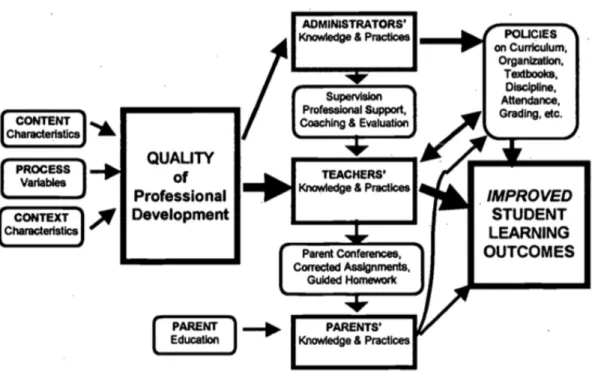
Content, process, and context all work together as characteristics of quality performance development. When these three characteristics are evaluated, administrators can plan for high-quality and meaningful professional development that impacts the knowledge and practice of teachers. Guskey and Sparks’s (2002) model for the relationship between professional
development and improvements in student learning dictates that such impacts to the knowledge of teachers have a direct effect on student learning outcomes. In this research, these three characteristics were incorporated into the survey to collect data that could address the research questions of this study.
Research Design
This research was conducted in the form of a quantitative study by creating a survey to administer to public school district administrators. The survey collected information about the methods of professional development that the districts offer, the content that they delivered, and the decision maker. The survey was utilized to gather information from districts and did not target perceptions or pose questions about evaluating the effectiveness. The basic constructs of interest in this study were the content, process, and context of professional development, which define the professional development methods, the delivered content, and the planning process of professional development.
These main themes were used to develop a survey that helped to answer the research questions of this study. The items from this survey were modified from those of a previous survey that was employed by the researcher Dr. Christine Scheffert Lowden to evaluate the
effectiveness of professional development (Scheffert Lowden, 2003) as well as a survey by the National Center for Education Statistics (NCES) called the Schools and Staffing Survey -
Teacher Questionnaire (2011–2012). Both of these surveys have been used to gather information on professional development implementation in various capacities. Although the surveys were designed for different research purposes, a modification of their items supported the collection of relevant data for addressing the research questions of the present study.
After the respondents submitted the survey, student academic performance data,
including subgroup achievement data, were collected from New Jersey Department of Education (NJDOE) public district performance reports. Demographic and student subgroup information was gathered from the National Center for Education Statistics Common Core of Data. These data were utilized to run multiple regression models to determine the existence of a relationship between the method of professional development and students who met or exceeded expectations in the district performance reports. Regression models were also run to identify the influence of the content of the professional development and the decision maker behind the professional development on student academic performance.
Research Questions
Previous research has studied teachers’ perceptions of professional development,
classroom observations of changing pedagogy, and pre/post-test research on specific professional development methods. However, there is limited research on the link between professional development methods and student academic performance. The present quantitative research explores the following questions:
o How does the method of professional development influence student academic performance?
o How does the content of professional development influence student academic performance?
o How does the professional development decision maker influence the relationship between the method of professional development and student academic
performance?
Limitations and Delimitations
Despite the strengths of this survey, some delimitations should be highlighted. While a cross-sectional study may provide an understanding of the type of professional development that occurs in schools, it is not able to establish a causal relationship, as it does not make any
observations over time. Furthermore, convenience sampling was performed to collect responses in the easiest way for the researcher, which limits the ability to generalize the results. Based on the convenience sample and the respondents, the variety of districts with diverse demographics was somewhat limited, which influenced the results of this study.
Other limitations may have influenced the relationship between districts’ academic performance and professional development that cannot be captured by the data. Since this study focuses on math performance, one factor was the district’s professional development plan and goals for the school year. While the survey defined the type of professional development, the quality of certain professional development methods, such as job-embedded learning, PLCs, and coaching, can present differently across districts and schools. There may also be unforeseen
factors that could impact the relationship, such as financial changes and budget cuts, district restructuring, and drastic changes in enrollment or staffing.
Definition of Terms
The following terms are defined to clarify key words that are used throughout the study: • Professional development, which is also referred to as staff development or professional learning, consists of educational learning that impacts an individual’s professional career and growth. The NJDOE has defined professional development as “professional learning opportunities aligned with student learning and educator development needs and school, school district, and/or state improvement goals” (NJDOE, 2013).
• Effective professional developmenthas been described by Mizell (2010) as a way to “enable educators to develop the knowledge and skills they need to address students’ learning challenges” and requires thoughtful planning, implementation, and feedback. “Professional development is not effective unless it causes teachers to improve their instruction” (p. 10).
• A professional development method, which may also be known as a model or type, identifies the kind of professional development that is offered. Such methods include coaching, observations, webinars, workshops, and conferences, and they may be referenced as professional development types, delivery, or modes.
• Professional development content refers to the information that is presented during a professional development session or, alternatively, content delivered in professional development. This study discusses professional development content in the area of elementary mathematics.
• Student academic performanceis defined by an evaluation of a student’s level of understanding of learning standards and objectives. Synonyms include student learning outcomesand student proficiency. For this research, student academic performance was measured through an analysis of district performance reports that are available in a public database of the NJDOE. These reports review data that are connected to student
performance on statewide assessments.
• In-service trainingis a professional development method that is hosted by the district as a stand-alone, one-time activity. In-service trainings are presented in a large group setting by an outsourced presenter or in-district staff.
• An out-of-district workshop refers to a professional development workshop that staff may attend as a stand-alone, one-time activity. An out-of-district workshop is presented in a large group setting by an out-of-district presenter and focuses on a specific topic.
• Online learningrefers to online courses or virtual learning experiences that teachers may undergo as part of their professional development.
• Job-embedded professional development is, according to the National Comprehensive Center for Teacher Quality, “a shared, ongoing process that is locally rooted and makes a direct connection between learning and application in daily practice…and is designed to enhance teachers’ content specific instruction practices” (Croft, Coggshall, Dolan, Powers, & Killion, 2010). This method is presented in a small group setting and may be led by a district staff developer or out-of-district consultant.
• A professional learning community (PLC) has been defined by Learning Forward, a professional learning association, as a community of educators in a department, team, school, or district who “convene regularly and frequently during the workday to engage
in collaborative professional learning to strengthen their practice and increase student results” (Learning Forward, n.d.).
• Site-based coachingis part of the site-based professional learning approach, which allows staff to connect with specialists who support teaching and learning (Polly, 2012). This model also provides sustainable opportunities for teacher growth by permitting time for feedback (Yoon et al., 2007).
Organization of the Study
This research report is organized into five chapters. The present chapter has introduced the research topic and the significance of investigating a relationship between professional development and student academic performance. It has also defined the research questions and important terms that are discussed throughout the study. Next, Chapter 2 outlines the historical context and purpose of professional development before discussing various methods of
professional development design. Additionally, it describes the link between professional development and student academic performance.
Chapter 3 then presents the research design and methodology and explains the
independent, dependent, and control variables. Subsequently, Chapter 4 analyzes the results of the study in order to address the research questions. Chapter 5 concludes with the findings and implications of the study as well as recommendations for future research.
Chapter II Review of Literature
This chapter reviews the existing literature on professional development within public school districts and how it defines student academic performance. It begins with a history of professional development with a focus on how politics have shaped professional development and student academic performance. Then, it considers the purpose of professional development, its connection to student academic performance, and how professional development is designed before analyzing the most frequently researched methods of professional development. Finally, the chapter reviews the literature to identify stakeholders who are involved in planning
professional development as well as barriers to implementation.
History of Professional Development in School Districts
Providing students with high-quality instruction has been a consideration of policymakers for decades. However, it has taken many years and multiple presidents and laws to clarify how school districts can deliver excellent teaching. As education reform has evolved, the role of professional development for teachers has progressed to its current state.
In 1965, President Lyndon B. Johnson signed ESEA as a promise to deliver a quality education to all students. This law introduced Title I funding, which allocates federal resources to districts with high-risk students. Such resources include federal funding to improve the quality of education for students in low socio-economic areas (U.S. Department of Education, n.d.). This law holds public school districts responsible for their student achievement.
Shortly after, during President Ronald Reagan’s administration, “A Nation at Risk” was released, which discusses the nation’s failing school systems in comparison to the rest of the
world. The report highlights that students in the US were falling behind those of other nations in the areas of mathematics and science. The commission shared recommendations for education that included devoting more time to the core subjects of English, mathematics, science, social studies, and computer science, setting higher expectations, and spending time and resources on teacher preparation programs to retain excellent teachers, particularly in the fields of math and science (Goldberg & Harvey, 1983). This report was alarming, and policymakers further reformed education and added to ESEA for years.
Later, President George W. Bush reauthorized ESEA by signing NCLB in 2001 to continue improvements in education for all students. The act requires school districts to hire highly qualified teachers (Robelen, 2005) and provide high-quality professional development (Borko, 2004) that demands scientifically supported activities. Moreover, it requires districts to dedicate more time to professional development beyond the short workshops or day-long
conferences that districts were previously offering (Blank, de las Alas, & Smith, 2007; Corcoran, 1995; Rebora, 2011). While NCLB imposes higher teaching expectations, it does not precisely define high-quality professional development (Borko, 2004). Since a major task of NCLB was to close the achievement gap, it devised strict guidelines that hold local districts even more
accountable for student achievement rates (Robelen, 2005), thus linking high-quality instruction to student academic performance.
Furthermore, NCLB specifically allocates funds for cultivating excellence in teachers and delivering quality instruction to students by extending professional development to all subject areas, requiring ongoing activities for collaboration, and developing teacher leader initiatives (ASCD, n.d.; Yoon, Duncan, Lee, Scarloss, & Shapley, 2007). These funds, which are known as Title II Part A, equip schools with over $3 billion annually to improve teacher quality through
professional learning (Guskey, 2009; Jaquith et al., 2010). In 2015, President Barack Obama signed ESSA, which continues the mission of NCLB: to provide quality education to all students. However, ESSA obligates districts to assign more emphasis and resources to improving teacher quality and targeting student subgroups, including economically disadvantaged students, students with disabilities, and English learners.
Under ESSA, the U.S. Department of Education (2016) identifies strategies to provide high-quality professional development that meets the following criteria: “sustained (not stand-alone, 1-day, or short-term workshops), intensive, collaborative, job-embedded, data-driven, and classroom focused” (p. 11). These characteristics outline the expectations for districts to continue receiving federal funding for professional development, but they are also connected to the factors that researchers believe contribute to effective staff development (Borko, 2004; Garet et al 2001; Guskey & Yoon, 2009; Stachler, Young, & Borr, 2013). In addition, ESSA holds districts accountable to student subgroups, such as minority groups, students in poverty, students with disabilities, and English learners (NJDOE, 2018). As policymakers have changed the landscape of education, researchers have evaluated the effects of professional development on student learning and achievement.
While federal mandates and funding work under ESSA regulations, states have developed their own administrative codes and statutes regarding professional development. In New Jersey, the code “N.J.A.C. 6A:9C, Professional Development” outlines the purpose, components, and requirements for public school districts as established in 2017 by the New Jersey State Board of Education and Commissioner of Education. To comply with the state’s code, districts must provide a cycle of professional development that improves practice and evaluates data to determine student needs. Such professional development should employ “coherent, sustained,
and evidence-based strategies that improve educator effectiveness and student achievement” (NJDOE, 2017b), which is similar to the definition set forth by federal policies and researchers. The state has highlighted some professional development methods that are reviewed in this study, including job-embedded professional development, coaching, and PLCS. With 590 operating public school districts in New Jersey in 2016–2017, the state’s administrative code on professional development can be interpreted and implemented in numerous ways across the state.
Purpose of Professional Development
Both policymakers and school leaders have recognized the importance of high-quality professional development in view of its link to student learning (NSDC, 2001). In studying professional development, researchers such as Guskey (2003), Kelly (2012), Villegas-Reimers (2003), and Yoon et al. (2007) have found that the key to improving classroom instruction is adequate professional development for staff. In fact, Guskey and Yoon (2009) have reported that “no improvement effort has ever succeeded in the absence of thoughtfully planned and well implemented professional development” (p. 497), which illustrates that professional
development has a substantial role in improving teaching and student learning.
The purpose of professional development is to train teachers to provide high-quality instruction to students. Rotermund et al. (2017) have identified professional development as an opportunity for teachers to “update their knowledge, sharpen their skills, and acquire new teaching techniques, with the intent of enhancing the quality of teaching and learning” (p. 1). When teachers refine their skills, they can transfer them to the classroom, which in turn improves student learning (Rotermund et al., 2017). High-quality professional development has a
2003, p. 19) and is “often seen as vital to school success and teacher satisfaction” (Rebora, 2004). By providing high-quality professional development, districts set their schools, classrooms, and teachers up for success, which can increase student academic performance.
Link to Student Academic Performance
Professional development has been found to be vital to improving student academic performance (Borko, 2004; Corcoran, 1995; Guskey, 1994; Kennedy, 2016; Yoon et al., 2007; Zambak et al., 2017). An analysis by the National Staff Development Council (2009) has revealed that professional development spread over 6 to 12 months yielded positive effects on student performance, whereas a limited amount of professional learning attained no statistical significance (Darling-Hammond et al., 2009). Similarly, Yoon et al. (2007) have indicated that professional development that lasted more than 14 hours had a statistically significant
relationship to student performance. While research has proven that a connection between professional development and student achievement, it is imperative to understand how the two are linked.
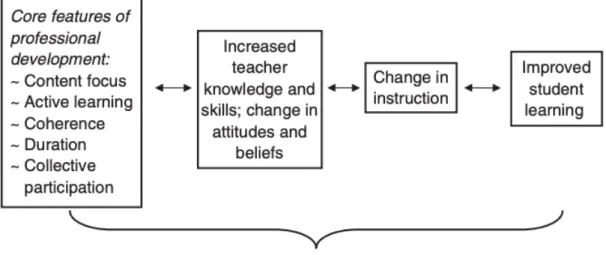
Desimone (2009) and Yoon et al. (2007) have developed models for the effect of
professional development on student achievement. Both models embody the same key concepts in the steps toward improving student learning (see Figure 1). These steps proceed from the provision of high-quality professional development for increasing teacher knowledge to an impact on classroom instruction, which subsequently leads to enhanced student learning.
Figure 1. Framework for studying the effects of professional development on teachers and students (Desimone, 2009)
The entire purpose of professional development is to increase teacher quality and student learning for all pupils. With the implementation of ESSA and higher number of students in subgroups (Gibson, 2016), districts are now held accountable for those subgroups, which include economically disadvantaged students, those who receive special education services, and English learners (NJDOE, 2018). The academic achievement gap for students in these subgroups has been a frequent topic of interest for educational leaders and policymakers (Vance, 2016; Royle & Brown, 2014). The individuals in these subgroups are considered “at-risk” students, which is a way to “describe the inequitable conditions, challenging circumstances, or stressful situations that make it more likely for students, individually or collectively, to have poor or harmful school outcomes” (Zinskie & Rea, 2016). Through high-quality professional development, staff can expand their knowledge and introduce new and more effective strategies, pedagogy, and
practices to their students (Gibson, 2016; Sandoval, Challoo, & Kupczynski, 2011). Therefore, it is crucial to evaluate the approaches of schools to designing professional development for staff as well as the relationship between the method of professional development and student
performance.
Designing Professional Development
Advances in research, knowledge, and technology have altered the ways in which districts deliver and design professional development for teachers. “Only in the past few years has the professional development of teachers been considered a long-term process that includes regular opportunities and experiences planned systematically” (Villegas-Reimers, 2003, p. 12). Garet et al. (2001), Guskey (1994), and Yoon et al. (2007) have agreed that districts should consider long-term learning goals and student outcomes when designing effective professional development to ensure that the professional learning will benefit students. However, districts often rush through the planning and design process to settle on staff development programs that can be easily organized, quickly executed, or cost effective (Corcoran, 1995; Garet et al., 2001; Guskey, 2009 ; Kelly, 2012) but are not necessarily aligned with student academic goals and needs.
Researchers have argued that many other factors are relevant to increasing student academic performance (Corcoran, 1995; Darling-Hammond, 2000; Desimone, 2009; Guskey, 2009; Silva, 2014; Yoon et al., 2007). However, three categories are the most influential for effective staff development, which subsequently affects student learning outcomes. According to Guskey and Sparks (2002), these categories are “content, process, [and] context,” as depicted by the model for the relationship between professional development and improvements in student
learning. This model has been used in many studies on this topic (Borko, 2004; Desimone, 2009; Green & Allen, 2015; Kedzoir, 2004; Yoon et al., 2007).
The model (see Figure 2) has been frequently referenced in evaluations of staff development programs, including by the National Staff Development Council in the National Standards for Staff Development (NSDC, 2001). The model supports a deeper understanding of the impact of quality professional development and student learning outcomes compared to the model by Yoon et al. (2007). Nevertheless, both models demonstrate the importance of designing high-quality professional development, as “no improvement effort has ever succeeded in the absence of thoughtfully planned and well-implemented professional development” (Guskey & Yoon, 2009, p. 497).
Figure 2. Model of the relationship between professional development and improvements in student learning (Guskey & Sparks, 2002).
Content: The content of a staff development experience is the most vital aspect of designing effective professional development (Boardman & Woodruff, 2004). Professional development that focuses directly on subject matter is viewed as the most influential type of professional learning because teachers have a direct connection to learning in the classroom (Kedzior, 2004; Griffin et al., 2018; Rotermund et al., 2017; Yoon et al., 2007). According to Stachler, Young, and Borr (2013), in order for professional development to be viable, “teachers expect new information that is content-specific, has practical applications, and is relevant to their program” (p. 15).
A nationwide study by the National Staff Development Council (Darling-Hammond et al., 2009) has found that 23% of teachers listed the content they teach as their top priority for professional learning (p. 6). When designing professional development, the content should be reviewed to meet teachers’ needs and subjects but also align with the long-term goals for student outcomes (Garet et al., 2001; Guskey, 1994; Villegas-Reimers, 2003). However, content
knowledge refers to the subject matter and knowledge of teaching standards rather than the knowledge of a curriculum package, textbook, or board-approved program (Kennedy, 2016; Walker, 2007).
Content knowledge can also encompass professional learning that is necessary to support student subgroup demographics. Research by Royle and Brown (2014) has evidenced that professional development in issues of social and emotional learning, such as mindset and
perspective, were important for helping teachers connect and build relationships with students in various academic subgroups. Students in these subgroups often need different instructional strategies to meet their learning needs (Gibson, 2016; Wildschut, Moodley & Aronstam, 2016; Sandoval et al., 2011).
With regard to staff development in mathematics, teachers often encounter professional development experiences that deliver knowledge about programs or textbooks rather than content knowledge about pedagogy for teaching mathematics or standards (Polly, 2012; Walker 2007). Chval, Abell, Pareja, Musikul, and Ritzka (2007) have reported that “[m]ost U.S. school districts do not have the necessary resources to design, implement, and fund the PD that is required to improve the teaching and learning of science and mathematics” (p. 32). Furthermore, they have agreed that the content is a key aspect of professional development that districts are not properly implementing to support math instruction in the classroom. More research is needed to determine whether the difference in content has an effect on professional learning or student learning outcomes.
Process and Context: In designing effective professional development, the process variable is directly linked to the method and activities that are provided (Borko, 2004; Guskey & Sparks, 2002; Kedzoir, 2004). Meanwhile, the context characteristics refer to the staff, resources, and systems that are involved. These two categories are connected because the method,
activities, staff, and resources are all intertwined in the design of effective professional development, and they should thus be considered together.
Researchers have found that the most effective professional developments included components of active learning and hands-on work in which teachers could engage (Darling-Hammond, 2009; Garet et al., 2001; Villegas-Reimers, 2003). Additionally, professional
development methods granted time for collaboration among colleagues (Calvert, 2016; Corcoran, 1995; Darling-Hammond et al., 2009; Griffin et al., 2018; Kedzoir, 2004; Joyce et al., 2003; NSDC, 2001; Villegas-Reimers, 2003). Finally, all process variables and context characteristics
were connected back to data analysis and long-term goals (Borko 2004; Garet et al., 2001; NSDC, 2001; Rotermund et al., 2017).
Methods of Professional Development
In professional development, there is a wide variety of methods from which districts can choose, although not all of them meet the criteria for effective staff development. The following methods are the most frequently cited in current research and literature. More research should be conducted on the type of relationship, if any, between each individual method and student academic performance.
In-service training:This method of professional development may present differently across districts; however, the purpose of an in-service training is to train teachers who are currently employed by the district (Villegas-Reimers, 2003). These sessions are usually developed by the district and may not be relevant to teachers’ current needs (Corcoran, 1995). Like other professional development methods, in-service trainings are only viewed as effective when they are part of a long-term plan, and follow-up sessions are provided (Darling-Hammond et al., 2009). However, there is usually minimal or no follow-up to in-service professional development (Corcoran, 1995).
Districts often bring in experts or consultants to lead these trainings. Guskey and Yoon (2009) have found that schools that used experts as presenters witnessed more improvements in student performance because of the experts’ creditability and platform for reaching the staff. In-service trainings are frequently perceived as ineffective (Corcoran, 1995); however, Guskey and Yoon (2009) have disagreed, stating, “[n]one of the successful efforts used a train-the-trainer
approach, peer coaching, collaborative problem solving, or other forms of school-based professional learning” (p. 496).
Out-of-district workshops:When implementing effective professional development, sustainable learning with a follow-up aspect is essential to the learning process. Workshops are often viewed as “disconnected from practice” (Darling-Hammond et al., 2009, p. 9), “single-shot, one-day workshops that often make teacher professional development ‘intellectually superficial’” (Yoon et al., 2007, p. 1), or an “ineffective ‘drive-by’” approach (Darling-Hammond & Richardson, 2009, p. 1). Another study has claimed that 9 out of 10 teachers attended such single-shot workshops with no feedback or follow-up (Darling-Hammond et al., 2009). This method of professional development does not necessarily align with federal and state mandates and expectations that call for follow-up and goal-oriented professional learning.
Guskey and Yoon (2009) have analyzed various studies on professional development and improvement in student learning. In the nine studies that they incorporated into their analysis, the workshop method demonstrated a positive relationship (Guskey & Yoon, 2009). The analysis indicates that the workshops used “research-based instructional practices, involved active-learning experience for participants, and provided teachers with opportunities to adapt the practices” (Guskey & Yoon, 2009, p. 496), which proves that content is an important part of the planning process.
Online learning:As the 21st century progresses, online learning is becoming more
common in schools. With an online learning method, professional development can be achieved anywhere and at any time through the use of technology (Rice, 2017). Everyday technology allows educators to create personalized learning goals and plans, connect with and learn from
educators around the world, take online courses, and conduct their own research (NSDC, n.d.). Through online learning, teachers can access content and classes as they choose (Rice, 2017).
As technology has advanced, researchers have identified some negative components of virtual learning, including the possibility that content is not relatable to a teacher’s students or learning environment (Mizell, 2010). While the NSDC (n.d.) highlights the global connections that can be made through online learning, Mizell (2010) and Rice (2017) have found that online learning is a more isolated experience that lacks collaborative opportunities. Furthermore, according to Garet et al. (2001), Guskey (1994), and Yoon et al. (2007), effective professional development is planned with the school’s learning goals in mind, but since online learning is vastly personalized, the individual learning goals align (Mizell, 2010). Finally, “[n]o one will know whether or how well an educator applies his or her learning to benefit students” (Mizell, 2010, p. 9), which does not impact the broader community or growth for students.
Job-embedded professional development:Based on previously mentioned findings and government mandates, job-embedded professional development meets the criteria for an
effective professional development method. This method provides teachers with formal and informal collaborative opportunities with colleagues without the need to leave their buildings (Calvert, 2016; Croft et al., 2010; Darling-Hammond et al., 2009; Darling-Hammond & Richardson, 2009). Unlike in other models, teachers can receive immediate feedback and coaching and engage in self-driven learning, which is critical as they implement new practices (Croft et al., 2010; Guskey & Yoon, 2009).
Although this method has positive effects for improving classroom teaching and student performance, studies have suggested that this method is not common in current school practices (Hammond et al., 2009). Job-embedded professional development requires a strong system and
structure that can ensure the necessary time and space for such collaborative learning. This method is more frequently used in elementary school settings since the teachers work across content areas (Darling-Hammond et al., 2009).
Professional learning community:Like job-embedded professional development, PLCs are utilized to form collaborative learning opportunities for educators. Specifically, they “redress teacher isolation, create shared teacher responsibility for all students and expose teachers to instructional strategies or knowledge they did not have access to previously” (Croft et al., 2010). These professional communities grant teachers the autonomy to facilitate their own learning while also promoting teamwork (Green & Allen, 2015; Kennedy, 2016). The NJDOE requires PLCs to be part of the professional learning process in public schools to promote collaborative learning environments across the state (Jaquith et al., 2010). This site-based method is heavily collaborative and team oriented, though research has found limited evidence to promote reflection on personal practices and experiences (Blankenship & Ruona, 2007).
Site-based coaching:Another site-based professional development method that is linked to enhancing teacher performance is coaching (Linder, 2011; Polly, 2012). Coaching offers a unique opportunity for staff developers to tailor professional learning to teachers’ needs and abilities. This method promotes robust collaboration and trust while allowing teachers to voice their learning needs (Hill et al., 2016; K-12 Education Team, 2015; Linder, 2011). Schools prefer professional development with coaches because it allows for a stronger focus on their individual needs, which makes them more likely to implement new teaching practices compared to
traditional professional development participants (Corcoran, 1995; Darling-Hammond et al., 2009). However, a national survey has revealed that most teachers favored content experts in
coaching roles, as opposed to district personnel, and expected constructive feedback throughout (K-12 Education team, 2015), which is similar to job-embedded professional development.
A study by Polly (2012) has reported that “the largest adoption of instructional practices occurred with teachers who requested and received extensive classroom-based support” (p. 89). However, teachers who are resistant to change are often lost or forgotten in coaching models. In the study, these teachers seemed to avoid the instructional coach and restricted their work together to avoid the pressures and challenges of implementing new practices (Polly, 2012), which impacted the school’s long-term goals for increasing student performance. In another study, which was cited by Darling-Hammond et al. (2009), “teachers who had been coached felt more confident in their teaching, [but] they were not rated as more effective than teachers who had not been coached” (p. 12). Although instructional coaches seemingly meet the criteria for effective professional development, there is scant evidence to conclude which coaching model is optimal (K-12 Education Team, 2015).
Stakeholders and Decision Making
Designing professional development takes a significant amount of time and effort from whoever is responsible for making the impactful decisions. In more recent years, research has suggested that staff development is more effective when teachers are in control of their learning. According to a study by Darling-Hammond et al. (2009), “[w]hile a scant majority of teachers across the nation feel that they have some influence over curriculum and setting performance standards for students, fewer than half perceived that they had some influence over the content of their in-service professional development” (p. 6).
In study that was conducted in 2014 by the Bill & Melinda Gates Foundation, researchers evaluated teachers’ perceptions of professional development and found that “[m]uch of what systems consider professional developments, teachers perceive as wasted time” (K-12 Education Team, 2015, p. 11). The study discovered that when teachers were limited in choice, professional development was completed for compliance rather than for professional growth. Teachers who chose their professional development were more satisfied with their staff development
experience (K-12 Education Team, 2015, p. 10).
Kelly (2012) has argued that a successful professional development program may be unprofitable for teachers simply because someone else has made the decision. In addition, teachers who play an active role in the professional development decision-making process are driven in their professional learning to grow and contribute to the growth of others (Calvert, 2016; Darling-Hammond et al., 2009; Strachler et al., 2013; Wieczorek, 2017). Allowing teachers to make these decisions instills a sense of ownership over their professional learning, which promotes active participation and learning (Kedzior, 2004).
Researchers have recognized the importance of school administrators as instructional leaders and their collaborative role in teachers’ professional learning (Bredeson, 2006; Guskey, 2009; Pont, Nusche, & Moorman, 2008; Villegas-Reimers, 2003; Wieczorek, 2017). Although professional development should be based on teachers’ needs, the planning and design of these professional development experiences should be determined by the administrator. Teachers are able to identify needs, but they struggle to interpret and articulate ways in which to meet them (Guskey, 2003). More research should be conducted to explore if there is a relationship between the professional development decision-making process and student academic performance.
Professional Development in Mathematics
While professional development in all content is important for student success, mathematics have recently become a focus in school districts in New Jersey and across the country (Akkus, 2016; Brendefur, Thiede, Strother, Jesse, & Sutton, 2016; Loewenberg Ball, Hill, & Bass, 2005; Polly et al., 2017; Walker, 2007). Since the implementation of the New Jersey state-wide assessment (PARCC), math scores have decreased across the state. Less than 50% of students in New Jersey pass the PARCC math assessment, and this rate continues to decline each year (Clark, 2018).
The purpose of professional development in mathematics should be to increase
knowledge of math pedagogy and instructional strategies to improve student learning (Darling-Hammond & Richardson, 2009; Hill, Bicer, & Capraro, 2017; Walker, 2007). While curriculum standards and expectations are changing, math teachers’ pedagogy and instructional practices are not, as professional development often focuses more heavily on program implementation than on strategies (Norman & Nordine, 2016; Walker, 2007).
When states adopted the Common Core State Standards, stakeholders were forced to adopt a new pedagogical view of math. Teachers are responsible for understanding the
instructional shifts as well as teaching these standards and promoting mathematical practices for all learners (Akkus, 2016, Martin, Polly, Mraz, & Algozzine, 2018). Research has found that many professional development workshops for teachers do not actually take into account the needs, knowledge, and backgrounds of the teachers in attendance, which makes it difficult for those teachers to connect and engage with the workshop (Chval, et al., 2007).
Particularly in math professional development, educators learn about subject matter or programs when they should be acquiring instructional practices to promote 21st-century
mathematical thinking. Teachers need to have a deep understanding and ability to reason in their own mathematical thinking before they can make positive impacts on student learning (Hill et al., 2005; Loewenberg et al., 2005). A study by Brendeufur et al. (2016) has confirmed this assertion in reporting that professional development that focused on conceptual understanding and reasoning corresponded with increases in student achievement on state assessments.
Factors for Designing Effective Professional Development
Professional development is key to improving student learning outcomes, but some factors complicate the implementation of effective staff development. These barriers are
significant obstacles that prevent districts from designing high-quality professional development. Further research could clarify how such hurdles impact the relationship between staff
development and student learning outcomes.
Time: Guskey and Yoon (2009) have claimed that “[e]ffective professional development requires considerable time, and that time must be well organized, carefully structured,
purposefully directed, and focused on content or pedagogy or both” (p. 499). Adequate time is required in multiple regards—not only for the staff who plan and participate to design and execute professional development but also for teachers to fully grasp concepts, ideas, and implementation strategies. However, “simply adding more [time] for professional learning does not invariably make things better. What matters most is how that time is used” (Guskey, 2009, p. 230). A study by the K-12 Education Team (2015) has found that time was the most frequently cited barrier to effective professional development among both teachers and administrators. Therefore, designating time to sufficiently plan professional development can increase its effectiveness.
Cost: The cost of effective professional development can vary based on the methods, but high-quality learning can be expensive and pose a challenge for districts (Garet et al., 2001). Districts could spend more than twice the amount they would allot per teacher or even up to $2,000 per participant (Kedzior, 2004; Little, 1993). Federal grants, such as Title II, provide some funding for professional learning; nevertheless, districts reserve the majority of the
budgetary responsibility for professional development. The issue of equity highlights differences in access to professional development between districts. Through ESSA, federal mandates create more of an emphasis on subgroups and equity for all learners, but much of the burden still lies on school districts (Corcoran, 1995; Valli, et al., 2016; Villegas-Reimers, 2003). Minimal research has been performed to assess how funding affects professional development methods.
Professional development methods range in costs depending on the activity, time, and presenter. “Most states and districts have no idea what they are actually spending on professional development” (Corcoran, 1995, p. 3). Professional development expenditures can involve
planning, resources, materials, presenter fees, admissions to workshops, and wages for daily substitutes to cover teachers who attend sessions (Little, 1993; Mizell, 2010). Kelly (2012) has also depicted the cost of special remedial programs as an expenditure, as expensive remedial programs will no longer be necessary once teachers receive effective professional development (p. 106). Limited research has addressed whether funding has a direct relationship with
professional development and student academic performance.
Administrative and Board Support: Effective professional development requires that all stakeholders have a common vision and long-term goals for the district. In addition, it is important for school board members to have a shared vision of long-term goals as well as effective professional development and its relationship to student academic performance. Often,
school boards are not necessarily aware of the capacity of professional development, and during budget cuts, professional development is one of the first areas for reduction (Korelich &
Maxwell, 2015; Villegas-Reimers, 2003).
In addition to creating a common vision, designing professional development that meets the needs of all teachers can be a difficult undertaking. Although school leaders may promote teacher input in professional development design, teachers often resist the opportunity to contribute their input and opinions (Kedzior, 2004). On the other hand, balancing all teachers’ needs with school-wide goals and objectives can present another obstacle (Corcoran, 1995). Either way, devising content for effective professional development can hinder the process.
Gaps in the Literature
Research has established the importance of highly effective professional development for improving teacher quality and identified positive and negatives aspects of various professional learning methods. However, minimal research has examined whether there is a relationship between the method and improvement in teacher quality, which in turn affect student performance. The literature has also failed to identify any links between different types of professional development, the content of professional learning, and student academic performance.
This dissertation has contributed knowledge of the relationship between the method of professional learning and student performance. Additionally, it has clarified the impact of the content on student performance and examined the influence of the decision maker in the professional development planning process. This study has also established patterns between
professional development, student academic performance, and the specific student subgroups that are established by ESSA.
Chapter III Methodology
This chapter describes the methodology of this study. First, it explains the research design as well as the population, sample, and data sources. Then, it review the steps that were taken to ensure the validity and reliability of this study. Finally, it discusses the data collection process and methods of analysis.
Introduction
Former presidents, such as Lyndon B. Johnson, Ronald Reagan, and George W. Bush, have engaged in education reform and changed the mandates for the provision of professional development to staff. Under the most recent law, namely ESSA, the U.S. Department of Education (2016) identifies strategies to provide high-quality professional development that meets the criteria of being “sustained (not stand-alone, 1-day, or short term workshops), intensive, collaborative, job-embedded, data-driven, and classroom focused” (p. 11). These characteristics outline expectations for districts to continue receiving federal funding for
professional development. To continue the work of federal policymakers, New Jersey has created its own administrative code and statute (N.J.A.C. 6A:9C, Professional Development) on
professional development, which presents the state’s expectations for professional learning in its public school districts (NJDOE, 2017b). As policymakers have changed the landscape of
education, researchers have evaluated the effects of professional development on student
learning and achievement (Guskey, 2003; Guskey, 2009; Rebora, 2004; Rotermund et al., 2017; Villegas-Reimers, 2003).
Research has identified the need for professional development as a means to educate teachers on how to deliver high-quality instruction to students (Guskey, 2003; Kelly, 2012; Villegas-Reimers, 2003; Yoon et al., 2007). By providing effective professional development, districts set their schools, classrooms, and teachers up for academic success. Researchers have agreed that adequate professional development for staff is key to improving classroom
instruction (Calvert, 2016; Darling-Hammond et al., 2009; Guskey, 2003; Kelly, 2012; Villegas-Reimers, 2003; Yoon, 2007; Zambak et al., 2017).
The previous chapter has explained that professional development is a necessary
component to enhance student learning (Guskey, 2003; Guskey, 2009; Rebora, 2004; Rotermund et al., 2017). Previous research has identified effective professional development methods
through various quasi-experiments or qualitative methods. Such studies have, for example, collected pre- and post-data, analyzed teacher surveys, and connected perceptions of changes in teacher practice to student academic performance. Recent research has also independently examined professional development methods and content through experimental approaches; however, few studies have linked these methods to student academic performance. The present study contributes knowledge of the relationship between professional development methods and student academic performance, identifies the influence of the content that is delivered,
determines the impact of the decision maker, and recognizes any patterns that may exist between the professional development and student academic performance.
The following research questions guide this quantitative study to determine if there is a relationship between professional development and student academic performance.
o How does the method of professional development influence student academic performance?
o How does the content that is delivered in professional development influence student academic performance?
o How does the professional development decision maker influence the relationship between the method of professional development and student academic
performance?
Research Design
This research entails a quantitative study to determine if there is a relationship between professional development methods and student academic performance. For this research, a survey was used to collect data on the methods of professional development that districts offer to teachers. The survey development was based on the theoretical framework of Guskey and Sparks (2002) and the NSDC (2001). The survey responses were analyzed to determine which district performance reports to review.
Population: Based on the findings of the literature review, the population of this study consists of New Jersey public school districts. This population was chosen after the literature review revealed the importance of high-quality professional development in K-12 public schools. According to the most recent public database, namely the New Jersey Public Schools Fact Sheet from 2016–2017 (NJDOE, n.d.), there are 590 operating public school districts, 2,005 elementary schools, and 116,351 classroom teachers across the state. Of the 590 public school districts, 28 are regional high school districts, and 562 service elementary students. Data were collected and analyzed specifically from school districts that include grades three through six within the New Jersey public school system.