The Formation of the Oort Cloud and the Primitive
Galactic Environment
Julio A. Ferna´ndez
Departamento de Astronomı´a, Facultad de Ciencias, Tristan Narvaja 1674, 11200 Montevideo, Uruguay
E-mail: [email protected]
Received October 11, 1996; revised April 7, 1997
could have been the source from which the external Oort cloud has been replenished through the age of the Solar System. We analyze the conditions of formation of the Oort cloud
An interesting by-product of our scenario of a much denser from icy planetesimals scattered by the accreting outer planets.
galactic environment is that not only bodies from the accretion The combined effect of planetary and external perturbations
zones of Uranus and Neptune could find their way to the Oort is considered to be the mechanism of transfer from the comet’s
cloud, but also a significant number of residual planetesimals birthplace in the planetary region to the Oort cloud reservoir.
from the Jupiter and Saturn accretion zones could have been If the main external perturbers from the primitive galactic
incorporated into the Oort reservoir. The physical–chemical environment were similar to the current ones (namely, passing
nature of new comets may present different signatures ac-stars and the tidal force of the galactic disk), the resulting Oort
cording to their different birthplaces, thus constituting relevant cloud would have probably been too loosely bound to have
pieces of information to learn about the galactic environment withstood the disrupting effect of penetrating encounters with
in which the Solar System formed. 1997 Academic Press
giant molecular clouds. An additional problem is that most of the objects formed in the outer planetary region are found to be finally ejected by Saturn or Jupiter, and not by Neptune or
1. INTRODUCTION Uranus, thus making the whole process of transfer of bodies
from the planetary region to the Oort cloud very inefficient.
Comets are thought to be very pristine bodies, leftovers Jupiter and Saturn perturbations are so strong that most bodies
of the formation of the jovian planets. Oort (1950) argued scattered by these planets are very likely to overshoot the
narrow energy range of the present Oort cloud to interstellar that bodies scattered by planetary perturbations to almost
space. interstellar distances would be decoupled from the
plane-It is shown that the combined action of planetary and external tary region by perturbations from passing stars. This condi-forces would have produced a more tightly bound comet reser- tion is essential for obtaining long dynamical lifetimes, so as voir if the Solar System formed within a much denser galactic to keep a large fraction of primordial bodies still revolving environment, perhaps a molecular cloud and/or an open cluster. around the Sun, since planetary perturbations would lead This seems to be the way in which most stars form. Moreover,
to ultimate ejection within time scales considerably shorter the time scales of formation of Uranus and Neptune could well
than the age of the Solar System. Stellar perturbations have been very short (a few times 107years or even less), as
would also be responsible for randomizing the orbital their non-negligible contents of hydrogen and helium suggest,
planes of the scattered planetesimals. The main feature of which would give stronger support to the idea that the massive
Oort’s theory is thus the existence of a huge reservoir of scattering of planetesimals in the outer planetary region was
produced while the Solar System was still within its natal envi- icy bodies swarming around the Sun in a spherical structure ronment. It is found that a much stronger external field, caused at distances of several times 104AU. Oort also argued that
either by other members of an open cluster or by the tidal force stellar perturbations were also responsible for bringing of the molecular cloud itself, could have produced a much more some members of the comet cloud back to the planetary strongly bound Oort cloud at distances of a few thousand AU. region where they may become detectable as ‘‘new’’ com-Furthermore, a widened energy range for the Oort cloud
reser-ets. The Oort cloud theory has been able to explain several voir would have increased the probability of trapping bodies
dynamical features of comets, in particular the random scattered by Jupiter and Saturn there, thus making the transfer
orientations of the orbital planes of long-period comets process much more efficient. The strong external perturbations
and the concentration of original orbital energies Eorig
that drove comets to a much more tightly bound Oort cloud
(which are usually expressed in terms of the reciprocal ceased to act shortly afterward, as the molecular cloud (or the
semimajor axis 1/a) in the narrow energy range of near-open cluster) dissipated, thus preventing the formed comet
cloud from being disrupted. Such a tightly bound comet cloud parabolic orbits:21024AU21,E
orig,0 (negative values
106
0019-1035/97 $25.00
Copyright1997 by Academic Press All rights of reproduction in any form reserved.
OORT CLOUD FORMATION AND PRIMITIVE GALACTIC ENVIRONMENT 107 of Eorig, or positive values of aorig, are for elliptical orbits). plemented by numerical simulations that illustrate how
comets scattered by the jovian planets become trapped in The word ‘‘original’’ refers to the orbit the comet has
before entering the planetary region, i.e., before being the Oort reservoir by stellar perturbations (e.g., Weissman 1979, Ferna´ndez 1980). More complete numerical simula-perturbed by the planets.
Planetary perturbations act on near-parabolic comets tions including the tidal force of the galactic disk were later carried out by Duncan et al. (1987).
when they are close to perihelion, causing mainly a change
in the comet’s orbital energy. This is a stochastic process So far, most studies on Oort cloud formation have im-plicitly assumed that the field of external perturbers has in which the comet receives a kick at every perihelion
passage at a different energy level (it can either gain or experienced little change from the early Solar System up to now. But calculations show that the Sun may have expe-lose energy). The result is a random walk in energy phase
space. If no other forces act on the comet, the ultimate fate rienced radial excursions of more than 103parsecs (pc), as
it moved around the galactic center to a zone where the will invariably be ejection to interstellar space (neglecting
collisions with planets or the Sun or sublimation by the surface density of molecular gas falls off very steeply. This has probably modulated the strength of the tidal force of Sun’s radiation). It is the classical diffusion problem with
a cliff at one of the extremes that has been widely studied the galactic disk (e.g., Hut and Tremaine 1985). Matese et
al. (1995) have further estimated how radial variations in
by several authors (e.g., van Woerkom 1948, Lyttleton and
Hammersley 1963). Yet, if other forces act on the comet the galactocentric distance (and, thus, in the local density of the galactic disk), as the Solar System revolves around when it is far away from the Sun (for instance, stellar
perturbations), then its perihelion distance may increase the galactic center, modulate the rate of comets injected into the planetary region. The fundamental question, how-beyond the reach of planetary perturbations. The comet
will remain in such a loosely bound orbit until the external ever, is: What was the galactic environment in which the Solar System formed, since the buildup of the Oort cloud perturbers send it back to the planetary region or eject it
to interstellar space. probably occurred soon after the accreting jovian planets
acquired substantial masses? Oort suggested that comets and asteroids might have had
a common origin in the asteroid belt, though the different It is well known that most stars tend to form in clusters within molecular clouds (e.g., Lada et al. 1993), so it is physical nature of the rocky asteroids and the icy comets
was pointed out by Kuiper (1951) shortly afterward. Later then probable that this was the way in which the Solar System formed. However interesting this possibility may studies by Safronov (1969) and Ferna´ndez (1978) showed
that the Uranus–Neptune region was the most likely source be, very little attention has been paid to it until now. Mott-mann (1977) argued that the late heavy bombardment on of comets, since the more modest perturbations of these
planets would ensure that a large percentage of the scat- the surfaces of the terrestrial planets, about 43109years
ago, was triggered by a very close stellar passage at an tered comets would fall in the Oort region, namely, the
region in energy space where stellar perturbations are early epoch when the Sun formed part of an open cluster. He also argued that such an encounter also tilted the orbital strong enough to decouple bodies from the planetary
re-gion before ejection to interstellar space by planetary per- planes of the jovian planets by p88 with respect to the solar spin axis. Hills (1982) later assumed that the Solar turbations occurs.
But not only passing stars can perturb comets moving on System and an inner comet cloud formed during the early collapsing stages of the nebula within a very dense star near-parabolic orbits. Galactic tidal forces and penetrating
encounters with giant molecular clouds (GMCs) can exert cluster. Tremaine (1991) attributed the twist of the orbital angular momentum vector of the planets to torques due an even larger dynamical effect. Biermann (1978)
sug-gested that molecular clouds can play a fundamental role to nearby mass concentrations within the solar nebula or asymmetric infall of material. Gaidos (1995) has further in the dynamical evolution of Oort cloud comets, and
Na-pier and Clube (1979) argued that GMCs can disrupt the analyzed the dynamical consequences of Solar System for-mation within a dense galactic environment. He sets con-outer portions of the Oort cloud. Tidal forces of the galactic
disk are more intense than those of the galactic nucleus, straints on the local density of external perturbers from the current orbital inclinations of Uranus and Neptune. as was shown by Byl (1983). The most important dynamical
effect is to change the comet’s perihelion distance, so it Gaidos also refers to the formation of a transient comet cloud atp3000 AU from residual planetesimals scattered can be removed from or injected back into the planetary
region. It can be shown that the tidal force of the galactic by Saturn, but he argues that it would have promptly been eroded by the strong tidal field of the dense environment disk is more intense at mid-galactic latitudes [cf. eq.(8)],
which is reflected in a greater concentration of the aph- and frequent stellar encounters.
We think that all the dynamical consequences of the elion points of the observed long-period comets there
(Delsemme 1987). formation of the Solar System within a dense galactic
envi-ronment, in particular concerning the buildup of the comet The dynamical studies of the Oort cloud have been
com-cloud, have not been thoroughly explored. Our increasing Uranus and Neptune was dominated by small, kilometer-sized planetesimals.
body of observational data showing that stars form within
molecular clouds, and usually in clusters of different sizes, Ferna´ndez and Ip (1984, 1996) studied numerically the accretion and scattering of bodies in the Uranus–Neptune gives relevance to this subject. Furthermore, some recent
studies (e.g., Lissauer et al. 1995, Pollack et al. 1996) suggest zone. One interesting and unexpected result was that the orbit of Neptune, and to a lesser extent those of Uranus that the outer planets formed on time scales much shorter
than thought before (e.g., Safronov 1969), so the buildup and Saturn, experienced an outward drift due to exchange of angular momentum with the interacting planetesimals. of the Oort cloud might have been a very early episode
in the Solar System’s lifetime, probably when the Solar The angular momentum gained by the orbital expansion of these planets was compensated by a small drift inward System was still within its natal environment. The aim of
this paper is to further discuss the dynamical consequences of the massive Jupiter. These numerical models are sugges-tive in that initial masses two to three times the combined of a dense galactic environment on the formation of the
Oort cloud. masses of Uranus and Neptune (i.e., p60–100M%) were
required to form these planets; the unaccreted solid mate-rial was lost to the inner planetary region or to interstellar 2. ACCRETION OF THE JOVIAN PLANETS
space. Therefore, the accretion of Uranus and Neptune seems to have been very inefficient in their late stages, It is widely agreed that the mostly gaseous Jupiter and
Saturn had to form before the dispersal of the hydrogen which can be explained as due to the increasing probability of ejection of interacting planetesimals by rapidly growing and helium of the primitive nebula on a very short time
scale of a few million years (e.g., Lissauer 1987). There protoplanets (say, masses* a few M%) as compared with
collisional accretion. is strong observational support for a rapid dissipation of
circumstellar gas around pre-main-sequence, low-mass The much larger population in the outer planetary zone presumably had to include many massive bodies, in addi-stars, as the detection of ‘‘naked T Tauri’’ stars with ages
approximately a million years old suggests (see, e.g., Walter tion to proto-Uranus and proto-Neptune. Stern (1991) has argued that Triton, the Pluto–Charon binary system, and
et al. 1988). Recent radio CO observations by Zuckerman
et al. (1995) confirm that the molecular gas surrounding the tilt of Uranus and Neptune’s spin axes are fossil records of a substantial population of 1000-km-sized objects. The young solar-type stars tends to dissipate very quickly,
per-haps in only a few million years. Uranus and Neptune late heavy bombardment of the terrestrial planets that lasted until 3800 myr ago might be explained by a source may have essentially formed by collisional accumulation
of planetesimals over longer time scales. We do not yet of long-lived projectiles in the outer planet zone (Wetherill 1975, Ferna´ndez and Ip 1983). The above discussion then have good theoretical or numerical models to assess how
much longer these time scales were in comparison with suggests that there was a massive scattering by the jovian planets of the residual population left after the formation those of Jupiter and Saturn. Ferna´ndez and Ip (1996)
showed that embryo planets of Mars’s size, initially spread of Uranus and Neptune and that it likely occurred early in the history of the Solar System.
in the outer planetary region, can grow to Neptune-size planets over time scales ofp1–23108years. The fact that
3. EXTERNAL PERTURBERS IN THE SUN’S Uranus and Neptune contain nonnegligible fractions of
NEIGHBORHOOD hydrogen and helium, perhaps amounting to something
between 1M% and 2M% (Hubbard 1989, Hubbard et al.
For a body to be stored in the Oort cloud, its perihelion 1995), suggests that they grew fast enough to be able to
distance has to be raised above Neptune’s orbital radius capture gas from the nebula before its dispersal by the
by at least p10–15 AU. For comets in the outer planet strong T Tauri wind. Earth-size embryo planets in the outer
zone, this condition should be fulfilled whenDq pq. As
planet region might have already been able to maintain
mentioned, a comet of initial orbital energy E0Y2(1/a0)
extended dense atmospheres of hydrogen and helium
(Lis-(given in AU21) will random walk in energy space due to
sauer et al. 1995) favoring their later growth. Pollack et al.
planetary perturbations, experiencing an energy change« (1996) have recently developed a sophisticated numerical
during each perihelion passage. Since the energy changes model for the accretion of the jovian planets, taking into
are stochastic, the number of revolutions required for the account both the gas and planetesimal accretion rates.
comet to reach a parabolic orbit (1/a50) is of the order They find that it might have taken about 1.63 107years
for Uranus to reach its present size (not much longer than
the growth times of Jupiter and Saturn), while for Neptune Np(1/a0)2
«2 t
, (1)
the corresponding formation time might have been about 3.73107years. The authors find that these formation time
com-OORT CLOUD FORMATION AND PRIMITIVE GALACTIC ENVIRONMENT 109
FIG. 1. Distribution of original reciprocal semimajor axes of the observed new and young long-period comets from Marsden and Williams’ (1996) catalog with (1/a)orig,1023AU21(i.e., comets with aorig.103AU or original hyperbolic orbits with aorig,0). The thick histogram is for the subsample of comets of quality class 1 (as defined in the Marsden and Williams’ catalog) and perihelion distances q.2 AU which are presumably less affected by non-gravitational forces.
puted as the root mean square (rms) of a large sample of 2631025AU21defines the lower limit of the Oort region
at aorigp 1.73 104AU.
individual energy changes«(see Ferna´ndez 1981, Duncan
et al. 1987).«tis a function of the planet’s mass and semima- A passing star of mass M and relative velocity V will
impart an impulsive change in the comet’s velocity relative jor axis and of the encounter velocity of the comet with
the planet. Therefore, for near-parabolic comets there will to the Sun given by be a strong dependence of «t on the comet’s perihelion
distance and inclination. Equation (1) is valid provided
1/a0. «t. Dv5 Dvc2 Dv(52GMV
S
Dc D2 c 2D( D2 (D
, (2)If after N revolutions the comet has not been decoupled from the planetary region, it will be ejected to interstellar
space. Therefore, to be stored in the Oort cloud a comet where G is the gravitational constant;DvcandDv(are the
of energy 2(1/a0) will have to experience a change impulses received by the comet and the Sun from the Dq p q within N revolutions. Strictly speaking, a will passing star, and Dcand D( are the distances of closest
change due to planetary perturbations on each perihelion approach of the star to the comet and to the Sun, respec-passage, so we should expect that the change in q required tively (see, e.g., Ferna´ndez and Ip 1991). For distant en-to remove the comet from the planetary region should counters,DvcandDv(become nearly parallel, so the
modu-occur before N revolutions. If N is smaller, a0is larger, so lus ofDv in Eq. (2) can be approximately expressed by
strictly speaking Eq. (1) will give us a lower limit for the semimajor axis a0of comets likely to be removed from the
Dv52GMr cosb
VD2
( , (3)
planetary region before ejection occurs.
The distribution of the original orbital energies Eorig 5 2(1/aorig) of new and young comets clearly shows a spike
in the energy range2631025AU21,E
orig,0 (Fig. 1). where r is the heliocentric distance of the comet andbis
the angle betweenD(andr. We adopt in the following a
The spike is equally outstanding when we limit the sample
to the best-determined orbits as described in the figure time-average heliocentric distancekrl5a(11e2/2)p1.5a
(valid for a near-parabolic orbit of eccentricity ep1). caption. The observed sharp boundary at the energy level
The cumulative change in the orbital velocity of the equation that splitsDvinto two contributions, from close and distant encounters (cf. Ferna´ndez and Ip 1991), can comet during time spanDT will be given by
lead to a decrease in the computed value of a by no more than 20–40%. This variation does not qualitatively change
Dv2 *5 DT
E
Dmax Dmin Dv2s(D () dD(, (4) our discussion.At present, the tidal force of the galactic disk is mainly responsible for changes in the comet’s angular momentum where Dmax and Dmin are the maximum and minimum
(and, thus, in q) (Byl 1983, Morris and Muller 1986, Heisler distances of closest approach of passing stars to the Sun
and Tremaine 1986). The change in q in one orbital revolu-expected duringDT. Dmaxcan be taken as infinity without
tion due to this force is given by (e.g., Byl 1983, Ferna´n-too much error. Dmin5(2n*DT)21/2, where n*is the stellar
dez 1992) flux in the Sun’s neighborhood of about 7 stars myr21
pass-ing through a circle of 1-pc radius, assumpass-ing a relative velocity V530 km sec21(Ferna´ndez and Ip 1991). s(D
()
dD( 5 2n*D( dD( is the rate of stellar passages with
S
Dqq
D
156fGraP cosasin 2f
(2GM(q)1/2 , (8)
impact parameters in the range (D(, D(1 dD(). Let us
adopt for the star’s mass M5M(. The average change in
the transverse velocity of the comet is
where r is the density of the galactic disk in the Sun’s neighborhood, P is the comet’s orbital period,ais the angle (Dv*)2
TPDv*2kcos2cl5SdDv*2. (5) between the orbital plane and the plane perpendicular to
the galactic disk that contains the radius vector Sun–comet The corresponding change in the perihelion distance is r, and f is the galactic latitude of r (which, for a
near-given by parabolic orbit, is very close to the direction of the aphelion
point). As seen, the greatest dynamical effect is attained for f 5 458, in agreement with the observed
concentra-Dq q 52
(Dv*)T vT
(6)
tion of aphelion points at mid-galactic latitudes (cf. Sec-tion 1).
There is some question about the best value ofr. From wherevTQ(2GM(q)1/2/r is the transverse velocity of the
the comparison of different gravitational potential models comet (assumed to be in a near-parabolic orbit).
of the Galaxy with velocity dispersions of tracer stars, Let us setDT5N3P in the integral of Eq. (4), where
Bahcall (1984) derived r 5 0.185M(pc23, while Kuijken
N is given by Eq. (1) and P 5 2f(GM()21/2a3/2 is the
and Gilmore (1989) obtained a lower value ofr50.10M( comet’s orbital period, and adopt forDvthe approximate
pc23. Matese et al. (1995) used a densityr50.25M
(pc23
expression of Eq. (3), which is a reasonable assumption,
at the most recent plane crossing if dark matter is present, except for the rare, very close encounters. In the following
but it could be as low as 0.13M(pc23in a no-dark-matter
we consider the case of a body in Neptune’s zone for which
model. Moreover, they found a quasiperiodic variation of
q p 30 AU and«t p 2.253 1025AU21 (cf. Table II). If
the galactic disk density betweenp0.05M(and 0.15M(pc23
we substitute the derived value ofDv*in Eqs. (5) and (6),
as the Solar System circles the galactic center at varying we obtain after introducing the corresponding numerical
galactocentric distances. We adopt in the following an aver-values
age value ofr 50.15M(pc23.
If we assume that the comet remains more or less with
S
Dq qD
N,stellar5 0.0226S
«t 2.2531025AU21D
21S
q 30 AUD
21/2the same a during N revolutions, the total change will add linearly (assuming also that the orientation of the comet’s apsidal line and the vertical distance to the galactic
mid-S
a104AU
D
5/2.
(7)
plane do not change significantly during N revolutions), so we have
Since the body is at the edge of the planetary region, we assume that a change Dq p 0.5q is enough to place the
S
Dq qD
N5S
Dq q
D
13N. (9)
body beyond the perturbing influence of the planets (Ever-hart 1968).
If close encounters occur during the diffusion of the
comet, say stars approaching the Sun to distances&2krl5 Substituting N by Eq. (1) and (Dq/q)1 by Eq. (8) and
introducing numerical values for the averages kcos al 5 3a, the semimajor axis computed from Eq. (7) will be
OORT CLOUD FORMATION AND PRIMITIVE GALACTIC ENVIRONMENT 111
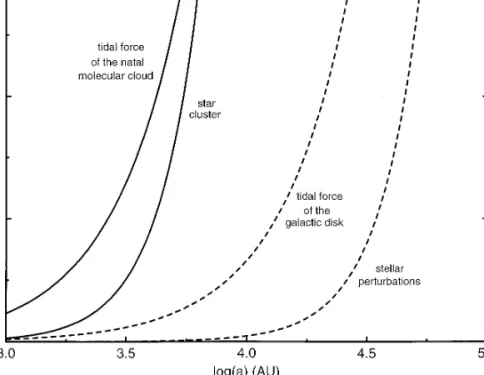
FIG. 2. Relative change in the perihelion distance of a comet as a function of its semimajor axis for different external perturbers. Dashed curves are for perturbers from the present galactic environment. Solid curves are for assumed perturbers in an early galactic environment.
ment similar to the current one, icy planetesimals scattered
S
Dq qD
N,tide5 0.329S
«t 2.2531025AU21D
22S
q 30 AUD
21/2by the jovian planets would have given rise to a loosely bound Oort cloud with an inner radius of ap 1.33 104
AU. We note that the definition of an inner radius does
S
a104AU
D
3/2.
(10)
not imply that no comets with smaller semimajor axes can be trapped in the Oort cloud. Since we introduced average values in Eq. (10), there will always be favorable circum-The error committed by averaging sine and cosine factors
stances to produce captures of comets with a&1.33104
in the above equation fortunately has only little influence
AU. Nevertheless, we should expect that the number of on the computed values of a. For instance, changes by
comets trapped in the Oort cloud falls off below that limit. about 50% in the product cos a sin 2f would lead to
From numerical experiments, Duncan et al. (1987) ob-changes of onlyp30%in the computed a.
tained a substantial fraction of Oort cloud comets with The dashed curves of Fig. 2 show the changeDq/q as a
ap3000–13,000 AU, which amounts to about two-thirds function of the semimajor axis a for stellar perturbations
of the total Oort cloud population in the range 3000–50,000 [Eq. (7)] and for the tidal force of the galactic disk in the
AU. Yet, this discrepancy with our computed inner radius present solar neighborhood [Eq. (10)]. From the plots we
cannot be considered to be very significant given the differ-see that changesDq p 0.5q due to the tidal force of the
ent procedures employed. Part of the discrepancy may galactic disk are reached for a semimajor axis ap 1.33
arise from small differences in the adopted numerical val-104AU. The effect of stellar perturbations is much smaller;
ues (for instance, the density of the galactic disk, the range the conditionDqp0.5q is reached only for ap3.43104
of initial q of the scattered comets). If we consider some AU. Therefore, the tidal force of the galactic disk plays,
extra effects, such as an enhanced role of Jupiter and at present, the major role in injecting comets into the
plane-Saturn in the scattering of bodies (cf. Section 5), the cap-tary region, which confirms previous results (e.g., Heisler
ture efficiency in the inner core may have decreased below and Tremaine 1986, Morris and Mueller 1986) and is in
the fraction estimated by Duncan et al. Therefore, we can good agreement with the observed maximum 1/a0 value
conclude that under the current galactic conditions the of the spike of original reciprocal semimajor axes shown
fraction of comets trapped in the range 3000–13,000 AU in Fig. 1.
p65%. The rest of the comet population would have and Uranus and Neptune were probably well on the way to reaching their present sizes and locations. That was been trapped in more loosely bound orbits with a *
13,000 AU. probably also the time when most of the residual solid
matter in the accretion zones of Jupiter and Saturn and a The picture of a loosely bound Oort cloud, however,
presents some difficulties with which to deal. The first significant fraction of the residual solid mass in the Uranus and Neptune zones were ejected (cf. Section 2).
difficulty has to do with the disrupting effect of penetrating
encounters with GMCs over the age of the Solar System Let us now analyze what would have been the conse-quences on the formation of the Oort cloud if the early (Napier and Staniucha 1982, Bailey 1983, Hut and
Tre-maine 1985). But there is a second important issue that Sun would have been within such a dense galactic environ-ment. Let us assume first that the Sun was within a molecu-we analyze below: No matter in which part of the planetary
region the residual planetesimals were originally located, lar cloud. The average density of a molecular cloud is about 50 H2molecules cm23(Blitz 1993), which corresponds to
Jupiter and Saturn were, at the end, the planets that took
control of the dynamical evolution of most bodies. And, a mass density ofrmcp2.5M(pc23. If we next assume that
the Solar System formed at a distance s(,Rmc) from the
as we discussed earlier, the probability that Jupiter and
Saturn placed a comet in a weakly bound, Oort-type orbit center of the cloud (assumed to be spherical of radius Rmc
and of uniform density), the tidal force acting on a body is very low.
at a radial distanceDs from the Sun is given by
4. THE EARLY GALACTIC ENVIRONMENT OF THE
SOLAR SYSTEM F5dF ds3 Ds5 2GMsDs s3 5 8 3fGrmcDs, (11) Near-infrared imaging surveys of nearby GMCs have
shed new light on the way stars form. Young stars appear where Msis the mass enclosed within the sphere of radius s. embedded in dense cores of gas (mainly molecular hydro- The rate of change of angular momentum of a comet at gen) and dust, which in itself is an indication that stars a distance r from the Sun is given by
form within molecular clouds (Lada et al. 1993, Lada 1995). Furthermore, they do not seem to form in isolation, but
dH dt 5Ft3r5 1 2
S
dF dsD
r 2sin 2hcosc, (12)in groups of different sizes and compactness, ranging from very poor clusters of a few members to very rich clusters of hundreds of stars. Kroupa (1995) raises the interesting
where Ftis the transverse component of the tidal force,h
issue of observations showing that the proportion of wide
is the angle betweenrand the direction from the Sun to binaries (separations from a few AU top1800 AU) among
the center of the natal molecular cloud,Ds5 r3 cosh, pre-main-sequence stars is about 1.5 times larger than on
andcis the angle between the plane containing the radius the main sequence. From this finding Kroupa concludes
vector r and the center of the molecular cloud and the that most galactic field stars may have formed as binary
comet’s orbital plane. systems in clusters of best-fit parameters: 200 binary
sys-We note that the drag force due to the comet’s motion tems and half-mass radius of 0.8 pc. Perturbations among
through the gas of the molecular cloud is negligible. For cluster binaries would lead to the dissolution of many pairs,
a comet nucleus of radius Rcand densityrc, and assuming
leaving the fraction of binaries of about 60% observed in
that Epstein’s drag regime applies (i.e., that the mean free galactic field stars.
path of the gas molecules is large as compared with the It is accordingly reasonable to propose that the Sun also
dimensions of the body), we can define the ‘‘stopping formed within a molecular cloud and, perhaps, a star cluster
time,’’ ts, i.e., the time required to reduce the comet’s
(we will leave aside here the intriguing and very exciting
velocity by a factor 1/e, as (see, e.g., Weidenschilling 1977) possibility that the Sun had a primitive companion that
escaped before the cluster dissolved). This primitive galac-tic environment could have lasted at most a few 107years,
ts5
rcRc
rmcv
, (13)
the time required for a GMC to dissipate in the galactic medium (Blitz 1993). If the Sun happened to form within
a rich cluster, then the residence time could have extended where v is the mean thermal velocity of the gas. If we introduce the numerical values Rc 5 105 cm, rc 5 0.5
to approximately a hundred million years, the average
life-time of open clusters (Lynga˚ 1982). Although a life-time span g cm23 for a standard comet nucleus, r
mc 5 2.5M( pc23
(Q1.7310222g cm23), andv5 3.53 104cm sec21(for a
of a few tens of millions to one hundred of millions of
years represents only a small fraction of the Solar System mean temperature of the molecular cloud of 10 K), we obtain ts 5 8.33 1021 sec (52.6 3 1014 years); i.e., ts is
age, it may nevertheless cover key episodes of its history
OORT CLOUD FORMATION AND PRIMITIVE GALACTIC ENVIRONMENT 113 consider the density of a core within the molecular cloud tive Sun’s neighborhood would have been ncl 5 ncl 3
Vclp15 stars pc22myr21.
of p104 H
2 cm23 we obtain a corresponding time ts 5
1.33 1012years, still longer than the age of the universe. We can make use of Eqs. (3) and (4) for stellar
encoun-ters. Even in an open cluster like the one assumed here, We can therefore neglect gas drag effects on the comet’s
motion with total confidence. the interstar distances will generally be much greater than
the comet’s semimajor axis at which perturbations by clus-Taking into account that
ter stars can decouple the orbit from the planetary region, provided that the considered time scale is not longer than p3 3 107 years, the average lifetime of a comet with a
dH5
S
GM(q2
D
1/2
dq
q , (14) of a few thousand AU under the gravitational control of
Neptune. The mean separation between cluster stars is
dQ(1/ncl)1/3Q8.43104AU, whereas the closest approach
and considering again that the tidal force of the natal
mo-to the Sun expected during t 5 3 3 107 years is D m 5
lecular cloud acts during a period N3 P, where P is the
(2nclt)21/2 Q6.93103 AU. Therefore, very few star
pas-comet’s orbital period and N is given by Eq. (1), then after
sages will be expected at distances smaller than the comet’s substituting these expressions into Eq. (12), we obtain for
distance, so we can still use Eq. (3) for distant encounters the change in the perihelion distance over N revolutions
(actually, if we consider the very close stellar encounters, the expression
the computed changeDvcwill be larger, so our result should
be considered as a lower limit). It may be argued that the impulse approximation described by Eq. (3), which
S
Dq qD
N,mc5 4 3 Ï2fGrmcr2NP coscsin 2h (GM(q)1/2 . (15)assumes the comet to be at rest during the star’s passage, breaks down for the low encounter velocities of cluster stars; however, Brunini and Ferna´ndez (1996) have found Substituting by the appropiate numerical values and
con-that the impulse formula is a good approximation, even in sidering averages kcos cl 5 2/f and ksin 2hl 5 2/3 we
the cases in which the encounter time is on the order of finally obtain
the comet’s orbital period. We accordingly use Eq. (3) for the time being to obtain order-of-magnitude estimates, though admitting that more accurate numerical
integra-S
Dq qD
N,mc53.65S
«t 2.2531025AU21D
22S
q 30 AUD
21/2(16) tions will be a more appropriate way to address this prob-lem in a follow-up study.
By introducing the numerical values discussed before in
S
a104AU
D
3/2.
Eqs. (3) and (4), we obtain From Eq. (16) we find that the tidal force of the natal
S
Dqq
D
N,cluster5 4.528S
«t 2.2531025AU21D
21S
q 30 AUD
21/2molecular cloud can remove comets from the planetary region for semimajor axes as small as a few 103AU. The
results are plotted in Fig. 2.
S
a104AU
D
5/2.
(17) Therefore, a galactic environment much more crowded
than the present one might have had dramatic
conse-quences in the buildup of the Oort cloud. A tightly bound Since the relative velocities within open clusters are about Oort cloud with a radius of a few thousand AU might be 30 times smaller than in the Sun’s neighborhood at present, a consequence of such an early environment where the the dynamical effect will be much stronger, which is con-Sun possibly formed. Since most stars tend to form in firmed by Eq. (17). According to these results, if the Sun clusters within molecular clouds, we consider this not to would have been a member of an open cluster like the be an ad hoc assumption, but based on strong observational one described here, the strong perturbations of other clus-grounds. We can further speculate that had the Solar Sys- ter stars would have decoupled comets from the planetary tem formed in a galactic environment like the current one, region for a of a few thousand AU (see Fig. 2).
far fewer comets in the Oort cloud would have survived
until the present epoch. 5. THE CONTRIBUTION OF THE JOVIAN PLANETS
Let us now assume that the Solar System formed within TO THE OORT CLOUD: A REASSESSMENT OF THE a cluster of stellar density ncl p 15 pc23, which is within ROLE PLAYED BY JUPITER AND SATURN the range observed in open clusters (Lynga˚ 1982). For a
cluster in virial equilibrium we find a rms relative velocity It has long been argued that the Uranus–Neptune region was the source of Oort cloud comets and that Neptune’s of Vclp1 km sec21. Therefore the stellar flux in the
primi-TABLE I perturbations, and to a lesser degree Uranus’s
perturba-Probability That a Given Jovian Planet Will tions, were the main driving force in transferring comets
Control the Dynamical Evolution of a Body from near-circular orbits within the planetary region to
Starting in Neptune’s Accretion Zone near-parabolic orbits (Safronov 1969, Ferna´ndez 1978).
The reason for this is that the typical energy change per Planet p
1
perihelion passage that a low-inclination comet
experi-Jupiter 0.60
ences under the gravitational control of Neptune (p2 3
Saturn 0.24
1025AU21) is somewhat smaller than the binding energies
Uranus 0.06
of Oort cloud comets (p3–6 3 1025 AU21). Therefore,
Neptune 0.10
a comet random walking in the energy space under the gravitational control of Neptune (or Uranus) is very likely to fall in the energy range of the Oort cloud before being
ejected. Conversely, Jupiter’s perturbations are so strong fore, p will rapidly increase for smaller heliocentric dis-tances and larger planet masses, the largest p being for Ju-(p1.5 3 1023 AU21) that comets under its gravitational
influence will very likely overshoot the Oort energy range piter.
Numerical simulations show that bodies starting at Nep-to a hyperbolic orbit. We now deem it necessary Nep-to
recon-sider some aspects of this scenario. tune’s zone indeed evolve in such a way that most of them end up ejected by Jupiter. For instance, numerical simula-As residual planetesimals of Neptune’s zone are
scat-tered, there is a statistical increase in the encounter velocity tions by Duncan et al. (1995) show that about one-third of objects starting in Neptune’s zone end up as visible
u due to Fermi’s acceleration mechanism (Arnold 1965),
and also due to secular perturbations by the other planets. Jupiter family comets. Ferna´ndez and Gallardo (1997) have repeated these calculations using O¨ pik’s two-body A body can be ejected in a parabolic orbit if the encounter
velocity reaches the value u5(Ï22 1)vcir, wherevciris algorithm and found very similar results. In particular, their
results show that almost 50%of the sample falls under the the (circular) orbital velocity at Neptune’s distance. Now,
before that happens the body’s perihelion can go down to gravitational control of Jupiter and is eventually ejected by this planet, unless a collision with a planet or the Sun Uranus’s orbit. The minimum perihelion distance qmin a
body can reach is occurs first. No more than 15–20%of the bodies starting
in Neptune’s influence zone continue under its control until they are ejected. And these are results for the current Solar
qmin5
(12U)2
112U2U2, (18) System: If we assume early conditions where Jupiter and
Saturn were already formed while Uranus and Neptune were still accreting material, the contribution of the two where U5u/vcir. Equation (18) shows us that for velocities
outermost planets turns out to be somewhat lower
(Ferna´n-U p 0.3, i.e., significantly smaller than that required for
dez and Ip 1981). Furthermore, if the birthplaces of Uranus escape, the body can reach Uranus’s zone.
and Neptune were closer to the Sun, and therefore to Once the body reaches Uranus’ zone, it can be subject
Jupiter and Saturn, as the numerical experiments of Fer-to strong perturbations by both Neptune and Uranus. Even
na´ndez and Ip (1984, 1996) show, a larger fraction of resid-though close encounters with Neptune could be more
prob-ual bodies of their accretion zones would fall under the able at the beginning, because one of the nodes of the
gravitational control of their closer giant neighbors Jupiter body’s orbit should be close to Neptune’s orbit, secular
and Saturn. The probability p1 that a body starting in a
perturbations by the planets will change the orientation of
low-inclination, low-eccentricity orbit in the accretion zone the nodes and apsidal line of the body’s orbit, so close
of Neptune falls under the dynamical control of a given interactions with either Uranus or Neptune can occur. The
jovian planet is given in Table I. The computed probabili-probabilities of close interactions with one of the planets
ties are average values for the different scenarios described can be expressed by O¨ pik’s (1951) equation
above. They have been derived from different results ob-tained analytically and numerically by Ferna´ndez (1978), Ferna´ndez and Ip (1981, 1984, 1996), and some new
numer-p5 t
2U fsin iuUxu
, (19)
ical experiments by means of O¨ pik’s two-body code. The scatter in the average probabilities is about 20%.
For bodies starting in Uranus’ zone we obtained results wheretis the radius of the cross section for strong
interac-tions and Ux is the component of the encounter velocity similar to the previous ones for Neptune’s zone.
As mentioned, comets scattered outward can be trapped in the radial direction.tis proportional to the gravitational
radius for collision expressed in units of the radius of the in the Oort cloud. Let p2be the probability that a comet
random walking in the energy space falls in the narrow planet’s heliocentric orbit (assumed to be circular).
There-OORT CLOUD FORMATION AND PRIMITIVE GALACTIC ENVIRONMENT 115
TABLE II DE5 (1/a)par1 (1/a)l, where (1/a)par5 0 is the energy
Typical Energy Changes of Near-Parabolic of a parabolic comet and El5 2(1/a)lis the largest binding
Comets in Low-Inclination Orbits energy (minimum semimajor axis) of a scattered comet
that has its perihelion decoupled from the planetary region
Planet «t(AU21)
before ejection by planetary perturbations. Therefore,
al 51/DE is the minimum semimajor axis of Oort cloud
Jupiter 1.5031023
Saturn 3.4931024 comets, so comets diffusing to semimajor axes a.a
lwill
Uranus 3.6731025
be incorporated into the Oort cloud (since we work with
Neptune 2.2531025
average values, al cannot be taken as a sharp boundary;
in actuality we should expect to have a transition region between no captures and full captures).
Results of poortas a function of the minimum semimajor
energy rangeDE of Oort cloud comets. If we assume that axis alare shown in Fig. 3. We can see that for the classical
the distribution of energy changes per perihelion passage Oort cloud, whose observed width isDEp631025AU21
of near-parabolic orbits follows a Gaussian distribution (a
l p 17,000 AU) (cf. Section 3), Neptune is clearly the
(Kerr 1961), the probability p2is approximately given by main driving force in placing bodies there, in agreement
with previous results (Safronov 1969, Ferna´ndez 1978). This is because even though about 60%of the planetesimals
p25 1 2f
E
DE 0 e 2z2/2dz, (20)of Neptune’s accretion zone fall under the gravitational control of Jupiter (cf. Table 1), the latter planet has a very where z5Ï3/23 «/«t(Ferna´ndez 1981),«is the energy low probability of placing bodies in the Oort cloud (less
change per perihelion passage, and«tis the standard devia- than 2%). The situation changes when we move to more
tion of the Gaussian energy distribution (that we adopted tightly bound models of the Oort cloud, which means a as the typical energy change). The adopted values of«tfor widening of DE. For instance, for ap 4000 AU Saturn,
near-parabolic comets in low-inclination orbits (random and to a lesser degree Jupiter, places in the Oort cloud inclinations in the range 0, i, 308) and perihelia close a significant fraction of the total mass (about 30%). For to the jovian planet controlling the dynamical evolution are extremely compact models of the Oort cloud (a p 103
listed in Table II. They are taken from Ferna´ndez (1981). AU), Saturn and in second place Jupiter become the main The values quoted in Table II do not take into account contributors of bodies to the Oort cloud. This was pointed close encounters; however, Ferna´ndez (1981) showed that out earlier by Weissman (1994), who suggested that a wider close encounters played a very important role in the ejec- energy range for the Oort cloud would result in a greater tion process, mainly when low-inclination orbits are consid- efficiency of trapping comets there as compared with ejec-ered. The distribution of energy changes takes the form tion, in particular for the case of Saturn. According to of a Gaussian distribution with long tails corresponding to Weissman, if this greater trapping efficiency were also ap-strong perturbations (Everhart 1968). Ferna´ndez showed plied to other solar systems, it would help to explain the that in this case typical energy changes are about three to seeming scarcity of interstellar comets.
four times larger than the values quoted in Table II. To
make allowance for close encounters, we computed p2from 6. DISCUSSION
Eq. (20) taken as the standard deviation «*t 5 3.53 «t.
We should bear in mind that this is a rough approximation, As mentioned, one of the problems with the existence since the«distribution departs now from a Gaussian one of a loosely bound Oort cloud is its survival during billions because of the long tails. Nevertheless, our results show a of years (e.g., Napier and Staniucha 1982, Bailey 1983). fairly good agreement with those found numerically by Hut and Tremaine (1985) have found a half-life of 33109
Ferna´ndez and Ip (1981), so we do not expect variations years for a comet with a 5 25,000 AU, which is a less by more than a factor 2 to 3 in more detailed studies stringent constraint. Yet this still leaves little energy range (though we deem it extremely interesting to do this in the for building up a comet cloud, since comets must have
near future). a*17,000 AU or E* 263 1025AU21to be effectively
The probability that a given jovian planet will place a decoupled from the planetary region before ejection by body coming from Neptune’s accretion zone in the Oort planetary perturbations (cf. Fig. 1). But, on the other hand,
cloud is expressed as for a* 25,000 AU or E* 243 1025, onlyp20%of the
comets will survive throughout the Solar System lifetime.
poort5p13p2. (21) Therefore, the storage of comets in the Oort cloud will be
much more efficient for the energy range 26 3 1025 &
E & 24 3 1025 AU21, i.e., for a narrow energy width
FIG. 3. Probability of placing a body coming from Neptune’s accretion zone in the Oort cloud by a given jovian planet, as a function of the minimum semimajor axis of the Oort cloud reservoir (the smaller the minimum semimajor axis, the wider the energy range of the Oort cloud reservoir).
DEp 2 3 1025 AU21, of the order of Neptune’s typical powerful stellar wind coming from the forming star meets
the surrounding envelope. Yet the formed comets would energy change. To overcome this difficulty, the existence
of an inner core of the Oort cloud has been postulated as have escape velocities, so this procedure would produce interstellar comets rather than a bound core or shell of an additional reservoir (Hills 1981, Bailey 1983, Duncan
et al. 1987). As comets with smaller binding energies are comets. Duncan et al. (1987) did obtain a substantial inner Oort cloud population with semimajor axes in the range ejected when the Solar System meets a strong perturber
(for instance, a GMC), other comets from the inner core p3000–20,000 AU (about 80% of the total population), though their results might somewhat depend on the initial gain energy (i.e., they are pumped up to occupy more
loosely bound orbits), so there is continuous replenishment conditions of the comets scattered to the Oort cloud (cf. Section 3). For instance, if the initial perihelion distances of the outer (or classical) Oort cloud. This is not quite a
steady-state process since the inner core will also be de- were concentrated around 5–10 AU, as discussed in Sec-tion 5, then the fracSec-tion of comets placed in the Oort region pleted with time, though its dynamical lifetime may
sub-stantially exceed the age of the Solar System. with ap3000–20,000 AU would drop drastically; however, our proposal for the formation of an inner core appears as We next analyze how a massive inner core could form.
In situ formation (e.g., Biermann and Michel 1978) encoun- a natural by-product of the formation of the Solar System within a dense galactic environment.
ters the difficulty of the extremely low density of the nebula
medium at such large heliocentric distances. Grains are not Gaidos (1995) also considered the formation of a tightly bound Oort cloud at a p 3000 AU in a dense galactic expected to agglomerate in comet-sized bodies at distances
greater than a few hundred AU (Ferna´ndez and Gallardo environment. But he argued that the same strong forces that formed the comet cloud (either the tidal force of the 1997). Cameron (1973) tried to explain the formation of
comets in satellite nebulae of the solar nebula moving in natal molecular cloud or cluster stars) disrupted it very quickly; however, because of the short lifetime of a dense highly elliptic orbits, while Hills (1982) considered that
grains might have coagulated into comets at distances galactic environment, it is very likely that the core of tightly bound comets will survive throughout this early stage. Ex-1–5 3 103 AU under the combined action of radiation
pressure from the proto-Sun and neighboring protostars. ternal perturbers will tend to thermalize the comet cloud population, so the probability of lowering the cometary Bailey (1987) tried to address the problem of the low
den-sity of the nebular material at such distances, arguing that perihelia back to planetary distances will decrease to a very small value; for instance, for a thermalized comet comets could form at the shock front produced when the
OORT CLOUD FORMATION AND PRIMITIVE GALACTIC ENVIRONMENT 117 population the probability that the perihelion distance de- have lifetimes significantly longer, perhaps on the order of a few hundreds of millions of years. Therefore, to answer creases to q,qL, where qLis the radius of the planetary
region, isp2qL/a (Hills 1981). Comets in the core can also this question we have to know the time scales of formation
of the jovian planets, since the massive scattering of resid-gain energy to positive values (hyperbolic orbits). If we
assume that the Solar System remained within a star cluster ual planetesimals accompanied the latest stages of their formation. The gaseous composition of Jupiter and Saturn duringDT5108years, the condition for escape is that the
rms change in the comet’s velocity,Dv
*[cf. eq. (4)] reaches strongly suggests a short formation time scale, probably significantly shorter than the dissolution time of the natal the value
molecular cloud. With respect to Uranus and Neptune, the answer is more uncertain. Their non-negligible content of
Dv*pvesc5
S
2GM(
r
D
1/2
, (22) hydrogen and helium suggests that they were able to grow into massive objects on a short time scale, so they could start to scatter bodies while the Sun was still within the wherevescis the escape velocity at distance r. Again, if we natal molecular cloud.
take an averagekrl51.5a, we find that the above condition
3. Since stronger external perturbers widen the energy is fulfilled for ap5800 AU. Therefore, comets in an inner
range of the Oort region, did Jupiter and Saturn play a core with a & 5000 AU would probably have survived
more significant role in the buildup of the Oort cloud than during the residence time in an open cluster. The condition
thought before? As shown, the answer may be positive; in for survival in the natal molecular cloud is less stringent.
particular, Saturn might have been a greater contributor For instance, if the Solar System remained there for 30
than Jupiter. myr, the total energy change would beD(1/a)p531026
4. Did Saturn and Jupiter place in the Oort cloud a AU21(see Appendix), which is considerably smaller than
significant fraction of residual planetesimals from their own the binding energy of the comets (p1024AU21).
accretion zones? The answer to this question also depends We should bear in mind that the scenario described in
on how efficient the process of accretion of solid matter of this paper is only one among a wide range of possible
these mostly gaseous planets was. Models of their internal scenarios, of which the formation of the comet cloud
structure show that Jupiter and Saturn may possess inner around an isolated Sun constitutes only an extreme case.
cores composed of silicates and ices of about 15M%each The Solar System could well have formed in a molecular
(Hubbard 1989), so most of the accreted material was gas-cloud more or less dense than the one adopted here, as
eous hydrogen and helium. The probable presence of ex-well as in a more compact star cluster or in near isolation.
tended gaseous envelopes might have increased the effi-We have tried to describe average conditions derived from
ciency of capture of planetesimals by these two planets, via observations of star-forming regions. This discussion opens
gas drag, fragmentation, and dissolution of bodies crossing up new possibilities not foreseen until now. After finishing
through their envelopes (Pollack et al. 1986). Still, it is this manuscript, I received a preprint from Eggers et al.
probable that a significant fraction of the interacting bodies (1997) discussing the capture of intracluster comets by the
were finally ejected by the powerful gravitational interac-early Sun during a stage in which the Sun was assumed to
tions of Jupiter and Saturn. If Jupiter and Saturn were be within an open cluster.
able to place a large number of bodies from their own accretion zones in a more tightly bound Oort cloud, this
7. CONCLUDING REMARKS would imply a significant mixing of bodies from different
parts of the planetary region, thus providing a physically In building a new scenario for the formation of a more
heterogeneous population of Oort cloud comets, as bodies tightly bound comet cloud, several key questions arise
re-formed closer to the Sun would tend to have different lated to the conditions of formation of the Oort cloud and
proportions of volatiles and rock (in a sense, Oort’s original the primitive galactic environment of the Solar System:
idea that the asteroid belt was the source of comets might now be partially vindicated if bodies from the accretion 1. Did the Solar System form in a molecular cloud and/
or an open cluster? As seen before, observations tend to zone of Jupiter were stored in a very compact Oort cloud). Future observations of the chemical nature of new comets favor this formation scenario as the most common one,
since molecular clouds are observed to be star factories, will be very relevant to determining their birthplaces in the planetary region. If we could find new comets that we are and protostars and young stars usually appear in clumps
that lead to open clusters and associations. able to show, from their chemical composition, were formed in the Jupiter–Saturn region, then important aspects of the 2. Did the buildup of the Oort cloud take place while
the Sun was still within the natal molecular cloud? As galactic environment that surrounded the early Solar Sys-tem would be highlighted. Comets become, once more, im-mentioned, molecular clouds have an average lifetime of
APPENDIX: ENERGY CHANGE OF A COMET Biermann, L., and K. W. Michel 1978. On the origin of cometary nuclei in the presolar nebula. Moon Planets18,447–464.
ASSUMING THE SUN TO BE WITHIN A
Blitz, L. 1993. Giant molecular clouds. In Protostars and Planets III
MOLECULAR CLOUD
(E. H. Levy and J. I. Lunine, Eds.), pp. 125–162, Univ. of Arizona Press, Tucson.
Let us assume the Sun to be within a molecular cloud of radius Rmc
and uniform densityrmc. For simplicity let us also assume that the molecu- Brunini, A., and J. A. Ferna´ndez 1996. Perturbations on an extended lar cloud has a spherical shape and the Sun is at a distance s(,Rmc) from Kuiper disk caused by passing stars and giant molecular clouds. Astron. the center. A comet of semimajor axis a and eccentricity e will experience Astrophys.308,988–994.
a change d(1/a)/dt given by the Gauss equation Byl, J. 1983. Galactic perturbations of nearly-parabolic cometary orbits.
Moon Planets29,121–137.
Cameron, A. G. W. 1973. Accumulation processes in the primitive solar
d(1/a) dt 5 22a 23/2e21/2
S
R ae sin f Ï12e21B a2Ï 12e2 rD
, (23) nebula. Icarus18,407–450.Delsemme, A. H. 1987. Galactic tides affect the Oort cloud: An observa-wheree5GM(, R and B are the radial and tranverse components of tional confirmation. Astron. Astrophys.187,913–918.
the perturbing force, and f and r are the true anomaly and the heliocentric Duncan, M. J., H. F. Levison, and S. M. Budd 1995. The dynamical distance of the comet, respectively. The tidal force acting on the comet
structure of the Kuiper belt. Astron. J.110,3073–3081. will beF58/3fGrmcr cosh(s/s), so we have R5F coshand B5F
Duncan, M., T. Quinn, and S. Tremaine 1987. The formation and extent sinhcosc, where, as before (cf. Section 4),his the angle betweenF
of the Solar System comet cloud. Astron. J.94,1330–1338. andr, andcis the angle between the plane formed byrandFand the
Eggers, S., H. U. Keller, P. Kroupa, and W. J. Markiewicz 1997. Origin comet’s orbital plane.
and dynamics of comets and star formation. Planet. Space Sci., in For a quasiparabolic orbit we haveÏ12e2pÏ2q/a. If we average
press.
d(1/a)/dt over the comet’s orbital period P, the first term on the right
side of Eq. (23) vanishes (the energy changes in the outgoing and incoming Everhart, E. 1968. Change in total energy of comets passing through the leg of the orbit cancel out), so Eq. (23) reduces to Solar System. Astron. J.73,1039–1052.
Ferna´ndez, J. A. 1978. Mass removed by the outer planets in the early Solar System. Icarus34,173–181.
K
d(1/a) dtLP
5 22Ï2e 21/2Ï q1 PE
P 0 Br dt. (24) Ferna´ndez, J. A. 1980. Evolution of comet orbits under the perturbing
influence of the Giant Planets and nearby stars. Icarus42,406–421. Making the appropriate substitutions in Eq. (24) we obtain Ferna´ndez, J. A. 1981. New and evolved comets in the Solar System.
Astron. Astrophys.96,26–35.
Ferna´ndez, J. A. 1992. Comet showers. In Chaos, Resonance and
Collec-K
d(1/a) dtLP
5 2 8 3Ï2fGe 21/2 q1/2r mcsin 2hcosc. (25)tive Dynamical Phenomena in the Solar System (S. Ferraz-Mello, Ed.),
pp. 239–254. Kluwer, Dordrecht.
Ferna´ndez, J. A., and T. Gallardo 1997. The origin of comets. In Asteroids, Taking averagesksin 2hl5 62/3 andkcoscl52/f, a densityrmc5
Comets, Meteors 96. COSPAR, in press.
2.5M( pc23, and q 530 AU, we finally obtain for the energy change
Ferna´ndez, J. A., and W.-H. Ip 1981. Dynamical evolution of a cometary D(1/a) duringDT(@P)
swarm in the outer planetary region. Icarus47,470–479.
Ferna´ndez, J. A., and W.-H. Ip 1983. On the time evolution of the com-D(1/a)5 65.031026
S
DT30 myr
D
AU21. (26)
etary influx in the region of the terrestrial planets. Icarus54,377–387. Ferna´ndez, J. A., and W.-H. Ip 1984. Some dynamical aspects of the accretion of Uranus and Neptune: The exchange of orbital angular
ACKNOWLEDGMENTS
momentum with planetesimals. Icarus58,109–120.
Ferna´ndez, J. A., and W.-H. Ip 1991. Statistical and evolutionary aspects I thank Paul Weissman who, as a referee, made very useful comments
of cometary orbits. In Comets in the Post-Halley Era (R. L. Newburn, and remarks that helped to improve the presentation of the results,
Jr., et al., Eds.), pp. 487–535. Kluwer, Dordrecht. and Soenke Eggers for pointing out an error in an earlier version of
the manuscript. Ferna´ndez, J. A., and W.-H. Ip 1996. Orbital expansion and resonant trapping during the late accretion stages of the outer planets. Planet.
Space Sci.44,431–439.
REFERENCES
Gaidos, E. J. 1995. Paleodynamics: Solar System formation and the early environment of the Sun. Icarus114,258–268.
Arnold, J. R. 1965. The origin of meteorites as small bodies. II. Astrophys.
J.141,1536–1547. Heisler, J., and S. D. Tremaine 1986. The influence of the galactic tidal field on the Oort comet cloud. Icarus65,13–26.
Bahcall, J. N. 1984. Self-consistent determination of the total amount of
matter near the Sun. Astrophys. J.276,169–181. Hills, J. G. 1981. Comet showers and the steady-state infall of comets from the Oort cloud. Astron. J.86,1730–1740.
Bailey, M. E. 1983. The structure and evolution of the Solar System
comet cloud. Mon. Not. R. Astron. Soc.204,603–633. Hills, J. G. 1982. The formation of comets by radiation pressure in the outer protosun. Astron. J.87,906–910.
Bailey, M. E. 1987. The formation of comets in wind-driven shells around
protostars. Icarus69,70–82. Hubbard, W. B. 1989. Structure and composition of Giant Planet interiors. In Origin and Evolution of Planetary and Satellite Atmospheres (S. K.
Biermann, L. 1978. Dense interstellar clouds and comets. In Astronomical
Atreya, J. B. Pollack, and M. S. Matthews, Eds.), pp. 539–563. Univ.
Papers Dedicated to Bengt Stro¨mgren (A. Reiz and T. Anderson, Eds.),
OORT CLOUD FORMATION AND PRIMITIVE GALACTIC ENVIRONMENT 119
Hubbard, W. B, M. Podolak, and D. J. Stevenson 1995. The interior of Napier, W. M., and S. V. M. Clube 1979. A theory of terrestrial catastro-phism. Nature282,455–459.
Neptune. In Neptune and Triton (D. P. Cruikshank, Ed.), pp. 109–138.
Univ. of Arizona Press, Tucson. Napier, W. M., and M. Staniucha 1982. Interstellar planetesimals. I. Dissi-pation of a primordial cloud of comets by tidal encounters with nebulae. Hut, P., and S. Tremaine 1985. Have interstellar clouds disrupted the
Mon. Not. R. Astron. Soc.198,723–735. Oort comet cloud? Astron. J.90,1548–1557.
Oort, J. H. 1950. The structure of the cloud of comets surrounding the Kerr, R. H. 1961. Perturbations on cometary orbits. In Proceedings, 4th
Solar System and a hypothesis concerning its origin. Bull. Astron. Inst.
Berkeley Symposium of Mathematical Statistics and Probability, Vol.
Neth.11,91–110. 3, pp. 149–164. Univ. of California Press, Berkeley.
O¨ pik, E. J. 1951. Collision probabilities with the planets and the distribu-Kroupa, P. 1995. Inverse dynamical population synthesis and star
forma-tion of interplanetary matter. Proc. R. Irish Acad.54(A), 165–199. tion. Mon. Not. R. Astron. Soc.277,1491–1506.
Pollack, J. B., O. Hubickyj, P. Bodenheimer, J. J. Lissauer, M. Podolak, Kuijken, K., and G. Gilmore 1989. The mass distribution in the galactic
and Y. Greenzweig 1996. Formation of the Giant Planets by concurrent disk—III. The local volume mass density. Mon. Not. R. Astron. Soc.
accretion of solids and gas. Icarus124,62.
239,651–664.
Pollack, J. B., M. Podolak, P. Bodenheimer, and B. Christofferson 1986. Kuiper, G. P. 1951. On the origin of the Solar System. In Astrophysics
Planetesimal dissolution in the envelopes of the forming, Giant Planets. (J. A. Hynek, Ed.), pp. 357–427. McGraw–Hill, New York.
Icarus67,409–443. Lada, C. J. 1995. The formation and early evolution of stars: An
observa-Safronov, V. S. 1969. Evolution of the Protoplanetary Cloud and
Forma-tional perspective. In Molecular Clouds and Star Formation (C. Yuan
tion of the Earth and the Planets. Israel Program for Scientific
Transla-and J. You, Eds.), pp. 1–46. World Scientific, Singapore.
tions, Jerusalem. Lada, E. A., K. M. Strom, and P. C. Myers 1993. Environments of star
Stern, S. A. 1991. On the number of planets in the outer Solar System: formation: Relationship between molecular clouds, dense cores and
Evidence of a substantial population of 1000-km bodies. Icarus90,
young stars. In Protostars and Planets III (E. H. Levy and J. I. Lunine,
271–281. Eds.), pp. 125–162. Univ. of Arizona Press, Tucson.
Tremaine, S. 1991. On the origin of the obliquities of the outer planets. Lissauer, J. J. 1987. Timescales for planetary accretion and the structure
Icarus89,85–92. of the protoplanetary disk. Icarus69,249–265.
Van Woerkom, A. J. J. 1948. On the origin of comets. Bull. Astron. Inst. Lissauer, J. J., J. B. Pollack, G. W. Wetherill, and D. J. Stevenson 1995.
Neth.10,445–472. Formation of the Neptune system. In Neptune and Triton (D. P.
Cruik-Walter, F. M., A. Brown, R. D. Mathieu, P. C. Myers, and F. J. Vrba shank, Ed.), pp. 37–108. Univ. of Arizona Press, Tucson.
1988. X-ray sources in regions of star formation. III. Naked T Tauri stars Lynga˚, G. 1982. Open clusters in our Galaxy. Astron. Astrophys.109,
associated with the Taurus–Auriga complex. Astron. J.96,297–325. 213–222.
Weidenschilling, S. 1977. Aerodynamics of solid bodies in the Solar Sys-Lyttleton, R. A., and J. M. Hammersley 1963. The loss of long-period tem. Mon. Not. R. Astron. Soc.180,57–70.
comets from the Solar System. Mon. Not. R. Astron. Soc.127,257–272.
Weissman, P. R. 1979. Physical and dynamical evolution of long-period Marsden, B. G., and G. V. Williams 1996. Catalogue of Cometary Orbits, comets. In Dynamics of the Solar System (R. L. Duncombe, Ed.), IAU
11th ed. Symp. 81, pp. 277–282. Reidel, Dordrecht.
Matese, J. J., P. G. Whitman, K. A. Innanen, and M. J. Valtonen 1995. Weissman, P. R. 1994. Why are there no interstellar comets? Bull. Am. Periodic modulation of the Oort cloud comet flux by the adiabatically Astron. Soc.26,1021.
changing galactic tide. Icarus166,255–268. Wetherill, G. W. 1975. Late heavy bombardment of the moon and terres-Morris, D. E., and R. A. Mueller 1986. Tidal gravitational forces: The trial planets. Proc. 6th Lunar Sci. Conf.2,1539–1561.
infall of ‘‘new’’ comets and comet showers. Icarus65,1–12. Zuckerman, B., T. Forveille, and J. H. Kastner 1995. Inhibition of Giant-Mottmann, J. 1977. Origin of the late heavy bombardment. Icarus31, Planet formation by rapid gas depletion around young stars. Nature
373,494–496. 412–413.