Prairie Crop Diversification
Elwin G. Smith
Research Scientist, Agriculture and Agri-Food Canada, Lethbridge, AB
Douglas L. Young
Professor, Washington State University, Pullman
Robert P. Zentner
Research Scientist, Agriculture and Agri-Food Canada, Swift Current, SK
The views expressed are those of the authors and not of Agriculture and Agri-Food Canada.
The Issue
he Canadian prairies traditionally have been dominated by spring wheat production. Crop diversification is now being advocated to enhance farm-level risk management, ecological benefits, nutrient cycling, and pest and disease control, and to reduce the farm economy’s reliance on income from a single crop. There has always been interest in diversifying away from wheat, but until recently, economically feasible alternatives have been limited, and government policies may have constrained the shift to other crops. Knowing the impact of prices and policies on crop diversification is essential to understanding producer response and to determining strategies to enhance cropping diversity.
Implications and Conclusions
he main factor that has driven recent cropping diversification on the prairies has been the higher prices of canola and pulse crops relative to the price of wheat. During the 1990s, the response of producers to these relative prices increased, leading to greater cropping diversity. The research reported here did not determine the causes of the increased responsiveness, but there are three feasible hypotheses. First, producers have become more market oriented with the publication of the Pool Return Outlook (projected wheat prices) by the Canadian Wheat Board and with greater knowledge of fixed-price contracts for canola
T
T
ß
Current
Agriculture, Food
& Resource Issues
and pulse crops. Second, there is less reliance on commodity-based government programs. Finally, emerging technologies for alternative crops increased the relative net returns from such crops, however, there was no evidence of increased gross returns from alternative crops relative to wheat over time. The main impact of government programs on cropping diversity was through the impact on relative farm-gate prices. Transport policies (the Crow rate and the Western Grain Transportation Act [WGTA]) reduced the relative price of high-valued crops (canola, pulse crops) to wheat and thereby reduced diversity. The Gross Revenue Insurance Program (GRIP) reduced cropping diversity, most likely because it favoured wheat production. The Lower Inventories for Tomorrow (LIFT) program in 1970 also had an effect on cropping diversity.
Background and Objectives
limate is a major determinant of cropping systems. The Canadian prairie has three fairly distinct agro-ecological regions: the semi-arid, short-grass prairie, the wetter, tall-grass prairie, and the moist parkland. The parkland of the northern and eastern prairies is generally not well suited to crops requiring heat and some dryness, such as durum wheat and lentils, but is conducive to continuous cropping and the production of canola, barley, and field peas. The warmer and more arid short-grass prairie of southwestern Saskatchewan and southeastern Alberta generally requires summerfallow to enhance soil moisture reserves and reduce yield risk, and is not well suited to growing cooler season crops such as canola. The intermediate
C
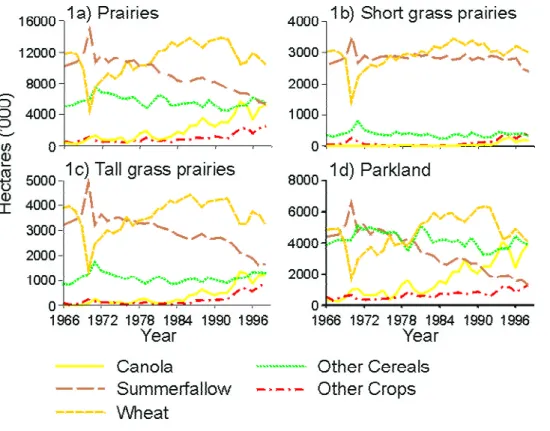
tall-grass prairie can grow most crops, and summerfallow is less of a necessity. In the past decade, there has been increased production of alternative crops, primarily canola and pulses, in place of cereal grains, and a reduction in summerfallow (figure 1). The agricultural industry has an interest in knowing whether this trend will continue, and in understanding the major factors driving changes in cropping systems.
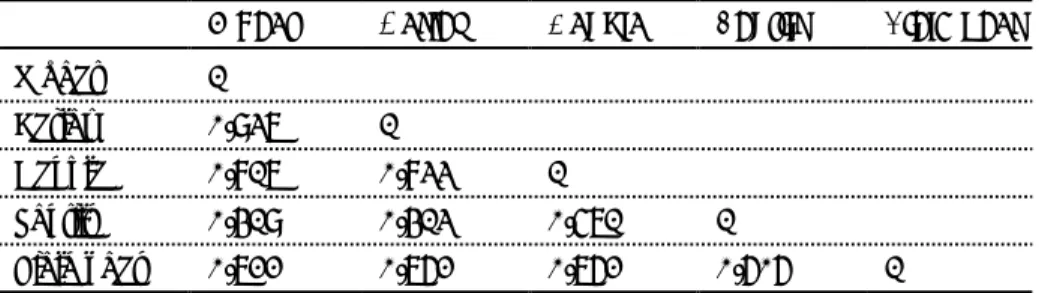
Diversification into alternate crops to reduce income risk has been found to have little effect on farm-level risk because returns from many crop enterprises are highly and positively correlated (Turvey and Driver, 1987). On the Canadian prairies, the real price of wheat has been highly correlated with the real prices of barley, canola, and field peas (table 1). Lentils offer the greatest opportunity for enterprise diversification to reduce income risk. Weisensel and Schoney (1989) found that inclusion of lentils in the crop mix depended on producer risk preference and income level.
Table 1 Real Price Correlations (1966-1998)
Wheat Barley Canola Lentils Field peas
Wheat 1
Barley 0.937 1
Canola 0.817 0.833 1
Lentils 0.419 0.413 0.571 1
Field peas 0.722 0.762 0.762 0.606 1
Acreage response models have been used to study cropping changes in the prairies due to changes in relative prices and policy (Clarke and Klein, 1992; Meilke, 1976). Acreage response models typically have not been successful in studying cropping diversity (Just and Schmitz, 1989). To determine cropping diversity, an alternative approach is required because acreage response models are for major crops and seldom include lower acreage crops that are important in measuring diversity.
Government programs, through altering and truncating the price and yield distributions of crops, can affect cropping decisions (von Massow and Weersink, 1993). The impact of government programs on cropping diversity will depend on whether major crops (wheat for example) are preferentially treated. Government programs can be expected to favour major crops because benefits will accrue to a larger number of producers.
The objectives of this paper are: (1) determine crop diversity across the Canadian prairies and within three climatic agro-ecological regions (short-grass prairie, tall-grass prairie, parkland), (2) use the determined diversity to estimate regional diversity response functions, (3) test if diversity response has increased in recent years corresponding with increased reliance on markets, and (4) test whether government programs have had an impact on cropping diversity.
Methods and Data
Diversity
To measure cropping diversity on the prairies, the multitude of crops produced are condensed into a single value. The Gini coefficient is used as the single-valued index of cropping diversity. Gini coefficients are commonly used to measure the concentration of personal income (Yotopoulos and Nugent, 1976) or to measure industry concentration (Hackbert and Anderson, 1975). A concentration ratio of wheat, the major crop, was not used because it would not reflect changes that have occurred in all other crops. A Gini coefficient value of zero indicates complete diversity (or equal crop concentration), with equal area in each crop, and a value of one indicates complete concentration in one crop. For crop production and discrete intervals, the Gini coefficient is approximated by:
GC
=
1
−
a
ia
i−1(
)
(
a
i−1c
i−1+
a
ic
i)
i=1 N∑
100
2where aiis the cumulative percentage of the crops of interest to interval i; ci is the percentage
of cumulative cropped area to interval i; i is the crop interval; and N is the total number of intervals or crops. The denominator in the second term is divided by 1002 because crops and
crop area are in percentage terms.
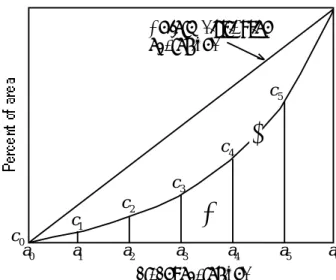
Figure 2 provides a graphical description of how the Gini coefficient is calculated. Six crops are illustrated, with the sixth crop occupying more cropped area than any of the other five. The curved line c0– c6 shows the cumulative cropped area for the six crops. Defining
the lens-shaped area between the diagonal and c0– c6 as area I, the area under the curve
Figure 2 Gini coefficient derivation for cropping concentration
c
0c
1c
2c
3c
4c
5c
6a
1a
0a
2a
3a
4a
5a
6Uniform distribution
of cropland
Percent of cropland
I
U
T
c0– c6 as U, and the total area under the diagonal as T, then the Gini coefficient can be
defined as I/T, or 1-U/T. As the lens-shaped area I decreases, cropping diversity increases, and as area I approaches T, cropping becomes concentrated in one crop.
The Gini coefficient in this analysis was calculated using provincial regional crop reporting data for the period 1966 to 1998. The data were aggregated to the short-grass prairie, tall-grass prairie, parkland, and the entire Canadian prairie. Twelve crops or land-use methods were included: barley, canary seed, canola, field peas, flax, lentils, mustard, oats, rye, summerfallow, sunflower, and wheat. Recently there has been a downward trend in wheat and summerfallow area and an increase in canary seed, canola, field peas, lentils, and mustard (figure 1).
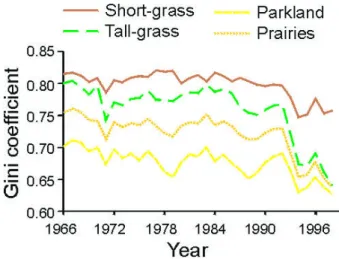
Cropping diversity was fairly constant until the 1980s, with the exception of an increase in diversity in the early 1970s that can be attributed to the LIFT program. Diversity then increased dramatically (a lower Gini coefficient) during the 1990s. Wheat was the dominant crop and the major determinant of the Gini coefficient over the entire time period because the majority of area was allocated to wheat production. Crop diversity was greatest in the parkland and least in short-grass prairie (see figure 3). This pattern was expected given the more favourable climate for diverse production in the parkland and the dominance of summerfallow in the short-grass prairie. The trend in cropping diversity was similar across regions but changes were least in the short-grass prairie. Periods of reduced diversity (1996) coincided with periods of high relative wheat prices, when land was allocated back to wheat production. A major increase in diversity throughout the prairies began in 1993, and diversity appears to continue to increase. The increase in diversity was greatest in tall-grass prairie and least in short-grass prairie.
The apparent sudden decline in the Gini coefficient in the 1990s corresponded with increased area seeded to canola and pulse crops, and reduced wheat and summerfallow area (figure 1). This corresponds to a period of high canola prices relative to wheat prices, a prolonged period of declining wheat prices (figure 4), and, as previously indicated, an increased reliance on markets. New technologies and improved cultivars may have played a role, but there was no increase in canola or pulse crop yields relative to wheat. The 1990s also witnessed increased use of conservation tillage and direct seeding, less summerfallow, and the successful adoption of noncereal crops in longer crop rotations. Cropping systems that include canola, canary seed, field peas, lentils, mustard, flax, and more recently chickpeas, have replaced monoculture wheat–fallow.
Increased canola acreage was a major factor contributing to increased cropping diversity. In the parkland, increased diversification from canola is limited for agronomic reasons. Planting canola on the same land more often than one year in four is not recommended. Except for 1996, canola has been planted since 1993 on about one-quarter of the cropland in the parkland. Increased diversification in this region will require the production of crops other than canola and wheat.
The large decline in the Gini coefficient in the tall-grass prairie was primarily the result of increased area devoted to canola production. Increased plantings of canary seed, field peas, lentils, and mustard also contributed to the decline in the Gini coefficient. The tall-grass prairie was once considered marginal for canola production. Alternative production systems, new technologies, and possibly more favourable weather during the 1990s have resulted in this crop being successfully produced in the tall-grass prairie. In the short-grass prairie, summerfallow has declined and there has been a modest increase in alternate crops, including lentils, canola, and mustard.
Response Model
The model to predict the Gini coefficient measure of diversity over time is similar to a lagged-acreage response model. The diversity response model to estimate the Gini coefficient is:
GCt = 0+ 1GCt−1+ kEPtk i=1 k
∑
+ kDTt k EPtk i=1 k∑
+ 1WGSPt+ 2SPGPt+3GRIPt+ 4LIFT70+ 5LIFT71
where:
• GCt is the Gini coefficient in year t. • EPt
k is the expected price ratio of diversification crop k to wheat (k = barley, canola,
lentils/field peas). EPt
k is determined by a geometric lag of prices in the previous three time
periods – i.e., EPt k= 0.5Pt−1 k + 0.33Pt−2 k + 0.17Pt−3
k . Since prices are farm-gate, the impacts
of the Crow rate and WGTA, two-priced wheat, and feed freight assistance are reflected in the prices.
• DTt
k is a binary variable to capture if there has been a change over time in the diversity
response. The binary variable DT is equal to 1 from 1993 to1998 for barley:wheat and
canola:wheat and otherwise 0; it is equal to 1 from 1987 to 1998 for lentils:wheat and field peas:wheat and otherwise 0.
• WGSPt is a binary variable to capture the effect of the Western Grains Stabilization Plan.
The variable takes a value of one when the WGSP was in place and zero otherwise. WGSP was in effect from 1976 to 1991.
•
SPGP
t is a binary variable to capture the effect of the Special Grains Program. Thevariable takes a value of one when the SPGP was in effect in 1987 and 1987 and zero otherwise.
• GRIPt is the ratio of indemnities paid out to the premiums paid by producers during the
years GRIP was in place; otherwise the value of the variable is zero. GRIP was initiated in 1991 and was discontinued in 1995 in Saskatchewan and by 1996 in Manitoba and Alberta. The GRIP variable is a measure of the magnitude of the program net payments.
• LIFT70 is a binary variable to capture the effect of the LIFT program that was in place in
1970 to reduce grain inventories by encouraging increased summerfallow. LIFT also had an impact on cropping in 1971 – captured by the binary variable LIFT71 – because the
Decisions about what mix of crops to grow should be based on revenue from the crops rather than on prices alone. Yield trends for barley, canola, lentils, and field peas relative to wheat indicated no trend for lentils and peas, a slight upward trend for barley, and a slight but not significant downward trend for canola. Since relative crop yields were fairly constant over the time period studied, price should be a good indicator of the relative revenue from these crops.
The early 1990s saw increased production of canola and pulse crops in non-traditional growing regions. The binary variable for price response was included in the model to determine whether the relative price response has increased. For canola, the binary variable
Table 2 Gini Coefficient Estimates for the Prairies and Three Regions
Variable Prairies Short-grass
prairie Tall-grassprairie Parkland Intercept 0.7030 ** 0.8749 ** 0.6269 ** 0.7196 ** GCt-1 0.1024 -0.1222 0.2593 ** 0.1544 E (PB/PW) 0.0028 0.0312 -0.0304 0.0325 DE (PB/PW) 0.0702 0.0814 0.0868 0.0534 E (PC/PW) -0.0237 ** 0.0009 -0.0191 * -0.0301 * DE (PC/PW) -0.0495 ** -0.0456 ** -0.0590 ** -0.0331 E (PP/PW) -0.0005 0.0027 0.0018 0.0072 DE (PP/PW) -0.0048 ** -0.0035 ** -0.0071 ** -0.0080 _ WGSP -0.0005 0.0068 0.0023 -0.0080 _ SPGP 0.0022 -0.0106 0.0036 0.0008 GRIP 0.0062 ** 0.0028 0.0064 ** 0.0064 ** LIFT 0.0042 0.0053 0.0182 * 0.0132 LIFTt+1 -0.0214 ** -0.0169 * -0.0387 ** -0.0075 adjusted R2 D-H 0.94 -1.52 0.87 -2.02 0.97 -0.88 0.78 -0.90
GCt-1 is the Gini coefficient lagged one period; E (•) is expectations; PB is the price of barley ($/t);
PW is the price of wheat ($/t); DE (PB/PW) is equal to PB/PW for 1993-1998, otherwise 0; PC is the price of canola ($/t); DE (PC/PW) is equal to PC/PW for 1993-1998, otherwise 0; PP is the price of pulse crop ($/t); DE (PP/PW) is equal to PP/PW for 1987-1998, otherwise 0; the pulse crop price was lentils, except for the parkland, where it was field peas; WGSP (Western Grain Stabilization Program) equal to 1 from 1976 to 1991, otherwise 0; SPGP (Special Grains Program) equal to 1 in 1986 and 1987, otherwise 0; GRIP equals the ratio of payout to premium for 1991 to 1996, otherwise 0; LIFT is equal to 1 for 1970, otherwise 0. The superscripts following the values indicate significance: _ is 15%, * is 10%, and ** is 5%. There are 17 degrees of
freedom, and the Durbin’s h (D-H) statistics indicate no autocorrelation, except possibly for the short-grass prairie.
DT equals 1 for 1993 to 1998. The impact on the Gini coefficient from the relative canola price during this period is the sum of the and the coefficients for canola:wheat. If producers have become more responsive to the relative price of canola:wheat since 1993, the coefficient will be negative and significantly different from zero. Lentils and field peas were also split into two periods, prior to 1987 and 1987 to 1998. As with canola, total response of Gini coefficient to the relative price of pulses:wheat since 1987 will be the sum of the and the coefficients for the pulse crop. Producers have become more responsive to relative prices if the coefficient is negative and significantly different from zero.
Estimated diversity response functions for the prairies and for each region are reported in table 2. The adjusted R-Square values are high, and Durbin’s h statistic indicates an absence of autocorrelation, except possibly for the short-grass prairie. A negative value for the estimated coefficients indicates increased diversity, since the definition of the Gini coefficient indicates perfect diversity if the Gini coefficient value is zero.
The significance of crop price ratios as an explanation for diversity varied with region. An increase in the expected barley:wheat price ratio did not have a significant effect on cropping diversity in any of the regions. Area devoted to feed grain production remained fairly constant over time, and as a result barley has had little influence on cropping diversity.
The expected canola:wheat price ratio prior to 1993 increased cropping diversity in the Canadian prairie as a whole, the tall-grass prairie, and the parkland, but not in the short-grass prairie. The short-grass prairie had limited canola production prior to 1993, so the short-grass prairie result was expected. The moderately significant effect in the tall-grass prairie was not expected, because the tall-grass prairie has historically not been a major canola producing region.
Since 1993, all regions except the parkland have become more responsive to the expected
canola:wheat price ratio, with diversity increasing in response to a higher price ratio. Canola
has become more widely grown in the tall-grass prairie and short-grass prairie regions. The dramatic increase in canola and pulse crops in the 1990s could have been the result of increased price responsiveness on the part of producers. The Uruguay Round of trade talks, a lengthy period of declining real wheat prices, an increasing gap between the U.S. and Canadian farm prices for wheat, and the indication by the Canadian government that it could not continue to subsidize wheat production, all contributed to producers making a rational decision to produce less wheat and to find more profitable cropping options. The lack of an additional response of canola to prices since 1993 in the parkland could be due to the region nearing the agronomic limit of canola production.
The pulse crops used in the analysis were field peas in the parkland and lentils in the other regions. Lentils are not agronomically suited for the parkland. The lentil:wheat and field
pea:wheat price ratios were not simultaneously included in the estimation because of a high
correlation among the price ratios. The pulse crop:wheat price ratio prior to 1987 had no statistically significant effect on cropping diversity because the area of pulse crops was negligible before 1987. After 1987, an increasing pulse crop:wheat price ratio significantly
major lentil growing regions in the prairies. Field pea production has increased in all regions, though the largest increase was in the parkland.
The primary influence agricultural policies have had on cropping diversity on the Canadian prairies has been through relative commodity prices. Rail transport policy (Crow rate and WGTA) and two-price wheat altered the relative farm gate prices. Prior to 1995, rail transport policy favoured low-valued crops such as wheat and barley relative to high-valued crops such as canola and pulses, and thereby reduced cropping diversity. The coefficients on WGSP and SPGP are not statistically different from zero. This is expected because the programs determined payments after crops had been harvested. The coefficient on GRIP is statistically significant, suggesting that the program reduced cropping diversity for the Canadian prairie, tall-grass prairie, and the parkland. The fifteen-year average price used to compute insured price levels appears to have favoured wheat production; the indexed moving average wheat price for GRIP from 1991 through 1993 was above the expected market price. The coefficient on GRIP was not statistically significant in the short-grass prairie. In the short-grass prairie, wheat/summerfallow remains the dominant cropping system and GRIP had less impact on cropping decisions. The LIFT program in 1970 and the follow-up effect in 1971 were most significant in the tall-grass prairie. Participation in the LIFT program was lower in the parkland, and in the short-grass prairie wheat and summerfallow essentially switched area during the program.
Conclusions
hanges in the diversity of cropping systems on the Canadian prairies can be explained by changes in the prices of canola and pulse crops relative to the price of wheat. Barley prices had no impact on cropping diversity; canola prices had the greatest impact. Crop diversification and recent changes varied depending on the region, with drier regions diversifying less than moister regions. The responses to relative prices followed a similar pattern across regions, though the magnitudes differed. Producers have become more responsive to relative prices since the early 1990s, an indication of greater market reliance.
Government policies and programs have primarily affected cropping diversity through their effect on relative farm gate prices. GRIP reduced cropping diversity in all regions but the short-grass prairie. GRIP may have favoured wheat production through price or reduced risk, or it may have contributed to producers relying less on market signals and more on program signals. By the mid 1990s, with the termination of GRIP, market signals were becoming more important and producers altered their production systems accordingly. Programs with payments determined after crop harvest (WGSP) or that were short term (SPGP) had no impact on cropping diversity. Additional factors that could influence changes in crop diversity, but could not be tested for in this study, include emerging technologies, the changing structure of prairie agriculture, government indications that the industry needs to become market oriented because of limited treasury resources, and development of markets for alternative crops.
References
Alberta Agriculture, Food and Rural Development (AAFRD). Various years. Production Economics and Statistics. Agricultural Statistics Yearbook. Edmonton.
Clark, J.S., and K.K. Klein. 1992. “Restricted Estimation of Crop and Summerfallow Acreage Response in Saskatchewan.” Canadian Journal of Agricultural Economics 40:485-498. Hackbert, M.M., and D.A. Anderson. 1975. “On Measuring Economic Diversification.”
Land Economics 51:374-378.
Just, R.E., and A. Schmitz. 1989. “The Effect of U.S. Farm Programs on Diversification” In A. Schmitz, ed., Free Trade and Agricultural Diversification. Boulder: Westview Press, pp. 303-328.
Manitoba Agriculture (MA). Various years. Manitoba Agriculture Yearbook. Winnipeg. Meilke, K. 1976. “Acreage Response to Policy Variables in the Prairie Provinces.” American
Journal of Agricultural Economics 58:572-577.
Saskatchewan Agriculture and Food (SAF). Various years. Agricultural Statistics. Regina. Turvey, C.G., and H.C. Driver. 1987. “Systematic and Nonsystematic Risks in Agriculture.”
Canadian Journal of Agricultural Economics 35:387-401.
von Massow, M., and A. Weersink. 1993. “Acreage Response to Government Stabilization Programs in Ontario.” Canadian Journal of Agricultural Economics 41:13-26.
Weisensel, W.P., and R.A. Schoney. 1989. “An Analysis of the Yield-Price Risk Associated with Specialty Crops.” Western Journal of Agricultural Economics 14(Dec.):293-299. Yotopoulos, P.A., and J.B. Nugent. 1976. Economics of Development: Empirical Investigations.