Palsa mires in Finland
Matti SeppäläDepartment of Geography, PL 64, FI-00014 Helsinki University, Finland E-mail: [email protected]
Introduction
The term palsa was originally used by the Sami people and Finns, and in their languages it means a large peat hummock with a frozen core, rising above the surface of a mire (Lundqvist 1969, Seppälä 1972, Nelson & al. 1992, Gurney 2001). Palsas are characteristic to the discontinuous circumpolar permafrost zone (Seppälä 1997) provided that the peat layer is thick enough. They contain a permanently frozen core of peat and/or silt, small ice crystals and thin layers of segregated ice, which can survive the heat of summers. An insulating peat layer is important for preserving the frozen core during the summer. The peat should be dry during the summer, thus having a very low thermal conductivity, and wet in autumn, when freezing starts, giving a much higher thermal conductivity. This allows the cold to penetrate so deep into the peat layers that they do not thaw during the summer.
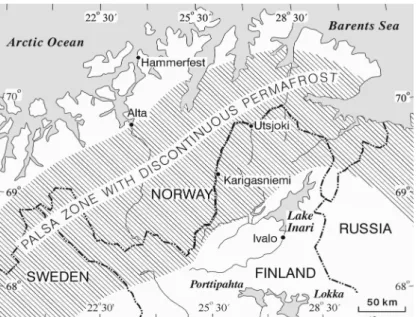
In western Finnish Lapland palsas are located north of 68º30’N latitude and in eastern Lapland north of Lake Inari (Fig. 1). Palsas are found in valleys with an insu-lating peat layer suffi ciently thick to preserve the frozen core. The vertical distribution of palsas in northern Finnish Lapland varied from altitudes of 180 m to 390 m a.s.l. (Luoto & Seppälä 2002). On lower altitudes there is probably too much snow and on higher levels peat layers are too thin.
Fig. 1. Distribution of palsas in
north-Climatological characteristics of palsa region
The optimum areas of palsa mires in northern Europe occur in areas of low precipitation (<450 mm) and the mean annual air temperature between -3°C and -5°C (Luoto & al. 2004).
In Finnish Lapland the southern limit of the palsa region coincides with the -1ºC mean annual air temperature. Lundqvist (1962) characterized the general distri-bution of palsas in Sweden requiring 200-210 days with temperature below 0ºC. Åhman (1977) in northern Norway found that the region could be delimited as having temperatures below -8°C for 120 days. The minimum temperatures in palsa region are often below -40°C in northern Finland. Maximum summer temperatures can rise up to +30°C. The warm air is not so damaging to palsas as summer moisture which decreases the insulation properties of the peat.
Freezing indices in palsa region in northern Finland range from 2000 to 2300 degrees and thawing indices from 1100 to 1400 degrees calculated from the daily mean values for period 1980-1991 (Seppälä & Hassinen 1997). Air temperatures do not directly affect permafrost formation because of snow cover.
Annual precipitation in palsa region is usually less than 400 mm, and less than half of precipitation is snow, received during 8-9 winter months when the air temperature is below zero.
Morphology and internal structure of palsas
Palsas can be classifi ed according to their morphology: dome-shaped, elongated string-form, longitudinal ridge-form, and extensive plateau palsas as well as palsa complexes with many basins, hollows and ponds of thermokarst origin (Fig. 2) (Åhman 1977).
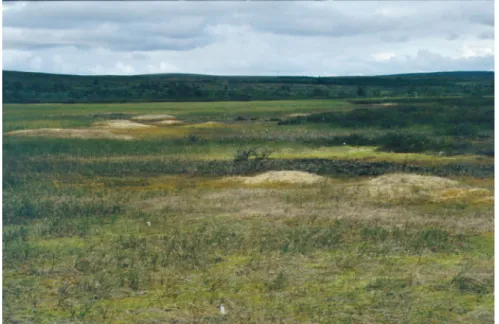
The diameter of dome-shaped palsas ranges from 10 m to 150 m and the heights from 0.5 m up to 7 m in Finland (Fig. 3). Longitudinal ridge-form palsas can be up to 0.5 km long and 6 m in height. Palsa plateaus rise 1-1.5 m above the surface of the surrounding peat surface and they can cover an area of a square km.
Palsas are either peat-cored or silt-cored. Peat-cored palsas have a perennial-ly frozen core of peat with segregated ice and small ice crystals fi lling the pores. Silt-cored palsas contain frozen silt or silty till with thin ice lenses under a thin layer of peat insulating the frozen core.
Fig. 2. A detailed map of a part of Vaisjeäggi palsa mire, Utsjoki, Finland. Contour interval 1 m.
Once a palsa hummock rises above the mire surface, peat formation on its top ceases almost entirely. The surface peat on an old palsa is produced mainly by Bryales mosses, lichens and Ericales schrubs. It can be also old moss peat eroded by wind. Below the dry surface, peat is the original mire peat formed of Sphagnum, Carex and Eriophorum remains (Seppälä 1988).
Dating of palsas
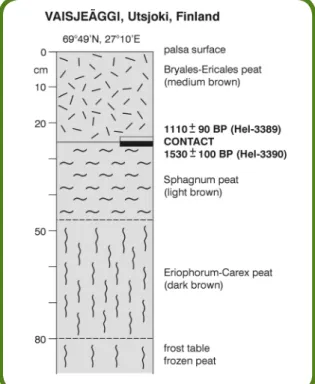
The dating of palsas is based on changes in ecological conditions caused by the uplift of the mire surface (Seppälä 2005). To date the formation of a palsa, samples should be collected from the contact of normal mire peat and of the dry peat formed on the palsa after its formation (Fig. 4).
Fig. 3. A mature, dome-shaped palsa in Iitto, Enontekiö. Photo Matti Seppälä.
Fig. 4. Example of the stratigraphy of a palsa with datings from the contact of xerophilic and wet fen peat
According to radiocarbon datings obtained from Finnish Lapland most palsas are less than 1000 years old (Seppälä 2005). By means of plant macrofossil analyses, physico-chemical analyses and AMS-radiocarbon dating of peat deposits Oksanen (2006) concluded that the fi rst permafrost aggradation on a palsa mire in northern-most Finland took place c. 2460 years B.P.
Some small palsas are much younger and since winter 2001-02 we have observed new palsa embryos (30 cm in height and 3-5 m in diameter) on Vaisjeäggi palsa mire, Utsjoki (Seppälä 2005)(Fig. 5). They occur occasionally after winters with thin snow cover and/or strong storms (Seppälä 1990) and survive a few years. Sometimes they may grow bigger, up to 60-80 cm in height, in favourable conditions even at present (Seppälä 2003).
Active layer on palsas
In Finnish Lapland the summer thawing forms only some 50 to 70 cm thick active layer on the summit of palsa.. On the southern slopes of palsas the active layer gets deeper and on the edges the permafrost table is almost vertical (Seppälä 1976, 1982b, 1983b). Small palsas thaw less than the high ones. On new palsa embryos the active layer is often less than 30 cm in thickness. Vegetation cover effects the active layer: thickest layers are foun on lichen-covered surfaces and thinnest under Betula nana bushes (Rönkkö & Seppälä 2003). A surprising observation is that the bare wind abra-ded peat surface did not increase the thawing of the active layer (Rönkkö & Seppälä 2003, Seppälä 2003). The much abraded and collapsing palsas have a thicker active layer than uneroded palsas.
In recent summers, an unfrozen layer in some palsas has been found between the permafrost table and the thawing seasonal frost layer indicating some mild winters. This has not increased the fi nal thickness of the active layer.
Fig. 5. Some new 1.5 years old palsas on Vaisjeäggi palsa mire, Utsjoki in 2003. Photo Matti Seppälä.
Origin of palsas
The process of palsa formation is a product of the physical characteristics of peat. The thermal conductivity of dry peat is very low, that of saturated peat is considerably higher and that for frozen peat can approach the value for ice (Seppälä 1988). This means that during winter the cold penetrates easily into the mires especially through the snow-free positions, but during summer much more heat and time is needed to thaw the frost underneath dry peat layers.
Freezing of palsas takes place from above because there is no frost in surrounding soil layers. This is a difference when compared palsa formation with pingos which belong to the zone of continuous permafrost. The freezing front sucks moisture and segregated ice lenses are formed in the frozen core.
Fries and Bergström (1910) postulated that palsa formation was triggered when wind turbulence was responsible for the thinning of the snow cover on certain parts of a mire surface, so that in these places frost could penetrate especially deeply into the peat.
Experimental palsa studies and importance of snow
Low air temperatures together with low precipitation and a thin snow cover are found to be the most prominent limiting factors for palsa formation. The hypothesis that palsas are formed in places with thin snow cover has been proved experimentally by cleaning the snow off from the mire surface several times during three winters and it formed a permafrost layer in the peat and a man-made small palsa (Seppälä 1982a, 1995).
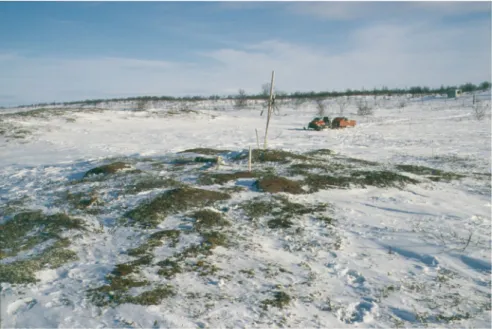
Wind drift controls the thickness of snow cover on the mire surface. Thin snow cover allows the frost to penetrate deep into the peat, and in these places the frost fails to disappear completely during the seasonal thawing and part of it remains under the insulating peat. In the following winters the unthawed layer of frost becomes thicker and the mound starts to rise. The wind then carries away snow from the exposed hump more easily and the freezing process accelerates (Fig. 6). This process increases the water content of the frozen core, which can be 80-90 per cent of the volume. Fig. 6. Snow free palsa
surface on Vaisjeäggi palsa mire in March 1994.
Cyclic development of palsas
The concept of cyclic palsa development is based on fi eld observations and experi-mental studies in Finnish Lapland (Seppälä 1982, 1986, 1988, 2004)(Fig.7):
(A, B): The formation of a palsa begins when snow cover is locally so thin that winter frost penetrates suffi ciently deeply to prevent summer heat from thawing it completely. The surface of the mire is then raised somewhat by frost processes.
(C): During succeeding winters frost penetrates still deeper, the process of formation accelerates and the hump shows further heaving due to the freezing of pore water and ice segregation. As the surface rises, the wind becomes ever more effective in drying the surface peat and keeping it clear of snow.
(D, E): When the freezing of the palsa core reaches the till or silt layers at the base of the mire, the mature stage of palsa development begins. By this time the palsa stands well above the surface of the mire, displaying a relief of up to 7 m in western Finnish Lapland.
(F): Degradation now starts, and peat blocks from the edges of the palsa collapse along open cracks into the pools which often surround the hummocks. During later stages, the vegetation may be removed so that the palsa surface is exposed to defl ation and rain erosion.
(G): Old palsas are partially destroyed by thermokarst, and become scarred by pits and collapse forms. Dead palsas are unfrozen remnants: either low (0.5 to 2 m high) circular rim ridges; or rounded open ponds and pond groups; or open peat surfaces without vegetation.
(H): From such pools a new palsa may ultimately emerge after a renewed phase of peat formation, and the cycle of palsa development recommences from the beginning.
Fig. 7. A general model of the formation of the frozen core (1) of a palsa in a mire (2) with a silty till substratum (3). A. The beginning of the thaw season. B. The end of the fi rst thaw season. C. Embryo palsa. D. Young palsa. E. Mature palsa. F. Old collapsing palsa surrounded by a large water body. G. Fully thawed palsa giving a circular pond on the mire (5). The thawed peat is decomposed (4). H. New peat (6) formation starts in the pond. (Seppälä 1982; 1986;
Thermokarst and the future of palsas
Palsa mires occur at the marginal zone of permafrost distribution. Therefore they may react easily on small changes in environmental conditions like warm air, but especially on summer precipitation and thick snow cover.
Thermokarst is a normal feature in the cyclic palsa formation. It modifi es the large palsas in rather irregular and complicated shapes (Fig. 2). It can also fully destroy a palsa and leave just small ponds on the mire. During recent years several authors (Matthews & al. 1997, Zuidhoff & Kolstrup 2000, Luoto & Seppälä 2003, Luoto & al. 2004) have discussed the degrading of palsas probably because of climatic warming. The palsa area has been earlier much larger than today (Luoto & Seppälä 2003).
Present observations indicate that also new palsas are formed among the old degrading ones. Warm summers which we have had several during the last years have not melted the palsa cores, because the summers have been also rather dry and dry peat is a good insulator. Also new recently formed permafrost has been found in Lapland (Seppälä 1998, Luoto & Seppälä 2002).
Some palsa mires have been heavily abraded by wind drifted snow and ice crystals and among the palsas can be found thermokarst ponds (Fig. 8). If this process increases it will destroy palsas in large areas.
Fig. 8. A thermokarst pond among abraded mature palsas on Luovdijeäggi palsa mire, Western Utsjoki in August 1999. Photo Matti Seppälä.
R E F E R E N C E S
Fries, T. & Bergström, E. 1910: Några iakttagelser öfver palsar och deras förekomst I nordligaste Sverige. [Some observations of palsas and their occurrence in northernmost Sweden]. – Geologiska Förenin-gen i Stockholm Förhandlingar 32: 195-205.
Gurney, S.D. 2001: Aspects of the genesis, geomorphology and terminology of palsas: perennial cryogenic mounds. – Progress in Physical Geography 25: 249-260.
Lundqvist, J. 1962: Patterned ground and related frost phenomena in Sweden. – Sveriges Geologiska Undersökning C 583: 1-101.
Lundqvist, J. 1969: Earth and ice mounds: a terminological discussion. – In Péwé, T.L. (ed.) The Periglacial Environment. Past and Present: 203-215. McGill-Queen’s University Press, Montreal.
Luoto, M., Fronzek, S. & Zuidhoff, F. S. 2004: Spatial modeling of palsa mires in relation to climate in northern Europe. – Earth Surface Processes and Landforms 29: 1373-1387.
Luoto, M., Heikkinen, R.K. & Carter, T.R. 2004: Loss of palsa mires in Europe and biological consequences. – Environmental Conservation 31: 30-37.
Luoto, M. & Seppälä, M. 2002: Modelling the distribution of palsas in Finnish Lapland with logistic regression and GIS. – Permafrost and Periglacial Processes 13: 17-28.
Luoto, M. & Seppälä, M. 2002: Characteristics of earth hummocks (pounus) with and without permafrost in Finnish Lapland. – Geografi ska Annaler 84A: 127-136.
Luoto, M. & Seppälä, M. 2003: Thermokarst ponds as indicators of the former distribution of palsas in Finnish Lapland. – Permafrost and Periglacial Processes 14: 19-27.
Nelson, F.E., Hinkel, K.M. and Outcalt, S.I. 1992: Palsa-scale frost mounds. – In Dixon, J.C. and Abrahams, A.D. (eds.) Periglacial geomorphology: 305-325, John Wiley & Sons, Chichester. Oksanen, P. 2006: Holocene development of the Vaisjeäggi palsa mire, Finnish Lapland. – Boreas (in
press).
Rönkkö, M. & Seppälä, M. 2003: Surface characteristics affecting active layer formation in palsas, Finnish Lapland. – In Phillips, M., Springman, S.M. & Arenson, L.U. (eds.) Permafrost. Proceedings of the 8th International Conference on Permafrost in Zürich: 995-1000.
Seppälä, M. 1972: The term “palsa”. – Zeitschrift für Geomorphologie N.F. 16: 463.
Seppälä, M. 1976: Seasonal thawing of a palsa at Enontekiö, Finnish Lapland, in 1974. – Biuletyn Peryglacjalny 26: 17-24.
Seppälä, M. 1982a: An experimental study of the formation of palsas. – In: French, H.M. (ed.). Proceedings 4th Canadian Permafrost Conference in Calgary, The Roger J.E. Brown Memorial Volume: 36-42. Ottawa, Canada
Seppälä, M. 1982b: Palsarnas periodiska avsmältning i Finska Lappland. [The periodical melting of palsas in Finnish Lapland]. – Geografi sk Tidskrift 82: 39-44.
Seppälä, M. 1983a: Palsasuon talvilämpötiloista Utsjoella. [On winter temperatures of a palsa mire in Utsjoki]. – Oulanka Reports 4: 20-24.
Seppälä, M. 1983b: Seasonal thawing of palsas in Finnish Lapland. – Permafrost Fourth International Conference, July 17-22, 1983, Proceedings: 1127-1132. National Academy Press, Washington, D.C. Seppälä, M. 1986: The origin of palsas. – Geografi ska Annaler A 68: 141-147
Seppälä, M. 1988: Palsas and related forms. – In: Clark, M.J. (ed.): Advances in periglacial geomorphology: 247-278, John Wiley, Chichester.
Seppälä, M. 1990: Depth of snow and frost on a palsa mire, Finnish Lapland. – Geografi ska Annaler A 72: 191-201.
Seppälä, M. 1994: Snow depth controls palsa growth. – Permafrost and Periglacial Processes 5: 283-288. Seppälä, M. 1995: How to make a palsa: a fi eld experiment on permafrost formation. – Zeitschrift für
Geomorphologie N.F., Supplement-Band 99: 91-96.
Seppälä, M. 1997: Introduction to the periglacial environment in Finland. – Bulletin of the Geological Society of Finland 69: 73-86.
Seppälä, M. 1998: New permafrost formed in peat hummocks (pounus), Finnish Lapland. – Permafrost and Periglacial Processes 9: 367-373.
Seppälä, M. 2003: Surface abrasion of palsas by wind action in Finnish Lapland. – Geomorphology 52: 141-148.
Seppälä, M. 2004: Palsa – In: Goudie, A.S. (ed.): Encyclopedia of geomorphology: 756-758. Routledge, London.
Seppälä, M. 2005: Dating of palsas. – Geological Survey of Finland, Special Paper 40: 79-84. Seppälä, M. & Hassinen. S. 1997: Freeze-thaw indices in northernmost Fennoscandia according to
meteorological observations, 1980-1991. – In: Knutsson, S. (ed.). Ground Freezing 97. Frost action in soils: 153-160. A.A.Balkema, Rotterdam.
Zuidhoff, F.S. & Kolstrup, E. 2000: Changes in palsa distribution in relation to climate change in Laivadalen, northern Sweden, especially 1960-1997. – Permafrost and Periglacial Processes 11: 55-69. Åhman, R. 1977: Palsar i Nordnorge. (Summary: Palsas in northern Norway). – Meddelanden från