H
EALTHC
ARER
EFORMORIGINAL INVESTIGATION
Yield of Diagnostic Tests in Evaluating
Syncopal Episodes in Older Patients
Mallika L. Mendu, MD; Gail McAvay, PhD; Rachel Lampert, MD; Jonathan Stoehr, MD; Mary E. Tinetti, MD
Background:Syncopal episodes are common among older adults; etiologies range from benign to life threat-ening. We determined the frequency, yield, and costs of tests obtained to evaluate older persons with syncope. We also calculated the cost per test yield and deter-mined whether the San Francisco syncope rule (SFSR) improved test yield.
Methods:Review of 2106 consecutive patients 65 years or older admitted following a syncopal episode. Results:Electrocardiograms (in 99% of admissions), te-lemetry (in 95%), cardiac enzyme tests (in 95%), and head computed tomographic (CT) scans (in 63%) were the most frequently obtained tests. Results from cardiac en-zymes tests, CT scans, echocardiography, carotid ultra-sonography, and electroencephalography all affected di-agnosis or management in less than 5% of cases and helped determine the etiology of syncope less than 2% of the time. Postural blood pressure (BP) recording, performed in only
38% of episodes, had the highest yield with respect to affecting diagnosis (18%-26%) or management (25%-30%) and determining etiology of the syncopal episode (15%-21%). The cost per test affecting diagnosis or man-agement was highest for electroencephalography ($32 973), CT scans ($24 881), and cardiac enzymes test ($22 397) and lowest for postural BP recording ($17-$20). The yields and costs for cardiac tests were better among patients meeting, vs those not meeting, the SFSR. For example, the cost per cardiac enzymes test affecting diagnosis or management was $10 331 in those meet-ing, vs $111 518 in those not meetmeet-ing, the SFSR. Conclusions:Many unnecessary tests are obtained to evaluate syncope. Selecting tests based on history and ex-amination and prioritizing less expensive and higher yield tests would ensure a more informed and cost-effective approach to evaluating older patients with syncope. Arch Intern Med. 2009;169(14):1299-1305
S
YNCOPE,DEFINED AS THE SUD -den, transient loss of con-sciousness with spontaneous recovery, accounts for 1% to 3% of emergency department visits and up to 6% of hospital admissions.1,2 Older patients present more often with syn-cope, have higher rates of hospitalization, and have greater morbidity than youngerpatients.3 Evaluation of older patients following a syncopal episode is challenging because there is a wide spectrum of possible etiologies, ranging from benign to life-threatening conditions.4Because of the var-ied causes of syncope, clinicians may pur-sue a range of diagnostic investigations. Despite thorough evaluations, however, the etiology of syncope frequently remains undetermined.5,6
Several authors7 , 8 have suggested schemes for evaluating syncope, based primarily on expert consensus rather than
empirical evidence. Studies9-13have at-tempted to reduce unnecessary testing by the use of algorithms to improve syncope evaluation methods. The algorithms in-creased the percentage of patients in whom an etiology was identified but did not de-crease the use of low-yield testing or re-duce the cost associated with diagnostic
testing. The few studies14,15 examining the utility of individual tests found that car-diac enzymes test, electroencephalography (EEG),16head computed tomographic (CT) scan,17and carotid ultrasonography (US)18 seldom identified the etiology. Neurologi-cal testing was less useful diagnostiNeurologi-cally than cardiac testing in 1 study.19The contribu-tion of magnetic resonance imaging (MRI), echocardiogram, telemetry, and other tests remains unknown, as does cost of tests
rela-CME available online at
www.jamaarchivescme.com
and questions on page 1258
See Invited Commentary
at end of article
For editorial comment
see page 1262
Author Affiliations:
Departments of Internal Medicine (Dr Mendu), Internal Medicine (Drs McAvay, Lampert, Stoehr, and Tinetti), and Epidemiology and Public Health (Dr Tinetti), Yale University School of Medicine, New Haven, Connecticut.
tive to their effect on diagnosis or management. Also un-clear is whether the yield and cost-effectiveness of evalu-ation can be improved by identifying older adults present-ing with syncope in whom test results are likely to affect diagnosis or management. Patient characteristics such as those used in the San Francisco syncope rule (SFSR)20may serve this latter purpose. The SFSR was developed to im-prove prediction of the likelihood of serious outcomes in patients presenting with syncope and has been prospectively validated for this purpose.21
We determined how often diagnostic tests were ob-tained to evaluate older persons presenting with syn-cope and whether these tests helped establish the etiol-ogy of the syncopal episode or affected diagnosis or management. We also calculated the cost per test that affected diagnosis or management. Finally, we exam-ined whether the SFSR was associated with the likeli-hood of test results affecting diagnosis or management.
METHODS
STUDY DESIGN AND POPULATION The study included all patients 65 years or older admitted to an acute care hospital, after presentation to the emergency depart-ment, from July 1, 2002, to December 31, 2006, with an admis-sion or discharge diagnosis of syncope. Patients were identified based on the presence of anInternational Classification of Dis-eases, Ninth Revision, Clinical Modification(ICD-9-CM) code of 780.2 as a primary or nonprimary diagnosis in the hospital bill-ing records. Up to 10 diagnoses are listed, enhancbill-ing the likeli-hood that patients with syncope were identified. Based on re-view of the medical records, all patients with presumed loss of consciousness were included. Patients in whom absence of loss of consciousness (eg, near-syncope) was documented were ex-cluded. The study was approved by the institutional review board of the Yale University School of Medicine (New Haven, Con-necticut). Consent was not obtained from participants because we reviewed existing data; in accordance with federal guide-lines, no subject identifiers were included in the data collected. Medical records from 2209 admissions in 2009 patients were reviewed. We excluded 103 admissions because of the com-plete absence of laboratory data, imaging, electronic medical record, or paper medical chart. Admissions were included if partial data were available; there were 2106 admissions in-cluded for 1920 patients.
DATA COLLECTION
For each admission, emergency department, inpatient admission, andprogressnotes;dischargesummaries;andlaboratoryandimaging data were abstracted. We used methods recommended to ensure the validity and reliability of data collected, including a standard-ized abstraction form, precisely defined variables and criteria, and a pilot study of 60 medical charts to refine criteria.22
Data collected included patient age and sex; dates of admis-sion and discharge; whether presumed loss of consciousness was documented in the medical record and whether the episode was witnessed; symptoms and activity at the time of the episode; health conditions; cardiac and neurological examination findings; pos-tural blood pressure (BP) recordings; and cardiac enzymes test. Reported etiology of the syncopal episodes was ascertained from the discharge summary. If no etiology was reported in the dis-charge summary, then progress note documentation was used. Results of electrocardiogram, echocardiogram, head CT scans,
ca-rotid US, stress testing, head MRI scans, and EEG were ab-stracted from the test reports and progress notes.
A second reviewer blindly abstracted a random sample of 40 admissions. To measure interrater agreement, we used the prevalence-adjusted, bias-adjustedstatistic,23,24and the mean (SD) was 87% (20%) for the diagnostic test variables.
CRITERIA FOR DEFINING RESULTS OF DIAGNOSTIC TESTS
An abnormal finding for imaging was defined as any abnor-mality, no matter how minor, not seen on prior testing as writ-ten in the test reports (for example, mild mitral valve regurgi-tation on echocardiogram and mild slowing on EEG). If no mention was made of prior testing, the result was assumed to be new. Abnormal cardiac enzyme results were defined as any troponin I level greater than 0.05 ng/mL (the hospital’s refer-ence value; to convert to micrograms per liter, multiply by 1.0). For postural BP, recordings were documented based on posi-tion (changing from lying to sitting, lying to standing, or lying to sitting to standing). Postural BP was defined using 2 sets of criteria, “strict” and “loose.” The strict criteria for postural hy-potension was a drop in systolic BP of at least 20 mm Hg, or a drop in diastolic BP of at least 10 mm Hg while changing from a lying position to a standing position.25The loose criteria for postural hypotension was a drop in systolic or diastolic BP of at least 10 mm Hg or a systolic BP drop to 90 mm Hg or lower while changing from a lying position to a sitting or standing position. This definition incorporated the variability in meth-ods used to assess BP changes and the wide range of defini-tions used in the literature, particularly for older patients.26-28 A test result was considered to have affected diagnosis or management if it was noted in any test reports, progress notes, or discharge summaries that the test had contributed to, con-firmed, or established any diagnosis or management deci-sions. This definition included documentation of negative and positive test results and all diagnoses, including those not re-lated to syncope. We also recorded whether it was docu-mented anywhere in the medical record that a test result had helped determine the etiology of the syncopal episode. Ex-amples of a test affecting diagnosis included an electrocardio-gram identifying atrial fibrillation and postural BP recordings identifying postural hypotension. Examples of a test affecting management included an electrocardiogram resulting in the management of atrial fibrillation with anticoagulation and -blockers and postural BP recordings resulting in the manage-ment of postural hypotension with hydration. The criteria de-tailed herein for test results were defined independently such that a test result could be abnormal but not considered to have affected diagnosis or management or vice versa. Patients were considered to have met the SFSR criteria if they had a history of congestive heart failure, a hematocrit level lower than 30%, abnormal results from an electrocardiogram, shortness of breath, or systolic BP lower than 90 mm Hg at presentation.20
COST CALCULATIONS
Standard billing charges for this hospital were used to calculate the charge per test. For imaging and electrocardiography, this in-cluded professional fees associated with interpretation. Similar to the method used in other studies, we converted billing charges to costs by multiplying charges by the hospital’s cost to charge ratio29,30because the hospital calculates costs based on a pa-tient’s admission rather than on individual tests or services pro-vided. A cost to charge ratio for a given hospital is determined by dividing the cost incurred to the hospital for an admission di-vided by the amount charged to an admitted patient. A cost to
charge ratio of 0.34 was used based on this hospital’s cost to charge ratio from the State of Connecticut’s Annual Report on the Fi-nancial Status of Connecticut’s Acute Care Hospitals for Fiscal Year 2007.31This ratio was similar to the cost to charge ratio of 0.35 for patients with syncope admitted during the study pe-riod. The cost for telemetry was estimated as the difference in cost between a monitored bed and an unmonitored bed. For postural BP, we estimated $5 per test, assuming that it required 5 min-utes at a nurse’s wage of $60 per hour, the highest nursing salary on a medicine service. Nurses most often obtain postural BP re-cordings at this hospital. We defined the cost per test affecting diagnosis or management as the cost per test multiplied by the number of tests obtained divided by the number of test results that affected diagnosis or management.
STATISTICAL ANALYSIS
Statistical analysis was performed using SAS software (version 9.1; SAS Inc, Cary, North Carolina). Yields were reported as percentages. Denominators were the number of tests ob-tained, and the numerators were the number of tests in which findings were abnormal, affected diagnosis, affected manage-ment, or helped determine the etiology of the syncopal epi-sode. We stratified patients into those meeting or not meeting SFSR criteria to compare test results and cost per test affecting diagnosis or management. The Fisher exact test was used to compare test results in patients meeting and patients not meet-ing the SFSR. A 2-sidedttestPvalue of⬍.05 was used to in-dicate statistical significance.
RESULTS
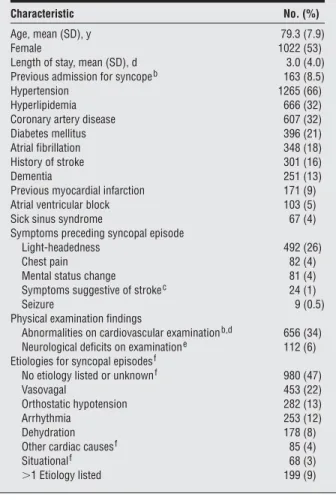
Characteristics of the 1920 patients are presented inTable 1. Their mean (SD) age was 79.3 (7.9) years; 53% were female. A total of 163 patients (8.5%) had had 2 or more admissions for syncope during the 41⁄2-year period, resulting in 2106 admissions. The most common preexisting health condi-tions included hypertension (66%), hyperlipidemia (32%), and coronary artery disease (32%). The most commonly re-ported etiologies were vasovagal and orthostatic hypoten-sion. For 47% of episodes, the etiology was reported as un-known or not reported in the medical records. Ninety per-centofadmissionsweretoageneralinternalmedicineservice, 6% to a cardiology service, and 3% to neurology. We did not find any important differences in testing between patients admitted to the different services.
The frequencies of tests obtained, abnormal find-ings, and yields are shown inTable 2. The most fre-quently obtained tests were electrocardiogram (99% of admissions), telemetry (95%), and cardiac enzymes test (95%). Only 5% of patients admitted had abnormal val-ues for cardiac enzymes, defined as any elevation in tro-ponin I level. Echocardiograms had the highest fre-quency of abnormal findings (63%); most of these were minor structural changes, such as mild mitral valve regurgitation. Only 2% of echocardiograms revealed find-ings, most often aortic stenosis, reported to have con-tributed to the syncopal episode. Similarly, for electro-cardiograms and telemetry, most findings were minor, such as premature ventricular contractions. Telemetry results helped determine the etiology, such as atrial fi-brillation or bradycardia, for 5% of syncopal episodes.
Postural BP recording was performed in 38% of pa-tients; only 24% of patients had recordings obtained while
changing from a lying to a standing position. Postural BP had the highest yield with respect to affecting diagnosis (18% using strict criteria) and management (25% using strict cri-teria) and was the test most frequently reported to have helped determine the etiology of the syncopal episode. The tests with the lowest likelihood of affecting diagnosis or man-agement or determining the etiology of the syncopal epi-sode were head CT scans, carotid US, EEG, and cardiac en-zymes test. In the 8 of 9 admissions in which a cardiac enzymes test helped determine the etiology of syncope, ab-normal electrocardiogram changes were also noted.
Table 1. Characteristics of Study Patientsa
Characteristic No. (%)
Age, mean (SD), y 79.3 (7.9)
Female 1022 (53)
Length of stay, mean (SD), d 3.0 (4.0)
Previous admission for syncopeb 163 (8.5)
Hypertension 1265 (66)
Hyperlipidemia 666 (32)
Coronary artery disease 607 (32)
Diabetes mellitus 396 (21)
Atrial fibrillation 348 (18)
History of stroke 301 (16)
Dementia 251 (13)
Previous myocardial infarction 171 (9)
Atrial ventricular block 103 (5)
Sick sinus syndrome 67 (4)
Symptoms preceding syncopal episode
Light-headedness 492 (26)
Chest pain 82 (4)
Mental status change 81 (4)
Symptoms suggestive of strokec 24 (1)
Seizure 9 (0.5)
Physical examination findings
Abnormalities on cardiovascular examinationb,d 656 (34)
Neurological deficits on examinatione 112 (6)
Etiologies for syncopal episodesf
No etiology listed or unknownf 980 (47)
Vasovagal 453 (22)
Orthostatic hypotension 282 (13)
Arrhythmia 253 (12)
Dehydration 178 (8)
Other cardiac causesf 85 (4)
Situationalf 68 (3)
⬎1 Etiology listed 199 (9)
aA total of 1920 patients with 2106 admissions.
bPrevious admission for syncope includes admissions during the 41⁄2-year
study period.
cSymptoms suggestive of stroke included acute neurological symptoms or signs such as motor deficits and dysarthria, excluding acute mental status changes.
dAbnormalities on cardiovascular examination included any of abnormal rate, abnormal rhythm, murmurs, or S3 or S4 heart sounds.
eNeurological deficits on examination included any of sensory, motor, cranial nerve, or mental status deficits.
fReported etiology of syncopal episode was ascertained primarily from discharge summary. If no etiology was reported in the discharge summary, then progress note documentation of an etiology was used. The sum of percentages, calculated using a denominator of total number of episodes (2106), does not equal 100% because more than 1 etiology may have been listed for a patient. No etiology listed or unknown included patients for whom no documentation of etiology was noted in the discharge summary or progress notes and patients for whom it was documented that no etiology could be determined. Other cardiac causes included aortic stenosis, cardiac ischemia, and so forth. Situational etiology included etiologies such as micturition or defecation-related syncope.
Head CT scans affected diagnosis or management in only 28 of 1327 admissions (2%); 25 of these involved clinically suspected neurologic disease such as brain me-tastases, new neurological symptoms, or recent head trauma. Similarly, 17 of the 20 cases in which the MRI result affected diagnosis or management were sus-pected based on history or examination.
The costs per test affecting diagnosis or management are shown inTable 3. This cost was highest for EEG ($32 973), head CT scan ($24 881), and cardiac en-zymes test ($22 397) and lowest for postural BP record-ing ($17-$20). Examples of the cost per test that helped determine the etiology of syncope include $99 525 for head CT scan, $77 144 for cardiac enzymes test, $65 946 for EEG, and $23 to $33 for postural BP recording.
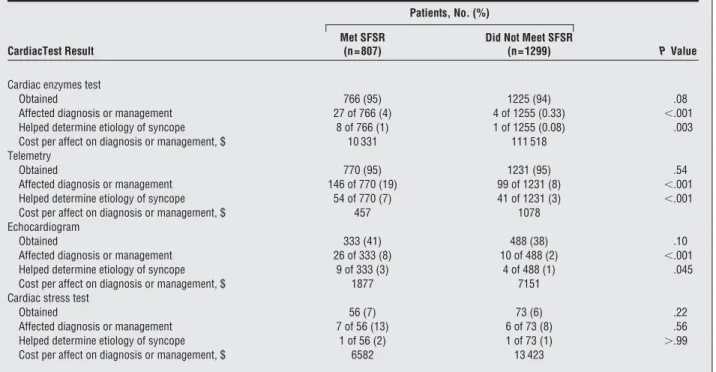
As shown inTable 4, with the exception of cardiac stress testing, cardiac test results were much more likely to have affected diagnosis or management or helped de-termine the etiology of the syncopal episode in patients meeting the SFSR than in patients not meeting criteria. The costs per cardiac test affecting diagnosis or manage-ment also were much higher among patients not meet-ing the SFSR among those meetmeet-ing the SFSR. For ex-ample, for cardiac enzymes tests, the cost per test affecting diagnosis or management was $10 331 in those meet-ing, vs $111 518 in those not meetmeet-ing, the SFSR.
COMMENT
In this study, we found that cardiac and neurologic tests were commonly obtained in the evaluation of syncope in older patients despite a minimal effect on diagnosis or
man-agement. In the few cases in which neurological tests were helpful, neurological conditions were suspected based on history or examination. Cardiac testing also had low yields overall. Conversely, postural BP recordings had the high-est yield but were performed in only about a third of ad-missions and frequently were performed inadequately. Ap-plication of the SFSR markedly improved yields and lowered costs without compromising the identification of persons with life-threatening cardiac conditions.
As in previous studies, vasovagal episodes and ortho-static hypotension were the most frequently reported eti-ologies. The lack of an etiology in almost half of patients despite extensive testing was also similar to prior reports of older adults.1,4Algorithm-based evaluations, which were not used in the study hospital, result by design in higher percentages of patients with a diagnosed etiology.9-13
The lowest likelihood of useful test results, and, there-fore, the highest costs per yield, was incurred by EEG, head CT scans, and cardiac enzymes tests. Although only troponin I level was used to define abnormal results,32,33 the total cost per set of cardiac enzymes test included cre-atine kinase and crecre-atine kinase–MB levels. If the tropo-nin I level alone was obtained, the cost per cardiac en-zymes test affecting diagnosis and management would decrease from $22 397 to $4813. Postural BP measure-ments represented the lowest cost per test affecting di-agnosis and management at $17. This figure maybe lower or higher in actual practice based on who is performing the BP measurements, but the magnitude is likely accu-rate for comparison to other testing costs.
Many of our findings are consistent with prior stud-ies. Grossman et al14and Link et al15found that serial car-Table 2. Diagnostic Tests Obtained in Evaluation of Syncopal Episodes in Older Patientsa
Test Obtained Abnormal Findingsb Affected Diagnosisc
Helped Determine Etiologyc Affected Managementc Electrocardiogram 2081 (99) 438 (21) 147 (7) 72 (3) 153 (7) Telemetry 2001 (95) 314 (16) 212 (11) 95 (5) 245 (12)
Cardiac enzymes test 1991 (95) 108 (5) 31 (2) 9 (0.5) 29 (1)
Head CT 1327 (63) 138 (10) 28 (2) 7 (0.5) 28 (2) Echocardiogram 821 (39) 516 (63) 35 (4) 13 (2) 36 (4) Postural BP recording 808 (38) Strict criteriad 230 (28) 142 (18) 122 (15) 202 (25) Loose criteriad 445 (55) 212 (26) 173 (21) 241 (30) Carotid US 267 (13) 122 (46) 2 (1) 2 (0.8) 6 (2) EEG 174 (8) 68 (39) 2 (1) 1 (0.6) 2 (1) Head MRI 154 (7) 46 (30) 20 (13) 3 (2) 19 (12)
Cardiac stress test 129 (6) 53 (41) 13 (10) 2 (2) 12 (9)
Abbreviations: BP, blood pressure; CT, computed tomography; EEG, electroencephalogram; MRI, magnetic resonance imaging; US, ultrasonography. aA total of 2106 admissions for 1920 patients. Data are given as number (percentage).
bAbnormal findings were defined as abnormal values for cardiac enzymes tests and postural BP recording as outlined in the “Methods” section; for imaging studies, abnormal findings were defined as any abnormalities that were not seen on prior testing as noted in the test reports.
cDenominators were the number of tests obtained. “Affected diagnosis” was defined as any test results that were noted in test reports, progress notes, or discharge summary to have contributed to, confirmed, or established any diagnosis; examples included an electrocardiogram identifying atrial fibrillation or postural BP measurements meeting criteria for postural hypotension. “Helped determine etiology” of syncope was defined as any test results that were noted in test reports, progress notes, or discharge summary to have helped determine the etiology of the syncopal episode; examples included cardiac enzymes test confirming findings on abnormal electrocardiogram of ischemic disease or head CT demonstrating ischemic infarction of indeterminate age. “Affected management” was defined as any test results that were noted in test reports, progress notes, or discharge summary to have contributed to any management decision; examples included electrocardiogram resulting in the management of atrial fibrillation with anticoagulation and-blockers or postural BP recordings resulting in the management of orthostatic hypotension with hydration.
dThe strict criteria for postural BP was a drop in systolic BP of at least 20 mm Hg or a drop in diastolic BP of at least 10 mm Hg while changing from a lying to a standing position. The loose criteria for postural BP was defined as a drop in systolic or diastolic BP of at least 10 mm Hg or a drop in systolic BP to 90 mm Hg or less while changing from a lying position to a sitting or standing position.
diac enzymes tests had little impact on diagnosis in syn-cope. Head CT scans, carotid US, and EEG are all known to rarely identify lesions contributing to syncope.16-18Our findings confirm these earlier reports that neurological imaging is not warranted in the evaluation of syncope unless a neurological disease or event is suspected. As has been previously shown,34our results suggest that the etiology of syncope can often be determined solely by his-tory. The high yield of postural BP recordings in our study supports guideline recommendations that the initial evalu-ation of syncope should entail medical history, physical examination, electrocardiogram, and postural BP mea-surements.3,7,8,35
The strengths of our study include a large sample size, standardized medical abstraction, consistent defini-tions and criteria, and blinded reabstraction to ensure re-liability. The evaluation of syncope entails identifying the presence of underlying diseases in addition to determin-ing the etiology of the syncopal episode. Therefore, we complemented existing research by determining the effect the tests had on establishing any diagnosis or on any man-agement decision.
There are limitations to our study. First, we report the retrospective experience of a single hospital, although comparison to previous studies3,14-19suggests that this ex-perience is representative of other hospitals. Second, be-cause we usedICD-9-CMcode 780.2 to identify syn-cope admissions, it is possible that we may have missed some patients diagnosed as having syncope whose ad-mission did not have thisICD-9-CMcode. However, be-cause we included patients with an admission or dis-charge, primary or nonprimary diagnosis, the number of missed patients is likely small and should not affect our results. Third, all clinical decisions may not have been documented in the medical record. For example, we likely underestimated the contribution of negative results to
di-agnosis or management because only 3% of test results that were reported to have affected diagnosis or manage-ment were negative results. Fourth, we did not evaluate tests performed after the hospitalization, such as loop re-corders and tilt-table testing, and commonly performed laboratory testing, such as hematocrit and glucose lev-els. Finally, our calculation of costs using a cost to charge ratio is an estimation based on charges—an approach to cost calculation used by other studies in the absence of hospital estimates of cost. The hospital’s cost to charge ratio used in the calculation was nearly identical to the cost to charge ratio of patients admitted with syncope, which supports the accuracy of our estimation. Our cal-culation of costs may have underestimated total costs be-cause it does not include all tests and procedures per-formed or the cost of hospitalizations, estimated to be $7460 to $9950 per admission.
Perhaps the finding in this study that causes the most concern is the extent to which unhelpful, and presum-ably unnecessary, testing in the evaluation of syncope con-tinues to be performed despite the compelling evidence against the practice dating back 20 years.7-19The cur-rent study complements earlier work by showing the high costs associated with this unnecessary testing. Extrapo-lating our results nationally, assuming approximately 460 000 hospitalizations per year for syncope,29 yearly costs associated with the most commonly obtained tests may be nearly $6 billion. Investigators have shown that easy availability of low-risk testing contributes to the over-use of resources.36The frequency of syncope and wide availability of low-risk testing make its an important source of revenue for hospitals. Unnecessary testing is a substantial contributor to rising health care costs and has been proposed as a target for cost savings.36,37
Our results suggest how clinicians might be more se-lective when obtaining tests to evaluate syncope. One goal Table 3. Costs of Diagnostic Tests in the Evaluation of Syncopal Episodesa
Tests Obtained Cost Per Test, $b Total Cost, $c
Cost per Test Affecting Diagnosis or Management, $d
EEG 1115⫻0.34 = 379 65 946 = (379⫻174) 65 946/2 = 32 973
Head CT scan 1545⫻0.34 = 525 696 675 = (525⫻1327) 696 675/28 = 24 881
Cardiac enzymes test 357⫻0.34 = 121 694 298 = (121⫻5738 sets) 694 298/31 = 22 397
Troponin I alone 78⫻0.34 = 26 149 188 = (26⫻5738 sets) 149 188/31 = 4813
Carotid US 1294⫻0.34 = 440 117 480 = (440⫻267) 117 480/6 = 19 580
Head MRI 3316⫻0.34 = 1127 173 558 = (1127⫻154) 173 558/20 = 8678
Cardiac stress test 2492⫻0.34 = 848 109 392 = (848⫻129) 109 392/13 = 8415
Echocardiogram 809⫻0.34 = 275 225 775 = (275⫻821) 225 775/36 = 6272
Electrocardiogram 221⫻0.34 = 75 156 075 = (75⫻2081) 156 075/153 = 1020
Telemetry 255⫻0.34 = 87 174 087 = (87⫻2001) 174 087/245 = 710
Postural BPe 5 4040 = (5⫻808) 4040/241 = 17
Abbreviations: BP, blood pressure; CT, computed tomography; EEG, electroencephalogram; MRI, magnetic resonance imaging; US, ultrasonography. aA total of 2106 admissions in 1920 patients.
bCost per test was calculated as the charge per test multiplied by the cost to charge ratio of 0.34, based on the 2007 Yale–New Haven Hospital cost to charge ratio from the State of Connecticut’s Annual Report on the Financial Status of Connecticut’s Acute Care Hospitals for Fiscal Year 2007.31
cThe total cost is equal to the number of tests obtained multiplied by the cost per test.
dCost per test affecting diagnosis or management was calculated as the total cost divided by the number of tests that affected diagnosis or management. An “affected diagnosis” was defined as any test results that were noted in test reports, progress notes, or discharge summary to have contributed to, confirmed, or established any diagnosis; examples included an electrocardiogram identifying atrial fibrillation or postural BP measurements meeting criteria for postural hypotension. An “affected management” was defined as any test results that were noted in test reports, progress notes, or discharge summary to have contributed to any management decision; examples included electrocardiogram resulting in the management of atrial fibrillation with anticoagulation and-blockers or postural BP recordings resulting in the management of orthostatic hypotension with hydration.
eA cost of $5 calculated based on 5 minutes of a nurse’s time at a $60 per hour wage. Loose criteria for postural BP, as defined in the “Methods” section, were used to calculate costs. If strict criteria, as defined in the “Methods” section, were used, then the cost per test affecting diagnosis or management was $20.
of the evaluation of syncope is to detect conditions, par-ticularly life-threatening ones such as arrhythmias, which may be present in patients with syncope. In this study we found the SFSR criteria to be helpful in identifying patients likely to benefit from cardiac testing. Valida-tion studies21,38of the SFSR have had conflicting results. Other criteria have been proposed to predict adverse out-comes39and may be helpful as well in serving as predic-tors of diagnostic yield. Our results suggest that using patient characteristics, such as the SFSR, may help iden-tify patients for whom certain tests, particularly cardiac enzymes tests and perhaps telemetry, are indicated, re-sulting in a marked savings costs. Further research is needed to determine reliable and feasible criteria to screen patients presenting with syncope.
Because almost one-quarter of older patients who ex-perience a syncopal episode exex-perience serious injuries, such as a hip fracture, during the episode,40another goal is to identify non–life-threatening, but treatable, etiologies, such as postural hypotension. Even if other etiologies are sus-pected, assessment and management of postural hypoten-sion are warranted. Our study suggests that inexpensive postural BP testing is greatly underutilized, resulting in many missed opportunities to institute effective treatment strat-egies such as medication reduction.
Instituting evidence-based diagnostic guidelines, as have been developed by the European Union, might lessen the extent of unnecessary testing.7Basing subsequent test-ing on the results of the initial history and examination and prioritizing higher yield tests would ensure a more informed and cost-effective approach to evaluating older patients with syncope.
Accepted for Publication:March 20, 2009.
Correspondence:Mary E. Tinetti, MD, Department of Internal Medicine, Yale School of Medicine, 333 Cedar St, PO Box 208025, New Haven, CT 06520-8025 (mary [email protected]).
Author Contributions:Study concept and design:Mendu and Tinetti.Acquisition of data:Mendu and McAvay. Analysis and interpretation of data:Mendu, McAvay, Lam-pert, Stoehr, and Tinetti.Drafting of the manuscript:Mendu and McAvay.Critical revision of the manuscript for im-portant intellectual content:Mendu, Lampert, Stoehr, and Tinetti.Statistical analysis:Mendu and McAvay.Study su-pervision:McAvay, Lampert, and Tinetti.
Financial Disclosure:None reported.
Funding/Support:This study was supported by grants from Yale University, the American Federation for Ag-ing Research, the Hartford Foundation, and the Claude D. Pepper Older Americans Independence Center at Yale School of Medicine (P30AG21342) from the National In-stitute on Aging.
Previous Presentations:This study was presented in abstract form at the Annual Meeting of the American Geriatrics So-ciety; April 30, 2008; Washington, DC; and at Yale Student Research Day; May 6, 2008; New Haven, Connecticut. Additional Contributions:Peter Charpentier, MPH, as-sisted in developing the database for this project; Denise Acampora, MPH, provided help with human investiga-tion approval and access to medical records; Jane Mal-lory, BS, assisted with the manuscript preparation; and Leo Cooney, MD, provided his guidance and reviewed this manuscript. They received no compensation for as-sistance given on this project.
Table 4. Association Between San Francisco Syncope Rule (SFSR) and Cardiac Test Results in Older Patients Presenting With Syncopea
CardiacTest Result
Patients, No. (%)
PValue Met SFSR
(n = 807)
Did Not Meet SFSR (n = 1299)
Cardiac enzymes test
Obtained 766 (95) 1225 (94) .08
Affected diagnosis or management 27 of 766 (4) 4 of 1255 (0.33) ⬍.001
Helped determine etiology of syncope 8 of 766 (1) 1 of 1255 (0.08) .003
Cost per affect on diagnosis or management, $ 10 331 111 518
Telemetry
Obtained 770 (95) 1231 (95) .54
Affected diagnosis or management 146 of 770 (19) 99 of 1231 (8) ⬍.001
Helped determine etiology of syncope 54 of 770 (7) 41 of 1231 (3) ⬍.001
Cost per affect on diagnosis or management, $ 457 1078
Echocardiogram
Obtained 333 (41) 488 (38) .10
Affected diagnosis or management 26 of 333 (8) 10 of 488 (2) ⬍.001
Helped determine etiology of syncope 9 of 333 (3) 4 of 488 (1) .045
Cost per affect on diagnosis or management, $ 1877 7151
Cardiac stress test
Obtained 56 (7) 73 (6) .22
Affected diagnosis or management 7 of 56 (13) 6 of 73 (8) .56
Helped determine etiology of syncope 1 of 56 (2) 1 of 73 (1) ⬎.99
Cost per affect on diagnosis or management, $ 6582 13 423
aA total of 2106 admissions in 1920 patients. The SFSR is defined as a history of at least 1 of the following: congestive heart failure, hematocrit level of less than 30%, abnormal electrocardiogram result, shortness of breath, or systolic blood pressure lower than 90 mm Hg.
REFERENCES
1. Kapoor WN. Evaluation and management of patients with syncope.JAMA. 1992; 268(18):2553-2560.
2. Quinn J, McDermott D, Kramer N, et al. Death after emergency department vis-its for syncope: how common and can it be predicted?Ann Emerg Med. 2008; 51(5):585-590.
3. Sun BC, Emond JA, Camargo CA Jr. Characteristics and admission patterns of patients presenting with syncope to US emergency department 1992-2000.Acad Emerg Med. 2004;11(10):1029-1034.
4. Forman DE, Lipsitz LA. Syncope in the elderly.Cardiol Clin. 1997;15(2):295-311. 5. Gupta AK, Maheshwari A, Lokhandwala Y. Evaluation of syncope: an overview.
Indian Pacing Electrophysiol J. 2001;1(1):12-22.
6. Linzer M, Yang EH, Estes NA III, Wang P, Vorperian VR, Kapoor WN; Clinical Efficacy Assessment Project of the American College of Physicians. Diagnosing syncope: part 1: value of history, physical examination, and electrocardiog-raphy: clinical efficacy assessment project of the American College of Physicians.
Ann Intern Med. 1997;126(12):989-996.
7. Kapoor WN. Current evaluation and management of syncope.Circulation. 2002; 106(13):1606-1609.
8. Brignole M, Alboni P, Benditt D, et al; Task Force on Syncope, European Society of Cardiology. Guidelines on management (diagnosis and treatment) of syncope.
Eur Heart J. 2001;22(15):1256-1306.
9. Farwell DJ, Sulke AN. Does use of a syncope diagnostic protocol improve the investigation and management of syncopeHeart. 2004;90(1):52-58. 10. Brignole M, Menozzi C, Bartoletti A, et al. A new management of syncope:
pro-spective systematic guideline-based evaluation of patients referred urgently to general hospitals.Eur Heart J. 2006;27(1):76-82.
11. Sarasin FP, Pruvot E, Louis-Simonet M, et al. Stepwise evaluation of syncope: a pro-spective population-based controlled study.Int J Cardiol. 2008;127(1):103-111. 12. Ammirati F, Colivicchi F, Santini M. Diagnosing syncope in clinical practice:
imple-mentation of a simplified diagnostic algorithm in a multicentre prospective trial: the OESIL 2 study (Osservatorio Epidemiologico della Sincope nel Lazio).Eur Heart J. 2000;21(11):935-940.
13. Del Rosso A, Ungar A, Maggi R, et al. Clinical predictors of cardiac syncope at initial evaluation in patients referred urgently to a general hospital: the EGSYS score.Heart. 2008;94(12):1620-1626.
14. Grossman SA, Van Epp S, Arnold R, et al. The value of cardiac enzymes in el-derly patients presenting to the emergency department with syncope.J Geron-tol A Biol Sci Med Sci. 2003;58A(11):1055-1058.
15. Link MS, Lauer EP, Homoud MK, Wang PJ, Estes NA III. Low yield of rule-out myocardial infarction protocol in patients presenting with syncope.Am J Cardiol. 2001;88(6):706-707.
16. Abubakr A, Wambacq I. The diagnostic value of EEGs in patients with syncope.
Epilepsy Behav. 2005;6(3):433-434.
17. Grossman SA, Fischer C, Bar JL, et al. The yield of head CT in syncope: a pilot study.Intern Emerg Med. 2007;2(1):46-49.
18. Schnipper JL, Ackerman RH, Krier JB, Honour M. Diagnostic yield and utility of neurovascular ultrasonography in the evaluation of patients with syncope.Mayo Clin Proc. 2005;80(4):480-488.
19. Pires LA, Ganji JR, Jarandila R, Steele R. Diagnostic patterns and temporal trends in the evaluation of adult patients hospitalized with syncope.Arch Intern Med. 2001;161(15):1889-1895.
20. Quinn JV, Stiell IG, McDermott DA, Sellers KL, Kohn MA, Wells GA. Derivation of the San Francisco syncope rule to predict patients with short-term serious outcomes.Ann Emerg Med. 2004;43(2):224-232.
21. Quinn J, McDermott D, Stiell I, Kohn M, Wells G. Prospective validation of the San Francisco syncope rule to predict patients with serious outcomes.Ann Emerg Med. 2006;47(5):448-454.
22. Gilbert EH, Lowenstein SR, Koziol-McLain J, Barta DC, Steiner J. Chart reviews in emergency medicine research: where are the methods?Ann Emerg Med. 1996; 27(3):305-308.
23. Byrt T, Bishop J, Carlin JB. Bias, prevalence and kappa.J Clin Epidemiol. 1993; 46(5):423-429.
24. van Ness PH, Towle VR, Juthani-Mehta M. Testing measurement reliability in older populations: methods for informed discrimination in instrument selection and application.J Aging Health. 2008;20(2):183-197.
25. Kaufmann H. Consensus statement on the definition of orthostatic hypotension, pure autonomic failure and multiple system atrophy.Clin Auton Res. 1996; 6(2):125-126.
26. Naschitz JE, Rosner I. Orthostatic hypotension: framework of the syndrome. Post-grad Med J. 2007;83(983):568-574.
27. Masaki KH, Schatz IJ, Burchfiel CM, et al. Orthostatic hypotension predicts mor-tality in elderly men: the Honolulu Heart Program.Circulation. 1998;98(21): 2290-2295.
28. Cohen N, Gorelik O, Fishlev G, et al. Seated postural hypotension is common among older inpatients.Clin Auton Res. 2003;13(6):447-449.
29. Sun BC, Emond JA, Camargo CA Jr. Direct medical costs of syncope-related hos-pitalizations in the United States.Am J Cardiol. 2005;95(5):668-671. 30. Krahn AD, Klein GJ, Yee R, Manda V. The high cost of syncope: cost
implica-tions of a new insertable loop recorder in the investigation of recurrent syncope.
Am Heart J. 1999;137(5):870-877.
31. Annual report on the financial status of Connecticut’s short-term acute care hos-pitals for fiscal year 2007. http://www.ct.gov/ohca/site/default.asp. Accessed No-vember 15, 2008.
32. Roussanov O, Estacio G, Capuno M, Wilson SJ, Kovesdy C, Jarmukli N. New-onset syncope in older adults: focus on age and etiology.Am J Geriatr Cardiol. 2007;16(5):287-294.
33. Ferguson JL, Beckett GJ, Stoddart M, Walker SW, Fox KA. Myocardial infarction redefined: the new ACC/ESC definition, based on cardiac troponin, increased the apparent incidence of infarction.Heart. 2002;88(4):343-347.
34. Gould PA, Krahn AD, Klein GJ, Yee R, Skanes AC, Gula LJ. Investigating syn-cope: a review.Curr Opin Cardiol. 2006;21(1):34-41.
35. Brignole M. Diagnosis and treatment of syncope.Heart. 2007;93(1):130-136. 36. Wennberg JE. Unwarranted variations in healthcare delivery: implications for
aca-demic medical centres.BMJ. 2002;325(7370):961-964.
37. Wennberg JE, Fisher ES, Skinner JS, Bronner KK. Extending the P4P agenda, part 2: how Medicare can reduce waste and improve the care of the chronically ill.Health Aff (Millwood). 2007;26(6):1575-1585.
38. Birnbaum A, Esses D, Bijur P, Wollowitz A, Gallagher EJ. Failure to validate the San Francisco syncope rule in an independent emergency department population.
Ann Emerg Med. 2008;52(2):151-159.
39. Grossman SA, Fischer C, Lipsitz L, et al. Predicting adverse outcomes in syncope.
J Emerg Med. 2007;33(3):233-239.
40. Rubenstein LZ, Josephson KR. The epidemiology of falls and syncope.Clin Geri-atr Med. 2002;18(2):141-158.
INVITED COMMENTARY
S
yncope is a common and expensive symptom. It re-sults in 1% to 1.5% of all emergency department (ED) visits, with the annual cost of patients admit-ted in the Uniadmit-ted States estimaadmit-ted to be $2.5 billion.1-3In most patients, the causes are benign and are aggressively investigated to find the few who may experience clinically significant morbidity or mortality. Despite aggressive in-vestigation, only 50% of patients with syncope ever get a clear diagnosis. This uncertainty of risk and diagnosis leads to tremendous variability among those who are admitted, how they are evaluated, and associated costs. Academic cen-ters in the United States report ED admission rates rang-ing from 55% to 85%. Other health care systems, includ-ing Kaiser Permanente, admit about 35% of patients with syncope, whereas some countries, like Australia (admis-sion rate,⬍30%) and Canada (admission rate,⬍20%),ad-mit very few patients with syncope without any real ap-parent differences in outcome.1,4
To help guide admission and investigations, there is evidence to help identify patients at higher risk for both short- and long-term outcomes.5-7The San Fran-cisco syncope rule (SFSR) adds to the growing body of evidence that defines patients with syncope at risk.2 This evidence shows that patients with abnormal results from electrocardiogram and a history of struc-tural heart disease, best determined by a history of congestive heart failure or shortness of breath, are at increased risk. Furthermore, patients with persistent low blood pressure and low hematocrit level are more likely to have poor outcomes. Advanced age is also a risk factor; however, advanced age is nonspecific, ill defined, and is an increased risk for death regardless of