PL IS S N 0015-9301 O M u s e u m a n d I n s t i t u t e o f Z o o l o g y PA S
W hat species of owlflies (Neuroptera: Ascalaphidae), an extinct family in
Poland, have occurred in Poland in the past?
Roland Dobosz
Department o f The Natural History, Upper Silesian Museum, PI. Sobieskiego 2, 41-902 Bytom, Poland e-mail: [email protected]
Abstract. Literature data on Ascalaphidae in Poland are critically discussed. Libelloides macaroniushas never been found in the present-day territory o f Poland. Libelloides coccajusmost likely occurred in Poland at the end o f the 18th century. Evidence for this statement comprises a drawing and a note in a manuscript o f Charles de Perthees from
1 8 0 2 - 1 8 0 3 .
Key words: Neuroptera, Ascalaphidae, Libelloides coccajus, Libelloides macaronius,Poland, distribution, extinct species.
The intensive research on the Neuropterida carried out in Poland up to the end of 1980’s revealed several species new to the Polish fauna. Nevertheless, most of the faunistic data available come from papers written 50 or even 100 years ago. Even if the data from papers published after the end of the Second World War are not to be doubted, the information from earlier times is difficult to verify. The reasons are: lack of voucher specimens and unclear data on specimens mentioned in the papers or presented on the labels. These problems mounted enormously following changes to the borders of Poland due to political and historical changes. Therefore, besides a revision of the scarce specimens and collections available, a review of the bibliographical data presented in this paper, both Polish and non-Polish, must be undertaken before the number and a list of species recorded within borders of Poland up to the Second World War can be presented. Such data were often presented as very poor and general, with numerous misspellings and language errors, which in some cases make the interpretation very difficult, or even impossible.
The limits of distribution of several species of plants and animals are known to be in the area of Poland. Therefore such faunistic data are very important for zoogeographical analyses. Special attention must be given to the topographic data comprised in the old, historical collections, which are frequently invaluable for the interpretation of transformations of the flora and fauna of the Western Palaearctic over the last few centuries. Dynamic changes of climatic and biotic conditions resulted in numerous temporary migrations of numerous organisms, insects in particular.
The most recent list of Neuropterida of Poland (Czechowska 2007) contains erroneous data
about the probable presence in Poland of Libelloides macaronius (Scopoli, 1763) of the family
Ascalaphidae. This data was based on the report of Pongracz (1919). In the materials regarding the status of neuropteroid species of Poland Pongracz pointed out that ” ...Ohne nahere
Fundorte. In Galizien vereinzelt, selen...”, i.e. rarely in Galicia. Ascalaphus kolyvanensis
(Laxmann, 1770), a synonym of L. macaronius, had been recorded by Pongracz. These times,
the term “Galizien” referred to an area that is now outside of the borders of Poland. In all formerly published papers and reports, citations of the localities of this species do not refer to
100 R. Dobosz
sites within the current borders of Poland; however, some localities are close to these borders. The most interesting data, in terms of knowledge of Polish fauna, are the localities given in the Red Data Books of the former Soviet Union and Ukraine (Kochetova 1985; Ermolenko 1994). Some of these localities are found close to the south-eastern border of Poland. The localities of this species are poorly documented in Slovakia, or doubtful (Zeleny 1992, 2005; Jedlicka 2001). The Red Data Books are by nature compendia rather than critical analyses of scientific reports. Zakharenko (1994), in a critical review of the neuropterofauna o f Ukraine, pointed out
that the localities o f L. macaronius in the western part of Ukraine currently do not exist.
Another species potentially present in
the area of Poland is Libelloides coccajus
(Denis et Schiffermuller, 1775). At present, this species is relatively widely distributed (Aspock et al. 2001). The localities of this species that are currently closest to Poland are known in Germany and Czech Republic (Rohricht & Troger 1998, Zeleny 2005), while the presence of this species in Slovakia is doubtful (Jedlicka 2001; Jedlicka et al. 2004; Zeleny 1977, 1992).
One of the oldest and most
comprehensive elaborations containing faunistic data from Poland is the manuscript of Prince Józef Poniatowski’s court cartographer - Charles de Perthees (1739-1815). This researcher, endowed with impressive drawing abilities, in addition to insect collecting, presented notes on numerous species enriched with perfectly detailed drawings. In numerous cases, thanks to his drawings, we have evidence for the presence of particular species, species of particular interest for the study of the origins of
Polish fauna (Pawłowski 1991).
Unfortunately, his rich collection
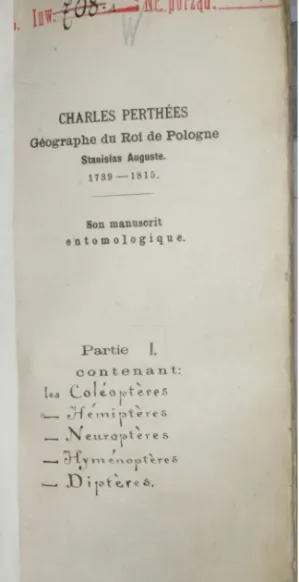
disappeared or was destroyed, and its fate has remained unclear (Pawłowski 2003). The history of the destroyed collections and the nine preserved volumes of the manuscript has been stormy and particularly interesting. This story was described in detail by Pawłowski (2003, 2005). For neuro- pterologists, the first volume (Fig. 1) is the most interesting. It was prepared in the years 1802-1803, in which together with a few drawings of Neuropterida, the details of the collection sites were given. Charles de Perthees made mistakes in the identification of some species, but his detailed drawings are
CHARLES PERTHEES G ś o g r a p Ł e du Roi de Pologne Stanislas Auguste. 1 7 3 9 — 1 8 1 5. Son manuscrit Partie I. c o n t e n a n t :
Fig. 1. Title page of the first volume o f the manuscript of Charles de Perthees (thanks of the courtesy of the Library of Institute o f Systematics and Evolution of Animals, Polish Academy o f Sciences, Kraków).
unusual perfect documentation of the morphology of the insects, and it is easier to identify the species based on these drawings than based on the imperfect description. Some groups of insects presented by Perthees were described and discussed in a more detailed manner. The
Neuropterida were rarely mentioned, but the descriptions included that of Ascalaphus (recently
Libelloides, see Pawłowski 1991), very important for the knowledge of neuropterofauna of Poland, and a general discussion of the order (Pawłowski 2003). The first species mentioned is
unusual for the Polish fauna of owlflies. It was named Ascalaphus barbarus. Ascalaphus
barbarus is now a North African species (typus generis of Ascalaphus) with transparent wings.
It is different from the species of Libelloides with coloured wings, but at the turn of the 19th
century the name Ascalaphus barbarus was used for European species with coloured wings
different from Libelloides coccajus (Pantaleoni & Letardi 2002) or for the real L. coccajus. On
the other hand, a comparison of the drawing from de Perthees with drawings of Ascalaphidae
species known from Central Europe, will exclude L. macaronius, the most probable species for
the Polish fauna. The characteristic black markings at the base of the hind wings doubtless
indicate the second species supposed to be present in Poland, i.e. L. coccajus. The more
detailed data on the date and place of collection of the specimens are not exhaustive.
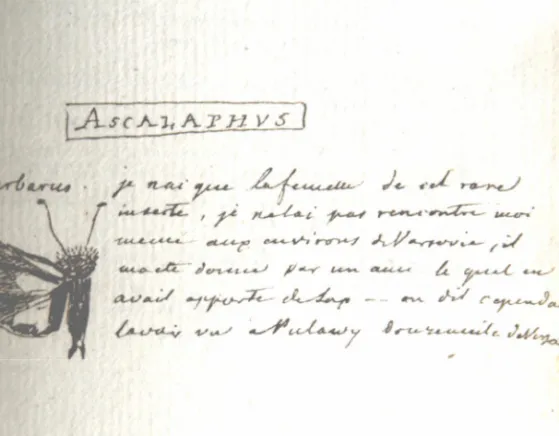
Fortunately, together the drawing of the specimen o f 4 Ascalaphus barbarus’ is accompanied
with a relatively long note (Fig. 2). It is written, as most of the manuscript, in poor French, with numerous abbreviations and mistakes, in numerous cases in Polish.
j A - r f A - i ,
L v s l
A / n o 4- / A { / *-I U - v iPAIN Q K P A [
tr * . ><-Fig. 2. Drawing of ‘ Ascalaphus barbarus’ with a note (page 214 from the first volume of Charles de Perthees manuscript). Courtesy of the Library of Institute of Systematics and Evolution of Animals, Polish Academy of Sciences, Kraków.
102 R. Dobosz
Below is the free translation by Professor Jerzy Pawłowski of the original text:
“Ascalaphus barbarus - I have only a female of this rare insect. I did not find it myself in the vicinity of Warsaw. The specimen was offered to me by one of the friends, who collected
[it] in the vicinity of Puławy, thirty miles from Warsaw”.
Considering the recent distributional pattern of this species in Europe, the data from Poland collected at the turn of the 19th century are surprising. On the other hand, taking into consideration the climatic changes and examples from the other groups of insects, such fluctuation of the range is probable and possible. It could be stated with high probability that the limit of range of this species was once in Poland, maybe related to the habitats of the Vistula river valley. Collecting insects in central Poland to its southern parts, Charles de Perthees found numerous interesting species, with limits distinctly shifted now, e.g.
Scarabaeus sacer L. (Coleoptera: Scarabaeidae), Purpuricenus budensis (Gotz) (Coleoptera:
Cerambycidae). He collected in the vicinities of Warsaw such species as: Mantis religiosa (L.)
- Mantodea, Pericalia matronula (L.), Pamassius mnemosyne (L.) and Parnassius apollo (L.)
- Lepidoptera, whose current ranges are distinctly more southwards.
One of the reasons for such shifts of ranges was climatic changes. The turn of the 19th century was a time of a distinct decrease in annual temperatures in most of Europe, especially in Central Europe. An example of such changes is reports of freezing of the Baltic Sea during a dozen or so years. Very probably, changes of limits of numerous species took place at that time, especially those with narrow ecological tolerance, particularly thermal tolerance. Particularly distinct and dynamic changes could have taken place in Central Europe (Pawłowski 1991). Of course, we cannot also exclude the role of increasing anthropopression and the associated degradation of natural habitats.
Co n c l u s i o n s
The results of the investigations proved that at present there are no representatives of
Ascalaphidae in Poland. There is no doubt that in the past L. coccajus was present in the area
of Poland. Anyway, we have no data to confirm the presence of L. macaronius within the
present borders of Poland in the past and now.
Ac k n o w l e d g e m e n t s
I wish to thank Professor Jerzy Pawłowski for the translation and interpretation of the text from the manuscript by Charles de Perthees.
Re f e r e n c e s
ASPÓCK H ., HÓLZEL H. & ASPÓCK U. 2001. Kommentierter Katalog der Neuropterida (Insecta: Raphidioptera, Megaloptera, Neuroptera) der Westpalaarktis. Denisia2: 1-606.
CZECHOWSKA W. 2007. Sieciarki właściwe Neuroptera. In: BOGDANOWICZ W., CHUDZICKA E., PlLIPIU K I. & SKIBIŃSKA E, (eds), Fauna o f Poland - Characteristics and checklist of species. Vol 2, pp. 279-292. Muzeum i Institytut Zoologii PAN, Warszawa, pp. 505.
ERMOLENKO V . M . 1 9 9 4 . Ascalaphus macaronius (Scopoli, 1 7 6 3 ). In: SHCHERBAK, M . M . (ed.), Red Data Book of Ukraine. Animal kingdom, p. 1 0 7 . Ukrainian encyclopedia, Kyiv, pp. 464.
JEDLICKA L. 200E Red (Ecosozological) List o f Neuroptera of Slovakia. In: BalAŻ, D. M ARHOLD K., U R BAN P. (eds), Red List o f Plants and Animals o f Slovakia, pp. 108-109. Ochrana Prirody, Banska Bystrica, Suppl. 20, pp. 160. JEDLICKA L., Sevcik J & V lD LICK A L. 2004. Checklist o f Neuroptera of Slovakia and the Czech Republik. Biologia,
Bratislava, 59, Suppl. 15, pp. 59-67.
KOCHETOVA N. I. 1985. Ascalaphus macaronius(Scopoli, 1763). In: BORODIN, A. M., et al. (eds), Krasnaya kniga SSSR. Red Data Book of the USSR. p. 278. Moscow, vol. 1, pp. 390.
Pa n t a l e o n i R. A. & LETARDI A. 2002. What is the real name o f the Italian ascalaphid? In: SZIRAKI G. (ed.), Neuropterology 2000. Proceedings of the Seventh International Symposium on Neuropterology (6-9 August 2000, Budapest, Hungary), pp. 253-264. Acta Zoologica Academiae Scientiarum Hungaricae, 48, Suppl. 2, pp. 430.
PAW ŁOWSKI J. 1991. 2.4.5. Przemiany fauny od pleniglacjalu do czasów współczesnych. In: STARKEL L. (ed.), Geografia Polski. Środowisko przyrodnicze, pp. 159-177. PWN, Warszawa, pp. 670.
PAW ŁOWSKI J. 2003. Wstępna ocena działalności entomologicznej Karola Pertheesa. In: PAW ŁOW SKI J. (ed.), Karol Perthees (1739-1815) kartograf Pierwszej Rzeczypospolitej i entomolog, pp. 193-260. Warszawa, pp. 342. PAW ŁOWSKI J. 2005. Rękopisy entomologiczne Karola Pertheesa w Bibliotece Instytutu Systematyki i Ewolucji
Zwierząt PAN w Krakowie w 110 rocznicę ich pozyskania. Rocznik Biblioteki Naukowej PAU i PAN w Krakowie 50: 167-180.
PONGRACZ A. 1919. Beitrage zur Pseudoneuropteren- und Neuropterenfauna Polens. Annales Musei Nationalis Hungarici 17: 161-177.
R o h r ic h t W. & TRÓ G ER E. J. 1998. Rote Listę der Netzflugler (Neuropteroidea). In: B lN O T M., BLESS R., BO YE P., G r u t t k e H. & PRETSCHER P. (eds), Rote Listę gefahrdeter Tiere Deutschlands, pp. 231-234. Schriftenreiche fur Landschaftspflege und Naturschutz, Bonn-Bad Godesberg, 55, pp. 434.
ZAKHARENKO A. V. 1994. Rare and extinct species of lacewings (Insecta, Neuroptera) of the fauna o f Ukraine. Izvestiya Kharkovskogo Entomologiecheskogo Obshestva, 2 (2): 101-104.
ZELEN Y J. 1977. Planipennia (Neuroptera). In: D LABOLA J. (ed.), Check list 1 - Enumeratio Insectorum Bohemoslovakiae. Acta Entomologica Bohemoslovaca 68: 167-184.
ZELEN Y J. 1992. Lacewings (Neuroptera). In: ŚKAPEC L. (ed.), Cervena kniha ohrożenych a vzacnych druhu rostlin a zivocichu CSFR 3. Bezobratli. Red book of endangered and rare species and plants of Czechoslovak Federal Republik. 3. Invertebrates, pp. 80-82. Priroda Bratislava, pp. 155.
ZELEN Y J. 2005. Neuroptera (Lacewings)] pp. 163-165. - In: FARKAĆ J., KRAL D. ŚKOPIK M. (eds), Red list of threatened species in the Czech Republic. Invertebrates, pp. 163-165. Agentura ochrany pfirody a krajiny ĆR, Praha, 760 pp. [In Czech with English text]
St r e s z c z e n i e
[Jakie gatunki z żupałkowatych (Neuroptera: Ascalaphidae), zanikłej w Polsce rodziny, występowały u nas w przeszłości?]
Autor krytycznie analizuje dane literaturowe dotyczące występowania na obszarze współczesnej Polski dwóch gatunków sieciarek z rodziny żupałkowatych (Ascalaphidae)
Libelloides macaronius (Scopoli, 1763) i Libelloides coccajus (Denis et Schiffermuller, 1775). W opublikowanym w ostatnich latach wykazie owadów siatkoskrzydłych (Czechowska
2007) znalazła się informacja o prawdopodobnym występowaniu na terenie Polski Libelloides
macaronius. Podstawą do włączenia tego gatunku w skład fauny Polski była praca Pongracz’a (1919). Autor ten w swoim przyczynku do znajomości owadów siatkoskrzydłych Polski podaje informację o występowaniu tego gatunku w Galicji. Termin Galicja dotyczył w znacznej części obszaru znajdującego się poza współczesnymi granicami naszego kraju. We wszystkich wcześniejszych pracach (cytowanych przez Pongracza) stanowiska tego gatunku znajdują się poza terytorium obecnej Polski, choć niektóre znajdują się stosunkowo blisko naszych granic.
Stanowiska te nie zostały współcześnie potwierdzone (Zakharenko 1994).
Jest natomiast wielce prawdopodobne, że w Polsce występował pod koniec XVIII wieku
Libelloides coccajus. Świadczą o tym notatka i rysunek zamieszczony w manuskrypcie nadwornego kartografa Księcia Józefa Poniatowskiego - Edmunda Pertheesa. Współczesne stanowiska tego gatunku, najbliżej naszych granic, znajdują się w Niemczech i Czechach (Rohricht & Tróger 1998, Zeleny 2005).