Monitored Field Performance of Conventional Roofing Assemblies – Measuring
the Benefits of Insulation Strategy
2013 RCI Symposium on Building Envelope Technology,
November 13-14, 2013, Hyatt Regency Minneapolis, Minneapolis, Minnesota
Marcus Dell, MASc, P.Eng. and Graham Finch, MASc, P.Eng. RDH Building Engineering Ltd. Vancouver, BC
Abstract
A field monitoring study was implemented to measure the impacts and benefits of membrane color (white, grey and black) and insulation strategy on the performance of conventional roofing assemblies. The same roof membrane cap sheet type with three different surface granule colors was placed over three different conventional insulation strategies, creating a total of nine unique roofing assemblies (16 square in size) on the same building. The thicknesses of the different insulation products were varied to achieve approximately the same R-value for each of the 9 roof assemblies. Sensors were installed to measure temperature, relative humidity, moisture content, and heat flux at various points within each of the roof assemblies. Displacement sensors were also installed to measure the dimensional stability of the insulation. In addition, webcam photos were captured to study the impact of night sky cooling, wetting/frost, and other differences between the assemblies. To complement the field investigation of this study, the effective R-values of the insulation products were measured in the laboratory following ASTM C518 protocols.
Presented in this paper are findings from the study and the highlights of the impacts of the insulation strategy on the thermal behaviour, dimensional movement, and moisture movement for these conventional roofing assemblies. In-situ R-values and net energy transfer for each of the roofing assemblies are discussed in combination with comfort and performance implications. The study also provides insight into the performance of various insulation and mixed insulation assemblies, which take advantage of optimum temperatures, and highlights the potential benefits of each assembly.
Background
Conventionally insulated roofs (i.e. roofs with exposed roofing membrane on top of the roof insulation and structure) make-up the majority of low-slope roofing assemblies across North America. These types of roof assemblies are preferred in many applications instead of protected membrane roofs (inverted roofs) or interior insulated roofs (vented or unvented) due to a combination of factors, including familiarity, relative ease of construction, adequate durability and life-span, availability of roofing materials, and economics.
Several different types of roofing membranes are commonly utilized in conventional roofs including 2-ply membranes (SBS, APP), single-ply membranes (EPDM, PVC, TPO), multi-ply built-up asphalt/tar (BUR), and liquid membranes (urethanes, polyureas, and other chemistries). Conventional roof membrane preference is based on expected in-service temperatures, building type and use, local trades, product familiarity/availability, and past material performance. Membrane colors from dark to light will be chosen based on product availability, aesthetics, building type/use, energy efficiency, and standard practice, which varies from Southern to Northern latitudes. Lighter, more reflective membrane colors or finishes are common in the Southern US where required by energy
code (ASHRAE 90.1); though with LEED projects and some other energy rating programs, light or white colored roofs are often used regardless of geography. In Northern climates, the benefit of using white membrane roofs to achieve air-conditioning energy savings is typically small, and can be negatively offset by higher wintertime heating loads (DOE Cool Roof Calculator 2013, Roof Savings Calculator 2013). In addition, studies and investigations by the authors and others (Rose 2007, Bludau et al 2008) have demonstrated moisture issues when employing reflective white roof membranes (versus solar absorptive dark colors) within certain roof assemblies in North America. One objective of this research study is to investigate the thermal differences and resulting net heat flux through conventional roof assemblies with exposed membranes (in this case 2-ply SBS) of different cap sheet colors, and thus, solar absorptivity in the Pacific Northwest. These findings will be used to calibrate energy and hygrothermal models to extrapolate the findings to other climate zones.
The thermal insulation used within new conventional roofing assemblies typically consists of rigid polyisocyanurate (polyiso, R-5 to R-6/inch), expanded polystyrene (EPS, R-4 to R-4.5/inch), or rigid stone wool1/mineral wool (R-3.7 to R-4.3/inch). Wood fiberboard, rigid fiberglass, extruded polystyrene (XPS), and spray polyurethane foam insulations are also used in some applications, but these additional insulation types are less common in conventional roofs.
It is also becoming common for many designers and roofers to use a combination of insulation layers within conventional roofs, thus blending the positive attributes of each insulation type in “hybrid systems”. An example of a hybrid system would be using polyiso over tapered EPS (as EPS taper packages tend to be more economical than polyiso), or the use of rigid stone wool over polyiso, as investigated in this study. In this hybrid system, the stone wool is used on top of the polyiso as it is generally more dimensionally stable than polyiso (diurnal movement and long-term shrinkage), which reduces exposed membrane stresses and keeps the lower polyiso insulation layer within a tighter temperature range close to the interior temperature. This also results in conditions that optimize the apparent R-value of the polyiso insulation.
Field Monitoring Program
A large-scale field monitoring study was implemented in the Lower Mainland of British Columbia with the intent of measuring the impacts and benefits of roof membrane color and insulation strategy on the thermal, hygrothermal, and long-term behaviour and performance of conventional roofing assemblies.
The roofing variables consist of three different 2-ply SBS membrane cap sheet colors placed over three different conventional insulation strategies (polyiso, stone wool, and a hybrid combination of both), creating a total of nine unique roofing assemblies (each 16 square, 1600 ft2 in size) on the same building to study. The thickness of each insulation combination was varied to achieve approximately the same effective R-value in each assembly. A combination of sensors were installed within each of the nine roof assemblies to measure various material temperatures, relative humidity, moisture content, heat flux, and dimensional stability of the insulation over the course of several years. Interior and exterior conditions were also monitored along with a weather station and a number of direct and reflected solar radiation sensors (pyranometers). In addition, a camera was set-up to automatically capture photos of the roof surfaces to study the impact of night sky cooling, wetting/frost, white
1 Stone wool is the same material as mineral wool/mineral fiber but has a higher fiber density (typically above 10 pcf), and is intended for roofing rather than wall applications.
membrane soiling, and other differences between the assemblies. Finally, the apparent R-values of the insulation products were measured in the laboratory to allow for comparison with the in-situ values calculated using the embedded heat flux and temperature sensors.
The primary goals of the monitoring program are to improve roofing industry understanding in the following areas:
• Difference in R-value of the three insulated roof combinations (stone wool, polyiso, hybrid) both initially
and long-term due to aging of the insulation.
• Heat flow through each insulation and membrane color combination under a range of exterior and
interior conditions (i.e. summer cooling vs winter heating).
• Membrane surface temperature, interior surface temperature, and thermal comfort benefits of light
colored vs dark colored SBS membrane cap sheets.
• Impact of long-term aging and soiling of reflective white SBS membranes on roof assembly temperatures
and heat flow.
• Dimensional stability and movement of polyiso, stone wool, and hybrid roof assemblies. • Impact of insulation moisture levels (if present) on heat flow and temperatures within roof.
• Impact of solar radiation and night sky cooling on light and dark membrane colors with different solar
absorptivity and emissivity properties.
Study Building
The study building is an industrial building located in Chilliwack within the Lower Mainland of British Columbia, Canada. The climate within Chilliwack is similar to the larger metropolis of Vancouver, though as it is more inland it gets hotter in the summer and colder in the winter. The average annual temperature at the Chilliwack airport, located approximately 1 km (0.6 miles) from the site is 10.5°C (50.9°F), with the average July temperature of 18.5°C (65.3°F) and January temperature of 2.2°C (36.0°F) (Environment Canada 2013).
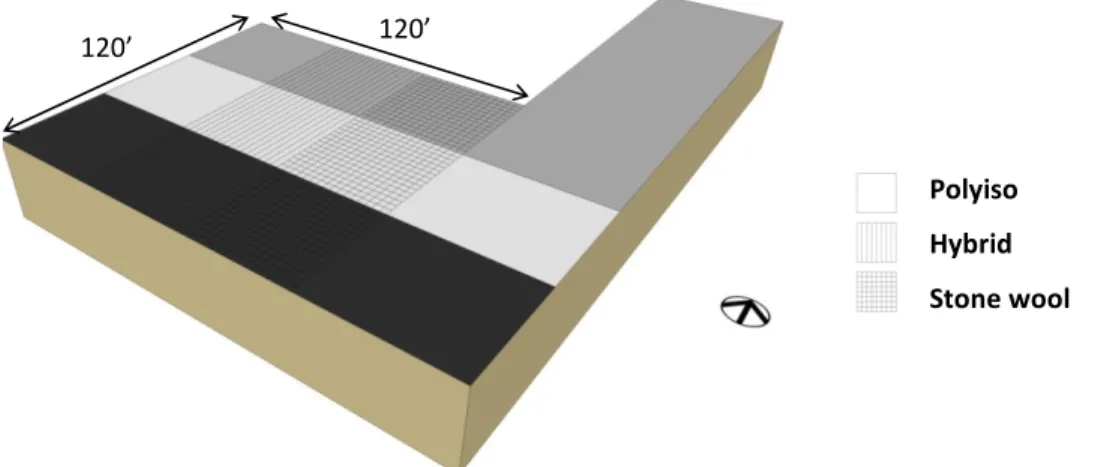
The building was selected because it provided a single large uninterrupted test area for the roof monitoring the construction schedule coincided with the research study, and the building owners were willing to have a number of alternate roof assemblies installed on their building. Prior monitoring of an adjacent building housing similar industrial equipment ascertained that the interior conditions in the new building would be on average between 20°C (68°F) and 25°C (77°F) year round. A sketch of the building is presented in Figure 1 showing the three different membrane colors and three insulation combinations as discussed in the following section.
Figure 1 Study Building and Layout of Roof Membrane Cap Sheet Color and Insulation Strategy
Polyiso Hybrid Stone wool
As shown, a total of nine unique roof assemblies, each 40 x 40 feet in area (16 square) were constructed and monitored at the west part of the building. The adjacent section of the roof along the east side is insulated with stone wool, but is not monitored or included within the study.
Roof Assemblies
Each roof assembly consists of a 2-ply torch-on SBS cap (white, grey, or black) and base sheet over asphalt protection board, insulation layers (as indicated), reinforced air/vapour barrier membrane, and metal Q-deck over open web steel joists. The air/vapour barrier membrane spans between the metal deck flutes, though has been designed and tested by the manufacturer to do so without sagging in this application. The use of a continuous rigid gypsum board over the deck flutes is generally more common in this application with standard membranes. The asphalt protection board and insulation layers are structurally adhered together and to the air/vapour barrier membrane using a low-rise, two-part urethane adhesive negating the need for mechanical fasteners in the assembly. The top surface of the stone wool contains an integral asphalt impregnated surface and does not require an additional overlay protection board.
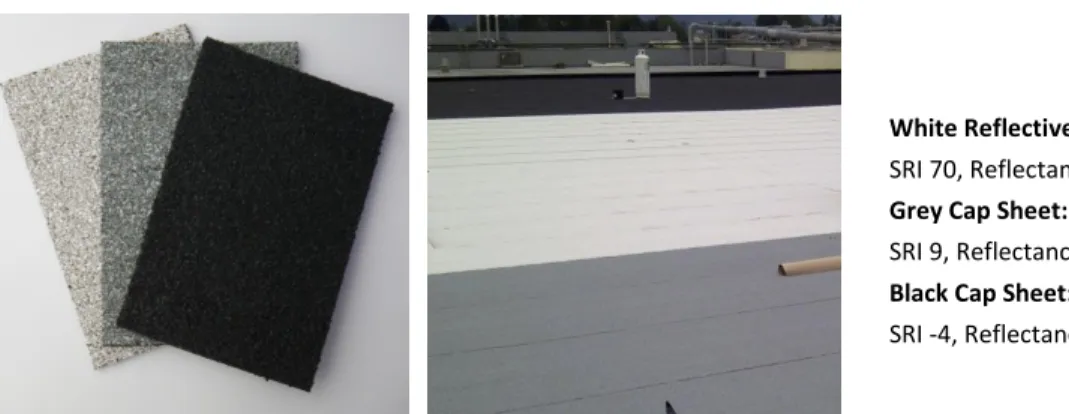
The three SBS cap sheet colors include standard black, grey, and white (LEED compliant SRI cap). The thickness of each insulation combination was varied to achieve approximately the same apparent R-value of R-21.5 (at standard test conditions of 23.9°C (75°F)). Samples of insulation were taken from site for laboratory testing covered later in this paper. These three insulation combinations are shown in Figures 2 through 4 along with the apparent R-value of the insulation, insulation weight, and total insulation heat capacity. Figure 5 shows the membrane cap sheet colors. The Solar Reflective Index (SRI), the reflectance, and emittance for each cap sheet type are also listed. The insulation thickness transitions (3.5”, 5.75”, 4.5”) between the three different insulation strategies were made using a few feet of tapered insulation, well away from sensors and monitoring equipment.
Figure 2 Polyiso Roof Assembly (3.5” polyiso, R-21.5) – Weight: 4.6 kg/m2, Heat Capacity: 6.75 kJ/K/m2
Figure 4 Hybrid Roof Assembly (2.5” stone wool over 2” polyiso, R-21.3) – Weight: 14.3 kg/m2, Heat Capacity: 13.7 kJ/K/m2
Figure 5 Membrane Cap Sheet Colors (Reflective White, Grey and Black) Shown on Left in Lab (Un-soiled and New) and Right in Field Shortly After Installation.
All three assemblies have an initial calculated apparent R-value of between R-21.3 and R-21.5, though as covered later, this R-value varies with insulation temperature and in the case of polyiso, decreases with long-term aging.
Monitoring Program & Sensors
The monitoring program utilizes a range of sensors installed within the same key comparative locations within each roof assembly. The sensor wires are run through common holes within the metal Q-deck, and connected to data-loggers for transmission to the internet to allow for data download and real-time monitoring/analysis. The sensors were installed within each assembly for the following purposes. Not all of the sensor data is covered at this time within this paper.
• Temperature of the following using thermistors: exterior air temperature, cap sheet (between cap and
base sheet to be protected from torch and weather), top of insulation layer at base sheet interface (redundant in case of over-torched cap sensor), bottom of insulation layer at air/vapour barrier, interior surface of metal deck, and air located 3 feet below metal deck. Used to compare thermal performance, energy flows, and thermal comfort implications.
• Relative humidity at air/vapour barrier interface below the insulation to observe presence and movement
of moisture. RH sensors not installed below membrane due to conditions that would rapidly damage the electronics.
• Moisture detection tape at air/vapour barrier interface below insulation to supplement the RH sensors,
and provide baseline data for conventional roof monitoring systems.
White Reflective Cap Sheet:
SRI 70, Reflectance 0.582, Emittance 0.91
Grey Cap Sheet:
SRI 9, Reflectance 0.136, Emittance 0.85
Black Cap Sheet:
• Heat flux using calibrated heat flux sensors sandwiched between insulation layers to measure net heat
flow through each assembly. Using the heat flux measurements and surface temperatures, one can calculate the approximate effective R-value for each assembly under steady state conditions.
• Differential movement between selected 4’x4’ insulation boards, top and bottom layers of insulation in
both directions to understand short- and long-term movement of polyiso and stone wool insulation boards in an adhered system.
• Solar radiation and reflected solar radiation to measure relative loss in reflectance (soiling) of white SBS
membrane over time.
• Weather station to monitor exterior conditions, and automatic camera to photo-document roof surface
conditions and observe long-term soiling patterns.
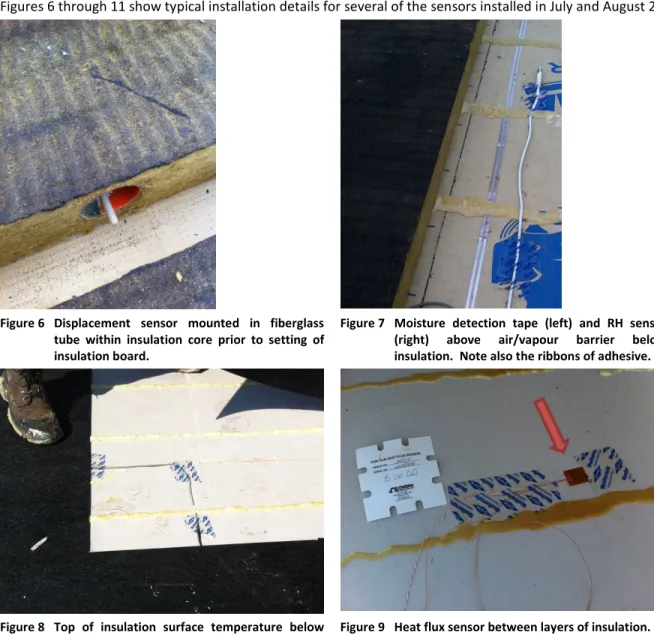
Figures 6 through 11 show typical installation details for several of the sensors installed in July and August 2012.
Figure 6 Displacement sensor mounted in fiberglass tube within insulation core prior to setting of insulation board.
Figure 7 Moisture detection tape (left) and RH sensor
(right) above air/vapour barrier below
insulation. Note also the ribbons of adhesive.
Figure 8 Top of insulation surface temperature below asphalt protection board sheet.
Figure 10Reflected solar radiation sensors (3 in total) located at grey and white roof (2 locations).
Figure 11Interior view of data-logger and two interior
temperature sensors (metal deck) and
surrounding air. Deck flutes run in north-south direction.
Laboratory Testing of Insulation R-values
In conjunction with the field monitoring program, material testing of the thermal resistance (R-value) of the roofing insulation (polyiso and stone wool) was undertaken on representative batch samples of the insulation products installed within the test roofs. This information is used to support the field monitoring data. ASTM C518 thermal transmission material testing was performed to quantify the effective R-values of the polyiso and stone wool insulation products when installed within the roofs. Testing was performed at mean temperatures of -3.9, 4.4, 23.9, and 43.3°C (25, 40, 75, and 110°F); and a temperature difference of 27.8°C (50°F). Follow-up tests are planned at the end of the study to further quantify the impact of age on the apparent conductivities as well. In the interim, samples of a 4 year old polyiso insulation board (of same brand and manufacturer and aged within the lab) collected from a previous research study by the authors were included with the test results for comparison. The measurement of the apparent2 R-value of polyiso insulation by others including the National Roofing Contractors Association (Graham 2010, NRCA 2011) and Building Science Corporation (BSC 2013a) has shown a strong relationship of the mean insulation temperature to apparent R-value in addition to aging factors. The variation in R-value is thought to be primarily attributable to vaporization and condensation of the blowing gases within the closed cell polyiso foam. Highest apparent R-values with polyiso are near room temperature, 23.9°C (75°F), with degrading performance at lower and higher temperatures; where unfortunately, the heat loss or gain is the greatest. The phenomenon of varying R-value with temperature and other insulation properties has recently caught the roofing industry’s attention, though it has been known about for most insulation products for some time (Shirtliffe 1972).
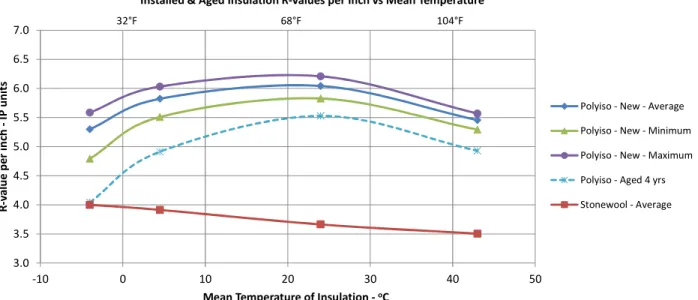
Figure 12 presents the apparent R-value per inch as determined by ASTM C518 testing from six polyiso and three rigid stone wool samples used in this study, that were removed from site and 2 months old at time of test. In addition, the 4 year old sample of the same brand of polyiso is shown for comparison. The results agree well with the BSC and NRCA test results for the polyiso samples and from published data for the rigid stone wool (mineral fiber). Long term aged R-value (LTTR) testing following CAN/ULC-S770-09 and ASTM C1303-11 procedures as
2
Apparent R-value is the actual thermal resistance of the insulation which varies with temperature and due to other factors such as age.
incorporated in ASTM C1289-11A was not performed, although the actual aging effects are being monitored as part of this study.
Figure 12Apparent R-value per inch vs Mean Temperature for Polyiso and Stone Wool Insulation
Both polyiso and stone wool exhibit a strong temperature-dependent thermal conductivity, though behave differently at cold and hot temperatures. Insulation materials such as stone wool that do not rely on blowing agents for insulation performance show a linear relationship between temperature and thermal performance. The performance thermal resistance of stone wool increases with colder temperatures from standard conditions 23.9°C (75°F), whereas the performance of polyiso decreases under both cold and hot conditions.
As an example, if the roofing insulation is at a mean temperature of 0°C (e.g. interior 20°C and exterior -20°C ), the stone wool provides approximately R-4/inch; while the polyiso would provide anywhere from R-4.5 to R-5.8/inch depending on its age and other factors. At a mean temperature of 20°C, the stone wool is less at R-3.7/inch; while the polyiso is optimal at R-5.5 to R-6.3/inch (depending on age). The range in stone wool performance between boards is relatively consistent (no minimum and maximum shown), whereas a range of R-0.5 to R-1.0/inch was observed with the polyiso boards, largely due to varying foam density from 3.0 to 3.4 pcf (albeit cut from the same 4x8 sheet).
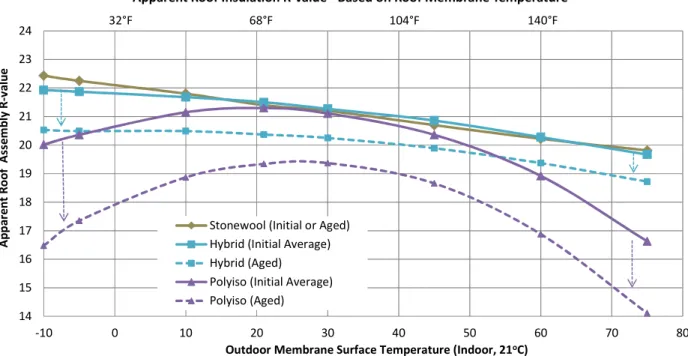
These laboratory measurements of effective R-value/inch for each insulation can then be applied to the three roofing assemblies from this project including: stone wool (5.75” stone wool, R-21.4), hybrid (2.5” stone wool over 2” polyiso, R-21.5), and polyiso (3.5” polyiso, R-21.3); to determine the apparent R-value of the whole roof assembly. Figure 13 provides R-values for each assembly based only on the roof membrane surface temperature and a typical indoor condition of 21°C. The impact of polyiso aging is predicted with the matching color dashed lines for both the hybrid and polyiso assemblies.
3.0 3.5 4.0 4.5 5.0 5.5 6.0 6.5 7.0 -10 0 10 20 30 40 50 R -v a lu e p e r in ch -IP u n it s
Mean Temperature of Insulation -oC
Installed & Aged Insulation R-values per Inch vs Mean Temperature
Polyiso - New - Average Polyiso - New - Minimum Polyiso - New - Maximum Polyiso - Aged 4 yrs Stonewool - Average
Figure 13Apparent R-values for Study Building Roof Assemblies Based on Roof Membrane Surface Temperature Over a Range of -10°C to 75°C (14°F to 167°F) – Note that extrapolation beyond this range may not be valid
This finding demonstrates the sensitivity of the thermal resistance of the polyiso roofing assembly when exposed to either extreme cold or hot outdoor temperatures. A roof constructed with 3.5” of polyiso may have a code-acceptable calculated R-value of R-21.3, but when exposed to cold (-10°C) would drop to R-20 or as low as R-16.5 depending on its age; and when exposed to hot (75°C membrane surface) temperatures would drop to R-16.5 or as low as R-14.0 depending on its age. This is an important consideration to be made when sizing mechanical equipment in new buildings, and will likely increase the actual energy consumption within buildings constructed with polyiso-insulated roofs in both cold and hot climates.
In the hybrid assembly (4.5” thick), the use of a layer of stone wool insulation (in this case, equivalent to approximately 45% of the assembly R-value) over top of the polyiso significantly improves the effective R-value of the polyiso as it keeps it near optimum temperatures (which are similar to typical interior temperatures); and therefore, results in a better assembly R-value in cold and hot conditions.
The roof assembly insulated with entirely stone wool insulation (thickest at 5.75”) will have a more stable R-value (increasing at colder temperatures, but decreasing at hot temperatures from calculated R-value), and is not susceptible to a loss of R-value with age.
Field Monitoring Results
This paper presents selected results for the first 10 months of the field monitoring program with a focus on the differences in thermal behaviour between the three different insulation strategies. To compare the insulation assemblies, the measured heat flux data along with cap surface temperature and interior surface temperatures are compared for each assembly. Of interest are key behavioural differences between the polyiso and stone wool due to varying apparent R-value and different heat capacities.
14 15 16 17 18 19 20 21 22 23 24 -10 0 10 20 30 40 50 60 70 80 A p p a re n t R o o f A ss e m b ly R -v a lu e
Outdoor Membrane Surface Temperature (Indoor, 21oC)
Apparent Roof Insulation R-value - Based on Roof Membrane Temperature
Stonewool (Initial or Aged) Hybrid (Initial Average) Hybrid (Aged) Polyiso (Initial Average) Polyiso (Aged)
Heat Flow & Thermal Differences
Heat flux data measures the hourly transfer of heat energy across each assembly from interior to exterior. A positive value indicates that heat flow is upwards (i.e. at night and when interior is warmer than exterior membrane surface temperature) and a negative value indicates that heat flow is inwards (i.e. membrane heated above interior temperature by solar radiation). Unfortunately, due to issues with the logging of the heat flux data at some of the locations prior to February 2013, data is only available from spring through summer at this time. Based on the monitoring to date, we have found subtle differences in the heat flux and interior and exterior surface temperatures. Firstly, we have observed a thermal lag within the stone wool compared to the polyiso insulation. This shows up in dampened heat flux measurements and by reduced cap sheet surface temperatures and lower interior surface temperatures. This lag in temperatures can be beneficial from a thermal comfort and energy efficiency standpoint. The reduction in peak membrane temperature also likely reduces the rate of deterioration of the membrane. This thermal lag effect, seen mostly during solar heating of the roof membranes, appears to be the result of the difference in heat capacity between the two types of insulation (6.75 kJ/K/m2 for polyiso, 13.7 kJ/K/m2 for hybrid, and 22.7 kJ/K/m2 for stone wool), and likely impacted by the temperature-dependant polyiso R-value. Latent energy from moisture movement through the stone wool insulation may also be a factor. The hybrid assembly falls between the polyiso and stone wool, though it does have some unique behaviour as a result of the interaction of the two insulation products requiring further investigation.
Figure 143 presents the hourly heat flux measurements for one of the hottest days during the monitoring period, when exterior air temperatures at the site exceeded 34°C (93°F). The results are similar for other days when the roofs are exposed to solar radiation, even during the wintertime. As expected, there is a large difference in the heat flux between the black and white cap sheets by approximately 50% at peak conditions, but there are also significant differences between the polyiso and stone wool insulation arrangements. The heat flow through the stone wool compared to the polyiso in these cases is approximately 28% less for the black and 33% less for the white, and is offset by a few hours. Grey colored membrane data is not shown for clarity here though falls between the white and black findings.
Figure 15 presents the integrated average daily energy transfer for four selected two-day periods from late winter through spring and early summer. These periods were selected as data was complete and to be representative of typical conditions for this climate. Average exterior temperature and solar radiation intensity during those periods are summarized within the figure. Here, the net difference between the polyiso, hybrid, and stone wool assemblies are shown. Differences are more dramatic during the warmer months when exposed to more solar radiation, and indicate less net heat flow through the stone wool assembly versus the polyiso. The hybrid assembly has slightly higher heat flow through it than the polyiso assembly, which is interesting considering the previous finding. During the colder winter months, the differences between the insulation strategies is less clear and the further analysis of additional wintertime data is needed before any conclusions can be made. Due to the minimal heat flux readings during the winter (<5 W/m2) that result from a fairly well insulated roof assembly, the results may be affected by the resolution of the heat flux sensor technology generally available and used in this study. More
3
In all of the subsequent plots within the legend code, ‘W’ refers to the white roof membrane, ‘G’ for grey, and ‘B’ for black. ISO refers to the polyiso insulation, and ISO-SW refers to the hybrid (stone wool over polyiso), and SW refers to the stone wool. The 9 different test areas are defined in short form using a combination of these letters.
accurate heat flux sensors will be considered for installation in later phases of this study to improve the wintertime results.
Figure 14Comparison of Heat Flux between White and Black Cap Sheet for 3 Insulation Strategies
Figure 15Average Daily Energy Transfer for Selected Dates through White and Black Cap Sheet for 3 Insulation Strategies
Roof surface temperatures for the membrane cap sheet and interior metal deck are presented for the June 30 to July 1 time period in Figures 16 and 17. Here, the difference in peak temperatures and thermal lag is demonstrated between the stone wool and polyiso insulation strategies.
-25 -20 -15 -10 -5 0 5
Jun 30 0:00 Jun 30 6:00 Jun 30 12:00 Jun 30 18:00 Jul 1 0:00
H e a t F lu x [ W /m ²] -+ (l o ss ), -(g a in )
Heat Flux Through Roof - White vs Black Color for 3 Insulation Strategies
W-ISO HF W-ISO-SW HF W-SW HF B-ISO HF B-ISO-SW HF B-SW HF
Average Daily Energy Transfer During Different Exterior Conditions
-250 -200 -150 -100 -50 0 50 100 A v g . D a il y E n e rg y T ra n sf e r [W ·h r/ m ² p e r d a y ] Feb 21 to 23 Apr 13 to 15 May 9 to 12 June 30 - July 2 Average Outdoor Temperature Average Solar Intensity on horizontal roof, all hours of day
Feb 21-23 4.4°C (39.9°F) 27 W/m2
Apr 13-15 6.9°C (44.4°F) 200 W/m2
May 9-12 18.7°C (65.6°F) 261 W/m2
Figure 16Roof Membrane Cap Surface Temperatures for White and Black Cap Sheet for 3 Insulation Strategies – June 30, 2013
Figure 17Interior Metal Deck Surface Temperatures for White and Black Cap Sheet for 3 Insulation Strategies – June 30, 2013
As shown within both figures, the use of stone wool insulation versus polyiso reduces peak membrane temperatures by between 2 to 6°C (4°F to 11°F). It also reduces the peak interior surface temperature by up to 2°C (4°F) and shifts the peak by 1 to 2 hours, a benefit for both thermal comfort and cooling energy. By analyzing both figures, one can also compare the lag in peak temperatures between the membrane cap (approx. 1pm) and interior surfaces (approx. 5pm) of these roof assemblies.
50 70 90 110 130 150 170 190 10 20 30 40 50 60 70 80 90
Jun 30 0:00 Jun 30 6:00 Jun 30 12:00 Jun 30 18:00 Jul 1 0:00
M e m b ra n e C a p S u rf a ce T e m p e ra tu re -oF M e m b ra n e C a p S u rf a ce T e m p e ra tu re -oC
Roof Membrane Cap Surface Temperatures - White vs Black Color for 3 Insulation Strategies
W-ISO T-CAP W-ISO-SW T-CAP W-SW T-CAP B-ISO T-CAP B-ISO-SW T-CAP B-SW T-CAP Exterior Air Temperature Series3 75 80 85 90 95 100 24 26 28 30 32 34 36 38
Jun 30 0:00 Jun 30 6:00 Jun 30 12:00 Jun 30 18:00 Jul 1 0:00
M e ta l D e ck S u rf a ce T e m p e ra tu re -oF M e ta l D e ck S u rf ra ce T e m p e ra tu re -oC
Interior Metal Deck Surface Temperatures - White vs Black Color for 3 Insulation Strategies
W-ISO TEMP-DECK W-ISO-SW TEMP-DECK W-SW TEMP-DECK B-ISO TEMP-DECK B-ISO-SW TEMP-DECK B-SW TEMP-DECK Exterior Air Temperature Interior Air Temperature - Black Interior Temperature -White Series10
Insulation Movement & Shrinkage
The movement between the 4’x4’ insulation boards was monitored using displacement sensors installed into the core of selected insulation boards in both the north-south (parallel to adhesive) and east-west (perpendicular to adhesive) direction of the black and white membrane roof assemblies. Previous research by the authors and by several others has found that in-service polyiso insulation may shrink over time and will expand and contract on a daily basis with temperature. Stone wool is relatively dimensionally stable and neither shrinks nor moves significantly with temperature change. The open-web steel joist roof assembly with metal deck will move under influence of temperature, and may also affect the movement of the insulation boards as it bows and flexes. Movement of the roof membrane under thermal cycling may also distribute movement to the insulation boards and be recorded by the displacement sensors.
Figure 18 presents the monitoring results to date showing the displacement of the lower and upper insulation layers in the east-west and north-south orientations for the white and black stonewool and polyiso roofs. Within the plots a negative reading means the displacement sensor pin has extended which indicates that the monitored insulation panels have moved apart. This could result from shifting of the panels, thermal contraction, or long term shrinkage.
Figure 18Insulation Displacement for Stone Wool and Polyiso Roofs (Black and White Membrane) at Lower layer and Upper Layer of Insulation in East-West and North-South Orientation.
Note: A Negative reading indicates that the monitored insulation panels have moved apart. This could result from shifting of the panels, thermal contraction, or long term shrinkage.
The monitoring to date shows that the lower layer of insulation expands/contracts very little on a daily basis as would be expected. A small amount of shrinkage (less than 0.5 mm) appears to have occurred in the lower polyiso boards in both directions of restraint. Movement within the polyiso and stone wool on a diurnal basis is less than 1 mm, lower under a white membrane compared to a black membrane. The upper layer of insulation moves more than the lower layer likely because it is exposed to greater daily, monthly, and annual temperature swings. The upper layer of polyiso appears to have shrunk slightly more than the lower sheet by up to 1.0 mm to date. Interestingly, some of the largest diurnal changes occurred within the stone wool insulation; though upon closer review of this data, peak movements occurred inconsistently and non-permanently. Further monitoring is needed to confirm the cause of the movements that occurred in the black stone wool roof in April, but is no longer occurring to the same extent.
-3.0 -2.0 -1.0 0.0 1.0
Sep Oct Nov Dec Jan Feb Mar Apr May Jun Jul Aug
D is p la ce m e n t [m m ]
Displacement - Lower Insulation - East-West
-3.0 -2.0 -1.0 0.0 1.0
Sep Oct Nov Dec Jan Feb Mar Apr May Jun Jul Aug
D is p la ce m e n t [m m ]
Displacement - Lower Insulation - North-South
-3.0 -2.0 -1.0 0.0 1.0
Sep Oct Nov Dec Jan Feb Mar Apr May Jun Jul Aug
D is p la ce m e n t [m m ]
Displacement - Upper Insulation - East-West
-3.0 -2.0 -1.0 0.0 1.0
Sep Oct Nov Dec Jan Feb Mar Apr May Jun Jul Aug
D is p la ce m e n t [m m ]
Displacement - Upper Insulation - North-South
Relative Humidity & Vapour Movement
The relative humidity (RH) level and liquid moisture level (measured using a moisture detection tape) within each roof assembly was monitored to assess the impact of built-in construction moisture within each assembly. As the roofs were constructed under ideal conditions during the dry summer months, no materials were wetted during construction and relative humidity levels were initially very low. Monitoring over the past 10 months, starting in the fall, demonstrates that while conditions within the insulation layers started off dry (average 40% RH), conditions in the first spring to summer have led to elevated RH levels within the insulation, which increase up to 100% (condensation) on the surface of the vapour barrier. This is particularly apparent on a diurnal basis within the stone wool insulation assemblies (more so for the black vs the white membrane) where moisture freely moves up and down through the insulation under the influence of solar radiation and is able to redistribute from other areas of the roof. Moisture is not able to move as freely within the polyiso as it is more resistant to vapour flow resulting in more stable RH levels below the insulation. Liquid water has not yet been detected by the moisture detection tape, though the stone wool with black cap sheet assembly is indicating higher vapour accumulation (as expected with higher membrane temperature and greater inward vapour drive). These findings are demonstrated by RH measurements at the bottom of the insulation within Figure 19 for the 10-month monitoring period and in detail on a daily (short-term) basis from June 30 to July 2 in Figure 20.
Figure 19Relative Humidity Below Insulation, Sorted from Highest to Lowest RH Levels – September 15, 2012 through July 3, 2013 0 10 20 30 40 50 60 70 80 90 100
Sep Oct Nov Dec Jan Feb Mar Apr May Jun Jul Aug
R e la ti v e H u m id it y [ % ]
Relative Humidity Below Insulation
B-SW RH-B-INS B-ISO-SW RH-B-INS W-SW RH-B-INS W-ISO-SW RH-B-INS B-ISO RH-B-INS W-ISO RH-B-INS
Figure 20Hourly RH Levels below Insulation Demonstrating the Diurnal Influence of Solar Radiation on Stone Wool, Hybrid, and Polyiso Insulated Assemblies (White vs Black Membrane), June 30 and July 1, 2013.
At this point, this small amount of moisture is not a concern to the long-term performance of the assembly, because it is really a redistribution of moisture that was in the assembly at the time of construction. The presence of moisture affects the transfer of heat flow by thermal conductance and latent heat flow in porous insulations (Hedlin 1987), and will be further investigated for each roof assembly as part of this research study.
Conclusions & Recommendations
This large-scale field monitoring study was implemented with the intent of measuring the impacts and benefits of roof membrane color and insulation strategy on the thermal, hygrothermal, and long-term behaviour and performance of conventional roofing assemblies. At the study building in the Lower Mainland of British Columbia, Canada, three different 2-ply SBS membrane cap sheet colors (white, grey, black) were placed over three different conventional insulation strategies (polyiso, stone wool, and hybrid combination of both) creating a total of nine unique conventional roofing assemblies. Sensors were installed within each of the roof assemblies to measure material and surface temperatures, relative humidity, moisture content, heat flux, and dimensional stability of the insulation.
As part of the study, thermal resistance testing of the polyiso and stone wool insulation was performed using ASTM C518 procedures. The insulation products were tested at a range of in-service temperatures, and a relationship between R-value and temperature was developed. The results were then applied to the three insulated assemblies monitored within this study to determine in-service apparent R-values based on exterior membrane temperature. The findings show that the stone wool and hybrid roofs will maintain R-values close to calculated values, whereas the R-value in the roof with polyiso will drop a fair amount when exposed to either extreme of cold or hot outdoor (and solar radiation induced) temperatures. This is an important consideration when designing roof assemblies.
The heat flow and temperature field measurements show a difference in behaviour between the polyiso, stone wool, and hybrid insulation strategies. Stone wool has a heat capacity approximately 3.4 times higher than polyiso for the same design R-value, which likely affects peak temperatures of the membrane and interior and offsets the
0 10 20 30 40 50 60 70 80 90 100
Jun 30 0:00 Jun 30 12:00 Jul 1 0:00 Jul 1 12:00 Jul 2 0:00
R e la ti v e H u m id it y [ % ]
Relative Humidity Below Insulation
W-ISO RH-B-INS W-ISO-SW RH-B-INS W-SW RH-B-INS B-ISO RH-B-INS B-ISO-SW RH-B-INS B-SW RH-B-INS
peak load (thermal lag effects). In short, higher heat capacity of the stone wool insulation reduces the peak membrane temperature, which is positive to the longevity of the membrane; and reduces the peak interior temperature, which is typically a positive for the occupants. In addition, stone wool has a more stable R-value than polyiso so it insulates better when exposed to larger temperature differences, as experienced .
Movement of the insulation boards is being monitored using displacement sensors between insulation boards in the north-south and east-west direction. To date, a small amount of shrinkage (<1mm in 1220mm, 0.08%) has been observed between polyiso boards, and diurnal movement of both polyiso and stone wool insulation boards is less than 0.08% under peak temperature cycles. In the case of the polyiso, these values are lower than initially expected based on our experience with polyiso and a previous monitoring.
While RH and water vapour levels within each of the roof assemblies started off low after installation in late summer, RH levels have increased during the first full summer. Water vapour moves within the stone wool insulation more readily than the polyiso insulation resulting in greater accumulations during periods of high and low temperature. This means that with stone wool insulation there is the potential for more water vapour redistribution with the roof system in the event of a leak.
This study provides insight into the behaviour of differently insulated conventional roof assemblies with light to dark roofing membranes. The study is ongoing and will continue for the next few years.
Acknowledgements
The authors wish to thank both Roxul and Soprema for providing a roof to test, the building materials, funding, and providing technical peer review on this project. Special recognition is also extended to SMT Research for installing and troubleshooting the sensors and data-logging equipment, and to Building Science Labs for the ASTM C518 material testing.
References
ASTM Standard C518, 2010, “Standard Test Method for Steady-State Thermal Transmission Properties by Means of the Heat Flow Meter Apparatus” ASTM International, West Conshohocken, PA, 2010. Available at
http://www.astm.org/Standards/C518.htm.
ASHRAE Standard 90.1 “Energy Standard for Buildings except Low-Rise Residential Buildings” I-P and S-I Editions. 2007, 2010. ANSI/ASHRAE/IESNA. American Society of Heating, Refrigerating and Air-Conditioning Engineers, Inc. Available at: http://www.ashrae.org.
Bludau, C., Zirkelbach, D., Kuenzel, H. 2008. Condensation Problems in Cool Roofs. Proceedings from 11DBMC Conference on Durability of Building Materials and Components. Instanbul, Turkey. Republished within August 2009 RCI Interface Magazine.
Building Science Corporation (BSC). 2013a. BSC Information Sheet 502: Understanding the Temperature Dependence of R-values for Polyisocyanurate Roof Insulation. Available at: http://www.buildingscience.com. Building Science Corporation (BSC). 2013b. The Thermal Metric Project. Available at:
http://www.buildingscience.com/documents/special/thermal-metric/
DOE Cool Roof Calculator. 2013. Oak Ridge National Laboratory. Software Version 1.2. Available online:
Environment Canada. 2013. Canadian Climate Normals, Chilliwack Airport. Available at:
http://climate.weather.gc.ca/climate_normals/
Graham, M., 2010. Revised R-values, Professional Roofing, May 2010. Available at:
http://www.professionalroofing.net/.
Hedlin, C.P., 1987. Seasonal Variations in the Modes of Heat Transfer in Moisture Porous Thermal Insulation in a Flat Roof. Journal of Thermal Insulation, Vol. 11, p54-66, July 1987, (IRC Paper No. 1496).
Roof Savings Calculator (RSC). 2013. Oak Ridge National Laboratory and Lawrence Berkeley National Laboratory. Software Version v0.92. Available online: http://www.roofcalc.com/index.shtml.
Rose, W. 2007. White Roofs and Moisture in the US Desert Southwest. Proceedings from ASHRAE Buildings X Conference, Clearwater Beach, Florida. December 2007.
Shirtliffe, C.J. 1972. Thermal Resistance of Building Insulation. Canadian Building Digest (CBD) #149. National Research Council of Canada. 1972. Available online: