Student Name:
Higher Education
Learning Agreement form for studies
Subject Area:
LEARNING AGREEMENT FOR STUDIES
Academic year 2014/15
Subject
Subject Area
Code
1Study
cycle
2The Student
Last name (s)
□
male
First name (s)
□
female
Date of birth
Nationality
3phone
+49 (0)
Contact details of the departmental coordinator - sending institution
Name
University of Münster
Erasmus code (if applicable)D MUNSTER01
Country code4DE
Faculty/ DepartmentAddress
Contact person
5phone
+
49 (0) 251
Contact details of the departmental coordinator - receiving institution
Name Erasmus code (if applicable) Country code
Faculty/ Department
Address
Contact person
phone
Mustermann
2014/15
L2 Sportwissenschaft
1014 Sports 1014 SportsEQF level 6 - bachelor / first cycle
Mustermann
■
Max
09.09.1990
German
251-66 55
[email protected]Institut für Sportwissenschaft
Horstmarer Landweg 62B, 48149 Münster
Dr. Maike Tietjens
251-8339282
[email protected]
University of Greenwich
auswählenSports Institute
Greenwich Avenue 15, England
Mr. Greenwich
Student Name:
Higher Education
Learning Agreement form for studies
Subject Area:
Section to be completed
BEFORE THE MOBILITY
I. Proposed mobility programme
Planned period of the mobility:
from [month/year]
till [month/year]
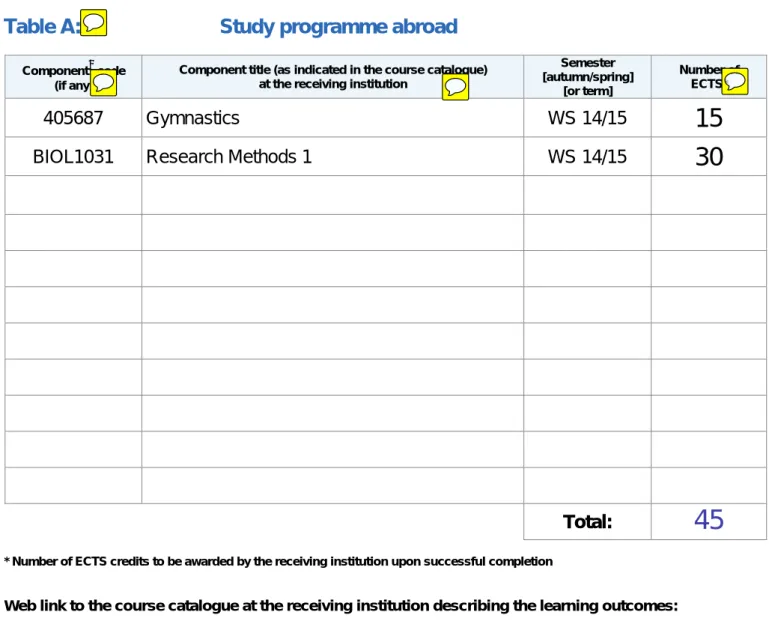
Table A:
Study programme abroad
Component6 code (if any)
Component title (as indicated in the course catalogue) at the receiving institution
Semester [autumn/spring] [or term] Number of ECTS*
Total:
* Number of ECTS credits to be awarded by the receiving institution upon successful completion
Web link to the course catalogue at the receiving institution describing the learning outcomes:
Web link(s) to be provided
1014 Sports
Mustermann
09.2014
03.2015
405687
Gymnastics
WS 14/15
15
BIOL1031
Research Methods 1
WS 14/15
30
45
1
2
Student Name:
Higher Education
Learning Agreement form for studies
Subject Area:
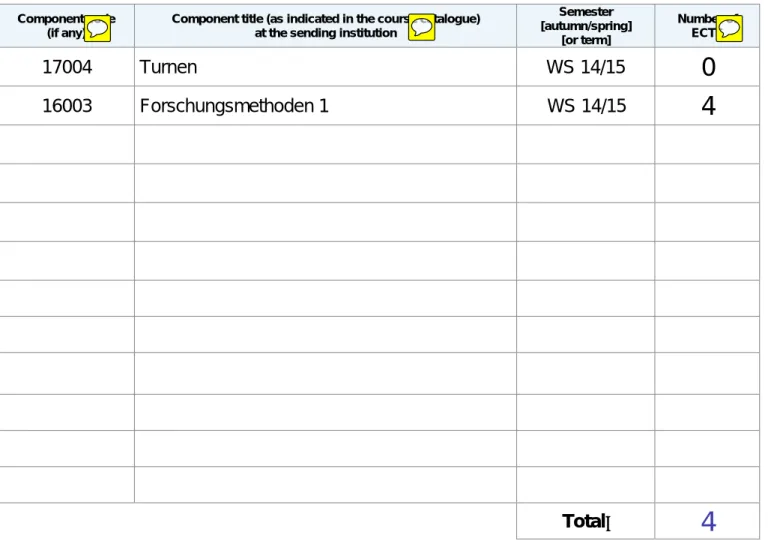
Table B:
Group of educational components in the student’s degree that
would normally be completed at the sending institution and which
will be replaced by the study abroad
NB no one to one match with Table A is required. Where all credits in Table A are recognised as forming part of the
programme at the sending institution without any further conditions being applied, Table B may be completed with
a reference to the mobility windows (see guidelines)
Component code (if any)
Component title (as indicated in the course catalogue) at the sending institution
Semester [autumn/spring] [or term] Number of ECTS
Total
:
If the student does not complete successfully some educational components, the following provisions will
apply:
(Please, specify or provide a web blink to the relevant information.}
Language competence of the student
The level of language competence
7in ………..……
[the main language of
instruction]
that the student already has or agrees to acquire by the start of the study period is:
A1
A2
B1
B2
C1
C2
1014 Sports
Mustermann
17004
Turnen
WS 14/15
0
16003
Forschungsmethoden 1
WS 14/15
4
4
1
2
Student Name:
Higher Education
Learning Agreement form for studies
Subject Area:
II. Responsible
Persons
8for the recognition of ECTS Credits
Responsible person in the sending institution - University of Münster
Name:
Function:
Phone number:
E-mail:
Responsible person in the receiving institution -
Name:
Function:
Phone number:
E-mail:
III.
Commitment of the three parties
By signing this document, the student, the sending institution and the receiving institution confirm that they approve the proposed Learning Agreement and that they will comply with all the arrangements agreed by all parties. Sending and receiving institutions undertake to apply all the principles of the Erasmus Charter for Higher Education relating to mobility for studies (or the principles agreed in the inter-institutional agreement for institutions located in partner countries).
The receiving institution confirms that the educational components listed in Table A are in line with its course catalogue.
The sending institution commits to recognise all the credits gained at the receiving institution for the successfully completed educational components and to count them towards the student's degree as described in Table B. Any exceptions to this rule are documented in an annex of this Learning Agreement and agreed by all parties.
The student and receiving institution will communicate to the sending institution any problems or changes regarding the proposed mobility programme, responsible persons and/or study period.
The student
Date
Student’s signature
The sending institution - University of Münster
Responsible
person’s
signature
(Seal)
Date
The receiving institution -
Responsible
person’s
signature
(Seal)
Date
1014 SportsMustermann
Dr. Neil van Bentem
Studienkoordinator
0251-8331787
[email protected]Mr. Greenwich
Coordinator of study
0156/32854695
[email protected]University of Greenwich
Student Name:
Higher Education
Learning Agreement form for studies
Subject Area:
Section to be completed during the mobility
CHANGES TO THE ORIGINAL LEARNING AGREEMENT
I.
Exceptional changes to the proposed mobility programme
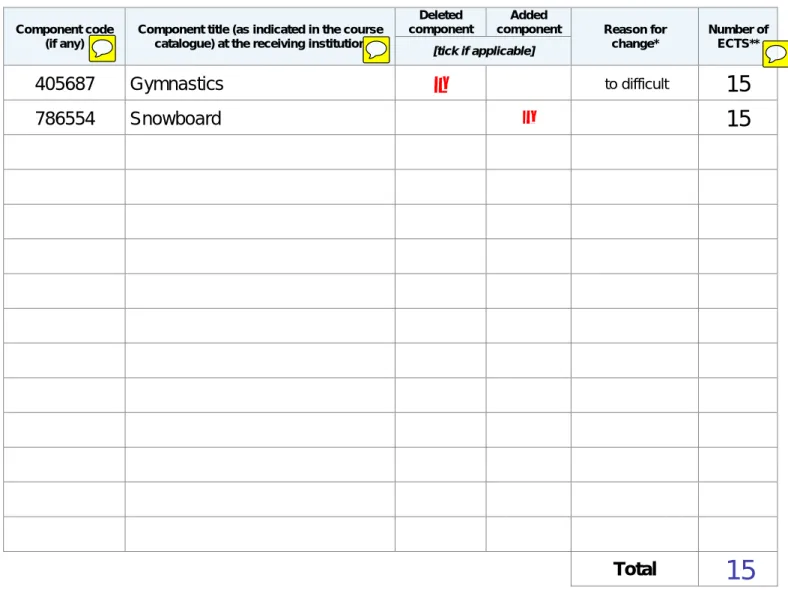
Table C:
Exceptional changes to study programme abroad or additional
components in case of extension of stay abroad
Component code (if any)
Component title (as indicated in the course catalogue) at the receiving institution
Deleted component
Added
component Reason for change* Number of ECTS** [tick if applicable]
□
□
□
□
□
□
□
□
□
□
□
□
□
□
□
□
□
□
□
□
□
□
□
□
□
□
□
□
Total
* Reasons for deleting a component: A1) previously selected educational component is not available at receiving institution A2) Component is in a different language than previously specified in the course catalogue A3) Timetable conflict, A4) other (please specify).
Reason for adding a component: B1) Substituting a deleted component, B2) Extending the mobility period, B3) other (please specify).
** Number of ECTS credits to be awarded by the receiving institution upon successful completion of the component.
The student, the sending and the receiving institutions confirm that they approve the proposed amendments to the
mobility programme.
Approval by e-mail or signature of the student and of the sending and receiving institution responsible persons.
1014 SportsMustermann
405687
Gymnastics
■
to difficult
15
786554
Snowboard
■
15
15
1
3
Student Name:
Higher Education
Learning Agreement form for studies
Subject Area:
[Only if changes affect table B, please insert a revised version below and label the table as "Table D:
Exceptional changes to set of components to be replaced at sending institution".]
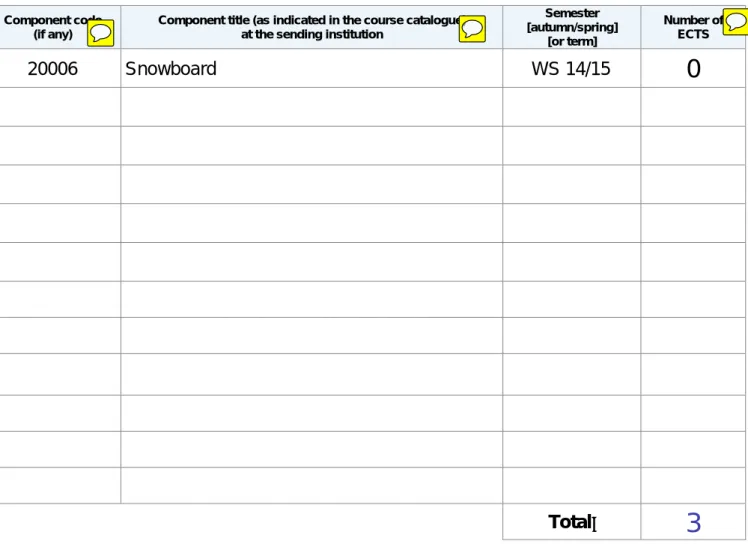
Table D:
Group of educational components in the student’s degree that
would normally be completed at the sending institution and which
will be replaced by the study abroad
NB no one to one match with Table A is required. Where all credits in Table A are recognised as forming part of the
programme at the sending institution without any further conditions being applied, Table B may be completed with
a reference to the mobility windows (see guidelines)
Component code (if any)
Component title (as indicated in the course catalogue) at the sending institution
Semester [autumn/spring] [or term] Number of ECTS
Total
:
1014 SportsMustermann
20006
Snowboard
WS 14/15
0
3
3
Student Name:
Higher Education
Learning Agreement form for studies
Subject Area:
II. Changes in the responsible persons for the recognition of ECTS Credits, if
any:
New Responsible person in the sending institution - University of Münster
Name:
Function:
Phone number:
E-mail:
New Responsible person in the receiving institution -
Name:
Function:
Phone number:
E-mail:
III.
Commitment of the three parties
By signing this document, the student, the sending institution and the receiving institution confirm that they approve the proposed Learning Agreement and that they will comply with all the arrangements agreed by all parties. Sending and receiving institutions undertake to apply all the principles of the Erasmus Charter for Higher Education relating to mobility for studies (or the principles agreed in the inter-institutional agreement for institutions located in partner countries).
The receiving institution confirms that the educational components listed in Table A are in line with its course catalogue.
The sending institution commits to recognise all the credits gained at the receiving institution for the successfully completed educational components and to count them towards the student's degree as described in Table B. Any exceptions to this rule are documented in an annex of this Learning Agreement and agreed by all parties.
The student and receiving institution will communicate to the sending institution any problems or changes regarding the proposed mobility programme, responsible persons and/or study period.
The student
Date
Student’s signature
Responsible person in the sending institution - University of Münster
Responsible
person’s
signature
(Seal)
Date
Responsible person in the receiving institution –
Responsible
person’s
signature
(Seal)
Date
1014 SportsMustermann
Dr. Neil van Bentem
Studienkoordinator
0251-8331787
[email protected]
University of Greenwich
Mr. Greenwich
Coordinator of Stduy
Student Name:
Higher Education
Learning Agreement form for studies
Subject Area:
Section to be completed
AFTER THE MOBILITY
RECOGNITION OUTCOMES
I. Minimum information to include in the receiving institution’s
TRANSCRIPT OF RECORDS
Start and end dates of the study period:
from [day/month/year] till [day/month/year]
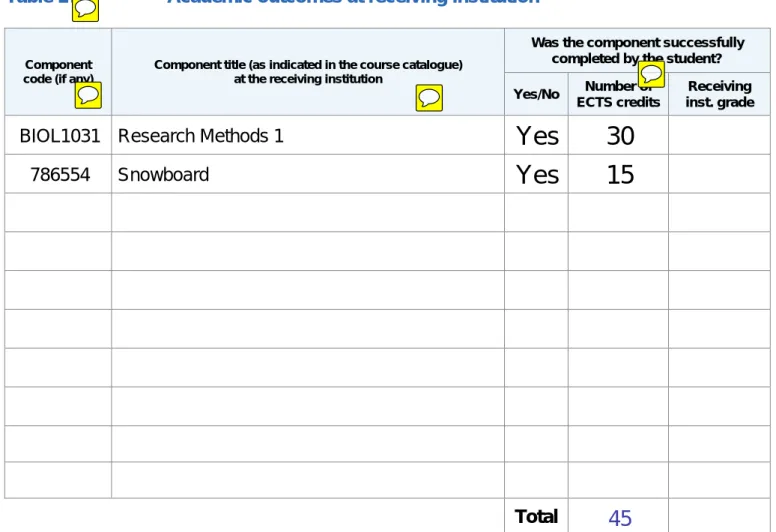
Table E:
Academic outcomes at receiving institution
Component code (if any)
Component title (as indicated in the course catalogue) at the receiving institution
Was the component successfully completed by the student? Yes/No Number of
ECTS credits
Receiving inst. grade
Total
Responsible person in the receiving institution –
Responsible
person’s
signature
(Seal)
Date
1014 SportsMustermann
09.2014
03.2015
BIOL1031
Research Methods 1
Yes
30
786554
Snowboard
Yes
15
45
University of Greenwich
2
3
Student Name:
Higher Education
Learning Agreement form for studies
Subject Area:
II. Minimum information to include in the sending institution’s
TRANSCRIPT OF RECORDS
Start and end dates of the study period:
from [day/month/year] till [day/month/year]
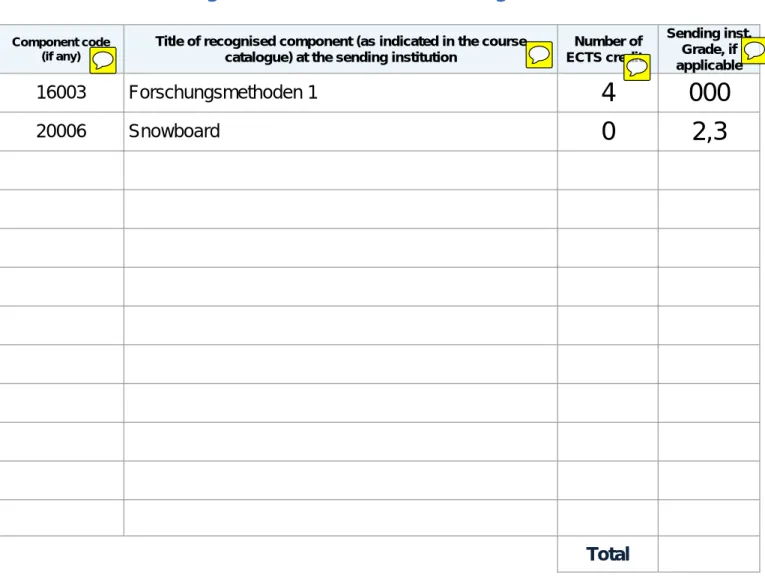
Table F:
Recognition outcomes at the sending institution
Component code (if any)
Title of recognised component (as indicated in the course catalogue) at the sending institution
Number of ECTS credits Sending inst. Grade, if applicable
Total
Responsible person in the sending institution - University of Münster
Responsible
person’s
signature
(Seal)
Date
1014 SportsMustermann
09.2014
03.2015
16003
Forschungsmethoden 1
4
000
20006
Snowboard
0
2,3
2
3
Student Name:
Higher Education
Learning Agreement form for studies
Subject Area:
Annex 1: Guidelines
The purpose of the Learning Agreement is to provide a transparent and efficient preparation of the study period abroad and to ensure that the student will receive recognition in his/her degree for the educational components successfully completed abroad. It is recommended to use this template. However, if higher education institutions already have an IT system in place to produce the Learning Agreement or the Transcript of Records, they can continue using it. What is important is that all the information requested in this template is provided, no matter in which format, provided that it respects certain requirements outlined in the sections below.
How to use the Learning Agreement:
Before the mobility, it is necessary to fill in page 1 with information on the student, the sending and the receiving institutions and the three parties have to agree on the section to be completed before the mobility (pages 2 and 3). On page 1, all the information mentioned will have to be encoded in the Mobility Tool. Institutions can decide to add more information (e.g. additional contact person in the coordinating institution of a consortium) or to request less in case some of the information is already provided in other documents internal to the institution. However, it should at least include the names of the two institutions, and names and contact details of the student and persons of contact in both the sending and receiving institutions. The section to be completed during the mobility (page 4) should only be used if there are changes in the responsible persons or in case it is necessary to introduce changes to the original mobility programme. This section and the section before mobility (pages 1 to 4) should always be kept together in all communications.
After the mobility, the receiving institution should send a Transcript of Records to the student and the sending institution (page 5). Finally the sending institution should issue a Transcript of Records (page 5) to the student or record the results in a database accessible to the student.
PROPOSED MOBILITY PROGRAMME
The proposed mobility programme includes the indicative start and end months of the agreed study programme that the student will carry out abroad. The Learning Agreement must include all the educational components to be carried out by the student at the receiving institution (in table A) and it must contain as well the group of educational components that will be replaced in his/her degree by the sending institution (in table B) upon successful completion of the study programme abroad. Additional rows can be added as needed to tables A and B. Additional columns can also be added, for example, to specify the study cycle-level of the educational component. The presentation of this document may also be adapted by the institutions according to their specific needs. However, in every case, the two tables A and B must be kept separated, i.e. they cannot be merged. The objective is to make clear that there needs to be no one to one correspondence between the courses followed abroad and the ones replaced at the sending institutions. The aim is rather that a group of learning outcomes achieved abroad replaces a group of learning outcomes at the sending institution, without having a one to one correspondence between particular modules or courses.
A normal academic year of full-time study is normally made up of educational components totalling 60 ECTS* credits. It is recommended that for mobility periods shorter than a full academic year, the educational components selected should equate to a roughly proportionate number of credits. In case the student follows additional educational components beyond those required for his/her degree programme, these additional credits must also be listed in the study programme outlined in table A.
When mobility windows are embedded in the curriculum, it will be enough to fill in table B with a single line as described below:
Component code (if any)
Component title (as indicated in the course catalogue) at the sending institution
Semester [autumn / spring] [or term]
Number of ECTS* credits
Mobility window … Total: 30
Otherwise, the group of components will be included in Table B as follows: Compon
ent code
Component title (as indicated in the course catalogue)
Semester [autumn / spring][or term]
Number of ECTS* credits
Course x … 10 Module y … 10 Laboratory work … 10 Total: 30 1014 Sports
Mustermann
Student Name:
Higher Education
Learning Agreement form for studies
Subject Area:
The sending institution must fully recognise the number of ECTS* credits contained in table A if there are no changes to the study programme abroad and the student successfully completes it. Any exception to this rule should be clearly stated in an annex of the Learning Agreement and agreed by all parties. Example of justification for non-recognition: the student has already accumulated the number of credits required for his/her degree and does not need some of the credits gained abroad.
Since the recognition will be granted to a group of components and it does not need to be based on a one to one correspondence between single educational components, the sending institution must foresee which provisions will apply if the student does not successfully complete some of the educational components from his study programme abroad. A web link towards these provisions should be provided in the Learning Agreement.
In all cases, the student will report via the on-line EU survey on the full recognition by the sending institution of his/her credits achieved abroad based on what has been agreed in Table B (or table D in case of changes during the mobility) and its possible annexes.
The student will commit to reach a certain level of language competence in the main language of instruction by the start of the study period. The level of the student will be assessed after his/her selection with the Erasmus+ online assessment tool when available (the results will be sent to the sending institution) or else by any other mean to be decided by the sending institution. A recommended level has been agreed between the sending and receiving institutions in the inter-institutional agreement. In case the student would not already have this level when he/she signs the Learning Agreement, he/she commits to reach it with the support to be provided by the sending or receiving institution (either with courses that can be funded by the organisational support grant or with the Erasmus+ online tutored courses).
All parties must sign the document; however, it is not compulsory to circulate papers with original signatures, scanned copies of signatures or digital signatures may be accepted, depending on the national legislation.
* In countries where the "ECTS" system it is not in place, in particular for institutions located in partner countries not participating in the Bologna process, "ECTS" needs to be replaced in all tables by the name of the equivalent system that is used and a weblink to an explanation to the system should be added.
CHANGES TO THE ORIGINAL LEARNING AGREEMENT
The section to be completed during the mobility is needed only if changes have to be introduced into the original Learning Agreement. In that case, the section to be completed before the mobility should be kept unchanged and changes should be described in this section.
Changes to the mobility study programme should be exceptional, as the three parties have already agreed on a group of educational components that will be taken abroad, in the light of the course catalogue that the receiving institution has committed to publish well in advance of the mobility periods and to update regularly as ECHE holder. However, introducing changes might be unavoidable due to, for example, timetable conflicts.
Other reasons for a change can be the request for an extension of the duration of the mobility programme abroad. Such a request can be made by the student at the latest one month before the foreseen end date.
These changes to the mobility study programme should be agreed by all parties within four to seven weeks (after the start of each semester). Any party can request changes within the first two to five-week period after regular classes/educational components have started for a given semester. The exact deadline has to be decided by the institutions. The shorter the planned mobility period, the shorter should be the window for changes. All these changes have to be agreed by the three parties within a two-week period following the request. In case of changes due to an extension of the duration of the mobility period, changes should be made as timely as possible as well.
Changes to the study programme abroad should be listed in table C and, once they are agreed by all parties, the sending institution commits to fully recognise the number of ECTS credits as presented in table C. Any exception to this rule should be documented in an annex of the Learning Agreement and agreed by all parties. Only if the changes described in table C affect the group of educational components in the student's degree (table B) that will be replaced at the sending institution upon successful completion of the study programme abroad, a revised version should be inserted and labelled as "Table D: Revised group of educational components in the student's degree that will be replaced at sending institution". Additional rows and columns can be added as needed to tables C and D.
All parties must confirm that the proposed amendments to the Learning Agreement are approved. For this specific section, original or scanned signatures are not mandatory and an approval by email may be enough. The procedure has to be decided by the sending institution, depending on the national legislation.
Student Name:
Higher Education
Learning Agreement form for studies
Subject Area:
RECOGNITION OUTCOMES
The receiving institution commits to provide the sending institution and the student with a Transcript of Records within a period stipulated in the inter-institutional agreement and normally not longer than five weeks after publication/proclamation of the student’s results at the receiving institution.
The Transcript of Records from the receiving institution will contain at least the minimum information requested in this Learning Agreement template. Table E (or the representation that the institution makes of it) will include all the educational components agreed in table A and, if there were changes to the study programme abroad, in table C.
In addition, grade distribution information should be included in the Transcript of Records or attached to it (a web link where this information can be found is enough). The actual start and end dates of the study period will be included according to the following definitions:
- The start date of the study period is the first day the student has been present at the receiving institution. For example, this could be the start date of the first course/first day at work, a welcoming event organised by the receiving institution, or language and intercultural courses; this may include attending language courses organised or provided by other organisations than the receiving institution if the sending institution considers it as a relevant part of the mobility period abroad.
- The end date of the study period is the last day the student has been present at the receiving institution and not his actual date of departure. This is, for example, the end of exams period, courses or mandatory sitting period.
Following the receipt of the Transcript of Records from the receiving institution, the sending institution commits to provide to the student a Transcript of Records, without further requirements from the student, and normally within five weeks. The sending institution's Transcript of Records must include at least the information listed in table F (the recognition outcomes) and attach the receiving institution's Transcript of Record.
In case of mobility windows, table F may be completed as follows:
Component code (if any)
Title of recognised component (as indicated in the course catalogue) at the sending institution
Number of ECTS credits
Sending institution grade, if applicable
Mobility window Total: 30 …..
Where applicable, the sending institution will translate the grades received by the student abroad, taking into account the grade distribution information from the receiving institution (see the methodology described in the ECTS Users' Guide). In addition, all the educational components will appear as well in the student's Diploma Supplement. The exact titles from the receiving institution will also be included in the Transcript of Records that is attached to the Diploma Supplement.
Student Name:
Higher Education
Learning Agreement form for studies
Subject Area:
Steps to fill in the Learning Agreement for Studies
1014 Sports
Mustermann
Student Name:
Higher Education
Learning Agreement form for studies
Subject Area:
Appendix 1:
ISCED Fields of Education and Training Broad field – ISCED
F
00 Generic programmes and qualifications 001 Basic programmes and qualifications
0011 Basic programmes and qualifications 002 Literacy and numeracy
0021 Literacy and numeracy 003 Personal skills and development
0031 Personal skills and development
06 Information and Communication Technologies (ICTs) 061 Information & Communication Technologies (ICTs)
0611 Computer use
0612 Database and network design and admin. 0613 Software and applications developent and
analysis
01 Education
011 Education
0111 Education science
0112 Training for pre-school teachers
0113 Teacher training without subject specializ. 0114 Teacher training with subject specialization
07 Engineering, manufacturing and construction 071 Engineering and engineering trades
0711 Chemical engineering and processes 0712 Environmental protection technology 0713 Electricity and energy
0714 Electronics and automation 0715 Mechanics and metal trades 0716 Motor vehicles, ships and aircraft 072 Manufacturing and processing
0721 Food processing
0722 Materials (glass, paper, plastic and wood) 0723 Textiles (clothes, footwear and leather) 0724 Mining and extraction
073 Architecture and construction
0731 Architecture and town planning 0732 Building and civil engineering 02 Arts and humanities
021 Arts
0211 Audio-visual techniques and media product. 0212 Fashion, interior and industrial design 0213 Fine arts
0214 Handicrafts
0215 Music and performing arts 022 Humanities (except languages)
0221 Religion and theology 0222 History and archaeology 0223 Philosophy and ethics 023 Languages
0231 Language acquisition 0232 Literature and linguistics
08 Agriculture, forestry, fisheries and veterinary 081 Agriculture
0811 Crop and livestock production 0812 Horticulture 082 Forestry 0821 Forestry 083 Fisheries 0831 Fisheries 084 Veterinary 0841 Veterinary 03 Social sciences, journalism and information
031 Social and behavioural sciences 0311 Economics
0312 Political sciences and civics 0313 Psychology
0314 Sociology and cultural studies 032 Journalism and information
0321 Journalism and reporting
0322 Library, information and archival studies
09 Health and welfare 091 Health
0911 Dental studies 0912 Medicine
0913 Nursing and midwifery
0914 Medical diagnostic and treatment technology 0915 Therapy and rehabilitation
0916 Pharmacy
0917 Tradit. & complementary medicine & therapy 092 Welfare
0921 Care of the elderly and of disabled adults 0922 Child care and youth services
0923 Social work and counselling 04 Business, administration and law
041 Business and administration 0411 Accounting and taxation 0412 Finance, banking and insurance 0413 Management and administration 0414 Marketing and advertising 0415 Secretarial and office work 0416 Wholesale and retail sales 0417 Work skills
042 Law 0421 Law
05 Natural sciences, mathematics and statistics 051 Biological and related sciences
0511 Biology 0512 Biochemistry 052 Environment
0521 Environmental sciences
0522 Natural environments and wildlife 053 Physical sciences
0531 Chemistry 0532 Earth sciences 0533 Physics
054 Mathematics and statistics 0541 Mathematics 0542 Statistics
10 Services
101 Personal services 1011 Domestic services 1012 Hair and beauty services 1013 Hotel, restaurants and catering 1014 Sports
1015 Travel, tourism and leisure 102 Hygiene and occupational health services
1021 Community sanitation
1022 Occupational health and safety 103 Security services
1031 Military and defence
1032 Protection of persons and property 104 Transport services
1041 Transport services
“999” or “99” can be used in data collections, especially in surveys if the field is not known
1014 Sports
Mustermann
Student Name:
Higher Education
Learning Agreement form for studies
Subject Area:
In addition to the detailed fields in the table above; “0”, “8” and “9” may be used (see also the guidelines in Sections 7 and 8): “8” is used at the narrow and detailed field level when classifying inter-disciplinary or broad programmes and qualifications to the broad field in which the greater part of the intended learning time is spent (e.g. 0288 “Inter-disciplinary programmes and
qualifications involving arts and humanities”). “0” is used when no further information is available about the field than the field description at the next higher level of the classification hierarchy (i.e. at the broad field or at the narrow field level).
“9” is used at the detailed field level when classifying programmes and qualifications which do not fit within any of the listed detailed fields.
Appendix 2: ISCO Ländercodes Europa (bisherige ERAMUS Teilnehmerländer)
AT
Austria
BG
Bulgaria
BE
Belgium
CH
Switzerland
CZ
Czech Republic
CY
Cyprus
DE
Germany
DK
Denmark
EE
Estonia
ES
Spain
FI
Finland
FR
France
GR
Greece
HR
Croatia
HU
Hungary
IE
Ireland
IS
Iceland
IT
Italy
LI
Liechtenstein
LT
Lithuania
LU
Luxembourg
LV
Latvia
MT
Malta
NL
Netherlands
NO
Norway
PL
Poland
PT
Portugal
RO
Romania
SE
Sweden
SI
Slovenia
SK
Slowakia
TR
Turkey
UK
United Kingdom
BEISPIELE für das Ausfülllen der Tabellen
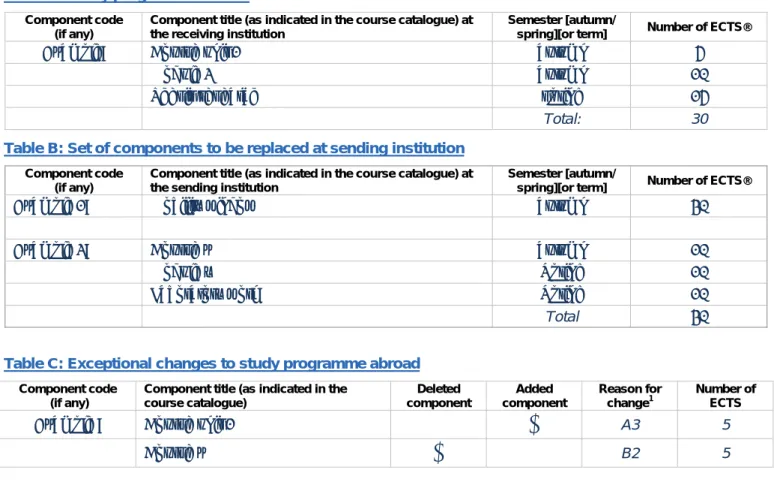
Table A: Study programme abroad
Component code (if any)
Component title (as indicated in the course catalogue) at the receiving institution
Semester [autumn/
spring][or term] Number of ECTS®
Example:
Course unit 1
autumn
5
Module 2
autumn
10
Thesis research
spring
15
Total:
30
Table B: Set of components to be replaced at sending institution
Component code (if any)
Component title (as indicated in the course catalogue) at the sending institution
Semester [autumn/
spring][or term] Number of ECTS®
Example 1:
Mobility window
autumn
30
Example 2:
Course x
autumn
10
Module y
Spring
10
Laboratory work
Spring
10
Total
30
Table C: Exceptional changes to study programme abroad
Component code (if any)
Component title (as indicated in the course catalogue) Deleted component Added component Reason for change1 Number of ECTS
Example :
Course unit 1
■
□
A3
5
Course x
□
■
B2
5
1014 Sports
Mustermann
Student Name:
Higher Education
Learning Agreement form for studies
Subject Area:
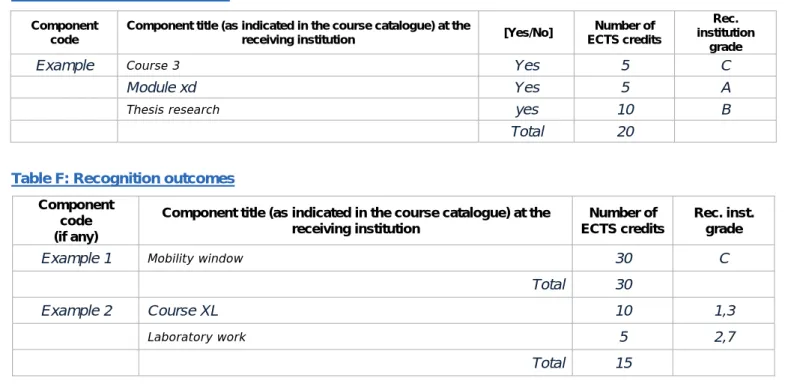
Table E: Transcript of Records
Component code
Component title (as indicated in the course catalogue) at the
receiving institution [Yes/No]
Number of ECTS credits
Rec. institution
grade
Example
Course 3Yes
5
C
Module xd
Yes
5
A
Thesis research
yes
10
B
Total
20
Table F: Recognition outcomes
Component code (if any)
Component title (as indicated in the course catalogue) at the receiving institution
Number of ECTS credits
Rec. inst. grade
Example 1
Mobility window30
C
Total
30
Example 2
Course XL
10
1,3
Laboratory work
5
2,7
Total
15
Annex 2 : End notes
1
TheISCED-F 2013 search tool available at http://ec.europa.eu/education/tools/isced-f_en.htm should be used to find the ISCED 2013 detailed field of education and training that is closest to the subject of the degree to be awarded to the student by the sending institution. (or Appendix 1)
2
Study cycle :
Short cycle (EQF level 5) / bachelor or equivalent first cycle (EQF level 6) / master or equivalent second cycle (EQF level 7) / doctorate or equivalent third cycle (EQF level 8).3 Nationality: Country to which the person belongs administratively and that issues the ID card and/or passport. 4
Country code: ISO 3166-2 country codes available at: https://www.iso.org/obp/ui/#search.
(or Appendix 2):
5 Contact person: a person who provides a link for administrative information and who, depending on the structure of the higher education institution, may be the departmental coordinator or equivalent body within the institution.
6 An "educational component" is a self-contained and formal structured learning experience that features learning outcomes, credits and forms of assessment. Examples of educational components are: a course, module, seminar, laboratory work, practical work, preparation/research for a thesis, mobility window or free electives.
7 For the Common European Framework of Reference for Languages (CEFR) see
http://europass.cedefop.europa.eu/en/resources/european-language-levels-cefr
8 Responsible person in the sending institution: an academic who has the authority to approve the mobility programme of outbound students (Learning Agreements), to exceptionally amend them when it is needed, as well as to guarantee full
recognition of such programmes on behalf of the responsible academic body.
Responsible person in the receiving institution: an academic who has the authority to approve the mobility programme of incoming students and is committed to give them academic support in the course of their studies at the receiving institution.
1014 Sports