Automating the Fact-Checking Task:
Challenges and Directions
Dissertation
zur
Erlangung des Doktorgrades (Dr. rer. nat.)
der
Mathematisch-Naturwissenschaftlichen Fakultät
der
Rheinischen Friedrich-Wilhelms-Universität Bonn
von
Diego Nascimento Esteves da Silva
aus
Rio de Janeiro, Brasilien
Bonnhttp://hss.ulb.uni-bonn.de/diss_online elektronisch publiziert.
1. Gutachter: Prof. Dr. Jens Lehmann 2. Gutachterin: Prof. Dr. Sören Auer Tag der Promotion: 29.05.2019
Abstract
In recent years, misinformation has caused widespread alarm and has become a global concern, given the negative impact placed on society, democratic institutions and even computing systems whose the primary objective is to serve as a reliable information channel, e.g., Knowledge Bases (KBs). The proliferation of fake news has a wide range of characteristics and different motivations. For instance, it can be produced unintentionally (e.g., the creation process of KBs which is mostly based on automated information extraction methods, thus naturally error-prone) or intentionally (e.g., the spread of misinformation through social media to persuade). Thus, they differ considerably in complexity, structure and number of arguments and propositions. To further exacerbate this problem, an ever-increasing amount of fake news on the Web has created another challenge to drawing correct information. This huge sea of data makes it very difficult for human fact checkers and journalists to assess all the information manually. Therefore, addressing this problem is of utmost importance to minimize real-world circumstances which may provoke a negative impact on the society, in general. Presently Fact-Checking has emerged as a branch of natural language processing devoted to achieving this feat. Under this umbrella, Automated Fact-Checking frameworks have been proposed to perform claim verification. However, given the nature of the problem, different tasks need to be performed, from natural language understanding to source trustworthiness analysis and credibility scoring. In this thesis, we tackle the problem of fake news and underlying challenges related to the process of estimating the veracity of a given claim, discussing challenges and proposing novel models to improve the current state of the art on different sub-tasks. Thus, besides the principal task (i.e., performing automated fact-checking) we also investigate: the recognition of entities on noisy data and the computation of web site credibility. Ultimately, due to the challenging nature of the automated fact-checking task - which requires a complex analysis over several perspectives - we also contribute towards reproducibility of scientific experiments. First, we tackle the named entity recognition problem. We propose a novel multi-level approach named HORUS which - given an input token - generates heuristics based on computer vision and text mining techniques. These heuristics are then used to detect and classify named entities on noisy data (e.g., The Web). Second, we propose WebCred, a novel model to compute the credibility score of a given website, regardless of dependency on search engine results, which is a limiting factor when dealing with real scenarios. WebCred does not require any third-party service and is 100% open-source. Third, we conduct several empirical evaluations and extend DeFacto, a fact-checking framework initially designed to verify English claims in RDF format. DeFacto supports both structured claims (e.g., triple-like) as well as complex claims (i.e., natural language sentences). Last, but not least, we consistently contributed towards better reproducibility research tools, methods, and methodologies. We proposed ontologies (MEX, ML-Schema) and tools (LOG4MEX, MEX-Interfaces, Web4MEX, WASOTA) which turned into state of the art for better reproducibility of machine learning experiments, becoming part of a global W3C community.
Acknowledgements
First of all, I thank God for giving me the necessary strength and encouragement during all the challenging and stressful moments in completing this thesis. The thesis was written within the Smart Data Analytics (SDA) research group, led by Prof. Dr. Jens Lehmann. I was fortunate to have Prof. Lehmann as an adviser during the development of this thesis, which I thank for granting me the freedom to develop and pursue my research ideas that have lead to this work. The realization of this work would not have been possible without the indirect support of Prof. Dr. Elmar Langetepe. I will always be grateful to him. I also appreciate the great opportunity offered to me by Prof. Dr. Maria Claudia Reis Cavalcanti (Yoko), who encouraged me to pursue a Ph.D. abroad. I also want to thank Dr. Sebastian Hellmann for inviting me to become a member of the Agile Knowledge Engineering and Semantic Web (AKSW) group at the University of Leipzig, where SDA began to take shape. My sincere gratitude to Prof. Dr. Julio Cesar Duarte for his continuing partnership in research, which impacted in a successful project developed within the scope of this thesis. I am delighted to be part of SDA and have had the opportunity to work with so many smart people. Thanks to Dr. Giulio Napolitano and Dr. Anisa Rula for working together in challenging research publications. Special thanks go to Mehdi Ali, Monish Dubey, Gëzim Sejdiu, Hamid Zafar, Debanjan Chaudhuri, Harsh Thakkar, Denis Lukovnikov, Nilesh Chakraborty, Gaurav Maheshwari, Priyansh Trivedi and Debayan Banerjee. I would also like to extend my deepest gratitude to my colleagues from Leipzig, most notably the Brazilian mates and Tommaso Soru. It was an honor to meet you on this journey. In especial, I would like to sincerely thank Diego Moussallem, who contributed to various research milestones within the framework of reproducible research and for having become a true friend. I am grateful to have had the opportunity to discuss research topics with Dr. Amrapali Zaveri and Dr. Pablo N. Mendes. I extend my gratitude to Prof. Dr. Henrique Lopes and Gil Rocha for the invitation to collaborate with the University of Porto. I would also like to extend my deepest gratitude to my family. To my wife for supporting and motivating me to complete this thesis and for enriching my life beyond my scientific endeavors. Thank you for understanding stressful times and for fully supporting me through the journey. To my parents, Nelson and Lourdes to always encourage me to chase my dreams. They have always sacrificed their lives to raise me to be a better person. To my lovely and blessed sister Luane (in memoriam) who taught me life values which can not be learned in courses or through books. To my mother-in-law, Liliane, for your great support and love. I want to thank Fundação CAPES for the scholarship which supported great part of this research. Finally, my sincere gratitude to Microsoft and BabelNet to have offered me infrastructure grants. Further funding for travel expenses was granted by the DAAD, SDA Research and Amazon.
Contents
1 Introduction 1
1.1 Motivation . . . 2
1.2 Problem Specification and Challenges . . . 3
1.2.1 Challenge 1: Detecting Entities on Short-Text. . . 3
1.2.2 Challenge 2: Computing Trustworthiness of Web pages . . . 4
1.2.3 Challenge 3: Automating the Fact-Checking Task. . . 4
1.2.4 Challenge 4: Reproducibility Issues . . . 5
1.3 Research Questions . . . 5 1.4 Thesis Overview . . . 6 1.4.1 Contributions . . . 6 1.4.2 List of Publications . . . 8 1.5 Thesis Structure . . . 11 2 Related Work 13 2.1 Automated Fact-checking . . . 13
2.1.1 Triple Plausibility Estimation . . . 13
2.1.2 Triple Validation . . . 14
2.1.3 Triple Ranking (Relevance Scoring) . . . 16
2.1.4 Natural Language Claim Verification . . . 18
2.2 Named Entity Recognition on Noisy Text . . . 19
2.3 Web Credibility . . . 20
2.3.1 Fundamental Research . . . 20
2.3.2 Automated Web Credibility . . . 22
2.4 Reproducible Research . . . 23
2.4.1 Workflow Systems . . . 23
2.4.2 Vocabularies and Ontologies. . . 24
2.4.3 Repositories for Machine Learning Metadata Experiments . . . 24
3 Detecting Entities on Noisy Data 25 3.1 Named Entity Recognition for Noisy Text . . . 26
3.2 The HORUS Approach. . . 26
3.2.1 Problem Definition . . . 26
3.2.2 Proposed Solution . . . 27
3.3 Framework Modules . . . 28
3.3.1 Computer Vision Module . . . 28
3.3.2 Text Mining Module . . . 29
3.4.2 NER Algorithms . . . 30
3.4.3 Experiments: Binary Classifiers Committee . . . 31
3.4.4 Experiments: Advanced Neural Network Techniques . . . 32
3.5 Summary . . . 36
4 Web Credibility 39 4.1 How Credible is a Website . . . 40
4.2 The WebCred Approach . . . 41
4.3 Experimental Setup . . . 42
4.3.1 State-of-the-art (SOTA) Features . . . 42
4.3.2 Datasets . . . 43
4.3.3 Final Features . . . 44
4.4 Experiments. . . 45
4.5 Discussion . . . 47
4.6 Summary . . . 50
5 DeFacto: An Automated Fact-Checking Framework 51 5.1 Automating The Fact-Checking Task . . . 52
5.2 Automation Challenges . . . 53
5.3 The DeFacto Approach: Validating RDF Triples . . . 54
5.3.1 Proposed Solution . . . 55
5.3.2 Features . . . 56
5.3.3 Experimental Setup . . . 58
5.3.4 Fact Scoring . . . 59
5.3.5 Date Scoring . . . 61
5.3.6 Effect of Multi-lingual Patterns . . . 65
5.3.7 Discussion . . . 66
5.4 The DeFactoNLP Approach: Validating Unstructured Claims . . . 66
5.4.1 Proposed Solution . . . 67
5.4.2 Retrieval of Relevant Documents and Sentences . . . 68
5.4.3 Textual Entailment Recognition Module . . . 68
5.4.4 Final Classification . . . 70
5.4.5 Experimental Setup . . . 71
5.4.6 Discussion . . . 72
5.5 Boosting the Evidence Extraction. . . 72
5.5.1 Features . . . 72
5.5.2 SimpleLSTM . . . 74
5.5.3 Experimental Setup . . . 76
5.5.4 Results . . . 77
5.6 Summary . . . 80
6 The Quest for Reproducibility in the Context of Machine Learning Experiments 81 6.1 Reproducing Machine Learning Experiments: An Open Problem . . . 82
6.2 Proposed Solutions . . . 83
6.2.1 The MEX Vocabulary . . . 84
6.2.2 LOG4MEX . . . 85
6.2.3 Metadata Generation Frameworks . . . 86
6.2.4 WEB4MEX . . . 92 6.2.5 WASOTA . . . 93 6.2.6 ML-Schema . . . 94 6.3 The ML-Schema . . . 94 6.3.1 The MLS ontology . . . 95 6.3.2 MLS Ontology properties . . . 96 6.3.3 Related ontologies . . . 96
6.4 MLS core and alignments . . . 98
6.4.1 Task . . . 98 6.4.2 Algorithm . . . 99 6.4.3 Implementation . . . 101 6.4.4 HyperParameter . . . 102 6.4.5 Data . . . 103 6.4.6 Model . . . 104 6.4.7 Run . . . 106 6.4.8 EvaluationMeasure . . . 106 6.4.9 Study . . . 106 6.5 Use cases . . . 109
6.5.1 Open Provenance Model for Workflows and Research Objects . . . 109
6.5.2 OpenML . . . 109
6.5.3 Deep Learning . . . 111
6.6 Summary . . . 111
7 Conclusion and Future Directions 113 7.1 Overall contributions and conclusions . . . 113
7.2 Outlook . . . 117
7.3 Closing Remarks . . . 120
Bibliography 121
A Complete List of Publications 141
List of Figures 145
C H A P T E R
1
Introduction
With billions of individual pages on the web providing information on almost every conceivable topic, we should have the ability to collect factual information (fact extraction) to confirm a broad range of claims. However, only a small fraction of this information is contained in structured sources (e.g., Knowledge Bases), which makes the verification process time-consuming as the experts have to carry out several search processes and must often read several documents. The fact-checking process of collecting evidence to validating input claims also becomes relevant to knowledge-base population (KBP), since it mostly relies on automatic or semi-automatic information extraction methods. The process of creating and managing large-scale knowledge bases (KBs) has been the key to success of many applications [1–3]. However, if the quality of such KBs is insufficient, this poses a significant obstacle to the uptake of data consumption applications at large-scale [4].
Yet, there is another problem that has become the focus of a lot of recent research: misinformation coming from unreliable sources [5,6]. The problem of veracity estimation is also recognized as one of the key challenges in building and maintaining large KBs [7]. Therefore, fact extraction and fact validation algorithms are also very important to the knowledge base construction process. Fact checking is studied in different communities (e.g., journalism, machine learning, semantic web) and historically has being referred under various names such astruth finding,fact-checking, claim verification and trustworthiness[5], for instance. Still, the research community still lacks a more granular taxonomy of the related tasks. Broadly speaking, fact-checking is a complex multi-disciplinary topic. It encompasses the intersection of different research fields, with the emphasis being placed on Natural Language Processing (NLP), machine learning (ML) and semantic web (SW). For instance, the following sub-tasks in NLP (i.e., mostly related to machine reading and comprehension) can be performed in a fact-checking framework: (1) information extraction methods (e.g. Named Entity Recognition and Dependency Parsing), (2) Natural Language Generation, (3) Natural Language Understanding, (4) Argumentation Mining and Textual Entailment and (5) Trustworthiness of Information Sources. A fact-checking system typically takes a statement as input and then tries to find evidence to support of refute this givenclaim by searching for textual information (proofs) in different data sources. The task can be performed over free text (e.g., a claim existing in a web site) or structured information (e.g., RDF triples from a Knowledge Base). Typically the output of a fact-checking framework is a confidence score that represents the level of trustworthiness w.r.t. the input claim. The task can
be sub-divided as follows:
1. Plausibility Estimation: indicates whether theclaimis plausible (e.g.,"Barack Obama", "birth place", "NYC") or not (e.g., "Barack Obama", "birth place", "Blue"). However, the correctness of the input claim is not relevant.
2. Validation: indicates whether theclaim is correct (true) or not (false).
3. Ranking: considering a number of inputclaims sharing the same subject andpredicate, the task is to ordering them w.r.t. their relevance relying on common-sense rules (e.g., "Barack Obama", "profession", "politician" should be higher ranked then "Barack Obama", "profession", "lawyer", since he is mostly known as a politician.). In general, all claims existing in the set are consideredtrue.
In this thesis, we target to address the fact-validation task along with its challenges.
1.1 Motivation
With the increase in false fact circulation across different social media platforms, it has become pertinent to validate the claims and statements released online [8, 9]. False statements are mostly spread through the Web, but they can also exist in Knowledge Bases due to automatic database population procedures [10,11].
Over news on the web, false claims expressed in natural languageare often referred as fake-news or junk-news, for instance. These have gained importance in the last few years, mainly in the context of electoral activities in North America and Western Europe. Celebrity death hoaxes, misinformation about political leaders, political statements etc. are some of the most common types of fake-news types1. The deceptive information can in general can be categorized asmisinformation (false or misleading information) anddisinformation (false information that is purposely spread to deceive people) [12]. These false facts (or rumors), in the past, have led to situations like stock price drops and large scale investments [13]. Though social media platforms are the most common breeding grounds for fake-news, it sometimes finds its way into the mainstream media too [14]. The most effective methodology to consume news found on unconventional news media is to check multiple resources. But most news-media consumers cannot effectively validate the accuracy or may enjoy partisan views of the news [14]. In such cases, these media consumers start an uncontrolled reaction of consuming and sharing of false facts that spreads faster an epidemic in a demographic and sometimes throughout the world.
False claims stated in structured information sources (e.g., Knowledge Bases (KBs)) also are of utmost importance for many state of the art applications both in scientific research and in-use industry projects. They are mainly designed to store complex structured information, which depicts facts about the world. For instance, DBpedia, YAGO, Freebase, Wikidata and Google Knowledge Graph are examples of successful KBs projects. However, only a small fraction of the world information is contained in these structured sources. The creation process is mostly
1
1.2 Problem Specification and Challenges
based on automated information extraction (IE) methods which are error-prone. Therefore, the quality of knowledge is of high importance. To this end, fact extraction and fact verification algorithms are of utmost importance to the process of knowledge base population. Moreover, in this respect, ranking triples (fact ranking) based on their relevance is another important task. For instance, a person could have more than one profession or nationality, but among different possibilities, one of them often is more relevant.
To deal with the above-introduced challenges, fact-checking algorithms for KBs have been proposed and are classified in three different groups: validation, ranking and plausibility estima-tion. In this thesis, we aim at exploring different techniques to automatize the validation task, studying current limitations and developing novel solutions to overcome current state of the art results.
1.2 Problem Specification and Challenges
In general, the task of automated fact-checking is considered as one of the most challenging tasks in the natural language processing (NLP) field [15] requiring a multidisciplinary effort [16]. In the scope of automated fact-checking frameworks, Table 2.1 presents an overview of the features of some state-of-the-art approaches for fact-checking over KBs. The decentralized and autonomous nature of the Web along with the complexity of human languages allow for multiple representations of the same information, which brings multiple challenges to solve the task. At the conceptual level, we face (1) a knowledge retrieval problem, i.e., “search and integrate pieces of knowledge about a given claim spread on several documents”. Also, (2) a natural language understanding problem, i.e., "to understand and reason about diverse excerpts of texts obtained from different sources". Furthermore, (3) a credibility challenge, i.e., "distinguish trustworthy from doubtful information sources".
In the following section, we discuss the challenges that need to be addressed to produce an automated fact-checking framework.
1.2.1 Challenge 1: Detecting Entities on Short-Text
The first challenge to overcome is the process of recognizing entities in a free-format text, which is very challenging [17]. Named Entity Recognition (NER) is an important step in most of the natural language processing (NLP) pipelines, including automated fact-checking frameworks. However, most of the state-of-the-art solutions to detect objects in short and informal text (e.g., microblogs) still are not able to perform similarly to frameworks designed explicitly to formal text (e.g., newswire) [18], which naturally imposes a barrier on developing high-performance models. This is due to the lack of implicit linguistic formalism (e.g. punctuation, spelling, spacing, formatting, unorthodox capitalisation, emoticons, abbreviations and hashtags) [17,
19–21]. Furthermore, the lack of external knowledge resources is an important gap in the process regardless of writing style [22]. Thus, to perform language understanding we need an algorithm able to perform the task in a noisy environment such as the Web.
1.2.2 Challenge 2: Computing Trustworthiness of Web pages
Apart from detecting entities, deciding which information provider should have more relevance is yet another challenging task. Computing the trustworthiness of sources of information is a crucial step to enhance the quality of fact-checking algorithms. However, existing trustworthiness indicators are not freely available anymore2, including Google Pagerank. The solution proposed by Nakamura [23] appears as an open-sourcealternative to compute web source trust indicator values. They developed a prototype for enhancing the search results provided by a search engine based on trustworthiness analysis. However, it is a graph-based model which calculates the relevance among retrieved sources, and not a global trustworthiness indicator. For instance, given a certain domain (e.g.,bbc.com), how can we define its credibility measure. Moreover, how can we automatically infer that an information coming frombbc.comshould be more credible than a claim obtained a random web blog?
1.2.3 Challenge 3: Automating the Fact-Checking Task
Fact-checking itself is especially hard due to the complexity inherent in creating and connecting logical arguments that are used to either support or refute a given claims [24]. This is a basis to communicate and defend opinions (orclaims within this context), to understand new problems and to perform scientific reasoning [25]. Thus, more powerful methods are required (argumentation mining) other than standard information extraction methods (e.g., part-of-speech tagging, named entity recognition and dependency parsing) for better understanding text structures and relations among entities. Argumentation mining methods pose as next generation of algorithms to processing free-format text in natural language to recover inferential structure [26]. However, most of the proposed works are of a theoretical nature, lacking more real-world applications.
Finally, the dependency on relation extraction methods tends to restrict the comprehensiveness of fact-checking algorithms [27], since the verbalization of predicates is a crucial step to the information extraction process. This process allows to generate distinct verbalizations which have semantically the same meaning as the input claim. For instance, the relation “marriage” can be represented by the following verbalizations: “X-wife-Y”, “X-husband-Y” as well as “X-spouse-Y”. Traditional approaches predict relations within some fixed and finite target schema [28]. The strategies are described as follows: (1) hard-coded verbalization and rules (fixed or ontology-based), which naturally restricts scalability; (2) standard machine learning approaches which require manual annotation; (3) use distant supervision methods which very often have a sub-optimal performance, since the method relies on the availability of a large database that has the desired schema; or (4) use external linguistic corpora (e.g. lexical databases) to obtain similar words (e.g. synonyms) to a given predicate. It can be observed that these methods are rather self-limited and hence the verbalizations generated are either of a low quality or have low precision and/or recall.
2
1.3 Research Questions
1.2.4 Challenge 4: Reproducibility Issues
Every scientific experiment should be replicable, specially experiments performed in an attempt to find answers to complex problems, such as fact-checking. The need for reproducibility is increasing dramatically as data analyses become more complex, involving more sophisticated and complex experimental configurations. Reproducibility allows for people to focus on the actual content of a data analysis, instead of on superficial details reported in a written summary. Overall, scientific experiments are still hard to be reproduced, because of these complex configurations, because of lack of time to properly report scientific experiments.
1.3 Research Questions
Based on the main problem and associated challenges described in Section 1.2, we formulate four research questions in the scope of this thesis. Each research question provides a solution for a correspondent challenge.
RQ1: Can images along with news improve the performance of the named entity recogni-tion models on noisy text?
To answer RQ1we fully explore existing techniques to detect and extract named entities from texts, in the context of the Web. The challenges to perform the task in such context are manifolds, from the lack of grammatical rules to the noisy existing in the Web. Our hypothesis is that images and related documents can help at boosting the task. In the scope of this thesis we propose a novel methodology to extract heuristics for potential named entities using computer vision and text mining techniques. The results of the research questionRQ1allow us to address challenge three C1.
RQ2: How to calculate a credibility score for a given information source?
To address RQ2, we evaluate state-of-the-art web credibility approaches that can be used to compute the trustworthiness of a given information source. We further propose a novel model that automatically extracts source reputation cues and computes a credibility factor based on metadata extracted from the source-code. The results of the research questionRQ2 allow us to address challenge two C2.
RQ3: How to determine the veracity of a given claim?
To answerRQ3we investigate the state-of-the-art approaches for fact-checking, and detail steps of the automation process. Particularly we analyze and evaluate the complex fact-checking task
within three perspectives: (a) fact-checking over RDF triples (b) fact-checking over complex claims and (c) evidence extraction methods for fact-checking. The results of the research question
RQ3allow us to address challenge threeC3.
RQ4: Are existing reproducible research methods sufficient to enable reproducibility?
Reproducibility is a serious problem in scientific experiments. To address RQ4we investigate several approaches to support the representation of machine learning experiments, from ontologies and libraries to support the experimental process to repositories to storage the metadata. We highlight the challenges and trade-offs to offer the ideal scenario and define new standards which are more suitable to bridge this gap. As consequence, we have funded a new W3C group to guide the community towards better representation of scientific experiments. The results of the research questionRQ4 allow us to address challenge fourC4.
1.4 Thesis Overview
To prepare the reader for the rest of the document, in this section we present an overview of our main contributions, the research areas investigated by this thesis, the references to scientific publications covering this work, and an overview of the thesis structure.
1.4.1 Contributions
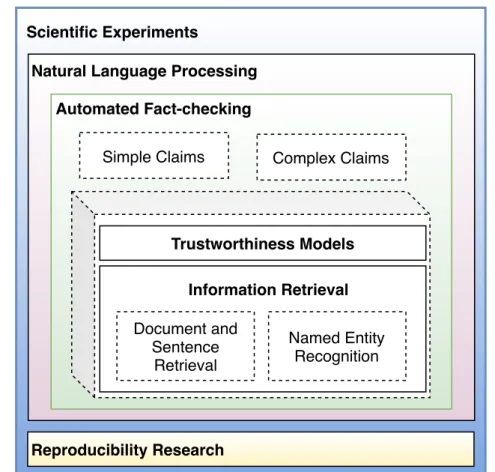
The contributions of this thesis are cross disciplinary around the fact-checking topic involving Automated Fact-Checking, Named Entity Recognition, Web Credibility and Reproducible Research fields. Firstly, as a focus of this thesis, we fully exploited the domain of fact-checking in both simple as well as complex claims. Secondly, we advanced methods in necessary areas of domain to improve the fact-checking task, namely: Information Retrieval, Trustworthiness and Named Entity Recognition. Finally, we extensively contributed towards better reproducible experiments in the machine learning domain. Figure 1.1shows the overall contributions across several levels of a scientific experiment.
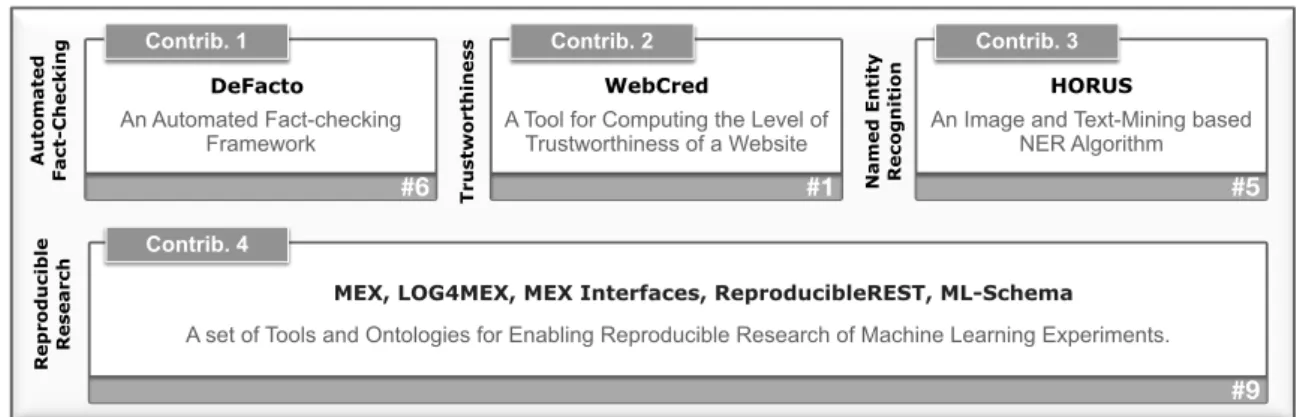
Figure1.2 shows the four main contributions of this thesis.
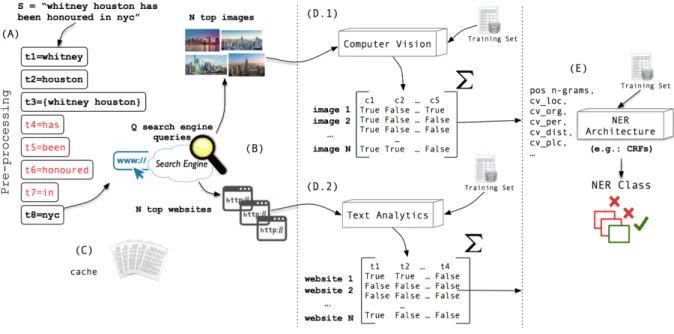
• Contrib. 1: Named Entity Framework designed for Noisy Data; to address the problem of detecting and classifying named entities on noisy data, we develop HORUS, a novel methodology that integrated computer vision and text mining techniques to perform NER. HORUS implements a three-fold approach for both detecting and classifying named entities. First it extracts image-based features and then in parallel performs a set of text classifications over extracted documents. Using the produced heuristics, it then performs a final classification using both decision trees methods as well as concatenating the vectors and using more powerful architectures such as B-LSTM. Furthermore, we demonstrate that this simple idea is able to outperforms state of the art without encoded rules. An empirical
1.4 Thesis Overview
Scientific Experiments
Automated Fact-checking
Simple Claims Complex Claims
Trustworthiness Models Natural Language Processing
Information Retrieval Document and Sentence Retrieval Named Entity Recognition Reproducibility Research
Figure 1.1:Academic Contributions: Natural Language Processing and Reproducible Research were the principal areas of research
evaluation assesses the effectiveness of HORUS for the detection of named entities on noisy data. The experiments are executed on Ritter, WNUT-15, WNUT-16 and WNUT-17 answering research question RQ1.
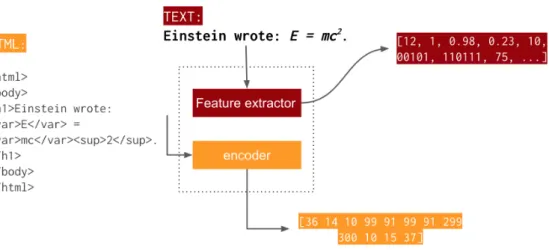
• Contrib. 2: A Trustworthiness Framework for the Web; defining the level of trustwor-thiness of a given information source is crucial to perform fact-checking. We propose a novel web credibility model based on a concept we call HTML2Seq. HTML2Seq the transformation of HTML tags into sequences of integers. We thus evaluate websites w.r.t. website metadata. Thus, we present WebCred, a web credibility model that performs trustworthiness analisys based on metadata inspection through the transformation of HTML tags into sequential vectors. We empirically study the performance of WebCred with respect to state-of-the-art methods. The observed results show that WebCred is very competitive in terms of precision and recall with respect to existing methods, with the advantage that it works for any given website as well as it is completely open-source. Experimental results answer our research question RQ2.
• Contrib. 3: An Automated Fact-Checking Framework; In order to tackle the fact-checking problem, an automated fact-checking framework, dubbed DeFacto, has been designed and extended to also perform claim verification over natural language. An empirical evaluation of the quality of the proposed framework in comparison with triple-based approaches
A u to m at e d F ac t-C h e ck in g An Automated Fact-checking Framework Contrib. 1
A Tool for Computing the Level of Trustworthiness of a Website
Contrib. 2
An Image and Text-Mining based NER Algorithm
Contrib. 3
A set of Tools and Ontologies for Enabling Reproducible Research of Machine Learning Experiments.
Contrib. 4 Tr u stw or th in e ss N am e d E n ti ty Reco gnit io n Repro ducible R e se ar ch
DeFacto WebCred HORUS
MEX, LOG4MEX, MEX Interfaces, ReproducibleREST, ML-Schema
#6 #1 #5
#9 Figure 1.2:Contributions: Four are the main contributions of this thesis including: (1) an automated fact-checking framework; (2) a web credibility model; (3) a named entity recognition algorithm for noisy data; and (4) a set of tools and ontologies for enabling reproducible research on machine learning experiments. In the bottom box, the number of related publications to a specific area of research (#) during the development of this PhD thesis.
indicates that DeFacto approach accurately perform fact-validation for triple-like claims. For complex claims (unstructured claims), DeFacto ranks among state-of-the-art solutions when evaluated in a very selective fact-checking challenge, giving an answer to our research questionRQ3.
• Contrib. 4: Enabling Reproducible Research During the development of this thesis, we faced a very common challenge when designing and executing scientific experiments: the ability to manage and extract outcomes as well as turning them open to the scientific community. The lack of patterns, standards and tools are the keystone to enable re-producible research. We joint efforts to existing attempts and created a W3C working group (ML-Schema) which aims to define standards to achieve this goal. Through the development of this thesis we proposed several tools and vocabularies towards better interpretability of machine learning experiments, answering our research questionRQ4.
1.4.2 List of Publications
The development of this thesis has led to multiple scientific publications and three different open-source projects: DeFacto, HORUS and MEX (enclosing 5 related projects). AppendixA
contains the complete list of 30 publications. However, the content of this thesis is based on the aforementioned open-source projects and the following 23 related scientific publications:
• Journal Articles:
1. Gustavo Publio, Agnieska Ławrynowicz, Larisa Soldatova, Panče Panov, Diego Esteves, Joaquin Vanschoren and Tommaso Soru. ML-Schema: An interchangeable format for description of machine learning experiments In Journal of Web Semantics (JWS), 2019 - submitted;.
1.4 Thesis Overview
2. Diego Esteves, Anisa Rula, Aniketh Reddy, Jens Lehmann. Toward Veracity Assessment in RDF Knowledge Bases: An Exploratory Analysis. In Journal of Data and Information Quality (JDIQ), 2018.
3. Anisa Rula, Matteo Palmonari, Simone Rubbinaci, Axel Ngonga, Jens Lehmann,
Diego Esteves. TISCO: Temporal Scoping of Facts. In Journal of Web Semantics (JWS), 2018.
4. Daniel Gerber, Diego Esteves, Jens Lehmann, Lorenz Bühmann, Ricardo Usbeck, Axel-Cyrille Ngonga Ngomo, René Speck. DeFacto - Temporal and Multilingual Deep Fact Validation. In Web Semantics: Science, Services and Agents on the World Wide Web (SWJ), 2015.
• Conference and Workshop Papers:
5. Diego Esteves, Asja Fischer, Piyush Chwala, Saad Khan, Jens Lehmann and Rafael Peres. Beyond Lexical Features: Named Entity Recognition on Noisy Data through the Web. In Proceedings of the 2019 Conference of the Association for Computational Linguistics (ACL’19) - submitted;
6. Piyush Chwala andDiego EstevesAutomating Fact-Checking: Why is it so difficult? In Proceedings of the 25th ACM SIGKDD International Conference on Knowledge Discovery & Data Mining (2019) - submitted;
7. Diego Esteves, Aniketh Janardhan Reddy, Piyush Chawla and Jens Lehmann. Belittling the Source: Trustworthiness Indicators to Obfuscate Fake News on the Web. In Proceedings of Fact Extraction and VERification (FEVER) co-located with the 2018 Conference on Empirical Methods in Natural Language Processing (EMNLP-2018), Brussels, Belgium, 2018.
8. Aniketh Janardhan Reddy, Gil Rocha and Diego Esteves. DeFactoNLP: Fact Verification using Entity Recognition, TFIDF Vector Comparison and Decomposable Attention. In Proceedings of Fact Extraction and VERification (FEVER) co-located with the 2018 Conference on Empirical Methods in Natural Language Processing (EMNLP-2018), Brussels, Belgium, 2018.
9. Gustavo Correa Publio, Diego Esteves, Agnieszka Ławrynowicz, Panče Panov, Larisa Soldatova, Tommaso Soru, Joaquin Vanschoren and Hamid Zafar. ML-Schema: Exposing the Semantics of Machine Learning with Schemas and Ontolo-gies. In Proceedings of the 2nd Reproducibility in Machine Learning Workshop (MLTRAIN@RML) co-located with the 2018 Conference on Empirical Methods in
Natural Language Processing (EMNLP-2018), Stockholm Sweden, 2018.
10. Rafael Peres, Diego Estevesand Gaurav Maheshwari. Bidirectional LSTM with a Context Input Window for Named Entity Recognition in Tweets. In Proceedings of
the 9th International Conference on Knowledge Capture (K-CAP 2017)
Esteves. An Interoperable Service for the Provenance of Machine Learning Experi-ments. In Proceedings of the International Conference on Web Intelligence (WI2017) 12. Agnieszka Lawrynowicz,Diego Esteves, Pance Panov, Tommaso Soru, Sašo Dzeroski and Joaquin Vanschoren. An Algorithm, Implementation and Execution Ontology Design Pattern. In Proceedings of Advances in Ontology Design and Patterns 32 (2017) - co-located with the 15th International Semantic Web Conference (ISWC 2016) in Kobe, Japan.
13. Diego Esteves, Pablo N. Mendes, Diego Moussallem, Julio Cesar Duarte, Amrapali Zaveri, Jens Lehmann and Ciro Baron Neto, Igor Costa and Maria Claudia Cavalcanti. MEX Interfaces: Automating Machine Learning Metadata Generation. In Proceedings of the 12th International Conference on Semantic Systems (SEMANTiCS 2016). 14. Diego Esteves, Diego Moussallem, Ciro Baron Neto, Tommaso Soru, Ricardo
Usbeck, Markus Ackermann and Jens Lehmann. MEX Vocabulary: A Lightweight Interchange Format for Machine Learning Experiments. In Proceedings of the 11th International Conference on Semantic Systems (SEMANTiCS 2015), 15-17 September 2015, Vienna, Austria.
15. Diego Esteves, Diego Moussallem, Tommaso Soru, Ciro Baron Neto, Jens Lehmann, Axel-Cyrille Ngonga Ngomo and Julio Cesar Duarte. LOG4MEX: A Library to Export Machine Learning Experiments. In Proceedings of the International Conference on Web Intelligence (WI’17), Leipzig, Germany.
16. Diego Esteves, Rafael Peres, Jens Lehmann and Giulio Napolitano. Named Entity Recognition in Twitter using Images and Text. In Proceedings of the 3rd International Workshop on Natural Language Processing for Informal Text (NLPIT 2017), Rome, Italy.
17. Ciro Baron Neto, Dimitris Kontokostas, Gustavo Publio, Diego Esteves, Amit Kirschenbaum and Sebastian Hellmann. IDOL: Comprehensive & Complete LOD Insights. In Proceedings of the 13th International Conference on Semantic Systems (SEMANTiCS 2017), 11-14 September 2017, Amsterdam, Holland.
• Posters and Demos:
18. Diego Esteves. Named Entity Recognition on Noisy Data using Images and Text. In Proceedings of The 4th Workshop on Noisy User-generated Text (W-NUT) co-located with the 2018 Conference on Empirical Methods in Natural Language Processing (EMNLP-2018), Brussels, Belgium, 2018.
19. René Speck,Diego Esteves, Jens Lehmann, Axel-Cyrille Ngonga Ngomo. DeFacto - A Multilingual Fact Validation Interface. In Proceedings of the 14th International
Semantic Web Conference (ISWC 2015, Semantic Web Challenge)
20. Diego Esteves, Diego Moussallem, Ciro Baron Neto, Jens Lehmann, Maria Claudia Cavalcanti, Julio Cesar Duarte. Interoperable Machine Learning Metadata using
1.5 Thesis Structure
MEX. In Proceedings of the 14th International Semantic Web Conference (ISWC 2015, Posters & Demos)
21. Sandro A. Coelho, Diego Moussallem, Gustavo C. Publio,Diego Esteves. TANKER: Distributed Architecture for Named Entity Recognition and Disambiguation. In Proceedings of the Posters and Demos Track of the 13th International Conference on Semantic Systems - co-located with the 13th International Conference on Semantic Systems (SEMANTiCS 2017), Amsterdam, The Netherlands, September 11-14, 2017. 22. Ciro Baron Neto, Diego Esteves, Tommaso Soru, Diego Moussallem, Andre Valdes-tilhas and Edgard Marx. WASOTA: What Are the States of the Art? In Proceedings of the 12th International Conference on Semantic Systems (SEMANTiCS 2016), 12-15 September 2016, Leipzig, Germany (Posters & Demos)
The following is the complete list of preprints submitted during the development of this Ph.D. thesis.
• Technical Reports:
23. Diego Esteves, Agnieszka Lawrynowicz, Pance Panov, Larisa Soldatova, Tommaso Soru and Joaquin Vanschoren. ML-Schema Core Specification. In Technical report, World Wide Web Consortium (W3C), 2016.
The final Ph.D. contributions are summarized as follows:
Ph.D. Statistics From 07.2014 to 12.2018 (4.5 Years)
Accepted In Rev. Total Thesis Related
Journal 3 1 4 4 (100%) Conference/Workshop 14 1 15 12 (80%) Poster/Demo 7 0 7 5 (71%) Arxiv 3 0 3 1 (33%) Technical Report 1 0 1 1 (100%) Nr. of Publications 28 02 30 23 (76%)
1.5 Thesis Structure
The remainder of this thesis is comprised by seven chapters organized as follows:
• Chapter 2 - Related Work; provides the state-of-the-art approaches related to this thesis. Firstly, We give a complete view of the state-of-the-art approaches to fact-checking. Secondly, web credibility models are introduced and discussed. Thirdly, we progress to discuss the challenging task of named entity recognition on noisy data. Finally, we
introduce challenges on enabling reproducible research.
• Chapter 3 - Named Entity Recognition on Noisy Data; presents a novel named entity recognition for microblogs and informal text dubbed HORUS, which is crucial information extraction task to perform fact-checking.
• Chapter 4 - Web Trustworthiness; presents our novel credibility model (WebCred) for detecting trust and non-trust websites. We show limitations of existing approaches and how this model can enhance the fact-checking task.
• Chapter5 - Automated Fact-Validation; presents DeFacto, an automated fact-checking framework for fact-validation. It is part of the final pipeline of the automation process. DeFacto accepts both structured as well as non-structured claims as input and can be customized according to the use case and domain.
• Chapter6 - Reproducible Research; contextualizes reproducible issues in scientific experi-ments, shedding light on current limitations, difficulties and proposing novel solutions to make experiment more accessible and reproducible.
• Chapter 7 - Conclusion and Future Direction; finalizes this thesis with a summary of our results and main contributions to the complex problem of automating fact-checking, and defines the future directions of the research work.
C H A P T E R
2
Related Work
2.1 Automated Fact-checking
Fact-checking is a relatively new research area which focuses on classifying (and/or assigning scores) a given statement [29]. In general, the task of automated fact-checking can be considered as one of the most challenging tasks in natural language processing (NLP). Apart from designing trustworthiness indicators associated with sources of information, the task is especially hard due to the complexity inherent in creating and connecting logical arguments. This is a basis to communicate and defend opinions (or claims within this context), to understand new problems and to perform scientific reasoning [30]. Thus, argumentation mining methods pose as state of the art solution for better understanding text structures and relations among entities, i.e., processing raw text in natural language to recover inferential structure [26]. However, it is still a challenging task and most of the proposed works are of a theoretical nature, lacking useful real-world applications.
We can divide the task in: fact-checking over structured (e.g., triples) and unstructured claims (i.e., news). With respect to structured fact-checking, we can perform three different tasks: validation,plausibility orranking. Table 2.1 presents an overview of the features of some state of the art approaches. Verification of unstructured claims generally involves the design of neural architectures.
In the following, we present recent work in each area:
2.1.1 Triple Plausibility Estimation
Plausibility assessment of triples is another related problem. It deals with the measurement of the plausibility of a certain subject type being linked to a certain object type through a given predicate. It could be seen as a prior task toTriple Veracity Assessment. Hong et al [38] propose
PAUST, a three-phase system which determines the plausibility of a triple using both DBpedia and Wikipedia as sources of information. Given a set of test triples,PAUST first generates unlabelled training triples by changing the subject, object, predicate or a combination of the attributes
Fact-Checking Frameworks
System Counter Real-Time Source Reliance Nr. Supported Predicate Open Evidences Source Trust. on SEs Predicates Expansion Source Triple Validation
[31] DeFacto Yes No Yes Yes 10 Library Yes
[32] OpenEval No No No Yes Any (upon training) Keywords No
[33] KnowItAll No No No Yes Many (ontology) Patterns No
Triple Ranking
[34] Bast et al. No No No No 2 No No
[35] Bokchoy No No No No 2 No Yes
[36] Cress No No No No 2 No Yes
[37] Goosefoot No No No No 2 Synonym-based Yes
Triple Plausibility
[38] PAUST No No No No Any (ext. resources) Lexical DBs No
Table 2.1: Features of triple assessment frameworks
above of the test triples. These changes are made in such a way that subjects, objects or predicates are replaced with similar subjects, objects and predicates respectively. The similarity between various entities is determined using features extracted from DBpedia. WordNet [39], NOMLEX [40] and PreDic [41] are used to determine similarity between predicates. In the second phase, the unlabelled training triples are labeled as plausible or not plausible using the Wikipedia sentence corpus. Using statistical hypothesis testing,PAUSTassigns a value between 0 and 1 to a triple denoting the distance between the test triple and the training triple. In the final phase,PAUSTdetermines the plausibility of the test triple by examining the k-nearest neighbors of the test triple. If a majority of the nearest neighbors are plausible, then the test triple is also determined to be plausible. Otherwise it is labeled not plausible. When the subjects, objects and predicates of many triples belong to the same subject, object and predicate concepts respectively, all such triples are given the label which is the majority among such triples.
2.1.2 Triple Validation
Triple Validation is a task in which an input triple is classified as positive or negative, i.e. true orfalse. Thus, the process is often performed using supervised classification techniques. There are many approaches and strategies for validating the facts represented by the triples. First, one can search for the input triple on the web, and then apply some method to decide if the triple is true based on the features extracted from the search results [42]. The keywords used while querying the search engines are derived from thesubject and theobject of the triple. The web pages retrieved are then ranked based on the calculated values of different features. After determining the features values and ranks of the search results, the system finally outputs its classification, saying whether the input triple is true or false. These approaches often apply some method to obtain natural language representations (NLRs) of predicates (e.g., hard-coded NLRs, string similarity measures or distant supervision techniques). A different solution is to apply supervised knowledge extraction on the web, and consider a triple as verified if it can be extracted. The approach described in [43] also searches for the triple on the Web where it identifies relevant sources, extracts evidence from them, estimates source trustworthiness and uses those trustworthiness scores for improving triple evaluation. The difference with the
2.1 Automated Fact-checking
previous works is that it is completely machine learning based. A first a set of data is provided for training the classifiers for each category of triples, instead of using just one classifier for all the categories. This work classifies the set of unlabeled triples to either true or false and provides a confidence value attached to the label. It considers IS-Arelationships. Furthermore, a third approach may first leverage both search-based and extraction-based techniques to find supporting evidence for each triple, and subsequently, predict the correctness of each triple based on the evidence. The extracted evidence may be from other knowledge bases, and further enriched with evidence from the web and finally from query logs. In addition to the other approaches data fusion techniques are applied for distinguishing correct triples from incorrect ones [44].
One of the earliest systems which leveraged the World Wide Web to validate facts was
KnowItAll [33]. Soderland et al [45] describe how KnowItAll uses generic patterns and boot-strapping to gauge the confidence of a certain fact. It uses search engine hits to approximate the probability that a certain pattern is correct for detecting a fact which pertains to a given class or relation (a predicate). This probability is estimated as the number of web pages returned by a search engine which contain both the pattern and the given fact divided by the total number of pages returned which contain the fact. Each class or relation has multiple patterns and each pattern has an associated probability for a given fact. These probabilities are then fed as features to a naive Bayes classifier which finally outputs the confidence score of the fact. The main advantage of this method is that the system requires very little supervision because of its bootstrapping capabilities, and can be applied to any generic relation. But a major shortcoming of this approach is its sole reliance on search engines. Many search engines such as Google have now stopped providing APIs which facilitate automatic querying, thereby debilitating this approach. Another major shortcoming of this approach is that it is incapable of measuring the trustworthiness of the source of the information.
DeFacto [31] is a system which scores RDF triples based on evidence found in web pages. Though DeFacto uses search engines to find evidence, it overcomes the second shortcoming by using a two-pronged approach which takes into account both the trustworthiness of the source and the evidence which supports or contradicts the given fact, thereby improving the quality of its predictions.
OpenEval [32] is another fact validation system which leverages Google results to determine the confidence values of a given fact. The system is unique because of its ability to train classifiers within a given time limit (online algorithm). The performance of the classifiers gets better as more time is given for training. OpenEval takes as input a set of predicates, a set of seed instances for each of the predicates and the set of mutually exclusive relationships between the given predicates. For each seed instance, a Google query consisting of the subjects, objects and the automatically inferred keywords for the predicate is generated. After querying Google, the set of words which occur around the query in the top results is extracted. These sets, called Context-Based Instances (CBIs), are used for training the Support Vector Machines (SVMs) [46]. For each predicate, the set of CBIs generated using the seed instances of that predicate are used as positive examples, and the set of CBIs generated using seed instances of predicates which are mutually exclusive to the given predicate are used as negative examples while training the SVM for that predicate. After training all the SVMs, if there is some time remaining, the SVMs with the maximum entropy are re-trained by extracting new CBIs, so as to improve their
performance. Another unique aspect is that the keywords used while querying are generated automatically by selecting those words that have the highest weights in the SVMs as the set of possible keywords which represent that predicate. The newly generated keywords are used for generating new CBIs while re-training. While testing, the most important keywords are first used to generate the CBIs. These CBIs are then fed to the appropriate SVM to determine the confidence score of a test instance. If time remains, the keywords with lesser weights are also used while determining the final score. Though this approach has many unique features, it also suffers from its reliance on Google and it is incapable of measuring the trustworthiness of the source of the information. An SVM needs to be trained for each predicate, making it inefficient and time consuming because a set of seed instances and the set of relationships need to be supplied to train each such SVM.
2.1.3 Triple Ranking (Relevance Scoring)
Triple Rankingis the task of ordering triples with the same subjectsand similarobjects according to the relevance of the objects to the subjects. Bast et al [34] recently explored this problem in detail. Their dataset consisted of manually scored triples whose predicates were either “profession” or “nationality” and the triples were derived from Freebase. Each triple was scored on a scale from 0 to 7 with 0 indicating least relevance and 7 indicating most relevance. They assumed all triples to be true and built three different triple scoring mechanisms. All of the systems used a related text corpus which was used to extract features for the classifiers. The first system was based on logistic regression. They trained multiple binary classifiers, one for each profession and one for each nation, which classified triples as primary or secondary. For example, a classifier for the object “Actor” when the predicate is profession would classify the triple having “Tom Hanks” as the subject as primary and would classify the triple having “Barack Obama” as secondary. The second system computed a weighted sum which indicated the degree of relevancy of that object to that subject, predicate pair. This sum was computed by gathering the list of all words which indicated that a givenprofession/nationality was the primary profession/nationality for that person and then computing a weighted sum of the number of the occurrences of such words with the weights being the TF-IDF values of those words in the related text corpus. The third system used a generative model to assign the probabilities of the triple being relevant based on the related text corpus. The main advantage of the approaches proposed by the authors is that most of the learning happens in an unsupervised manner which lends the approaches to automation. An important observation is that all of these classifiers require the range of the predicate to be known. Moreover, a classifier needs to be trained for each predicate, object pair. This is not only time and resource intensive but also unfeasible if the range of a predicate is not known or subject to variation. DeFacto, on the other hand, does not need to knowa priori the range of predicates. It uses a single classifier for all triples, leveraging the more generic features mapped by its architecture, thus making it more efficient. However, it is still dependent on a natural language library [47] to obtain the verbalizations for each possible predicate, potentially limiting the approach. Moreover, all of the approaches described in [34] require a related text corpus while training and also for evaluation. This means that the systems cannot handle real-time queries which may need information which is not contained in the related text corpus. DeFacto overcomes this major shortcoming by using search engines which provide real-time results and their results are then used to score triples.
2.1 Automated Fact-checking
The WSDM Cup 2017 had a challenge which required competitors to build triple ranking models similar to the ones proposed by Bast et al [34]. Zmiycharov et al [37] (The Goosefoot Triple Scorer) approached this problem by first downloading related Wikipedia, DeletionPedia and DBpedia data regarding the persons mentioned in the dataset. They then obtain more training data using distant supervision on the person files. The person files and training data were then normalized using synonym lists for the professions and nationalities and other basic transformations. Word2Vec embeddings, TF-IDF features and Type-like Occurrence Order features were then extracted from the person files for each of the training instances and a linear regression classifier was then trained using these features. This model was ranked the best according to the Kendall Tau metric (tau). Though this approach is good for the given task, it is incapable of scoring generic triples because it requires external person files which may not be available.
Hasibi et al [36] (The Cress Triple Scorer) uses handcrafted features to train a Random Forest model used to predict the relevance score. For each of the relations, these features are extracted from the annotated Wikipedia sentences provided by the challenge. This simple approach performed the best with respect to average score difference (avd) and was ranked second concerning tau. Although this approach performs surprisingly well, it does not work for any generic triple since the approach requires handcrafted features for each relation which is not feasible to achieve given the huge number of possible relations.
Bokchoy [35] employed ensemble learning to combine the results of four base scorers, three which used Wikipedia data and one which used Freebase. The three Wikipedia based classifiers are those proposed in [34]. The main novelty of this scorer was the fourth classifier which employed Freebase. It was a classifier which predicted the relevance score of a triple based on the path between the subject and the object of the triple in the knowledge base. Positive examples were obtained directly from Freebase and negative samples were generated by randomly replacing real professions/nationalities1 with other ones and taking care that these replaced professions/nationalities were not associated with the subject. A random forest binary classifier was then trained which output the score indicating the likelihood of the given predicate connecting the given subject and object. An ensemble was employed to obtain the combined score by computing a weighted sum of the scores output by the base classifiers. The final step involved detecting “trigger” words (manually defined) for a given profession/nationality in the related text for a given person. If trigger words are found in the first paragraph of the Wikipedia text related to that person, the score computed by the ensemble is refined. This approach was ranked the best with respect to accuracy, second with respect to avd and third with respect to tau index. Thus,Bokchoy was one of the best classifiers in the challenge. However, it also can not be applied to any generic triple because it requires a trigger word based score tuning which is not possible for all relations. It also suffers from the same shortcomings as those experienced by the systems proposed by [34] since both use the same Wikipedia-based classifiers.
1
2.1.4 Natural Language Claim Verification
Apart from structured claims, fact-checking has also a more realistic facete: the verification of claims written in natural language. Thorne et al. [48] give an overview of fact-checking automation, bridging the gaps between fact-checking and related research areas. Starting with the fact-checking in journalism, they define basic terminology and then go on drawing a parallel between Fake news research, fact-checking, textual entailment etc. Fact-checking as a branch of NLP is the main focus of this study. They also discuss input and output structures of well-known fact-checking and validation systems and publicly available datasets. An important contribution of their work is shedding light on the importance of evidence in fact-checking systems.
Vlachos and Riedel [9] define the problem of fact-checking as the truthfulness of claims, a binary classification problem. They provide two datasets constructed from political fact-checking websites PolitiFact and Channel-4. Their work tries to define the problem of fact-checking as a one-to-one automation mapping of the human fact-checking process. But the work does not give a concrete implementation of their pipeline hypothesis. Lee et. al. [49] propose a neural-ranker-based evidence extraction method, an important part of the fact-checking pipeline, extending the [50] baseline method. They propose a three-step (document retrieval, evidence selection, and textual entailment) pipeline for the task. Taniguchi et al. [51] give a three-component pipeline consisting of document retrieval, sentence selection and recognizing textual entailment (RTE). Popat et al. [52] design an end2end model for fake-news detection. They use pre-retrieved articles related to a single fact and aggregate the veracity score from each article to make the final decision about the claim. They experiment on four political fact-checking datasets and compare the performance of their model with baselines onSnopesandPolitifact. Tosik et al. [53] talk about the limitation of deep-learning in yielding interpretable results and the challenges faced specifically in the case of fake-news detection. They model a feature based framework for stance detection, outperforming the fake-news-challenge (FNC-1)2 baseline. Yang et al. [54] propose a convolution neural network-based approach for fake news detection. They combine the text in the articles with the image cues. Though this is an interesting variation of fake news detection, no improvements over state-of-the-art were reported.
Recently many studies have proposed deep learning solutions to the fact-checking problem [52,
55–57]. DeclarE [52] combines the evidence extraction and claim classification in a single end2end model. Sizhen et al [55] tackle the problem with a deep learning paradigm. They select relevant Wikipedia entities using an online available tool,S-MART, and use their model to perform both evidence selection and claim classification in a combined fashion using bi-directional attention. The model reaches baseline results but does not perform well onevidence retrieval task. Conforti et al. [56] propose a deep learning approach for fake-news detection by focusing on the stance of the claims. They use the dataset from Fake-News-Challenge (FNC-1) to test their model. The model yields better results than the top performers of FNC-1 but there is no comparison with other end-to-end deep learning approaches. However, the approach handles cross-level stance detection when the input corpus has a high variation in length. Yin and Roth [57], give a two-wing-optimization strategy and combine the last two steps of Fact-Checking pipeline. Their model beats the baseline [58] on evidence identification and claim verification by a good margin. Karadzhov1 et al. [12] proposes a fully automated fact-checking system. Their model follows a
2
2.2 Named Entity Recognition on Noisy Text
three-component structure, named: External support retrieval, Text representation andveracity prediction3.
Baly et al. [59] use the approach of bias detection in the news media and predict the "factuality" in news reported by the media source. They divide the task of veracity assessment of information into four classes: fact-checking (claim level), fake news detection (article level), troll detection (user level) and source reliability estimation (medium level). Their work explains the subtle difference in all these related areas. Popat et al. [60] add source trend and language to the credibility assessment approach. Their model also provides user interpretable explanations of the final decision. They use web for retrieving source documents a.k.a reporting articles from using a search engine. Due to this method of retrieving source documents, they call their model a content-aware model (an idea similar to the topical-evidence based approach).
Some previous works have focused on knowledge bases [9,61] as a method for fact-checking. Ciampaglia et al. [61] formulate the fact-checking problem as a special case of link prediction in knowledge graphs. They use DBpedia4 database, a knowledge base derived from Wikipedia. The fundamental limitation with this line of research is that the most commonly used knowledge bases are outdated and they cannot leverage from the status-quo of the world, thus lacking the external-evidences.
2.2 Named Entity Recognition on Noisy Text
Over the past few years, the problem of recognizing named entities in natural language texts has been addressed by several approaches [62–66], reporting decent to very good performance measures on newswire datasets [66,67] (mostly CoNLL-20035), but failing to recognize entities in microblogs and similar resources with little context or sentences which are not compliant with grammatical norms (e.g. isolated snippets of search engine results and microblog posts). Thus, the major disadvantage of most NER architectures is the domain-specific knowledge dependency, which imposes a natural barrier to generalize over different contexts and datasets. Designing hand-crafted features for each domain represents a major obstacle for generalization. To bridge this gap, Collobert et al. [68] proposed a neural network (NN) model which required little feature engineering using word embeddings. Al-Rfou et al. [69] also proposed a language agnostic model that learns distributed word representations (i.e., word embeddings) which encode semantic and syntactic features. Chiu and Nichols [70] minimized the NN known design gap regarding long-term dependency with a RNN. In a similar architecture Lample et al. [71] recently reported the performance for different languages (English, German, DutchandSpanish), showingF1 measures (on the CoNLL-2003 test set) similar to other state of the art NER models: 90.9,78.7,81.7 and 85.7 (respectively). They, however, focused onnewswire data sets to improve current state of the art systems and not on microblogs texts (e.g. WNUT datasets), which are naturally harder to tackle due to the issues previously introduced. Shifting to this context, approaches have emerged specifically designed to better perform on short and noisy texts, such as T-NER[19] andTwiterIE[72]. The first performs tokenization, POS tagging and noun-phrase
3
although a different name convention, it is in line with the approach proposed by [50]
4
https://wiki.dbpedia.org/
5
chunking before using topic models to find named entities whereas the second – an extension of GATE ANNIE [73] – implements an NLP pipeline customized to microblog texts at every stage (including Twitter-specific data import and metadata handling). Also, Liu et al. [20] propose a gradient-descent graph-based method for text normalization and recognition. Likewise, these approaches are highly dependent on hand-crafted rules. Recently, in order to overcome this issue, different models were proposed. Limsopatham and Collier [74] proposed a neural architecture for NER onmicroblogs, which combines a bidirectional LSTM with an CRF achieving aF1 measure of 52.41 forEnglish text. Models supporting other languages were proposed, however, similar performances (min-maxF1 measure) have also been observed across different languages other than English, such as French, Portuguese and Chinese, for instance ([75] - 21.28−58.59, [76] -24.40−52.78 and [77] - 44.29−54.50, respectively). [78] proposed a methodology to encode image and news features into NER architectures, showing promising preliminary results. [79] followed the same idea to detect entities in Twitter, but just analyzing existing images associated to a given tweet, which drastically restricts the approach. Furthermore, in a period of three years of a very famous workshop for NER in social media6, modest results have been reported by a vast number of different NER architectures: 16.47−56.41, 19.26−52.41 and 39.98−41.86 (min-max F1 in WNUT 2015, 2016, 2017, respectively) [80–82]. Therefore, although neural architectures pose a good choice to outperform standard architectures (e.g. CRFs), the task is still far from being solved formicroblogs.
2.3 Web Credibility
Credibility is an important research subject in several different communities and has been the subject of study over the past decades. Most of the research, however, focuses on theoretical aspects of credibility and its persuasive effect on different fundamental problems, such as economic theories [83]. Due to its fuzzy nature, the definition of credibility may be subject of distinct interpretations [84].
2.3.1 Fundamental Research
A thorough examination of psychological aspects in evaluating documents credibility has been studied [84–86], which reports numerous challenges. Apart from sociological experiments,Web Credibility has a more practical perspective. Figure 2.1 depicts the main sides of credibility
assessment.
While our work falls into the categoryAutomated Models - Website Scoring, we briefly introduce related research (which, in turn, are relevant to validate important credibility factors in a practical scenario) as follows:
Rating Systems, Simulationsare mostly platform-based solutions to conduct experiments (mostly using private data) in order to detect credibility factors. Nakamura et al. [87] surveyed internet users from all age groups to understand how they identified trustworthy websites. Based
6
2.3 Web Credibility
Rating Systems,
Simulations Automated Models
SPAM/Phishing
detection Ranking MethodsGraph-based Website Scoring
Web Credibility
Figure 2.1: Credibility models
on the results of this survey, they built a graph-based ranking method which helped users in gauging the trustworthiness of search results retrieved by a search engine when issued a query Q. A study by Stanford University revealed important factors that people notice when assessing website credibility [86], mostly visual aspects (web site design,look and information design). Thewriting style and bias of information play a small role as defining the level of credibility (selected by approximately 10% of the comments). However, this process of evaluating the credibility of web pages by users is impacted only by the number of heuristics they are aware of [88], biasing the human evaluation w.r.t. a limited and specific set features. An important factor considered by humans to judge credibility relies on the search engine results page (SERP). The higher ranked a website is when compared to other retrieved websites the more credible people judge a website to be [89]. Popularity is yet another major credibility factor [90]. Liu et al. [91] proposed to integrate recommendation functionality into a Web Credibility Evaluation System (WCES), focusing on the user’s feedback. Shah et al. [92] propose a full list of important features for credibility aspects, such as 1) the quality of the design of the website and 2) how well the information is structured. In particular, the perceived accuracy of the information was ranked only in 6th place. Thus, superficial website characteristics as heuristics play a key role in credibility evaluation. Dong et al [93] propose a different method (KBT) to estimate the trustworthiness of a web source based on the information given by the source (i.e., applies fact-checking to infer credibility). This information is represented in the form of triples extracted from the web source. The trustworthiness of the source is determined by the correctness of the triples extracted. Thus, the score is computed based on endogenous (e.g., correctness of facts) signals rather thenexogenous signals (e.g., links). Unfortunately, this research from Google does not provide open data. It is worth mentioning that - surprisingly - their hypothesis (content is more important than visual) contradicts previous research findings [86, 92]. While this might be due to the dynamic characteristic of the Web, this contradiction highlights the need for more research into the real use of web credibility factors w.r.t. automated web credibility models. Similar to [87], Singal and Kohli [94] proposes a tool (dubbed TNM) to re-rank URLs extracted from Google search engine according to the trust maintained by the actual users). Apart from the search engine API, their tool uses several other APIs to collect website usage information