PDF hosted at the Radboud Repository of the Radboud University
Nijmegen
The following full text is an author's version which may differ from the publisher's version.
For additional information about this publication click this link.
http://hdl.handle.net/2066/102005
Please be advised that this information was generated on 2017-12-06 and may be subject to
change.
Source Normalization for Language-Independent Speaker Recognition using
i-vectors
Mitchell McLaren, Miranti Indar Mandasari and David A. van Leeuwen
Centre for Language and Speech Technology, Radboud University Nijmegen, The Netherlands
{m.mclaren, m.mandasari, d.vanleeuwen}@let.ru.nl
Abstract
Source-normalization (SN) is an effective means of im-proving the robustness of i-vector-based speaker recognition for under-resourced and unseen cross-speech-source evaluation conditions. The technique of source-normalization estimates di-rections of undesired within-speaker variation more accurately than traditional methods when cross-source variation is not ex-plicitly observed from each speaker in system development data. Source normalization can be incorporated into Within Class Covariance Normalization (WCCN) as an effective pre-processing step to Probabilistic Linear Discriminant Analysis (PLDA) based speaker recognition with i-vectors.
This paper proposes to extend the application of source-normalization to the reduction of language-dependence in PLDA speaker recognition by normalising for the variation that separates languages. Evaluated on the NIST 2008 and 2010 speaker recognition evaluation (SRE) data sets, the proposed Language Normalized WCCN (LN-WCCN) provides relative improvements of 26% in minimum DCF and 14% in EER under multilingual scenarios without detriment to common English-only conditions. LN-WCCN is also shown to significantly im-prove calibration performance when calibration parameters are learned from scores mismatched to evaluation conditions.
1. Introduction
Speaker recognition technology based on i-vectors currently dominates the research field due to its state-of-the-art perfor-mance, low computational cost and the suitability of i-vectors for use with many existing pattern recognition techniques such as Linear Discriminant Analysis (LDA), Probabilistic LDA (PLDA) and Support Vector Machines (SVM) [1, 2]. I-vectors represent a speech utterance as a fixed length vector extracted from a low-dimensional subspace that bounds all sources of
variability. Consequently, i-vectors represent both
between-and within-speaker variation; the later of which is detrimen-tal to system performance. Session compensation is therefore required to minimise the impact of within-speaker variation.
Session compensation aims to improve system robustness to differences between utterances of the same speaker. En-compassed by the term session variation, these differences are induced by factors such as speech source, transmission chan-nels, background noise, and speaker characteristics including health, age, accent and language. In order to robustly compen-sate for these factors, system development data must be repre-sentative of the variability in such characteristics [3]. Unfor-tunately, the amount of data available for this purpose is often limited thereby restricting the benefit from traditional session
This research was funded by the European Community’s Seventh Framework Programme (FP7/2007-2013), under grant no. 238803.
compensation techniques such as Within-class Covariance Nor-malization (WCCN), LDA, and PLDA [4, 5]. Common to each of these approaches is the need to estimate a within-class co-variance or scatter matrix which typically does not capture all sources of variation detrimental to system performance [4].
Source Normalization (SN) was recently proposed to ac-commodate the shortcomings of traditional scatter estimation in the context of development datasets commonplace in the speaker recognition community [4, 6]. Specifically, develop-ment data sets do not typically consist of a minimum of one utterance from every ‘source’ of variation from each speaker needed to accurately estimate within-class scatter. Sources of variation are labelled dataset characteristics that may contribute to differences between utterances of the same person as ob-served by the system. Source normalization was originally de-veloped to compensate for speech source variation (i.e., the dif-ferences between microphone and telephone sourced speech) and offers significant improvements in cross speech-source tri-als and under-resourced microphone speech conditions [4]. One source of variation that has received limited focus since the in-vention of i-vectors is that of language.
Speaker recognition systems are commonly tailored toward English speech due to the ample resources available for system development and the focus of the recent NIST 2010 Speaker Recognition Evaluation (SRE) [7]. Consequently, both discrim-ination and calibration performance is difficult to maintain un-der multilingual trial conditions [8, 9, 10]. This is largely due to the relatively limited development data available for non-English languages and the fact that each speaker in the data set does not speak every language, thus resulting in a suboptimal estimate of the within-speaker covariance to be suppressed. It was precisely this type of scenario for which source normaliza-tion was developed.
In this work, we extend source normalization to improve the robustness of multilingual PLDA-based speaker recogni-tion using i-vectors. The approach taken involves subjecting i-vectors to SN-WCCN prior to PLDA modelling where the language is the source of variation to be suppressed. Thus, we evaluate Language Normalized WCCN (LN-WCCN) on the all-language telephony trials of SRE’08 as well as the English-only trials of both SRE’08 and SRE’10 in order to observe the effect of language normalization on the well-developed English-only condition. Further, the effect of LN-WCCN on score calibration is analysed in the context of matched and mismatched calibra-tion and evaluacalibra-tion data.
This article provides an overview of speaker recognition us-ing i-vectors in Section 2. Source normalization and the pro-posed LN-WCCN are detailed in Section 3. Section 4 describes the experimental protocol used in this study followed by exper-imental results and analysis in Section 5.
Odyssey 2012
The Speaker and Language Recognition Workshop 25-28 June 2012, Singapore
2. Speaker recognition using i-vectors
In recent years, speaker recognition research has focussed on the use of i-vectors to represent an utterance [1, 8]. Once ob-tained, i-vectors can be used in conjunction with many straight-forward pattern recognition techniques such as LDA and cosine distance scoring to obtain a high level of performance. Cur-rent state-of-the-art technology consists of several preprocess-ing stages followed by PLDA modellpreprocess-ing of i-vectors [2, 11]. This section describes the PLDA framework utilised in this work.2.1. I-vector extraction
I-vectors can be viewed as a compact representation of a speech
utterance extracted from a low-dimensional subspace,T, that
bounds the main directions of between-utterance variability. Referred to as the total variability subspace, this subspace is estimated from a large set of development data via factor
anal-ysis [12]. An i-vector is the latent factor vector,w, obtained
from the Gaussian Mixture Model (GMM) representation,
M=m+T w, (1)
wheremis the speaker- and session-independent mean
super-vector taken from a Universal Background Model (UBM). The low-rank i-vector (400 dimensions in this work) has a standard
normal distribution N(0,1) and is given as the
maximum-a-posteriori point estimate in the space defined byTbased on the
observed Baum-Welch statistics from an utterance. Further de-tails on subspace training and i-vector extraction can be found in [12] and [8].
2.2. I-vector preprocessing
Traditional PLDA can be utilised in conjunction with a number of simple i-vector preprocessing stages to achieve state-of-the-art performance comparable to the more complex heavy-tailed PLDA model [13, 2, 11]. These processes include WCCN [14], followed by the normalization of i-vector length [11].
2.2.1. Within-Class Covariance Normalization (WCCN)
As the name suggests, Within-Class Covariance Normaliza-tion (WCCN) [14] normalizes the within-speaker covariance of the i-vector space. This process prevents the subsequently trained PLDA model from being biased toward directions of rel-atively high variation. Fundamental to WCCN is the estimate of within-speaker scatter, SW = S X s=1 Ns X n=1 (wsn−µs)(w s n−µs) t , (2)
whereSis the number of speakers in the development dataset,
each of whom haveNsutterances, andµs =
1 Ns PNs n=1w s nis
the mean of the i-vectors from speakers. Given an estimate of
SW, the WCCN transformBis found through the Cholesky
decomposition of(S1SW)−1=BBt.
2.2.2. Length normalization
Normalising i-vectors to have a unit length has been shown to greatly improve PLDA-based performance [2, 11].
Garcia-Romeroet al.[11] found that differences in i-vector length
be-tween system development and evaluation data contributes to system errors and can be counteracted through length normal-ization. This straightforward process better fits the distribution of i-vectors to the Gaussian assumptions made by the PLDA
model, due to the fact that anD-dimensional Gaussian for high
Dhas most of its probability density around a thin shell at
con-stant distance from the mean. A raw i-vector is thus prepro-cessed using WCCN and length-normalization via
w= B
tw
|Btw|. (3)
2.3. Probabilistic Linear Discriminant Analysis (PLDA)
Speaker detection involves comparing two speech utterances to determine whether or not they were uttered by the same speaker. Probabilistic Linear Discriminant Analysis (PLDA) is a proba-bilistic approach that provides this information directly in terms
of a likelihood ratioR. The comparison of two i-vectorsw1and
w2is given by the ratio of hypothesisHtarthat both i-vectors
originate from the same speaker andHnonthat they were
ut-tered by different speakers. This can be formulated as
R= P(w1,w2|Htar)
P(w1|Hnon)P(w2|Hnon)
, (4)
where P(w1,w2|Htar) and P(w|Hnon) can be determined
from a trained PLDA model following the strategy taken in [2].
The PLDA model assumes that i-vector ws can be
mod-elled as,
ws=V ys+U x+ (5)
whereV andUare subspaces that bound the major directions
of speaker and session variation, respectively. Loading factors
ysandxhave a standard normal distribution andrepresents
the residual variation with diagonal covariance matrix. In this
work,ws has 400 dimensions while subspacesV and U are
tuned to between 50–100 dimensions as detailed in Section 4.
3. Language-Normalization
This section extends SN-WCCN to the task of suppressing the variation that separates languages in the i-vector space with the objective of improving system robustness to multiple languages.
3.1. Source normalization
Source Normalization (SN) [6, 4] was initially developed to im-prove recognition performance in cross speech source condi-tions and under-resourced trial condicondi-tions through obtaining a more accurate estimation of the scatter matrices used during LDA and WCCN optimisation in the context of a suboptimal dataset. The use of a suboptimal dataset for scatter estimation is commonplace in speaker recognition research and can be de-fined as one in which every speaker does not provide an utter-ance from every source. A ‘source’ of variation is typically a data-labelled characteristic such as transducer type (i.e., micro-phone or telemicro-phone) that contributes to differences in i-vectors extracted from the same speaker and, subsequently, to a degra-dation in speaker recognition performance. In this context, the use of (2) to estimate within-speaker scatter for the purpose of WCCN does not adequately represent the directions of varia-tion within speakers and WCCN is therefore unable to properly normalize for this variation [4].
Source normalization is based on the fact that the total
vari-ation of i-vectorsST =SB+SW, where the total scatter
ma-trixST =PNn=1wnwtn1. DeterminingSBandSW is thus a
breakdown in total variation. It was demonstrated in [4] that the
1The center of the i-vector space is a null vector due to the factor
traditional method of scatter estimation can result in a between-speaker scatter affected source variation — variation that is, in fact, within-speaker variation. Source normalization is a two stage process in which a normalized between-speaker scatter,
ˆ
SB, is estimated to be void of source variation after which the
within-speaker scatter is found as the residual variation,
ˆ
SW =ST−SˆB. (6)
Fundamental to SN is the estimation of scatterSˆB which is
an accumulation of source-dependent scatter matricesSsrc
B for
each source of interest,src. This can be formulated as
ˆ SB= X src SsrcB , (7) SsrcB = Ssrc X s=1 Nssrc(µ src s −µsrc)(µ src s −µsrc) t . (8)
whereSsrcis the number of speakers with i-vectors from source
srcin the development dataset andµsrcs is the mean of theN
src
s
i-vectors from speakersand sourcesrc. Key to the approach
is fixing the the center of the i-vector space to the source mean
µsrc= 1 Nsrc PNsrc n=1w src
n whereNsrcis the number of i-vectors
available for sourcesrc.
3.2. Source-Normalized WCCN (SN-WCCN)
Source Normalized WCCN (SN-WCCN) can be implemented
by using the normalized within-speaker scatterSˆWfrom (6) in
place ofSW in (2). That is, decomposing(S1SˆW)−1=BBt.
In [4], SN-WCCN was shown to be comparable to SN-LDA where the latter additionally exploits the information of the nor-malized between-class scatter. Utilised for i-vector preprocess-ing, SN-WCCN was recently integrated into the PLDA-based i-vector framework in the context of gender-independent speaker recognition in which the source to be normalized was both gen-der and speech source [5]. In this manner, source variation that dominates the i-vector space [4] is heavily attenuated to allow the subsequent PLDA modelling process to better exploit true speaker discriminative information.
3.3. Language-Normalized WCCN (LN-WCCN)
In this study, we focus on the scenario of multilingual speaker recognition made particularly difficult due to speakers being able to speak in multiple languages. For example, it is not trivial to recognize whether two speech samples of different languages were uttered by the same speaker due the significant differences in phonetic variability. As illustrated later in Section 5.1, each language is represented differently in i-vector space, leading to the surmise that language is a source of undesirable variation. As speakers in the development dataset can not provide utter-ances in every language of interest, a within-speaker scatter ma-trix estimated via source normalization is required to reduce the effect of language variation.
In this work, we extend SN-WCCN to the task of removing
variation that separates languages via Language-Normalized
WCCN (LN-WCCN). This can be implemented by labelling language as the source for SN-WCCN. Based on previous re-search findings [4], LN-WCCN is expected to improve system performance in both cross-language trials and under-resourced
non-English language conditions. Noteworthy is that
LN-WCCN requires language-labels only to estimate of the within-speaker scatter during system development and is language-blind at trial time.
Male Female
Language #Spkr #Seg #Spkr #Seg
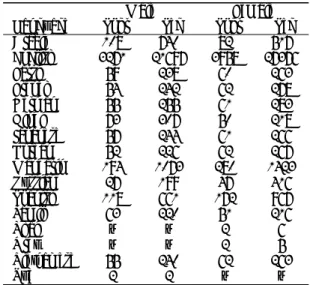
Arabic 108 740 82 517 English 3271 21697 3958 27376 Farsi 59 238 60 263 French 54 242 62 278 German 55 255 61 283 Hindi 73 307 50 218 Japanese 57 244 61 266 Korean 52 226 62 267 Mandarin 194 1073 280 1423 Russian 27 199 47 416 Spanish 118 661 172 967 Tamil 63 220 51 216 Thai – – 2 6 Urdu – – 2 5 Vietnamese 55 240 62 263 Yue 2 2 – –
Table 1: Multilingual resources used for system development.
4. Experimental Protocol
The recent NIST 2008 and 2010 SRE corpora are used to eval-uate the proposed approach of language normalization. Results
are reported for telephony (tel-tel) multilingual trials (det6) and
English-only trials (det7) on the SRE’08 database and the tele-phony English-only trials from det5 of the SRE’10 extended protocol. Performance was evaluated using the equal error rate (EER) and a normalized minimum decision cost function (DCF) calculated using effective prior odds of 1/9.9 and 1/999 for SRE’08 and SRE’10, respectively [15]. In all approaches, the number of PLDA subspace dimensions was evaluated in steps of
50 in order to minimise the average of(DCF+ 10×EER)from
det5 of SRE’10. The resulting dimensions were 100 speaker and 100 session dimensions when preprocessing i-vectors with WCCN and 100 speaker and 50 session dimensions for LN-WCCN. These optimised subspaces were then used in the eval-uation of SRE’08.
Speech activity detection was performed as in [16]. Gender-dependent, 2048-component UBMs were trained on
20-dimensional, feature-warped MFCCs (includingC0) with deltas
and double-deltas appended. UBM training data included tele-phone and microtele-phone speech sourced from the NIST 2004— 2006 SRE corpora and LDC releases of Fisher English, Switch-board II: phase 3 and SwitchSwitch-board Cellular (parts 1 and 2). The total variability subspace of 400 dimensions was trained using the same data along with data from Switchboard I, Switchboard II: phase 1 and the Callfriend database. The WCCN and LN-WCCN transforms and PLDA models were trained using the same data as used for subspace training but limited to telephone speech.
4.1. Multilingual development speech
System development data includes speech from a variety of lan-guages represented by the aforementioned NIST SRE (2004– 2006), Fisher and Switchboard series of corpora along with the Callfriend database commonly used for language identification. The Callfriend database consists of speech from 12 languages recorded as 30 minute conversations from 120 speakers of each language. Each 30 minute conversation side was split into mul-tiple segments containing 5 minutes of audio to match the length of NIST telephone conversations and to provide a limited
es-−0.6 −0.4 −0.2 0 0.2 0.4 0.6 −0.5 −0.4 −0.3 −0.2 −0.1 0 0.1 0.2 0.3 0.4 0.5 1st PCA Dimension 2nd PCA Dimension ara eng far fre ger hin jap kor man rus spa tah tha urd vie (a) WCCN −0.6 −0.4 −0.2 0 0.2 0.4 0.6 −0.5 −0.4 −0.3 −0.2 −0.1 0 0.1 0.2 0.3 0.4 0.5 1st PCA Dimension 2nd PCA Dimension ara eng far fre ger hin jap kor man rus spa tah tha urd vie (b) LN-WCCN
Figure 1: Projection of language-labelled i-vectors into 2D PCA space after applying (a) WCCN or (b) LN-WCCN. This represents the distribution of languages in i-vector space prior to training the PLDA classifier.
timate of within-speaker variation for the Callfriend speakers. This resulted in approximately 400–1000 utterances per lan-guage from Callfriend which included Arabic, English, Farsi, French, German, Hindi, Japanese, Korean, Mandarin, Spanish, Tamil, and Vietnamese. Additional languages represented in the SRE 2004–2006 datasets include Russian, Yue, Thai, and Urdu. Table 1 details the number of speakers and segments available for each represented language on a per gender basis.
4.2. Score Calibration Protocol
The calibration process was conducted using the FoCal [17] toolkit which is based on a linear transformation,
`=α0+α1s (9)
to produced calibrated log-likelihood-ratio (LLR) `from raw
scoress. The linear transformation weighting parametersα0
andα1 were trained from a set of development scores via
lo-gistic regression [10]. This transformation was optimized for
the NIST SRE prior 1/9.9 [15]. In this paper, the
calibra-tion performance is evaluated in an applicacalibra-tion independent ap-proach based on [18], and presented in terms of cost of LLR
(Cllr), the minimum cost of LLR (Cllrmin), and miscalibration
Cmis =Cllr−Cllrmin. The calibration experiments were
car-ried out in a gender-dependent manner using SRE’10 for de-velopment data, while SRE’08 was specified as the evaluation dataset in order to provide unseen language variability in the calibration evaluation.
5. Results
The following experiments illustrate the effectiveness of the proposed language-normalized WCCN to improve the robust-ness of PLDA-based speaker recognition. As detailed in Sec-tion 4, tuning of system parameters including PLDA subspace dimensions was done entirely on SRE’10 so as to allow for an unbiased comparison of SRE’08 results. This is of particular interest since SRE’10 is an English-only data set.
5.1. Analysis of language-normalized i-vector space
Prior to analysing performance trends, we have often found it beneficial to observe how a given technique changes the way in which data lies in the i-vector space. In a similar manner to previous publications [4, 5], i-vectors from the female PLDA training dataset were first processed using either WCCN or
LN-Trial WCCN LN-WCCN
Corpus Lang. Min. DCF EER Min. DCF EER
SRE’08 All .0329 5.98% .0244 5.12%
SRE’08 English .0111 2.28% .0111 2.36%
SRE’10 English .4510 2.71% .4540 2.85%
Table 2: SRE’08 det6 (All) and det7 (English) and SRE’10 det5 extended (English) results comparing WCCN to Language
Normalized-WCCN across different trial conditions. PLDA
subspaces were tuned on SRE’10 results.
WCCN. Each set of i-vectors was used to train a corresponding 2D PCA space into which the same i-vectors were projected. This final projections are depicted in Figure 1 and labelled based on the language to which i-vectors correspond. Figure 1(a) rep-resents vectors processed with WCCN. The distribution of i-vectors from other languages (darker scatter) is noticeably dis-joint from i-vectors corresponding to English speech (yellow scatter). It is the objective of LN-WCCN to suppress this vari-ation. Figure 1(b) illustrates that LN-WCCN successfully moved the variation attributed to language differences and re-sulted in a less skewed distribution of i-vectors with a common center. Based on these observations, it is expected that using LN-WCCN instead of WCCN will provide added robustness to cross-language speaker comparisons in a subsequently trained PLDA model.
5.2. Language normalization
This section compares PLDA performance when modelling i-vectors preprocessed with WCCN or the proposed LN-WCCN using the NIST SRE’08 and SRE’10 databases. While focus is given to the multilingual SRE’08 corpus, the SRE’10 det5 (extended) protocol was evaluated to observe the effect of LN-WCCN on the English-only trials of this recent data set.
Table 2 summarizes results from all-language trials (det6) and English-only trials (det7) on the SRE’08 database. In the all-language trials (top line of the table), LN-WCCN was found to provide a relative improvement of 26% in minimum DCF and 14% in EER over the use of WCCN. This demonstrates that sup-pression of language related variation from i-vectors provides improved robustness to multilingual speech in a PLDA-based speaker recognition system. Interestingly, the English-only tri-als (det6) of SRE’08 were largely unaffected by the introduction
Trial WCCN LN-WCCN Languages Restriction # Trials Min. DCF EER Min. DCF EER
All None 35896 .0329 5.98% .0244 5.12%
All Different Language 13967 .0378 7.65% .0309 6.39%
non-English None 4853 .0427 7.95% .0338 6.84%
non-English Same Language 4168 .0420 7.46% .0332 6.86%
non-English Different Language 685 .0279 6.69% .0248 8.51%
Table 3: Comparison of performance from WCCN and Language-Normalized WCCN on language-conditioned subsets of the SRE’08 det6 trials.
of language normalization into the system. LN-WCCN appears, therefore, to hold the desirable characteristic of not ‘trading-off’ between performance of the targeted multilingual conditions and the English-only trials. This was further explored by evalu-ating the English-only telephone trial det5 protocol (extended) from SRE’10 using both WCCN and LN-WCCN preprocessing steps. It was this condition for which the PLDA subspace di-mensions were tuned. The last row in Table 2 shows that the difference between LN-WCCN and WCCN on the SRE’10 tri-als was minimal. This supports the conclusion that removing the variation that separates languages from i-vector space does not degrade the representation of English spoken speech.
Results from the SRE’08 all-language condition (det6) were divided into subsets in order to observe where LN-WCCN provided most benefit. Subsets of results included different
lan-guage trials (det7\det6), and three conditions involving only
non-English speech: same language, different language and all non-English trials. Table 3 details the system performance from these subsets when using WCCN or LN-WCCN along with the number of trials in each set. The top line of the table refer-ences the performance of det6 trials from SRE’08. It can be observed that, with the exception of the last row in the table, the remaining subsets found similar improvements of 18–21% in minimum DCF and 8–16% in EER when using LN-WCCN relative to WCCN. The non-English, different language trials subset (last row in table) lacks the number of trials needed to provide meaningful results but was included for completeness. From the findings in this section, we can conclude that in the context of a system developed using a majority of English spo-ken speech, language normalization offers robustness when en-countering both cross-language trials as well as under-resourced languages without degradation to commonly targeted English-only conditions.
5.3. Score distributions
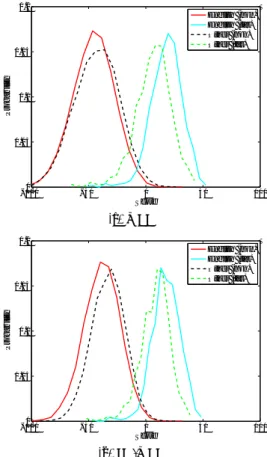
The previous section illustrated that LN-WCCN provided ro-bustness to the multilingual trials (det6) of SRE’08. In this sec-tion we analyse the distribusec-tions of the English-only and other-language trial scores to shed some light on why LN-WCCN is more effective than WCCN in the multilingual context. The SRE’08 target and non-target score distributions from English
trials (det7) and other trials (det7\det6) were thus plotted for
WCCN in Figure 2(a) and for LN-WCCN in Figure 2(b). It can be observed that in both plots, the English and other score distributions have different characteristics, particularly in terms of mean score. It can be seen, however, that the way in which the other language score distributions shift relative to English scores differs between WCCN and LN-WCCN. In the case of WCCN, the non-target score distribution is similar between En-glish and other language trials, while the target score distribu-tion for English trials shows a considerable positive shift. In contrast, LN-WCCN offered a global compression of other lan-guage trial scores around a central point. This, in turn, allowed
−1000 −50 0 50 100 0.05 0.1 0.15 0.2 Score Probability English (non) English (tar) Other (non) Other (tar) (a) WCCN −1000 −50 0 50 100 0.05 0.1 0.15 0.2 Score Probability English (non) English (tar) Other (non) Other (tar) (b) LN-WCCN
Figure 2: Score distributions illustrating the differences be-tween English-only trials and other language trials of SRE’08 det6 for PLDA pre-processed with (a) WCCN or (b) LN-WCCN.
for the more compatible pooling of the English and other lan-guage score distributions.
It can also be observed that the ratio of non-target score variance to target score variance was lower in the case of LN-WCCN. As observed in Figure 3, this has the effect of rotating the corresponding detection error trade-off (DET) curve anti-clockwise [19], thus explaining the greater relative improve-ment in DCF compared to EER observed in Section 5.2 when introducing language-normalization into the system.
5.4. Calibration Performance
In the context of the NIST SRE, unseen evaluation data often exhibits characteristics (e.g. language spoken or microphone type) which have never been seen in previous evaluations. This leads to a calibration problem due to the information in the de-velopment stage of calibration not being completely representa-tive of the unseen evaluation data. As discussed in Section 5.2, language normalization was shown to offer robustness in
cross-Calibration Condition Male Female (Language) Pre-processing Cllr Cllrmin Cmis Cllr Cllrmin Cmis
Mismatched (All) WCCN .244 .190 .054 .333 .256 .077
LN-WCCN .169 .143 .026 .267 .217 .050
Matched (English) WCCN .084 .070 .014 .140 .110 .030
LN-WCCN .088 .076 .012 .146 .114 .032
Table 4: SRE’08 actual cost of LLR (Cllr), minimum cost of LLR (Cllrmin), and mis-calibration (Cmis =Cllr−Cllrmin) for PLDA
systems with WCCN or LN-WCCN pre-processing. The calibration parameters were trained on the English-only scores from SRE’10.
0.1 0.2 0.5 1 2 5 10 20 40 0.1 0.2 0.5 1 2 5 10 20 40
False Alarm probability (in %)
Miss probability (in %)
WCCN LN−WCCN
Figure 3: Plot of DET curves for SRE’08 det6 (All-language) scores comparing WCCN and LN-WCCN for i-vector prepro-cessing.
language and under-resourced language trials from a system tuned on English speech. We explore whether this beneficial trend of language normalization extends to the system calibra-tion performance by evaluating two different calibracalibra-tion
condi-tions —matchedandmismatched. The calibration parameters
were learned on theEnglish-onlySRE’10 det5 dataset, and the
calibration was evaluated on SRE’08 dataset for both matched
(det7,English-only) and mismatched (det6,All-languages)
con-ditions.
Table 4 details the calibration performance of WCCN and LN-WCCN systems which were evaluated on the matched and mismatched calibration conditions. In the mismatched condi-tion, all calibration metrics of LN-WCCN were reduced by 15% to 51% relative to the WCCN metrics. The largest of these rel-ative improvements were 51% and 35% in terms of
miscali-bration (Cmis) in the male and female trials, respectively. In
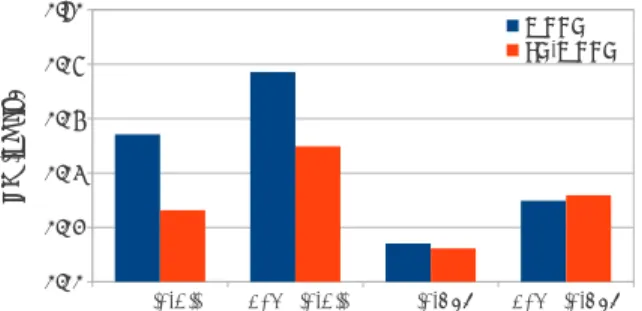
the matched condition, a different trend was found compared to the mismatched condition, where relatively small differences were observed between the WCCN and LN-WCCN calibration metrics. Figure 4 summarizes the effect of language normaliza-tion on calibranormaliza-tion performance by depicting the miscalibranormaliza-tion
(Cmis) of matched and mismatched conditions. The figure
il-lustrates that when compared to WCCN, LN-WCCN success-fully reduced miscalibration metrics in the mismatched condi-tion, while offering a comparable level of miscalibration in the matched condition. These results demonstrate the ability of lan-guage normalization to improve system calibration performance in the context of mismatched language conditions.
6. Conclusion
This work extended the application of source normalization to the task of improving the language-independence of
state-of-2048 system
Page 3
Male-All Female-All Male-Eng Female-Eng
0.00 0.02 0.04 0.06 0.08 0.10 WCCN LN-WCCN M is ca lib ra tio n
Figure 4: Comparing the miscalibration of WCCN and LN-WCCN (lower is better). Calibration parameters learned on SRE’10 det5-English and evaluated on SRE’08 det6-All (mis-matched) and det7-English ((mis-matched) conditions.
the-art PLDA-based speaker recognition with i-vectors. Using language labels to identify different sources in the development data set, language normalized WCCN (LN-WCCN) was pro-posed as an i-vector preprocessing stage. Evaluated on the mul-tilingual telephony conditions of SRE’08, LN-WCCN provided improvements of 26% in minimum DCF and 14% in EER rel-ative to WCCN. These improvements were achieved without detriment to the commonly targeted English-only trial condi-tions or SRE’08 and SRE’10. Additionally, LN-WCCN was found to improve calibration performance when development and evaluation data were mismatched with respect to language.
7. References
[1] N. Dehak, R. Dehak, P. Kenny, N. Brummer, P. Ouellet, and P. Du-mouchel, “Support vector machines versus fast scoring in the low-dimensional total variability space for speaker verification,” inProc. Interspeech, 2009, pp. 1559–1562.
[2] L. Burget, O. Plchot, S. Cumani, O. Glembek, P. Matejka, and N. Br¨ummer, “Discriminatively trained probabilistic linear dis-criminant analysis for speaker verification,” in Proc. IEEE ICASSP, 2011.
[3] M. Senoussaoui, P. Kenny, N. Dehak, and P. Dumouchel, “An i-vector extractor suitable for speaker recognition with both mi-crophone and telephone speech,” inProc. Odyssey Speaker and Language Recogntion Workshop, 2010.
[4] M. McLaren and D.A. van Leeuwen, “Source-normalised LDA for robust speaker recognition using i-vectors,”IEEE Trans. Audio Speech and Language Processing, vol. 20, pp. 755–766, 2011. [5] M. McLaren and D.A. van Leeuwen, “Gender-independent
speaker recognition using source normalisation,” inaccepted into Interspeech, 2012.
[6] M. McLaren and D.A. van Leeuwen, “Source-normalised-and-weighted LDA for robust speaker recognition using i-vectors,” in
Proc. IEEE ICASSP, 2011, pp. 5456–5459.
[7] National Institute of Standards and Technology, NIST Speaker Recognition Evaluation site, Available: http://www.itl.nist.gov/iad/mig/tests/sre/.
[8] N. Dehak, P. Kenny, R. Dehak, P. Dumouchel, and P. Ouel-let, “Front-end factor analysis for speaker verification,” IEEE
Trans. Audio, Speech and Language Processing, vol. 19, pp. 788– 798, 2011.
[9] S.S. Kajarekar, N. Scheffer, M. Graciarena, E. Shriberg, A. Stol-cke, L. Ferrer, and T. Bocklet, “The SRI NIST 2008 speaker recognition evaluation system,” inProc. IEEE ICASSP, 2009, pp. 4205–4208.
[10] N. Brummer, L. Burget, J.H. Cernocky, O. Glembek, F. Grezl, M. Karafiat, D.A. van Leeuwen, P. Matejka, P. Schwarz, and A. Strasheim, “Fusion of heterogeneous speaker recognition sys-tems in the stbu submission for the nist speaker recognition evalu-ation 2006,”IEEE Trans. Audio, Speech, and Language Process-ing, vol. 15, no. 7, pp. 2072–2084, 2007.
[11] D. Garcia-Romero and C. Y. Espy-Wilson, “Analysis of i-vector length normalization in speaker recognition systems,” inProc. Interspeech, 2011, pp. 249–252.
[12] P. Kenny, P. Ouellet, N. Dehak, V. Gupta, , and P. Dumouchel, “A study of inter-speaker variability in speaker verification,” IEEE Trans. Audio, Speech, and Language Processing, vol. 16, pp. 980– 988, 2008.
[13] P. Kenny, “Bayesian speaker verification with heavy tailed priors,” inProc. Odyssey Speaker and Language Recognition Workshop, 2010.
[14] A. Hatch, S. Kajarekar, and A. Stolcke, “Within-class covari-ance normalization for SVM-based speaker recognition,” in
Proc. Ninth Int. Conf. on Spoken Language Processing, 2006, pp. 1471–1474.
[15] David A. van Leeuwen, Alvin F. Martin, Mark A. Przybocki, and Jos S. Bouten, “NIST and TNO-NFI evaluations of automatic speaker recognition,” Computer Speech and Language, vol. 20, pp. 128–158, 2006.
[16] M. McLaren and D.A. van Leeuwen, “A simple and effective speech activity detection algorithm for telephone and microphone speech,” inProc. NIST SRE Workshop, 2011.
[17] Niko Br¨ummer, FoCal-II: Toolkit for calibration of multi-class recognition scores, August 2006, Software available at http://www.dsp.sun.ac.za/∼nbrummer/focal/index.htm. [18] D. van Leeuwen and N. Br¨ummer, “An introduction to
application-independent evaluation of speaker recognition sys-tems,”Speaker Classification I, pp. 330–353, 2007.
[19] R. Auckenthaler, M. Carey, and H. Lloyd-Thomas, “Score normalization for text-independent speaker verification systems,”