A fast EM algorithm for Gaussian model-based source
separation
Joachim Thiemann, Emmanuel Vincent
To cite this version:
Joachim Thiemann, Emmanuel Vincent. A fast EM algorithm for Gaussian model-based source
separation. EUSIPCO - 21st European Signal Processing Conference - 2013, Sep 2013,
Mar-rakech, Morocco. 2013.
<
hal-00840366
>
HAL Id: hal-00840366
https://hal.inria.fr/hal-00840366
Submitted on 2 Jul 2013
HAL
is a multi-disciplinary open access
archive for the deposit and dissemination of
sci-entific research documents, whether they are
pub-lished or not.
The documents may come from
teaching and research institutions in France or
abroad, or from public or private research centers.
L’archive ouverte pluridisciplinaire
HAL
, est
destin´
ee au d´
epˆ
ot et `
a la diffusion de documents
scientifiques de niveau recherche, publi´
es ou non,
´
emanant des ´
etablissements d’enseignement et de
recherche fran¸
cais ou ´
etrangers, des laboratoires
publics ou priv´
es.
A FAST EM ALGORITHM FOR GAUSSIAN MODEL-BASED SOURCE SEPARATION
Joachim Thiemann
CNRS, IRISA – UMR 6074
Campus de Beaulieu
35042 Rennes Cedex, France
[email protected]
Emmanuel Vincent
Inria, Centre de Nancy - Grand Est
615 rue du Jardin Botanique
54600 Villers-l`es-Nancy, France
[email protected]
ABSTRACT
We consider the FASST framework for audio source sepa-ration, which models the sources by full-rank spatial covari-ance matrices and multilevel nonnegative matrix factorization (NMF) spectra. The computational cost of the expectation-maximization (EM) algorithm in [1] greatly increases with the number of channels. We present alternative EM updates using discrete hidden variables which exhibit a smaller cost. We evaluate the results on mixtures of speech and real-world environmental noise taken from our DEMAND database. The proposed algorithm is several orders of magnitude faster and it provides better separation quality for two-channel mixtures in low input signal-to-noise ratio (iSNR) conditions.
Index Terms— Audio source separation, FASST, EM al-gorithm, binary masking, DEMAND.
1. INTRODUCTION
We consider the problem of under-determined reverberant source separation, that is to separate the signals ofJsources from a mixture recorded by an array ofI < Jmicrophones. See [2, 3] for a review. Numerous techniques have been pro-posed, ranging from early multichannel spatial filtering and single-channel spectral modeling techniques [4, 5] to recent techniques jointly exploiting spatial and spectral cues [1, 6]. The general Gaussian model-based framework in [1], which underlies the FASST toolbox1, is currently one of the most advanced frameworks which enables the modeling of rever-berant sources by means of full-rank spatial covariance ma-trices and the enforcement of spectral constraints by means of multilevel nonnegative matrix factorization (NMF).
For historical reasons, most of these techniques have been designed or assessed in two-channel scenarios. Additional microphones can improve the separation performance by in-creasing the spatial resolution of the array, but they imply a greater computational cost. The increase of the computational
1Flexible Audio Source Separation Toolbox,a MATLAB toolbox which can be found athttp://bass-db.gforge.inria.fr/fasst/
cost as a function of the number of channels is especially dra-matic (cubic) for Gaussian expectation-maximization (EM)-based techniques which consider the source signals as hidden data [1,7,8]. Based on the idea of binary masking [4], a range of techniques have been proposed that provide a smaller cost increase by assuming that a single source predominates in each time-frequency bin and by considering the correspond-ing source indexes as discrete hidden data [6, 9, 10]. In [11], the source separation algorithm by Duong [12] is investigated by an EM algorithm targeting this hidden data.
In this paper, we propose a binary activation EM (BAEM) algorithm for the FASST framework, which extends the algo-rithm in [11] to multichannel NMF modeling of the spectra instead of unconstrained spectra. This algorithm exhibits a quadratic cost increase as a function of the number of chan-nels while retaining the latter desirable feature of FASST, en-abling the enforcement of spectral or temporal constraints on the source short-term spectra. We also test the algorithm for source separation in a noisy environment and we consider a larger number of experimental conditions, such as the level of background noise and the number of channels.
The structure of the rest of the paper is as follows. We recall the conventional EM algorithm for FASST in Section 2 and describe the BAEM algorithm as it fits within the FASST framework in Section 3. We evaluate them in Section 4 and conclude in Section 5.
2. GAUSSIAN MODEL-BASED SOURCE SEPARATION
2.1. Model
Using the Short-Time Fourier Transform (STFT), theI×1
vectorxf nof mixture STFT coefficients in time framenand frequency binf can be expressed as [3]
xf n=XJ
j=1yj,f n+bf n. (1)
whereyj,f nis thespatial imageof thejth source andbf nis a small Gaussian noise with covarianceΣb,f n. FASST models
the spatial images of all sources as Gaussian random vectors yj,f n∼ N(0, vj,f nRj,f) (2) wherevj,f ndenotes the short-termpower spectrumof thejth source andRj,f itsspatial covariance matrix. The short-term power spectraVj = [vj,f n]f,nof each source are further as-sumed to factor in a multilevel NMF fashion as
Vj= Wexj Uexj Gexj Hexj
Wftj Uftj Gftj Hftj
(3) where the nonnegative matricesWjex,Uexj ,Gexj andHexj en-code the fine spectral structure, the spectral envelope, the tem-poral envelope and the temtem-poral fine structure of the source excitation signal andWft
j,Uftj,Gftj andHftj the same quanti-ties for the spectral resonance filter, anddenotes entry-wise matrix multiplication. In the following, we assume that the sources are reverberated or diffuse, so thatRj,f is full-rank. 2.2. Subsource EM algorithm
Given this model, the log-likelihood can be expressed in terms of the empirical mixture covariance matrix Rx,f nb in each time-frequency bin. The classical approach for maximum likelihood (ML) inference in such Gaussian models is to em-ploy the EM algorithm, where the source time-frequency co-efficients themselves are considered as hidden data [7, 8].
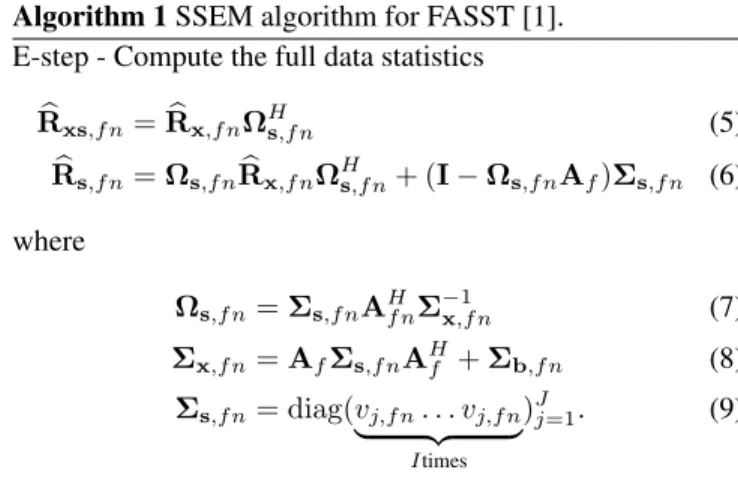
This approach was applied to FASST by defining vectors ofsubsource2coefficientssj,f nsuch thatyj,f n=Aj,fsj,f n withAj,fAHj,f = Rj,f and by considering them as hidden data [1]. The resulting subsource EM (SSEM) updates are summarized in Algorithm 1 and Figure 1. The E-step relies on the computation of the Wiener filterΩs,f n, while the M-step involves a closed-form update forAf = [A1,f, . . . ,AJ,f] and multiplicative updates for the multilevel NMF parame-ters. Strictly speaking, this is a generalized EM (GEM) algo-rithm because the multiplicative updates increase but do not maximize the log-likelihood of the complete data.
Once the parameters θ = {Rj,f,Wex
j ,Uexj ,Gexj ,Hexj , Wft
j,Uftj,Gftj,Hftj}j,fhave been estimated, the source STFT coefficients are obtained via the Wiener filter
ˆ yj,f n=vj,f nRj,f XJ j=1vj,f nRj,f −1 xf n. (4) 2.3. Complexity
Although it has been successfully employed for the separation of two-channel mixtures [1, 3], the SSEM algorithm has two
2This concept generalizes that of “source” whenR
j,fis full-rank.
3The eight matrices in (3) are updated in turn. Denoting byC
jthe ma-trix to be updated, the factorization (3) can always be rewritten asVj =
(BjCjDj)Ej, where the nonnegative matricesBj,DjandEjare as-sumed to be fixed whileCjis updated. For example, ifCj = Hftj, then
Bj=Wftj UjftGftj,Dj=IandEj=Wexj Uexj Gexj Hexj .
Algorithm 1SSEM algorithm for FASST [1]. E-step - Compute the full data statistics
b Rxs,f n=Rx,f nΩb Hs,f n (5) b Rs,f n=Ωs,f nRbx,f nΩHs,f n+ (I−Ωs,f nAf)Σs,f n (6) where Ωs,f n=Σs,f nAHf nΣ−x,f n1 (7) Σx,f n=AfΣs,f nAHf +Σb,f n (8) Σs,f n= diag(vj,f n. . . vj,f n | {z } Itimes )Jj=1. (9)
M-step - Update the model parameters (see [1] for notation3)
Af =X nRxs,f nb X nRs,f nb −1 (10) Cj =Cj BT j[ΞbjE.−j 1(BjCjDj).−2]DTj BT j(BjCjDj).−1DTj (11) whereΞbj= [ ˆξj,f n]f,nwith ˆ ξj,f n= 1 I XjI r=(j−1)I+1(Rs,f nb )rr. (12)
initial source model parameters
E-step
invert the mixture covariance
matrix and compute its determinant
for every time-frequency bin
compute the source posterior mean and covariance
update the model parameters (only matrix addition/multiplication and scalar division required)
for every set of model parameters final source model parameters
M-step
for every source
Fig. 1. Processing schema of SSEM.
drawbacks when the number of channelsIincreases. First, the computational cost of each iteration becomes dominated by that of the matrix multiplications and inversions in (5)–(8), which grows inO((J2+ 6J + 2)I3F N)forN time frames andF frequency bins. Second, we have found in preliminary experiments that the increase in the size of the hidden data space requires more iterations until convergence. Altogether, this results in a major increase of the computational cost.
3. BINARY ACTIVATION EM
In order to address these drawbacks, we propose here the faster BAEM algorithm for FASST under the assumption that a single source predominates in each time-frequency bin [11]. An approximate generative model is proposed for the mixture signal and a GEM algorithm is derived by considering the corresponding source indexes as discrete hidden data. 3.1. Model
Denoting bylf nthe index of the predominant source in time-frequency bin(f, n), we replace the generative model (1) by
xf n=ylf n,f n with lf n∼Cat(π1,f n, . . . , πJ,f n) (13)
where the source spatial image coefficientsyj,f n follow the same model as in (2)–(3) andCatdenotes the categorical dis-tribution. The prior probabilityπj,f n that thejth source be predominant in this time-frequency bin may be set to zero in certain time frames for those sources which are known to be inactive and uniformly shared among the other sources. 3.2. Algorithm
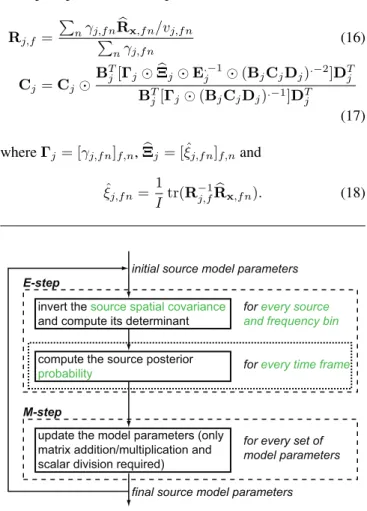
We then conduct ML inference by consideringlf nas hidden data. The resulting BAEM updates [11]are summarized in Algorithm 2 and Figure 2. The E-step consists of comput-ing the posterior probabilityγj,f n =P(lf n =j|x, θ)oflf n and the M-step of solving the optimization problemθ = arg maxP
j,f nγj,f n[−tr(Σ −1
y,j,f nRx,f nb )−log det(πΣy,j,f n)]. For the source spatial covariance matricesRj,f, the update is obtained in closed form. For the multilevel NMF parame-ters, this optimization problem is equivalent to the weighted multilevel NMF problemarg minP
f nγj,f ndIS( ˆξj,f n|vj,f n) wheredIS(x|y) =xy −logxy−1is the Itakura-Saito (IS) di-vergence andξˆj,f nis defined in (18), which can be addressed using weighted multiplicative updates [13]. After conver-gence, the sources are separated bysoft masking
b
yj,f n=γj,f nxf n. (14)
3.3. Complexity
BAEM does not require matrix multiplications and inversions in each time-frequency bin anymore. By rewriting (15) as
γj,f n∝πj,f ne −tr(R−1
j,fRbx,f n)/vj,f n
(πvj,f n)Idet(Rj,f)
, (19)
it appears that the inverse and the determinant ofRj,f must be computed only once for each source in each frequency bin instead. For typical values ofN, this has negligible cost and the cost of each iteration becomes dominated by that of the matrix dot product tr(R−j,f1Rbx,f n)in (19), which grows in
Algorithm 2Proposed BAEM algorithm for FASST. E-step - Compute the posterior probability oflf n
γj,f n∝πj,f ne −tr(Σ−1 y,j,f nRbx,f n) det(πΣy,j,f n) (15) whereΣy,j,f n=vj,f nRj,f.
M-step - Update the model parameters (see [1] for notation3)
Rj,f = P nγj,f nRbx,f n/vj,f n P nγj,f n (16) Cj =CjB T j[ΓjΞjb E.−j 1(BjCjDj).−2]DTj BT j[Γj(BjCjDj).−1]DTj (17) whereΓj = [γj,f n]f,n,Ξbj = [ ˆξj,f n]f,nand ˆ ξj,f n= 1 Itr(R −1 j,fRx,f nb ). (18)
initial source model parameters
E-step
invert the source spatial covariance
and compute its determinant
for every source and frequency bin
compute the source posterior
probability
update the model parameters (only matrix addition/multiplication and scalar division required)
for every set of model parameters
final source model parameters
M-step
for every time frame
Fig. 2. Processing schema of BAEM.
O(J I2F N). The complexity of each iteration is therefore
re-duced by a factor on the order of(J+ 6)I. Furthermore, we have found by monitoring the log-likelihood in preliminary experiments that the number of iterations needed to reach con-vergence is one order of magnitude smaller than for SSEM, which is a natural consequence of the drastic reduction of the size of the hidden data space (fromI×J×F×N complex-valued variables toF×Ndiscrete variables).
One limitation of BAEM compared to SSEM is that soft masking induces a smaller oracle upper bound [3] on the sepa-ration performance than multichannel Wiener filtering. How-ever, we will see that this does not prevent BAEM from con-verging to better solutions than SSEM in certain conditions.
4. EXPERIMENTAL EVALUATION 4.1. Acoustic setup
In our experimental setup, one or two target speech signals are convolved by room impulse responses simulated via the source image technique and added to field recordings of envi-ronmental noise, as classically done in source separation eval-uations [3]. The publicly available database of 16-channel noise recordings (DEMAND) [14] is used. The microphone array setup, the room dimensions and the reverberation time in the simulated environment mirror those in the physical en-vironments in which the DEMAND data was recorded.
Of the original 16 recorded channels, a subset correspond-ing to a planar array of 8 microphones in three staggered rows is used. The simulated target sources are placed 1 m away from microphone 1 of the array, separated by 45 degrees, in the same plane as the array, 1.5 m off the ground. Proper subsets of the multichannel data are also evaluated. In the two-channel case, only the two microphones of the center row are used, and in the four-channel case, the four microphones forming a diamond in the center of the array are used.
We use 5 s excerpts from 10 of the noise recordings in DEMAND: NFIELD, NPARK, OHALLWAY, OOFFICE, PRESTO, PSTATION, SPSQUARE, STRAFFIC, TCAR, and TMETRO. The simulated sources are mixed with the noise recordings to have an input SNR (iSNR) of -6, 0, 6, 12 and 18 dB for all channels combined. In the case of two targets, the iSNR is measured between the sum of the target sources and the noise recording. All signals are sampled at 16 kHz.
4.2. Algorithm parameters and evaluation criteria The STFT window size is set to 1024 samples. The spectral variances of the noise source are constrained to NMF with 16 components. The spatial covariance matrices of the speech sources are initialized given knowledge of their position as in [12, eq. 12]. The other parameters are randomly initial-ized. Based on the convergence rates observed in initial ex-periments, we use 100 iterations per channel for SSEM and 10 iterations (regardless of the number of channels) for BAEM.
Altogether, BAEM is more than two orders of magnitude faster. In MATLAB, processing a single two-channel mixture takes 25 min with SSEM in contrast to 7.5 s with BAEM.
Separation quality is evaluated in terms of the average Signal-to-Interference Ratio (SIR) and Signal-to-Artifacts Ratio (SAR) [3] over all environments, where the background noise and the second source (if present) are both considered as interfering sources.
4.3. Results
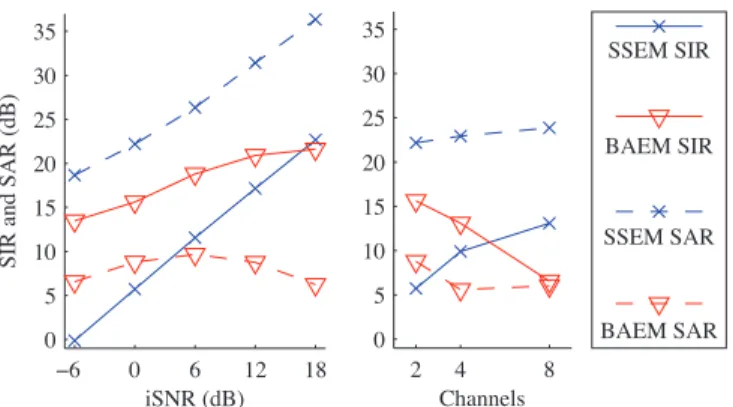
The separation results for a single target in noise and for two targets in noise are shown in Figs. 3 and 4, respectively.
−6 0 6 12 18 0 5 10 15 20 25 30 35 S IR a nd S A R (dB) iSNR (dB) 2 4 8 0 5 10 15 20 25 30 35 Channels SSEM SIR BAEM SIR SSEM SAR BAEM SAR
Fig. 3. Average SIR and SAR for the separation of one target in noise, as a function of iSNR with 2 channels (left) and of the number of channels at an iSNR of 0 dB (right).
−6 0 6 12 18 0 5 10 15 20 ave ra ge S IR a nd S A R (dB) iSNR (dB) 2 4 8 0 5 10 15 20 Channels SSEM SIR BAEM SIR SSEM SAR BAEM SAR
Fig. 4. Average SIR and SAR for the separation of two targets in noise, as a function of iSNR with 2 channels (left) and of the number of channels at an iSNR of 0 dB (right).
On two-channel mixtures, BAEM improves theSIRby 2 to 7 dB compared to SSEM when iSNR≤ 0 dB. When the iSNR increases, the SIR increases and remains almost always superior to that of SSEM, while the SAR exhibits a stable, lower value. This is expected for soft masking reconstruc-tion, which often comes close to producing a binary mask on the resulting signal. In such situtations, the SAR can be im-proved at the expense of a comparable reduction in SIR by temporal smoothing of the mask [15]. This post-processing
shouldallow BAEM to achieve a higher overall quality than
SSEMfor iSNRs less than about 9 dB.Quality might further
be improved by using SSEM with few iterations as a post-processing step for BAEM.
On mixtures of four or more channels, BAEM surpris-ingly shows a decrease in performance as the number of chan-nels is increased. This might be due to the apparently lower robustness to noise of the updates (16) and (18) in BAEM compared to the updates (10) and (12) in SSEM, which could be addressed by appropriate regularization. Further study of this behavior is needed, however, due to the complex
inter-twining of all updates.
It is essential to note that this has no impact on the low-iSNR real-world applications that motivated this study. In-deed, applying BAEM to 2 channels out of the 8 available provides both the fastest estimation and the best overall qual-ity for these applications.
5. CONCLUSION
We proposed a new EM algorithm for the FASST source sep-aration framework, which greatly reduces its computational cost while retaining its ability of exploiting advanced source models. Even with few channels, this reduction is about one order of magnitude for each iteration whilst also requiring far fewer iterations. In addition, the overall separation quality of the proposed BAEM algorithm on two-channel mixtures is larger than that of the traditional SSEM algorithm in the low-iSNR real-world conditions that motivated this study. Further work will be devoted to the examination of numerical robust-ness issues, to temporal smoothing of the separation mask and to the investigation of the use of SSEM as a post-processing step for BAEM, so as to extend the observed quality improve-ment to higher iSNR conditions and to more channels.
6. ACKNOWLEDGMENTS
This work was supported by Canon Research Centre France. We wish to thank G. Kergourlay for helping with the design of the schemas in this paper.
7. REFERENCES
[1] A. Ozerov, E. Vincent, and F. Bimbot, “A general flex-ible framework for the handling of prior information in audio source separation,”IEEE Trans. on Audio, Speech and Language Processing, vol. 20, no. 4, pp. 1118– 1133, 2012.
[2] S. Makino, T.-W. Lee, and H. Sawada, Eds., Blind Speech Separation, Springer, 2007.
[3] E. Vincent, S. Araki, F. J. Theis, G. Nolte, et al., “The Signal Separation Evaluation Campaign (2007–2010): Achievements and remaining challenges,” Signal Pro-cessing, vol. 92, pp. 1928–1936, 2012.
[4] ¨O. Yılmaz and S. T. Rickard, “Blind separation of speech mixtures via time-frequency masking,” IEEE Trans. on Signal Processing, vol. 52, no. 7, pp. 1830– 1847, 2004.
[5] S. T. Roweis, “One microphone source separation,” inAdvances in Neural Information Processing Systems, 2001, pp. 793–799.
[6] T. Nakatani, S. Araki, T. Yoshioka, and M. Fujimoto, “Joint unsupervised learning of hidden Markov source models and source location models for multichannel source separation,” inProc. IEEE Int. Conf. on Acous-tics, Speech, and Signal Processing, 2011, pp. 237–240. [7] J.-F. Cardoso, H. Snoussi, J. Delabrouille, and G. Patan-chon, “Blind separation of noisy Gaussian stationary sources. Application to cosmic microwave background imaging,” in Proc. European Signal Processing Conf. (EUSIPCO), 2002, pp. 561–564.
[8] A. Ozerov and C. F´evotte, “Multichannel nonnegative matrix factorization in convolutive mixtures for audio source separation,” IEEE Trans. on Audio, Speech and Language Processing, vol. 18, no. 3, pp. 550–563, 2010. [9] M. I. Mandel, R. J. Weiss, and D. P. W. Ellis, “Model-based expectation-maximization source separation and localization,” IEEE Trans. on Audio, Speech and Lan-guage Processing, vol. 18, no. 2, pp. 382–394, 2010. [10] A. Deleforge and R. P. Horaud, “A latently constrained
mixture model for audio source separation and localiza-tion,” inProc. 10th Int. Conf. on Latent Variable Analy-sis and Signal Separation, 2012, pp. 372–379.
[11] R. Sakanashi, S. Miyabe, T. Yamada, and S. Makino, “Comparison of superimposition and sparse models in blind source separation by multichannel Wiener filter,” inProc. APSIPA Annual Summit and Conf., 2012, pp. 1–6.
[12] N. Q. K. Duong, E. Vincent, and R. Gribonval, “Under-determined reverberant audio source separation using a full-rank spatial covariance model,”IEEE Trans. on Au-dio, Speech and Language Processing, vol. 18, no. 7, pp. 1830–1840, 2010.
[13] T. Virtanen, A. Mesaros, and M. Ryyn¨anen, “Combin-ing pitch-based inference and non-negative spectrogram factorization in separating vocals from polyphonic mu-sic,” inProc. ISCA Tutorial and Research Workshop on Statistical And Perceptual Audition, 2008, pp. 17–22. [14] J. Thiemann, N. Ito, and E. Vincent, “The DEMAND
database of multichannel environmental noise record-ings,” inProc. Int. Congress on Acoustics, to appear. [15] E. Vincent, “An experimental evaluation of Wiener
fil-ter smoothing techniques applied to under-defil-termined audio source separation,” inProc. 9th Int. Conf. on La-tent Variable Analysis and Signal Separation, 2010, pp. 157–164.