Design of Efficient Java
Communications for High
Performance Computing
Guillermo L ´
opez Taboada
Department of Electronics and Systems
Department of Electronics and Systems
University of A Coru˜
na, Spain
PhD Thesis
Design of Efficient Java
Communications for High
Performance Computing
Guillermo L´
opez Taboada
May 2009
PhD Advisors:
Juan Touri˜no Dom´ınguez
Dr. Juan Touri˜no Dom´ınguez Catedr´atico de Universidad Dpto. de Electr´onica y Sistemas Universidade da Coru˜na
Dr. Ram´on Doallo Biempica
Catedr´atico de Universidad Dpto. de Electr´onica y Sistemas Universidade da Coru˜na
CERTIFICAN
Que la memoria titulada “Design of Efficient Java Communications for High Perfor-mance Computing” ha sido realizada por D. Guillermo L´opez Taboada bajo nuestra
direcci´on en el Departamento de Electr´onica y Sistemas de la Universidad de A
Coru˜na y concluye la Tesis Doctoral que presenta para optar al grado de Doctor en Ingenier´ıa Inform´atica con la Menci´on de Doctor Europeo.
En A Coru˜na, a 26 de Febrero de 2009
Fdo.: Juan Touri˜no Dom´ınguez
Director de la Tesis Doctoral
Fdo.: Ram´on Doallo Biempica
Director de la Tesis Doctoral
Vo Bo: Luis Castedo Ribas
Resumen de la Tesis
Introducci´
on
El lenguaje de programaci´on Java se ha convertido r´apidamente en uno de los m´as populares tras su aparici´on a mediados de los a˜nos noventa. Entre las causas de su pronta aceptaci´on en numerosos ´ambitos de aplicaci´on est´an el tratarse de un lenguaje orientado a objetos, ser independiente de la plataforma, su portabilidad, ser inherentemente seguro, contar con una API muy extensa, y finalmente figurar como el principal lenguaje de programaci´on por n´umero de desarrolladores y por formaci´on ofertada, tanto en el mundo acad´emico como en el profesional. Su penetraci´on en el mundo de la web e Internet es especialmente importante, tanto en aplicaciones cliente-servidor como en computaci´on distribuida. No obstante, la presencia de Java no est´a restringida a estos ´ambitos, siendo una opci´on consolidada en muchos otros (por ejemplo, en aplicaciones multimedia y de escritorio) e incluso una alternativa emergente en la actualidad para su aplicaci´on en computaci´on de altas prestaciones (High Performance Computing o HPC).
El creciente inter´es en Java para computaci´on paralela est´a motivado por las especiales caracter´ısticas del lenguaje, de enorme utilidad en este ´ambito de aplica-ci´on. As´ı, su inherente soporte para aplicaciones en red, el tratarse de un lenguaje multithread (lo cual permite aprovechar de forma directa los sistemas multi-n´ucleo), y el ser portable y multiplataforma, entre otras ventajas de Java, est´an contribuyen-do a su acontribuyen-dopci´on en el campo de la computaci´on de altas prestaciones. El principal inconveniente de Java en este ´ambito ha sido, hasta ahora, su rendimiento inferior al de los lenguajes que son compilados a c´odigo nativo de cada plataforma, los cuales est´an m´as establecidos en este campo, especialmente Fortran y C. No obstante, en
vi
la actualidad el rendimiento ya no constituye un obst´aculo insalvable. La tradicio-nal diferencia de rendimiento entre Java y los lenguajes compilados espec´ıficamente para cada plataforma se ha ido estrechando en los ´ultimos a˜nos gracias al Just-In-Time (JIT), la t´ecnica de compilaci´on de la M´aquina Virtual de Java (JVM) que proporciona al bytecode de Java rendimientos comparables al del c´odigo nativo.
Sin embargo, aunque Java obtiene rendimientos similares en c´odigos secuencia-les a los lenguajes compilados, en aplicaciones paralelas su escalabilidad depende en gran medida de la intensidad y eficiencia de las comunicaciones y/o accesos a memoria compartida. De hecho, la inexistencia de mecanismos de comunicaci´on efi-cientes en Java tiene como consecuencia que sus aplicaciones paralelas presenten peor escalabilidad que las que utilizan c´odigo nativo, ralentizando de este modo el desarrollo de soluciones Java en computaci´on de altas prestaciones.
En cuanto a la arquitectura y configuraci´on de los sistemas utilizados en HPC cabe destacar que actualmente se est´a incrementando significativamente el n´ ume-ro de n´ucleos de procesador instalados a fin de satisfacer la creciente demanda de potencia de c´alculo. Adem´as, las arquitecturas cl´uster siguen siendo las m´as de-mandadas, debido a su excelente ratio coste/rendimiento. Finalmente, la necesidad de que las aplicaciones escalen con un mayor n´umero de n´ucleos favorece la uti-lizaci´on de redes de baja latencia (por ejemplo InfiniBand, Myrinet o SCI). Este hecho, la popularizaci´on de los clusters con redes de baja latencia y con un n´umero
cada vez mayor de n´ucleos por nodo, subraya la importancia del paralelismo y de
la programaci´on multithread e h´ıbrida utilizando ambos paradigmas de memoria
compartida/distribuida.
As´ı, el actual escenario demanda lenguajes de programaci´on que permitan un
desarrollo m´as productivo y que proporcionen un completo soporte multithread y
de servicios de red. Adem´as, la agregaci´on de nodos multi-n´ucleo en clusters por medio de redes de altas prestaciones debe ir pareja del uso de un middleware de
comunicaci´on que permita a las aplicaciones aprovechar el rendimiento de dichas
redes. El lenguaje de programaci´on Java puede satisfacer estas demandas y constituir una alternativa atractiva para la programaci´on paralela en computaci´on de altas prestaciones, siempre y cuando sea capaz de dotarse de mecanismos de comunicaci´on eficientes en las actuales arquitecturas de computaci´on.
vii
La presente Tesis Doctoral,“Design of Efficient Java Communications for High
Performance Computing”, parte de la hip´otesis inicial de que es posible desarro-llar aplicaciones Java en computaci´on de altas prestaciones, un ´ambito en el que el rendimiento es crucial, siempre que est´e disponible un middleware de comunicaci´on eficiente. Entre los objetivos de esta Tesis se hayan la evaluaci´on del rendimiento
de Java en el marco de la computaci´on de altas prestaciones y proporcionar
nue-vas herramientas para mejorar este proceso de evaluaci´on y posterior an´alisis de los resultados. Adem´as, otra finalidad de este trabajo es el dise˜no y desarrollo de un middleware de comunicaci´on optimizado para Java, basado en sockets, as´ı como
do-tar a Java de bibliotecas de comunicaci´on que proporcionen mayores rendimientos
que alternativas previamente existentes. Entre los desarrollos implementados
des-tacan un middleware de comunicaci´on no bloqueante a bajo nivel, una biblioteca
de paso de mensajes en Java, y una optimizaci´on del protocolo de la Invocaci´on de
M´etodos Remotos (RMI) para Java. Finalmente, la Tesis proporciona una gu´ıa de
recomendaciones y buenas pr´acticas en optimizaci´on del rendimiento de aplicaciones Java en computaci´on de altas prestaciones.
Metodolog´ıa de Trabajo
La metodolog´ıa de trabajo seguida en el desarrollo de la presente Tesis Doctoral, ha consistido en:
Definir la lista de tareas a realizar en el tema de la Tesis, teniendo en cuenta los trabajos previos y los recursos disponibles.
Determinar su secuencia u orden de ejecuci´on, ateni´endose a las restricciones que pudiesen existir y al orden m´as favorable.
Establecer su duraci´on y la oportunidad de su desarrollo en un momento
de-terminado.
Organizar las acciones o tareas por bloques de cierta entidad que definan etapas.
viii
Definir, para cada etapa, las metas a alcanzar (u objetivos concretos a lograr en tiempo definidos), sabiendo que en cada etapa puede haber una o varias metas.
Fijar para cada meta, dentro de cada etapa, la metodolog´ıa de trabajo a emplear para lograrla (revisi´on bibliogr´afica, evaluaci´on de proyectos previos, an´alisis de la eficiencia de los desarrollos existentes en el ´ambito de la Tesis, an´alisis de aportaciones necesarias en el ´ambito de trabajo, dise˜no e imple-mentaci´on de soluciones m´as eficientes en el ´area de investigaci´on, evaluaci´on de las aportaciones realizadas y, en caso de ser de positivas y de entidad, difu-si´on posterior a trav´es de congresos y revistas del ´ambito de conocimiento; y, finalmente, recopilaci´on de las principales conclusiones en la presente memoria de Tesis).
De este modo, la lista de tareas (Tn), agrupadas en bloques (Bn), desarrolladas en la presente Tesis han sido:
B1 Estado actual de las comunicaciones en Java para computaci´on de altas
pres-taciones.
T1.1 Selecci´on del paradigma m´as apropiado para la computaci´on de altas
prestaciones en Java. Se seleccion´o el paso de mensajes debido a la mayor escalabilidad de los sistemas de memoria distribuida, en los cuales cons-tituye el principal paradigma de programaci´on. Adem´as, las bibliotecas de paso de mensajes proporcionan, en general, rendimientos aceptables y Java cuenta con numerosos proyectos de bibliotecas de paso de mensajes.
T1.2 Revisi´on de la literatura y proyectos desarrollados en Java para paso de mensajes.
T1.3 Evaluaci´on del rendimiento de las bibliotecas existentes de paso de men-sajes en Java.
T1.4 Obtenci´on de modelos anal´ıticos de rendimiento de comunicaciones colec-tivas en paso de mensajes en Java. Estos modelos se obtuvieron en tres clusters, con redes de interconexi´on Fast Ethernet y las redes de baja latencia SCI y Myrinet.
ix
T1.5 Evaluaci´on y modelado anal´ıtico de comunicaciones MPI utilizando las
tres redes de interconexi´on mencionadas en el punto anterior con finalidad comparativa.
T1.6 Identificaci´on de los principales problemas de rendimiento detectados: po-bre rendimiento de las bibliotecas de comunicaciones de Java en clusters, especialmente si se utiliza RMI, bibliotecas de paso de mensajes en Java poco desarrolladas y con operaciones colectivas poco escalables.
B2 An´alisis y desarrollo de un middleware de comunicaciones m´as eficiente en
Java.
T2.1 Determinaci´on de la aproximaci´on a seguir en el dise˜no de mecanismos de comunicaci´on eficientes en Java. Se selecciona una estrategia de abajo a arriba, comenzando por el desarrollo de una biblioteca de comunicaci´on m´as eficiente en Java a bajo nivel (Java sockets).
T2.2 An´alisis y dise˜no de necesidades de una implementaci´on m´as eficiente de sockets en Java (soporte de redes de baja latencia, un protocolo con menos copias de datos, tanto en Java como en las funciones nativas del sistema utilizadas, y reducci´on del coste que supone la serializaci´on de los datos que han de ser transferidos en Java).
T2.3 Desarrollo de un primer prototipo de soluci´on: implementaci´on de una
biblioteca de sockets de alto rendimiento en Java sobre TCP/IP.
T2.4 Desarrollo de la soluci´on sobre una red de baja latencia: implementaci´on de una biblioteca de sockets en Java sobre SCI.
T2.5 Implementaci´on de la biblioteca de sockets para Myrinet e InfiniBand.
T2.6 Desarrollo de un protocolo de comunicaci´on a trav´es de sockets en siste-mas de memoria compartida, para permitir que aplicaciones basadas en sockets mejoren su rendimiento en sistemas multi-n´ucleo.
T2.7 Identificaci´on de necesidades en comunicaciones en Java: soporte m´as
eficiente de comunicaciones no bloqueantes sobre Java IO sockets.
T2.8 An´alisis, dise˜no e implementaci´on de una biblioteca de comunicaciones no
bloqueantes en Java, tanto sobre el API est´andar de Java sockets como
x
T2.9 Optimizaci´on del protocolo Java RMI, con el objeto de trasladar a las
aplicaciones basadas en RMI los beneficios del middleware desarrollado.
T2.10 Evaluaci´on del rendimiento del middleware de comunicaciones desarro-llado, especialmente en aplicaciones paralelas en Java.
B3 An´alisis y desarrollo de una biblioteca de paso de mensajes en Java.
T3.1 An´alisis, dise˜no y desarrollo de una biblioteca de paso de mensajes basada en el middleware desarrollado. Se implementa un subconjunto importante y perfectamente funcional de la API de mpiJava 1.2, la m´as utilizada ya que mpiJava y MPJ Express, dos de las bibliotecas de paso de mensajes en Java m´as extendidas, la implementan.
T3.2 Desarrollo de primitivas de comunicaci´on colectiva para paso de mensajes en Java utilizando algoritmos m´as escalables.
T3.3 Validaci´on de las bibliotecas desarrolladas.
T3.4 Desarrollo de benchmarks en Java para paso de mensajes.
T3.5 Evaluaci´on del rendimiento de Java con los benchmarks implementados y
haciendo uso del middleware y las bibliotecas desarrolladas en esta Tesis, con especial atenci´on al impacto que presentan en el rendimiento final.
T3.6 Documentaci´on y difusi´on del trabajo desarrollado en la aplicaci´on de las bibliotecas desarrolladas en computaci´on de altas prestaciones en Java.
B4 Determinaci´on de las principales conclusiones y l´ıneas de trabajo futuras.
T4.1 Determinaci´on de las principales conclusiones.
T4.2 Evaluaci´on de las principales l´ıneas de investigaci´on abiertas a ra´ız del trabajo desarrollado.
T4.3 Redacci´on de la memoria final de la Tesis Doctoral.
El trabajo llevado a cabo en estas tareas ha sido recogido en la presente memoria. As´ı, las tareas del primer bloque han sido desarrolladas en los cap´ıtulos 1 y 2. El segundo bloque constituye los cap´ıtulos 3 y 4. Las tareas del tercer bloque est´an recogidas en los cap´ıtulos 5 y 6. Finalmente, el cuarto bloque est´a incluido dentro del ´ultimo cap´ıtulo, el de las conclusiones.
xi
Asimismo, la lista de metas (M) asociadas con cada bloque (B) de la Tesis
Doctoral ha sido:
B1 Estado actual de las comunicaciones en Java para computaci´on de altas
pres-taciones.
M1.1 Evaluaci´on actual de los proyectos existentes en comunicaciones en Java para computaci´on de altas prestaciones, tanto del rendimiento proporcio-nado como de sus principales aportaciones y carencias.
M1.2 Mejora de las herramientas disponibles para dicha evaluaci´on (nuevos
modelos de rendimiento, t´ecnicas de evaluaci´on y desarrollo de nuevos benchmarks).
B2 An´alisis y desarrollo de un middleware de comunicaciones m´as eficiente en
Java.
M2.1 Middleware de comunicaciones en Java que del modo m´as transparente
posible para el usuario proporcione mejores rendimientos tanto en redes de baja latencia (SCI, Myrinet, InfiniBand) como en sistemas de memoria compartida (sistemas multi-n´ucleo). Adem´as, debe extender las funcio-nalidades existentes en la actualidad en Java, proporcionando comunica-ciones no bloqueantes sobre la API de Java IO sockets.
M2.2 Desarrollo de un protocolo optimizado de Java RMI.
B3 An´alisis y desarrollo de una biblioteca de paso de mensajes en Java.
M3.1 Implementaci´on de una biblioteca de paso de mensajes en Java que mejore el rendimiento de otras bibliotecas existentes aprovechando el middleware
de comunicaciones especificado en la meta M2.1.
M3.2 Evaluaci´on en t´erminos de impacto en el rendimiento final de aplicaciones Java de los proyectos desarrollados en el marco de esta Tesis, as´ı como de sus principales aportaciones y carencias.
B4 Determinaci´on de las principales conclusiones y l´ıneas de trabajo futuras.
M4.1 Memoria final de la Tesis Doctoral que recoge las principales conclusiones y l´ıneas futuras de investigaci´on.
xii
Los medios necesarios para realizar esta Tesis Doctoral, siguiendo la metodolog´ıa de trabajo anteriormente descrita, han sido los siguientes:
Material de trabajo y financiaci´on econ´omica proporcionados
fundamental-mente por el Grupo de Arquitectura de Computadores de la Universidade da
Coru˜na, junto con la Xunta de Galicia (beca predoctoral), el Ministerio de
Educaci´on y Ciencia (beca FPU AP2004-5984) y la Universidade da Coru˜na
(contrato de profesor ayudante).
Adem´as, esta Tesis se ha financiado a trav´es de los siguientes proyectos de investigaci´on:
• De financiaci´on estatal (Ministerios de Ciencia y Tecnolog´ıa, Educaci´on y Ciencia, y Ciencia e Innovaci´on) a trav´es de los proyectos
TIC2001-3694-C02-02, TIN2004-07797-C02, y TIN2007-67537-C03-02, adem´as de
la mencionada beca FPU AP2004-5984.
• De financiaci´on auton´omica a trav´es de los proyectos PGIDT01-PXI10501-PR, PGIDIT02-PXI10502IF, PGIDIT05PXIC10504PN,
PGIDIT06PXIB-105228PR, Programa de Consolidaci´on de Grupos de Investigaci´on
Com-petitivos (Ref. 3/2006 DOGA 13/12/2006) y Red Gallega de Compu-taci´on de Altas Prestaciones (Grupos de Redes de Investigaci´on 2007/147), adem´as de la beca predoctoral.
Financiaci´on del Ministerio de Ciencia e Innovaci´on de una ayuda de movilidad para la participaci´on de profesores en tribunales de Tesis convocados para la
menci´on europea en el t´ıtulo de doctor, TME2008-00739 (BOE 12/1/2009).
Acceso a material bibliogr´afico, a trav´es de la biblioteca de la Universidade da Coru˜na.
Acceso al software desarrollado en proyectos previos de comunicaciones en Java.
Acceso a clusters con redes de baja latencia y/o m´ultiples procesadores/n´ucleos por nodo:
• Cl´usteririxoa(Univ. de A Coru˜na, 2002). 10 nodos Pentium III 933 MHz con 512 MB RAM interconectados mediante Fast Ethernet.
xiii
• Cl´usterbw(Centro de Supercomputaci´on de Galicia, CESGA, 2003-2006). 16 nodos Pentium III a 1 GHz con 512 MB RAM interconectados me-diante Myrinet.
• Cl´ustermuxia(Univ. de A Coru˜na, 2003-actualidad). Inicialmente 8 nodos dual Xeon 1.8 GHz y 1 GB RAM interconectados mediante redes SCI y Gigabit Ethernet. Posteriormente se han incorporado 8 nodos dual Xeon a 2.8/3.2 GHz con 2 GB de RAM (2003-2004-2005) y 8 nodos dual
Xeon de doble n´ucleo a 3.2 GHz y 4 GB de RAM (2006). La instalaci´on
del cl´uster se financi´o gracias a los proyectos PGIDT01-PXI10501PR y PGIDIT02-PXI10502IF, mientras que las sucesivas ampliaciones han si-do a cargo de los proyectos TIC2001-3694-C02-02, TIN2004-07797-C02 y PGIDIT05PXIC10504PN.
• Cl´usterstarbug (Univ. de Portsmouth, Reino Unido, 2005-2006). Cl´uster con 8 nodos dual Xeon a 2.8 GHz y 2 GB de RAM interconectados me-diante SCI y Myrinet.
• Supercomputador Finis Terrae (CESGA, 2008-actualidad). 144 nodos
con 16 n´ucleos de procesador Itanium2 Montvale a 1.6 GHz y 128 GB
RAM interconectados mediante InfiniBand, adem´as de contar con un
sistema Superdome de memoria compartida con 128 n´ucleos Itanium2
Montvale a 1.6 GHz y 1 TB RAM.
Dos estancias de investigaci´on en el Distributed Systems Group de la
Uni-versidad de Portsmouth, Reino Unido, bajo la supervisi´on del Profesor Mark
Baker. Estas estancias, de 3.5 meses en 2005 y de 4 meses en 2006, permitieron el desarrollo de las tareas T2.5 y T2.8. Adem´as, brindaron la oportunidad de establecer una relaci´on de colaboraci´on con los Profesores Bryan Carpenter y Aamir Shafi, desarrolladores de buena parte de los proyectos m´as relevantes en
computaci´on de altas prestaciones en Java, como son HPJava y muy
especial-mente las bibliotecas de paso de mensajes en Java mpiJava y MPJ Express. La financiaci´on de ambas estancias de investigaci´on fue obtenida en concurrencia
competitiva en sendas convocatorias p´ublicas de la Xunta de Galicia y del
xiv
Conclusiones
La presente Tesis Doctoral, “Design of Efficient Java Communications for High
Performance Computing”, ha puesto de manifiesto que es posible desarrollar apli-caciones Java en computaci´on de altas prestaciones si se dispone de middleware y bibliotecas de comunicaci´on eficientes. El an´alisis del estado del arte en este tema puso de manifiesto que Java carec´ıa de dicho middleware y bibliotecas, lo cual le imped´ıa obtener rendimientos escalables en computaci´on de altas prestaciones. Una evaluaci´on m´as profunda de la situaci´on realizada con nuevos benchmarks y mode-los desarrollados en esta Tesis identific´o las causas de la falta de eficiencia en las comunicaciones:
Carencia de soporte directo en redes de baja latencia.
Realizaci´on de copias de datos prescindibles en transferencias entre Java y las bibliotecas de comunicaciones nativas del sistema.
Serializaci´on de los datos a transmitir, siendo esta operaci´on muy costosa. Carencia de soporte eficiente a las comunicaciones no bloqueantes con Java sockets IO.
Utilizaci´on de protocolos de comunicaci´on no adaptados a clusters HPC.
Una vez analizadas las causas de la ineficiencia de las comunicaciones en Java se procedi´o a dise˜nar soluciones que incrementasen su rendimiento, desarrollando
un middleware de comunicaci´on eficiente para Java, denominado Java Fast Sockets
(JFS), una implementaci´on de sockets de alto rendimiento que proporciona soporte a redes de baja latencia (InfiniBand, Myrinet, SCI) e incrementa el rendimiento de sistemas de memoria compartida. Adem´as, se dise˜n´o e implement´o una biblioteca, iodev, que proporciona comunicaciones no bloqueantes en Java, y que sirvi´o de base para el desarrollo de una biblioteca de paso de mensajes en Java. Dicha biblioteca, denominada F-MPJ, implementa algoritmos de operaciones colectivas m´as escalables que otras implementaciones de paso de mensajes previas. Finalmente, la optimiza-ci´on del protocolo de Java RMI para clusters con redes de baja latencia complet´o el elenco de soluciones m´as eficientes para comunicaciones en Java.
xv
El an´alisis del impacto de las soluciones desarrolladas en el rendimiento final de las aplicaciones paralelas en Java ha validado la hip´otesis inicial, ya que ha sido posible aumentar significativamente la escalabilidad de las aplicaciones Java en el ´
ambito de la computaci´on de altas prestaciones. No obstante, a la hora de imple-mentar aplicaciones paralelas en Java es importante la optimizaci´on del rendimiento del c´odigo Java, para lo cual tambi´en se ha proporcionado una gu´ıa de “buenas pr´acticas” para desarrollar c´odigos m´as eficientes, recopiladas durante el desarro-llo de los micro-benchmarks, benchmarks de kernels y aplicaciones utilizados en las evaluaciones de rendimiento realizadas en esta Tesis.
Conviene destacar que aunque se ha demostrado que es posible el uso de Java en HPC, es necesario seguir mejorando y extendiendo los proyectos iniciados en el presente trabajo. As´ı, es de sumo inter´es el desarrollo de nuevas implementaciones de sockets de alto rendimiento en Java, como los sockets SCTP (Stream Control
Transmission Protocol). Adem´as, la orientaci´on a mensajes del protocolo SCTP
lo hacen especialmente indicado para la implementaci´on de bibliotecas de paso de mensajes sobre ´el. En este sentido, ser´ıa importante el completar la implementaci´on
de la API de mpiJava 1.2 en F-MPJ. La integraci´on de JFS y el protocolo RMI
optimizado en otros middleware de comunicaci´on es tambi´en altamente interesante. De este modo, ser´ıa posible extender de forma significativa el alcance de las mejoras de rendimiento obtenidas con las bibliotecas desarrolladas en esta Tesis.
Para concluir conviene tener presente que el auge de los sistemas multi-n´ucleo demanda un mayor desarrollo de las soluciones en memoria compartida. Por tanto,
el desarrollo de una implementaci´on eficiente de OpenMP en Java debe abordarse
de forma apremiante. As´ı ser´ıa posible aunar las optimizaciones desarrolladas pa-ra bibliotecas de memoria distribuida (JFS, iodev, RMI optimizado, F-MPJ) con protocolos de memoria compartida, permitiendo explotar al m´aximo la arquitectura de los clusters multi-n´ucleo: la comunicaci´on en memoria compartida se realizar´ıa intra-nodo mientras que las bibliotecas de comunicaci´on eficientes ser´ıan utilizadas para transferencias inter-nodo.
xvi
Principales Contribuciones
Las principales aportaciones de esta Tesis son:
Una evaluaci´on actual de Java para computaci´on de altas prestaciones [61, 94], con especial ´enfasis en su rendimiento en clusters con nodos con m´ultiples pro-cesadores (multi-core o con hyper-threading) interconectados mediante redes de baja latencia (InfiniBand, Myrinet y SCI).
La mejora de las herramientas disponibles para evaluar el rendimiento de
Java para programaci´on paralela al proporcionar: (1) una suite de
micro-benchmarks de operaciones colectivas en paso de mensajes [87], (2) un mo-delo anal´ıtico m´as exacto del rendimiento de dichas operaciones [94], el cual ha permitido caracterizar de forma m´as precisa el rendimiento de las comuni-caciones en Java para paso de mensajes sobre clusters de baja latencia [94],
y (3) una implementaci´on en Java para paso de mensajes de los NAS
Para-llel Benchmarks [61], la suite de benchmarks est´andar para la evaluaci´on del rendimiento de sistemas y lenguajes en computaci´on de altas prestaciones.
El dise˜no y desarrollo de una biblioteca de sockets de alto rendimiento en
Java, Java Fast Sockets (JFS) [92]. El uso de JFS permite, de un modo trans-parente para el usuario y las aplicaciones, incrementar el rendimiento de las comunicaciones en Java. As´ı, el protocolo de comunicaciones implementado en
JFS reduce el n´umero de copias de datos necesarias para realizar una
comu-nicaci´on, evita la serializaci´on de tipos de datos primitivos y proporciona el soporte necesario para aprovechar la baja latencia y los elevados anchos de banda tanto de redes de altas prestaciones como InfiniBand, Myrinet y SCI,
como de la memoria compartida en sistemas multi-n´ucleo.
El dise˜no e implementaci´on de un middleware de comunicaci´on en Java que soporta de forma eficiente comunicaciones no bloqueantes sobre la API de sockets IO, iodev [93], permitiendo de este modo aprovechar el rendimiento proporcionado por JFS, en el caso de que esta biblioteca est´e disponible en el sistema.
xvii
El dise˜no y desarrollo de una implementaci´on m´as eficiente de RMI para clus-ters homog´eneos [86], gracias a un protocolo m´as eficiente que reduce la can-tidad de informaci´on a transmitir, as´ı como el coste de las comunicaciones mediante el uso de JFS. El impacto del uso de este protocolo es muy impor-tante al estar basadas en RMI un amplio n´umero de bibliotecas y aplicaciones distribuidas.
El dise˜no e implementaci´on de una biblioteca de paso de mensajes en Java, Fast MPJ (F-MPJ) [93], que proporciona una mayor escalabilidad a las apli-caciones paralelas en Java gracias al uso de iodev y a su implementaci´on de las operaciones colectivas utilizando algoritmos m´as eficientes.
Publications from the Thesis
Journal Papers (3)
G. L. Taboada, J. Touri˜no, and R. Doallo. F-MPJ: Scalable Java
Message-passing Communications on Parallel Systems. Journal of Supercomputing,
2009 (In press).
G. L. Taboada, J. Touri˜no, and R. Doallo. Performance Analysis of
Message-Passing Libraries on High-Speed Clusters. Intl. Journal of Computer Systems
Science & Engineering, 2009 (In press).
G. L. Taboada, J. Touri˜no, and R. Doallo. Java Fast Sockets: Enabling
High-speed Java Communications on High Performance Clusters. Computer
Communications, 31(17):4049-4059, 2008.
International Conferences (9)
G. L. Taboada, J. Touri˜no, R. Doallo, Y. Lin and J. Han. Efficient Java
Communication Libraries over InfiniBand. In Proc. 11th IEEE Intl. Conf. on
High Performance Computing and Communications (HPCC’09), Seoul, Korea, 2009.
D. A. Mall´on, G. L. Taboada, J. Touri˜no, and R. Doallo. NPB-MPJ: NAS
Par-allel Benchmarks Implementation for Message-Passing in Java In Proc. 17th
Euromicro Intl. Conf. on Parallel, Distributed, and Network-Based Processing (PDP’09), pages 181-190, Weimar, Germany, 2009.
xx
G. L. Taboada, C. Teijeiro, and J. Touri˜no. High Performance Java Remote
Method Invocation for Parallel Computing on Clusters. In Proc. 12th IEEE
Symposium on Computers and Communications (ISCC’07), pages 233-239, Aveiro, Portugal, 2007.
G. L. Taboada, J. Touri˜no, and R. Doallo. High Performance Java Sockets
for Parallel Computing on Clusters. InProc. 9th Intl. Workshop on Java and
Components for Parallelism, Distribution and Concurrency (IWJacPDC’07), page 197b (8 pages), Long Beach, CA, USA, 2007.
G. L. Taboada, J. Touri˜no, and R. Doallo. Non-blocking Java Communications
Support on Clusters. In Proc. 31st IEEE Conf. on Local Computer Networks
(LCN’06), pages 264-271, Tampa, FL, USA, 2006.
G. L. Taboada, J. Touri˜no, and R. Doallo. Non-blocking Java
Communica-tions Support on Clusters. In Proc. 13th European PVM/MPI Users’ Group
Meeting (EuroPVM/MPI’06), Lecture Notes in Computer Science vol. 4192, pages 256-265, Bonn, Germany, 2006.
G. L. Taboada, J. Touri˜no, and R. Doallo. Designing Efficient Java
Com-munications on Clusters. In Proc. 7th Workshop on Java for Parallel and
Distributed Computing (IWJPDC’05), page 192 (8 pages), Denver, CO, USA, 2005.
G. L. Taboada, J. Touri˜no, and R. Doallo. Performance Analysis of Java
Message-Passing Libraries on Fast Ethernet, Myrinet and SCI Clusters. In
Proc. 5th IEEE Intl. Conf. on Cluster Computing (CLUSTER’03), pages 118-126, Hong Kong, China, 2003.
G. L. Taboada, J. Touri˜no, and R. Doallo. Performance Modeling and
Eval-uation of Java Message-Passing Primitives on a Cluster. In Proc. 10th
Eu-ropean PVM/MPI Users’ Group Meeting (EuroPVM/MPI’03), Lecture Notes in Computer Science vol. 2840, pages 29-36, Venice, Italy, 2003.
xxi
National Conferences (4)
D. A. Mall´on, G. L. Taboada, J. Touri˜no, and R. Doallo. Implementaci´on de
los NAS Parallel Benchmarks en Java con Paso de Mensajes. In Actas de las
XIX Jornadas de Paralelismo, pages 405-410, Castell´on, Spain, 2008.
G. L. Taboada, J. Touri˜no, and R. Doallo. Bibliotecas de Comunicaci´on
Eficiente en Clusters para C´odigos Java. In Actas de las XVII Jornadas de
Paralelismo, pages 407-412, Albacete, Spain, 2006.
G. L. Taboada, J. Touri˜no, and R. Doallo. Configuraci´on y Evaluaci´on de
Bibliotecas de Paso de Mensajes Java en Clusters. In Actas de las XIV
Jornadas de Paralelismo, pages 193-198, Legan´es, Spain, 2003.
G. L. Taboada. Estudio de la Programaci´on de Clusters mediante
Bibliote-cas de Paso de Mensajes en Java. In Actas del I Certamen Arqu´ımedes de
Introducci´on a la Generaci´on de Conocimiento, pages 1-24, Valencia, Spain, 2002.
Technical Reports (1)
B. Amedro, V. Bodnartchouk, D. Caromel, C. Delbe, F. Huet, and G. L.
Taboada. Current State of Java for HPC. InINRIA Technical Report RT-0353,
pages 1–24, INRIA Sophia Antipolis, Nice, France, 2008, http://hal.inria.fr/-inria-00312039/en/.
Abstract
There is an increasing interest to adopt Java as the parallel programming lan-guage for the multi-core era. This interest demands scalable performance on hybrid shared/distributed memory architectures. Although Java offers important advan-tages, such as built-in multithreading and networking support, security, widespread use, high programming productivity, portability and platform independence, the lack of efficient communication middleware is an important drawback for its uptake in High Performance Computing (HPC). This PhD Thesis presents the design, imple-mentation and evaluation of several solutions to improve this situation. For this, it has been designed, developed and evaluated a high performance Java sockets imple-mentation (named JFS, Java Fast Sockets), in order to take advantage of high-speed networks (SCI, Myrinet, InfiniBand) and shared memory (e.g., multi-core) machines. Moreover, an efficient non-blocking communication support is provided through the development of the iodev library, which allows to overlap communication and com-putation. Finally, a Java message-passing library, Fast MPJ (F-MPJ), has been implemented, which provides more scalable algorithms in collective communication primitives. These middleware and libraries have been used in Java communication protocols (e.g., RMI) and eventually in parallel applications, enhancing their perfor-mance, especially thanks to the avoidance of the serialization of primitive data types, commonly used in HPC. Furthermore, a collection of good programming practices for performance have been gathered from the implementation of new Java parallel codes, used for the performance evaluation and validation of the middleware and libraries developed in this Thesis. The final and main conclusion is that the use of Java for HPC is feasible, and even advisable when looking for productive develop-ment, provided that efficient communication middleware is made available, such as the projects presented in this Thesis, and following the guidelines for performance optimization also suggested in this work.
A Karina
meu Amor
A meus pais
por tanto
Acknowledgments
This Thesis is not the result only of my own effort; there are many people involved in this work whose support and dedication I want to acknowledge. First
and foremost, I want to acknowledge my PhD advisors Juan and Ram´on for the
confidence they placed in me, and the support they gave me during all these years. I cannot forget my colleagues in the Computer Architecture Group because they made my experience in the lab easier during all these years. Furthermore, Javier, To˜no, o padri˜no, a madri˜na e a abuelita have always been there for me.
I gratefully thank Mark Baker for hosting me during my visits to the Distributed Systems Group, University of Portsmouth, UK, and Bryan Carpenter and especially Aamir Shafi for working side by side with me during that time and for their valuable comments. I also thank Denis Caromel and his group for their valuable collaboration. I also gratefully thank CESGA (Supercomputing Center of Galicia, Santiago de Compostela, Spain) for providing access to the Finis Terrae supercomputer and the Myrinet cluster.
Finally, but not least, I am thankful to the following institutions for funding this work: the Computer Architecture Group and the Department of Electronics
and Systems for the human and material support, the University of A Coru˜na for
giving me the opportunity of starting a career in academia, and for financing my attendance at some conferences, the Galician Government (Xunta de Galicia) for the projects PGIDT01PXI10501PR, PGIDIT02PXI10502IF, PGIDIT05PXIC10504PN, PGIDIT06PXIB105228PR, Consolidation Program of Competitive Research Groups (Ref. 3/2006 DOGA 13/12/2006), High Performance Computing Galician Thematic Network (2007/147), and a Pre-Doctoral Grant, and the Ministry of Education and Science of Spain for the projects TIC2001-3694-C02-02, TIN2004-07797-C02-02 and TIN2007-67537-C03-02, the FPU Grant AP2004-5984, and for a mobility grant for inviting recognized professors to serve on the Thesis committee TME2008-00739.
El necio es atrevido y el sabio comedido
(Fools rush in where angels fear to tread)
Spanish proverb
Contents
Preface 1
1. Java Communications for High Performance Computing 9
1.1. Java Sockets . . . 10 1.2. Java Remote Method Invocation (RMI) . . . 12 1.3. Java Message-Passing Libraries . . . 13
1.4. Additional Java Communication Libraries . . . 20
2. Performance Analysis of Message-Passing Communications 21
2.1. Message-Passing Performance Models . . . 22 2.2. A New Model for Message-Passing Overhead . . . 24 2.3. Message-Passing Micro-benchmarking . . . 28
2.3.1. Cluster Hardware/Software Configuration . . . 28
2.3.2. Analytical Models and Metrics . . . 29 2.4. Analysis of the Performance Models . . . 35
2.4.1. Point-to-Point Communication . . . 35
2.4.2. Collective Communications . . . 37
2.4.3. Model-based Performance Optimization . . . 40
xxxii CONTENTS
2.5. Kernel Benchmarking . . . 41 2.6. Analysis of the Kernel Benchmarking Results on Dual Nodes . . . 45 2.6.1. Performance Analysis on Dual-Processor Nodes . . . 45 2.6.2. Performance Analysis on SMT Dual-Processor Nodes . . . 46 2.7. Chapter 2 Conclusions . . . 48
3. JFS: High Performance Java Fast Sockets 51
3.1. Efficient Java Socket Implementation . . . 52 3.1.1. Serialization Overhead Reduction . . . 52 3.1.2. Socket Protocol Optimization . . . 53 3.1.3. Efficient Shared Memory Socket Communication . . . 54 3.1.4. Efficient Java Sockets on High-speed Networks . . . 56 3.1.5. JFS Application Transparency . . . 57 3.2. JFS Performance Evaluation . . . 59 3.2.1. Experimental Configuration . . . 59 3.2.2. JFS Micro-benchmarking on High-speed Networks . . . 61 3.2.3. JFS on Gigabit Ethernet Jumbo Frames . . . 68 3.2.4. Java Shared Memory Communication . . . 69 3.3. Performance Impact on Parallel Applications . . . 71 3.4. Chapter 3 Conclusions . . . 74
4. Efficient iodev Low-level Message-Passing and RMI Middleware 77
4.1. Low-level Message-Passing Devices Overview . . . 78
4.2. iodev: Low-level Message-Passing Library . . . 80
CONTENTS xxxiii
4.2.2. Implementation of the iodev Communication Device . . . 83 4.2.3. iodev Communication Protocols . . . 85 4.2.4. Java Fast Sockets Support in iodev . . . 89 4.3. Performance Evaluation of iodev . . . 91 4.3.1. Experimental Configuration . . . 91 4.3.2. Point-to-point iodev Micro-benchmarking . . . 92 4.4. High Performance Java RMI . . . 101 4.4.1. Transport Protocol Optimization . . . 103 4.4.2. Serialization Overhead Reduction . . . 104 4.4.3. Object Manipulation Improvements . . . 105 4.5. Performance Evaluation of Java RMI for HPC . . . 106 4.5.1. Experimental Configuration . . . 106 4.5.2. Micro-benchmarking Results . . . 107 4.5.3. Performance Impact on RMI-based Applications . . . 109 4.6. Chapter 4 Conclusions . . . 113
5. Fast MPJ: Efficient Java Message-Passing Library 115
5.1. Efficient MPJ Communication . . . 116 5.2. MPJ Collective Algorithms . . . 118 5.3. F-MPJ Collective Primitives Algorithms . . . 121 5.4. F-MPJ Performance Evaluation . . . 123 5.4.1. Experimental Configuration . . . 123 5.4.2. Micro-benchmarking MPJ Point-to-point Primitives . . . 124 5.4.3. Micro-benchmarking of MPJ Collective Primitives . . . 126
xxxiv CONTENTS
5.4.4. MPJ Kernel and Application Benchmarking . . . 128 5.5. Chapter 5 Conclusions . . . 131
6. Implementation and Evaluation of Efficient MPJ Benchmarks 133
6.1. NAS Parallel Benchmarks in Java . . . 134 6.2. NPB-MPJ: NAS Parallel Benchmarks for MPJ . . . 137 6.2.1. NPB-MPJ Design . . . 137 6.2.2. NPB-MPJ Implementation . . . 138 6.2.3. NPB-MPJ Optimization . . . 138 6.3. NPB-MPJ Performance Evaluation . . . 141 6.3.1. Experimental Configuration . . . 141 6.3.2. Analysis of the NPB Results . . . 142 6.3.3. NPB-MPJ Scalability on Gigabit Ethernet . . . 146 6.3.4. NPB-MPJ Scalability on InfiniBand (x86-64 Cluster) . . . 151 6.3.5. NPB-MPJ Scalability on InfiniBand and Shared
Memory (Finis Terrae) . . . 154 6.4. Chapter 6 Conclusions . . . 160
Conclusions 162
List of Tables
1.1. Overview of Java message-passing projects . . . 18 1.2. Characteristics of Java message-passing projects . . . 19
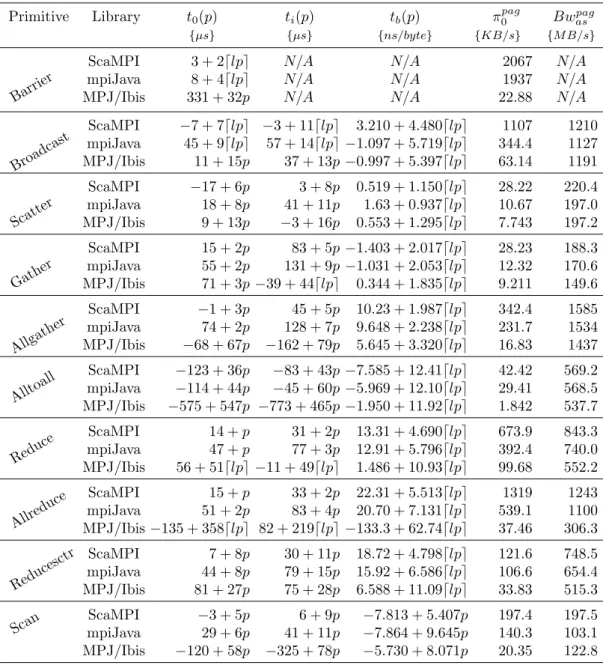
2.1. Myrinet: analytical models and peak aggregated metrics (lp = log2p) 31 2.2. SCI-single: analytical models and peak aggregated metrics (lp= log2p) 32 2.3. SCI-dual: analytical models and peak aggregated metrics (lp= log2p) 33
2.4. SCI-dual SMT: analytical models and peak aggregated metrics (lp =
log2p) . . . 34 2.5. Parameter values for latency (T) reduction through primitive
substi-tution . . . 42 2.6. RatioTSCI−single(p)/TSCI−dual(p) . . . 47
2.7. RatioTSCI−single(nd)/TSCI−dual(2×nd) . . . 47
2.8. RatioTSCI−dual(2×nd)/TSCI−dual SM T(4×nd) . . . 47
3.1. CPU load percentage of sockets processing using Gigabit Ethernet Jumbo Frames . . . 69 3.2. JFS performance improvement compared to Sun JVM sockets . . . . 76
xxxvi LIST OF TABLES
5.1. Collective algorithms used in representative MPJ libraries (1selected
algorithm for short messages; 2selected algorithm for long messages;
3selectable algorithm for long messages andnpes power of two) . . . . 122
List of Figures
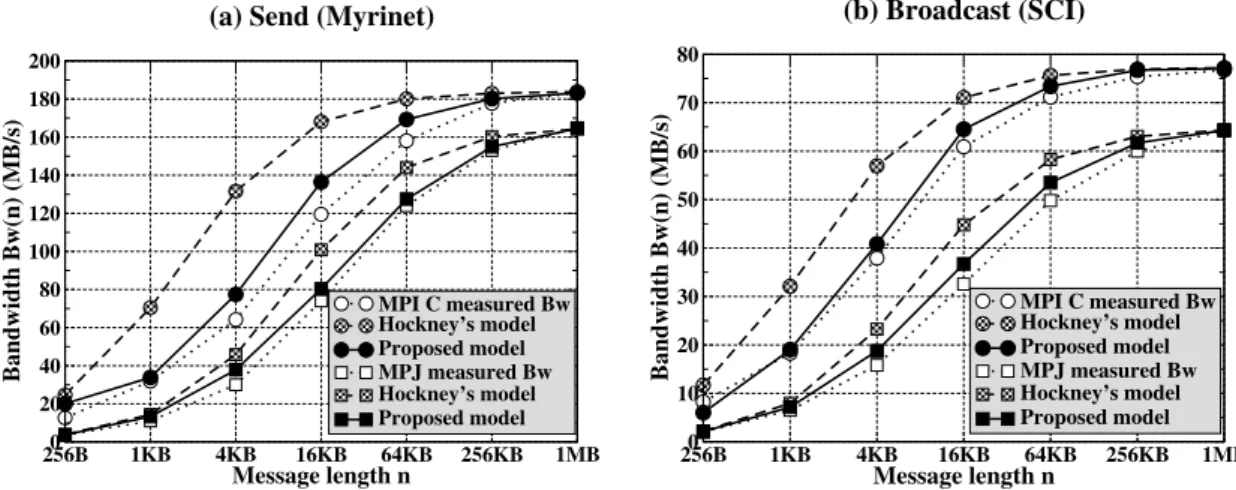
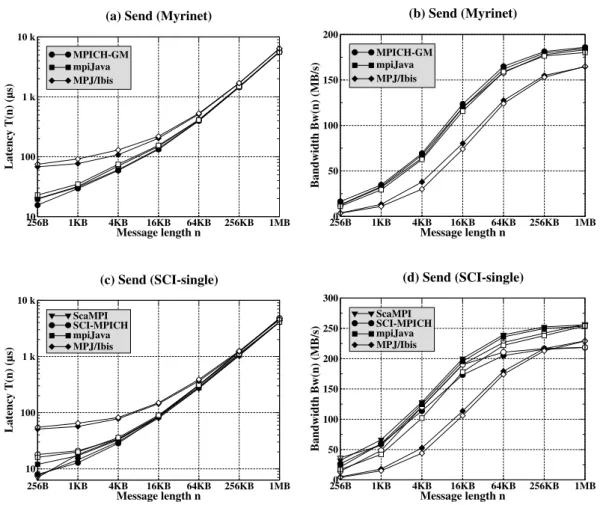
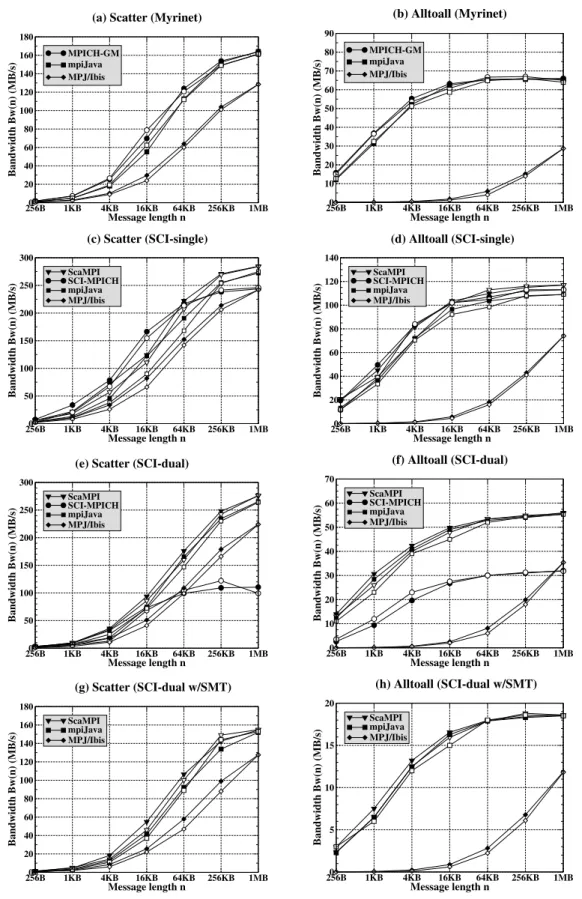
2.1. Comparison of Hockney’s model vs. proposed model . . . 27 2.2. Measured and estimated latencies and bandwidths of Send . . . 36
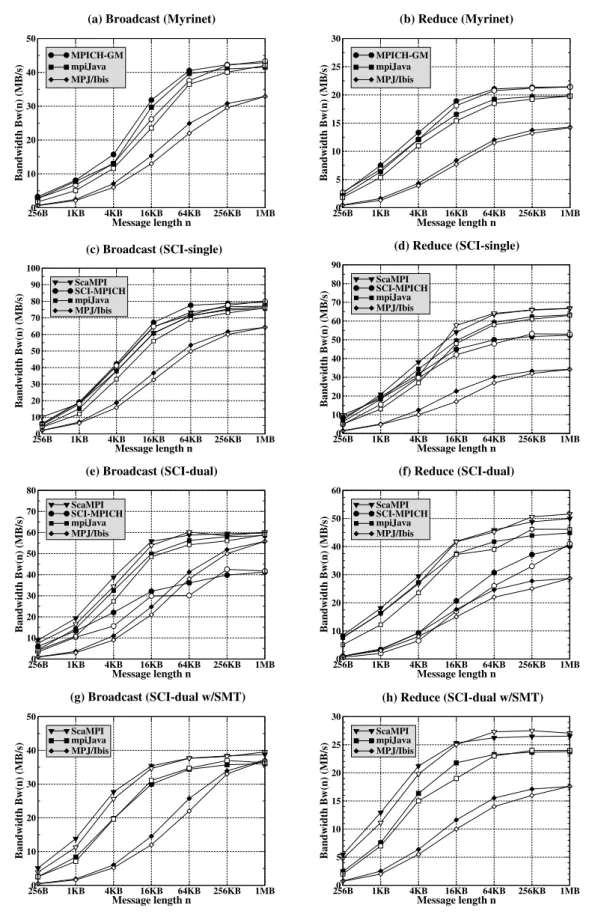
2.3. Measured and estimated bandwidths for Broadcast and Reduce . . . 38
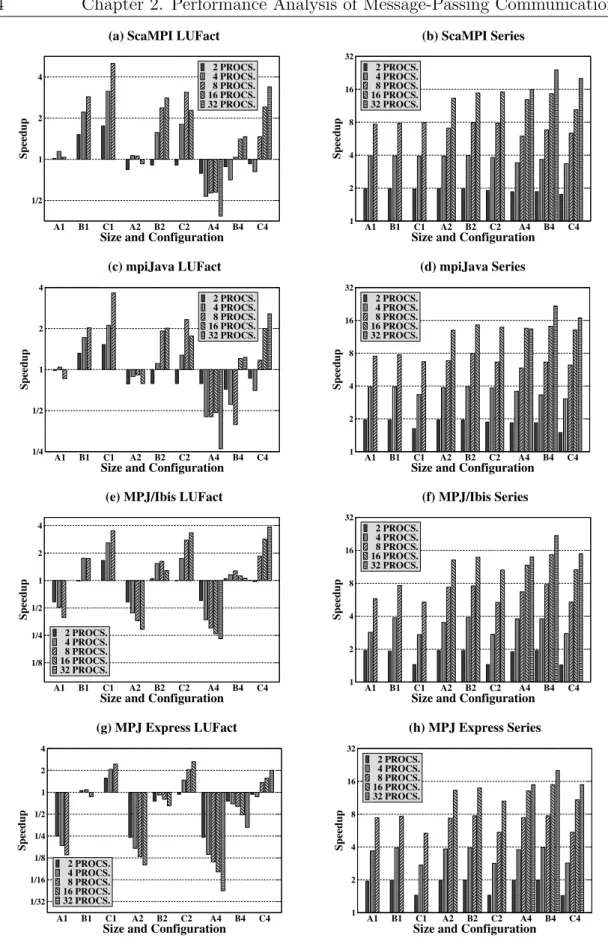
2.4. Measured and estimated bandwidths for Scatter and Alltoall . . . 39 2.5. Speedups of selected Java Grande kernels . . . 44
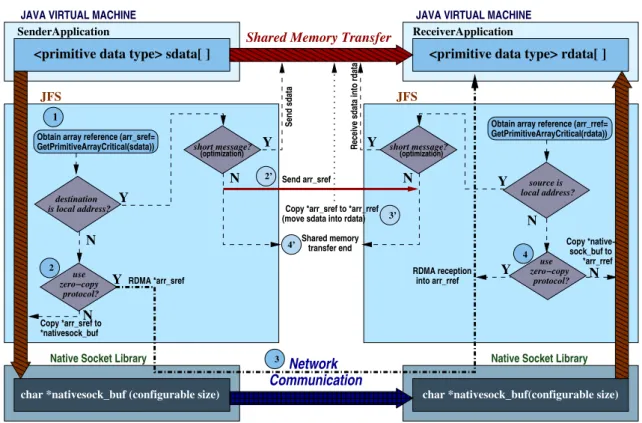
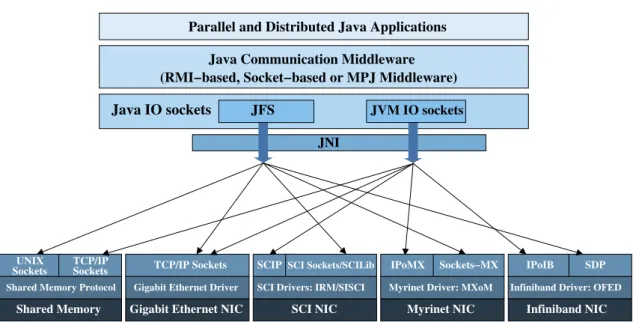
3.1. Sun JVM socket operation . . . 54 3.2. JFS optimized protocol . . . 55 3.3. Java communication middleware on high-speed multi-core clusters . . 57 3.4. JFS core class diagram . . . 58
3.5. Java array communication latency on SCI . . . 62
3.6. Java array communication bandwidth on SCI . . . 62
3.7. Java array communication latency on Myrinet . . . 64 3.8. Java array communication bandwidth on Myrinet . . . 64 3.9. Java array communication latency on InfiniBand . . . 65 3.10. Java array communication bandwidth on InfiniBand . . . 65 3.11. Java array communication latency on Gigabit Ethernet . . . 67 3.12. Java array communication bandwidth on Gigabit Ethernet . . . 67
xxxviii LIST OF FIGURES
3.13. Java array communication latency on shared memory . . . 70 3.14. Java array communication bandwidth on shared memory . . . 70 3.15. MPJ LUFact kernel performance on Gigabit Ethernet and SCI . . . . 73 3.16. MPJ MolDyn application performance on Gigabit Ethernet and SCI . 75
4.1. xxdev low-level communications stack on high-speed multi-core clusters 80 4.2. Request.iwait method pseudocode . . . 85 4.3. iodev eager protocol pseudocode . . . 86 4.4. iodev rendezvousprotocol pseudocode . . . 88 4.5. Point-to-point message-passing devices performance on Gigabit
Eth-ernet . . . 94 4.6. Point-to-point message-passing devices performance on SCI . . . 96 4.7. Point-to-point message-passing devices performance on Myrinet . . . 97 4.8. Point-to-point message-passing devices performance on InfiniBand . . 99 4.9. Point-to-point message-passing devices performance on Shared Memory100 4.10. Java RMI layered architecture . . . 102 4.11. RMI send overhead of a 3 KB Object on SCI . . . 102
4.12. Java RMI communication stack on high-speed multi-core clusters . . 104
4.13. Ping and ping-pong RMI benchmark sequence diagram . . . 107 4.14. Performance results of RMI overhead of sending a 3 KB Object on SCI108 4.15. RMI integer array communication performance on Gigabit Ethernet . 110 4.16. RMI integer array communication performance on SCI . . . 111 4.17. RMI object communication performance on Gigabit Ethernet and SCI 112 4.18. Performance of ProActive NPB MG and CG (Class C workload) . . . 113
LIST OF FIGURES xxxix
5.1. Overview of F-MPJ communication layers on HPC hardware . . . 117 5.2. FT Broadcast pseudocode . . . 119 5.3. MSTBcast pseudocode . . . 119 5.4. Minimum-spanning tree algorithm for Broadcast . . . 119 5.5. BKTAllgather and BDEAllgather pseudocode . . . 120 5.6. Bucket algorithm for Allgather (BKTAllgather) . . . 121 5.7. Bidirectional exchange algorithm for Allgather (BDEAllgather). In
the 2nd step, bidirectional exchanges occur between the two pairs of
processes p0 and p2, and p1 and p3 . . . 121
5.8. MPJ point-to-point primitives performance . . . 125
5.9. MPJ collective primitives performance . . . 127 5.10. Speedups of Crypt and LUFact JGF kernels . . . 130 5.11. Speedups of JGF MolDyn application . . . 131
6.1. NPB relative performance on the x86-64 cluster . . . 143 6.2. NPB relative performance on the Finis Terrae . . . 144 6.3. NPB Class A results on Gigabit Ethernet . . . 147 6.4. NPB Class B results on Gigabit Ethernet . . . 148 6.5. NPB Class A results on InfiniBand (x86-64 cluster) . . . 152 6.6. NPB Class B results on InfiniBand (x86-64 cluster) . . . 153 6.7. NPB Class A results on the Finis Terrae . . . 156 6.8. NPB Class B results on the Finis Terrae . . . 158 6.9. NPB Class C results on the Finis Terrae . . . 159
Preface
Java has become a leading programming language soon after its release, espe-cially in web-based and distributed computing environments, and it is an emerging option for High Performance Computing (HPC) [3, 57, 82]. The increasing inter-est in Java for parallel computing is based on its appealing characteristics: built-in networking and multithreading support, object orientation, platform independence, portability, security, it has an extensive API and a wide community of developers, and finally, it is the main training language for computer science students. Moreover, performance is no longer an obstacle. The gap between Java and native languages performance has been narrowing over the last few years, thanks to the Just-in-Time (JIT) compiler of the Java Virtual Machine (JVM) that obtains native performance from Java bytecode. Nevertheless, although the performance gap is usually small for sequential applications, it can be particularly large for parallel applications when depending on communications performance. The main reason is the lack of efficient Java communication middleware, which has hindered Java adoption for HPC.
Regarding HPC platforms, new deployments are increasing significantly the num-ber of cores installed in order to meet the ever growing computational power
de-mand. This current trend to multi-core clusters underscores the importance of
parallelism and multithreading capabilities [30]. Therefore, this scenario requires scalable parallel solutions, where communication efficiency is fundamental. This efficiency not only depends heavily on the use of high-speed networks, such as In-finiBand [45], Myrinet [14] or SCI [41], but more and more on the communication middleware [104]. Furthermore, hybrid systems (shared/distributed memory archi-tectures) increase the complexity of communication protocols as they have to com-bine inter-node and intra-node communications, which may imply efficient communi-cation overlapping. Hence, Java represents an attractive choice for the development
2 Preface
of communication middleware for these systems as it is a multithreaded language, supports the heterogeneity of the systems and can rely on efficient communication middleware that provides support on high performance communication hardware. Thus, Java can take full advantage of hybrid architectures using shared memory for intra-node communication and relying on efficient inter-node communication.
Work Methodology
The present PhD Thesis, “Design of Efficient Java Communications for High
Performance Computing”, deals with the initial hypothesis that it is possible to develop Java applications for High Performance Computing (HPC), where perfor-mance is essential, provided that an efficient communication middleware is made available. Thus, the main objective of this work is the design and development of such middleware for HPC.
The methodology used in this Thesis begins with the identification of the main causes of inefficiency in this field, through an extensive evaluation of Java perfor-mance in HPC. At this point, it is expected that new benchmarks and models have to be developed as the evaluation of emerging solutions usually lacks such facilities. Next, the work follows a bottom-up approach. Thus, it is first targeted at the design and development of more efficient Java middleware, based on Java sockets, as well as providing non-blocking support on Java IO sockets. Among the criteria for selecting the API or protocol to be implemented are the lack of efficient implementations, a wide range of applicability of the optimized middleware, and its user and appli-cation transparency. The selection of Java IO sockets meets these criteria, as well as the Java Remote Method Invocation (RMI) protocol and the implementation of a more efficient Message-Passing in Java (MPJ) library. Thus, an optimized Java RMI protocol for high-speed networks clusters and a more scalable MPJ library are implemented on top of the previously developed middleware.
Finally, all these efforts have served to the main goal of improving Java communi-cations performance. In fact, the performance analysis of Java parallel benchmarks has shown that this goal has been accomplished. Additionally, not only Java com-munications benefit from this Thesis, but also the Java code of HPC applications is
Preface 3
potentially improvable using the best programming practices for performance gath-ered during the development of these communication libraries.
Contributions
The main contributions of this Thesis are:
1 An up-to-date performance evaluation of Java for HPC. An up-to-date review of Java for HPC, which includes an extensive evaluation of the performance of current projects [61, 94], has been provided. It has been put a special em-phasis on the analysis of the impact on performance of the use of clusters with multi-processor and multi-core nodes interconnected via high-speed networks (InfiniBand, Myrinet and SCI).
2 A more accurate communication performance model. A more precise model for the characterization of the performance of Java communications [94], together with a message-passing micro-benchmark suite to derive the models [87] have been proposed. The performance parameters for the model and some through-put metrics obtained on several high-speed clusters are presented in [94], show-ing better estimates than previous modelshow-ing techniques [88].
3 Design and development of the high performance Java Fast Sockets (JFS). A high performance Java IO socket library, named Java Fast Sockets (JFS), whose interoperability and transparency allow for immediate performance in-creases in high-speed networks and shared memory environments [89, 90, 92] has been designed and implemented. Thus, JFS:
Enables efficient communication on clusters interconnected via high-speed networks (InfiniBand, Myrinet and SCI) through a general and easily portable solution.
Avoids the need of primitive data type array serialization.
Reduces buffering and unnecessary copies in the socket communication protocol.
4 Preface
Provides an efficient protocol for shared memory (intra-node) communi-cation which shows a high impact on multi-core systems performance. JFS optimizes both user applications and communication middleware, such as RMI [86] and Java message-passing protocols [93].
4 Design and development of the iodev low-level non-blocking communication li-brary. A low-level communication device which provides efficient non-blocking communication on Java IO sockets, allowing communication overlapping [93, 96] has been implemented. This library runs on top of a Java IO sockets implementation, and therefore can take advantage of JFS, if available. This library is oriented to performance-critical communication middleware.
5 Design and development of an efficient Java RMI communication library. A lightweight Java RMI protocol, whose main optimization is the reduction of its processing overhead and its support on high-speed networks has also been implemented.
6 Design and development of an efficient Java message-passing library, Fast MPJ (F-MPJ). F-MPJ [93], a scalable and efficient Java message-passing li-brary on top of iodev has been implemented. F-MPJ especially benefits from the use of JFS as underlying layer of iodev, as this allows the avoidance of the serialization overhead of primitive data type arrays, data structures commonly used in HPC applications.
7 Implementation of an efficient Java message-passing collective library. F-MPJ implements several algorithms per collective primitive which allows, thanks to their selection at runtime, to significantly improve the performance of collective message-passing primitives. Thus, according to our experimental results, Java message-passing codes that without F-MPJ achieve their highest performance running on 8-16 cores, can take advantage of the use of up to 128 cores showing good scalability with F-MPJ.
8 New benchmarks in Java for HPC. Besides the message-passing micro-bench-mark suite, a Java version of the NetPipe performance tool [102], and the MPI counterparts of Message-Passing in Java (MPJ) codes from the Java Grande Benchmark suite [84] have been implemented in order to compare
Preface 5
native and Java performance. Also, the NAS Parallel Benchmarks (NPB) suite for MPJ (named NPB-MPJ) [61] has been implemented in order to analyze MPJ libraries performance and to compare Java and native parallel libraries. Additionally, the Java optimization techniques for parallel programming used in the development of these benchmarks has been gathered, especially from the NPB-MPJ.
Overview of the Contents
The Thesis is organized into seven chapters whose contents are summarized in the following paragraphs.
Chapter 1,Java Communications for High Performance Computing, is intended
to give the reader a clear description of the goals and the basic concepts behind the material presented in the Thesis. The chapter begins with a review of the Java communication libraries for High Performance Computing (HPC). These libraries allow the development of Java parallel applications, although their low performance has been the main obstacle to their being embraced in HPC. The related litera-ture provides a detailed discussion on the reasons for the poor performance of the Java parallel applications, pointing out the inefficient communications as the main
cause. Thus, the main motivation of this Thesis is the design of efficient Java
communication libraries that increase the performance of Java parallel applications, contributing to the adoption of Java for HPC. This Thesis is designed to test the hypothesis that Java can be an interesting alternative for HPC, provided that an efficient communication middleware is made available, due to its appealing features of portability, inherent multithreading and networking support, and productive de-velopment.
Chapter 2,Performance Analysis of Message-Passing Communications, discusses
current communication performance models in order to evaluate implementations of communication primitives. Due to the lack of an appropriate model for this evalua-tion purpose, a new model for the characterizaevalua-tion of the communicaevalua-tion overhead, based on the linear model but more precise, is proposed. Thus, Java and native com-munication performance models are derived from the experimental micro-benchmark
6 Preface
results using this more accurate analytical model. The proposed model obtains bet-ter estimates than preceding ones and serves to identify inefficient communication primitives. Furthermore, a model-based performance optimization process is pro-posed, replacing an inefficient primitive by an efficient equivalent combination of primitives. This chapter finishes with an evaluation of Java communication libraries. For this purpose, representative benchmarks have been implemented in Java in order to overcome the lack of standard Java benchmarks for the characterization of the message-passing communication overhead. The impact on performance of the use of systems with multiple hyper-threaded processors has been especially analyzed.
Chapter 3, JFS: High Performance Java Fast Sockets, presents a high
perfor-mance sockets implementation in Java. First, the design objectives of this library, which overcomes many limitations of current sockets libraries for HPC, are pre-sented. Next, the JFS communication protocols are described, together with their implementation issues on high-speed cluster networks and shared memory systems. Experimental results that show the efficiency of JFS protocols are presented towards the end of the chapter. Finally, the impact of the use of JFS on the optimization of Java message-passing protocols is shown.
Chapter 4, Efficient iodev Low-level Message-Passing and RMI Middleware,
pre-sents iodev, a low-level message-passing communication library, and the design of an optimized Java RMI protocol for high-speed networks. Both solutions are im-plemented on top of the middleware developed in the previous chapter. The iodev communication device provides efficient non-blocking communications using Java IO sockets. A related project, MPJ Express, has implemented its low-level communica-tion library, niodev, using Java NIO sockets. However, these latter sockets already provide non-blocking communication methods, whereas iodev has to implement the non-blocking support on top of Java IO sockets. The chapter covers the main imple-mentation similarities and differences between both approaches. Additionally, the efficient coupling of iodev and JFS, and a comparative performance evaluation of low-level communication devices, both Java and native implementations, on several representative HPC scenarios is described. The analysis of the results states that the combination of iodev+JFS improves Java communications, especially when avoiding the serialization overhead. The chapter concludes with the description of the Java RMI protocol optimization, which also shows an important performance increase.
Preface 7
Chapter 5, Fast MPJ: Efficient Java Message-Passing Library, presents Fast
MPJ (F-MPJ), a scalable and efficient Java message-passing library implemented on top of the middleware developed in the previous chapter. The F-MPJ develop-ment has been focused on the impledevelop-mentation of scalable collective primitives, based on the iodev point-to-point communication. The runtime selection of collective al-gorithms allows an important increase in communication performance, as shown in the micro-benchmarking of the collective primitives and in the evaluation of the impact of the use of F-MPJ+iodev+JFS on kernel/application benchmarks.
Chapter 6, Implementation and Evaluation of Efficient MPJ Benchmarks,
pre-sents the design, implementation and performance optimization of a suite of parallel benchmarks (the NAS Parallel Benchmarks), taken as representative codes for the development of Java message-passing applications. The development of this bench-mark suite has been useful for gathering good programming practices for perfor-mance in Java for HPC. The impact of these practices is discussed in this chapter. Moreover, the chapter includes comprehensive benchmark results from the evalua-tion of the developed benchmarks on InfiniBand and Gigabit Ethernet multi-core clusters. Furthermore, an analysis of the impact of using different runtime configu-rations (number of nodes and number of processes per node) is included.
Finally, theConclusionschapter summarizes the main contributions of the Thesis and outlines the main research lines that can be derived from the hypothesis proved, that Java can be a viable alternative for HPC.
Chapter 1
Java Communications for High
Performance Computing
This chapter presents a review of Java communication libraries for High Per-formance Computing (HPC). The evaluated projects can be classified, from lower to higher level, in: Java sockets, Java Remote Method Invocation (RMI) proto-cols, Java message-passing implementations, and finally, other Java communication solutions. These libraries allow the development of higher level libraries and Java parallel applications. However, the analysis of the related literature and, in the most relevant cases, the direct evaluation of the projects have pointed out their usually low performance, which has been the main obstacle for their embrace in HPC. Thus, the main motivation of this Thesis is the design of efficient Java communication li-braries that increase the performance of Java parallel applications, contributing to the adoption of Java for HPC.
The present review discusses each project, trying to identify the main causes of performance bottlenecks, in order to overcome them in the design and implemen-tation of efficient communication middleware. Thus, the combination of efficient communication libraries and the appealing features of Java such as portability, in-herent multithreading and networking support, and a better productivity in code development, turn Java into an interesting alternative for HPC.
Another alternative in Java for HPC is the use of Java threads or thread-based projects, among which the Java OpenMP implementations, such as JOMP [50] and
10 Chapter 1. Java Communications for High Performance Computing
JaMP [55], are the most noticeable. These approaches are not covered in this The-sis as they are limited to shared memory systems, which provide less scalability than distributed memory machines. Moreover, they do not rely on communication middleware.
The structure of this chapter is as follows: Section 1.1 presents Java sockets im-plementations and high performance native sockets libraries. Section 1.2 describes the Java RMI optimization projects. The most relevant Java message-passing li-braries for HPC are shown in Section 1.3. Finally, Section 1.4 covers additional Java communication libraries not included in the previous sections as they imple-ment more specific APIs and middleware.
1.1.
Java Sockets
Sockets are a low-level programming interface for networked communications,
which allows sending streams of data between applications. The socket API is
widely extended and can be considered the standard low-level communication layer as there are socket implementations on almost every network protocol. Thus, sock-ets have been the choice for implementing in Java the lowest level of networked communication.
Java sockets are, like Java, fully portable, but their operation is limited to the widely deployed TCP/IP protocol. However, although most clusters have high-speed networks, such as InfiniBand, Myrinet or SCI, to boost communication performance, Java can not take advantage of them as shown in [88] because it has to resort to inefficient TCP/IP emulations for full networking support. These emulation libraries present high start-up latency (the 0-byte message latency), low bandwidth and high CPU load as shown in [12]. The main reason behind this poor throughput is that the IP protocol was designed to cope with low speed, unreliable and prone to failure links in WAN environments, whereas current cluster networks are high-speed, hardware reliable and non-prone to failure in LAN environments. Examples of IP emulations are IPoMX and IPoGM [70] on top of the Myrinet low-level libraries MX (Myrinet eXpress) and GM, respectively, LANE driver [54] over Giganet, IP over InfiniBand (IPoIB) [44], and ScaIP [15] and SCIP [29] on SCI.
1.1 Java Sockets 11
A direct implementation of native sockets on top of low-level communication libraries can avoid the TCP/IP overhead, and thus performance could be increased. Representative examples are next presented. FastSockets [79] is a socket imple-mentation on top of Active Messages [31], a lightweight protocol with high-speed network access. SOVIA [54] has been implemented on VIA (Virtual Interface Ar-chitecture); and Sockets over Gigabit Ethernet [10] and GAMMAsockets [75] have been developed for Gigabit Ethernet. The Socket Direct Protocol (SDP) over In-finiBand [47] is the representative socket library of the Offload Sockets Framework (OSF). Sockets-MX and Sockets-GM [70] are the developments on Myrinet, where MX is intended to supersede GM thanks to a more efficient protocol implementation. The high performance native sockets library on SCI is SCI Sockets [80]. However, from these implementations only SDP, Sockets-MX/GM and SCI Sockets are cur-rently available. The Windows Sockets Direct components for Windows platforms provide access to certain high-speed networks. A related project is XenSocket [110], an optimized socket library restricted to Xen virtual machine intra-node communi-cation that replaces TCP/IP by shared memory transfers.
However, the previous socket libraries usually implement a subset of socket func-tionality on top of low-level libraries, resorting to the system socket library for unim-plemented functions. Thus, some applications such as kernel-level network services and Java codes can request features not present in the underlying libraries and thus failover to system sockets, which provides poorer performance.
A pioneer project in obtaining efficient Java sockets is NBIO [106], which provides non-blocking communications in order to increase scalability in server applications. This library has led to the introduction of significant non-blocking features in Java NIO (New I/O) sockets. Nevertheless, NBIO does not provide high-speed network support nor HPC tailoring. Ibis sockets partly solve these issues adding Myrinet support and being the base of Ibis [73], a parallel and distributed Java computing framework. However, their implementation on top of the Java Virtual Machine (JVM) sockets limits the performance increase to serialization improvements.
This Thesis presents the design and development of the high performance Java IO sockets implementation named Java Fast Sockets (JFS) (see Chapter 3). This library significantly reduces communication overhead and provides efficient shared memory and high-speed networks support. Thus, JFS is tailored to HPC, especially
12 Chapter 1. Java Communications for High Performance Computing
to multi-core clusters with high-speed networks. Moreover, by optimizing the widely used socket API, parallel and distributed Java applications based on it can improve performance transparently.
1.2.
Java Remote Method Invocation (RMI)
The Java Remote Method Invocation (RMI) protocol allows an object running in one JVM to invoke methods on an object running in another JVM, providing Java with remote communication between programs equivalent to Remote Procedure Calls (RPCs). The main advantage of this approach is its simplicity, although the main drawback is the poor performance shown by the RMI protocol.
ProActive [5, 77] is an RMI-based middleware for parallel, multithreaded and distributed computing focused on Grid applications. ProActive is a fully portable “pure” Java (100% Java) middleware whose programming model is based on a Meta-Object protocol. With a reduced set of simple primitives, this middleware simplifies the programming of Grid computing applications: distributed on Local Area Net-work (LAN), on clusters of Net-workstations, or for the Grid. Moreover, ProActive supports fault-tolerance, load-balancing, mobility, and security. Nevertheless, the use of RMI as its default transport layer adds significant overhead to this middleware operation.
Different frameworks have been implemented with the efficiency of RMI
com-munication on clusters as their goal. The most relevant ones are KaRMI [76],
RMIX [56], Manta [60] and Ibis RMI, part of Ibis [73]. KaRMI is a drop-in re-placement for the Java RMI framework that uses a completely different protocol and introduces new abstractions (such as “export points”) to improve communica-tions specifically for cluster environments. However, KaRMI suffers from perfor-mance losses when dealing with large data sets and its interoperability is limited to the cluster nodes. RMIX extends Java RMI functionality to cover a wide range of communication protocols, but the performance on high-speed clusters is not satis-factory. The Manta project is a different approach for implementing RMI, based on Java to native code compilation. This approach allows for better optimization, avoids data serialization and class information processing at runtime, and uses a
1.3 Java Message-Passing Libraries 13
lightweight communication protocol. Serialization is the process of transforming objects in byte series, in this case to be sent across the network. Finally, Ibis RMI extends Java RMI to make it more suitable for grid computing. Looking for per-formance, Ibis supports the Myrinet high-speed network and avoids the runtime type inspection. However, the use of specific high-level solutions with substantial protocol overhead and focused on Myrinet has restricted the applicability of these projects. In fact, their start-up latency is from several times up to an order of magnitude larger than socket latencies. Therefore, although previous Java com-munication middleware (e.g., message-passing libraries) was usually based on RMI, current Java communication libraries use sockets due to their lower overhead. In this case, the higher programming effort required by the lower-level API allows for higher throughput, key in HPC.
One of the objectives of this Thesis is to provide Java with a high performance RMI implementation with high-speed networks support (see Section 4.4). This can be done by optimizing the Java RMI protocol for cluster communications under some basic assumptions for the target architecture, and using a high performance sockets library that copes with the requirements of an RMI protocol for parallel computing on high-speed clusters. As Java RMI is a widely spread API, many Java parallel applications and communication libraries can benefit from this efficient Java RMI implementation. Moreover, the goal is to optimize this protocol with the minimum associated trade-offs. Thus, the solution is transparent to the user, it does not modify the source code, and it is interoperable with other systems. The trade-off is that this protocol is limited to clusters with a homogeneous configuration in terms of JVM and architecture, although most clusters are under these conditions.
1.3.
Java Message-Passing Libraries
Message-passing is the most widely used parallel programming paradigm as it is highly portable, scalable and usually provides good performance. It is the preferred choice for parallel programming distributed memory systems such as clusters, which can provide higher computational power than shared memory systems. Regarding the languages compiled to native code (e.g., C, Fortran), MPI [64] is the standard interface for message-passing libraries.