Procedia Computer Science 58 ( 2015 ) 289 – 296
1877-0509 © 2015 The Authors. Published by Elsevier B.V. This is an open access article under the CC BY-NC-ND license (http://creativecommons.org/licenses/by-nc-nd/4.0/).
Peer-review under responsibility of organizing committee of the Second International Symposium on Computer Vision and the Internet (VisionNet’15) doi: 10.1016/j.procs.2015.08.023
ScienceDirect
Second International Symposium on Computer Vision and the Internet (VisionNet’15)
Background Modelling from a Moving Camera
Amitha Viswanath
a, b,*, Reena Kumari Behera
b, Vinuchackravarthy Senthamilarasu
b,
Krishnan Kutty
baCentre for Excellence in Computational Engineering and Networking, Amrita Vishwa Vidyapeetham, Coimbatore, Tamil Nadu,641112,India bCentre for Research in Engineering Sciences and Technology, KPIT Technologies Ltd., Hinjewadi, Pune, 411057, India
Abstract
In video analytics based systems, an efficient method for segmenting foreground objects from video frames is the need of the hour. Currently, foreground segmentation is performed by modelling background of the scene with statistical estimates and comparing them with the current scene. Such methods are not applicable for modelling the background of a moving scene, since the background changes between the scenes. The scope of this paper includes solving the problem of background modelling for applications involving moving camera. The proposed method is a non-panoramic background modelling technique that models each pixel with a single Spatio-Temporal Gaussian. Experimentation on various videos promises that the proposed method can detect foreground objects from the frames of moving camera with negligible false alarms.
© 2015 The Authors. Published by Elsevier B.V.
Peer-review under responsibility of organizing committee of the Second International Symposium on Computer Vision and the Internet (VisionNet’15).
Keywords: Video Analytics; Moving Camera; Non- Panoramic Background Modelling; Spatial-Temporal Gaussian Distribution;
1.Introduction
Video analytics is the process of analysing video streams to extract/predict an event of interest mainly in automotive and surveillance applications. Based on the application, either pre-recorded or real time videos need to be processed. The event is predicted based on the spatial and temporal information of the image. Unlike human
* Corresponding author. Tel.: +91-949-536-7261.
E-mail address:[email protected]
© 2015 The Authors. Published by Elsevier B.V. This is an open access article under the CC BY-NC-ND license (http://creativecommons.org/licenses/by-nc-nd/4.0/).
Peer-review under responsibility of organizing committee of the Second International Symposium on Computer Vision and the Internet (VisionNet’15)
operators, the effectiveness of video analytics algorithms is consistent and reliable irrespective of the operational hours. In order to realize a faster and cost effective video analytics system, it is primary to model the scene background using various statistical estimates1. The modelled background is used for detecting the foreground objects in both moving as well as fixed cameras. Object detection is of paramount importance in applications related to surveillance and for the current day Advanced Driver Assistance Systems (ADAS). It is to be noted that modelling the background for a fixed camera system is a straight forward task, since the scene background is fixed. However, the challenges associated with modelling manifolds while handling videos from a moving camera. Since the camera is moving, the background of the scene changes. This overloads the segmentation algorithm to distinguish moving objects from the fixed ones. In-line with the problem of segmenting moving objects from videos extracted from a moving camera, a faster and efficient background modelling technique is proposed in this paper.
Conventionally, the background modelling for static camera uses techniques like Gaussian Mixture Models, Kernel Density Estimation1, 2. In Gaussian Mixture Model, each pixel is modelled by a mixture of Gaussian distributions, in order to incorporate changes due to illumination variation, slow moving objects and repetitive motion in the scene. The statistical estimates of Gaussian mixtures are compared with the current frame and non-adhering pixels are segmented as foreground objects/moving objects. However, the limitation is that it is applicable to stationary cameras only. In case of moving cameras, the background changes across frames and modelling is possible only after the alignment of frames. Prior work on background modelling for moving cameras, especially Pan Tilt Zoom (PTZ), uses panoramic background modelling methods3 - 7. In these methods, the panoramic model is constructed by stitching the input background frames from all possible views into a panoramic image. The foreground objects in the current image are segmented by correlating the current image with the corresponding region in the panoramic model. This is similar to the segmentation steps that are followed for the static camera applications. Various image registration techniques like tonal mosaic alignment8 and Lucas Kanade Tracking (LKT)9 are used for stitching the panoramic model from the input frames. Kang et al.10proposed a method in which the internal parameters of the camera are utilized to build the background mosaic. The need for internal parameters of the camera makes the algorithm unsuitable for pre-recorded video analytics application. It is to be noted that these stitching techniques suffer from image registration errors resulting from depth discontinuities. However, the limitation of image registration due to parallax is solved by using spatial distribution of Gaussian11 and cylindrical mosaic12 at the cost of increased computational complexity and memory. Methods based on optic flow algorithms are also utilized for segmentation of moving objects from the frames of moving camera13, 14. However, these techniques can handle only small camera motions between the frames and they are computationally costlier. Soo et al.15 proposed an algorithm based on non-panoramic background model. This method updates the model by using image warping and pixel matching techniques. Though it solves computation problem, the method suffers from errors arising due to improper image warping. Any error resulting from feature selection and tracking modules significantly distorts warped image and produces discontinuity in the updated background model.
In this paper, an algorithm based on the non-panoramic background model similar to Soo et al.15 is presented with a simpler solution to the discontinuity in the updated model. The features are extracted from the background region of the previous frame for image warping; unlike from background model in Soo et al.15 .The algorithm is simpler and reliable for any video analytic system.
The rest of the paper is organized as follows: section 2 discusses the proposed method. In section 3, the extracted features and tracking is explained. The method utilized for computing homography and image warping is briefed in section 4. In section 5, foreground/background decision technique is described followed by discussion on background updation. Finally, the algorithm is applied on few videos and results are discussed and concluded in section 7 and 8 respectively.
2.Proposed method
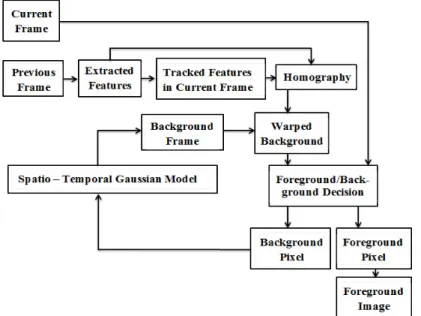
The block diagram of the proposed algorithm is illustrated in Fig. 1. The algorithm assumes the initial frame as the background model (model frame) for spatio-temporal Gaussian model. Unique features are extracted from the current as well as the model frame for estimating the camera motion. In the proposed work, corner features are considered as the unique features and they are estimated using Harris corner detectors16. Extracted corner features are tracked using LKT17. The extracted corners are then used to calculate homography that gives the relation
between the extracted corner features from the initial frame and the tracked corner features from the current frame. The homography estimation is done globally by assuming that the entire scene in the image can be roughly viewed as a single plane, provided its image is taken from a camera at a distance6. The estimated homography matrix is used to warp the background (initial) frame with the current frame. It is obvious that warping overlaps most of the regions in the current frame with the background. In addition, there are few non overlapping new regions which are considered as background. Each pixel is compared between the warped and current frame and is classified based on a predefined threshold. For every iteration, the current frame from the previous iteration is considered as the virtual background and features are extracted, excluding the foreground pixels. This approach reduces the afore mentioned error caused due to incorrect warping and also removes the discontinuity in the warped image. The tracking error is eliminated by putting a thresholdߝ. If the tracking error is greater thanߝ, then the corresponding corners are tagged to be non-background regions and hence excluded from further calculations. The value of ɛ is directly proportional to the frame-to-frame motion of the input video sequence.
Fig. 1. Block diagram of the proposed algorithm.
3.Feature extraction and tracking
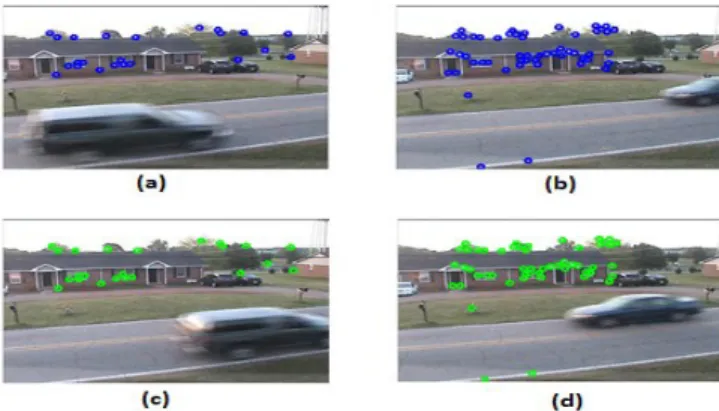
The reliability of foreground segmentation algorithm for moving cameras depends on the extraction of unique feature points in the frames. It is necessary to ensure that the selected feature points are not from the foreground object and are not occluded in the succeeding frame. Corner points are chosen as the unique feature points. In the current work, Harris corner features16 detection algorithm is implemented for extracting features from the previous frame. Harris corner detection algorithm works on the intensity variation around a given pixel to classify the pixels. In case of corner, intensity variations are more prominent in both the Eigen directions. The resultant features extracted (blue dots) from the implementation on few example images are given in the Fig. 2 (a) and 2 (b).
The extracted features from the virtual background image or the previous frame are tracked in the current frame using the LKT17 algorithm. The limitation with the tracking method is that it requires the optimized initial estimate and also assumes smaller displacement between the adjacent frames. The LKT algorithm is implemented and some of the tracked features (green points) in the current frame of the example video are shown in Fig. 2 (c) and 2 (d). In addition, displacement between the current and background frame is calculated and utilized to eliminate few foreground features. Any feature point that has distinct displacement from their tracked features is eliminated. The equation for calculating the displacement is as given in Equation 1.
ܧ ൌ ඥሺݔ௧െ ݔሻଶ ሺݕ௧െ ݕሻଶ (1)
where, ሺݔ௧ǡ ݕ௧ሻare the tracked features and ሺݔǡ ݕሻ are the extracted features. Forܧ ߝ, the corresponding feature
is not tracked properly. For the proposed method, the threshold ߝ is chosen as 5, because the frame to frame motion of the video considered is small, so greater value of ɛ will result in ambiguity in tracking the pixels.
Fig. 2. (a) and (b) illustrates detected feature points in previous frame; (c) and (d) shows tracked feature points in the current frame.
4. Homography and warping
Homography between the features from background and current frame implicitly implies camera motion. The relation between the ݅௧ extracted feature,ܺ
and ݅௧ corresponding tracked feature,ܺᇱ is given by:
ሾܺଵᇱܺଶᇱǥ ሿ ൌ ܪሾܺଵܺଶǥ ሿ (2)
Here, H is the homography matrix. With the extracted features,ܺ and their corresponding features,ܺᇱ, H can be
calculated using the Direct Linear Transform (DLT) algorithm18 . In the DLT algorithm, the homography matrixܪ is estimated in the least square sense and the resultant transformation matrix is utilized to warp the background frame over the current frame. The warping results in two regions: overlapped region and newly covered region are illustrated in Fig. 3. The newly covered regions are the regions that are available in the current frame but not in the previous and they are directly labelled as the background. However, the moving objects are detected from the overlapped region between the frames and labelled as the foreground.
5.Foreground/background decision
After obtaining the overlapped region, the next step is to detect the moving objects or the foreground pixels from the overlapped region. By estimating the homography and warping the background frame, the displacements of background pixels due to camera motion are eliminated and the only displacement that a pixel possesses is its corresponding object motion in the real world. Hence, the spatial information around the pixel of warped frames is utilized for deciding foreground/background. For a pixel in the current frameǡ ܺǡ the corresponding pixel,ܺ, in
background frame is calculated as: 1
.
b c
X H X (3)
whereܪ is the estimated homography matrix (see section 3). The label forܺis determined by comparing the
intensity value ofܺwith ݅௧neighbours ofܺ, ܰሺܺሻ:
, 1 ( ) c i T X X T c i c i i i D I X X I X X X X P P ¦ ¦ (4) , ˆ arg min c i i b X X X X D ,XiN Xb , (5)
σሺǤ ሻand ߤሺǤ ሻ represent the covariance matrix and mean value of the background model with in N(Xb) and ܫሺǤ ሻ is the intensity value of Xc in the current frame. The pixel ( ˆXb) in the neighborhood N(Xb) that matches well with the current frame is chosen as the actual correspondence of Xc and the respectiveܦǡ threshold for deciding
foreground pixel. If ܦǡ is greater than the specified threshold (ܶ), then the corresponding current pixel is
labelled as foreground. For the current study, the threshold ܶ is chosen as 2.5.
ˆ , if D , otherwise c b c X X c Background T L X Foreground ° ® °¯ (6) 6.Background updation
The background model is updated similar to the method followed in Soo et al.15. For the first time, the initial frame is considered as the mean of the Single Gaussian background model and 11 as the standard deviation. It is to be noted that, after every iteration, the mean and standard deviation of the background needs to be updated using spatial and temporal information as given in Equation 7 and 8.
1 ˆ 1 . ˆ . t Xb t Xb I Xc P D P D (7) 1 1 ˆ 1 . ˆ T ˆ . ˆ T ˆ t Xb D t Xb t Xb D I Xc P Xb I Xc P Xb ¦ ¦ ¦ (8) 1 . 0.1 ˆ b Age X D ¨§¨ ·¸¸ ¨ ¸ © ¹ (9)parameter varies based on the age of the current pixel and that defines the period of a particular pixel being background. Initially, the age value of all the pixels is set to 1 and after every cycle, the age value of the overlapped region is increased by 1. When age = 1, more weightage is given to the current pixel value as the value of age
increases, more weightage will be given to the background model. If a pixel is detected as background then the mean value (μt) of that particular pixel is updated by using the previous mean value (μt-1) and the current intensity value (I). For updating the standard deviation, ˆXb is used instead ofXb based on the best match criteria briefed in previous section.
7.Experimentation and results
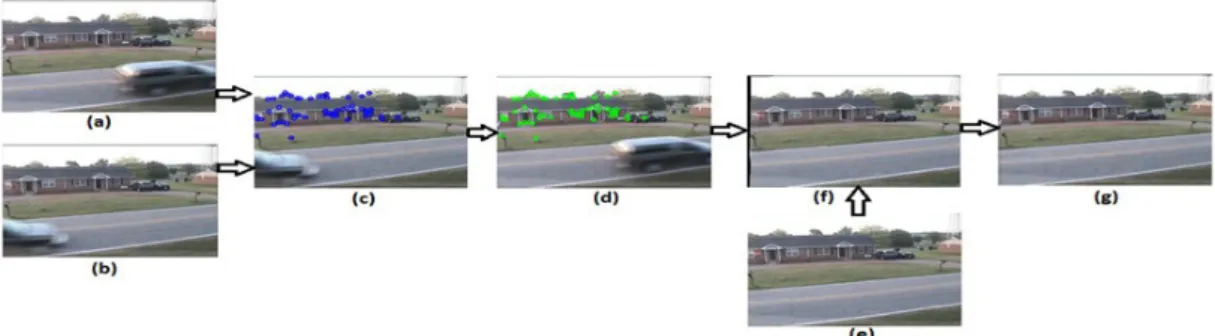
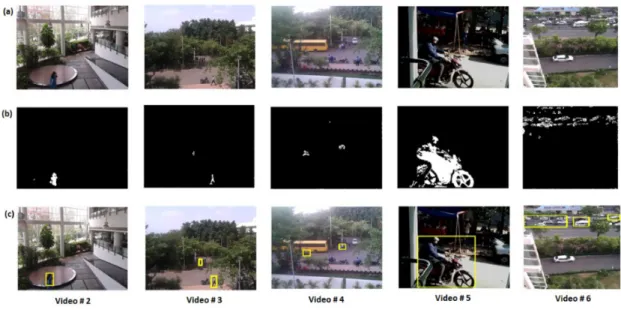
The proposed algorithm is implemented using openCV 2.0 in Microsoft Visual C++ 2008 Express Edition. The written C code is processed using Intel® Core i3 3.2 GHz PC and it is tested over six pan camera video sequences. The results of different stages of the algorithm on a test video (video #1) are given for reference in Fig. 4. The features extracted from previous frame are shown in Fig. 4 (c) and the features on foreground pixels are neglected based on described criteria. The extracted features are tracked in the current frame (see Fig. 4 (d)) and more features are eliminated by thresholding the tracking error using the factor ߝ (ߝ ൌ ͷ). The final extracted and the tracked features are used for estimating the homography matrix using the global DLT method. The background model is then warped to the current frame using the computed homography and the resultant image is illustrated in Fig. 4 (f). The warping gives the overlapped region between the background frame and the current frame and new regions in the current frame are directly appended to the background frame. The background pixels in the overlapped region are updated using Spatio – Temporal Distributed Gaussian and the updated background model is shown in Fig. 4 (g). The steps are followed on sequential current frames and the result of moving object detected using the implemented algorithm is given in Fig. 5. Fig. 5 clearly highlights the moving objects in various frames captured by a moving camera. Fig. 6. illustrates results of moving object detected in various video sequences considered for experiments.
Fig. 4.Different stages of results, (a) current frame, (b) previous frame, (c) extracted features from the previous frame, (d) tracked features in the current frame, (e) previous background model, (f) background warped to the current frame and (g) modelled background.
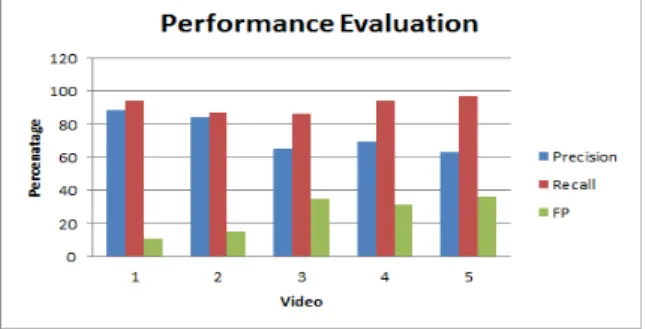
The performance evaluation of five video sequences is illustrated in Fig. 7. For video #1, video #2, and video #5, the performance evaluation is based on 1000 frames. For video #3 and video #4, the performance evaluation is based on 380 and 260 frames respectively. The frame size of all the videos is resized to 240 × 352. In the performance graph, it is observed that video #1 has 88% of precision, 94% of recall and 11% of false positive. For video #2, the precision percentage is 84, the recall percentage is 87 and the false positive percentage is 15. The performance of the proposed methodology decreases for the conditions like more trees in the scene, or when there are no sufficient features in the scene for homography calculation. This is clearly observed in the performance graph of video #3, video #4 and video #5 in Fig. 7. Video #3 has a precision of 65%, recall of 86% and false positive of 35%. This is because in such cases the warping of background model to the current frame will not be accurate, which results in increase of the number of false positives. The proposed algorithm completes one cycle in 0.45 seconds with 240 × 352 resolution for the results illustrated. The advantage of the proposed method is that it is non-panoramic, computationally efficient and does not involve any prior training of background.
ܲݎ݁ܿ݅ݏ݅݊ ൌ ்௨௦௧௩ାி௦௦௧௩்௨௦௧௩ (10)
ܴ݈݈݁ܿܽ ൌ ்௨௦௧௩
்௨௦௧௩ାி௦ே௧௩ (11)
ܨ݈ܽݏ݁ܲݏ݅ݐ݅ݒ݁ܲ݁ݎܿ݁݊ݐܽ݃݁ ൌ ቀி௦௦௧௩ା்௨௦௧௩ி௦௦௧௩ ቁǤ ͳͲͲ (12)
Fig. 5. The results of moving object detection from a pan camera sequence. For each sequence, (a), (b) and (c) current frame, (d), (e) and (f) the modelled background, (g), (h) and (i) the detected foreground.
Fig. 6. Results of moving object detection in the videos considered for experiment, (a) Input frame, (b) detected foreground objects, and (c) detected moving objects in the input frame.
Fig. 7. Illustration of the performance evaluation of five video sequences.
8. Conclusion and future work
Detection of moving objects from a moving camera is quite challenging as the background scene changes with the camera motion. This paper proposes an algorithm for detecting foreground objects from a moving camera sequence. This algorithm uses Spatio-Temporal Distributed Gaussian for modelling the background pixels. Experimental results on various video sequences show that the proposed algorithm can detect moving objects from a moving camera sequence with fewer false alarms. The proposed method faces challenges when sufficient features are not available from the scene. Our future work will focus on solving these challenges and extend the proposed method to forward moving camera.
References
1. Stauffer C., Grimson W.E.L. Adaptive background mixture models for real-time tracking. In: Computer Vision and Pattern Recognition, IEEE
Computer Society Conference on, vol. 2, IEEE, 1999.
2. Elgammal A., Duraiswami R., Harwood D., Davis, L.S. Background and foreground modeling using nonparametric kernel density estimation
for visual surveillance. Proceedings of the IEEE, 90.7, 2002, pp. 1151-1163.
3. Cho S.H., Hang B.K. Panoramic background generation using mean-shift in moving camera environment. In: proceedings of the international
conference on image processing, computer vision, and pattern recognition, 2011.
4. Guillot C., Taron M., Sayd P., Pha Q.C., Tilmant C., Lavest J.M. Background subtraction adapted to pan tilt zoom cameras by key point
density estimation. In: Computer Vision–ACCV Workshops, Springer Berlin Heidelberg, 2010, pp. 33-42.
5. Jin Y., Tao L., Di H., Rao N., Xu G. Background modeling from a free-moving camera by multi-layer homography algorithm. In: Image
Processing, ICIP 2008, 15th IEEE International Conference on, 2008, pp. 1572-1575.
6. Xue K., Liu Y., Ogunmakin G., Chen J., Zhang J. Panoramic Gaussian Mixture Model and large-scale range background substraction method
for PTZ camera-based surveillance systems. In: Machine vision and applications, 24(3), 2013, pp. 477-492.
7. Robinault L., Bres S., Miguet S. Real time foreground object detection using pan tilt zoom camera. In: VISSAPP (1), 2009, pp. 609–614.
8. Azzari P., Bevilacqua A. Joint spatial and tonal mosaic alignment for motion detection with pan tilt zoom camera. In: Proceedings of ICIAR, 2006, pp. 764–775.
9. Lucas B.D., Kanade T. An iterative image registration technique with an application to stereo vision. In: International Joint Conference on, Artificial Intelligence, 1981, pp. 674–679.
10. Kang S., Paik J., Kosehan A., Abidi B., Abidi M.A. Real-time video tracking using pan tilt zoom cameras. In: Proceedings of the SPIE
6thInternational conference on Quality Control by Artificial Vision 5132, 2003, pp. 103–111.
11. Ren Y., Chua C.S, Ho Y.K. Motion detection with non-stationary background. In: Proceedings of 11th International Conference on Image
Analysis and Processing, 2001, pp. 78–83.
12. Bhat K., Saptharishi M., Khosla P. Motion detection and segmentation using image mosaics. In: Multimedia and Expo, IEEE International
Conference on, vol. 3, IEEE, 2000, pp. 1577–1580.
13. Narayana M., Hanson A., Learned M.E. Coherent motion segmentation in moving camera videos using optical flow orientations. In:
Computer Vision (ICCV), 2013 IEEE International Conference on, 2013, pp. 1577-1584.
14. Patel M. P., Parmar S. K. Moving object detection with moving background using optic flow. In: Recent Advances and Innovations in
Engineering (ICRAIE), IEEE, 2014, pp. 1-6.
15. Soo W K., Kimin Y, Kwang M Y., Sun J K., Jin Y C. Detection of moving objects with moving camera using non – panoramic background
model. In: Machine Vision and Applications, 2013, pp. 24-1015
16. Harris C., Stephens M. A combined corner and edge detector. In: Alvey vision conference, vol. 15, 1988, pp. 50.
17. Baker S., Raju P., Man C K, Iain M. Lucas-Kanade 20 years on: Part 5. In: Robotics Institute, Carnegie Mellon University, Tech. Rep.
CMU-RI-TR-04-64 , 2004.
18. Dubrofsky E., Robert J. W. Combining line and point correspondences for homography estimation. In: Advances in Visual Computing,