University of Huddersfield Repository
Pein, Raoul PascalSemi-Supervised Image Classification based on a Multi-Feature Image Query Language
Original Citation
Pein, Raoul Pascal (2010) Semi-Supervised Image Classification based on a Multi-Feature Image Query Language. Doctoral thesis, University of Huddersfield.
This version is available at http://eprints.hud.ac.uk/9244/
The University Repository is a digital collection of the research output of the University, available on Open Access. Copyright and Moral Rights for the items on this site are retained by the individual author and/or other copyright owners. Users may access full items free of charge; copies of full text items generally can be reproduced, displayed or performed and given to third parties in any format or medium for personal research or study, educational or not-for-profit purposes without prior permission or charge, provided:
• The authors, title and full bibliographic details is credited in any copy; • A hyperlink and/or URL is included for the original metadata page; and • The content is not changed in any way.
For more information, including our policy and submission procedure, please contact the Repository Team at: [email protected].
Semi-Supervised Image Classification based on a
Multi-Feature Image Query Language
Raoul Pascal Pein
A thesis submitted to the University of Huddersfield in partial fulfilment of the requirements for
the degree of Doctor of Philosophy
The University of Huddersfield
I would like to thank everybody who gave me support in finishing this thesis. Special thanks go to my supervisors Dr. Joan Lu and Prof. Dr. Wolfgang Renz for their
Contents
List of Tables 10 List of Figures 11 Abstract 13 1. Introduction 14 1.1. Research Hypothesis . . . 16 1.2. Contribution . . . 16 1.3. Roadmap . . . 17 2. Background Research 18 2.1. Related Work . . . 18 2.1.1. Browsing . . . 20 2.1.1.1. Browsing Strategies . . . 212.1.1.2. Visual Arrangement of Search Results . . . 22
2.1.1.3. Thumbnail Format . . . 23
2.1.2. Query Language . . . 25
2.1.2.1. Textual . . . 25
2.1.2.2. Visual . . . 29
2.1.3. Relevance Feedback in Search Results . . . 29
2.1.4. Features and Similarity Measures . . . 30
2.1.5. Annotation . . . 33
2.1.6. Evaluation of Retrieval Systems . . . 34
2.1.6.1. Benchmarks . . . 34
2.1.6.2. Metrics and Analysis . . . 35
2.1.7. Retrieval Frameworks . . . 35
2.1.7.1. Merging/Fusion . . . 36
2.1.8. Categorization . . . 39
2.2. Own Preliminary Work . . . 40
2.2.1. Query Language . . . 40 2.2.2. Grammar . . . 41 2.2.3. Plug-Ins . . . 42 2.3. Identification of Problems . . . 43 2.3.1. Browsing . . . 43 2.3.2. Query Language . . . 44
2.3.3. Relevance Feedback in Search Results . . . 44
2.3.4. Features and Similarity Measures . . . 44
2.3.5. Annotation . . . 45
2.3.6. Evaluation of Retrieval Systems . . . 46
2.3.7. Retrieval Frameworks . . . 46
2.3.8. Categorization . . . 46
2.4. Aims and Objectives . . . 47
3. Methods Employed 50 3.1. Browsing . . . 50
3.2. Query Language . . . 52
3.2.1. Query Language Requirements . . . 52
3.2.2. Query Composing . . . 54
3.2.3. Query Language Principles . . . 55
3.3. Relevance Feedback . . . 56
3.4. Features and Similarity Measures . . . 56
3.4.1. Feature Evaluation . . . 56
3.4.2. Feature Normalization . . . 57
3.4.2.1. Similarity Profiles . . . 57
3.4.2.2. Determining a Normalization Function . . . 58
3.5. Evaluation of Retrieval Systems . . . 59
3.6. Framework . . . 60 3.6.1. Similarity Search . . . 60 3.6.2. Merging/Fusion . . . 61 3.7. Categorization . . . 62 3.7.1. Unsupervised Learning . . . 63 3.7.2. Supervised Learning . . . 63
3.7.3. Semi-Supervised Learning . . . 65
3.7.4. Definitions . . . 65
3.7.5. Example . . . 66
3.7.6. Interpretation as Decision Tree . . . 67
3.7.6.1. Nodes . . . 67 3.7.6.2. Node Splitting . . . 68 3.7.6.3. Root Node . . . 69 3.7.6.4. Null Query . . . 70 3.7.7. Learning Algorithm . . . 70 3.7.8. Complexity . . . 72 3.7.9. Query Descriptors . . . 73 3.7.9.1. Pre-Classification Fusion . . . 73 3.7.9.2. Post-Classification Fusion . . . 75 4. Design 76 4.1. Retrieval Framework Design . . . 76
4.1.1. Main Components . . . 77
4.1.2. Speed & Quality . . . 78
4.2. Query Language . . . 79
4.2.1. Wildcards and Ranges . . . 79
4.2.2. Parse Trees . . . 79
4.2.3. Browsing . . . 82
4.3. Learning Algorithm . . . 84
4.3.1. Multi Threaded Processing . . . 84
5. Implementation 86 5.1. Query Language . . . 87 5.1.1. XML . . . 87 5.1.2. Visual Query . . . 90 5.2. Algorithms . . . 92 5.2.1. Normalization Algorithm . . . 92 5.2.2. Learning Algorithm . . . 94
6. Case Studies 100
6.1. Impact of Query Image Size on Features and Similarity Measures . . . . 101
6.1.1. Requirements . . . 101 6.1.2. Testing . . . 101 6.1.3. Results . . . 102 6.1.4. Discussion . . . 102 6.1.5. Summary . . . 104 6.2. Feature Normalization . . . 104 6.2.1. Requirements . . . 104 6.2.2. Testing . . . 104 6.2.3. Results . . . 105 6.2.3.1. Original Profiles . . . 105 6.2.3.2. Normalized by ETH-80 . . . 107 6.2.3.3. Normalized by Caltech 101 . . . 108 6.2.4. Analysis . . . 110 6.2.4.1. Original Profiles . . . 111 6.2.4.2. Normalized by ETH-80 . . . 111 6.2.4.3. Normalized by Caltech 101 . . . 113 6.2.4.4. Summary . . . 113 6.2.5. Discussion . . . 115 6.2.6. Summary . . . 116
6.3. Estimating the Improvement Capabilities of Different Features . . . 116
6.3.1. Requirements . . . 117 6.3.2. Data Preparation . . . 117 6.3.3. Data Collection . . . 117 6.3.4. Data Normalization . . . 118 6.3.5. Results . . . 118 6.3.6. Analysis . . . 120 6.3.7. Limitations . . . 122 6.3.8. Discussion . . . 123 6.3.9. Summary . . . 123 6.4. Supervised Learning . . . 124 6.4.1. Requirements . . . 124
6.4.2. Preparation & Implementation . . . 124
6.4.4. Results . . . 126
6.4.4.1. Effect of Single Clauses . . . 126
6.4.4.2. Effect of Additional Clauses and Tolerance . . . 126
6.4.4.3. Effect of Boost Parameter . . . 132
6.4.4.4. Constructed Category Queries . . . 136
6.4.5. Analysis . . . 137 6.4.6. Discussion . . . 139 6.4.7. Summary . . . 139 6.5. Query Descriptors . . . 139 6.5.1. Requirements . . . 140 6.5.2. Testing . . . 140 6.5.3. Results . . . 140 6.5.4. Analysis . . . 142 6.5.5. Discussion . . . 144 6.5.6. Summary . . . 145 6.6. Semi-Supervised Learning . . . 145 6.6.1. Requirements . . . 146 6.6.2. Testing . . . 146 6.6.3. Results . . . 147
6.6.3.1. Impact of removed MUST NOT . . . 147
6.6.3.2. Reference System . . . 149 6.6.4. Analysis . . . 149 6.6.5. Discussion . . . 153 6.6.6. Summary . . . 154 6.7. Discussion . . . 154 7. Conclusion 156 7.1. Achieved . . . 156 7.2. Future Work . . . 157 Bibliography 158 A. Definitions 177 B. Descriptors 179 Glossary 181
Acronyms 183
List of Tables
2.1. Thumbnail Layouts . . . 22
2.2. Thumbnail Image Formats - Display . . . 24
2.3. Thumbnail Image Formats - Storage . . . 25
2.4. Language Approaches . . . 26
2.5. Language Features Compared . . . 28
2.6. Similarity Measures . . . 32
3.1. Query Composing . . . 54
6.1. Cumulated Average Error . . . 114
6.2. Summarized Improvement . . . 120
6.3. Query Composition . . . 138
6.4. Query Quality Parameters . . . 138
6.5. Raw Categorization Summary . . . 143
6.6. Categorization Summary . . . 144
6.7. Additional False Categorizations . . . 149
6.8. Recognition Results for the categorization of unknown objects [68] . . . . 149
6.9. Raw Categorization Summary . . . 150
6.10. Categorization Summary (Leave-One-Object-Out) . . . 151
List of Figures
2.1. Research Field Dependencies . . . 19
2.2. Searching Process [44] . . . 20
2.3. Search Strategies [63] . . . 21
2.4. Query shape . . . 36
3.1. Ranking in a Typical CBIR-System [133] . . . 51
3.2. Retrieval-Workflow [94] . . . 51
3.3. User Experience Levels . . . 53
3.4. Optimal Similarity Profile . . . 58
3.5. Feature Space Separation . . . 66
3.6. Decision Tree . . . 70
4.1. Layers in the Retrieval Process [96] . . . 76
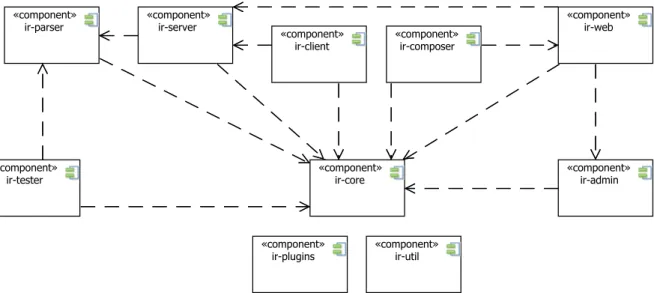
4.2. Main Components . . . 77
4.3. Parse Tree of a complex Query . . . 80
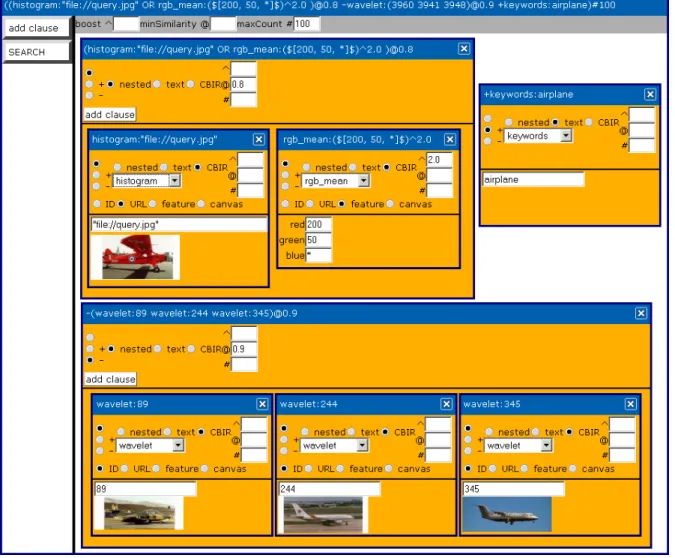
5.1. Visual Query Composer . . . 91
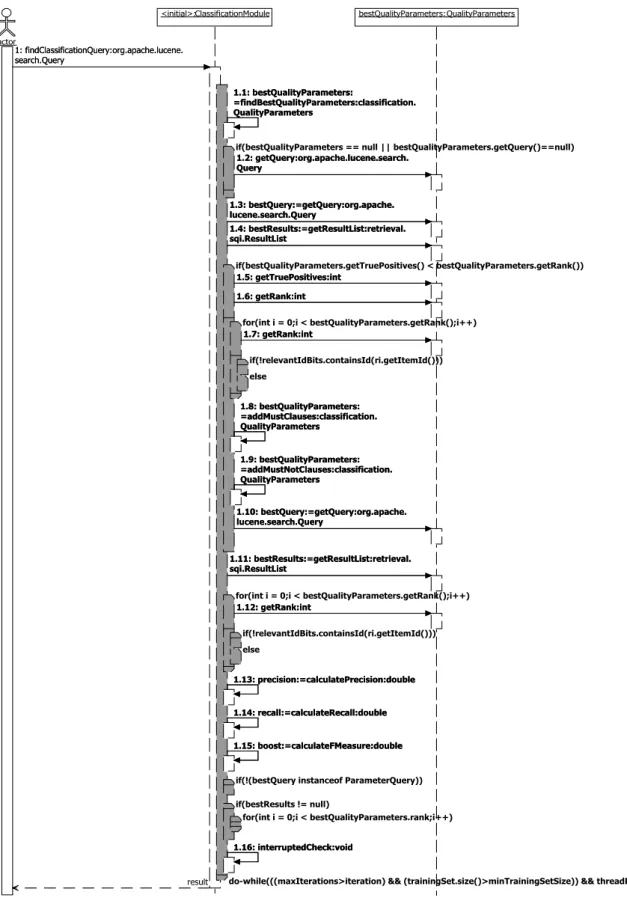
5.2. findClassificationQuery - Sequence Diagram . . . 95
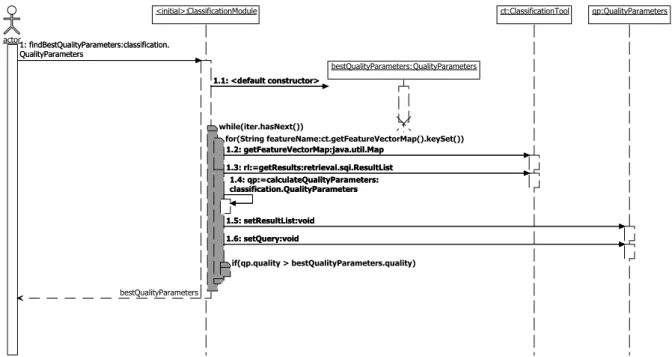
5.3. findBestQualityParameters - Sequence Diagram . . . 96
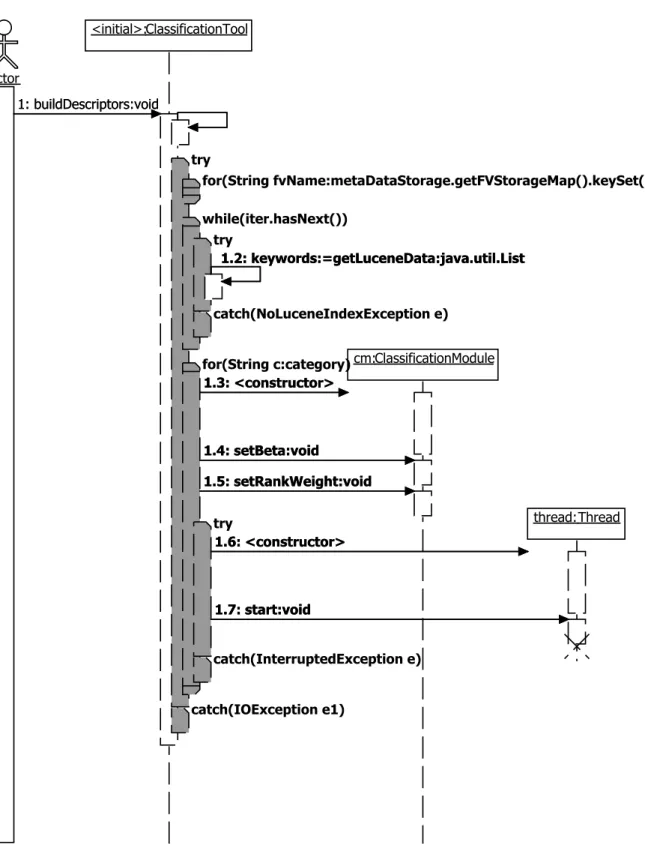
5.4. buildDescriptors - Sequence Diagram . . . 99
6.1. Impact of query image sizes . . . 103
6.2. Similarities Cumulated by Rank (ETH-80) . . . 105
6.3. Similarities Cumulated by Rank (Caltech-101) . . . 106
6.4. Similarities Cumulated by Rank (ETH-80, normalized by ETH-80) . . . . 107
6.5. Similarities Cumulated by Rank (Caltech-101, normalized by ETH-80) . 108 6.6. Similarities Cumulated by Rank (ETH-80, normalized by Caltech-101) . 109 6.7. Similarities Cumulated by Rank (Caltech-101, normalized by Caltech-101) 109 6.8. Error of Original Similarity Profiles for ETH-80 Images . . . 110
6.9. Error of Original Similarity Profiles for Caltech-101 Images . . . 111
6.10. Error of Normalized (ETH-80) Similarity Profiles for ETH-80 Images . . 112
6.11. Error of Normalized (ETH-80) Similarity Profiles for Caltech-101 Images 112 6.12. Error of Normalized (Caltech-101) Similarity Profiles for ETH-80 Images 113 6.13. Error of Normalized (Caltech-101) Similarity Profiles for Caltech-101 Images114 6.14. Cumulated Average Error . . . 115
6.15. Improvement Factor . . . 119
6.16. Caltech 101 - category subset: BACKGROUND Google . . . 120
6.17. Caltech 101 - category subset: car side . . . 121
6.18. Caltech 101 - category subset: inline skate . . . 121
6.19. Caltech 101 - category subset: stop sign . . . 122
6.20. Caltech 101 - category subset: airplanes . . . 122
6.21. Precision/Recall of ETH-80 categories, single feature . . . 127
6.22. Precision, Recall and Quality (F-Measure) for “cow” related queries . . . 128
6.23. Highest Ranked False Positives for “cow”, 20 SHOULD (first 100 hits) . 129 6.24. Highest Ranked False Positives for “cow”, MUST NOT (first 100 hits) . . 130
6.25. Precision/Recall of Manually Edited Query for “cow” up to Rank 900 . 131 6.26. Highest Ranked False Positives for “cow”, modified MUST NOT (first 100 hits) . . . 131
6.27. Precision/Recall of ETH-80 “cow”, max 20 SHOULD clauses, variations of “slack” . . . 132
6.28. Equal Application of Slack . . . 133
6.29. Boost Dependent Application of Slack . . . 135
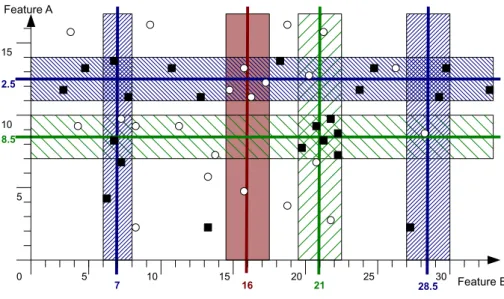
6.30. Decision Tree for concept ”cow” (most relevant clauses) . . . 136
6.31. Category Probabilities for ETH-80 Images . . . 141
6.32. Category Probabilities for ETH-80 Images (all cows) . . . 148
6.33. Wrong Classification by Object . . . 152
Abstract
The area of Content-Based Image Retrieval (CBIR) deals with a wide range of research disciplines. Being closely related to text retrieval and pattern recognition, the probably most serious issue to be solved is the so-called “semantic gap”. Except for very restricted use-cases, machines are not able to recognize the semantic content of digital images as well as humans.
This thesis identifies the requirements for a crucial part of CBIR user interfaces, a multimedia-enabled query language. Such a language must be able to capture the user’s intentions and translate them into a machine-understandable format. An approach to tackle this translation problem is to express high-level semantics by merging low-level image features. Two related methods are improved for either fast (retrieval) or accurate (categorization) merging.
A query language has previously been developed by the author of this thesis. It allows the formation of nested Boolean queries. Each query term may be text- or content-based and the system merges them into a single result set. The language is extensible by arbitrary new feature vector plug-ins and thus use-case independent.
This query language should be capable of mapping semantics to features by applying machine learning techniques; this capability is explored. A supervised learning algo-rithm based on decision trees is used to build category descriptors from a training set. Each resulting “query descriptor” is a feature-based description of a concept which is comprehensible and modifiable. These descriptors could be used as a normal query and return a result set with a high CBIR based precision/recall of the desired category. Ad-ditionally, a method for normalizing the similarity profiles of feature vectors has been developed which is essential to perform categorization tasks.
To prove the capabilities of such queries, the outcome of a semi-supervised training session with “leave-one-object-out” cross validation is compared to a reference system. Recent work indicates that the discriminative power of the query-based descriptors is similar and is likely to be improved further by implementing more recent feature vectors.
Chapter 1.
Introduction
With rapid development of digital technologies, building an efficient and reliable im-age retrieval system is always challenging in computing science and related application disciplines [14, 15, 38, 44, 47, 80, 94, 116, 145]. A typical application area of CBIR is multimedia publishing and design. Often, an image with specific properties is required for a certain layout. Garber and Grunes [44] describe a typical layout task, where somebody needs to pick some images from a huge repository. Similarly, the growing amount of personal digital image collections (like Flickr [145] or Picasa [47]) could ben-efit from a CBIR system. Another suggestion is the use of CBIR techniques to retrieve copyright infringements [116]. Further more, in medical environments, the use of 3D body scanners with high resolution results in an immense amount of visual data [80]. Space agencies and Geographic Information System (GIS) companies taking pictures with high-resolution cameras on satellites also produce large amounts of pixel images, depicting planet surfaces, surface features and other content [14, 38]. Even more general cases in Multimedia Information Retrieval (MIR) have been studied, such as the pow-erful supporting tools in the retrieval of 3D models for engineering companies [94] or similar sound files for musicians [15]. It follows that this key technology, Content-Based Image Retrieval, always plays a significant role in the application search engines, though the development of consistent theory in CBIR is still rudimental.
Many basic issues in CBIR have been collected by Eakins and Graham [34] in 1999. The most severe problems of image retrieval identified in their report remain unsolved. The key is “bridging the semantic gap” between low-level image content (pixels, as seen by machines) and its high-level meaning (semantics, as seen by humans) [149]. Though many new technologies and methods have been continually improving the quality of Multimedia Information Retrieval (MIR) [140] and several real-life applications have been developed in many areas. A summary of recent challenges in MIR is provided by
Lew et al. [70].
MIR systems mostly apply the feature vector paradigm because the documents to be retrieved are typically very large. Further, the information contained in each document exhibits a considerable amount of redundancy and fuzziness. For example, several default colour space models in computing are mapped to 24 bits which corresponds to 224 =
16777216 different colours for each pixel. Modern hardware is capable of generating images with a resolution expressed in megapixels. Therefore, a single image can easily contain millions of pixels, encoding some real or synthetically generated information. Matching any set of two high-resolution images directly would consume a very high amount computing resources, rendering a naive matching based retrieval for thousands or even millions of images useless with the currently available technology. To greatly reduce the retrieval complexity, MIR systems perform the most time consuming part of data analysis only once and generate a so-called “feature vector” for each document during the indexing phase. These feature vectors are designed to contain a highly condensed piece of information representing the original data, without losing too much of the relevant characteristics. A direct comparison between two feature vectors is expected to be similar as a comparison of the respective original documents. The feature vector approach is basically a lossy transformation from an extremely high dimensional representation to a representation with a dimensionality that can be handled within seconds.
Gupta and Jain [50] coined the term Visual Information Retrieval (VIR) which covers the visual subset of MIR. They propose a retrieval system to find images and videos. VIR is a research domain that links the analysis aspects of computer vision with the querying aspects of database systems. A main difficulty in their work was to map natural language to a machine understandable query language. Natural language may be suitable to describe complex sceneries, but it is inherently ambiguous and the retrieval has to be performed by a machine with no deeper understanding. Also a plain textual query is considered to be not powerful enough to express all required details. In contrast to VIR, the research for other media types such as audio data are less common. One such system specifically developed to retrieve music is “Muugle” [15].
After more than a decade in research on CBIR and MIR in general, the interest in this area is very high and still seems to increase [28]. Observing the currently available software compared to the amount of publications indicates that still no general break-through has been achieved. A study by Datta et al. [28] published in 2005 analyses the amount of related publications in detail. Only about 20% of about 300 briefly surveyed papers in this study described real-life applications, most of them being merely
proto-types. This seems to be an indication that there are many theories available, but none is capable of causing a real breakthrough. Thus, Datta et al. [28] recommend the building of useful systems in parallel, even if they are limited to specific domains.
1.1. Research Hypothesis
This thesis investigates several CBIR techniques and their interrelationship. The main emphasis is put onto the issue of querying. Being able to express the user’s needs in a machine-readable way is assumed to be a crucial element of any retrieval system. Generic object recognition and semantic scene interpretation remains an open problem [70]. Thus, the so-called “semantic gap” cannot be completely bridged yet. This leads to the research question investigated in the following:
Are multi-feature query languages capable of narrowing down the semantic gap in Content-Based Image Retrieval?
Below, a multi-feature query language is evaluated to estimate its capabilities in mping high-level semantics to a set of low-level feature vectors. A machine learning ap-proach is applied to generate a set of the most efficient queries to find specific categories within an image repository. The discriminative power of each query is evaluated.
1.2. Contribution
• Two feature merging approaches for fast retrieval and for image categorization/ tagging (sections 3.6.2 and 3.7.9)
• A way of describing high-level semantics with an arbitrary and extensible set of low-level features in a query language (sections 3.7.9 and 6.5)
• A machine learning approach to find queries describing a category with positive and negative Query-By-Example (QBE), thus potentially reducing the semantic gap (sections 3.7.9 and 6.5)
• The derived queries describing a category are comprehensible to humans and thus can be modified manually (sections 3.7.9 and 6.4)
• Proposed metrics for evaluating the appropriateness of feature vectors and their potential information gain in various applications, e.g. which available feature vector achieves the best ranking quality for a given image category (section 6.3) • Evidence that the expressiveness of the query language developed by the author of
this thesis can compete with traditional machine learning approaches (section 6.6)
1.3. Roadmap
The thesis is arranged in seven chapters. The background research in chapter 2 is split into four smaller sections. Publications in multiple CBIR related research areas are mentioned in section 2.1. Related preliminary work of the author of this thesis is described in section 2.2. Section 2.3 provides an overview of currently unsolved problems to motivate the aims and objectives of this thesis (section 2.4).
Chapter 3 lists the methodologies used in this thesis inferred from the background research. The design and implementation of the prototype developed to support this thesis are explained in chapters 4 and 5.
The core of the thesis is located in chapter 6. This chapter focuses on six different case studies that are used to underpin the methodology from chapter 3. The first case studies examine several basic feature vector properties an their interrelationship (sections 6.1 to 6.3). The latter ones focus on the machine learning aspects and how low-level feature vectors could be applied to describe higher-level semantics (sections 6.4 to 6.6).
The final chapter 7 concludes the thesis and gives a brief overview of the achievements of this thesis and potential future work in this particular area.
Chapter 2.
Background Research
2.1. Related Work
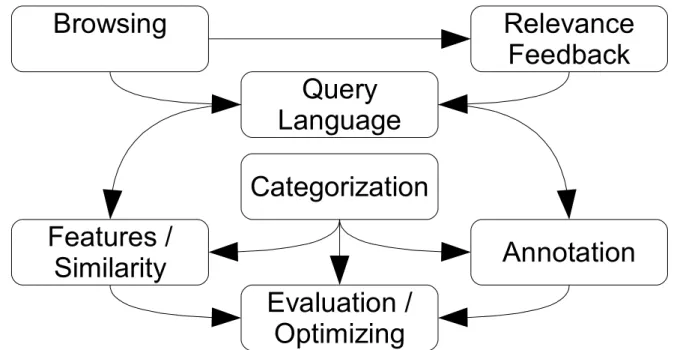
Many of the basic issues in CBIR have been collected by Eakins and Graham [34] in 1999. The most severe problems of image retrieval identified in their report remain unsolved. The key to image retrieval is “bridging the semantic gap” between low-level image content (pixels, as seen by machines) and its high-level meaning (semantics, as seen by humans) [149]. In Figure 2.1, the semantic gap is represented by the two research fields Features/Similarity and Annotation. The first one deals with low-level content whereas the second one deals with its high-level counterpart. A technology to connect these two fields is theCategorization.
New technologies and methods have been continually improving the quality of MIR [140] and several real-life applications have been developed in many areas. Yet, a large amount of recent challenges in MIR are still to be solved. Lew et al. [70]. provide a summary of these challenges.
Currently the research seems to shift from image retrieval towards video retrieval. Nevertheless it should be considered that the diversity in multimedia retrieval is bene-ficial for all sub-disciplines as they overlap in many cases. Also the researchers coming from several different disciplines contribute to the richness of different approaches and solutions [139].
The recent overview provided by Datta et al. [30] concludes with the statement that the research focused more insystems, feature extraction and relevance feedback than in application-oriented aspects such as interface, visualisation, scalability and evaluation. Thus it seems desirable to improve research in these areas.
According to Lew et al. [70] there are several recent research topics trying to bridge the semantic gap. In human-centred computing the system tries to satisfy the user while
Relevance
Feedback
Query
Language
Evaluation /
Optimizing
Features /
Similarity
Browsing
Annotation
Categorization
Figure 2.1.: Research Field Dependencies
keeping the interface easily understandable. Learning algorithms could be beneficial in adding semantic value. Developing new features based on low-level information may still be beneficial, when adapted to the human perception and easy to use. Their conclusion is that none of the major challenges in MIR are actually solved and all areas require significant further research.
This section briefly describes several research areas closely related to CBIR (fig. 2.1). Some of these are user-centred and some deal with the underlying methodology. Con-cerning the user interface, the areas ofBrowsing,Query Languages and Relevance Feed-back play an important role. This supports the user in creating queries and to navigate through a given repository. CreatingFeature VectorsandSimilarity Measures is a matter of improving the system quality on the server side. Similarly, the Annotation is impor-tant to enable keyword based retrieval. They usually need to be tuned by anEvaluation process. The area of Categorization is an approach to link existing low-level features directly to high-level keywords and categories. Finally, there are Retrieval Framework Designs available, which provide researchers with the basic functionality needed to do this kind of research.
Generate criteria and weightings Enter picture and similarity criteria Retrieve set of images
View images and information about the images
Put on or remove from light table, etc.
Re-define search Change criterion Add restriction Pull target image Add criterion
Figure 2.2.: Searching Process [44]
2.1.1. Browsing
In order to build a user interface for a CBIR system, typical related work flows need to be examined. A detailed analysis of a retrieval work flow is described by Garber and Grunes [44]. They focused on a common task of art directors, searching images for use in advertisement. The iterative searching process is depicted in figure 2.2.
A perfect search engine would already contain all relevant hits in this first overview, omitting all unrelated content. In reality,precision andrecall are far from being perfect and the user needs to pick the relevant images manually. At this point, a well designed browsing interface could guide a user through the repository, presenting only the most related fraction of images and refining the initial query. This iterative approach supports an evolving search process as described by Garber and Grunes [44].
Frohlich et al. [43] interviewed 11 families about their photo management and usage habits. Their paper concludes with a list of requirements for useful software. A similar use case was examined by Rodden and Wood [107]. Their analysis of user behaviour was carried out for six months and 13 participants using the management system “Shoebox”. The outcome was that the advanced features such as CBIR were rarely used. Instead, the basic browsing capabilities proved to be the most important feature of the system. This was mainly due to the rather small and well known personal image set.
The recent system PARAgrab by Joshi et al. [63] provides a browsing interface that offers several retrieval techniques. Results are listed by matches on file name, surround-ing text and images that have been viewed by other users. In addition, the semantics
(a) Strict order (b) Hierarchical tree (c) Search sequence
Figure 2.3.: Search Strategies [63]
from WordNet [76] are used for improving the keyword based search. A ranking based on visual similarity and query-by-example rounds off the system.
Shneiderman et al. [122] focus on a user interface, determined to provide simple brows-ing and usbrows-ing as much meta information as possible. Sharbrows-ing the photos with others is considered important, but it is assumed, that the casual user is less interested in annotating images than browsing them to have fun. Otherwise solutions like the direct annotation in PhotoFinder [121] could utilise their full potential. Huynh et al. [55] pro-pose a way to organize images by their timestamps and a ranking simultaneously. The time line is broken down into parallel parts and the images are located in the correct position. To stress the relevance of each hit, the images are scaled accordingly. Several techniques to interweave multimedia results from several dimensions are discussed by Candan et al. [18].
2.1.1.1. Browsing Strategies
Some basic browsing strategies are described by Joshi et al. [63]. The concepts are visualised in fig. 2.3. All these strategies should be supported by a retrieval client. (a) “Begin with a single query image and browse result pages strictly in the order of
visual similarity to query.”
(b) “Begin with a single query image and then hierarchically explore the next level, using each top level result as a subsequent query.”
(c) “Begin with a single query, and keep performing visual searches based on personal preference and relevance to query. The sequence thus can potentially deviate further
Especially in a creative process, the user is usually not sure about the desired findings and the requirements may change during a retrieval session. This probably matches best browsing strategies b and c. During this process, the user might want to keep some intermediate results as a potential candidate and put them onto a “light table”. Later, these images can either be used directly or fed into a new search, like in strategy b.
2.1.1.2. Visual Arrangement of Search Results
Table 2.1.: Thumbnail Layouts
Article Dim. Pattern
traditional 1 list
Liu et al. [71] 2 Similarity, Adjustable Overlap Liu et al. [71] 2 Fisheye
Huynh et al. [55] 2 Truncated Timeline, Relevance Zooming Torres et al. [133] 2 Concentric Rings
Torres et al. [133] 2 Spiral
Torres et al. [133] 2 Spiral + Image Similarity Degree
Liu et al. [71] examined several layouts for arranging result thumbnail images on a screen. The images were sorted by similarity, either in a 1D ranking list or clustered in a 2D grid. They performed a user study to evaluate the influence of image overlapping, zoomed images and different arrangements. Huynh et al. [55] and Torres et al. [133] also experimented with innovative 2D layouts. Some proposed layouts are listed in table 2.1. First of all, it is to be decided, in how many dimensions the results are to be displayed. The traditional solution is a simple one dimensional ranking, beginning with the high-est and proceeding with a gradually decreasing similarity. This approach requires an algorithm to determine a linear ranking.
Exploiting two dimensions for display, greatly increases the possible layouts. The resulting images could be directly arranged by 2 features on an x and y axis, which hopefully generates meaningful clusters. Having a single ranking dimension, the images could be arranged in a zigzag pattern, a ring or spiral with the best match in the centre [133] or even randomly distributed on the screen. Most important hits can also be accentuated by an enlarged image [55, 71]. Clustering the results by semantics provides another guideline for a good layout.
Experiments indicated that an irregular (or “untidy”) arrangement of overlapping thumbnail images is rather irritating than helpful. Sorting the images into a clean grid was much more accepted in multiple studies [71, 108].
Having arranged several thumbnail images on the screen, the user might want to see some meta information. This could be done by a dedicated area at the border, a tool tip window or separate windows. A dynamical approach could also be used to reduce the overall amount of images displayed. Clusters of very similar images could be merged into a single representative image, hiding the others. Selecting that image would then expand the view to show all of the hidden images.
Another interesting feature is to crop thumbnails automatically to enhance its infor-mation density ans reduce the required space. The proposed techniques by Suh et al. [128] include cropping by salient regions and faces.
2.1.1.3. Thumbnail Format
With unlimited resources, a system could easily store the original images in full resolution and without any compression. This would offer a very high flexibility and the system could scale the images down to an appropriate size for each reading access. In reality, the restrictions of the technology used need to be considered.
Because each stage in the system has several restrictions, a hybrid approach may be beneficial. The browser should have access to Joint Photographic Experts Group (JPEG) or Portable Network Graphics (PNG) images of various resolutions. JPEG is usually preferable for photographs and PNG is more suitable for images with high contrast, like sketches or drawings.
At least two strategies for persistence issues are possible. The persistence could be either optimized on speed or a reasonable storage capacity.
Having almost unlimited (or just very cheap) disk space available, the images could be easily stored in multiple resolutions redundantly. The Database Management System (DBMS) or file system would simply load the relevant images directly from the hard disk and could stream the file directly to the client. The bottleneck would still be the connection between client and server. Thus, the time required for reading the informa-tion from the hard disk is unlikely to be perceivable by the user. A disadvantage would be that all the thumbnails need to be prepared in advance.
A more sensible and flexible solution is to avoid redundancy and save disk space by using multi-resolution images. Image formats like Joint Photographic Experts Group 2000 (JPEG 2000), Enhanced Compression Wavelet (ECW), Multiresolution Seamless Image Database (MrSID) or Progressive Graphics File (PGF) formats are all capable of doing such tasks. Only one image needs to be stored. At runtime, the system simply reads data up to the desired accuracy and then stops reading the stream. The main
Table 2.2.: Thumbnail Image Formats - Display
Format colour open
browser-depth standard support (≥32bit) JPEG [137] 3 most 3 JPEG 2000 [130] 3 most 7 PNG [31] 3 3 3 GIF [27] 7 patented by 3 Unisys ECW [35] 3 3 7
MrSID [72] 3 patented by plug-in
LizardTech
PGF [127] 3 3/LGPL 7
task is to convert the image into a browser supported format. This hardly avoidable computation time is the main disadvantage of this second approach.
Further, if the images are stored in a reasonable quality, the feature extraction process does not need to access the original images in all cases. Especially global features should still be present in “high-resolution” thumbnail images. Often the original images are scaled down in the pre-processing anyway, like the wavelet approach by Jacobs et al. [58]. The requirements for image display a) and storage b) are different. For display, well-known standards extend portability while the storage format should focus on storage efficiency.
a) The requirements for the browser representation are focused on user friendliness. All used image formats should be easily displayable in common browsers and tools. The file size should be small while ensuring a reasonable quality. Finally, the image resolution depends on screen size (from mobile phone up to a power wall). A set of several formats is listed in table 2.2.
Regarding the browser support, either JPEG (photographs) or PNG (drawings) should be used. GIF has no real advantage to PNG. All the other formats are simply not supported by most browsers. Nevertheless, they could be of much use in specialized clients.
b) The second task is to store the thumbnail images in a reasonable quality and as many resolutions as possible. There are both lossy and lossless formats available. An interesting feature to be used is multi-resolution, allowing the extraction of smaller
Table 2.3.: Thumbnail Image Formats - Storage
Format comp. lossy/ multi- open focus of
algo. lossless resolution standard optimizing
JPEG [137] DCT lossy 7 most size
JPEG 2000 [130] DWT both 3 most quality
PNG [31] LZ77 both 7 3 quality
ECW [35] DWT lossy 3 3 memory
MrSID [72] DWT both 3 LizardTech flexibility
PGF [127] DWT both 3 3(LGPL) speed
versions of an image without loading the whole file. Some recent formats are compared in table 2.3. Unfortunately, none of the multi-resolution formats are supported by browsers. Allowing a conversion from a storage format into a browser-standard, either ECW or PGF should be used. Being open, both standards can be used. A slight advantage of PGF is the lossless option.
2.1.2. Query Language
Users need to formulate their queries, i.e. be able to express what they expect to receive from a search engine. Converting the mental model to a structured machine understandable format [50] is not straightforward. Firstly, it requires a user, whose mental model correlates to the machine model. Secondly, the query language must be able to capture all the relevant nuances of the users intent. Otherwise the retrieval system cannot return relevant results without making assumptions.
There are multiple languages available which are basically suitable to be applied in CBIR. In the following, a couple of textual and visual query languages are presented.
2.1.2.1. Textual
Most query languages for search engines are based on strings. This is not surprising, as most documents can be retrieved by keywords. It is especially true for pure text documents, but also applies to a certain extent to correctly annotated multimedia data. Usually these query languages are defined in Backus-Naur Form (BNF) to ensure a mathematical sound background and consistency. Representative examples are widely used in Internet search engines, such as the Google Query Syntax [46]. Others are provided by frameworks and toolkits like the Apache Lucene Query Syntax [7]. Often these languages understand basic queries like single or multiple keywords separated by
Table 2.4.: Language Approaches
Language CBIR Approach Base Language
Nepal and Ramakrishna [84] FOQL object driven ODMG/OQL Town and Sinclair [134] OQUEL ontology driven none/natural
Pein et al. [95] feature driven Lucene
spaces which are widely used by untrained users. More advanced searchers are also able to exploit meta information (e.g. title, author, creation date, etc.), Boolean expressions and nesting. While there is a diversity of full text query languages, most of them follow this basic behaviour and even define a similar syntax. Nevertheless there seems to be no uniquely accepted standard.
Still there are several standards of query languages available. This is especially true for areas, where a high accuracy is of importance. A popular language used in relational data bases, is the SEQUEL/SQL family [21]. It can be applied for huge amounts of struc-tured data and ensures a short response time combined with absolute and deterministic precision. Recently a new kind of data base is gaining popularity, the XML database. Its main advantages are the increase of XML based communication protocols and the high flexibility to storing new or unpredicted data structures. Much effort is currently put into research for developing a query language for XML databases. A promising candidate is XQuery [20], proposed by the World Wide Web Consortium (W3C). It may become the successor of SQL. It is also attempted to add full text search capabilities to this language, e.g. the extension TeXQuery [5].
In the area of CBIR it is very difficult to point out query languages or even standards. Most languages are not more than a research project. Three representative languages with varying approaches are compared in table 2.4. Example queries for the languages are given below.
FOQL example The Fuzzy Object Query Language (FOQL) by Nepal et al. [83] is specifically designed for image databases. As it is based on Object Query Language (OQL), the syntax complexity is similar to that of SQL. This language lets the user specify anything in detail. An example of a natural language query converted into FOQL is given below (see Nepal et al. [83]):
“Find all distinct images from the image collection ‘Flower’ that have color similar to the example image ‘flower1.gif’ and contain an image component
similar to the example image component rose (whose imgobjno is ‘01’). As-sume an overall similarity of greater than 0.8.”
select distinct [0.8] I.imagename
from Img-col R, I in R.has, O in I.contains, Image J, Image-comp K
where R.name = "Flower" and I.colormatch(J)
and O.similarto(K) and J.imagename = "flower1.gif" and K.imgobjno= "01"
OQUEL examples The Ontological Query Language (OQUEL) is an image retrieval language proposed by Town and Sinclair [134] with a focus on user friendliness. It is based on an ontology and the user input remains very basic. The actual work has to be done by the system. The system is working with segmentation and categorization. Regions are arranged in a region graph for spatial relationships. Below some query examples by Town and Sinclair [134]:
• “some sky which is close to trees in upper corner, size at least 20%” • “[indoors] or [outdoors] & [people]”
• “[some green or vividly coloured vegetation in the centre] which is of similar size as [clouds or blue sky at the top]”
• “artificial objects, smooth and polygonal”
Own language examples The third language by Pein et al. [95] (see section 2.2) is designed to be user-friendly and flexible. The language follows the principles of the Lucene Query Syntax [7] where each term is composed of a an optional field and the desired content. The field is interpreted as a feature and the content is directly forwarded to the corresponding feature parser.
“Find an orange image or a fruit with double weight on the mean colours.” fv_mean:($orange$)^2 keywords:"fruit"
“Find images that are wavelet-similar to image 123 and remove images that have more than a 0.9 histogram similarity to image 987.”
Table 2.5.: Language Features Compared Language Fuzzy Bo olean Min Threshold User Defined Sorting Extensible (F eature s) AND-OR-NOT W eigh ts High-Lev el Concepts Simple Structure Query-By-Example FOQL [84] 3 3 3 3 3 31 32 7 3 OQUEL [134] 3 3 7 73 3 3 3 3 7 Pein et al. [95] 3 3 7 3 3 3 74 3 3
1 sum of partial weights must be 1.0
2 keyworddefineto map low-level queries to high-level
con-cepts
3 ontology can be modified
4 mapping only possible by nesting/meta features
contain-ing prepared low-level queries
Comparison Table 2.5 compares the three query languages mentioned above concern-ing several key CBIR properties.
The Fuzzy Boolean is necessary to capture the blurred line between hit and miss. To limit the result space to a reasonable amount, theMin Threshold is required. Both are available in all checked languages. A User Defined Sorting is helpful to further control the ranking, especially in situations with many identically ranked images, but this is only supplied by FOQL. For a widespread use in several scenarios, the Extensibility by Features seems to play an important role. While OQUEL requires the modification of the ontology model, the others capture new features individually. Boolean combinations byAND-OR-NOT and Weights are supported in all cases.
The user friendliness is assessed by three final properties. Introducing important High-Level Conceptsinto the language by Pein et al. [95] requires additional work in the feature code itself, while FOQL offers the keyworddefine and OQUEL implicitly uses high-level concepts. Measuring theSimple Structure is indeed arguable. In this case, it is checked, whether the language is initially designed for amateur users or for specialists. FOQL requires much overhead, the other languages offer very short and concise queries. Finally the integration of Query-By-Example (by ID or Uniform Resource Locator (URL)) is not available in OQUEL.
2.1.2.2. Visual
Providing a graphical query interface to the user can simplify the assembly of queries. Rather than having to type a query string, the query can be assembled with a couple of mouse-clicks. These interfaces are similar to a drawing program for diagrams. The query is drawn to a canvas and all available constructs are listed in a tool bar. The user picks the relevant nodes and drops them at relevant positions. Each node could be edited in detail or linked to other nodes while each single element has certain semantics. In the end the user has built a graph representing the query, which is sent to the search engine.
Several visual query languages have been developed for GIS environments [14, 17, 38, 88]. Others are usually related to object oriented approaches [19]. The Classifica-tion Query Language (CQL) by J¨arvelin et al. [60] is based on classifications and their relationship. It provides a user interface with several forms to compose a query.
The proposal by Keim and Lum [64] is a visual interface for a Multimedia Database Management System based on relational data. It differs from visual interfaces in com-mon DBMS, because multimedia content is inherently ambiguous. Its purpose is to simplify the SQL like language towards usability of natural language. Users can see all possibilities and choose them by point-and-click (no misspelling).
2.1.3. Relevance Feedback in Search Results
Relevance feedback in CBIR applications gives the user some additional control to in-fluence the search results. Usually the user can judge the quality of a result set and submit hints to the system in order to improve future retrieval sessions. A relevance feedback mechanism needs to be integrated into the result browser. It relies on the active participation of a searcher.
Zhou and Huang [151] published a useful overview of multiple relevance feedback as-pects. The algorithms are classified into several categories for short-term and long-term learning. They summarized several issues to be considered when designing a relevance feedback algorithm as follows (see Zhou and Huang [151]):
• ‘Minimize the influence of (false) negative examples’
• ‘The training set must be large enough to cover all feature dimensions’ • ‘Pre-clustering usually requires to assume a specific point-of-view’
• ‘Queries can be considered to be global or regional’
• ‘The low-level features should be enriched with textual annotation’
• ‘The nearest neighbour search needs to be fast, even with many dimensions in-volved’
Many papers related to relevance feedback in CBIR scenarios can be found. Some interesting contributions are recommended for further reading. An early article by Ben-itez et al. [12] gives a good idea of the basic problems involved. M¨uller et al. [77] discuss the differences between positive and negative relevance feedback.
A couple of research systems using relevance feedback have been developed. One of the first systems was ImageRover by Taycher et al. [131], which is an early image retrieval system with integrated relevance feedback for Internet use. Sciascio et al. [118] additionally allowed query-by-sketch in their approach. A more recent approach is Cortina by Quack et al. [100], a large-scale CBIR system which also included relevance feedback aspects. One of the latest researches in this area has been published by Chiang et al. [24]. They combined relevance feedback with an object movie retrieval.
A special variation of relevance feedback is the annotation by searchers. Instead of letting the originator of the image do all the hard work, it is delegated to all users. Russell et al. [110] developed the LabelMe system, which is suitable for region aware web based image annotation.
2.1.4. Features and Similarity Measures
The selection of supported features and similarity measures is highly application specific [28]. For this reason it should be possible to add them as needed to the retrieval engine used [90].
Many image features have been proposed so far. While earlier ones focused on single low-level features, later approaches tried to include more and more complex ones. Also the effort shifted from global to local features. In the following some exemplary features are described.
Jacobs et al. [58] proposed a feature based on Haar wavelets. Their approach is performing a multi resolution decomposition of the images. Short signatures containing a set of wavelet coefficients with the highest amplitudes for each picture are extracted. Several other attempts are also based on wavelets (e.g. [32]). Their strength is usually their sensitivity for the image texture.
Histogram approaches are a way to focus on colour-based similarity as well as provid-ing rotation invariance. An examples is the feature vector proposed by Al-Omari and Al-Jarrah [4], compressing the histogram into 12 stochastic moments (mean, variance, skewness, colour correlation) for three colour channels. Another one has been proposed by Berens et al. [13]. Their feature vector compresses an opponent colour histogram with several transformations (Karhunen–Loˆeve, discrete cosine, Hadamard and hybrid) with a stated compression rate of up to 250:1.
A third field tries to get the grips on shape detection often based on an autocor-relograms. Typical instances are both the features by Latecki and Lak¨amper [66] and Mahmoudi et al. [73]. Other research even attempts to do some object recognition based on extracted shapes [11] by matching the contours of objects identified in an earlier pro-cessing stage. A comprehensive overview of early descriptors for the MPEG-7 standard are presented by Manjunath et al. [74].
One representative for a more recent feature is the aesthetics measure by Datta et al. [29]. They do not try to find images based on similarities, but on higher visual aspects. This feature could be used as a filter to automatically reject poor quality images in advance.
Carefully choosing appropriate features for a use case is only the first step in designing a CBIR application. Afterwards it is to be considered, how the similarity between each of two image features can be calculated. Several basic metrics and their properties are collected and described by Santini and Jain [111] as well as Jolion [62]. It is argued that the similarity (or dissimilarity) should not always be measured as a simple geometric distance. Santini points out that the four axioms for metrics (self-similarity,minimality, symmetry and triangular inequality) cannot be applied to both perceived and judged similarity. They state that several recognition experiments revealed the weaknesses of the distance approach. Still measures like varieties of the Minkowski/Lm distances are
widely interpreted as similarity. This is probably mostly done in order to minimize the effort to develop a whole new indexing structure for faster retrieval.
A major problem of many features is their retrieval performance. Having a simple structure and similarity metric, indexes can be based on generic solutions. Using the euclidean distance, allows for implementing one out of several multi dimensional index trees. The more specific a single feature gets, the more specific is the related index structure.
Early research in this field has been done by Seidl and Kriegel [119]. Recent results by Gelasca et al. [45] already claim to handle image databases with more than 10 million
T able 2.6.: Similarit y Measures Citation Similarit y Measure F eature Data Format Maths Mo del ( sQI = . .. ) (1) Symmetric Al-Omari and Al-Jarrah [4] v ector dot pro duct histogram momen ts v ector (12 dim) 2( V Q kf • V I kf ) V Q kf • V Q kf + V I kf • V I kf 3 Belongie et al. [11] L1 Distance (2) p olygons v ector (3dim) n X i =1 | Qi − Ii | 3 Berens et al. [13] v ector dot pro duct compressed histogram v ector (n) qQ − qI 2 3 Do and V et-terli [32] Kullbac k-Leibler div ergence (KLD) w a v elet co effi-cien ts 18 v alues B X j =1 D ( p ( . ; α ( j ) Q ; β ( j ) Q ) k p ( . ; α ( j ) I ; β ( j ) I ) 7 Jacobs e t al. [58] a v erage colour sum of matc hes w a v elet co effi-cien ts co efficien t bins w0 | Q [0 , 0] − I [0 , 0] | − X i,j : eQ [ i,j ] 6 =0 wbin ( i,j ) ( eQ [ i, j ] = eI [ i, j ]) 7 Latec ki and Lak¨ amp er [66] in tegral p olygons tangen t function Z 1 0 ( T ( Q )( s ) − T ( I )( s ) + Θ0 ) 2 ds max ( l ( Q ) , l ( I )) max l ( Q ) l ( I ) , l ( I ) l ( Q ) 3 Mahmoudi et al. [73] L1 Dis-tance edges matrix (n,m) n X i =1 m | Qi − Ii | 3 (1) The v alue sQI is the similarit y b et w ee n query Q and image I resp ectiv ely its features. (2) This is the second stage in the calculation to com b ine the more complex results“shap e con text”, “app earance cost” and “b ending energy”.
entries.
Jain et al. [59] mention the problem of score merging when using multiple sources in biometrics. Each source would generate a different score depending on the technol-ogy and matching algorithm involved. Merging the results of multiple image unrelated feature vectors in a CBIR system basically faces the same challenges.
Table 2.6 shows a concise comparison of diverse similarity measures. The value sQI
defines the similarity between the query representation Q and any image/document representationI. Below the notation of the related maths models are explained.
The similarity equation by Al-Omari and Al-Jarrah [4] uses the two 12 dimensional vectors calledVkf. The “•” denotes the inner or dot product.
The feature vector proposed by Belongie et al. [11] is matching sets of polygon points based on three values: “shape context”, “appearance cost” and “bending energy”. Each one is calculated by a different function, but the resulting 3 dimensional vectorsQ and
I are then merged into a single value.
In the vector dot product of Berens et al. [13], the value q represents the vector of weights generated by the histogram compression algorithm. The similarity between those weights is proven to be equivalent to the similarity of the original histograms.
The KLD based similarity measure of Do and Vetterli [32] sums all distances D from all analyzed sub bands j into a single value. The values α(j) (“scale paramater”) and
β(j) (“shape parameter”) are defined as the extracted texture features from the wavelet sub band j. Both are assigned to a feature vector p().
In the feature vector by Jacobs et al. [58], w denotes the relative weight of a single value. The notation X[i, j] describes a single two-dimensional coefficient for image X. Quantized coefficients are written asXe.
The equation by Latecki and Lak¨amper [66] uses the tangent function T(X) of the turning functionX. Further,l(X) is the relative arclength of an arc and Θ0 is a constant
minimizing the integral.
Mahmoudi et al. [73] also use theL1distance for the extracted matrices. The similarity
is measured by the summed distance of all value pairs.
2.1.5. Annotation
The annotation carried out by humans is an important way to tell computers something about the ground truth of images. In the end, every learning algorithm requires some
annotation information for text based retrieval [149]. A current meta data standard is the International Press Telecommunications Council - Information Interchange Model (IIM) (IPTC) description, which will most likely be succeeded by the more flexible Extensible Metadata Platform (XMP) [56].
The annotation itself can be done for whole image files or bounded objects within. Simple annotation for each image is relatively straightforward and can be easily sup-ported. Several commercial or experimental systems adopt this scheme, especially for private photo books [107, 145]. Advanced user interfaces may even provide drag&drop solutions [121, 122].
The support of bounded objects requires much more effort, as the regions need to be defined somehow. These regions are usually represented as rectangles, polygons or pixel-based overlays. Algorithms are able to find several regions in an image. Based on those regions, humans only have to select and maybe edit them to define the proper boundaries. The next logical step is to annotate each image region separately [110].
2.1.6. Evaluation of Retrieval Systems
As soon as a CBIR prototype has been developed, the question arises how to evaluate its quality. There are several synthetic benchmarks available.
2.1.6.1. Benchmarks
A very popular, yet non standardized benchmark is using the Corel Stock Photo col-lection. It contains several images, already assigned to several categories. This data is especially useful to measure classification algorithms.
Other than the Corel dataset, the Caltech 101 collection [40] has been specifically developed for benchmarks. It consists of 101 categories (plus a background category) with about 40 to 800 images per category. In addition, the outlines of each object and further annotation are available. Recently an updated version of the collection has been released, named Caltech 256 [48]. The amount of categories has been increased to 256 and each category now holds at least 80 images. Another Caltech database contains several thousand images of planes, motorbikes cars and general background [41].
Further image databases are the UIUC Image Database for Car Detection [2, 3], the TU Darmstadt Database (formerly the ETHZ Database) [67], the TU Graz-02 Database [86, 87] and the MIT-CSAIL Database of Objects and Scenes[132]. The PASCAL Object Recognition Database Collection uses some of the collections above to compile different
test sets used in the Visual Object Classes Challenges [36, 102]. Some collections also contain images from Google, Flickr and the Microsoft Research Cambridge database.
The Benchathlon framework [79] is another attempt to generate and collect bench-marks for a fair and general comparison of various retrieval systems, such as BIRDS-I [49].
Several conferences (e.g. ImageCLEF [25], TRECVID [52, 123]) are especially dedi-cated to competitive multimedia retrieval solutions. These conferences develop challeng-ing tasks closely related to real-world applications. Each participant needs to submit a prototype system solving certain tasks and the results are then compared to each other. ImageCLEF [25] is focused on Cross-Language Information Retrieval (CLIR) and CBIR. In the last workshop, the topics were: “photographic retrieval”, “medical re-trieval”, “photographic concept detection”, “medical automatic image annotation” and “image retrieval task from a collection of Wikipedia images”. The TRECVID [52, 123] is essentially dedicated to video retrieval.
2.1.6.2. Metrics and Analysis
The performance of CBIR systems is usually measured by calculating values as Precision-Recall (PR), Receiver Operating Characteristic (ROC), F-Measure/F-Score and Fall-Out. They use the amount of true/false positives and true/false negatives in the result set. Some metrics are dependent on other values like the result size or cannot be reduced to a single number. Each metric must be applied carefully regarding its specific strengths and weaknesses. A comprehensive discussion about these measures, especially ROC has been done by Fawcett [39].
2.1.7. Retrieval Frameworks
All technologies described so far are different building blocks for a CBIR system. Ex-cept for the optional relevance feedback, each part is required. Research in the CBIR area often requires a prototype implementation and thorough testing of the outcome. Instead of building a search engine from scratch each time, the application of an existing framework should be considered.
An early solution was the Virage search engine [8, 50]. It already allowed to extend the basic system by simple or complex primitives. MetaSEEk [9] is a meta search engine, supporting the systems VisualSEEk [125], WebSEEk [23], QBIC [85] and Virage.
GNU Image Finding Tool (GIFT) framework. It uses altered techniques from traditional information retrieval. The idea is to merge several sources of information for the retrieval itself, such as textual as well as visual features. Currently the system is being replaced by a new development, called “ComMon SensE: Cross-Modal Search Engine”.
Joshi et al. [63] describe the recent, scalable web architecture PARAgrab for image retrieval, able to handle CBIR and keywords as well as interactive image tagging. It is part of a research group supervised by James Z. Wang at the Carnegie Mellon University, who also developed SIMPLIcity [138] and other CBIR related research.
2.1.7.1. Merging/Fusion
When merging multiple sub queries into a single one, there are several possibilities to do so. “Multi-modal fusion” is a recent research area emerging from the needs of modern retrieval systems.
(a) weighted average [65] (b) convex, clustering [65] (c) concave, disjunctive [65]
(d) concave, conjunctive
Figure 2.4.: Query shape
single feature space for relevance feedback (figure 2.4). In fig. 2.4(d), the model used by the author of this thesis is visualized. It can be argued that all given query points are within the desired cluster. The search engine must now decide how the final similarity should be calculated. In the simplest case, all query points are averaged in the feature space to get a new query point. The generation of convex or concave similarity shapes is more complex, but provides advantages if the cluster has no circular borders. Especially the first two methods require the use of a simple distance measure. Otherwise the calculations may become overly complex.
The Rocchio’s formula [105] is based on the vector space model and represents the query type in figure 2.4(a):
Q1 =Q0 +β n1 X i=1 Ri n1 −γ n2 X i=1 Si n2 (2.1) where Q0 is the original query, Ri is the feature vector for the relevant document
i and n1 the number of relevant documents. This formula also considers non-relevant
documentsSi by subtracting them from the query. The importance of the two sums can
be justified by the weightsβ andγ [57]. A second formula for query point movement by Porkaew et al. [98] would be:
C[j] = n X i=1 wiEi[j] n X i=1 wi (2.2)
where E1 to En are the n query objects/feature vectors and w1 to wn are the
cor-responding weights. C denotes the resulting centroid to be used as the next query. Parameter j stands for a single dimension of the feature vector. The second approach depicted in figure 2.4(b) assumes, that all relevant documents lie close to each other in the feature space. The query points are clustered to a maximum ofN clusters. For each cluster, the point closest to the centroid is used and weighted according to the cluster size. These form the next multi point query M = hn, P, W, Di, where P is the set of points,W the corresponding weights andDis the distance function between two points. In this case — also proposed by Porkaew et al. [98] — the distance betweenM and any pointx is:
D(M, x) =
n
X
i=1
wiD(Pi, x) (2.3)
The third approach (fig. 2.4(c)) is a multi point query, where each query point is taken as a separate query and the final result is merged from the sub results. This could be done by applying weighted sums, fuzzy sets or else. An example is the approach by Fagin [37], who interprets results as graded sets. They are basically lists sorted by similarity and set characteristics. He proposes to apply the basic Fuzzy rules defined by Zadeh [147]: • Conjunction: µA∧B(x) =min{µA(x), µB(x)} (AND) • Disjunction: µA∨B(x) =max{µA(x), µB(x)} (OR) • Negation: µ¬A(x) = 1−µA(x) (NOT)
Using the disjunction would directly produce the concave shape depicted in fig. 2.4(c). In general, the merging approach which is most suitable for a given use case cannot be decided. This highly depends on the nature of the implemented features. Systems designed for experts should offer a choice, but for occasional use a decision has to be made by the administrator or the system itself.
This problem applies to a single feature with multiple query points and also to multiple disjunct features for a single query image. Further a more complex combination of these cases can be imagined. The proposed query language [95] offers the ability to create and use those queries. Though, it does not define the way of merging. A fourth merging alternative is the weighted sum of sub results (fig. 2.4(d)), where the similarities for all query points are added up and normalized [93]. Another, non-linear fusion approach called “super-kernel fusion” has been presented by Wu et al. [144].
2.1.7.2. Communication Protocols
It is remarkable that even after several years the existing prototypes are not yet estab-lished in daily life. Probably one reason is the diversity of approaches and the lack of interoperability. Recently emerged communication protocols could be the key to link many smaller systems together.
A communication protocol for this purpose, called Multimedia Retrieval Markup Lan-guage (MRML), is proposed by M¨uller et al. [81]. It is based on XML, has a formal specification and is already in use. The most recent proposal is version 2.0.
Currently, a de-facto standard for textual retrieval is emerging and gaining popularity. The Open Search Interface [1] is developed byA9.com. It wraps up several XML formats in order to allow federated search across the web. The whole standard is based on the assumption, that specialized engines are best suited to certain domains. Hence, a unified communication between clients and search engines is meant to be the best approach.
2.1.8. Categorization
Automatic image categorization — letting a machine determine, which semantic category an image belongs to — always involves some kind of more or less sophisticated machine learning. Common techniques are Artificial Neural Networks (ANNs) [33], Support Vector Machines (SVMs) [54, 141, 150] and Self Organizing Feature Maps (SOFMs) [22] or Decision Trees (DTs) [114]. Besides other techniques, there are two main approaches for machine learning, supervised and unsupervised.
Unsupervised techniques have no real need of training sets and manual annotation. They take a given set of input and try to find a describing model. A common way of doing this is clustering the data where no additional information is needed. The supervised techniques have in common that they are optimizing certain parameters to satisfy a training set with respect to certain classes as good as possible. A given input should lead to a defined output. An intermediate discipline is the semi-supervised learning, where a labelled training set is provided to learn a set of samples. This approach is a trade-off between the effort of annotating large amounts of data and the lack of semantic information.
In this investigation it is attempted to automatically build up descriptors based on a multi-feature query language. It is essential to provide at least a minimal ground truth, if certain concepts are to be learned in conjunction with a keyword. It can either be manually prepared for this purpose or has to be derived from the information context. This feeds essential information into the learning algorithm to optimize the descriptors. Thus, a supervised or semi-supervised approach is required if high-level semantics are to be learned. Semi-supervised learning has been successfully applied in image retrieval software, such as the “Multimedia Analysis and Retrieval System” [126] by IBM. The aspect of semi-supervised learning is further expanded in section 6.6.
2.2. Own Preliminary Work
This section summarizes related work of the author prior to the PhD itself, mostly contained within the master thesis [90].
2.2.1. Query Language
Prior to the PhD work, a CBIR query language has been developed by the author of this thesis [96]. It is based on the Lucene Query Parser [6] which defines a common language for full text search. The language allows queries similar to those used in traditional search engines and the parser is generated by JavaCC. This approach tries to merge key design principles of different languages. Like in OQUEL [134], queries are kept as simple and natural as possible. Yet, to provide a high machine readability, a strict grammar like in SQL is defined. The main extensions to provide CBIR functionality are:
fuzzy related operators and a nested two-layer grammar. The boost parameter for terms in the Lucene parser [6] has been extended in the master thesis of the author to multipleTermParams allowing additional control of fuzzy result sets [90].
To provide a high extensibility the grammar is split into two different layers. The basic layer (see 2.2.2) is parsed and interpreted by the search engine directly. This part of the grammar is predefined and fixed. Users may specify which meta information should be searched for by simply using fields. Typically these are fields like title, content, author, creationdate. Images hold other fields than normal text documents, typically Exchangeable image file format (Exif) and IPTC information. In the near future, this information may be replaced by the XML based XMP [104]. Additionally, a CBIR environment provides one or multiple feature vectors holding low-level information about the pixels. These feature vectors can be added by plug-ins, each one having a unique identifier which is the field name for content based queries. The difficulty now lies in specifying how the query feature vector is entered. There are at least three different ways possible:
• ID of an image stored in the repository
• Uniform Resource Identifier (URI) of a query image • specification of the feature vector itself
The simplest way is to use an existing image for a query (query-by-example). Images already in the repository have the prepared feature vector available. Specifying the URI
of an image requires the engine to load the image and to extract the feature vector. The most advanced and complicated way is to let the user specify a feature vector in detail. As a custom feature vector may contain any kind of proprietary data, offering an all-embracing language is not possible. Thus a second layer is added to the query language. A Term may contain the string <FEATURE START> [<FEATURE CONTENT>]
<FEATURE END>. The parenthesized part<FEATURE CONTENT>is extracted by the search engine and passed to the responsible plug-in. The plug-in is fully responsible for parsing and interpreting this string to return the object representation of the feature vector.
2.2.2. Grammar
Below, the grammar of the query language in Extended Backus-Naur Form (EBNF).
Conjunction ::= [ <AND> | <OR> ]
Modifiers ::= [ <PLUS> | <MINUS> | <NOT> ]
Query ::= ( Conjunction Modifiers Clause )*
Clause ::= [ LOOKAHEAD(2)
( <TERM> <COLON> | <STAR> <COLON> ) ]
( Term | <LPAREN> Query <RPAREN> [TermParams] )
Term ::= (
( <TERM> | <STAR> | <PREFIXTERM> | <WILDTERM> | <NUMBER> | <URI> ) [ <FUZZY_SLOP> ] [ TermParams [ <FUZZY_SLOP> ] ] | ( <RANGEIN_START> ( <RANGEIN_GOOP>|<RANGEIN_QUOTED> ) [ <RANGEIN_TO> ] ( <RANGEIN_GOOP>|<RANGEIN_QUOTED> ) <RANGEIN_END> ) [ TermParams ] | ( <RANGEEX_START>
[ <RANGEEX_TO> ] ( <RANGEEX_GOOP>|<RANGEEX_QUOTED> ) <RANGEEX_END> ) [ TermParams ] | ( <FEATURE_START> [ <FEATURE_CONTENT> ] <FEATURE_END> ) [ TermParams ] | <QUOTED> [<FUZZY_SLOP> ] [ TermParams ] ) TermParams ::= ( <CARAT> boost (
([ <HASH> maxCount ] [ <AT> threshold ])
| ([ <AT> threshold ] [ <HASH> maxCount ])
)
| <HASH> maxCount (
([ <CARAT> boost ] [ <AT> threshold ])
| ([ <AT> threshold ] [ <CARAT> boost ])
)
| <AT> threshold (
([ <CARAT> boost ] [ <HASH> maxCount ])
| ([ <HASH> maxCount ] [ <CARAT> boost ])
) )
2.2.3. Plug-Ins
The plug-in concept of the retrieval framework described in [90] allows the definition of any new feature. To make such a plug-in available in this language, only a few requirements need to be met. The plug-in needs an identifier which is automatically used as a term field. With this information it is already possible to formulate queries containing an example image (either by internal id or URI). The tricky part is to develop a syntax for user defined feature vector information embedded in a query. As features can be arbitrarily complex, each plug-in should use a simple default language to describe the
![Figure 3.1.: Ranking in a Typical CBIR-System [133] Query ResultsSearch Refining Navigation Figure 3.2.: Retrieval-Workflow [94]](https://thumb-us.123doks.com/thumbv2/123dok_us/9232523.2807936/52.892.220.676.171.646/figure-ranking-typical-resultssearch-refining-navigation-retrieval-workflow.webp)
![Figure 4.3.: Parse Tree of a complex Query ( ( histogram:"file://query.jpg" OR rgb_mean:($[200, 50, *]$)^2.0 )@0.8 -wavelet:(89 244 345)@0.9 +keywords:airplane )#100](https://thumb-us.123doks.com/thumbv2/123dok_us/9232523.2807936/81.892.129.779.109.451/figure-parse-complex-query-histogram-wavelet-keywords-airplane.webp)