The Chromatic Guitar Method
Joseph Nicholas Burke
A THESIS SUBMITTED TO THE FACULTY OF GRADUATE STUDIES IN PARTIAL FULFILLMENT OF THE REQUIREMENTS
FOR THE DEGREE OF MASTERS OF ARTS
GRADUATE PROGRAM IN MUSIC YORK UNIVERSITY
TORONTO, ONTARIO
Abstract
The Chromatic Guitar Method was written to help beginning guitar students better understand music theory and music notation.
In my 17 years of experience teaching guitar I have found common pitfalls associated with the standard guitar method books used in most institutions.
There is a need for a new pedagogical method for guitar as the standard methods which take a diatonic approach to instruction create confusion and are simply out of date. These methods are no longer relevant to the modern guitar student
In establishing a context for my pedagogical method, the philosophical foundations of using a chromatic approach will be examined as well as the challenges faced by musical educators using alternative pedagogical methods.
.
Acknowledgements
I would like to thank my supervisor Bill Thomas, and my second reader Michael Coghlan for all their guidance and input during this past year. I would also like to express my gratitude to all of the staff at York University for their support over the past 6 years that I have been a student.
Tere Tilban-Rios has provided me with a lot of advice and assistance throughout the year and deserves special mention.
Thanks to Tommy Kho for designing the cover of my book, and heartfelt thanks are extended to my cousin Matthew Antonocci for generously offering his time to reformat and illustrate the content within The Chromatic Guitar Method.
Finally, I would like to thank my mother Loredana for the push she gave me to return to university after a 10-year hiatus. Without her none of this would have been possible.
Table of Contents Abstract ... ii Acknowledgments ... iii Table of contents ... iv List of Figures ... vi Introduction ... 1
Issues in Current Methods ... 4
Conceptual Challenges ... 7 Notational Challenges ... 10 Repertoire Challenges ... 16 Educational Influences ... 18 My Method ... 23 Chromatic Approach ... 27 Pitch Identification ... 29 Rhythm ... 31 Tonality ... 33 Chords ... 36 Etudes ... 39 Conclusion ... 50 Bibliography... 52 Appendix ... 54
List of Figures
Figure 1 Guitar Layout and Tuning ... 7
Figure 2 Guitar Fretboard Layout in 5ths ... 9
Figure 3 Example of Guitar Score ... 10
Figure 4 Example of Guitar Tablature ... 13
Figure 5 Fretboard Chart Example 1 ... 14
Figure 6 Fretboard Chart Example 2 ... 15
Figure 7 Ode to Joy... 25
Figure 8 Exercises 1 and 2 of The Chromatic Guitar Method... 28
Figure 9 Exercises 1-9 of The Chromatic Guitar Method ... 30
Figure 10 Exercise with Rhythmic Notation ... 30
Figure 11 Examples 1-3 of Hal Leonard’s Guitar Method ... 31
Figure 12 The Major Triad in Root Position ... 37
Figure 13 The Elders of Lore ... 40
Figure 14 The Black Hen Jig ... 42
Figure 15 The Cobbler’s Ditty ... 43
Figure 16 The Clumsy Squire ... 44
Figure 22 Catch a Wave ... 49 Figure 23 Little Brother... 49
Introduction and Motivation
I have been a guitar instructor for over 15 years. In this time, I have noticed common challenges which face most students I have taught. One of these challenges is not limited to beginner guitar students, and that is the ability to read music
notation. While I have studied the guitar for over twenty years, even I still cringe when asked to read a piece of sheet music especially when the key signature displays several sharps and flats. My "guitar instructor" experience includes the teaching of literally hundreds of students and I can confidently state that notational literacy is the one area of music education where guitarists struggle most.
There is an old joke that has become well known amongst many musicians who play popular and jazz genres - "how do you get a guitar player to stop playing?" The punch line "you place a piece of sheet music in front of them" says much about the nature of guitar players as musicians and also offers a somewhat negative but commonly held perception of the "guitar playing culture" in general. There are numerous similar jokes about various instrumentalists and vocalists but this particular "guitarist" joke, like any good joke, has an element of truth to it. Most guitar players, no matter their training or musical preferences, are not competent
In my opinion, the cause of this are the teaching materials used by many guitar instructors. There are several standardized publications common to learning guitar used by numerous musical institutions. Two of the most common
publications offer an approach that is presented in the books: Mel Bay's The Modern Guitar Method and Hal Leonard's Guitar Method. Arguably, this approach is the most flawed. These two methods are essentially identical and, in my opinion, are major factors in beginners losing interest and, ultimately, quitting guitar lessons. It should be noted that the first of these two books was published in 1948 and little has changed in the content contained in both books since this original publication date. Many new techniques such as travis picking, string skipping, hammer-ons, pinch harmonics, economy picking, chanking, string bending, palm muting and tapping, methods such as hum and strum and the Suzuki method, and approaches such as Edwin Gordon’s teachings on the process of developing the ability to audiate, have been developed in music education since 1948 and the guitar itself has evolved in numerous ways through the development of microphonic guitar pickups and effects units have aided the guitar to be now quite commonly found as an ensemble
instrument.
In 1950, a radio repairman named Leo Fender invented the first mass produced electric guitar, “The Fender Broadcaster”. Up to this point electric guitars were expensive instruments to produce. Fender’s innovative bolt on neck design was immediately adopted by other guitar manufacturers leading to a market
allowed the guitar to be heard at larger venues thus being exposed to more people. In the 1960’s manufacturers began experimenting with devices that manipulated the guitar’s audio signal path producing new sonic possibilities for the instrument. Several devices (referred to as effects pedals) were paramount to the creation of new genres of guitar centric music. International music distribution during the past 60 years has revealed many new genres of music dominated by the guitar's
versatility. It is my firm belief that the above mentioned method books have become obsolete and are not viable for teaching the guitar students of today.
In response to an obvious need I have taken it upon myself to develop a new pedagogical method for guitar which is sensitive to some of the common pitfalls in guitar education and incorporates techniques developed for music education such as incorporating keyboard literacy, which are not currently present in guitar specific learning systems. This paper will examine the conceptual, notational and repertoire challenges that learning guitarist face and will show how these challenges were addressed in the conception of my pedagogical method.
Issues in Current Methods
As mentioned previously: The most widely used and highest selling guitar method book currently on the market is Hal Leonard's Guitar Method. An
explanation of the flawed approach of this method book, and any other using a similar approach, is best demonstrated by sharing an analogy. Imagine you have been given the task to teach an intelligent alien life form about our number system. Your objective is to teach the digits 1 through 9 and what each digit represents. Instead of starting from the number 1 and progressing through each number in order you must instead start from the number 7. Once you teach the concept of what 7 represents you can move on to 8 followed by 9. The next sequence of numbers you must teach are 4, 5 and 6. Finally, you would teach what the numbers 1, 2 and 3 represent. I think anyone would agree that this would be a very illogical approach to teaching our alien student about our number system, but sadly, this is the exact approach the above mentioned method books use to teach the concept of the western musical notation system.
Instead of designating numbers to notes in music we designate letters of the alphabet from A to G. The first three notes these methods teach are E, F, and G. This is followed by B, C and D. Which is followed by G and A. This is very confusing for non musicians as it is taking something familiar such as the alphabet and scrambling it up with a 3 steps forward and 6 steps backwards pattern. Would it not make more sense to simply start at A and learn the notes in order A,B,C,D,E,F,G? It appears that
the only reason these books take this approach is so the student can quickly learn to read and play simple pieces such as: "Old MacDonald”, "Mary Had a Little Lamb", “Down In The Valley”, and “The Red River Valley”. Also, these systems do not utilize each finger of the left hand equally which leads to certain fingers developing more strength than others. This creates issues in a players ability to play passages smoothly and consistently that require all 4 fingers to be used. Why would anyone use these archaic method books with out-dated songs when there have been so many developments in music education over the past 65 years? I speculate the reason for this is to save on publishing costs, as perhaps no one owns the copyright on the above-mentioned songs.
The other increasingly popular approach being used today is to abandon standard music notation in favour of a more aural approach. Teachers use a
numerical system known as tablature to show students where to press their fingers on the guitar to learn whatever song the teacher thinks the student can manage. This approach does not set clear long term goals for the student to work towards. It is the same as learning a language by memorizing the sounds of words phonetically and without context opposed to learning to read words and decipher their
“Hum and strum” is another popular technique used to teach guitar and this is a common approach in many elementary school programs. Programs of this type are usually designed for students who will study guitar for only one year. The typical objectives of the hum-and-strum class are to enable the student to accompany folk, or popular songs, with basic first-position chords (Bartle, 1990). In addition,
students may be encouraged to develop some harmonic and rhythmic concepts. The hum-and-strum approach gives students skills that have ongoing utility in leisure-time music making. Although the objectives of the hum-and-strum program are valid, in his article Guitar Class: A Multifaceted Approach, Bartle argues that they often fall short of attaining many common goals of music education such as developing a comprehensive knowledge of music through performance, creation, and description. The skill most commonly neglected in this method is reading notation. This, in addition to a neglect of melodic skill and of concept development, inhibits the students' achievement of their potential levels of musicianship (ibid.).
Conceptual Challenges
As guitarists attempt to learn to play notes on the fretboard, they can easily encounter a communication issue which Eli Harrison describes in his article
Challenges Facing Guitar Education as "directional reversals." Figure 1 illustrates a guitar in standard tuning. The string positioned at the vertical top of the guitar produces the lowest pitches. The string at the bottom produces the higher pitches. When instructed to move up a string (up being used to describe the raising of pitch) students will often misunderstand this to mean move up in "direction" resulting in the playing of a lower pitched string. The frets of the guitar neck create a similar misdirection phenomenon. Guitarists must physically descend the fret board from the head of the guitar down towards the body to raise the pitch of a string. Asking a beginner guitarist to move two frets higher may result in them playing a note a whole tone lower. See Figure 1.
Learning simple diatonic melodies can be difficult on guitar for several reasons. First, beginning guitarists must immediately interpret the differences between tones and semi-tones to play diatonic melodies, unlike beginning pianists, who can play consecutive white keys to produce melodies in the key of C major (Harris, 2010). Second, the large pitch range of each string of the guitar creates a condition where the same note can be played on several different strings. Concert middle C, which is in the middle register of the guitar, can be played on 5 different strings spanning 19 frets in range. The average note on the guitar has 2.8 locations (Goodrick, 1987).
To further complicate matters, the intervals between the strings are not
identical. Most strings are spaced by a perfect fourth, but the interval between the G and B strings is a major third. The guitar is tuned in this manner to facilitate easier fingerings patterns to execute chords. Students who approach the fretboard by visualizing patterns across all six strings at once need to account for a missing half step when moving between the G and B string. Figure 2 illustrates a series of perfect fifths starting from F. Notice that the distance between the D and A are an additional fret apart in distance.
Unfortunately, there is no solution to solve these conceptual challenges short of renaming the parts of the guitar and changing the manner in which it is tuned. Neither of these solutions are practical. Instead, an instructor must be sensitive to
these conceptual challenges and must be diligent in correcting their students when these conceptual errors are made.
Figure 2
Notational Challenges
Staff notation is an indispensable method of communicating music. Unfortunately, the range of possible fingerings gives less experienced guitarists an extra sight-reading puzzle. Although string and brass families share similar fingering concerns; their long- standing role in orchestral music has brought them into a comprehensive tradition of staff-reading. Also, they are less frequently expected to produce chords or harmony in a solo setting, often a prominent role of the guitar. Guitarists have developed additional forms of music notation to approach the fretboard. Fingerstyle guitarists often use staff notation with expanded markings. Figure 3 is an example of such a score.
Figure 3
In this example, numbers by each notehead indicate which finger to use. A number or letter with a circle tells which string will voice the given pitch. Italicized letters by each notehead show which finger will strum the string: p for the thumb, i for the index finger, m for the middle finger, and a for the ring finger. Stems pointing down also indicate a thumb stroke. Even with adaptations, staff notation poses several challenges. Guitar typically uses only the treble clef, occasionally requiring
extended passages of upper or lower ledger lines for the extreme low and high ranges of the guitar. Some chords may even span across both lower and upper ledger lines. Furthermore, adapted staff notation still emphasizes pitch over
fretboard clarity; a guitarist must translate the given pitch and fingering to a precise location on the fretboard.
In his book Learning Sequences in Music: A Contemporary Learning Theory, Edwin Gordon argues that rhythm notation, as it was intended historically, assists musicians in recalling music they have already learned. Gordon (2007) believes that “because rhythm notation is necessarily imprecise- the ebb and flow of music being impossible to notate- rhythm is truly understood through body movement”(p. 77). This example is especially evident in guitar performance as the right hands swinging motion to sound the strings must have a fluid motion to play in the instrument at a steady tempo. Being such a populist instrument, people have been exposed to all levels of guitar performance and have become accustomed to rhythmic variance in guitar performance.
There are many musicians today who avoid learning to read music because they feel it will stunt their creativity (Shwartz, 1993). Popular contemporary
guitar at all. I couldn’t even pass Guitar 101. Folk Guitar 101. Everyone knows more than I do. I never learned how to read the music. If you go by a text you’re pretty limited, you know…
I’m a songwriter. I have no desire to become any better of a guitar player. I’m not into musicianship at all. I don’t have any respect for it, I just hate it. To learn how to read music or to understand arpeggios and Dorian modes. It’s just a waste of time. It gets in the way of originality. (Cobain, 1994)
It can be argued that Cobain’s views on notation and music theory have no academic merit, but it is often difficult to dissuade a student from forming a similar opinion. Especially when the student idolizes and aspires to emulate the guitarist making such claims.
Although many guitar teachers use written music to instruct, many still rely heavily upon demonstration as their main instructional mode. Perhaps a part of this concept derives from a sort of "romanticised primitivism" since teachers and
students feel it is more 'real' to learn from a live demonstration than from a printed text, but part of it also comes, according to Shwartz, from the teacher's desire for self-preservation. He points out that if students become too proficient at reading written scores, they will no longer rely on their instructor for information.
Guitarists across several styles use tablature notation. Tablature directly illustrates which combination of frets and strings to play. It resembles staff notation, but has six lines symbolizing the six strings on the guitar. Most modern tablature is written with the highest-pitched string at the top line and the lowest-pitched string at the bottom. Instead of noteheads, numbers show which frets to press. A guitarist
need not understand staff notation to learn a song from tablature. Figure 4 shows the C major scale with staff and tablature notation. Tablature has disadvantages. It does not show the melody as an absolute series of pitches, nor does it use the letter names of notes. Tablature does not clearly indicate rhythms unless it is
accompanied by another form of notation. It also does not give a visual
representation of pitch range as a number on a string will be in the same vertical position.
A fretboard chart, illustrated in Figure 5, is yet another common form of guitar notation. Fretboard charts usually depict single chords independent of time and rhythm. They can also show extended patterns, like arpeggios and pentatonic scales in a fretboard chart. A grid represents each string and a cross section of frets. Dots indicate where to put one's fingers. Numbers on the side tell which finger to use, the letter O stands for an open string, and an X means to mute or skip the string. If the chord belongs anywhere other than the first frets, the chart will include a fret number as a reference point.
Figure 5
Fretboard charts introduce the idea of movable chord shapes. Figure 6 shows the comparison of an A-flat major seventh chord and a C-sharp major seventh chord. The strings and fingerings are exactly the same; the difference is the starting fret. A guitarist who understands movable chord shapes can easily transpose many songs and chord progressions. The drawbacks of fretboard charts are similar to those of tablature: the absolute pitches are not explicitly given, and rhythmic information is completely absent. Also, fretboard charts must be fairly large to be legible. They also
assume the guitarist is right-handed; left-handed guitarists must make a mirror image. Fretboard charts are more useful as a reference guide than as a performance notation.
Repertoire Challenges
Most guitar instruction is conducted on a one-to-one basis by uncertified, independent teachers. Although there is a Royal Conservatory of Music curriculum for classical guitar, most beginning guitar students are more interested in learning contemporary guitar repertoire and there is currently no curriculum in place which categorizes contemporary guitar pieces into a graded system based on difficulty comparable to the Royal Conservatory of Music system. Most contemporary guitar lessons are conducted face-to-face, and are based on the student's imitation of the teacher's example. (Shwartz, 1993). Popular music education is largely an oral tradition, thus meeting the usual criteria of folk cultures. However, the texts of popular music are available to everyone in their authoritative recorded formats: vinyl records, tapes, CDs, YouTube, etc. The folk process of local oral transmission works differently here; performance technique, the physical motion of playing an instrument, is passed from person to person, mutating in this handing-down as it does in folk culture, but the text, the music itself, does not change. It remains fixed, canonical. The popular music recording serves as an even stricter model than the classical music score (ibid.). The recording is a simulation, a copy for which there is no original score. What the musician who copies a record does is to make the simulation real, to construct a physical, real-time performance where none
previously existed (ibid.). Even the musician who performed on a recording, when playing live, is in this position of 'realising' the simulation. Jacques Attali (1985) thoroughly describes this situation in Noise: The Political Economy of Music: “today
the performance is only successful as a simulacrum of the recording” (p. 85). In other words, the best a performer can hope to achieve is executing an as close as possible representation of what is recorded. Many transcriptions of guitar performances include music, which is accurate, but unplayable. This 'impossible music', as Bennett (1983) calls it, takes three forms: mistakes, overdubs, and extreme technique (ibid. p. 231). Overdubs and extreme technique refer to
recording tricks that are impossible to recreate in real time. Mistakes refer to notes that were probably unintentionally played but have become, by their presence on recordings and in transcriptions, part of the canonical versions of these works. There are numerous cases where guitarist strike an open string while changing position. For example, Jimi Hendrix can be heard striking open strings when
switching chords in the recording “Voodoo Chile (slight return)”. Should the student attempt to duplicate what were most likely accidents? (Shwartz, 1993). Hendrix himself is known to have said that he has been imitated so well that he has heard people copy his mistakes (although a citation for this quote can not be found and may just be part of the Hendrix folklore).
Educational Influences
Over the course of my research for developing my method I was inspired by the writings of Edwin Gordon and a concept he describes as audiation. Audiation is a matter of concentrating on one set of musical sounds while at the same time
attending to or performing one or more other musical sounds. It is impossible to describe all the ways and combinations of ways musicians audiate. Although music is not a language, the process is the same for audiating and giving meaning to music as for thinking and giving meaning to speech. When you are listening to speech, you are giving meaning to what was just said by recalling and making connections with what you have heard on earlier occasions. At the same time, you are anticipating or predicting what you will be hearing next, based on your experience and
understanding. Similarly, when you are listening to music, you are giving meaning to what you just heard by recalling what you have heard on earlier occasions. At the same time, you are anticipating or predicting what you are hearing next, based on your musical experience. In other words, when you are audiating as you are listening to music, you are summarizing and generalizing from the specific music patterns you have just heard as a way to anticipate or predict what will follow. Every action becomes an interaction. What you are audiating depends on what you have already audiated. As audiation develops, the broader and deeper it becomes and thus the more it is able to reflect on itself. Members of an audience who are not audiating usually do not know when a piece of unfamiliar, or even familiar, music is nearing its end. They may applaud at any time, or not at all, unless they receive clues
from others in the audience who are audiating. Through the process of audiation, we sing and move in our minds, without ever having to sing and move physically
(Gordon, 2007).
In his paper, The Pedagogy of Choral Intonation: Efficient Pedagogy to Approach an Old Problem James M. Jordan states that no other concept is as
important to intonation or to musicianship in general as audiation. Jordan stresses the difference between musical memory and audiation. As a choir performs a piece of music it is hoped that they recall the music through the process of audiation as opposed to reproducing what has been acquired through memorization (Jordan, 1987). Jordan believes that confusion between audiation and memorization is to blame for the intonation problems that many choirs face. Ideally, as musicians attempt to read music in rehearsals they should be recalling audiated sounds from the notation they read. Jordan calls this notational audiation. Through the process of notational audiation a musician brings meaning to the notation they read opposed to the notation giving meaning to the notes on the page. Jordan states that there is no easy answer as to how to teach audiation but insists that research over the past 20 years clearly tells us that as music educators we must teach audiation. Choral music education has stressed notational literacy for over 30 years without paying
In his paper Sound before Sight Strategies for Teaching Music Reading Charles E Hicks states that teaching music reading is complicated because what takes place in the mind when certain musical tasks are performed has still not been clearly established. Music cognition research builds upon musicology, psychology and neuroscience. Each discipline can be regarded as having made some contribution to the subject, although often in ways that cannot be easily applied or communicated outside that discipline's boundary (Desain et al., 1998). Furthermore, it has not been established that individuals experience the same perceptual process when learning to read music notation.
Hicks believes that before a student is introduced to musical notation they should first be exposed to musical sounds and be able to categorize them into elemental concepts such as melody, harmony, tone colour, rhythm and dynamics. Only once these concepts have been established should notational symbols be introduced. Hicks believes when teachers focus on the principles of notation opposed to the system of notation; the true pedagogical implication of his method become obvious. The first concept Hicks introduces to his students is rhythm. Rhythm is taught through exercises that involve movements such as walking, marching, clapping or tapping to become familiar with pulse and tempo changes. The next concept Hicks focuses on is melody. The student imitates simple melodic lines performed by the teacher. The melodic exercise become more complicated over time to include larger intervallic leaps for the student to familiarize themselves with. Once a teacher is confident in their students ability to perform at a basic level
on their instrument notation can than be gradually introduced. Hicks teaches staff notation in stages. First, note identification on the staff is introduced. Students learn to read simple melodies and are encouraged to perform the melody with varying tempos and rhythms. Sound before sight pedagogy stresses that direct notational symbols should be used before indirect symbols. During this stage of development the student is taught to associate slash marks with note values. A whole note is represented by a single slash within a bar where as half note would be represented by 2 slashes, a quarter note 4 slashes etc. This system allows the student to view a note value as a unit of space within a time line. The slash system is a far more accurate visual representation of rhythm than traditional note values. Once a
student develops an adequate grasp of pitch notation note values can be introduced. Hicks suggests teaching students quarter note values initially. He then ties quarter notes to introduce the concept of half notes. Once the student recognizes a half note as 2 tied quarter notes the same method is used to introduce whole notes by tieing 2 half notes. The final notational concepts Hicks focuses on are timbre and dynamics.
The writings of Hicks, Jordan and Gordon reinforce that a music instructor’s central goal for a student is aiding them in developing the ability to audiate.
notation to become a well rounded musician. The ability to read notation in paramount to a student’s ability to analyze music and develop a language to
describe theoretical concepts. Hicks’ step by step approach to teaching notation had a major influence on my method, and I adopted several of his strategies such as separating rhythm from pitch in the conception of my book.
My Method
No single source can teach a person to play guitar. There are many areas that must be developed to become a well rounded musician with the ability to audiate. Like Hicks, my approach to developing well rounded musicians is to initially separate developing the ability to audiate from the process of learning musical notation. I made a conscious effort to include only original compositions in my method book. This allows the book to be both a tool for developing reading skills as well as a tool for developing the ability to audiate and both of these skills can be worked on at the instructor's discretion.
The first advantage of having no familiar music in my method is: the student is unable to “cheat” and play the examples in the book from auditory memory. In my experience using method books such as the Hal Leonard's Guitar Method and similar books that use the same approach, I find that students rely less on utilizing their developing reading skills when they attempt to sight read familiar music examples. Students often rely on their inner ear to recall how the music sounds and learn the piece by finding the notes on the guitar opposed to reading the notated score.
speculate that Hal Leonard's Guitar Method avoids teaching the melodic minor interpretation of this piece to avoid an accidental. Because there is no mode which is both minor and includes a raised seventh it would be impossible to present a
melodic minor version of this piece without having to include an accidental. Often I will observe students substituting notes to create a melodic minor or natural minor tonality to suit the version of “Greensleeves” they are most familiar with. This phenomenon of playing what is familiar opposed to what is written is even more prevalent in rhythmic reading.
An excellent example of students neglecting rhythmic notation is
demonstrated in Hal Leonard's Guitar Method. In this arrangement of Ode To Joy the last bar of each system replaces the original rhythmic figure with a simplified
interpretation consisting of 2 quarter notes followed by a half note (Figure 7). The majority of students that I have taught using this book play the last bar of every system with the familiar original rhythmic figure. I feel this is a clear indication that beginner students neglect rhythmic notation when reading a familiar piece of music. As much as learning music by ear is an excellent skill to be developing and utilizing, it is my opinion that an instructor should be in control of what skills are being developed at what time. By having no familiar examples in my method book the instructor can control when they want to develop sight reading skills by introducing a new unfamiliar example to the student.
Figure 7
The examples in this book can also be used to develop the ability to audiate as such. I have made a concerted effort to make each example as musical as possible in fact, I treated each example as a short composition. I was conscious in my attempt to end each example with a cadence whenever possible to give the feeling of
resolution. Once a particular example in my method book becomes too familiar to a student through repetition the instructor can encourage the student to reinterpret the piece of music by altering the tempo, swinging the rhythmic feel and adding dynamics. Because there is no original reference for the example being interpreted the student is free to be creative and employ any interpretations they choose with no inhibitions in regards to straying from the “expected” presentation of the piece. The instructor can also use the musical examples to demonstrate a particular
than the original reference. My book avoids all these complications by featuring unfamiliar music thus giving the instructor greater control on what skill they want to focus on during a lesson.
Chromatic Approach
Every music method book that I have encountered takes a diatonic approach to teaching musical notation. As mentioned above this is to enable the student to perform as quickly as possible. This approach works well with most instruments, but creates a problem when learning the guitar. When teaching notation diatonically on guitar, the accidental frets are skipped over. It is difficult to explain to a student why they are not learning what the notes are on these mystery frets without
explaining the concept of accidentals or avoiding the question altogether. Explaining the concept of accidentals at the behest of the student is a distraction for the
instructor and disrupts accomplishing the goals of the planned lesson.
Because this issue is perceptually unavoidable for a new student, and the question is bound to arise, I decided to explain the mechanics of the guitar and its chromatic nature from the first lesson. By familiarizing the student with the keyboard before they are introduced to the mechanics of a guitar I am able to demonstrate that some notes have accidentals in between them while others, such as E and F as well as B and C, do not.
because there are frets that are skipped when playing diatonically and proper guitar technique dictates that each fret should have a corresponding finger.
A particular challenge with this approach was to keep the examples musical by shifting the key centers of each given example and this presents yet another advantage: students are able to play examples that expose them to the tonal qualities of various keys where as in diatonic methods examples are most often limited to the keys of C major and G major due to the tuning of the guitar and preference to teach students to play in first position.
I alternate between notating pitches with sharps and flats to give each
enharmonic equivalent equal attention and representation. Figure 8 demonstrates 2 examples from my method book which are identical in pitch but notated
enharmonically of one another. Figure 8
Pitch Identification
In my experience students focus more on identifying a pitch when sight reading than on the rhythm that is notated. In Mel Bay's The Modern Guitar Method, Hal Leonard’s Guitar Method, Belwin’s 21st Century Guitar Method et al., rhythmic notation and pitch notation are introduced at the same time. Instructors are forced to be relaxed in enforcing rhythmic accuracy with beginner students because they lack the motor skills to execute these passages correctly. Instructors instead focus on students identifying and fretting pitches. Why introduce a concept that the instructor must be forced to ignore?
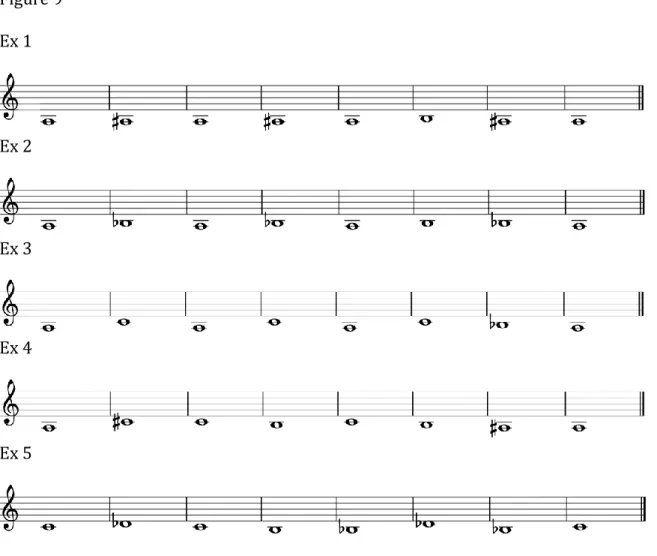
My solution to this problem is to focus solely on pitch identification in the beginning of my method book. The first set of examples in my book (Figure 9) are to be performed in free time. Once the student has displayed some proficiency with pitch identification and technique the instructor can then proceed to the next section of the book and introduce the students to the concept of rhythmic notation. The instructor then has the ability to reinforce the rhythmic notation more strictly in the following examples throughout the book.
Figure 9 Ex 1 Ex 2 Ex 3 Ex 4 Ex 5
Later on in the book the same notes are used but with rhythms included as shown in Figure 10.
Rhythm
Hal Leonard's Guitar Method introduces multiple note values at once but refrains from using them in combination to create rhythms. Instead the book uses examples that utilize one note value exclusively per bar. Figure 11 is a transcription of the first examples in Hal Leonard's Guitar Method. In my experience, students tend to play examples at the fastest tempo they can physically manage in order to curb boredom. This results in note values representing a pulse opposed to a
component of a rhythmic figure. For example: a student may attempt example 1 in Figure 10 at 200 BPM, example 2 at 100 BPM and example 3 at 50 BPM resulting in a consistent pulse.
My method also introduces whole notes, half notes and quarter notes at the same time but my method uses multiple note values example to create rhythmic diversity. If an instructor chooses to focus solely on maintaining a steady pulse earlier examples in the book can be used. The method eventually introduces the concept of subdividing a beat into halves (using eighth and sixteenth notes) and later on into triplets. This approach was inspired by Charles E Hicks technique of teaching rhythm as demonstrated in his article Sound before Sight Strategies for Teaching Music Reading. First, note identification on the staff is introduced. Students learn to read simple melodies and are encouraged to perform the melody with varying tempos and rhythms. Once the student is comfortable with pitch identification and playing simple rhythms he introduces rhythmic notation.
Tonality
As previously stated: I made a concerted effort to make all examples as musical as possible and made sure they had a tonal center, but the concept of tonality is not introduced until every chromatic note is learned in the guitar’s first position. In Hal Leonard's Guitar Method the concept of key signatures is not approached until pages 26 and 27. The book first introduces the concept of whole and half steps and then proceeds to introduce F sharp.
On the next page an explanation of key signatures is given as follows:
“Instead of writing a sharp sign before every F in a song, one sharp is placed at the beginning of the line. This is called a key signature and indicates that every F in the song should be played as F sharp…” (Schmid & Koch, 2002)
This statement does not properly explain what a key signature is. It also fails to illustrate the concept of a scale being a pattern of tones and semitones
represented by the key signature. This is the only mention of key signatures anywhere in the book.
accidental F sharp I believe to include more diatonic material in first position Hal Leonard's Guitar Method included a lesson brief lesson on the F sharp accidental. If the guitar was tuned to C major/A minor, I doubt there would have been any mention of key signatures in Hal Leonard's Guitar Method as there would be no shortage of musical examples that could be created in those keys without the need of using accidentals.
As previously stated: my method introduces the topic of tonality after every chromatic note in first position is covered. I then explain how the notes are
assembled to create a major scale. I reinforce the concept of the major scale by including solfege in my method book. I find that most people submersed in western culture are familiar with the solfege syllables (do,re mi, fa etc.) and have an
understanding of major tonality.
The book then introduces each key in order throughout the circle of fifths. The book does not present the circle of fifths in a conventional manner that relies on mnemonic devices to memorize key signatures. Instead, the book guides the student in constructing major scales based on the Tone-Tone-Semitone- Tone-Tone-Tone-Semitone formula starting from C major and moving through the cycle of fifths. The pattern of how fifths are related is not revealed until a few moves through the cycle and it is up to the student to make the connection how they see fit in the early stages of this exercise. This gives more opportunity for the student to audiate than if they were to memorize key signatures taking the standard approach. The method then
progresses through the circle of fourths in the same manner covering all the keys with flat key signatures
Chords
In the Hal Leonard's Guitar Method chords are introduced based on the primary triads of the key of C major and are taught through chord charts. There is no explanation of what a chord is or how a chord is constructed. Amongst the first three chords introduced is a G7. Explaining the concept of a seventh chord to an inquisitive student proves to be quite challenging when they have no idea what a scale degree is let alone what the major scale is. Again, the recurring theme
throughout the Hal Leonard's Guitar Method seems to be the raising of unanswered questions. This method, and any other taking a similar approach, gives students a peak of concepts that they have no intention of ever explaining. This puts the
instructor in the position where they must either ignore their student’s questions or make a futile attempt to explain complex ideas to someone with no theoretical fundamentals. Awkward discussions such as the example above involving seventh chords often discourage students and overwhelm them. I have had many students say to me that “music sounds way too complicated” with a sigh of defeat as I desperately try to do damage control on a concept addressed far too soon in Hal Leonard's Guitar Method.
Chords are easily taught as a product of scales, so my method book waits until the student has a grasp of scales and key signatures before introducing the topic of chords. The Hal Leonard's Guitar Method may reward the student with the ability to explore the harmonic qualities of the guitar sooner than my method but
my method teaches the student to voice the major triad in a movable voicing which allows them to apply the voicing to any root (Figure12). This gives the student the ability to play 12 chords with one voicing opposed the Hal Leonard's Guitar Method which gives the student the ability to only play one chord. My method book then goes on to explain how a major triad is altered to produce minor, diminished and augmented triads. With this information the student can quickly apply these voicings to interpret songs of their choosing. The method book includes a list of suggested strumming and picking patterns to give the student rhythmic ideas.
Often guitarists rely on nothing more than chord charts to interpret a musical score. It was my intention to prepare the student for this common scenario. The book then goes on to explain first and second inversions of the above mentioned triads. This is a far more thorough and productive method of teaching chords than the Mel Bay's The Modern Guitar Method’s, approach of teaching first position chords in order of their popularity. My approach gives students choices in how they voice a chord because they have 3 voicing options that span the length of the neck where as in Mel Bay's The Modern Guitar Method the student is limited to only one root position option per chord. The student using my method is free to discover the relationship between different voicing across the guitar neck and develop a preference for what they feel sounds best to their ear.
Etudes
I felt it was important to include etudes in my method book to give students some practical goals to work towards such as the opportunity to perform, the ability to interpret pieces using dynamics, consolidating multiple concepts and skills
introduced within the book, and an opportunity to attempt larger pieces. Hal Leonard's Guitar Method as well as other books, which take a similar approach, often include pieces at the end of each chapter that are public domain. The issue with this (as previously stated) is that students may rely more on their ear to play these pieces opposed to utilizing their reading skills. For this reason I decided to write my own compositions as they would be unfamiliar to the student and would require them to rely on their reading skills. I took special attention to relate each piece to a specific exercise within the same chapter.
The first etude, “The Elders of Lore” (Figure13), does not appear until page 32 (nearly a third of the way into the entire method). The student is required to work through 83 exercises before attempting to perform a piece. I felt it was necessary to have students learn all the notes in the range of one octave before applying their developing skills to a performance situation. Up to this point the student has learned whole notes, half notes, quarter notes eight notes, and the
directly related to exercise 81. Notice that the first bars of both compositions are identical.
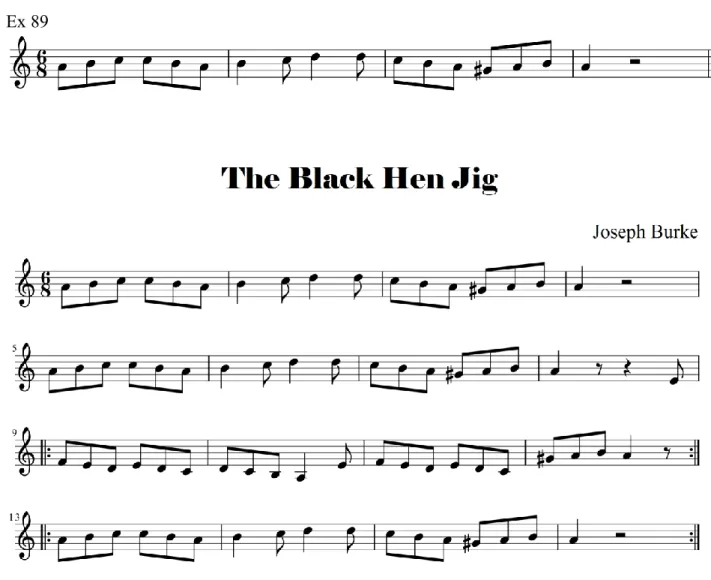
The second etude, “The Black Hen Jig”(Figure 14) is a composition with a 6/8 time signature. It appears on page 36 of the method book. Between “The Elders of Lore” and the “The Black Hen Jig”the student learns the notes on the second string as well as the 6/8 time signature. Note that the first line of “The Black Hen Jig”is identical to exercise 89. I made an effort to utilize the repeat sign as much as possible in the piece so reinforce my earlier lesson on the function of the repeat sign. In my experience, many of my students ignore repeat signs and I felt it was necessary to include a piece that relies heavily upon them.
Figure 14 Ex 89
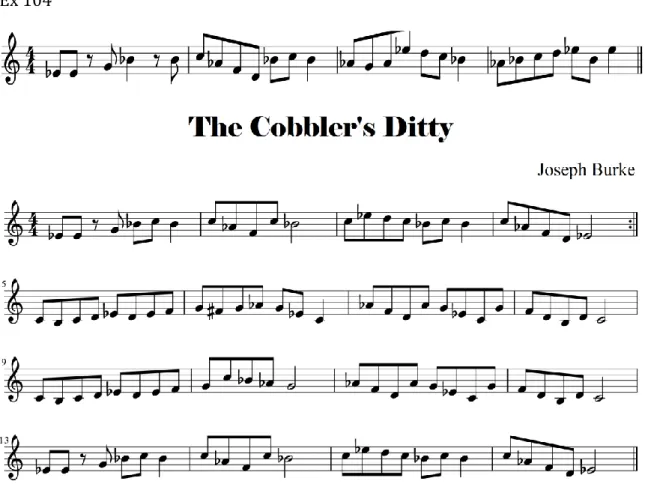
The third etude, “The Cobbler’s Ditty”(Figure 15)appears on page 38 of the method book. You will notice that the etudes appear in quick succession of one another as they are designed to keep the students interest and help them to apply each new musical idea presented after the fundamentals featured in the first 89 exercises are learned. “The Cobbler’s Ditty”was designed to have students play arpeggios as well as reinforce the use of the natural sign through chromatic motifs. Note that the first bar of exercise 104 and “The Cobbler’s Ditty”are identical.
Exercise 89 is one of the more challenging exercises in the book and I felt that it was important to have as much repetition as possible to have the student practice the arpeggios contained in both the exercise and etude.
Figure 15 Ex 104
“The Clumsy Squire”. I made an effort to not only reinforce new lessons in each etude but to also make each etude increasingly more difficult.
Figure 16
The fifth etude, “Speedy’s Double Time Blues” (Figure 17) was designed as a conceptual challenge for the student and appears on page 49 of the method book. Between “The Clumsy Squire”and “Speedy’s Double Time Blues”the student is introduced to dotted notes as well as triplets. A blues passage usually consists of swung eighth notes and triplets. Up to this point the concept of swinging has not been introduced to the student. I opted to use sixteenth notes and dotted sixteenth notes to create the swing feel. This way when swing is introduced later in the method book the student already has experience with the swing feel. I also wanted to introduce the feel of quarter note triplets.
Quarter note triplets are never mentioned in the method book, but the student will develop a foundation to understand how to play quarter note triplets by preforming this etude.
Figure 17
The sixth etude, “The Battle Song”(Figure 18) appears on page 112 of the book. Between “Speedy’s Double Time Blues” and “The Battle Song”the student focuses on learning about key signatures and chords. I believe that by this point the student has enough knowledge to seek out their own resources in the form of
musical scores to apply all the skills have learned. “The Battle Song”simply acts as a final challenge for the student.
Figure 18
Up to this point in the method book, the guitar has been approached mainly as a melodic instrument. I felt that it was important to introduce the harmonic aspects of the guitar to the student before ending the book. I also felt it was important to give the student an introduction to how to interpret musical scores. The final five etudes are preceded with an explanation of dynamics and tempo markings. The final five etudes also include fingerings as these are quite commonly found in classical music scores. The first two etudes of the final set of five, “A Song For Michael” (Figure 19) and “Bill’s Blues “(Figure 20) focus on the
E minor chord in first position. The student plays a melodic line followed by a chordal response. The third and fourth etudes “Lavien”(Figure 21) and “Catch A Wave” (Figure 22) focus on the A minor chord in first position. The final etude “Little Brother”(Figure 23) focuses on alternating between the E minor and A minor chord in first position.
Figure 20
Figure 22
Conclusion
When I began teaching 17 years ago, I relied heavily upon Hal Leonard's
Guitar Method to teach my students. Although I was unaware of the term at the time, I realized early in my teaching career that books of this nature do not teach a
student to audiate. I did however, continue to use Hal Leonard's Guitar Method to teach students how to read music. I encountered many of the issues Eli Harrison mentioned in his article Challenges Facing Guitar Education when using Hal
Leonard's Guitar Method and eventually abandoned the book altogether in favour of developing my own method to teach musical literacy. After years of trial and error I developed an approach that I felt was worthy of a book.
Much of my research reinforced the teaching strategies I instinctually
developed and presented in my first draft of the book. The Chromatic Guitar Method
is the culmination countless rewrites and was largely influenced by Hick’s approach to teaching notation.
Another objective of this book was to cover the fundamentals of music theory in a rational order. No concept was ever introduced for the purpose of creating less challenging parameters to generate musical examples for my book. Initially, my intention was to develop a book that served as a stand alone tool to teach students to play guitar. After reading Gordon’s Learning Sequences in Music: A Contemporary Learning Theory I realized that a book alone can not teach a student to audiate.
I arrived at the conclusion that The Chromatic Guitar Method should not serve as a stand alone “how to” method, but is an excellent tool for guitar instructors to use at their discretion. Due to the amount of planning and the logical flow of how the information is presented; there are numerous applications for this book. For example, the book itself only explains music notation in the guitar’s first position, but there is no reason why the book can not be recycled to develop notational
reading skills in every position. Although The Chromatic Guitar Method can not teach one to audiate per se; it would make for an excellent tool in aiding an instructor in guiding a student to develop the ability to audiate.
Bibliography
Bartel, Lee R. “Guitar Class: A Multifaceted Approach.” Music Educators Journal 77, no. 2 (1990): 40-45.
http://www.jstor.org.ezproxy.library.yorku.ca/stable/3397816 (accessed December 27, 2013).
Bennett, H. S. “Notation and identity in contemporary popular music.” Popular Music, 3, (1983): 215-341. http://dx.doi.org/10.1017/S026114300000163X
(accessed January 10, 2014).
Desain, Peter, Honing, Henjan, Vanthienen, Huub and Windsor, Luke.
“Computational Modeling of Music Cognition: Problem or Solution?” Music Perception: An Interdisciplinary Journal 16, no. 1 (1998): 151-166
DOI: 10.2307/40285783 (accessed February 11, 2014).
Eco, Umberto. Travels in Hyperreality: Essays, trans. William Weaver. New York: Harcourt Brace & Company, 1986.
Goodrick, Mick. The Advancing Guitarist: Applying Guitar Concepts and Techniques. Milwaukee: Third Earth, 1987.
Gordon, Edwin. Learning Sequences in Music: A Contemporary Learning Theory. Chicago: GIA, 2007.
Harrison, Eli. “Challenges Facing Guitar Education.” Music Educators Journal 97, no. 1 (2010): 50-55.
http://www.jstor.org.ezproxy.library.yorku.ca/stable/40960178 (accessed January 10, 2014).
Hicks, Charles. “Sound before Sight Strategies for Teaching Music Reading.”
Music Educators Journal 66, no. 8 (1980): 53-67
http://www.jstor.org.ezproxy.library.yorku.ca/stable/3395858 (accessed February 10, 2014).
Jordan, James. “The Pedagogy of Choral Intonation: Efficient Pedagogy to Approach an Old Problem.” The Choral Journal 27, no. 9 (1987): 9-16
http://www.jstor.org.ezproxy.library.yorku.ca/stable/23547288 (accessed March 15, 2015).
Mr Jim 1972, “Kurt Cobain - Nirvana Rare Full Interview Seattle, 1993”. Online video clip.YouTube. YouTube, 11 Dec. 2013. Web 31 Mar. 2015
Cobain, Kurt interview by Edgar Klüsener
Schmid, Will, and Greg Koch. Hal Leonard's Guitar Method. Milwaukee: Hal Leonard, 2002.
Schwartz, Jeff. “Jimi: Rock Guitar Pedagogy as Postmodern Folkloric Practice.”
Popular Music 12, no.3 (1993): 281-288
http://www.jstor.org.ezproxy.library.yorku.ca/stable/931236 (accessed January 4, 2015).
Introduction
A
Note
is a representation of a pitch.
There are 12 notes in western music.
7 notes are called
Natural
notes and are named after letters from the
alphabet they are:
A, B, C, D, E, F, and G.
The other 5 notes are called
Accidentals.
On a keyboard Accidentals are the black keys in between the white keys
which are Naturals.
Accidentals are named based on their location on the keyboard.
Each Accidental has two names and can be identified as follows:
The note is said to be SHARP
(
♯
)
of the note to its left and FLAT
(
♭
)
of
the note to its right.
Notice that there are no Accidentals between “B” and “C” or “E” and “F”.
The two names of the accidentals are known as
Enharmonic Equivalents
SEMI-TONE
A term to identify the relationship between two notes. A
Semi-Tone
is a
note
’
s closest neighbor.
TONE
A term used to identify the relationship between two notes. A
Tone
is
two semitones in distance.
Examples
C
♯
/ D
♭
is a semitone higher than C.
B is a semitone lower than C.
D is a tone higher than C.
A
♯
/
B
♭
is a tone lower than C.
Complete the chart below :
Be sure to include both Accidental names.
You may use the keyboard on the previous page as a reference.
Note
Semitone
Higher
Semitone
Lower
Tone Higher
Tone Lower
A
A
♯
/ Bb
B
C
C
♯
/ D
♭
B
D
A
♯
/ B
♭
C# / D
♭
D
D
♯
/ E
♭
E
F
F
♯
/ G
♭
G
G
♯
/ A
♭
The Guitar
Take a moment to become familiar with the names of the parts of the
guitar.
Holding a Pick
Bend your pointer finger and curl it tightly. Place the pick parallel to the
flat portion of your finger and grip the pick with your thumb.
Approximately 3 mm of the tip of the pick should be visible.
Always alternate your picking with up and down strokes.
Fingerstyle Technique
Practice all of the exercises in this book using a pick as well as using
fingerstyle technique. Alternate between your index and middle finger
when plucking strings. Also practice alternating between your middle
and ring finger.
Each fret is a semi- tone in distance apart.
Since we can play the same note on different strings we can use the
sixth string to tune the fifth string, the fifth string to tune the fourth
string, the fourth string to tune the third
string, the third string to tune
the second string, and the second string to tune the first
string.
This method of tuning is called Relative Tuning.
The Staff
Music is notated on five lines known as the staff.
A clef is placed on one of the lines at the beginning of the staff to
indicate the name and pitch of the notes on that line. We use the treble
clef for the guitar.
The staff is divided into sections called bars or measures.
bar lines
A double bar line with the second line being thicker than the first
indicates the end of a piece of music.
We need to extend the treble clef to include the notes on the 6
th5
thand
Notes on the 5
thString
Ex 1
Ex 2
Ex 4 Ex 5 Ex 6 Ex 7 Ex 8 Ex 9 Ex 10
Note Values
Notes on the staff identify not only the pitch to be played but also the
duration of time the note is played for.
This is a Whole Note.
This is a Half Note.
It is held one half as long as a whole note.
This is a Quarter Note.
It is held one quarter as long as a whole note and
1/2 as long as a half note.
Time Signatures
The
beat
is the basic time unit of music. It indicates the pulse of a piece
of music.
The
tempo
indicates the speed of the pulse. It is expressed in Beats per
minute or bpm.
A clock for example ticks at 60 beats per minute.
The
time signature
indicates the number of beats per bar as well as
which note is designated a beat.
The top number indicates the number of beats per bar.
The bottom number indicates which note is designated a beat. Think of
the bottom number as a fraction.
The most common time signature is 4/4. It is also known as
Common
Time.
Examples on 5
thstring in common time
Ex 12
Ex 13
Ex 14
Ex 16 Ex 17 Ex 18 Ex 19 Ex 20 Ex 21
Ex 22
Ex 23
A note that is marked sharp or flat is considered to continue to be sharp
or flat for the rest of the bar. There is no need to re-indicate the note as
sharp or flat for the duration of the bar. In the example below every
note in the first bar is F#. In the second bar F returns to being natural.
The Natural symbol
If a note is marked with the Natural symbol it is considered to return to
being natural for the duration of the bar unless indicated otherwise with
an accidental. In the example below the first note is G
♭
the second and
third note are G Natural, and the fourth note is G
♭.
Ex 24 Ex 25 Ex 26 Ex 27 Ex 28 Ex 29
Notes on the 4
thstring
Ex 31
Ex 32
Ex 35 Ex 36 Ex 37 Ex 38 Ex 39 Ex 40
Ex 41
Ex 42
A Tie
A tie is a curved line connecting the heads of two notes of the same
pitch. It indicates that the two notes are to be played as a single note
with a duration equal to the length of the two notes added together.
The note in the in the first bar is 6 beats long and the note in the third bar is 5 beats long.
Exercises on the 5
thand 4
thstring
Ex 43 Ex 44 Ex 45 Ex 46 Ex 47Ex 48 Ex 49 Ex 50 Ex 51 Ex 52 Ex 53
Rests
A rest indicates an interval of silence. When you see a rest you must
stop the previous note from ringing until it is time to play the next note.
You can do this by releasing pressure from your fretting hand or by
muting the strings with the palm of your picking hand.
Notes on the 3
rdString
Ex 55
Ex 56
Ex 57
Ex 59
Exercises on 3
rdand 4
thString
Ex 60
Ex 61
Ex 62
Ex 64
Ex 65
Ex 66
Exercises on 3
rd4
thand 5
thString
Ex 67
Ex 69
Ex 70
Ex 71
Eighth Notes and Rests
Eighth Notes
and
Eight Rests
are worth 1/8 the value of a whole note.
When an eighth note is followed by other eighth notes in a piece of
music they are connected with a beam. Eighth notes can be beamed in
pairs, groups of three, or groups of four.
Below is an example of the different ways eighth notes are beamed.
When reading music with eighth notes in 4/4 time, we must subdivide
our count to incorporate twice as many pulses. We do this by saying
“AND” between each number we count. It would be a good habit to
always count in this manner from this point onward.
Exercises using 8
thnotes
Ex 73
Ex 74
Ex 75
Ex 78
The Repeat Sign
When you see a repeat sign, it means that you repeat the song from the
very beginning and end the second time through, at the repeat sign. If
you are required to repeat a section multiple times it will be indicated
below the repeat sign.
Some pieces of music require you to repeat a section in the middle of the
piece. If this is the case there will be a repeat sign at the beginning of the
section to be repeated as well as the end. Refer to the example below.
We would play the piece above from the beginning through the first
repeat sign (located at bar three) until we arrive at bar six (where the
second repeat sign is located). We would then play starting from bar
three (where the first repeat sign is located) through to the end of the
piece.
If we were required to repeat this section more than once it would be
written under the second repeat sign (located at bar six).
Ex 80
Ex 81 This exercise will prepare you for the piece Elders of Lore
Ex 82
Notes on the 2nd String
Ex 84
Ex 85
Ex 86
Ex 88
6/8 Time Signature
There are six beats per bar and eighth notes are worth one beat.
Exercises on 2
ndand 3
rdString in 6/8 Time
Ex 89 This exercise will prepare you for the piece Black Hen JigEx 91 Ex 92 Ex 93 Ex 94 Ex 95 Ex 96
Ex 97
Ex 98
Ex 99
Exercises on 2
nd3
rdand 4
thString
Ex 101Ex 103
Ex 104 This exercise will prepare you for the piece The Cobbler’s Ditty
Ex 105
16
thNotes and Rests
Sixteenth Notes
and
Sixteenth Rests
are worth 1/16
thof a whole note
Like an eighth note, when a sixteenth note is followed by other sixteenth
notes they are connected with a double beam. When a sixteenth note is
followed by an eighth note it is joined with a single beam.
Below is an example of the different ways sixteenth notes are beamed.
Just as with eight notes in 4/4 time we must subdivide the beat to count
sixteenth notes in 6/8 time.
Exercises on the 2
nd3
rd4
thand 5
thstring with 16
thnotes
Ex 107Ex 109
Ex 110
Ex 111
Ex 112
Counting 16
thNotes and Rests in 4/4 Time
Since a sixteenth note or rest is worth 1/4 of a beat in 4/4 time we must
subdivide the beat into 4.
We do this by counting as follows:
Ex 116 Ex 117 Ex 118 Ex 119 Ex 120 Ex 121 Ex 122