Accumulation and Causes Developmental
Defects in Rice
1[w]
Bin Liu2, PingChuan Li2, Xin Li, ChunYan Liu, ShouYun Cao, ChengCai Chu, and XiaoFeng Cao*
National Key Laboratory of Plant Genomics and Center for Plant Gene Research, Institute of Genetics and Developmental Biology, Chinese Academy of Sciences, Beijing 100101, China (B.L., P.L., C.L., S.C., C.C., X.C.); Graduate School of the Chinese Academy of Sciences, Beijing 100039, China (B.L., P.L.); and China Agricultural University, Beijing 100094, China (X.L.)
MicroRNAs (miRNAs) and small interfering RNAs (siRNAs) are two types of noncoding RNAs involved in developmental regulation, genome maintenance, and defense in eukaryotes. The activity of Dicer or Dicer-like (DCL) proteins is required for the maturation of miRNAs and siRNAs. In this study, we cloned and sequenced 66 candidate rice (Oryza sativa) miRNAs out of 1,650 small RNA sequences (19 to approximately 25 nt), and they could be further grouped into 21 families, 12 of which are newly identified and three of which, OsmiR528, OsmiR529, and OsmiR530, have been confirmed by northern blot. To study the function of rice DCL proteins (OsDCLs) in the biogenesis of miRNAs and siRNAs, we searched genome databases and identified four OsDCLs. An RNA interference approach was applied to knock down two OsDCLs,OsDCL1 andOsDCL4, respectively. Strong loss of function of OsDCL1IR transformants that expressed inverted repeats of OsDCL1 resulted in developmental arrest at the seedling stage, and weak loss of function of OsDCL1IR transformants caused pleiotropic developmental defects. Moreover, all miRNAs tested were greatly reduced inOsDCL1IRbut notOsDCL4IRtransformants, indicating thatOsDCL1plays a critical role in miRNA processing in rice. In contrast, the production of siRNA from transgenic inverted repeats and endogenous CentO regions were not affected in eitherOsDCL1IRorOsDCL4IRtransformants, suggesting that the production of miRNAs and siRNAs is via distinct OsDCLs.
Most eukaryotes have two classes of short (21–25 nt) noncoding RNAs, microRNAs (miRNAs) and small interfering RNAs (siRNAs), which are involved in RNA-silencing pathways (Baulcombe, 2004). The two classes of small RNAs are related but differ in their biogenesis from their origins, initiation, to their subsequent as-sembly into different RNA-induced silencing com-plexes (RISCs; Tang, 2005). miRNAs are processed from single-stranded RNAs with imperfect stem-loop structure, whereas siRNAs are derived from double-stranded RNAs (dsRNAs). Both miRNA and siRNA precursors are cut into double-stranded duplexes by Dicer, a multidomian enzyme of the RNase III family. Then the duplexes are unwound and one strand is subsequently assembled into miRISC or siRISC, re-spectively. Both miRNAs and siRNAs down-regulate gene expression via sequence complementarity to their target mRNAs by either cleavage or translational re-pression mechanism. Although the function of miRNAs
and siRNAs is interchangeable depending on the ex-tent of base pairing between the small RNAs and their mRNA targets in cleaving RISCs, miRNAs and siRNAs have distinct target functions in cells (Hutvagner and Zamore, 2002; Doench et al., 2003; Tang et al., 2003; Zeng et al., 2003; Bartel, 2004). For example, miRNAs play important roles in regulating gene expression and cell differentiation for normal development (Bartel and Bartel, 2003; Kidner and Martienssen, 2005), while siRNAs are involved in genome management of trans-poson and retrotranstrans-poson activity at the chromatin level (Lippman et al., 2004) and in protecting against virus infection or transgene invasion (Hamilton and Baulcombe, 1999; Xie et al., 2004).
In plants, several components that are involved in miRNA biogenesis and metabolism have been exper-imentally characterized. In Arabidopsis (Arabidopsis thaliana), miRNA genes are transcribed into long precursors, pri-miRNAs, which are first processed into pre-miRNAs and then into miRNAs by Dicer-like (DCL)1 (Kurihara and Watanabe, 2004). It has been shown that ARGONAUTE1 (AGO1), a key component of RISC, is necessary for the function of miRNAs (Vaucheret et al., 2004). Moreover, HEN1 plays a broad role in small RNA metabolism that is required for the accumulation of both miRNA and siRNA (Park et al., 2002; Boutet et al., 2003; Xie et al., 2004). Further study revealed that HEN1 is a small RNA methyltransferase that methylates ribose of the last nucleotide of both 1This work was supported by the National Natural Science
Foundation of China (grant nos. 30430410 and 30325015 to X.C.) and the BaiRen and State High-Tech Program (grant to X.C.).
2These authors contributed equally to the paper.
* Corresponding author; e-mail [email protected]; fax 86–10– 64873428.
[w]
The online version of this article contains Web-only data. Article, publication date, and citation information can be found at www.plantphysiol.org/cgi/doi/10.1104/pp.105.063420.
mRNAs and siRNAs (Yu et al., 2005). Furthermore, HYL1 encodes a double-stranded RNA-binding pro-tein, and a subset of miRNAs is reduced in the hyl1
background (Han et al., 2004). In addition, an ortholog of exportin-5, known as HASTY, might play a role in the nuclear export of most miRNAs in Arabidopsis (Park et al., 2005). All these components are involved in miRNA biogenesis or metabolism; therefore, they affect multiple aspects of normal development.
Dicer, a multidomain endonuclease, plays essential roles in RNA-silencing pathways (Tijsterman and Plasterk, 2004). First, Dicer initiates the process of RNA interference (RNAi) by cutting dsRNA into 21 to approximately 24-nt siRNA duplexes, which form RISC-loading complexes. Then RISC-loading com-plexes mature into RISC in an asymmetric way such that only one strand of the duplex is chosen to be assembled (Hannon, 2002; Pham et al., 2004; Tomari et al., 2004a, 2004b). In metazoan, miRNAs are pro-cessed first by Drosha and Pasha in the nucleus and then by Dicer in cytoplasm (Lee et al., 2003; Denli et al., 2004). In plants, evidence suggests that miRNAs are likely processed by Dicer in the nucleus (Kurihara and Watanabe, 2004; Park et al., 2005).
An N-terminal helicase domain, two tandemly re-peated RNase III domains, and one or more C-terminal dsRNA-binding domains are highly conserved among all Dicers and DCL proteins. However, the number of DCL proteins varies among different organisms. For example, in mouse (Mus musculus) and human (Homo sapiens), a single Dicer gene is responsible for the gen-eration of both miRNAs and siRNAs, whereas in other organisms, such as flies and plants, multiple DCL proteins exist.
In organisms with multiple DCL genes, these genes may have distinct roles in the RNA-silencing path-ways (Kadotani et al., 2004; Lee et al., 2004; Xie et al., 2004). For example, in Drosophila, Dicer-1 is respon-sible for miRNA maturation, whereas Dicer-2 is re-quired for siRNA accumulation in the initiation step of siRNA pathways (Lee et al., 2004). Furthermore, both Dicer-1 and Dicer-2 are involved in the formation of RISC in the effector step. In the filamentous fungus
Magnaporthe oryzae, one of the two DCL proteins, MDL-2, is responsible for siRNA accumulation and gene silencing, whereas MDL-1 function is unknown to date (Kadotani et al., 2004).
Arabidopsis has four DCL proteins, and distinct functions have been observed for three of them.DCL1, also namedSHORT INTEGUMENTS1/SUSPENSOR1/
CARPEL FACTORY (Robinson-Beers et al., 1992; Jacobsen et al., 1999; McElver et al., 2001; Schauer et al., 2002), is required for normal plant development. Partial loss-of-function alleles ofdcl1show pleiotropic phenotypes due to a reduction of miRNA accumula-tion (Park et al., 2002). In Arabidopsis, maturaaccumula-tion of miRNAs requires at least three cleavage steps, and
DCL1is involved in processing pri- and pre-miRNAs (Kurihara and Watanabe, 2004). In contrast,DCL2and
DCL3 have no effect on plant development, but are
important for resistance to a specific viral pathogen and the accumulation of different types of endogenous siRNAs, respectively (Xie et al., 2004).
Rice (Oryza sativa), one of the most important crop species in the world, has become the model monocot species for genomic and molecular analysis. Twenty miRNA families have already been identified in rice through computational approaches based on conser-vation with known miRNAs from Arabidopsis (Llave et al., 2002; Park et al., 2002; Reinhart et al., 2002; Jones-Rhoades and Bartel, 2004; Sunkar and Zhu, 2004; Wang et al., 2004; Adai et al., 2005), whereas direct experimen-tal evidence was only recently reported (Sunkar et al., 2005). In addition, multiple DCL proteins (OsDCLs) have been predicted in rice. However, which OsDCL is in-volved in the miRNA biogenesis is unknown. Moreover, how OsDCLs affect rice development is also unclear. In this study, we identified miRNAs from rice by direct-cloning method. We also evaluated the roles ofOsDCL1
and OsDCL4 in miRNA/siRNA biogenesis and rice development. Loss of function of OsDCL1IR and
OsDCL4IRtransformants were generated by RNAi ap-proach. We confirmed thatOsDCL1andOsDCL4were knocked down specifically. We further demonstrate thatOsDCL1, but notOsDCL4, is important for miRNA accumulation. In contrast, the production of siRNAs from transgenic inverted repeats and endogenous CentO regions are not affected in eitherOsDCL1IRor
OsDCL4IRtransformants, suggesting that the produc-tion of miRNAs and siRNAs is via distinct OsDCLs.
RESULTS
Analysis of Small RNAs from Rice
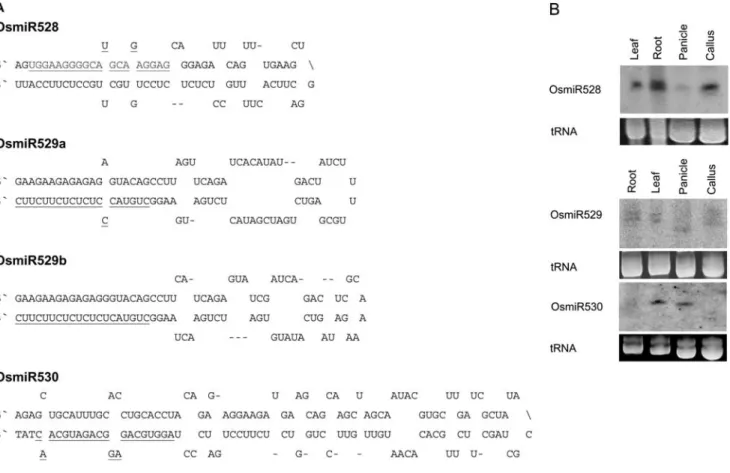
To identify novel miRNAs from rice, we constructed a small RNA library (see ‘‘Materials and Methods’’). Clones from the above library were sequenced. Nine-teen- to 25-nt-long RNA molecules with perfect match to noncoding regions of the rice genome were collected and analyzed. Upstream and downstream genomic sequences of each miRNA candidate (with 20–200 nt for each side) were extracted and screened for hairpin-like secondary structure using an m-fold RNA-folding program. Among all sequenced small RNAs, 66 were derived from the stem region of hairpin-structured precursors. Therefore, these small RNAs could be candidate miRNAs according to the current miRNA annotation criteria (Ambros et al., 2003). These cloned candidates could be divided into 21 subfamilies, including nine previously identified rice miRNAs (Supplemental Table I). Among them, 12 are newly identified families that do not have phylogenetic con-servation with known Arabidopsis miRNAs (Fig. 1A and Supplemental Fig. 1; Llave et al., 2002; Park et al., 2002; Reinhart et al., 2002; Jones-Rhoades and Bartel, 2004; Sunkar and Zhu, 2004; Wang et al., 2004; Xie et al., 2004; Adai et al., 2005). Further investigation indicated that three of them, OsmiR528, OsmiR529,
and OsmiR530 (Fig. 1A), are bona fide miRNAs since they can be detected by northern-blot hybridization and the expression patterns from different tissues were observed (Fig. 1B). Therefore, we conclude that OsmiR528, OsmiR529, and OsmiR530 are three novel miRNAs from rice (Fig. 1, A and B). In addition, the three novel miRNAs did not have targets of known proteins (Supplemental Table II). This may be due to the incomplete annotation of the rice genome. Com-parison of precursor sequences of the cloned miRNAs with rice cDNAs showed half of the putative miRNAs had primary transcripts in full-length cDNA clones. Since the cloning of the cDNAs relied on the presence of 5#CAP structure (Kikuchi et al., 2003), these miRNA
precursors were likely transcribed by RNA polymer-ase II (Supplemental Table III).
Rice Has Four DCL Proteins
To study the function of OsDCLs in the biogenesis of miRNAs and siRNAs, we searched rice genome data-bases using the protein sequence of Arabidopsis DCL1. Four putative rice proteins, named OsDCL1 to OsDCL4, were identified from the National Center for Biotechnology Information (http://www.ncbi.nlm.nih. gov/) and the Plant Chromatin Database (http://www.
chromdb.org). Sequences of these OsDCLs were aligned with selected plant and animal Dicer or DCL proteins to explore their relationships.
Phylogenetic analysis of DCL proteins from differ-ent species showed that Dicer-1 in Drosophila, mouse, and human were grouped together (Fig. 2). Dicer-2 from Drosophila was separated from other animal Dicers reflecting its unique function in siRNA processing (Lee et al., 2004). In plant DCLs, three subfamilies could be defined with high bootstrap value. The OsDCLs and DCLs did not show one-to-one relationships, except for OsDCL4 and DCL4. Instead, OsDCL1 was grouped with both DCL1 and DCL2, whereas DCL3 had two rice orthologs, OsDCL2 and OsDCL3. Each subgroup may have similar or related functions.
Knock Down ofOsDCL1and OsDCL4by RNAi
To understand the roles of OsDCLs in the RNA-silencing pathways in rice, especially in miRNA bio-genesis, we applied the RNAi approach to knock down rice OsDCLs. Phylogenetic analysis showed that among all OsDCLs, OsDCL1 was the closest to DCL1, which is responsible for miRNA processing in Arabidopsis. In order to knock down OsDCLs, we used Pfam (http://pfam.wustl.edu/) to predict the
Figure 1. Representatives of newly identified miRNAs from rice. A, Predicted fold-back structure of OsmiR528, OsmiR529a, OsmiR529b, and OsmiR530 precursors from rice. B, Expression patterns of novel rice miRNAs. The samples from different tissues of wild-type rice, including root, leaf, panicle, and callus, are indicated above. The tRNA bands were visualized by ethidium bromide staining of gels and served as internal loading controls.
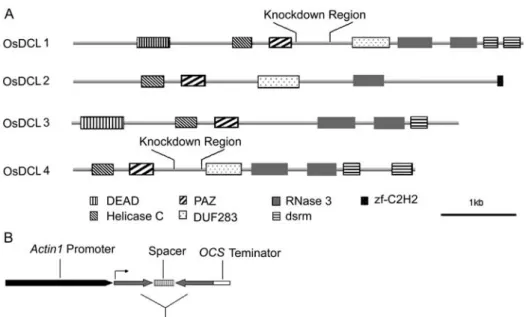
domain structure of OsDCLs (Fig. 3A). OsDCL4 is more similar to OsDCL1 among the four OsDCLs (Figs. 2 and 3A). Therefore, a less conserved region between the DUF283 and PAZ domain of OsDCL1 and OsDCL4 was selected to ensure the specificity of the RNAi experiment (Fig. 3A). dsRNAs were generated under the riceActin1promoter (Fig. 3B).
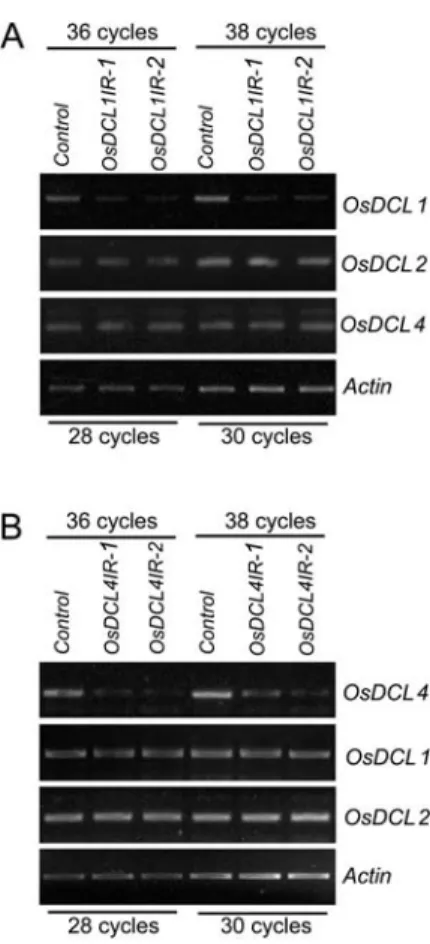
We evaluated whether the RNAi approach resulted in knockdown ofOsDCL1andOsDCL4, respectively. A significant reduction in OsDCL1 expression was ob-served by reverse transcription (RT)-PCR in
loss-of-function transformants ofOsDCL1IRcompared to that of wild type (Fig. 4A, top section). To rule out the possibility that the RNAi approach also affected other
OsDCL genes, we detected the expression ofOsDCL2
andOsDCL4using RT-PCR. As expected, no difference was observed for the expression of OsDCL2 and
OsDCL4between loss of function ofOsDCL1IR trans-formants and wild-type plants (Fig. 4A, middle sections). TheActingene was used as an internal control in the RT-PCR reactions (Fig. 4A, bottom section). A similar approach was applied to OsDCL4IRtransformants, and the expression of OsDCL4, but not OsDCL1
andOsDCL2, was greatly reduced inOsDCL4IR trans-formants compared to that of control plants (Fig. 4B). These results indicated that OsDCL1 and OsDCL4
had indeed been knocked down specifically by RNAi.
OsDCL1Is Required for Rice Development
In contrast with loss of function ofOsDCL4IR trans-formants that did not show developmental defect at vegetative stage, the regenerated transgenic plants containing OsDCL1 RNAi construct showed various degrees of developmental defects compared to control plants (Fig. 5). Strong loss of function of OsDCL1IR
transformants showed overall shoot and root abnor-malities such as severe dwarfism and dark green color. These plants often produced rolled leaves and mal-formed shoots with tortuousness. Root elongation was also greatly reduced inOsDCL1IRtransformants (Fig. 5A). During further development, the shoots of strong loss of function of OsDCL1IR transformants were greatly enlarged transversely and rolled leaves wilted and senesced. These plants showed develop-mental arrest during rooting or at the young seedling stage and eventually died either on sterile medium or in soil (Fig. 5B).
Figure 3. A, Schematic representation of conserved motifs among four DCL proteins in rice. Regions used in the RNAi knockdown are labeled. B, Dia-gram ofOsDCLRNAi constructs. Frag-ments containing respective OsDCL
genes in sense and antisense orienta-tions separated by an unrelated intron were cloned under the rice Actin1
promoter.
Figure 2. Phylogenetic relationships of DCL proteins in higher plants and animals. Full-length protein sequences were used for phylogenetic analyses. Abbreviations and accession numbers were as follows: OsDCL1 to OsDCL4 are four putative DCL proteins from rice. The sequences were derived from http://www.chromdb.org/ and partially confirmed by RT-PCR. DCL1 to DCL4 are four Arabidopsis DCL proteins. DCL1 (NM_099986), DCL2 (NM_111200), DCL3 (NM_114260), and DCL4 (NM_122039) correspond to predicted protein sequences from Arabi-dopsis At1g01040, At3003300, At3g43920, and At5g20320 genes, respectively. Dicer-1 (NM_079729),Drosophila melanogasterDCR-1; Dicer-2 (NM_079054),D. melanogasterDCR-2; hDicer (NM_177438), human Dicer-1; mDicer (NM_148948), mouse Dicer1.
Weak loss of function of OsDCL1IR transformants displayed a dark green color and dwarfism with different leaf and root phenotypes, including narrow, rolled, and outward-folded leaves (Fig. 5C). They also had fewer adventitious roots compared to wild type (Fig. 5C). This is consistent with the exhibition of
ago1in Arabidopsis which regulates adventitious root emergence through mRNA mediate-regulation path-way (Sorin et al., 2005). Furthermore, the adventitious roots of weak loss of function ofOsDCL1IR transform-ants were short and radically swollen when grown on sterile medium (Fig. 5, D and E). The short adven-titious roots phenotype was partially restored after transferring the plants into soil. Since the selection medium contained 0.5 mg/L naphthylacetic acid, the altered root phenotypes of OsDCL1IR transformants might be due to altered sensitivity to auxin.
To further investigate if cellular pattern of adventi-tious roots had been affected, we made transverse sections at the differentiated region of fresh root tissue. Ectopically developed chloroplasts were found in
OsDCL1IRtransformants roots; however, the cell num-ber and overall cellular organization of OsDCL1IR
transformants roots did not change (Fig. 5, F and G).
OsDCL1Is Essential for miRNA Processing in Rice
Becausedcl1loss-of-function alleles resulted in a re-duced miRNA population and caused developmen-tal defects in Arabidopsis, we investigated whether
Figure 4.Specificity of RNAi inOsDCL1IRandOsDCL4IR transform-ants. RT-PCR analyses were performed for theOsDCL1,OsDCL2, and
OsDCL4loci in a control plant and twoOsDCL1IR(A) andOsDCL4IR
(B) transformants, respectively. Equal amount of cDNAs was deter-mined by RT-PCR with 28 and 30 cycles at theActinlocus; the same amount of cDNAs was used to amplify 36 and 38 cycles atOsDCL1,
OsDCL2, andOsDCL4loci, respectively.
Figure 5. Morphology ofOsDCL1IRtransformants showing pleiotropic phenotypes. A, Wild type and strong loss of function of OsDCL1IR
transformants. TheOsDCL1IRtransformant showed severe dwarfism, rolled and curly leaves, and tortuous shoots. B, The strong loss of function ofOsDCL1IRtransformant showed developmental arrest at the young seedling stage. C, The weak loss of function ofOsDCL1IRtransformants displayed pleiotropic phenotypes at the seedling stage. D and E, Roots fromOsDCL1IRtransformants (D) and control (E) plants. The weakOsDCL1IR
transformants had fewer adventitious roots. F and G, Cross sections of roots fromOsDCL1IRtransformants (F) and control plants (G). Ectopi-cally developed chloroplasts were found inOsDCL1IRtransformants roots; however, the cell number and overall cellular organization of weak loss of function ofOsDCL1IRtransformant roots did not change.
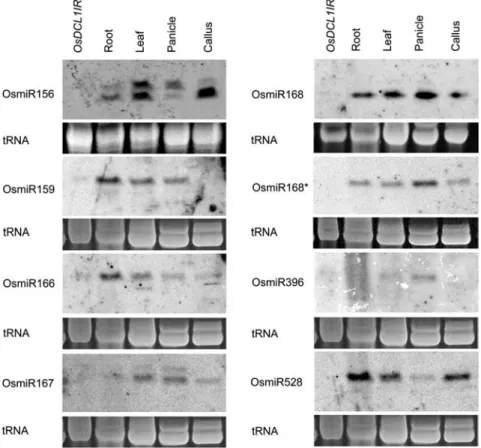
OsDCL1IRtransformants also caused a reduction of miRNA in rice. We validated the miRNA level in leaves ofOsDCL1IRtransformants and different tissues of wild-type plants (Fig. 6). Hybridization results showed that all miRNAs accumulation in leaves ofOsDCL1IR trans-formants was abolished or greatly reduced at the tested loci compared to that of wild-type leaves. These loci included OsmiR156, OsmiR159, OsmiR166, OsmiR167, OsmiR168, OsmiR168*, OsmiR396, and OsmiR528 (Fig. 6). In contrast toOsDCL1, loss of function ofOsDCL4IR
transformants did not display altered miRNA accumu-lation from both leaf and flower samples (Fig. 7, A and B, top sections). These results suggest OsDCL1 plays an essential role in miRNA accumulation.
Neither OsDCL1 nor OsDCL4 Is Essential for the Production of siRNAs from Inverted Repeats of Transgene and Endogenous CentO Satellites in Rice
RNAi is an evolutionarily conserved process in which double-stranded RNAs are converted into 21-to 25-nt siRNAs that trigger the degradation of ho-mologous mRNAs. In Arabidopsis, it has been shown that different DCL proteins participate in the biogen-esis of siRNAs and miRNAs, respectively (Xie et al., 2004). To determine whether OsDCL1is required for siRNA processing in rice, we first analyzed siRNA accumulation corresponding to RNAi regions in
OsDCL1IRtransformants. By usinga-32P-UTP-labeled RNA probes specific for OsDCL1 inverted repeats
region, we detected both 24-nt and a large amount of 21-nt siRNAs from OsDCL1IRtransformants but not from control plants andOsDCL4IRtransformants (Fig. 7A). Twenty-four- and 21-nt siRNAs were also ob-served in OsDCL4IR transformants, if RNA probes specific for OsDCL4 inverted repeats region were applied (Fig. 7A). These results were consistent with the fact that OsDCL1 and OsDCL4 mRNA levels were reduced in loss of function of OsDCL1IR and
OsDCL4IR transformants, respectively (Fig. 4). From these results, we conclude that neither OsDCL1 nor
OsDCL4 is essential for the production of siRNAs derived from transgenic inverted repeats.
In order to determine if endogenous siRNAs pro-duction was also affected in loss of function of Os-DCL1IRand OsDCL4IRtransformants, we performed northern-blot hybridization using a probe correspond-ing to CentO satellites, which is similar to 165-bp re-peated sequences in Oryza punctata (Zhang et al., 2005). The same blot was hybridized sequentially with probes corresponding to inverted repeat regions of OsDCL1IR or OsDCL4IR transformants to verify each sample. We observed that the production of en-dogenous CentO siRNAs was not decreased in either
OsDCL1IR or OsDCL4IR transformants compared to that in wild type, which suggests that neither OsDCL1 nor OsDCL4 is the key enzyme for the production of CentO satellites related to endogenous siRNAs (Fig. 7B). This result also suggests that the production of miRNAs and siRNAs is via distinct OsDCLs.
Figure 6. The OsDCL1 gene is essential for miRNAs accumulation. Small-sized RNAs from different tissues were separated in polyacryl-amide gels, and blots were probed with anti-sense oligenucleotides complementary to mRNA sequences. The samples from leaf tissue of OsDCL1IR transformants and different tis-sues of wild type, including root, leaf, panicle, and callus are indicated. The tRNA bands were visualized by ethidium bromide staining of gels and served as internal loading controls. Each probe is listed.
DISCUSSION
Rice miRNAs have been identified based on the conserved hairpin structure of miRNA precursor. Yet the experimental evidence of OsmiRNA identifica-tion is only recently reported (Sunkar et al., 2005), and how OsmiRNAs are produced and further affect rice development are unclear. In this paper, we experi-mentally identified three novel miRNA families and nine candidate miRNAs from rice. Functional study of OsDCLs demonstrated that OsDCL1 is required for miRNA processing and rice normal develop-ment.
Specificity of DCLs in Higher Plants
The Dicer family has relatively more genes in higher plants compared to animals. Different functions were found for different DCL proteins that participate in the biogenesis process of different types of small RNAs. In Arabidopsis, DCL1 is responsible for miRNA but not siRNA accumulation. Impaired miRNA production in
dcl1mutants causes pleiotropic developmental defects but does not affect gene silencing (Jacobsen et al., 1999; Xie et al., 2004). In contrast, DCL2 is important for some siRNA accumulation related to viral resistance. Loss of function ofdcl2mutants reduces the accumu-lation of viral siRNA and causes more severe disease symptoms compared to that of wild type after in-fection with turnip crinkle virus (Xie et al., 2004). In addition, DCL3 is involved in 24- to 25-nt siRNA accumulation (Xie et al., 2004). Impaired siRNA accu-mulation in dcl3-1 mutants caused plants to lose the ability to maintain characteristic heterochromatic fea-tures, specifically in DNA methylation and histone methylation at H3Lys-9. Thedcl3as well asdrm2,sde4,
ago4, and rdr2 mutant alleles all lost the ability of de novo methylation of the newly transformedFWA trans-gene (Cao and Jacobsen, 2002; Chan et al., 2004). Recently,
SDE4 gene has been identified to encode the largest subunit of RNA polymerase IV (Herr et al., 2005; Onodera et al., 2005). Moreover, DCL3, RNA polymer-ase IV, and RNA-dependent RNA polymerpolymer-ase 2 (RDR2) are all essential for the accumulation of endogenous 24-nt siRNAs (AtSN1, 1003, 02, and cluster 2), which are impor-tant for the maintenance of silencing at corresponding loci. Therefore, it is likely that DCL3, RDR2, and RNA polymerase IV act together in the RNA-silencing path-ways. These results suggest DCL3 is important in RNA-directed gene silencing and chromatin modification.
Similar to Arabidopsis, the rice genome also con-tains four OsDCLs. In this paper, we demonstrated that OsDCL1 is essential for miRNA processing. Loss of function of OsDCL1IR transformants greatly re-duced miRNA accumulation resulting in pleiotropic phenotypes, but these plants did not affect siRNA production either from inverted repeats of transgene or endogenous CentO satellite repeats. The rice OsDCL4 shares the highest homology to OsDCL1, but it did not affect the accumulation of either miRNA or siRNA from transgenic inverted repeats and en-dogenous CentO satellites DNA. These results indicate OsDCL1 is the ortholog of DCL1 from Arabidopsis. Moreover, the specificity of OsDCL1 for miRNA bio-genesis is conserved between monocots and dicots. We were able to detect both 21-nt and 24-nt-long siRNAs inOsDCL1IRandOsDCL4IRtransformants suggesting either OsDCL2 or OsDCL3 or both are required for short and long siRNA accumulation in rice. Although from our limited data OsDCL4 did not affect either siRNAs from its own inverted repeat of transgenes or endogenous CentO siRNAs, we cannot rule out the possibility that OsDCL4 is involved in siRNAs biogen-esis at specific loci or at certain types of uncharacterized
Figure 7. siRNA and miRNA accumulation inOsdcl1IRandOsdcl4IR
transformants. To detect siRNA, eachOsDCLinverted repeats region and endogenous CentO regions was labeled by T7 RNA polymerase, and miRNA was detected as previously described. Hybridization was performed sequentially to the same blot. The tRNA bands were visualized by ethidium bromide staining of gels and serve as in-ternal loading controls. Leaf and flower RNA samples were isolated from control plants,OsDCL1IR, andOsDCL4IRtransformants as in-dicated.
siRNAs. How siRNAs affect rice at the develop-mental or physiological level is unclear. The exact roles of OsDCL2, OsDCL3, and OsDCL4 are under investi-gation.
miRNAs and Rice Development
miRNAs play an important role in plant develop-ment. In this paper, we showed that weak loss of function ofOsDCL1IRtransformants cause pleiotropic phenotypes including narrow, rolled, and outward-folded leaves. A similar effect was also observed in miRNA-defective mutants such asdcl1,hen1,ago1, and
hyl1in Arabidopsis (Jacobsen et al., 1999; Park et al., 2002; Kidner and Martienssen, 2004; Vazquez et al., 2004). In Arabidopsis, the expression ofPHABULOSA,
PHAVOLUTA, and REVOLUTA, the class III HD-Zip mRNAs, was developmentally down-regulated by miR165/166 to determine abaxial fate. In maize (Zea mays), the expression of HD-Zip III family member
ROLLED LEAF 1was also regulated spatially through miR166 that determine adaxial/abaxial polarity in devel-oping leaves. The rolled-leaf phenotype ofOsDCL1IR
transformants could be due to less expressed miR165/ 166. This is consistent with conserved function of miR165/166 in establishment of leaf polarity and morphology both in Arabidopsis and maize (Emery et al., 2003; Tang et al., 2003; Juarez et al., 2004; Kidner and Martienssen, 2004; Mallory et al., 2004).
RNAi Approach to Study Proteins Involved in RNAi Pathway
The RNAi approach has been widely used to study gene functions since dsRNAs have been recognized to trigger mRNA degradation (Fire et al.,1998). In this study, we used RNAi approaches to investigate the func-tions of OsDCLs in RNA-silencing pathways. If any OsDCL protein is essential for siRNA accumulation, siRNA accumulation derived from the double-stranded regions of RNAi will not be detected and silencing may not occur. Alternatively, some siRNA can be detected due to partial loss of function. However, inOsDCL1IR
andOsDCL4IRtransformants, siRNAs with 21 nt and 24 nt in size corresponding to each RNAi region can be easily detected suggesting that both OsDCL1 and
OsDCL4are not required for the production of siRNAs from inverted repeats of transgene and endogenous CentO siRNAs. This result also suggests distinct path-ways of miRNA and siRNA in higher plants.
MATERIALS AND METHODS Plant Materials and Growth Conditions
Rice (Oryza sativa) plants used in this study werejaponicacv Nipponbare. Leaves and young panicles were harvested from plants grown in the field before the primary panicle branches grew out from the axils. Roots were collected from 14-d-old seedlings grown in a growth chamber at 25°C with 16 h light and 8 h dark. Callus tissues were induced from embryogenic calli on Murashige and Skoog (with 2 mg/L 2,4-dichlorophenoxyacetic acid) medium for 28 d before harvesting.
Small RNA Cloning
Rice panicles and callus cultures were used for small RNA isolation. Total RNA was extracted and enriched for small-sized RNAs using polyethylene glycol precipitation as described previously (Mette et al., 2000; Hamilton et al., 2002). Cloning of small-sized RNAs was performed as described (Elbashir et al., 2001; Park et al., 2002). Briefly, using the Decade Marker System (Ambion) as a size marker, a band of small RNAs between 10 and 30 nt was excised from 15% polyacrylamide-7Murea-gel/0.225XTBE. Approximately 200mg of enriched small-sized RNA was loaded and then eluted with 0.3Mof NaCl at 4°C overnight followed by ethanol precipitation. The RNA was then dephosphorylated and ligated with T4 RNA ligase (New England Biolabs) to a 3#adapter (pUUUctgtaggcaccatcaat-it: uppercase, RNA; lowercase, DNA; p,
phosphate; it, inverted deoxythymidine). The ligated product was recovered, 5# phosphorylated by T4 Polynucleotide kinase (New England Biolabs),
and ligated with 5# adapter (5#atcgtaggcaccUGAAA; uppercase, RNA; lowercase, DNA). The second ligated product was gel purified and eluted in the presence of RT primer (attgatGGTGGCtacagaaa: uppercase,BanI site), used as carrier. RT was performed by SuperScript II Reverse Transcriptase (Invitrogen) and subsequently followed by PCR using the forward (atcg-taGGCACCtgaaa: uppercase,BanI site) primers and Taq DNA polymerase. The PCR product was digested withBanI and concatamerized with T4 DNA ligase (New England Biolabs) at 22°C for 5 h. Concatamers of a size of 500 to 1,000 bp were recovered from 2% of agarose gel and ends blunted with Taq DNA polymerase before cloned into pCR4-TOPO (Invitrogen) cloning vector for DNA sequencing.
miRNA Prediction
Nineteen- to approximately 25-nt fragments were extracted from all of the sequenced small RNAs and BLASTed against the nucleotide database down-loaded from ftp://ftp.ncbi.nlm.nih.gov/blast/db/. Fragments of noncoding RNAs (such as rRNAs, tRNAs, and snoRNA) or those having mismatches to database sequences were discarded as contaminating species. The remaining sequences were regarded as putative small RNAs and subjected to blast analysis against japonica genome sequences downloaded from ftp://ftp. dna.affrc.go.jp/pub/Rice_Seq_DB/. Fragments localized at the genome se-quences with upstream 200 bp plus downstream 20 bp and vice versa were extracted as putative precursors, which were analyzed for hairpin structure using the m-fold program (Zuker, 2003). The small RNAs whose putative precursors have hairpin structure were defined as putative miRNAs and further verified using expression and biogenesis criteria for mRNA annotation (Ambros et al., 2003; Griffiths-Jones, 2004).
Phylogenetic Analysis
Alignments of full-length Dicer protein sequences were performed using ClustalX version 1.81 with default parameters (Tian et al., 2004). A bootstrapping phylogenetic tree was constructed by the MEGA2 program with the Un-weighted Pair Group Method with Arithmetic Mean method. OsDCL1 through OsDCL4 are four putative DCL proteins from rice. These sequences are derived from http://www.chromdb.org/ and partially confirmed by RT-PCR. Domain structures were predicted by Pfam (http://pfam.wustl.edu/).
Construction of RNAi Vector
pCam23ACT:OCS, a derivative of pCambia 2300, carrying the riceActin1
promoter and theOCSterminator, was used for plant transformation. The first-strand cDNA from rice panicle was used as a template and the primer pairs used were as follows:OsDCL1(CX0020: 5# ccgctcGAGCAGAATGAT-GAAGGTGAA 3#; CX0021: 5#ATGCTTTTGCGGGATCCCAA3#); OsDCL4
(CX0026: 5#cgcggaTCCCATACCAGAAGATAGGC3#; CX0027: 5# ccgctcGAG-GCATGCACAGACACATCT3#). The PCR fragments were sequentially cloned
intoXhoI/BglII andBamHI/SalI sites of pUCC-RNAi vector to target the gene in both the sense and antisense orientations. The whole-stem loop fragment was further cloned into pCam23ACT:OCS between the riceActin1promoter andOCS terminator sequence, yielding the binaryOsDCL1and OsDCL4
RNAi vector. pCam23ACT:OCS plasmid withoutOsDCLinsertion was used as control for transformation.
Plant Transformation and Detection
Rice transformation and regeneration were based on a previously pub-lished protocol with some modifications (Hiei et al., 1994). The regenerated plants were further confirmed by PCR using primers corresponding to the neomycin phosphotransferase II gene. The primer sequences were as follows: CX637 (5#GATTGAACAAGATGGATTGCACGCAGGTT3#) and CX638 (5#CAGAAGAACTCGTCAAGAAGGCGATAGAA3#).
RT-PCR Analysis of Gene Expression
For confirmation of gene expression, leaves were harvested from plants grown in soil and flash frozen in liquid nitrogen. Tissues were stored at280°C until RNA extraction. Total RNAs were isolated from leaves using Trizol, treated with RNase-free DNase I (Roche), quantified with a GeneQuant (Amersham) spectrophotometer, and visualized on a 1.2%-formaldehyde agarose gel. For the RT-PCR reaction, 2mg total RNA was reverse transcribed using SuperScript II Reverse Transcriptase (Invitrogen) and equal amounts of RT products were used to perform PCR as described previously (Zilberman et al., 2003). For theActingene, reactions proceeded for 28 to 30 cycles, using the following primer pairs: CX0151 (5#CTTCGTCTCGACCTTGCTGGG3#)
and CX0152 (5#GAGAAACAAGCAGGAGGACGG3#). The primer pairs were CX0020 and CX0290 (5#GCTCCTACAGGGACAAAGAGGT3#) forOsDCL1,
CX0022 (5#cgcgGATCCAGTTCCAGAAATTGTA3#) and CX0274 (5# CACTC-GCAGTGTTCCACACAAA3#) forOsDCL2, and CX0026 and CX0276 (5#
GCC-AACTACATCGGTTTTACT3#) forOsDCL4. Reactions proceeded for 36 and 38 cycles. Control reactions without RT were used to assess the presence of any contaminating DNA.
RNA Filter Hybridization
Total RNAs were isolated from rice tissues (panicles, leaves, roots, and callus cultures) and small RNAs were enriched by using polyethylene glycol precipitation as described by Mette et al. (2000). The enriched small-sized RNAs were dissolved in 0.2% of SDS in RNase-free water. For RNA filter hybridization, 50mg of enriched small-sized RNAs was loaded per lane and separated on a 15% polyacrylamide-7Murea-gel/0.225XTBE. The RNAs were then transferred electrophoretically to Bio-Rad Zeta-Probe GT nylon mem-brane at 10 V for 1 h. The nylon memmem-brane was cross-linked under UV trans-illumination followed by vacuum drying at 80°C for 2 h to fix the RNA onto the membrane. The complementary sequences corresponding to miRNAs were used as probes labeled withg-32P-ATP using T4 polynucleotide kinase or a-32P-UTP by T7 RNA polymerase (Ambion). The probe corresponding to endogenous CentO siRNAs, which contained two 165-bp tandem repeats between 12061625 to 12061954 positions of BAC clone AP008218, was amplified. Primers used for amplification were CX0759 (5# GATTTTTGGA-CATATTGGAGTGTATTGGGT3#) and CX0760 (5#
ATGTTTTGGTGCTTTTG-AAACCTTTTCA3#). Hybridization was performed as previously described (Zilberman et al., 2003).
ACKNOWLEDGMENTS
We greatly thank Dr. Steve Jacobsen at University of California at Los Angeles, and Drs. Mingsheng Chen and Xiujie Wang at Institute of Genetics and Developmental Biology, Chinese Academy of Sciences, for the critical reading of the manuscript.
Received March 28, 2005; revised June 8, 2005; accepted June 21, 2005; published August 26, 2005.
LITERATURE CITED
Adai A, Johnson C, Mlotshwa S, Archer-Evans S, Manocha V, Vance V, Sundaresan V(2005) Computational prediction of miRNAs in Arabi-dopsis thaliana. Genome Res15:78–91
Ambros V, Bartel B, Bartel DP, Burge CB, Carrington JC, Chen X, Dreyfuss G, Eddy SR, Griffiths-Jones S, Marshall M, et al(2003) A uniform system for microRNA annotation. RNA9:277–279
Bartel B, Bartel DP(2003) MicroRNAs: at the root of plant development? Plant Physiol132:709–717
Bartel DP (2004) MicroRNAs: genomics, biogenesis, mechanism, and function. Cell116:281–297
Baulcombe D(2004) RNA silencing in plants. Nature431:356–363
Boutet S, Vazquez F, Liu J, Beclin C, Fagard M, Gratias A, Morel JB, Crete P, Chen X, Vaucheret H(2003)Arabidopsis HEN1: a genetic link between endogenous miRNA controlling development and siRNA controlling transgene silencing and virus resistance. Curr Biol13:843–848
Cao X, Jacobsen SE (2002) Locus-specific control of asymmetric and CpNpG methylation by the DRM and CMT3 methyltransferase genes. Proc Natl Acad Sci USA (Suppl 4)99:16491–16498
Chan SW, Zilberman D, Xie Z, Johansen LK, Carrington JC, Jacobsen SE
(2004) RNA silencing genes control de novo DNA methylation. Science
303:1336
Denli AM, Tops BB, Plasterk RH, Ketting RF, Hannon GJ(2004) Process-ing of primary microRNAs by the microprocessor complex. Nature432:
231–235
Doench JG, Petersen CP, Sharp PA(2003) siRNAs can function as miRNAs. Genes Dev17:438–442
Elbashir SM, Lendeckel W, Tuschl T(2001) RNA interference is mediated by 21- and 22-nucleotide RNAs. Genes Dev15:188–200
Emery JF, Floyd SK, Alvarez J, Eshed Y, Hawker NP, Izhaki A, Baum SF, Bowman JL(2003) Radial patterning of Arabidopsis shoots by class III HD-ZIP and KANADI genes. Curr Biol13:1768–1774
Fire A, Xu S, Montgomery MK, Kostas SA, Driver SE, Mello CC(1998) Potent and specific genetic interference by double-stranded RNA in Caenorhabditis elegans. Nature391:806–811
Griffiths-Jones S (2004) The microRNA registry. Nucleic Acids Res (Database Issue)32:D109–D111
Hamilton A, Voinnet O, Chappell L, Baulcombe D(2002) Two classes of short interfering RNA in RNA silencing. EMBO J21:4671–4679
Hamilton AJ, Baulcombe DC(1999) A species of small antisense RNA in posttranscriptional gene silencing in plants. Science286:950–952
Han MH, Goud S, Song L, Fedoroff N(2004) The Arabidopsis double-stranded RNA-binding protein HYL1 plays a role in microRNA-mediated gene regulation. Proc Natl Acad Sci USA101:1093–1098
Hannon GJ(2002) RNA interference. Nature418:244–251
Herr AJ, Jensen MB, Dalmay T, Baulcombe DC(2005) RNA polymerase IV directs silencing of endogenous DNA. Science308:118–120
Hiei Y, Ohta S, Komari T, Kumashiro T(1994) Efficient transformation of rice (Oryza sativa L.) mediated by Agrobacterium and sequence analysis of the boundaries of the T-DNA. Plant J6:271–282
Hutvagner G, Zamore PD (2002) A microRNA in a multiple-turnover RNAi enzyme complex. Science297:2056–2060
Jacobsen SE, Running MP, Meyerowitz EM(1999) Disruption of an RNA helicase/RNAse III gene in Arabidopsis causes unregulated cell di-vision in floral meristems. Development126:5231–5243
Jones-Rhoades MW, Bartel DP (2004) Computational identification of plant microRNAs and their targets, including a stress-induced miRNA. Mol Cell14:787–799
Juarez MT, Kui JS, Thomas J, Heller BA, Timmermans MC (2004) microRNA-mediated repression of rolled leaf1 specifies maize leaf polarity. Nature428:84–88
Kadotani N, Nakayashiki H, Tosa Y, Mayama S(2004) One of the two Dicer-like proteins in the filamentous fungi Magnaporthe oryzae genome is responsible for hairpin RNA-triggered RNA silencing and related small interfering RNA accumulation. J Biol Chem279:44467–44474
Kidner CA, Martienssen RA(2004) Spatially restricted microRNA directs leaf polarity through ARGONAUTE1. Nature428:81–84
Kidner CA, Martienssen RA(2005) The developmental role of microRNA in plants. Curr Opin Plant Biol8:38–44
Kikuchi S, Satoh K, Nagata T, Kawagashira N, Doi K, Kishimoto N, Yazaki J, Ishikawa M, Yamada H, Ooka H, et al (2003) Collection, mapping, and annotation of over 28,000 cDNA clones from japonica rice. Science301:376–379
Kurihara Y, Watanabe Y (2004) Arabidopsis micro-RNA biogenesis through Dicer-like 1 protein functions. Proc Natl Acad Sci USA101:
12753–12758
Lee Y, Ahn C, Han J, Choi H, Kim J, Yim J, Lee J, Provost P, Radmark O, Kim S, et al(2003) The nuclear RNase III Drosha initiates microRNA processing. Nature425:415–419
(2004) Distinct roles for Drosophila Dicer-1 and Dicer-2 in the siRNA/ miRNA silencing pathways. Cell117:69–81
Lippman Z, Gendrel AV, Black M, Vaughn MW, Dedhia N, McCombie WR, Lavine K, Mittal V, May B, Kasschau KD, et al(2004) Role of transposable elements in heterochromatin and epigenetic control. Nature430:471–476
Llave C, Kasschau KD, Rector MA, Carrington JC(2002) Endogenous and silencing-associated small RNAs in plants. Plant Cell14:1605–1619
Mallory AC, Reinhart BJ, Jones-Rhoades MW, Tang G, Zamore PD, Barton MK, Bartel DP(2004) MicroRNA control of PHABULOSA in leaf development: importance of pairing to the microRNA 5#region. EMBO J 23:3356–3364
McElver J, Tzafrir I, Aux G, Rogers R, Ashby C, Smith K, Thomas C, Schetter A, Zhou Q, Cushman MA, et al(2001) Insertional mutagenesis of genes required for seed development in Arabidopsis thaliana. Genetics159:1751–1763
Mette MF, Aufsatz W, van der Winden J, Matzke MA, Matzke AJ(2000) Transcriptional silencing and promoter methylation triggered by dou-ble-stranded RNA. EMBO J19:5194–5201
Onodera Y, Haag JR, Ream T, Nunes PC, Pontes O, Pikaard CS(2005) Plant nuclear RNA polymerase IV mediates siRNA and DNA methylation-dependent heterochromatin formation. Cell120:613–622
Park MY, Wu G, Gonzalez-Sulser A, Vaucheret H, Poethig RS(2005) Nuclear processing and export of microRNAs in Arabidopsis. Proc Natl Acad Sci USA102:3691–3696
Park W, Li J, Song R, Messing J, Chen X(2002) CARPEL FACTORY, a Dicer homolog, and HEN1, a novel protein, act in microRNA metabolism in Arabidopsis thaliana. Curr Biol12:1484–1495
Pham JW, Pellino JL, Lee YS, Carthew RW, Sontheimer EJ(2004) A Dicer-2-dependent 80s complex cleaves targeted mRNAs during RNAi in Drosophila. Cell117:83–94
Reinhart BJ, Weinstein EG, Rhoades MW, Bartel B, Bartel DP(2002) MicroRNAs in plants. Genes Dev16:1616–1626
Robinson-Beers K, Pruitt RE, Gasser CS(1992) Ovule development in wild-type Arabidopsis and two female-sterile mutants. Plant Cell4:
1237–1249
Schauer SE, Jacobsen SE, Meinke DW, Ray A(2002) DICER-LIKE1: blind men and elephants in Arabidopsis development. Trends Plant Sci7:487–491
Sorin C, Bussell JD, Camus I, Ljung K, Kowalczyk M, Geiss G, McKhann H, Garcion C, Vaucheret H, Sandberg G, et al(2005) Auxin and light control of adventitious rooting in Arabidopsis require ARGONAUTE1. Plant Cell17:1343–1359
Sunkar R, Girke T, Jain PK, Zhu JK(2005) Cloning and characterization of microRNAs from rice. Plant Cell17:1397–1411
Sunkar R, Zhu JK(2004) Novel and stress-regulated microRNAs and other small RNAs from Arabidopsis. Plant Cell16:2001–2019
Tang G(2005) siRNA and miRNA: an insight into RISCs. Trends Biochem Sci30:106–114
Tang G, Reinhart BJ, Bartel DP, Zamore PD (2003) A biochemical framework for RNA silencing in plants. Genes Dev17:49–63
Tian C, Wan P, Sun S, Li J, Chen M(2004) Genome-wide analysis of the GRAS gene family in rice and Arabidopsis. Plant Mol Biol54:519–532
Tijsterman M, Plasterk RH(2004) Dicers at RISC: the mechanism of RNAi. Cell117:1–3
Tomari Y, Du T, Haley B, Schwarz DS, Bennett R, Cook HA, Koppetsch BS, Theurkauf WE, Zamore PD(2004a) RISC assembly defects in the Drosophila RNAi mutant armitage. Cell116:831–841
Tomari Y, Matranga C, Haley B, Martinez N, Zamore PD(2004b) A protein sensor for siRNA asymmetry. Science306:1377–1380
Vaucheret H, Vazquez F, Crete P, Bartel DP(2004) The action of ARGO-NAUTE1 in the miRNA pathway and its regulation by the miRNA pathway are crucial for plant development. Genes Dev18:1187–1197
Vazquez F, Gasciolli V, Crete P, Vaucheret H(2004) The nuclear dsRNA binding protein HYL1 is required for microRNA accumulation and plant development, but not posttranscriptional transgene silencing. Curr Biol14:346–351
Wang XJ, Reyes JL, Chua NH, Gaasterland T (2004) Prediction and identification of Arabidopsis thaliana microRNAs and their mRNA targets. Genome Biol5:R65
Xie Z, Johansen LK, Gustafson AM, Kasschau KD, Lellis AD, Zilberman D, Jacobsen SE, Carrington JC(2004) Genetic and functional diversi-fication of small RNA pathways in plants. PLoS Biol2:E104
Yu B, Yang Z, Li J, Minakhina S, Yang M, Padgett RW, Steward R, Chen X
(2005) Methylation as a crucial step in plant microRNA biogenesis. Science307:932–935
Zeng Y, Yi R, Cullen BR(2003) MicroRNAs and small interfering RNAs can inhibit mRNA expression by similar mechanisms. Proc Natl Acad Sci USA100:9779–9784
Zhang W, Yi C, Bao W, Liu B, Cui J, Yu H, Cao X, Gu M, Liu M, Cheng Z
(2005) The transcribed 165-bp CentO satellite is the major functional centromeric element in the wild rice species Oryza punctata. Plant Physiol139:306–315
Zilberman D, Cao X, Jacobsen SE(2003) ARGONAUTE4 control of locus-specific siRNA accumulation and DNA and histone methylation. Science299:716–719
Zuker M(2003) Mfold web server for nucleic acid folding and hybridiza-tion predichybridiza-tion. Nucleic Acids Res31:3406–3415