Dynamic Load Balancing in Distributed Virtual
Environments using Heat Diffusion
YUNHUA DENG and RYNSON W. H. LAU, City University of Hong Kong
Distributed virtual environments (DVEs) are attracting a lot of attention in recent years, due to the increasing popularity of online gaming and social networks. As the number of concurrent users of a DVE increases, a critical problem is on how the workload among multiple servers can be balanced in order to maintain real-time performance. Although a number of load balancing methods have been proposed, they either try to produce high quality load balancing results and become too slow or emphasize on efficiency and the load balancing results become less effective. In this article, we propose a new approach to address this problem based on heat diffusion. Our work has two main contributions. First, we propose a local and a global load balancing methods for DVEs based on heat diffusion. Second, we investigate two performance factors of the proposed methods, the convergence threshold and the load balancing interval. We have conducted a number of experiments to extensively evaluate the performance of the proposed methods. Our experimental results show that the proposed methods outperform existing methods in that our methods are effective in reducing server overloading while at the same time being efficient. Categories and Subject Descriptors: C.2.4 [Computer-Communication Networks]: Distributed Systems—Client/server; H.5.1 [Information Interfaces and Presentation]: Multimedia Information Systems—Artificial, augmented, and virtual realities; I.3.2 [Computer Graphics]: Graphics Systems—Distributed/network graphics; I.3.7 [Computer Graphics]: Three-Dimensional Graphics and Realism—Virtual reality
General Terms: Algorithms, Performance
Additional Key Words and Phrases: Multi-server architecture, DVE load balancing, heat diffusion, network latency. ACM Reference Format:
Yunhua Deng and Rynson W. H. Lau. 2014. Dynamic load balancing in distributed virtual environments using heat diffusion. ACM Trans. Multimedia Comput. Commun. Appl. 10, 2, Article 16 (February 2014), 19 pages.
DOI: http://dx.doi.org/10.1145/2499906
1. INTRODUCTION
A distributed virtual environment (DVE) allows remote users to interact in a 3D virtual environment (VE) through the Internet. Applications of DVEs include multiplayer online games, military/industrial remote training, collaborative engineering and social networks. As the scale of some DVE systems is becoming very large with thousands of concurrent users, the DVE load balancing problem has been attracting a lot of research attention.
The work presented in this article was partially supported by two GRF grants from the Research Grants Council of Hong Kong (RGC Reference Numbers: CityU 116010 and CityU 115112).
Authors’ addresses: Y. Deng, Department of Computer Science, City University of Hong Kong, Kowloon Tong, Kowloon, Hong Kong; email: [email protected]; R. Lau, Department of Computer Science, City University of Hong Kong, Kowloon Tong, Kowloon, Hong Kong; email: [email protected].
Permission to make digital or hard copies of part or all of this work for personal or classroom use is granted without fee provided that copies are not made or distributed for profit or commercial advantage and that copies show this notice on the first page or initial screen of a display along with the full citation. Copyrights for components of this work owned by others than ACM must be honored. Abstracting with credit is permitted. To copy otherwise, to republish, to post on servers, to redistribute to lists, or to use any component of this work in other works requires prior specific permission and/or a fee. Permissions may be requested from Publications Dept., ACM, Inc., 2 Penn Plaza, Suite 701, New York, NY 10121-0701 USA, fax+1 (212) 869-0481, or [email protected].
c
2014 ACM 1551-6857/2014/02-ART16 $15.00 DOI: http://dx.doi.org/10.1145/2499906
A popular way to address the DVE load balancing problem is to divide the load among multiple servers by dividing the VE into multiple partitions with each partition being served by a single server. Some load balancing methods may treat this partitioning process as an offline process. This load bal-ancing strategy is referred to asstatic load balancing. For example, Steed and Abou-Haidar [2003] statically divide the VE into multiple partitions according to the expected density of users and num-ber of handovers. They consider several partitioning methods, such as quad-tree, unconstrained and constrained K-D tree, and region growing. Similar study is also conducted by Prasetya and Wu [2008], where a set of partitioning methods with different partition shapes are compared. Both studies assume the VE to be partitioned in advance. Some popular DVE applications, such as World of Warcraft and Second Life, have adopted the static load balancing strategy. Its advantages are that it is simple and the speed of the partitioning process does not affect the interactivity of the DVE systems. However, as users of a DVE system move inside the VE, some regions may become too crowded while others may have too few users. As a result, the servers managing the crowded regions will become overloaded and the users within them may suffer from significant delay, while other servers may be underutilized. (In systems like World of Warcraft and Second Life, players of different partitions are not allowed to interact with each other to avoid the synchronization problem. Unfortunately, this also reduces the shared experience of users.) To overcome this limitation, the partitioning process can be performed dynamically during runtime. This load balancing strategy is referred to asdynamic load balancing. The idea is that when the load of a server becomes too high, it may dynamically transfer part of its load to other lightly loaded servers to achieve load balancing.
There are two main approaches in dynamic load balancing, global load balancing and local load balancing, categorized by the level of knowledge utilized in the load balancing process. In global load balancing, a central process, possibly running on a central server, is responsible for computing the load balancing solutions for all servers based on the load information collected from all servers. This approach typically emphasizes on the accuracy of the load balancing solutions and neglects the com-putation overhead. Unlike global load balancing, local load balancing does not have a central process. Every server is responsible for computing its own load balancing solutions based on the load infor-mation of its nearby servers. As each server uses only the load inforinfor-mation of nearby servers in the load balancing process, the load balancing process tends to be efficient but the load balancing solutions produced are often not very accurate.
In this work, we aim at addressing the limitations of the global and the local load balancing ap-proaches. The major limitation of existing global approaches is of inefficient, which is mainly due to their high complexity, while the major limitation of existing local approaches is of ineffective, which is mainly due to the limited knowledge available to the load balancing process. Our objective of this work is to develop methods that are both effective and efficient in resolving DVE load balancing problems dynamically. To achieve this objective, we consider the use of heat diffusion approach here because of its two main advantages. First, heat diffusion has a simple concept while producing effective load balancing solutions [Cybenko 1989]. Second, it has a low computational cost since it involves only sim-ple computations, without the need to solve any optimization [Willebeek-LeMair and Reeves 1993]. Hence, in this article,1we investigate the effectiveness of applying the heat diffusion concept on DVE load balancing. Our main contributions include the following.
(1) We investigate two methods based on heat diffusion,local diffusionandglobal diffusion, to address the dynamic load balancing problem of DVEs. As shown in our experiments, these two methods
are effective in balancing the load among servers at runtime, while having very low computation overheads. We also propose anefficient cell selection schemeto carry out the actual load transfer. (2) We investigate two performance factors, the convergence threshold and the load balancing interval.
The convergence threshold determines when to stop the iteration in the global diffusion method, while the load balancing interval determines the shortest interval that we may perform the load balancing process in the global and the local diffusion methods, in the presence of network latency. This is the first attempt to employ heat diffusion to solve the dynamic load balancing problem of DVEs. The rest of this article is organized as follows. Section 2 summarizes related works. Section 3 presents our two heat diffusion based methods for DVE load balancing. Section 4 presents and dis-cusses a number of experiments.
2. RELATED WORK
In this section, we summarize existing methods that are based on the global and on the local load bal-ancing approaches. We also briefly discuss a hybrid load balbal-ancing method proposed recently. Finally, we summarize major diffusion methods proposed in other areas.
2.1 Global Load Balancing
Global load balancing methods utilize the load information from all servers to compute load balancing solutions, with the goal of keeping the load on every server balanced during runtime. In Ou and Ranka [1997] and Hu et al. [1998], the global load balancing problem is modeled as an optimization problem with the objective of minimizing the amount of load for migration during the load balancing process. Although these works are conducted primarily by researchers working in the area of finite element analysis, they address similar partitioning problems as ours.
Based on Ou and Ranka [1997], Lui and Chan [2002] propose a global load balancing method for DVEs. It models the load of a DVE system as a connected graph, with each node representing a user and each edge representing the communication cost between the two adjacent nodes. It then performs node migrations between adjacent partitions so as to minimize a linear combination of the load imbal-ance among partitions and the inter-partition communication cost of the reassigned node distribution. However, in order to form a connected graph, this method may need to create extra edges that do not represent actual communication links among the users. Besides, as its optimization process involves all the nodes in the DVE system, it has a very high computational cost. (For example, it took about 200 and 800 seconds with 8 and 16 servers, respectively, as reported by the paper.) In Van Den Bossche et al. [2009], the entire VE is divided into a set of cells. The optimal assignment of cells to servers with the objective of balancing load among servers is formulated as an integer linear programming problem. This problem is NP-hard, so that only suboptimal solutions can be obtained by adding more constraints including limiting the allowed computation time for the solver. As reported in the paper, the allowed computation time was set to 300 seconds with no more than 8 servers, but it may still be too short to obtain good solutions.
In Ta et al. [2009], the zone mapping problem that concerns how to assign zones of the VE to a number of distributed servers with the objective of minimizing network latency between clients and servers is studied. This is an important problem especially for large-scale DVEs with lots of distributed servers and remote users. The method tries to avoid assigning a user to a distant server (in terms of network latency), which may degrades the interactivity of the DVE system as perceived by the user. Ta et al. [2011] extends Ta et al. [2009] by considering not only network latency between clients and servers, but also the re-mapping overhead (zone migrations) as the optimization objectives and use some heuristic algorithms to solve such a multi-objective optimization problem in a global manner.
However, this zone mapping problem (with the key objective of reducing the network latency between users and servers) is different from the load balancing problem (with the key objective of balancing the load among servers) that we address in this article.
In summary, global load balancing methods generally produce effective load balancing solutions. However, they need a central server to process all the nodes, that is, users, in an optimization frame-work. Hence, they have high computational costs and may not be practical for interactive DVE applications.
2.2 Local Load Balancing
Unlike global load balancing methods, which focus mainly on the quality of load balancing solutions, local load balancing methods focus more on the efficiency of the load balancing process. Each server in a local load balancing method needs to determine the amount of load to be transferred to its neighbor servers that manage the adjacent partitions.
In Ng et al. [2002], an adaptive partitioning method is proposed. When a server is overloaded, it identifies the lightest loaded neighbor server as the target server to transfer its extra load to. It also attempts to minimizes the perimeter length of the resulting partition as it determines which parts of the partition to transfer. This helps reduce the number of users located near the partition boundaries, that is, the number of users needed to be served by two adjacent servers. Results show that this method is very efficient, due to its simplicity. However, as it only considers the load status of adjacent servers, the load balancing solutions produced tend to be short-term and the overloaded servers may quickly become overloaded again. In addition, an overloaded server may sometimes not be able to find any target servers to migrate its load if all its neighbor servers are also overloaded or highly loaded. In Lee and Lee [2003], a refined method is proposed to address this limitation. When an overloaded server finds out that it cannot migrate all its extra load to its direct neighbor servers, it will consider the neighbor servers of its neighbor servers and so on. When there are enough target servers to take up all the excessive load, the partitions managed by all these selected target servers will be repartitioned using a graph partitioning method similar to Lui and Chan [2002]. This method generally produces better load balancing solutions than Ng et al. [2002] at the cost of a higher computation overhead.
In Chen et al. [2005], each server monitors its own QoS violations measured in terms of user response time. It determines whether a perceived QoS violation is due to heavy workload, that is, the server be-ing overloaded, or high inter-server communication, that is, the partition containbe-ing too many discon-nected regions. It then triggers either load shedding to transfer the extra load to neighbor/nonneighbor servers or region aggregation to merge disconnected regions. While allowing load transfer between non-neighbor servers may improve the load balancing performance, spatial coherence within a parti-tion may no longer be guaranteed. A region aggregaparti-tion process needs to be executed occasionally to resolve this problem, resulting in a higher computation overhead.
In summary, existing local load balancing methods can efficiently resolve the load balancing prob-lem. However, they tend to produce short-term load balancing solutions, as they only consider local load information when making the load balancing decisions. Hence, load balancing methods that not only produce good load balancing solutions, but also have low computation overheads are desirable for DVE applications.
2.3 Hybrid Load Balancing
The main limitation of global methods is that they are not very efficient, while the main limita-tion of the local methods is that their load balancing solulimita-tions are not very effective. To address the limitations of these two approaches, Lau [2010] proposes a hybrid approach to address the DVE load balancing problem. It augments a local load balancing algorithm [Ng et al. 2002] with some global
load information obtained less frequently. This global load information is used to guide the local load balancing algorithm where to redistribute the loads so as to produce more long-term load balancing solutions. Results show that this approach helps reduce the average number of overloaded servers. However, this approach requires a dynamic server clustering step, which can be complex.
Unlike the hybrid approach, our heat diffusion based methods proposed here are very simple in concept and extremely efficient.
2.4 Heat Diffusion Algorithms
The heat diffusion process models heat diffusing from region of high temperature to region of low tem-perature over time. The diffusion follows the gradient of the temtem-perature field and heat flows smoothly across regions of different temperature. The heat diffusion approach has been applied to guide load migration for solving dynamic load balancing problems in several domains, including multiprocessor computing, parallel finite element computing and parallel molecule dynamics simulation.
Heat diffusion was first presented in Cybenko [1989] for load balancing on message passing mul-tiprocessor networks. The method can achieve global load balance with very small computation and communication overheads as it involves only simple calculations and local load information. Willebeek-LeMair and Reeves [1993] points out that the heat diffusion algorithm is superior to some global meth-ods, like the gradient model algorithm [Lin and Keller 1987] and the hierarchical algorithm [Horton 1993], in terms of quality and speed. In addition, the heat diffusion algorithm has an optimal property that the amount of load needed to be migrated is minimized, which is comparable to the global opti-mization based methods [Hu and Blake 1998]. A limitation of the heat diffusion methods, as pointed out by Boillat [1990], is that it may converge slowly for graphs with very large scale but very small connectivity. Some methods have been proposed to accelerate the convergence speed. Watts and Taylor [1998] apply a second-order implicit scheme, instead of a first-order explicit scheme used in Cybenko [1989], to shorten the convergence time. Muthukrishnan et al. [1998] and Hu and Blake [1999] use the Chebyshev polynomial to do so. Although these methods can reduce the convergence time, they have higher computation and communication overheads. Hence, for graphs with limited scale and rea-sonable connectivity, it is still better to employ the first-order explicit scheme, due to its simplicity. Although heat diffusion is proven to be very useful in several traditional areas, it has not yet been employed for DVE load balancing, which has a very high demand on interactivity.
3. OUR DYNAMIC LOAD BALANCING ALGORITHMS
We model the VE by dividing it regularly into a large number of square cells. Without loss of generality, we assume that the computation load of each cell is computed according to the number of users (or avatars) within it. In order to map the VE to multiple servers, it is divided intonpartitions, referred to as{P1,P2, . . . ,Pn}. If each partition is assigned to a separate server, there will benservers referred
to as{S1,S2, . . .Sn}, withSi serving partition Pi. For simplicity, we assume for the rest of this article
that references to a partition and the corresponding server are interchangeable if the context is clear. Each partition contains a number of cells and each cell may contain some users. The load of server
Si, denoted asli, is therefore the summation of the loads of all the cells inside partition Pi, counted
by the number of users. Thus the load distribution of thenservers of the DVE system is{l1,l2, . . . ,ln}.
Figure 1(a) shows an example DVE.
Given a DVE system defined above, we may construct a server graphG=(S,E), where Scontains the set of nodes, that is, servers, in the DVE system andEcontains the set of edges with each edge linking two servers managing two adjacent partitions. The server graph is a weighted undirected graph. The weight associated with each nodeSiis represented by its loadli, and the weight associated
Fig. 1. An example DVE and the corresponding server graph.
with each edgeei,j is represented by a coefficient calleddiffusion coefficientdenoted byci,j, which will
be defined later. Figure 1(b) shows the server graph of the example DVE in Figure 1(a).
The load balancing process is to migrate loads from the overloaded servers to the underloaded servers. The load on an overloaded server can be considered as heat, which is being diffused from this server outwards via its neighbor servers. This is analogous to the heat diffusion process, which is governed by a partial differential equation calledheat equation:
∂u ∂t =α ∂2u ∂x2 + ∂2u ∂y2 , (1)
whereu(x,y,t) is a temperature function that describes the variation of temperature across spatial location (x,y) at timet, andαis the thermal conductivity. The heat equation is used to determine the change in the temperature function over time as heat spreads throughout space. Solutions of the heat equation are characterized by a gradual smoothing of the initial temperature by the flow of heat from hotter to colder regions.
Heat diffusion was first used for load balancing in Cybenko [1989], which models the dynamic load balancing problem in a distributed multiprocessor network using a discrete form of the heat equation based on the first-order explicit scheme. For each node of the server graphG=(S,E), the execution of the heat diffusion method is divided into a sequence of iteration steps. Atkthiteration step, nodeS
i
computes its load using the following equation, assuming thatli(0)is the initial load of Si:
li(k) =l(ik−1)−
j
ci,j
li(k−1)−l(jk−1), (2)
wherel(ik−1)andl(jk−1)are the loads of nodeSiand its adjacent nodeSj, respectively, at (k−1)thiteration
step.ci,jis the diffusion coefficient that determines the portion of the load difference betweenSiandSj
to be exchanged between them. Cybenko [1989] also discusses the necessary and sufficient conditions for the convergence of the diffusion method and comes up with the appropriate diffusion coefficients for those graphs with binaryn-cube topology (e.g., rings) to guarantee the convergence of the iterative process. For generalized graphs, Boillat [1990] proposes to compute the diffusion coefficients as follows:
ci,j =
1
max{deg(Si),deg(Sj)} +1
, (3)
wheredeg(Si) is the degree of nodeSi, that is, the number of nodes adjacent toSi, andci,j =cj,i. The
In our DVE load balancing problem, the load needed to be transferred between any two neighbor servers, Si and Sj, can be viewed as a flow of load along the edge ei,j. We refer to this flow as a
balancing flowand denote it asλi→j. Note that ifλi→j is a positive value, the flow direction is from
Si toSj; otherwise, it is fromSj toSi. Then, our load balancing problem can be viewed as finding the
balancing flow along each edge such that the load on each server becomes roughly the same:
l=li−
j
λi→j, (4)
wherelis the average load over all servers, that is,l=(klk)/n.
jλi→j represents the summation of
the balancing flows betweenSi and each of its neighbor serversSj.
According to the level of knowledge that the load balancing process needs in order to make load balancing decisions, we propose two methods based on the heat diffusion approach. The first one is the local diffusion method, in which every server that manages a partition computes the balancing flows based on the load information of its neighbor servers only. The second one is theglobal diffusion method, in which a central server computes the balancing flows for every server based on the load information of all the servers and delivers the computed balancing flows to the corresponding servers. Note that this central server can be any of the servers managing a partition or a dedicated server. 3.1 The Local Diffusion Method
Based on Equations (2) and (3), serverSi computes a balancing flow for each of its neighbor serversSj
as
λi→j =ci,j(li−lj). (5)
We note from Equation (5) that server Si only needs to have the load information of its neighbor
servers in order to compute the balancing flows. After determining the balancing flows,Si may start
transferring its load to its neighbor servers. In practice, the transfer of load is application specific, due to the differences in the definition of load in different applications. In our DVE system, we subdivide the VE into cells and each cell is considered as a basic unit for load transfer among the servers. As the load in the VE is measured in terms of the number of users and each cell may have a different number of users, that is, a different load, there is not a direct mapping from the amount of load to transfer into the number of cells to transfer. To address this problem, we propose an efficientcell selection scheme
to carry out the load transfer efficiently.
Our cell selection scheme can be divided into two processes: an initial process and a runtime process. During the initial process, for each server Si, we construct a list of boundary cells with each of Si’s
neighbor servers,Sj. Each of these boundary cells has at least one side connected to Sj. We refer to
this list as theboundary cell list. (Hence, ifSi has 4 neighbor nodes, it should maintain four boundary
cell lists.) We then assign a priority to each cell of this boundary cell list according to the number of sides that it has connected to Sj. As there is at least one side and at most three sides of each cell
connected toSj, this priority value ranges between 1 to 3. Finally, we sort this list in descending order
of the priority value.
During the runtime process, when server Si has determined the balancing flowλi→j, if its value is
negative, it means that Si will receive some load from Sj. Hence, it does not need to carry out the
cell transfer. If its value is positive, we first round it up to the nearest integer number of users to be transferred,λi→j. We then perform the following cell transfer operations.
(1) Select the first cell in the list for transfer.
(2) Check and update the status of the four neighbor cells of the transferred cell. This may involve adding them to the appropriate boundary cell lists and updating their priority values.
(3) Reduceλi→jby the load in the transferred cell.
(4) Repeat step 1 ifλi→j>0. Otherwise, we have finished withei,j.
To save runtime handover costs, we duplicate all user information, such as user profiles and 3D geometry of the avatars, in each server. Hence, during the load balancing process, we only need to send the IDs and the current positions of all users within each transferred cell to the target server. This can significantly reduce the bandwidth consumption due to the load balancing process.
3.2 The Global Diffusion Method
A global local balancing method requires a central process to collect the load information of all servers and compute the load balancing decisions. Theoretically, this central process can be run on any one of the servers that are managing the partitions. To simplify the discussion, we assume that this central process is run on a dedicated server, referred to as the central server,SC. We refer to the servers that
manage partitions as the local servers.
We may model the load distribution among the local servers as a vector: L=(l1,l2, . . . ,ln)T, where
nis the total number of local servers. The initial load distribution vector just before the central server starts the iterative balancing flow computation process can be denoted as L(0) = (l1(0),l2(0), . . . ,ln(0))T, while the intermediate load distribution vector at thekthiteration step (k>0) can be denoted asL(k) = (l(1k),l2(k), . . . ,l(k)
n )T. Here, “intermediate” means thatL(k) does not represent an actual load distribution
of the DVE system; it is just some intermediate values during the iterative balancing flow computation process. Hence, given an initial load distribution vector, L(0), we may compute the intermediate load distribution vector at thekthiteration step as follows:
L(k)=DL(k−1), (6) whereD=(di,j)n×nis called thediffusion matrix. It is given by
di,j = ⎧ ⎪ ⎨ ⎪ ⎩ ci,j ifi= j, andei,j ∈E 1−mci,m ifi= j 0 otherwise,
withmci,mrepresenting the sum of the diffusion coefficients for nodeSi. It is a symmetric irreducible
nonnegative matrix, which guarantees the iterative computation defined by Equation (6) to converge to an equilibrium state, that is, uniform load distribution, in polynomial time [Boillat 1990]. Using the server graph in Figure 1(b) as an example and according to Equation (3), the diffusion matrix should be the following. ⎛ ⎜ ⎜ ⎜ ⎜ ⎜ ⎜ ⎜ ⎜ ⎜ ⎜ ⎜ ⎜ ⎜ ⎜ ⎝ 1 2 1 4 0 1 4 1 4 3 10 1 4 0 1 5 0 14 12 0 0 14 1 4 0 0 3 10 1 5 0 1 4 1 5 0 1 5 1 5 1 5 0 1 5 1 4 0 1 5 3 10 0 0 1 4 1 4 0 0 1 2 1 4 0 1 5 0 0 3 10 1 4 1 4 0 1 4 1 2 ⎞ ⎟ ⎟ ⎟ ⎟ ⎟ ⎟ ⎟ ⎟ ⎟ ⎟ ⎟ ⎟ ⎟ ⎟ ⎠ 9×9
Suppose that at theNthiteration step (N>0), we have the following. L(N)= ⎛ ⎜ ⎜ ⎜ ⎜ ⎝ l(1N) l(2N) .. . l(N) n ⎞ ⎟ ⎟ ⎟ ⎟ ⎠= ⎛ ⎜ ⎜ ⎜ ⎜ ⎝ l l .. . l ⎞ ⎟ ⎟ ⎟ ⎟ ⎠. (7)
Then, the iterative computation process of Equation (6) would terminate. In practice, we may not really need to achieve such an exact load balance. Since the load is measured in terms of the number of users, the computed load values must be rounded to the nearest integer numbers. Besides, an approximate balance will also allow the iterative computation process to terminate earlier. We will discuss this issue more in Section 3.3. Finally, we have the list of all intermediate load distribution vectors as follows.
⎧ ⎪ ⎪ ⎪ ⎪ ⎨ ⎪ ⎪ ⎪ ⎪ ⎩ L(0)=l(0) 1 ,l (0) 2 , . . . ,l(0)n T L(1)=l(1) 1 ,l (1) 2 , . . . ,l(1)n T .. . L(N)=l(N) 1 ,l (N) 2 , . . . ,ln(N) T (8)
If we rearrange all the load values, we have the load vectors for each of the nodes (or local servers) overNiterations as follows:
⎧ ⎪ ⎪ ⎪ ⎪ ⎨ ⎪ ⎪ ⎪ ⎪ ⎩ L1= l1(0),l1(1), . . . ,l1(N) L2= l2(0),l2(1), . . . ,l2(N) .. . Ln= l(0) n ,ln(1), . . . ,ln(N) , (9)
whereLicontains the sequence of intermediate load values of serverSi. Each iteration step defined by
Equation (6) computes the amount of load that each node of the server graph,Si, should transfer to (or
receive from) each of its adjacent nodes. Thus, the total balancing flow across any edgeei,j is obtained
by accumulating the intermediate loads transferred acrossei,j overNiterations: λi→j = N−1 k=0 ci,j li(k)−l(jk). (10)
After determining the balancing flows for each local server, the central server will then send this information to the local servers. Upon receiving the balancing flow values, each local server will start the load transfer using the efficient cell selection scheme discussed in Section 3.1.
3.3 The Convergence of Balancing Flow Computation
As it is not necessary to achieve an exact load balance in practice, we introduce a convergence threshold here to control the level of load balance for our global diffusion method. When computing the balancing flows, the iterative process will stop if the deviation of the load of every local server from the mean load is smaller than the convergence threshold,θconv, as follows:
1 l MAX for all i li(k)−l < θconv, (11)
where MAX() finds out the maximum values from the input set. li(k) is the intermediate load of Si
average load of all local servers. Note that we modelθconvas the percentage deviation from the average
server load. In general, a higher convergence threshold value allows the iterative process to terminate earlier. As such, we expect it to affect the computation time as well as the amount of load needed to be transferred among the local servers. We will investigate how it affects our global diffusion method in Section 4.
The connectivity of the server graph also affects the convergence of the balancing flow computa-tion. According to Cybenko [1989], the condition needed to be hold for Equation (6) to converge to the uniform distribution is that the server graph should be fully connected. In our DVE system, the VE is subdivided into cells which are then assigned to the partitions. As all the cells are connected, the partitions containing them are also connected, and so is the server graph. Regarding the convergence speed, Boillat [1990] has proved that it is relatively slow in server graphs with low connectivity, and the worst situation occurs when the server graph is a ring. In our case, the server graphs are typically in a gridlike topology with moderate connectivity. Hence, the convergence problem is generally not a concern when adopting the heat diffusion approach in DVE load balancing.
3.4 The Load Balancing Interval
In a DVE system where all the local servers are placed in the same site, the communication delay among the servers may be neglected. However, in a large scale DVE system, users may be accessing the service from around the world, and the local servers may need to be physically distributed. In this situation, the communication delay among the local servers may no longer be neglected. The existence of this network delay causes two accuracy problems for theglobal diffusion method. First, as there is a time gap between the moment when a local server sends its load information to the central server and the moment that the local server receives the balancing flow values from the central server, the latest load of the local server may be very different from the one used by the central server to compute the balancing flows. This information aging problem is elaborated and addressed in Deng and Lau [2012]. Second, if the communication delay among the local servers is comparable to the interval between two consecutive load balancing processes, the previous load balancing process may not have been com-pleted when the central server begins a new load balancing process. This will cause significant load fluctuation. To address this problem, we need to make sure that the interval between any two con-secutive load balancing processes, denoted asTintvl, is longer than the time needed to complete a load
balancing process:
MAX
for all i(t(Si,SC))×2+for all i, jMAX(t(Si,Sj))+tcomp<Tintvl, (12)
wheret(Si,SC) is the single-trip delay between local serverSi and central server SC. We multiply
it by 2 to consider the round-trip delay here due to the time taken by Si to send its load information
to SC and the time taken by SC to send the balancing flow values to Si. (To simplify our discussion,
we simply assume that the delay from Si to SC is the same as that from SC to Si.) t(Si,Sj) is the
single-trip delay between local serverSi and its neighbor local serverSj. This is the time taken bySi
to transfer its load toSj.tcompis the computation time taken bySCto compute the balancing flows.
The second problem also affects the local diffusion method. Hence, we also need to make sure that the interval between any two consecutive load balancing processes of the local diffusion method is longer than the time needed to complete a load balancing process as follows:
MAX
for all i,j(t(Si,Sj))×2+tcomp<Tintvl. (13)
We multiplyt(Si,Sj) by 2 to consider the round-trip delay due to the time taken by Sj to send its
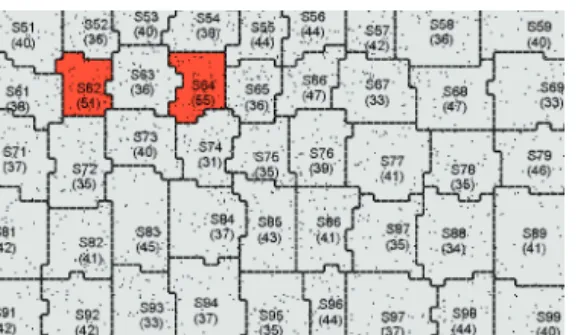
Fig. 2. A screenshot of a part of the virtual environment. The two numbers within each partition indicate the server ID (outside braces) and the current load value (inside braces), that is, the number of users. The two partitions in red color represent overloaded regions, as their load values exceed 50.
the delay fromSi to Sj is the same as that fromSj toSi.)tcompis the computation time taken bySi to
compute the balancing flows.
This load balancing interval defines the shortest time interval that we may perform the load balanc-ing process in the local or the global diffusion method without incurrbalanc-ing the load fluctuation problem mentioned above.
4. EXPERIMENTAL RESULTS AND EVALUATIONS
To evaluate the performance of the proposed methods, we have implemented a simulation environment of a DVE in C++. The testing platform is a PC with an Intel Core i7 2.80GHz CPU and 6GB RAM. We have simulated a VE of 1,000m×1,000min size. It is subdivided into a set of 100×100 cells. Hence, the size of each cell is 10m×10m. The cells are then divided into 100 partitions and managed by 100 servers. The load of a partition is quantified by the number of users within it. We assume that each server can serve a maximum of 50 users without being overloaded. (Note that this is a tunable parameter depending on the computation performance of the server.) Figure 2 shows a screenshot of a part of the simulated VE, with each dot representing a user.
To simulate the movement of users in the VE, we may adopt therandom waypoint mobility model
[Johnson and Maltz 1996], which is widely used in mobile networking research for testing routing algo-rithms. The key feature of this mobility model is that the next destination, called a waypoint, to which a user will head to as he reaches the current one is a randomly chosen location within the VE. However, this model may not be accurate enough to model avatar mobility in DVEs, as pointed out by Liang et al. [2009] based on their measurement study in Second Life and Pittman and GauthierDickey [2010] based on their measurement study in World of Warcraft. Pittman and GauthierDickey [2010] suggest that a nonuniform distribution like the log-normal distribution (similar to the power law distribution) of waypoint choices, rather than the uniform distribution used in the random waypoint mobility model, is more accurate for avatar mobility modeling. Based on this suggestion, we introduce some hotspots to the VE as potential waypoints. In our simulation, we follow the 80–20 rule of the power law that we set the number of randomly distributed hotspots to 20% of the total number of partitions and we set the probability for a user to choose anyone of the hotspots as his waypoint to 80% and a randomly generated waypoint to 20%. We have created 4,000 users to move around in the VE, whose initial loca-tions are randomly chosen. Each user repeatedly selects a waypoint and then moves to it with a speed randomly chosen from a speed range. We use two speed ranges in our experiments: a slow speed range of [0, 3m/s] to model human walking speeds, referred to as theslow scenario, and a high speed range of [0, 10m/s] to model human running speeds, referred to as the rapid scenario. The slow scenario
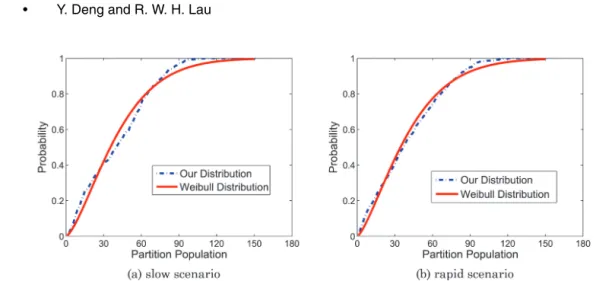
Fig. 3. Cumulative distribution of partition population.
is to test the load balancing method during normal situation, while the rapid scenario is to test the load balancing method under a more extreme situation. In particular, the rapid scenario may be used to simulate a demanding situation of a massively multiplayer online game (e.g., World of Warcraft), while the slow scenario may be used to simulate a less demanding situation of a social network virtual world (e.g., Second Life), according to the report in Machado et al. [2010].
To study how non-uniform the users are distributed in our simulation, we have captured the num-ber of users (population) in each partition. Here, we spatially divide the entire VE evenly into 100 partitions. Figure 3 shows the cumulative distribution function (CDF) of the partition population for each scenario. In the two diagrams, the blue dash-dot curve represents our user distribution while the red solid curve represents the fitted Weibull distribution. According to Pittman and GauthierDickey [2010], the Weibull distribution has been found to be an appropriate model to describe the partition population distribution. From Figures 3(a) and 3(b), we can see that our user distribution is well fitted to the Weibull distribution.
The system frame rate is set to 10. Hence, the system updates the location of each user in the VE every 0.1s. The total duration of the experiments is 1,000 seconds. Typically we run the simulation for a while so that the DVE system is stabilized before we begin to capture the performance information. We use the following metrics to evaluate the performance of the load balancing methods.
—Number of overloaded servers (NOS). This counts the number of servers getting overloaded within
a certain period of time. Here, we add up the total number of overloaded servers over 1 second. (If a server is overloaded in 3 frames out of a second, it is counted as 3 overloaded servers.) We then divide this number by the frame rate, that is, 10, to obtain the NOSvalue. This metric is to evaluate
the ability of the load balancing method in avoiding server overloading and should be as low as possible.
—Number of migrated users (NMU). This counts the number of users being migrated per second.
Mi-grating a large number of users consumes network bandwidth and may affect the interactivity expe-rienced by the users being migrated. This metric is to evaluate the transmission overhead induced by the load balancing method and should be as low as possible.
4.1 Experiment #1: Comparison on Load Balancing Performance
In this experiment, we compare the performance of the two proposed load balancing methods with three existing methods: the adaptive partitioning method [Ng et al. 2002], which is a purely local
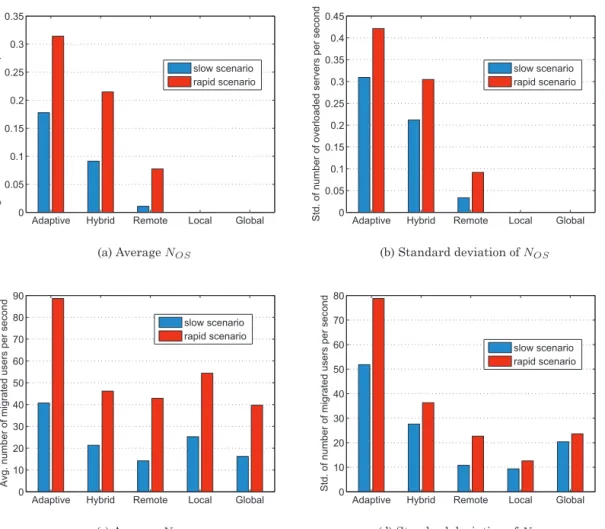
Fig. 4. Comparison of theNOSandNMUperformances, whenTintvl= 0.1s.
method, the hybrid load balancing method [Lau 2010], which is based on Ng et al. [2002] but with added global information to guide load redistribution, and the method proposed in Chen et al. [2005], which is similar to Ng et al. [2002] but allows load migration from an overloaded server to nonneighbor underloaded servers. To simplify the discussion, we refer to our local diffusion method asLocal, our global diffusion method asGlobal, the adaptive partitioning method [Ng et al. 2002] asAdaptive, the hybrid method [Lau 2010] asHybrid, and the method in Chen et al. [2005] that allows remote load migration asRemote. We ignore the network delay among the servers in this experiment by assuming that they are located within the same LAN, so that we may focus on comparing the load balancing performance of these methods. We experiment two load balancing intervals, 0.1s(or 1 frame) and 1s
(or 10 frames). InGlobal, the convergence thresholdθconv as discussed in Section 3.3 is set to 0.2 and 0.1 when the load balancing interval is set to 0.1sand 1s, respectively. These are the optimal values that we obtain from Experiment #4 to be discussed in Section 4.4. In this experiment, both the slow and the rapid scenarios are tested.
Figure 4 compares the NOSand NMU performances of the five methods when the load balancing
NOS performance of each method. We can see thatAdaptivehas the highest average NOS value than
the other methods. This shows that without any global information,Adaptiveis not able to redistribute the load well and hence causes frequent server overloading. With the guidance of global information in load redistribution,Hybridperforms better thanAdaptive.Remoteallows load migration among non-neighbor servers, making it easier to resolve server overloading. We can see that Remote has lower average NOS value than those of Adaptive and Hybrid. On the other hand, Local and Global have
no server overloading observed during the whole period, that is, their average NOS values are zero.
This indicates that the heat diffusion approach is effective in DVE load balancing. Although Local
is a local method, it can diffuse the load among the servers over time effectively. We have also mea-sured the standard deviation of theNOSvalues for each method as shown in Figure 4(b) for reference.
Figure 4(c) shows the correspondingNMU performance of each method. We can see thatAdaptivealso
has a higherNMU value than the other four methods. This is because if the servers get overloaded
fre-quently, more users will need to be migrated among the servers. The other four methods have similar
NMU performance. We may also see thatLocalhas a larger NMU value thanGlobal. This is because
Localonly performs one iteration during each load balancing process, whileGlobalperforms many it-eration (until converged), which helps reduce load discrepancy among servers in a shorter time. Again, we show the standard deviation of theNMUvalues of each method in Figure 4(d). From Figures 4(a) and
4(c), we observe that as the users move faster (in the rapid scenario), the averageNOSandNMU values
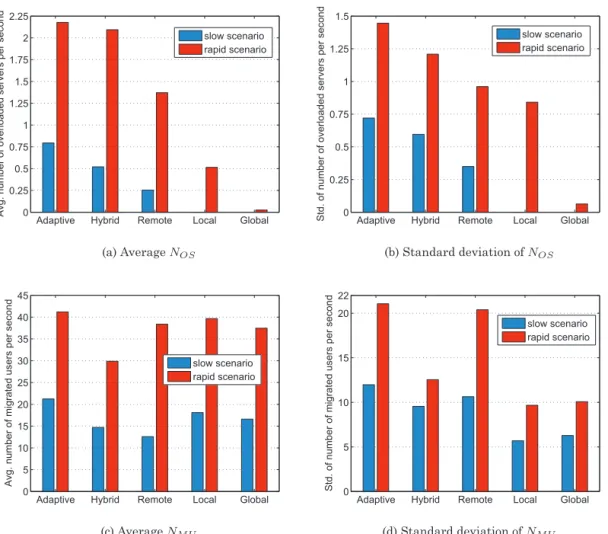
for all methods become higher, compared to those in the slow scenario. This is because as the users move faster, it generally takes a shorter time for the users to move across partition boundaries, and hence for the servers to get overloaded. Overall, this part of the experiment shows that the heat diffu-sion approach for DVE load balancing is more effective, withGlobaloutperforming the other methods. Figure 5 shows similar experimental results as Figure 4, except that the load balancing interval is now set to 1s(i.e., when the load balancing process is executed once every 10 frames). This is to study the NOS and NMU performances of the five methods as we execute the load balancing process
less frequently. Figure 5(a) shows that all five methods now have higher averageNOSvalues compared
to Figure 4(a). This is mainly because the loads of the servers become more imbalanced as we execute the load balancing process less frequently. In particular,Adaptive,HybridandRemotenow have much higher averageNOSvalues in the rapid scenarios, whileLocalandGlobalbegin to see some overloaded
servers in the rapid scenario. Figure 5(b) shows the standard deviation of the NOS values for each
method for reference. Figure 5(c) shows that the averageNMU are all lower than those in Figure 4(c).
This is due to the reduced number of load balancing processes from 10 per second to 1 per second. We can also see that all five methods now have similar NMU values. Figure 5(d) shows the standard
deviation of theNMU values for each method.
Overall, this experiment shows that the heat diffusion approach for DVE load balancing is more effective thanAdaptive,Hybrid, andRemote. They can significantly reduce the number of overloaded servers. In particular,Globaloutperforms all the other methods.
4.2 Experiment #2: Comparison on Computation Time
In this experiment, we compare the computation times of the five methods. Table I shows the average computation time of each load balancing process for each method when the load balancing interval is set to 0.1sand 1s. We can see that the computation times of our proposed methodsLocalandGlobal
are comparable to those ofAdaptive and Hybrid. Remotehas a relatively higher (roughly ten times higher) computation time than the others. This is mainly becauseRemotehas an extra partition ag-gregation process to correct the isolated locality disruption caused by remote cell migration between non-neighbor partitions. We may also see that there is a small increase in computation times as we increase the moving speed from the slow scenario to the rapid scenario or the load balancing interval
Fig. 5. Comparison of theNOSandNMUperformances, whenTintvl=1s.
Table I. The Average Computation Time (inms) of Each Load Balancing process
slow scenario rapid scenario
Adaptive Hybrid Remote Local Global Adaptive Hybrid Remote Local Global Tintvl=0.1s 1.1 1.2 13.4 1.0 1.6 1.1 1.2 14.1 1.0 1.6
Tintvl=1s 1.2 1.4 14.8 1.0 1.6 1.5 2.1 15.0 1.0 1.8
from 0.1sto 1s. The reason may be that either increasing the moving speed or the load balancing in-terval causes a higher degree of load imbalance. As a result, it takes longer for the methods to achieve load balance. Overall, our proposed methods are efficient compared to existing methods and can be executed in every frame without affecting the interactivity of the DVE system.
4.3 Experiment #3: Performance Against Network Latency
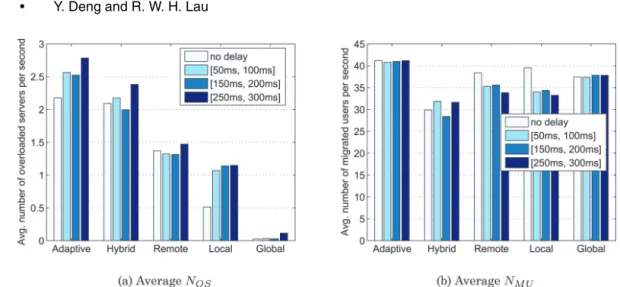
In order to apply the proposed load balancing methods in a real world DVE system, where some of the servers may be distributed across the globe, we need to consider the impact of network delay existed among the servers. This experiment studies the performance of our two methods in the presence of
Fig. 6. NOSandNMUperformances under different ranges of network delay.
network delay. We consider four ranges of network delay: no delay, [50ms,100ms], [150ms,200ms], and [250ms,300ms]. The first one is an ideal situation where there is no delay among the servers. The last one, that is, [250ms,300ms], represents a high latency environment and models the situation where the servers are connected through the Internet. To setTintvl, we may considerGlobal, which is most
affected by the network delay. The maximum time needed to run the whole load balancing process is around 900mswhen considering the above delay settings according to Equation (12). Hence, we may safely set the load balancing interval to 1s. For the convergence threshold, we use the same setting as in Experiment #1, that is,θconv=0.1 forGlobal.
Figure 6 comparesLocalandGlobalon the average NOSandNMU values under different ranges of
network delay. (We have also included the corresponding values fromAdaptive, Hybridand Remote
here for reference.) Figure 6(a) shows that as the network latency increases, the average NOS values
of all methods also increase in general. This is because the load information that the servers receive for computing the balancing flows ages as the network latency increases. Hence, the load balancing solutions produced become less accurate, causing more servers to get overloaded. Figure 6(b) shows that as the network latency increases, the averageNMU value ofLocalappears to be decreasing while
that ofGlobaldoes not change much. In both situations, the range of variation is within around 15%, which is too small to give a conclusion. Hence, we have conducted a similar experiment withTintvl =3s
and more ranges of network delay. We have found that when the load balancing interval is fixed, the averageNMU values of both methods only fluctuate within a small range as we increase the network
latency. Similar results can also be observed from the other three methods. Hence, we may conclude that the averageNMU values are not affected by the network latency. This may be explained as follows.
When the load balancing solutions are not accurate due to load information aging, some servers may actually transfer more load than necessary while other may transfer less load than required. Hence, the average number of migrated users remains more or less the same.
4.4 Experiment #4: Performance Against Convergence Threshold
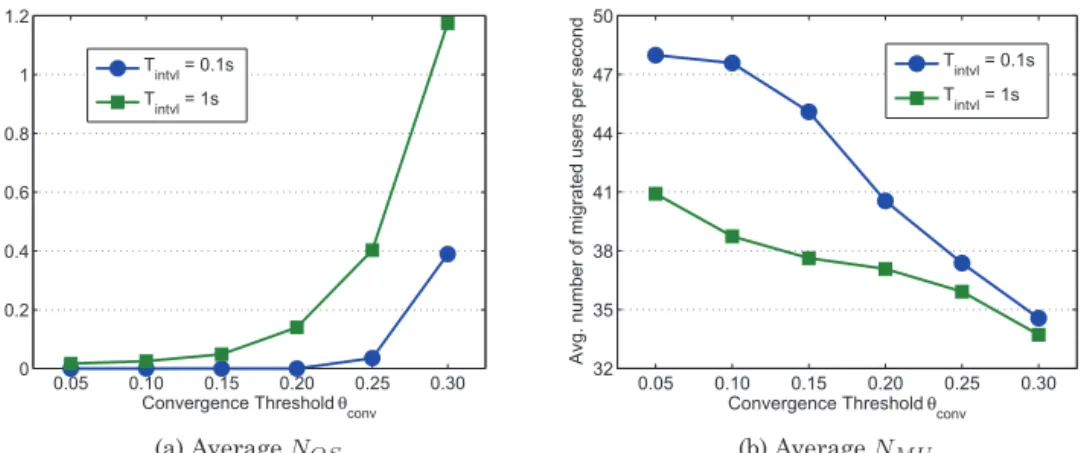
In this experiment, we study the effect of the convergence threshold, θconv, on our global diffusion
method in terms ofNOS and NMU. Figure 7(a) shows that as we increase the convergence threshold,
theNOSvalue also increases. This is because increasing the convergence threshold allows higher load
deviations among the servers, making it easier for the servers to get overloaded. We can also see that if we increase the load balancing interval from 0.1sto 1s, theNOSvalue also increases, which agrees with
Fig. 7. NOSandNMUperformances of our global diffusion method for variousθconvsettings.
the results shown in Experiment #1. Figure 7(b) shows that as we increase the convergence threshold, the NMU value decreases. This is because increasing the convergence threshold allows higher load
deviations among the servers and hence requires less load to be transferred in order to achieve a load balancing state. In addition, if we increase the load balancing interval from 0.1sto 1s, the NOSvalue
also increases. This is due to the increase in load deviation among the server as a result of the increased load balancing interval.
Overall, we have found that the total number of migrated users is very small, even for small con-vergence threshold values. In practice, if we duplicate all user information, including the geometry representing the avatars, in each local server, we only need to transfer an average of 48 user IDs and locations among the local servers whenθconv = 0.05 and Tintvl = 0.1s. This is only a small amount of
data for transmission. Hence, to determine an appropriate convergence threshold value, we only need to consider the number of overloaded servers in Figure 7(a). When Tintvl = 0.1s, we find that there
is a critical point when the convergence threshold value is at around 0.2. From 0 to 0.2, the slope of the curve is very gentle. After 0.2, the slope increases significantly. Hence, the optimal convergence threshold value would be 0.2 when the load balancing interval is set at 0.1s. Likewise, the optimal convergence threshold value would be 0.1 when the load balancing interval is set at 1s.
4.5 Evaluations
We have compared our two heat diffusion based methods with three existing DVE load balancing meth-ods. Results show that our methods are more effective than these methods in reducing the numbers of overloaded servers. In general, they also produce low numbers of migrated users. Even though our methods are more effective, their computational costs are comparable to the other methods. In terms of implementation efforts, these existing methods that we compare with are all based on heuristics. There are a lot of exceptional cases needed to be handled. On the other hand, the heat diffusion based methods have very simple concept and there is no need to handle any exceptional cases.
Comparing the two proposed methods, the main difference between the two methods is that in each load balancing process, the local diffusion method computes a single iteration of load balancing flows and then executes the load balancing flows, while the global diffusion method computes many itera-tions of load balancing flows until the results converge before executing the load balancing flows. From our experimental results, the global method has a lower number of overloaded servers than the local method, while the two methods have similar numbers of migrated users. The computation overheads
of both methods are very small. Overall, the global method has a clear performance advantage over the local method.
However, the global method also has its limitations compared with the local method. First, it requires a central server/process to collect load information from all servers, compute the load balancing flows and then distribute the load balancing flow values to the local servers. This central server/process can potentially become a single point of failure. One simple solution to address this limitation is that whenever the DVE system detects a failure in the central server/process, each local server may initiate the local diffusion process to perform local load balancing. Due to the similarity of the two methods, such a dynamic change in the load balancing methods is expected to be straightforward. Second, the global method suffers a higher overall delay (i.e., a single-trip delay to collect load information from all servers, a single-trip delay to distribute the load balancing flows to all servers and a single-trip delay to perform the load balancing with neighbor servers) than the local method (i.e., a single-trip delay to collect the load information from the neighbor servers and a single-trip delay to perform the load balancing with the neighbor servers), as discussed in Section 3.4. This overall delay affects the setting of the load balancing interval. Our experimental results show that a higher load balancing interval leads to a small increase in the number of overloaded servers.
Server overloading occurs as a result of users moving around causing uneven load distribution among the servers. A higher user mobility leads to a higher uneven load distribution and there-fore a higher chance of server overloading. There are different types of DVE applications. Some may have a higher user mobility, causing a higher computation overhead. Massively multiplayer online games are generally considered as the most demanding applications due to their high user mobility. As we have demonstrated in this article, our proposed methods perform well in the extreme situation where users move rapidly. We believe that these methods can also be applied to other DVE applications such as social network virtual worlds, which in general have relatively lower user mobility.
5. CONCLUSION
In this article, we have proposed a new dynamic load balancing approach for DVEs based on the heat diffusion model. We have investigated two dynamic load balancing methods based on the approach, a local load balancing method and a global load balancing method. In the local method, each local server performs load balancing with its own neighboring servers based on their load information. In the global method, a central server/process determines how each local server should perform the load balancing using the load information of all servers and then instructs each local server to carry out the suggested load balancing with its neighboring servers. We have analyzed two practical factors of the proposed methods, the convergence threshold and the load balancing interval.
The main advantage of our heat diffusion based load balancing approach is that it is extremely simple. As a result, it is also very efficient as demonstrated by our experimental results. In addition, our results show that the two proposed load balancing methods perform better than some existing methods, in terms of the number of overloaded servers and the number of migrated users. Overall, the global method performs better than the local method.
ACKNOWLEDGMENTS
We would like to thank all the anonymous reviewers for their helpful and constructive comments. REFERENCES
J. Boillat. 1990. Load balancing and Poisson equation in a graph.Concurrency: Practice Experi.2, 4, 289–313.
J. Chen, B. Wu, M. Delap, B. Knutsson, H. Lu, and C. Amza. 2005. Locality aware dynamic load management formassively multiplayer games. InProceedings of the ACM SIGPLAN Symposium on Principles and Practice of Parallel Programming. 289–300.
G. Cybenko. 1989. Dynamic load balancing for distributed memory multiprocessors.J. Parallel Distrib. Comput.7, 2, 279–301. Y. Deng and R. Lau. 2010. Heat diffusion based dynamic load balancing for distributed virtual environments. InProceedings of
the ACM Symposium on Virtual Reality Software and Technology. 203–210.
Y. Deng and R. Lau. 2012. On delay adjustment for dynamic load balancing in distributed virtual environments.IEEE Trans. Visual Comput. Graph.18, 4, 529–537.
G. Horton. 1993. A multi-level diffusion method for dynamic load balancing.Parallel Comput.19, 2, 209–218.
Y. Hu and R. Blake. 1998. The optimal property of polynomial based diffusion-like algorithms in dynamic load balancing. In Computational Dynamics’98, K. D. Papailiou et al., Ed., Wiley. 177–183.
Y. Hu and R. Blake. 1999. An improved diffusion algorithm for dynamic load balancing.Parallel Comput.25, 4, 417–444. Y. Hu, R. Blake, and D. Emerson. 1998. An optimal migration algorithm for dynamic load balancing.Concurrency: Practice
Experi.10, 6, 467–483.
D. Johnson and D. Maltz. 1996. Dynamic source routing in ad hoc wireless networks.Mobile Comput.353, 153–181. R. Lau. 2010. Hybrid load balancing for online games. InProceedings of ACM Multimedia. 1231–1234.
K. Lee and D. Lee. 2003. A scalable dynamic load distribution scheme for multi-server distributed virtual environment systems with highly-skewed user distribution. InProceedings of the ACM Symposium on Virtual Reality Software and Technology. 160–168.
H. Liang, R. De Silva, W. Ooi, and M. Motani. 2009. Avatar mobility in user-created networked virtual worlds: measurements, analysis, and implications.Multimedia Tools Appl.45, 1, 163–190.
F. Lin and R. Keller. 1987. The gradient model load balancing method.IEEE Trans. Softw. Eng.1, 32–38.
J. Lui and M. Chan. 2002. An efficient partitioning algorithm for distributed virtual environment systems.IEEE Trans. Parallel Distrib. Syst.13, 3, 193–211.
F. Machado, M. Santos, V. Almeida, and D. Guedes. 2010. Characterizing mobility and contact networks in virtual worlds. In Proceedings of the International Conference on Facets of Virtual Environments. 44–59.
S. Muthukrishnan, B. Ghosh, and M. Schultz. 1998. First- and second-order diffusive methods for rapid, coarse, distributed load balancing.Theory Comput. Syst.31, 4, 331–354.
B. Ng, A. Si, R. Lau, and F. Li. 2002. A multi-server architecture for distributed virtual walkthrough. InProceedings of the ACM Symposium on Virtual Reality Software and Technology. 163–170.
C. Ou and S. Ranka. 1997. Parallel incremental graph partitioning.IEEE Trans. Parallel Distrib. Syst.8, 8, 884–896.
D. Pittman and C. Gauthierdickey. 2010. Characterizing virtual populations in massively multiplayer online role-playing games. InProceedings of the International Conference on Advances in Multimedia Modeling. 87–97.
K. Prasetya and Z. Wu. 2008. Performance analysis of game world partitioning methods for multiplayer mobile gaming. In Proceedings of the ACM Workshop on Network and System Support for Games. 72–77.
A. Steed and R. Abou-Haidar. 2003. Partitioning crowded virtual environments. InProceedings of the ACM Symposium on Virtual Reality Software and Technology. 7–14.
D. Ta, S. Zhou, W. Cai, X. Tang, and R. Ayani. 2009. Efficient zone mapping algorithms for distributed virtual environments. In Proceedings of the ACM/IEEE/SCS Workshop on Principles of Advanced and Distributed Simulation. 137–144.
D. Ta, S. Zhou, W. Cai, X. Tang, and R. Ayani. 2011. Multi-objective zone mapping in large-scale distributed virtual environments. J. Netw. Computer Appl.34, 2, 551–561.
B. Van Den Bossche, B. De Vleeschauwer, T. Verdickt, F. De Turck, B. Dhoedt, and P. Demeester. 2009. Autonomic microcell assignment in massively distributed online virtual environments.J. Netw. Computer Appl.32, 6, 1242–1256.
J. Watts and S. Taylor. 1998. A practical approach to dynamic load balancing.IEEE Trans. Parallel Distrib. Syst. 9, 3, 235–248. M. Willebeek-Lemair and A. Reeves. 1993. Strategies for dynamic load balancing on highly parallel computers.IEEE Trans.
Parallel Distrib. Syst.4, 9, 979–993.