Political Science Publications
Political Science
2018
Utilizing Multivariate Analysis for Assessing
Student Learning Through Effective
College-Industry Partnerships
Caleb Burns
DanfossShweta Chopra
Iowa State University, [email protected]
Mack C. Shelley II
Iowa State University, [email protected]
Gretchen A. Mosher
Iowa State University, [email protected]
Follow this and additional works at:
https://lib.dr.iastate.edu/pols_pubs
Part of the
Agriculture Commons
,
Higher Education Commons
,
Political Science Commons
,
and the
Systems Engineering Commons
The complete bibliographic information for this item can be found at
https://lib.dr.iastate.edu/
pols_pubs/53
. For information on how to cite this item, please visit
http://lib.dr.iastate.edu/
howtocite.html
.
This Article is brought to you for free and open access by the Political Science at Iowa State University Digital Repository. It has been accepted for inclusion in Political Science Publications by an authorized administrator of Iowa State University Digital Repository. For more information, please [email protected].
Utilizing Multivariate Analysis for Assessing Student Learning Through
Effective College-Industry Partnerships
Abstract
There is no doubt that college–industry collaborations are vital to the success of undergraduate students with engineering and technology majors. This collaboration provides students with an opportunity to bridge the gap between classroom education and real-world experience. Inviting industry representatives to engage in the classroom and involving students with professional organizations, student field trips, virtual plant tours, and industry-focused final projects are ways in which an instructor can incorporate student–industry engagement into their course. During their undergraduate degree program, students are required to participate in an internship program where they gain substantial industry engagement and opportunities to learn and apply classroom knowledge
Keywords
student learning, industry engagement, case study, guest speaker; internship; MANOVA
Disciplines
Agriculture | Higher Education | Political Science | Systems Engineering
Comments
This article is published as Burns, C., Chopra,S., Shelley,M, Mosher, G. Utilizing Multivariate Analysis for Assessing Student Learning Through Effective College-Industry Partnerships.Journal of STEM Education. 2018, 19(3); 27-32. Posted with permission.
J o u r n a l o f S T E M E d u c a t i o n V o l u m e 1 9 • I s s u e 3 J u l y - A u g u s t 2 0 1 8
27
Utilizing Multivariate Analysis for Assessing Student
Learning Through Effective College-Industry Partnerships
Caleb Burns
Shweta Chopra Mack Shelley Gretchen Mosher
Danfoss
Iowa State University
Abstract
There is no doubt that college–industry collabora-tions are vital to the success of undergraduate students with engineering and technology majors. This collabora-tion provides students with an opportunity to bridge the gap between classroom education and real-world expe-rience. Inviting industry representatives to engage in the classroom and involving students with professional orga-nizations, student field trips, virtual plant tours, and indus-try-focused final projects are ways in which an instructor can incorporate student–industry engagement into their course. During their undergraduate degree program, stu-dents are required to participate in an internship program where they gain substantial industry engagement and op-portunities to learn and apply classroom knowledge. To assess the impact of industry engagement on student learning, we disseminated a survey instrument among undergraduate students to identify which activities had the most and least impact on student learning. For this study, we analyzed student perceptions of the effec-tiveness of industry engagement activities using multivar-iate analysis of variance. The objective was to determine which industry engagement activities are more effective when looking at student learning. The data gathered in-cluded survey responses from senior-level technology stu-dents at Iowa State University along with their comments about the various activities. Results indicate that there is a difference in students’ perception of how various industry engagement activities impact their learning.
Keywords: student learning; industry engagement; case study; guest speaker; internship; MANOVA
Introduction
Industry engagement activities have been used along-side lectures and lab assignments to provide students with the best possible learning experiences, allowing students to acquire the knowledge and experience necessary to become successful professionals upon graduation. In this study, we focused on student’s perception of the impact on their learning of several industry engagement activi-ties, including case studies, guest speakers, internships,
industry tours, industry-focused projects, professional organization involvement, and industry-focused videos as studied by Burns and Chopra (2017). Six aspects of student learning were targeted in the analysis: workplace culture, skills used/applied, daily job duties, applicable coursework, pursuing a career in the field, and learning about a potential employer. These six aspects of learning were drawn from previously validated surveys that mea-sured student learning (Haag, Guilbeau, & Goble, 2006; Metrejean, Pittman, & Zarzeski, 2002; Rodrigues, 2004; Watson & Lyons, 2011).
Review of Literature
Prior studies have suggested or empirically tested the link between engagement activities and student learn-ing. Students take what they learn from these industry engagement activities and apply them after graduation to become better professionals. Case studies are incorpo-rated in the syllabus and used throughout the semester to explain key concepts. Guest speakers are invited dur-ing the semester to come and discuss their experience. Every graduating student in the program is required to participate in internships before graduation. Industry tours are done through online videos and a physical visit to the facilities. Facilities are chosen close to campus so students can participate during class time. As a course a requirement, students will participate in a 6-week long industry-based project, the scope of which is defined by the instructor. Class time is provided for students to work in groups to complete the project. Students are also made aware of existing professional organizations so that they can choose to participate. Each of these aspects of learn-ing is discussed below.
Workplace Culture
Workplace culture is defined as the most immediate social context that staff experience through everyday in-teractions within the work environment (Manley, Sand-ers, Cardiff, & Webster, 2011). Workplace culture includes, but is not limited to, company policies, company mission and values, work environment, coworkers, how workers behave and make decisions, and communication among workers (McShane & Von Glinow, 2015). Through another
survey in which 631 students and 58 faculties responded, it was found that students obtain information about workplace culture by hearing about these different guest speakers’ personal experiences in the workplace (Ro-drigues, 2004). Various empirical studies in which more than 50 students participated found that students gain a greater understanding of the workplace and how workers interact on a daily basis during internships and projects (Fleming & Eames, 2005; Haag et al., 2006; Schambach & Dirks, 2002; Thomas, 2000). During tours, students can view and better understand the physical layout, process-es, and operations of the company (Sivan, Wong Leung, Woon, & Kember, 2000).
Skills Used/Applied
The level of understanding of the skills used in the workplace changes from when individuals are in college to when they are working in the industry (Park & Cha, 2013). Herrid (1994) proposed that students can simu-late decision-making, communication, and analytical skills through the use of case studies. When listening to guest speakers, students learn about teamwork, problem-solving, communication, and self-management skills; while at internships, students develop communication, time-management, teamwork, and problem-solving skills (Schambach & Dirks, 2002; Smith et al., 2009).
Daily Job Duties
Job duties are defined as tasks assigned to a worker that are expected to be completed within a specified amount of time (McShane & Von Glinow, 2015). Daily job duties may differ depending on what activity/personnel the students are observing/talking to, so it is important for students to have multiple engagements with indus-try. Guest speakers share their experiences with students about their job duties (Riebe, Sibson, Roepen, & Meakins, 2013). Learning about daily job duties during an intern-ship contributes to a student’s desire to pursue a career in that specific field. They are also able to see what other kinds of duties are asked of other workers around them (Guler & Mert, 2012). Similarly, while on tours, students observe workers and the various duties they have (Patil et al., 2012). Finally, while working on projects, students
gain insights on what kinds of tasks need to be completed before a project moves forward (Jollands, Jolly & Moly-neaux, 2012).
Applicable Coursework
Applicable coursework includes discipline-specific concepts, analytical methods, programs, and techniques learned from lectures or other teaching methods (Sivan et al., 2000). This coursework qualifies students for certain jobs after graduation (Smith et al., 2009). Through guest speakers and internships, students gain an understand-ing of how their coursework applies in the real world (Rodrigues, 2004; Cates and Jones, 1999). Leicht, Zappe, Hochstedt, and Whelton (2015) also proposed that stu-dents incorporate classroom learning while completing various stages of the project.
Pursuing Careers in the Field
Industry engagement activities provide students with an idea of the different kinds of careers they will be able to pursue upon graduation (Metrejean et al., 2002). Listening to guest speakers helps students to learn about the speakers’ daily work, role and responsibility (Guler & Mert, 2012; Patil et al., 2012; Rodrigues, 2004). Plant tours provide an opportunity to observe classroom learning in practice (Rodrigues, 2004).
Learning about Potential Employers
Industry engagement activities allow students to interact with company personnel and learn about how large companies function, the goods they produce, or the services they provide. Allowing students to become engaged with industry personnel provides them with an opportunity to pose specific questions to industry personnel, thereby increasing student knowledge of that company. Students also learn details about potential em-ployers when listening to guest speakers talk about their experiences with the current company (Goldberg, Vikram, Corliss, & Kaiser, 2014) and during internships and tours (Haag et al., 2006; Sivan et al., 2000).
Research Methodology
Research QuestionThe research question guiding this study was: Do stu-dents perceive differences in the impact of various indus-try engagement activities on their learning? The indusindus-try engagement activities included in this study: case studies, guest speakers, internships, professional organization in-volvement, projects, tours, and videos.
Six aspects of student learning were considered: workplace culture, skills used/applied, daily job duties, applicable coursework, pursuing a career in the field, and learning about a potential employer.
Instrument Development
We collected the data for this research utilizing a questionnaire-based survey, which was comprised of survey questions obtained from various validated ques-tionnaire items (Haag et al., 2006; Metrejean et al., 2002; Rodrigues, 2004; Watson & Lyons, 2011). In the survey, we used the term “industry engagement activities” to collectively account for case studies, internships, industry tours, industry videos, industry-focused final projects, professional organization involvement, and guest speak-ers. Using a seven-point Likert-type scale ranging from 1
(strongly disagree) to 7 (strongly agree) and 0 being neu-tral, the undergraduate students in industrial technology or agricultural systems technology who participated in this study responded to the survey items by indicating their perceptions of the effect of different industry en-gagement activities on six aspects of student learning. Not applicable (NA) was available as one of the responses for students if they have not been engaged in some activi-ties. The seven-point Likert-type scale is most suited for electronically distributed surveys and achieves greater data granularity of exploratory research (Finstad, 2010). Furthermore, research suggests that seven-point scales have stronger correlations with t-test results (Allen & Sea-man, 2007).
Face validity measures how easy it is for respondents to comprehend the survey items (DeVon et al., 2007). We assessed face validity by tapping into the expertise of field experts as well as through 20 hours of meetings with sev-eral students with characteristics similar to those in the target sample group but who did not participate in the final sample. Through these efforts, the survey became robust and easy to understand.
Content validity of the survey questionnaire ensures that the instrument measures what it is intended to mea-sure. Content validity was assessed by subject-matter experts (Lawshe, 1975), which included three graduate students and three faculties with subject matter research expertise. We asked this team to assess face and content validity to ensure that the questions are easy to under-stand and measure the students’ skills gained through various aspects of industry engagement activity. We constructed the survey instrument using Qualtrics (Copyright © 2015), an online survey software used for data collection. We sent a consent form and the survey to students via their campus e-mail, which we determined was the best way to collect data because all of the stu-dents had access to e-mail through the university. Once students completed the consent form, the questionnaire opened. Students could close the survey at any time.
Sampling
We adopted a respondent selection technique in which researchers used their judgment in choosing a group that was representative of the entire population (Kothari, 2004). Using this technique, we selected a senior level technology class for lean manufacturing in
which students had already participated in most industry engagement activities. We confirmed students’ industry engagement experience by reviewing the class syllabus. The students surveyed were all seniors pursuing a degree in industrial technology, agricultural systems technology, or a dual major in both industrial and agricultural systems technology. Students pursuing these academic degrees are required to undertake an internship as part of their degree program.
The criterion used for selecting students was whether they had participated in industry engagement activities during their coursework. For this study, we used a senior-level class knowing that the students had participated in various industry engagement activities. We provided students with a brief introduction to the research and the impact their participation would have on the study. The introduction provided an overview of the research study, a brief overview of the information to be collected, and the purpose of data collection.
We sent the survey to 75 students, of which 61 com-plete responses were returned for a response rate of 86%. These 61 completed responses were from the students who had participated in all the engagement activities. The high response rate could be attributed to the follow-ing: (a) the first author visited the participating class and provided a brief overview of the project, (b) the individual faculty member teaching the class sent out an email to encourage students to participate in the study, and (c) e-mail dissemination provided students with flexibility to complete the survey at their convenience.
Hypothesis
H01: The mean scores for student perceptions of activities are equal
HA1: The mean scores for student perceptions of activities are different for at least two activities
We evaluated the findings related to these hypoth-eses using multivariate analysis of variance (MANOVA) to compare student perception scores across the activities. The null hypothesis states that the mean scores from all the activities are equal and that there is no difference in perceived impact on student learning among the activi-ties. The alternative hypothesis states that at least one of the mean scores for an activity is not equal to the mean for at least one other activity, providing statistical evidence that students perceive some activities as being more ef-fective at enhancing student learning.
Results
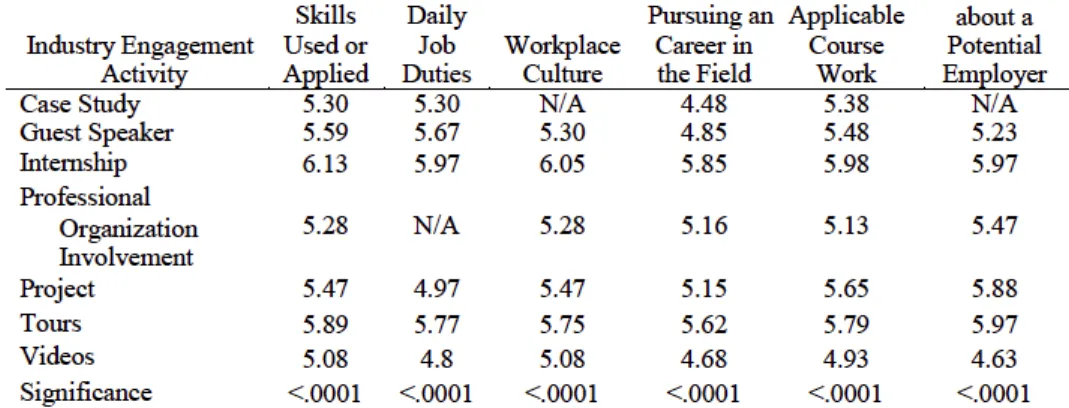
The mean score for each activity according to what kind of learning students were rating as well as the sig-nificance level (p-value < 0.05) of the results are provided in Table 1. The p-value shows that there is a statistically
J o u r n a l o f S T E M E d u c a t i o n V o l u m e 1 9 • I s s u e 3 J u l y - A u g u s t 2 0 1 8
29
significant difference in the mean scores for each aspect of student learning.
Because the findings revealed that all aspects of student learning showed significant differences among mean scores for the activities, we calculated post hoc comparisons. The results are shown in Table 2 in the form
of a connecting letter report, which shows which activities were statistically similar and which ones were statistically different in terms of their perceived impact on student learning. We assigned the same letter to activities whose mean scores were not statistically different. Likewise, we assigned different letters to activities whose mean scores
were statistically different from each other. The MANOVA analysis results for each aspect of student learning are presented next, and the corresponding MANOVA results are provided in Tables 3-8.
The findings shown in Table 3 indicate that there is a significant difference in students learning about skills used or applied among the activities [F(6,414) = 5.88,
p < .05]. Post hoc comparisons using the Tukey-Kramer method indicated that the mean score for internships is significantly different from the mean score for projects, case studies, professional organization involvement, and videos (NIST/SEMATECH, 2003). Also, there is a statisti-cally significant difference between the mean score for tours from the mean scores for videos. These results sug-gest that students attain greater learning through intern-ships, tours, and speakers when learning what skills can be used or applied from their classroom to the real world. Therefore, we rejected the null hypothesis, or accepted the alternative hypothesis that students perceive some activi-ties as being more effective at enhancing student learn-ing.
The findings shown in Table 4 indicate that there is a statistically significant difference in student learning about daily job duties among the activities [F(5,359) = 8.75, p
< .05]. Post hoc comparisons using the Tukey-Kramer method indicated that there was a statistically significant difference between the mean score for internships and the mean scores for case studies, projects, and videos. Also, the results indicated that there is a statistically significant difference between the mean score for projects and the mean scores for tours and guest speakers. These findings suggest that internships, guest speakers, and tours are perceived as having the most positive impact on student learning about daily job duties. In light of these results, we rejected the null hypothesis and accepted the alterna-tive hypothesis that there is a difference in the perceived impact of activities on student learning.
The findings shown in Table 5 indicate that there is a significant difference in student learning about workplace culture among the activities [F(5,354) = 9.21, p < .05)].
Post hoc comparisons using the Tukey-Kramer method in-dicated that there was a statistically significant difference between the mean score for internships and the mean scores for speakers, professional organization involve-ment, and videos. The mean score for tours was statistical-ly different from that of professional organization involve-ment and videos. Finally, there is a statistically significant difference between the mean score for projects and the mean scores for videos. The results suggest that students perceive internships, projects, and tours as having the most impact on their learning about workplace culture. In light of these results, we rejected the null hypothesis, or accepted the alternative hypothesis that students perceive some activities as being more effective at enhancing stu-dent learning.
Table 1. Mean Scores of Industry Engagement Activ Aspect of Student Learning
Table 2. Connecting Letters Report for All Activities and All Aspects of Student Learning
Table 3. MANOVA Results for Questions About Skills Used/Applied
The findings shown in Table 6 indicate that there is a significant difference in perceived impact on learning about pursuing a career in the field among the activities [F(6,415) = 6.88, p < .05].
Post hoc comparisons using the Tukey-Kramer method indicate there is a statistically significant differ-ence between the mean score for internships and the mean scores for speakers, videos, and case studies. The post hoc comparison also showed that there was a sta-tistically significant difference between the mean score for tours and the mean scores for videos and case studies. Thus, the findings indicate that for learning about pursu-ing a career in the field, internships, tours, involvement in professional organizations, and projects had the most per-ceived impact. These results provide evidence to reject the null hypothesis, or accept the alternative hypothesis that students perceive some activities as being more effective at enhancing student learning.
The findings shown in Table 7 indicate that there is a significant difference in perceived impact on learn-ing about applicable coursework among the activities [F(6,413) = 5.64, p < .05].. Post hoc comparisons us-ing the Tukey-Kramer method indicated that there was a statistically significant difference between the mean score for internships and tours from the mean scores for professional organization involvement and videos. Also, there was a statistically significant difference between the mean score for projects and the mean scores for videos.
We found that internships, tours, projects, speakers, and case studies had the most perceived impact on student learning about applicable coursework. Thus, we rejected the null hypothesis, or accepted the alternative hypothesis that students perceive some activities as being more ef-fective at enhancing student learning.
The findings shown in Table 8 indicate that there was a significant difference in perceived impact on learning about a potential employer among the activities [F(5,356) = 10.80, p < .05].. Post hoc comparisons using the Tukey-Kramer method indicated that there was a statistically sig-nificant difference between the mean score for internships and tours and the mean scores for speakers, projects, and videos. Furthermore, the mean score for professional or-ganization involvement was also found to be significantly different from the mean score for videos. Internships, tours, and professional organization involvement had the highest perceived impact on student learning about a po-tential employer. With these results, we rejected the null hypothesis, or accepted the alternative hypothesis that students perceive some activities as being more effective at enhancing student learning.
Discussion
According to the results, students perceive intern-ships as having the biggest impact on the various aspects of student learning they were asked to evaluate. The rest
of the discussion below will compare the perceived im-pact of the other engagement activities, which can be undertaken during scheduled class time. Of these non-internship engagement activities, students perceived tours, guest speakers, and projects as having the biggest impact on their learning. Industry tours allow students to observe workers, experience the industry setting, and understand the applications of certain topics discussed in class. Through these tours, students learn about what they can achieve in the workplace with their major and hear firsthand stories about the industry. Projects show stu-dents how they can incorporate their classroom learning into solving real-world problems.
Students also provided comments about the connec-tion between industry activities and the various aspects of learning. Students indicated that they found industry tours and guest speakers to be most effective concern-ing learnconcern-ing about skills used or applied. One student’s comments about guest speakers included: “I learned a lot about different applications in different workplaces.” Another student stated that going on industry tours was “good experience to learn what [skills] to work on.” In gaining knowledge about daily job duties, students learned the most from tours and guest speakers. One stu-dent commented, “The industry tour gave me a glimpse of what I might want to do or what I will be doing when I start my career.” Another student perceived that guest speakers “were able to share their own experiences from working in a certain field.”
Concerning gaining knowledge about workplace culture, pursuing a career in the field, applicable course-work, and potential employers, students learned the most from tours and projects. Regarding workplace culture, one student noted that tours enabled students “to see how all of the functions in the workplace work together.” With respect to projects, another student commented, “I learned that working with large companies can be very difficult.” With regard to learning about pursuing a career in the field, one student commented, “The tours helped me understand the potential occupations one can have as [a technology major].” Concerning learning about appli-cable coursework, one student’s comment about tours in-cluded, “It’s nice to see things in person and see how stuff that we learn in class is applicable to the real world,” and another student said, “Going on the industry tours were a great way for me to see the things I learned about in a real-life environment.” Regarding learning about potential employers, a student commented that tours “show what a company is like” and introduce students to “many different types of jobs they wouldn’t normally get to see.” The data and comments presented show that stu-dents perceive some industry engagement activities as more effective than others at enhancing different aspects of their learning. In light of these results, we suggest that in addition to the program’s requirement that students do
Table 5. MANOVA Results for Questions About Workplace Culture
Table 6. MANOVA Results for Questions About Pursuing Career in the Field
Table 7. MANOVA Results for Questions About Applicable Course Work
J o u r n a l o f S T E M E d u c a t i o n V o l u m e 1 9 • I s s u e 3 J u l y - A u g u s t 2 0 1 8
31
internships, instructors can incorporate company tours, guest speakers, and projects as industry engagement ac-tivities in the classroom. Even though case studies, profes-sional organization involvement, and videos did not rate as highly, we still found them to be useful.
Identifying and implementing industry engagement activities that enhance student learning will help stu-dents better understand the work environment they can expect to experience after college. There are some areas in which future work should be considered. First, research-ers should review various technology and engineering programs to determine if those at other higher education institutions are producing the same results. Second, we suggest expanding the research to include students at various levels, for example, looking into whether there is a difference in perception between sophomores and seniors as to how various industry engagement activities impact their learning.
References
Allen, I. E., & Seaman, C. A. (2007). Likert scales and data analyses. Quality progress, 40(7), 64.
Cates, C., & Jones, P. (1999). Learning outcomes the educa-tional value of cooperative education. Columbia, MD: Cooperative Education Association, Inc.
DeVon, H. A., Block, M. E., Moyle-Wright, P., Ernst, D. M., Hayden, S. J., Lazzara, D. J., & Kostas-Polston, E. (2007). A psychometric toolbox for testing validity and reliability. Journal of Nursing Scholarship, 39, 155–164.
Finstad, K. (2010). Response interpolation and scale sen-sitivity: Evidence against 5-point scales. Journal of Usability Studies, 5(3), 104-110.
Fleming, J., & Eames, C. (2005). Student learning in rela-tion to the structure of the cooperative experience.
Asia-Pacific Journal of Cooperative Education, 6(2), 26–31.
Goldberg, J., Vikram, C., Corliss, G., & Kaiser, K. (2014). Benefits of industry involvement in multidisci-plinary capstone design courses. International Jour-nal of Engineering Education, 30(1), 6–13. Guler, H., & Mert, N. (2012). Evaluation of internship
pro-grams for educational improvements: a case study for civil engineering. International Journal of Engi-neering Education, 28, 579–587.
Haag, S., Guilbeau, E., & Goble, W. (2006). Assessing engi-neering internship efficacy: Industry’s perception of student performance. International Journal of Engi-neering Education, 22, 257–263.
Herrid, C. F. (1994). Case studies in science: A novel meth-od of science education. Journal of College Science Teaching, 23, 221–229.
Jollands, M., Jolly, L., & Molyneaux, T. (2012). Project-based learning as a contributing factor to graduates’ work readiness. European Journal of Engineering Education, 37, 143–154.
Kothari, C. R. (2004). Research methodology methods and techniques (2nd ed.). New Delhi, India: New Age. Retrieved from http://202.74.245.22:8080/xmlui/ bitstream/handle/123456789/45/C.R._Kothari_ Research
_Methodology_Methods_and_Techniques 2009. pdf?sequence=1
Lawshe, C. H. (1975). A quantitative approach to con-tent validity. Personnel psychology, 28(4), 563-575.
Leicht, R. M., Zappe, S. E., Hochstedt, K. S., & Whelton, M. (2015). Employing an energy audit field context for secnario-based learning activities. International Journal of Engineering Education, 31, 1033–1047. Manley, K., Sanders, K., Cardiff, S., & Webster, J. (2011).
Effective workplace culture: the attributes, enabling factors and consequences of a new concept. Inter-national Practice Development Journal, 1(2), 1–29. McShane, S. L., & Von Glinow, M. A. (2015).
Organiza-tional Behavior (7th ed.) Columbus, OH:McGraw-Hill Education.
Metrejean, C., Pittman, J., & Zarzeski, M. T. (2002). Guest speakers: Reflections on the role of accountants in the classroom. Accounting Education, 11(4), 347– 364.
NIST/SEMATECH (2003). Engineering Statistics Handbook.. Retrieved from http://www.itl.nist.gov/div898/ handbook/prc/section4/prc471.htm
Park, S., & Cha, G. (2013). A study on the assessment of key competencies for automative engineering tech-nology education in Korea. International Journal of Engineering Education, 29, 1192–1198.
Patil, R., Wagner, J., Schweisinger, T., Collins, R., Gramo-padhye, A., & Hanna, M. (2012). A multi-disciplin-ary mechatronics course with assessment: Integrat-ing theory and application through laboratory activ-ities. International Journal of Engineering Education, 28, 1141–1149.
Riebe, L., Sibson, R., Roepen, D., & Meakins, K. (2013). Impact of industry guest speakers on business students’ perceptions of employability skills de-velopment. Industry and Higher Education, 27(1), 55–66. Retrieved from https://doi.org/10.5367/ ihe.2013.0140
Rodrigues, C. A. (2004). The importance level of ten teaching/learning techniques as rated by university business students and instructors. Journal of Man-agement Development, 23, 169–182.
Schambach, T. P., & Dirks, J. (2002, December). Student perceptions of internship experiences.
Paper presented at the International Conference on Informatics Education Research, Barcelona, Spain. Retrieved from http://eric.ed.gov/?id=ED481733 Sivan, A., Wong Leung, R., Woon, C., & Kember, D. (2000).
An implementation of active learning and its effect on the quality of student learning. Innovations in Education & Training International, 37, 381–389. doi.org/10.1080/135580000750052991
Smith, M., Brooks, S., Lichtenberg, A., Mcllveen, P., Torjul, P., & Tyler, J. (2009). Career development learning: Maximising the contribution of work-integrated learning to the student experience. New South Wales, Australia: University of Wollongong. Careers Central. Academic Services Division.
Thomas, J. W. (2000). A review of research on project-based learning. Retrieved from http:// medicina.iztacala.unam.mx/medicina/A%20 REVIEW%20OF%20RESEARCH%2 0ON%20 PROJECTBASED%20LEARNING.htm
Watson, J., & Lyons, J. (2011). Aligning academic prepara-tion of engineering Ph.D. programs with the needs of industry. International Journal of Engineering Edu-cation, 27, 1394– 1411.