Indiana University – Purdue University Fort Wayne
Opus: Research & Creativity at IPFW
Masters' Theses Graduate Student Research
5-2012
Using Tacit Knowledge for Competitive
Advantage: A Study of Sales Team Performance
David N. JacksonIndiana University - Purdue University Fort Wayne
Follow this and additional works at:http://opus.ipfw.edu/masters_theses
Part of theBusiness Administration, Management, and Operations Commons,Entrepreneurial and Small Business Operations Commons,Management Sciences and Quantitative Methods Commons,Marketing Commons,Organizational Behavior and Theory Commons,Other Business Commons, and theSales and Merchandising Commons
This Master's Research is brought to you for free and open access by the Graduate Student Research at Opus: Research & Creativity at IPFW. It has been accepted for inclusion in Masters' Theses by an authorized administrator of Opus: Research & Creativity at IPFW. For more information, please [email protected].
Recommended Citation
David N. Jackson (2012). Using Tacit Knowledge for Competitive Advantage: A Study of Sales Team Performance. http://opus.ipfw.edu/masters_theses/15
Using Tacit Knowledge for Competitive Advantage:
A Study of Sales Team Performance
November 8, 2011
David N. Jackson, M.B.A.
IPFW – Richard T. Doermer School of Business
Thesis Committee:
Karen Moustafa Leonard, Ph.D., Chair Joseph Khamalah, Ph.D.
Accepted by the
Graduate Faculty of Indiana University
In partial fulfillment of requirements for the degree of MBA.
Thesis Committee:
__________________________________________ Karen Moustafa Leonard, Ph.D., Committee Chair
__________________________________________ Prasad Bingi, Ph.D.
__________________________________________ Joseph Khamalah, Ph.D.
2 TABLE OF CONTENTS Table of Contents Acknowledgements………..……….……….….………….3 Abstract………..….……….…………4 List of Tables………..……….……….…5 List of Figures……….………..….………..6 Chapter 1: Introduction………..………..……….7
Chapter 2: Literature Review……….….………...9
Chapter 3: Model and Hypothesis……….….……….44
Chapter 4: Methodology……….……….…47
Chapter 5: Data Analysis.………..……….……..54
Chapter 6: Discussion……….……..……58
Chapter 7: Conclusion……..………....……60
References……….………….……65
3 .
Acknowledgements
It is with immense gratitude that I acknowledge the support of Dr. Karen Moustafa Leonard, who supported me throughout the process of researching and writing this thesis with patience and gentle guidance. I attribute much of the value of attaining my M.B.A. to her
encouragement, insight, and effort. Without her this thesis would not have been completed. One could not wish for a better thesis advisor, mentor, and friend. Dr. Joseph Khamalah and Dr. Prasad Bingi have also provided me with objective insight, advice, and counsel throughout this work.
Also, I would like to extend a special thanks to Dave Sommer, Roger Penn, Tobin Bailey and Brad Bannwart, executive managers within the organization studied, without whose
permission and encouragement this research could not have been possible. I consider it an honor to work with many of the sales professionals who were subjects of this research and witness first-hand their skill in the profession of sales.
The IPFW – Richard T. Doermer School of Business has provided the support and resources needed to complete my thesis. I am indebted to the Department of Management for making this work achievable.
Finally, I would like to thank my wife and children for supporting me during my studies at IPFW and enduring my absences, late nights, frustrations, and celebrations. They provided a home in which I found sanctuary, motivation and support to complete this work.
4
Abstract
Sales organizations can realize competitive advantage by identifying, capturing and transferring their inherent tacit knowledge. In this research, the relationship between tacit knowledge and sales team performance is examined. Due to the generally accepted difficulty measuring tacit knowledge, an indirect measure of tacit knowledge, a tacit knowledge index, is developed to investigate the correlation of the tacit knowledge index to a performance metric. The tacit knowledge index is comprised of a customer relationship knowledge component and a product knowledge component. While there are many factors influencing a sales team‘s
performance; the amount of tacit knowledge owned by a sales team is hypothesized to positively relate to performance. The amount of tacit knowledge owned by account managers employed in various team structures and geographic locations is quantified. This approach demonstrates that tacit knowledge owned by the team is a significant determinant of the team‘s performance. Using a proxy specific to the organization can be useful in future research examining the practical aspects of embedded knowledge resources for competitive advantage.
5
List of Tables
Table 1: Four Key Modes of Knowledge Conversion……….………….14
Table 2: Correlation Analysis – Age to Selling Level……….……….55
Table 3: Correlation Analysis – Tenure to Selling Level……….55
Table 4: Correlation Analysis – CRS to Selling Level……….56
Table 5: Correlation Analysis – PKS to Selling Level……….56
Table 6: Correlation Analysis – TKI to Selling Level……….57
Table 7: Statistics……….83
Table 8: Age……….……….83
Table 9: Selling Level……….……….…84
Table 10: Industry Experience……….85
Table 11: Graduate Training Program………..85
Table 12: Experience with Company ……….………….86
Table 13: Educational Level……….…….……..86
6
List of Figures
Figure 1: Wisdom-Knowledge-Information-Data ……….11
Figure 2: Socialization-Externalization-Combination-Internalization or SECI Model….….15
Figure 3: The Polycentric Embedded Sales Force Model……….…….………….39
Figure 4: Tacit Knowledge Index vs. Performance Model……….44
7
Chapter 1: Introduction
Globalization, rapid technological advancement and diffusion, the development of new uses of knowledge, and the innovative use of organizational and social networking are changing the competitive landscape. To survive and prosper, firms today seek new sources of competitive advantage (Hitt, Keats, & DeMarie, 1998). Despite challenges in the application of the Resource Based View (RBV) of the firm, it remains a popular approach. The RBV is based on the theory that the competitive advantage of a firm lies primarily in the application of valuable, rare, inimitable and non-substitutable resources at the firm's disposal (Barney, 1986; Conner, 1991; Penrose, 1959; Wernerfelt, 1984). When a firm‘s rare, valuable, and difficult-to-imitate resources are successfully applied, the firm is likely to gain a sustainable competitive advantage over its competitors and, thus, earn higher returns (Hitt, Clifford, & Coyne, 1999; Peteraf, 1993).
Tacit knowledge, often implicit in nature and difficult to imitate, is a tool that, when actively developed, acquired, and transferred within an organization, offers the most opportunity to create enduring competitive advantage (Zhang, 2009). Many scholars and practitioners have studied the measurement and management of explicit knowledge assets, while little progress has been made concerning the identification and utilization of tacit knowledge assets by organizations. Most firms realize that their knowledge
resources, both tacit and explicit, are sources of competitive advantage but struggle to manage them as they would tangible assets. ―…current [knowledge management] techniques are heavily based in technologies and, as a consequence, only consider knowledge when it has been made explicit; thus, ignoring the characteristics that define its human nature‖ (Garcia-Perez & Mitra, 2007: 373).
8
This research answers the question: Is there a statistically significant correlation of tacit knowledge owned by sales teams to their performance? To understand the relationship between tacit knowledge and sales team performance, this research focuses on four main objectives: (1) To better understand the value of tacit knowledge assets within the organization; (2) To provide a framework for the development of an organization specific knowledge allocation tool for managers; (3) To develop an organization-specific proxy to measure tacit knowledge; and (4) To determine the correlation between tacit knowledge and sales performance in sales teams.
This paper is organized as follows: a review of current and past literature related to the definitions of knowledge, the management of knowledge, the socio-cultural aspects of
knowledge management, the function of knowledge to create sustainable competitive advantage, tacit knowledge and team performance, tacit knowledge and sales team performance, and the development and use of a proxy to indirectly measure tacit knowledge. Continuing, the paper describes the model and hypothesis that frame the comparison of the tacit knowledge index to a metric of performance. Then, the method of study is described and data is analyzed followed by a discussion of the results and implications of this work on future research.
Management‘s uses for this research and the development of an organization specific tacit knowledge index include: aligning knowledge resources with problems, identifying and allocating professional intellect, mapping the knowledge assets of the firm, and supporting decisions regarding training, performance assessment, organizational structure, and customer relationship management.
9
Chapter 2: Literature Review
A review of the literature demonstrates the debate surrounding the definition of knowledge itself, the early foundations of the field of knowledge management, the ongoing discussion about technological and socio-cultural aspects of knowledge management, the
endeavor to derive competitive advantage from knowledge based resources, and research into the role tacit knowledge plays in team dynamics.
Knowledge Defined
Although beyond the scope of this study to delve too deeply into the philosophical debate concerned with defining knowledge itself, it is worth noting that most scholars have abandoned the ―…positivistic view of knowledge as an objectified and monistic absolute truth (Stenmark, 2000; 11). In lieu of the positivistic view, the field has adopted a pluralistic epistemology that accepts that there is more than one form or type of knowledge (Spender, 1998). This literature review begins by first examining scholarly works that define knowledge as a concept that include the most prominent definitions of the broader topic of knowledge itself, establish the foundation for the pedagogy and philosophy of the study of knowledge, and distinguish between data, information, and knowledge. Tacit and explicit components of knowledge are identified and defined, and models for the creation, acquisition, socialization, externalization, combination, and internalization of knowledge are illustrated.
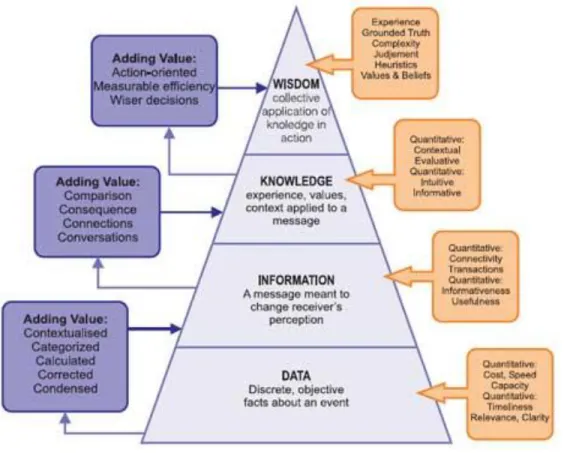
To better understand knowledge as a concept, it is helpful to define the three components of knowledge: data, information, and, both tacit and explicit knowledge. As illustrated in Figure
10
1, Data is an entity that exists and, alone, has no meaning. Forming a link between different pieces of data gives some "meaning" that may or may not be useful, and this linking can be characterized as information (Ackoff, 1989). In other words, information is organized data (Brooking, 1999). Knowledge is the use of the highest order of the relational connection between data and information (Ackoff, 1989). ―Information use is the dynamic, social process of inquiry and construction that results in the making of meaning, the creation of knowledge, and the selection of patterns of action‖ (Choo, 1998: 268). ―Knowledge is broader, deeper, and richer than data or information. Data reflect discrete, objective facts about events in our world, while information is organized around a body of data‖ (Bhagat, Kedia, Harveston & Triandis, 2002: 205). Davenport and Prusak (1998) defined knowledge as ―…a fluid mix of framed experience, values, contextual information, and expert insight that provides a framework for evaluating and incorporating new experiences and information. It originates and is applied in the minds of knowers. In organizations, it often becomes embedded not only in documents or repositories but also in organizational routines, process, practices, and norms.‖ (5). Figure 1 illustrates the relativity of data, information, and knowledge, along with the concept of wisdom, which is beyond the scope of this paper.
11
Figure 1: Retrieved from:http://www.trainmor-knowmore.eu/FBC5DDB3.en.aspx
―Knowledge is difficult to define, but is generally taken to represent the collection of events, experiences and feelings about an organization‘s business that helps it to rationalize its current situation and develop plans/product for the future‖ (Herbert, 2000: 68). Knowledge consists of two components: explicit knowledge – ―…knowledge that can be codified,
categorized and stored‖ , and tacit knowledge which is – ―…implied or inferred…[consisting of] the experiences and feelings that exists in people‘s minds‖ . Davenport and Prusak (1998) define knowledge as ―a fluid mix of framed experience, values, contextual information, and expert insight that provides a framework for evaluating and incorporating new experiences and information. It originates and is applied in the minds of knowers. In organizations, it often
12
becomes embedded, not only in documents or repositories, but also in organizational routines, process, practices, and norms‖ (5).
DeLong and Fahey (2000), define three types of knowledge; Human, Social and
Structured. Human knowledge is ―…what individuals know or know how to do, is manifested in important skills, and usually comprises both explicit and tacit knowledge‖ (206). Social or collective knowledge ―…is largely tacit, composed of cultural norms that exist as a result of working together, and its salience is reflected in our ability to collaborate and develop transactional relationships‖ (206). Structured knowledge ―...is embedded in organizational systems, processes, rules and routines‖ (206).
Tacit knowledge, as Polanyi (1966) stated is the fact that, ―…we can know more than we can tell‖ (4). Nonaka and Takeuchi (1995) in The Knowledge-Creating Company, further
described tacit knowledge as, ―…highly personal and hard to formalize, making it difficult to communicate and share with others. Subjective insights, intuitions, and hunches fall into this category of knowledge‖ (8). Polanyi (1966) continues by describing the problem of tacit
knowledge elicitation, "We know a person's face, and can recognize it among a thousand, indeed among a million. Yet we usually cannot tell how we recognize a face we know. So, most of this knowledge cannot be put into words" (9). ―The transfer of tacit knowledge requires richer context and richer media, because tacit knowledge requires more than just codification (i.e., indexing). Often, it is embedded within individuals‘ cognitive processes or is deeply ingrained in the routine and non-routine processes of an organization‘s unique culture and values (Daft & Lengel, 1986), and there are considerable causal ambiguities surrounding it (Szulanski, Cappetta
13
& Jensen, 2004). ―Explicit knowledge; however, can be codified and is transferred with relative ease‖ (Bhagat, et al., 2002: 207).
Nonaka and Takeuchi (1995) describe the contrast between Eastern and Western cultural perceptions of knowledge. They summarize the theoretical foundation of knowledge and its application to management. Furthermore, they introduce their new theory of organizational knowledge creation. They conclude that Japanese and Western societies and, by extension, companies evolved different philosophies of learning and innovation. Western philosophy, since Descartes posited the ―Cartesian Split,‖ separates ―…subject who knows from the object that is known‖ (Nonaka & Takeuchi, 1995: 20). Also, a concept well documented in Western thought is that knowledge is based on what we experience (empiricism) or inherent truths (rationalism). Another differentiation between Western and Eastern thought is the concept of knowledge itself. In Western philosophy, knowledge is about beliefs, commitment, action, and meaning.―Western philosophers have generally agreed that knowledge is ‘justified, true belief‗ a concept that was first introduced by Plato in Meno, Phaedo and Theaetetus" (Cited by Drucker, 1993; 21) and, for the past two centuries, has focused on what truth means. Japanese thought, while not having as rigorously addressed the epistemological or philosophical tradition, treats tacit knowledge as equally important (Nonaka and Takeuchi, 1995).
Another key aspect that Nonaka and Takeuchi (1995) outline is that knowledge is considered a resource of the firm, ideally creating new knowledge, not merely processing
information. They define knowledge creation as the process of making tacit knowledge explicit. Nonaka and Takeuchi‘s (1995) model (see Table 1 and Figure 2) makes the assumption that tacit
14
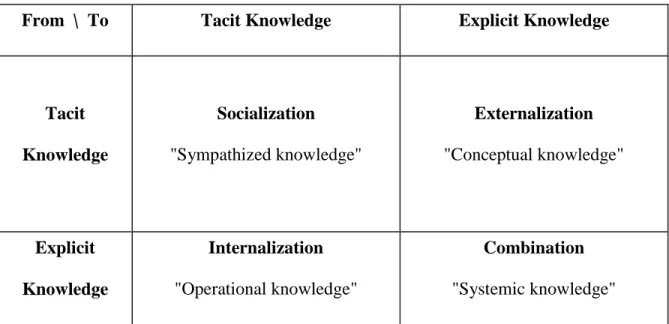
knowledge can be converted or transferred. Therefore, the key modes of knowledge conversion are assumed to be socialization, externalization, internalization and combination, sometimes referred to in the literature as the SECI model (Nonaka & Takeuchi, 1995). The aforementioned four key modes of knowledge conversion, from explicit to tacit, represent a crucial part of the knowledge sharing process and are charted in Table 1 below:
Table 1: Four Key Modes of Knowledge Conversion
From \ To Tacit Knowledge Explicit Knowledge
Tacit Knowledge Socialization "Sympathized knowledge" Externalization "Conceptual knowledge" Explicit Knowledge Internalization "Operational knowledge" Combination "Systemic knowledge"
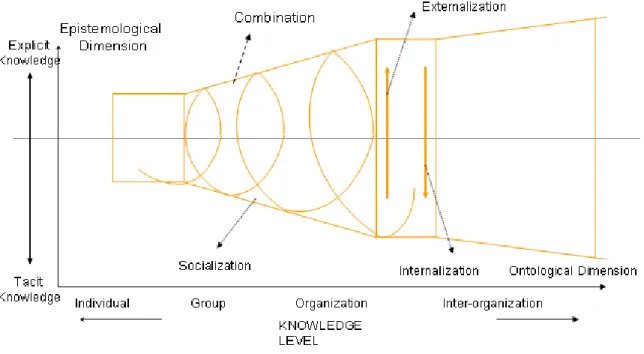
Nonaka and Takeuchi (1995) and others acknowledged that the creation of knowledge involves a dynamic interaction labeledthe Knowledge Spiral. A knowledge spiral, as shown in Figure 2, is sustained with dialog to move from socialization to externalization; linking explicit knowledge to move from externalization to combination; learning by doing to move from combination to internalization; and field building to move from internalization to socialization. This model for knowledge conversion is commonly known as the
Socialization-Externalization-15
Combination-Internalization or SECI Model. ―The organizational knowledge-creating process starts with the (1) sharing of tacit knowledge, (2) creating concepts, (3) justifying concepts, (4) building an archetype, and (5) cross-leveling knowledge" (Nonaka & Takeuchi, 1995: 84).
Figure 2: The Socialization-Externalization-Combination-Internalization or SECI Model
(Retrieved from: www.gswconsulting.org)
According to Nonaka and Takeuchi (1995), to enable the knowledge creating spiral, shown in Figure 2, the five conditions must be present:
Intention: ―…often expressed by organizational standards or visions that can be used to evaluate and justify the created knowledge‖ (74)
Autonomy: ―…all members of an organization should be able to act autonomously as far as circumstances permit.‖ (75)
16
Fluctuation and creative chaos: ―…an interruption of our habitual, comfortable state of being.‖ ―sense of crisis‖ (79)
Redundancy: "…the existence of information that goes beyond the immediate operational requirements of organizational members." (80)
Requisite variety: ―…internal diversity.‖ (82)
The knowledge-creating process, as outlined above, creates a self-sustaining feedback loop to and from the market; whereby ―…knowledge is constantly exchanged with the outside environment‖ (Nonaka & Takeuchi, 1995: 85). Similarly, a dual path describing organizational learning that consists of single loop learning (obtaining know-how) and double loop learning (establishing new premises, paradigms or perspectives) to replace existing ones was developed by Argyris & Schon (1978). In addition, Nonaka and Takeuchi (1995) outline two dimensions in their theory of organizational knowledge creation: (1) Epistemological: (Is the knowledge tacit or explicit?) and (2) Ontological: (Is the knowledge categorized as individual, group, organization, or inter-organizational?)
Citing the difficulties or impossibility of codifying tacit knowledge, critics question the validity of Nonaka and Takeuchi‘s (1995) knowledge model. Critics argue that once tacit knowledge is codified, it is no longer tacit, but has been converted to explicit. To convert tacit knowledge to explicit, Nonaka (1995) argues: ―Organizational knowledge is created through a continuous dialogue between tacit and explicit knowledge.‖ Tacit knowledge is created in social and cultural contexts (Johannessen, Olaisen, & Olsen, 2001); thus, it is difficult to identify and measure. Attempts to quantify tacit knowledge have been made despite being less recognizable
17
and more difficult to measure than codifiable or explicit knowledge (Boudreau, 2002; Busch et al., 2003; Saviotti, 1998).
Team knowledge is comprised of both tacit and explicit knowledge, yet teams regularly communicate knowledge not formally codified. Explicit knowledge, defined as all forms of documentation, written instructions, manuals, books, paper files, etc., is called data (Busch et al., 2003; Johannessen et al., 2001; Nonaka, 1998; Polanyi, 1966; Saviotti, 1998). Combining both components of tacit knowledge with explicit knowledge comprise the total organizational knowledge base. Further differentiation of tacit knowledge into two categories, codifiable and non-codifiable, is necessary. While not inherently explicit, some tacit knowledge can be codified over time (Busch et al., 2003; Polanyi, 1966). Know how, culture, externalization, practice, face-to-face transfer, perception, common sense, imitation, observation, and wisdom are examples of codifiable tacit knowledge (Busch et al., 2003; Johannessen et al., 2001; Nonaka, 1998; Polanyi, 1966; Saviotti, 1998). When teams use the examples above they are exhibiting high levels of organizational learning to convert their codifiable tacit knowledge into explicit knowledge (Johannessen et al., 2001; Sorenson, 2003). To accomplish knowledge transfer at this level, individuals must trust each other (Boudreau, 2002) and be willing to share their knowledge freely with the team without fear of losing ownership. Examples of non-codifiable tacit
knowledge, as identified by Busch et al. (2003), are: skill, experience, intuition, mental models, knowing, practical intelligence, non-awareness, emotion, ―we know more than we can tell,‖ and insight. However, despite the difficulties identifying and measuring tacit knowledge, tacit knowledge needs to be made explicit and measurable (Johannessen, et al., 2001), to the extent reasonable, feasible and possible, to support strategic decisions regarding economic resources such as money, time, human capital and other assets (Boudreau, 2002).
18
Knowledge Management
Any treatise on the subject of tacit knowledge and its application in a modern
organization is framed by the broader topic of knowledge management. This review leads to the history and subsequent developments in the relatively young but growing field of knowledge management. Drucker, and others, built on Fredrick Winslow Taylor‘s early work, which creates the framework for a scientific approach to knowledge management and to establishing
knowledge as a valuable resource that can and should be managed.
There is a common misperception that knowledge management is merely a buzzword made popular in the late 1990‘s. (Swan, Newell, Scarbrough, and Hislop, 1999). Dispelling this misperception, Prusak (1999) estimated that 80% of Global 1000 businesses are conducting projects related to utilizing knowledge based resources, and 68% of Fortune 1000 businesses are undertaking projects related to utilizing knowledge based resources. Many of the world‘s
organizations invest considerable resources toward research in the area of knowledge management (Alvesson and Karreman, 2001). However, the widespread adoption and
application of knowledge management throughout organizations is not yet widely implemented (Skyrme, 1999).
―…the knowledge agenda is new, yet not new‖ (Skyrme and Amidon, 1999; pg.
108). Dating back to ancient Greece there is evidence that knowledge management was, at least implicitly, used. Transferring from one generation to the next skills, practices and know-how necessary to successfully hunt, early hunters used a knowledge management activity, the transfer of knowledge to facilitate better performance (Wiig, 1997).
19
However, knowledge management, established as discipline, is relatively new. The foundations of knowledge management literature stem from Fredrick Winslow Taylor‘s application of knowledge to work processes. Taylor‘s influence, based on his idea of Scientific Management (Taylor, 1911), increased the productivity of industrialized countries by 3.5%, a factor of 50 in a hundred years (Drucker, 1993). Fifty-six years later Drucker wrote The Effective Executive (Drucker, 1967), launching knowledge management as a discipline.
Drucker was one of the earliest management academics to report that business
organizations would evolve into knowledge creators. In his 1993 publication, Post-Capitalist Society, he suggested that we were entering the knowledge society and that knowledge would be the basic resource — not capital, natural resources, or labor.Drucker stated in The New
Productivity Challenge (1991): ―The single greatest challenge facing managers in the developed countries of the world is to raise the productivity of knowledge and service workers‖ (69). The unique challenges presented when attempting to raise the productivity of knowledge and service workers are an ongoing concern of knowledge management practitioners and academics.
Solutions to future knowledge management challenges will determine the competitive performance of companies (Drucker, 1991).
Other influential works, like the trilogy, Future Shock, The Third Wave and Powershift (Toffler, 1970, 1980, 1990), popularized the concept of the knowledge based organization and knowledge as a resource. Overviews such as Knowledge Horizons: The Present and the Promise of Knowledge Management (Despres and Chauvel, 2000) and compilations, including The Blackwell Handbook of Organizational Learning and Knowledge Management, (Easterby-Smith & Lyles, 2003) and the Handbook of Organizational Learning and Knowledge, (Dierkes, Antal,
20
Child & Nonaka, 2001) put the works of many scientists in perspective, making them more accessible to management practitioners. They created a framework for the study of knowledge management. As a result, the established and developing interdisciplinary theoretical foundations in the field of knowledge management are built upon, ―…information economics, strategic management, organizational culture, organizational behavior, organizational structure, artificial intelligence, quality management, and organizational performance measurement‖ (Baskerville & Dulipovici, 2006: 83).
Knowledge management research literature developed along two disparate views. The Culturists were more concerned with analyzing knowledge within an organizational context examining culture, values, schema, belief systems, tacit norms, and embedded routines. Intellectual Capitalists chose to examine aspects of knowledge management in terms that are quantitative, measurable and strategic (Kumar & Thondikulam, 2006). Outside academia, industrial practitioners at IBM (Schütt, 2003) extended and modified Taylor‘s idea of applying knowledge to work. Specific applications applying knowledge to work were developed at BP by Collison & Parcell (2001), in the power generation industry by Mann,et al. (1991), and in
management research by O‘Dell and Grayson (1998), Carneiro (2000) and Newell, et al. (2002). Knowledge management, conceptually, can be linked to the closely related field of organizational learning. Knowledge management can be defined as management initiatives to create a culture or structure that encourages and supports learning from within the organization. Organizational learning can be thought of as a process by which an organization reconstructs knowledge (Ackerman et al, 2003). Leverage of organizational tacit and explicit knowledge in the interest of the group can also be considered knowledge management (Ackerman et al, 2003;
21
Bellaver & Lusa, 2001; Choo, 1998). Davenport and Prusak (1998) described knowledge
management as a tool to develop and exploit the knowledge assets in the best interest of the firm. The authors contended that for organizations to succeed in managing knowledge they should view knowledge as an asset and encourage behaviours that support knowledge transfer, creation, and sharing.
Socio-Cultural Aspects of Knowledge Management:
Knowledge management is regarded as the combination of human capital management and information management, and is inextricably bound to all processes that are concerned with the identification, acquisition, creation, distribution and use of information and knowledge (Iivonen a& Huotare, 2000). Therefore, the technological aspects of knowledge management are essential but trust is a human aspect that cannot be ignored. Within organizations, trust facilitates the effective team collaboration and knowledge sharing practices which are imperative to
effective knowledge management (Iivonen & Huotare, 2000).
Senge (1997) argued that the current knowledge management challenge is not rooted in technological innovations but in, ―…how to harness the intelligence and spirit of people at all levels of an organization to continually build and share knowledge‖ (Senge, 1997: 32). Person-to-person transfer of tacit knowledge requires that tacit knowledge be converted to explicit knowledge, as much as possible, through dialogue and shared experiences, know-how ―exteriorization,‖ and traditional teaching methods. Direct tacit knowledge transfer is also feasible through observation and practice (Bourdreau and Couillard, 1999).
22
For a team to develop useful decisions there is a need for interpersonal trust among team members and with management before team members feel comfortable enough to respond openly and accept new knowledge. Team members must trust their peers and management to create and share new knowledge (Gruenfeld et al., 1996). Interpersonal trust has been studied extensively by a number of management researchers and practitioners (Atwater, 1988; Kramer & Tyler, 1996). An early trust theorist, Rotter (1967), defined interpersonal trust, ―…as an
expectancy held by an individual or a group that the word, promise, verbal or written statement of another individual or group can be relied upon‖ (651). The recent emergence of
self-managing, cross-functional teams has increased academic interest on the topic of interpersonal trust among teams (Mayer et al., 1995; O‘Shea, 2000). However, a relatively small body of literature exists that specifically examines the effect of interpersonal trust on knowledge creation, storage and transfer and its effect on team performance.
According to Kogut and Zander (1996), in the knowledge-based theory of the firm, organizations are viewed as social communities specializing in effective knowledge creation and transfer. Effective knowledge transfer among individuals is critical to most organizational processes and outcomes and is considered a distinct source of competitive advantage (Arrow, 1974; Kogut and Zander, 1992; Szulanski, 1996; et al.). Social structure and social networks are crucial to the transfer of knowledge within organizations. Gaps in social structure create critical bottlenecks when transferring knowledge (Reagans & McEvily, 2003). ―Tacit knowledge is more likely to remain embedded in local communities of practice. Unlike codifiable knowledge, tacit knowledge does not diffuse across a network‖ (Reagans & McEvily, 2003: 263).
23
Transferring tacit knowledge across organizational boundaries is more difficult and slower than transferring explicit knowledge (Zander & Kogut, 1995). Hence, the importance of social capital, established social networks and an organizational culture that encourages the free flow of knowledge. Furthermore, the fear of losing individual competitive advantage, without a compensating reward mechanism, will often prevent the sharing of tacit knowledge (Osterloh & Frey, 2000). according to Stenmark (2000), other reasons to be reluctant to share tacit knowledge are: (1) An individual may not be aware of their tacit knowledge, (2) An individual may not see a reason to make explicit the tacit knowledge they possess, and (3) As mentioned above, an
individual may not want to lose their inherent competitive advantage by sharing the tacit knowledge.
Portes (1998) defined social capital as the ability of actors to secure benefits through belonging to social networks or social structures. Another definition describes social capital as the resources available in and through personal and business networks (Baker, 2000). Social capital is defined by Dess, Lumpkin, and Eisner (2008), as, ―…the network of friendships and working relationships between talented people both inside and outside the organization‖ (122). It is a valuable because it can be used to attract and retain talent, bridge relationships, and achieve high degrees of closure or ties to other group members. Social capital allows employees to share information better than traditional hierarchical organizational structures (Dess, Lumpkin & Eisner, 2008).
―The tradition is that knowledge is transferred in a social context‖ (Sveiby, 1999: 25). Language, tone, or social context often conveys meaning lost in written or codified
24
management that takes into consideration, ―…people, management, and organizational culture as well as technology infrastructure. In fact, it is the approach to the human and organizational factors…that is the determining factor in achieving a successful outcome from a knowledge program‖ (109). Firms can derive competitive advantage from the fruits of interorganizational social networking. ―…firms that establish partnership relationships involving frequent exchange of information…tend to develop products and processes faster than their competitors who do not establish these types of relationships‖ (Echeverri-Carroll, 1999: 303). In current practice, organizations tend to approach knowledge management from either a social or technological perspective. ―…effective knowledge management requires a hybrid solution, one that involves both people and technology…our long term vision is a corporate or organizational memory, at the core of a learning organization, supporting sharing and reuse of individual and corporate knowledge‖ (Abecker, et al., 1999: 185).
―Despite the fact that social capital phenomenon has only recently been discussed in the general literature, in practice, networks of the production of goods and services have always been an essential function of all organizations, whether small or large. But what makes an organisation distinctive is the predominance, in the marketplace, of social capital in the form of productive organizations operating according to the organizational mission and goals‖ (Akdere, 2005: 2). A great deal of the shared knowledge of an organization is created and transferred using social capital and ―socially complex processes‖ (Dess, Lumpkin & Eisner, 2008: 122). A large portion of knowledge owned by a firm exists in the skills and talents of members of the organization. Knowledge develops while it flows, as a result of people participating in the practices of the organization as a social community (Wenger, 1998). Most managers seeking to manage
25
knowledge have turned to IT solutions. However, since people talking to each other generate knowledge at the individual level, it is imperative for organizations to foster means of informal tacit knowledge exchange (Desouza, 2003). As a means of communicating tacit social
knowledge arguably the most effective means is by narrative. A narrative is a representation of past events in any medium: narratives can be oral, written, filmed, or drawn (Linde, 2001). A narrative is a story told by a member of a group that conveys otherwise unquantifiable
knowledge, particularly regarding social interactions, social practices, and know-how (Linde, 2001).
Despite proclamations that organizational knowledge is a major untapped source of competitive advantage; there is a growing sense of disenchantment from executives charged with finding pragmatic means of managing knowledge and articulating the culture-knowledge
relationship (De Long and Fahey, 2000). Much of the disenchantment executives experience can be traced to cultural aspects of knowledge management which are, ―…increasingly recognized as a major barrier to leveraging intellectual assets‖ (De Long and Fahey, 2000: 113).
Thomas, Kellogg and Erickson (2001) express a concern that the dominant conception of knowledge management in the marketplace is over simplified and primarily concerned with capturing, organizing, and retrieving information. The authors believe, ―…this view is too simple. [Since] knowledge is inextricably bound with human cognition and the management of knowledge occurs within an intricately structured social context‖ (Thomas, Kellogg & Erickson, 2001: 863). An over simplified view lends itself to the use of technology to manage knowledge but ignores the tacit social and cultural aspects of knowledge management.
26
Knowledge and Competitive Advantage
―Successful companies are those that consistently create new knowledge, disseminate it widely throughout the organization, and quickly embody it in new technologies and products‖ (McCampbell et al, 1999: 172). Today‘s business landscape is one of radical and discontinuous change. Organizations are required to adapt to changes and create knowledge more frequently, innovating continuously based on the newly created knowledge (McCampbell et al., 1999: 173).
Conventional share valuation of a firm is the net worth of its balance sheet, basically, its assets less liabilities. The difference between market capitalization and net assets indirectly indicate the perceived value of non-tangible assets such as patents, goodwill, brand names, customer listings, access to scarce resources, the quality of management, and trade prospects among others. In recent history, the gap between tangible net worth and share value has widened. Some of the largest companies today have relatively few tangible assets. Companies like
Facebook, eBay, Amazon, Yahoo, Google, Skype, Intel, et al, create value based upon investor‘s perception of the potential of the knowledge assets the companies hold, such as, knowledge and skills, accumulated over time, including customer relationship knowledge, product knowledge, techniques and processes, market intuition, and skills involved in storing, transferring, and sharing their knowledge assets through organizational learning. Value beyond the balance sheet is intellectual capital. Intellectual capital defines the collective knowledge of the organization and extends beyond the traditional notion of firm goodwill (Herbert, 2000).
More widely accepted as an analysis method is the Resource Based View (RBV) of the firm. The RBV is based on the theory that the competitive advantage of a firm lies primarily in
27
the application of valuable, rare, inimitable and non-substitutable resources at the firm's disposal (cf. Barney, 1986, 1991; Penrose, 1959; Conner, 1991; Wernerfelt, 1984). The RBV is defined as the, ―…perspective that firms‘ competitive advantages are due to their endowment of strategic resources that are valuable, rare, costly to imitate, and costly to substitute‖ (Dess, Lumpkin & Eisner, 2008: 91). The RBV has three core tenets: 1) Firms are endowed different resources; 2) Valuable and rare resources result in superior performance; and 3) A firm‘s resources, to be valuable, must be difficult to imitate or diffuse (Rumelt, 1987). According to the RBV, a firm‘s competitive advantage is built on a set of strategically relevant resources (cf. Barney, 1991; Grant, 1991; Peteraf, 1993). If firms have access to similar resources, competitive advantage will be enjoyed by the firms possessing strategic capabilities that determine the efficiency of
transformation of inputs into outputs, i.e. of ―activating‖ resources. ―Such capabilities stem from the nature of organizations as complex social routines‖ (Collis, 1994: 145). ―Among various strategic resources and capabilities, a pivotal role is often assigned to knowledge‖ (Alfirevic & Racic, 2004: 712). Alignment of a firm‘s strategy and the creation of an organizational culture that fosters the efficient use of intellectual capital in necessary for a firm to compete in today‘s knowledge based economy. ―Tacit knowledge shapes the way the leaders of the organization perceive their industry and their firm‘s place within it: tacit knowledge determines how the organization makes decisions and shapes the collective behaviour of the members‖ (Saint-Onge, 1996: 13).
Since tacit knowledge is intangible and uncodifiable, it constitutes a valuable intangible resource within the frame work of the RBV of the firm that is rare, inimitable and embedded in the collective intellect and culture of the firm (Barney, 1991; et al.). Other supporting arguments
28
for the value of tacit knowledge as a resource cite the fact that tacit knowledge cannot be isolated as a firm‘s resource; thus, making it difficult to value. Proponents of the RBV of the firm argue that tacit knowledge, when correlated to high performance, is a sustainable, long term, valuable and rare resource of the firm (Lippman & Rumelt, 1982; Kogut & Zander, 1993; Teece, 1982, Teece & Pisano, 1998; and Berman, Down & Hill, 2002). However, knowledge assets, patents, and other intellectual property are not enough; the organization must be capable of deriving sustainable competitive advantage from their knowledge assets by adding customer value, both innovative and financial (Harlow, 2008).
Recently, with the rise of the service economy and global competition, has the perception of tacit knowledge gained acceptance as a strategic competitive factor (Argote & Ingram, 2000; et al.). Despite efforts that describe parts of the development of tacit knowledge theory; such as, the knowledge theory (Grant, 1996; Argote et al., 2003) and dynamic capability approach (Barney, 1991; Busch et al, 2003; Grant, 1996; Penrose, 1959; Teece, 1984), a unified theory addressing the strategic competitive value of tacit knowledge has yet to be developed.
Tacit knowledge within a firm takes on two forms: 1) Individual knowledge, which can be classified as skill (Polanyi, 1969); and 2) Collective knowledge of team or group abilities are stored in a, ―collective mind‖ (Weick & Roberts, 1993; et al.). For a group or team to perform complex tasks with a relatively high level of accuracy they must practice with each other, the efficacy of the group depends on the experiential knowledge gained from performing the task together (Berman, Down, & Hill, 2002). This experiential knowledge that is gained by group or team experience together is tacit. Knowledge, dispersed and embedded, tends to be tacit within a network of social relations (Nelson & Winter, 1982).
29
Quinn proposed the Intelligent Enterprise, a new management paradigm, the objective of which is to manage to competitive advantage a knowledge-based productivity. Quinn‘s (1992) Spider Web organizational structure describes his approach, because he predicted organizations would realize the value of relinquishing managerial control in favor of individual autonomy allowed by less formal networks that facilitate the interaction of specialized, educated, well trained, experienced individuals working in innovative environments. Mintzberg‘s (1987) contribution shifted current management thought from strategic planning to an organizational learning approach and is considered a major contribution and influence to the work of others, cf., Quinn, Anderson, and Finkelstein (1998); Senge (1992); Mintzberg (1987); Schein (1993); Garvin (1993); Nonaka & Takeuchi (1995). Nonaka & Takeuchi (1995) agree with Quinn (1992) and Quinn, et al. (1996) with regard to leveraging professional activities to advantage business organizations, arguing that Eastern dualism is the key to Japanese business success that fuels continuous innovation.
Theidea that the economic and production capacity of today‘s corporations is largely due to the utilization of knowledge-based resources rather than on the firm‘s real assets can be attributed to Quinn (1992), Quinn, Anderson & Finkelstein (1998), Drucker (1986 and 1993), and Toffler (1990).Although the idea that knowledge-based resources are a competitive advantage is widely accepted, current management research has not adequately addressed the development of tools by which knowledge resources are created, identified and allocated.
Traditional management methods need to be unlearned and the central control style of managing restructured (Quinn, Anderson & Finkelstein, 1998).
30
Examples of companies with business practices that support certain features of the Quinn et al. approach are Microsoft, Dell and Cisco: ―Microsoft tries to force out the lowest performing five per cent of its highly screened talent each year,‖ supporting their ―evaluate and weed‖ research. Recent examples of organizations managing professional intellect include Dell and Cisco Systems. Anecdotal support is proffered by Quinn, et al., as opposed to rigorous empirical analysis citing that actual industry acceptance of new management constructs is far more
problematic than simply appealing to scientific evidence (Stablein, 1996). The management of knowledge based resources is receiving increased interest because of its impact on competitive advantage for a firm. For a knowledge-based firm, directing strategy toward core intellectual and service resources and the leveraging of the organization‘s intellect is of great importance (Quinn 1992). ―Ideas and intellect, not physical assets build great companies‖ (Quinn, 1992: 214).
Tacit Knowledge and Team Performance
Team dynamics and sales team performance as they relate to knowledge based resources are reviewed. Savage (1990) takes the position that knowledge is a competitive advantage based on the knowledge and capabilities owned by its employees. Knowledge assets are key aspects in managing business performance and continuous innovation within an organization (Quinn, 1992). Frequent problem solving, creativity, individuality, advanced educational levels, and professional employees characterize knowledge intensive firms. Knowledge workers, in knowledge intensive companies, whether producers of products or providers of services,
demonstrated several common attributes; such as, flexibility, initiative, entrepreneurial intention and strong job performance (Davenport and Prusak, 1998).
31
Teams are effective when they are used to both acquire external sources of knowledge and generate knowledge through integration and creation. As discussed earlier, the Nonaka & Takeuchi (1995) socialization, externalization, combination, and internalization (SECI) knowledge conversion model illustrates the process of converting tacit knowledge to explicit knowledge where possible. ―The knowledge creation process builds upon itself as team interactions are repeated and layer upon layer of tacit and explicit knowledge are explored. As the process is repeated, it generates what has been termed a knowledge spiral that can eventually permeate an organization. The presence of a knowledge spiral will likely be reflected by greater productivity, innovation, and ability to solve problems. This can, indeed, be a source of sustained competitive advantage for a firm‖ (Sherman and Lacey, 1999: 23).
Once knowledge is created, and to an extent converted, it is the ability of an organization to integrate, communicate, and transform knowledge competencies into a wide body of
organizational knowledge that makes it a strategic advantage (Grant, 1996; Lorenzoni and Lipparini, 1999). When complementary knowledge that is separately held by team members is combined to form new knowledge, it is called knowledge integration (Grant, 1996). Cross-functional teams are generally accepted as the most effective unit for performing complex knowledge integration tasks (Denison et al., 1996). For example, forming a team, prior to the development of a new product, that includes boundary spanning members from marketing, sales, manufacturing, accounting and leadership, among others, will identify potential advantages and problems with the product that would be overlooked by an individual. Often, knowledge
32
Teams are the most common and effective means of creating knowledge (Nonaka & Takeuchi, 1995). They stated that the three stages of knowledge creation are: (1) Team members possessing different stocks of tacit knowledge share and become aware of each other's expertise; and (2) As sources of tacit knowledge interact, there is constant re-interpretation of each other's perspectives until new ideas emerge. In due course, the team members come to collectively share these new ideas and perspectives (and thus new knowledge) (Nonaka & Takeuchi, 1995: 3). Team members test the validity of the new knowledge that they have created. If successful, the testing of the new ideas leads to the formal embodiment of the new knowledge as an end product.
Mohamed, Stankosky and Murray (2004) believed the key to capitalizing on the competitive advantage of knowledge requires the formation of cross-functional teams and learning communities since the intelligence of a team is collective, interacted and socially
constructed tacit knowledge. Nonaka and Takeuchi (1995) placed emphasis on the need for team members to be in close proximity and to develop ongoing relationships in order to be able to share tacit knowledge efficiently through dialogue and activity.
In today‘s marketplace, the onus is on middle managers to overcome the challenges of creating knowledge generating and sharing teams using face-to-face social interaction and practical experiences. ―Tacit knowledge often requires that one of those already holding that knowledge work with the novices to teach them in a hands-on process‖ (Zucker, Darby & Armstrong, 2001: 8). In most cases, it is not enough to simply get people together, but a manager needs to learn to recognize and address the cultural complexities that exist in the transfer, externalization and codification of a team‘s knowledge (Zucker, Darby and Armstrong,
33
2001). Two benefits of forming cross-functional teams are: (1) Organizing into cross-functional teams encourages the transfer of tacit knowledge and yields even greater efficacy if the team members span multiple organizational boundaries (Zucker, Darby and Armstrong, 2001); and (2) Team based organizations can achieve more productive cooperation via specialization than possible by simply linking individual team member‘s efforts through impersonal channels (Demsetz, 1995).
Stenmark (2000) contrasts the value of tacit knowledge with its elusiveness. While organizations recognize the value tacit knowledge can bring they find it difficult to exploit. ―The troublesome aspect of tacit knowledge is its elusiveness, which derives from at least three reasons: (1) We are ourselves not fully aware of it, (2) There is no personal need to make it explicit on the individual level; and (3) There is a potential risk of losing power and competitive advantage by making it explicit‖ (Stenmark, 2000: 12). Difficulty exploiting the competitive advantage of tacit knowledge can also be attributed to compartmentalization of functional departments, excessive internal competition, and rigid organizational silos within traditional organizations which causes firms to underperform largely due to restrictive critical knowledge flows. Collaboration occurs but is most often accidental and unpredictable. Barriers to teaming, and collaboration in general, can be found in four areas; leadership, organizational structure, technology and learning. Mohamed, Stankosky, & Murray (2004) proposed a systematic approach to combine the benefits of cross-functional teaming and knowledge management to increase organizational knowledge flow.
Smith (2001) lists practical applications that illustrate how knowledge resources, both tacit and explicit, can be implemented by managers to achieve team competitive advantage. It is
34
essential to create a culture that includes the team‘s collective knowledge into business processes (Wah, 1999). Managers who wish to facilitate knowledge sharing need to locate those who frequently need to share knowledge in close physical or virtual proximity to one another
(Bonner, 2000). Use communities of practice to encourage knowledge sharing among those who share common expertise, passions and interests (Smith, 2001). Visualize a spider‘s web
network of knowledge to enable the sharing of knowledge and rapid adaptation of power relations to approach varied problems with the greatest collective force of knowledge (Quinn et al., 1996). Allow human-talent exchange that links people and their talents to leverage the team‘s collective capital (Quinn et al., 1996). Recruit and retain extraordinary talent with supportive work environments and intrinsic motivational incentives to create feelings of belonging and friendship within the team (Thomas, 2000). Create reward systems that support individual needs for self-fulfilment and fosters trust among the team (Quinn et al., 1996). Establish a safe environment for the sharing of knowledge that allows people to feel secure in admitting what they do now know and sharing ideas without fear of losing credit or receiving blame for their contribution (Wah, 1999). Allow knowledge workers more ―uninterrupted private thinking time‖ (Smith, 2001: 321). Develop peer-to-peer networks and create a ―global mind-set‖ for fluid exchange of knowledge across boundaries (Dutton, 1999).
Knowledge Management and Sales Team Performance
This study focuses primarily on the subject of tacit knowledge as it relates to sales performance, but the literature reviewed examines many other factors influencing sales
performance. Some other academic interests in the profession and practice of sales are listed by Sternberg and Horvath, et al. (1999), such as, the acquisition of expertise, the identification and
35
use of practical intelligence, the use of adaptive behaviour and the accumulation of tacit
knowledge. More recently, Bradford et al. (2010) addressed the concepts of embeddedness and centricity and discuss the need for more research into the effects on sales team performance, of sales team composition, sales team structure, and the management techniques used with sales teams.
First, success in sales requires the acquisition of a considerable amount of expertise (Weitz, Sujan, & Sujan, 1986). Conceived by Schank and Abelson (1977), and later validated by Leong, Busch, and John (1989), script theory exposed the differences in sales performance between expert and novice account managers by studying both expert and novice account managers using scripts to guide their behaviour in real world selling situations. Leong, Busch, and John‘s (1989) work found greater differences in performance existed between expert and novice account manager using the same scripted sales guide when faced with a less typical selling situation. In other words, when the situation more closely matched the script the expert and the novice had similar rates of success. When the situation was atypical and did not match the scripted guide the expert performed better than the novice, suggesting that the expert owned knowledge that allowed more skilful adaptation to the situation and; thus, a greater success rate. Another factor influencing the expert-novice differences is the significant correlation of
experience to sales performance due to the self-selecting nature of the sales profession in that only the successful sales people last long enough to gain experience (Beswick and Craven, 1977).
Second, selling is an endeavour that requires considerable intelligence, but intelligence that is more practical than academic in nature. In fact, despite the prevalence of traditional
36
academic intelligence tests in sales selection, the evidence relating scores on these tests to sales success is weak (Weitz, 1981). Sternberg, et al., (2000) proposed three intelligences analytical, creative, and practical. According to Sternberg Successful Intelligence is made up of the three aforementioned intelligences or abilities and together comprise an integrated ability to attain success, as defined by an individual within their own socio-cultural context. Whether practical, or academic, successful intelligence plays a role in sales success.
Finally, selling requires knowledge of the customer‘s motives, values, and beliefs (Weitz, 1978) and the successful adaptation of selling behaviour to the customer and the situation
(Sternberg and Horvath, 1999). A key aspect in the ability to adapt to real world selling situations in today‘s highly relational selling environment requires the acquisition of tacit knowledge. Studies by Wagner (1987) took the concept of tacit knowledge as it relates to sales performance further by defining a distinction between local tacit knowledge and global tacit knowledge. Local tacit knowledge is knowledge used to accomplish a shorter term more
transactional task, while global tacit knowledge is used to achieve longer-range goals by putting the shorter-term tasks in perspective relative to a broader conceptual understanding of the overarching objective (Sternberg and Horvath, 1999).
Weitz and Bradford (1999) described four different criteria by which to judge selling effectiveness. The first is the ―production‖ orientation where the account manager focuses on satisfying immediate sales goals by providing information and taking orders from buyers. Second is the ―sales‖ orientation whereby salespeople need to persuade actual and potential clients to buy their products or services. Third is the ―marketing‖ orientation where salespeople become problem-solvers or consultants for their clients and work to solve their client‘s short
37
term needs. The most advanced selling orientation is the ―partner‖ or ―trusted advisor‖ orientation where the sales person works to satisfy their client‘s long term needs.
Different sales situations require a different mix of the selling orientations. The skill to practice all four orientations and vary the emphasis, based on the demands of the situation, is difficult for an individual salesperson to master (Weitz & Bradford, 1999). It is not common that a single individual can encompass all the skills needed to implement the four selling orientations. As a consequence, research on selling effectiveness suggests the use of sales teams that combine, synergistically, the abilities of individual account managers (Workman, Hombug & Jensen, 2003). Managers should form selling teams that combine diverse skills, experiences and
judgements to be able to manage complex tasks required to serve complex clients needs (Jones, Dixon, Chonko & Cannon, 2005; Moon & Armstrong, 1994).
Increasing customer consolidation and globalization, increased product commoditization, and expanding levels of service offerings are causing firms to become more customer centric and; thus, adopt marketing strategies built on relationships not transactions. Firms are shifting their marketing perspective away from transactional relationships to longer term relationships, or partnerships, with their customers (Weitz & Bradford, 1999; Jones et al., 2005). Since sales is a boundary spanning role, a firm‘s sales force plays a crucial part in executing a relationship marketing strategy. Selling, in contrast to ―order taking‖, is a skill in persuading others by modifying their attitudes, beliefs and behaviours (Weitz, 1978). In sales parlance, ―order takers,‖ who rely on repeat transactional business, are being replaced by ―account managers,‖ responsible for recognizing unique opportunities and enlisting, gathering and coordinating the firm‘s assets
38
to meet the customer‘s requirements with creative and innovative long term solutions (Dixon, et al., 2003).
Tacit knowledge is uncodified, how-to knowledge typically acquired through experience. In a sales context, it provides the know-how for managing oneself and others (customers, peers, and supervisors). Tacit knowledge is considered more valuable than explicit knowledge because it provides context for understanding people, places, ideas, and experiences. Tacit knowledge can be characterized as being either global, abstract and overarching, or local, relating to an
immediate concern. Research suggests that global tacit knowledge because it is more abstract is more valuable than local tacit knowledge (Wagner et al., 1999). Tacit knowledge among sales professionals is often conveyed using narrative, as discussed earlier. The profession of sales lends itself to narrative conveyance of tacit social knowledge. Sales professionals tell stories, or narratives, about big wins or losses. This tacit knowledge is easy to narrate since it includes shared known characters, the outcome of the sale is in question which provides tension or drama, and there is a shared value system about the experience of selling within the same setting. New tactics or new approaches to old sales situations are most often communicated by group narrative (Linde, 2000).
Polycentric account managers embedded in many function areas of their firm and their customers‘ firms are more likely to acquire global tacit knowledge compared to unicentric (embedded in one organization‘s functional area) account managers. Thus, embeddedness should increase the quality of tacit knowledge salespeople have and their subsequent effectiveness. Research has not explored the extent to which this is the case or what the optimal balance
39
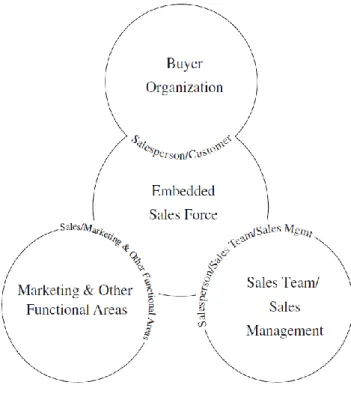
243). Figure 3 shows a a polycentric embedded sales force. The four concentric overlapping circles represent the polycentric, embedded sales force and the multiple necessary interfaces with the functional organizations within the buying and selling firms.
Figure 3: The Polycentric Embedded Sales Force Model
(Bradford, et al., 2010: 241)
An effective sales person needs to be deeply involved in the business practices of both the buying and selling firms, knowledgeable of both firm‘s assets, capabilities, resources, needs and human capital. Industry factors, as mentioned, are evolving the role of the sales force into one that is polycentric and embedded in both firm‘s organizations, one that, ―…integrates on a regular basis with both its own organizational subunits as well as the customers‘ subunits for the
40
purpose of creating customized products and services for its customers‖ (Bradford, et al. 2010: 241).
Measuring Tacit Knowledge by Proxy
There are few empirical studies focused on quantifying or measuring the tacit knowledge construct due to the problems of conceptualizing and defining tacit knowledge (Ryan &
O‘Connor, 2009). Sujan, Sujan and Bettman (1991) found that salespeople differed in their tacit knowledge of sales strategies and that practical knowledge is positively related to sales
performance. Wagner, Sujan, Sujan, Rashotte and Sternberg (1999) reported a study in which tacit knowledge was used to predict sales performance across different indicators of
performance. In their study of NBA basketball teams Berman, Down and Hill, (2009) used a proxy to indirectly measure the team‘s endowment of tacit knowledge. Therefore, this research develops a sales team specific tacit knowledge index (TKI) as an indirect measurement by proxy for the tacit knowledge endowed to sales teams with the intent of comparing the TKI to an indicator of team sales performance.
The TKI is designed to provide insight for sales managers to apply practical knowledge management methods to achieve predictable performance outcomes. The development of a TKI is not new, a number of studies have focused on tacit knowledge measurement at the firm level, (Wagner & Sternberg, 1992, et al.,). Insch, McIntyre and Dawley (2008) developed an academic tacit knowledge scale that relates tacit knowledge with the academic performance of individuals. However, few researchers have attempted to quantify organizational knowledge as it correlates to a financial performance indicator at the sales team level.
41
Using a proxy variable to tap into the effects of an unobservable construct has a long a history in scientific and social science research and can be justified on philosophical and methodological grounds (Godfrey & Hill, 1995). The construct of a tacit knowledge proxy, as developed here, when compared to an observable variable, provides an indication of how the unobservable would behave could it be observed. This approach has both historical and philosophical precedent, legitimacy, and merit.―Quantifying tacit knowledge by proxy
measurements such as financial and human resource data on the penetration of new markets by Japanese and American firms was completed by Hennert (1992) and Kim and Hwang (1992). Nonaka and Takeuchi‘s (1995) theory of knowledge creation depends on the idea that tacit knowledge can be transferred. As examples of the successful transfer of tacit knowledge, they pointed to the success of Japanese multinational NEC, Honda, and Matshushita. These theories of knowledge creation support this research and its measurement of tacit knowledge since they also point out that in order to transfer tacit knowledge successfully the firms must plan for that transfer by using tacit methods (people-centered) appropriate to tacit knowledge transfer‖ (Harlow, 2008: 152).
Logical positivists argue that only empirically observable objects have meaning
(Hacking, 1983). However, this has rendered logical positivism incapable of explaining theories based on unobservable constructs, like quantum physics (Putnam, 1990). Thus, positivists developed a, more flexible, instrumental position acknowledging the value of unobservable constructs in science (Godfrey and Hill, 1995).
According to instrumental positivists: if the use of unobservable constructs lead to empirically verifiable predictions; then, unobservable constructs can have value (Friedman,
42
1953). For example, the economist‘s construct of marginal utility is valuable if it helps accurately predict human economic behavior, even if humans can never be observed to be computing marginal utilities when making buying decisions (Godfrey and Hill, 1995).
Using unobservable constructs or proxies to develop theories has precedent in management theory. Transaction cost theory and the Resource Based View of the firm have unobservable constructs at their core (Godfrey and Hill, 1995). Berman, Down and Hill (2002), used a proxy to study tacit knowledge within NBA basketball teams without directly measuring the tacit knowledge owned by the teams. Berman, Down and Hill (2002), used data from the National Basketball Association (NBA) to argue that team tacit knowledge could be measured reliably by proxy. The study found a positive correlation between the team‘s success and their collective tacit knowledge as measured with a proxy measurement. Their proxy measure was developed by taking the years of experience of each team member and weighting it with minutes played in a season, which was then averaged to calculate a tacit knowledge team year index. In addition to finding that team success increased with increasing tacit knowledge levels, the study also concluded that tacit knowledge is not gained from formal study methods but from
experience. Another notable study was conducted by Edmonson, et al. (2003), where an
efficiency measure was used as a proxy for tacit knowledge among cardiac surgical teams in 15 hospitals. Ryan and O‘Connor (2009) studied the tacit knowledge endowed to software
development teams and develop a tacit knowledge index. Ryan and O‘Connor (2009) described three issues that must be addressed when using a proxy to measure tacit knowledge in order to validate the construct: 1) Team tacit knowledge is specific to a functional group and
43
knowledge owned by all team members for the purpose of determining the shared team-level of tacit knowledge; and 3) The proxy measure can only measure tacit knowledge at the articulated level of abstraction. Ryan and O‘Connor (2009) cautioned that construct validity encumbers the use of a proxy to measure an unobservable function like tacit knowledge. Taub, et al. (2001), argued that while a proxy measure might be statistically reliable it is not necessarily a valid indication of success or performance.
44
Chapter 3: Model and Hypothesis
Model
Weitz and Bradford (1999) argued that relationship building is critical to sales
effectiveness, but it is not the only criterion that identifies sales effectiveness. They suggested that both customer relationship knowledge and product knowledge are essential to have performance at the level that it becomes a competitive advantage. Both are considered, by definition, to be tacit knowledge. See Figure 4, which visually depicts this model.
Figure 4: Tacit Knowledge vs. Performance Model
Weitz and Bradford (1999) propose four situation-specific selling orientations to categorize sales activity. The ―production or order taking‖ orientation describes an account manager who focuses on short term sales objectives and is primarily transactional, simply providing information and taking orders. The ―sales or closer‖ orientation describes an account manager who uses persuasion or sales techniques to convince buyers to purchase a product. The ―marketing or consultant‖ orientation describes an account manager who is a problem solver or consultant for the clients. The ―partnering or trusted advisor‖ orientation proposes that the account manager is embedded in the buyer‘s organization and is empathic with the buyer‘s long
Tacit Knowledge = Customer Relationship Knowledge + Product Knowledge Performance / Competitive Advantage (Selling Level)