Occupant Adaptive Behaviour: an Effective Method towards Energy Efficient Buildings. In: CIBSE Technical Symposium 2018 - Stretching the Envelope, 12-13 April 2018, London, UK. URL: https://www.cibse.org/knowledge/knowledge-items/de... <https://www.cibse.org/knowledge/knowledge-items/detail?id=a0q0O00000EPv0O>
This version was downloaded from Northumbria Research Link: http://nrl.northumbria.ac.uk/34979/
Northumbria University has developed Northumbria Research Link (NRL) to enable users to access the University’s research output. Copyright © and moral rights for items on NRL are retained by the individual author(s) and/or other copyright owners. Single copies of full items can be reproduced, displayed or performed, and given to third parties in any format or medium for personal research or study, educational, or not-for-profit purposes without prior permission or charge, provided the authors, title and full bibliographic details are given, as well as a hyperlink and/or URL to the original metadata page. The content must not be changed in any way. Full items must not be sold commercially in any format or medium without formal permission of the copyright holder. The full policy is available online: http://nrl.northumbria.ac.uk/policies.html
This document may differ from the final, published version of the research and has been made available online in accordance with publisher policies. To read and/or cite from the published version of the research, please visit the publisher’s website (a subscription may be required.)
Occupant Adaptive Behaviour: an Effective Method
towards Energy Efficient Buildings
SHENWEIBENG,MSC,PHD, MASHRAE,FHEA
Bartlett School of Construction and Project Management, University College London (UCL), UK
JUNFENG YONG, BOBO NG, JESS TINDALL
Faculty of Engineering and Environment, Northumbria University, UK QIN LU
Newcastle Business School, Northumbria University, UK HU DU
Welsh School of Architecture, Cardiff University, UK
Abstract
Energy efficient buildings play an important role in achieving a sustainable society. Conventional methods achieving energy efficient buildings mainly focus on upgrading the physical properties of the building, such as increasing their thermal insulations, neglecting the occupants who are using the building. This study justifies the potential contribution of a new method, i.e. selecting offices for occupants with a consideration of their behavioural preferences and the building’s physical properties, to the
building’s energy efficiency. Dynamic building performance simulation has been adopted for the justification, based on a case study building with a simple rectangular shape. The occupant window behavioural model was developed from field measured data in an office building and the up-to-date stochastic approach was used to predict the state of windows for the simulation. Simulation results clearly reflect that 1) building’s physical properties, such as window orientation, have impact on the thermal performance of the building; 2) occupant behaviour can also affect the thermal performance of the building; and 3) considering both occupant behavioural preference and building’s physical properties can promote building’s thermal
performance, without requirement of changing occupant behaviour.
Keywords
occupant adaptive behaviour; energy efficient buildings; building simulation1.0 Introduction
Buildings account for over 40% of society’s energy consumption. Reducing energy
consumption of buildings is crucial for the achievement of sustainable development. Conventional methods reducing building energy consumption focus on changes to the physical properties of the buildings, such as increasing façade insulation/thermal
mass (1-3), implementing renewable energy (4-6) and applying passive design
solutions (7, 8). These methods have been widely adopted in both the design of new buildings and the retrofitting of existing buildings.
The adaptive approach for thermal comfort has proposed that in buildings, especially non-air-conditioned buildings, people would make actions to adjust their indoor thermal environment when feeling thermally discomfortable (9), and these actions have been classified as occupant adaptive behaviour (10, 11). In the recent 20 years, the important contribution of occupant adaptive behaviour (referring as occupant
behaviour in the remaining contents), such as opening/closing windows, adjusting thermostatic settings and opening/closing blinds, to building energy performance has been well justified by both real measured data (12-14) and building performance simulation (15-17). Improper use of buildings may result in a significant waste of energy (18-20). In order to achieve a golden rule of “if you don’t need it, don’t use it” (18), many studies have been carried out to examine a range of techniques to promote more energy efficient behaviour by building occupants (21-24). Changing occupant behaviour has been suggested by many researchers as an effective method to contribute towards achieving energy efficient buildings (25-27). However, these changes are challenging to achieve and the rebound effect also tends to revert the changed behaviour back thus partially, or totally, removing the advancements made (19). Therefore, how to promote building energy efficiency without the need to change building users’ intrinsic behaviour becomes a crucial research question. To answer the above research question, this study proposed a new approach considering occupant behaviour in the actual operation of buildings, by deliberately selecting offices for occupants according to both their behavioural preferences, i.e. whether they are active or passive system users, and the physical properties of the offices. In real applications, however, occupants are mainly given their offices
according to the availability of the office or the department/group they are working in. The study used occupant window behaviour, i.e. opening/closing office windows, to justify the advantage of the proposed approach, due to its significant impact on both indoor thermal environment and building energy consumption (28-30), but the results should be applicable for other behavioural types, such as heating and cooling
behaviours, as well. A simple case study building has been used for the justification to maximise the comparability among offices. The window behavioural model was developed from field measured data in an office building in the UK and the up-to-date stochastic approach was applied to predict the state of windows for the simulation.
2.0 Methods
2.1 Model Development
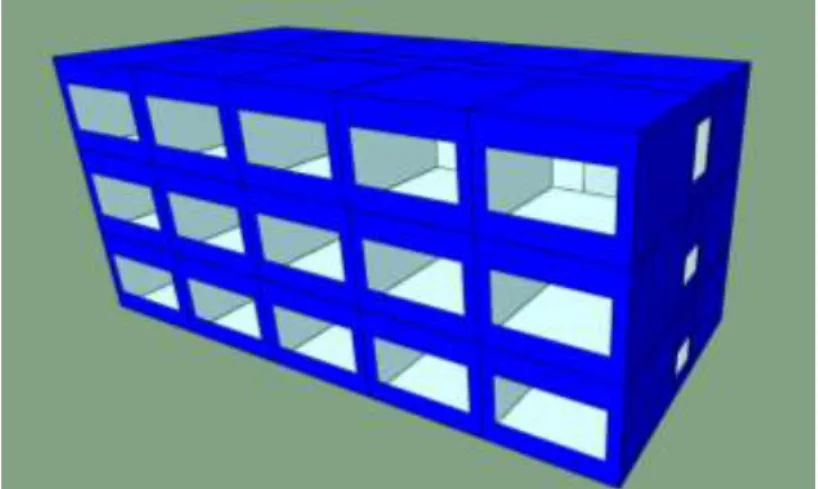
To answer the research question mentioned above, a simulation model has been developed in IES VE (Version 2017.1.0.0), a popular dynamic building simulation package widely used by modellers (31), as shown in Figure 1. The case study
building had three floors and each floor had ten single-cell offices, with identical room dimensions (i.e. 4m X 4m X 3m). On each floor, five offices faced south and the other five faced north. The rooms on the south façade were defined using even numbers and those on the north façade were defined using odd numbers. In between the two façades, there is a corridor on each floor, such a width of 1.5m. The model had a simple rectangular shape so the impact from physical factors, such as window orientation and room location, on the building’s performance can be clearly reflected in the later analysis. On the external wall of each office, there was a window to enable natural ventilation, sized to achieve a Window to Wall Ratio (WWR) of 40%, as suggested by the UK Building Regulations for office buildings (32). The windows were assumed to have an openable area of 50% and to be manually controlled by the room occupants as predicted by their window opening preference as described later. The thermal insulation levels of all building components, such as external walls and roof, were chosen to comply with the requirements defined in the UK Building Regulations, Part L (32), as shown in Table 1. Additionally, as the main behavioural type to explore was window behaviour, the building was defined as thermally heavy weight building in order to maximise the benefit of night time natural ventilation (2).
Figure 1 – Thermal Dynamic Model for the Case Study Building Component U-value (W/m²K) External wall 0.33 Roof 0.24 Ground floor 0.25 Window 2.00
Table 1 – Thermal Insulation Levels of Building Components
The building was assumed to be located in London, where the risk of overheating may be increased due to the urban heat island effect (33). The hottest month of the year, i.e. August, has been selected to drive the dynamic building performance simulation, and the external dry bulb temperature for this month in the simulation package has been depicted in Figure 2 (31), with an average temperature of
17.44°C, a maximum temperature of 24.90°C and a minimum temperature of 7.60°C. The building was an office building, which was occupied between 9am and 5pm in week days. Each office was occupied by a single person and modelled with heat gain from both the occupant (a total of 90 W with sensible to latent ratio of 5:4) and
equipment (12 W/m2) – the values were selected from Chapter 6, CIBSE Guide A (9).
Figure 2 – External Dry Bulb Temperature for the Simulation Period (August in London)
2.2 Modelling Occupant Window Opening Behaviour
To reflect the behavioural difference between occupants, two user types have been classified, i.e. active window user and passive window user. This classification has been used in existing studies to differentiate occupants regarding to their preferences towards opening windows (28, 34, 35). Additionally, occupants’ window operation was modelled by a stochastic process, which is currently used widely when modelling occupant behaviour in buildings (36). The behavioural modelling was based on a logistic regression analysis (37), which defines a correlation between the probability of window opening and influential factors, such as outdoor air temperature, as shown in Equation 1,
𝑝 = 𝑒𝐴+𝐵1𝑥1+⋯+𝐵𝑘𝑥𝑘/(1 + 𝑒𝐴+𝐵1𝑥1+⋯+𝐵𝑘𝑥𝑘) (Equation 1)
where p is the probability of an event happening, A is a constant, B1 to Bk are coefficients for each influential factor and x1 to xk are all influential factors.
The prediction of window states, i.e. open or closed, for the building simulation was achieved by the inverse function method, based on the probability calculated by Equation 1 and a random generated number between 0 and 1, following uniform distribution. A detailed description about the prediction process can be found in Page 100 of Wei (38).
The models used in this study were developed from a field study carried out in a naturally ventilated building in the UK (39). The study focused on occupants’ window behaviour at the end of the working day, i.e. their decisions on using night cooling, and occupants have been classified as Leave Openers (active users) and Habitual Closers (passive users), based on their preferences of leaving windows open when finally departing their offices. The given populations for Leave Openers and Habitual Closers in a building are dependent on some factors, such as floor level and gender. For example, from the monitored 36 offices, more females were classified as
Habitual Closers comparing to males, probably because of a consideration of security during the unoccupied nighttime. The logistic regression models for both type of window users were defined in Equations 2 and 3, and both models have been validated against a recorded dataset.
𝑝𝐿𝑂 = 𝑒−2.636+0.244𝑇𝑜𝑢𝑡/(1 + 𝑒−2.636+0.244𝑇𝑜𝑢𝑡) (Equation 2) 𝑝𝐻𝐶 = 𝑒−8.582+0.244𝑇𝑜𝑢𝑡/(1 + 𝑒−8.582+0.244𝑇𝑜𝑢𝑡) (Equation 3)
where pLO and pHC are the probability of opening windows at the end of the day for Leave Openers and Habitual Closers and Tout is the outdoor air temperature on departure.
As the models used in this study were developed for the end-of-day window position only, in the simulation, all windows were assumed to be closed during the occupied time. At the final departure time, i.e. 5pm, the window position was determined by the stochastic process mentioned above. For Saturdays and Sundays, the window
position followed the decision made at the end of the Friday in that week.
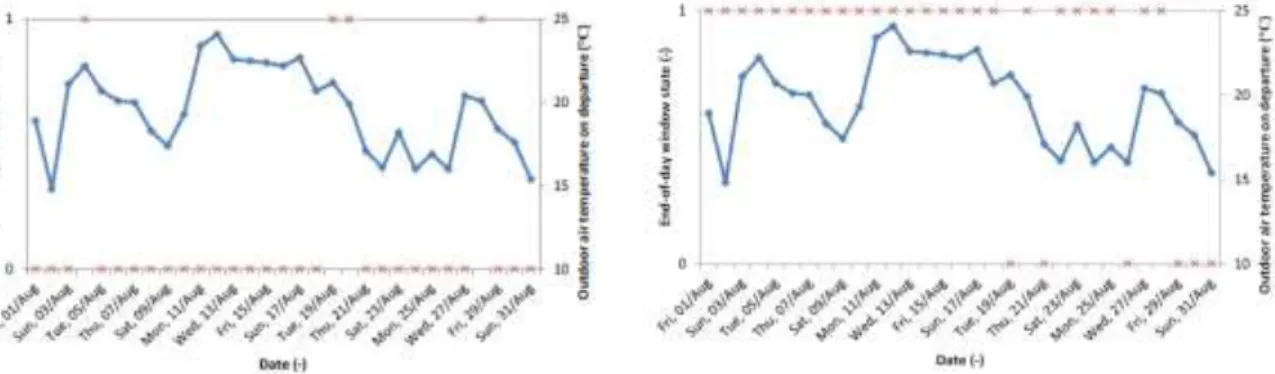
Figures 3a and 3b show the predicted end-of-day window positions (denoted as ‘X’ in the figures) for the simulation period, for Habitual Closers and Leave Openers
the line in the figures). It clearly reflects that Habitual Closers had more windows closed at the end of the working day than Leave Openers.
(a) Habitual Closer (b) Leave Opener
Figure 3 – Predicted End-of-day Window Position for the Simulation Period
Scenarios Occupancy Internal Gains Window Operation
S1 Off Off Off
S2 On On Habitual Closers in hotter rooms
Leave Openers in cooler rooms
S3 On On Leave Openers in hotter rooms
Habitual Closers in cooler rooms
Table 2 – Simulation Scenario Matrix
2.3 Simulation Scenarios
To answer the research question mentioned above, three simulation scenarios have been proposed, as shown in Table 2. Scenario 1 was designed to confirm the impact of building’s physical properties, such as window orientation and room location, on the indoor thermal environment, hence all three main settings, namely, occupancy, internal gains and window operation, were set as ‘OFF’. Scenario 2 put Habitual Closers in the hotter rooms that were identified using Scenario 1 and Habitual Closers in those rooms that were cooler. Scenario 3 reversed the room allocation arrangement between Habitual Closers and Leave Openers.
3.0 Results
3.1 Impact from Building’s Physical Properties
Before modelling occupants within the building, the impact from the building’s physical properties, such as window orientation and room location, has been identified, as those properties cannot be managed during the operation of the
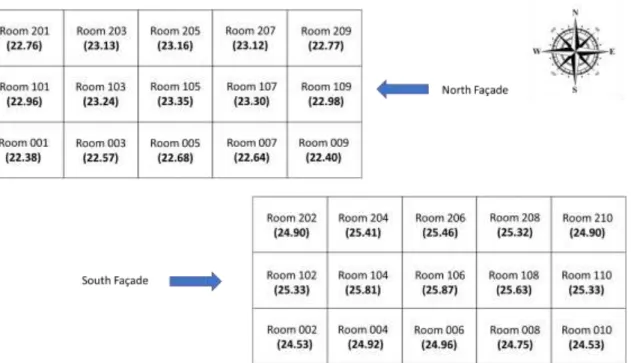
building. Figure 4 shows the predicted average indoor air temperature for each office during the occupied time, modelled using Scenario 1.
Figure 4 – Impact from the Building’s Physical Properties on the Building’s Thermal Performance
From the prediction, it could be found that the offices on the southern façade were significantly warmer than those on the northern façade, with a Max Difference of 2.57°C and a Minimum Difference of 2.11°C. The average temperature of all south-façade offices was 2.3°C higher than that of all north-south-façade offices, which is statistically significant (t-test: P=0.00<0.05). This difference was mainly due to the different heat gains from solar, i.e. in the Northern Hemisphere, southern façades receive more solar gain than northern façades. For the case study building, offices located at the central part, i.e. Rooms 104 to 108 and Rooms 103 to 107, seem to be warmer than those located at the perimeter, although the difference is not significant. This is mainly due to the additional external surfaces, i.e. external wall, window and/or roof, in those rooms on the perimeter. It also appears that offices on the top floor of this building were warmer on average than those on the ground floor, mainly because of the solar energy received on the building’s roof, but the difference is not significant for this case study building as well.
3.2 Impact from Occupant Behaviour
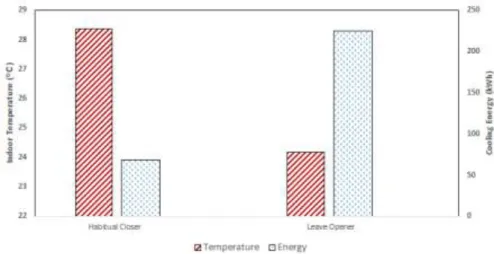
To justify the impact from occupant behaviour on the building’s thermal performance, the hottest room, i.e. Room 106, has been selected. A Habitual Closer and a Leave Opener have been allocated into this room separately and the predicted building performance, including temperature and captured cooling energy by natural
ventilation, has been compared with that when nobody used the room, i.e. Scenario 1. The simulation results are shown and compared in Figure 5. The comparison clearly reflects that the mean indoor temperature during the occupied time when Room 106 was occupied by a Leave Opener (active window user) was much lower, i.e. 3.12°C, than that when it was occupied by a Habitual Closer (passive window user). This is mainly due to the higher cooling energy obtained from outdoors during
the night-time, unoccupied period, by night cooling, as shown in Figure 5 as well, which is consistent with existing literatures (35, 40).
Figure 5 – Impact from Occupant Behaviour on the Building’s Thermal Performance
3.3 Contribution from Selecting Offices for Occupants based on their
Behavioural Preference
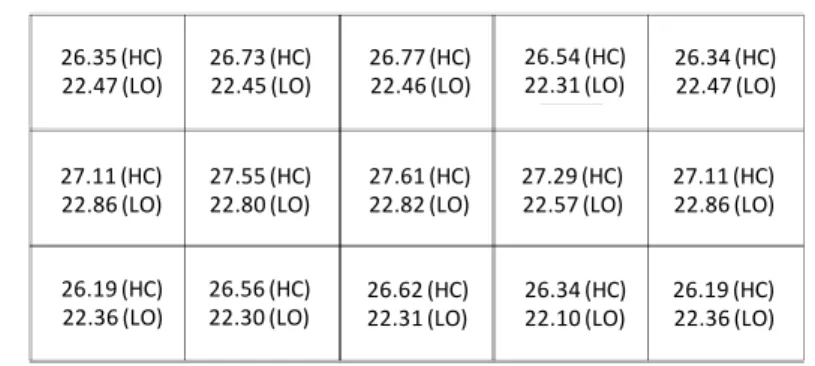
To justify the contribution of selecting offices for occupants based on their behaviour preference to the performance of the building, Scenario 2 and Scenario 3 defined in Table 2 have been used to drive the simulation separately. Figure 6 compares the mean indoor air temperature during the occupied time when putting Habitual Closers in offices on the south façade (warmer) and when putting them in offices on the north façade (cooler). It demonstrates that doing this can greatly reduce the overheating risks for those Habitual Closers, because they do not use night cooling actively, with a minimum temperature reduction of 1.8°C in all offices. Figure 7 compares the mean indoor air temperature during the occupied time when Habitual Closers (HC) and Leave Openers (LO) were put in the offices on the south façade separately. The comparison reflects that putting active window users in rooms on the south façade can reduce the overheating risk significantly, due to their active window use to compensate for the higher solar gain on that façade.
Figure 6 – Mean indoor air temperature when putting Habitual Closers on south (S) and north (N) façades
Figure 7 – Mean indoor air temperature when putting different users on the south façade
4.0 Conclusions
Reducing buildings’ energy consumption is a hot research topic due to the high contribution of buildings to society’s energy consumption. Conventional methods achieving this are based on changing the physical properties of the building, such as increasing its thermal insulation. These methods, however, always need initial
investment and increase embedded carbon, and their actual impact can only be realised in a certain payback period. Since 1980s, occupant behaviour has captured the attention of researchers due to their significant impact on the building’s
performance. How to achieve energy saving by considering occupant behaviour has become a popular research topic. Existing research studies focused on changing occupant behaviour to achieve building energy reduction, but lack of motivation and the rebound effect may significantly influence the outcomes. This study tried a
method maintaining occupants’ intrinsic behaviour but arranging their locations within the building with a consideration of both the building’s physical properties and the occupants’ behavioural preferences. The justification was carried out in a simple case study building in order to maximise the comparability among offices. The window behavioural model was developed from field measured data in an office building in the UK and the up-to-date stochastic approach was applied to predict the state of windows for the simulation. Some major findings from this study have been listed below:
1. Building’s physical properties, such as window orientation and room location, would affect the indoor thermal environment (Figure 4), and these properties are difficult and expensive to change during the operation of the building;
2. Occupant behaviour has a significant impact on the building’s thermal
performance as well (Figure 5), which complies with the findings from existing studies. This impact may be usable to compensate the effects from buildings’ physical properties;
3. Selecting offices for occupants with a consideration of their behavioural preferences has a positive and significant impact on the building’s thermal performance (Figures 6 and 7), hence can be used to achieve energy efficient buildings. South Façade 26.19 (HC) 22.36 (LO) 26.56 (HC) 22.30 (LO) 26.62 (HC) 22.31 (LO) 26.34 (HC) 22.10 (LO) 26.19 (HC) 22.36 (LO) 27.11 (HC) 22.86 (LO) 27.55 (HC) 22.80 (LO) 27.61 (HC) 22.82 (LO) 27.29 (HC) 22.57 (LO) 27.11 (HC) 22.86 (LO) 26.35 (HC) 22.47 (LO) 26.73 (HC) 22.45 (LO) 26.77 (HC) 22.46 (LO) 26.54 (HC) 22.31 (LO) 26.34 (HC) 22.47 (LO)
It is hoped that the findings from this study can increase building managers’ awareness of the importance of selecting offices for their occupants/clients with a consideration of the occupants’ behavioural preferences, to achieve a more energy efficient building with minimal additional cost.
References
1. Yuan L, Kang Y, Wang S, Zhong K. Effects of thermal insulation
characteristics on energy consumption of buildings with intermittently operated air-conditioning systems under real time varying climate conditions. Energy and Buildings. 2017;155(Supplement C):559-70.
2. Auzeby M, Wei S, Underwood C, Tinall J, Chen C, Ling H, et al. Effectiveness
of Using Phase Change Materials on Reducing Summer Overheating Issues in UK Residential Buildings with Identification of Influential Factors. Energies. 2016;9(8).
3. Ling H, Chen C, Wei S, Guan Y, Ma C, Xie G, et al. Effect of phase change
materials on indoor thermal environment under different weather conditions and over a long time. Applied Energy. 2015;140(Supplement C):329-37.
4. Cuce E. Toward multi-functional PV glazing technologies in low/zero carbon
buildings: Heat insulation solar glass – Latest developments and future prospects. Renewable and Sustainable Energy Reviews. 2016;60(Supplement C):1286-301.
5. Zhou H, Lu Y, Liu X, Chang R, Wang B. Harvesting wind energy in low-rise
residential buildings: Design and optimization of building forms. Journal of Cleaner Production. 2017;167(Supplement C):306-16.
6. Cho S, Ray S, Im P, Honari H, Ahn J. Methodology for energy strategy to
prescreen the feasibility of Ground Source Heat Pump systems in residential and commercial buildings in the United States. Energy Strategy Reviews.
2017;18(Supplement C):53-62.
7. Valladares-Rendón LG, Schmid G, Lo S-L. Review on energy savings by solar
control techniques and optimal building orientation for the strategic placement of façade shading systems. Energy and Buildings. 2017;140(Supplement C):458-79.
8. Vidrih B, Arkar C, Medved S. Generalized model-based predictive weather
control for the control of free cooling by enhanced night-time ventilation. Applied Energy. 2016;168(Supplement C):482-92.
9. CIBSE. CIBSE Guide A: Environmental Design. London, UK: Chartered
Instituition of Building Services Engineers; 2015.
10. Baker∗ N, Standeven M. A BEHAVIOURAL APPROACH TO THERMAL
COMFORT ASSESSMENT. International Journal of Solar Energy. 1997;19(1-3):21-35.
11. Nicol JF, Humphreys MA. Understanding the adaptive approach to thermal
comfort. ASHRAE Transactions. 1998;104(Part 1B):991-1004.
12. Steemers K, Yun GY. Household energy consumption: a study of the role of
occupants. Building Research & Information. 2009;37(5-6):625-37.
13. Gill ZM, Tierney MJ, Pegg IM, Allan N. Low-energy dwellings: the contribution
of behaviours to actual performance. Building Research & Information. 2010;38(5):491-508.
14. Haas R, Auer H, Biermayr P. The impact of consumer behavior on residential
energy demand for space heating. Energy and Buildings. 1998;27(2):195-205.
15. Bonte M, Thellier F, Lartigue B. Impact of occupant's actions on energy
building performance and thermal sensation. Energy and Buildings. 2014;76(Supplement C):219-27.
16. Mavrogianni A, Davies M, Taylor J, Chalabi Z, Biddulph P, Oikonomou E, et al. The impact of occupancy patterns, occupant-controlled ventilation and shading on indoor overheating risk in domestic environments. Building and Environment.
2014;78(Supplement C):183-98.
17. de Meester T, Marique A-F, De Herde A, Reiter S. Impacts of occupant
behaviours on residential heating consumption for detached houses in a temperate climate in the northern part of Europe. Energy and Buildings. 2013;57(Supplement C):313-23.
18. Masoso OT, Grobler LJ. The dark side of occupants’ behaviour on building
energy use. Energy and Buildings. 2010;42(2):173-7.
19. Guerra Santin O. Occupant behaviour in energy efficient dwellings: evidence
of a rebound effect. Journal of Housing and the Built Environment. 2013;28(2):311-27.
20. Pan S, Wang X, Wei S, Xu C, Zhang X, Xie J, et al. Energy Waste in Buildings
Due to Occupant Behaviour. Energy Procedia. 2017;105(Supplement C):2233-8.
21. Staats H, van Leeuwen E, Wit A. A LONGITUDINAL STUDY OF
INFORMATIONAL INTERVENTIONS TO SAVE ENERGY IN AN OFFICE BUILDING. Journal of Applied Behavior Analysis. 2000;33(1):101-4.
22. Goodhew J, Pahl S, Auburn T, Goodhew S. Making Heat Visible: Promoting
Energy Conservation Behaviors Through Thermal Imaging. Environ Behav. 2015;47(10):1059-88.
23. Abrahamse W, Steg L, Vlek C, Rothengatter T. The effect of tailored
information, goal setting, and tailored feedback on household energy use, energy-related behaviors, and behavioral antecedents. Journal of Environmental
Psychology. 2007;27(4):265-76.
24. Wei S, Goodhew J, Rafiq Y, Pahl S, de Wilde P. Energy Efficiency Educator –
early stages of an interactive tool to help reduce heating energy demand in residential buildings. eceee 2015 Summer Study on energy efficiency 1–6 June; Presqu’île de Giens Toulon/Hyères, France2015.
25. de Wilde P, Pahl S, Hamza N, Wei S, Jones R, AboHela I. Using building
simulation to drive changes in occupant behaviour: A pilot study. Building Simulation 2013 Conference; 25-28 August; Chambery, France2013.
26. Wei S, Jones R, de Wilde P. Extending the UK's green deal with the
consideration of occupant behaviour. Conference of Building Simulation and Optimization 2014; 23-24 June; UCL, London, UK2014.
27. Kim YK, Altan H. Using dynamic simulation for demonstrating the impact of
energy consumption by retrofit and behavioural change Building Simulation 2013 Conference; Chambery, France2013.
28. Wei S, Buswell R, Loveday D, editors. A comparison of alternative occupant
classification approaches for the modelling of window opening behaviour in office buildings Windsor Conference 2014; 2014 10-13 April; Cumberland Lodge, Windsor, UK.
29. Porritt SM, Cropper PC, Shao L, Goodier CI. Ranking of interventions to
reduce dwelling overheating during heat waves. Energy and Buildings. 2012;55(Supplement C):16-27.
30. Fabi V, Andersen RV, Corgnati S, Olesen BW. Occupants' window opening
behaviour: A literature review of factors influencing occupant behaviour and models. Building and Environment. 2012;58(Supplement C):188-98.
31. IES. IES VE official webpage 2017 [Available from: https://www.iesve.com/.
32. Government DfCaL. UK Building Regulations Part L1A: Conservation of fuel
33. Oikonomou E, Davies M, Mavrogianni A, Biddulph P, Wilkinson P, Kolokotroni M. Modelling the relative importance of the urban heat island and the thermal quality of dwellings for overheating in London. Building and Environment.
2012;57(Supplement C):223-38.
34. Rijal HB, Tuohy P, Humphreys MA, Nicol JF, Samuel A, Clarke J. Using
results from field surveys to predict the effect of open windows on thermal comfort and energy use in buildings. Energy and Buildings. 2007;39(7):823-36.
35. Yun GY, Tuohy P, Steemers K. Thermal performance of a naturally ventilated
building using a combined algorithm of probabilistic occupant behaviour and
deterministic heat and mass balance models. Energy and Buildings. 2009;41(5):489-99.
36. Roetzel A, Tsangrassoulis A, Dietrich U, Busching S. A review of occupant
control on natural ventilation. Renewable and Sustainable Energy Reviews. 2010;14(3):1001-13.
37. Hosmer DW, Lemesbow S. Applied logistic regression (2nd Edition). New
York: John Wiley & Sons, Inc; 2000.
38. Wei S. Preference-based modelling and prediction of occupants' window
behaviour in non-air-conditioned office buildings: Loughborough University, PhD Dissertation; 2014.
39. Wei S, Buswell R, Loveday D. Factors affecting ‘end-of-day’ window position
in a non-air-conditioned office building. Energy and Buildings. 2013;62(Supplement C):87-96.
40. Wei S. Preference-based modelling and prediction of occupants' window