Informative Data Projections:
A Framework and Two Examples
Tijl De Bie1,2, Jefrey Lijffijt1,2, Ra´ul Santos-Rodriguez2, and Bo Kang1 ∗ 1- Data Science Lab - Ghent University
Technicum, Sint-Pietersnieuwstraat 41, 9000 Gent - Belgium 2- Dept. of Engineering Mathematics - University of Bristol MVB Woodland Road, BS8 1UB, Bristol - United Kingdom
Abstract. Methods for Projection Pursuit aim to facilitate the vi-sual exploration of high-dimensional data by identifying interesting low-dimensional projections. A major challenge is the design of a suitable qual-ity metric of projections, commonly referred to as theprojection index, to be maximized by the Projection Pursuit algorithm. In this paper, we intro-duce a new information-theoretic strategy for tackling this problem, based on quantifying the amount of information the projection conveys to a user given theirprior beliefsabout the data. The resulting projection index is a subjective quantity, explicitly dependent on the intended user. As a useful illustration, we developed this idea for two particular kinds of prior beliefs. The first kind leads to PCA (Principal Component Analysis), shining new light on when PCA is (not) appropriate. The second kind leads to a novel projection index, the maximization of which can be regarded as a robust variant of PCA. We show how this projection index, though non-convex, can be effectively maximized using a modified power method as well as using a semidefinite programming relaxation. The usefulness of this new projection index is demonstrated in comparative empirical experiments against PCA and a popular Projection Pursuit method.
1
Introduction
The analysis of high-dimensional data often starts with dimensionality reduc-tion, to facilitate initial visual exploration by a human user. Most analysts will instinctively do this by Principal Component Analysis (PCA) [1]: it is widely available, computationally efficient, easy to interpret, and in the common situa-tion where the data lies close to a low-dimensional subspace, PCA is effective in retrieving it. However, in user interactions with their PRIM-9 system for inter-active data exploration [2], it was observed that the human operators tended to prefer projections that revealsome form of structure, rather than projections of high variance as preferred by PCA. Later [3] provided theoretical arguments for why projections in which the data are Normally distributed areleastinteresting, as they essentially reveal no structure in the data.1
∗This work was supported by the European Union through the ERC Consolidator Grant FORSIED (project reference 615517).
1This means that Independent Component Analysis (ICA) and Projection Pursuit (PP) are largely equivalent: appropriate PP methods can be and are being used to do ICA [4, 5, 6].
Quantifying the precise extent to which a projectionis interesting, however, is riddled with conceptual and practical difficulties. In fact, it seemed obvious to the early PP research protagonists that a universally useful projection index that formalizes the interestingness of a projection cannot exist (see e.g. [3]). The answer, therefore, was the introduction of lots of different projection in-dices. Most of these aim to quantify the extent to which the distribution of the projected data departs from the Normal distribution, and all strike a different balance between practical usefulness, computational complexity, and robustness against outliers (e.g. [2, 3, 4, 7] and references therein). Indeed, due to the elusive nature of the core question of what makes a projection interesting to a given user, the focus shifted towards secondary questions around robustness aspects and computational properties of the projection indices.
Contributions in this paper Here our aim is to return the focus to the user once again, and directly ask the question of how interesting a given data projection is to a particular user. Our work presents the first generic design strategy for projection indices that explicitly depend on the intended user.
In Section 2 we introduce a strategy for quantifying the interestingness of a projection as its information content against the background of a probability distribution representing the user’s beliefs about the data. In Sections 3 and 4 we then apply this strategy for two particular types of prior beliefs, leading to a novel interpretation for PCA in the first case, and a novel projection index in the second, the optimization of which represents a robust variant of PCA. Although this latter projection index is non-convex, we introduce two algorithms for effectively optimizing it. We end by empirically illustrating the benefits of this robust PCA variant as compared to standard PCA and FastICA, a popular PP method that is also used for ICA [6].
2
The subjective information content of a data projection
– general outline
The proposed strategy for quantifying the subjective information content of a data projection closely follows the generic approach introduced by [8, 9], where the choices made are extensively motivated. Here we will merely provide some intuition underlying the approach.
The strategy from [8] for quantifying information content rests on the avail-ability of a representation of the user’s prior belief state in the form of a proba-bility densitypXover the set of possible values for the dataX–in casuover the
set Rn×d. Given this so-called background distribution, one can then compute
the marginal probability density function of a data projectionpw=Xwdefined
by the weight vector w∈Rd. We will denote this marginal probability density
function aspXw.
We call aprojection pattern a statement of the formpw∈[ ˆXw,Xwˆ + ∆1),
specifying that the valuepwof the projected data lies within an interval of width
user through a scatter plot of the data projections ˆXw, with plotting resolution ∆. Clearly, the smaller the probability Probpw∼pXw
pw∈[ ˆXw,Xwˆ + ∆1)
, the more the surprising and hence informative this pattern would beto that par-ticular user. This is argued more formally by [8], where the negative logarithm of this probability is shown to be a good measure of Subjective Information Content (SIC). We denote this as follows:
SICXwˆ =−logProbpw∼pXw
pw∈[ ˆXw,Xwˆ + ∆1)
This is what we propose as a generic projection index, quantifying the interest-ingness of a projection.
An important question is howpX and hence the marginals pXw can be
ob-tained, without overburdening the user. In [8] it is suggested that the user is often capable of specifying aspects of their belief state as constraints on expected values of specified statistics of the data. He argued that theMaximum Entropy (MaxEnt) distribution subject to these constraints is an attractive choice, given its unbiasedness, its robustness, and in being an exponential family model [10], the inference of which is well understood and often computationally tractable.
In Sections 3 and 4, we will develop this strategy for two different assump-tions regarding the prior beliefs of the user, illustrating how it can lead to new algorithms, as well as to new insights into existing ones. Throughout this paper, we assume the data has been centered (i.e. has zero mean).
3
PCA: an information theoretic interpretation
Here we show how standard PCA can be derived using this generic strategy for designing projection indices. This exercise will also present new insight in what cases PCA is an effective PP approach.
3.1 The prior beliefs
A user not expecting any outliers can be assumed capable of expressing an expectation about the value of the average two-norm squared of the data points:
EX∼pX ( 1 n n X i x0ixi ) =σ2. (1)
I.e., the user has a specific expectation about the average squared norm of the data points.
The MaxEnt distribution subject to this constraint is well known and equal to a product distribution of multivariate Normal distributions N(0, σI), with one factor for each of the data points xi. More formally, the density function pXfor the dataset representing the background distribution is:
pX(X) = Y i px(xi),wherepx, defined aspx(x) = 1 √ 2πσ2d exp −x 0x 2σ2 , (2)
is the probability density function for each of the individual data points in the dataset.2
3.2 The subjective information content
Given a Normal random vectorx∼ N(0, σI), a projection onto a weight vector w withw0w= 1 is also Normal: x0w∼ N(0, σ). Thus, given the independence of the data points under the background distribution, the marginal probability density functionpXw for the projectionpw=Xw of a datasetXsampled from
the background distribution is given by:
pXw(pw) = 1 √ 2πσ2nexp −p 0 wpw 2σ2 .
We can thus compute the SIC of a projection pattern pw ∈ [ ˆXw,Xwˆ + ∆1)
as minus the logarithm of its probability under this marginal density function
pXw. Noting that for small enough ∆, Probpw∼pXw
pw∈[ ˆXw,Xwˆ + ∆1)
≈
∆n·pXw( ˆXw), this leads to:
SICXwˆ =−logpXw( ˆXw) −nlog(∆) =n 2 log(2πσ 2)−nlog(∆) + 1 2σ2w 0Xˆ0Xwˆ . (3)
It is trivial to generalize this towardr-dimensional projectionsPWr =XWr
of the dataset, defined by an orthogonal matrix Wr ∈ Rd×r with Wr0Wr =
I. With ∆0 = ∆1 ∆2 · · · ∆r
a vector containing the resolutions for each of the projections, then the information content of the pattern PWr ∈
[ ˆXWr,XWˆ r+1∆0) specifyingrprojections simultaneously, is given by:
SICXWˆ r = nr 2 log(2πσ 2)−n r X i=1 log(∆i) + 1 2σ2Tr h W0rXˆ0XWˆ r i . (4)
3.3 Finding the most informative projections
For fixed ∆, maximizing the SIC from Eq. (3) is done by solving: max
w w
0Xˆ0Xwˆ ,s.t.w0w= 1,
equivalent to the optimization problem to be solved for finding the first principal component in classical PCA. Similarly, optimizing Eq. (4) is equivalent to finding therdominant PCA components.
Remark 1. The assumption that∆ is constant is not always warranted. When making a scatter plot, it is often desirable to stretch the axes in order to fill
2Note that it is not our intention to argue in favor of this; our intent is merely to investigate what is a suitable projection indexif this is an accurate representation of the prior belief state.
available space. Then ∆ ∝max( ˆXw)−min( ˆXw), such that finding the most informative projection amounts to solving:
max
w w
0Xˆ0Xwˆ −2σ2nlogmax( ˆXw)−min( ˆXw),s.t.w0w= 1,
This is another explanation of why simple variance maximization done by PCA is rarely a good approach for exploratory data analysis.
From Eq. (4) the most informative r-dimensional projection of the data are found by solving: max Wr∈Rd×r TrhW0rXˆ0XWˆ r i ,s.t.W0rWr=I,
again equivalent to the optimization problem for finding therdominant principal components.
Remark 2. The exact value ofσwill have no effect on the relative information content of different possible projections, hence the user does not need to provide this value.
4
t-PCA: for users expecting a heavy tailed distribution
The previous section elucidates the assumptions on the user (prior belief on average squared norm of the data points) and visualization approach (constant resolution) for PCA to be optimal. In the present section we will develop an alternative for PCA when the assumption on the user’s prior beliefs is altered, to be more accommodating for outliers.
4.1 The prior beliefs
As the user’s prior belief about the data, we here propose the following:
EX∼pX ( 1 n n X i log 1 + 1 ρx 0 ixi ) =c.
Thus, rather than specifying an expectation on the spread of the data, for small values of ρ the user specifies an expectation on the order of magnitude of the spread of the data. When the user expects outliers to be present, they may feel able to specify an expectation on the average order of magnitude of the 2-norms of the data points, rather than on the average of their 2-norms themselves.
For notational convenience, let us introduce the function κ(ν) =ψ ν+2d
−
ψ ν
2
, where ψ represents the digamma function. In the sequel the value of
κ−1(c) will need to be used, denoted asν for brevity. Then, the background dis-tribution can be derived by relying on [11], where it is shown that the MaxEnt
distribution subject to the specified prior information is the product of inde-pendent multivariate standard t-distributions with density function px defined
as: px(x) = Γ ν+2d p (πρ)dΓ ν 2 · 1 1 + 1 ρx0x ν+2d ,
with a factor in this product distribution for each data point. Here Γ represents the gamma function.
Note that forρ, ν→ ∞,ρν →σ2this density function tends to the multivari-ate Normal density function with mean0and covariance σ2I. Forρ=ν = 1 it is a multivariate standard Cauchy distribution, which is so heavy-tailed that its mean is undefined and its second moment is infinitely large. Thus, this type of prior belief can clearly model the expectation of outliers to varying degrees. 4.2 The subjective information content
The marginals of a t-distribution with given correlation matrix are again at -distribution with the same number of degrees of freedom, obtained by simply selecting the relevant part of the correlation matrix [12, 13]. This means that the marginal density function for the data projectionspw=Xw onto a vector
w withw0w= 1 (andpw,i,x0iw) is:
pXw(pw) = Y i px0w(pw,i),wherepx0w(pw,i) = Γ ν+1 2 √ πρΓ ν2· 1 1 +1ρp2 w,i ν+12 .
Thus the SIC of the projection patternpw∈[ ˆXw,Xwˆ + ∆1) is:
SICXwˆ =ν+ 1 2 n X i=1 log 1 + 1 ρ(ˆx 0 iw) 2 −nlog(∆) + a constant. (5)
This derivation can be generalized towards the information content of an
r-dimensional projection onto the columns of an orthogonal matrixWr∈Rd×r
(i.e. Wr0Wr = I). Without proof, we state the information content of the
patternPWr ∈[ ˆXWr,XWˆ r+1∆ 0): SICXWˆ r =ν+r 2 n X i=1 log 1 + 1 ρxˆ 0 iWrWr0xˆi −n r X i=1 log(∆i) + a constant. (6) 4.3 Finding the most informative projections: an analysis and two
algorithms
As in the derivation of PCA, we will assume that ∆ is constant. For ease of exposition, we will focus on the SIC of a single projection as given by Eq. (5).
Taking into account that w0w = 1, and ignoring some constant factors and terms, maximising the SIC is thus equivalent to solving the following problem:
max w n X i=1 log ρ+ (ˆx0iw)2 ,s.t.w0w= 1. (7)
Clearly, the largerw0w, the larger the objective, so the constraint can be relaxed tow0w≤1.
Remark 3. Given the reliance of this approach on the multivariatet-distribution as a background distribution, we will refer to this approach as t-PCA.
Remark 4. Just like in PCA where the value ofσhas no effect on which pattern is most interesting, here the value of ν and thus of c is absent from the final optimization problem, and thus it has no effect on which projection is the most interesting one. (Thoughσandcdo affect the value of the interestingness.) This significantly reduces the demands on the user in specifying their prior beliefs. Remark 5. By varying ρ, t-PCA interpolates between maximizing the arith-metic mean, like PCA does, and maximizing thegeometric meanof the squares of the data projections, which is more robust against outliers. Indeed, forρ= 0, the objective function is monotonically related to the geometric mean of the squares of the data projections(ˆxiw)2:
exp " 1 n n X i=1 log(ˆx0iw)2 # = n Y i=1 (ˆx0iw)2 !1n .
On the other hand, forρ→ ∞, the objective function is monotonically related to the arithmetic mean, and thus becomes equivalent to the PCA objective function:
lim ρ→∞ ρ n n X i=1 log ρ+ (ˆx0iw)2 −ρlog(ρ) = 1 n n X i=1 (ˆx0iw)2.
4.3.1 The complexity of the optimization problem
To get some insight into the computational complexity of problem 7, let us consider the special case of ρ = 0. The constraint w0w ≤ 1 is convex, and the objective is concave as long as w ∈ Ws , {w|sign( ˆXw) = s} for some
fixed sign vector s. Indeed, for ρ= 0 the objective function can be rewritten as Pn i=1log((ˆx0iw) 2) =Pn i=1log det sixˆ0iw 0 0 sixˆ0iw
, which is the sum ofn
(concave) log determinant functions of linear matrix functions of the parameters w.
This seems to suggest a possible solution strategy, at least for the caseρ= 0: enumerate all possible sign vectorssfor the dataset ˆX, find a weight vector w for each of these, and locally optimize it using a convex optimization problem.
However, according to Cover’s Function-Counting Theorem [14], the number of homogeneously linearly separable dichotomies of n points in d-dimensional Euclidean space is 2Pd−1 k=0 n−1 k =O (n−1)d−1
, which is clearly impractical. Since even for the special case of ρ = 0 it is impractical to maximize the information content exactly, we developed two approximation algorithms: the first one a modification of the power method for solving eigenvalue problems, and the second one a convex relaxation to a log-determinant optimization problem. 4.3.2 A modified power method
The stationarity condition of the Karush-Kuhn-Tucker (KKT) optimality con-ditions for Eq. (7) is:
n X i=1 ˆ xixˆ0i ρ+ (ˆx0iw)2 ! w=λw,
with λ≥0 a KKT multiplier corresponding to the constraint w0w ≤1. Note that the matrix on the left hand side is essentially a weighted empirical covariance matrix for the data, where points contribute more if they have a smaller value for (ˆx0iw)2: the weight for ˆx
ixˆ0i is
1
ρ+(ˆx0
iw)2
.
As pointed out above, this optimisation problem is not convex, and also the optimality conditions do not admit a closed form solution in terms of e.g. an eigenvalue problem. Instead we investigated the use of a simple gradient descent method with after each gradient step a projection onto the feasible setw0w= 1. This can be formulated as a modified power method [15]:
1. Start with an initial value forw(0), normalized to unit norm.
2. Iterate from k = 1 until convergence or maximum number of iterations reached: (a) v(k)=I+αPn i=1 ˆ xixˆ0i ρ+(ˆx0 iw(k−1))2 w(k−1). (b) w(k)= v(k) kv(k)k.
Here,αis a step-size parameter that controls the speed of convergence. Clearly this algorithm is not guaranteed to converge, but for sufficiently smallαit does converge to a local optimum in practice.3
Forw(0), we use the dominant eigenvector ofPn
i=1 ˆ xixˆ0i ρ+ˆx0 iˆxi , which amounts to maximizing an approximation of the SIC obtained by approximating (ˆx0iw)2 with ˆx0ixi.
As a first approximation, we search for good subsequent projections simply by iteratively deflating the data (i.e. projecting it onto the orthogonal complement of the previously found projections).
4.3.3 A convex relaxation
The problem can also be relaxed to a semidefinite log determinant optimization problem. We will do this more generally for finding the most informative r -dimensional projection for generalr, i.e. of the optimization problem maximizing Eq. (6) subject to W0rWr =I. After removing irrelevant constant terms and
factors, the optimization problem we need to solve is equivalent with:
max Wr∈Rd×r n X i=1 log (ρ+x0iWrWr0xi),s.t.W0rWr=I. (8)
We claim that this problem can be rewritten in terms of a new variable M , WrW0r as follows: max M∈Rd×d n X i=1 log (ρ+x0iMxi),s.t. Tr [M] =r, M0, I−M0, Rank(M) =r. (9)
Theorem 1. Problems 8 and 9 are equivalent.
Proof. GivenM=WrWr0, the objective functions are clearly equivalent. Thus
all we need to show is that the feasible sets are identical as well. It is easy to verify that the constraints in problem 8 imply the constraints in problem 9. Also the converse is true. Indeed, the rank constraint forces all butr eigenvalues to be 0. The constraintsI−M0andM0ensure all eigenvalues lie between 0 and 1. And the trace constraint ensures all eigenvalues add up tor. Hence, Mmust havereigenvalues equal to 1, andd−requal to 0. Thus, we can write the eigenvalue decomposition ofM as: M=WrIWr0, withWr an orthogonal
matrix as required by the constraint in the previous formulation. Thus, the constraint set of problem 9 also implies the constraint of problem 8.
The only non-convex constraint in problem formulation 9 is the rank con-straint. We suggest to drop that constraint to relax this problem. Note that for
r= 1, the constraintI−M0is redundant given Tr [M] = 1 andM0, and can therefore also be dropped. To obtain an estimate for the unrelaxed weight matrixWr, we suggest to use ther dominant eigenvectors ofM.
5
Empirical evaluation
In Section 5.1 we evaluate the behaviour of t-PCA in comparison with PCA in a controlled setting on synthetic data. Then, in Section 5.2, we demonstrate the practical usefulness of t-PCA on some real-life datasets, and compare its results with PCA as well as a popular projection pursuit method (FastICA).
-30 -20 -10 0 10 20 30 First t-PCA component -150 -100 -50 0 50 100 150
First PCA component
-150 -100 -50 0 50 100 150 -150 -100 -50 0 50 100
150 Data including outliers
PCA PCA no outliers t-PCA (ρ = 1) t-PCA (ρ = 10) t-PCA ( ρ = 100) -10 -5 0 5 10 -10 -8 -6 -4 -2 0 2 4 6 8
10 Data excluding outliers
PCA PCA no outliers t-PCA (ρ = 1) t-PCA (ρ = 10) t-PCA ( ρ = 100)
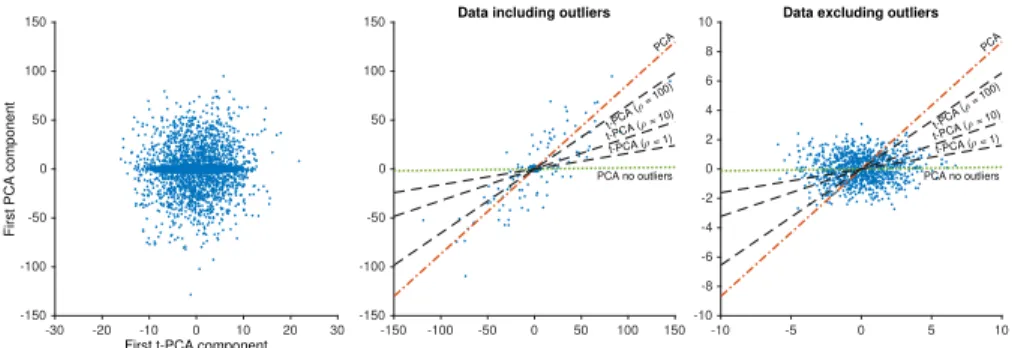
Fig. 1: Left: comparison of the dominant PCA projection (vertical axis) with the most informative t-PCA projection with ρ = 0 (horizontal axis). t-PCA shows more detail in the central less spread out point cloud that contains most data points. Middle and right: a scatter plot of all data points in the original space, including (middle) and excluding (right) outliers, with weight vectors of PCA (dot-dashed red line), as well as t-PCA computed with the modified power method withρ= 1,10,100 (dashed black lines) and PCA fitted on data excluding the 100 outliers (dotted green line).
5.1 Experiments on synthetic data
Comparing PCA with t-PCA We generated a synthetic dataset consisting of two populations: a population with a small spread and 8000 data points, and a population with a large spread and 2000 data points. More specifically, both populations were sampled from a 100-dimensional multivariate Normal distri-bution with diagonal covariance. For the large population the variances were sampled from aχ2 distribution with 1 degree of freedom; for the small popula-tion the same process was used, but the covariance matrix was then multiplied by 100.
As shown in Fig. 1 (left figure), due to the sensitivity of PCA to outliers, the dominant PCA direction is determined almost exclusively by the small popula-tion with large spread. t-PCA (here with the power method), however, offers an insight into the large population with lower spread as well.
The information content of the solution found by the SDP relaxation and modified power method are 1.43×10⁴and 1.44×10⁴ respectively, while that of PCA is much worse at 3.18×10³. Note that the SDP relaxation took around 3 hours, compared to 30 seconds for the modified power method, on this 10.000×
100 dataset. Usefully, the relaxation also provides us with an upper bound, namely 1.681×10⁴. Thus, both the SDP relaxation and the modified power method are close to optimal.
The effect of ρ To illustrate the robustness of t-PCA, consider a dataset con-sisting of two populations with different covariance structures: 1000 data points
sampled from the Normal distributionN 0, 4 0 0 1
, and 100 ‘outliers’ from a Normal distributionN 0, 16 12 12 13 .
The weight vector resulting from PCA is shown with a dashed red line in Fig. 1 (right two figures). The full black lines show the weight vectors retrieved by t-PCA, with values forρequal to 1,10, and 100. The largest value of these resulted in the line closest to the PCA result. The green dotted line shows the weight vector that would have been found using PCA had there been no outliers at all (i.e. computed just on the first 1000 data points). The middle plot in Fig. 1 demonstrates that the PCA result is determined primarily by the outliers. The right plot shows the same resulting weight vectors on top of a scatter plot of excluding the 100 outliers, showing that t-PCA is hardly affected by the outliers. 5.2 Experiments on real-life data
We used two realistic datasets: the Shuttle Dataset4 (58000 datapoints and 9 numerical dimensions) available from the UCI repository, and a reduced version5 of the 20 NewsGroups dataset (16242 datapoints and 100 dimensions). Both these datasets exhibit some complex structure, and the former in particular has a highly imbalanced cluster structure (class 1 contains 80% of all data points).
The algorithms evaluated include PCA, t-PCA withρ equal to 10−5 multi-plied by a measure of the scale of the data equal to the square root of the average squared norm of all data points, and a popular PP method often used for ICA, known as FastICA, with default parameters.
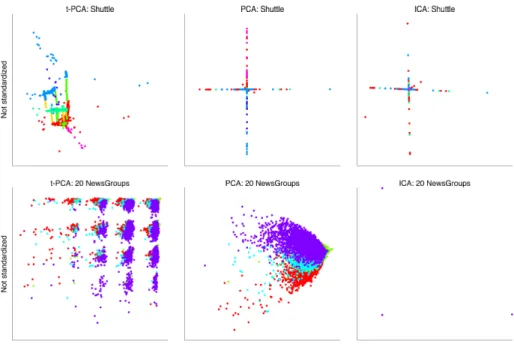
The results are shown in Fig. 2. The four top-level newsgroup classes in the reduced 20 NewsGroups dataset, and the seven classes in the Shuttle dataset, are shown in different colours. In all cases, the t-PCA version appears to reveal a more interesting structure in the data than either PCA or FastICA do. Re-markably, for the 20 NewsGroups dataset, the t-PCA weight vectors are close to sparse: more than 97% of the total variance of the weight vectors are due to just three, four of the 100 dimensions (i.e. words), respectively: ‘email’, ‘help’, and ‘problem’ for the first projection and ‘case’, ‘fact’, ‘god’, and ‘question’ for the second. The FastICA weight vectors, in contrast, have almost all weight on a single dimension, explaining that all datapoints are projected onto one of just three points when projecting onto the two top ICA components.
6
Conclusions
PCA is often notoriously inappropriate for dimensionality reduction, e.g. in the presence of outliers. To address this the Projection Pursuit literature has introduced numerous projection indices that quantify the interestingness of a projection in different ways. More recently, various authors also proposed prin-cipled robust versions of PCA as an alternative, e.g. [16, 17]. Yet, while these
4https://archive.ics.uci.edu/ml/datasets/Statlog+(Shuttle)
Fig. 2: The top 2 projections found by t-PCA (left), PCA (middle), and FastICA (right). Top row: Shuttle; bottom row: 20 NewsGroups.
lines of work are useful when the assumptions made are valid, they do not fun-damentally address how interesting a data projection is to a user. We presented a new approach to this elusive problem, explicitly recognizing the subjective nature of the notion ‘interestingness’.
Avenues for further work include alternative prior beliefs and data types, e.g. the case where the data is not real-valued but positive integer-valued or where the user assumes dependencies between the data points (when they are vectors in a time series, geographical locations, people in a social network, etc.). More immediately, the computational properties of the t-PCA optimization problem and its convex relaxation are worth investigating. Finally, an open question is to what extent the proposed strategy can be applied to non-linear dimensionality reduction as well.
References
[1] Ian Jolliffe. Principal component analysis. Wiley Online Library, 2002.
[2] Jerome H Friedman and John W Tukey. A projection pursuit algorithm for exploratory data analysis. IEEE Tr. Comp., 100(23), 1974.
[3] Peter J Huber. Projection pursuit. Ann. Stat., 13(2):435–475, 1985.
[4] Aapo Hyv¨arinen. New approximations of differential entropy for independent component analysis and projection pursuit. InProc. of NIPS, volume 10, page 273. MIT Press, 1998.
[5] Aapo Hyv¨arinen, Juha Karhunen, and Erkki Oja. Independent component analysis, vol-ume 46. John Wiley & Sons, 2004.
[6] Aapo Hyv¨arinen. Fast and robust fixed-point algorithms for independent component analysis. IEEE Tr. Neur. Netw., 10(3):626–634, 1999.
[7] Jerome H Friedman. Exploratory projection pursuit. J. ASA, 82(397):249–266, 1987. [8] Tijl De Bie. An information theoretic framework for data mining. InProc. of KDD, pages
564–572. ACM, 2011.
[9] Tijl De Bie. Subjective interestingness in exploratory data mining. InProc. of IDA, pages 19–31. Springer, 2013.
[10] Martin J Wainwright and Michael I Jordan. Graphical models, exponential families, and variational inference. Found. Trends in ML, 1(1-2):1–305, 2008.
[11] Konstantinos Zografos. On maximum entropy characterization of pearson’s type II and VII multivariate distributions. J. Multiv. Anal., 71(1):67–75, 1999.
[12] Samuel Kotz and Saralees Nadarajah.Multivariate t distributions and their applications. Cambridge University Press, 2004.
[13] Michael Roth. On the multivariate t distribution. Technical Report LiTH-ISY-R-3059, Department of Electrical Engineering, Link¨oping universitet, 2013.
[14] Thomas M Cover. Geometrical and statistical properties of systems of linear inequalities with applications in pattern recognition.IEEE Tr. Electr. Comp., pages 326–334, 1965. [15] Gene H Golub and Charles F Van Loan. Matrix computations, volume 3. JHU Press,
2012.
[16] Emmanuel J. Cand`es, Xiaodong Li, Yi Ma, and John Wright. Robust principal component analysis? J. ACM, 58(3), 2011.
[17] Jiashi Feng, Huan Xu, and Shuicheng Yan. Robust PCA in high-dimension: A determin-istic approach. CoRR, abs/1206.4628, 2012.