Navigating
in vitro
bioactivity data
by investigating available resources
using model compounds
Sten Ilmjärv
1,2, Fiona
augsburger
1, Jerven Tjalling
Bolleman
3, Robin
Liechti
2,
Alan James
Bridge
3, Jenny
Sandström
4, Vincent J
aquet
1, Ioannis
Xenarios
2,5,6&
Karl-Heinz Krause
1the number of chemical compounds and associated experimental data in public databases
is growing, but presently there is no simple way to access these data in a quick and synoptic
manner. Instead, data are fragmented across different resources and interested parties need
to invest invaluable time and effort to navigate these systems.
B
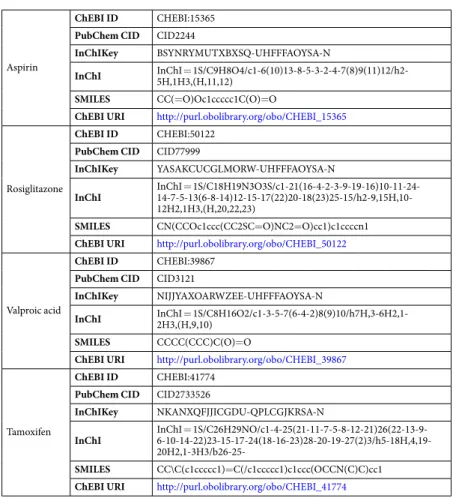
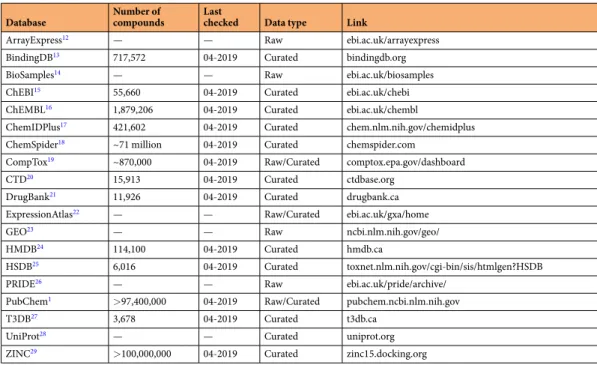
oth the CAS RegistrySM and PubChem1 contain more than 90 million compounds, with new compounds added daily. Most of these compounds are missing toxicological characterization, due in part to the lim-ited capacity of current methods to assess a compound’s bioactivity in a living system. High-throughput and scalable in vitro test systems aim to bridge that gap. In combination with structural information and known molecular properties, these high-throughput data will allow researchers to describe toxicity pathways more com-prehensively. However, the increasing amounts of new data presents its own set of challenges.Anomalies in metadata records and the inadequate use of ontologies are hindering for the data to be FAIR2. Even after a compound has been published in a scientific document, the diversity of compound synonyms and identifiers, and lack of precise metadata and annotations, can lead to false conclusions and difficulties identifying the compound correctly3. To improve the reproducibility of experimental results and to test new hypotheses (e.g. development of predictive computational models), availability and accessibility of raw data are crucial. Using a set of four arbitrarily chosen model compounds (aspirin, rosiglitazone, valproic acid, and tamoxifen; Table 1), we investigated data access and consistency within publicly available online resources (Table 2). We observed that modest adoption of semantic web technologies and poor annotations of experimental metadata represent a major obstacle for high-quality data integration and reusability. We argue that this could be substantially improved by annotating compound-related experimental data with standardized ontologies. Also, new and existing resources should adapt to accommodate ontology-based data representation on their platforms and compounds should always be accompanied with a unique structural identifier that helps later discoverability and reduces mistakes. Abbreviations:
CASRN - Chemical Abstract Service Registry Number; ChEBI - Chemical Entities of Biological Interest; FAIR - Findable, Accessible, Interoperable and Reusable; InChI - International Chemical Identifier;
InChIKey - International Chemical Identifier Key;
IUPAC - International Union of Pure and Applied Chemistry; SPARQL - SPARQL Protocol and RDF Query Language; SMILES - Simplified Molecular Input Line Entry System;
RESTFul API - Representational State Transfer Application Programming Interface; RDF - Resource Description Framework.
1Department of Pathology and immunology, Medical School, University of Geneva, Geneva, Switzerland. 2Vital-IT Group, SiB Swiss institute of Bioinformatics, Lausanne, Switzerland. 3Swiss-Prot group, SIB Swiss Institute of Bioinformatics, Medical School, Geneva, Switzerland. 4ScAHt Swiss centre for Applied Human toxicology, Basel, Switzerland. 5center for integrative Genomics, University of Lausanne, Lausanne, Switzerland. 6Departement of Biochemistry and chemistry, University of Geneva, Geneva, Switzerland. correspondence and requests for materials should be addressed to S.i. (email: [email protected]) or K.-H.K. (email: [email protected]) Received: 8 February 2018
Accepted: 6 March 2019 Published: xx xx xxxx
CommeNt
Identifying Data in Compound-Specific Resources
A chemical compound can be referenced with many identifiers, such as a trade name, a generic name, a system-atic IUPAC name, a registry number (e.g. CASRN), or a unique database identifier and its structure-derived rep-resentations, i.e. structural identifiers: InChI, InChIKey and SMILES. Any of the above can potentially be used to search for a compound within an online resource, but researchers need to be careful about the variability between resources. For example, the compound rosiglitazone has 157 depositor-supplied synonyms in PubChem, but only two synonyms in ChEBI. Predictably, the PubChem depositor-supplied synonym for rosiglitazone termed Gaudil failed to recognize the compound in ChEBI.
Structural identifiers, intuitively, should be the most unique identifiers of a compound, but disparity between the resources still exists. Among eleven resources that reported SMILES (BindingDB, ChEBI, ChEMBL, ChemIDPlus, ChemSpider, CompTox, CTD, DrugBank, HMDB, HSDB, PubChem, T3DB and ZINC15), we found 8 different SMILES for rosiglitazone and tamoxifen, 5 for aspirin and 3 for valproic acid. A single InChIKeys was observed for aspirin, valproic acid and tamoxifen but three different ones for rosiglitazone. IUPAC system-atic names were only reported in ChEBI, ChemSpider, CompTox, DrugBank, HMDB, PubChem and T3DB and demonstrated the largest variability: 3 different names for aspirin, 4 for rosiglitazone, 1 for valproic acid and 5 for tamoxifen. UniChem4 provides a cross-referencing service connecting 39 individual database identifiers of vari-ous resources using InChIKeys but this service is only useful when one already knows the compound’s database identifier or the InChIKey. Currently, it cannot be used with other structural identifiers or compound names.
InChIKey was the most unique identifier among the various databases, possibly because InChI is derived from a single algorithm, whereas several proprietary and open-source algorithms exist for SMILES, whose imple-mentations differ from one another5. Although widely used, we did not look at CASRN because the accuracy of CASRN in the public domain is not absolute and reliable information can only be accessed by paid services provided by the Chemical Abstract Service (CAS)6.
Identification of Compound Data in Omics Databases
The identity of chemical compounds reported in omics experiments can be ambiguous since compounds are often mentioned by name without the accompanying structure representations3. We investigated this issue by searching a series of omics data resources using structural identifiers of the compounds in Table 1 as reported in ChEBI, using web-based free-text searches (ArrayExpress, ExpressionAtlas, BioSamples, GEO and PRIDE). We were able to retrieve data for all model compounds from at least four resources using compound names.
Aspirin
ChEBI ID CHEBI:15365 PubChem CID CID2244
InChIKey BSYNRYMUTXBXSQ-UHFFFAOYSA-N
InChI InChI 5H,1H3,(H,11,12)= 1S/C9H8O4/c1-6(10)13-8-5-3-2-4-7(8)9(11)12/h2-SMILES CC(=O)Oc1ccccc1C(O)=O
ChEBI URI http://purl.obolibrary.org/obo/CHEBI_15365
Rosiglitazone
ChEBI ID CHEBI:50122 PubChem CID CID77999
InChIKey YASAKCUCGLMORW-UHFFFAOYSA-N
InChI InChI 14-7-5-13(6-8-14)12-15-17(22)20-18(23)25-15/h2-9,15H,10-= 1S/C18H19N3O3S/c1-21(16-4-2-3-9-19-16)10-11-24-12H2,1H3,(H,20,22,23)
SMILES CN(CCOc1ccc(CC2SC=O)NC2=O)cc1)c1ccccn1 ChEBI URI http://purl.obolibrary.org/obo/CHEBI_50122
Valproic acid
ChEBI ID CHEBI:39867 PubChem CID CID3121
InChIKey NIJJYAXOARWZEE-UHFFFAOYSA-N
InChI InChI 2H3,(H,9,10)= 1S/C8H16O2/c1-3-5-7(6-4-2)8(9)10/h7H,3-6H2,1-SMILES CCCC(CCC)C(O)=O
ChEBI URI http://purl.obolibrary.org/obo/CHEBI_39867
Tamoxifen
ChEBI ID CHEBI:41774 PubChem CID CID2733526
InChIKey NKANXQFJJICGDU-QPLCGJKRSA-N
InChI InChI 6-10-14-22)23-15-17-24(18-16-23)28-20-19-27(2)3/h5-18H,4,19-= 1S/C26H29NO/c1-4-25(21-11-7-5-8-12-21)26(22-13-9-
20H2,1-3H3/b26-25-SMILES CC\C(c1ccccc1)=C(/c1ccccc1)c1ccc(OCCN(C)C)cc1 ChEBI URI http://purl.obolibrary.org/obo/CHEBI_41774
Table 1. Table of model compounds used in the study and their identifiers including unified resource identifier (URI).
In addition, the IUPAC systematic names of aspirin, rosiglitazone and valproic acid retrieved datasets from ArrayExpress, BioSamples and GEO. Interestingly, in BioSamples, we were able to retrieve datasets for valproic acid also with SMILES. These datasets, however, actually corresponded to the sodium salt of valproic acid, which has a slightly different SMILES representation in ChEBI compared to valproic acid. Confusingly, these samples were not retrieved when the compound name was used instead.
This highlights that, at present, the best way to identify compound-related data from omics resources is with compound names, which requires researchers to exhaust all compound synonyms. To understand this variability between annotations in sample labels, we retrieved the name, synonyms and structural identifiers for each of our model compounds from the ChEMBL public SPARQL endpoint. These were used to identify samples and labels in the BioSamples database through its public SPARQL endpoint. For rosiglitazone and tamoxifen, only the sam-ples with the respective name was found in any of the sample labels. For aspirin, samsam-ples were found using aspirin, asparin, asprin, levius and measurin. Surprisingly, the compound name acetylsalicylic acid was not found in any of the sample labels. Valproic acid retrieved results also for valproate, depakote and 44089. The latter is a synonym of valproic acid in ChEMBL but none of the associated samples were actually associated to valproic acid. Of note, all the samples retrieved were unique, i.e. alternative compound labels were not used to annotate the same sample.
Identification of
in vitro
Compound Data
One approach to identify in vitro data in public resources is to browse the study descriptions for references of in vitro experiment related keywords like “in vitro”, “cell-line” or specific cell-line names (e.g. “HeLa”). ChEMBL provides a web-based search, which allows one to retrieve data on compounds associated with specific cell-lines or in vitro assays. Because this approach is not scalable, most public resources also provide access through bulk data downloads, or programmatically through RESTful API or RDF technologies.
In a RESTful query, the data request is constructed into a single URL which is simple to use and platform independent. Out of the 19 resources in our study, 10 provided free access to their RESTful API. The DrugBank API can be accessed for a fee. Data in RDF compatible formats can be supplied as a bulk download, or through public SPARQL endpoints, which facilitate querying the service provider directly, thus always retrieving the most up-to-date data. In our study, only BioSamples, ChEMBL, ExpressionAtlas and UniProt provided a public SPARQL endpoint. Acquiring data using a SPARQL endpoint can be slower compared to RESTful data access, since the latter is better optimized for specific, recurrent query requests. In contrast, SPARQL queries have the benefit of being customizable, providing flexibility that caters to the researchers’ unique needs. Also, since RDF is an inherent part of the “linked data” concept, it can be used to find relationships between datasets in different resources. This is useful for data integration purposes, such as connecting a compound’s effect in one resource to its physicochemical properties in another.
Ontology terms can be used to directly associate and retrieve samples with keywords related to in vitro exper-iments. Using BioSamples’ public SPARQL endpoint as our target database, we found samples for all our model compounds using ChEBI universal reference identifiers (URI) (Table 1). We were also able to find data for our sample compounds retrieved with ChEBI ontology terms, that had been annotated with the molarity unit term (http://purl.obolibrary.org/obo/UO_0000061, Units of measurement ontology, UO7) and the cell-line ontology term (http://www.ebi.ac.uk/efo/EFO_0000322, Experimental Factor Ontology, EFO8), both indicators of in vitro
Database Number of compounds Last checked Data type Link
ArrayExpress12 — — Raw ebi.ac.uk/arrayexpress
BindingDB13 717,572 04-2019 Curated bindingdb.org
BioSamples14 — — Raw ebi.ac.uk/biosamples
ChEBI15 55,660 04-2019 Curated ebi.ac.uk/chebi ChEMBL16 1,879,206 04-2019 Curated ebi.ac.uk/chembl
ChemIDPlus17 421,602 04-2019 Curated chem.nlm.nih.gov/chemidplus ChemSpider18 ~71 million 04-2019 Curated chemspider.com
CompTox19 ~870,000 04-2019 Raw/Curated comptox.epa.gov/dashboard
CTD20 15,913 04-2019 Curated ctdbase.org
DrugBank21 11,926 04-2019 Curated drugbank.ca ExpressionAtlas22 — — Raw/Curated ebi.ac.uk/gxa/home
GEO23 — — Raw ncbi.nlm.nih.gov/geo/
HMDB24 114,100 04-2019 Curated hmdb.ca
HSDB25 6,016 04-2019 Curated toxnet.nlm.nih.gov/cgi-bin/sis/htmlgen?HSDB
PRIDE26 — — Raw ebi.ac.uk/pride/archive/
PubChem1 >97,400,000 04-2019 Raw/Curated pubchem.ncbi.nlm.nih.gov
T3DB27 3,678 04-2019 Curated t3db.ca
UniProt28 — — Curated uniprot.org
ZINC29 >100,000,000 04-2019 Curated zinc15.docking.org
Table 2. A list of resources used in the study, their categorization and the number of estimated compounds in these resources at the time of the study.
assays. Using the latter, we were able to identify several examples of rosiglitazone and tamoxifen samples and a single example for valproic acid. With the exception of these few examples, we observed that most data for our compounds had been deposited without associated ontology terms. Nevertheless, we are confident that further uptake of the ontologies and improved annotations will be a powerful feature in future search strategies leading to increased data integration capabilities.
Compound data is generated by researchers, screening facilities and assay developers
Data for compound of interest is (A) curated from publications into compound-specific databases or (B) raw data is stored in high-throughput omics databases.
A SINGLE COMPOUND DATA ACCESS POINT WOULD RESOLVE COMPOUND IDENTIFICATION ISSUES BETWEEN RESOURCES AND
ACCELERATE DATA RETRIEVAL AND ANALYSIS
Curation of data Ontologies Semantic-web technologies
+
+
AZ
Identification of compound data in compound-specific resources (A) can be done easily but attention must be given to compound naming and identifiers that can differ between resources.
There is little communication between compound-specific (A) and high-throughput omics (B) data resources.
Due to compound naming and identifier ambinguity the identification of compound data in high-throughput omics resources (B) is complicated and time consuming.
com
pound of inter est
=
Semantic web tech-nologies can be used to connect knowledge in different resources based on shared ontology terms.
A unifying resources that takes advantage of ontologies, semantic web technologies and clean data annotation will provide an invaluable service to researchers globally, improve metadata quality, researcher’s efficiency and save considerable amount of time and money.
Curation of existing and new data with ontology terms will improve data annotation. This will reduce ambiquity in accessing relevant compound information. Standardized
ontolo-gies can be used to identify relevant data associated with specific keywords (e.g. in vitro) that fit experimental description.
Fig. 1 A graphics illustrating the problems of integrating knowledge between compound of interest and different types of data resources. The problems can be solved with integrated approaches using ontologies, semantic-web technologies and better annotation of the data.
Final Thoughts
There already exists a substantial corpus of resources that contain data on a large number of chemical com-pounds. These data and their sources are diverse and they need to be integrated in order to attain a complete understanding on a compound (Fig. 1). Accessing published data with correct compound information is essen-tial. The problems encountered in accessing data on our model compounds, demonstrate, that using the results from publications stored in public resources and cross-referencing them with omics data still requires substantial investigative capacity. Efforts similar to SourceData9, that allows to annotate already published figures in exist-ing publication, and RepositiveIO (https://repositive.io/), that makes improving metadata a crowd-sourced task, could provide a potential remedy. Would the efforts necessary for general accession to in vitro compound data be worth the money and time? Considering the success of UniProt which incorporates extensively curated and trustworthy protein data, the answer is yes. Indeed an analysis published in the EMBL-EBI value report10 esti-mated 46% increase in research efficiency for scientists accessing information relevant to their research question. With around 400,000 unique visitors per month, the reported estimation had an enormous cost-effect benefit for the researcher community. The interest in chemical compounds is even bigger: PubChem alone receives about 1 million unique users per month11. This highlights the need for an improved resource that would enhance the efficiency and speed of accessing raw and analyzed compound data in a reliable, simplified and intuitive manner. It would allow researchers to focus on data analysis and its interpretation instead of collection and curation.
References
1. Kim, S. et al. PubChem Substance and Compound databases. Nucleic Acids Res 44, D1202–1213, https://doi.org/10.1093/nar/gkv951 (2016).
2. Goncalves, R. S. & Musen, M. A. The variable quality of metadata about biological samples used in biomedical experiments. Sci Data 6, 190021, https://doi.org/10.1038/sdata.2019.21 (2019).
3. Murray-Rust, P., Mitchell, J. B. & Rzepa, H. S. Communication and re-use of chemical information in bioscience. BMC Bioinformatics 6, 180, https://doi.org/10.1186/1471-2105-6-180 (2005).
4. Chambers, J. et al. UniChem: a unified chemical structure cross-referencing and identifier tracking system. J Cheminform 5, 3, https://doi.org/10.1186/1758-2946-5-3 (2013).
5. Heller, S. R., McNaught, A., Pletnev, I., Stein, S. & Tchekhovskoi, D. InChI, the IUPAC International Chemical Identifier. J Cheminform 7, 23, https://doi.org/10.1186/s13321-015-0068-4 (2015).
6. Williams, A. J. et al. Open PHACTS: semantic interoperability for drug discovery. Drug Discov Today 17, 1188–1198, https://doi. org/10.1016/j.drudis.2012.05.016 (2012).
7. Gkoutos, G. V., Schofield, P. N. & Hoehndorf, R. The Units Ontology: a tool for integrating units of measurement in science. Database (Oxford) 2012, bas033, https://doi.org/10.1093/database/bas033 (2012).
8. Malone, J. et al. Modeling sample variables with an Experimental Factor Ontology. Bioinformatics 26, 1112–1118, https://doi. org/10.1093/bioinformatics/btq099 (2010).
9. Liechti, R. et al. SourceData: a semantic platform for curating and searching figures. Nat Methods 14, 1021–1022, https://doi. org/10.1038/nmeth.4471 (2017).
10. Beagrie, N. H. J. The Value and Impact of the European Bioinformatics Institute. Full Report, Charles Beagrie Ltd, https://beagrie. com/static/resource/EBI-impact-report.pdf (2016).
11. Kim, S., Thiessen, P. A., Bolton, E. E. & Bryant, S. H. PUG-SOAP and PUG-REST: web services for programmatic access to chemical information in PubChem. Nucleic Acids Res 43, W605–611, https://doi.org/10.1093/nar/gkv396 (2015).
12. Kolesnikov, N. et al. ArrayExpress update–simplifying data submissions. Nucleic Acids Res 43, D1113–1116, https://doi.org/10.1093/ nar/gku1057 (2015).
13. Gilson, M. K. et al. BindingDB in 2015: A public database for medicinal chemistry, computational chemistry and systems pharmacology. Nucleic Acids Res 44, D1045–1053, https://doi.org/10.1093/nar/gkv1072 (2016).
14. Faulconbridge, A. et al. Updates to BioSamples database at European Bioinformatics Institute. Nucleic Acids Res 42, D50–52, https:// doi.org/10.1093/nar/gkt1081 (2014).
15. Degtyarenko, K. et al. ChEBI: a database and ontology for chemical entities of biological interest. Nucleic Acids Res 36, D344–350, https://doi.org/10.1093/nar/gkm791 (2008).
16. Bento, A. P. et al. The ChEMBL bioactivity database: an update. Nucleic Acids Res 42, D1083–1090, https://doi.org/10.1093/nar/ gkt1031 (2014).
17. Tomasulo, P. ChemIDplus-super source for chemical and drug information. Med Ref Serv Q 21, 53–59, https://doi.org/10.1300/ J115v21n01_04 (2002).
18. Pence, H. E. & Williams, A. ChemSpider: An Online Chemical Information Resource. Journal of Chemical Education 87, 1123–1124, https://doi.org/10.1021/ed100697w (2010).
19. Williams, A. J. et al. The CompTox Chemistry Dashboard: a community data resource for environmental chemistry. J Cheminform 9, 61, https://doi.org/10.1186/s13321-017-0247-6 (2017).
20. Davis, A. P. et al. The Comparative Toxicogenomics Database: update 2017. Nucleic Acids Res 45, D972–D978, https://doi. org/10.1093/nar/gkw838 (2017).
21. Law, V. et al. DrugBank 4.0: shedding new light on drug metabolism. Nucleic Acids Res 42, D1091–1097, https://doi.org/10.1093/nar/ gkt1068 (2014).
22. Petryszak, R. et al. Expression Atlas update–an integrated database of gene and protein expression in humans, animals and plants. Nucleic Acids Res 44, D746–752, https://doi.org/10.1093/nar/gkv1045 (2016).
23. Barrett, T. et al. NCBI GEO: archive for functional genomics data sets–update. Nucleic Acids Res 41, D991–995, https://doi. org/10.1093/nar/gks1193 (2013).
24. Wishart, D. S. et al. HMDB 3.0–The Human Metabolome Database in 2013. Nucleic Acids Res 41, D801–807, https://doi.org/10.1093/ nar/gks1065 (2013).
25. Fonger, G. C., Hakkinen, P., Jordan, S. & Publicker, S. The National Library of Medicine’s (NLM) Hazardous Substances Data Bank (HSDB): background, recent enhancements and future plans. Toxicology 325, 209–216, https://doi.org/10.1016/j.tox.2014.09.003 (2014).
26. Vizcaino, J. A. et al. 2016 update of the PRIDE database and its related tools. Nucleic Acids Res 44, D447–456, https://doi.org/10.1093/ nar/gkv1145 (2016).
27. Wishart, D. et al. T3DB: the toxic exposome database. Nucleic Acids Res 43, D928–934, https://doi.org/10.1093/nar/gku1004 (2015). 28. The UniProt, C. UniProt: the universal protein knowledgebase. Nucleic Acids Res 45, D158–D169, https://doi.org/10.1093/nar/
gkw1099 (2017).
29. Sterling, T. & Irwin, J. J. ZINC 15–Ligand Discovery for Everyone. J Chem Inf Model 55, 2324–2337, https://doi.org/10.1021/acs. jcim.5b00559 (2015).
Acknowledgements
S.I. was supported by the Swiss Centre of Applied Human Toxicology (SCAHT).
additional Information
Competing Interests: The authors declare no competing interests.
Publisher’s note: Springer Nature remains neutral with regard to jurisdictional claims in published maps and
institutional affiliations.
Open Access This article is licensed under a Creative Commons Attribution 4.0 International
License, which permits use, sharing, adaptation, distribution and reproduction in any medium or format, as long as you give appropriate credit to the original author(s) and the source, provide a link to the Cre-ative Commons license, and indicate if changes were made. The images or other third party material in this article are included in the article’s Creative Commons license, unless indicated otherwise in a credit line to the material. If material is not included in the article’s Creative Commons license and your intended use is not per-mitted by statutory regulation or exceeds the perper-mitted use, you will need to obtain permission directly from the copyright holder. To view a copy of this license, visit http://creativecommons.org/licenses/by/4.0/.